



Abstract

R. Rocco Cottone has made major contributions to the counseling profession, from his beginnings in rehabilitation counseling continuing through his work in marriage and family counseling. His work also has implications for counselor education. Cottone is professor of Counseling and Family Therapy and previously served as Coordinator of Doctoral Training in the Department of Education Sciences and Professional Programs at the University of Missouri-St. Louis. He is a licensed professional counselor in Missouri and a licensed psychologist in Missouri and Arizona. He is a certified family therapist. He is married and has five children. Cottone was born and raised in St. Louis Missouri, received his PhD from St. Louis University in 1980, and spent much of his career in Missouri, serving as a psychologist, rehabilitation counselor, couples and family therapist, and professor. Rocco, who is called Rock by his friends, teaches courses in counseling theories, systems theory, couple and family counseling, and ethical and professional issues.
He is well-known for years of work as an ethicist; he served on professional codes of ethics re-write committees, including those for the American Counseling Association (ACA) and the American Rehabilitation Counseling Association (ARCA). He published a textbook, Ethics and Decision-Making in Counseling and Psychotherapy (Cottone & Tarvydas, 2016), that has been used in several editions for over 20 years as a reference and in counselor education. In ethics, Rock is best known for his leadership in defining the need for clear guidelines to replace the “dual relationships” standard in the older codes of ethics. He argued for the need to focus on harm and detriment in such standards, which by contrast allowed for some limited “potentially beneficial” interactions outside of the formal counseling relationship (e.g., a marriage counselor attending a marriage vows renewal ceremony at the request of a client couple). He also advocated for replacement of the ethical principle of autonomy with “accordance,” a construct from the relational paradigm (Cottone, 2014). He argued that “autonomy” implies no weighing of input from others, which he held to be unlike the observed process clients undertake when they seek consultation and agreement among their service providers and significant others during the decision process. Most recently, his professional efforts explored meanings and values associated with theories of counseling and psychotherapy (Cottone, 2012, 2017b)
His published works and presentations advocated expanding individual theories and paradigms to include a relational perspective. In recent years, Cottone (2012, 2017a) has been involved in an effective advocacy of radical social constructivism (RSC) as an emerging paradigm in counseling. He was resolute in defending the position of RSC as social philosophy against a critique by North (Cottone & Tarvydas, 2016, p. 114) who presented the movement as a “millennial mistake,” which North argued introduces theoretical incoherence and ethical conflicts in professional counseling. RSC downplays the psychology of the individual and holds to the postmodern primacy of relationships (Cottone, 2017a, p. 465). Rock chronicled the evolutionary process of paradigm shifts in counseling from the “psychology of the individual” through systems theory to social constructivism (Cottone, 2012, 2013). In his view, counseling theory has matured sufficiently to embrace relational models, values, and practices. One of the purposes of the following interview was to explore Cottone’s views on social constructivism as a paradigm for the profession. Rock noted that theoreticians “…are lucky to be alive at this stage in counseling’s development” (Cottone, 2013, p. 57).
R. Rocco Cottone has produced over 80 publications, including books, chapters, and refereed articles. In 2011, International Association of Marriage and Family Counselors recognized him at the annual conference with the research award for sustained contributions to the literature. He has conducted many workshops, courses, and conference presentations. Recently, he was interviewed under the title “Reality is relationships: An intro to radical social constructivism,” in “The Theory of Change podcast” (Palacios, 2019–present).
Although his publications speak volumes, Rock consented to this interview so we can explore the intersection of his life and work. Our interactions began early in 2019 and continued with some email exchanges and a literature review on my part. The process was disrupted by my transition to a new position. We interacted through email, and Rock provided some diagrams that clarify his views. The concluding interview occurred in December 2019.
The Interview
The purpose of the interview was to secure the perspectives of Dr. R. Rocco Cottone on developments in contemporary counseling practice and theory. I wanted to explore the role of RSC in his work on ethics and values, theories and paradigms, and relational therapy. I wondered whether his involvement in rehabilitation services shaped his perspective on family systems and ultimately his philosophy. I was also curious about his publications on religion and spirituality.
A few quotes from a recent article provide the best introduction to his work: My work reflects my social trajectory, which is my journey and connection with groups that influence me and in which I am enmeshed. (Cottone, 2017a, p. 468) Over 30 years of practice (it took me awhile), I learned to listen closely to what my clients were saying…It is much more elegant and coherent to work fully within the relational realm—the realm where almost all clients locate their problems. (Cottone, 2017a, p. 469) If people are harmed by relationships, they can be healed by relationships. (Cottone, 2017a, p. 469) Clients do not construct complex theories of personality, psychologists do. (Cottone, 2017a, p. 469)
Figure 1.
Rock, thank you so much for agreeing to this interview. I wish I had gotten to know you when I was in St. Louis, which I view as a great American city. I studied at Washington University for a while and trained at Masters and Johnson Institute. I know you spent much of your career in St. Louis and Missouri. How do you think your roots in the American Heartland have influenced you?
I didn’t know about your history in St. Louis, Stephen. I too wish we had gotten to know each other a bit earlier. We probably would have had a lasting effect on each other’s professional formation. For me, being a St. Louisan and Missourian has had a major influence on my development. As a child, I was enthralled by the power of the mighty rivers around St. Louis and spent much time watching the tugs, barges, and ferries passing by and through the locks and dam in Alton, IL, near where I lived in Missouri. I was impressed by the power of the rivers, much like, I suspect, Mark Twain was impressed. I grew up in a hardworking family of immigrants (and their children) in a bilingual home. My parents were determined to ensure that I had a good education (my mother only went through the 8th grade). So, education was very important in our household and in my life. I was a hardworking student, and I had some very impressive teachers who took me under their wings. I owe them much.
As an undergraduate at the University of Missouri, Columbia, I fell in love with the study of psychology. I also was able to enroll in a graduate counseling course (group counseling) as a senior psychology major, and once I developed some friendships in the graduate counseling course, I realized I fit right in. I applied for the graduate counseling program at Mizzou and enrolled the next term. The programs at the University of Missouri, Columbia, were very “psychological” in their focus at that time—it was all about the psychology of the individual and trait factor psychology (e.g., worker traits fit certain work factors like fitting a peg into a hole). After graduating with my master’s degree, I worked as a rehabilitation counselor and simultaneously enrolled in a doctoral degree at Saint Louis University (SLU). My program at SLU was focused on general counseling and educational psychology, but due to a scheduling conflict, I found myself in a course in marital and family therapy. I found myself in a strange world—a class with a professor who proposed that relationships should be the focus of study in mental health—not people. The professor’s name was Ray Becvar, and he was establishing himself as a respected social systems theorist. In his class, though, I was the skeptic student (sitting in the back of the class). I resisted the idea that people shouldn’t be the focus of counseling—that relationships somehow had a life of their own and were the culprit in emotional disturbance. I argued, “I see people.” That class, though, had a major effect on me. I began to listen to my clients and to realize their complaints were, almost across-the-board, about the effect of past or present relationships on their adjustment. So, the people I encountered in my limited geographic circle in the Midwest had a major influence on my development as a counselor, as I found myself merging disparate ideas just as the two mighty rivers (the Missouri and the Mississippi) merged in St. Louis.
Thank you for sharing the course of your education. I appreciate the imagery of the confluence of the rivers. We are fortunate that your career landed on family systems.
I have admired your work on ethics and theories and always wanted to better understand your position on postmodern counseling. Your career speaks to the importance of embracing transitions in our profession. What do you see in the future of counseling?
Well, in 1992 I published my first book, Theories and Paradigms of Counseling and Psychotherapy. I laid out a “big picture” framework for mental health treatment, and I defined four paradigms. They are chronological and mutually exclusive. First, there is the organic medical paradigm, then the psychological, followed by the systemic relational paradigm, and finally I am proposing that social constructivism meets the criteria for a paradigm. These paradigms develop through dissociations from the earlier paradigms, so it is possible that any new developments in the field will emerge from existing practices.
I am also thinking that technology will produce a revolution of sorts in the mental health enterprise, and in 2015 I published a piece in Counseling Today about the possibility of a “techno-human counseling paradigm (Cottone, 2015).” That was a fun exercise for me, and in some ways, the prospect of a technologically transformative profession of counseling was appealing to me. In other ways it was frightening. A theme that runs through most of my work is about the importance of relationships, so whatever emerges in the future hopefully will not lose the human connection that I believe is so healing.
As I prepared for this interview, I read some of your recent publications and took about 10 pages of notes. Writing is the best way for me to understand. Your position on RSC is at the heart of your work on paradigms and ethics. Could you take a little time to describe RSC for the marriage and family counselor, our primary readership?
I’d love to see those notes. It’s always fun to see how people interpret one’s work. First, though, I think we have to define some terms. I’ll try to keep in simple, as I’ve had to whittle these ideas down over the years. So, here are some terms that I use and what they generally mean.
When I use the term “postmodern,” I simply mean that there is a transition to relational thinking. Postmodern artists and philosophers essentially place their works in a relational context, and meaning comes as much from the context as from the work itself. I leave it at that. When I use the term “social constructivism,” I mean that understanding comes from the meaning that develops through shared experience. We are not trying to socially construct things—we don’t socially construct reality. We socially construct our meaning of the world through shared experience. I used to think that social constructivism was about constructing reality, and I used the “reality” term in my early writings, but I have gotten away from it because I think it confuses people.
RSC, my version, is all about how people come to believe together through shared experience and defining those experiences symbolically (most usually through language). So, we don’t socially construct a brick, but we can socially define the brick as a building block (what masons do) or a projectile (what rioters do). The meaning of the brick comes not from the brick itself, but how people act around the brick as they experience it, use it, and describe it. A knife to wood carvers has a different meaning than it does to a warrior.
Meaning always comes from people interacting around some shared experience (in the present or in the past). I use the “fruit bowl” example in my classes, and my students say it helps explain RSC. Consider a group in a conference room with a large table, and in the middle of the table is a bowl of fruit. Someone says, “I’m kinda hungry—is that fruit for public consumption?” Another person says, “I don’t know if that is real fruit—it might be decorative.” Another person says, “It looks so real.” So, one person reaches over, touches the banana, squeezes it, and proclaims, “It’s not real fruit.” The people in the room pass it around and declare, “It’s rubberized decorative fruit.” They socially constructed their understanding of shared experience. Now take the bowl of fruit and place it in a land where there is no concept of rubberized decorative fruit—say a native land that is isolated from much of civilization. The members of this group might see the fruit bowl, talk about it in their language, and decide to approach the fruit bowl. Someone might actually touch the fruit, reacting with some sort of surprise. That member of the group may pass the contents around, and they all will begin to understand what they experience in their language and tradition—it might be interpreted as a threat, or a hoax, or a God-given gift. In other words, they will socially come to agreement about what the fruit bowl represents, but it won’t be “rubberized decorative fruit,” because they would have no concept of such. In both fruit bowl situations, the group came to consensus through interaction around shared experience about the meaning of what they experienced. Meaning is not a result of psychological experience—it’s a result of social interaction.
So, postmodernism implies relationship and context. And social constructivism, in its radical form, means that people construct understanding through interaction around shared experiences.
These are some straightforward definitions, but the implications are profound. If meaning is socially constructed, the psychology of the individual vanishes into the social web. There is no psychology of the individual because all understanding, all meaning, all decision making happens in the social matrix within which the person is enmeshed. I didn’t choose to enter the profession of counseling, I just happened upon counseling and was connected through an intricate web of relationships that led me to professional graduate study. I may think I chose to enter the counseling profession, but it was the social trajectory that was “in charge.”
My introduction to social systems theory also was not by choice; it happened because of a course scheduling issue that lead me to connect with a professor who inspired a new way of thinking about mental health issues. When we examine where we are, we can re-narrate the journey by focusing historically on the relationships that took us one way or another. We connect and disengage in relationships and our personal course is forever changed. Some people will argue, that’s crazy, because I made a personal decision to act a certain way. A radical social constructivist would then deconstruct that decision. What language was used? Who defined the choice? Who was involved in both the definition of the choice and the process of choice determination? If language was used, then the person was not alone, because language is social and firmly places the person in the social linguistic tradition, which is the social context of the decision. Decisions are never made alone—they always involve language and interaction with others in past or present relationships or communications (Cottone, 2001). There are no “mavericks” or “rogues,” unless such terminology is imbedded in the language of a culture where such behavior is applauded—Indiana Jones, Han Solo, the Batman, the Maverick, Rooster Cogburn, the Lone Ranger, and others. We live in a culture where individualism is lauded. Acting accordingly means we are simply living out the imperative of the social matrix. In other words, we are bound to the intricate social linguistic web that surrounds us.
I thought Maturana’s (1978) structure determinism accounted for the coherence of family systems better than homeostasis. How did the models of Maturana and others contribute to your view of systems?
Maturana’s work had a major influence on me (Cottone, 1989). His work is hard to understand—his writing is very dense. But after much study, I began to realize that Maturana’s position was unique about the limits of our neurological systems and how we come to understand. In a nutshell, Maturana proposed that our nervous systems are closed to information—we are biologically wired to operate on internal sensation. For example, he uses the finger press exercise to make his point. Press your finger firmly against a hard surface and roll your fingertip around on the surface until you feel some discomfort (don’t hurt yourself). Maturana then asks, Do you feel the surface? His answer is “No, you can never feel the surface—you only feel your skin sensors against your finger bone. You can never objectively know the surface because you can only know what you sense internally.” So, when you see something, it’s not outside of you—it’s on your retina. When you hear something, it’s not the sound of some “thing”; it’s the vibration of your inner ear mechanism as it is connected to your auditory nerves. Maturana made the case, there is no objectivity. Our experiences are totally internal—”structurally determined.” But we are so rich neurologically that we can simultaneously be stimulated by one sense organ (touch) and socially by another sense organ (hearing, for example). So, we are capable of communicating socially about our sense experiences. He called the sensory/social interaction “the consensual domain.” In effect, Maturana tells us that we are neurologically wired to consensualize. Objectivity is not “out there”; rather, it’s in relation to us. It’s relational!
But Maturana’s ideas are not enough. He just challenged objectivity. I still held on to the concept of subjectivity. I was indoctrinated in the psychology of the individual, so I held fast to the idea that I could know a truth unto myself. Me, myself, and I. I still had personal experience that I could depend upon, at least until I came across the works of Kenneth Gergen. His work is the other major theoretical influence on my work. Gergen, a social psychologist, made a compelling argument that challenged the idea of subjectivity (Gergen, 1985). He argued a position that he learned from Wittgenstein, the German philosopher, and concluded that “there is no private language.” Wittgenstein argued that language was a social “convention.” It is impossible to have a private language, or it would be meaningless. So, that means that when a person is in thought, for example, the person is in his or her social/linguistic/cultural context. No one is alone in thought. One is always enmeshed in one’s culture in language.
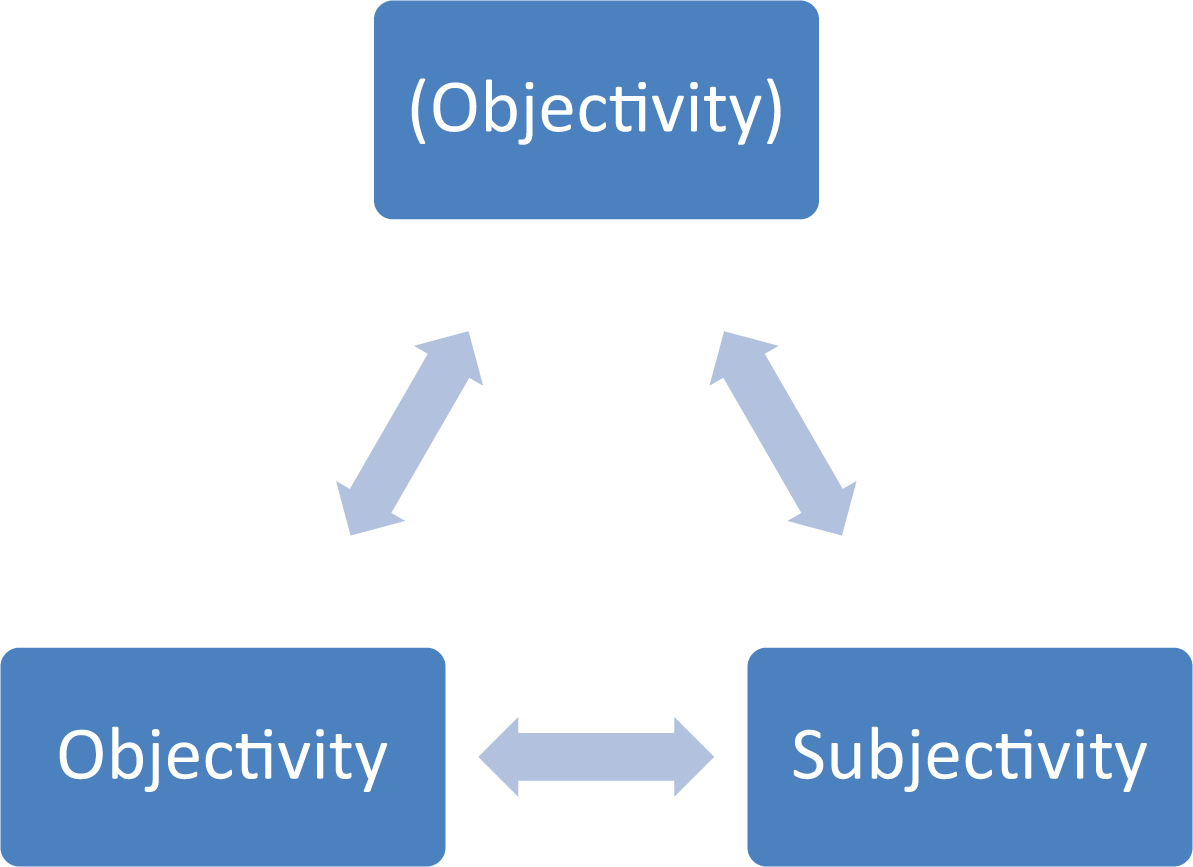
So, thoughts are not one’s own—they are one’s culture speaking through one’s neurology. There is no objectivity. There is no subjectivity. There is, in Maturana’s term, “objectivity in parentheses.” Gergen’s work helped to solidify a position that truth making is a social process. There are no individual truths. There are no objectively knowable truths that everyone can experience the same way (each person’s neurology is similar but not the same). Truths are housed in the consensual domain. I finally understood. We socially construct our understanding of the world through shared experience. My work is just a connection of Maturana’s ideas with Gergen’s ideas. I’m a conduit for their works. I always tease my students that I’m “channeling” Maturana and Gergen when I lecture. I realized that Maturana’s idea of objectivity in parentheses is triadic to the objectivity—subjectivity continuum. I’ll send you a diagram I drew that helped me to understand. Most people are bound to the objectivity–subjectivity continuum; Maturana’s ideas take us off the continuum—”objectivity in parentheses” is triadic to the objectivity–subjectivity continuum (Figure 1).
Thanks for sending the diagram. You also observed that systems theory declined following criticism by feminist scholars and social justice advocates. Circular models of causality in systems thinking could be viewed as reducing individual responsibility for harm or blaming victims. What is your view of family systems today?
Bograd in 1984 wrote a compelling paper arguing that the social systemic idea of circular causal responsibility was flawed when it came to addressing male or female physical abuse, which at the time was about 95% male perpetrated. She said that subscribing to any circular causal process was in effect victim blaming. Abuse victims should not be causally implicated in their own abuse. The case is even more salient if we consider physical or sexual abuse of infants or very young children—we can’t morally hold those children as responsible in any sense. To do so would be abhorrent. Ethics would require us to abandon a systemic relational approach to treatment of either the victim or the perpetrator, to protect the endangered party, and to treat the victim separately from the abuser. In effect, this produced a very credible critique of social systems theory, and it was a very powerful imperative to change our ways of treating people in these situations or to revise or to abandon systems theory as a framework of case conceptualization.
Bograd’s critique of systems theory was published in 1984. Dell published a paper comparing Bateson to Maturana in 1985 (Dell, 1985). Gergen (1985) published his famous paper “The Social Constructionist Movement in Modern Psychology.” The timing could not have been better. The social constructivist solution to the feminist critique is as follows. In some cases, there can be clear agreement among all parties involved in serious abuse that the abuse was unilateral, unprovoked, and damaging. In such cases, the cause of the abuse can be socially constructed as resulting from a linear victimization and treated as such. The victim would not be implicated. Also, it is possible that a relationship between two adults, a male and a female couple as an example, evolved into a very sick physically confrontive and abusive relationship where both were involved symmetrically in the escalations. In such a case, more clearly, the abuse can be defined as developing from a circular causal process, and couples counseling might be indicated. So, with the social constructivism approach, treatment always follows the consensus of the problem. The problem must be agreed to before any treatment can be implemented. Theoretically, this allows for individual treatment when called for by a truth (individual responsibility) that is established through involved relationships. It solves the systemic relational dilemma of circular causal exclusivity.
We seem to be in the midst of a paradigm shift in counseling theory. On the one hand, there are proponents of evidence-based practice, such as Dialectical Behavior Therapy or Trauma-Focused Cognitive Behavior Therapy, who continue the modernist standard of empirical support. Others, such as practitioners of solution-focused therapy, seem somewhat anti-theoretical and rejecting of scientific principles. How do social philosophy and postmodern thought resolve these tensions?
First, from a RSC perspective, science is not a monolith and an objective “truth.” Science, like all belief systems, is the consensus of the scientific community about how truths are defined and the rules of the truth method (the scientific method). Science is people in the scientific community who agree to act according to the rules. In psychological science, we find people adhering to the idea of objectifying outcomes in counseling. In some areas of counseling, it is easy to objectify outcomes. A classic case is marriage counseling, where one can objectively measure how long a couple has remained together after completing marriage counseling. We can compare such an outcome on any number of independent variables. But most outcome research in counseling and psychotherapy has been based on measures of depression, specifically the Beck Depression Inventory or other quick screening measures of “pathology.” Actually, these measures are not the most reliable and valid measures. And depression, as defined by those who make such instruments, typically is about sadness and pessimism. A social constructivist would ask, “Who defined sadness as a problem?” “Is there no survival value to pessimism?” In other words, when one takes a test of any sort, one is in relationship to the test makers, and their “truth” claims are expressed in the measures. It’s not objectively about “depression”; rather, it’s about what some people define as “depression,” which they purport is “a problem.”
Actually, constructivists, being postmodern, always view a situation from the perspective of context, so context becomes a potent descriptor in any argument about both the method and the outcome. This is in contrast to logical positivism (a competitor viewpoint) which holds to a consensualized empirical tradition about truth seeking. Some people subscribe to the empirical tradition, and they will find research accomplished in that mode as “truthful.” Constructivists may be more circumspect and concerned about context.
It’s also valuable to identify another popular competitor to the social constructivism approach—phenomenology. In phenomenology, the personal subjective truth of an individual is valued and weighed heavily. Many mental health professionals ascribe to a phenomenological view rather than either the empirical tradition or the social constructivism alternative.
Social constructivism is elegant in that it does not claim to be a universal truth. It does not hold to a position of theoretical supremacy. It simply presents itself as a way of agreeing with others about the nature of the mental health enterprise. People can agree or disagree, and that is okay, so long as one’s point of view is transparent and not used to condemn or belittle others. Ethics should prevent us from being hateful or discriminatory.
Based on your radical social constructivist views, what is your opinion regarding the emphasis on diagnosis in much of behavioral health care?
First, let me just talk about clients and then I’ll try to tackle this theoretically. When I listen to clients, what I hear is a litany of complaints about other people, past or present. Some people have been, or are being, horribly abused by others. It pains me to hear their stories. People, for whatever reason, can and will do horrible things to others, and the victims often end up in our offices. There are victims of physical, emotional, and sexual abuse. There are parents who are cruel or neglectful of their children. There are unfeeling people in relationships with those who need reassurance. There are people with malicious intent. There are parents who are incompetent at raising their children. There are couples who are in trouble due to infidelity or lack of trust. There are people who take advantage of others financially, personally, or otherwise. This is what I hear and have heard in counseling from my clients.
To diagnose them as mentally ill seems a moral and ethical wrong. They have faced or are facing serious problems in relationships, and they need to be helped to solve the problems or to heal through the loving, ethical, competent care of a counselor. You can’t believe in counseling if you don’t believe in the power of relationships at affecting mental health. Counseling is a relationship, and many of us have experienced firsthand both the harmful power of relationships and the helping power of counseling.
Diagnosis is a social convention, which I think misses the mark in many cases. The mental health enterprise has bought into the organic medical model of payment—medical psychotherapy insurance reimbursement. I am reminded of two books by Thomas Szasz written in the 1970s—The Myth of Mental Illness (1974), and The Myth of Psychotherapy (1978). Szasz made the case that psychiatry adopted the disease model and medicalized problems in living as mental disorders. He attacked his own profession, as he was an MD psychiatrist. What a credible argument! I think as a profession, knowing what we know now about counseling paradigms, we should seriously reassess the role of counselors and whether the medical model is counterproductive to a goal of emotional enhancement in most cases.
That being said, the social constructivism approach does not preclude a consensus of organic cause or individual psychopathology. All stakeholders may agree that a person is schizophrenic or acting with bipolar disorder, and the consensus might be that medication management must or should be an option. The constructivism approach does not preclude medical treatment, but it comes to the conclusion that such treatment is necessary in the consensual social processes that surround such a decision. In other words, the RSC primacy of relationship stance outweighs any purported objective or subjective claims about someone’s “mental illness.” Relationships are everything, and everything is relationships. That’s the primacy of relationships position. Any truth claim is established by at least two people in a relationship, even a truth claim of “mental illness.”
Your views on diagnosis make it clear that context and relationship determine approach to counseling. Diagnoses are not “facts” and may not fit the ways people express their need for change. Do you think your systemic relational perspective helps counselors better understand families facing disability or chronic illness such as cancer?
Yes definitely. As a rehabilitation counselor, early in my career I quickly realized that family involvement with individuals with disabilities could be influential both in coping and ironically, sometimes in maintaining an unhealthy situation. After I was first introduced to family counseling in my doctoral studies, I began to apply it to my work in rehabilitation. I found it to be extremely useful in addressing the concerns of clients with intact family systems. I also began to assess the rehabilitation system itself, as I started to realize that the rehabilitation system could be viewed as a massive social mechanism for screening social deviance. No matter what the disability, those clients who were socially problematic were screened out, whereas no matter what the disability, those clients who were socially skilled were given opportunities.
In 1987, I wrote “A Systemic Theory of Vocational Rehabilitation,” and several other related works. Looking back, I think I produced the first comprehensive theory of vocational rehabilitation (the psychomedical paradigm dominated before then, and it was a loose compilation of tenets deriving from medical and psychological practices). A systemic theory of vocational rehabilitation was all based on a relational worldview, both in client case conceptualization and in understanding the workings of the rehabilitation system. Relationships are crucial to successful rehabilitation, coping, and vocational adjustment. In 2011, I published a paper with one of my doctoral students (Taylor & Cottone, 2011), and we addressed how cancer patients can be helped by services provided from a systemic relational point of view—dealing with family and relational issues as part of the treatment process.
You served on the panel that revised the ACA Code of Ethics. Recently, you took issue with one of the six core principles. You noted that five of the six domains were social: beneficence (doing good for others), nonmaleficence (avoiding harming others), justice (being fair in relationships with others), fidelity (being loyal to others), and veracity (being truthful to others; Cottone, 2014, 2017a). The sixth principle, autonomy, was challenged as a problematic individual psychology construct. You proposed the alternative principle of accordance (Cottone, 2014). Could you compare and contrast the two constructs? What is your view of the utility of accordance today?
Serving on task forces to revise the codes of ethics was a very special pleasure for me. I served on two code revision committees for the ARCA (in collaboration with the Commission on Rehabilitation Counselor Certification), chairing the latter revision committee. I was also a member of the ACA code revision task force (chaired by Michael Kocet) that produced the 2005 Code of Ethics. What a great opportunity for me to interact with the preeminent ethicists of the profession.
Working on a code revision committee is a lesson in the creation of a consensual ethics—standards that are derived from the very intense and thorough negotiation process that occurs around questions of right and wrong in professional practice. Codes of ethics are not carved in stone—they are evolving and changing documents that significantly affect professional practice. They are important in shaping acceptable counseling practice. We had some great debates in the committee meetings, and I was proud to have been heard by my colleagues on a couple of matters, most saliently the need for a positive ethic regarding nonprofessional relations with clients. There are many interactions that counselors may have with clients, which can be potentially beneficial—not all dual relationships are harmful. So, the codes, starting with the CRCC code, and followed by the ACA code, revised away the “dual relationship” standard and replaced it with a standard that addressed harm, thus allowing some potentially beneficial interactions outside of the formal counseling relationship. Should a family counselor not be able to buy Girl Scout cookies from a child in family counseling? Why not? What harm is there? Should a couple counselor not be able to attend a wedding after providing premarital counseling to a couple? Of course, there have to be some constraints and the permission of clients, but these types of interactions are not harmful and have positive potential benefits for clients.
As you can see by now, the basic theme that runs through all of my recent work is the importance of relationships. The concept of accordance is all about agreement between and among people. It takes choice out of the head of the decision-maker (autonomy) and places it squarely in the midst of social interaction.
I am interested in your movement beyond ethics and values to the fields of spirituality and religion. How did you arrive at this place in your journey?
In the mid-1980s, I began to explore the social constructivist movement thoroughly, and I began to get an understanding of how it was different than social systems theory. In 1993, I traveled to Laguna Beach, CA, to attend a conference with Humberto Maturana. Interacting with him was a highlight of my career. The same year I traveled to Florida to attend a conference where Gergen presented, I got to meet and interact with him briefly there. By then I was feeling there was real promise in this framework. But I had lingering doubts. I’d already been through one paradigm transition, from the psychological to the systemic relational, and I was hesitant to embrace fully the emerging constructivist framework.
But in 1997, I learned of a cult in California—Heaven’s Gate—where 39 people took their lives apparently without any sort of coercion. They consumed a poison concoction and perished in hopes of rising up spiritually to a spaceship that was following the Haley-Bopp comet. They believed the spaceship was charged with clearing the earth of humanity. These people believed this narrative as an unquestioned truth because people do not die in the name of questionable truths. To them, it was an absolute. Learning of this religious cult was an “Aha!” moment for me. It convinced me that the social constructivism philosophy had credence—that truths are housed in communities of believers. There is no mystery of faith—faith comes from people believing together. It sounded ridiculous to me that people would commit suicide over such an outlandish belief—that it was absolutely true to members in the community, but to outsiders, it seemed bizarre.
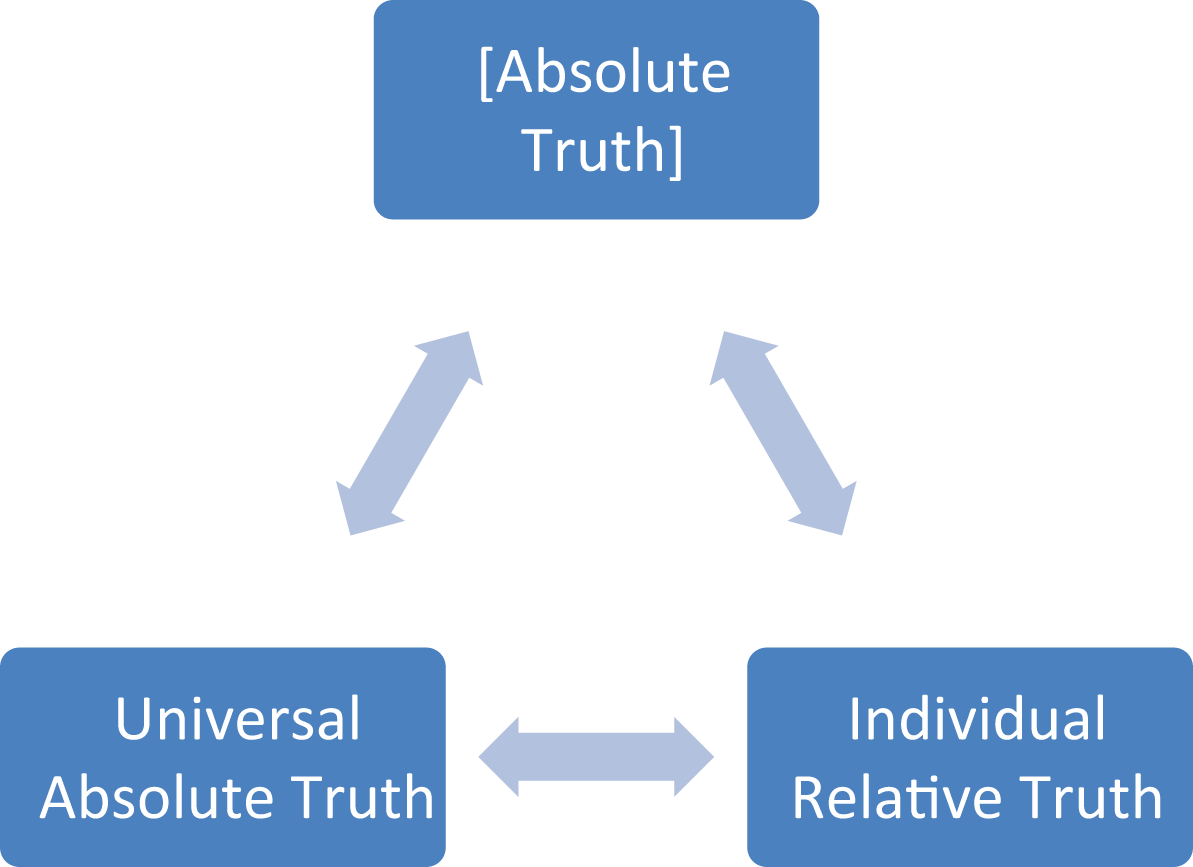
So, there can be truths that are indisputable within a community, but at the same time, they can be disputable from the perspective of another community. I realized there was no one accepted “God”—that “God” was not an objective truth—that humans had multiple gods each abiding within a community of believers. There are the Christians that believe that the teachings of Jesus are true, and there are the Buddhist who find Buddha’s teachings hold weight, and there are the Muslims who faithfully abide by the teachings of Muhammad, and there are Jews who follow the teachings of the Jewish prophets. There are literally thousands of religions. Each religious community holds to truths, some incompatible with other religions, that direct the behavior of adherents, and there is no question that people will die to defend these beliefs. In effect, the study of religion was the cement that built the foundation of RSC. Essentially, I built another triangle to help me understand. In this case, the triangle was about truth construction. I’ll send a copy of that diagram too. Truths can be disputable, globally indisputable, and indisputable within a community. I used the term “bracketed absolute truths” to mean truths that are unquestionable within a community. The diagram helped. Bracketed absolute truths (truths unquestionable in a community) are triadic (at the top of the triad) and different than truths held as universal absolute truths (on the lower left) and truths relative to each individual (on the lower right). Social constructivism is in a unique philosophical position at the top of the triad (Figure 2).
In 2011, I published a book, Toward a Positive Psychology of Religion: Belief Science in the Postmodern Era, which was my attempt to explain and to apply a social constructivism philosophy to the study and practice of religion. I’ve been told that the book is a good primer on RSC. I became convinced that social constructivism was a candidate for paradigm status—that it had all the makings of a full-fledged mental health treatment framework.
As an aside, I had a very personal reason for studying religion as I studied the social constructivism movement. My son, Torre, at the age of (in 1998), was diagnosed with Duchenne Muscular Dystrophy, a fatal disorder that takes children usually by the age of 20. My wife and I faced our greatest challenge, and I wanted to have a clear idea as to what I believed spiritually. It was about this time that the study of social constructivism took a personal turn, and I sensed some urgency in defining my religious philosophy. So, writing Toward a Positive Psychology of Religion was my way of discerning my most basic religious beliefs. We lost Torre in 2017 at the age of 20, and he and I had many deep conversations about religion and spirituality.
Figure 2.
Unspoken comment. Rock’s disclosure profoundly affected me. I sit here in silence as I reflect on his words. Life and work are really woven together to construct a vocation, a genuine “calling.” This is inspirational for me.
What implications of RSC are there for the practice of couples, marital, and family counseling?
Major implications. First, counselors are not bound to the idea of either individual blame or circular shared blame. Blame can be socially constructed around the situation with the involvement of stakeholders. Treatment then can vary from individual counseling for relationship problems, conjoint counseling of couples, or family therapy with groups of three or more. So, RSC frees the counselor to work with the group of significance to define the problem and then to act to solve the problem accordingly. Also, counselors will recognize that problems that confront them are most likely clear-cut “conflicts of truths,” meaning that at least two people are in disagreement where each side of the disagreement represents a “bracketed absolute truth” established by a group of influence.
So, here’s an example. A husband comes to marriage counseling complaining of his wife, saying that she is socializing with a bunch of women who are against him. He complains that they are super critical of him and that she has become cold in their marriage due to her increasing involvement with her group. The wife says the husband has been hanging out with his single friends, going to bars, and playing pool, and she says his attitude about their marriage has taken its toll on their relationship. In this case, the husband and wife are being influenced by two nonintersecting groups, and one can easily predict they will be pulled apart by the influence of the groups and the “bracketed truths” that are established in those groups about the marriage and the marriage partners.
The counselor’s job is to help the couple come to agreement about establishing a common group of friends who value marriage. It might involve helping the couple to sever or to limit relationships with those in the nonintersecting groups of influence. It might address common positive values the couple holds and how those values have been influenced by others they respect in their histories. It’s not about psychology. It’s not about defining the mental illness of either party. It’s about the negotiation of truth and the significant influence of the counselor in helping to establish the “truth” of a healthy, loving marital relationship.
Counselors, if they listen closely to their clients, will recognize that there are often conflicts of truths at the root of any relationship problem in couples, marital, or family counseling. Another example I use in classes is the case of a drug-abusing teenager. He is involved with a group of peers who smoke marijuana in a state where it is illegal. They have consensualized that it is safe, fun, a social lubricant, and “okay.” They are smart kids, so they have researched marijuana and found it is not too harmful—not as harmful as alcohol as an example. But the teenage boy is part of a drug prohibitionist family. His parents believe marijuana use will connect him to an unhealthy group—the drug culture—and to people involved in illegal activity. They are concerned about evidence that use of marijuana produces an amotivational syndrome and may negatively affect his teenage brain. They are adamant that the teenager must stop.
In this case, the counselor is again faced with conflicting truths, and the solution involves connecting the teenager to a group of healthy peers who are not drug-using. The counselor, due to ethics and law, cannot condone illegal use of marijuana, so the counselor must consensualize with the socio-legal system in moving the teenager to a legal alternative to marijuana abuse. Again, counseling becomes more about engineering social interactions than psychological psychotherapy.
RSC has transformed my style of counseling. I have learned to ask many questions about who is involved in any truth claim by a client. If a client is depressed, I ask, Where did you learn the definition of “depression?” Who depresses you? Who can lift you from your depression? Are there places with certain people when you notice you are not depressed? Where are you depressed and who is around or not around in those times? What have you read online or on paper about depression, and who are the authors? In other words, I can ask lots of questions that place depression in context. Depression is not viewed as an internal psychological matter. So too with anxiety, or other problems. But remember, RSC does not deny biology, so it accepts, for example, that some people are “wired” to be active, slow moving, internally focused, or otherwise biologically predisposed. It’s really about a person’s social fit within some context. Finding social fit for clients is a crucial role for counselors. A hyperactive high school student may not fit well in the classroom but might be exceptional on a sports team. So, the RSC counselor is always thoughtful about context.
My approach to counseling has been transformed by theory. The way I practice is much different now. I think that Freud, unfortunately, set psychotherapy on a questionable course. I’m joining other social theorists to help provide an alternative way to conceptualize what counselors do. I think RSC, and the relational therapies, are a perfect fit for the profession of counseling.
Thank you for sharing your views and simplifying some potentially complex constructs. I am encouraged that RSC can be translated into such useful counseling practices. I look forward to seeing you at the next conference. I’ll bring my notes (Ha).
Stephen, thank you so much for allowing me to explain some of these ideas. Your questions were “to the point.” I hope the readers find some value in our dialogue.
Footnotes
Declaration of Conflicting Interests
The author(s) declared no potential conflicts of interest with respect to the research, authorship, and/or publication of this article.
Funding
The author(s) received no financial support for the research, authorship, and/or publication of this article.