



Abstract
Intimate partner violence (IPV) is a national public health concern that is often conceptualized individually. This article provides a systemic understanding of IPV through the separate and combined lens of Bowen family systems and Attachment Theories. A brief individual overview and application to IPV is provided for each theory, followed by a conceptual integration and then an application of the two theories combined to a case example.
Keywords
Intimate partner violence (IPV) can be defined as “physical violence, sexual violence, stalking and psychological aggression (including coercive tactics) by a current or former intimate partner” (Breiding et al., 2015, p. 13). Traditional conceptualizations and therefore treatments of IPV were based on the Duluth model that uses an individual lens and within the framework of a “perpetrator” and “victim” (Hurless & Cottone, 2018; Stith et al., 2012). However, the definition of IPV has expanded, along with the treatment modalities, identifying that there are more nuances in the typologies of IPV (Stith et al., 2012). For instance, there is a recognition that couple violence can range from coercive controlling to situational couple violence, with coercive controlling violence characterized by patterns of fear and control, while situational couple violence is characterized by bidirectional violence that is mild to moderate in severity and frequency (Hayes & Kopp, 2020; Stith et al., 2012). Subsequent treatment modalities that have been developed include theoretical conceptualization from cognitive behavioral therapy, acceptance and commitment therapy (Zarling et al., 2015), and family systems theory (Hayes & Kopp, 2020; Stith et al., 2012).
As the definition has expanded to account for the relational components, so too has the literature made a shift in examining IPV from relational or systemic perspectives and an acknowledgment for the need for more relationally focused conceptualizations of and treatments for the situational couple violence typology of IPV (Bell & Naugle, 2008; Karakurt, Whiting, et al., 2016; Stith et al., 2012). Specifically, Attachment Theory has been utilized to conceptualize IPV both individually and relationally for several decades (Karakurt et al., 2019; Park, 2016). While Bowen family systems theory has been utilized to conceptualize IPV more sparsely in the literature over the last few decades (Likcani et al., 2017), it appears to have multiple conceptual overlaps with attachment theory. These overlaps have been identified by several authors (Gingrich, 2004; Hainlen et al., 2016), however, not in the application of IPV, thus far.
To better understand how Bowen family systems theory and attachment theory may have overlapping concepts that may be useful for conceptualizing IPV, it is important to get a better understanding of the two theories and how they individually address IPV.
Overview of Attachment Theory
Adult romantic attachment theory finds its roots in infant attachment theory. Bowlby believed that attachments develop in infancy based on a primary caregiver’s sensitivity and responsiveness to the infants’ basic needs as well as needs for comfort and protection (Hazan & Shaver, 1987). Infants whose needs are responded quickly, accurately, and with regularity develop a secure attachment to their primary caregiver (Hazan & Shaver, 1987). Anger has been identified as a natural infant response to a real or perceived threat to the attachment relationship, designed to (West & George, 1999). Anger has been identified as a natural infant response to a real or perceived threat to the attachment relationship, designed to elicit a response that provides comfort and protection (West & George, 1999).
Similar to the infant–caregiver relationship, adults develop similar attachments to their romantic partners and reciprocally use their partners as secure bases from which they experience the world (Karakurt, Silver, & Keiley, 2016). In adult relationships, both partners will experience ever-changing closeness and distance from their partner. Tolerance to and comfort with closeness and distance has been conceptualized as two continua, attachment avoidance and attachment anxiety, ranging from complete comfortability to complete discomfort (Holmes & Johnson, 2009). Securely attached adults are tolerant of fluctuations in closeness and distance without fears of rejection; however, insecurely attached adults will not be able to tolerate as much closeness or distance (Pietromonaco & Barrett, 2000). Expanding upon the original conceptualization of adult romantic attachment styles, Bartholomew and Horowitz (1991) added the continuums of working models of self and others. Those adults who have positive working models of the self will be most comfortable with autonomy, while those who have negative working models of the self will be least comfortable with autonomy (analogous to the attachment avoidance continuum). Also those adults who have positive working models of others will be most comfortable with intimacy, while those who have negative working models of others will be least comfortable with intimacy (analogous to the attachment anxiety continuum; see Figure 1).

Attachment continuums overlaid.
In addition to the premise that attachment style should be stable across the life span, attachment theorists have suggested that our attachment style would affect how we choose partners (Holmes & Johnson, 2009). Three hypotheses have been derived from this about what type of partners we would choose: partners who would provide us with the most attachment security (i.e., all attachment styles paired with securely attached partners), partners with complementary attachment styles (secure–secure pairing vs. dismissing–preoccupied pairing), and partners with similar attachment styles. Results from a review showed mixed support for these hypotheses. The authors concluded that while we may be attracted to partners who provide the most attachment security, relationships that last may be the ones in which our partners’ attachment styles are complementary to our own (Holmes & Johnson, 2009).
Attachment Theory Applied to IPV
Theoretically, when partners with opposing closeness and distance needs (e.g., insecure anxious and insecure avoidant) or when partners who both desire intense closeness are paired (e.g., insecure anxious and insecure anxious), finding a balancing point may be especially difficult and the attachment system may become aroused frequently (Pistole, 1994; Velotti et al., 2018). In these adult romantic relationships, one or both partners may have experienced attachment injuries, and increased proximity may not elicit the intended safe and secure feeling. The anger response that at one point elicited caregiving behaviors in their attachment figure may actually heighten the perception of threats to the relationship for one or both partners, triggering fears of abandonment or rejection and snowballing into an explosion of violence (Brown et al., 2010; Park, 2016; Shaver et al., 2009). Thus, in these relationships, violence may serve as a way of relieving the built up anger triggered by attachment anxiety and rebalancing the closeness and distance between the partners.
Research applying attachment theory to IPV has suggested that it may be the interaction of complementary insecure attachment styles in relationships that triggers violent behavior. For instance, research has found that IPV occurred when the perpetrator was high in attachment anxiety (fearing abandonment) and the other partner was high in attachment avoidance (fearing intimacy; Roberts & Noller, 1998 cited in Allison et al., 2008; Park, 2016; Velotti et al., 2018. Similarly, research has shown that IPV occurs in couples when a male high in attachment avoidance is “mispaired” with a female high in attachment anxiety (Allison et al., 2008; Doumas et al., 2008). Still other research has found that violence was more likely to occur in couples in which both members were high in attachment anxiety (preoccupied attachment style; Allison et al., 2008; Park, 2016; Velotti et al., 2016) or when partners demonstrate behaviors of attachment insecurity (Karakur et al., 2016; Oka et al., 2014).
Overview of Bowen Family Systems Theory
Bowen Family Systems theory is a theory of balance, interpersonally in the form of separateness and connectedness and intrapersonally in the form of thoughts and feelings (Kerr & Bowen, 1988). Chronic anxiety is the pressure that permeates all human interactions, pushing people toward interpersonal and intrapersonal connectedness (Friedman, 1991). Differentiation of self is the antidote to the chronic anxiety (Friedman, 1991). It is the ability to remain individuated while under the pressures to connect. The process of attempting to respond in a differentiated manner to the chronic anxiety is known as distance regulation. Differentiation is an ever-present process of becoming and exits on a continuum such that most people lie somewhere in the middle of the continuum and need to continue to strive to maintain a differentiated stance while under ever-present pressures of chronic anxiety (Bowen, 1978).
Emotional reactivities are the responses that occur when one succumbs to the pressures of chronic anxiety (Bowen, 1978). These responses involve vacillating between extremes, becoming too close to others (fusion) or too separate from others (cutoff). Additionally, intrapersonally, emotional reactivity manifests as responding only with emotion or only with rationale thought but being unable to utilize both to make choices about how to respond. These emotionally reactive responses serve to shut down the tension created by the chronic anxiety (Kerr & Bowen, 1988). Those with lower differentiation can become so emotionally reactive in relationships that individual identities become inextricably intertwined with the relational identity such that individuals are not able to operate without the significant other and any threat to the relationship is perceived as a threat to the individual identity as well (Bowen, 1978). Symptoms that result from lower differentiation and high emotional reactivity are hypothesized to fit into one of three categories: relational conflict, symptom development in one partner, or symptom development in a child. The former two categories are of particular significance for the purpose of this article and will be discussed further.
Bowen Family Systems Theory Applied to IPV
Although Bowen did not specifically address violence in relationships in his theory, it stands to reason that IPV may be a combination between an extreme manifestation of marital conflict (Bartle & Rosen, 1994; Titleman, 2003) or symptom development in one partner, depending on the severity of the violence. Violence becomes a way to regulate the distance in couples. The togetherness force draws the partners closer to each other and those with lower differentiation will succumb to the togetherness force, thereby fusing to one another (Bartle & Rosen, 1994). However, in that fusion, one’s individual identity is lost in the relational identity, which becomes overwhelming, and distance is needed. The conflict or violent explosion that happens forces cutoff between the members of the primary dyad. It is as though the couple is so anxious about being too close that they have to physically push each other apart, but the violence also physically restrains the other partner, so they have to stay close at the same time (Allison et al., 2008). In the aftermath of the violence, the couple will create distance as they attempt to heal and make sense of the incident. Too much distance combined with attempts from outsiders, such as law enforcement, to intervene is then perceived as a threat to the relationship and the individual identities, so the trauma of the violence also inadvertently bonds them together, a process that has been labeled traumatic bonding (Dutton & Painter, 1993).
Some research has supported this theoretical conceptualization of IPV, finding that couples experiencing either unidirectional or bidirectional IPV have higher reactivity to each other. Furthermore, distressed couples’ communication is “characterized by a heightened sensitivity to their partners’ behavior and their interactions are related to greater behavioral dependency” (Bartle & Rosen, 1994, p. 228). Allison and colleagues (2008) also found that violence can be used as both a distancing and a pursuit strategy.
An additional consideration in this conceptualization is the concept of power. The partner who begins overfunctioning for the relationship will engage in behaviors to ensure the stability of the relationship and the perception of the relationship to outsiders, serving to maintain the relationship and enable the behavior (Titleman, 2003). The underfunctioner may be the symptomatic partner who may actually have more power and control over the relationship than it appears. This dynamic, combined with the inability to regulate distance in the relationship, may trigger violence more readily when conflict is already present.
Integrating Bowen Family Systems and Attachment Theories to Conceptualize IPV
Although created in very different fields and using different observations of human interactions, Bowen family systems and attachment theories (both infant and adult romantic) have a surprising amount in common. First and foremost, both theories emphasize the powerful influence of anxiety especially in relation to attempts to balance closeness or distance with significant others. The continuums that attachment theory uses (avoidance and anxiety) are also very similar to the continuums of closeness and distance that Bowen discusses (Figure 2). Furthermore, the anxious avoidant attachment style seems similar to Bowen’s concept of cutoff, and the anxious ambivalent attachment style seems similar to Bowen’s concept of fusion (Figure 3). Theoretically, fusion and cutoff are on opposing ends of the same spectrum, so it may also be that rather than being categories, the anxious avoidant and anxious ambivalent insecure attachment styles are also on the same spectrum (Figure 2).
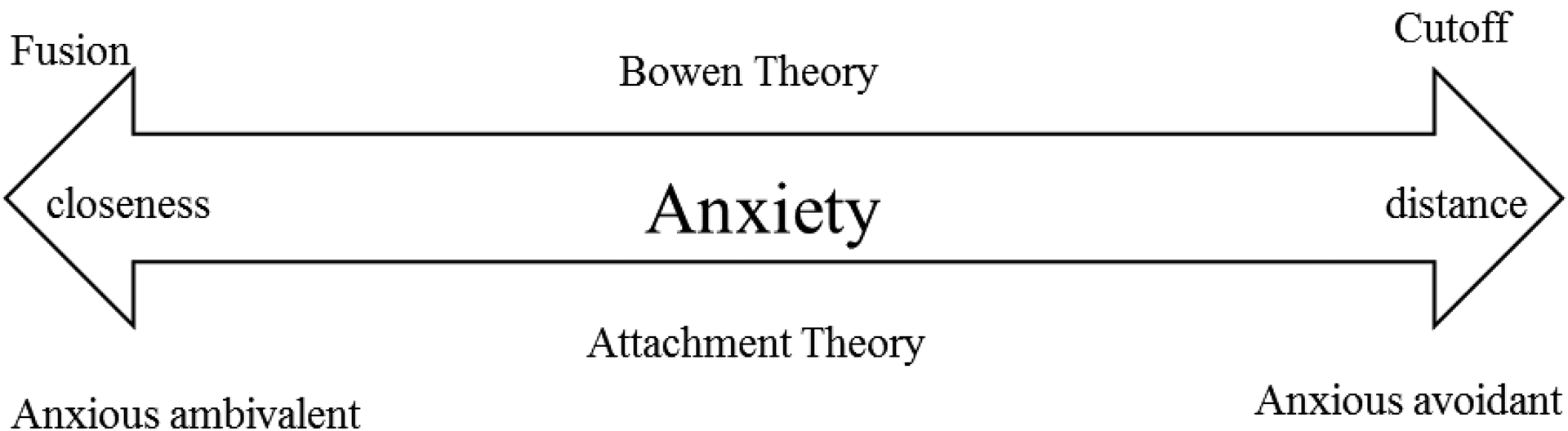
Conceptualization of the overlap of the anxiety dimensions in Bowen and attachment theories.
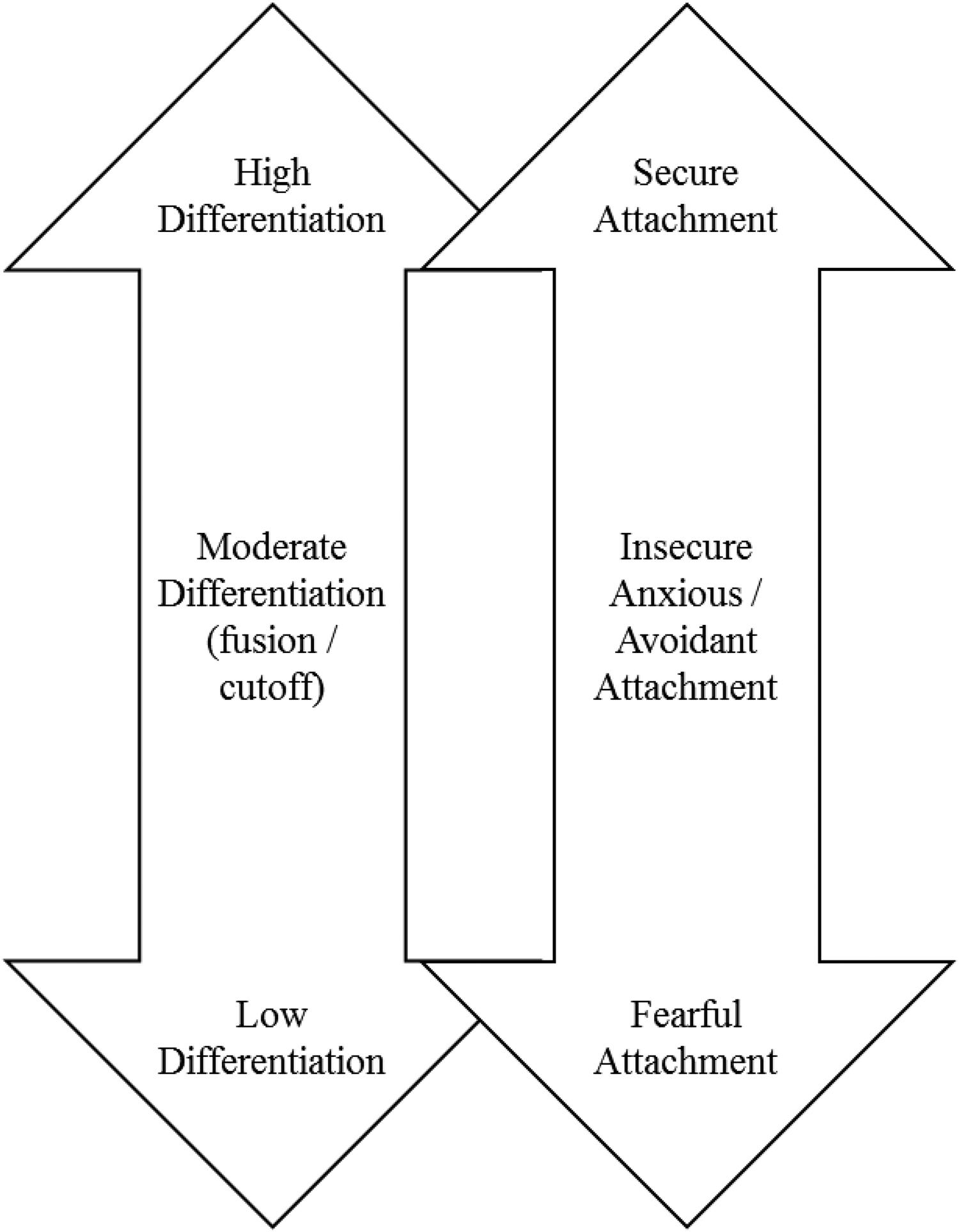
Overlaying the continuums of differentiation with attachment styles.
To continue, the secure attachment style seems similar to a person with a high level of differentiation who is able to tolerate both closeness and distance. Attachment theorists identified a unique insecure attachment style not previously discussed, fearful, which is unable to tolerate either closeness or distance (Both & Best, 2017), and may be representative of a person who has a very low level of differentiation (lower than the other two insecure attachment styles). Research has partially supported this hypothesis, in that both fusion and cutoff have been found to be related to the fears of abandonment typically associated with attachment theory (Skowron & Schmitt, 2003).
It is clear that both theories have similar conceptualizations of IPV—that it is a response to an inability to regulate closeness and distance in relationships and that threats to the relationship are perceived as threats to one’s individual identity. However, both theories also add unique components to the conceptualization of IPV. Bowen expands on this to discuss the role of couple conflict and triangulation of symptoms, which is a means of reducing anxiety and bringing the couple closer together. Attachment theory adds the dimension of anger to its explanation of IPV, in that insecurely attached couples may respond to their attachment anxiety by becoming angry, with the desired effect of getting the attention of their significant other to restore the balance of closeness and distance. Contrary to the desired expectations, this anger seems to trigger attachment anxiety in the other partner, escalating, rather than deescalating the attachment anxiety, ultimately leading to the violence.
Moving the Abstract Into the Therapy Room
This integrated conceptualization of Bowen Family Systems and attachment theories has implications for the treatment of individuals and couples who are experiencing situationally based IPV. Targeting the underlying attachment anxieties about closeness and distance needs in a couple relationship will be the paramount mechanism of change in therapy. Also important for the change process is reframe anger as attempts to reconnect. Further, therapists will need to teach communication strategies to give partners' tools to convey their distance needs in a differentiated manner. It will also be imperative to support each partners’ individual identities while maintaining the relational identity as the secure base for each individual.
Case Example
Justin and Judy have been married for approximately 2 years. They are a Caucasian heterosexual couple. They identify as nondenominational Christian. Justin and Judy are in their early 20s. They have two children together, daughters aged 2 and 3. They presented to couple counseling due to Justin’s recent domestic violence charge. Justin successfully completed his required group treatment prior to presenting to couple therapy, and they had been living separately for approximately 6 months. Their identified goals are to rebuild the trust in their relationship and learn new ways to communicate.
Initial Information
The therapist spent the first few sessions exploring the history of the couple and identifying a time line of the “problem.” The couple reported that they had always argued, sometimes with the conflicts being verbally volatile. They characterized the conflict early in their relationship as aggressive bidirectional verbal altercations. The physical conflict then began approximately 2.5 years ago when their eldest daughter was only a few months old. Justin reported that at that point in their relationship, Judy had to spend more and more time with their daughter and did not seem to have enough time for him. Justin felt displaced and struggled to build a connection with their daughter because Judy was the primary caregiver while Justin worked. Judy then became unexpectedly pregnant again and developed hyperemesis gravidarum. She was tired and sick all of the time, so when she was not caring for the baby, she was in bed. Justin became resentful of attention who received from Judy, including their daughters. As Justin became increasingly lonely, he also became increasingly angry with Judy. Unbeknownst to Judy, he also began to seek out affection from online dating sites, triangulating others into Justin and Judy’s relationship, while simultaneously restricting Judy’s contact with family and friends. Over time, their interaction dynamics became polarized, with Justin becoming increasingly aggressive and Judy becoming increasingly withdrawn. The physical violence began initially as physical restraint when Judy would attempt to walk away from Justin as she had in the past during arguments. He began by blocking her path, so she could not leave the room, then escalated to grabbing her arms, and continued to pinning her against the wall. In the incident that brought them into therapy, Justin again escalated when he slapped Judy in the face and hit her in the stomach.
Initial Case Conceptualization
Justin and Judy present in the families with preschool-age children life cycle stage; however, it seems there was attachment trauma experienced in the transition to parenthood stage, resulting in them being unable to move forward in their life cycle. From an integrative Bowen Family Systems and Attachment Theories perspective, Justin appears to have insecure anxious attachment style as evidenced by his discomfort with separation from her and his attempts to fuse with her. Justin is unable to fuse with Judy and unable to respond to her in a differentiated way communicating his unmet need, and he begins to seek outside companionship to meet that fusion need. In his relationship with Judy, he becomes emotionally reactive and engages his childlike attempts to continue to garner her attention by displaying angry and aggressive behavior. Judy does not respond to Justin’s protest attempt because she is not capable due to the familial and medical issues she is individually struggling with, resulting in Justin escalating his protest attempts. Judy presents with an insecure avoidant attachment style in her relationship with Justin as evidenced by her discomfort with closeness with Justin. She attempts to cutoff from Justin while fusing with their infant/toddler children instead. As the children are in such a young age and such a high need, symptom development is not necessary to create the triangulation. The imbalance created because Judy is the primary caregiver and Justin does little to care for the children creates a fusion dynamic between Judy and the children while Justin is cutoff. The IPV that manifests in this relational context becomes a symptom within Justin as well as an exaggerated relational conflict response within the couple.
Family of Origin Information
In the next phase of therapy, the therapist focused on gathering family of origin from Justin and Judy to better understand the attachment style and differentiation levels they individually brought into this relationship. Judy reported that her father was abusive toward her mother, other women he dated when he and Judy’s mother were separated (although they never actually divorced), and toward her. She reported that she had an older sister who experienced behavioral problems during high school and who moved out while Judy was in middle school. Judy reported feeling like a pawn between her mother and father’s relationship. She further explained that her mother struggled with substance use and she frequently had to care for her mother when she was under the influence. Judy reported identifying more and getting along better with men, perceiving them as strong, while she had a negative opinion of women, perceiving them as weak. Justin reported that he was raised by a single parent, his mother. He further explained that he did not have a relationship with his biological father. He reported having a close relationship with her until he was a teenager, at which time she remarried his stepfather, with whom he had a conflictual relationship. He reported that his stepfather had two sons from his prior marriage for whom he had shared custody.
Family of Origin Conceptualization
Judy was triangulated into her relationship between her parents. She experienced her sister’s launching into adulthood as an abandonment. Judy’s parents’ lower differentiation levels were evidenced through the multitude of symptoms experienced including Judy’s sister’s behavioral problems, her mother’s substance use, her father’s infidelity, and his volatile anger and violent behavior. She developed an insecure avoidant attachment, developing a negative opinion of others and a comfort with independence. Judy perceived closeness as vulnerability.
Justin grew up experiencing comfort with fusion to his mother, leading him to develop an insecure anxious attachment style. As there was not a father figure in his life until his teenage years, he filled the role of emotional partner for his mother. He developed a positive image of his mother and others, while a negative view of himself, as he experienced separation anxiety from her and fear of growing independent. When he approached the launching year, Justin’s mother found a romantic partner; however, Justin was not prepared for the change in emotional distance with his mother. He resented his stepfather for taking his mother from him, perceiving their marriage and the entrance of his children into their family as a rejection.
Therapeutic Interventions
Now having a firm understanding of the family of origin dynamics of each partner, as well as background of the presenting issue, the therapist integrating Bowen Family Systems and attachment theories determines the best interventions for Judy and Justin. The therapist has already engaged in a genogram as discussed above. From a Bowen Family Systems perspective, maintaining a differentiated stance, also referred to as an “I position,” will be very important in working with Judy and Justin given their differing distance needs and difficulty regulating distance. This differentiated stance will also serve to model for and reduce Justin and Judy’s emotionally reactive responses in session.
Utilizing a systemic hypothesis will also be an effective tool with Justin and Judy as it serves multiple purposes. First, it will help Justin and Judy understand their ongoing patterns of interactions. This systemic hypothesis will help Justin and Judy understand each of their roles in their conflict and how their individual attachment styles intersect to form their relational dynamics. Further, the therapist can utilize psychoeducation to discuss the cycle of violence with Justin and Judy.
Next, the therapist will discuss individual coping strategies with Justin and Judy to help them learn to better manage their individual experiences of chronic anxiety. Communication strategies in session will serve to help Justin and Judy communicate about their attachment anxieties while allowing them to manage their emotional reactivity. Finally, the therapist will assign relationship experiments to encourage Justin and Judy to engage each other in differentiated responses when interacting between therapy sessions.
Conclusion
This article provides a conceptualization of IPV utilizing the overlapping constructs from Bowen family system and Attachment Theories. Utilizing a systemic framework to conceptualize and understand IPV can provide both researchers and clinicians additional avenues for navigating this national public health problem. Further empirical investigations are needed to more fully elucidate this integration and application to IPV.
Footnotes
Declaration of Conflicting Interests
The author(s) declared no potential conflicts of interest with respect to the research, authorship, and/or publication of this article.
Funding
The author(s) received no financial support for the research, authorship, and/or publication of this article.
