



Abstract
The action-oriented nature of adventure-based counseling (ABC) makes it a good therapeutic modality for family counseling settings. Research studies exploring the integration of ABC with families are positively correlated with increased communication, conflict resolution, trust, and intimacy. The author presents adventure-based family communication experience, a series of three ABC activities integrated with Satir’s communication model to use in family counseling sessions. Each activity is described, and thoughts about how to integrate and process the experience with a family are provided.
According to Taibbi (2015), family counseling requires the counselor to “step up and actively guide the process throughout the session” (p. 4). The guidance that Taibbi speaks to is, perhaps, one of the most daunting tasks for family counselors, especially new counselors, to learn how to do. At the same time, the counselor is tasked with building a trusting relationship (Taibbi). Adventure-based counseling (ABC) is an action-oriented, guided approach to counseling (Gerstein, 1992; Schoel et al., 1988) providing structure coupled with opportunities to build rapport and open communication (Burg, 2001). The experience of ABC informs learning and development and has the capacity to develop desirable personal and social outcomes for clients (Beames et al., 2019). Given the action-oriented nature of ABC, it makes for a good therapeutic modality for a family counseling setting.
Research studies exploring the integration of ABC with families are positively correlated with increased communication, conflict resolution, trust, and intimacy (Burg, 2001). The focus of ABC is about doing something in session and the subsequent metaphors that emerge through activity rather than the traditional talk therapy (Fletcher & Hinkle, 2002). Experiential counseling such as ABC utilizing physical human communication is useful when verbal-based communication may not be as effective, yet ABC family counselors are challenged by the lack of standardized protocols (Griswold, 2014). Therefore, the author presents a series of three ABC activities integrated with Satir’s communication model to use in family counseling sessions. A brief overview of ABC applied to family counseling is discussed, Satir’s communication model is overviewed within the context of ABC, and finally, adventure-based family communication experience (ACE)—a series of three adventure-based activities to improve communication within the family counseling context—is described with best practice considerations.
Adventure-Based Family Counseling
Adventure-based family counseling is recognized as an effective intervention, yet it is not discussed extensively regarding its use in a traditional family counseling setting (Bandoroff, 2003; Glass & Dotson-Blake, 2010). Rather, many wilderness-based programs for adolescents have increased their inclusion of families in the treatment (Bandoroff, 2003). ABC is defined as “the prescriptive use of adventure experiences provided by mental health professionals, often conducted in natural settings kinesthetically engage clients on cognitive, affective, and behavioral levels” (Gass et al., 2012, p. 1). Norton et al. (2019) found that using adventure-based therapy with children and families affected by abuse decreased trauma symptoms in children and adolescents; furthermore, families moved from stressed to nonstressed in the areas of communication and family function with the integration of adventure-based activities into counseling. Freeman and Zabriskie (2002) noted that adventure-based activities contribute to increased engagement and connection in family life. Furthermore, leisure is a known factor contributing to greater family life satisfaction. Freeman and Zabriskie also found that at residential camps, family members were able to escape everyday life distractions and focus their time on each other and building greater relationships. General themes common within adventure-based programming include the following: The environment is different and contrasts with everyday experiences of the family, the challenges require the family to take physical action to accomplish something, and the environment and the physical action create a context for the counselor to process the experience to increase greater awareness and understanding (Beames et al., 2019). Yet even with all these cited benefits, ABC is not widely documented in the family counseling setting (Bandoroff, 2003; Griswold, 2014).
Integrating ABC into family counseling has several levels of intervention: short-term (1-day event), long-term enrichment-oriented programs (such as wilderness therapy), and an adjunctive therapeutic modality (Gillis et al., 1991). Adjunctive therapeutic modalities are adventure activities integrated within more traditional family counseling settings. Bandoroff (2003) noted that wilderness therapy, while effective and powerful with families, is not a viable option for many counselors in practice and suggested that adventure-based interventions could be integrated within family sessions.
Gillis and Gass (1993) identified five domains utilized within an ABC counseling experience: assessment, structuring, intervention, debriefing, and follow-up. Assessment is conducted using more traditional methods or using adventure-based activities. Adventure-based approaches in the assessment create opportunities where more typical, familial patterns of interaction emerge quickly (Swank & Daire, 2010). Swank and Daire (2010) recommended structuring a series of activities that gradually increased in challenge and comfort level to assess family dynamics and treatment goals. Additionally, by incorporating ABC into the assessment process, it allows for the counselor to assess for the family’s comfort level with the ABC approach. Structuring, intervention, and debriefing are also referred to as the adventure wave (Schoel et al., 1988). The adventure wave is the difference in intensity and concentration before, during, and after an adventure-based activity. A central component of structuring and applying interventions and debriefing is facilitation of a positive integration into the family’s future and in the case of this article’s focus—family communication. Burg (2001) noted that one of the areas that family adventure counseling is lacking is the integration with family systems theory. ABC, while effective and using a methodology of its own, could benefit from a more intentional connection with family systems theory, which is the focus of this article.
Family Communication
A basic premise of family systems theory on the whole is greater than the sum of its parts (DeMille & Montgomery, 2016). Family counseling is specifically designed to improve the functioning and health of a family. DeMille & Montgomery (2016) noted that creative approaches to providing family counseling have the capacity to enhance family function and health and increase productive communication. Learning how to express feelings using an “I statement” is a common technique. However, helping family members understand and learn how their culture, their upbringing, their perceptions, expectations, and emotions impact family life is critical to productive communication. Zabriskie and McCormick (2001) found that greater leisure time played a critical role in the development of family communication. Burg (2001) found that ABC integrates well with family counseling because of the potential to promote communication. Satir believed strongly in an experiential component in family counseling (Satir et al., 1991). Bandoroff (2003) also found that families engaged in ABC programs noted that improved communication was a benefit.
The adventure-based activities discussed later in this article are integrated with the theoretical concepts created by Satir et al. (1991), specifically the communication stances and the iceberg model. Satir et al. (1991) used the iceberg model or metaphor to conceptualize an individual’s experience (see Figure 1).
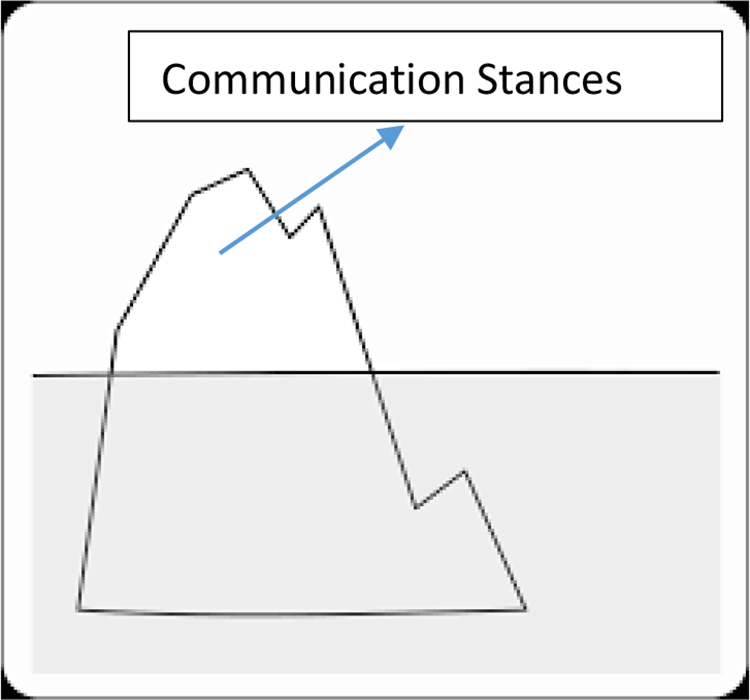
Iceberg metaphor.
Above the waterline is the behavior or situation, and sometimes the communication stances, that we use when engaged with our life experiences; however, Satir theorized that below the water, there were layers to the iceberg to include feelings, feelings about feelings, perceptions, expectations, yearnings, and finally a reflection on “who am I?” Above the water line, Satir, et al. noted the communication stances emerge. Each family member’s communication stance reflects their coping skills. She believed there were five ways to communicate within three parts of the communication (self, other, and context). The communication styles include blaming, placating, computing, distracting, and leveling. Leveling is also known as congruent communication in which the communication components self, other, and context are equally balanced.
ACE
The following section outlines ACE—a set of three ABC activities integrated with Satir’s iceberg model (Satir et al., 1991) providing a guide for family counseling sessions. ACE stands for adventure-based family communication experience. As noted earlier in this article, there is a lack of clear methods regarding how to integrate ABC within the family counseling context (Griswold, 2014); therefore, the author provides ACE which falls within the adjunctive therapeutic modality (Gillis et al., 1991). While a format is provided, which at first thought seems like the enrichment category (Gillis et al., 1991), the three-activity formatted process should be tailored in length, as well as issues addressed depending upon the family’s presenting concerns at intake. Given that a format is provided, sessions should be structured to fit each family’s individual needs. Many adventure-based programs go through a series of activities that start with building trust and move toward greater levels of problem-solving (Schoel et al., 1988); therefore, ACE uses this same perspective within the family counseling session. Before the implementation of the activities, family counselors should discuss what ABC is and give a brief overview of Satir’s iceberg model (Satir et al., 1991). It is helpful to explain the adventure-based progression that the family counselor will guide the family through. The following ABC progression starts with potholes (Rohnke, 1984), an activity used to help the family identify their own communication potholes; blind polygon (Rohnke, 1980), an activity used to help the family apply some of the initial learning about their potholes and identify new strategies to communicate more effectively; and finally arctic crossing, which is an activity in the sequence used to integrate learning and allow for time to reflect on the iceberg metaphor for the family. What have they learned about each person’s individual iceberg? The following is a more detailed description of how to integrate and process each of the three activities including a discussion of how to process the entire experience.
Potholes (Adapted From Minefield)
The pothole activity, adapted from the minefield by Rohnke (1984), was renamed by the author to exercise greater sensitivity to families that may have a military or combat background. For this activity, either one or two people are blindfolded and at least one or two people act as guides. If there are more family members, then those remaining can act as process observers.
In this activity, the counselor sets up potholes in the room (8 × 11 white paper with a circle drawn on them). The challenge involves walking from one side of the pothole field to the other without stepping on the pothole. To get started, the counselor will work with the family to decide what roles each will engage with (blindfolded; guide through the potholes, spotter); engage children to help the counselor set up the pothole field; set rules such as you cannot say backward, forward, left, or right, so you have 5 min to establish a language for directions; establish what the penalty is for stepping in a pothole. Some examples of penalties include starting over, frozen for 30 sec, or simply a count of how many times a pothole was stepped in; and the guide will direct the blindfolded person using the family-developed language for directions.
The important aspect of this activity is to process what happened. Some processing questions are as follows: What did you notice? Do a go-around with the entire family asking them to talk about what they saw or express a feeling. Of interest may be what the process observers watched and how it is like what they observe at home. What was it like to have to trust your guide? Guides, what was it like to be trusted? This can be particularly powerful if it is children who are the guides. How is being blindfolded like being in counseling right now? What were the key ingredients needed to build trust? How does communication connect with trust? How did you communicate well today? What could have been better or what did you learn? What are the “potholes” when it comes to communication and building trust in a family? (Write down all their ideas on the actual potholes that they just navigated.) How do you navigate these “potholes” based upon what happened today? What is important to consider?
The overall goal of this activity is to begin the discussion on what builds trust or gets in the way of trust in a family and what are the “potholes” of communication. The top of Satir’s iceberg metaphor starts with the communication stances (blaming, placating, computing, distracting, and leveling). The communication stances are what is visible in families with everything below the iceberg informing the communication stances. The pothole activity works well to assess the family’s communication stances and structure future process questions (Gillis & Gass, 1993). If communication was difficult during this activity, work to identify what did work and how the family could build on what did work for the next activity in the sequence, which is Blind Polygon.
Blind Polygon
Before beginning this activity with the family, review what they learned about their communication in the pothole exercise (Rohnke, 1980). For this activity, the entire family is blindfolded; therefore, facilitating discussion about what they learned the week before is critical for the communication aspect of this activity as well as continued building of trust. For this activity, the counselor needs a rope and blindfolds. First, have the family form a circle, and put the rope down. Next, have the family blindfold themselves. Third, explain the rules, which there are two—(1) everyone must remain blindfolded and (2) everyone must always hang onto the rope. Last, initiate the activity. For this activity, the family is asked to move from a circle to a square.
For this activity, some families will complete it rather quickly and others may struggle with a lot of talking over each other. Sometimes in these instances, the counselor could ask the person who has talked the least to take off their blindfold and assess the family’s progress and provide direction once their blindfold is back on. Once the initiative is complete, the counselor can have the family take their blindfold off or start some of the processing with the blindfold on, which can provide an interesting metaphor (How is being blindfolded like communicating in the family?).
Processing questions start rather broad and begin to move with intentional connection to Satir’s (1991) communication stances and the iceberg model. Process questions for the family related to the blind polygon include the following: What happened during this experience? What challenges did you encounter and how did you navigate through them? Building on communication stances from the pothole activity, what emerged this time? What did you notice about how you were communicating? What did you like? What would you like to change? You have done two of these activities now, what feelings have emerged? How does it feel to have those feelings? What expectations or yearnings do you have as we continue in this process? What do you hope for in terms of what you have experienced?
Arctic Crossing (Also Known as Lava Flow)
Lava flow (Priestley, 2015) was adopted in name by the author to be more in line with Satir’s iceberg metaphor. For this activity, the family’s objective is to get safely across the freezing cold water. They cannot touch the water; therefore, they must use the icebergs placed to help them cross. Equipment required includes icebergs (carpet squares work well) and tape to mark off the area of the arctic water.
The family receives half the number of icebergs they need for family members. If there are four people, they only get two icebergs to get across. The icebergs can only move forward and backward and there can be no riding on the backs of others or picking each other up. Once the activity begins, the squares must always have a body part touching until everyone safety reaches the other side. By the time the family works on this activity, the hope is that they have developed greater awareness regarding their family communication patterns. Process questions for the family related to the arctic crossing activity include the following: What happened during this experience? What challenges did you encounter this time that you did not before and how did you navigate through them? Last time you indicated that you had the following expectations and/or yearnings for the family. How were those met today? If the icebergs were family strengths, what would they be? What is different about today? What feelings do you have? How does it feel to have those feelings? What expectations or yearnings do you have as we continue in this process? What do you hope for in terms of what you have experienced? Who are you as a family? As you have gone through these experiences, how would you describe your family? Who are you? How is this activity symbolic of who you have become as a family?
As a follow-up to this activity, another session may be implemented to create something symbolic representing what the family has learned and describes the last level of Satir’s iceberg “who am I?” or in this case who is the family? Symbolic creations could be a flag, a coat of arms, a sculpture, a sand tray (take a picture to give to the family), or a piece of art.
Processing the Activities
To process adventure-based activities, Kolb’s (1984) experiential learning cycle is helpful. There are four stages: what happened, reflective observation, learning from the experience, and active experimentation or trying on outside of the family counseling context (see Figure 2).
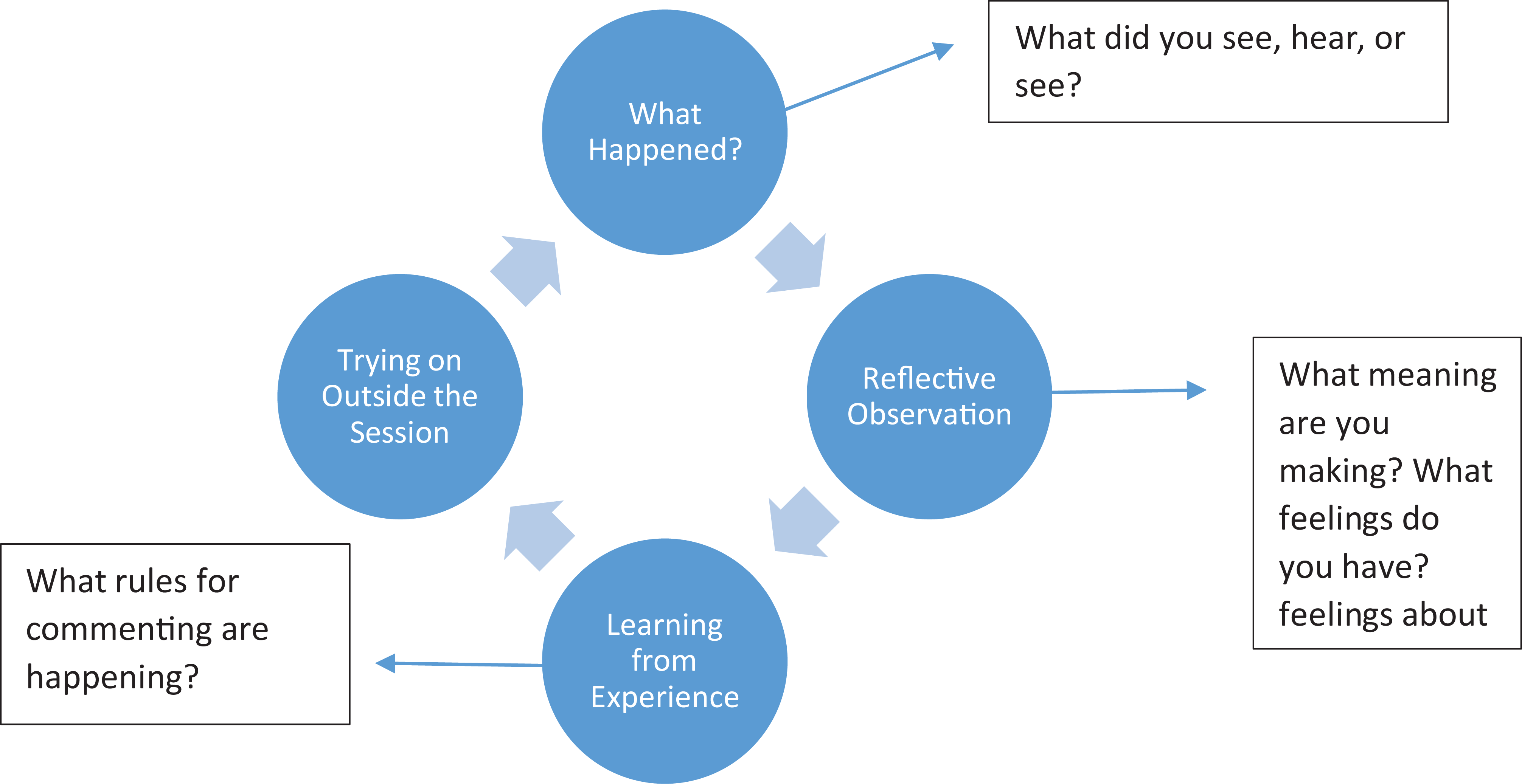
Kolb’s learning cycle.
Kolb’s process coupled with Satir’s ingredients of an interaction—What do you hear or see? What meaning do you make of what you hear or see? What feelings do you about the meaning you make? What feelings do you have about those feelings? What defenses are you using? What are the rules for commenting happening inside you?—provides ample opportunity to model and teach families how to communicate more intimately, effectively, and with greater clarity of emotion.
Best Practice Considerations
In addition to the lack of intentional theoretical connection of adventure-based with other counseling theories, Burg (2001) identified two additional areas of concern: scope of practice and research. Additionally, development/family life stage considerations are addressed.
Scope of Practice
Critical to the success of ABC implementation is the client’s understanding of what the modality provides and what it does not provide (Newes & Bandoroff, 2004; Burg, 2001; Griswold, 2014). Family counselors should have a good disclosure statement prepared with transparent information regarding what the process entails. Furthermore, Burg (2001) suggested that even with a good disclosure statement, families may respond more intensely and more quickly to the dynamics that ABC can evoke. Additionally, there is some debate regarding the requisite requirements for counselors who use adventure-based activities within a family context with the most basic requirement being training in family counseling (Newes & Bandoroff, 2004; Griswold, 2014). Newes and Bandoroff believes that family counselors interested in integrating ABC in their work should seek additional training. Burg (2001) expressed concerns for family fights emerging and the lack of ability of the family counselor to navigate disagreements and discord. If family counselors question their ability to handle the situations that emerge, they should seek additional supervision. Finally, if family counselors venture outside the counseling office and choose to utilize adventure methods that are more physically taxing such as ropes courses, they should evaluate with a lawyer the legal and liability issues involved.
Research
Burg (2001) identified the lack of identified research in ABC. Identified are authors who document the efficacy of their programs through participant narrative (Bandoroff, 2003; DeMille & Montgomery, 2016). Norton et al. (2019) explored the efficacy of adventure-based interventions with families affected by abuse and neglect. They found that adventure-based interventions decreased trauma symptoms and improved overall family functioning. They noted that function was improved most specifically in three domains: communication, closeness, and problem-solving.
Development and Family Life Stage
Adventure-based activities potentially strengthen and provide an effective modality for addressing development (Epstein, 2004; Glass & Dotson-Blake, 2010) and family life stage issues. Glass and Dotson-Blake noted that while the development of young people is influenced strongly by peers, they are also influenced by family. Furthermore, Glass and Dotson-Blake noted that ABC can engage and strengthen families using a developmentally appropriate modality. In addition to individual development, ABC can be very useful with thoughtful consideration of family life cycle stage. Carter and McGoldrick (2005) note six typical stages starting with single adulthood to families in later life. They provide second-order changes that each stage encompasses. The transition to each stage can sometimes be hindered by unresolved issues from previous stages; therefore, it is helpful for family counselors to also consider family life stage as well.
Conclusion
A primary struggle for family counselors is involving the family in the treatment process (DeMille & Montgomery, 2016). ACE provides a set of three activities illustrating how counselors can integrate activities with family theory. “If we accept that adventures are challenging experiences, have a degree of unpredictability, and demand physical and mental skills to overcome, then let us put some of these features to the test” (Beames et al., 2019, p. 4). Perhaps reframing the experiences of family as adventures could have a positive impact. ABC has the capacity to engage families in such a way that they recapture their closeness through improved communication.
Footnotes
Declaration of Conflicting Interests
The author(s) declared no potential conflicts of interest with respect to the research, authorship, and/or publication of this article.
Funding
The author(s) received no financial support for the research, authorship, and/or publication of this article.
