



Abstract
This article reports a study on the effectiveness of WhatsApp-based spiritual posts in promoting connectedness and adjustment among ever-single heterosexual couples in nonmarital cohabitation in four global cities. In comparison with trivia posts, the spiritual posts had greater impact and were more effective for Christian couples, middle class, highly qualified, and professionals-salaried cohabitants. This was in comparison with Hindu–Buddhist–Sikh dyads, upper class, with college degree, and entrepreneurs. However, cohabitation duration, initial cohabitation experience with other partners, having children/cohabitation dependents, and near future marriage plans were not significant predictors. Gender also did not significantly moderate spiritual intervention responses as proposed in the previous research. Couple intervention outcomes were mutually interdependent and intervention compliance in terms of number of posts read and do-it-yourself exercises posted were robust predictors of intervention success. With some subgroup-specific refinements, WhatsApp-based spiritual posts would be an effective spiritually sensitive social work intervention for improving relationship quality of nonmarital cohabitants.
Keywords
Research on nonmarital cohabitation has increased in the past few decades in keeping with the growing trend of this new form of partnering (Lamidi et al., 2019). Nonmarital cohabitation has been seen as lengthening in duration over time, cutting across socio-demographic characteristics, consistent with the diffusion theory and recent conceptual work on deinstitutionalization of marriage (Brown et al., 2017; Busby et al., 2019). It is generally an alternative to marriage; however, scholars argue that childbearing within cohabitation (including births, conceptions, or even contraceptive use) makes it indistinguishable from marriage (Perelli-Harris, 2014), prompting a transition (Perelli-Harris et al., 2012) or often, dissolution from the alliance (Lavner et al., 2020). Cohabitation of ever-singles yet to enter any marital union is the most prevalent form, but it often precedes and is a preclude to higher order and late-life marriages and remarriages (Guzzo, 2018; Wright, 2020).
The primary motives of cohabitation by ever-single young adults are spending time together, sharing experiences, and evaluating compatibility. Cohabitation is also driven by divergent gendered cultural norms governing intimate relationships in terms of perceived advantages/disadvantages, expectations, and feelings of security/insecurity (Dailey et al., 2020; Jackson et al., 2015; Manning & Cohen, 2012). Education is an important moderator in cohabitation decisions, birth within cohabitation, and transition to marriage, with less educated partners more likely to experience a birth and less likely to eventually marry (Wright, 2019).
In a study examining differences in subjective well-being between cohabiting and married men and women in midlife across the UK, Australia, Germany, & Norway, Perelli-Harris et al. (2019) found that across contexts, especially after selection and relationship satisfaction are taken into account, marriage does not enhance subjective well-being, but cohabitation is a symptom of economic and emotional strain (van Hedel et al., 2018). Scholars have also proposed that cohabiting prior to marriage is associated with lower levels of marital quality and greater likelihood of divorce (Kamp Dush et al., 2003), or what is called the cohabitation effect (Stanley et al., 2006). Cohabitation effect is explained by selectivity, or the idea that some characteristics of people predispose them both to cohabit and to have difficulties in marriage. The plausible selection variables are religion, education, and ethnicity, but beyond that, scholars argue that it is the cumulative experience of cohabitation that leads to increased risk of marital difficulties (Prager et al., 2015).
Research on couple therapy and interventions has advanced, which traditionally include behavioral therapy, in-person couple therapies, and brief relationship education interventions aimed at improving relationship quality and communication (Christensen et al., 2010; Halford & Bodenmann, 2013). The sparse intervention research on cohabitations has addressed the need to look at their individual, interpersonal, and intersystemic issues (Gold, 2012). Rhoades et al. (2009) have indicated that in working with cohabitation in relationship education and therapy, the need is to help individuals to explore their own expectations about cohabitation, as well as how cohabitation may or may not change their relationships and influence future relationship goals. The focus is on building communication skills to talk about issues related to commitment. Given the current realities of increasing instances of nonmarital cohabitation, and the corresponding strains, there is a need to examine couple or dyadic interventions with cohabitants to promote connectedness and adjustment. Although the aim of such interventions may not be to enable successful transition to marriage, but the likely emotional harms can certainly be mitigated.
Spirituality is widely used in social work interventions and counselling (Kennedy et al., 2015) and the complex construct encompasses discourses on the divine or Absolute Being, transcendence or the connections between the individual soul and the Universe, and relational consciousness or relationality referring to meaningful and harmonious relationships with significant others and the environment (Pargament & Saunders, 2007). The forms that spirituality takes are techniques such as meditation and mindfulness and reflective/introspective sessions aimed at changing individual and relational consciousness (Hodge, 2013).
The use of spirituality for interventions with marital dyads or couples is a growing field, with goals of facilitating marital functioning, communication, and better relationships, satisfaction, and adjustment (Lambert et al., 2013; Mahoney & Boyatzis, 2019). In addition to in-person and face-to-face interventions, a growing trend is also that of online programs, which are gaining prominence due to ease of access and cost effectiveness (Andersson & Titov, 2014). Randomized controlled trials (RCTs) have supported the effectiveness of online mindfulness interventions for mental health and well-being (Trompetter et al., 2014). This is further facilitated by mobile technologies and instant messaging facilities (WhatsApp) that give access to the internet via handheld devices. The WhatsApp popular mobile instant messaging program is an application that is growing fast also as an intervention tool for education and social care (Raviola et al., 2019).
Moreover, the impact of spirituality and spiritual interventions vary based on certain socio-demographic characteristics of participants and intervention compliance. Research supports that women are more spiritual compared to men and hence are more responsive to spiritual interventions. Spiritual techniques such as meditation reduce the tendency to ruminate, which is the natural behavioral response of women to stressful life situations as compared to men who tend to externalize and seek distractions (Rojiani et al., 2017). Participants who find cultural familiarity with spirituality and spiritual techniques tend to be more responsive (Woods-Giscombé & Gaylord, 2014). Religious participation is often linked to private spiritual quests, though the evidence is inconclusive and some research makes clear distinctions between extrinsic religiosity (public) and intrinsic spiritual pursuits (private) (Krause et al., 2002). Education and economic class status are also considered are crucial intervening variables in participants’ innate spiritual quests and response to spiritual interventions, but with no firm conclusions (Sauer et al., 2013). Further, some research suggests that dyads or relational partners who undergo some joint therapy or intervention are likely to influence each other (Sillars et al., 2001). Regular participation in sessions and self-practice or home practice are strong predictors in determining the impact of spiritual programs and interventions (Carmody & Baer, 2009; Parsons et al., 2017).
The questions that need to be investigated are: whether spiritual interventions are effective for dyads in nonmarital cohabitation, would WhatsApp-based spiritual posts be impactful as compared to few trivia posts on improving relationships, which variables would strongly predict of the impact, and whether the outcomes for the dyads would be mutually associated? This article reports a study on the impact of WhatsApp-based spiritual posts for improving connectedness and adjustment among ever-single dyads in nonmarital cohabitation across four global cities. The following hypotheses were developed:
Method
Intervention and Control Group Dyads’ Characteristics
Table 1 depicts the participant dyad characteristics at T1 (pretest) and T2 (posttest).
Intervention and Control Group Dyads’ Characteristics.
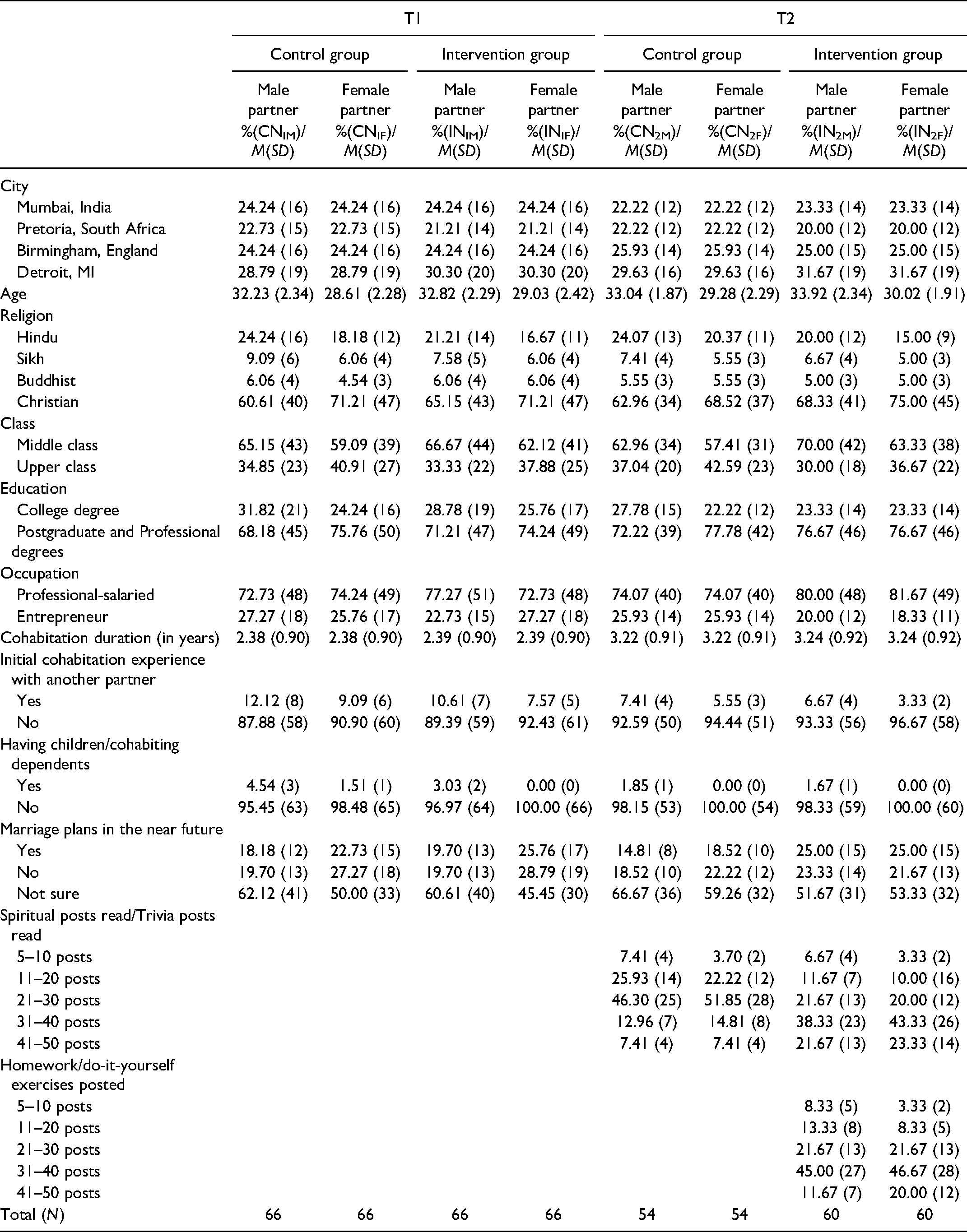
Chi-squared tests indicated that there were no significant differences between the intervention and control group dyads on all socio-demographic and cohabitation characteristics at baseline (p ≥ .23) as well as at T2 (p ≥ .31).
Recruitment
Participants were recruited in the four study sites through friend connections obtained through social networks and social media sites in a snowballing manner. A list of 169 ever-single currently cohabiting heterosexual couples were obtained through this process who were then contacted via email/Facebook Messenger with details of the proposed study and WhatsApp posts. Inclusion criteria were the inclination to participate and commit to using the WhatsApp application with the same contact details for the study duration. Exclusion criteria were any prior advanced knowledge of or participation in spiritual interventions. Through this process 132 cohabitant couples/dyads eventually signed up. The researcher randomized the potential participant dyads into intervention (IN = 66) (WhatsApp spiritual posts) and control (WhatsApp trivia posts) (CN = 66) groups using computer generated random numbers at pretest (T1). Randomization was masked from the potential participants and participation was voluntary and did not entail any monetary cost. Posttest (T2), 60 (IN) cohabitant couples remained with the intervention (dyads’ reasons for attrition: cohabitation dissolution = 2; not interested = 4) and 54 (CN) (dyads’ reasons for attrition: cohabitation dissolution = 3; not interested = 5; no formal response = 4), with the control groups, respectively. Figure 1 depicts the flow of participants through each stage of the study.
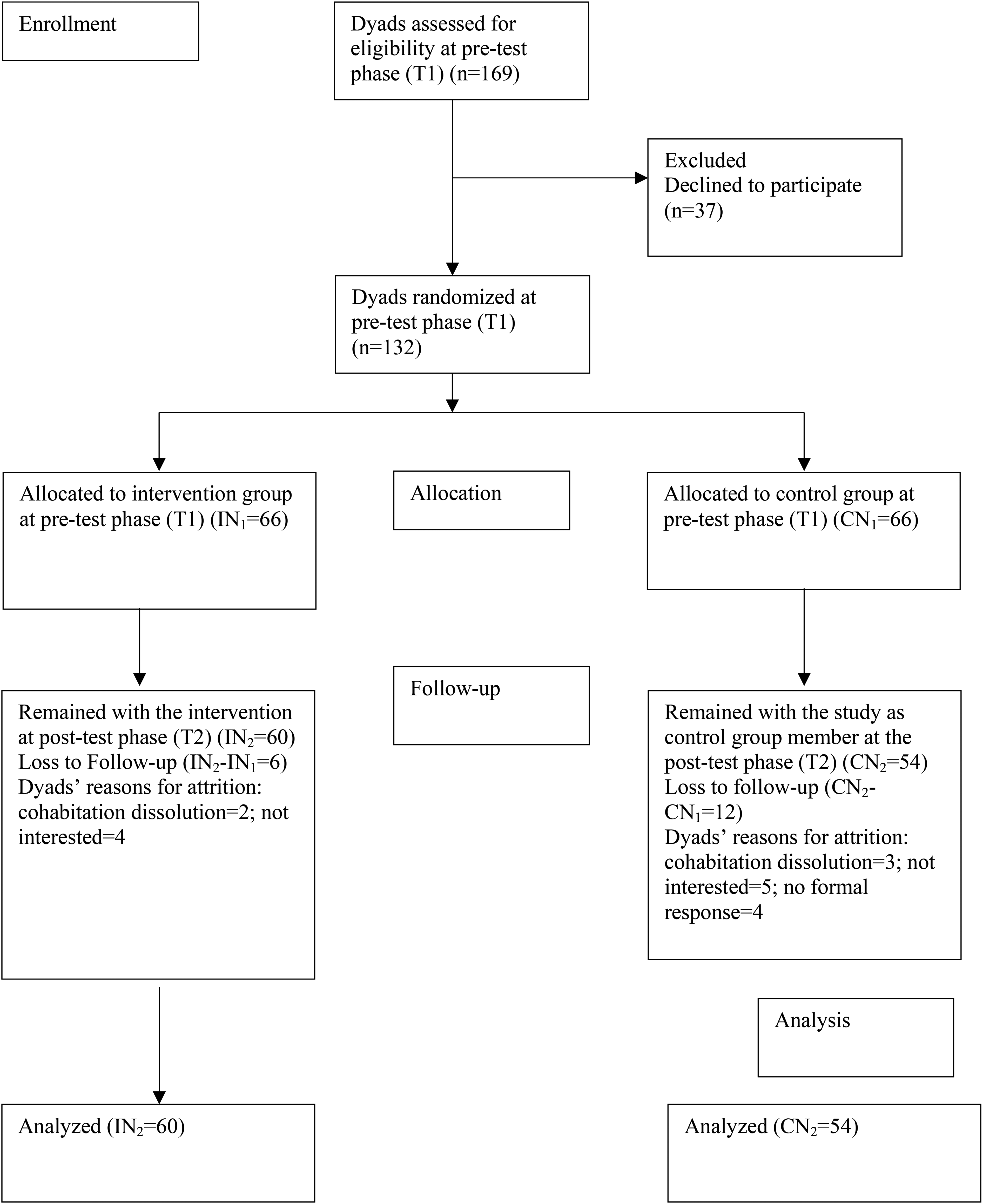
Flow of Participants through Each Stage of the Study.
Informed written consent was obtained from all the study participants. No risks resulting from taking part in the study were identified. There is no registered funder to report for this submission. The study conforms to the norms prescribed by the Declaration of Helsinki, 1975 as amended in 2000, and comparable ethical standards. There are no conflicts of interest to report for this submission.
Measures
T1 and T2 data were collected via online questionnaire administered in English language. Basic socio-demographic and cohabitation details were gathered and outcomes were measured through self-report. WhatsApp posts perused and do-it-yourself exercises done were auto-recorded for the participants in the group administrator's records. Three scales were used to assess the outcomes: inclusion of the other in the self scale (IOSS), relationship assessment scale (RAS), and revised dyadic adjustment scale (RDAS).
The IOSS, developed by Aron et al. (1992), is a unidimensional pictorial measure of perceived interpersonal connectedness in pair-bonded relationships, where respondents choose a picture from an array of seven figures comprising two circles each. Defined through different degrees of overlapping cognitive structures with the other individual, different degrees of such overlap correspond to different degrees of sensed closeness. Scores can range from 1 to 7, with higher scores indicating greater degree of interpersonal closeness or connectedness. The IOSS captures aspects of feeling close and behaving close as per the original validation and owing to its flexibility, has been used cross-culturally to study diverse categories of personal relationships and has good psychometric (Dalsky et al., 2008; Gächter et al., 2015). For the present study: Cronbach's α = 0.93; item-scale intercorrelation = 0.95.
The RAS, developed by Hendrick (1988), is a short seven-item self-report inventory designed to measure relationship satisfaction. Items are scored on a 5-point Likert scale, ranging from 1 (low satisfaction) to 5 (high satisfaction) and two items are reverse-scored. Total scores can range from 7 to 35, average score can be calculated by dividing the total score with the number of items, and higher total or average scores represent higher levels of relationship satisfaction. The RAS has shown good internal consistency and convergent validity in multiple samples (Hendrick et al., 1998; Vaughn & Matyastick Baier, 1999) and has also been used to assess multiple types of close relationships with slight adaptations to the wording (changing words relating to romantic relationships to more generic relations) and demonstrated good psychometric properties (Renshaw et al., 2011). For the present study, the original RAS was used with the following psychometrics: Cronbach's α = 0.93; item-scale intercorrelation range = 0.87–0.92.
The RDAS, developed by Busby et al. (1995), is a 14-item self-report scale with a three-factor structure measuring dimensions of dyadic consensus, dyadic cohesion, and dyadic satisfaction. It is a revised version of the original DAS (Spanier, 1976), which had a four-factor structure (satisfaction, consensus, cohesion, and affectional expression) and 32 items, though several studies later found several items redundant and the affectional expression subscale not producing adequate Cronbach's α scores (Graham et al., 2006). In the RDAS, which has a clearer factor structure, six items measuring dyadic consensus on crucial matters (religious matters and career decisions) are scored on a 6-point Likert-type scale ranging from 0 = always disagree to 5 = always agree. Four items measuring dyadic satisfaction (do you ever regret that you married or lived together?) are scored on a 6-point Likert-type scale ranging from 0 = all the time to 5 = never. Three items measuring dyadic cohesion (work together on a project) are scored on a 6-point Likert-type scale ranging from 0 = never to 5 = more often and one item on dyadic cohesion (do you and your mate engage in outside interests together) is scored on a 5-point Likert-type scale ranging from 0 = never to 4 = all the time. Subscale scores ranges are as follows: dyadic consensus = 0–30; dyadic satisfaction = 0–20; dyadic cohesion = 0–19; and total RDAS scores range from 0 to 69, with higher scores indicating greater dyadic adjustment. The RDAS has good psychometric properties including internal consistency, test–retest reliability, validity, and cross-cultural applicability (Crane et al., 2000; Hollist et al., 2012). For the present study: Cronbach's α = 0.89; item-scale intercorrelations range = 0.79–0.88.
Intervention and Procedure
The WhatsApp group spiritual posts intervention and the trivia posts control condition were conceived through a webinar with two spiritual trainers associated with transnational spiritual organizations and two social workers with experience in couple counselling. Both the programs were planned in a 50-posts format to be posted by the group administrator once a week. The spiritual posts intervention also had an additional component of do-it-yourself exercises to be posted by the participants once a week prior to the next administrator post. The group administrators for the spiritual posts were the spiritual trainers and for the trivia posts were the social workers. Frequency of reading of the posts by the participants and posting of homework exercises were auto-recorded on the group and accessible by the researcher. Figures 2 and 3 give details of the spiritual and trivia posts including apparatus, duration, repertoire, and homework recommendations.
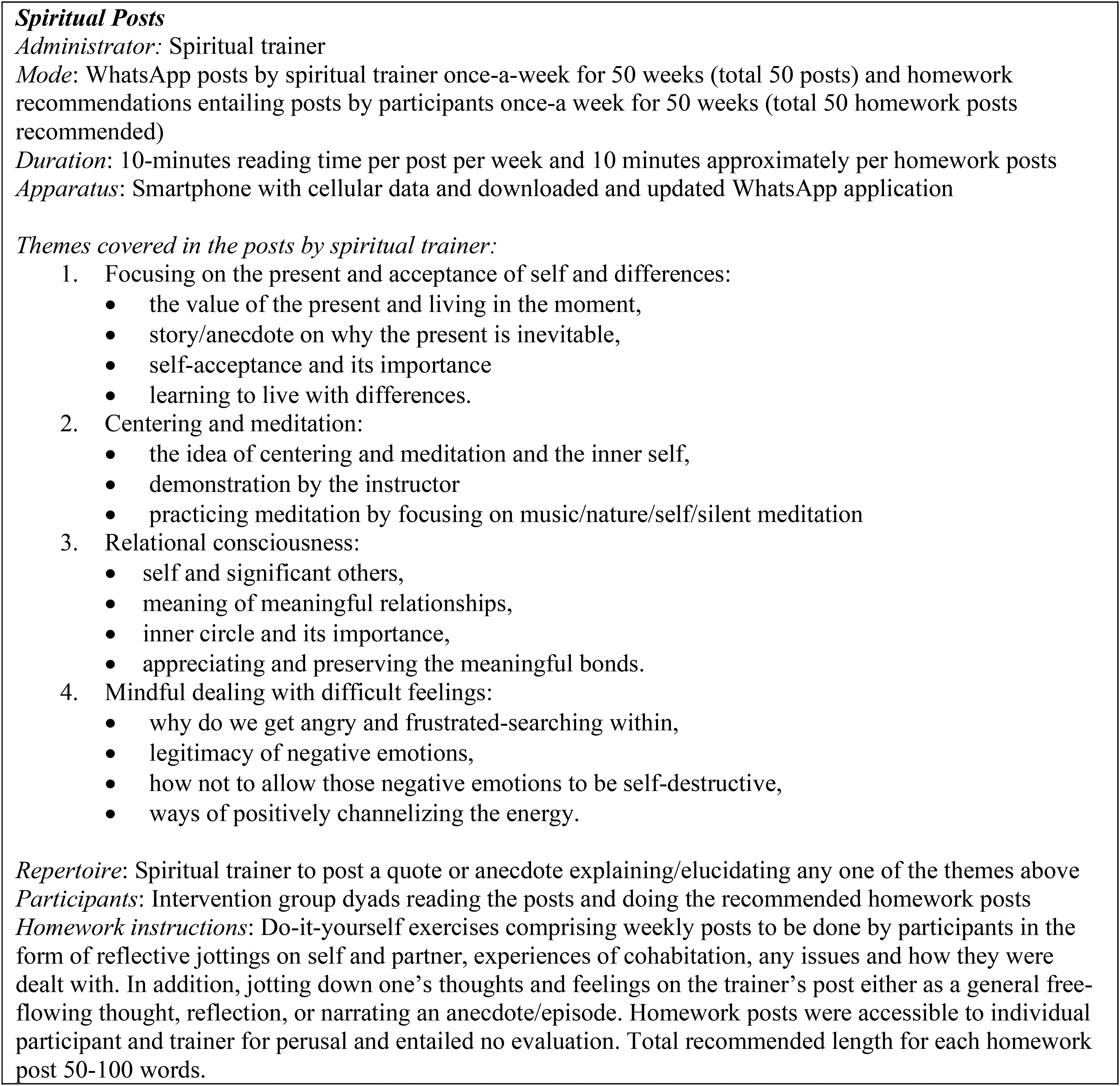
Spiritual Posts.
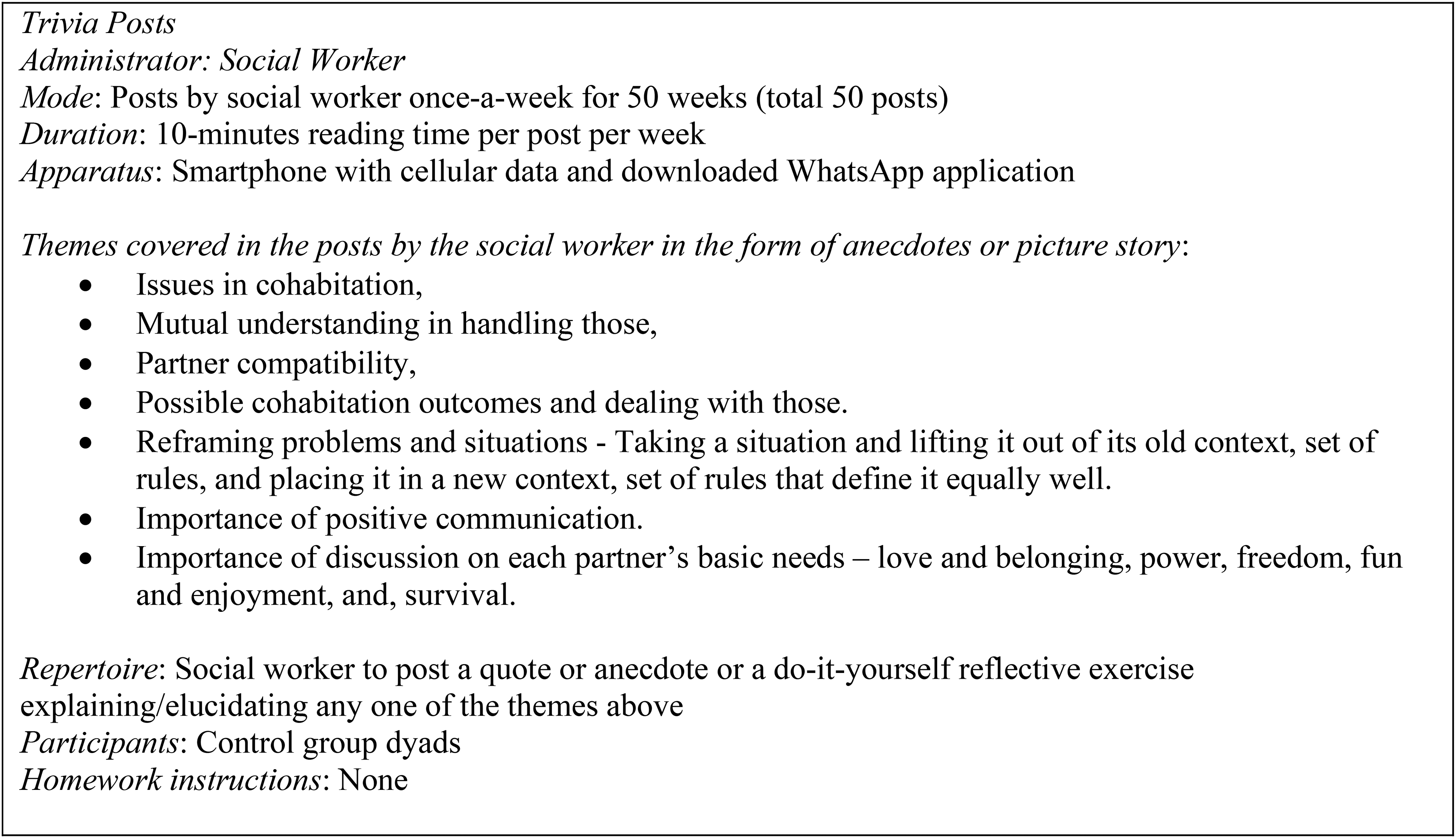
Trivia Posts.
T1 data were collected online at the commencement of the study (year 2017) and T2 data were collected at the end, and within 2 weeks of completion (year 2018). The spiritual trainers and social workers were offered Amazon gift vouchers (USD 25) as a token of appreciation for their honorary contribution. The two spiritual trainers were in their 40s, one male and one female, middle class, with postgraduate degrees/formal qualifications, one Hindu and one Christian, associated with transnational spiritual organizations for 14–15 years, and having undergone trainers training programs to develop and deliver spiritual training programs. The two social workers were, in their 40s, one male and one female, middle class, with postgraduate degrees in counselling, one Hindu and one Christian, and associated with counselling services for 14–15 years.
Statistical Methods
To test the first hypothesis, outcome scores of the control and intervention group dyads were compared at baseline and T2 and effect sizes were measured using Cohen's d statistics. Group × Time interactions were assessed through mixed-design two-way analysis of variance (ANOVA). To test the second hypothesis, significant main effects and predictors of gain scores were assessed through multivariate analysis of variance (MANOVA); Kruskal–Wallis nonparametric tests and Bonferroni adjusted alpha levels were used to investigate the independent, pairwise, and combined effects of significant predictors on changes in outcomes. Actor–partner interdependence models (APIM) examined the mutually interdependent effects on outcomes, to test the third hypothesis. In the APIM, the analytic focus is on the assessment of bidirectional effects (b coefficient and t) and hence the current models were compared to a saturated model (assuming that all variables were correlated), with best fit indices (root mean square error of approximation (RMSEA) < 0.05; confirmatory fit index (CFI), Tucker-Lewis index (TLI) > 0.95; and standardized root mean squared residual (SRMR) < 0.08). To test the fourth hypothesis, Tobit regression models estimated the T2 outcomes using the strongest predictors as explanatory variables. The measurement accuracy of the models was estimated through Akaike information criterion (AIC), Bayesian information criterion (BIC), and the relative size and significance of individual parameter estimates (i.e., RMSE and sigma) in the second part of the two-part models.
Results
The intent-to-treat analyses compare outcomes of dyads at T1 and T2 and examine predictors of T2 changes or gains in outcomes for actors (male partners) and partners (female partners) in the dyad and the mutual interdependence.
IOSS, RAS, and RDAS Scores
Baseline Comparisons and Posttest Effects
Table 2 indicates that the control and intervention group outcome measure scores were equal at baseline, with no significant difference at T1 (p = .67–.95; d = 0.01–0.07). There was no significant difference in the T2 outcome measure scores of the control group (p = .08–.90; d = 0.02–0.33). T2 IOSS scores of the intervention group dyads were higher than the control group (p ≤ .001; d = 3.32–3.56) and their own T1 scores (p ≤ .001; d = 3.12–3.51). T2 RAS scores of the intervention group dyads were higher than the control group (p ≤ .01; d = 2.61–2.75) and their own T1 scores (p ≤ .01; d = 2.90–2.99). T2 RDAS scores of the intervention group dyads were higher than the control group (p ≤ .01; d = 3.24–3.40) and their own T1 scores (p ≤ .01; d = 3.12–3.80).
Effects of Control and Intervention Conditions on Control and Intervention Dyads.
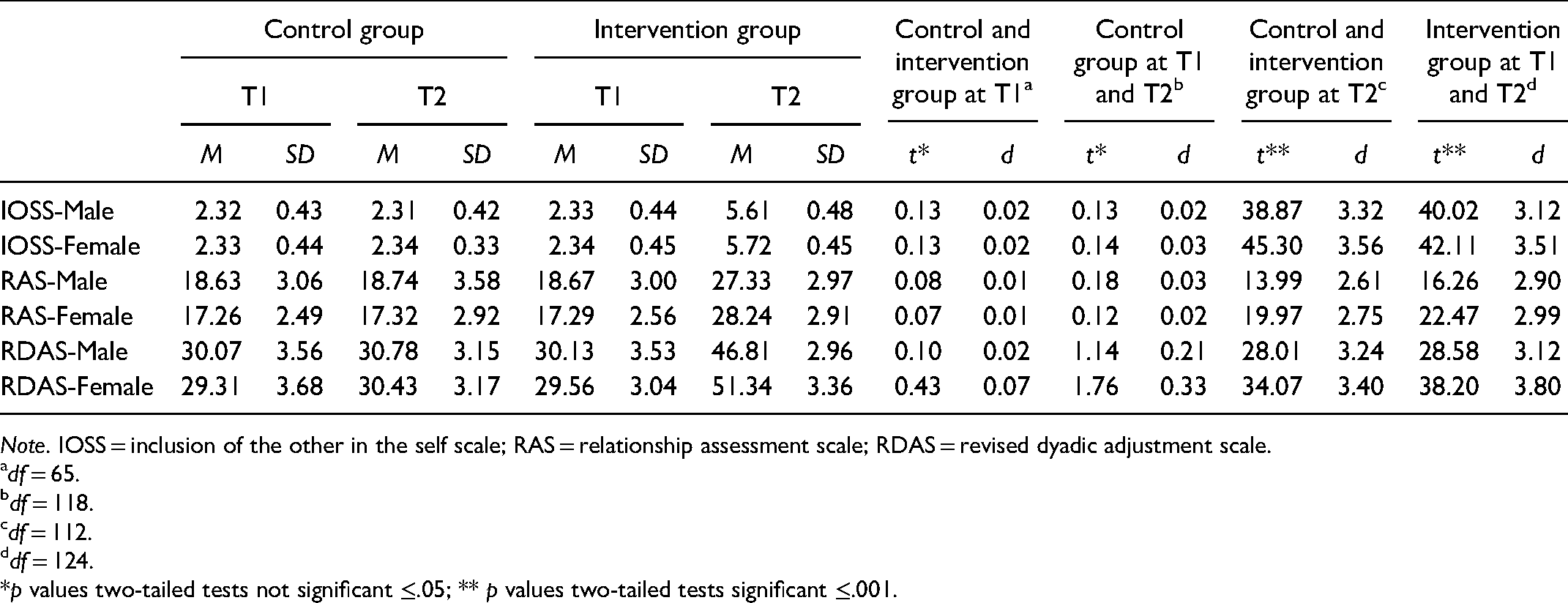
Note. IOSS = inclusion of the other in the self scale; RAS = relationship assessment scale; RDAS = revised dyadic adjustment scale.
df = 65.
df = 118.
df = 112.
df = 124.
*p values two-tailed tests not significant ≤.05; ** p values two-tailed tests significant ≤.001.
Group × Time Interactions
Results of the mixed-design two-way ANOVA indicated that there were some significant interaction effects between time points and groups on outcome measures. The Mauchly's tests were nonsignificant and hence the assumption of sphericity was met. There were no significant interaction effects between the T1 scores of the control and intervention groups and between T1 and T2 scores of the control group (all p ≥ .05, ηp2 ≤ 0.001). There were significant interactions between T2 IOSS (F (1, 112) = 56.78, p = .02, ηp2 = 0.66), RAS (F (1, 112) = 71.32, p = .01, ηp2 = 0.69) and RDAS (F (1, 112) = 83.22, p = .01, ηp2 = 0.76) scores of the intervention and control group male partners. There were significant interactions also between the TI and T2 IOSS (F (1, 124) = 56.09, p = .02, ηp2 = 0.67), RAS (F (1, 124) = 69.35, p = .02, ηp2 = 0.66) and RDAS (F (1, 124) = 79.63, p = .01, ηp2 = 0.70) scores of the intervention group male partners. There were significant interactions between T2 IOSS (F (1, 112) = 69.03, p = .02, ηp2 = 0.69), RAS (F (1, 112) = 76.88, p = .01, ηp2 = 0.72) and RDAS (F (1, 112) = 79.85, p = .01, ηp2 = 0.71) scores of the intervention group female partners. There were significant interactions also between T1 and T2 IOSS (F (1, 124) = 68.34, p = .02, ηp2 = 0.68), RAS (F (1, 124) = 72.35, p = .01, ηp2 = 0.69) and RDAS scores of the (F (1, 124) = 71.22, p = .02, ηp2 = 0.68) intervention group female partners.
Simple Main and Interaction Effects at Different Time Points Within Each Group
Analyses of variance indicated that at T1 and T2 for the control group and at T1 for the intervention group, the main effects of the following socio-demographic variables were significant: class, education, occupation. Post-hoc analyses using Tukey's honestly significant difference (HSD) indicated that within the control group, the TI and T2 outcome scores were higher for middle class, highly qualified (postgraduate and professional degrees) and professional-salaried male and female partners. This was in comparison with upper class, less qualified (college degree) and male and female partners working as entrepreneurs (p = .01–.03, ηp2 = 0.62–0.78). This was also so for the T1 scores of the intervention group dyads (p ≤ .05, ηp2 ≥ 0.50). All other main and interaction effects were nonsignificant (p ≥ .09, ηp2 ≤ 0.01).
Group Differences Posttest and Main Effects
At the posttest phase (T2), when the intervention and control group had significant differences on all outcome measures, the main effects of class, education, and occupation continued to be significant. In addition, the main effects of religion, spiritual posts read and do-it-yourself exercises posted, were significant. Post-hoc analyses using Tukey's HSD indicated that T2 connectedness, relationship satisfaction, dyadic consensus, and cohesion outcomes were higher for male and female partners who were Christians, middle class, highly qualified, professional-salaried, who perused at least 31 spiritual posts (62%) and posted 31 or more do-it-yourself exercises. This was in comparison with male and female partners who were Hindus–Sikhs–Buddhists, upper class, less qualified, entrepreneurs, who perused fewer posts (5–30) and posted fewer do-it-yourself exercises (5–30). All other main effects were nonsignificant.
Predictors of T1 → T2 Gains or Changes in Outcomes: Multivariate Analyses
To investigate the T1→T2 changes or gains in outcome measures, the T1 and T2 scores were further subjected to a MANOVA with six predictor variables: religion, class, education, occupation, spiritual posts read, and do-it-yourself exercises posted. These significant main effects were further examined through nonparametric testing (Kruskal–Wallis). The interactions between socio-demographic (religion, class, education, and occupation) and intervention adherence/compliance (spiritual posts read and do-it-yourself exercises posted) related variables, were significant (Roy's largest root range = 0.0716238–0.0889362, p = .01–.02, ηp2 range = 0.66–0.79).
Kruskal–Wallis tests were further conducted using Bonferroni adjusted alpha levels at 0.0833 per test (0.05/6). The independent and pairwise combinations of socio-demographic and intervention compliance-related predictors were significant. Further, their combined effects were also significant. T2 IOSS scores of the male partners were higher under all the more significant predictors combined (Christians, middle class, highly qualified, professional-salaried, 62% and above intervention compliance) as compared to less significant predictors (Hindus–Buddhists–Sikhs, upper class, less qualified, entrepreneurs, lower intervention compliance), F (5, 48) = 78.92, p = .02, ηp2 = 0.64. Similarly, T2 IOSS scores of the female partners were higher under all the more significant predictors combined as compared to less significant predictors, F (5, 48) = 76.74, p = .02, ηp2 = 0.62. This was also so for RAS scores of male partners (F (5, 48) = 87.32, p = .01, ηp2 = 0.72) and female partners (F (5, 48) = 85.28, p = .02, ηp2 = 0.68), and RDAS scores of male partners (F (5, 48) = 83.44, p = .01, ηp2 = 0.75) and female partners (F (5, 48) = 79.21, p = .01, ηp2 = 0.70).
Actor–Partner Interdependence Effects
The actor effects in the present study estimate the link between significant socio-demographic variables of male partners (actors) in nonmarital cohabitation at T1 and additionally the intervention compliance variables at T2, and the phase-wise outcomes, while controlling for female partners’ (partners) demographic, cohabitation, and intervention compliance variables and corresponding outcomes and vice versa. The partner effects estimate the link between male partners’ T1 and T2 outcomes and female partners’ T1 and T2 outcomes.
Prior to conducting the main set of analyses, correlation between male and female partners’ intervention compliance variables and outcomes were computed to assess the degree of interdependence between participation in the intervention and outcome scores. Partner score correlations were significant at p ≤ .01 on all of the variables: spiritual posts read r = .72; do-it-yourself exercises posted r = .78; IOSS score male partner T1 r = .72, T2 r = .76; IOSS score female partner T1 r = .73, T2 r = .79; RAS score male partner T1 r = .73; T2 r = .78; RAS score female partner T1 r = .76, T2 r = .81; RDAS score male partner T1 r = .72; T2 r = .79; RDAS score female partner T1 r = .75, T2 r = .82.
Estimates of actor and partner effects were derived using the pooled multiple regression approach in which two equations are computed, one using the averaged scores of male and female partners and another using the difference scores of the predictors and each outcome, and employed to derive each estimate (Kenny et al., 2006). The predictors were suitably recoded into binary/dummy variables for the partner effects analyses.
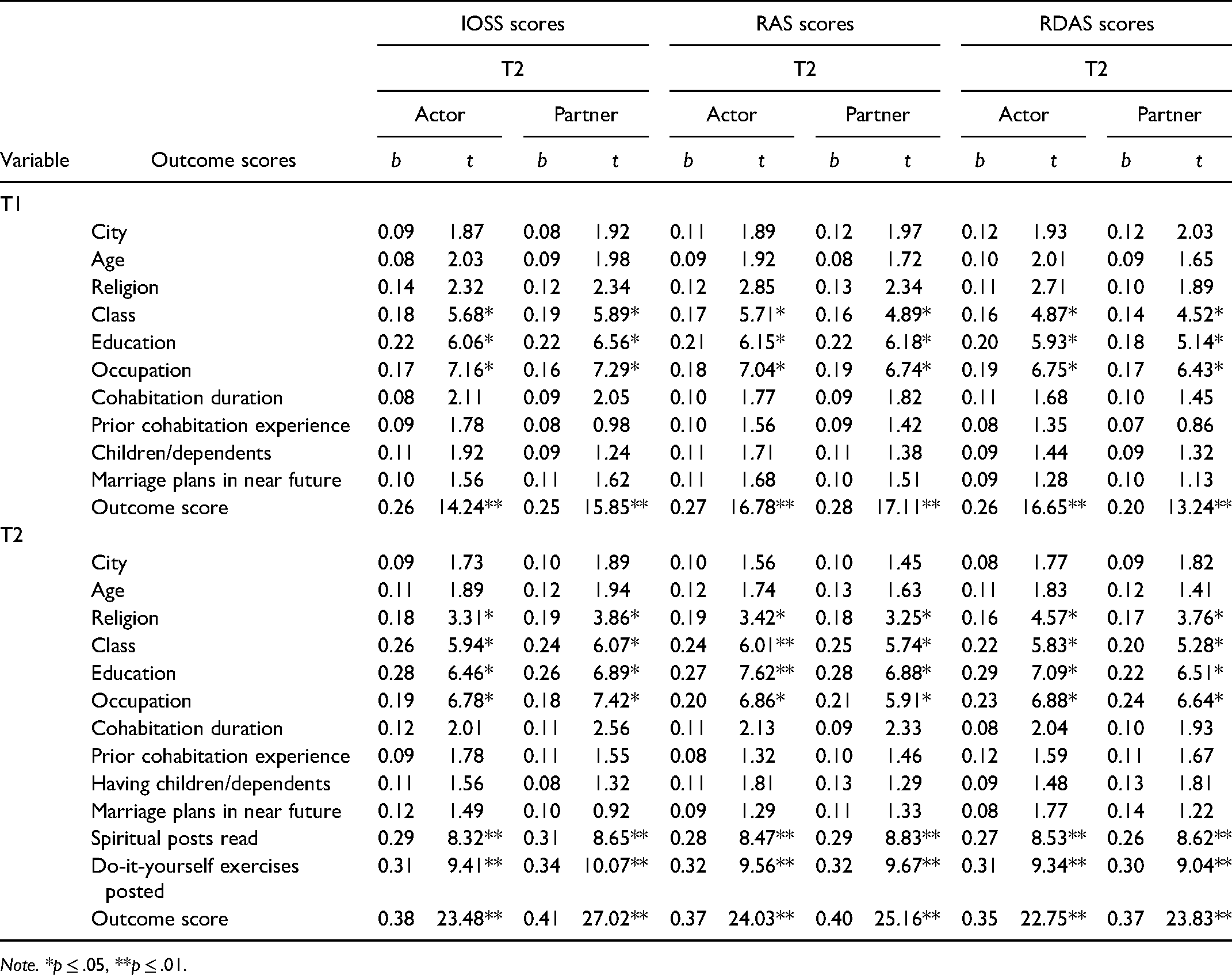
Table 3 reports the results of the APIM analyses of the association between IOSS, RAS, and RDAS scores of the male and female nonmarital cohabitant partners, the significantly associated predictors at both phases (T1 and T2) that impact the outcomes and interdependence. Hypothesis 3 is supported by the results: T2 increase in IOSS, RAS, and RDAS scores of actors (male partners) was positively associated with an increase in corresponding T2 outcomes of partners (female partners).
Actor–Partner Effects with Socio-Demographic Variables on Outcome Scores by Time Period (IN1 = 66; IN2 = 60).
Note. *p ≤ .05, **p ≤ .01.
Table 3 also indicates that at T1, class, education, and occupation of the actors and partners were significantly associated with respective and interdependent IOSS, RAS, and RDAS scores. At T2, religion, class, education, occupation, spiritual posts read, and do-it-yourself exercises posted had a significant association with outcome scores of actors and partners. Specifically, higher intervention compliance was positively associated with connectedness, relationship and dyadic satisfaction, dyadic consensus, and cohesion. Moreover, female partners in nonmarital cohabitation whose male partners had higher intervention compliance were more likely to have higher compliance themselves. The combined actor and partner effects at T1 accounted for 46% (R2 = .46, p ≤ .01) variance in all the three outcomes. The combined actor and partner effects at T2 accounted for 74% (R2 = .72, p ≤ .01) variance in all the three outcomes.
Estimating the T2 Outcomes: Tobit Models
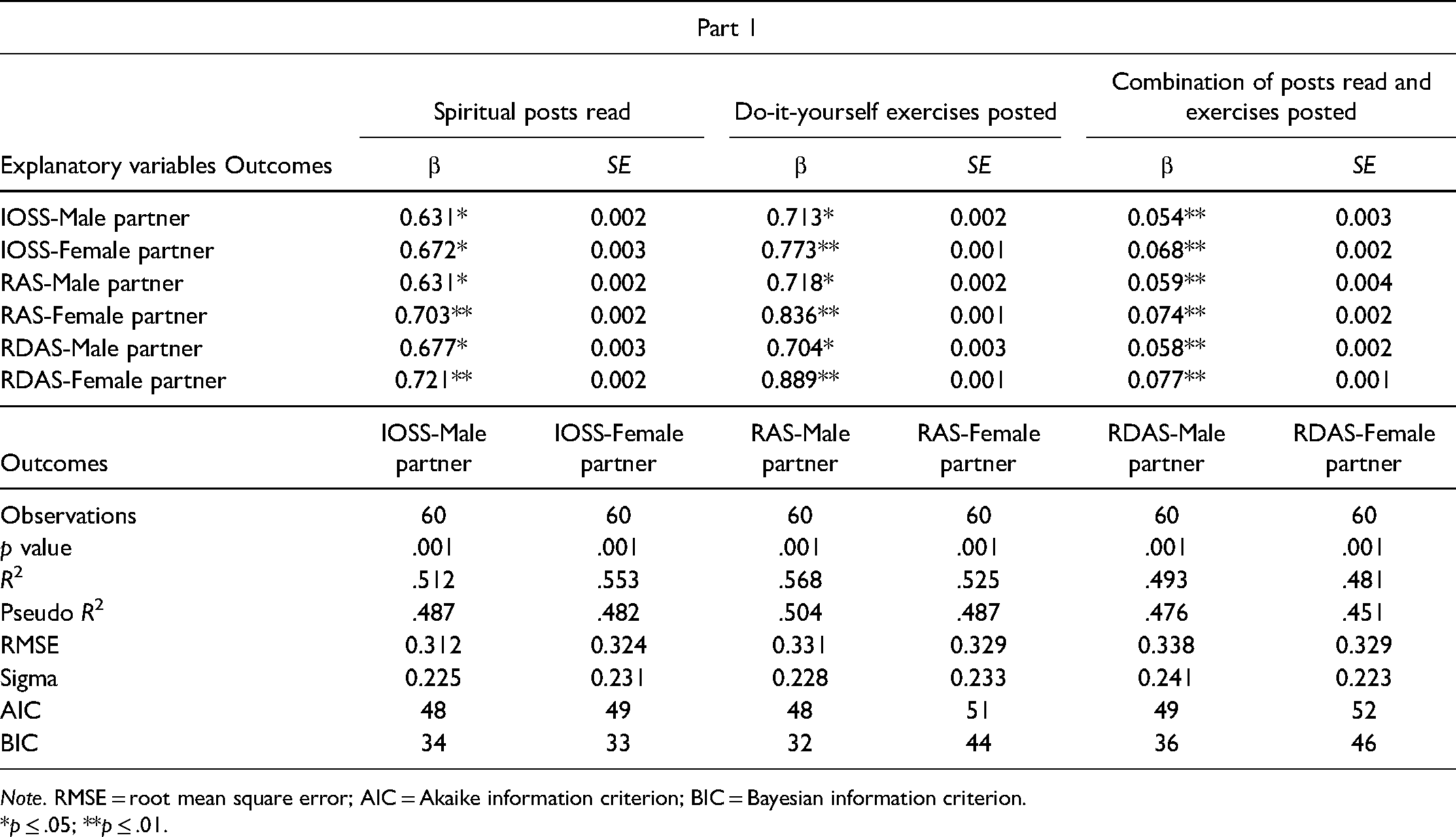
Table 4 presents the relationship between spiritual posts read and do-it-yourself exercises posted and the relationship quality outcomes of the dyads using Tobit models. Sigma is lower than RMSE, thereby indicating that the Tobit models are accurate in the estimation. The AIC and BIC figures indicated that the models provided a good fit. Spiritual posts read predicted statistically significant increase in IOSS (β = 0.631), RAS (β = 0.631), and RDAS (β = 0.677) scores of male partners; do-it-yourself exercises posted predicted statistically significant increase in IOSS (β = 0.713), RAS (β = 0.718), and RDAS (β = 0.704) scores of male partners; and, the combined effects of spiritual posts read and do-it-yourself exercises posted led to corresponding statistically significant increase in IOSS (β = 0.054), RAS (β = 0.059), and RDAS (β = 0.058) scores of male partners. Spiritual posts read predicted statistically significant increase in IOSS (β = 0.672), RAS (β = 0.703), and RDAS (β = 0.721) scores of female partners; do-it-yourself exercises posted predicted statistically significant increase in IOSS (β = 0.773), RAS (β = 0.836), and RDAS (β = 0.889) scores of female partners; and, the combined effects of spiritual posts read and do-it-yourself exercises posted led to corresponding statistically significant increase in IOSS (β = 0.068), RAS (β = 0.074), and RDAS (β = 0.077) scores of female partners. Hence, as expected, the predicted IOSS, RAS, and RDAS scores of the male and female partners increased with greater number of spiritual posts read and do-it-yourself exercises posted and the increase were statistically significant. Outcome scores increased for most participants who posted higher number of do-it-yourself exercises, indicating that it tended to have the largest positive impact. This was followed by spiritual posts read.
Tobit Regression Models: Estimating the Outcome Scores.
Note. RMSE = root mean square error; AIC = Akaike information criterion; BIC = Bayesian information criterion.
*p ≤ .05; **p ≤ .01.
Discussion and Conclusion
Results support the initial hypotheses. Spiritual posts on the WhatsApp group were more effective for couples in nonmarital cohabitation in promoting interpersonal connectedness, relationship satisfaction, and dyadic adjustment as compared to trivia posts, which adds to intervention research with cohabitants (Gold, 2012; Rhoades et al., 2009), and spirituality for relationship interventions (Mahoney & Boyatzis, 2019). Online spiritual interventions and mobile application based program for behavioral interventions are also supported (Raviola et al., 2019; Trompetter et al., 2014).
At the point of no intervention, middle class cohabitants, highly qualified and professionals-salaried dyads were better connected and adjusted as compared to the upper class, with college degree (less qualified) and entrepreneurs (self-employed). This affirms previous cohabitation research that indicates education and social class advantage as significant predictors of cohabitation satisfaction and outcomes (Wright, 2019). Middle-class nonmarital cohabitants were better adjusted than the upper class. This is at once emblematic of the growing trends of cohabitation norms (Brown et al., 2017; Lamidi et al., 2019) that may make it routine to global city-dwelling middle-class realities, and also signals the need to relook at upper class or affluent peoples’ lifestyles, forms of partnerships, and adaptations.
Postintervention, religion, class, education, and occupation of dyads were significant moderators in addition to intervention compliance. However, and contrary to existing research (Lavner et al., 2020; Perelli-Harris, 2014; Perelli-Harris et al., 2012), cohabitation duration, initial cohabitation experience with other partners, having children/cohabitation dependents, and near future marriage plans were not significant predictors. One explanation could be a smaller or negligible proportion of participants who responded in the affirmative to the said indicators/characteristics. However, a culture-specific investigation is needed, controlling for and/or taking into account some of these confounders. Further, results here also did not find any intrapartner or gender differences in cohabitation experiences (connectedness and adjustment) as indicated in earlier studies (Jackson et al., 2015; Manning & Cohen, 2012). Gender also did not significantly moderate spiritual intervention responses as proposed in previous research, as no significant differences between male and female partners were found (Rojiani et al., 2017). Although this could signal yet another transformation in cohabitations, mobile application as a medium of intervention may also have played a role in reaching out better (access) (Raviola et al., 2019) and possibly also eradicate gender differences in treatment response.
Spiritual posts were more effective for Christian couples, middle class, highly qualified, and professionals-salaried cohabitants. This was in comparison with Hindu–Buddhist–Sikh dyads, upper class, with college degree and entrepreneurs. This may be explained to some extent by the arguments of cultural familiarity (Woods-Giscombé & Gaylord, 2014), and advantages in education and class being bolsters, both for intervention response (Sauer et al., 2013) as well as in making the nonmarital cohabitation relationship work (Wright, 2019). There is no sufficiently convincing explanation as to why Christian cohabitants responded better than Hindus, Sikhs, and Buddhists, but the speculation could be strengthened if further details on religious participation (public and private) were also gathered (see Krause et al., 2002). Further, in support of previous research, couple intervention outcomes were mutually interdependent (Sillars et al., 2001) and intervention compliance variables were robust predictors of intervention success (Carmody & Baer, 2009; Parsons et al., 2017).
Overall, results show some promise, however, the study has some of the following limitations. The outcome measures are self-report, which has an inherent bias and lacks the robustness of researcher and/or objectively assessed outcomes. The control condition of trivia posts is an inadequate comparison situation, as the content, nature, and quality of such posts may not be comparable with a tailored spiritual intervention. This ambiguity in the control factor may make it difficult to conclude that the changes/gains in relationship quality outcomes for nonmarital cohabitants were due to the intervention alone. Moreover, in a mobile application-based intervention in the real world, it is not always possible to clearly demarcate control and intervention conditions as posts may reach several recipients through mutual and group forwarding facilities. To some extent, this was addressed by security features such as login keys and passwords, but potential confounders such as external posts and multiple group memberships cannot be completed ruled out. Certain other intervening variables that may have effected intervention compliance and outcomes need to be factored into future research such as significant life-course events, accidental pregnancies, economic factors, and stability or otherwise of residential premises.
Implications and Applications
With adequate emphasis on intervention compliance, WhatsApp group spiritual posts would be an effective spiritually-sensitive social work intervention for improving the relationship quality of nonmarital cohabitants. Some modifications may be needed for non-Christians, upper-class dyads, less qualified, and entrepreneurs. Refinements may include adding culturally familiar spiritual tenets, taking into consideration upper-class realities and corresponding complications having a psychosocial impact, such as class demonstration effect and serial cohabitations, simpler instructions and content for the less qualified, and flexible compliance demands for those who are entrepreneurs by profession.
Footnotes
Declaration of Conflicting Interests
The author declared no potential conflicts of interest with respect to the research, authorship, and/or publication of this article.
Funding
The author received no financial support for the research, authorship, and/or publication of this article.
