



Abstract
The restrictions imposed by the COVID-19 pandemic have required program planners to re-evaluate the provision of relationship education (RE). The current mixed-methods study focuses on the Healthy Relationships [State] initiative's transition from in-person to virtual online RE programing, measuring program impact and comparing the outcomes between the two delivery methods for individuals participating in Couple LINKS, a curriculum designed for adults in committed relationships. Comparisons between delivery methods revealed that in-person participants showed greater gains than virtual participants on key program measures; however, the outcomes were positive for all. Qualitative responses of virtual participants revealed what they liked most and liked least about the virtual format, citing their appreciation for the curriculum, the opportunity to develop new skills, facilitator quality, online accessibility, and couple time. Schedule conflicts and uneven course pacing, reference materials, technology, and sharing personal information were listed as things participants liked least about the virtual program. Implications for the future delivery of RE programs are discussed.
Relationship education (RE) is designed for individuals, couples, and families as a tool to develop healthy relationship skills and to promote personal, family, and child well-being (Markman & Rhoades, 2012). Traditionally delivered in-person, RE has become increasingly available in online formats as a way to make programs more accessible (Georgia & Doss, 2013; Turner et al., 2019). Research comparing the outcomes between in-person and online RE programs is somewhat limited (Braithwaite & Fincham, 2009, 2011; Roddy et al., 2018), and very few studies have compared the outcomes of these delivery methods in the midst of a crisis that forced the reorganization of program delivery (Higginbotham, Turner, & Bradford, 2021).
In this study, we discuss the transition made by the Healthy Relationships [State] initiative from in-person to virtual RE programing in light of restrictions imposed by the COVID-19 pandemic. Specifically, we examine the initiative's delivery of Couple LINKS (Van Epp, 2014), a curriculum designed for adults in committed relationships. A mixed-methods approach was applied to: (a) measure overall program outcomes, (b) compare outcomes by delivery method (in-person vs. virtual), and (c) qualitatively examine what virtual participants liked most and liked least about the virtual RE course in which they participated. A mixed-methods approach allows researchers to identify possible similarities and differences between quantitative and qualitative results, while helping to give voice to program participants, to gain a greater perspective on their point of view (Wisdom & Creswell, 2013). The lessons learned from this approach may be useful in informing the field as best practices are developed and the feasibility of dual-delivery models is explored.
Literature Review
Relationship Education
Relationship education (RE) has continued to grow as a way to promote personal, family, and child well-being and the development of healthy relationship skills (Markman & Rhoades, 2012). RE programing has been designed to improve relationships among a wide range of audiences, including youth and single adults (Van Epp, 2015), couples and parents (Cline & Fay, 1990; Van Epp, 2014), fathers (Brown et al., 2018; Van Epp, 2016), stepfamilies (Authors), and divorcing parents (Brotherson et al., 2012; Feng & Fine, 2001). RE takes place in a variety of venues outside of traditional educational settings, including community workshops or in-home sessions facilitated by family life educators (Allen, 2013; Darling & Cassidy, 2014).
RE programs are typically research-based and designed around standardized curricula (Markman & Rhoades, 2012). RE programing has been associated with improved relationship quality and effective communication skills (Hawkins et al., 2008). An initial evaluation of the Couple LINKS program, delivered in-person, found it to be effective in improving relationship knowledge, commitment, and communication (Crapo et al., 2019).
Online Relationship Education
With the growth of RE programs, a wide range of online RE programs have become increasingly available, including computer, web-based, and virtual formats (Georgia & Doss, 2013; Turner et al., 2019). Proponents of online RE argue that virtual formats facilitate greater privacy and more convenient participation for those with barriers to in-person RE, such as childcare arrangements, work schedules, and other logistical and socioeconomic concerns (Roddy et al., 2018; Townley & Yalowich, 2015).
Online RE for couples has been found to have mainly positive impacts (Braithwaite & Fincham, 2007, 2009, 2011, 2014; Georgia & Doss, 2013; Georgia Salivar et al., 2018; Nadan et al., 2020; Roddy et al., 2017; Roddy et al., 2018; Simpson & Reid, 2014). Still, it is important to note variations in approaches, which range from self-guided, asynchronous programs (Braithwaite & Fincham, 2007, 2009, 2011, 2014), a blend of synchronous and asynchronous delivery (Doss et al., 2019; Georgia Salivar et al., 2018; Roddy et al., 2017), or purely synchronous delivery, as evaluated in this current study.
In their series of evaluations of the ePREP program, Braithwaite and Fincham (2007, 2009, 2011, 2014) found that participants in this self-guided, asynchronous program showed improvements in relationship-relevant variables when compared to control groups. With the exception of their 2014 study, which focused on married couples, participants in Braithwaite and Fincham's work (2007, 2011) involved college-aged, young adults in dating relationships. Highlights from these studies demonstrated that participating in ePREP was associated with declines in physical and psychological aggression for married couples (Braithwaite & Fincham, 2014), while college-aged participants reported better relationship functioning at follow-up (Braithwaite & Fincham, 2011).
More recent research has also shown positive outcomes for online RE programs. In their evaluation of the OurRelationship program, which focused on RE for traditionally underserved couples through a blend of synchronous and asynchronous delivery, Georgia Salivar et al. (2018) found similar positive outcomes for underserved couples when compared to couples that were not underserved. The researchers concluded that online RE may be a viable option for reaching traditionally underserved populations, be they rural, low-income, or members of minority groups (Georgia Salivar et al., 2018). Doss et al. (2019) subsequently showed that online participants maintained gains in relationship satisfaction, relationship confidence, and relationship quality through 12 months.
The aforementioned research illustrates the variety of approaches to online RE programs. The largely positive outcomes of these programs may provide further impetus for online and virtual RE, especially when considering the ability of such programs to reach isolated and historically underserved groups (Braithwaite & Fincham, 2007; Georgia Salivar et al., 2018; Roddy et al., 2018). However, with the further evolution of online RE programs, practitioners have called for continued research on program effectiveness (Caldwell et al., 2017).
Current Study
There is limited research that compares the impact of in-person versus online RE programing for couples (Braithwaite & Fincham, 2009, 2011; Roddy et al., 2018). Even fewer studies have compared the outcomes of these delivery methods in the midst of crises, such as the COVID-19 pandemic, that forced the reorganization of program delivery in the middle of a program year (Higginbotham et al., 2021). Greater knowledge of these outcomes may inform program planners on best practices moving forward, while evaluating the feasibility of a dual-delivery (in-person and virtual) approach to RE. To address these issues, our mixed-methods approach addressed the following questions:
What were the overall outcomes of the Couple LINKS program? How did in-person and virtual participants compare on key program measures? What did virtual participants like most and like least about the virtual RE format?
Methodology
Program Description and Procedure
Couple LINKS is a six-hour curriculum based on the Relationship Attachment Model (RAM). The program addresses five components of a committed relationship: (a) knowledge and understanding of healthy relationships (Knowledge), (b) openness in communication with one's partner (Disclosure), (c) the perceived importance of recognizing and meeting a partner's needs (Meeting Needs), (d) commitment to a partner and the relationship (Commitment), and (e) openness to physical intimacy (Touch) (Van Epp, 2014). As part of the Healthy Relationships [State] initiative, courses were facilitated in-person by [State] University extension educators from July 2019 to March 2020. Once statewide COVID-19 restrictions were imposed, courses transitioned to virtual classrooms, which continued from April to June 2020. Virtual courses mirrored in-person courses in terms of content, group format, and scheduling, with the only difference being that participants met in a virtual classroom via Zoom technology.
Data and Sample
Participants consisted of adults in romantic relationships (i.e., married, engaged, or dating), who completed the Couple LINKS course (n = 187). Completers, for purposes of this study, were those participants who provided data for both pretest and posttest surveys. Participants were grouped by delivery method: (a) in-person (n = 64; 34%) or (b) virtual (n = 123; 66%). Average participant age was 38.46 years (SD = 11.38) and 57% of the overall sample was between the ages of 25 and 44; 54% were female; 92% were White; 7.5% were Hispanic; 56% had completed a Bachelor's degree or higher; 30% reported annual incomes of less than $20,000; 88% were married; and 49% had three or more children. Full descriptive statistics for the overall sample and each sample group are presented in Table 1. Group comparisons revealed that participant demographics did not differ, with the exception of education. Virtual participants reported higher levels of education than in-person participants.
Participant Characteristics (n = 187).

Quantitative Measures
Quantitative measures reflected the five components of the RAM model:
Alpha reliability coefficient levels for some measures were lower than traditionally desirable levels (e.g., Tavakol & Dennick, 2011). This is common in measures with lower numbers of items (Cortina, 1993). Further, lower alpha reliability coefficient levels are often deemed acceptable for exploratory research in general (Lance et al., 2006), specifically for exploratory research pertaining to RE for couples (Crapo et al., 2019).
Qualitative Measures
At posttest, participants responded to a series of open-ended items. The current study focused on what virtual participants reported in terms of what they liked most and liked least about the virtual format. Qualitative data were analyzed through a phenomenological lens, which typically uses open-ended survey data to achieve greater understanding of individual experience (Creswell, 2013). Phenomenology is couched in social constructivism and is frequently applied when common meanings are of interest to researchers (Creswell, 2013).
To achieve interrater reliability (Gisev et al., 2013), authors analyzed all usable qualitative responses individually to identify statements that described participant experiences, a process Creswell (2013) referred to as horizonalization. For purposes of this study, qualitative responses were considered usable when they allowed for analysis. Therefore, blank responses (i.e., non-responses) and one-word responses were eliminated. Given that qualitative items appeared near the end of the posttest survey, non-responses were attributed to respondent fatigue and omitted from analyses (Porter et al., 2004). Next, statements were grouped and emerging themes within the data were identified (Bogdan & Biklen, 2003). Overlap of major themes were discussed until agreement was achieved.
Quantitative Results
Evaluating Program Impact
Paired-samples t-tests were conducted to examine pretest to posttest changes for the entire sample (see Table 2). Significant increases in Knowledge were identified from pretest (M = 3.45, SD = .63) to posttest (M = 3.94, SD = .61), t = −10.37, p = .000, d = .78. Significant increases occurred in Disclosure from pretest (M = 4.17, SD = .71) to posttest (M = 4.38, SD = .59), t = −4.71, p = .000, d = .31. Significant increases in Meeting Needs were identified from pretest (M = 4.17, SD = .63) to posttest (M = 4.50, SD = .45), t = −7.76, p = .000, d = .60. Significant increases were recorded for Commitment from pretest (M = 3.90, SD = .65) to posttest (M = 4.29, SD = .56), t = −9.76, p = .000, d = .64. Finally, results revealed increases in Touch from pretest (M = 4.11, SD = .82) to posttest (M = 4.45, SD = .67), t = −6.00, p = .000, d = .45.
Paired-Samples t-Tests for Program Measures among Couple LINKS Completers.
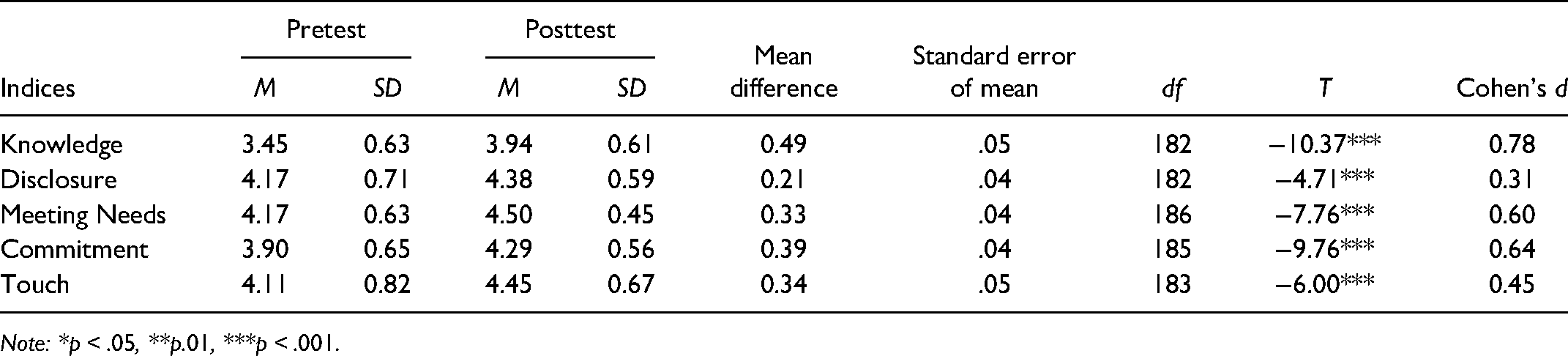
Note: *p < .05, **p.01, ***p < .001.
Group Comparisons
To compare outcomes of in-person and virtual participants, repeated measures ANOVA examined possible between-subjects interaction effects for program outcomes by delivery method (see Table 3). With the exception of Touch, analyses yielded significant differences in all comparisons, with in-person participants reporting greater mean changes than virtual participants in Knowledge (F = 6.65, p = .011), Disclosure (F = 9.40, p = .049), Meeting Needs, (F = 6.40, p = .012), and Commitment (F = 11.14, p = .001).
Repeated Measures ANOVA Results for Couple LINKS Program Measures: In-Person vs. Virtual Participants.

Note: *p < .05, **p < .01, ***p < .001.
Qualitative Results
Qualitative findings among virtual participants emerged along two major themes: (a) likes and (b) dislikes, and each theme had related subthemes. Subthemes comprised of statements mentioned by less than 10 participants were not considered to be common experiences and thus were not included in this report, a common practice in phenomenology (Creswell, 2013).
Likes
A total of 83 virtual participants (67%) offered responses related to what they liked most about the virtual format. Major subthemes included: (a) course curriculum, (b) developing new skills, (c) facilitator quality, (d) online accessibility, and (e) couple time.
Dislikes
A total of 83 virtual participants (67%) offered responses to the open-ended questions about what they liked least about the virtual format. Of these participants, 18 responded there was nothing they disliked about the virtual courses. From the analysis of the remaining responses, four major sub-themes emerged: (a) schedule and pace, (b) reference materials, (c) technology, and (d) sharing personal information.
Discussion
Relationship education (RE) programing is constantly evolving, not only with the groups it targets, but the methods by which it is delivered. As part of this evolution, online RE programing has become more common, with favorable evaluations in terms of effectiveness (Braithwaite & Fincham, 2007, 2009, 2011, 2014; Georgia Salivar et al., 2018; Roddy et al., 2017). Although studies have compared the outcomes of in-person and virtual delivery methods (i.e., Roddy et al., 2018), few have compared these outcomes in the midst of crises that forced program delivery reorganization (Higginbotham et al., 2021). This study focused on the Healthy Relationships [State] initiative's transition from in-person to virtual RE programing, measuring program impact and comparing the outcomes between the two delivery methods for individuals participating in Couple LINKS, a curriculum designed for adults in committed relationships. The ensuing sections present a discussion of these findings.
Evaluation of Findings
Virtual participants also offered praise for the course facilitators. Several participants highlighted that facilitators effectively showed enthusiasm, the ability to adapt, and helped participants feel comfortable with the subject matter. This finding may account for some of the positive outcomes as facilitator quality in RE has been found to significantly influence program outcomes (Ketring et al., 2017; Turner et al., 2020).
Further, some participants enjoyed the convenience of the virtual format, which allowed them to participate from home. This speaks to one of the benefits noted by proponents of web-based programing, who have argued that such formats can help eliminate some of the logistical concerns that may prevent some participants from enrolling (Doss et al., 2019; Roddy et al., 2018; Townley & Yalowich, 2015). Finally, several participants noted the pleasure they experienced in being able to attend the virtual course with their partner. Although this may be considered a latent function of social distancing regulations that encouraged people to stay home during the COVID-19 pandemic, reports of greater togetherness among partners taking part in a couple-focused RE program may foreshadow the possibility of couples making a greater effort to apply what they learned moving forward.
The same might be said of program pacing; however, facilitators were teaching virtually for the first time, so an adjustment period is to be expected.
Nearly a quarter of participants who provided usable qualitative responses articulated concerns related to technology, noting lack of personal interaction and technical difficulties. Technical difficulties are to be expected given the varying quality and levels of internet service and access among participants, including those in rural areas. Lack of knowledge of or experience with using Zoom technology may have also played a role. Complaints about the lack of personal interaction in virtual courses is consistent with some research related to online learning, which has noted that such formats can deter participants from fully participating (Wut & Xu, 2021).
Some of the desire for in-person delivery may have been related to a reluctance among virtual participants to share personal thoughts and feelings. Openness to share personal feelings has been found to be a common challenge in online learning (Song et al., 2019). This issue may have been exacerbated for some, given some of the topics of Couple LINKS, which includes discussion of intimate topics such as sexual relations.
The last major dislike for virtual delivery was related to reference materials. Concerns over the occasional mismatch between the participant materials and what was being presented by the facilitators was a product of the transition from in-person to virtual programing, which took place in a week's time due to the University's response to COVID-19. The quick change required rapid adjustments in order to continue to provide RE programing (e.g., facilitating group activities in Zoom).
The quantitative results further illuminate the various facets of qualitative data. That is, the quantitative data show that on average, virtual participants rated themselves higher in the pretest scores, but in-person participants benefitted more overall. Thus, the quantitative data suggest that, despite the pros and cons of each format, in-person delivery seems to have yielded more benefits on average – at least for the participants in the current study.
Limitations and Future Directions
This study has limitations, which may help direct future research. First, although this study focused on a relationship education program for couples, data were not dyadic. Therefore, we could not perform comparisons between partners who completed Couple LINKS together. Access to dyadic data could be beneficial in this case, especially in determining how couples respond to virtual programing.
Second, for purposes of this study, the emphasis was placed on the experiences of virtual participants. This study did not profile the qualitative comments of in-person participants. Other researchers may elect to compare the comments of in-person and virtual participants in order to capture the nuances of the different delivery methods.
Next, our sample consisted of participants from a single U.S. state, which is largely racially homogeneous. Research is needed among diverse and nationally representative samples. This may be especially important to the extent that virtual programs gain more support, and reach more isolated and underrepresented audiences (Georgia Salivar et al., 2018; Roddy et al., 2018; Townley & Yalowich, 2015).
Finally, in this study, we did not specifically measure how participants felt the pandemic was impacting their relationships. However, the fact that virtual participants did not allude to this in their comments is informative. Future research studies may directly investigate how the pandemic or other states of emergency impact their relationships and how the quality of their relationships may impact their participation in educational programs.
Practical Implications
The challenges posed by the COVID-19 pandemic have provided practitioners an opportunity to adapt and test best practices for the future delivery of relationship education (Higginbotham et al., 2021). Such adjustments may help to prepare RE programs for future crises or events that could once again force the adjustment of program delivery.
Even before COVID-19, online RE programing had been gaining momentum (Doss et al., 2019; Georgia & Doss, 2013; Turner et al., 2019). As online programs for couples continue to develop, educators will benefit as they become familiar with the reasons couples seek virtual programs, and adapt techniques to more effectively engage online participants (Roddy et al., 2018). As research has shown, and as proponents of virtual programing have argued, the flexibility of virtual programs enables participants to overcome certain logistic or socioeconomic barriers to participation (Braithwaite & Fincham, 2007, 2009; Roddy et al., 2018; Townley & Yalowich, 2015). Indeed, a classic problem in RE is the ability to reach populations that might benefit most from its programs (Sullivan & Bradbury, 1997). In the current study, although more individuals in the virtual sample earned less than $20,000 annually, the omnibus test yielded no statistically significant difference in income between the two groups. Still, the fact that more than one-third of virtual participants could be considered “low-income” lends some support to the argument that virtual formats may make participation in RE more accessible (Georgia Salivar et al., 2018).
One of the main contributions of this study was the qualitative feedback from virtual participants. Gaining insight on participant perspectives can help practitioners identify the most effective approaches to program delivery (Ferraro et al., 2018) and may also help with program retention and completion, which is a concern with some virtual programing (Georgia Salivar et al., 2018; Roddy et al., 2018). As results of this study show, virtual RE programs can produce some of the same benefits as in-person programs, as several participants who participated virtually noted the new skills they were able to develop and the enjoyment they derived from participating with their partner. Participants who offered qualitative responses also noted the convenience of virtual participation.
Still, results also indicate that concerns remain regarding the timing of virtual delivery, the potential technical difficulties that can arise, and the lack of personal interaction that can characterize online learning. Given these concerns, administrators of RE should consider the user-friendliness of virtual programs for participants living in remote areas, while not discontinuing in-person courses where/when possible. Facilitators of virtual programs should also seek ways to make such programs more personable to encourage more disclosure and intimate participation. Continuing to emphasize the importance of the human and personal aspects of RE will be important as virtual delivery becomes more common due to its convenience, its ability to reach remote and underserved populations, and the possible necessity of adapting to health and safety-related restrictions.
Footnotes
Declaration of Conflicting Interests
The author(s) declared no potential conflicts of interest with respect to the research, authorship, and/or publication of this article.
Funding
The author(s) received no financial support for the research, authorship, and/or publication of this article.
