



Abstract
Previous studies have demonstrated that self-esteem and happiness play significant roles in couples’ levels of marital satisfaction. However, most of these studies findings are from Western countries; thereby, the extent to which these findings are generalizable across different languages and cultures is still an open question. This study aims to investigate the relationship between self-esteem and happiness with marital satisfaction in the sample of Iranian female students to fill this gap. Participants were 250 Iranian female students who completed Rosenberg's self-esteem, Oxford happiness, Pick and Andrade's marital satisfaction questionnaires. The results logistic regression showed that the odds of being satisfied in marriage increased with happiness and self-esteem. Happy individuals with high self-esteem had, respectively, 2.4 and 2.41 times more likely to have marital satisfaction than unhappy individuals with low levels of self-esteem. The demographic variables of participants such as age, number of children, and the length of the relationship did not predict marital satisfaction. The results are discussed in relation to psychological and cultural factors present in self-esteem and marital relationships in Iranian women.
Introduction
The significance of marital satisfaction (MS) for physical and mental health of both spouses (Gottman & Silver, 2000; Holt-Lunstad et al., 2008) and children's development (Cummings & Davies, 2010) had drawn strong scientific interest to investigate the psychological mechanisms that might contribute to MS. According to Pick and Andrade (1988), marital satisfaction involves couple's satisfaction with marital interactions, emotional exchanges, and their mental representation or beliefs about themselves and the marital relationship. Marital satisfaction of couples depends on the efficacy of their chosen strategy to deal with intervening life stressors during the marriage. These adaptation strategies are affected by the couple's personality traits and prior life experiences (vulnerabilities), and their emotions and communicational skills. that is, quality of social interactions (Bradbury & Lavner, 2012).
Self-esteem (SE), as an individuals’ relatively stable personality trait, acts as a sort of coping resource. SE is generally defined as an individuals’ subjective judgment their worth as a person (Leary & Baumeister, 2000) and the extent to which self is evaluated as worthy compared to others (Rosenberg, 1965). Positive evaluation of self as worthy (i.e., higher level of SE) increases individuals coping resources. It neutralizes or mitigates the effect of stress whereas low SE signal inadequacy leading to further avoidance (Leary & Baumeister, 2000). Research by Murray et al. (2000) demonstrated that low SE individuals’ underestimating how optimistically their partner viewed them was related to lower relationship satisfaction while high SE individuals’ overestimation of how positive their partner perceives them was related to relationship satisfaction. Individuals with high SE tend to be happier and have more satisfying and stable relationships than those with lower SE (Erol & Orth, 2016).
According to Argyle and Crossland (1987), happiness is a positive inner experience that consists of three main dimensions including: the frequency and degree of positive affect; a high average level of satisfaction over a period of time; and the absence of negative feelings, such as depression and anxiety. Ample number of studies supported the adaptive value of positive emotions. For example, experiencing frequent positive affect predicts resilience to adversity and increased happiness (Fredrickson & Losada, 2005). Gottman (1993) argued that both happy and unhappy partners exchange positive and negative interactions; however, the ratio of positivity to negativity unhappy couples displaying more negative than positive behaviors while satisfied couples outperformed negativity with positive interactions. Studies indicated the results of self-reports positivity–negativity ratio of about 2:1 in satisfied couples while unsatisfied couples report a ratio where negative behaviors exceeded positivity (Bertoni & Bodenmann, 2010). In addition to the SE and martial satisfaction (MS), ample number of studies have indicated demographic characteristics such as number of children, age, length of marriage, and education as a significant predictor of MS. For example, couples who have higher education have been found to have higher MS while age has shown negative association with MS (Rostami et al., 2014). Regarding the association between the number of children and MS, previous studies from 33 countries including Iranian sample indicated contradictory results and suggested that some culture-dependent factors may influence the association (Sorokowski et al., 2017). In contrast, a more recent study of 7178 married individuals from 33 countries revealed that the number of children was a significant negative predictor of MS (Kowal et al., 2021). With respect to age, some studies found no clear link between age of participant and MS in the literature (Sorokowski et al., 2017), while some other studies found age to be negatively related to MS (Amato & Cheadle, 2005; Rostami et al., 2014). Scholars recommended to examine age as a predictor of MS with respect to the duration of the marriage (Sorokowski et al., 2017). The majority of studies reported a reported negative or U-shaped association, that is, MS decreases in the beginning and increases after some time, between duration of marriage and MS (Sorokowski et al., 2017). Studies reported MS of North American couples’ experience sharpest declines after the honeymoon period and most of all divorces occur within the first 7 years of marriage (Amato & Cheadle, 2005).
Even though some studies argued that MS predicts the SE and happiness of spouses (Proulx et al., 2007). Ample number of studies reported the importance of spouses’ personal well-being such as SE (Erol & Orth, 2016; Leary & Baumeister, 2000; Murray et al., 2000) and happiness (Baumeister et al., 2003; Gottman, 1993; Karami et al., 2021) in predicting MS. The current study aims to investigate the predictors of MS in Iranian female university students living in Yasuj city, which is an understudied country in the MS. Previous studies (Baumeister et al., 2003; Sciangula & Morry, 2009) examined the predictors of MS in the American and European samples. However, none of these previous studies has investigated the predictive power of happiness and SE and the demographic characteristics on MS in Iran.
Context of Iran
Unfortunately, in Iran, research on MS is scant. However, a few studies have examined the relation between the MS and SE and happiness. For example, Homaei et al. (2016) investigated the relationship between optimism, religiosity and SE with MS and life satisfaction in the sample of 200 married Iranian university students. Their result showed that the scores of optimism, religiosity, and SE predicted the MS of married Iranian students. In another study on MS of 150 Iranian couples by Karami et al. (2021), happiness significantly predicted MS and quality of life. These findings, which are consistent with the findings from other countries (Baumeister et al., 2003; Sciangula & Morry, 2009) provide support for the importance of the SE and happiness in predicting MS. To our knowledge, none of these previous studies has investigated the predictive power of happiness and SE together, as an important variable representing spouses’ personal well-being, in predicting MS. To fill this gap, the present study sought to examine the predictive power of SE and happiness in predicting MS of Iranian women.
Furthermore, following Hewitt (2020), we view SE as a socially constructed discourse and emotion. In other words, SE reflects the social conditions under which SE is formed and sustained. In Iranian culture, SE is considered as the very root of Islamic ethics. As such, low SE is regarded as failure to meet the social expectations and the eligibility for social inclusion (Joshanloo & Daemi, 2015). Thus, individuals conform to social expectations in order to receive the approval of others and to enhance SE. In Iran, the religious commitment and religious practice are considered as vital for a happy married life (Avarandeh et al., 2021); however, individuals’ concern for social approval may override their happiness. This study aims to discuss its result in the context of Iran and the cultural and Islamic values, which have shaped the way of life in the Iranian society.
Methods
Participants and Procedure
Participants were 250 Iranian female students selected by purposive sampling. As such, participants are intentionally sought according to information required by the analysis. Purposive sampling applied since it enabled us to select participants according to the purpose of the research. Participants completed Rosenberg's SXE, Oxford happiness, and Pick and Andrade MS questionnaires. The ethics committees of the Yasuj Medical University approved the study and the participants provided informed consent at the beginning of the study.
Measures
Oxford Happiness Questionnaire
Participants’ score of happiness was assessed by the Oxford Happiness Questionnaire (OHQ) (Hills & Argyle, 2002). Based on Argyle and Crossland’s (1987) definition of happiness, the OHQ examines the frequency and degree of positive affect, the average level of satisfaction over time, and the absence of negative feeling. As such, the OHQ is the opposite point to the Beck Depression Inventory (BDI). The OHQ is multiple-choice questions in which each person judges about himself/herself from feeling unhappy to feeling very happy (Francis et al., 1998). The answers include a five-point scale: strongly agree, moderately agree, slightly agree, moderately disagree, slightly disagree, and strongly disagree. The OHQ has been translated by Alipoor and Noorbala (1999) in Persian. The reliability and validity of the questionnaire were examined in the sample 110 undergraduate students of Allameh Tabatabai University and Shahed University of Tehran and its formal validity has been confirmed by 10 experts. The Cronbach's alpha was .98 was .98 and the purity reliability was .92, and the reliability of the experimental method was .79 after three weeks. This scale has 29 items that are graded based on a four-point range from 0 to 3. Therefore, the minimum score of each subject is 0 and the maximum is 87.
The validity of this scale has been confirmed in various studies, including the study of Argyl and Lu (1990), and the research of Alipoor and Noorbala (1999). Also, to determine the reliability of this test, Argyle and Lu (1990) had an alpha coefficient of 90 with 347 subjects, Furnham and Brewin (1990) had an alpha coefficient of .87 with 101 subjects and Noor (1995) with 180 Cronbach's alpha subjects obtained .84. In Iran, Alipoor and Noorbala with 101 Cronbach's alpha subjects obtained .93 (Alipour & Noorbala, 1999; Noor, 1995).
Rosenberg SE Scale
The Rosenberg SE Scale (RSES) is made up of 10 items that measure overall SE. The RSES's items rated on a 4-point Likert- type scale, ranging from 1 (totally disagree) to 4 (totally agree). Items 1, 3, 4, 7, and 10 are expressions of positive SE, and items 2, 5, 6, 8, and 9 are expressions of negative SE (Martín-Albo et al., 2007). The answers in favor of each of the questions 6 to 10 receive a score of −1 and the opposite answers receive a score of + 1. The closer a person's score is to 10, the greater their SE. A score above zero indicates high SE and a score below zero indicates low SE. An SE score of + 10 indicates the highest SE and a score of 10 indicates the lowest SE, and vice versa (Ganji, 2005). The minimum score on this scale is 0 and the maximum is 10. Many studies have proved the reliability and validity of the Persian version of RSES (Mohammadi, 2005; Zadeh Mohammadi et al., 2007). In reliability areas, RSES reported high ratings. Its internal compatibility was 0.77, and minimum reproducibility coefficient was at least 0.90 (Rosenberg, 1965).
Marital Satisfaction Scale
Marital Satisfaction Scale (MSS) proposed by Pick and Andrade (1988) consists of 24 items distributed in three domains: (I) satisfaction with conjugal interaction (items 1–10), which is related to the pleasure that a spouse manifested when evaluating the sustained dynamics with their partner; (II) satisfaction with the emotional aspects of the spouse (items 11–15), which refers to the satisfaction that a member of the dyad expresses in response to the emotional reactions of their partner; and (III) satisfaction with the organizational and structural aspects of the relationship (items 16–24), which measures the satisfaction that occurs as a result of the way in which the members of a couple organize, establish, and comply with the rules (Acevedo et al., 2007; Pick & Andrade, 1988). Individuals express their level of satisfaction by each of the items’ three options for answer, regarding what raises in the statement: 1 means: I would very much like different, 2 means: I would like something different' and 3 means: I like how it's happening (Pick & Andrade, 1988). To qualify, satisfaction is assumed to move on a continuum of 48 points within an interval scale, with a reference value of 24 points and a maximum of 72; so that the greater the satisfaction with the marital situation, the closer to the maximum of the scale (Acevedo et al., 2007).
Results
Descriptive Statistics
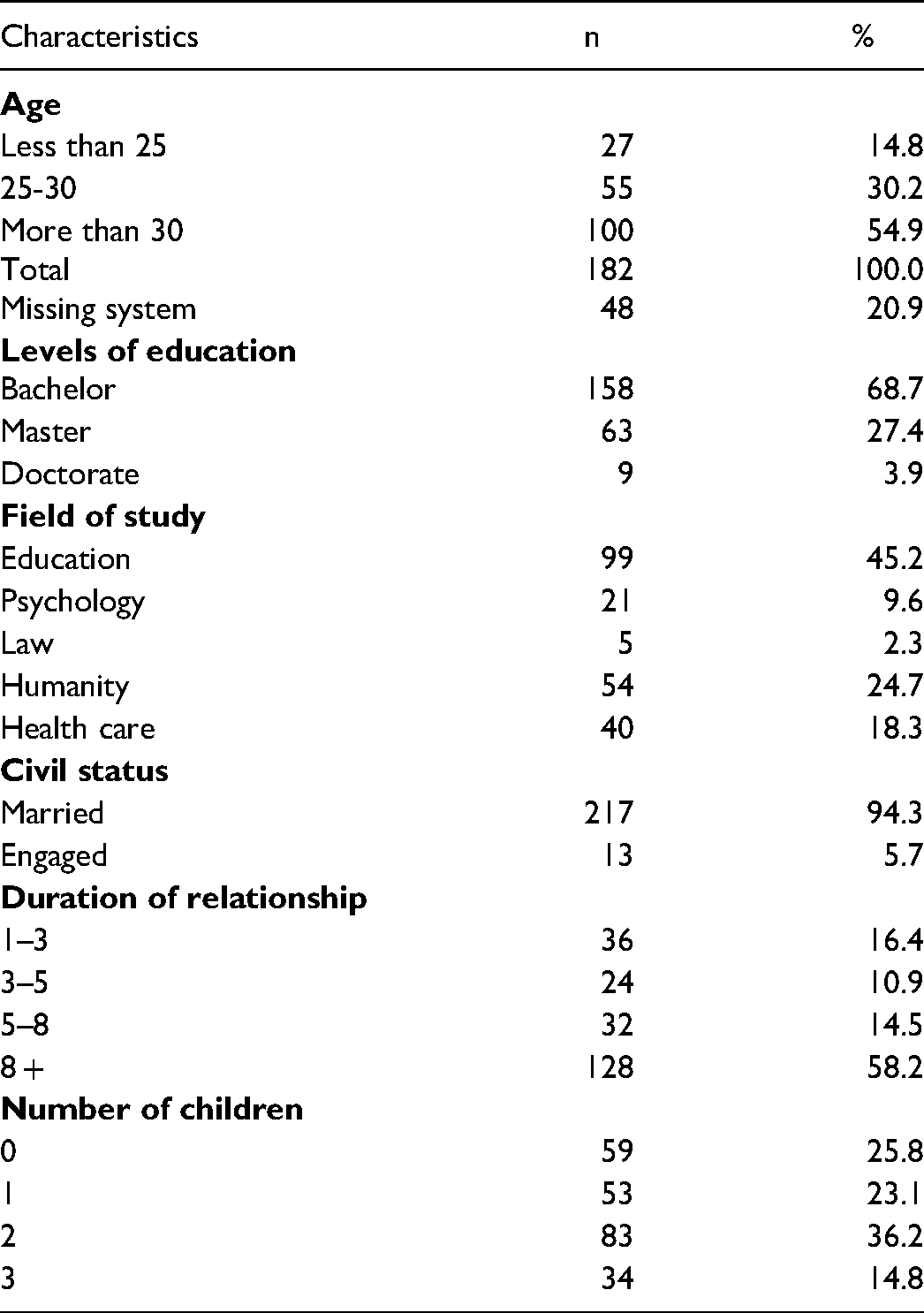
Table 1 presents demographic characteristics of the participating Iranian female students. Results show that most (54.9%) of the female participants were more than 30 years old and (30.2%) were in their mid- and late-20s, only (14.8%) were <25 years old. They were educated women as almost third (68.7%) were bachelor's degree students, and (27.4%) and (3.9%) masters and doctorate students, respectively. The majority of female participants were in education field of study (45.2%), followed by humanities (24.7%), then health care (18.3%), and lastly the rest includes disciplines such as psychology (9.6%) and law (2.3%). Almost more than half of the participants were in a relationship more than 8 years (58.2%) and were mainly married (94.3%). Finally, 36.2% of participants reported to have more than one child, and 25.8% had no child.
Demographic Characteristics of Participants.
As you can see in Table 2, the majority of the participants’ SE level were high 200 (89.7%) while majority of them reported to be not happy 87 (37.8%). The majority of the participants’ MS's level was high 102 (52.3%).
Levels of Self-Esteem, Happiness, and Marital Satisfaction.
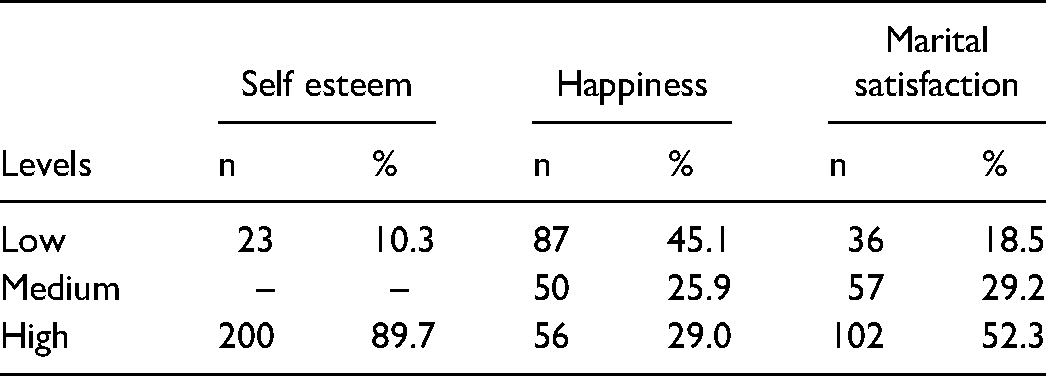
Table 3 presents the mean levels, standard deviations, and the zero-order bivariate correlations between the study variables. Results revealed a positive correlation between SE and happiness (r = .2, p < .01). There were positive correlations between SE and MS (r = −.29, p < .01). Likewise, happiness showed positive correlation with MS (r = 0.38, p < 0.01) (Table 3).
Descriptive Statistics and Bivariate Correlations Between Self-Esteem, Happiness and Marital Satisfactions.
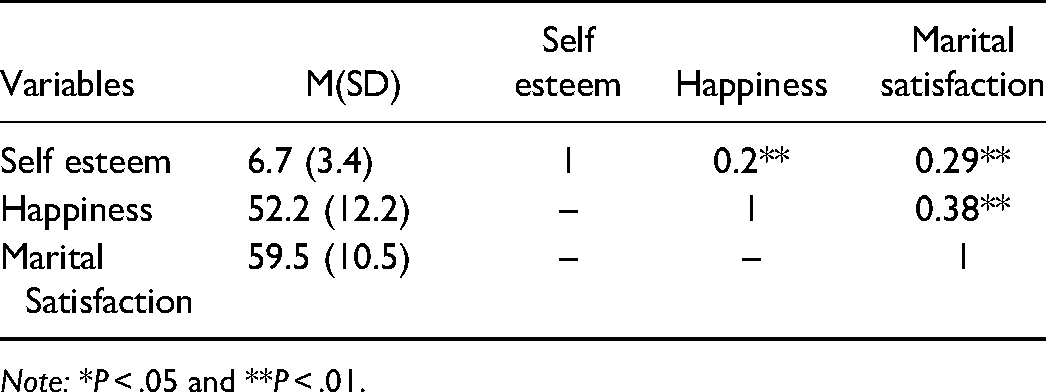
Note: *P < .05 and **P < .01.
Table 4 displays the correlations between study variables and participant's demographic characteristics. As you can see, the result showed a negative significant correlation between age and MS (r = −.24, p < .05) while no significant correlation between age and SE (r = −.1) and happiness (r = −.12). Results also showed a negative significant correlation between length of relationship and MS (r = −.16, p < .05) while there were no significant correlations between length of relationship and SE (r = −.12) and happiness (r = −.09). Likewise, the result showed a negative significant correlation between number of children with MS (r = .16, p < .05), but no correlation with SE (r = −.07) and happiness (r = −.08) (Table 4).
Correlation Between Demographic Variables and Self-Esteem, Happiness, and Marital Satisfaction.
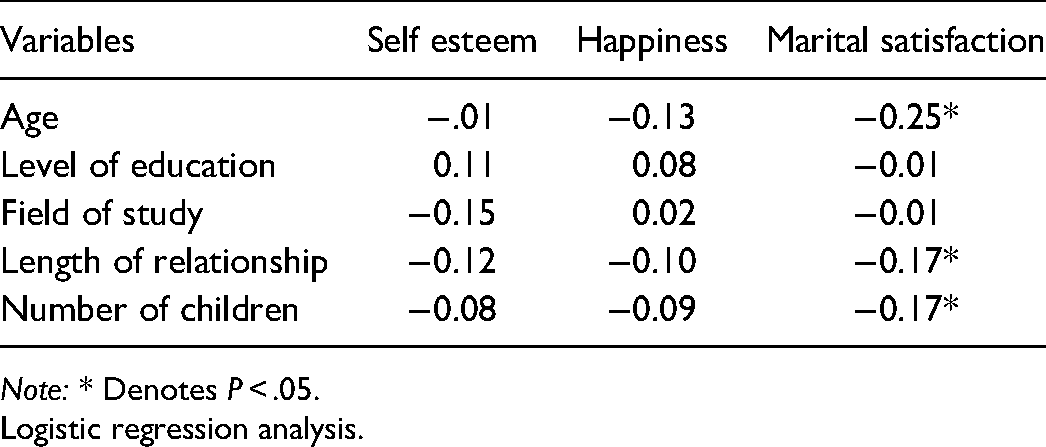
Note: * Denotes P < .05.
Logistic regression analysis.
Logistic Regression Analysis
Bivariate as well as multiple logistic regression analyses were conducted with MS as the dependent variable, and SE, happiness, and age as the major independent variables. For these analyses, MS was coded categorically as not satisfied versus satisfied. The results of bivariate and multivariate relationships between the MS and each of the independent variables also described with logistic regression are shown in Table 5. The multiple logistic regression analysis produced results that were similar to the results of the bivariate analyses. The likelihood ratio chi-square test indicated that SE (χ2(1) = 11.56, P < .001), happiness (χ2(1) = 11.51, P < .001) demonstrated a good fit of our model; however, the participants’ number of children (χ2(1) = 2.94, P = .08) duration of marriage (χ2(1) = 1.43, P = .23), and age (χ2(1) = 4.83, P = 0.02) did not show a good fit. As you can see, there were no significant associations with age, number of children, and duration of marriage.
The Results of Bivariate and Multivariate Logistic Regression Analysis.
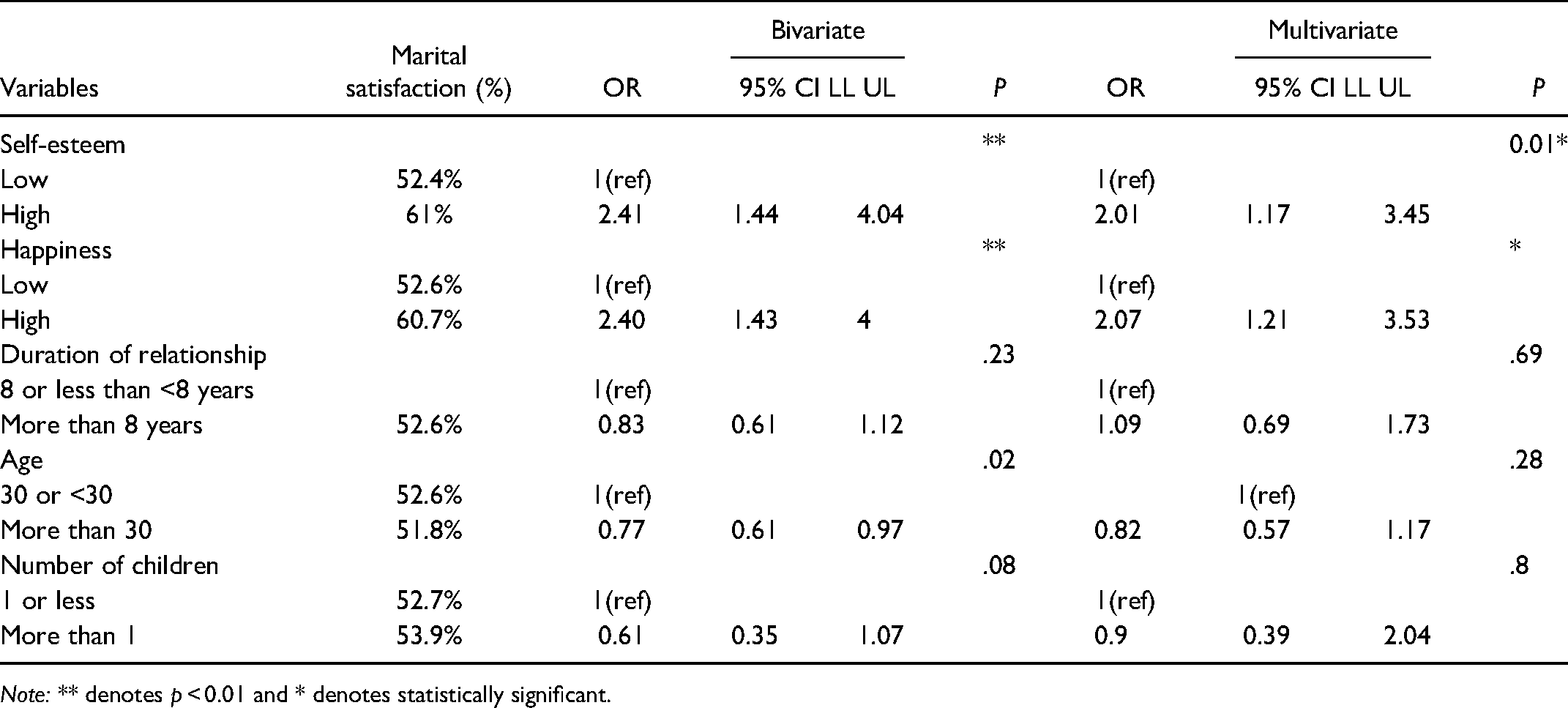
Note: ** denotes p < 0.01 and * denotes statistically significant.
Participants with high SE were 2.41 times more likely to have MS compared with low level of SE (reference group). In other words, increasing SE (B = 0.88, p < .001) was associated with an increased likelihood of MS. Additionally, SE explained 0.06% (Nagelkerke R2) of the variance in MS and correctly classified 61% of cases. Likewise, the odds of being satisfied in marriage increase significantly with happiness (B = 0.87, p < .001). Happier female participants were 2.4 times more likely to be satisfied (OR = 2.4) about their marriage compared with female participants with a low level of happiness (reference group). Moreover, happiness explained 0.06% (Nagelkerke R2) of the variance in MS and correctly classified 60.7% of cases.
Discussion
The aim of our study was to investigate the predictors of MS in female university students in Yasuj. Our major findings can be summarized as follows: (a) happier participants with higher SE were 2 times more likely to be satisfied in their marriage compared with unhappy participants with a low level of SE. (b) age, number of children, and duration of marriage did not predict female participant's MS. (c) the majority of the participants’ MS and SE level were high; however, they reported to be unhappy.
The study result indicated that the odd or the chance of being satisfied in marriage is two times more likely in women with high SE compared to the ones with low SE. These findings are consistent with previous research that reported the positive role of SE in predicting MS (Homaei et al., 2016; Sciangula & Morry, 2009). One reason given to the positive role of SE in predicting MS is SE is related to individuals’ perceptions of how the partner sees themselves, that is, meta-perceptions. As such, individuals with low SE tend to negatively perceive how their partners view them and underestimate their partner's love and acceptance, whereas high SE individuals more accurately estimate their partners’ positive perceptions or idealize their relationship (Sciangula & Morry, 2009).
Additionally, SE effects are not limited to perceived regard; studies have shown positive association between SE and secure attachment orientations (Mikulincer & Shaver, 2016). High SE individuals feel secure about their partner's love and acceptance while low SE individuals experience doubts and concerns. Secure individuals are less dependent on their partner's assistance and approval and believe in their coping abilities and actions while insecure individuals tend to be overly dependent on the partner support and approval or defensively avoid seeking support (Erol & Orth, 2016; Mikulincer & Shaver, 2016). Additionally, attachment anxiety is linked to less supportive behavior and being less responsive to the partner (Collins & Feeney, 2000).
The study result indicated that the chance of being satisfied in marriage increase significantly with happiness. This finding is consistent with the findings of previous studies (Baumeister et al., 2003; Karami et al., 2021). High SE individuals appraise themselves as likable and attractive and feel more accepted by the partner. Individuals with high SE not only have secure attachment orientation but also higher score of optimism (Baumeister et al., 2003; Mikulincer & Shaver, 2016). Adults with secure attachment orientation tend to hold positive beliefs about self and relationships and a secure-based script that view others as trustworthy and the self is valuable and been loved by others. Access to internalized positive mental representations of responsive and supportive attachment figure contribute to a broaden-and-build cycle of attachment security that arouses positive emotions (comfort, relief, love, and pride) and encourage confident engagement in intimate relationships (Fredrickson & Losada, 2005; Mikulincer & Shaver, 2016). Satisfied couples reported experiencing a higher ratio of positive emotions than negative emotions (Gottman, 1993).
The study result indicated demographic variables of length of relationship, age, and number of children did not predict the MS. Previous empirical evidence regarding the effect of these demographic variables on MS is mixed. Some studies’ results consistent with our findings did not found a clear link between age of participant and MS (Sorokowski et al., 2017) whereas other studies found age to be negatively related to MS (Amato & Cheadle, 2005; Rostami et al., 2014). In line with our result, Sorokowski et al. (2017) found mixing result for the link between number of children and MS. In contrast, others found negative association between number of children and MS (Kowal et al., 2021; Rostami et al., 2014). Finally, contrary to our result, the majority of studies demonstrated negative association between duration of marriage and MS (Sorokowski et al., 2017).
The current study supports previous research that emphasized the importance of spouses’ personal well-being such as happiness and SE on their MS (Baumeister et al., 2003; Erol & Orth, 2016; Gottman, 1993; Karami et al., 2021; Leary & Baumeister, 2000; Murray et al., 2000). This study also extent the literature that has been limited to European and North American samples. In the context of Iran, SE is considered as the very root of Islamic ethics. As such, humankind is held in great esteem. Islamic views addressed the intrinsic worth of individuals and views SE as empowering source of resistance against sin. Low SE is regarded as failure to meet the social expirations (Joshanloo & Daemi, 2015). Additionally, SE as a sociometer reflects the degree to which people are eligible for inclusion in social groups (Leary & Baumeister, 2000). Thus, individuals conform to social expectations in order to receive the approval of others and to enhance SE. In Iran, the disobedience of religious criteria for being a good wife can threaten individuals’ SE and portray them as socially undesirable, incompetent, irresponsible, or immoral. Subsequently, rejection of religious criteria for happy marriage can lead individuals to have low SE and experiencing various negative emotions such as loneliness and anxiety (Leary & Baumeister, 2000). Homaei et al. (2016) reported that optimism, religiosity, and SE predicted the MS of married Iranian students. Other study by Avarandeh et al. (2021) reported that MS, social support, and resilience moderate the relationship between spiritual experiences and happiness in Iranian couples. The religious practices and beliefs such as compassion and forgiveness may reduce conflict and enhance relationship satisfaction (Fincham et al., 2008). Additionally, it can provide individuals with considerable resources of social support in the context of religious societies such as Iran. The current study result indicated that the majority of the participants’ MS and SE level were high; however, they reported to be unhappy. One possible reason for this could be that individuals’ concern for social approval may override individual's happiness.
Limitations
The study variables were measured by a self-report test; thus, the result may be affected by social desirability bias. The study should be generalized with caution to other situations since this study only measured the effect of one of the partners that is a female partner who has Middle Eastern background on MS. Moreover, we did not investigate the effect couples’ SE similarities on MS. A third limitation of our research is that the cross-sectional does not contain repeated measurements to investigate the developmental trajectory of variables over time to determine causality.
Footnotes
Declaration of Conflicting Interests
The authors declared no potential conflicts of interest with respect to the research, authorship, and/or publication of this article.
Funding
The authors received no financial support for the research, authorship, and/or publication of this article.
