




Abstract
The most common reason for divorce in West Java, Indonesia, shifted from financial difficulties prior to the Covid-19 pandemic to marital conflicts throughout the outbreak. A theoretical explanation of the rising percentage of couple fight was required to inform predictions about how the present pandemic might damage the couple's relationship and avert marital dissolution. The narrative study used a conceptual framework that combined the family stress model and the stress divorce model to postulate that couples who were already vulnerable prior to the pandemic were more likely to experience relationship instability and, eventually, marital dissolution after being exposed to inherent pandemic risks. Couple relationship stability during the pandemic could be achieved by the development of a positive dyadic coping strategy. A coordinated couple task allocation and high-quality communication among each other were crucial in fostering bonadaptation and resilience in a married relationship. Future research can use quantitative and qualitative methods to determine the underlying cause of the change in the primary reason for divorce during the pandemic.
Introduction
The coronavirus-19 (Covid-19) pandemic disrupted people's lives and was accompanied by a wide range of stressors. The pandemic was officially reported for the first time in Indonesia on March 2, 2020. Physical distancing, hand washing, mask wearing, and home confinement policies were immediately implemented in response to the virus's spread.
The Covid-19 pandemic resulted in a wide range of societal issues, such as financial insecurity, job loss, the death of family members or friends, and social isolation. Multiple losses and social isolation led to a decrease in emotional and psychological well-being (Chin Wen & Mohtaram, 2021; Hertz-Palmor et al., 2021; Jin et al., 2021; Walsh, 2020). Furthermore, the pandemic hardships posed a risk to family resilience (Eales et al., 2021; Gayatri & Irawaty, 2021; Prime et al., 2020). Several previous studies have found the associations between the hardships of the Covid-19 pandemic and the couples’ relationship (Fernandes et al., 2021; Pietromonaco & Overall, 2021; Schmid et al., 2021). Some studies found that divorce rates increased during the pandemic compared to before the pandemic (Goodwin et al., 2020; Zhu et al., 2021), while others found that they decreased (Fallesen, 2021; Kim & Kim, 2021; Manning & Payne, 2021).
The total number of divorces was recorded in the Case Traffic System of West Java’s Islamic High Court (Si-Kabayan) (TIMDA PTA Jabar, n.d.). During the period between 2018 and 2021, the most common reason for divorce in West Java changed. In 2018 and 2019, the primary reason for divorce was financial difficulties (prior to the pandemic). Marital conflicts, on the other hand, were the leading cause of divorce in 2020 and 2021. Fights between romantic partners were also reported to be more common among U.S. adults in the early stages of the pandemic (Ipsos, 2020).
The Si-Kabayan could not support the data of the early experiences for this marital dispute. The descriptive analytics method was used to describe the number of divorce cases at the provincial level in West Java. Thus, a theoretical understanding of the increased number of couple fights was required to inform predictions about how the current pandemic could have an impact on couple relationships and prevent marital dissolution. The current study employs the family stress model and the stress divorce model to examine how the Covid-19 pandemic increased the likelihood of couple conflict, which leads to marital dissolution.
Conceptual FrameWork
The conceptual framework was adapted from the family stress model and the stress divorce model. According to McCubbin and Patterson's family stress model, perception of the hardships of the initial stressors and the resources available to the family resulted in coping strategy and family adjustment to the crisis (McCubbin et al., 1983). Furthermore, Bondenmann's stress divorce model focuses on the impact of daily stress on couple functioning, which leads to dissatisfaction in the relationship and marriage dissolution (Bodenmann, 1995, 1997).
Figure 1 depicted how the Covid-19 pandemic's hardships led to marital dissolution. An initial stressor was pre-existing vulnerability prior to the pandemic (pre-crisis). During the pandemic, couples with pre-existing vulnerability were more likely to suffer from the pandemic's consequences.
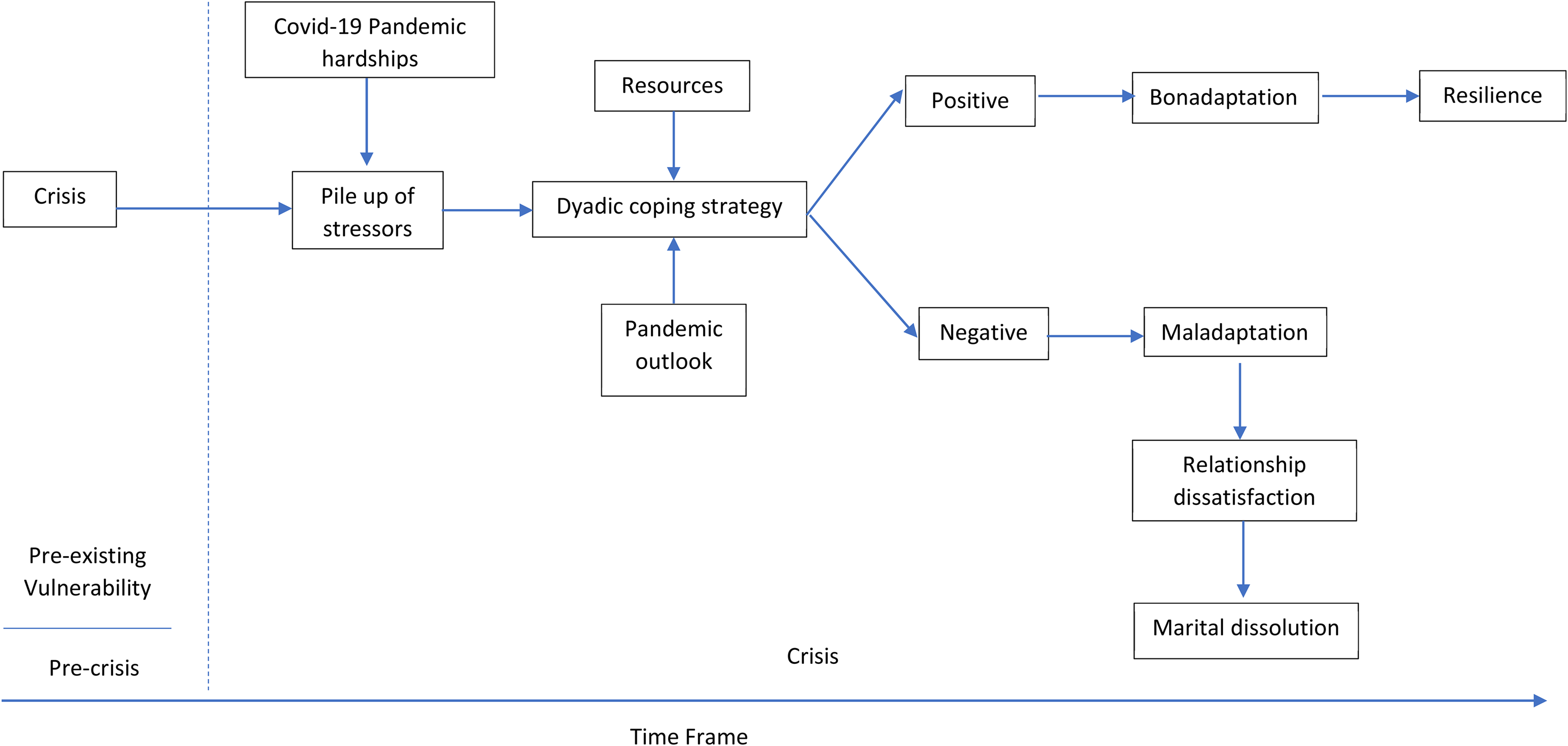
Theoretical framework of marital dissolution in West Java, Indonesia, during the Covid-19 pandemic (adapted from McCubbin and Patterson's family stress model and Bondenmann's stress divorce model) (Bodenmann, 1995, 1997; McCubbin et al., 1983).
A wide range of stressors caused by the Covid-19 outbreak spilled over into the couple relationship, increasing dyadic stress between the partners, which then impacted marital relationship and increased the risk of divorce (Randall & Bodenmann, 2009). However, external stressors should be long term and continuous exposure, which would be more demanding and exhausting for the couple's resources than only punctual exposure (Randall & Bodenmann, 2009). Then, couples who were already vulnerable were subjected to the cumulative effects of pandemic exposures.
The presence of existing resources and the event's challenging perception influenced positive coping strategies and maintained relationships stability. However, a lack of resources, combined with a crisis-inducing perception, resulted in a negative coping strategy. Negative coping strategies might manifest as poorer dyadic coping strategies and, eventually, marital dissolution.
Method
Data
The analyses were performed using routine data collection from West Java's Religious High Court (Si-Kabayan) (http://kabayan.pta-bandung.go.id) during the period between 2018 and 2021. The routine data collection includes information on the number of divorce cases, divorce decisions, case types involving family issues concerning spouses, parents, and children, factors causing divorce, and characteristics of divorce's applicants by education and age. Data on factors causing divorce consists of marital conflicts, financial issues, leaving their partner, domestic violence, polygamy, and other reasons.
Moreover, this research used narrative review that involved a comprehensive search of online databases to complement the descriptive statistics of routine data collection. The databases PubMed, Google Scholar, Scopus, PsycINFO, Social Sciences Citation Index (via the Web of Science) were searched for qualitative data relating to marital dissolution or family matters. The literature review was conducted using some keywords such as “divorce,” “family,” “coping strategy,” “stress model,” “vulnerable,” and “marital dissolution.” This study used studies that were published in peer-reviewed journals and written in English.
Statistical Methods
This study used descriptive analysis to summarize the routine data collection. The frequency of distribution in percentages was used in this study. Moreover, this research compared the percentages of marital dissolution by reason and time (year) to provide clear information on marital dissolution. For qualitative methods, the key findings were extracted and organized to strengthen the quantitative results. The themes of the literature review were analyzed into a narrative review. Most studies focused on family stress model, family stressors, and coping strategies.
Results
Table 1 showed the number of divorce reasons in West Java (Indonesia). The number of divorce cases were increased gradually from 2018 to 2021.
Divorce cases by reasons in 2018, 2019, 2020, and 2021, West Java, Indonesia.
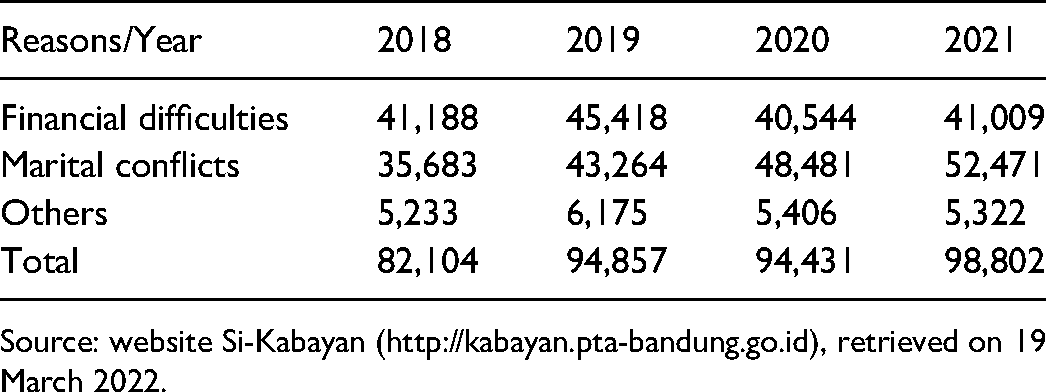
Source: website Si-Kabayan (http://kabayan.pta-bandung.go.id), retrieved on 19 March 2022.
Figure 2 showed the percentages of marital dissolution in West Java. Financial difficulties were the leading cause of marital dissolution in 2018–2019, followed by marital conflicts. However, during the COVID-19 pandemic in Indonesia in 2020–2021, marital conflicts were the leading cause of marital dissolution, followed by financial difficulties.
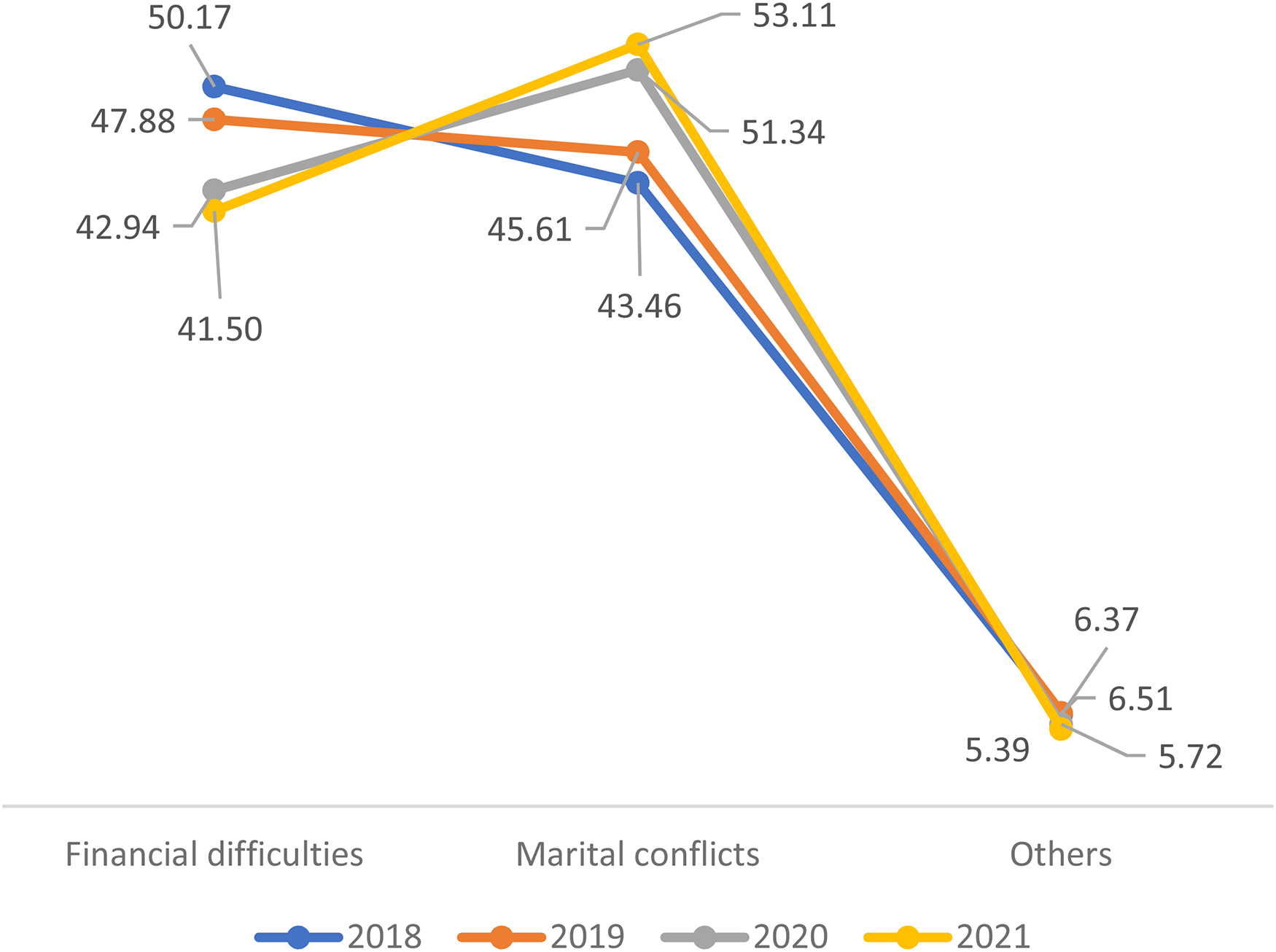
The percentages of marital dissolution in West Java, Indonesia (2018–2021).
Discussion
Initial Stressor (Pre-crisis)
The Covid-19 pandemic not only caused a health crisis, but it also disrupted many aspects of human life. Previous research found that the Covid-19 pandemic had a negative impact on Indonesia's labor market, economic, and mental health (Fernandes et al., 2021). During the early stages of pandemic, negative emotions such as anxiety, sadness, anger, and fear were observed in Indonesian families living in West Java (Ramadhana, 2020). The mental health crises, such as stress and emotional disturbance, was negatively associated with couple's relationship (Goodwin et al., 2020; Ogan et al., 2021).
The data shows that prior to the pandemic, the total number of divorces in West Java, one of Indonesia's provinces, increased, rising from 82,104 cases in 2018 to 94,857 cases in 2019. Divorce rates, on the other hand, fell slightly by about 0.5% between 2019 and 2020. Recent studies found that the couple's level of satisfaction with their intimate relationship remained stable or even improved during the early stages of the pandemic (Neff et al., 2021; Weber et al., 2021; Williamson, 2020). People even became more forgiving and less critical of their partner’s negative behaviors, attributing them to the pandemic (Neff et al., 2021) rather than their partner's characteristics (Williamson, 2020). Finally, following a long period of continuous exposure to the inherent pandemic hardships, the number of cases gradually increased from 94,431 cases in 2020 to 98,802 cases in 2021.
Despite a similar number of divorce cases between 2019 and 2020, changes in the primary reason for divorce have been observed since the pandemic's early stages. Financial burden issues were the most common reason for divorce in 2018 and 2019 (prior to the pandemic), accounting for approximately 50.17% and 47.88%, respectively. Couple fights, on the other hand, were the leading cause of divorce in 2020 and 2021, accounting for 51.34% and 53.11% of all divorces in each respective year. There was evidence of a cascading effect of economic pressure on the couples, which resulted in increased conflict and marital dissatisfaction (Dew et al., 2012; Masarik et al., 2016; Neppl et al., 2016).
The divorce process could last months or even years, implying that marital problems existed prior to the divorce. Therefore, marital conflict in West Java was likely to occur far before 2020 and 2021. Recent study found that prior stress from couple attachment insecurity shaped the couple's poor relationship quality during the pandemic (Overall et al., 2021). As a result, the pandemic's difficulties were only one of several factors that exacerbated the early experience of marital problems (initial stressor). Pandemic hardships had a greater impact on poor couple relationships in those who were already vulnerable prior to the pandemic.
Coping Strategy
Stress from pandemic exposure could lead to dyadic stress. Dyadic stress was a stressful event that affected both partners, either directly when the couple was confronted with the same stressful event or when the stress originated within the couple, or indirectly when unresolved one partner's stress became relevant for the intimate relationship and influenced both partners (Bodenmann, 1995; Randall & Bodenmann, 2009). Living in isolation for an extended period of time would increase the couple's chances of developing mental health problems (Lee et al., 2021). During the pandemic, dyadic stress was created when each partner was affected by the stressful event under a long-time period caused by pandemic exposure and eventually concerned both partners. Dyadic stress led to an increasing risk posing to physical and psychological well-being, such as negative emotions and sexual dysfunction, and a reduction in relationship quality, such as poor communication, irritability, withdrawal interaction, and hostility between partners (Bodenmann, 1997; Randall & Bodenmann, 2009). Recent study found that pandemic stress could lead to poor sexual health (Amerio et al., 2021; Dong et al., 2021; Pascoal et al., 2021), which could reduce the quality of relationships. During the outbreak, the couple frequently experienced relationship stress for a variety of underlying reasons (Schokkenbroek et al., 2021). Poor relationship quality resulted in marital dissatisfaction and increased the likelihood of marital dissolution.
Following the family stress model, the coping strategy was marked by the use of pre-crisis resources and new resources developed to cope with the initial crisis. Pre-crisis and new resources should be combined to create a dyadic coping strategy. Prior dyadic coping strategies might have served as existing resources that were used to cope with pandemic exposure. Previous research, however, found that a prior dyadic coping strategy in a pre-crisis situation was required but insufficient to cope with the pandemic's hardships (Lee et al., 2021). As a result, new resources should be added to supplement existing ones.
Individual family members, the family unit, and the community context might all provide resources (McCubbin et al., 1983; Patterson, 2002). While stress hampered positive adaptation and contributed to marital relationship instability (Neff & Karney, 2009), other studies found that emotional intelligence (Li, Li et al., 2021) and individual resilience (Chan et al., 2021; Riehm et al., 2021) were negatively associated with stress. During the pandemic, reallocating roles and responsibilities between partners could be a resource at the family level, with gender division at labor within the household properly considered (Charbonneau et al., 2021; Waddell et al., 2021). Community support was critical for the couples maintaining mental health during the pandemic (Li, Luo et al., 2021) and developing resources to respond to pandemic exposure (Carstensen et al., 2021).
Making a positive meaning out of the pandemic situation was also important as a coping strategy during the pandemic. Developing a positive outlook was critical for mental health (Boyraz et al., 2020; Paredes et al., 2021; Robinette et al., 2021) and relationship stability (Randall et al., 2021) during the pandemic.
Although resources and a positive definition of the situation were required to develop an adaptive coping strategy, the couple's support for each other during the crisis situation was the most important for relationship stability. Following the stress divorce model, the couple's ability to support each other was critical for the dyadic coping strategy (Bodenmann, 1995). External sources of support, such as friends and relatives, were not as effective as support provided by a marital partner (Bodenmann, 1995). Recent study found that external support did not reduce the risk of marital dissolution (Cammack & Heaton, 2011; Grether & Jones, 2020; Potter, 2021).
Mitigating the Effect of Pandemic Exposure on Couple's Relationship
The family resilience perspective was used to minimize the risk of marital relationship instability. A family resilience framework was already contained in family stress model (Patterson, 2002). Resilience was defined as a process that included not only successfully adapting and functioning after being exposed to adversity or crisis, but also the possibility of personal and relational transformation and positive growth that could emerge from adversity (Walsh, 1996).
To be resilient, the couple should be active participants in the process of balancing the impact of pandemic exposure with resources as these interacted with their positive definition of pandemic exposure to achieve a level of bonadaptation. The couple's ability to support each other and maintain their marriage relationship after being exposed to the pandemic's hardship demonstrated resilience.
According to the family resilience perspective, there were three fundamental processes to becoming resilient: belief system, organizational patterns, and communication process (Walsh, 1996). Rather than focusing solely on individual coping strategies, this study examines organizational patterns and communication processes that contributed to dyadic coping strategies. Both strategies demonstrated how couples supported one another during the outbreak.
In the face of pandemic hardships, organizational characteristics such as flexible structure, shared leadership, mutual support, and cooperation increased resilience. Couples dedicated time to shared activities that benefited their relationship, such as sharing household chores, child rearing, and task allocation (Vowels et al., 2021). Gender equality in domestic labor division should be emphasized for relationship stability (Waddell et al., 2021). As a result, a coordinated response to demand would result in a dyadic coping strategy.
Communication processes that promote the resilience should help to clarify ambiguous situations, encourage open emotional expression and empathetic response, and foster collaborative problem solving between partners. Couples could discuss the emotional impact of sharing space as physical space became scarce, resulting in adjustment and attunement to one another (Vowels et al., 2021). Furthermore, being confined in a small space might allow couples to share and discuss their previous problematic relationship (Fraenkel & Cho, 2020; Holmberg et al., 2021). As a result, the pandemic's constraints might provide opportunities for couples with previously vulnerable marital relationship to strengthen their relationship.
Limitation of Study
There are some limitations to this study. First, this study only presents the total number of divorce reasons. There was no individual data available to explain the cause of marital dissolution. Future research can be conducted using quantitative and qualitative methods to determine the underlying cause of the shift in the primary reason for divorce. Second, the divorce data in this study is derived solely from Islamic society. The Religious High Court only keeps track of Islamic marriages and divorces. Third, the divorce rates in this study were derived solely from data recorded in the Religious High Court. It is possible that other divorces occurred in Indonesian Islamic society that were not recorded in the Religious High Court, especially since the aforementioned people never reported their marriage and divorce in the Religious High Court.
Conclusions
Divorce rates in West Java, Indonesia, increased gradually from prior to the Covid-19 pandemic in 2018 to throughout the outbreak in 2021. Furthermore, despite a similar number of divorce cases in 2019 and 2020, it was observed that in the early stages of the pandemic (in 2020), the most common reason for divorce shifted from financial difficulties to marital conflicts. Given the length of the divorce process, it is reasonable to assume that the long-standing issue existed prior to the divorce occurring during the outbreak. Moreover, economic pressure had a cascading effect on the couples, leading to increased conflict and marital dissatisfaction.
During the Covid-19 pandemic, the presented framework emphasized the risk and resilience on a couple's relationship in West Java, Indonesia. Couples who were already vulnerable prior to the pandemic were more prone to relationship instability, and eventually marital dissolution, after being exposed to inherent pandemic risks such as financial difficulty, home confinement, and other multiple pandemic losses.
Couples with a prior positive dyadic coping strategy previous to the pandemic, more resources, and a positive outlook on pandemic exposure might have relatively stable levels of high relationship quality. Being resilient means that after being exposed to pandemic strains, the couple could grow positively and achieved higher levels of relationship quality. Couples could take advantage of having more time together in their home confinement by developing a coordinated household task allocation and improving their communication skills with one another. The ability of the couple to support each other was critical for dyadic coping strategy during the pandemic and the most important point for developing marital relationship stability. The presented framework illuminates the critical factors to target in order to foster bonadaptation and resilience in marital relationships by addressing vulnerabilities during a crisis situation.
Footnotes
Declaration of Conflicting Interests
The authors declared no potential conflicts of interest with respect to the research, authorship, and/or publication of this article.
Funding
The authors received no financial support for the research, authorship, and/or publication of this article
