



Abstract
The aim of this study was to investigate the factors affecting marital interpersonal pathologies of men with avoidant attachment. Particularly, this study examined the role of men's cognitive emotion regulation strategies and the mediating role of their caregiving styles. Availability sampling method was used to select 420 married men with avoidant attachment who were referred to counseling centers in Isfahan, Iran for marital problems during 2021 to 2022. The participants were asked to answer to scales on their instruments included experiences in close relationships, cognitive emotion regulation, caregiving styles, and marital interpersonal pathologies. The data analysis was performed using structural equations via analysis of a moment structures software. The results showed that adaptive and maladaptive cognitive emotion regulation strategies (MERS) and caregiving styles (sensitive, proximate, and controlling) directly predicted marital interpersonal pathologies. Also, caregiving styles (sensitive, proximate, and controlling) played a mediating role in the relationship between adaptive and MERS and marital interpersonal pathologies. Therefore, based on the findings of the study, it was recommended that family therapists examine cognitive emotion regulation strategies and caregiving styles in order to investigate and treat marital problems in such men.
Keywords
Introduction
Establishing close and meaningful relationships in adulthood is very important so that it is considered as a fundamental transformational task for adults (Shulman & Connolly, 2013). Iran's National Organization for Civil Registration reported around 175,000 cases of divorce registered in 2020 while over the same year the number of marriages was about 600,000. This means that one divorce occurred for almost every three marriages, which is the highest divorce rate registered in the history of Iran. Moreover, the available information shows that Iran is the fourth country in the world in terms of ratio of divorce to marriage (Yousefi, 2012).
Numerous studies have highlighted the importance of engaging in interpersonal relationships and the ability to pursue and fulfill basic responsibilities of adult life (Simeon- DeFrancesco et al., 2015). Particularly, intimate relationships and its problems are commonly associated with personality issues which may lead to interpersonal pathologies in marital relationships (Simeon- DeFrancesco et al., 2015).
Attachment orientations among the personality traits and important factors in establishing healthy relationships ignoring which can create interpersonal pathologies in couples (Bartholomew, 1990). Bartholomew (1990) conceptualized attachment based on two dimensions of anxiety and avoidance. People with secure attachment (low anxiety and low avoidance) feel comfortable in intimate relationships. They are also able to rely on others and trust them for receiving support while maintaining their autonomy (Collins & Feeney, 2000). On the other hand, people with insecure attachment have high levels of avoidance and fall into two groups depending on their severity of anxiety. The first group includes individuals with fearful avoidant attachment style who, in addition to the anxiety of rejection, experience a great degree of fear of being rejected which may lead to avoiding intimacy despite the desire for having intimate relationships. As a result, they avoid close relationships and keep their distance from their loved ones because they do not feel comfortable in close relationships and are distrustful of others (Collins & Feeney, 2000). The second group includes people with dismissive avoidant attachment style who are characterized by low anxiety and high avoidance, no fear of rejection, emotional distance from the partner, lack of comfort in relationships with others, avoidance of intimacy, and self-reliance (Patrik et al., 2007). Attachment orientation is one of the important factors that affect romantic relationships and satisfaction with it (Alder et al., 2018).
Previous research indicates that people with secure attachment have healthier lifestyles and higher self-esteem and experience greater interdependence, commitment, trust, and satisfaction in their relationships (Huntsinger & Luecken, 2004). Moreover, people have more effective and constructive conflict resolution strategies (Marchand, 2004). In contrast, those with insecure attachment experience more problems in their relationships (Dogan, 2010) and have less flexible coping strategies (Marchand, 2004). In addition, couples with insecure attachment styles are more likely to avoid problems and experience violence in their relationship (Lueken, 2002). Ashnad et al. (2021) reported a negative relationship between avoidant attachment style and marital commitment. Similarly, Han et al. (2021) reported that physical presence of the spouse created more positive physiological responses in secure individuals compared with avoidant insecure people. Arguably, attachment security plays a key role in marital relationships and marital satisfaction and stability. Moreover, insecurity of attachment can aggravate marital conflicts and increase dissatisfaction and instability in marital life. Therefore, these variables could be of great help to family therapists as they can provide insights for reducing marital problems, increasing satisfaction, and consequently reducing the possibility of divorce.
On the other hand, considering that family systems are influenced by intrapersonal personality traits (Easler, 2016), avoidant attachment is of special importance in that people with avoidant attachment could experience several problems and pathologies in their intimate marital relationships. This can result in marital conflicts and reduced quality of marriage for them and their spouses. Therefore, investigating interpersonal pathologies of men with avoidant attachment and researching the factors that influence such pathologies is very important.
Emotional expression is another important factor affecting marital relationships (Mirgain & Cordova, 2007). The quality of marital relationship is particularly affected by emotional expression in the family so that frequent negative emotional expressions are associated with low marital satisfaction (Buehler, 2014). As such, couples need to learn and use various skills to reduce interpersonal pathologies. Emotion regulation is one of these skills that plays an important role in preventing interpersonal pathologies in marital relationships because family is the center of emotions and the experience of some degree of negative emotions in married life is inevitable.
Emotion regulation is the process by which individuals consciously or unconsciously modulate their emotions (Campbell-Sills & Barlow, 2007). People utilize different methods for emotion regulation including the use of cognitive strategies. Cognitive emotion regulation strategies are cognitive processes that people use to manage exciting and motivating information with a focus on cognitive aspects of coping. Thus, thoughts and cognitions play an important role in the ability to manage, regulate, and control emotions after experiencing stressful events. In other words, cognitive processes can help people manage or regulate emotions so that they can control our emotions after stressful situations. Past studies have identified two general types of cognitive emotion regulation strategies: negative or maladaptive emotion regulation strategies (MERS) and positive or adaptive cognitive emotion regulation strategies (ACERS). MERS include self-blame, catastrophizing, rumination, and other-blame, while ACERS include acceptance, positive refocusing, refocus on planning, positive reappraisal, and putting into perspective (Granefski et al., 2002). The ways in which people control their emotions and how they regulate them can be considered as important conditions influencing the relationship between couples (Fatehi & Kachooei, 2020). Cognitive emotion regulation can be a determining factor that exerts an impact on mental well-being and effective functioning (Dawson et al., 2022; Granefski et al., 2001) and is important for adapting to stressful events in life (Nolen-Hoeksema et al., 2008).
Moreover, attachment theorists believe that adult romantic relationships are governed by three intrinsic behavioral systems including attachment, caregiving, and sex. They have argued that these three interrelated yet distinct systems are essential for the optimal functioning of marital relationships (Bowlby, 1979, 1982; Mikulincer & Shaver, 2007).
In the same vein, caregiving is among the significant factors for human survival, social adaptation, and emotional health (Bowlby, 1982; Revenson et al., 2015). Caregiving is particularly important in romantic relationships (Collins et al., 2010). Caregiving is important because adult romantic relationships are different from other relationships and partners can be both providers and recipients of care (Rafaeli & Gleason, 2009). According to Bowlby (1988), emotional partners will be able to maintain intimacy and close relationships when they are aware of their role as caregivers. Caregiving in intimate adult relationships refers to a wide range of behaviors that complement the partner's attachment behavior. Such behaviors involve helping, reassurance, providing a secure foundation, and encouraging autonomy (Bowlby, 1982, 1988; Kunce & Shaver, 1994). In other words, caregiving behaviors serve to satisfy the partner's attachment needs and reduce one's distress when one's attachment system is activated (Mikulincer & Shaver, 2007). The capacity to form intimate emotional bonds with others, through care-seeking or caregiving, is a key feature of effective personality function and mental health (Bowlby, 1988). Moreover, care-giving responsiveness, such as availability, responsiveness, and participation, has a strong positive relationship with the stability of marital relationships (Knapp et al., 2016). According to Kunce and Shaver (1994), caregiving has four dimensions. Sensitivity refers to the ability to pay attention and understand the signs of distress and need in the partner, while proximity refers to being physically and emotionally available and close to the partner in order to alleviate his/her distress. Furthermore, controlling is the tendency to take too much responsibility for the partner's problems in a way that minimizes his/her chances of finding solutions. In contrast to controlling, cooperation refers to supporting the partner’s efforts to solve his/her own problems. Finally, compulsion or obsession refers to the excessive unsolicited involvement in the life and problems of the partner, with minimal regard to his/her real needs.
Caregiving behaviors in couples can affect their romantic relationships (Collins & Feeney, 2000). Also, caregiving responsiveness has a strong positive relationship with the stability of marital relationships (Knapp et al., 2016) and communication satisfaction for both the caregiver and the recipient. It is also positively related to the recipient's trust, and negatively related with communication conflicts reported by the recipient. Moreover, compulsive and controlling caregiving are associated with greater relationship conflicts and lower communication satisfaction in both parties (Feeney & Collins, 2003). Positive dimensions of caregiving (sensitivity and proximity) are directly related to sexual satisfaction in couples, while negative dimensions of caregiving (controlling and compulsion) are inversely related to their sexual satisfaction (Rezapour Faridian et al., 2019).
Despite the importance of caregiving in intimate adult relationships, the literature does not address its relationship with marital interpersonal pathologies of people with insecure attachment. Past research has mainly focused on experiences of those who need care and less attention is paid to people who provide care (Feeney & Collins, 2001). Some researchers refer to this issue as the forgotten component of the attachment theory (Bell & Richard, 2000). Although caring for others is a universal human tendency, individuals differ markedly in terms of warmth and ability to respond sensitively to the needs of others (Mikulincer & Shaver, 2007). Mikulincer and Shaver (2007) believe that effective caregiving requires intrapersonal and interpersonal regulation involving emotion regulation processes, self-regulation in terms of goals and motivations, and interpersonal regulation that involves adjustment and coordinating between the behavior of the caregiver and the care-seeker to solve a problem. This type of coordination can be achieved quite easily, but in some cases, it can only be achieved if the caregiver is able to find a flexible balance between distance and intimacy and between domination and submission. The construct of cognitive emotion regulation is built based on the points mentioned with regard to intrapersonal and interpersonal regulation. In addition, the review of literature shows that the relationship between cognitive emotion regulation and caregiving has remained rather understudied.
Considering the theoretical foundation of the topic and given various developments including the transformation of family system, changing styles of marital relationships, communication patterns in the Iranian society, and the transition of Iranian society from tradition to modernity and its consequences with regard to marital relationship pathologies, investigating interpersonal pathologies seems in order. Likewise, considering the importance of stability and durability of marriage for promoting social objectives and enhancing marital health, it seems necessary to pay attention to marital interpersonal pathologies of men with avoidant attachment.
On the other hand, satisfying relationship is an important component of marital satisfaction, which depends on the ability to understand, control, and regulates emotions (Damiri et al., 2014). Satisfactory relationships between couples can also be evaluated based on mutual interest and the amount and style of caring for each other, which can affect family health, growth and flourishing of talents, personality development, as well as physical, cognitive, emotional, and moral development of family members (Masarik & Conger, 2017). The authors did not find any published study on the relationship between cognitive emotion regulation strategies and marital interpersonal pathologies of men with avoidant attachment mediated by their caregiving styles. Therefore, the aim of this study was to investigate the factors that affected interpersonal pathologies with an emphasis on cognitive emotion regulation strategies and by examining the mediating role of their caregiving styles. The present study hypothesizes that cognitive emotion regulation strategies (self-blame, other-blame, mental rumination, catastrophizing, acceptance, refocus on planning, positive refocus, positive reappraisal, and putting into perspective) have a significant relationship with marital interpersonal pathologies in men with avoidant attachment and its dimensions (emotional captivity, emotionally cold homes, perfectionist and self-centered expectations of spouse, self-deprecation, problems in marital relationship, problematic interpersonal relationships, problems in sexual relationship, poor parenting, poor performance in doing the housework, self-centeredness in economic performance, and problems related to job performance). Finally, this study hypothesized that caregiving styles (proximate, sensitive, controlling, and compulsive) mediate the relationship between the dimensions of cognitive emotion regulation and marital interpersonal pathologies among these men.
Method
In the present study, structural equation modeling was used to investigate the factors that influenced marital interpersonal pathologies of men with avoidant attachment.
Statistical Population and Sampling
The statistical population of the study consists of all married men with avoidant attachment who referred to counseling centers and psychological clinics in Isfahan, Iran for marital problems over the period of 2021 to 2022.
In this study, availability sampling was used. The sample size was determined based on the recommended criterion of 20 to 5 respondents for each free parameter (Bentler & Chou, 1987). Considering the proposed structural model and the existence of 43 free parameters, the estimated sample size was determined as N = 420. The inclusion criteria for this study included being married and having marital problems and the exclusion criteria included lack of cooperation with the researcher in completing the questionnaires. Therefore, 420 married men in Isfahan, Iran were included in this study. They had a mean age of 38.40 ± 4.55 years and a mean duration of marriage of 13.28 ± 4.26 years. Moreover, 188 participants (44.8%) had bachelor's degree and 164 (39%) had two children.
Procedure
Initially, potential participants were introduced to the research team by a number of counseling centers in Isfahan. Based on the therapists’ assessments over the counseling sessions, those who referred to counseling centers due to marital problems and were likely to have avoidant attachment were identified. After obtaining their informed consent, the questionnaires for assessing marital interpersonal pathologies of men with avoidant attachment, cognitive emotion regulation strategies, caregiving styles, and experiences in close relationships were distributed among 1000 married men. As many as 420 men scored higher than average in the avoidance dimension of the experiences in close relationships scale while their wives scored lower than average in the avoidance and anxiety attachment dimensions. Then, the data generated from these men were used for further analysis.
Instruments
Demographics
A personal information form was designed to collect the demographic information including age, duration of marriage, occupation, education, and number of children. This information was used to depict the demographic picture of the sample.
Experiences in close relationships scale
In order to assess avoidant attachment in the participants, Experiences in Close Relationships Scale developed by Brennan et al. (1998) was used. This scale has 36 items and asks the participants to rate their experience of romantic relationships based on the Likert scale from 1 (strongly disagree) to 7 (strongly agree). The 18 even items are dedicated to the anxiety subscale and assess fear of being left, preoccupation with the spouse, and fear of rejection. The avoidance subscale is measured by 18 odd items, addressing issues such as avoidance of intimacy, discomfort with intimacy, and self-reliance. Brennan et al. (1998, cited by Wei et al., 2005b) reported alpha coefficients of .91 and .94 for the dimensions of anxiety and avoidance, respectively. Brennan et al. (2000, cited by Wei et al., 2005) reported a 3-week retest reliability of .70 for this questionnaire. Studies have reported a positive correlation between anxiety and avoidance subscales with depression and hopelessness (Wei et al., 2004) as well as with shame, depression, and loneliness (Wei et al., 2005). This scale was used in the present study to assess avoidant attachment in male participants and secure attachment in their wives.
Marital Interpersonal Pathologies of Men with Avoidant Attachment Questionnaire (MIPA)
This 76-item questionnaire was developed by Arianfar et al. (2022) and includes three main dimensions (emotional pathologies, communication pathologies, and functional pathologies), and 11 subscales (emotional captivity, emotionally cold homes, perfectionist and self-centered expectations of spouse, self-deprecation, problems in marital relationship, problematic interpersonal relationships, problems in sexual relationship, poor parenting, poor performance in doing the housework, self-centeredness in economic performance, and job-related problems). Cronbach’s alpha was used to determine the reliability of the instrument. Its validity was ascertained using content validity, confirmatory and exploratory factor analysis, and convergent/divergent validity using the dyadic adjustment scale and marital conflicts questionnaire.
Based on Arianfar et al. (2022), a significant positive correlation was found between MIPA factors and subscales of the Marital Conflicts questionnaire, confirming the good convergent validity of the MIPA construct. Moreover, a significant negative correlation was observed between MIPA factors and subscales of the Dyadic Adjustment Scale that shows the adequate divergent validity of the MIPA construct. Also, a moderate to weak correlation was found between the MIPA factors, indicating the acceptable convergent and divergent validity of the MIPA instrument.
Cronbach’s alpha for the entire MIPA scale in the original study was .98. Cronbach’s alpha values for the three dimensions of emotional, communication, and functional pathologies were .95, .92, and .94, respectively. Cronbach’s alphas for the subscales of emotional captivity (.92), emotionally cold homes (.91), unrealistic and perfectionist expectations (.91), self-deprecation (.93), problems in marital relationship (.90), problematic interpersonal relationships (.91), problems in sexual relationship (.92), poor parenting (.91), poor performance in doing the housework (.93), selfishness in economic performance (.93), and work-related problems (.94) were also quite satisfactory (Arianfar et al., 2022). In the present study, Cronbach’s alpha was obtained as .85, .86, and .80 for the emotional, communication, and functional pathologies, respectively.
Cognitive emotion regulation questionnaire
This is a self-assessment questionnaire designed in 1999 and published in 2001 (Granefski et al., 2002). The main version of this questionnaire includes 36 items covering the nine components of self-blame (items 1-10-19-28), acceptance (items 2-11-20-29), mental rumination (items 3-12-21-30), positive refocus (items 4-13-22-31), refocus on planning (items 5-14-23-32), positive reappraisal (items 6-15-24-33), putting into perspective (items 7-16-14-25-34), catastrophizing (items 8-17-26-35), and other-blame (items 9-18-27-36). The content of this questionnaire is designed based on theoretical and practical constructs. Each four items form a single component that measures a strategy. In this questionnaire, self-blame, other-blame, rumination, and catastrophizing strategies are all negative emotion regulation strategies whereas acceptance, refocus on planning, positive reappraisal, positive refocus, and putting into perspective are positive emotion regulation strategies. By adding up the scores of the 36 items a total score is obtained, which evaluates the use of cognitive emotion regulation strategies and can range from 36 to 180. The authors of this questionnaire reported its reliability through Cronbach’s alpha equal to .91 for the positive strategies, .87 for the negative strategies, and .93 for the whole questionnaire. In the present study, Cronbach’s alpha for positive and negative strategies were .83 and .79, respectively.
Caregiving styles questionnaire
This 32-item questionnaire was developed by Kunce and Shaver (1994) and includes four dimensions of proximity, sensitivity, control, and compulsion. Eight items are used to measure each of these subscales. The items are answered by the respondent on a 6-point Likert scale. Kunce and Shaver (1994) reported the reliability of the subscales of this questionnaire using Cronbach’s alpha between .80 and .87 and using 1-month retest method between .77 and .88. They assessed the convergent validity of this questionnaire by examining its correlation with the Attachment Styles Questionnaire, whose coefficients ranged from .31 to .87 and all the coefficients were significant at the .05 level. In another study by Péloquin et al. (2014), Cronbach's alpha coefficients for the subscales were between .66 and .88. Malek Asa et al. (2017) reported Cronbach’s alpha in all the subscales for men, women, and all the participants between .87 and .70. In the present study, Cronbach’s alpha values of the subscales were between .81 and .87.
Data analysis
The proposed model of the relationships between variables was examined using structural equation modeling in analysis of a moment structures 7.0 (Arbuckle, 2006; Byrne, 2010; Kline, 2005). The data were initially examined for outliers and normality. Univariate outliers (z scores >3.29 and <−3.29) were removed from analyses (n = 5). Multivariate outliers were nonproblematic (D2 values were not distinctively apart, Byrne, 2010), which resulted in a sample of 415 participants. Multivariate normality was confirmed (i.e., multivariate kurtosis critical ratio was <5.00, Byrne, 2010).
Skewness and kurtosis values of all research variables were in the range of (−3, 3), therefore, examining the statistical assumptions showed structural equation modeling to be a suitable method for evaluating the model fit and the maximum likelihood method was used to estimate the parameters.
The bootstrap technique was used in the MACRO software written by Preacher and Hayes (2008) to investigate the indirect effect and the number of bootstrap samplings was 5000 (Preacher & Hayes, 2008).
To evaluate the model fit, we used the comparative fit index (CFI) > .9, Incremental Fit Index (IFI) > .9, Goodness of Fit Index (GFI) > .9, Parsimonious Comparative Fit Index (PCFI) > .5, Parsimonious Normed Fit Index (PNFI) > .5, the standardized root mean square residual (SRMR) < .08, and the root mean square error of approximation (RMSEA) < .08 (Kline, 2016).
Results
Table 1 shows the descriptive statistics and Pearson correlation between the research variables. No significant correlation was observed between the duration of marriage with MIPA and caregiving styles (p > .05).
Correlation and Descriptive Statistics of Research Variables for Married Men.
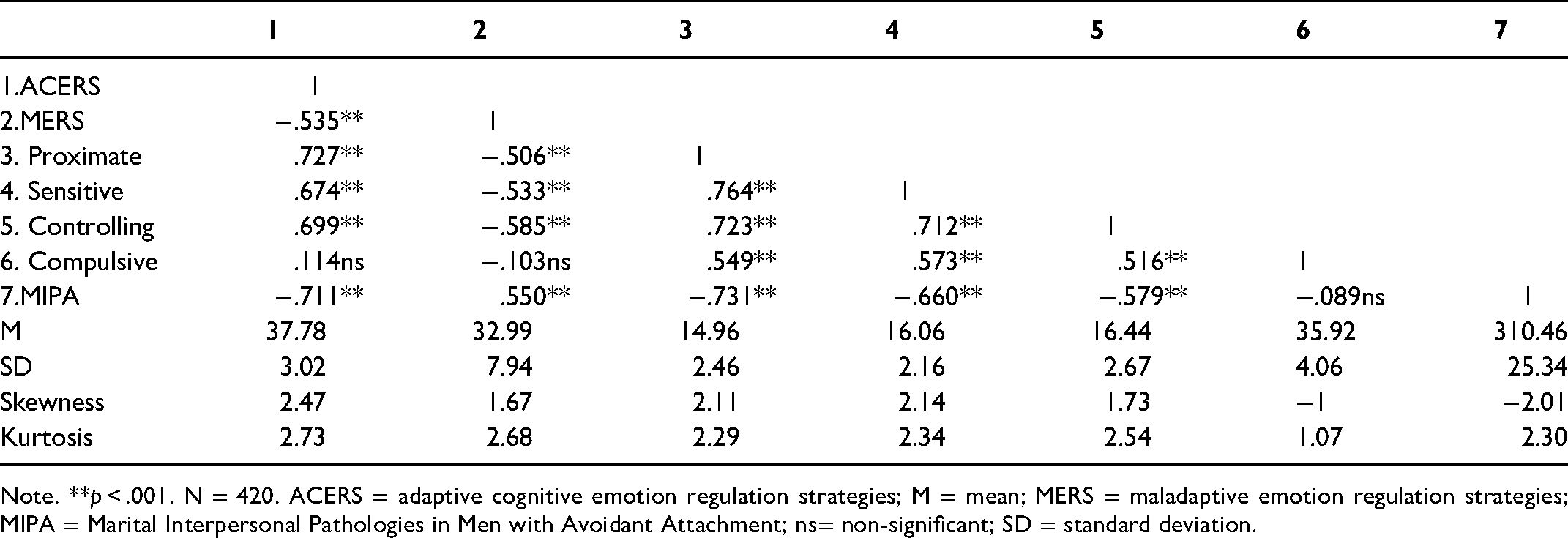
Note. **p < .001. N = 420. ACERS = adaptive cognitive emotion regulation strategies; M = mean; MERS = maladaptive emotion regulation strategies; MIPA = Marital Interpersonal Pathologies in Men with Avoidant Attachment; ns= non-significant; SD = standard deviation.
Here, the two-step approach by Anderson and Gerbing (1988) was used to answer the main research hypothesis. After evaluating the fit of the measurement model using Confirmatory Factor Analysis, the proposed structural model was tested based on structural equation modeling.
Model fit statistics suggest that the measurement model fit the data well: χ2 (82, N = 415) = 230.585, p < .001; CFI = .92; SRMR = .03; RMSEA = .066, 90% confidence interval (CI) (.060, .075); PNFI = .62; PCFI = .63; IFI = .92, and GFI = .90. All factor loadings were significant at p < .001. The hypothesized model was also an acceptable fit for the data χ2 (93, N = 415) = 217.983, p < .001; CFI = .94; SRMR = .01; RMSEA = .056, 90% CI (.051, .064); PNFI = .66; PCFI = .68; IFI = .94, and GFI = .92; R2 = .83. Figure 1 presents the key estimated structural model paths and factor loadings for the three latent variables.

Structural equation model with standardized coefficients, R2, and factor loadings.
Direct Paths
There are several significant paths in the proposed model (see Table 2). There was a negative and significant relationship between ACERS and MIPA (p < .001). In other words, MIPA scores decrease with increasing ACERS in men with avoidant attachment. However, there was a positive and significant relationship between MERS and MIPA (p < .001). This means that as MERS decreases in men with avoidant attachment, MIPA scores decrease as well. High ACERS scores in these men were associated with high proximate, sensitive, and controlling caregiving styles (p < .001). Low MERS scores in these men were associated with high proximate, sensitive, and controlling caregiving styles (p < .001). Moreover, there was a negative and significant relationship between proximate, sensitive, and controlling caregiving styles and MIPA (p < .01).
Standardized Coefficients of Direct and Indirect Paths.
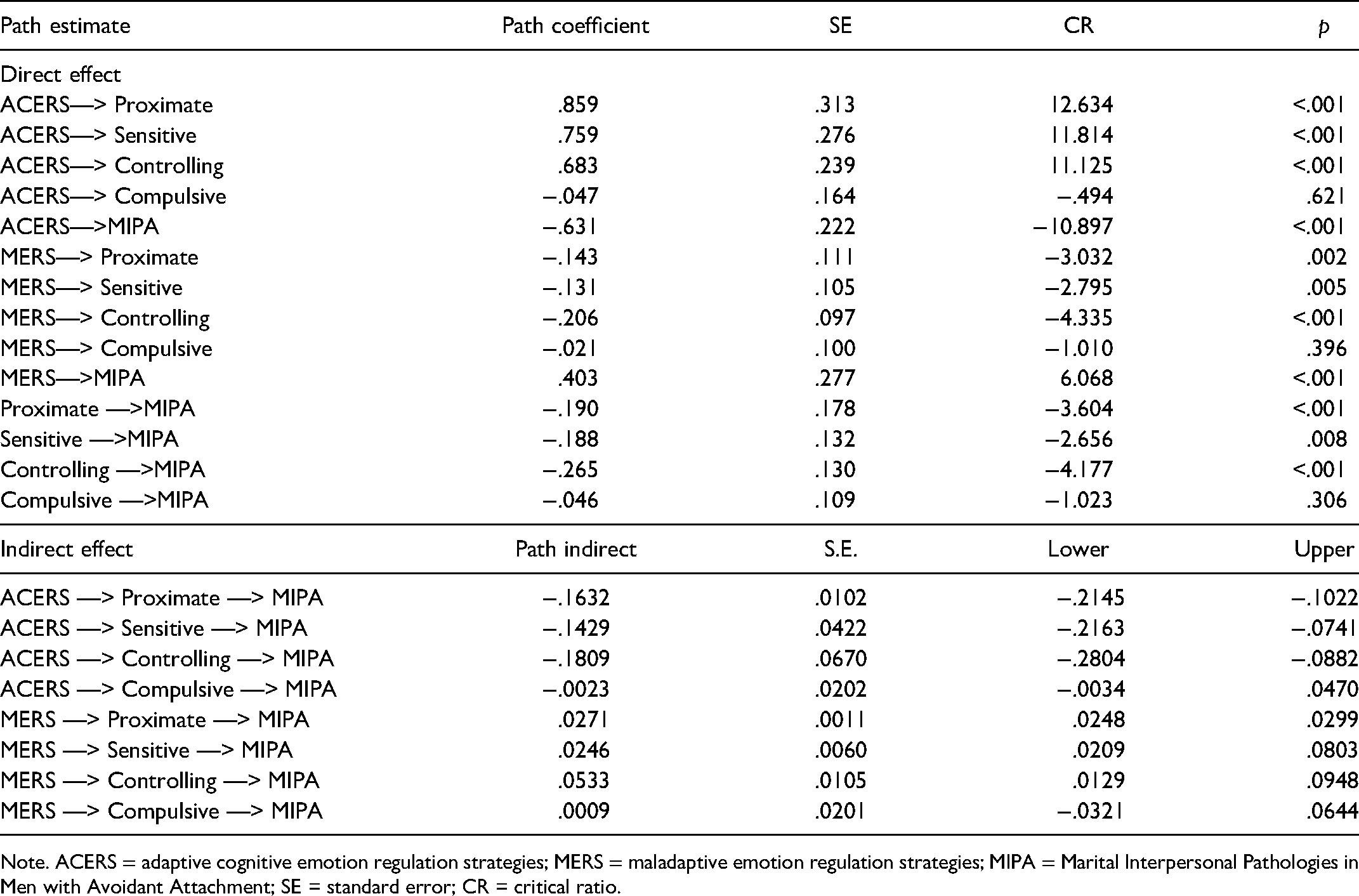
Note. ACERS = adaptive cognitive emotion regulation strategies; MERS = maladaptive emotion regulation strategies; MIPA = Marital Interpersonal Pathologies in Men with Avoidant Attachment; SE = standard error; CR = critical ratio.
Indirect Paths
Determination of mediation in the model was based on examining the significance of the indirect effects from the bootstrap procedure (Preacher & Hayes, 2008). Six indirect relationships were significant.
First, the bootstrap analysis revealed a significant specific indirect relationship between ACERS and MIPA, with proximate as the mediator: standardized indirect effect = −.1632, SE = .0202, 95% CI (−.2145, −.1022). Second, the bootstrap analysis indicated a significant specific indirect relationship between ACERS and MIPA, with sensitive as the mediator: standardized indirect effect = −.1429, SE = .0422, 95% CI (−.2163, −.0741). Third, the results showed that there was a significant specific indirect relationship between ACERS and MIPA, with the mediation of controlling: standardized indirect effect = −.1809, SE = .0670, 95% CI (−.2804, −.0882). Fourth, the results showed that proximate mediated the relationship between MERS and MIPA: standardized indirect effect = .0271, SE = .0011, 95% CI (.0248, .0299). Fifth, the bootstrap analysis showed that there existed a significant specific indirect relationship between MERS and MIPA mediated by sensitive: standardized indirect effect = .0246, SE = .0060, 95% CI (.0209, .0803). Finally, controlling mediated the relationship between MERS and MIPA: standardized indirect effect = .0533, SE = .0105, 95% CI (.0129, .0948).
Discussion
The aim of this study was to investigate the factors affecting marital interpersonal pathologies in men with avoidant attachment. This study paid particular attention to cognitive emotion regulation strategies and the mediating role of caregiving styles.
The results indicated that there was a significant positive relationship between ACERS (acceptance, refocus on planning, positive refocus, positive reappraisal, and putting into perspective) and proximate, sensitive, and cooperative caregiving styles. In addition, the results showed that there was a significant negative relationship between MERS (self-blame, other-blame, rumination, and catastrophizing) and proximate, sensitive, and cooperative caregiving styles. When faced with tensions in marital relationships, avoidant insecure men often resort to MERS, which make it impossible for them to properly manage negative emotions such as anxiety and negative thoughts.
Especially in the cultural context of Iranian families, in childhood, parents have special ways of communicating with their sons. For example, when their son expresses his negative emotions or cries, instead of empathizing with him and contacting and caring for him, they refuse to call and intimacy with him and tell him, “You have become man and you must be strong and these behaviors are girlish …!”. Hence, these children (due to fear of rejection) refrain from expressing their negative and even positive feelings, as well as discussing their problems. As a result, these children develop a cold and withdrawn personality or prefer to avoid contact and care when they feel insecure. They take these strategies with themselves into adulthood as well as their marital relationships. In old age, when tensions in marital relationships, they are not able to accept the situation and think of a plan for better performance. They cannot think of good experiences and tend to catastrophize their experiences. Sometimes, they ruminate on a problem and thus cannot forgive their spouse and blame themselves or others, or they cannot change their perspective of a bad situation to a better one. Also, they cannot accept and understand their spouse's point of view or they do not think about the positive aspects of a problem resulting in maladaptive problem solving, which in turn makes them unable to positively take care of their spouse. Also, these men cannot establish emotionally intimate relations with their spouse, be sensitive to her emotional needs, or understand her needs, and thus try to control rather than cooperate in solving the problems. This finding is consistent with the conclusion reported by Brehl et al. (2021) and Granefski et al. (2001).
The results of this study showed that there was a significant negative relationship between proximate, sensitive, and cooperative caregiving styles, and marital interpersonal pathologies of men with avoidant attachment. Avoidant men tend to experience more marital interpersonal pathologies when they distance themselves from marital tensions and problems, when they focus only on themselves and their needs instead of cooperating in solving problems and considering the feelings and needs of their spouse, or when they show no sensitivity to their spouse’s feelings and needs. In other words, when faced with communication tensions, the inappropriate caregiving styles of these men lead to emotionally cold homes and self-centered expectations devoid of understanding and empathy with the other person. Having weak problem solving and conflict resolution skills can have negative effects on sexual relationship, relationship with the families of origin, agreement over financial and parenting issues, and job-related problems. This finding is consistent with the results reported by Péloquin et al. (2014) and Purfaridian (2017).
Moreover, there was a significant negative relationship between ACERS and marital interpersonal pathologies, while there was a significant positive relationship between MERS and marital interpersonal pathologies of these men. Using MERS by insecure men during tensions in marital relationships undermines their ability to manage their emotions and negative thoughts about their spouse, their relationship, and others. As a result, they cannot accept the situation or think of a plan for better performance. They fail to think of good experiences or possible favorable outcomes. Such men could engage in catastrophizing and ruminating on their problems. Thus, they are not inclined to forgive their spouse or others, they blame themselves or others. They cannot accept and understand the views of their spouse or others and do not think about the positive aspects of problems, and consequently, they may have maladaptive problem-solving approaches, which in turn create further problems and pathologies marital. In other words, such MERS undermine their ability to resolve issues and conflicts properly, which negatively affects the relationship with families of origin, sexual relationship, agreement about financial issues, cooperation in doing the housework, and increase job-related problems. This is consistent with the findings reported by Buehler (2014), Granefski et al. (2001), and Wang et al. (2021).
The present study also found a significant positive relationship between MERS and marital interpersonal pathologies mediated by proximate, sensitive, and cooperative caregiving styles. There was also a significant negative relationship between ACERS and marital interpersonal pathologies mediated by proximate, sensitive, and cooperative caregiving styles. This might be because facing communication tensions and problems with their spouse, due to feelings of insecurity, avoidant men cannot accept the situation well and plan for a better performance, they cannot think of good experiences and good things that they have not tried. In response, they may catastrophize or ruminate about problems and consequently cannot forgive their spouse, they may blame themselves or others, they may not accept and understand their spouse’s perspective, they may not think about the positive aspects of problems and therefore use MERS. This can make them unable to positively take care of their spouse and prevent them from approaching or embracing their spouse emotionally. They are not sensitive to her emotional needs and they do not understand these needs. Also, instead of cooperation in solving the problem, they may try to control. Naturally, these strategies increase marital dissatisfaction and marital interpersonal pathologies, such as greater emotional distance and emotionally cold homes, lack of understanding and empathy, lack of problem solving and conflict resolution skills, sexual problems, and problems dealing with their families, lack of agreement about parenting or financial decisions, and increased job-related problems.
According to our findings all direct and indirect pathways related to the compulsive caregiving style were not significant. It is possible to argue that avoidant men do not have much fear and anxiety about losing the other party, instead of clinging to the other party (which is usual in the obsessive anxious attachment style), they try to avoid or distance themselves from their spouse and thus avoid facing their emotions. Therefore, it is uncommon among these men to obsessively care for their spouse or put her needs above theirs. In the Iranian culture, boys are particularly taught that they should show strength. As such, they tend to have fewer obsessive behaviors and do not try hard to be pleasing. This finding is consistent with the results reported by Roohi et al. (2018).
Conclusion
Considering that the research sample only included avoidant men in a single city in Iran, the findings should be generalized with caution to women, other attachment styles, and other cultural and ethnic contexts. It should be noted that in this study the factors affecting marital interpersonal pathologies of avoidant men were investigated by emphasizing the role of cognitive emotion regulation strategies and caregiving styles. Therefore, we suggest other researchers to investigate the proposed model for women, other attachment styles, as well as individuals with different cultural and ethnic groups. It is also recommended that researchers examine other factors that exert an impact on marital interpersonal pathologies of avoidant men.
Practitioner Points
Based on the findings of the present study, therapists can examine the avoidant attachment style in men for diagnosis and treatment of marital problems. Moreover, it is important to pay attention to the role that cognitive emotion regulation strategies and caregiving styles play in avoidance men with marital interpersonal pathologies. Therefore, therapists can have therapeutic interventions to improve emotion regulation strategies and caregiving styles in these men and thus help increase their marital satisfaction and reduce divorce rates in Iran. Also, there are many traditional stereotypes in families of Iranian cultural context about raising boys in childhood, which in turn leads to the formation of avoidant attachment style in their sons and the inability to express feelings, empathy, caregiving, and problem solving in them. Of course, this issue also has negative effects on the future marital relations of these children. Therefore, the results of this research can be used by family therapists to correct many of these traditional stereotypes about how to care for and empathize with boys, thus preventing of future marital problems of these boys as well as divorce.
Footnotes
Acknowledgments
The authors greatly appreciate and thank all individuals and institutions that collaborated in conducting this research. They would also like to thank all the participants whose cooperation made it possible to complete this study.
Author Contributions
In the present study, NA performed, analyzed, and wrote the article, and SH and OE reviewed and judged the article.
Availability of Data and Material
Data are available upon request from the corresponding author.
Case Material
This study does not include case materials.
Declaration of Conflicting Interests
The author(s) declared no potential conflicts of interest with respect to the research, authorship, and/or publication of this article.
Ethics Approval
All procedures performed in this study involving human participants were in accordance with the ethical standards of the institutional and/or national research committee and with the 1964 Helsinki declaration and its later amendments or comparable ethical standards.
Funding
The author(s) received no financial support for the research, authorship, and/or publication of this article.
