




Abstract
Marriage and family formation has become a great challenge and a matter of concern in modern societies; it seems that one of the most important factors that can affect people's decision to get married is their attitude toward marriage. This study aimed to investigate the relationship between existential thinking, meaning of life, existential loneliness, and attitude toward marriage in single youth. A cross-sectional correlational design was conducted in 377 university students (age ranged 18–22 years old) in Isfahan city, Iran. Findings of structural equation modeling showed that there was a negative and significant relationship between existential thinking and existential loneliness and a positive significant relationship between existential thinking and meaning of life. The existential loneliness had a negative effect on positive attitude toward marriage. The findings also revealed that existential thinking affects existential loneliness via influencing on meaning of life as a mediating factor. There was a negative and significant relationship between meaning of life and existential loneliness. Moreover, meaning of life had a positive significant relationship with attitude toward marriage (p < .01). Regarding, premarital interventions that emphasize on existential issues may probably increase the positive attitude of single youth toward marriage.
Keywords
Introduction
Being single literally means being unmarried, and refers to a boy or girl who has reached maturity and is still unmarried, or a person who is divorced or widowed. In other words, “single” is a word used to categorize a large group of individuals who all of which have a common characteristic of “not marrying” (Prabhakar, 2011). Prabhakar (2011) showed that most young people, especially girls, either voluntarily chose to remain single or remained single because of their circumstances. Voluntary includes reasons such as desire for freedom and independence, high marital expectations, pursuit of career, as well as disappointment in love. Non-voluntary means not marrying due to family restrictions or loss of parents, low income and generally not marrying due to personal circumstances. In a study conducted on a sample of Iranian youth, the causes of staying single and marriage barriers including economic, social, and cultural factors were examined. The results showed that cultural and economic factors were the most effective factors of staying single in young people (Tahery et al., 2018). According to the latest statistics from Iran Population Database in 2018, more than 11 million Iranian youth aged 20–35 years are still unmarried. According to Iran population database, the age of marriage for men and women has increased compared to previous years and reached an average of 27.2 years for men and 23 years for women. These statistics show an increase in definite staying single rate in Iran society (National Organization for Civil Registration, 2019). These evidences show attitude toward marriage, that is one of the most important factors influencing the marriage in single youth, is changing.
Attitude toward marriage
“Attitude” can be considered as individual's predisposition to evaluate an object, a person or world in a favorable or unfavorable manner. In fact, attitude is a reflection of how a person feels about something (Schwarz & Bohner, 2001). Attitudes toward marriage and long-term relationships become a part of one's identity in adulthood (Arnett, 2000). Attitudes toward marriage among young people also vary based on gender, sexual experience, family structure, academic achievement, and race (Willoughby et al., 2015a). Attitudes are reflected in what a person says or hears and affect people's perception of the world (Omidvar et al., 2011). The age and manner of marriage in the United States and other industrialized countries has changed dramatically over the past few decades. In most Western countries, marriage is typically delayed until age 30, and marriage rates are generally declining (Lee & Payne, 2010). Several studies have been conducted on the social causes of the increase in the age of marriage. For example, (Hamilton & Siow, 2007) indicated that the demand for marriage depends on individuals’ socioeconomic status. Kazemipour (2004) found that there is a relationship between the continuing education and high marital expectations with conflict in choosing a partner in a sample of Iranian youth. Also, lack of a suitable job, family poverty, low family social status, problem in facial appearance, employment status, type of job, low education, high cost of marriage, having a single older sibling, and indecisiveness were associated with less willingness to marry (Kazemipour, 2004).
According to social psychologists point of view, an individual's attitude toward a subject is not formed suddenly, but the formation of a particular attitude can be the result of various factors and takes place over time (Willoughby et al., 2015b). Evidence shows young people's attitudes toward marriage and family formation have been negatively oriented, and as a result the desire to get married has decreased (Jónsson et al., 2000) and we see the shift to new patterns of family formation such as cohabitation and changes in marriage values, especially among urban and educated youth. However, all forms of marriage also depend on the type of attitude people have toward marriage (Gottman, 1993).
Existential loneliness and attitude toward marriage
It seems that one of the variables related to the attitude toward marriage is existential loneliness. Loneliness is defined as the unpleasant feeling that comes from not being with others and a desire to have an interaction different from what has been experienced before (Francis, 1976). Sønderby and Wagoner (2013), noted that loneliness is the feeling of being alone in spite of eager for longing to others. Since the 1980s, most researchers have agreed on the concept of loneliness as a feeling of loss of interpersonal relationships. People who are alone are often eager to get in touch with people, but their mood makes it hard to communicate with others. Loneliness has always been considered as a common problem among the elderly, but today this concern has increased among young people (Matthews et al., 2019). Loneliness is a perceptual experience, meaning that if people think they are alone, they will feel lonely. One type of loneliness is existential loneliness. Existential loneliness is defined as an intolerable emptiness, sadness and meaninglessness, which is a much deeper and more painful than interpersonal loneliness. Existential loneliness means that an individual suffers from a lack of meaning in his life (Van Tilburg, 2021). But, on the other hand, some see existential loneliness as something that can be appreciated positively. They believe that man finds strength in being solitary, although this requires a lot of effort in self-exploration (Van Tilburg, 2021). According to Moustakas (1961), existential loneliness is inherent in human existence, so that everyone can be identified as a lonely person (Van Tilburg, 2021). Nevertheless, existential loneliness mostly includes negative feelings and emptiness, so it is expected that people who have negative feelings, meaninglessness and emptiness, don't have a positive attitude toward marriage because they feel empty and meaningless in marriage as well as in other aspects of life.
Meaning in life and marriage
Theoretically, similar to existential loneliness, meaning in life has been linked to attitude toward marriage. Frankl (1985), as the theorist of logotherapy, believed that people are seeking meaning in life and well-being is raised when a person finds the meaning of life. He noted that human behavior is not based on hedonism according to Freud theory nor power-seeking according to Adler theory, but that human beings seek their personal meaning in life and the meaning of life is the basis of the motivation of behavior. If a person cannot find meaning in life, he/she will feel empty and disappointed in life and he/she may not find meaning in other aspects of life such as marriage. The evidence shows that the meaning of life is a predictor of tendency to marriage in single youth (Porzoor et al., 2015) and has a negative relationship with the tendency of marital infidelity (Heydarian et al., 2022 In press). According to Steger and Frazier (2005), the meaning of life consists of two dimensions: the presence of meaning and the search for meaning. They consider the meaning of life as a symbol of connection between the present, the past and the future, they believe life is so cohesive that it connects the present to the past and our desires and aspirations to the future. Evidences have shown that the meaning of life or the search for the meaning of life has a significant relationship with mental health, life satisfaction, mental well-being and hope (Czekierda et al., 2017; Glaw et al., 2017); However, few researches have investigated the relationship between the meaning of life and attitude toward marriage, and mainly they have investigated the relationship between the meaning of life and marital satisfaction (Çelik et al., 2022; Kalantarkousheh & Hassan, 2010). Anyway, the studies that have been conducted on the “meaning of marriage” have also dealt with the meaning of life and show that the meaning of marriage is in line with the meaning of life. These studies show that people tend to marriage and childbearing when they find the meaning of life and the meaning of marriage (Jarnkvist, 2019; Özyiğit, 2017).
Existential Thinking and attitude toward marriage
Thinking in Oxford dictionary is defined as the active use of mind to shape different ideas (Oxford Universal Dictionary, 1964). Thinking also defined as organizing and reorganizing the past learnings to use in the current situation and problem solving (Glaser, 1984). Solso (1971), completed these definitions and believed that thinking is a process that occurs through the transformation of information, a series of argumentations and problem-solving processes. Existential thinking is one form of thinking. Allan and Shearer (2012) defined existential thinking as the tendency to explore the fundamental concerns of human existence and the capacity to engage in a meaning-making process. They also developed the scale for existential thinking (SET), to measure the degree to which people have engaged in this way of thinking. This scale is very much related to the presence and search for the meaning of life. In this way, the search for meaning requires an existential thinking. As mentioned, Steger and Frazier (2005) distinguished between the presence and the search for meaning in life. The presence of meaning in life indicates the belief that life has a purpose, and the search for meaning indicates an attempt to find meaning in life. Existential thinking may overlap the search for meaning, because people who are looking for purpose and meaning in life would logically spend more time thinking about the purpose of their life or the meaning of life. However, Gardner (1999) maintained that existential thinking also involves locating oneself in respect to existential issues. This implies that existential thinking includes a process by which people find meaning in existential issues. In the same way, Kretschmer and Storm (2018) showed that the search for meaning is the strongest predictor of existential thinking. They revealed that existential thinking and the search for meaning in life are correlated positively and significantly, so that when a person thinks about his life and existence, he is actually in search for the meaning of his life. Therefore, it can be concluded that a person who has never thought about his life and existence, has not consequently thought about marriage as a part of life; hence, he may not have the appropriate attitude toward marriage.
Proposed model
Existential concepts such as existential thinking as well as existential loneliness seem to be related to the meaning of life in general and to the attitude toward marriage in particular. The present study seeks to discover the structural relationship between existential thinking, meaning of life, existential loneliness, and attitudes toward marriage. Allan and Shearer (2012) showed that there is a negative and significant relationship between existential thinking and existential anxiety consequences such as loneliness, so that more existential thinking will lead to less anxiety and loneliness. On the other hand, existential thinking leads to finding of meaning in life (Allan & Shearer, 2012) and the life meaning leads to a positive attitude toward marriage (Porzoor et al., 2015). In line with social, cultural, and generational changes, the meaning of life in general and the meaning of marriage in particular also change. Each person can have his own unique meaning toward life and marriage, but the lack of meaning for marriage leads to a decrease in the tendency to marry in single youth. Regarding, existential thinking helps young people to find the meaning of their lives, cope with existential loneliness, have a positive attitude toward marriage, and find the meaning of marriage (Özyiğit, 2017). In other words, it is expected that a person who has existential thinking and has been able to reduce his existential loneliness through existential thinking will be able to find his meaning of life and therefore will have a positive attitude toward marriage. Nevertheless, it seems that existential thinking causes a person to think about the main concepts of life, to explore goals of life, and to see life as meaningful and valuable and therefore see marriage as a part of this valuable life. So, it can be concluded that existential thinking by reducing existential loneliness and improving the attitude toward life and strengthening the meaning of life improves the attitude toward marriage.
The present study
Regarding the changes which have taken place in the attitudes and desire of young people to marriage in recent decades and increasing the rate of staying single (Sassler & Lichter, 2020), many societies that are facing declining population rates are looking for a way to increase the marriage rate. Increasing the rate of marriage without having the appropriate attitude toward marriage and finding meaning in marriage also leads to the formation of unstable marriages, which is associated with an increase in divorce and, as a result, the engaging of societies with the negative consequences of divorce. Therefore, exploring the variables that can help to increase the positive attitude toward marriage in young people, can help the societies to plan for increase the rate of marriage and childbearing. Therefore, the purpose of this study was to evaluate the structural relationships among existential thinking, meaning of life, existential loneliness, and attitude toward marriage in single youth. On the other hand, if the proposed model has been confirmed, because existential concepts can be taught, existential intervention programs can be designed to change the attitude toward life and perusing a new meaning in life, and as a result, changing the attitude toward marriage.
Methods
Design and participants
A cross-sectional correlational design was conducted. A total of 377 university students in Isfahan city, Iran, were selected using available sampling method. The inclusion criteria were as follows: age ranged 18–22 years old, being single, and not being involved in any romantic relationship since the last six months. Exclusion criteria were included having a previous marriage, having psychiatric disorders, and taking psychiatric drugs. According to Siddiqui (2013) which considers a sample size of more than 300 participants to be desirable for structural equations analysis, 400 participants were selected. The data of 23 participants could not be analyzed and finally the data of 377 were analyzed (return rate of 94%). Inclusion and exclusion criteria were evaluated using interviews. The objectives of the study were explained to the participants and they completed the consent form. The questionnaires were completed individually and the participants’ questions were answered about how to complete the items that were unclear to them.
Instruments
Existential Loneliness Questionnaire
The Existential Loneliness Questionnaire (ELQ) was initially constructed with 32 items, but after factor analysis was reduced to 22 items that are scored on a 6-point Likert scale from 1 (not at all true of me) to 6 (very much true of me) (Mayers et al., 2002). Cronbach's alpha of 22 items was .90. This scale was created to measure existential loneliness in women infected with HIV, but it can be used in other societies as well (Kretschmer & Storm, 2018). Three items were removed because they were related to HIV patients. The modified scale (19 items) demonstrated good reliability (α = .78) (Kretschmer & Storm, 2018). The ELQ would significantly correlate with the Beck Depression Inventory, the Beck Hopelessness Scale, the Purpose in Life Scale, and the UCLA Loneliness Scale (Mayers et al., 2002). The 19-item form of ELQ had a significant positive correlation with the death anxiety scale, Identity distress scale, psychological reaction scale, and the search subscale of the meaning of life scale, and a negative correlation with the presence subscale of the meaning of life scale (Kretschmer & Storm, 2018). In this study, the content validity of the Persian version of ELQ was confirmed by experts. Also, factor structure of ELQ was confirmed using confirmatory factor analysis. Cronbach's alpha of the ELQ was .89.
Life Attitude Profile
Life Attitude Profile (LAP) is a multidimensional measure of attitude toward life which measure existential meaning and purpose in life and the strength of motivation to find meaning and purpose (Reker, 1992). LAP includes 48 items that are scored on a 7-point Likert scale from 1 (strongly disagree) to 7 (strongly agree). The range scores are 48–336. LAP includes 7 subscales: purpose, coherence, choice/responsibleness, death acceptance, existential vacuum, and goal seeking. Cronbach's alpha LAP was between 0.89 and 0.91; LAP has a significant convergent validity with the purpose-of-life questionnaire and the meaning of life index (Reker, 1992). The factorial structure of the Persian version of this questionnaire was confirmed and the test-retest reliability was .83 (Khaiyat-Farahani, 2011). Cronbach's alpha of the LAP in this study was .92.
Existential Thinking Scale
Scale for existential thinking (SET) is an 11-item self-report measure, scored on a 6-point Likert scale (0 = No or rarely, to 4 = All the time, the final item was: I don't know). Scores range from 11 to 55 (Allan & Shearer 2012). SET measures the degree to which one thinks about existential concepts; has a unidimensional structure. The SET has a significant test-retest reliability (r = .91) and Cronbach's alpha ranging from α = .88 to α = .94 (Allan & Shearer, 2012). SET has a convergent validity with the Spiritual Intelligence Self-Report Inventory (r = .67) and its subscale of existential thinking (r = .67). There was a significant correlation between SET scores and religiosity, life satisfaction, and meaning in life (Allan & Shearer, 2012). The single-factor structure of the Persian version of the SET has been approved. Also, Cronbach's alpha was 0.88 and test-retest reliability was 0.75. The Persian version of the SET had convergent validity with the spiritual intelligence questionnaire and divergent validity with existential anxiety (Fasanghari et al., 2020). Cronbach's alpha of the SET in this study obtained .87.
Marriage attitude questionnaire
The Marital Attitude Scale (MAS) is a 23-items scale, scored in a 4-point Likert from strongly agree (1) to strongly disagree (4), and assesses global satisfaction toward heterosexual marriage (Braaten & Rosén, 1998) scores ranging from 23 to 92. Higher scores indicate a more positive attitude toward marriage. Six items designed to measure a person's current beliefs about marriage include items about relationship satisfaction, anxiety, commitment, and fear of marital breakdown. Other items refer to the general attitude toward marriage. According to Braaten and Rosén (1998), the MAS significantly correlated with the ATM (attitudes toward marriage), r = .77. The MAS was also significantly negatively correlated with some subscales of the Communication Beliefs Questionnaire. The factorial structure of the Persian version of MAS was confirmed in an Iranian sample, and Cronbach's alpha and ordinal theta were 0.75 and 0.8, respectively (Sayah et al., 2018). In another study, the factorial structure of the Persian version of MAS was confirmed and the test-retest reliability was 0.91. The scores of this scale with the expectations of marriage questionnaire also had significant convergent validity (Nilforoshan et al., 2013). Cronbach's alpha of the MAS in this study was .78.
Data analysis
Statistical analyses were conducted using AMOS & SPSS version 24. The mean ± standard error was presented for continuous variables, and proportions for categorical variables. To replace the missing values, participants’ responses to items of the same domain in the scale were used. The level of significance was considered to be 95% (p < .05). Pearson correlation was used to explore the relationship between variables. Structural equations modeling analysis was used to assess the proposed model. Direct and indirect relationships between variables were analyzed by bootstrapping method. Preliminary analyses were conducted to ensure no violation of the assumption of normality, linearity, multicollinearity, and homoscedasticity.
Results
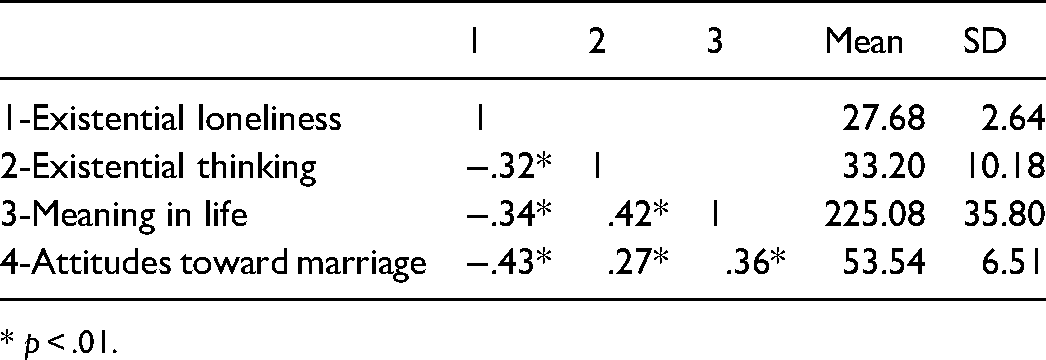
A total of 125 participants were men (33.3%) and 252 were women (66.7%). 293 participants were undergraduate students (78%) and 84 were postgraduate (22%). The mean, standard deviation, and correlation between the study variables are presented in Table 1.
Mean, standard deviation a correlation between variables.
* p < .01.
Existential loneliness had a significant negative correlation with existential thinking, meaning of life, and attitudes toward marriage (p < .01). There was a significant positive correlation between existential thinking and the meaning in life, and between existential thinking and attitude toward marriage (p < .01). The meaning in life also had a significant positive correlation with the attitudes toward marriage (p < .01). Structural equation analysis was used to examine the default research model. One of the assumptions of structural equation analysis is the normality of the distribution of scores. The results of the Kolmogorov-Smirnov test showed that the distribution of existential thinking scores (w = .062, p = .103), existential loneliness (W = .051, p = .287), meaning of life (w = .046, p = .342), and the attitude toward marriage (W = 0.039, p = .576) is normal. In order to investigate the collinearity between the independent variables, the variance inflation factor (VIF) and tolerance statistics were used. Tolerance statistics for the variables of existential loneliness, existential thinking, and meaning of life were 0.84, 0.78, and 0.77, respectively, and VIF statistics for the variables of existential loneliness, existential thinking, and meaning of life were 1.19, 1.28, and 1.3, respectively. Tolerance statistics were higher than 0.4 and VIF statistics were lower than 2.5 which indicate the there was no multiple collinearity.
The fitness indexes in the tested model show that the model has reached the appropriate fitness (Table 2). The value of χ2 is significant. Although this value must be insignificant for the model fitness, but in models with a large sample size and several observed variables, the χ2/df ratio is used. This ratio should be less than 3 to be considered good for the model fitness. In the tested model, the ratio was χ2/df = 2, which is considered favorable for model fitness. Goodness of Fit Index (GFI), Normal Fit Index (NFI), Relative Fit Index (RFI), Incremental Fit Index (IFI), and Comparative Fit Index (CFI) must be greater than 0.90 to confirm the model fitness. In the tested model, all of these statistics were higher than 0.9. Finally, the root mean square error of approximation (RMSEA) statistic was 0.05, which values less than 0.080 are good for model fitness.
Fit indices of the tested model.

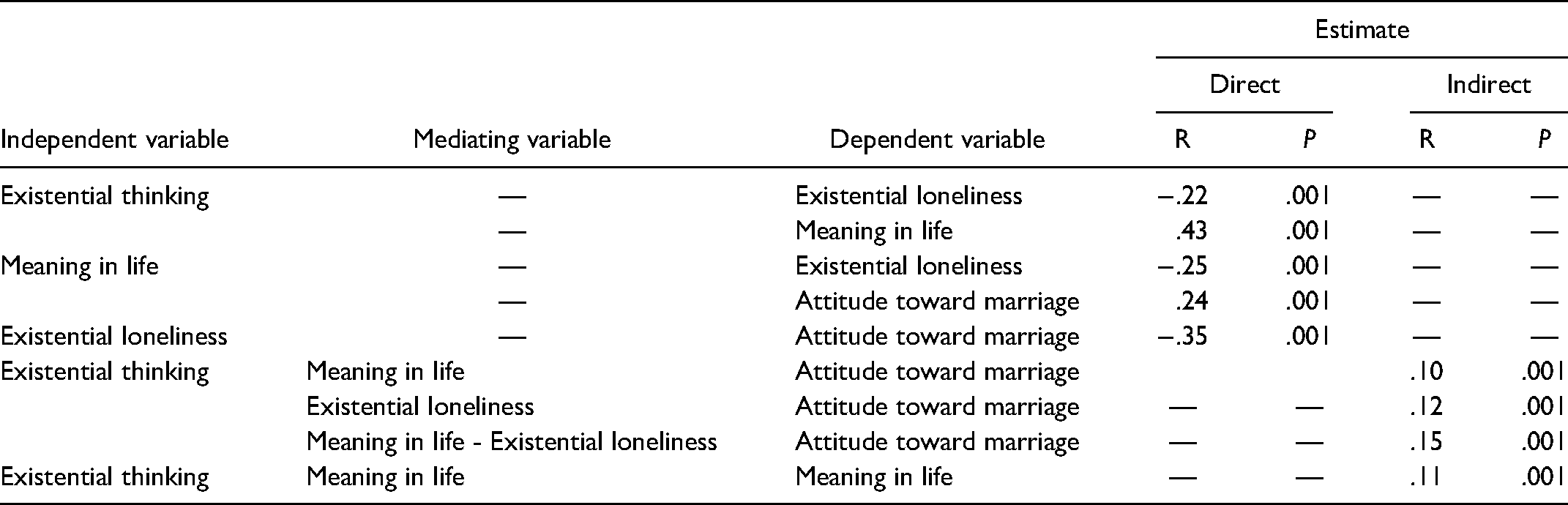
The path coefficients of the tested model are presented in Figure 1 and Table 3. The path coefficient of existential thinking to existential loneliness and meaning of life was β = −0.22 and β = 0.43, respectively (p < 0.01), which showed that existential thinking had a significant negative effect on existential loneliness and has a positive effect on the meaning in life. The path coefficient of the meaning in life to existential loneliness and attitudes toward marriage was β = −0.25 and β = 0.24, respectively (p < .01), which showed that the meaning in life has a significant negative effect on existential loneliness and a significant positive effect on the attitude toward marriage in single youth. In order to estimate the indirect effects and the mediating role of the meaning in life and existential loneliness, the Bootstrap method was used (Table 3). The results show that the indirect effect of existential thinking on the attitude toward marriage through the meaning in life (β = 0.10) and existential loneliness (β = 0.12) is significant (p < .01) and the existential loneliness and meaning in life play a significant mediating role between existential thinking and attitude toward marriage. Moreover, existential thinking had an indirect effect on existential loneliness (β = −0.11) through the influence on the meaning in life; therefore, the mediating role of the meaning in life in the relationship between existential thinking and existential loneliness was significant (p < .01).
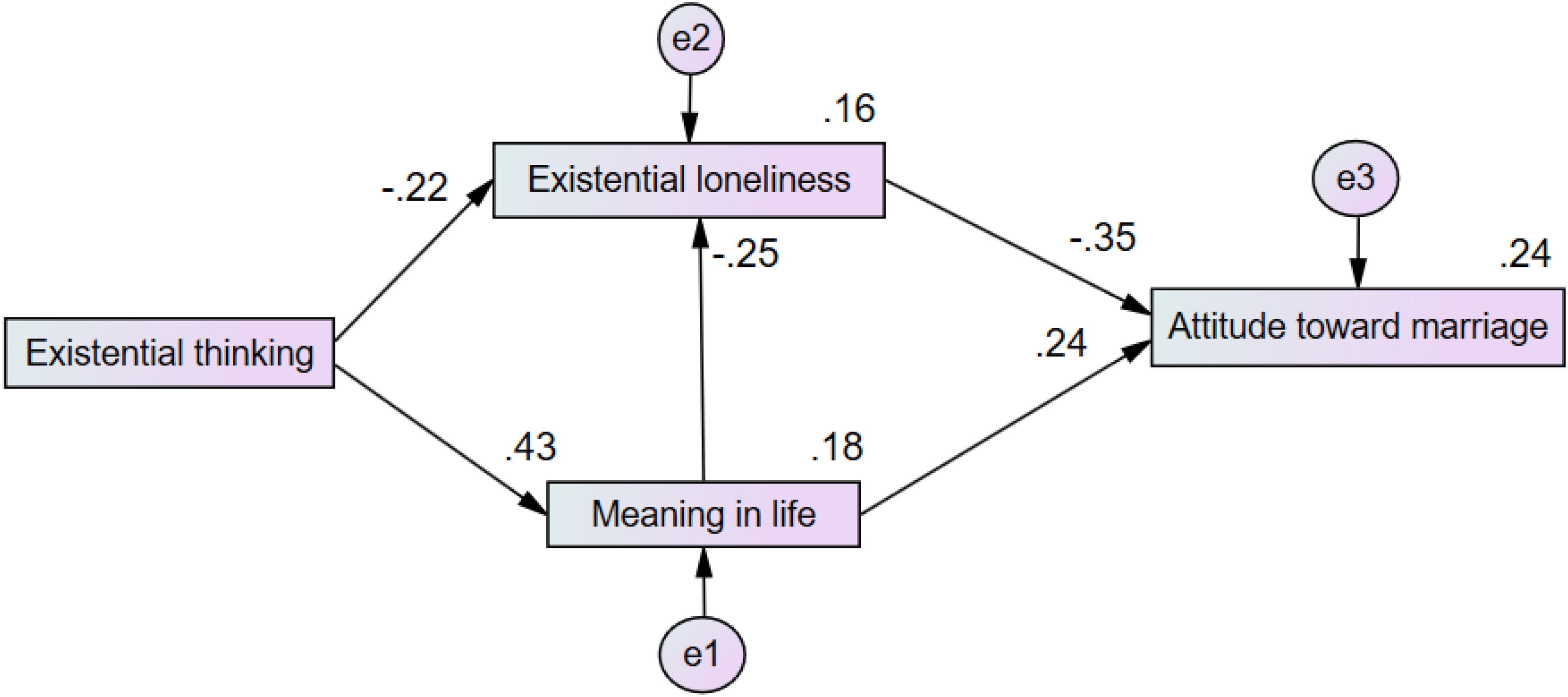
The research model.
Estimation of direct and indirect paths of the model.
Discussion
As our society changes with each passing year, the type of marriage and the attitude toward marriage also changes. Factors related to successful marriage such as childbearing, population increase, reducing divorce, and increasing vitality in society are important issues for any societies and governments. Changing the attitude toward marriage is relatively inevitable, however, identifying the variables that can affect the positive attitude toward marriage can help psychologists and sociologists to plan to increase the tendency to marriage and increase the stability of the marital relationship.
The results of this study revealed a significant negative relationship between existential thinking and existential loneliness. On the other word, with the increase of existential thinking, existential loneliness decreases. In line with the findings, Kretschmer and Storm (2018) revealed that existential loneliness has a negative relationship with presence of meaning in life and positive relationship with depression and the search for meaning. A person who has lost the meaning of life falls into existential loneliness and depression, on the other hand, a person who has lost the meaning of life does not engage in existential thinking. According to existentialism, existential loneliness is a very deep level of loneliness, which means separation between the individual and existence. Yalom (1980) believe that one of the most important ultimate concerns of human being is facing existential loneliness. Finding the meaning of life as a result of existential thinking can help relieve existential loneliness. Modern society has brought a sense of meaninglessness to many people and has led to the kind of suffering and distress which is called existential vacuum. Furthermore, the main way of creating meaning is to engage in existential thinking. Therefore, individuals who engage in existential thinking will be able to free themselves from emptiness, aimlessness, meaninglessness, and existential distress and finally avoid from existential loneliness (Azizi & Alizamani, 2016).
The results of this study showed existential thinking has a positive effect on meaning in life which means that with the increase in existential thinking meaning in life also increases. This result is in consistent with previous studies (Fasanghari et al., 2020; Kretschmer & Storm, 2018; Saha & Ahuja, 2017). Saha and Ahuja (2017) found that existential thinking about the meaning of life resulted in satisfaction in life. When people think about the different dimensions of their lives, existence, and the purpose of existence, they find their personal purpose and meaning in life is raised (Park et al., 2010; Richardson Gibson & Parker, 2003).
The findings of present study also showed meaning in life has a significant negative effect on existential loneliness. In the other words, when meaning in life is increased, the existential loneliness decreased. Evidences consistent with these findings show that the feeling of existential loneliness is an unpleasant experience that makes a person separate and distinct from others, and such a feeling is accompanied by depression, anger, and sadness (Bolmsjö et al., 2019; Van Tilburg, 2021). According to the cognitive theory, loneliness is the result of negative attitudes such as self-doubt, fear of reject by others, sense of emptiness, and aimlessness. Regarding, it can be argued that purpose and meaning in life are related to existential loneliness. As Frankl (1985) noted, basis of the motivation of human behavior is the search for meaning.
The meaning of human life is manifested in valuable works, transcendence experiences and acceptance and cope with pain and suffering. In quest to find the meaning of life by doing valuable tasks and self-transcendence, in addition to becoming purposeful in life, a person establishes a better relationship with others and existential loneliness is reduced. According to the existential theory, in trying to “being in the world” and find meaning in life, a human being must deal with three tasks: Eigenwelt (being with ourselves), Mitwelt (being with others), and Umwelt (being with the world in which we exist); So, in an effort to search meaning, people find an appropriate relationship with others and avoid from of existential loneliness (Larsson et al., 2019). On the other hand, finding the meaning of life will lead to more life satisfaction and, as a result, a positive attitude to life, less depression, isolation and existential loneliness (Park et al., 2010).
The present study showed there was a positive relationship between the meaning in life and attitude toward marriage in single youth. In line with these results, Porzoor et al. (2015) found that as the meaning of life increases in young people, their positive attitude toward marriage also increases. Özyiğit (2017) showed the relationship between attitude toward life and marriage in single students. He found that marriage generally creates positive feelings among single youth, and they have a positive attitude toward marriage and family life, especially those who have a positive family life background and childhood experiences. Özyiğit (2017) revealed the participants who have a positive attitude toward marriage believed that the marriage basically means commitment, love, compassion and loyalty and those who find more meaning in marriage, commitment, love, and loyalty had a more positive attitude toward marriage.
The structural equation analysis in this study showed meaning of life in relation between existential thinking and existential loneliness has significant mediating role in single youth. Kretschmer and Storm (2018) found that existential thinking is related to the search for meaning in life. Existential thinking is a stimulus for finding the meaning of life, self-exploration, and thinking about existence (Kretschmer & Storm, 2018). Therefore, in existential thinking, like the rest of existential dimensions, a person also thinks about the relationship with others and finding meaning in it; As a result, existential thinking is expected to improve interpersonal relationship and reduce existential loneliness by increasing the meaning of life in relation to others, doing good deeds for others, and helping others (Allan et al., 2018). Finding a personal purpose and meaning in life causes a person to find a strong motivation to take steps toward positive things in life, to deal with the hardships and problems of life and avoid isolation (Imanzadeh & Alipour, 2018).
Conclusion
The purpose of this study was to investigate the relationship between existential thinking, meaning of life, existential loneliness, and attitude toward marriage in single youth. The results showed that young people's positive attitude toward marriage can be increased by considering some existential factors such as existential thinking, the meaning in life and existential loneliness, and if these factors are channeled in the right direction, the attitude toward marriage will also be on the right way. Regarding, it can be concluded that the positive attitude of single youth toward marriage can be increased by improving the meaning of life, increasing existential thinking and as a result, reducing the existential loneliness; Therefore, existential psychotherapy interventions that emphasize the concepts of existential thinking, the meaning of life, and proper confronting with existential loneliness can probably increase the tendency of young people to marry.
Implications for marriage and family counselors
This study has the following practical applications for marriage and family counselors: First, existential issues can play a role in the positive attitude of single young people toward marriage, and unless young people can reduce their existential concerns and anxieties, they cannot have a positive attitude toward marriage. Perhaps one of the reasons for the increasing desire of young people to remain single is their involvement in everyday life, seeking pleasure, materialism, meaninglessness, and whatever can be called lack of existential thinking. Second, premarital interventions that emphasize on existential issues may probably increase the positive attitude of single youth toward marriage.
Limitation and future studies
One of the limitations of this study was the lack of control of some intervening variables such as socio-economic status and previous of romantic relationships due to the limitations of the authors in choosing a larger sample size. It is suggested that in future studies, the proposed model in the present study in young people with previous romantic relationships and without previous romantic relationships be compared. It is also suggested to study the effect of existential thinking training on the attitude toward marriage in single youths using experimental design methods.
Footnotes
Acknowledgments
We thank all the students participated in the study.
Ethical approval
Before the intervention, the study objectives were explained to the participants and they were informed that they were undergoing a psychological study and the results of the study would be published without mentioning their names. Ethical consent was obtained from Ardakan University research committee (number id: 1399/326/4-5).

Informed consent
Written informed consent to participate in the study was obtained from all participants.
Declaration of Conflicting Interests
The author(s) declared no potential conflicts of interest with respect to the research, authorship, and/or publication of this article.
Funding
The author(s) received no financial support for the research, authorship, and/or publication of this article.