



Abstract
Parents of children with developmental delay (DD) report significantly higher levels of parenting stress compared to parents of children with typical development. There is a heightened need for social support among families of children with DD. Siblings play an important role in these contexts as a supportive resource and primary stress buffer. Little to no research has examined how these stress and supportive processes may differ among Latino and non-Latino parents. The current study examined the relation between sibling support and parents’ perceived daily hassles between Latino and non-Latino parents of children with DD (N = 146; 65% Latino; mean parent age = 37.39 years; mean child age = 49.63 months; SD = 7.9). Latinos reported significantly greater use of sibling support and lower perceived daily hassles compared to non-Latino counterparts. In the combined sample, greater sibling support was significantly correlated with lower daily hassles. When examined separately in Latino and non-Latino groups, this correlation only remained significant among Latinos. The interaction between ethnicity and sibling support on perceived daily hassles was approaching significance, such that Latinos who reported high levels of sibling support reported lower perceived daily hassles. Findings emphasize the universal importance of familial support systems for the well-being of parents of children with DD and point to the possible protective role of Latino cultural factors that influence the degree to which these supports are employed. Results may inform culturally sensitive adaptations to parenting interventions for Latino families that harness sibling support to target and buffer parenting stress.
Parents of children with developmental delay (DD) report significantly higher levels of parenting stress—a negative psychological response to the obligations of being a parent—compared to parents of children without DD, which has been primarily attributed to elevated behavior problems from their children with DD (Baker et al. 2003; Neece et al., 2012; Webster et al., 2008). Indeed, emerging literature suggests that the relationship between parenting stress and child behavior problems within families of children with DD is bidirectional, such that child behavior problems are associated with increased parenting stress over time, and greater parenting stress is associated with further increased child behavior problems. This contributes to elevated risk for psychopathology and prolonged behavior challenges within such families (Baker et al., 2002, 2003; Neece et al., 2012; Orsmond et al., 2003). As such, among families of children with DD, there is a heightened need for social support, the perception of care and assistance from others, which is a potential buffer of these stress and behavioral processes. Siblings, in particular, play an important role in these family contexts as a supportive resource. They often serve as a source of emotional and instrumental support to their parents and as an additional short- and long-term caregiver to their sibling with DD. While the stress-buffering effects of sibling support are well established (e.g., Usher et al., 2019; see Glidden & Schoolcraft, 2007, for a review), to date, little to no research has examined how these processes may differ among Latino parents, who comprise the largest ethnic minority population in the United States, but remain empirically underexamined. Moreover, as Latino parents of children with DD tend to report lower psychological distress and greater reliance on support from siblings (e.g., Blacher & McIntyre, 2006; Blanche et al., 2015), an exploration of the ethnic group (i.e., Latino versus non-Latino) differences in these stress and supportive processes is vital. The current study aims to bridge a critical gap in the literature by examining the relationship between parenting stress, operationalized as perceived intensity of daily hassles, and presence of sibling support between Latino and non-Latino parents of children with DD.
Parenting stress among Latino and non-Latino parents of children with DD
Within families of children with DD, parenting stress is very common, with over two thirds of parents reporting levels of stress in the clinically significant range (Davis & Carter, 2008; Tomanik et al., 2004). These significantly elevated stress levels are associated with greater risk for parents, including increased susceptibility to negative physical health outcomes (Eisenhower et al., 2009), greater depressive symptoms (Hastings et al., 2006), and heightened levels of anxiety (Firth & Dryer, 2013). Parenting stress has also been linked to increased risk for the family environment as a whole and is associated with less effective parenting and increased social and behavioral challenges in children (Coldwell et al., 2006; Crnic et al., 2005; Neece & Baker, 2008; Neece et al., 2012). Among Latino families in the United States, these effects may be heightened by the deleterious effects of acculturative stress, low socioeconomic status, health disparities, and language barriers (Bailey Jr et al., 1999; Berlin et al., 2009; Larson et al., 2006; Leclere et al., 1994). However, despite these additional stressors, the literature on stress in Latino families is largely mixed; unexpectedly, a growing body of research has found that Latino parents report lower levels of stress compared to non-Latino counterparts (Hickey et al., 2021).
More recent research has sought to unpack this paradoxical finding, pointing to potential cultural and methodological mediators. The role of parenting is culturally congruent with familism (commitment to the family unit over one's own desires; Campos et al., 2016), marianismo (veneration for feminine virtues of self-sacrifice, family, and morality; Nuñez et al., 2016), and other collectivistic goals that are typically embodied by members of Latino cultural groups (Campos & Kim, 2017). Hence, Latino parents may be less likely to perceive the role of parenting as stressful and burdensome—rather, appraising parenting as a moral duty to their family and as consistent with existing cultural scripts (Campos & Kim, 2017). Meanwhile, in more individualistic (e.g., European American) contexts, parenting may be incongruous with more Western, individualistic values that prioritize autonomy and the achievement of personal goals versus the needs of the group (Triandis, 2018). In such individualistic, non-Latino cultural contexts, parenting a child—particularly a child with DD—may be perceived as a hindrance to one's autonomy and individual goal achievement, thereby elevating feelings of stress among non-Latino parents.
Theorists also point to methodological limitations of existing stress measures, suggesting that the traditional operationalizations of stress are poorly suited to capture Latino cultural nuances in stress perception. Extant parenting stress measures (e.g., the Parenting Stress Index-4th edition; PSI-4) that include items such as “I feel trapped by my responsibilities as a parent” and “my child rarely does things for me that make me feel good” may be incongruous with Latino appraisals of stress. Although Latino parents do face numerous life stressors including elevated levels of depression, more frequent emergency room visits, and higher levels of poverty compared to non-Latino counterparts (e.g., Allen & Cummings, 2016; Menselson et al., 2008), Latinos may be reluctant to report their stress in the ways delineated by existing stress measures (i.e., reporting their experience as a parent as suffocating or their child as burdensome), thereby potentially underestimating Latinos’ true stress levels on such measures. Indeed, recent studies increasingly suggest that the PSI-4's 85th percentile clinical cutoff is too strict for Latino populations, and that a lower cutoff is better equipped to identify clinically elevated stress and depression levels (Barroso et al., 2016). Given the ethnic group variability in the degree to which certain stressors are perceived, a more nuanced measure of stress that quantifies the parenting stress at a daily level is critical (Crnic & Coburn, 2021). To address this issue, the current study operationalizes and evaluates parenting stress using Crnic and Booth's (1991) Parenting Daily Hassles scale, which assesses the frequency and valence of routine parenting hassles and is a stronger predictor of familial outcomes (e.g., satisfaction with parenting, child behavior problems, maternal depression, and anxiety) compared to other stress measures (Crnic & Greenberg, 1990).
Family support systems and the role of siblings
In the wake of daily parenting hassles, social support serves as a primary buffer and holds the potential to attenuate parents’ negative perception of such hassles (Crnic & Booth, 1991). Among families of children with DD, parents rely on a range of formal supports (e.g., health care professionals, therapists, social workers, teachers) as well as informal supports (e.g., friends, coworkers, and family members) to assist in childrearing. Siblings, a primary form of informal support, tend to play an important role within such family contexts, providing emotional and instrumental support to their parents (Hall & Rossetti, 2017); contributing to long-term support and future planning for their sibling with DD (Orsmond & Seltzer, 2007); and serving as an advocate, legal representative, role model, and informal service coordinator, among many other supportive roles (Hall & Rossetti, 2017; Heller & Kramer, 2009).
Although sibling support holds the potential to benefit parents across a wide range of family contexts, we contend that certain cultural factors may influence the degree to which sibling support is both employed and effective in attenuating parenting stress. Among Latino parents, sibling support is not only congruent with cultural values of familism (Campos et al., 2016; Magana, 1999; Steidel & Contreras, 2003), but also aligns with the commonly-held cultural belief that the caregiving of children with DD is not only the parents’ responsibility but that of siblings without DD as well (Magana, 1999; Sabogal et al., 1987). Indeed, increasing research evidence suggests that Latino parents are far more likely to rely on informal (versus formal) sources of support (Blanche et al., 2015). This is in part due to a number of factors including limited access to more formal supports (Akins et al., 2014; Wong & Smith, 2006; Zuckerman et al., 2013), language barriers (Bailey Jr et al., 1999), as well as purposeful avoidance of formal support sources (e.g., from children's schoolteachers; LeFevre & Shaw, 2012) out of respeto (deference to and respect for authority; Campos & Kim, 2017), viewing such support use as counterproductive or burdensome to the support provider (Quezada et al., 2003). Accordingly, Latino parents of children with DD may benefit more from family sources of support compared to non-family support sources (Bailey Jr et al., 1999; Rueda et al., 2005), increasing the likelihood of sibling support use among Latinos (compared to non-Latino peers).
Conversely, sibling support and other informal support sources may be relatively underutilized by non-Latino parents, particularly those from more individualistic, European American cultural backgrounds whose cultural values of autonomy and independence may discourage dependence on one's own children for support or additional caregiving (Triandis, 2018). Accordingly, non-Latino parents tend to report greater use of and preference for formal (versus informal) support services including help from clinicians, schoolteachers, and counselors (Siklos & Kerns, 2006). These preferences may also reflect a greater availability and accessibility (i.e., economically, culturally, and linguistically) of formal support sources for non-Latinos relative to Latino counterparts.
Despite the ostensible group-specific preferences for certain forms of support, to our knowledge, no study to date has explicitly tested whether sibling support—in particular—is differentially used between Latino and non-Latino parents of children with DD. The present study is the first to empirically examine such group differences on sibling support utilization, as well as the first to examine the effects of ethnicity on the relationship between sibling support and parenting stress.
The current study
Given the marked ethnic group variation in stress perception and family support use between Latino and non-Latino parents of children with DD, the current study sought to examine the relation between sibling support and parenting stress, operationalized as parents’ perceived intensity of daily hassles, between Latino and non-Latino parents of children with DD. In particular, the present study had three aims: (1) to examine perceived daily hassles between Latino and non-Latino parents; (2) to examine sibling social support in raising a child with DD and evaluate how the presence of this support differs between Latino and non-Latino parents; and (3) to examine the relation between sibling support and parents’ perceived daily hassles and whether this relationship differs between Latino and non-Latino parents. In investigating these relations, we hypothesized the following:
(H1) Latino parents will report lower perceived intensity of daily hassles than non-Latino parents. (H2) Latino parents will report greater presence of support from siblings than non-Latino parents. (H3) Perceived sibling support will be negatively associated with perceived daily hassles, such that parents who perceive greater sibling support will perceive lower intensity of daily hassles. (H4) The relationship between sibling support and perceived intensity of daily hassles will be moderated by ethnicity, such that the effect of sibling support on perceived intensity of daily hassles will be greater for Latino (versus non-Latino) parents.
Method
Participants and procedure
Procedures were approved by the Institutional Review Board at Loma Linda University. This study included baseline data for 146 primary caregivers (hereafter referred to as “parents”) from four cohorts of a larger randomized controlled trial at two sites in the west coast of the United States. Families were recruited through the Early Childhood Coordination Agency for Referrals, Evaluations and Services in Lane County, Oregon and the Inland Regional Center in San Bernardino, CA a government agency that contracts services for individuals with developmental disabilities. Additional recruitment was done through community disability groups, local agencies that provide services for children with developmental disabilities, local preschools, and community events for families of children with disabilities. Three cohorts (n = 86) were English-speaking, and one was Spanish-speaking (i.e., monolingual Spanish-speaking or self-identified Spanish as preferred language, n = 60). Parents completed baseline questionnaires, all of which were collected between 2018 and 2020, prior to the onset of the COVID-19 pandemic. Eligible families included parents and their children between the ages of 3 and 5 years old with DD enrolled in an ongoing larger randomized clinical trial investigating the effects of mindfulness-based stress reduction and behavioral parent training on child and family outcomes (McIntyre & Neece, 2018).
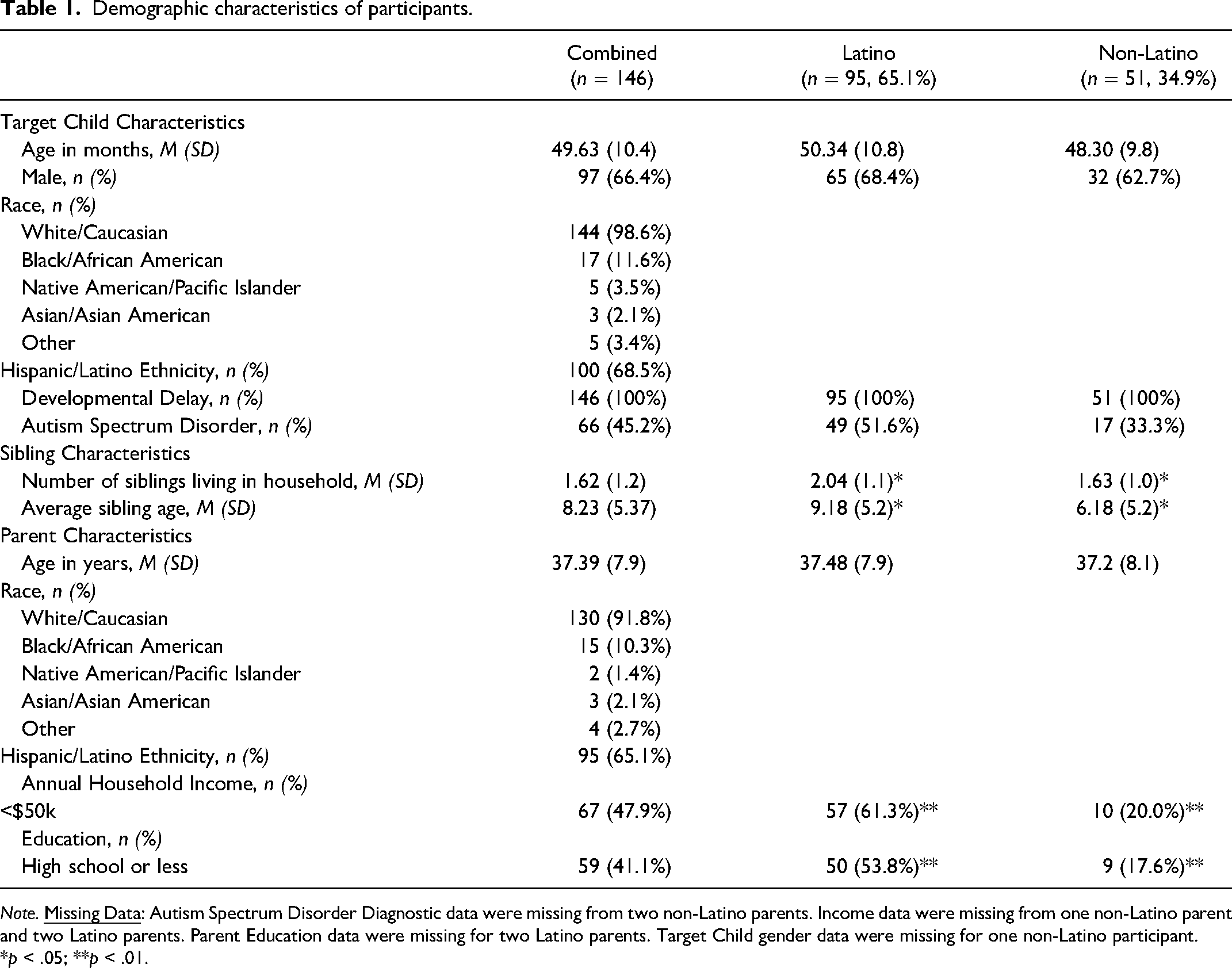
Table 1 provides demographic characteristics for participating parents and children. Parents were primarily Latino (n = 95, 65.1%). Approximately one-fifth (19%) reported not completing high school and 22% of parents reported earning a high school diploma or equivalent as their last level of formal education completed. Household income ranged greatly (range = $12,000- $700,000; Mdn = $43,000), nearly half (47.9%) reported an annual household income of $50,000 or less, and an estimated 33% of families (n = 48) had incomes that placed them at or below the federal poverty threshold (United States Department of Health & Human Services, 2021).
Demographic characteristics of participants.
Note.
*p < .05; **p < .01.
All enrolled children had identified delays or disabilities, with 45% reporting diagnoses of ASD. Eighty-four percent of families reported at least one sibling living in the household, in addition to the target child enrolled in the larger clinical trial. Families reported an average of 1.62 siblings (SD = 1.23) living in their household. The average sibling age was 8.23 years (SD = 5.37).
On average, Latinos (M = 2.04; SD = 1.1) reported a greater number of siblings living in their household than non-Latinos (M = 1.63; SD = 1.0), t = −2.10, p = .05. Latino siblings (Mage = 9.18, SD = 5.19) were significantly older than non-Latino siblings (Mage = 6.18, SD = 5.23), t = −2.92, p = .005. Latino and non-Latino parents also differed in education completion, such that Latinos (53.8%) were more likely to report their last level of formal education as “high school or less” compared to non-Latinos (17.6%), χ2 (1, N = 144) = 17.77, p < .001. Latinos (61.3%) were more likely to report an annual household income of less than $50,000 compared to non-Latinos (20.0%), χ2 (1, N = 143) = 22.26, p < .001.
Measures
All measures for the current study were administered in English or Spanish, for English- and monolingual Spanish-speakers, respectively. When validated measures were not available in Spanish, questionnaires were translated by bilingual and bicultural study personnel from English to Spanish and then back-translated from Spanish to English, to check for accuracy (Brislin, 1970).
Demographics
All parents completed a demographic interview with study personnel to obtain information about parent and child characteristics (e.g., parent and child age, ethnicity, child diagnoses, number of siblings residing within the home) and socioeconomic status (e.g., household income, parent level of education).
Perceived daily hassles
Perceived daily hassles were assessed with Crnic and Greenberg's (1990) parenting daily hassles (PDH) measure. The PDH consists of 45 items related to child behaviors and parenting tasks that can be challenging for parents (e.g., being complained to, difficulty getting privacy, sibling fighting requiring a referee, and having to change plans because of unplanned child need). Using 5-point Likert scales for each item, the parent was asked to rate both how often the hassle occurred and how much of a hassle the item was perceived to be. Two summary scores were created: the frequency of parenting hassles and the perceived intensity of those hassles. The intensity score is an index of appraised stressfulness by the parent, whereas the frequency reflects only the presence of stressors. The perceived intensity of hassles was used in the study, owing to prior research indicating that individual cognitive appraisal of significant events as stressful is the primary factor that predicts the impact of a stressor (Lazarus et al., 1985). The PDH has been validated among samples with and without DD, demonstrating adequate reliability and high construct validity with parenting satisfaction, well-being, family functioning and major life stresses (Crnic & Greenberg 1990), as well as adequate reliability among Latino and non-Latino samples (e.g., Finegood et al., 2017). Cronbach's alpha in our sample was .96 (.90 among non-Latinos; .97 among Latinos).
Sibling support
The presence of sibling support was measured using one item of the 18-item Family Support Scale (FSS; Dunst et al., 1986), which asks parents to rate on a five-point Likert scale the perceived helpfulness of support from various support sources (e.g., parents, spouse/partner, my own children) in raising their child with DD. Sibling support was assessed as the raw helpfulness score from the item asking how helpful parents perceive their own children (i.e., the siblings of the child with DD) have been in raising their child. Greater scores indicated a greater presence and perceived helpfulness of sibling support. The FSS has demonstrated acceptable reliability and validity among parents of children with DD and developmental risk (Dunst et al., 1984).
Data analytic plan
Prior to running the main analyses, bivariate correlation analyses were run to determine if any demographic variables were significantly correlated with both an independent variable and the dependent variable (perceived intensity of daily hassles). Number of siblings was significantly correlated with average sibling age (r = .400, p <.001) and sibling support (r = .214, p = .038), but not correlated with perceived intensity of daily hassles (p = .35). Average sibling age was significantly correlated with ethnicity (Latino/non-Latino), but not correlated with sibling support (p = .08) nor perceived intensity of daily hassles (p = .58). Since number of siblings and average age were not correlated with both an independent variable and dependent variable, they were not included as demographic covariates in the stepwise hierarchical linear regression in Aim 4. Both parent education (high school or less/more education than high school) and family income (less than 50K/more than 50K) were significantly correlated with ethnicity (Latino/non-Latino) and perceived intensity of daily hassles. Parent education was significantly correlated with parent income (r = .29, p = .003) and was a unique predictor of parenting stress when entered into the regression analysis (p = .02) whereas parent education was not (p = .40). Thus, only parent income was included as a demographic covariate in the stepwise hierarchical linear regression in Aim 4.
Additional tests were conducted to detect outliers and multicollinearity and to check the assumptions of regression. A multiple linear regression was run and DFBetas, DFFITS, Leverage, and Studentized Deleted Residuals were obtained in order to test for the leverage, discrepancy, and both global and specific influence of outliers. Cases were considered outliers if values for DFBetas or DFFITS, Leverage, and Studentized Deleted Residuals were all outside the following ranges: DFBetas ± 1 or DFFITS > |1|, Leverage < .17, and Studentized Deleted Residuals ± 2 (Cohen et al., 2003). Multicollinearity was considered a concern if VIF values were greater than 10 and Tolerance values were less than .1. There were no multicollinearity concerns nor significant outliers, and our data did not violate any of the assumptions of regression. All analyses for the current study were conducted in SPSS 20.
For Aims 1 and 2, independent sample t-tests were used to examine if there were significant differences in perceived intensity of daily hassles (Aim 1) and presence of sibling support (Aim 2) between Latino and non-Latino parents. For Aim 3, we used correlation analyses to assess the relationship between presence of sibling support and perceived intensity of daily hassles, in the combined sample and within the two ethnic groups. For Aim 4, we ran a hierarchical linear regression analysis in order to examine whether the relationship between sibling support and perceived intensity of daily hassles was moderated by ethnicity. Family income was included as a covariate in the first step of the regression, followed by sibling support in the second step of the regression. Parent ethnicity was included in the third step of the regression. The interaction between sibling support and ethnicity was added in the fourth step of the regression. Simple slopes for the association between sibling support and perceived intensity of daily hassles were tested for Latino and non-Latino participants.
Access to materials
These data will be made available by request to the corresponding author. This study was not preregistered.
Results
Aims 1 through 3
Latino parents (M = 47.94, SD = 24.03) reported significantly lower intensity of perceived daily hassles than non-Latino parents (M = 55.93, SD = 13.93), t(136.35) = 2.53, 95% CI = [1.74, 14.25], p = .01; d = .41. In terms of sibling support, Latino parents (M = 2.82, SD = 1.39) reported a significantly greater presence of support from siblings than non-Latino parents (M =2.10, SD = 1.39), t(136.35) = 2.53, 95% CI = [1.74, 14.25], p = .01. Additionally, in the combined sample, perceived sibling support was negatively associated with perceived intensity of daily hassles, such that parents who perceive greater sibling support perceived lower intensity of hassles (r = −.314, p < .001). Among Latino parents, perceived sibling support was negatively associated with perceived intensity of daily hassles, such that parents who perceived greater sibling support perceived lower intensity of hassles (r = −.36, p = .004); however, among non-Latino parents, perceived sibling support was not significantly related with perceived intensity of daily hassles (r = −.104, p = .53).
Aim 4
Overall, sibling support and ethnicity accounted for a significant proportion of variance in parents’ perceived intensity of hassles, F(5, 97) = 4.43, p = .001. The optimal linear combination of family income, sibling support, and parent ethnicity accounted for 20% of the variance in perceived daily hassle, R2adj = .20. Family income, which was included as a covariate in the model, significantly predicted perceived intensity of daily hassles while controlling for all other variables in the model. Specifically, parents with incomes over 50K reported, on average, 10.54 points higher on perceived intensity of daily hassles than parents with incomes less than 50K. In the first step, sibling support was a significant negative predictor of perceived intensity of daily hassles; however, it was no longer significant in the final model, which controlled for family income, ethnicity (Latino/non-Latino), and the interaction between sibling support and ethnicity. After controlling for all other variables in the model, the interaction between sibling support and ethnicity predicting perceived intensity of daily hassles while controlling for all other variables in the model was approaching significance, p = .062. See Table 2 for hierarchical linear regression results. Simple slopes tests (i.e., conditional effects of Latino ethnicity on perceived hassles) revealed a stronger negative association between sibling support and perceived intensity of daily hassles among Latino participants (B = −9.12, SE = 3.04, t = −3.00, p = .005), compared to non-Latino participants (B = −.66, SE = 3.28, t = −.202, p = .841). Participants with high levels of sibling support who were Latino perceived lower intensity from daily hassles compared to those who were non-Latino. Figure 1 plots the simple slopes for the interaction.
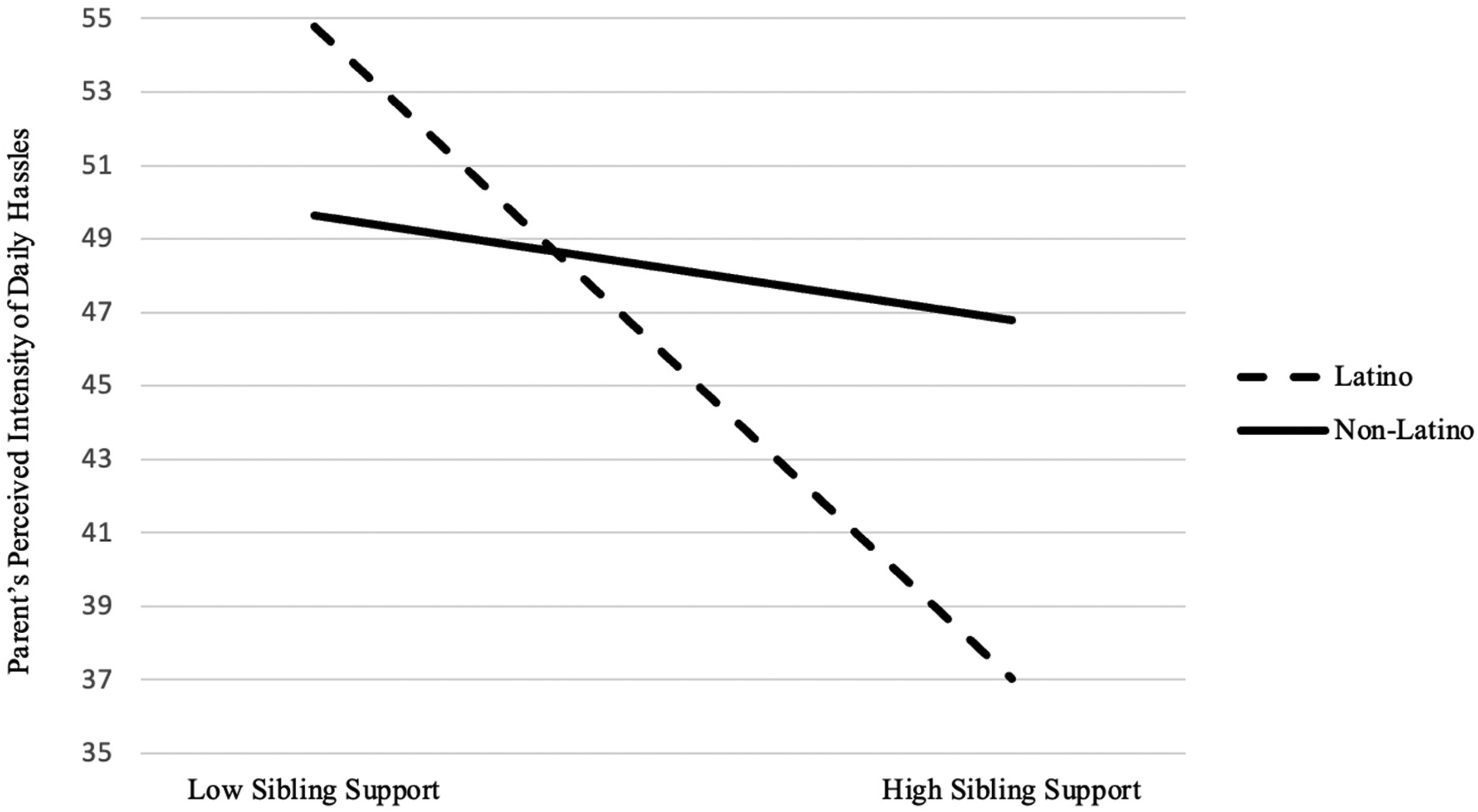
Simple slopes plot of the conditional effects of Latino ethnicity on the association between sibling support and perceived daily hassles.
Multiple regression to examine interactions of sibling support and ethnicity on perceived daily hassles.
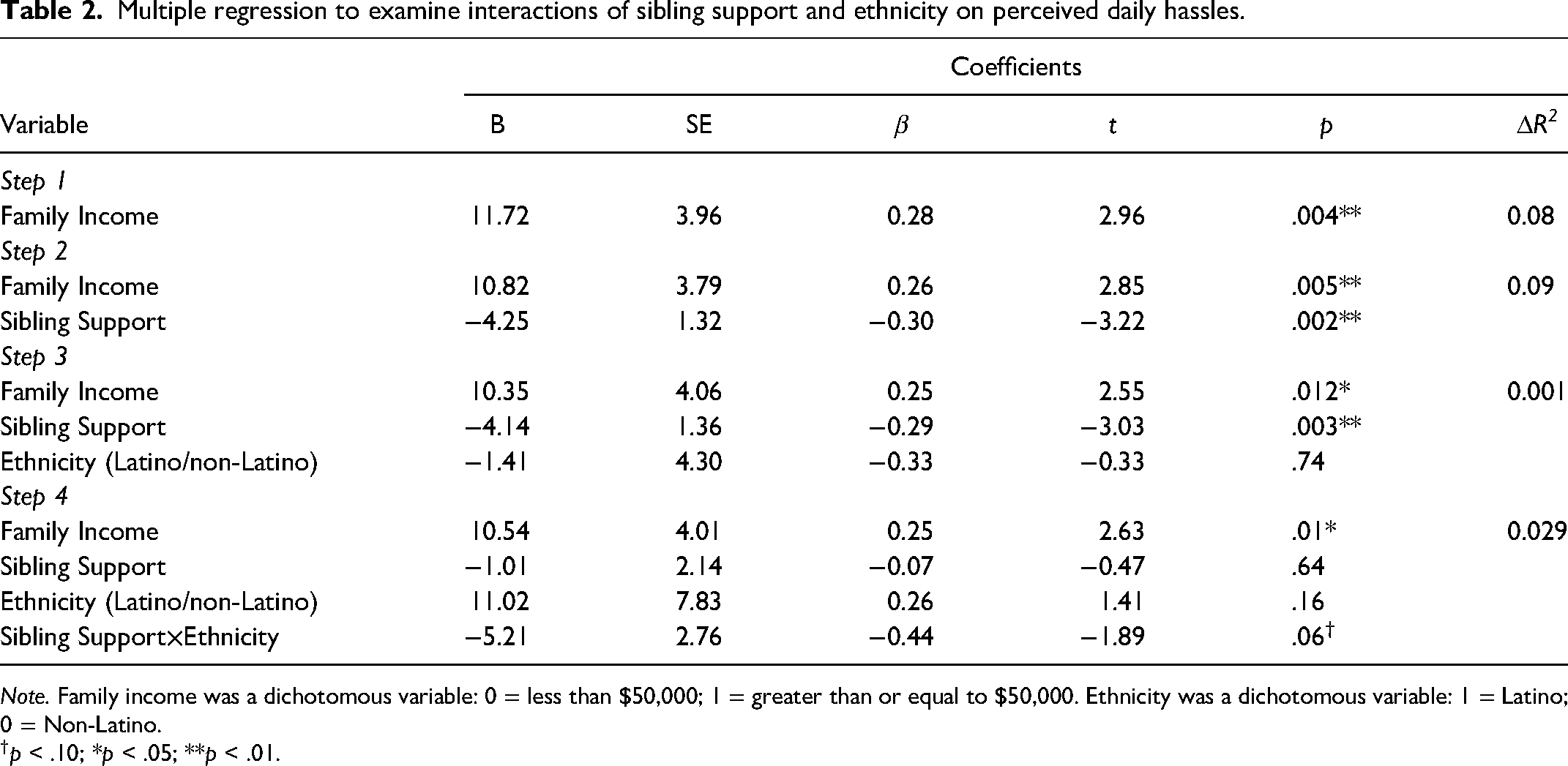
Note. Family income was a dichotomous variable: 0 = less than $50,000; 1 = greater than or equal to $50,000. Ethnicity was a dichotomous variable: 1 = Latino; 0 = Non-Latino.
p < .10; *p < .05; **p < .01.
Discussion
This study examined the relationship between sibling support and perceived daily hassles among an ethnically diverse sample of Latino and non-Latino parents of children with DD. Our findings provide robust support for our hypotheses, revealing that Latinos reported greater presence of and benefit from sibling support compared to non-Latino counterparts, as predicted. Consistent with our hypotheses, Latinos also reported lower perceived intensity of daily hassles compared to non-Latinos. In the combined Latino and non-Latino sample, greater sibling support was significantly correlated with lower perceived intensity of daily hassles. However, when examining this correlation separately (i.e., within Latino and non-Latino groups, respectively), this correlation only remained significant among Latinos. Similarly, the interaction between ethnicity (i.e., Latino versus non-Latino) and sibling support on perceived intensity of daily hassles was approaching significance, such that Latinos who reported high levels of sibling support reported lower intensity of daily hassles.
Sibling support and parenting daily hassles differ between Latinos and non-Latinos
Our findings suggest that perceptions of both parenting daily hassles and sibling support differ between Latinos and non-Latinos. Indeed, as expected, Latinos reported lower perceived intensity of daily hassles compared to non-Latino counterparts. This finding is consistent with existing literature suggesting that Latino parents are more likely to report lower levels of stress (Barroso et al., 2016), and less likely to perceive parenting as burdensome (Lopez & Magaña, 2020). A number of cultural factors may contribute to these patterns. First, Latino cultural values of simpatía (a Latino cultural script that stresses interpersonal harmony through emphasizing the positive and deemphasizing the negative in a given interaction; Holloway et al., 2009) may further attenuate Latino stress appraisals. In valuing and attending to the positive features of parents’ routine events and interactions, the positive valence of daily parenting hassles may increase, thereby undermining Latino parents’ stress. Second, Latinos’ cultural valuation of familism (Campos & Kim, 2017; Martin et al., 2021) may contribute to greater familial support, a primary buffer of parenting stress that may further attenuate the perceived intensity of daily parenting hassles. Third, religious values within Latino cultural groups may drive the commonly held belief in “God's plan” or in the notion that having a child with a disability or developmental delay is a challenge sent directly from God, thereby tempering one's negative appraisals of parenting hassles (Skinner et al., 2001).
As expected, Latino parents also reported greater levels of sibling support compared to non-Latino parents. A number of factors may underlie these ethnic group differences in sibling support. On the one hand, Latino parents in our sample reported having more children, on average, than non-Latino parents, a finding which is consistent with 2020 census and Pew Research Center data (Bureau, 2020; Passel et al., 2012). Having more children may allow for a greater availability of sibling support for Latino parents, as well as a greater number of support sources, thereby engendering a greater utilization of and perceived helpfulness from sibling support among such parents. This finding may also reflect a Latino cultural preference for family support (versus other, more formal, support sources). The aforementioned cultural valuation of familism promotes greater family involvement in child rearing and may therefore increase siblings’ overall contributions of and parents’ corresponding reliance on sibling support within Latino family realms. Additionally, as more formal support sources (e.g., therapy and health services) are systemically less accessible to Latino (versus non-Latino White) families (Nomaguchi & House, 2013), Latinos may rely more heavily on informal sources of support (i.e., from family members) by default. Taken together, these findings provide robust support for our first two hypotheses and contribute to a greater understanding of cultural nuances in stress perception and sibling support utilization.
The importance of sibling support in the wake of parenting stress
In spite of the marked ethnic group differences in sibling support and stress perception, our results largely point to the global benefit and importance of sibling support for Latino and non-Latino parents alike. As predicted, in the combined sample (i.e., across both Latino and non-Latino groups), results indicated that high levels of sibling support were related to lower perceived intensity of daily hassles. This highlights the utility of sibling support among families of children with DD and its potential to benefit all parents, regardless of cultural background. We contend that sibling support plays a protective role in the context of parenting stressors. Harnessing sibling support in the face of daily hassles may confer greater mental health benefits for parents raising a child with DD. This finding reiterates the benefits of using sibling support within family systems as an accessible buffer of parenting stress.
The benefits of sibling support in Latino family contexts
Although sibling support was found to be negatively associated with perceived intensity of daily hassles in the combined sample, when correlation analyses were run separately for Latino and non-Latino subsamples, this association only remained significant among Latinos. This finding was partially corroborated by the results of our moderation analysis, which found that the effect of ethnicity on the sibling support—daily hassles relationship was approaching significance (see Figure 1). As illustrated in Figure 1, at low levels of sibling support, parents reported higher intensity of parenting daily hassles across both groups, whereas at high levels of sibling support, only Latinos saw a decrease in intensity of parenting daily hassles, with little-to-no change in intensity for non-Latinos. We contend that while sibling support may, indeed, hold the potential to benefit all parents of children with DD, certain cultural factors particularly those prevalent within Latino cultural contexts may influence the degree to which sibling support is employed. Having a Latino cultural background, for instance, may influence the degree to which informal supports, such as sibling support, are used. Indeed, cultural values of familism (Campos & Kim, 2017), accessibility of familial support (versus more formal support sources) to U.S. ethnic minorities (Bailey Jr et al., 1999), and a cultural predilection for informal support (LeFevre & Shaw, 2012), may engender greater familial support use among Latinos (Valdivieso-Mora et al., 2016), as well as increased reliance on siblings for assistance in child-rearing (East & Hamill, 2013). The greater prevalence and accessibility of sibling support may translate to more favorable parent well-being outcomes, particularly by attenuating acute stress from day-to-day hassles. Owing to sibling supports’ congruence with existing Latino cultural scripts, we posit that Latinos may be primed to activate sibling support more frequently and extract greater benefit from such support when it is employed. Taken together, these findings emphasize the universal importance of strong familial support systems for the well-being of parents of children with DD and point to the possible protective role of certain Latino cultural factors (e.g., familism) that influence the degree to which these supports are employed and are efficacious.
Strengths, limitations, and future directions
The present study had several strengths. First, our study drew from a diverse multi-ethnic, multicultural sample from both English and Spanish-speaking participants. Additionally, the present study employed a more nuanced measure of stress, compared to existing stress measures, that quantified the occurrence and intensity of parenting stress on a daily level, providing a multidimensional approximation of the number and valence of day-to-day stressors influencing the parents in our sample.
Although promising, the results of the current study should be considered in the context of the following limitations. All measures utilized in the current study were parent-report measures, which results in inherent biases. Parents may unintentionally misreport the daily hassles they experience or may be unaware of the support that siblings are providing to their sibling with DD. Future studies should utilize a multi-method approach including sibling reports of their support to the family, and additional measures of parent stress. An additional measurement limitation includes the fact that the sibling support variable is a single item measure. Concerns related to using a single item measure include low construct validity, lower sensitivity, and a lack of internal-consistency reliability. We also acknowledge the complexity of sibling research; variability in sibling order, sibling behavior, sibling gender, and siblings’ own DD status may further influence the level of sibling support provided, which were not comprehensively measured in the current study. Additionally, the complex impact of sibling support on the siblings themselves is not accounted for in our models, though should be further explored in future research. Additionally, we note that ethnicity was dichotomized as Latino and non-Latino, overlooking considerable cultural variability within these respective groups. Non-Latinos, for example, comprised diverse multicultural groups including European Americans, African Americans, and Asian Americans, and similarly, Latinos spanned multiple countries of origin (e.g., Mexico, Guatemala, El Salvador). Future studies should examine these groups separately, among a larger sample, to unpack cultural nuances both between and within these ethnic categories. Furthermore, within-group variability including immigration, acculturation, and generational status is not accounted for in our models, though may further explain some of the variance in parents’ perception of daily hassles. Finally, as our study drew from cross-sectional data, we cannot infer causality or temporal ordering of variables. Future iterations of this study should explore the relations of these variables across time to confirm causal links.
Despite our limitations, the implications of this study are significant. Our findings elucidate important cultural patterns in parenting stress and support systems that may help to inform culturally sensitive intervention targets. For instance, parenting interventions for Latino parents of children with DD may benefit from culturally sensitive adaptations that harness sibling support in order to target and buffer parenting stress. In sum, our study is one of the first to empirically demonstrate ethnic group differences in perception of daily hassles and corresponding sibling support utilization, highlighting important family intervention targets and illuminating pathways for future longitudinal work.
Practice implications for marriage and family therapists (MFTs)
Having a child with DD impacts multiple aspects of family life including parent mental health, family functioning (e.g., family cohesion, managing responsibilities related to child rearing), as well as service access and acquisition. Given the increased needs of these families, understanding how to support them is vital for MFTs. This study provides insight into the DD experience and highlights the supportive resources available to Latino and non-Latino families of children with DD. Particularly, we emphasize how integral siblings are in supporting Latino families, which is related to Latino cultural values of familism and a cultural tendency to access more informal familial supports rather than formal supports (Bailey Jr et al., 1999). A greater understanding of siblings’ increased involvement in Latino family settings may help to improve MFTs’ cultural sensitivity in working with Latino families. Overall, this study hopes to increase clinicians’ awareness of the effects of both cultural diversity and neurodiversity on the family system, which may inform their delivery of clinical interventions across diverse populations.
Footnotes
Author note
We have no known conflict of interest to disclose. This study was supported by a grant from the National Institute of Health (R01 HD093667). The content is solely the authors’ responsibility and does not necessarily represent the views of the NIH. This study was not preregistered. Data will be made available by request to the study author.
Declaration of Conflicting Interests
The author(s) declared no potential conflicts of interest with respect to the research, authorship, and/or publication of this article.
Funding
The author(s) disclosed receipt of the following financial support for the research, authorship, and/or publication of this article: This work was supported by the National Institute of Health (grant number R01 HD093667).
