



Abstract
We examined the relationship between ethnic identity (EI), family ethnic socialization (FES), heritage language ability (HLA), and desire to learn a heritage language (HLD) in a sample of 91 U.S. psychology graduate students. We had four main findings. First, HLD had a significant positive relation with EI (24.9%). Second, FES had a significant positive relation with EI (33.8%). Above and beyond FES, HLD uniquely accounted for 10.9% of the variance of EI. Third, HLA had a significant positive relation with EI (12.3%). Above and beyond HLA, HLD uniquely accounted for 12.7% of the variance of EI. Accounting for the contribution of HLD decreased the beta associated with HLA; a finding that suggests HLD may mediate the relation between HLA and EI. Fourth, the combined contribution of FES and HLA accounted for approximately 36.3% of the variance of EI. HLD had a significant positive relation to ethnic identity after the other the factors in this study were considered, in combination, and uniquely explained 9.0% of the variance of EI. Our results highlight the importance of considering internal factors, such as desire to learn a heritage language, when examining ethnic identity. Implications for practice and recommendations for future research are discussed.
Accommodating and incorporating the cultures of many different ethnic groups has been an integral part of the formation, history, and growth of the United States as a nation. As the proportion of ethnic and racial minority people in the United States continues to increase (Passel & Cohn, 2008; U.S. Census Bureau, 2021), it is important for mental health providers and researchers alike to understand ethnic identity to better support the growing ethnic minority population. Ethnic identity is dynamic and may transform across one's lifespan. Thus, more knowledge about the factors that impact ethnic identity will help better inform and increase cultural competency.
Ethnic identity is a complex and multidimensional construct and specific definitions of it vary based on the underlying theory used to conceptualize it. Ethnic identity has been referred to as one's sense of belonging to an ethnic group, often defined by cultural heritage and language, and the value and emotional significance attached to that membership (Phinney & Ong, 2007). It has also been referred to as commitment to a cultural group and engagement in its cultural practices, regardless of what race one ascribes to (Helms, 2007). Tajfel and Tuner's (1986) social identity theory provides another perspective on ethnic identity and has been used as a theoretical underpinning for forming and interpreting studies on ethnic identity. They assert that ethnic identity is the most visible of many social categories and becomes a salient identity because it shapes others’ view of an individual, which in turn impacts how they view themselves.
We used Phinney and Ong's (2007) definition of ethnic identity in this study. Phinney and Ong revised the 14-item Multigroup Ethnic Identity Measure (MEIM; Phinney, 1992) into the 6-item Multigroup Ethnic Identity Measure -Revised (MEIM-R) via an examination of the research. Exploratory and confirmatory factor analysis of the MEIM-R provided support for a two-factor structure: exploration and commitment (Phinney & Ong). The MEIM-R has strong psychometric properties and has been widely used to assess ethnic identity. It has been used in youth (Herrington et al., 2016) and adults (Brown et al., 2014), in the USA (Burn et al., 2012; Chakawa et al., 2015) and internationally (Musso et al., 2018).
Strong ethnic identity is a crucial aspect of wellbeing and there has been an increase in the amount of research examining ethnic identity, the factors influencing it, and ethnic identity's impact on psychosocial development. Researchers have found that higher ethnic identity is associated with positive outcomes in ethnic and racial minority adolescents such as higher self-esteem (Greig, 2003; Martinez & Dukes, 1997; Phinney et al., 1997), career decision-making self-efficacy (Gushue, 2006), willingness to seek counseling services (Li et al., 2016), and overall better mental health (Gamst et al., 2002; Greig, 2003; McClain et al., 2016; Mossakowski, 2003; Simons et al., 2002). Although there are varied and nuanced differences, these findings have been replicated in different ethnic groups. As adverse experiences such as ethnic discrimination also correlate with stronger ethnic identity (Iwamoto et al., 2013), professionals (e.g., researchers, health care providers) have a unique opportunity and role to help ethnic minority people adjust in a positive way by fostering connection with culture and ethnic identity (Nassar-McMillan et al., 2011).
Factors influencing ethnic identity (EI)
Understanding the specific factors related to strong ethnic identity is important to promoting positive outcomes for ethnic minority people. Phinney (1990), in a review of the literature on ethnic identity, enumerated several areas that impact ethnic identity: attitudes toward ethnic group, sense of belonging, participation in cultural activities, language usage, friendship, religion, politics, area of residence, music, dances, books, food, and celebrations. In this study we focused on family ethnic socialization and heritage language; oft cited contributors to ethnic identity (Bailey, 2000; Kalbach & Pigott, 2005; Knight et al., 1993; Oh & Fuligni, 2010; Phinney, 1990; Phinney et al., 2001; Quintana & Vera, 1999; Ricento, 2005; Rosenthal & Cichello, 1986; Schecter & Bayley, 1997; Weisskirch, 2005). We were particularly interested in the unique contribution of the desire to learn heritage language.
Familial ethnic socialization (FES)
Research indicates family attitudes toward ethnic identity and actions taken to socialize children in an ethnic manner influence a child's ethnic identity (Knight et al., 1993; Phinney et al., 2001; Quintana & Vera, 1999; Rosenthal & Cichello, 1986). Family impact on ethnic identity development is also known as family ethnic socialization (FES) in the ethnic identity literature. Greater FES is related to a stronger ethnic identity in various ethnic groups and in adopted children (Huh & Reid, 2000; Phinney et al., 2001; Quintana et al., 1999, Umaña-Taylor et al., 2006). Examples of these types of actions include, but are not limited to, facilitating participation in activities related to one's ethnic culture (e.g., targeted communications to children, emphasis on certain values ethnic teachings, ethnic traditions).
Indirect forms of FES include language brokering, where a child acts as translator for their parents out of necessity rather than out of purposeful parental socialization. Weisskirch (2005) found that language brokering contributes to stronger feelings toward one's ethnic group. Another example of indirect socialization includes perceived parental cultural identification. Xu et al. (2004) found that Asian American children's increased ethnic behavior correlated with perceiving that their parents identified with a particular culture. Additionally, heritage language is one way that families socialize children toward ethnic identity. For example, families may orient children toward ethnic identity by pressuring them to learn heritage languages (e.g., enrolling them in heritage language schools or extracurricular activities).
Heritage language ability (HLA)
In English-speaking countries, heritage language is a language other than English that is associated with one's cultural background and may or may not be spoken in the community (Mu, 2015). American Community Survey data from 2019 (Dietrich & Hernandez, 2022) indicates that 22% of U.S. households speak a language other than English at home. Of these households, 19.6% are limited English-speaking households. Research indicates a positive relation between heritage language ability (HLA) and ethnic identity (Cheng & Kuo, 2000; Gatbonton & Trofimovich, 2008; Giles & Johnson, 1987; House et al., 2006; Hurtado & Gurin, 1987; Imbens-Bailey, 1996; Jo, 2001; Kalbach & Pigott, 2005; Khanna, 2004; Mah, 2005; Oh & Fuligni, 2010; Panicacci, 2019; Phinney et al., 2001; Taylor et al., 1973; Tse, 1998, 2000, 2001; You, 2005). Heritage language ability is also generally associated with positive outcomes. For example, Park and Han (2022) found that multiracial adolescents who were bilingual demonstrated better adjustment than those that were not.
People may strive to maintain their ethnic self-concept via HLA (Jaspal & Coyle, 2010). The relationship between ethnic identity and language ability may vary depending on perceived expectations from society (Brown, 2009; Oriyama, 2010). Brown found strength of ethnic identity was impacted by perceived societal pressure to speak English. Peers may also influence HLA. Luo and Wiseman (2000) found that the Chinese-speaking peers and English-speaking peers had the most impact on the retention of heritage language in Chinese American children. The relation between HLA and ethnic identity may be more nuanced because Kim and Chao (2009) found variation between ethnic groups (i.e., related to ethnic identity for second-generation Mexican American adolescents but not Chinese American adolescents).
Heritage language ability also intersects with family dynamics (deSouza et al., 2022) and shared language is a medium used to maintain relationships (Gonzalez et al., 2022). For example, Cho et al. (1997) found that Korean Americans wanted to learn their heritage language in order to have better communication with their families. Luo and Wiseman (2000) research highlight the importance of parent-child cohesion. Wang et al. (2022) also found that family relationship quality has a stronger relation to adolescent Spanish proficiency than the family language environment. The ability to communicate with one's family is crucial and the erosion of shared language with parents has implications for one's connection with family. In their review of the literature, deSouza et al. found that heritage language proficiency has a strong relation to healthy parent–child relationships.
The impact of family dynamics on heritage language ability is complicated for a number of reasons. First, English language competency varies among family members. Children's HLA, in first generation immigrant families, is often higher when their parents only speak the heritage language (Cheng & Kuo, 2000). Second, it is important to consider immigration context for family members. For example, Luo and Wiseman (2000) research indicates that one's age when immigrating is an important factor to consider. Immigrating when one is younger increases the challenge of maintaining one's HLA. Third, different family members (e.g., parent, grandparent) may have different expectations (Gonzalez et al., 2022). Families may implement a number of strategies for their children to learn and maintain a heritage language (e.g., heritage language school, heritage language home environment, reward systems, access to heritage language books, flash cards, multimedia and online resources, educational extracurricular activities, involvement in ethnic community; Gonzalez et al.). Different expectations make coordination of efforts in this realm challenging. Fourth, family policies regarding heritage language vary from family to family. In the Choi (2023) study, parents did not have a strict language policy and did not have high expectations for heritage language learning. In contrast, parents in the Gonzalez et al. study expected their children to be bilingual or trilingual and were concerned about the loss of heritage language. They also invested more effort into their children's Chinese language development than English.
Desire to learn heritage language (HLD)
Given the influence that parents, families, peers, ethnic community, and society have on children, heritage language ability may not reflect one's actual desire to learn a heritage language (HLD). HLD has not been specifically studied in the literature. However, related findings provide a foundation for the relevance and importance of HLD. A key aspect is the distinction between internal and external ethnic identity (Kwan & Sodowsky, 1997), which reflect aspects of ethnic identity experienced within an individual and observable behaviors performed by an individual, respectively. Kwan and Sodowsky described one's internal ethnic identity as being comprised of cognitive, moral, and affective components. The affective dimension refers to an individual's feelings of attachment to their ethnic group and may contribute to one's motivation to learn heritage language. Some researchers have conceptualized language as a vehicle to “express, enact, and symbolize” ethnic identity (Baker & Jones, 1998). As such, individuals may choose to foster or neglect their fluency in their heritage language to affirm or deny their connection to their ethnic heritage. Thus, we posit that desire to learn heritage language likely has a strong relation with ethnic identity.
In terms of the impact of family dynamics on HLD, intergenerational differences exist within families because each family member has different levels of interaction with each culture (Alzayed, 2015; Szapocznik et al., 1984). Intergenerational cultural dissonance describes the clash in cultural values between parents and their children (Choi et al., 2008). Thus, children may have a different level of desire to learn their heritage language than their parents.
Although parents may want to have their children learn a heritage language, the opportunities to actually learn and practice may be limited. This is particularly true when a heritage language is only spoken in the home. When English is also spoken at home, it is particularly difficult to maintain a heritage language (Gonzalez et al., 2022). This challenge is amplified when parents speak different languages or dialects. Parents also often need to work. Thus, financial needs of the family may make parents less accessible and available in the learning of a heritage language. Once children start school, heritage language use often diminishes (Choi, 2023; deSouza et al., 2022). Given this multitude of challenges, one's desire to learn a heritage language likely has impact on one's HLA.
There may be limited opportunity to learn one's heritage language (Choi, 2023). Carreira (2004) discussed a subset of language learners not embedded in their ethnic community who study their heritage language to strengthen the connection with their ethnic background. Examples include being adopted outside of one's ethnic community, paucity of heritage language resources in one's community, and limited resources (e.g., time, money) to access heritage language resources that exist. In these contexts, one may have a high desire to learn their heritage language but have low HLA.
Positive feelings toward one's ethnic heritage, desire to connect with one's ethnic culture, and desire to connect with one's ethnic community may also serve to increase one's HLD. Jaspal and Coyle (2010) found maintaining heritage language ability was the vehicle through which second generation Asians born in Britain maintained their self-definition of Asian. Noels (2005) found that strong ethnic self-concept was an integral part of wanting to learn a language and Comanaru and Noels (2009) found that Chinese individuals chose to learn their heritage language because they considered it an integral aspect of their identity. Thus, there may be personal, family, and community-based motivations (Banegas & Roberts, 2022). Cho et al. (1997) found that Korean Americans wanted to learn their heritage language in order to maintain ties to the Korean community.
Perception of one's heritage language by the broader society may also influence HLD. For example, perceptions of heritage language impacted its use in public (Sáenz-Hernández et al., 2021). In the current U.S. zeitgeist, speaking a heritage language (e.g., Spanish, Arabic, Chinese) in public may make one more vulnerable and thus reduce HLD. Tse (2000) found that Asian Americans’ interest in maintaining and developing their heritage language was related to attitudes toward their ethnic group, and that those who did not want to learn their heritage language did not want to be associated with their ethnic heritage.
Immigrant parents may also encourage their children to abandon their heritage language to focus on their English language skills to secure a better future and the possibility of the American Dream (Thorsos, 2019). Similarly, Alsahafi (2022) found that Myanmarese (Burmese), Rohingya-speaking refugees in Saudi Arabia focused on learning Arabic in order to pursue educational and economic opportunities. Thus increased perceived opportunity may decrease HLD. In contrast, Cho et al. (1997) found that Korean Americans wanted to learn their heritage language in order to expand their career options.
Although the studies discussed do not directly study the relation between HLD and ethnic identity, the results indicate that this relation may exist. We believe that HLD is a reflection of one's inner ethnic identity. As such, it is possible for people who do not have strong heritage language ability to identify strongly with their ethnic heritage.
Research questions
Our research questions were designed to determine the unique contribution of desire to learn heritage language (HLD) to ethnic identity when compared to the contributions of family ethnic socialization (FES) and heritage language ability (HLA). We wanted to ensure that each variable, independently, had a significant relation with ethnic identity to confirm that the inclusion of each variable in this study was appropriate (i.e., 1.1, 2.1, 3.1). Examining the contribution of HLD, after controlling for the contribution other variables, was important to establish that HLD has an important contribution to ethnic identity (i.e., 2.2, 3.2, 4.2). Thus, our specific research questions were:
HLD Alone
1.1. Is higher HLD significantly related to higher ethnic identity? HLD After FES
2.1. Is higher FES significantly related to higher ethnic identity? 2.2. Does HLD have a unique and significant positive relation to ethnic identity over and above the contribution of FES? HLD After HLA
3.1. Is higher HLA significantly related to higher ethnic identity? 3.2. Does HLD have a unique and significant positive relation to ethnic identity over and above the contribution of HLA? HLD After FES and HLA
4.1. Is the combination of FES and HLA significantly related to higher ethnic identity? 4.2. Does HLD have a unique and significant positive relation to ethnic identity over and above the combined contributions of HLA and FES?
Method
Participants
Participants were psychology graduate students (N = 91) who ranged in age from 22 to 43 years (M = 29.16, SD = 4.05). In terms of ethnic and racial identity: 1.1% (n = 1) of our sample identified as American Indian/Alaska Native, 1.1% (n = 1) Black/African/African American, 3.3% (n = 3) Middle Eastern/Middle Eastern American, 14.3% (n = 13) European/White, 29.7% (n = 27) Asian/South Asian/Asian American, 36.3% (n = 33) Hispanic/Latino/Chicano, 1.1% (n = 1) Other, and 13.2% (n = 12) multiracial. With regard to gender, 1.1% (n = 1) of our sample identified as nonbinary, 2.2% (n = 2) as genderqueer, and 16.5% (n = 15) as male, and 80.2% (n = 73) as female. In terms of annual household income, 13.2% (n = 12) earned less than $10,000, 25.3% (n = 23) earned $10,001 to $20,000, 26.4% (n = 24) earned $20,001 to $50,000, 11.0% (n = 10) earned $50,001 to $75,000, 7.7% (n = 7) earned $75,001 to $100,000, 4.4% (n = 4) earned $100,001 or more, 5.5% (n = 5) only had student loans, and 4.4% (n = 4) preferred not to respond.
Measures
Each participant completed a questionnaire comprised of demographics questions and variable-related information for this study.
Multigroup ethnic identity measure-revised (MEIM-R)
Ethnic identity was assessed using the 6-item multigroup ethnic identity measure-revised (MEIM-R; Phinney & Ong, 2007), which includes the two subscales of exploration and commitment. Each subscale is comprised of 3 items. As indicated in the introduction, the MEIM-R is used widely to assess ethnic identity. Participants responded on a scale ranging from 1 (strongly disagree) to 5 (strongly agree). Cronbach's alpha was .76 for exploration, .78 for commitment, and .81 for the combined scale in a sample of 241 university students (Phinney & Ong). In our study, the Cronbach's alpha was .85 for exploration, .89 for commitment, and .90 for the combined scale.
Familial ethnic socialization (FES)
FES was measured in our study using the 12-item Family Ethnic Socialization Scale (FES; Umaña-Taylor, 2001). Participants responded on a scale of 1 (Not at all) to 5 (Very often) to items such as “My family teaches me about my ethnic/cultural background” and were instructed to respond based on their experiences before age 18. Higher scores reflected greater family ethnic socialization. The coefficient alpha of FES ranged from .81 to .86 (Umaña-Taylor et al., 2006). For this study, the Cronbach's alpha was .93.
Heritage language ability (HLA)
HLA was assessed in our study using a modified version of the 13-item heritage language use and proficiency subscale of the General Ethnicity Questionnaire (GEQ; Tsai et al., 2000). We made several revisions to the GEQ. We adjusted some of the wording and/or items to enhance clarity (e.g., “ethnic language” to “this ethnic language,” “much” to “often”), to increase inclusiveness (e.g., from “at prayer” to “for religious and spiritual reasons”), and to modify to current times (e.g., from “in film” to “on the internet”). We also added the item, “How often do you view, read, or listen to this ethnic language on other media?” to modernize this measure. We removed the item,“Are you bilingual? and incorporated it into our demographic questionnaire where it seemed to be a better fit for the purpose of our study. Participants responded on a scale of 1 (Not at all) to 5 (Very often). Internal reliability for the GEQ was high (Cronbach's alpha = .92) and test-retest reliability ranged from .57 to .62 (Tsai et al., 2000). The Cronbach's alpha for our modified measure was .92.
Desire to learn heritage language (HLD)
HLD was also assessed in our study using a modified version of the 13-item heritage language use and proficiency subscale of the General Ethnicity Questionnaire (GEQ; Tsai et al., 2000). The changes made to the GEQ measure for assessing HLD were similar to the ones made to assess HLA. All questions on HLD and HLA were the same, except the word “want” was added in bold letters to each question. The Cronbach's alpha for our modified measure was .93.
Procedure
After our study (958307-1) was reviewed by our institutional review board, we collected data from students who were currently enrolled in graduate psychology programs in the USA. We generated a list of programs by starting with doctoral programs that were American Psychological Association (APA) accredited. We then supplemented this list of programs with non-APA programs on a state-by-state basis. We contacted 278 programs via email and asked program representatives to disseminate our study invitation to students within their graduate programs. Participants were informed of our interest in increasing knowledge about heritage language and ethnic identity and invited to participate. If they identified as meeting inclusionary criteria (18 years of age or older, agreed to participate, self-identified as having an ethnic heritage that was connected to a language other than English, currently enrolled in a 3-year (or longer) psychology program), they were invited to complete the survey through Qualtrics.
Results
The unstandardized means, standard deviations, and correlations are presented in Table 1. The results from the correlational table suggest that all four variables in this study are significantly related but also independent concepts. We used hierarchical regression to examine the relations between ethnic identity, family ethnic socialization, heritage language ability, and desire to learn heritage language (see Table 2). First, when considered alone, HLD had a significant positive relation to ethnic identity and accounted for 24.9% of its variance.
Mean, standard deviation, and correlations among the independent variables (N = 91).
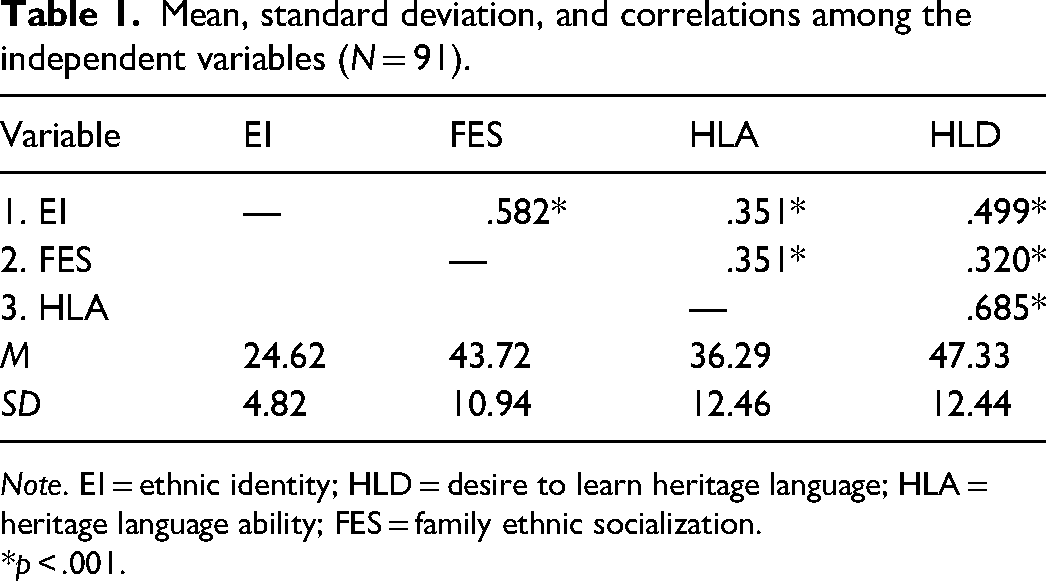
Note. EI = ethnic identity; HLD = desire to learn heritage language; HLA = heritage language ability; FES = family ethnic socialization.
*p < .001.
Summary of hierarchical regression analyses (N = 91).
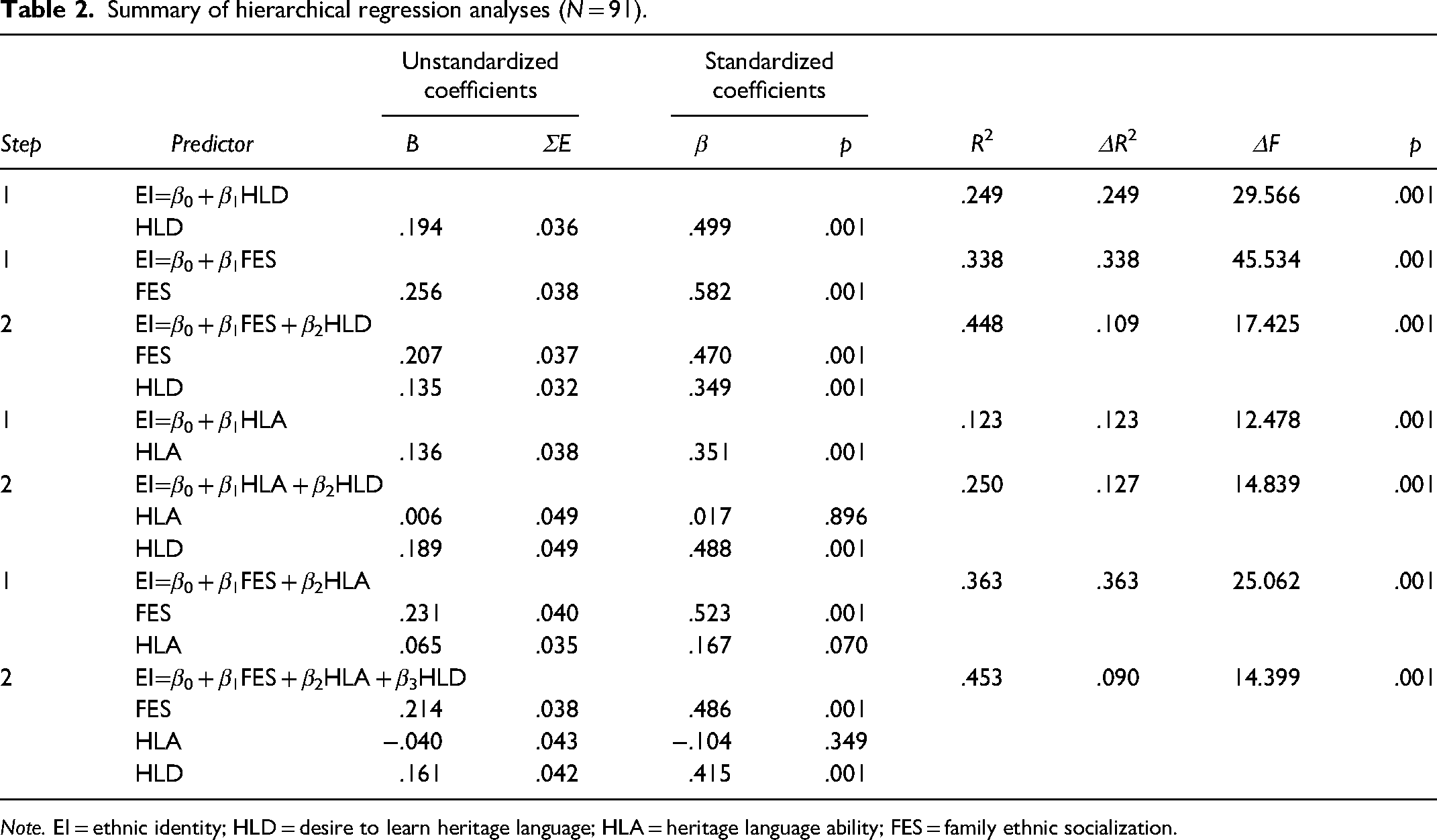
Note. EI = ethnic identity; HLD = desire to learn heritage language; HLA = heritage language ability; FES = family ethnic socialization.
Second, when family ethnic socialization was considered alone it had a significant positive relation with ethnic identity and accounted for approximately 33.8% of its variance. Beyond family ethnic socialization, HLD had a significant and positive relation to ethnic identity with a unique effect of 10.9%.
Third, heritage language ability had a significant positive relation with ethnic identity and accounted for approximately 12.3% of its variance. After heritage language ability was considered, HLD had a significant positive relation to ethnic identity and uniquely accounted for 12.7% of its variance. Interestingly, accounting for the contribution of HLD decreased the beta associated with HLA from .351 (p < .001) to .017 (ns).
Fourth, the combined contribution of family ethnic socialization and heritage language ability had a significant relation with ethnic identity and accounted for approximately 36.3% of its variance. Over and above this, HLD had a significant positive relation to ethnic identity after the other the factors in this study were considered (in combination) and uniquely explained 9.0% of its variance.
Discussion
In this study, we explored how a factor not yet established in the literature (i.e., desire to learn heritage language) related to ethnic identity, even when factors previously established in literature (i.e., family ethnic socialization, heritage language ability) were considered. HLD was found to be significantly and positively related to ethnic identity. Our findings provide empirical support for its importance and has implications for how mental health providers and researchers view ethnic identity. Based on our findings, ethnic identity may not be measured accurately if only external behaviors are considered.
Our findings present the possibility that an individual who desires to learn a heritage language, and does not already speak the language nor engage in ethnic practices, may nevertheless identify strongly with an ethnic heritage. This knowledge is important because it may encourage mental health providers and researchers to be more sensitive and inclusive toward individuals of various ethnic backgrounds who may not exhibit external behaviors affiliated with a particular ethnic background. For example, someone may be interested in learning their heritage language. However, because of lower representation of their ethnic group in a given geographical location, they may have limited opportunities to learn and/or maintain their ethnic language. This finding of a significant, positive correlation between desire to learn a heritage language and ethnic identity is particularly important for mental health providers in practice. It suggests that assessing a client's connection to their ethnic heritage may be inadequate if only assessed (e.g., during intake) by asking whether they speak a language other than English. A culturally sensitive approach would include a broader assessment (e.g., cultural interests, activities, goals) rather than misjudge or misperceive people who do not have the ability to speak their heritage language as being assimilated or disconnected from their ethnic heritage.
As expected and as supported by previous research, FES was significantly correlated with ethnic identity. This suggests, consistent with the literature, that families have an important impact on one's ethnic identity. With this relation as a foundation, we found that HLD contributed significantly to ethnic identity even after FES was considered. This indicates that both FES and HLD are important parts of ethnic identity and further substantiates the relation between HLD and ethnic identity. Family socialization is important in the development of one's ethnic identity, particularly when children are young. However, openness, commitment, and persistence on the part of a person also impact connection with their ethnic identity.
As expected, based on previous research, HLA was significantly related to ethnic identity. With this relation as a foundation, we found that HLD contributed significantly to ethnic identity even after HLA was considered. Furthermore, HLA's relation to ethnic identity changed (was significant, then was no longer significant) when the contribution of HLD was considered. The findings from our study with regard to HLA, HLD, and ethnic identity are consistent with Baron and Kenny's (1986) definition of mediation. More specifically, HLD may mediate the relation between HLA and ethnic identity. There is a possibility that HLA may have a weaker relation to ethnic identity than has been posited by the literature. HLD connotes a conscious internal motivation to gain HLA, while individuals who naturally acquired HLA may not have had any desire to learn the language despite being proficient. It is possible that desire is more indicative of strength of ethnic identity than ability. This result does not necessarily contradict previous research findings, but rather suggests that HLA may have a more complex relation to ethnic identity than previously recognized. Language is intrinsically linked to culture and speaking ability is a common manner used to determine connection to one's ethnic heritage. Unfortunately, this simplistic approach to assessing ethnic identity may lead to unintended, negative consequences for clients in therapy. For example, a biracial client who is White-passing and does not speak an ethnic heritage language may benefit from exploring their struggle with ethnic identity issues (e.g., identifying more strongly with their ethnic culture but feeling ashamed about their inability to speak the language). In another example, an adopted client might still want to relate more strongly to their ethnic identity but not have the courage to assert this desire by initiating the conversation in therapy due to shame, guilt, or concerns about being judged. It may be easy for mental health providers to assume that the client has no interest in speaking an ethnic heritage language when this is not the case. The finding that desire to speak one's heritage language has a stronger connection with ethnic identity than the actual ability to speak the language itself is an important finding for mental health providers to consider in practice. It is not uncommon for the topic of identity to arise in therapy, especially for ethnic minority clients whom view issues around race and ethnicity to be more important than those who are White (Meyer & Zane, 2013). For many cultures, ability to speak a heritage language is a source of pride. Mental health providers have the privilege, and unique advantage, of helping clients navigate defining and developing their ethnic identity.
It is important to acknowledge limitations that exist. Our sample was limited in terms of sample size (N = 91), education level and field (e.g., primarily graduate psychology students), gender (80.2% female), and geographical location (e.g., USA). Conclusions from our study may not generalize to different populations. We also made revisions to our languages measures that have not yet been empirically validated. Future research could be strengthened by addressing these limitations. Furthermore, we refer to heritage language as if people only have one heritage and one language. However, in reality, this is often not the case. Despite these limitations, the results of this study indicate provide strong support for the importance of HLD in relation to ethnic identity and contributes to a gap in the ethnic identity literature.
With additional knowledge about ethnic identity, mental health providers and researchers may better support ethnic minority people as they developing stronger ethnic identities. For example, increased support for ethnic identity exploration and formation has been found to lead to better mental health outcomes for ethnically diverse individuals (McMahon & Watts, 2002; Umaña-Taylor & Updegraff, 2007). Specifically, knowledge from these findings may equip mental health providers with an additional tool with which to explore a client's ethnic identity: inquiring about nonvisible aspects of a client's ethnic identity (e.g., HLD). A broader view of ethnic identity will allow us to better understand and assess the role of ethnic identity and ultimately provide more culturally informed care.
Footnotes
Declaration of Conflicting Interests
The author(s) declared no potential conflicts of interest with respect to the research, authorship, and/or publication of this article.
Funding
The author(s) received no financial support for the research, authorship, and/or publication of this article.
