



Abstract
Despite having an easy option to end the relationship and start a new one, many individuals betray their dating partner. In order to understand why, the present study explored the reasons for infidelity in dating relationships. Forty heterosexual adult participants (21 males and 19 females; Mage = 27.15) who had themselves engaged in infidelity participated in the study. The participants were recruited through the snowball sampling method. The study followed narrative methodology, where the perpetrators themselves narrated their cheating stories. The content analysis of narratives was done using Quirkos software. The findings reported numerous motivational factors contributing to infidelity in dating, which were clubbed into four factors: personal, relationship, third-party, and situational factors. Though many motives of infidelity in dating are similar to married individuals, only certain aspects are specific to a dating relationship, such as uncertainty about ‘the one’ revenge. The study not only shows the importance of personal, situational, and relationship factors but also stresses on third-party-factors, like love, attraction. The results show these reasons/factors may present alone to make individuals cheat or could present in combination or even in sequence. The results of the study can be useful in understanding and helping the dating couples going through such issues.
Infidelity has been a prevalent feature in literature and art well before our modern period. There are different views about what the word infidelity entails, ranging from simple acts such as petting and kissing to having sexual intercourse at the most (Blow & Hartnett, 2005). What would be seen as an act of infidelity relies on the form of partnership between individuals, however, most scholars commonly believe infidelity is a hidden and forbidden relationship that violates the agreement that no one other than their partner meets the needs of an individual (Blow & Hartnett, 2005; Mao & Raguram, 2009). Incidence of infidelity contributed to the insight that there are certain prevalent factors for why infidelity happens in exclusive relationships. Most studies support the notion of individuals engaging in infidelity when something is lacking in their primary partnership (Glass & Wright, 1985). However, contradictory findings (Thompson, 1983) have shown that just 25% of the variation in infidelity was attributed to the features in primary partnerships, thus, relationship satisfaction tends to be a major criterion for infidelity only for just certain pairs. Understanding infidelity through its root causes and therefore curbing it could significantly improve individuals’ overall well-being as a result of positive relationships. Having a clear view of the factors influencing a person's decision to take part in extradyadic relationships would mean a logical comprehension of infidelity which would be otherwise seen as just an immoral act. Therefore, the question remains as to what factors are vital for people to indulge in alternative options outside of their dating relationship.
Motivational Factors for Infidelity
Glass and Wright's study (1992) was among the first to explore motivational factors that led to infidelity and described four basic categories that prompted a person—sexual factors, emotional intimacy, love, and extrinsic factors. Many previous studies have also regarded individual or dispositional factors as vital to understanding infidelity as well as that personal factors can serve as an important predictor of the attitude they have towards infidelity serving as the motivational factor for participating in infidelity (Allen et al., 2008; Isma & Turnip, 2019). Features such as an individual's liberal political and religious views (Hackathorn et al., 2011), self-regulation (Ciarocco et al., 2012), and personality characteristics (Barta & Kiene, 2005; Schmitt & Shackelford, 2008) have all been linked to infidelity. Sociosexual orientation was also found to be linked to infidelity as a result of individuals preferring varied sexual experiences (Weiser et al., 2018). Research in the sexual domain has also shown that individuals with dispositional low self-control have a greater tendency to engage in a variety of sexual behaviors one of them being infidelity (Love, 2006). Research has also shown that men seem to be more frequently engaging in infidelity as compared to women (Allen et al., 2008).
While other studies, since then, have looked into infidelity and found relationship factors as equally vital since a primary reason for people's involvement in infidelity has to do with their primary partners and/or relationships (Barta & Kiene, 2005; Norona et al., 2018; Omarzu et al., 2012). Dissatisfaction and problems in the primary relationship were found to be associated with extradyadic relationships (McAnulty & Brineman, 2007). Likewise, models such as the four-factor model for infidelity presented by Barta and Kiene (2005), accept dissatisfaction, neglect, sex, and anger as reasons to explain why people participate in infidelity. Physical proximity between partners can also play an important role in fueling the act of infidelity, for example, couples who live separately have more opportunities to find potential alternatives and therefore, are more likely to have secondary sex partners (Blumstein & Schwartz, 1983). While another study with female participants (Jeanfreau et al., 2014) looked into their involvement in an extramarital affair and found that the absence of spending quality time and attention were both influential in their participation with a third person. Moreover, a person who learns about their partner's infidelity might respond with tit-for-tat infidelity behaviors and may be motivated to indulge in infidelity due to anger at their partner's actions (Hackathorn & Ashdown, 2021).
Apart from the relationship factors, individuals may also gravitate towards infidelity on the basis of certain factors that are attributable to the cheating partner. Omarzu et al. (2012) for instance when looking into general categories of motivation for engaging in an extramarital relationship, came up with eight categories of motivation. The categories indicate that it might not always be a deficit in their primary relationship but also wanting or desiring additional aspects that motivated an individual towards forming extradyadic relationships, such as desiring additional emotional connection and falling in love with the third person.
Contextual or situational factors are also the prime reason for individuals’ contribution to infidelity. The opportunity has been mentioned as being an important factor that leads to a likelihood of extradyadic involvement (Buunk, 1980). Such as a place to socialize outside the company, can very well provide an opportunity for infidelity (Lawson, 1988). Additionally, opportunities in the form of potential partners, or circumstances assuring confidentiality can facilitate extramarital sex if their partner cannot find out (Greeley, 1991). Giddens meanwhile (1992) emphasizes alcohol-impaired judgment and sexual addiction as the irrational causes of everyday accounts of extramarital sex. Contextual influences (stress for example relationship qualities such as communication and adjustment) along with intrapersonal factors (such as mental health and religiosity) might function together to maximize the risk of infidelity (Allen et al., 2008).
Present Study
A fundamental requisite of most romantic relationships is exclusivity and the expectation that nearly all emotional and physical requirements would be met solely by their relationship partner, despite this known detail, people still choose to get involved outside their relationships. Studies have reported that infidelity is prevalent among dating couples (Allen & Baucom, 2004; Toplu-Demirtaş & Fincham, 2018), in fact, studies hint that the prevalence of infidelity may be even higher in dating relationships (Allen & Baucom, 2006; Hall & Fincham, 2009). This is somewhat worrying, given the negative effects of infidelity impacting both the betrayed partner and the perpetrator as well as their relationship (Hall & Fincham, 2009; Warach & Josephs, 2021).
It is during the period of dating that the individual learns more about how to behave in romantic relationships. In some ways, dating has been perceived to be training for marriage, and the groundwork for many behavioral tendencies that may be shown later in marriage may be set during this time. Roscoe et al. (1988) and Thompson (1984) also pointed out that the reasons for unfaithfulness and the dating relationship patterns are very similar to married people. Drigotas et al. (1999) also stated that individuals could carry over infidelity in their marriages in the future from infidelity in dating relationships. Therefore, a proper understanding of infidelity by looking at the various reasons that drive a person towards infidelity is necessary, especially from the perspective of the perpetrator.
Meanwhile, Blow and Hartnett's (2005) methodological review study on infidelity in committed relationships talked about a lack of diversity in the literature and found out that most studies are restricted to married people and potential studies are required which would include coexistence, dating, homosexuals, etc. Drigotas et al. (1999) similarly noted that previous studies ignore the existence of infidelity among dating couples by putting much of their focus only on married couples. Also, researchers such as Berscheid et al. (1971) and Murstein (1972) discussed the differences between marriage and dating relationships. The very basic difference between marriage and dating relationships lies in their seriousness (Murstein, 1972). While a dating relationship is an initial stage, marriage comes much later. The interpersonal attraction in the initial stage is guided more by physical attributes. It is only when people seek a serious relationship (marriage) that they start focusing on other important attributes of their partner other than physical beauty (Murstein, 1972). Moreover, the ending or exit option in dating is less complicated, despite that many people get romantically involved with others before ending their present dating relationship. Clearly, marriage and dating relationships are quite different and this aspect is taken into care by the present study by investigating infidelity with the use of individuals in dating relationships. Therefore, the present study aims to analyze the different factors leading to infidelity among the dating population.
Methodology
The present study is a narrative inquiry to look into the reasons for infidelity. For the purpose of this study, infidelity is referred to as “engaging in any form of emotional or sexual behavior outside the primary relationship which would be considered as crossing the boundaries.” Moreover, a dating relationship is “an established relationship between two mutually consenting individuals wherein it is understood that the two of them are committed and seeing each other romantically.”
Participants
For the study, a total of 40 participants (21 males and 19 females) between the age of 18 and 36 years were taken with the average age being 27.15 years. Participants were from India and were involved in infidelity in their heterosexual relationships. The data was collected between October 2020 and January 2021. The snowball sampling was used wherein the first few participants were identified through the researcher's personal contact and then participants’ contacts were used to get further participants. The selection criteria for the participants entailed that (a) the participants should be themselves the perpetrator of infidelity and (b) the individuals should have been in a committed relationship for a minimum of 6 months during the time of their infidelity incident. Ethical approval for the study was taken from the ethical review board. Informed consent was taken from each participant for the data collection, recording, and data use for research purposes and publications.
Narrative Interview
The narratives of the cheating incidents were collected through the interview method. Storytelling comes naturally as we use it to make sense of important incidents in our lives (Adler et al., 2016; McAdams, 2001). Therefore, the use of narratives for studying infidelity was chosen since it provides detailed and in-depth first-hand data. Telephonic interviews were preferred for data collection in this study for two reasons. Firstly, many researchers have noted that for sensitive/personal topics, a telephonic conversation could be a better option than an in-person interview since a person feel less conscious in the physical absence of the interviewer. Secondly, due to the ongoing pandemic, for safety as well as for the purpose of feasibility, the telephonic interview was chosen over the traditional interview method. Although the interview was unstructured, there were still a few guiding questions around which the whole narrative investigation was focused. Some of the key questions were as follows—Can you tell me the instance where you got involved with someone else while being in a committed relationship? How did that happen? How was your relationship with the committed partner at that time? What led you to involve with another person, etc.? Based on their responses, probes were used, if and when required.
Procedure
Prior permission was taken from the participants after an explanation of the purpose of the study. A convenient time and date were fixed for the telephonic interview. The interviews were taken in Nepali, English, and Hindi languages as per the convenience of the participant. Initial rapport was built with the participants to provide them with a sense of confidentiality and anonymity. They were informed about the interview and their rights during the interview. The informed consent was taken verbally and recorded in the recorder. Once they felt comfortable about talking, the questions were asked about their relationship and the infidelity experience. They were further probed as per their answers and the requirement of the study. In the end, to bring the participants at ease and to their relaxed state, a few additional questions such as the occurrence of infidelity in present society, their perception of infidelity, and their present relationship, were asked, however, these were not included in the analysis. The interviews durations were around 30–35 minutes on average. For recording the data, a recording app was used on the mobile phone, and prior permission from the participant was taken for this regard before starting the interview. In the end, participants were thanked for their participation, however, they did not receive any monetary or non-monetary compensation for their participation.
Data Analysis
The data were analyzed using Quirkos 2.4.1. The interview recordings were transcribed and translated into English. The transcripts were then imported into the software. Then, the thematic analysis of the Interview was carried out, wherein the transcript was read and then re-read to derive codes. These codes were then grouped together under certain themes on the basis of their similarities and what themes they represented and then themes were clubbed into major factors according to their nature. The reliability of the codes was then evaluated by a second independent rater. Cohen's Kappa analysis was used for calculating the intercoder reliability, which was found to be 0.866, while, the percentage agreement between the two coders’ coding was 95.114%.
Results
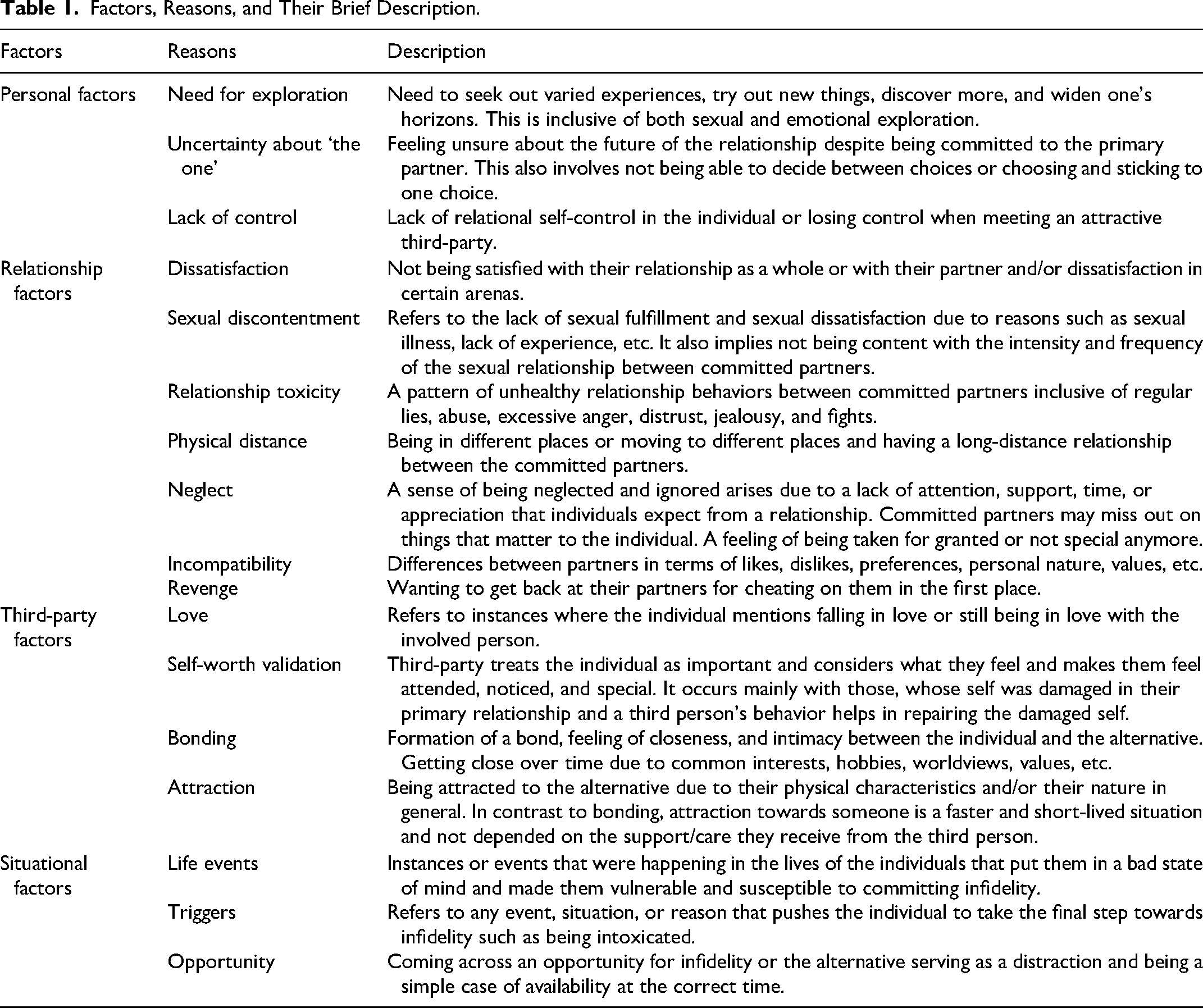
The data analysis of the participants’ narratives has shown many reasons for their betrayal, varying from their personal traits to situational factors. Based on the nature of those reasons, we have clubbed them into four broad factors, namely—personal factors, relationship factors, third-party factors, and situational factors. Each of these factors may present alone or occur simultaneously with others to let a partner involve in infidelity. In the following section, factors along with their reason are examined in detail (a brief desciprion is given in Table 1).
Factors, Reasons, and Their Brief Description.
Personal Factors
Personal factors refer to those factors that are inherent in the individual such as personal qualities of the individual as well as factors that affect the primary individual directly involved in infidelity such as losing self-control. Personal or dispositional factors may directly influence a person's participation in infidelity for example due to their sexual interests, or may indirectly by making the person more susceptible when under favorable certain situations. Personal factors in the current study comprise of need for exploration, lack of surety, and lack of control.
Need for Exploration
It refers to an individual's need to seek out varied experiences, try out new things, discover more, and widen his/ her horizons. This is inclusive of exploration both in sexual terms as well as emotionally seeking out in a platonic way. For instance, a male participant of 28 years, mentions he likes exploring and has been intimate with one of his exes. He says “So, yeah, in the current relationship I am, I am giving my hundred percent to her, and I love her with all of my heart. So, the other person who I would say I am involved with is one of my ex-partners, she's in Sikkim only right now, she's married but when we meet, we kind of like to sleep together, at least like the last couple of times. It's nothing serious, it's just like no strings attached to sleeping together. She is okay with it and so I am, it is mutually consenting. Not like I am in love or something, it's just that I am open to these ideas and like exploring.” This shows that it is not always problems in the relationship leading to infidelity but also personal nature wherein happily committed people also enjoy being involved with secondary partners to satisfy their urge for exploration.
Uncertainty about ‘The One’
This category refers to feeling unsure despite being committed to the primary partner and the future of the relationship. When people do not feel confident or sure that their partner is the right person for them or ‘the one’, they sometimes prefer to explore more to be sure. This category also involves not being able to decide between alternative choices or choose and stick to one choice. For example, a male of 34 years, who had been involved in emotional infidelity shares “People have got different temperaments. I like someone, they have some qualities, I like someone else, they have got some other qualities, so it is like indecision, which one I like.” He further adds “Because there are so many choices available, it happens because of fickle-mindedness also, we see someone, we get attracted to them and then we see someone else and we get attracted to them, it's quite natural also.”
Lack of Control
Lack of self-control in the individual and/or losing control which leads to them developing relationships outside the committed relationship. For instance, a male participant who had hooked up with one of his ex-partners quoted “Even at that time, I knew what I was doing, from inside I knew everything, that I was doing wrong but still, I couldn’t control myself because I was feeling good.” Thus, it can be understood that not being able to control themselves either in that very moment or as a trait could very well lead to infidelity. Participants have also reported that they become more vulnerable to losing control when they meet a very attractive yet approachable third person.
Relationship Factors
It refers to factors that are related to the committed partners and their relationship. Unlike the personal factor, relationship factors represent a joint aspect of the two partners. The relationship factors that cropped up in the present study were dissatisfaction, sexual discontentment, relationship toxicity, physical distance, neglect, incompatibility, and revenge.
Dissatisfaction
It involves the individual not being satisfied with their relationship and committed partner. This represents a general discontent that grows over the period because of small-small matters or due to some major issues between them. One of the participants quoted “There was a communication gap…. I felt communication became a very important factor you know cause when you want to share something and the person is not there, what is the point of keeping the person, if I want to tell it very rudely, that will be the thing you know.” This shows a dissatisfaction that had risen in his relationship due to the unavailability of his partner and the growing communication gap can lead to infidelity.
Sexual Discontentment
It refers to the lack of sexual fulfillment or sexual dissatisfaction due to various reasons like sexual illness, lack of experience, etc., also implying not being content with the intensity and frequency of the sexual relationship between committed partners. For example, a male of 30 years, expresses that not getting the required amount of sex, forces a person to cheat—“It is one of the reasons, what I have realized is that even if a person doesn’t want to cheat, a man or a woman, it is not about sexual dissatisfaction, it is about not having sex at all, and this is stemming from a relationship which is very active in nature. It's just like having food, if you don’t have food properly for a month what will happen so it's like that.”
Relationship Toxicity
This includes patterns of unhealthy relationships between committed partners which is inclusive of lies, abuse, excessive anger, distrust, jealousy, and fights. Moreover, the individual may also feel a sense of obligation and pressure in a toxic relationship. A female participant of 27 years, recalls, that she tried to stay committed, however, her partner cheated on her, despite this, she continued the relationship, but it started to get very toxic. She quotes—“So, I tried, to be in a relationship and even though there was no trust, I tried from my side. Then once we broke up after his cheating, I tried to handle it with partying and alcohol. Even then after we got back, I think I wouldn’t have cheated had he told me the truth about all of it but then he lied to me and physically abused me.” It is also possible that participants in our current study who were in a toxic relationship were also involved in infidelity as a way of escape. A male aged 29 years, who had emotionally engaged with another girl, mentioned that it was very difficult to cope with his committed partner's actions, and felt suffocated.
Physical Distance
This includes being in different places or moving to different places and having a distance relationship between the committed partners. For instance, a male, aged 24 years says “Everything can’t happen over the phone or text messages sometimes I think if we got a chance to meet once in a week that would also have been enough.” This quote also explains that being in different places or far away also means less sexual interaction. Therefore, being in separate places could even indirectly fuel infidelity if not just directly. Participants have mentioned that due to work or education, many a time they have to live in different places where they cannot meet each other regularly. Though, due to mobile and social media, they can call and see their partners any time, however, that does not fulfill their physical or emotional needs. This sometimes led to being involved with a third person either at a weak moment or over a period of time.
Neglect
It refers to the lack of attention, support, time, or appreciation that individuals get from a relationship, and may lead to the individual feeling ignored or neglected. The committed partner may miss out on things that matter to the individual, which may make them feel neglected. For instance, a female (23 years) shared that her committed partner had ended up forgetting their four-year anniversary and being in a distance relationship, she was really looking forward to it. She said—“I thought it's been 4 years, it's good, and then I called him, called him many times he didn’t pick up. I thought come on man other times you don’t pay attention, it's fine, at least on today, be conscious tonight, call me back, or at least drop a message.” The feeling of being neglected or taken for granted may develop over a period of time in a dating individual, however, it may become more evident when the individual started getting attention or importance from a third person. Hence, this supportive treatment from the third person may attract the individual toward that person.
Incompatibility
It refers to the differences amongst each other's characteristics in terms of likes, dislikes, preferences, personal nature, and values. Incompatibility could lead to dissatisfaction, however, they are different factors, especially in the context of the present study since incompatibility would not necessarily mean a bad relationship, merely the differences between partners. One of the females, aged 21 years, states “It was kind of too much, like bit too much good guy, he doesn’t drink, he doesn’t smoke and I am like actually quite different from him and our vibes don’t match much.” In the above quote, she talks about the differences in their personality and why she looked toward others. As individuals, grow and change, they may also start to become incompatible gradually due to one's differences.
Revenge
It refers to wanting to get back at their partners for cheating them in the first place. They justified their act since their partners were the ones who first involved in cheating, and their cheating was merely an act of revenge. A female of 28 years, revealed that after finding out about her partner's betrayal, she felt it was justified that she does the same to him and therefore got involved with an alternative merely for the sake of revenge, although she didn’t have any feelings towards that person. She stated “It was like, I knew my partner was cheating on me, so I wanted to do the same. It was just that you know and then, later on, I felt like, I was just using that person because I was never in love with that person the person that I cheated with but also I continued it just because my partner was cheating and I wanted to do the same to him.”
Third-Party Factors
It refers to all the aspects that are related to the third person which encourages the individual to be involved with the person and engage in infidelity. A probable reason why third-party factors were found to be important in leading to infidelity could be, that the resources provided by the alternative, filled the void that was lacking in their primary relationship. Analysis has shown that generally, the third-party factors worked more when the primary relationship was not very fulfilling, however, there were many cases where third-party factor led to infidelity despite having a healthy primary relationship. Third-party factors that lead to infidelity consist of love, rebuilding self, bonding, and attraction.
Love
This refers to instances where the individual talks about falling in love or still being in love with an old friend or ex-partner. A female, aged 21 years, who had cheated on her boyfriend with one of her ex-boyfriends, recalls being in love, with him. She quotes “It seems that the guy I talked about, whom I got really serious with, I had not gotten over him. It seems like I was still, I am still in the phase that I am recovering.” While another female of 25 years of age, accepted being in love with both partners when asked to describe her relationship with the third person. One of the statements that depict this is as follows—“It is difficult to put it into labels or put it into words, what it is. And I mean I had never imagined myself to be someone who would love or be in a relationship with two people but this is it.” Though feeling of love for a third person is more common when there is not everything is fine, however, it is possible that without any problem in a dating relationship, a partner may fall for the other.
Self-Worth Validation
When in a primary romantic relationship, individuals start feeling ignored or neglected and the partner's treatment towards them becomes indifferent or insensitive, individuals may grow a negative self-concept or lose their self-esteem. At that time, if a third person gives importance and makes them feel special or worthy, it helps the individual to rebuild their shattered self. That is a third person makes the individual feel important, noticed, and special, which the individual was not getting from his/her partner. For example, a female of 29 years said the following regarding the third person “This person used to notice all the small things and remembered them so it made me feel good that she paid so much attention to me.” Receiving attention and importance from a third person is one of the ways in which people moved from being just friends to having an affair. Probably, being special or important plays a vital role in dating relationships because many a time people date for getting care, support, and affection, and if that itself is missing then there are more chances that they will seek it somewhere else.
Bonding
It refers to the formation of a bond, a feeling of closeness, and intimacy between the individual and the alternative. Many times bonding and love are used interchangeably, however in the present study, as revealed by the quotes, the two are different since bonding is regarded as just a feeling of connection and emotional attachment without necessarily falling in love with the cheating partner. Communication, self-disclosure, spending time together, and providing support during difficult times are some ways in which people bond. A male participant spoke of how he formed an attachment with the third person as a result of shared activities in the following quote—“I became really close with him, more like we would eat together, have coffee together on breaks, would help each other out with the training assignments and stuff like that.”
Attraction
It refers to the characteristics of the third person that attracts the individual—physical characteristics and their nature in general. Individuals may be fascinated by the attractiveness, sexual appeal, or personal characteristics of the cheating partner. For instance, a male of 24 years mentioned liking the other person because she was so appealing physically—“I met her and it was infatuation, physical attraction, she was like a bomb, so hot and the way she dressed up, she ignited something, it was not love, but physical attraction and after that kiss we had I was enjoying that moment for a certain period.” This was indicative of him liking the cheating partner due to her qualities which further, may have pulled him towards the other person. In contrast to love, bonding, and rebuilding self, here individuals are being attracted towards a third person without getting any care or support or developing a bond or a serious feeling for the person. Most of the time it happens quickly, like at first sight, and generally fades too quickly as well.
Situational Factors
It includes external factors related to the context or external environment, which are beyond the control of the perpetrator. Situational factors in the present study comprised life events, triggers, and opportunities.
Life Events
This refers to instances or events that were happening in the lives of the partners that put them in a bad state of mind and made them vulnerable and more susceptible to committing infidelity. For example, a female of 23 years, mentions her father's accident that left her feeling worried and emotionally very vulnerable, and this event was one turning point in her life where she felt her committed partner was not as much available to her as he should have been. That time she received solace from someone else, which led her to involved with the other boy. While another female, aged 27 years, mentions that a major fight with her partner was very consequential, in her participation in infidelity, in the following quote—“One day I had a fight with my partner and so I called up the guy and started talking to him mainly out of anger that was there towards my committed partner.”
Triggers
It refers to any event, situation, or reason that pushes the individual to take a step toward infidelity. Although triggers can be anything and are not limited to alcohol, weed, drugs, etc., however, in this study alcohol was the most important reported trigger. Participants for example reported being drunk and in an intoxicated state which acted as the trigger, “That day for a change, when we were drinking beer, we ended up drinking too much, maybe because I was hurting and I just wanted to drink it all away. I didn’t realize when we drank a bit too much and then we were just sitting and he abruptly kissed me and things happened and I just got intimate with him” (Female, 24 years). In some cases it could be emotional intoxication, which means due to extreme emotions or moods, a person may involve in sexual or emotional infidelity with an available alternative. For instance, a male participant of 36 years mentions how he was in a positive emotional state when returning back home together due to the good time he had at the party with the third person, which influenced him a bit more in the direction of infidelity—“It was a first time where we were meeting wherein both of us were in an inebriated state, and we had a very good time in the office wherein we danced a lot, it was around 2 am when we left the party, a few people came and asked if we were a couple or they said that you are a good couple this that so we went back in that state of euphoria.”
Opportunity
It refers to coming across an opportunity for infidelity or the alternative partner serving as a distraction and being a simple case of availability at the correct time. A male participant, aged 29 years when talking about his involvement with a girl accepted that his involvement with her was motivated because the opportunity was available to him and he utilized this to his advantage. His quote goes like “We were in the hills and you know like it's on a solo trip so we got the feeling that what happens in Vegas stays in Vegas thing and we are gonna go off to our respective places after this so there was a platform of opportunities present to me and of course, I started to justify my will to be attracted to her and everything.” This quote is indicative that having an opportunity to cheat is one important reason why people actually cheat. Though it is possible that many factors play simultaneously along with the opportunity to involve with a third person, such as lack of control, unsure relationship future, etc., however, in some cases, it was also found that an individual may involve in infidelity merely because he/she had an opportunity.
Discussion
The present study was aimed at exploring what are the factors that play a part in involvement in the cheating process of infidelity. The initial studies mostly focused on married couples and extramarital infidelity. Dating is an important transition before marriage and the reasons for infidelity in today's scenario could be different. The results found multiple factors, which have been organized into four broader factors—personal, situational, relationship, and third-party factors.
Past studies have also noted the importance of dispositional factors in understanding infidelity as well as the possibility that these factors might be used to determine their attitude towards infidelity, which in turn can serve as a major guiding force for infidelity (Allen et al., 2008; Isma & Turnip, 2019). Personal variables can either have a direct impact on an individual's involvement in infidelity, such as their sexual preferences, or they might have an indirect effect by making the individual more susceptible under particular favorable circumstances. Similar to the present findings previous research has also discovered a favorable association between infidelity and traits like openness, the desire to explore, and a lack of self-control (Jain & Sahni, 2017; Schmitt & Shackelford, 2008). It should be emphasized that participants who stated the desire to explore frequently also shared that they were unable to restrain themselves. Due to their inability to resist temptation, individuals with poor self-control and self-regulatory abilities are more likely to engage in a variety of sexual behaviors, including infidelity (Ciarocco et al., 2012; Love, 2006; Pronk et al., 2011).
An unexpected finding of the current study was that being unsure about the partner and feeling uncertain of their relationship leading to marriage also encouraged people to cheat with a substitute. Uncertainty is produced in interpersonal relationships by three connected but separate sources, namely the self, the partner, and the relationship, and people are driven to reduce uncertainty and ambiguity (Berger & Calabrese, 1974; Knobloch & Solomon, 2002). The context could be of importance here. Collectivist cultures prefer a pragmatic approach to relationships (Madathil & Benshoff, 2008). Dating is frequently seen as a stepping stone before marriage and, there is a misplaced assurance that the person you date would be the one you eventually marry in the Indian context, especially for people in their late twenties and thirties, and a lot of emphasis is placed on security, stability and certainty. Not being able to imagine a future with their partners or in their current relationship, therefore, could drive their attention toward more beneficial and realistic alternatives.
The study also points out that relationship issues are a major contributing element to infidelity as the answer to why people get involved outside of their committed relationships is because they are dissatisfied with their primary partners. Prior research has underlined this by confirming that people try to fulfill their needs through partnerships, failing which they may seek fulfillment elsewhere (Barta & Kiene, 2005; Jeanfreau et al., 2014; Norona et al., 2018; Omarzu et al., 2012). Resentment and dissatisfaction between partners are brought on by a number of factors, including poor communication and unfulfilled emotional demands. There is evidence that extradyadic interactions are related to unhappiness and issues in the main partnership (McAnulty & Brineman, 2007). Similarly, theories that embrace unhappiness, neglect, sex, and wrath as motives for adultery include those provided in the four-factor model for infidelity by Barta and Kiene (2005). Studies also suggest that one of the major reasons for people cheating is due to sexual aspects (Barta & Kiene, 2005; Omarzu et al., 2012).
Unhealthy patterns in relationships have always been harmful, and the present study demonstrates that they also have an impact on couples who are dating (Maphosa et al., 2017). It's also likely that individuals in our present study who were in toxic relationships also engaged in adultery as a coping mechanism. Participants recognized engaging in adultery as a strategy for escaping their ongoing troubles, according to a previous qualitative study by Scheeren et al. (2018). Physical distance was one interesting factor that also emerged from the study. Living apart provides additional possibilities to engage with other suitable alternatives, which increases the likelihood of having secondary partners especially if they are already dissatisfied (Blumstein & Schwartz, 1983). Due to the options and chances it presents for other people to get closer, being apart might even indirectly promote infidelity instead of simply directly doing so (Blumstein & Schwartz, 1983). Being apart and missing the primary partner contributed to emotions of loneliness in the context of the current study. Loneliness and infidelity have been demonstrated to be positively correlated (Isanejad & Bagheri, 2018). Feeling neglected by their primary partner is another factor that is prevalent seen in the study which can also be found in Barta and Keine's (2005) infidelity model. Additional studies have also revealed that neglect and a lack of attentiveness are significant contributors to adultery (Jeanfreau et al., 2014).
Another element identified in the study was incompatibility which has been linked to infidelity in previous studies as well (Haseli et al., 2019). However, in the context of the current study, these differences between the partners happen with time as one of the partners matures and change and as a result of one's differences, they also begin to progressively become incompatible. Wanting to get even with their partners or taking revenge was another common factor that has been mentioned in previous literature as well (Drigotas et al., 1999).
The next category that was considered to be vital for infidelity is third-party factors. It is likely that the resources offered by the alternative filled the void that was lacking in their primary relationship. Pioneering work in this area by Glass and Wright (1992) also cited love as one of the most important driving factors behind infidelity. Scholars have highlighted the role that neglect plays in infidelity, thus it is likely that those who feel this way may seek out and end up cheating if they obtain care from other sources. In dating relationships, gaining attention may become more crucial since individuals often date to find care, support, and affection and if those things are lacking, there is a greater likelihood that they may go for them elsewhere. It is likely that they may bond via interaction, disclosure of problems and life situations, and spending time with each other, as well as through offering and receiving support when things are tough, further making them feel closer to the alternative. Attention, special treatment, or care received from a third person may help individuals to heal their damaged self caused by their primary partner or relationship. Therefore, rebuilding the self is one major reason why an individual reclined towards a third person. Rebuilding self, bonding, and love have some overlapping, however, they are different from each other. While attention is showing care and support from a third person and most of the time that is a one-way process. However, bonding is more about the development of trust, connection, and intimacy between two individuals. Here both parties started developing a feeling of closeness and most of the time bonding leads to emotional infidelity first and then sexual. Moreover, love is a more intense feeling, which could be one-sided or both-sided, here it is possible that the individual has not developed any bond or received any special attention or support but he/she still fell in love with someone. It is uncontrollable and to some extent illogical as well, as some participants have mentioned that it was difficult for them to understand why they fall for a third person while there was nothing wrong in their romantic relationship. However, it is possible these three, can be the reason for infidelity in a sequence, i.e., attention led to bonding and bonding led to love. Yet it is possible that these three can exist alone or in a separable manner.
Feeling attracted is one additional factor why some may get involved in extradyadic relationships. Attraction to the other person has often been cited as a reason for infidelity (Feldman & Cauffman, 1999). It could be that when people find certain aspects of an alternative very attractive such as their looks or personal nature they may be drawn towards them. While in other reasons under the third-party category, individuals get support and care from a third person, however, in the case of attraction, the individuals are the ones who are at the giving end not the receiving end. Moreover, unlike, love, rebuilding self, and bonding, attraction mostly led to sexual infidelity. In other words, it is a feeling of infatuation towards a third-party. The results of the study also suggested that while for other factors under the third-party category, relationship factors such as dissatisfaction, neglect, and long-distance may play a starting point, however, in the case of attraction, relationship factors mostly do not exist.
Literature from previous studies (Scheeren et al., 2018) has also designated contextual factors in support of infidelity. An interesting finding from the study was people also mentioned events in their lives and being intoxicated accountable for them wanting to cheat. People often feel vulnerable during certain phases of their lives and this may influence their decision. Additionally, the influence of alcohol or drugs on an individual is such that it may reduce their inhibitions and increase risk-taking which could lead to sexual behaviors such as infidelity (Feldman & Cauffman, 1999; Norona et al., 2018). A person's mood—negative as well as positive affects people's tendency to indulge in regretful sexual conduct (Mark et al., 2011). Though mood or emotion is a personal characteristic, however, these moods or emotions are depended on the context and they basically work as the trigger for infidelity in some instances. Finally, having the chance to engage in extradyadic activities also serves as motivation by itself. While, opportunities such as days spent traveling for work to simply being a case of one person working while the other partner is at home could serve further as additional reasons for those who already wish to cheat as well as for those who are already aggravated by their relationship factors (Atkins et al., 2001; Crouch & Dickes, 2016).
Limitations and Future Directions
The data were collected solely from the perpetrators of infidelity, therefore, it is possible that only limited personal factors have emerged and more external factors were mentioned, including situation, relationship quality, and third-party characteristics. Therefore, future investigators can include both the perpetrator and the victim so that both their perceptions and experiences can be evaluated and get a better understanding. Another limitation of the present study was focused only on dating couples, hence, similarities and differences between marital infidelity and dating infidelity could not be explored. Future studies may include perpetrators of both kinds of relationships and compare them to get a better comprehensive understanding of infidelity. Finally, the study was carried out during the pandemic and therefore telephonic interviews were carried out to gather the narratives. This could have restricted the data that could have otherwise been gathered, since participants might have left out some information, as well as the data, relied on self-reports by the participants, keeping this in mind, other methods should also be considered in future studies.
Implications
It is generally deemed that a person's involvement with a third-party outside of their primary relationship is due to a single factor such as dissatisfaction or weak moral values, studies like the present one would give an insight into the multiple reasons behind the nature of infidelity. Couples striving to make their relationship work after an episode of infidelity also will benefit if awareness exists about the root causes of it. One important assumption is also that sexual involvement will mostly be accompanied by emotional attachment, however with the changing scenario, a breakdown of infidelity as purely sexual, emotional, or a mix of both will make it easier for investigating it as well as for curbing it. Dating and romantic relationships are an integral part of most people's lives and are often linked to one's self-esteem, happiness, and well-being in general, however, most studies pay attention to the married population but the dating population is equally important since it is a crucial stage that most individuals go through and therefore studies with regard to this are very essential. Past literature has focused a lot on individual factors or relationship factors by itself, however as brought to light by the current study, a phenomenon like infidelity which has so much moral and societal judgment attached to it is not motivated by just one factor, but multiple factors, which often might be occurring simultaneously. This study, therefore, will bring people to the realization that more multifactorial approaches are further needed to study infidelity.
Footnotes
Authors’ Note
The study is a part of the Ph.D. thesis of Ms. Parvati Varma, Department of Psychology, Sikkim University, India.
Declaration of Conflicting Interests
The authors declared no potential conflicts of interest with respect to the research, authorship, and/or publication of this article.
Ethical approval
The study was conducted after approval and ethical clearance was received from the institutional ethical committee.
Funding
Ms. Parvati Varma has recived Savitribai Jyotirao Single Girl Child Fellowship, University Grant Commission, India, for her Ph.D. Work.
Informed consent
Informed consent for data collection and for the use of data for academic/research publication purposes was taken from all the participants prior to the interview.
