



Abstract
Problem or issue
Men and women in many African countries generally have limited faith in and utilization of ART
What we already know
Existing knowledge and attitudes concerning infertility
The experiences of both men and women dealing with infertility
The health-seeking behaviors of couples facing infertility
What this paper contributes
Insights into the knowledge held by both men and women regarding Assisted Reproductive Therapy
Examination of the cultural and religious beliefs surrounding Assisted Reproductive Therapy
Identification of barriers encountered in accessing Assisted Reproductive Therapy
Introduction
Approximately 0.3% of annual births worldwide result from Assisted Reproductive Technologies (ARTs) (Alviggi et al., 2020). Infertility affects 10–15% of couples in industrialized nations (Inhorn & Patrizio, 2015). Global awareness of ART is increasing (Davis, 2020). Over the past three decades, significant advances have been made in human conception and genetic manipulation (Pascual et al., 2017). Researchers are innovating new techniques to enhance well-being (Farid & Schotsmans, 2014), but these advancements have sparked ethical and legal debates (Kooli, 2019). Global barriers to ART, such as cost and limited availability, are well-documented (ICMART, 2013). However, there is a noticeable gap in literature on the impact of religion and culture on ART.
Cultural and religious factors have posed challenges to the early acceptance of ART, particularly in the Middle East and to a lesser extent in Europe (Serour & Serour, 2021). There have been inconsistencies regarding religious beliefs and ART. Some religious beliefs support the practice, while others forbid it (Schenker, 2005; Sariles, 2017). For instance, ART is widely accepted by numerous religious groups such as Judaism, Hinduism, and Buddhism, though Orthodox Jews typically avoid this procedure. Conversely, some religious groups, like Roman Catholics, oppose assisted reproduction entirely, while Protestants, Anglicans, Coptic Christians, and Sunni Muslims generally accept forms that do not involve gamete or embryo donation (Sallam & Sallam, 2016). However, little is known about the relationship between religion and assisted reproductive therapy in Africa and Ghana.
Despite Africa's early involvement in the global expansion of ART, it has faced significant opposition from religious scholars worldwide (Inhorn & Patrizio, 2015). Sub-Saharan Africa has the lowest rate of ART utilization, with only 71 cycles per million population annually (ICMART, 2013; Botha et al., 2018). However, ART use among women in Ghana is increasing (Torgbor et al., 2021). The Ghanaian in vitro fertilization (IVF) industry is highly internationalized, attracting individuals from various countries seeking ART clinics (Gerrits, 2016). While previous studies have explored aspects of IVF development in Ghana, this research examines cultural and religious beliefs about ART in the Abokobi rural community in the Greater Accra region.
Literature Review
Researchers have explored ethical issues surrounding gamete donation and practices (Farid & Schotsmans, 2013). However, there remains a gap in understanding how these concerns impact decision-making and the long-term psychological effects on donors and recipients. Access to infertility treatments like ART is considered a fundamental human right, but significant disparities exist in availability across regions and socioeconomic groups.
Assisted reproductive therapy is influenced by religious and cultural beliefs, underscoring the need for research on mitigating cultural resistance and enhancing policy support. Prag and Mills (2017) emphasized the role of cultural norms in regulating ART availability in Europe, but detailed guidelines on integrating these considerations into policies are lacking. Kooli (2019) reviewed ART laws in 14 Muslim countries, highlighting the need for amendments to align with medical advancements and identifying legislative challenges in multicultural societies.
In Ghana, Hiadzi et al. (2021) argued that religion can facilitate ART use by empowering individuals to seek solutions for infertility, challenging the notion that religion hinders ART. This suggests a need for nuanced research into how religious beliefs interact with ART acceptance and usage, and how religious institutions can support individuals undergoing ART treatments.
Methods
Research Design
Research design is the plan for the systematic approach, conducted in a way that ensures the answers found would be as meaningful and accurate as possible (Grove et al., 2012). For this study, a qualitative approach with interpretive descriptive design was employed to fully understand the participants in terms of their knowledge, cultural and religious beliefs, and challenges and barriers to the use of ART. Though this design provided a better understanding of the experiences, it provided no conclusive results but simply explored the research topic with diverse levels of depth (Bhat, 2020).
Inclusion Criteria
The study's inclusion criteria encompassed individuals of both genders aged 18 and above who resided in the Greater Accra Region of Ghana and expressed a willingness to take part in the research. To ensure effective communication and the accuracy of information gathered, participants were required to be fluent in English, as there was no available interpreter for multiple languages. Fortunately, all the selected participants demonstrated at least a basic proficiency in English, as they hailed from diverse regions where English was commonly spoken. As a result, the interviews were conducted in English to facilitate a smooth and comprehensive exchange of information. E.O.A, L.W, and H.AT conducted the interviews in participants’ homes. Participants who encountered difficulties or hesitations in sharing the required information were excluded from the study.
Sampling Technique
This study utilized the purposive sampling technique, often referred to as “judgment sampling,” to select participants. This method was chosen because it allows for the inclusion of individuals who possess specific and critical characteristics, such as knowledge, ideas, experience, and valuable role opinions, that are deemed essential for the study (Creswell & Creswell, 2017). Consequently, all participants were intentionally selected to ensure they possessed the requisite attributes and could provide the necessary information vital to the study's objectives.
Sample Size
A sample size for qualitative research is determined at the point of saturation as no new information was obtained from the participants (Bowen, 2019). The size of data does not really matter as its richness (Dibley, 2011). In this study, the researchers conducted the interviews until data was saturated. For this reason, the sample size for this was based on saturation, as it was the most preferred concept in qualitative research and was reached at 15.
Data Collection Procedure
Ethical clearance was sought from Dodowa Health Research Centre Institutional Review Board (DHRCIRB) before data were collected. Permission was sought from the district health directorate, including the chief and assembly member for the area through an introductory letter from school of Nursing and Midwifery, Valley View University. The researcher further sought then introduced herself to the selected participants and spelt out the objectives of the study to them and vividly explained the key words to them on the research instrument.
The primary data collection tool for this study was a semistructured interview guide. The interview guide was constructed based on the research objectives and the issues that appeared in the literature. The interview guide consisted of four sections including Sections A, B, C, and D. Section A consisted of background information which was made up of sociodemographic information such as age, religion, and marital status. Section B was made up of open-ended questions on the knowledge ART. Section C was made up of open-ended questions on cultural and religious view on ART. Section D also consisted of open-ended questions on challenges on the use of ART.
Prior to the pretesting, ethical clearance was secured from the DHRCIRB under protocol number DHRCIRB/081/04/22 The guide was pretested among five participants from two different communities in Accra which was not included in the main interviews. Face-to-face interview was conducted in convenient and private environment chosen by the participants. Prior to the data collection, the researchers introduced themselves and explain the purpose of the study to the participants. During the interview, a tape recorder was used to capture the interviews to be conducted. The researcher met the participant at the agreed venue, place and time with the semistructured interview guide.
At the time of the interview, participants who showed unwillingness were allowed to opt out from the interview. Those who agreed to participate in the study were assigned pseudonyms in identification to enhance confidentiality. The researcher explained all questions in simple language to participants to answer correctly. The discussions lasted between an hour (60 min) and an hour and 15 min (75 min). The data collection lasted for three months. The safety of the participants was ensured by observing covid-19 protocols such as; maintaining social distance during the interview, both researcher and participants had on their face masks. Knowingly, a box of face mask and hand sanitizer was on hand to ensure that the protocols were been observed. At the end of each interview, participants were thanked for contributing to the success of the study.
Data Analysis
The results were analyzed using content analysis. Content analysis is a method of analyzing a qualitative data that the researcher closely examines the data to identify common ideas, and patterns of meaning that come up repeatedly to generate themes, subthemes, and emerging themes (Caulfield, 2019). All the authors partook in the data analysis. There are five stages in content analysis. This includes familiarization, coding, generating themes, reviewing themes, and defining and naming themes. The themes were also organized with NVivo 12 software. In the first stage which is familiarization, the researchers got to know the data that have been collected by reading and rereading through the transcripts for a thorough understanding to aid in the coding of the data.
The second stage involves assigning codes to the data collected. The primary coding was done and systematically generated by utilizing a highlighter to mark all potential themes. The third stage involved the generation of themes, Comments and expressions of close nature were grouped together to form subthemes. Last but not the least was the reviewing the themes. The themes were examined and improved by collapsing some themes into other themes. This was to ensure that all the data followed a consistent pattern. For the purposes of this study, the developed codes were tabulated and arranged into main and subthemes.
Methodological Rigor
Rigor is defined as the quality of being very exact, careful, or being thorough and accurate (Cypress, 2017). The rigor is dependent on the four stringent dimension criteria developed by some authors which are credibility, dependability, confirmability, and transferability (Brown et al., 2015).
Credibility of a study is the confidence the researcher has on the findings and the extent to which a research account is believable and appropriate (Brown et al., 2015). To ensure credibility in this study, participants were allowed to reasonably judge the results of the study. Moreover, multiple data analysts and proof checks were employed to encourage data accuracy.
Dependability of a study is to make sure the findings of the study are repeated and depend upon for good outcome and other researchers can use the result without any doubt (Polit & Beck, 2013). To achieve this, participants were given the findings, interpretation and recommendations of the study for their view. Confirmability means to extend confidence that the results would be corroborated by other researchers (Forero et al., 2018). The result of the analyzed data was compared to other research findings. The data were collected till saturation stage.
Transferability is the degree to which the results can be generalized or transferred to other settings (Szalma & Bito, 2021). In this study, the researcher provided the study process to the participants including the study methodology, purpose, and perception of the problem under study.
Results
Analysis of Sociodemographic Data
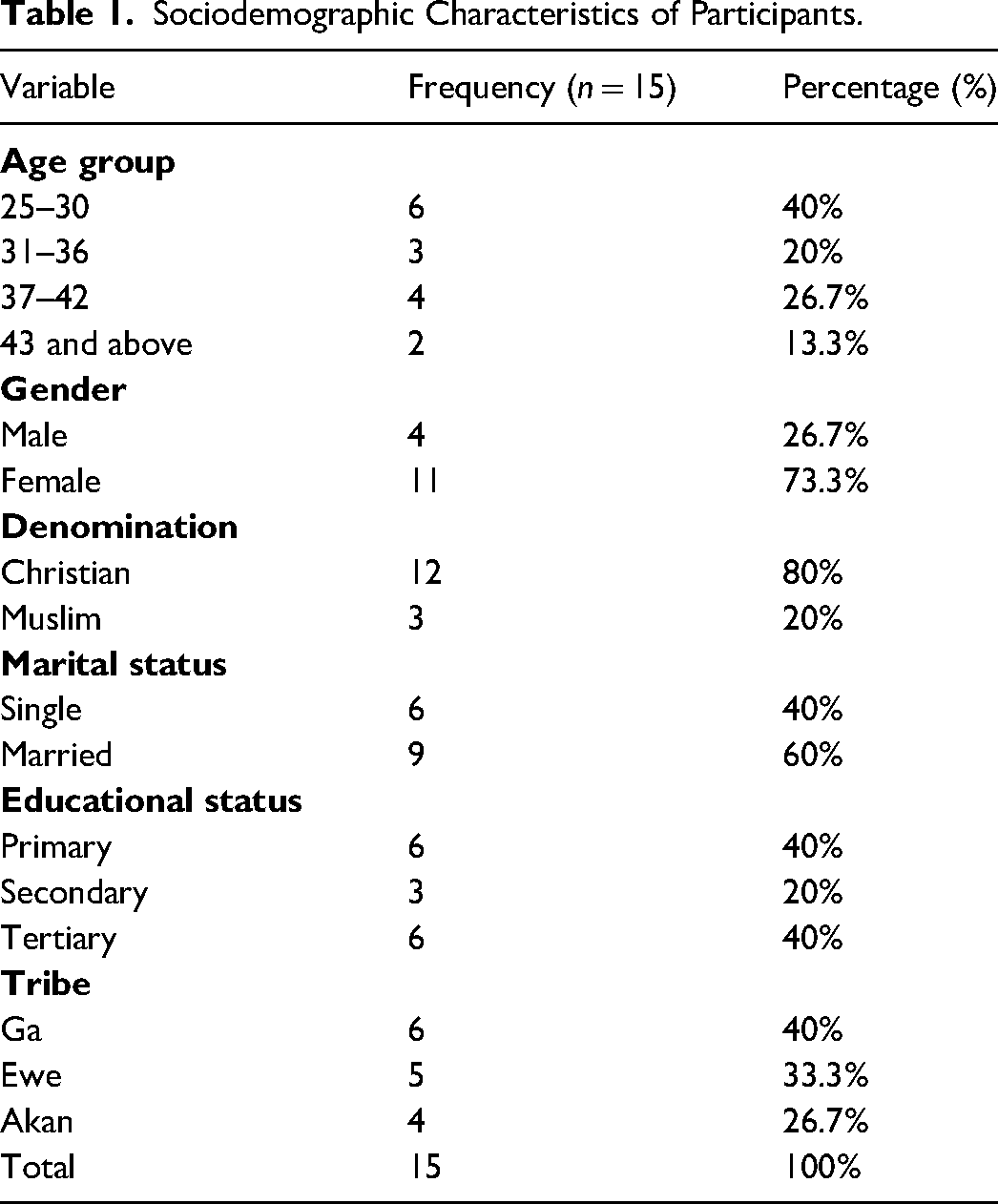
The study's findings revealed that the participants fell within the age range of 25–47 years. The religious composition of the group was diverse, with three participants identifying as Muslims and 12 as Christians, suggesting a predominantly Christian population in the Abokobi community. Regarding educational background, five participants had completed primary education, three had reached the secondary level, and nine had attained tertiary education. In terms of marital status, six participants were single, while nine were married. Detailed demographic information is presented in Table 1.
Sociodemographic Characteristics of Participants.
Organization of the Themes
There were 3 main themes and 12 subthemes. They are presented in Table 2.
Themes and Sub-themes.
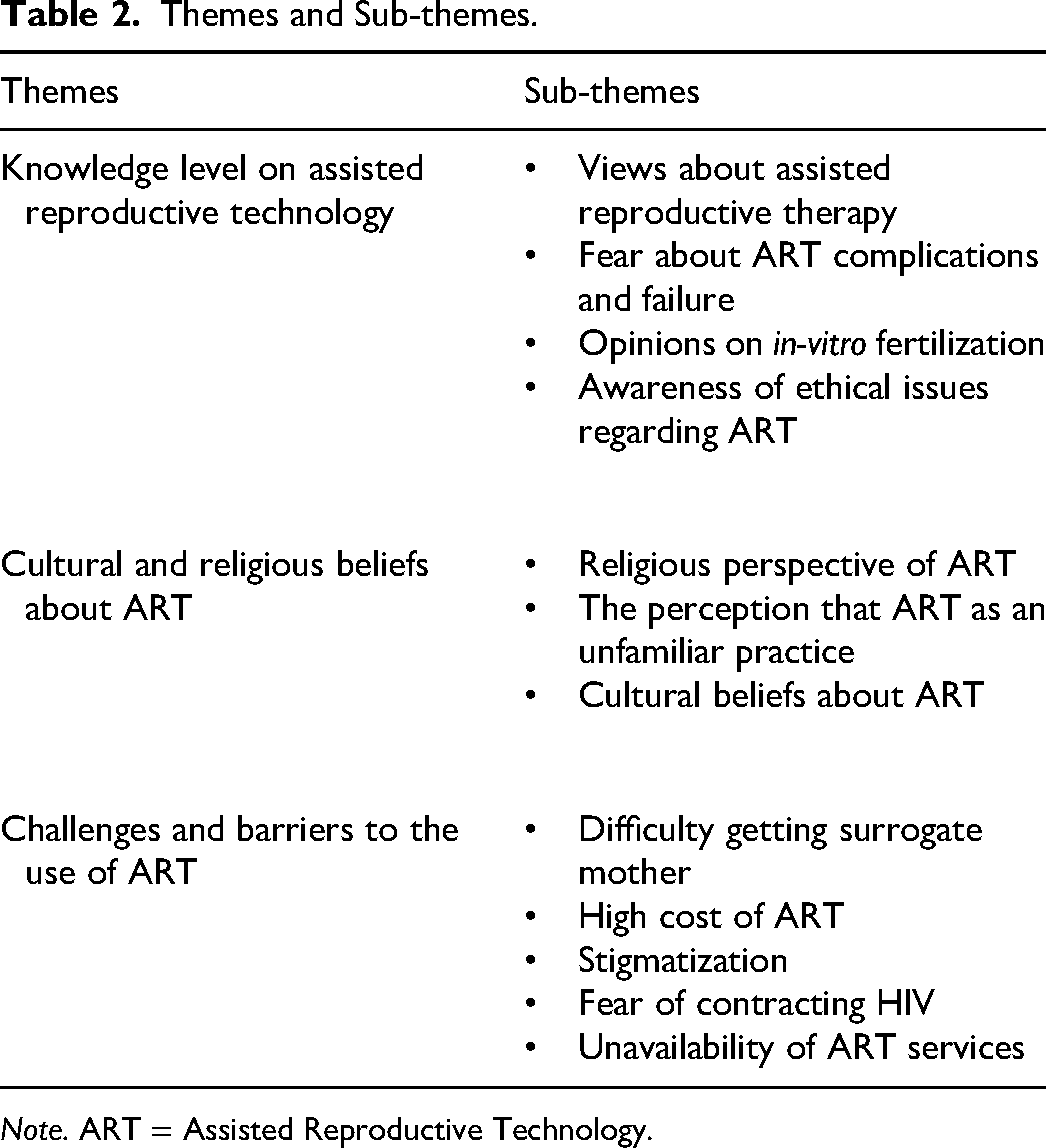
Note. ART = Assisted Reproductive Technology.
Knowledge Level on ART
Views about Assisted Reproductive Therapy
Majority of the participants demonstrated good knowledge on artificial insemination. They expressed their insight on artificial insemination as follows: “I know that with artificial insemination procedure the Dr. take the sperms from the man and inject it into the woman to help her conceive.” (P2) “I know that is a procedure done for couples finding it difficult conceive where the sperms of a male partner injected into the woman to fertilize the egg.” (P3) “I heard that with this, both sperms of the man and egg of the woman are removed and fertilized outside the woman and later inserted into the woman.” (P7)
Sadly, some of the participants were not knowledgeable about artificial insemination. This participant had this to say: “I know of infertility but don’t know of any treatment to correct that unless you tell me.” (P5)
Fear About Art Complications and Failure
Several treatment options are available for managing varied conditions. However, treatment has some associated side effects. It is therefore not surprising that some study participants indicated ART for infertility has some associated complications. “Even though ART is good for infertile couples, because surgery is performed, I believe there will be some complications like bleeding and infections.” (P8) “I guess it is not all the treatment that succeed, some may have ART failure.” (P10)
Others were ignorant of ART complications: “I have not done ART before so I do not know if there will be complications.” (P12) “Even though I know everything has side effects am not aware of any of such thing in relation to ART.” (P15)
Opinions on IVF
With regard to IVF, most participants indicated that they had heard about it before. This evidenced in the responses of some participants who openly acknowledged that they had some level knowledge about IVF. These were some of the comments: “In a conversation with a medical doctor who attended to me when I was not getting pregnant, he said a baby can be developed in the laboratory before inserting it in the woman's womb to grow and this is done by fusing the egg and the sperm together. That was when I got to know about IVF.” (P13) “I know that IVF helps people with birth problems such that fertilization is done outside artificially or outside the woman's body, preferably in the laboratory.” (P14)
In the contrary, some of the participants narrated that they had no knowledge about the IVF. One stated that: “What I know is that a baby is formed from the woman's womb. But producing a baby outside the womb of a woman, please I don’t know anything about it. It will be wonderful event to see, unless I see some with my naked eyes I will not believe it.” (P15)
Awareness of Ethical Issues Regard ART
Most of the participants were unaware of the ethical/legal implications of ART. The following statements were some ethical issues narrated by some participants: “I know there is a therapy to assist couples who are infertile, and I know that people can donate their eggs/sperms. I believe there are legal implications to this but I do not know what they are because I have not done some before.” (P13) “I know that there will be ethical issues with regard to ART. This is because You can’t just go through ART without due process but I cannot really tell these ethical issues surrounding ART.” (P14)
Few were aware of legal issues guiding ART: “I have undergone surgery before and I was asked to sign a consent form so I am sure with this ART one will have to sign a consent form too.” (P15)
Cultural and Religious Beliefs About Assisted
Religious Perspective of ART
Religion holds a significant role in society, shaping the lives and behaviors of individuals, including those in Africa and Ghana. This study explores participants’ religious beliefs concerning ART children: “I have been a Christian for so many years now, infact since I was born, and I have not heard any pastors preaching that if you want to give birth you should use ART techniques to get child and it is not captured in the bible to use such methods to give. Therefore, I will not do it even if I am facing fertility problem.” (P14) “Biblically, ART is not accepted because I have never read in the bible that Christians should use ART methods to give birth. The bible only said that is God who gives child. So I don’t think the use of ART is biblical.” (P12)
Some of the Muslim participants also expressed their beliefs about the use of ART in child birth. Some stated that: “We the Muslims do not involve in the use of ART techniques to get a child. I read Quran a lot but and I am yet to come across any quotation about ART and I am not sure the Quran supports it.” (P4) “I don’t really know what the Quran talked about ART but I am not sure my Muslim religion will support the ART methods to give birth.” (P5)
The Perception that ART as an Unfamiliar Practice
The notion that ART represents an encroachment of foreign culture is prevalent. Some participants view ART as a foreign influence supplanting traditional methods of childbirth. A few participants shared their perspectives on this matter: “ART is a not an African way of giving birth, it is a foreign culture that has come to replace the usual means of giving birth. From time in memorial, women conceive through sexual intercourse. But look at the weird ways of childbearing that the white people are bringing again.” (P3) “We don’t know about ART and it is not being practice here. Since that is not what our fathers taught me before they died, I won’t do it because it is not done in our culture.” (P1) “I was trusting my family that barrenness is not in our family and that the gods will bless you with a baby at their own time until 6 years now after marriage I did not realize any positive outcomes and now my husband has started maltreating me so I had to come for treatment.” (P6)
Cultural Beliefs About ART
Children are seen to be very important in most societies, especially in Sub-Saharan Africa which includes Ghana. The study revealed different cultural beliefs held by participants regarding ART. Some of their expressions were: “Culturally, the members in our society believe that children born through ART methods are not normal children. This is because it is believed that a child is only born through a man and woman sexual intercourse. Any other means to get a child is not accepted.” (P7) “The ART child acceptance in our society is in doubt. This is because I was once told by one old man that the only means they know to get a child is through a man and woman. That is what is considered a proper child. But ART child is believed to be a nuisance to the people and therefore not accepted because it is not God's creation.” (P12) “In our culture, when you can't give birth, we have specialized herbalist who who mix some herbs for you to use for some days and you will be able to conceive, all you need to do is either drink it or bath with it consistently as instructed. But I have personally witnessed that it has failed some people as the fault was not from them but their husbands.” (P8)
However, some participants hold that view that children born through ART should also be accepted by people. Some said that: “Now, there are lot of technologies evolving, so I am not surprised that they can get a child through other means a part from man and woman mating. Since it is a human being that is formed, it should be accepted as God's creation.” (P3) “If they can manufacture foods that we eat through scientific means, I believe that human being too can also be created through scientific means. The inability to accept ART children in the society is as a result of lack of education. People should be educated that the world today is full of scientific creations. So I believe that the ART children should be also considered normal children. Whatever it is, ART is the fusion of male and female gametes, just that it is done outside the womb.” (P5)
Challenges and Barriers to the Use of ART
Difficulty Getting Surrogate Mother
Difficulty getting a surrogate mother was reported by some of the participants as a major challenge to the use of ART. Few of the participants said it is difficult to find a surrogate mother, since carrying of pregnancy is not an easy job. Some of the participants stated that: “I have a problem with this procedure since getting someone who will help me is difficult. My doctors said I should look for someone to do that, because my womb cannot carry pregnancy.” (P1) “In this current world, no one will understand that she will carry pregnancy to deliver a child for another woman. It never happened in our society before and I think when you tell someone to do that they will just make mockery of you. So it is difficult to get another woman to do that.” (P6) “I and my wife have tried to have someone carry our pregnancy for us, but we can’t find anyone to do that for us.” (P8)
High Cost of ART
All the participants were of the view that ART in Ghana is expensive. The reasons given included the fact that ART in Ghana is mostly driven by the private health sector with few being in the public hospital. This means that the procedure are not being subsidized by the government, insurance does not cover most of the equipment and consumables used are imported which makes the cost of ART very high. These were the statements of some of the participants: “I wanted to do the IVF but the money I have now is not enough, I have been to so many places for treatment and spent a lot of money, but here I am, the value is the same. I actually wanted to try the IVF, but I don’t have enough money on me now, I have to go back and prepare myself.” (P8) “This technology is expensive and majority of infertile couples may not be able to afford, we are spending close to 20 to 30,000 Ghana Cedis at the clinic, hmm.” (P3) “Couples spend a lot of money to treat infertility. My cousin and the husband are facing the same infertility problem and spending a lot of money on ART for 5 years now and that depicts the fact that the procedure is very expensive.” (P9)
Others were of the view that if the cost is subsidized a lot of people will be able to afford and opt for it. This was evident as one of the participants said this: “If it is less expensive, many more people will go for it. There will be lesser problems in society from infertility. There should be an advocacy to subsidize ART methods in Ghana to lessen the cost.” (P12)
Stigmatization
Infertility stigma is a phenomenon associated with various psychological and social problems especially for women. In Africa, women without children are not considered as real women. As a result, they suffer some psychological distresses such as depression and social issues including isolation, family mockery, and sometimes banishment in some African societies. The participants had this to say; “I believe my condition (being infertile) has led to social exclusion, and sometimes I am subjected to physical and verbal abuse from some people.” (P1) “If you have not given birth and you went to occupy some positions in the society, that is what they will use to kick you out, since they don’t know how you will handle it.” (P4) “When it comes to discussing issues in the family, they don’t involve me because I am childless. If you even talk they don’t even take your ideas.” (P2)
Some of the participants said they were not being stigmatized in the society. “As for me, no one has stigmatized against me, I don’t have problem with anyone in this community, because it is not a crime not to have children.” (P7) “Personally, I have not faced any stigmatization problem from anyone. I am not the only person with infertility problem in this community. I am free with everyone.” (P9)
Fear of Contracting HIV
Fear of contracting HIV was another important finding from this study. Some of the participants expressed their fears in contracting HIV with regard to the usage of ART. “Well, the major reason why I don’t want to go for some of these ART methods is that you don’t know whether the donor is free from HIV or not, is a serious issue.” (P4) “My only fear is that when going through these procedures one can contract communicable diseases such as HIV. This is because even the instruments used to do the procedure, how sure are we that they are free from disease causing microorganism. In fact it is my greatest worry.” (P5)
Unavailability of ART Services
All the participants in this study complained of lack of ART facilities and services. New reproductive technologies are mostly unavailable in Ghana currently. Many of the respondents stated that they usually find it difficulty in accessing fertility services due to the limited number of fertility centers in the country. Some of their comments were “Personally, I know that there are different methods of ART. But I realized that most of the doctors are doing only IVF. When I asked the doctor said they are not doing other methods such as Gamete Intra-Fallopian Transfer, Zygote Intra-Fallopian Transfer and Frozen Embryo Transfer here. That makes me believe that most of the ART methods are not available in Ghana.” (P7) “I was receiving my fertility treatment at Ridge hospital and I met a couple there who said they were coming far away from Akwetia in the Eastern region and another one from Soga Kope in the Volta Region. This has made me believed that there is scarcity of fertility treatment centers in the country especially other regions aside Greater Accra.” (P2)
Discussions
A key outcome of this study is the participants’ understanding of assisted reproductive therapy. They accurately identified it as injecting the man's sperm into the woman for conception, demonstrating their knowledge of the procedure. This awareness enables informed decisions about its suitability. Assisted reproductive therapy is typically used for low sperm count or when sperm struggle to reach the fallopian tubes. In such cases, sperm is surgically extracted and introduced into the woman to fertilize the egg. This aligns with a study by Szalma and Bito (2021) in Hungary, where about 49.3% of respondents knew about IVF. Conversely, a study in Nigeria found that 4.9% of participants had not heard of artificial insemination (Obioha et al., 2014).
This study revealed participants’ awareness of potential complications associated with ART. They acknowledged that couples seeking ART treatments might face issues such as infections and bleeding due to the surgical nature of the procedures. Despite these challenges, many women would still choose ART as their primary means of achieving parenthood. Similarly, a Nigerian study found that the average number of embryos transferred in ART procedures ranges from 2 to 5, influenced by economic considerations, concerns about bleeding, and potential adverse outcomes (Fadare & Adeniyi, 2015).
The study unveiled that the participants had a strong grasp of IVF. They accurately described IVF as the artificial development of an embryo in a laboratory by fusing a fertile sperm and egg, primarily intended for individuals experiencing fertility issues. This level of awareness among the participants is not unexpected, as some were already dealing with fertility challenges and had proactively researched treatment options. This finding aligns with a study which similarly reported that the majority of their participants exhibited knowledge about IVF (Wojcieszek & Thompson, 2013).
The study revealed that most participants were unaware of the ethical and legal aspects of ART. Although some recognized potential ethical concerns, they could not specify issues, highlighting a significant knowledge gap. This emphasizes the need for educational initiatives to inform women considering ART about ethical considerations. This aligns with Klitzman (2017), who identified ethical dilemmas in assisted reproduction, including the right to procreate, the moral acceptability of interfering in reproduction, the moral status of embryos, and third-party involvement.
Cultural and religious beliefs concerning ART emerged as a prominent theme in this study. Some participants expressed that their cultural heritage did not impose restrictions on the use of ART, while others believed that certain ART methods were not in alignment with their religious principles. These findings emphasize the importance of tailoring health education to address these specific cultural and religious considerations in order to facilitate informed decision-making and acceptance of ART practices (Shreffler et al., 2010).
Religion is a significant aspect of human life, often guided by scriptures such as the Bible, Quran, and traditional beliefs, shaping individuals’ practices worldwide. Recognizing the impact of religion on ART beliefs and utilization is crucial for fostering respect for diversity and delivering personalized pre-ART counseling. Educating individuals about artificial reproductive therapy and its significance is imperative. This aligns with previous research indicating that Roman Catholicism finds ART entirely unacceptable, while Protestants, Anglicans, Coptic Christians, and Sunni Muslims tend to accept most ART forms that do not involve gamete or embryo donation (Sallam & Sallam, 2016).
Cultural beliefs regarding ART services were a significant finding. Some participants felt that ART methods conflict with their cultural beliefs, which traditionally link childbirth solely to sexual intercourse between a man and a woman. These beliefs can hinder individuals from seeking ART when natural conception fails. Addressing this perspective underscores the need for community education about ART. This finding aligns with a study by Präg and Mills (2017), which found that cultural values significantly influence ART usage in Europe, with greater cultural approval leading to increased ART treatments. Conversely, Jegede and Fayemiwo (2012) reported that some participants expressed a willingness to accept ART children as part of their family.
One significant study finding concerned the challenges of finding surrogate mothers. Participants described the difficulty in finding suitable surrogate candidates, noting that surrogacy was rare within their society. This finding aligns with the infrequent practice of surrogacy in African culture, and it can also be attributed to the substantial emotional, social, and legal complexities associated with surrogacy. Additionally, surrogacy often entails a significant financial cost due to the inherent risks and complications of pregnancy, including bleeding, abortions, infections, and stillbirths, making it a demanding and potentially perilous undertaking (Goli et al., 2019).
The study identified the high cost of ART as a significant concern for participants. They reported expenses ranging from Gh2000 to Gh3000 per visit, primarily incurred due to the predominance of private hospitals offering ART services. Additionally, the lack of health insurance coverage for ART further burdens couples dealing with infertility. This cost issue is compounded by the fact that many ART equipment is imported, and the services are primarily provided by private health facilities. As seen in studies from South Africa, ART is primarily driven by the private sector, rendering it expensive and potentially unaffordable for those in need (23). The current study is in support of another study that found the need to subsidize the cost of IVF services to lessen the burden of treatment on couples with infertility (Connolly et al., 2021).
Stigmatization against infertile couples emerged as a significant finding. Participants reported social exclusion, physical and verbal abuse, restrictions from holding high social positions, and limited societal influence. This underscores the psychological and social challenges faced by infertile couples, leading to depression, anxiety, and shame. They also endure social isolation. To combat this stigma, intensive education and awareness campaigns in society are necessary. Similar research revealed that infertile couples are often labeled as witches, face discrimination in decision-making, and are believed to be rejected by the ancestral world after death (Okantey et al., 2021).
Some couples hesitated with ART due to disease transmission concerns. This apprehension was linked to the potential for HIV and other diseases transmission during ART, particularly when embryos are donated. Participants also feared unsterilized instruments during procedures. To address these valid concerns, comprehensive disease screening and rigorous instrument sterilization protocols are essential. Similarly, this fear was expressed by the participants in a study conducted by Mosalanejad et al. (2014). The study reported that 50.5% of the participants feared contracting communicable diseases during treatment and laparoscopy.
A major challenge for infertile couples in Ghana is the limited availability of ART services. According to participants, these services, apart from IVF, are not offered in the country, primarily due to the need for specialized medical practitioners and lower demand. Government intervention is crucial to expand ART accessibility nationwide. This situation mirrors findings in South Africa, where ART is predominantly private-sector-driven and less available in rural regions (F22) and aligns with reports of ART service gaps in some parts of Nigeria.
Limitations
Despite being one of the first studies of its kind in Ghana, this research is limited to individuals from only one region. The use of purposive sampling, although effective for in-depth exploration, may introduce bias. Selecting participants based on specific criteria might exclude diverse perspectives and experiences related to culture, faith, and ART.
Conclusion
Despite high awareness, participants faced several challenges in using ART. These challenges included difficulty finding a surrogate mother, the high cost of ART services, stigmatization, and fear of contracting HIV. Future studies should therefore focus on addressing these barriers to increase the uptake of ART among men and women with infertility. Research could explore strategies to make ART more affordable, such as subsidies, insurance coverage, or lower-cost treatment options
Footnotes
Authors’ Note
Data will be made available to the editors of the journal for review or query upon request.
Declaration of Conflicting Interests
The author(s) declared no potential conflicts of interest with respect to the research, authorship, and/or publication of this article.
Funding
The author(s) received no financial support for the research, authorship, and/or publication of this article.
