




Abstract
Cultural distance is an important element in the study of international marketing phenomena. However, scholars have voiced significant concerns with its use. Although reviews of cultural distance have been conducted, no research has yet directly addressed how the choices that scholars make in relation to the conceptualization and operationalization of cultural distance influence our understanding of its role in international marketing phenomena. In this work, the authors review concerns pertaining to cultural distance and use them as a foundation to systematically analyze 83 articles referencing cultural distance in the international marketing literature to understand the choices that have been made. They find significant heterogeneity in conceptualization and operationalization of cultural distance. Then, they examine the empirical consequences of this choice heterogeneity within a single data set of 148 suppliers to a European original equipment manufacturer. The findings demonstrate that differences in conceptualizations and operationalizations significantly influence the observed effects of cultural distance and, thus, the understanding of its role in international marketing phenomena. Last, the authors put forth a series of recommendations aimed to enhance the discipline’s ability to build a strong foundation of knowledge of cultural distance’s role in international marketing phenomena.
The nature of international marketing, in which firms engage in marketing activities across national boundaries, has placed the concept of cultural distance front and center in the discipline (e.g., Dow and Larimo 2009; Magnusson et al. 2008; Sousa and Bradley 2006; Tower, Hewett, and Fenik 2019). A multitude of articles in the international marketing literature over the past 30+ years reference the concept of cultural distance, which is defined as the degree to which culture in one country is different from another country’s culture. 1 These articles often argue that differences in norms and values between country actors increase the cost of entry, decrease operational benefits, and hamper the firm’s ability to transfer core competencies to foreign markets (Ojala and Tyrvainen 2007; Palich and Gomez-Mejia 1999; Solberg 2008). Alternatively, some argue that cultural distance can be beneficial to operations by increasing the diversity of knowledge (e.g., Malik and Zhao 2013). The relevance of cultural distance to the study of international marketing is evident in the breadth of topics investigated, which includes, but is not limited to, entry mode choice (Dow and Larimo 2009; Ojala and Tyrvainen 2007), market entry/exit timing (Mitra and Golder 2002; Sousa and Tan 2015), relationship longevity (Malik and Zhao 2013; Tower, Hewett, and Fenik 2019), distributor relationship management (Solberg 2008), and innovation (Kumar 2014; Lorenz, Clampit, and Ramsey 2018).
While these works provide insights into the effects of cultural distance in international marketing activities, the literature is filled with mixed findings (Kirkman, Lowe, and Gibson 2006; Tihanyi, Griffith, and Russell 2005) and concerns regarding the conceptualization and operationalization of cultural distance (e.g., Beugelsdijk, Ambos, and Nell 2018; Cuypers et al. 2018; Magnusson et al. 2008; Shenkar 2001, 2012). For instance, Tung and Verbeke (2010, p. 1270) state that often journal reviewers reject the use of cultural distance, arguing that it is a “vestige of the ‘dark middle ages’ of cross-cultural research,” used as a black box explanation. Similarly, Beugelsdijk, Ambos, and Nell (2018), building on Shenkar’s (2001) claim that the appeal of the construct is illusory due to serious problems in its conceptualization and measurement, argue that the lack of transparency of reporting—along with failures of matching data and method to theoretical arguments—raise significant concerns, including those related to p-hacking or p-harking. 2 While others have discussed the challenges related to cultural distance, no research has directly addressed how the choices scholars make in relation to the conceptualization and operationalization of this construct influence our understanding of its role in international marketing phenomena.
This issue is important considering that such choices have specific and impactful consequences on our discipline (e.g., identifying whether cultural distance is a significant influence in understanding a phenomenon). By addressing this issue, this study makes four contributions to the international marketing literature. First, we extend the literature by identifying the conceptualization and operationalization choices that international marketing scholars make when examining the influence of cultural distance, such as the choice of cultural framework or its mathematical formulation (Beugelsdijk, Ambos, and Nell 2018; Cuypers et al. 2018; Magnusson et al. 2008; Shenkar 2001; Tihanyi, Griffith, and Russell 2005). 3 By identifying these choices, we set forth a foundation for analyzing the decisions that underlie the literature. Second, we extend the literature by systematically analyzing 83 international marketing articles referencing cultural distance over the past 30+ years to understand the variation in choices. Our findings demonstrate heterogeneity in conceptualization and operationalization of cultural distance. Third, we provide new and important insights by demonstrating the consequences of choice heterogeneity in conceptualization and operationalization of cultural distance by applying these choices to a data set of 148 suppliers of a single European original equipment manufacturer (OEM). Our results provide clear empirical evidence that making different choices influences the observed effects of cultural distance (e.g., whether cultural distance is influential). Fourth, we provide a set of recommendations to advance the study of cultural distance in the field of international marketing.
Background Literature
Review of the Literature of Cultural Distance Conceptualization and Operationalization
Cuypers et al. (2018, p. 1141) note that “the observation that national contexts differ from one another, both in terms of their set-up of formal legal and economic institutions and in terms of their informal cultural make-up, has long intrigued scientists from a variety of disciplines.” Whereas cross-cultural studies compare relationships across national contexts, between-country studies focus on the interactions among actors across national boundaries. In this between-country study approach, the notion of distance, representative of dissimilarity or similarity in national contexts, has become most prominent.
Distance is important in the study of international marketing as differences between national contexts can create costs or opportunities related to the efficient and effective development and implementation of marketing activities (Mitra and Golder 2002; Solberg 2008). For instance, differences in regulation across nations can limit a firm’s ability to market its product using a standardized approach, necessitating adaptations to meet regulatory standards (cf. Griffith, Chandra, and Ryans 2003; Westjohn and Magnusson 2017). Alternatively, differences can provide a diversity of knowledge, which can increase learning and marketing effectiveness (Malik and Zhao 2013). Among the various elements of distance in national contexts that international marketing scholars have explored, one of the most central to the international marketing literature is cultural distance (Magnusson et al. 2008).
Cultural distance is conceptualized as differences in national cultures with respect to norms and values. Although national boundaries do not always correspond with homogeneous value systems, strong forces exist within nations that create and maintain a shared national culture (Hofstede 1980). However, given that defining national culture is nebulous (e.g., Kroeber and Kluckhohn [1952] identify over 140 conceptual definitions of culture), it is not surprising that researchers have applied different frameworks (e.g., Hofstede, Schwartz, GLOBE). Further, while cultural distance has been used to explain a large number of international marketing phenomena, a growing literature assessing the conceptualization and operationalization of cultural distance as a construct has identified numerous concerns (e.g., Beugelsdijk, Ambos, and Nell 2018; Cuypers et al. 2018; Konara and Mohr 2019; Shenkar 2001, 2012).
Shenkar (2001), in one of the seminal critiques of cultural distance, indicates that conceptual and/or methodological properties of the cultural distance construct may underlie the inconsistent results found within the literature. Previous research has raised numerous concerns pertaining to how cultural distance is conceptualized (e.g., illusion of symmetry, illusion of stability, illusion of linearity; Beugelsdijk, Ambos, and Nell 2018; Cuypers et al. 2018; Shenkar 2001, 2012) or empirically constructed (e.g., assumption of spatial homogeneity, mathematical formulation; Beugelsdijk, Ambos, and Nell 2018; Cuypers et al. 2018; Konara and Mohr 2019; Shenkar 2001, 2012). We direct the reader to the literature cited for a more detailed discussion of these issues (as opposed to rehashing the extant debate on this topic).
Here, we focus on how scholars’ choices can influence our understanding of the role of cultural distance in international marketing. We speak to choices in two domains. First, we discuss those related to the conceptualization of cultural distance, inclusive of the conceptual domain of the construct and its theoretical use. Second, we discuss choices related to the operationalization of cultural distance, such as measurement approach, mathematical formulation, and measurement format. We believe it is important to consider each choice so as to present to the reader the practical consequences for knowledge advancement.
Conceptualization of cultural distance
Three fundamental choices scholars make can be distilled from the discourse in the literature: (1) the conceptual domain of the construct, (2) its use as a mechanism of an extant theory or its use as an institutional element to explain phenomena, and (3) if cultural distance is used as an institutional element, whether it is used in isolation or placed within a broader institutional framework.
First, multiple cultural frameworks could be chosen as the basis for the conceptualization of cultural distance. As Tihanyi, Griffith, and Russell (2005, p. 279) note, “Given the plethora of definitions, it is probably unrealistic to expect that a single measure can fully and accurately discern the underlying differences resident across cultures in relation to a wide variation in topics studied.” They further note that to gain better insights, additional research is needed to develop measures of the fundamental differences in culture relevant to organizational decisions. Magnusson et al. (2008), Beugelsdijk, Ambos, and Nell (2018), Cuypers et al. (2018), and others extend this point by observing that a variety of cultural frameworks (e.g., Hofstede, Schwartz, GLOBE) can serve as foundations for capturing cultural distance. Although scholars have demonstrated high correlations between cultural frameworks when examining cultural distance (e.g., Beugelsdijk, Ambos, and Nell 2018; Magnusson et al. 2008), each framework has a unique conceptualization that must be aligned with the context of the phenomena being studied. For instance, some contend that Schwartz’s framework, with its focus on underlying values of a culture, may be more appropriately applied to studying consumers (e.g., Burroughs and Rindfleisch 2002; Rubera, Ordanini, and Griffith 2011); that Hofstede’s framework, with its original focus on work-oriented values, is more appropriate for examining phenomena related to firm or managerial actions (e.g., Lorenz, Clampit, and Ramsey 2018; Tower, Hewett, and Fenik 2019); and that the GLOBE framework, with its focus on leadership and organizational effectiveness, is more appropriate for examining managerial and organizational decision making. In the end, scholars must choose a conceptualization of cultural distance that relates to the phenomena being investigated and justify its application.
The second choice is whether cultural distance is being used as a proxy variable for a mechanism in the application of an extant theory or as a representation of institutional differences. It is important that its use is explicit (Beugelsdijk, Ambos, and Nell 2018; Magnusson, et al. 2008; Maseland, Dow, and Steel 2018). For instance, a scholar may use cultural distance as a proxy for the transaction cost mechanism within the theoretical framework of transaction cost economics; that is, cultural distance reflects transaction costs within the context of international exchange relations. These transaction costs are specific to inefficiencies brought forth by differences in the work-oriented values between transacting parties. Malik and Zhao (2013), applying learning theory to the alliance context, argue that the diversity of values brought forth by cultural distance enhances alliance duration within learning alliances by creating new paths to learning. In this example, cultural distance serves as a proxy for knowledge diversity. That said, scholars most often use cultural distance to represent institutional differences. For instance, Ojala and Tyrvainen (2007) incorporate cultural distance, alongside geographic distance, in their study of institutional distance effects on market entry.
If used to represent institutional differences, scholars must then choose to either use cultural distance as the only institutional difference examined or place it within a broader institutional framework (e.g., institutional economics). Warning of interpretation problems, Beugelsdijk, Ambos, and Nell (2018, p. 1128) note, “Distance is given meaning within the context of specific theoretical frameworks. Hence, it is critical that authors specify clearly the theoretical context of their arguments on distance.” The importance of clearly giving meaning to distance is that findings related to such employment of a construct outside a theoretical model can be mixed and/or unstable. Critics have consistently raised alarms that studying cultural distance in isolation, without incorporating it into a broader international theoretical model, can overinflate its influence; moreover, findings in this context may only be significant due to the absence of other institutional elements (Beugelsdijk, Ambos, and Nell 2018; Griffith 2010; Magnusson et al. 2008).
One way to address this issue is by contextualizing cultural distance within an institutional framework. Similar to the multitude of cultural frameworks, there are also a variety of institutional frameworks. A prominent institutional framework offered in the literature is that of institutional economics (e.g., Davis and North 1970; North 1990). 4 Davis and North (1970, p. 133) argue that the institutional environment can be viewed “as a set of fundamental political, social, and legal ground rules that govern economic and political activity.” Applying Davis and North’s (1970) framework can provide guidance as to which institutional elements to include to represent institutional distance, thereby overcoming the aforementioned limitations.
To summarize, in relation to the conceptualization of cultural distance, scholars choose (1) the conceptual domain of the construct; (2) to use cultural distance as either a mechanism of an extant theory or an institutional element; and (3) if they choose to use cultural distance as an institutional element, whether to use it in isolation or place it within a broader institutional framework. These choices can have significant consequences on our understanding of the influence of cultural distance.
Approach to measurement
The literature on cultural distance can be viewed through the lens of four important choices scholars make when operationalizing the construct: (1) cultural framework alignment, (2) measurement format (3) number of dimensions, and (4) mathematical formulation.
First, alignment in cultural framework between conceptualization and operationalization of cultural distance is paramount. Cuypers et al. (2018, p. 1142) note, “The metric used in a distance measure will differ in accordance with the way in which it is conceived theoretically.” Hofstede, Schwartz, GLOBE, or another framework could each serve as an appropriate approach to both conceptualizing and measuring cultural distance. For internal consistency, scholars’ theoretical choice of conceptualization should determine its operationalization; however, this is not always the case. In fact, some scholarly work broadly defines cultural distance, without building from any specific cultural framework in the theoretical development of the work, and then employs a specific cultural framework for operationalization (e.g., scholars often employ the Kogut and Singh [1988] measure using Hofstede’s dimensions without conceptualizing or theorizing cultural distance from Hofstede’s framework). Such choices create misalignment between theory and measurement.
Second, scholars choose a measurement format (i.e., aggregate measure vs. individual dimensions). Given its broad conceptual nature, cultural distance is often formatted as an aggregate construct (Kirkman, Lowe, and Gibson 2006; Tihanyi, Griffith, and Russell 2005). Kogut and Singh (1988) created what many consider the seminal measurement of cultural distance by aggregating differences in each cultural dimension to provide a single, composite score. Aggregation of cultural dimension distances into a singular composite measure has by far been the most widely used approach in the literature (Cuypers et al. 2018; Kirkman, Lowe, and Gibson 2006; Tihanyi, Griffith, and Russell 2005). However, due to concerns raised regarding aggregate measures, scholars have also recommended the use of an individual dimension measurement format to reveal insight into the specific cultural differences that are influential (e.g., Dow and Karunaratna 2006; Drogendijk and Slangen 2006; Lorenz, Clampit, and Ramsey 2018). For instance, Tower, Hewett, and Fenik (2019) explore the cultural distance of a set of Hofstede’s individual dimensions to gain a more nuanced understanding of the influence of differences in each cultural dimension on international joint venture longevity.
Third, researchers choose the number of dimensions of a cultural framework to use. For example, Hofstede’s current conceptualization embodies six dimensions (i.e., power distance, individualism–collectivism, masculinity–femininity, uncertainty avoidance, long-term orientation, and indulgence). The first four dimensions were specified with the introduction of Hofstede’s framework in 1980. The framework was expanded in 2002 and then again in 2010 to include long-term orientation and indulgence, respectively (Beugelsdijk, Kostova, and Roth 2017). Cuypers et al. (2018, p. 1146) note “it would be straightforward to expand the original cultural distance measure using Kogut and Singh’s [1988] algorithm to incorporate these two new dimensions.” Some scholars recommend the use of all available dimensions for better prediction (Beugelsdijk, Ambos, and Nell 2018; Beugelsdijk, Kostova, and Roth 2017); in contrast, Hofstede (1983) and others have argued that scholars should carefully consider the theoretical relevance of each cultural dimension and apply only the relevant dimensions. The number of dimensions of a cultural framework to be included is thus a choice. Such choices have both theoretical and empirical consequences to our understanding of the effect of cultural distance.
Fourth, scholars choose the mathematical formulation of cultural distance. The question of which formula is most appropriate for cultural distance is far from settled. Beugelsdijk, Ambos, and Nell (2018) note that the two major approaches used to calculate cultural distance both reside within the Euclidean distance family. The Kogut and Singh (1988) original formulation of cultural distance examines the aggregate cultural dimensions differences between countries and is the most widely used formulation in the literature (Cuypers et al. 2018; Kirkman, Lowe, and Gibson 2006; Magnusson et al. 2008; Tihanyi, Griffith, and Russell 2005). Algebraically, in its more generalized form, the index is formulated as follows 5 :

where Iij stands for the index for the ith cultural dimension in the jth country (nonhome country), Iiu stands for the index for the ith cultural dimension in and uth country (home country), Vi is the variance of the index of the ith dimension, 6 n is the number of cultural dimensions, and CDj is the cultural distance of the jth country from the home country.
Recently, Konara and Mohr (2019, p. 335) have argued that the Kogut and Singh (1988) approach is “incorrectly specified and captures the squared cultural distance. This inaccuracy is problematic because it means that the empirical findings on the effects of cultural distance presented in different strands of international business research are likely to be misleading.” They argue that the correct mathematical formulation of cultural distance is the standardized Euclidean distance formula. Algebraically, in its more generalized form, the index is formulated as follows:

where Iij stands for the index for the ith cultural dimension in the jth country (nonhome country), Iiu stands for the index for the ith cultural dimension in the uth country (home country), Vi is the variance of the index of the ith dimension, n is the number of cultural dimensions, and CDj is the cultural distance of the jth country from the home country.
Other mathematical formulations of cultural distance have also been brought forth. For example, some scholars have computed cultural distance of the Hofstede dimensions by calculating the index score of the absolute value between nation j and nation u’s specific dimension (e.g., Lorenz, Clampit, and Ramsey 2018; Malik and Zhao 2013; Pothukuchi et al. 2002; Tower, Hewett, and Fenik 2019). Specifically, applying this absolute value approach in its most generalized form, for individual dimensions the calculation is as follows:

where CDj is the cultural distance for the ith cultural dimension of the jth country from the home country, Scoreij is the score for the ith cultural dimension for country j (nonhome country), and Scoreiu is the score the ith cultural dimension for country u (home country). To form a comparable aggregate measure using the absolute value calculation, the dimension scores can be summed and then divided (by the number of dimensions used). 7
As one might imagine, each mathematical formulation provides a unique empirical index of cultural distance. In an attempt to explore the consistency of the formulations, Beugelsdijk, Ambos, and Nell (2018) empirically examine the correlation between the Kogut and Singh (1988) index and the Euclidean distance index. 8 They find significant and highly positive correlations when using either four or six Hofstede dimensions. Despite demonstrations of high correlations, slight differences in construction due to the choice of mathematical formulation could have consequences when modeling the influence of cultural distance within international marketing studies.
To summarize, in relation to the operationalization of cultural distance, scholars make four choices: (1) whether to align the operationalization of cultural distance to the conceptual framework employed, (2) whether to investigate cultural distance as an aggregate construct or explore differences related to individual dimensions, (3) the number of dimensions to employ in either measurement format, and (4) the mathematical formulation to be used. These choices have important consequences for our understanding of the influence of cultural distance.
Empirical Review of Published International Marketing Research
Heterogeneity pertaining to the conceptualization and operationalization of cultural distance has practical consequences for advancing knowledge on international marketing phenomena. To shed light on choice heterogeneity, we systematically reviewed the literature.
To identify relevant articles using cultural distance, we adopted a broad-based approach to review the international marketing literature. Specifically, we used the advanced search function within the Web of Science Core Collection to identify articles published between 1988 and 2020 that included the keyword “cultural distance.” When searching within journals outside the marketing discipline, we searched using the keywords “cultural distance” and “marketing.” We conducted this search process with the following journals: Journal of International Marketing (30 articles), International Marketing Review (41 articles), Journal of Marketing (6 articles), Journal of Marketing Research (3 articles), Marketing Science (0 articles), and Journal of International Business Studies (40 articles). We then individually reviewed each article of the 120 identified by this initial search process to ensure that its focal topic was related to cultural distance in the international marketing context 9 and removed any article deemed not topically relevant from the sample (e.g., examined individual dimensions of national culture [27], psychic distance [5], or other distance issues [5]). We identified 83 articles in total ( 17 in Journal of International Marketing, 27 in International Marketing Review, 1 in Journal of Marketing, 1 in Journal of Marketing Research, 37 in Journal of International Business Studies). We then assessed each article according to a coding sheet. Data captured included descriptive elements, type of article, topic, conceptual or empirical use of cultural distance, cultural frameworks employed, measurement of cultural distance, and empirical models evaluated. Finally, we evaluated the data for quantitative patterns. While the results of this search do not represent an exhaustive review of the use of cultural distance in the field of international marketing, examining these articles provides insight into the choices researchers made in the use of cultural distance in the literature.
Examining Choice of Conceptualization of Cultural Distance
Our examination of how cultural distance has been used within the literature (see Table 1) shows that empirical articles on cultural distance were more prevalent (making up almost three-quarters of the articles) than articles in which cultural distance was only used conceptually. Conceptual articles varied substantially, from in-depth discussions to brief mentions (e.g., directions for future research). Cultural distance, when empirically measured, was overwhelmingly examined in single studies; only one meta-analysis addressed it. The empirical studies primarily focused on issues facing businesses, with topic areas including market selection/entry, entry mode, and the management of various forms of international relationships (e.g., exporting, alliances, joint ventures). Minimal attention was paid to measurement, country, and consumer issues regarding cultural distance.
Conceptualization of Cultural Distance.

a Evaluates only single-study empirical examinations.
The cultural framework alignment between conceptualization and measurement of cultural distance showed significant variation in choices. While scholars who chose to measure cultural distance at a general level consistently aligned it with a general conceptualization, those that elected to measure cultural distance using a specific cultural framework were almost evenly split between attempting to build from a specific conceptualization and relying on a broad definition of cultural distance. Some studies had no clearly stated conceptualization of cultural distance and simply utilized a specific measurement.
We also observed choice heterogeneity with regard to whether researchers used cultural distance as a mechanism of an extant theory or as an institutional element (see Table 2). Scholars have primarily used culture as an institutional element, with examinations of cultural distance focused on its direct effect on other variables, focusing less on its interaction effect with marketing variables. A smaller number of studies have used cultural distance in the empirical model as a control variable or as a dependent variable.
Use of Cultural Distance.

a Total count of each way cultural distance is used in the study’s model.
Although some studies use cultural distance as an institutional variable, they rarely place it within a formal institutional framework. That said, many models include other distance and institutional variables, with some studies including both distance and institutional variables. When examining the use of distance and institutional variables more closely, we observed that scholars exhibited substantive variability in the number and type of variables selected. Almost half of the studies examining cultural distance used additional distance variables. The number of distance variables used in models ranges from one to seven. The most common types of distance variables included are geographic distance, economic distance, and language distance. Similarly, almost half of the studies in the sample examine institutional environment variables. The number of institutional variables included ranges from one to six, with one or two institutional variables included in the model being the most frequent choices. By far, the most common type of institutional variable included is one that addresses economic conditions.
Examining Choice of Approach to Measurement
Scholars demonstrated noticeable heterogeneity in their choice of measurement format, cultural framework used and its associated number of dimensions, and specific mathematical formulation in empirical studies (see Table 3).
Approaches to Measurement.

a Some empirical studies used more than one cultural framework.
b Some empirical studies used more than one set of cultural dimensions.
c Combines aggregate and individual formats. Studies that used individual dimensions only used absolute value.
The most commonly used format for measuring cultural distance was as an aggregate measure of cultural dimensions, with a small set of studies examining cultural distance related to individual dimensions or examining both aggregate and individual formats. Studies that utilized both measurement formats explicitly noted that multiple formats were examined in an effort to have the results be comparable across the formats and with the literature. A small set of studies measured cultural distance at a general level using survey items.
The majority of measures relied on a specific cultural framework for their construction. Hofstede was the most frequently selected cultural framework, followed by GLOBE and then Schwartz. Researchers chose Hofstede’s framework most often in articles published across our search time period (earliest in 1992; latest in 2020). The earliest use of Schwartz was in 2007 and GLOBE was in 2008, and neither has been used as a framework since 2015. Unfortunately, a few studies did not make clear what cultural framework they used to measure cultural distance. The remaining measures of cultural distance, primarily for those that used a general survey scale approach, employed a general view of culture as its foundation.
We also observed heterogeneity in terms of the dimensions used from each cultural framework in the measurement of cultural distance (e.g., up to six dimensions for Hofstede, up to seven dimensions for Schwartz, up to nine dimensions for GLOBE). Studies that employed Hofstede varied in the number of dimensions selected from three to six. Hofstede’s first four dimensions are the most common, with nearly half occurring after Hofstede’s framework was expanded to include six dimensions (14 of 33 studies were published during the period 2012–2020). Studies that employed either Schwartz or GLOBE used the full number of dimensions available. Problematically, we found a subset of studies based on each of the frameworks that did not explicitly identify the number of dimensions used.
When calculating cultural distance using the dimension scores, scholars have varied somewhat in the mathematical formulations selected. The Kogut and Singh (1988) original formula is the most widely used, followed by Euclidean distance and absolute value difference. Within the measures categorized as Euclidean distance and absolute value difference, some studies made alterations to the general formula presented previously (e.g., no variance in Euclidean distance, sum of the absolute value differences). Further, for some studies that cite Kogut and Singh (1988), no formula is provided. This, by itself, may not be a reason for concern; however, some studies cite Kogut and Singh (1988) and use a different mathematical formulation of the index, which may present a problem.
In summary, our literature analysis demonstrates substantial heterogeneity in scholars’ choice of the conceptualization and operationalization of cultural distance. We contend this choice heterogeneity can have significant consequences on our shared understanding of the empirical effects of cultural distance within the literature.
Empirical Illustration of Choices and Consequences
To better understand the impact of scholars’ choice heterogeneity on the observed effects related to cultural distance, we investigate these consequences in an empirical illustration. Examining a well-established marketing relationship within a single context allows us to focus on the consequences of different choices pertaining to the use of cultural distance. Specifically, this empirical illustration demonstrates the different effects that cultural distance could have by employing different conceptual frameworks, measurement approaches, mathematical formulations, number of dimensions, and institutional distance elements.
Conceptual Model: Supplier Innovation Enhances Performance
For this illustration, we focus on the marketing relationship in which firm innovation positively influences firm performance (for a more detailed explication of the theoretical rationale for this relationship, see Rubera and Kirca [2012]). The main hypothesis of the conceptual model is that supplier innovation positively influences supplier sales to the OEM. In the context of international marketing relationships (e.g., Kumar 2014; Lorenz, Clampit, and Ramsey 2018; Rubera and Kirca 2012), the positive relationship between supplier innovation and its sales to the OEM is posited to be contingent on the institutional distance between country contexts. Specifically, following the literature, we contend that greater institutional distance between the supplier and OEM creates increased inefficiencies in said relationship. Inefficiencies created by distance dampen the positive effect of supplier innovation on supplier sales to the OEM.
Empirical Context
The empirical context for this illustration is one in which multiple suppliers located in different countries compete for business with one of a handful of OEM manufacturers in Europe. We consider this context ideal for several reasons. First, supplier innovation is one of the primary drivers of growth and relationship stability. Second, the industry is dominated by intense regional competition between suppliers, which establishes a competitive environment where the OEM works with suppliers from countries that vary in terms of cultural, legal, and regulatory environments. Third, limiting the empirical context to one industry eliminates the possibility that cross-industry factors influence firm performance (Saboo et al. 2017), thereby allowing greater isolation of institutional distance effects.
Data
We secured participation of a European OEM to obtain data for this project. The OEM is a private company that has been in operation for over 50 years, has over 15,000 employees, and generates annual sales of approximately €1 billion. Its business consists of four areas, one of which is considered its core business. The firm is one of only a handful of OEMs in the industry operating on the European continent. Competition in this industry is primarily regional, such that suppliers located in countries across Europe compete for sales to the OEM.
The OEM maintains a position as an innovator in the industry and demands innovation from its suppliers. The OEM developed a preferred supplier innovation program wherein it allowed preferred suppliers to request approval of their innovations. In this program, the OEM reviewed and approved supplier innovations in seven categories deemed important to the OEM (i.e., raw material improvements, cost savings, logistics, method improvements, environmental improvements, energy savings, and purchasing). Supplier innovations were available to the OEM in the year of approval. The innovation approval process was not directly associated with purchasing; however, it allowed the preferred suppliers to designate their offerings as “approved innovations by the OEM” when marketing to the OEM’s purchasing managers.
The OEM provided information on all of its 173 preferred suppliers. We removed suppliers due to missing data (e.g., no information pertaining to the supplier’s country, sales information for the base year [2013]), resulting in a total sample size of 148 preferred suppliers. The suppliers originated from 11 countries: Belgium (29), Czech Republic (29), Finland (2), France (9), Germany (5), Hungary (15), Italy (33), Netherlands (2), Russia (18), Spain (4), and the United Kingdom (2). The OEM is also located in one of these countries. Approximately 50% of the suppliers participated in the innovation approval program, averaging 1.11 approved innovations, with a range from 0 to 24 approved innovations during the base year. Of its preferred suppliers, the OEM had purchased from approximately 98% in the prior year and from 96% in the year after the base year. It designated approximately 51% as critical suppliers and 54% as suppliers to its core business unit. The OEM spent €1.4 million on average on a supplier, with a maximum of €24.8 million.
Measures
Base conceptual model
The well-established marketing relationship (i.e., innovation to performance) served as the base conceptual model for this illustration. We measured supplier innovation as the supplier’s total number of innovations approved by the OEM during the base year. The OEM provided its total spend per supplier in euros for the base year, representing supplier sales to the OEM (supplier performance). We included two variables, critical supplier status and purchases in a core product category, to control for two supplier elements that could influence the base model. Critical suppliers represent product offerings the OEM deemed necessary, and as such serve as a proxy for the dependence of the OEM on the supplier. We included supplier’s products purchased by the OEM’s core business segment due to the possibility that the OEM may value suppliers of the firm’s core business more highly than suppliers to other aspects of the OEM’s operations. Critical supplier status and core product category were both identified by the OEM.
Institutional distance
We conceptualized institutional distance as differences across national context. Employing Davis and North’s (1970) institutional economics approach, we used cultural distance as the proxy for social institution distance, rule of law distance for legal institution distance, and regulatory efficiency distance (hereafter referred to as regulatory distance) for regulatory institution distance. In calculating all distance measures, higher scores reflect greater distance. Correlations between distance measures are presented in Table 4.
Correlation Table (Aggregate Institutional Measures).

**Correlation is significant at the .01 level (two-tailed test).
Notes: K&S = Kogut and Singh (1988) approach
Cultural distance refers to differences in norms and values across national contexts. Consistent with our purpose of illustrating how choice heterogeneity affects its observed empirical influence, we operationalized cultural distance using different conceptual frameworks, mathematical formulations, measurement formats, and number of dimensions. First, we built measures of cultural distance from national culture dimension scores sourced from Hofstede (www.hofstede-insights.com) and Schwartz (1994). Second, we used three mathematical formulations presented previously (i.e., Kogut and Singh, Euclidean, and absolute value) to calculate cultural distance. Variance in these calculations was based on the home countries of the suppliers included in the study (not weighted by country representation). Third, we used each of these formulas to calculate cultural distance at both the aggregate and individual dimension levels for both the Hofstede and Schwartz conceptual frameworks. For aggregate measures, we calculated cultural distance using Hofstede’s original four dimensions, Hofstede’s full six dimensions, and Schwartz’s full seven dimensions. Ultimately, this process resulted in 30 unique approaches to measuring cultural distance. Consistent with Beugelsdijk, Ambos, and Nell (2018) and Magnusson et al. (2008), we find high correlations among aggregate cultural distance measures.
Rule of law distance refers to differences across national contexts related to legal institutions governing business transactions, and regulatory efficiency distance refers to differences related to regulations governing business transactions. We sourced measures for rule of law and regulatory efficiency from the Heritage Foundation Economic Freedom Index (www.heritage.org), a well-accepted measure of institutional environments (e.g., Liou, Rao-Nicholson, and Sarpong 2018; Rao-Nicholson and Khan 2018). The Economic Freedom Index captures four broad categories of economic freedom, of which we used the Rule of Law category (which captures property rights and government integrity) and the Regulatory Efficiency category (which captures business freedom, monetary freedom and fiscal freedom). Consistent with the calculations for cultural distance, we used the three mathematical formulations for distance previously discussed at the aggregate level. We captured variance in relation to the supplier countries included in the study (not weighted by country representation).
Analysis and Results
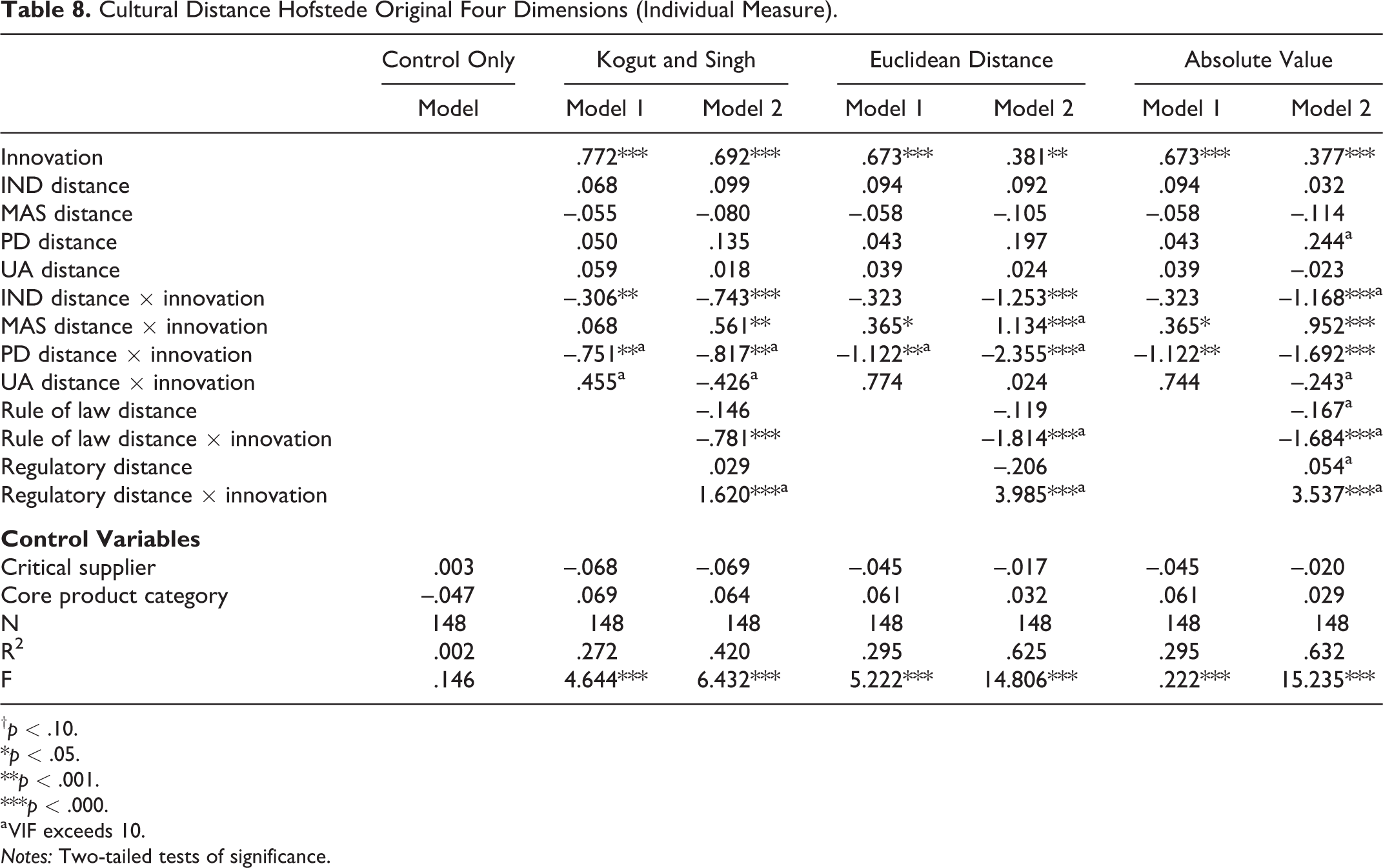
To examine the observed effects of the different conceptual and measurement approaches to cultural distance as well as the inclusion of other institutional distance elements, we conducted a series of regression models. We began by providing the results when only control variables are included (i.e., critical supplier status and core product category). Next, for each mathematical formulation (i.e., Kogut and Singh, Euclidean, and absolute value), we present the base model (i.e., supplier innovation on supplier OEM sales) including the main and moderating effects of cultural distance (Model 1), and then the full model, in which we also include the main and moderating effects of rule of law distance and regulatory distance (Model 2). We repeated this analysis for each unique combination of conceptual framework (Hofstede vs. Schwartz), measurement format (aggregate vs. individual), and number of dimensions (Hofstede’s four and six and Schwartz’s seven). Specifically, Table 5 presents the aggregate index of cultural distance using the original four Hofstede dimensions. Table 6 presents the aggregate index of cultural distance using all six of Hofstede dimensions. Table 7 presents the aggregate index of cultural distance using all seven of Schwartz’s dimensions. Table 8 presents the individual dimension approach to cultural distance using the original four Hofstede dimensions. Table 9 presents the individual dimension measurement format to cultural distance using all six of Hofstede dimensions. Table 10 presents the individual dimension measurement format to cultural distance using all seven of Schwartz’s dimensions. For ease of comparing significant effects across all models, Table 11 presents a simplified summary.
Cultural Distance Hofstede Original Four Dimensions (Aggregate Measure).

† p < .10.
*p < .05.
**p < .001.
***p < .000.
a VIF exceeds 10.
Notes: Two-tailed tests of significance.
Cultural Distance Hofstede Six Dimensions (Aggregate Measure).

† p < .10.
*p < .05.
**p < .001.
***p < .000.
a VIF exceeds 10.
Notes: Two-tailed tests of significance.
Cultural Distance Schwartz Dimensions (Aggregate Measure).

† p < .10.
*p < .05.
**p < .001.
***p < .000.
a VIF exceeds 10.
Notes: Two-tailed tests of significance.
Cultural Distance Hofstede Original Four Dimensions (Individual Measure).
† p < .10.
*p < .05.
**p < .001.
***p < .000.
a VIF exceeds 10.
Notes: Two-tailed tests of significance.
Cultural Distance Hofstede Dimensions (Individual Measure).

† p < .10.
*p < .05.
**p < .001.
***p < .000.
a VIF exceeds 10.
b Variable excluded during regression analysis.
Notes: Two-tailed tests of significance.
Cultural Distance Schwartz Dimensions (Individual Measure).

† p < .10.
*p < .05.
**p < .001.
***p < .000.
a VIF exceeds 10.
b Variable excluded during regression analysis.
Notes: Two-tailed tests of significance.

+/−: significant at p < .10.
n.s. = not significant
a Variable excluded during regression analysis.
Notes: M1 = model 1, M2 = model 2.
In each table, we report the standardized betas and note multicollinearity when VIFs exceed the threshold of 10. Consistent with the literature on the innovation–performance relationship (e.g., Rubera and Kirca 2012), almost every model estimated demonstrated a significant positive effect of supplier innovation on supplier OEM sales. The only exception was using Schwartz aggregate measurement under the Euclidean or absolute value mathematical formulation and not including other institutional distance elements [Table 7]. The strength (from b = .278 to .684) and significance (from .05 to .000) of the relationship varied considerably depending on the choice of cultural distance measure used and the inclusion of other institutional distance variables in the model. The control variables were not statistically significant in any model.
The purpose of this empirical illustration is to examine the consequences of scholarly choices on the observed influence of cultural distance. We observed noticeable differences in empirical effects. We next briefly discuss some of these consequences in relation to five aspects: mathematical formulation, number of dimensions, conceptualization, institutional distance inclusivity, and measurement format.
First, when examining Kogut and Singh, Euclidean and absolute value mathematical formulations, the results indicate significant differences in relation to direct and moderation effects. For instance, when examining the three mathematical formulations in Table 5 (i.e., Hofstede’s four-dimension aggregate), comparison of Model 1 indicates that the interaction effect of cultural distance and innovation is negative and significant (b = −.322, p < .05) as expected when employing the Euclidean approach. However, this effect is not observed using either the Kogut and Singh or the absolute value mathematical formulations.
Second, when examining the number of dimensions included in the cultural distance measure, we observed differential findings when comparing Hofstede’s four- (Table 5) and six- (Table 6) dimension aggregate measures. For instance, whereas cultural distance measured using the Kogut and Singh or Euclidean mathematical formulation significantly dampens the observed effect of supplier innovation on supplier sales using the four-dimension aggregate measure, it does not when using the six-dimension aggregate measure. In contrast, we observed consistencies in Model 2 for the absolute value mathematical formulation: cultural distance dampens the positive main effect of supplier innovation on supplier sales across both four- and six-dimension aggregate formats.
Third, employing cultural distance conceptualized as either an aggregate measure of the Hofstede six-dimensions or the Schwartz seven-dimension framework (Tables 6 and 7) demonstrates both consistent and inconsistent effects across cultural frameworks. Interestingly, a comparison of Model 1 across tables indicates that if cultural distance is used as the sole contextual element investigated, no significant effects are observed when using Hofstede or Schwartz across any of the three mathematical formulations. The examination of Model 2 across tables, however, indicates substantive differences. For instance, when applying Kogut and Singh, no significant effect of cultural distance emerged when using Hofstede’s framework, but one is present with Schwartz’s framework. More of note, a significant observed effect of cultural distance in the Schwartz framework is directionally opposite to theoretical expectations: rather than dampening the positive relationship between supplier innovation and supplier sales, greater cultural distance magnifies the positive effect.
Fourth, we observed differences when comparing models in which cultural distance was the only institutional distance included (Model 1) and those that included all the institutional distance elements (Model 2). Of note, greater inclusivity of the institutional distance elements did not dampen the influence of cultural distance (i.e., cultural distance was significant in Model 1 and not significant in Model 2); rather, including the broader set of institutional distance elements could provide the opportunity for greater observation of cultural distance effects. For instance, in Table 5, using the four-dimension Hofstede aggregate measurement format, the effect of cultural distance under the Kogut and Singh mathematical formulation in Model 1 was not significant, but when accounting for additional institutional distance elements, the moderating effect of cultural distance is observable (b = −.309, p < .05). We observed similar results for the Euclidean and absolute value mathematical formulations. When we used the six-dimension Hofstede aggregate measurement format (Table 6), we observed this pattern of cultural distance significance when including other institutional distances only under the absolute value mathematical formulation. Moreover, when we used the Schwartz aggregate measure (Table 7), not only is the cultural distance effect revealed in the expanded institutional model, but all three institutional distance elements have a significant moderating effect on the positive relationships between supplier innovation and supplier sales to the OEM.
Fifth, we observed different effects when we measured cultural distance using the individual dimension format. Regarding Hofstede’s conceptual framework, when employing the full six individual dimensions (Table 9), we observed significant effects pertaining to long-term orientation and indulgence across mathematical formulations, which would not have been identified if only the four original Hofstede dimensions were used (Table 8). This finding suggests that there are contexts in which excluding the two added dimensions could limit our understanding. Further, when examining the combination of conceptual framework, individual dimensions, and mathematical formulation used, we note that the individual dimension effects observed appear to be inconsistent. For instance, the observed effects using Schwartz’s individual dimension measures (Table 10) are unique across the Kogut and Singh, Euclidean, and absolute value mathematical formulations as well as between Models 1 and 2 when institutional distance inclusivity varies, which suggests that interpretation on cultural distance’s influence would vary considerably depending on operationalization and model choices. With regard to all of these individual dimension measurement formats to cultural distance, we recommend caution in the interpretation of findings because we observed an increased level of multicollinearity when using the individual dimensions in our moderated regression models. This was not unexpected, as both Hofstede and Schwartz indicate that their cultural framework dimensions are not orthogonal and that using multiple interaction effects heightens multicollinearity. In summary, the results of the empirical illustration demonstrate that scholars’ choices of the conceptualization and operationalization of cultural distance, as well as whether it is the only institutional distance variable or one of many, have substantive consequences for our understanding of whether and how cultural distance influences a well-known marketing relationship (i.e., innovation to performance). 10
Discussion and Recommendations
The purpose of this study was to directly address how scholars’ choices of conceptualization and operationalization of cultural distance can influence our understanding of its effects in international marketing phenomena. To better understand the choices and consequences related to cultural distance in international marketing, we present a review of the literature addressing the concerns related to the conceptualization and measurement of cultural distance, focusing on choices made during the research process. Building from this foundation, we then systematically analyze 83 articles in the international marketing literature referencing cultural distance to determine the heterogeneity of these choices. Given the identification of significant choice heterogeneity, we examined how these choices would influence outcomes in the research process (i.e., consequences) via an empirical illustration. Our findings demonstrate that choice heterogeneity results in substantive differences in the observed effects of cultural distance (e.g., whether cultural distance effects are significant, the nature of those effects).
We believe that the consequences observed in this work highlight that scholars should be sensitive to previous researchers’ choices and how these choices could influence our understanding of if, and how, cultural distance influences international marketing phenomena. To build a stronger, more theoretically and empirically consistent foundation of knowledge in the field, we offer several recommendations for international marketing scholars. Table 12 outlines a set of foundational and advanced guidelines. We believe that the foundational guidelines could serve as a series of scholarly expectations, whereas the advanced guidelines could be viewed as going above and beyond expectations.
Recommended Guidelines for Using Cultural Distance in International Marketing Scholarship.

First, and foremost, the results of our literature review, consistent with scholarly concerns in the broader international business literature, indicate a lack of justification of the concept of cultural distance and its explicit theoretical usage. As cultural distance is a construct, and not a theory, authors should address whether the construct is being employed as a proxy measure (e.g., of costs/friction) or as a component of national context. Specifically, authors should clearly delineate the rationale for the choice of conceptualization of cultural distance within the theoretical framework being employed. Is cultural distance being conceptualized as transaction costs or friction within a transaction cost economics framework (thereby being integrated into an existing theoretical paradigm), or is it being used to represent an institutional element (i.e., national context differences [Cuypers et al. 2018]) of the context of the international marketing phenomenon?
Not only should the conceptualization be explicit within the theoretical model, but so too should the theorization of cultural distance be appropriate to its intended operationalization. Our literature review reveals numerous conceptualizations of culture being employed in the literature (e.g., Hofstede, Schwartz, GLOBE), each with its own unique dimensionalities and domains (e.g., work-oriented norms and values, society values, leadership and organizational behaviors). It is important that scholars justify how the conceptualization of cultural distance chosen relates theoretically to the international marketing phenomena being investigated and how its resulting operationalization is consistent with the theorization used. For instance, if a researcher chooses to employ Hofstede’s original four dimensions as an aggregate measure, they must justify why distance along each of these four cultural dimensions, rather than the full six dimensions, would influence the phenomena under study and why each dimension would be of equal importance. Only by clearly delineating the theoretical conceptualization of cultural distance and specifically noting how the dimensions of the conceptualization of cultural distance utilized effect the phenomena of interest can the field develop a deeper understanding of how and why cultural distance influences international marketing activities.
Consistent with this recommendation, international marketing scholars should carefully examine the literature, especially when building on said literature, to ensure their positioning and arguments align with the conceptualization they have selected and what was used within the literature they are drawing from. Given the heterogeneity of choices, scholars should exercise care in building on and comparing findings with the literature (i.e., citing). Often, mixed results in the literature are used to position scholarly efforts; however, these mixed results could be attributable to differences in choices about conceptualization or operationalization of cultural distance. Similarly, scholarly statements that findings are supportive or contradictory to the literature are relevant only when consistency is present between conceptualizations and operationalizations. Where inconsistencies exist, but consistency of effects is observed, opportunities arise for discussions of potential robust effects.
Second, the empirical illustration demonstrates that the choice heterogeneity of how to operationalize cultural distance evident in the literature review results in unique consequences for the international marketing relationships examined. The empirical divergence observed across conceptual frameworks (e.g., Hofstede vs. Schwartz), measurement formats (e.g., aggregate vs. individual dimensions) and mathematical formulations (e.g., Kogut and Singh vs. Euclidean vs. absolute value) demonstrates the sensitivity of findings to scholars’ choices. Moreover, a high correlation between various operationalizations of cultural distance (e.g., shown in the literature [e.g., Beugelsdijk, Ambos, and Nell 2018; Magnusson et al. 2008] and in the empirical demonstration in Table 4) does not ensure consistency in its effects. These observed differences have significant implications for building knowledge in the field about the influence of cultural distance. We do not argue for a specific “rule of thumb” for the appropriate mathematical formulation. Rather, we advocate for an increase in the justification and transparency of reporting the operationalization of cultural distance.
In relation to measurement format, we recommend that scholars justify their selection. First, authors should clearly delineate why they are applying cultural distance at either the aggregate or individual level, both of which can be appropriate in different contexts. However, the appropriateness of each measurement format is justified only when aligned with the model being developed to study the international marketing phenomena. Second, whether using an aggregate or individual measurement format, scholars should justify the selection of dimensions to be studied. Here, we argue that, just as theory should drive our studies, it should drive selection. Thus, along the lines of Hofstede (1983), we recommend including only the theoretically appropriate cultural dimensions (such that in some cases, all dimensions will be included on theoretical grounds), as opposed to including all dimensions for methodological completeness. This recommendation would require authors to provide rationale as to why each is either included or excluded theoretically. Further, this does not preclude authors from including an analysis of all dimensions (as suggested by other scholars [e.g., Beugelsdijk, Ambos, and Nell 2018; Beugelsdijk, Kostova, and Roth 2017]) as a robustness test.
In terms of mathematical formulation, we do not recommend one approach as superior over another. For transparency purposes, however, it is essential that research clearly articulates the specific mathematical formula being applied. Our literature review noted some problematic instances in which no mathematical formula was provided, no explanation of how various components of the formula were calculated, or a different mathematical formula was presented when referencing a specific measure. Careful specification of how the formula is applied with the study’s data is needed (e.g., issues of variance calculation, availability of dimension scores for countries). This transparency is important not only for the ability to replicate results, but also for the field to place the empirical findings within the context of the choices made regarding how to conceptualize and operationalize cultural distance. Further, for the advancement of the field, scholars may wish to report the results of alternative mathematical formulations as robustness testing. For instance, if the Kogut and Singh (1988) approach is being employed, scholars could also report in an appendix the results of the same models using the absolute value and/or the Euclidean mathematical formulation. It is recognized that differences in mathematical formulation may lead to inconsistent findings. We believe that reviewers and editors should allow scholars to be fully transparent without being penalized for inconsistent findings, in the name of advancing understanding.
Third, cultural distance is most often used within the context of examining the influence of national context differences. Given the concerns in the literature pertaining its use in isolation (Beugelsdijk, Ambos, and Nell 2018; Magnusson et al. 2008), as well as the illustrated variance in observed effects when used in isolation versus with other institutional variables, scholars could employ a broader international conceptual or theoretical framework when examining cultural distance. For instance, conceptualizing distance in relation to cultural, economic, and structural (e.g., Kübler et al. 2018) can provide a broad yet inclusive institutional conceptualization. Advancing further, the institutional economics framework of Davis and North (1970) or Scott (1995), as well as other institutional frameworks in the literature (e.g., Ghemawat’s [2001] CAGE framework) could aid in contextualizing the effects of the distance of cultural norms and values within international marketing research. Moreover, these frameworks could also aid in developing the international marketing literature by moving beyond an ad hoc selection of distance variables to ensuring the inclusion of other distance and institutional measures (e.g., legal, regulatory, administrative, economic, geographic, language) appropriate to the specific international marketing phenomena investigated.
Last, moving beyond our data but aligned with contemporary research issues, we advance several broader recommendations pertaining to the advancement of the discipline based on our scholarly process. Authors, in a publish-or-perish academic world, often feel pressured to find models with statistically significant results. Thus, they may feel compelled to employ a variety of operationalizations of cultural distance, possibly changing their initial conceptualizations or mathematical formulations of cultural distance, to achieve publishable effects. Beugelsdijk, Ambos, and Nell (2018) note that concerns related to the conceptualization and measurement of cultural distance may be attributable to advancing statistically significant results, which reviewers typically demand. Taking the results of our empirical illustration, for example, it would clearly be advantageous for authors to report the findings of Model 2 in absolute value mathematical formulation from Table 6 rather than either the Kogut and Singh or Euclidean approaches. While this may advance an author’s work to publication (given the significant findings), does it advance the literature? To this end, we concur with Lehmann (1999, p. 16), who notes, “Stop rewriting papers so that the data match the hypotheses. Report what was originally thought and done and what the results were.” Justification for our decisions as scholars should be the standard to which we are held. However, for this recommendation to be effective, editors and reviewers need to be accommodating.
To editors and reviewers, we recommend that for the field of international marketing to advance with the highest levels of transparency and academic integrity, the review process must change. This aligns with current efforts aimed to discourage questionable research practices. For instance, the editorial team of the Journal of Marketing noted in 2019 that “we are committed to a review process that encourages honest and open reporting of results, which helps to counter “phacking” (p-value hacking)—the practice of torturing the data until they confess to the author’s (or reviewer’s) preferred outcome.” (Moorman et al. 2019, p. 5). Editors and reviewers should demand strong justifications for scholars’ choices and, consequently, assess the appropriateness of those choices rather than the statistical significance of the outcomes (This would be a considerable divergence from the current approach – which we understand is unlikely.) We recommend that reviewers demand that a work’s conceptualization of cultural distance be both internally consistent, such that its operationalization matches its conceptualization, and externally consistent with the literature from which it is developed. We argue that we, as a discipline, can learn more about the influence of cultural distance from a lack of statistical significance when choices are strongly justified than we can from an effect meeting the .05 threshold that lacks strong justification.
Conclusion
Cultural distance is, and will continue to be, an important aspect of international marketing scholarship. We believe that the literature addressing this construct, articles critical of the concept and its usage, and the conceptual and empirical studies that implement it have made strides in advancing our understanding of international marketing phenomena. However, mixed findings, potentially resulting from heterogeneity in scholars’ choices, have raised concerns regarding its value. As noted previously, Tung and Verbeke (2010, p. 1270) raise the alarm that many authors and journal reviewers reject the use of cultural distance, arguing that it is a “vestige of the ‘dark middle ages’ of cross-cultural research,” used as a black-box explanation. We believe that research advanced under our foundational and advanced guidelines put forth herein could provide greater theoretical and empirical consistency in the literature, thereby advancing a better understanding of specifically how, and when, cultural distance influences marketing actions in an international context.
Footnotes
Associate Editor
Matthew Robson
Declaration of Conflicting Interests
The author(s) declared no potential conflicts of interest with respect to the research, authorship, and/or publication of this article.
Funding
The author(s) received no financial support for the research, authorship, and/or publication of this article.
