



Abstract
This study presents a retrospective on Journal of International Marketing using bibliometrics. The study finds that the journal’s run has been characterized by continuous growth in publications and citations, with a dominant contribution base of authors from the United States. Authors have consistently shown a strong preference for quantitative research, with a decline in preference for qualitative research and a negligible increase in preference for mixed-methods research in recent years. The major themes in the journal include global branding, internationalization, cross-cultural marketing, and international relationship marketing. An exploration of the factors affecting article citations reveals that article attributes such as the conceptual method, empirical method, article length, title length, article age, and number of keywords play significant roles in increasing the number of citations. Authors affiliated with nonacademic institutions also have a significant and positive influence on total citations. The article concludes with directions for further research.
Founded in 1993 with S. Tamer Cavusgil at the helm, Journal of International Marketing (JIM) is an official journal of the American Marketing Association (since 1997). It is one of the four journals the association publishes in the marketing field (in addition to Journal of Marketing, Journal of Marketing Research, and Journal of Public Policy & Marketing). The journal broadly focuses on international research on marketing practices extending beyond national boundaries as well as cross-cultural comparisons of marketing issues in different national settings (Katsikeas 2014). The journal has been led by S. Tamer Cavusgil (1993–2000), Bodo B. Schlegelmilch (2000–2003), Daniel C. Bello (2003–2007), David A. Griffith (2007–2013), Constantine S. Katsikeas (2013–2019), and Kelly Hewett (2019–present) as editors in chief.
Different quantitative and qualitative measures reflect the growth in the journal’s reputation. According to the CiteScore tracker for Scopus, the articles published in the journal between 2015 and 2017 received an average of 7.1 citations in 2018. The citations garnered by JIM articles have received 2.379 times the average citations received by other journals in its category (source-normalized impact per paper). According to Clarivate Analytics, the journal articles published in 2017 and 2018 received an average of 4.575 citations in 2019 from articles indexed by Clarivate (two-year impact factor). 1 Apart from these quantitative measures, the journal enjoys a high reputation in the scholarly community, as indicated by its rank of “A” by the Australian Business Deans Council and an Academic Journal Guide rating of “3” by the Chartered Association of Business Schools. Appendix A shows a comparison between the journal and the top 20 marketing journals according to Scopus.
The aim of this article is to provide retrospective insights into the last 27 years of the journal’s run. The study of publication and citations is important for analyzing the productivity and impact of an individual, an organization, a country, or a journal over time. Furthermore, the knowledge of dominant methodologies has implications for the recognition and success of researchers in a scientific field (Hanson and Grimmer 2007). To this end, we used a variety of methods to identify trends about publication, citation, collaboration, and methodological choices. Our analysis includes publications, citations, and contributions (at the individual, institutional, and country levels) of the journal and identification and summary of methodologies. Although our conclusions pertain to a single journal, they can be extended by and compared with other journals in the field of international business to understand broader publication, citation, and methodological patterns. Thus, our first two research questions (RQs) are as follows:
In addition, this study presents a structural overview of JIM, with a focus on the major themes in the journal and their development over time. Because JIM is one of the leading journals in the field of international marketing, a structural overview of the topics it publishes can be helpful for researchers in navigating and developing the field further. This study also explores the drivers of article citation. Despite their shortcomings, citations are an objective measure of article impact (Pieters and Baumgartner 2002). Furthermore, the primary measures used in journal rankings are based on citations (Mingers and Yang 2017). We use bibliographic coupling to analyze the core themes and their development over time and regression analysis to analyze the drivers of citations. Thus, our next two research questions are as follows:
Other studies have also used bibliometric analysis to explore the marketing field (Backhaus, Lügger, and Koch 2011; Donthu, Kumar, and Pattnaik 2020; Kumar, Sharma, and Salo 2019; Malhotra, Wu, and Whitelock 2005; Martínez-López et al. 2018, 2020; Stremersch et al. 2015). Although multiple review methods exist (e.g., systematic review, narrative review), we chose a bibliometric review because of its ability to handle a large amount of bibliographic data (Ramos-Rodrígue and Ruíz-Navarro 2004). After addressing our four research questions, we also provide future directions for the journal to the marketing research community at large, along with a retrospective of the journal.
Overview of International Marketing
International marketing as a field of study has evolved into a rich and complex field in the last five decades (Samiee and Chabowski 2012). The topic itself is linked to the broader field of international business, with works being multidisciplinary in nature (Cavusgil 2003). From a strong focus on issues related to export processes and export marketing, the field has grown to cover a multitude of topics. A review conducted by Leonidou et al. (2010) of the international marketing literature published between 1975 and 2004 found that international marketing forms a small but substantial proportion of studies published in major marketing journals. The authors find that these studies have mainly focused on issues such as external environmental forces, marketing strategy, product/brand policy, and buyer behavior. The field itself, they assert, has entered the development stage, which is characterized by maturation of research topics. A subsequent study by Samiee and Chabowski (2012) on international marketing literature published between 1999 and 2010 asserts that while topics such as internationalization, marketing strategy and performance, and relationship marketing have continued to remain popular among scholars, topics related to consumer behavior—in particular consumer animosity and ethnocentrism—have emerged as important topics in the last decade.
From its roots in international trade, the field has grown to encompass a wide array of issues. Export-oriented research, which dominated the field during its formative years, now forms a small part of it. Various topics, mainly marketing strategy and performance, relationship marketing, and consumer behavior, have been included to create a truly multifaceted field of study. Marketing strategy and relationship marketing have been a focus for a long time, as shown in various reviews of the field (Cavusgil, Deligonul, and Yaprak 2005; Leonidou et al. 2010; Samiee and Chabowski 2012), and are likely to remain so. Comparatively newer topics such as buyer behavior are likely to pave the way for future research. Taking clues from previous research, this study explores JIM, with a focus on the journal’s thematic development, and provides an analysis of the journal’s development in terms of publications, citations, and contributions.
Methodology
Bibliometrics encapsulates the use of quantitative tools and techniques to derive meaning from bibliographic data. As a methodology, bibliometrics belongs to library sciences but has found application in various fields of study (Ellegaard and Wallin 2015). It has also received attention from various areas within management (Hota, Subramanian, and Narayanamurthy 2020) and has been widely used in studies similar to the current one (Donthu, Kumar, and Pattnaik 2020; Hoffman and Holbrook 1993; Kumar et al. 2020; Martínez-López et al. 2018). In addition, the methodology is well suited for this study because of its ability to process a large amount of data and its elimination of author bias.
Nonetheless, a bibliometric methodology is not free of shortcomings. First, a bibliometric review can show only the short-term impact of any research endeavor (Wallin 2005). Thus, this review is retrospective in nature and does not make any long-term predictions. Second, bibliometrics are a set of quantitative tools used to make qualitative pronouncements about research (Wallin 2005). The relationship between the quantitative and qualitative aspects of research is unclear, thus calling into question the results derived. For the most part, this study does not make any qualitative pronouncements, and when it does, it bolsters those statements with content analysis. Third, the results of bibliometric analysis depend on the bibliographic data. Any shortcomings in the data are bound to affect the analysis and its results. Such shortcomings can be minimized by cleaning the data, including removing duplicates and articles assigned to the wrong journal.
We used a range of measures to analyze the journal’s publication and citation patterns, such as publications and citations per year, citations per publication, and h-index. Publications and citations are commonly considered measures of productivity and impact, respectively (Svensson 2010). Following previous studies (Donthu, Kumar, and Pattnaik 2020; Martínez-López et al. 2018, 2020), we analyzed contributions from authors, institutions, and countries to provide a deeper assessment of the journal’s publication and citation patterns.
To identify the methodology, we analyzed JIM authors’ methodological choices used in each article. Prior research has identified methodology as a potential driver of article impact (Dang and Li 2018; Stremersch, Verniers, and Verhoef 2007; Valtakoski 2019). Furthermore, within the academic marketing community, status and promotion are influenced by practice, or at least the understanding of dominant methodologies in the field (Hanson and Grimmer 2007). To minimize our subjectivity and bias, two of the authors independently read the full articles and coded and classified each article by its research methods (conceptual, empirical, or both) and research design (qualitative, quantitative, or mixed).
We used bibliographic coupling to identify the development of themes in JIM. According to Kessler (1963), bibliographic coupling is based on the assumption that documents sharing references share themes as well. A higher number of shared literature references shows a higher degree of thematic similarity (Wallin 2005). We used the shared literature references among articles to create a document cluster using an algorithm by Newman and Girvan (2004), with each major cluster representing a major theme in the journal. We ordered clusters by the number of documents they contained and how recent they were (average publishing year). We conducted a content analysis based on the titles and themes identified in each major cluster.
We used the negative binomial regression model to find the determinants of article impact. This model is best suited to cases in which the count is variable and overdispersed, with the inclusion of zeroes (Stremersch, Verniers, and Verhoef 2007; Valtakoski 2019). This study analyzes the relationships between different attributes related to articles and their relationship to each article’s impact.
Unlike in many business disciplines, in which the University of Texas, Dallas, journal list serves as the gold standard for identifying and ranking top universities by research productivity, international marketing seems to have no such widely accepted university ranking. To fill this gap, we used an expert judgment approach to identify top-ranked universities by research productivity in international marketing. We invited five leading international marketing scholars (all of them previous editors of Journal of International Marketing or other leading journals) to provide the names of the top ten international marketing programs based on their expertise and judgment. We then used the mean ranking to create the list of leading international marketing programs based on research productivity using expert judgment. 2
We obtained data from the Scopus database in April 2020 using the source name “Journal of International Marketing.” After eliminating duplicates, notes, and undefined documents, we arrived at 515 articles. We then manually cleaned the bibliographic data to identify the most prolific authors, institutions, and countries for JIM. We used VOSviewer (Van Eck and Waltman 2010) for the network analysis, along with Gephi (Bastian, Heymann, and Jacomy 2009) for visualization. For a better idea of the journal’s publication patterns, we divided the data into four periods: 1993–1999, 2000–2006, 2007–2013, and 2014–2019. Given that the number of years included in this study is odd (27 years), we divided them into nearly identical periods (7–7–7–6), in accordance with previous research in the domain (Hu, Song, and Guo 2019; Ramos-Rodrígue and Ruíz-Navarro 2004). Figure 1 presents a summary of our study’s research design and the analysis scheme.

Research design of the study.
Descriptive Statistics of the Contributing Authors, Institutions, and Countries to JIM
Figure 2 summarizes the publication and citation data of JIM between 1993 and 2019. The figure shows that while the number of publications in the journal has remained consistent at approximately 20 articles per year, the growth in citations has been on an upward trajectory. In particular, the average publications between 1993 and 1999 were 16.86, compared with 20 between 2000 and 2006, 19.85 between 2007 and 2013, and 20.16 between 2014 and 2019. Comparing this with the average citations of 52 (1993–1999), 363.85 (2000–2006), 1,324.57 (2007–2013), and 2,379.16 (2014–2019), we show that although the growth in publications was almost linear, the growth in citations has been exponential. This indicates the journal’s commitment to quality over quantity.

Yearly publication and citation trend of JIM articles between 1993 and 2019.
Table 1, Panel A, presents a list of the most prolific authors and institutions for JIM. According to the table, Adamantios Diamantopoulos was the most prolific contributor to the journal, followed by David A. Griffith and S. Tamer Cavusgil. The most cited author was also Adamantios Diamantopoulos, followed by Susan P. Douglas and David A. Griffith. Adamantios Diamantopoulos, David A. Griffith, S. Tamer Cavusgil, Susan P. Douglas, and Constantine S. Katsikeas all have an h-index greater than 10, indicating the quality of their contributions to the journal. This also indicates the high reputation of the authors who have contributed to JIM.
Top 20 Most Prolific Authors and Institutions for JIM Between 1993 and 2019.

Notes: TP = total publications; TCP = total cited publications; TC = total citations; TC/TP = cites per publication; TC/TCP = cites per cited publication; h = h-index.
Table 1, Panel B, presents a list of the most prolific institutions affiliated with JIM’s authors. According to the table, Michigan State University was the highest contributor of publications in the journal, followed by the University of Leeds and the University of Missouri. Among the top contributors of citations, Michigan State University received the most citations, followed by the University of Missouri and New York University. Among the top 20 institutions, 10 institutions had an h-index greater than 10.
Table 2 shows a list of the most prolific countries affiliated with JIM’s authors. Overwhelmingly, more than half the journal’s publications involved an author affiliated with the United States. Apart from the United States, only the United Kingdom had more than 50 publications in JIM. Among the top 20 contributors, New Zealand had the highest cites per publication, followed by Norway and Canada. The contributions originated from all over the world, but the dominant contributors were predominantly from the Western Hemisphere. Thus, there is evidence of ethnocentrism. This is in line with conclusions of Svensson and Wood (2007), who find homogeneity between authors’ location and a journal’s location.
Top 20 Most Prolific Countries for JIM Between 1993 and 2019.
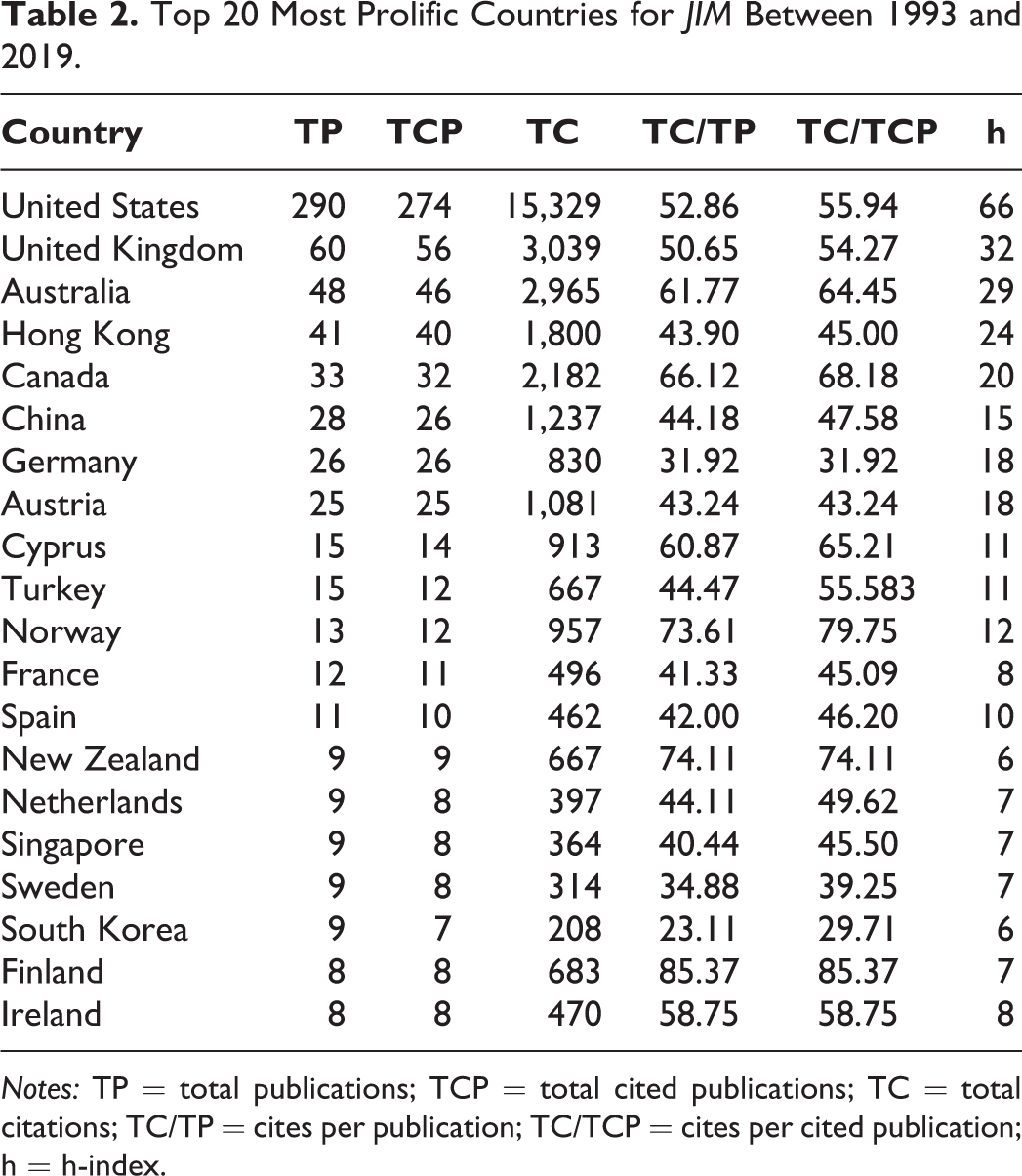
Notes: TP = total publications; TCP = total cited publications; TC = total citations; TC/TP = cites per publication; TC/TCP = cites per cited publication; h = h-index.
Temporal Breakdown of the Contributing Authors, Institutions, and Countries to JIM
The highest-contributing authors to the journal according to publications and citations across different periods were Constantine S. Katsikeas (1993–1999), David A. Griffith (2000–2006 and 2014–2019), and Adamantios Diamantopoulos (2007–2013) (see Appendix B). Regarding institutions, the highest contributors across different periods were University of Texas (1993–1999), Michigan State University (2000–2006), University of Vienna (2007–2013), and University of Leeds (2014–2019). This is a potential sign of ethnocentrism (Svensson and Wood 2007)—that is, because the journal is based in the United States, the country’s authors will tend to submit and be published more than anyone else.
Appendix B also presents the top five most cited articles across the four periods. Among the articles published between 1993 and 1999, the most cited article was that of Jones (1999), which examines the patterns of internationalization in small firms. Among the articles published between 2000 and 2006, the most cited article was that of Knight (2000), which explores the interrelationships among entrepreneurial orientation, marketing strategy, tactics, and firm performance in small firms affected by globalization. Among the articles published between 2007 and 2013, the most cited article was that of Douglas and Craig (2007), which investigates the methodology of reverse translations. Among articles published between 2014 and 2019, the most cited article was that of Ashraf, Thongpapanl, and Auh (2014), which examines the adoption of online shopping using the technology acceptance model.
Award-Winning Articles in JIM
The Hans B. Thorelli Award 3 (Thorelli Award hereinafter) is given to articles that have made the most significant long-term contributions to international marketing theory or practice. Appendix C presents the list of Thorelli Award winners from 1993 to 2019. The S. Tamer Cavusgil Award 4 (Cavusgil Award hereinafter) is awarded to articles that make significant contributions to international marketing management practice in the calendar year. Appendix D presents the list of Cavusgil Award winners from 1998 to 2019.
Appendix C shows that 11 Thorelli Award winners are among the top 50 most cited articles, whereas only 3 Cavusgil Award winners are among the top 50 most cited articles. The award winners are advertised separately on the journal’s home page, as well as on the American Marketing Association website, and therefore have greater visibility among scholars. These articles being among the top cited comes as no surprise. Visibility plays an important role in the citations an article receives (Stremersch, Verniers, and Verhoef 2007); therefore, articles with more visibility are likely to be highly cited as well.
More than half the winning articles for both awards had at least one author affiliated with the United States. Approximately 54% of the Thorelli Award winners and 81% of the Cavusgil Award winners were from the United States. U.S. universities are often considered prestigious in many research fields (Stremersch, Verniers, and Verhoef 2007; Valtakoski 2019). In addition, the United States was the most dominant contributor, both overall and by period. Comparatively, the Thorelli Award is more global in nature.
Further analysis of the affiliations of the award-winning articles’ authors reveals that 34.61% of the Thorelli Award winners and 33.33% of the Cavusgil Award winners were authored by scholars affiliated with top international marketing institutions. Research articles written with the involvement of prestigious institutions/universities are perceived to be more significant and reliable (Rosenzweig, Grinstein, and Ofek 2016; Valtakoski 2019). The awards won by such studies validate this perspective. In addition, works with authors from nonacademic institutions have won the awards. One winner of the Thorelli Award and two winners of the Cavusgil Award had authors from nonacademic institutions.
Moreover, an important data point is the involvement of female authors of award-winning articles. Many policy articles assert that the presence of female authors leads to better scientific outcomes (Nielsen et al. 2017), so it is unsurprising that nearly 81% of the Cavusgil Award winners had a female author. For the Thorelli Award, however, the percentage was around 21%. This shows that female contribution to the field has been geared toward practical approaches (the domain of the Cavusgil Award). For both award categories, more than three-quarters of the winners were empirical and quantitative in nature.
Research Method and Research Design Choices Among JIM Authors
Table 3 shows the trends of research methods among JIM authors. Throughout the years, JIM’s authors have focused mostly on empirical articles, with the share of conceptual articles steadily decreasing over time. However, the share of articles pursuing both theory and practical aspects has steadily increased. The share of empirical articles has remained steady, from 81.36% between 1993 and 1999 to 79.34% between 2014 and 2019. The share of conceptual articles has decreased from 17.80% (1993–1999) to 9.92% (2014–2019). Articles following both conceptual and empirical methods have grown a lot, from .85% (1993–1999) to 10.74% (2014–2019). This increase shows that while authors have not completely abandoned the pursuit of theory, they have put more emphasis on testing these theories.
Division of Documents Based on Research Methodology.

Table 3 also shows the summary of research designs used by JIM authors. The use of quantitative research designs has been popular among JIM authors, with the share of such articles increasing from 83.90% (1993–1999) to 91.74% (2014–2019). The use of qualitative research designs has decreased from 12.71% (1993–1999) to 3.31% (2014–2019). The popularity of mixed research designs has also increased, with their share growing from 3.39% (1993–1999) to 4.96% (2014–2019). These results are in line with the findings of Hanson and Grimmer (2007), who reveal in their study of marketing journals (Journal of Marketing, European Journal of Marketing, and Journal of Services Marketing) that authors used quantitative more than qualitative techniques. The dominance of quantitative techniques is attributed to the “Kuhnian” nature of the marketing academic community, in which knowledge of dominant methodologies is necessary for researchers’ recognition. Appendix E provides additional information on collaborations among JIM contributors.
Thematic Development of the JIM Corpus
To discern the major themes in the journal, we used the bibliographic coupling tool, which is based on the assumption that articles that share literature references also share thematic elements. The application of this tool led to the formation of four thematic clusters, each of which represents a major theme. These clusters cover more than 85% of the total documents included in the study. Table 4 presents a summary of these clusters.
Cluster Summary of JIM Articles.

Notes : TP = total publications; TC = total citations; APY = average publishing year.
Cluster 1: Global Branding
Cluster 1 contains 146 articles that have been cited 7,636 times. The JIM authors in this cluster have focused on the issues related to global branding strategies. They have taken up various topics, including the impact of country of origin, consumer ethnocentrism, cosmopolitanism, consumer values, and consumer attributions for global branding strategies. Consumers’ perceptions of the origins of the product influence global branding strategies. These perceptions derive from consumers’ attitudes toward foreign products (ethnocentrism), their cultural values, and the attributes they attach to such products. Exploration of strategies that overcome such differences to arrive at better positioning for each target market seems to be the goal of such research.
Cluster 2: Internationalization
Cluster 2 contains 146 articles that have been cited 10,253 times. The JIM authors in this cluster have focused on the issues related to internationalization. They have examined topics such as export behavior of firms, firms’ use of networks and alliances, international joint ventures, and market-entry choices. These topics are often discussed in relation to internationalization strategies. JIM authors have also shown a strong interest in discerning the differences in traditional (or gradual-global) and born-global firms, particularly among entrepreneurs and small and medium-sized enterprises. These topics tend to revolve around the issues of internationalization. Thus, the JIM authors in this cluster have enriched the understanding of the issues that firms face and the strategies that firms pursue toward internationalization.
Cluster 3: Cross-Cultural Marketing
Cluster 3 contains 87 articles that have been cited 3,693 times. In this cluster, the major focus has been on the issues related to cross-cultural marketing. The JIM authors in this cluster have scrutinized culturally related behaviors (attitudes, beliefs, and values) and national cultures (individualism and collectivism) and examined their impact on international marketing strategies (e.g., coalition marketing, product innovation, marketing communication) and performance (export). Indeed, the issue of cross-cultural marketing closely aligns with the journal’s focus on the international aspects of marketing. Geert Hofstede’s work is often cited. This is unsurprising given his eminence in shaping the understanding of cultures and equivalent marketing responses (strategies to align cultural and market orientation). Exploration of strategies for marketing across cultures is therefore a prominent focus in this cluster.
Cluster 4: International Relationship Marketing
Cluster 4 contains 67 articles that have been cited 2,869 times. In this cluster, the JIM authors have focused on the issues related to international relationship marketing. In particular, authors have explored topics such as consumers’ affinity for foreign countries and its impact on their purchase of foreign products; factors affecting the relationship between international suppliers and local distributors; and concepts such as guanxi, psychic distance, opportunism, and trust. Thus, the articles in this cluster contribute to the understanding of relationship issues in international marketing from both the consumer’s and the firm’s perspective. Given that a good understanding of relationships is important for marketing exchanges in the international marketplace, the authors in this cluster have added to the discussion by exploring this topic thoroughly.
Temporal Analysis of the JIM Corpus
Cluster Development Between 1993 and 1999
Panel A of Figure 3 (1993–1999) shows the development of the four major clusters between 1993 and 1999. As the figure shows, Cluster 2 was the most developed cluster during this period, as reflected in the internal connection in each cluster. While all clusters at this point are well-connected, the nodes are the most well-connected in Cluster 2. This indicates that, during this period, the focus of international marketing research was primarily on the nature and determinants of strategies through which firms develop their international operations (Welch and Welch 1996). The development of international operations can occur through exporting, joint ventures, and franchising, among other ways.

Bibliographic coupling network between 1993 and 2019.
One area that authors focused on was internationalization in small and medium-sized enterprises. With most research focusing on large multinational corporations (McAuley 1999), the small firm presents a unique case for the authors in the area. Small firms differ from large firms in several ways, including ownership, management, and scope of operations (Coviello and Martin 1999), and the process of internationalization can vary. For example, in his study of small high-technology firms, Jones (1999) identifies five broad categories of firms based on their pattern of internationalization, including domestic firms (no cross-border links), reluctant developers/export specialists (firms reluctant to form cross-border links and those that engage in import/export on an ad hoc basis), conventional developers (firms that form international links gradually), rapid developers (firms that form international links rapidly), and international entrepreneurs (firms with international links since their foundation). The development of internationalization in small firms remained in major focus during this time.
Another key area during this time was exports. Development in this area of research was driven primarily by the renewed interest in developing exports, which in turn was driven by slowing economic growth in many economies, persistent trade deficits, liberalization in world trade, and growing worldwide competition due to a globalized business environment (Leonidou, Katsikeas, and Piercy 1998). This increased interest in the area of exports led to further exploration of the factors affecting firms’ export performance (Shoham 1998, 1999). This also led to research on the development of scales for measuring export performance (Zou, Taylor, and Osland 1998). Some studies also used culture to narrow the focus. For example, LaBahn and Harich (1997) focus on the impact of national cultures (United States and Mexico) on exporting relationships. They find a significant impact of cultural sensitivity on channel relationships. The topics related to joint ventures also received minor attention during this time. For example, Beamish (1993) compares the characteristics of international equity joint ventures in China with the joint ventures in countries with market economies. Other minor topics explored during this time include foreign market servicing (Benito and Welch 1994) and cultural heterogeneity among countries (Kale 1995).
Cluster Development Between 2000 and 2006
Panel B of Figure 3 (1993–2006) showcases the subsequent development in the clusters between 2000 and 2006. All clusters saw development during this time, with many internal connections forming between their nodes. Cluster 2 is still the most developed cluster, but development is also noteworthy in Cluster 1. During this period, the topic of internationalization, along with the issue of globalization, remained a major one for JIM authors (Knight 2000). However, the focus shifted to the issues related to market entry. During this period, the authors also discussed and explored market service in international markets in the previous period. For example, Burgel and Murray (2000) examine the factors that influence firms’ market-entry choices and find that these include the availability of resources and the support requirement of customers in the target market. Another key area is market selection. Primarily, the authors explored the impact of geographical and psychological distance on market selection (Dow 2000). While the concept of geographical distance is quite simple, the concept of psychological distance is not. The former is the physical distance from the target market, whereas the latter is the difference between the perception of individuals in the home and foreign countries (Sousa and Bradley 2006). The exploration of such concepts during this period added to the existing knowledge on market selection.
The approach to internationalization is a topic that remained popular during this time. The focus was on the born-global approach to internationalization and how it fares against the gradual approach to internationalization. While the concept of firms having cross-border links was established in the previous period, authors explored the concept even more in this period. For example, authors explored questions related to how born-global firms solve issues related to internationalization (Freeman, Edwards, and Schroder 2006). Some studies (e.g., Moen and Servais 2002) also posited that firms with a born-global approach outperform firms that internationalize gradually. The born-global and traditional approaches to internationalization differ significantly across dimensions, such as home markets, psychic distance, and timing of internationalization (Chetty and Campbell-Hunt 2004).
The channel relationship is another key topic that continued to interest authors during the period. Cavusgil, Deligonul, and Zhang (2004) explore the issues of opportunism in foreign distributors. They find that though the existence of trust and formal contracts does not affect opportunistic behavior, the legal hostility in the target market has an impact on the management of such behavior. Other scholars highlight the significance of trust in the relationship between buying and supplying firms (Lee and Dawes 2005). Although major areas explored during this period were related to Cluster 2, topics related to other clusters were also explored. As mentioned previously, the development in Cluster 1 was noteworthy. The topics include the management of product image across different cultural settings (Madden, Hewett, and Roth 2000), the role of national culture in product diffusion rates (Dwyer, Mesak, and Hsu 2005), and the symbolic value of foreign products (Zhou and Hui 2003). The perceptions of consumers in the target market also play an important role in branding strategies; thus, exploring their perceptions is important to better inform firms on these strategies.
Cluster Development Between 2007 and 2013
Panel C of Figure 3 (1993–2013) shows further development of the clusters between 2007 and 2013. During this time, authors paid more attention to the topics covered in Clusters 3 and 4. The research in the two periods preceding this one focused mostly on firms and the processes through which they internationalize. Focus was also on the determinants of strategies that firms take to promote their products in the foreign markets. This development caused authors to explore consumer behavior in said markets and the factors determining firms’ marketing practices. This included the study of demographic characteristics and attitudinal dispositions (e.g., cosmopolitanism, consumer ethnocentrism, materialism). Cleveland, Laroche, and Papadopoulos (2009), for example, explore the impact of different demographic variables (i.e., sex, age, income, and education) on consumers’ attitudinal dispositions across different product categories. They find that the impact is different in different product categories and cultural settings. Ozdemir and Hewett (2010) examine the effect of collectivism on the relationship between behavioral intention and relationship and service quality. They show that the effect of collectivism is high in the context of high social contact. Studies also explored the impact of factors such as consumers’ emotional connection with a foreign country (Oberecker and Diamantopoulos 2011; Strizhakova, Coulter, and Price 2008) and the country of origin of the product (Balabanis and Diamantopoulos 2008; Koschate-Fischer, Diamantopoulos, and Oldenkotte 2012) on their behavioral intention.
In addition, authors during this period explored the topic of exporting. Lages, Silva, and Styles (2009) assess the impact of capabilities and product strategies on export performance and find that capabilities, the development of relationship and product quality, and product innovation lead to better export performance. Studies also examined topics related to product innovation, primarily with a focus on firms’ exploitation (small changes in current technology and marketing practices) and exploration (fundamental changes in technology and marketing practices) capabilities and their role in product innovation (Atuahene-Gima and Murray 2007; Yalcinkaya, Calantone, and Griffith 2007). These capabilities play an important role in the success of new product development, and thus, importers need to fine-tune products using their knowledge of international markets to better promote and sell new products (Yalcinkaya, Calantone, and Griffith 2007).
Cluster Development Between 2014 and 2019
Panel D of Figure 3 (1993–2019) shows further development in the clusters between the years 2014 and 2019. All four clusters were developed by this point and increased in density. Authors carried forward the topics they developed during the first three periods. They also continued to focus on the issues related to exporting. For example, highlighting the lack of research on a sustainable marketing strategy in international settings, Zeriti et al. (2014) examine the factors that drive such a strategy and its impact on export performance. They find that differences between home and export markets, in terms of economic and technological conditions, competitive intensity, customer characteristics, and stakeholder pressures, are drivers of a sustainable export marketing strategy.
In another strand of literature, the authors examined the relationships in marketing channels. For example, Leonidou et al. (2014) test the antecedents of relationship quality and find that opportunism, conflict, communication, distance, and adaptation have a significant impact on relationship quality and that relationship performance has a positive relationship to financial performance. Barnes et al. (2015) reaffirm the importance of interfirm relationships, showing that better relationships among firms lead to better financial outcomes. They find that interpersonal relationships cultivate interfirm trust, which in turn leads to a better interfirm relationship. Hoppner, Griffith, and White (2015) underscore the importance of adapting relationship strategies across different cultural settings. During this period, authors also continued to explore the impact of bilateral norms (Obadia, Vida, and Pla-Barber 2017) on relationship quality in addition to the focus on discretionary adaptations (Westjohn and Magnusson 2017), effect of loyalty programs (Beck, Chapman, and Palmatier 2015), and the role of contract specificity and contract violations (Griffith and Zhao 2015). Interfirm relationships play an important role in the building of global supply chains (Usui, Kotabe, and Murray 2017), which in turn is important for financial success.
Considering the growth of research in international relationship marketing, Samiee, Chabowski, and Hult (2015) examine the intellectual structure of international relationship marketing. Their review shows that though earlier research in the field focused on behavioral theory and multinational enterprises, the field has grown to include newer research topics such as knowledge in the multinational enterprise, foreignness, interorganizational commitment and trust, firm resources, dynamic capabilities, and learning and their relationship to competitive advantage, cultural values, and entry mode. In addition, internationalization and knowledge development were the major topics of research interest. The greater focus on relationship marketing underscores its role in firms’ performance in international markets.
The study of consumer behavior in international markets has also retained much focus. Fong, Lee, and Du (2014) examine country of origin with a focus on consumer animosity. They find that in countries with high animosity toward foreign brands, consumers prefer that foreign firms either launch their products via acquisitions and joint ventures or adopt a brand with some or all shares of local firms. By contrast, animosity does not affect consumer preferences in countries with low animosity. On the opposite side of the spectrum, Bartsch, Riefler, and Diamantopoulos (2016) review the literature on positive consumer disposition toward foreign products. Their review outlines many dispositions, such as global identity, identification with the global community, openness to and desire to emulate global consumer culture (GCC), global connectedness, and global/local identity and presents several future directions. Continuing the exploration, the authors examine the topic of GCC in relation to local consumer culture (LCC). This includes the exploration of consumer culture theory (Steenkamp 2019), factors driving the choice between global and local brands (Strizhakova and Coulter 2015), and the positioning of products based on GCC and LCC (Westjohn et al. 2016). In addition, researchers focused on the role of online reviews, given that the topic of electronic word of mouth was largely unexplored in international marketing (Tang 2017). Other researchers in the area explored technology acceptance through a cross-cultural lens (Ashrafet al. 2014) and the factors behind exit from foreign markets (Sousa and Tan 2015). This period is characterized by a growth in consumer-oriented research, whereas the earlier research in the journal focused mostly on firms.
Regression Analysis: Impact Analysis of JIM Articles
To determine the impact of different article attributes on article impact, we used negative binomial regression procedures. Negative binomial regression is suitable for studies when the dependent variable is a count variable that is overdispersed with the inclusion of zeroes (Stremersch, Verniers, and Verhoef 2007; Valtakoski 2019). We identified the variables from their use in previous studies (Chan, Chang, and Lo 2009; Dang and Li 2018; Rosenzweig, Grinstein, and Ofek 2016; Schwert 1993; Stremersch, Verniers, and Verhoef 2007; Valtakoski 2019). In addition, we follow the theoretical framework of Meyer et al. (2018), which draws on two theoretical perspectives: universalism and particularism. Appendix F presents the variable information and definitions.
Variable Definitions and Conceptual Framework
Dependent variable
As a measure of article impact, this study considers the total citation count. A common practice is to use citations as a measure of article impact (Meyer et al. 2018; Pecotich and Everett 1989; Stremersch et al. 2015; Stremersch, Verniers, and Verhoef 2007; Valtakoski 2019). Although citation behavior may be biased due to factors associated with the accessibility of a document or a negative citation, citations remain recognized as an objective measure of the impact of a publication on sciences (Hota, Subramanian, and Narayanamurthy 2020). In the context of this study, citations serve as a suitable measure of an article’s impact because the citation context and document accessibility do not vary from article to article. According to Li et al. (2010), citations provided by Scopus correlate more strongly with the judgments of experts than data from Google Scholar and Web of Science. Therefore, we used the citation data from Scopus.
Independent variables
According to universalism, the impact of an article depends on what the article says and how the article is presented (Meyer et al. 2018). This includes the domain of an article (methodology and content), quality, and presentation. This study considers domain variables such as methodological choices, which are operationalized as research method (conceptual and empirical) and research design (qualitative and quantitative). Other domain variables include those indicative of the content. In this regard, we took into account special issues (indicative of an article having content that is currently relevant) and article length (indicative of the amount of content). To operationalize quality, we used the lead article variable. For presentation, we used title length, title novelty (indicative of its attention-grabbing nature), and number of keywords.
According to particularism, article citations depend on the authors involved in the writing (Meyer et al. 2018). Under this perspective, the visibility of the article in academic circles may have an important implication on its impact. We used variables such as number of authors (indicative of social connectivity), number of references (indicative of intellectual connectivity), affiliation of authors (U.S. affiliation, affiliation with top institution, and nonacademic), and author gender.
Regression Results
Table 5 shows the results of the negative binomial regression. Among the variables under universalism, the research design variables (qualitative and quantitative) do not have a significant influence on citation, whereas both research method variables (conceptual and empirical) show a significant and positive influence on citation. Examination of the coefficients also reveals that the impact of the conceptual method is greater than that of the empirical method. In addition, article length has a significant and positive influence on citations, indicating that more citable content in an article attracts more citations. Title length and the number of keywords also have a significant and positive impact on citations. In this case, causation runs contrary to the correlations (see Appendix G). For title length, the reason may be that, along with more keywords, longer titles ensure that articles appear in more searches and therefore receive more citations. For the number of keywords, the reason may be that, although keywords were introduced in JIM only after 2007, their net effect on citations has been positive. Moreover, the article’s age has a significant and positive impact on citations.
Results of Regression.

*p < .10.
**p < .05.
***p < .01.
Notes: B = beta. TC = total citations; C/Y = citations per year; NA = nonacademic authors; PNA = proportion of nonacademic authors; FA = female authors; PFA = proportion of female authors; AIC = Akaike information criterion; BIC = Bayesian information criterion.
Among the variables under particularism, the number of references has a significant and negative effect on citations. This may be due to the lack of direct or indirect reciprocity (Meyer et al. 2018), in which fewer authors citing other authors receive a citation back. The effect of authors’ affiliation with nonacademic institutions is also significant and positive. The greater proportion of nonacademic authors, however, has a significant and negative effect. Authors’ affiliations also have a significant and positive impact on citations.
Robustness
To check the robustness of the model, we ran a regression for the variable citations per year (Table 5). Older articles may have an advantage in citations. The table shows an R-square value of .087, which is comparable to that of Chan, Chang, and Lo (2009) (R2 = .11), who also cover a single journal (European Financial Management). The table also shows the variance inflation factors for each variable; as a rule of thumb, values less than five are not problematic (James et al. 2013). Therefore, the model does not suffer from multicollinearity.
Among universalist variables, only article length, lead article, and number of keywords have significant relationships to citations per year. The direction of the relationship for these variables is positive. The findings suggest that articles appearing in first place in an issue and having more content and keywords receive more citations per year. Similarly, for particularistic variables, affiliation with nonacademic authors has a significant and positive relationship to citations per year. While the impact of many variables becomes nonsignificant in the second model, the signs before the coefficients remain the same. This indicates the importance of article age, as indicated in the main model.
Comparison of JIM with Other Journals
Building on the robustness check, we show how JIM fares in comparison with competitor journals (see Appendix H). In particular, we compare JIM with five leading journals that also publish international business research, including international marketing, from 1993 to 2019. For International Marketing Review (IMR), Journal of the Academy of Marketing Science (JAMS), and International Journal of Research in Marketing (IJRM), the period for the data is from 1993 to 2019, while for Journal of International Business Studies (JIBS) and Journal of World Business (JWB), which are both relatively newer journals, the period for the data is from 1996 to 2019 and from 1997 to 2019, respectively. IMR offers a direct comparison to JIM in international marketing research, JIBS and JWB provides an indirect comparison to JIM regarding international business research, and JAMS and IJRM present a comparison to JIM in terms of mainstream marketing journals that feature international marketing research. When reviewing this comparison, the difference in periods should be kept in mind.
In terms of publications, JIBS published the most articles in the period, averaging 57.79 articles per year. This is nearly three times the average publications of JAMS. In terms of citation, JIBS and JAMS both have average citations of more than 100 per article, while JIM’s citations are around 50 per article, which may be due to the former journals’ scope, which is broader than that of JIM, and the latter journal’s decision to pursue quality over quantity and, thus, to publish fewer and more-deserving articles. IMR, which has a similar scope to that of JIM, has average citations much lower than JIM’s.
In terms of collaboration, the collaboration index (the ratio of the number of unique authors contributing multiauthored publications to the number of multiauthored publications) shows that all five journals have fewer than two unique authors contributing to multiauthored articles. The collaboration index of JIM is greater than the average of all five journals (i.e., 1.85). Both JAMS and JIBS have a below-average collaboration index. Collaboration appears to be highest among JWB contributors.
The methodological choices of JIM authors suggest that the journal’s focus has been on empirical and quantitative research. In this regard, the journal is similar to JIBS, in which the share of empirical and quantitative articles is dominant (Eden and Nielsen 2020). Similarly, JAMS engages mostly in empirical and quantitative research (Calma, Martí-Parreño, and Davies 2019). Taken collectively, these observations suggest that international business research, including international marketing, is mostly dominated by empirical and quantitative research. However, further research across a broader range of journals is required to make any conclusive pronouncements.
Conclusion
This study used bibliometric analysis to present a retrospective of JIM. The study finds that the journal has grown substantially in terms of both publications and citations. The journal has averaged approximately 20 articles and close to 1,000 citations per year. This indicates the journal’s conscious choice of quality over quantity. Authors from the United States emerged as the dominant contributors to the journal, contributing to nearly 56% of the total corpus. However, evidence shows a slow and steady diversification of the contribution base. Because the journal is based in the United States, these findings also present signs of ethnocentrism, though this has declined over time.
In terms of research methodology, JIM authors show a heavy preference for empirical articles and quantitative research designs. Conceptual articles and qualitative research designs have declined, whereas mixed-methods research designs have slightly increased in recent years. This is in line with previous research; that is, author preference for empirical and quantitative articles is the norm rather than the exception in the field of business studies.
Thematic analysis of JIM articles reveals the existence of four major clusters in the journal: global branding, internationalization, cross-cultural marketing, and international relationship marketing. Temporal analysis of the clusters reveals that the journal’s discourse has shifted from internationalization to global branding and cross-cultural marketing. While the journal’s studies initially focused on issues related to exporting and other methods of internationalization, its corpus has grown to include many other themes, with a major focus on topics such as relationships between suppliers and distributors in international markets, factors affecting consumer behavior (e.g., animosity, positive disposition), and the impact of culture on these relationships and marketing strategy.
The negative binomial regression analysis of JIM articles reveals that the authors’ methodological choices of research designs (conceptual and empirical) but not research methods (quantitative and qualitative) significantly and positively influence the article’s impact. Other article attributes, such as article length, title length, article age, and number of keywords, also significantly and positively affect the article’s citations. Furthermore, the number of references and the involvement of authors from nonacademic institutions have a significant impact on article citations—the former negative, the latter positive. Overall, the study finds evidence that both universalist and particularistic variables affect article citations.
Future Research Directions for International Marketing
Notwithstanding the healthy growth of international marketing research in JIM, we take this opportunity to present several directions for future research that prospective authors may wish to consider and pursue to enrich the understanding of international marketing. We curated these research directions on the basis of the four clusters underpinning the intellectual structure of JIM.
Reimagining global branding
Globalization has exposed consumers to products offered by brands from cultures different from their own. The advancement of digital technology has also opened doors for brands to go global rapidly, as indicated by the success of social media companies, such as Facebook and Twitter, and sharing economy service providers, such as Airbnb and Uber. Yet the rise of ethnocentrism, nationalism, and global brand animosity has threatened the growth and prospects of global brands (De Nisco, Massi, and Papadopoulos 2020). In addition, global events such as supranational union exits, trade disputes, xenophobia, and, more recently, the coronavirus pandemic have caused much anxiety and uncertainty for global brands (Samiee 2019; Steenkamp 2019). The state of flux experienced by global brands calls for new research to chart the future of brands in the international marketplace. Thus, we propose the following research questions for future research to shed more light on branding in the global marketplace: What are the opportunities and challenges for global branding, and how can brands leverage digital technology to accelerate the born-global process in the age of digitalization-driven globalization? What is the future of global brands, and how can they navigate the volatile, uncertain, complex, and ambiguous geo-, psycho-, and sociopolitical landscapes in the international marketplace?
Reimagining internationalization
The vast majority of international marketing studies concentrate on how and why firms internationalize and under what conditions their international marketing strategies succeed or fail. Yet extant international marketing literature has largely ignored the complex, nonlinear phenomenon of internationalization, as evidenced by the rise of deinternationalization, which happens when firms reduce international operations or withdraw from international markets, and reinternationalization, which occurs when firms reenter international markets and increase international operations (Lim and Mandrinos 2020). Moreover, the gradual versus born-global discussion in international marketing should be updated to reflect the contemporary realities of digitalization, given the rapid emergence and proliferation of born digitals (Monaghan, Tippmann, and Coviello 2020), whose peculiarities remain understudied in international marketing. Thus, we put forth the following research questions for future exploration on internationalization and its impact on marketing strategy: What are the marketing reasons for exiting and reentering international markets, and how do firms undertaking these activities perform as compared with their newer counterparts (new entrants)? What are the effects of deinternationalization and reinternationalization on international marketing, and how can firms craft suitable marketing strategies to navigate through these operational phases in the international marketplace? What are the technological affordances for internationalization, and how do they affect the marketing performance and sustainability of born digitals in the short and long run?
Reimagining cross-cultural marketing
The growing interest in cross-cultural marketing has been fueled by the economic reforms and liberalized trade between countries, the growth of consumer markets in emerging economies such as China and India, and the migration of consumers from unbranded to branded products (Sheth and Parvatiyar 2020). Indeed, the globalization of economic activities creates a challenge for marketers, who must find a balance between offering standardized solutions and tailoring solutions to meet the specific needs of countries and cultures. While some scholars continue to champion the need to address cross-cultural differences, such as catering to individual preferences and priorities of consumers in Western cultures and the prevailing norms and societal expectations in non-Western cultures (Shavitt and Barnes 2020), other scholars have begun to find evidence of acculturation and cultural pluralism among consumers in the marketplace, thereby allowing product brand crossovers to occur across market segments (Lim, Teh, and Ahmed 2020). The increase in connectivity has also promoted cross-cultural mobility of people, be it physically or digitally, resulting in the (re)emergence of diaspora marketing, which is relevant for cross-cultural marketing, especially in locations known as cultural melting pots, such as Melbourne and New York (Sheth and Parvatiyar 2020). In some instances, this has led to creolization, or the process by which a new culture emerges as a result of the blending of elements of different cultures (Torelli and Stoner 2019). Thus, we call for future research to explore the following research questions to enrich the understanding of cross-cultural marketing: To what extent does acculturation or creolization manifest and affect cross-cultural consumption in the international marketplace, and how can marketers adapt their marketing strategies to cater to demands across global contexts? How can marketers find a balance between global and local consumer culture in their brand positioning in international markets, and how will consumers across countries and cultures react to such global brands?
Reimagining international relationship marketing
Extant literature on relationship marketing is rich, but less so for its scholarly insights and application in the international context. Indeed, international relationship marketing was the smallest cluster of the four in JIM. Despite the increasing interest in addressing the multifaceted social issues in international marketing, understanding of customer engagement and its dynamics and potential contingencies in international markets remains limited to domestic or local market conditions (Christofi et al. 2018), which reveals the lack of generalizability and an important research gap for international marketing researchers to address. Moreover, the different market conditions that exist in the international marketplace and the emergence of new technologies can have important ramifications on the relationship-building strategies that firms pursue with foreign counterparts (Samiee 2020). Previous research in JIM has noted the paucity of work on international relationship marketing (Samiee et al. 2015); however, such calls have remained largely unanswered. The low level of scholarly activity is also surprising given the massive technology investments borne by firms and the potential of technology to help firms save costs, seek new opportunities, and maintain relationships with foreign counterparts without the limitation of geographic boundaries (Samiee 2020; Sinkovics and Sinkovics 2020). Thus, we encourage future research exploration on cross-cultural marketing that addresses the following research questions: Why do customers place orders for brands situated abroad, and how can brands attract and build win-win relationships with international customers via the internet? To what extent can customer engagement strategies in local markets be applied in international markets, and how do such strategies fare in terms of international customer acquisition, satisfaction, and retention? What are the technologies available for creating engagement, and how can marketers leverage them to effectively engage with customers and partners across home and host markets?
Limitations and Final Remarks
Although we tried to be rigorous in our approach, this study is not without limitations. First is the limitation of data. Because we obtained the data from a single source (Scopus), any errors in the source data are bound to affect the analysis. Through data cleaning, we have tried to minimize this error. Second is the limitation of methodology. Although bibliometric methodology is an established method of review (Zupic and Čater 2015), it is not without drawbacks. We discussed these drawbacks in the “Methodology” section along with the methods we used to minimize them. These drawbacks, however, cannot be completely eliminated. These, too, can potentially affect this study.
Notwithstanding the study limitations, we provide several contributions to both the journal and the international marketing field. First, we explored the journal’s publication, citation, and contribution patterns so that both the editorial board and the journal’s reader base can appreciate its growth and also identify potential areas to expand the journal’s contribution. Second, we analyzed the methodological choices of JIM’s authors. Knowledge and practice of dominant methodologies are essential for academic success, so this analysis can help scholars identify dominant methodologies. It can also help the editorial board members identify the methodologies they have not published to a great extent and those they can promote in the future. Third, we determined the major thematic clusters in the JIM corpus and their development over time. This can help prospective JIM authors identify the most relevant themes in the area of international marketing. Fourth, we tested the impact of several variables on article citations. This provides direction for future research in the field of bibliometrics for researchers exploring the field of international marketing and business in general to find what drives journal citations. Finally, we suggested several future directions for both the editorial team and the authors that would benefit the future development of the journal and the field of international marketing at large. We hope that the readers of JIM will enjoy this retrospective as much as we enjoyed writing it.
Footnotes
Top 20 Journals Under Marketing Subject Area (per Scopus).

|
|
|
|
|
|
|
|
|---|---|---|---|---|---|---|
| Journal of the Academy of Marketing Science | 16.8 | 4.986 | 5.309 | 7.959 | A* | 4* |
| Journal of Marketing | 15.1 | 5.154 | 8.626 | 5.266 | A* | 4* |
| International Journal of Information Management | 14.1 | 3.773 | 2.881 | 8.210 | A* | 2 |
| Journal of Supply Chain Management | 13.4 | 2.887 | 3.983 | 6.842 | A | 3 |
| Journal of World Business | 11.9 | 2.925 | 3.061 | 5.194 | A* | 4 |
| Journal of Interactive Marketing | 9.5 | 2.683 | 3.289 | 5.097 | A | 4 |
| Industrial Marketing Management | 9.1 | 2.365 | 2.084 | 4.695 | A* | 3 |
| Journal of Business Research | 8.9 | 2.760 | 1.871 | 4.874 | A | 3 |
| Journal of Marketing Research | 8.9 | 3.103 | 7.325 | 4.626 | A* | 4* |
| Journal of Retailing | 8.7 | 2.965 | 3.146 | 5.873 | A* | 4 |
| Journal of Consumer Research | 8.5 | 3.247 | 7.595 | 6.207 | A* | 4* |
| Journal of Advertising | 8.3 | 3.129 | 3.373 | 6.302 | A | 3 |
| International Journal of Research in Marketing | 7.7 | 2.192 | 2.913 | 3.352 | A* | 4 |
| International Business Review | 7.6 | 2.213 | 1.453 | 3.953 | A | 3 |
| Academy of Management Perspectives | 7.5 | 3.000 | 3.649 | 5.098 | A | 3 |
| Journal of Retailing and Consumer Services | 7.4 | 2.166 | 1.338 | 4.219 | A | 2 |
| Public Administration Review | 7.4 | 3.111 | 2.867 | 4.063 | A | 4* |
| Business Horizons | 7.4 | 2.700 | 1.402 | 3.444 | B | 2 |
| Journal of Innovation and Knowledge | 7.1 | 2.826 | 1.059 | 6.027 | N.A. | N.A. |
| Journal of International Marketing | 7.1 | 2.379 | 2.190 | 4.575 | A | 3 |
a The Australian Business Deans Council classifies journals into four categories: A*, A, B, and C, where A* denotes highest quality and C denotes lowest quality.
Notes : SNIP = source normalized impact per paper; SJR = SCImago Journal Rank; 2Y-IF = two-year impact factor by Clarivate Analytics; ABDC = journal rank given by the Australian Business Deans Council; ABS = rating given by the Chartered Association of Business Schools; N.A. = not available.
Appendix B. Temporal Contributions and Most Cited Articles.
Most Cited JIM Articles Between 1993 and 2019.

|
|
|
|
|
|
|---|---|---|---|---|
|
|
||||
| M.V. Jones | The Internationalization of Small High-Technology Firms | 1999 | 317 | 15.10 |
| P.W. Beamish | The Characteristics of Joint Ventures in the People’s Republic of China | 1993 | 270 | 10.00 |
| L.C. Leonidou, C.S, Katsikeas, N.F Piercy. | Identifying Managerial Influences on Exporting: Past Research and Future Directions | 1998 | 254 | 11.55 |
| S. Zou, C.R Taylor, G.E. Osland | The Expert Scale: A Cross-National Generalized Export Performance Measure | 1998 | 233 | 10.59 |
| L.S. Welch, R.K. Luostarinen R.K. | Inward-Outward Connections in Internationalization | 1993 | 204 | 7.56 |
|
|
||||
| G. Knight | Entrepreneurship and Marketing Strategy: The SME Under Globalization | 2000 | 361 | 18.05 |
| Ø. Moen, P. Servais | Born Global or Gradual Global? Examining the Export Behavior of Small and Medium-Sized Enterprises | 2002 | 350 | 19.44 |
| S. Chetty, C. Campbell-Hunt | A Strategic Approach to Internationalization: A Traditional Versus a “Born-Global” Approach | 2004 | 341 | 21.31 |
| O. Burgel, G.C. Murray. | The International Market Entry Choices of Start-Up Companies in High-Technology Industries | 2000 | 296 | 14.80 |
| D. Crick, M.V. Jones | Small High-Technology Firms and International High-Technology Markets | 2000 | 267 | 13.35 |
|
|
||||
| S.P. Douglas, C.S. Craig | Collaborative and Iterative Translation: An Alternative Approach to Back Translation | 2007 | 273 | 21.00 |
| K. Atuahene-Gima, J.Y. Murray | Exploratory and Exploitative Learning in New Product Development: A Social Capital Perspective on New Technology Ventures in China | 2007 | 242 | 18.62 |
| M. Cleveland, M. Laroche, N. Papadopoulos | Cosmopolitanism, Consumer Ethnocentrism, and Materialism: An Eight-Country Study of Antecedents and Outcomes | 2009 | 241 | 21.91 |
| G. Yalcinkaya, R.J. Calantone, D.A. Griffith | An Examination of Exploration and Exploitation Capabilities: Implications for Product Innovation and Market Performance | 2007 | 222 | 17.08 |
| S. Freeman, S.T. Cavusgil | Toward a Typology of Commitment States among Managers of Born-Global Firms: A Study of Accelerated Internationalization | 2007 | 180 | 13.85 |
|
|
||||
| A.R. Ashraf, N. Thongpapanl, S. Auh | The Application of the Technology Acceptance Model under Different Cultural Contexts: The Case of Online Shopping Adoption | 2014 | 88 | 14.67 |
| K.P. Zeugner-Roth, V. Žabkar, A. Diamantopoulos | Consumer Ethnocentrism, National Identity, and Consumer Cosmopolitanism as Drivers of Consumer Behavior: A Social Identity Theory Perspective | 2015 | 80 | 16.00 |
| L.C. Leonidou, S. Samiee, B. Aykol, M.A. Talias | Antecedents and Outcomes of Exporter–Importer Relationship Quality: Synthesis, Meta-Analysis, and Directions for Further Research | 2014 | 73 | 12.17 |
| Y. Xie, R. Batra, S. Peng | An Extended Model of Preference Formation Between Global and Local Brands: The Roles of Identity Expressiveness, Trust, and Affect | 2015 | 63 | 12.60 |
| N.-T. Siamagka, G. Balabanis | Revisiting Consumer Ethnocentrism: Review, Reconceptualization, and Empirical Testing | 2015 | 56 | 11.20 |
Notes: TC = total citations; C/Y = cites per year.
Hans B. Thorelli Award Winners Between 1993 and 2019.

|
|
|
|
|
|---|---|---|---|
| 1993 | Strategic Alliances in the Triad: An Exploratory Study | Vern Terpstra, Bernard L. Simonin | 69 |
| 1994 | Product Standardization and Attribute Saliency: A Three-Country Empirical Comparison | Johann P. Du Preez, Adamantios Diamantopoulos, Bodo B. Schlegelmilch | 22 |
| 1995 | International Marketing Involvement: The Construct, Dimensionality and Measurement | Esra Gencturk, Terry L. Childers, Robert W. Ruekert | 13 |
| 1996 | Toward a Theory of International Services: Marketing Intangibles in a World of Nations | Terry Clark, Daniel Rajaratnam, Timothy Smith | 93 |
| 1997 | A Framework for Analysis of Strategy Development in Globalizing Markets | Carl Arthur Solberg | 14 |
| 1998 | The EXPERF Scale: A Cross-National Generalized Export Performance Measure | Shaoming Zou, Charles R. Taylor, Gregory E. Osland | 233 |
| 1999 | The Internationalization of Small High-Technology Firms | Marian V. Jones | 317 |
| 2000 | The Role of the Internationalization Process in the Performance of Newly Internationalizing Firms | George S. Yip, Javier Gomez Biscarri, Joseph A. Monti | 116 |
| 2001 | Strategic Alliance–Based Global Sourcing Strategy for Competitive Advantage: A Conceptual Framework and Research Propositions | Janet Y. Murray | 60 |
| 2002 | The Perennial Issue of Adaptation or Standardization of International Marketing Communication: Organizational Contingencies and Performance | Carl Arthur Solberg | 83 |
| 2003 | Internationalization and Entry Modes: A Multitheoretical Framework and Research Propositions | Naresh K. Malhotra, James Agarwal, Francis M. Ulgado | 86 |
| 2004 | An Assessment of Theoretical and Methodological Development in International Marketing: 1980–1990 | Preet S. Aulakh, Masaaki Kotabe | 124 |
| 2005 | Entrepreneurship and Marketing Strategy: The SME under Globalization | Gary Knight | 361 |
| 2006 | Identifying Managerial Influences on Exporting: Past Research and Future Directions | Leonidas C. Leonidou, Constantine S. Katsikeas, Nigel F. Piercy | 254 |
| 2007 | Configural Advantage in Global Markets | C. Samuel Craig, Susan P. Douglas | 91 |
| 2008 | The International Market Entry Choices of Start-Up Companies in High-Technology Industries | Oliver Burgel, Gordon C. Murray | 296 |
| 2009 | A Strategic Approach to Internationalization: A Traditional Versus a “Born-Global” Approach | Sylvie Chetty, Colin Campbell-Hunt | 341 |
| 2010 | Inward-Outward Connections in Internationalization | Lawrence S. Welch, Reijo K. Luostarinen | 204 |
| 2011 | Born Global or Gradual Global? Examining the Export Behavior of Small and Medium-Sized Enterprises | Øystein Moen, Per Servais | 350 |
| 2012 | Marketing Issues and Challenges in Transitional Economies | Rajeev Batra | 111 |
| 2013–14 | Managerial Assessments of Export Performance: Conceptual Framework and Empirical Illustration | Adamantios Diamantopoulos, Nikolaos Kakkos | 55 |
| 2015 | An Examination of Exploration and Exploitation Capabilities: Implications for Product Innovation and Market Performance | Goksel Yalcinkaya, Roger J. Calantone, David A. Griffith | 222 |
| 2016 | Cosmopolitanism, Consumer Ethnocentrism, and Materialism: An Eight-Country Study of Antecedents and Outcomes | Mark Cleveland, Michel Laroche, Nicolas Papadopoulos | 241 |
| 2017 | Product Ethnicity: Revisiting the Match between Products and Countries | Jean-Claude Usunier, Ghislaine Cestre | 111 |
| 2018 | The Influence of Competitive Intensity and Market Dynamism on Knowledge Management Capabilities of Multinational Corporation Subsidiaries | Anna Shaojie Cui, David A. Griffith, S. Tamer Cavusgil | 116 |
| 2019 | A Note on Psychological Distance and Export Market Selection | Douglas Dow | 162 |
Notes : TC = total citations.
S. Tamer Cavusgil Award Winners Between 1998 and 2019.

|
|
|
|
|
|---|---|---|---|
| 1998 | Global Sourcing of Services and Market Performance: An Empirical Investigation | Masaaki Kotabe, Janet Y. Murray, Rajshekhar G. Javalgi | 70 |
| 1999 | Virtual Services Go International: International Services in the Marketspace | Pierre Berthon, Leyland Pitt, Constantine S. Katsikeas, Jean Paul Berthon | 59 |
| 2000 | Configural Advantage in Global Markets | C. Samuel Craig, Susan P. Douglas | 91 |
| 2001 | Integrating Branding Strategy Across Markets: Building International Brand Architecture | Susan P. Douglas, C. Samuel Craig, and Edwin J. Nijssen | 125 |
| 2002 | Countering Brand Counterfeiters | Robert T. Green and Tasman Smith | 69 |
| 2003 | Marketing Strategy in Emerging Markets: The Case of China | Peter G.P. Walters, Saeed Samiee | 73 |
| 2004 | Real Differences between Local and International Brands: Strategic Implications for International Marketers | Isabelle Schuiling, Jean-Noël Kapferer | 163 |
| 2005 | Determinants of Customer Benefits in Business-to-Business Markets: A Cross-Cultural Comparison | Christian Homburg, Sabine Kuester, Nikolas Beutin, Ajay Menon | 53 |
| 2006 | On Improving the Conceptual Foundations of International Marketing Research | Susan P. Douglas and C. Samuel Craig | 136 |
| 2007 | What Drives Performance in Globally Focused Marketing Organizations? A Three-Country Study | G. Tomas M. Hult, S. Tamer Cavusgil, Seyda Deligonul, Tunga Kiyak, Katarina Lagerström | 21 |
| 2008 | Knowledge Transfer between Multinational Corporations’ Headquarters and Their Subsidiaries: Influences on and Implications for New Product Outcomes | Ruby P. Lee, Qimei Chen, Daekwan Kim, Jean L. Johnson | 58 |
| 2009 | Subsidiary Use of Foreign Marketing Knowledge | Martin S. Roth, Satish Jayachandran, Mourad Dakhli, Deborah A. Colton | 34 |
| 2010 | Exploring Cross-National Differences in Organizational Buyers Normative Expectations of Supplier Performance | Michelle D. Steward, Felicia N. Morgan, Lawrence A. Crosby, Ajith Kumar | 13 |
| 2011 | Convergence and Divergence: Developing a Semiglobal Marketing Strategy | Susan P. Douglas and C. Samuel Craig | 67 |
| 2012 | The Interplay between Global and Local Brands: A Closer Look at Perceived Brand Globalness and Local Iconness | Ayşegül Özsomer | 127 |
| 2013 | Internationalization Knowledge: What, Why, Where, and When? | Margaret Fletcher, Simon Harris, Robert Glenn Richey Jr. | 45 |
| 2014 | Understanding Cultural Differences in Innovation: A Conceptual Framework and Future Research Directions | V. Kumar | 18 |
| 2015 | Drivers of Local Relative to Global Brand Purchases: A Contingency Approach | Yuliya Strizhakova, Robin A. Coulter | 47 |
| 2016 | National Culture, Economy and Customer Lifetime Value: Assessing the Relative Impact of the Drivers of Customer Lifetime Value for a Global Retailer | V. Kumar, Anita Pansari | 19 |
| 2017 | Who Buys Counterfeit Luxury Brands? A Meta-Analytic Synthesis of Consumers in Developing and Developed Markets | Martin Eisend, Patrick Hartmann, Vanessa Apaolaza | 10 |
| 2018 | An Assessment of the Exporting Literature: Using Theory and Data to Identify Future Research Directions | Brian Chabowski, Pinar Kekec, Neil A. Morgan, G. Tomas M. Hult, Travis Walkowiak, Blake Runnalls | 9 |
| 2019 | Do Export Learning Processes Affect Sales Growth in Exporting Activities? | Shahin Assadinia, Nathaniel Boso, Magnus Hultman, and Matthew Robson | 3 |
Notes: TC = total citations.
Appendix E. Collaboration Among JIM Contributors.
According to Table E1, there has been a consistent rise in multiauthored documents throughout the time periods. Between 1993 and 1999, the total share of single-authored documents was nearly 30%. This decreased to nearly 4% between 2014 and 2019. This indicates a rise in collaboration culture, which may point to the subjects’ increased topical and methodological complexity, leading more authors to collaborate on a particular study (Acedo et al. 2006). Other researchers have discovered the same across different business areas (Andrikopoulos and Trichas 2018; Baker, Kumar, and Pandey 2021; Donthu et al. 2020). This suggests that the increasing culture of collaboration in JIM is the norm, rather than the exception, with regard to business studies.
Table E2 shows the share of articles with female participants. The data show a very good level of diversity. In all of the periods, over half of the published articles had female participation. The share of male-only publications decreased from 41.90% between 1993 and 1999 to 20.50% between 2014 and 2019. However, the proportion of male-only publications has been far greater than that of female-only publications, which have grown from 1.90% between 1993 and 1999 to 4.97% between 2014 and 2019. The figures are better for publications with female participants, which have grown from 58.10% between 1993 and 1999 to 79.50% between 2014 and 2019. In their study of research published in Germany, Eisend and Schuchert-Güler (2015) reported an average share of female authors in author teams of 22.1% in the marketing area. In a similar vein, in their study of Indian bibliometrics research, Garg and Kumar (2019) reported the share of woman-authored papers to be around 27%. When taking these findings from diverse fields into account, the diversity of the authorship in JIM is indeed impressive. The participation of nonacademic authors has decreased over time, from 7.63% (1993–1999) to 1.67% (2014–2019). The journal has always favored academic opinions, which is reflected in the overwhelming share of academic-only publications. These findings follow previous research such as Baker, Kumar, and Pandey (2021) and Chan, Chang, and Lo (2009). Although the findings are from the area of finance, this confirms that the academic contributions are preferred within marketing research too, though cross-journal studies are needed to verify this for business studies.
Figure E1 shows the evolving coauthorship network among the JIM’s contributing countries in the four periods between 1993 and 2019. Between 1993 and 1999, the United States appears to have been the most important node in the network, appearing most prominently. Most of the contributors in the network appeared to be from North America and Europe, with some involvement from Asian nations. The coauthorship network seemed to expand between 2000 and 2006, with more European nations joining in, along with many Central and East Asian nations. The United States was still by far the most important node in the network. Between 2007 and 2013, the network contributors remained essentially the same in terms of nations involved, but the United Kingdom’s importance in the network has grown significantly, and along with the United States, the United Kingdom has become the center of the network. Finally, in the most recent period (2014–2019), the importance of the United Kingdom appeared to match that of the United States. This indicates that the importance of any entity in the collaboration network is not dependent on the number of publications it has.
Regression Variables and Definitions.

|
|
|
|
|
|
|
|
|
|---|---|---|---|---|---|---|---|
|
|
|||||||
| Total citations | Count | Total number of citations | 52.01 | 57.95 | 0 | 361 | |
|
|
|||||||
| Qualitative | Dummy | 1 if methodology of article is qualitative, otherwise 0 | ± | 9.85% | .30 | — | — |
| Quantitative | Dummy | 1 if methodology of article is quantitative, otherwise 0 | ± | 86.10% | .35 | — | — |
| Empirical | Dummy | 1 if article is empirical in nature, otherwise 0 | + | 74.56% | .44 | — | — |
| Conceptual | Dummy | 1 if article is conceptual in nature, otherwise 0 | + | 12.62% | .33 | — | — |
| Special issue | Dummy | 1 if article is published in a special issue, otherwise 0 | + | 6.37% | .24 | — | — |
| Article length | Continuous | Number of pages in the article | + | 22.02 | 5.23 | 7 | 41 |
| Lead paper | Dummy | 1 if article is the first to appear in an issue, otherwise 0 | + | 20.66% | .41 | — | — |
| Title length | Continuous | Number of words in the article | − | 12.39 | 3.73 | 3 | 25 |
| Title novelty | Dummy | 1 if the article title contains “A new,” “@,” “!,” or quotation marks, otherwise 0 | + | 11.00% | .31 | — | — |
| Number of keywords | Count | Number of keywords in the article | + | 2.17 | 2.44 | 0 | 7 |
| Number of authors | Count | Number of authors involved in the article | + | 2.62 | 1.14 | 1 | 10 |
| Number of references | Count | Total number of references in an article | + | 63.76 | 32.46 | 0 | 206 |
| US author | Dummy | 1if author affiliated to United States is involved, otherwise 0 | + | 56.31% | .50 | — | — |
| Top international marketing institution | Dummy | 1 if at least one author is affiliated to a leading institution in the field of international marketing, otherwise 0 | + | 26.80% | .44 | — | — |
| Presence of nonacademic author(s) | Dummy | 1 if a nonacademic author is involved, otherwise 0 | + | 4.44% | .21 | — | — |
| Proportion of nonacademic authors | Continuous | Proportion of nonacademic authors | + | .02 | .12 | 0 | 1 |
| Presence of female author(s) | Dummy | 1 if a female author is involved, otherwise 0 | + | 50.97% | .50 | — | — |
| Proportion of female authors | Continuous | Proportion of female authors | + | .26 | .31 | 0 | 1 |
| Article age | Continuous | Article age in terms of years since publication | + | 13.48 | 7.62 | 1 | 27 |
Results of the Correlation Matrix.

|
|
|
|
|
|
|
|
|
|
|
|
|
|
|
|
|
|
|
|
|
|
|---|---|---|---|---|---|---|---|---|---|---|---|---|---|---|---|---|---|---|---|---|
| 1. Total citations | 1 | |||||||||||||||||||
| 2. Qualitative | .0308 | 1 | ||||||||||||||||||
| 3. Quantitative | −.0259 | −.8224* | 1 | |||||||||||||||||
| 4. Empirical | .1136* | −.2243* | .2660* | 1 | ||||||||||||||||
| 5. Conceptual | .0283 | .3634* | −.3020* | −.6507* | 1 | |||||||||||||||
| 6. Special issue | −.0062 | .0194 | −.0774* | −.011 | .0677 | 1 | ||||||||||||||
| 7. Article length | .1593* | .0515 | −.0629 | .0307 | −.0805* | −.0258 | 1 | |||||||||||||
| 8. Lead paper | .0955* | .0368 | −.0399 | −.0605 | .0771* | .0016 | .1018* | 1 | ||||||||||||
| 9. Title length | −.0351 | −.0695 | .0705 | .0558 | −.1672* | −.1406* | .0151 | −.0625 | 1 | |||||||||||
| 10. Title novelty | −.021 | −.0740* | .0689 | −.0108 | −.0576 | −.0914* | .042 | .0805* | .1287* | 1 | ||||||||||
| 11. Number of keywords | −.2615* | −.0963* | .0721 | −.1089* | −.1760* | −.2158* | −.0770* | −.0176 | .2059* | .0697 | 1 | |||||||||
| 12. Number of authors | −.1054* | −.1238* | .0780* | .0152 | −.1508* | −.0664 | .1059* | −.0271 | .1355* | .0108 | .2989* | 1 | ||||||||
| 13. Number of references | −.1983* | −.0672 | .0451 | −.1888* | −.065 | −.0315 | .3110* | .0848* | .1448* | .0567 | .5977* | .3557* | 1 | |||||||
| 14. U.S. author | .0133 | −.0487 | .0174 | −.0021 | .0636 | .0227 | −.1265* | .0979* | .0375 | .0059 | −.0895* | .1181* | −.1369* | 1 | ||||||
| 15. Top IM Institution | −.0766* | −.0391 | .029 | −.0191 | −.0583 | −.0151 | .0458 | .0653 | −.0285 | .0563 | .1808* | .1400* | .1939* | .0379 | 1 | |||||
| 16. NA | .0979* | .0542 | −.0484 | .0184 | .0311 | .0202 | −.1235* | .0041 | .0308 | −.0453 | −.072 | −.0031 | −.1137* | .0199 | .0072 | 1 | ||||
| 17. PNA | .0536 | .0996* | −.1101* | −.0133 | .066 | .0055 | −.1844* | −.0411 | .0437 | −.0401 | −.1063* | −.0967* | −.1813* | .0026 | .0051 | .8742* | 1 | |||
| 18. FA | −.1628* | −.0487 | .0375 | −.0523 | −.0446 | −.0422 | .0608 | −.1481* | .0996* | .0091 | .2876* | .0961* | .2374* | −.0893* | −.0522 | −.1055* | −.1305* | 1 | ||
| 19. PFA | −.1405* | .0009 | .0265 | −.0123 | −.0239 | −.0133 | .0596 | −.1161* | .0681 | −.0281 | .1865* | .0195 | .1405* | −.0343 | −.0828* | −.1013* | −.1168* | .8398* | 1 | |
| 20. Article Age | .3030* | .0731* | −.0409 | .1968* | .1218* | .1293* | −.0647 | .0313 | −.2681* | −.0995* | −.8070* | −.3875* | −.6936* | .1073* | −.2274* | .1040* | .1315* | −.3351* | −.2317* | 1 |
* Statistically significant at the .10 level (two-tailed test).
Notes: IM = international marketing; NA = nonacademic authors; PNA = proportion of nonacademic authors; FA = female authors; PFA = proportion of female authors. Appendix G presents the correlation matrix of the variables involved in the study. The matrix shows that the number of keywords, number of authors, number of references, affiliation with top IM institutions, presence of female author(s), and proportion of female authors have a negative correlation with the total citation, which is contrary to our expectations. For the number of keywords, the Scopus record shows that author keywords were not recorded until 2007. For the number of references and number of authors, it seems that the effect of time is far more pronounced. For top IM institutions, the correlation to citations is negative, which indicates that affiliation with top IM institutions does not provide an advantage when it comes to acquiring citations. Older articles have fewer authors and references compared with newer articles, which explains their negative relationships. There are signs of a potential gender bias for female authors (Meyer et al. 2018). Variables such as empirical article, article length, lead paper, and affiliation with nonacademic institutions run according to our expectation and show a positive correlation. As we expected, age has a positive correlation with citation.
Comparison Between JIM and Other Leading Journals in the Field.

|
|
|
|
|
|
|
|
|---|---|---|---|---|---|---|
| Articles published per year | 19.07 | 34.70 | 35.59 | 40.15 | 57.79 | 42.70 |
| Average citations per article | 52.01 | 55.21 | 37.83 | 125.2 | 106.6 | 55.96 |
| Average references | 63.76 | 42.82 | 50.59 | 51.12 | 50.38 | 60.04 |
|
|
||||||
| Single-authored articles | 68 | 119 | 220 | 164 | 280 | 157 |
| %SA | 13.20% | 12.69% | 22.89% | 15.13% | 20.19% | 15.99% |
| Collaboration index | 1.88 | 1.77 | 1.91 | 1.8 | 1.76 | 1.98 |
Notes: %SA = percentage of single-authored documents. JIM = Journal of International Marketing; IJRM = International Journal of Research in Marketing; IMR = International Marketing Review; JAMS = Journal of the Academy of Marketing Science; JIBS = Journal of International Business Studies. JWB = Journal of World Business.
Associate Editor
Matthew Robson
Declaration of Conflicting Interests
The author(s) declared no potential conflicts of interest with respect to the research, authorship, and/or publication of this article.
Funding
The author(s) received no financial support for the research, authorship, and/or publication of this article.
