



Abstract
Global crises have become increasingly more frequent and consequential. Yet the impact of these crises is unevenly distributed across countries, leading to discrepancies in (inter)national crisis-regulating institutions’ ability to uphold public trust and safeguard their constituents’ well-being. Employing the paradigm of citizens as customers of political institutions, drawing on attribution and sociopolitical trust theories, and using the COVID-19 pandemic as an empirical context, the authors investigate how consumers’ relative perceptions of local impact following a global crisis affect the psychological processes of institutional trust formation and consumer well-being. Conducting one survey-based study in two countries affected disproportionately by the pandemic’s first wave (the United States and Greece) and one experimental study in a third country (Italy) during the pandemic’s second wave, the authors find that institutional trust declines more in countries whose citizens hold perceptions of higher relative local impact following a global crisis; institutional blame attributions explain trust erosion; institutional distrust decreases consumer well-being and adherence to institutional guidelines; consumers’ globalization attitudes immunize international institutions from blame and distrust; and political conservatives transfer blame and distrust from national to international institutions amid global crises. The findings enrich the institutional branding and trust literatures and have implications for stakeholders involved in global crisis management (e.g., policy makers, political marketers, institutional brand managers).
Keywords
The long-standing assumption that global economic integration is inevitable for the prosperity of nations and their citizens has led many globalization scholars to develop a myopic view of the globalization debate. It was not until recently that scholars have brought forward arguments casting doubt on the inevitability of globalization following global events that exposed potential downsides of global integration (Witt 2019). Although the benefits of globalization have long been studied in both the economic and cultural spaces, we have limited knowledge on how global crises impact consumers’ willingness to strengthen their belief in and engagement with global integration entities and, subsequently, their well-being. Arguably, one reason is the limited frequency of crises that tap into the international landscape thus far. Unlike local crises (e.g., national political instability, civil wars, local environmental disasters), which have unfolded for years within the closed borders of local communities (i.e., nations) and been dealt with predominantly at the local level, recent evidence has emerged of the impact of global crises (e.g., the financial crash of 2008, climate change, the COVID-19 pandemic), and these crises have become increasingly more frequent and consequential (Biggs et al. 2011).
Although, by definition, global crises affect multiple local territories simultaneously, their impacts do not follow a uniform trajectory; instead, nations experience these impacts at different intensities. Globalization does not influence various countries similarly but has created a divide between country beneficiaries, who enjoy the upsides of globalization, and country discontents, who experience global integration grievances disproportionately (Stiglitz 2003). Such differential local impact has inevitably led to discrepancies in consumers’ perceptions about the causes of these crises, their responses to institutions deemed responsible for managing the crises, and their well-being. The ongoing COVID-19 pandemic represents a good example of a global crisis in the health domain with implications that are global enough to put international institutions in the forefront of crisis management yet sufficiently locally differentiated to require interventions from local institutions for the effective mitigation of the crisis’s impact on their national constituents’ well-being. However, scholars have yet to investigate this global–local contrast in the context of crises that directly influence consumer beliefs about the balance of costs and benefits achieved by putting their trust in international versus national entities that deal with well-being-threatening crises.
Although economists and social scientists have a long tradition of studying the consequences of global crises within their disciplines’ boundaries, global crises and their well-being implications have fallen off the radar of (international) marketing researchers. As shown in Table 1, it was not until the recent outbreak of the COVID-19 pandemic that related work pervaded business/marketing scholarship (Panels A and C). This is surprising, not least because the marketing discipline—specifically, international marketing scholarship—is both interested in the implications of global crises for marketing-related outcomes (e.g., consumption, crisis communications, well-being) and well-equipped to investigate important questions related to global crises that other disciplines are unwilling or unable to address (Panel B). The marketing paradigm is valuable in understanding the relationship between citizens and crisis-regulating institutions through the lens of an exchange transaction whereby institutions act as agents responsible for safeguarding consumers’ well-being through institutional actions in return for citizens’ trust as the relational currency by which institutional contributions are monetized (Panel D). In addition, international marketing scholarship has expertise in understanding contrasts between global and local marketplace concepts (e.g., brands, firms, identities) whose interactions are prominent in an increasingly globalizing marketplace and necessary to understand the inherent complexities of crises that affect multiple areas around the world in a locally distinct manner. Finally, global crises have implications for consumption patterns, organizational relationships, and business environments, all areas of international marketing relevance.
Review of COVID-19 and Well-Being Related Work in Marketing and Business Research.

Against this background, in the present research, we investigate how consumers’ perceptions about the severity with which a global crisis has affected their local community (i.e., country) relative to other areas around the world influence their trust in international and national institutions tasked with managing the crisis and, subsequently, the latter’s ability to achieve public adoption of crisis-preventing behaviors that safeguard consumer well-being. To address this question, we (1) use the marketing paradigm of citizens as customers of national and international institutional entities and conceptualize institutional trust and well-being guidelines as parallel transaction flows exchanged between them during a global crisis, (2) visit psychological theories of attribution and blame as well as sociopolitical theories of institutional trust and governance, and (3) draw from literature on global crises and well-being. We develop a conceptual framework predicting that consumers who perceive a disproportionately negative impact of global crises in their country (1) attribute more blame for the crises to both national and international institutions, (2) trust these institutions to guide them out of the crises less, (3) are less willing to follow institutional crisis-mitigating advice, and (4) experience larger drops in well-being. We also investigate the role of consumers’ globalization attitudes and political ideology and find that globalists limit attributions of blame and institutional distrust (especially) for international institutions, while conservative (compared with liberal) consumers tend to shift blame and distrust from national to international institutions during a global crisis. We use the COVID-19 pandemic as an empirical context to test our predictions, which we support across one survey-based study conducted during the first wave of the pandemic in two countries affected with different severity by the pandemic (the United States and Greece) as well as an experimental single-country study (Italy) conducted during the second wave of the pandemic. We conclude by presenting a consumer typology explaining ideologically motivated differences in global crises responses.
From a theory perspective, our work builds knowledge on consumers’ reactions to crises that originate outside their communities’ closed space, the determinants of institutional trust in periods of global crisis, and the attributional processes that explain citizens’ responses to crisis-regulating institutions. We also identify and explain variance in these responses based on consumers’ political orientation and generalized beliefs about the desirability of globalization and uncover the fundamental principles governing differences in trust building for national and international institutions. From a practical perspective, we conclude that different crisis-mitigation strategies must be sought depending on the localized impact of global crises and that institutional advice aimed at maximizing well-being during crisis conditions should be tailored to consumers’ beliefs about globalization and their self-determined position on the political spectrum. We also discuss the implications of our findings for stakeholders engaged in global crisis management, such as (1) policy makers responsible for issuing crisis-mitigating advice and well-being guidelines, (2) political marketers in need of communication strategies that neutralize threats to their political brands’ capital following local (mis)management of a global crisis, (3) institutional brand managers striving to retain brand trust and credibility in crisis environments managed by multiple agents, and (4) for-profit brands whose direct relevance to the nature of the crisis (e.g., pharmaceutical companies) elevates their institutional role in crisis resolution.
Conceptual Background and Research Hypotheses
Global Crises and Their Local Impact
Global crises are defined as “crises whose origins and outcomes cannot for the most part be confined inside the borders of particular nation states; rather, they are endemic to, enmeshed within, and potentially encompassing of today’s late-modern, capitalistic … world (Cottle 2011, p. 78; emphasis in the original). Although global crises are usually approached through an economic perspective as “periodic disturbances in the world economy” (Burke 1988), the term has been expanded to capture global challenges related to the environment (e.g., air pollution, global warming), geopolitics (e.g., wars, terrorism), public health (e.g., diseases, malnutrition), and social issues (e.g., discrimination, income inequality) (Gill 2011). Growing evidence suggests that global crises have increased in frequency, severity, and spatial impact and that they cannot be resolved locally (Biggs et al. 2011). Within the last decade, the world has experienced several shocks that could be characterized as global crises, including the U.S. mortgage crisis in 2008, the ISIS terrorist attacks in 2015, the refugee crisis following the Syrian Civil War, environmental disasters caused by climate change (e.g., Australian wildfires, South Asia floods), and, more recently, the COVID-19 pandemic.
All these ostensibly unrelated events share two common features. First, they have a “deterritorializing impact” that spans across national borders even when their origin can be accurately pinpointed (Cottle 2009, p. 497). Second, they are facilitated by the same forces that underlie globalization’s advancement (e.g., the free movement of people, advances in technology and travel, emergence of global media, integration of national economies; Ritzer 2007). Despite these commonalities, the footprint of global crises across different geographical areas is neither quantitatively nor qualitatively homogeneous. For example, the financial crisis of 2008 had a stronger impact on advanced economies’ gross domestic product growth than on that of emerging economies (Berkmen et al. 2012), and the political success of populist parties in Europe that emerged as a by-product of the sovereign debt crisis was much stronger in European countries that participated in the Eurozone than in those that did not (Guiso et al. 2019). Conversely, climate change has a more severe distributional impact on poor countries than on richer ones (Mendelsohn, Dinar, and Williams 2006). Even the COVID-19 pandemic, which has affected the whole world, has led to varying infection and mortality rates across countries (Chaudhry et al. 2020).
Multiple factors could explain cross-country variability in global crises’ impact (e.g., national social structures, macroeconomic policies, geo-environmental factors, demographic composition)—which are beyond the scope of this research. Global crises are experienced in a unique, localized fashion within the areas they impact, and public acceptance and/or effectiveness of institutional interventions aimed at eliminating crises, mitigating their damaging consequences, and restoring consumer well-being must consider the interplay between a crisis’s global reach and its localized manifestation in the context of a specific spatial unit of analysis (e.g., community, region, country).
Trust in National and International Institutions During a Global Crisis
The onset of a crisis engenders the question of which institutions are responsible for regulating it. Claiming a central role in managing crises—and subsequently the right to exercise authority within the context of a crisis—crisis-regulating institutions axiomatically become subjects of public scrutiny in terms of both their political legitimacy and their effectiveness in preventing/handling the crisis (Easton 1979). Crisis-handling institutions are assessed against two types of legitimacy: normative legitimacy, or the objective evaluation of an institution’s legal right to exercise authority, and descriptive legitimacy, or the subjective assessment of the effectiveness of an institution’s actions in achieving positive outcomes (Beetham 1991). The two forms of legitimacy do not always go hand in hand. Institutions may enjoy normative legitimacy yet lack descriptive legitimacy (e.g., the “Not My President” rallies against the Trump administration) or hold descriptive legitimacy while lacking normative legitimacy (e.g., nongovernmental organizations supporting public-opinion-friendly causes without having the legal authority to enforce their views). As descriptive legitimacy is critical to achieving public acceptance of (and compliance with) an institution’s directives (Caldeira and Gibson 1992), we follow a descriptive approach in assessing the role of crisis-regulating institutions.
For locally confined crises, local institutions are seen as both responsible (in terms of political legitimacy) and able (in terms of knowledge and resources) to manage the crisis. Global crises, though, require regulatory efforts from supranational institutions that exceed a country’s geographical borders, need “institutionalized modes of social coordination” that extend beyond a nation’s sovereign authority, and demand nonhierarchical collaboration with institutions outside the nation-state (Findlay 2013, p. 6). The outcome of this coordination is essential for building institutional trust, the social capital of legitimacy (Torgler 2008).
The construct of trust holds a central place in social and political sciences. Trust “involves an individual making herself vulnerable to another individual, group, or institution that has the capacity to do her harm or betray her” (Levi and Stoker 2000, p. 476). Although there is individual-level variation in people’s willingness to trust other entities, trust is a relational construct addressed to a particular referent (Williams 2020). Depending on that referent, social scientists have studied different forms of trust, such as social trust (i.e., trust people place in other members of their social environment) and political trust (i.e., trust placed in specific political entities) (Newton, Stolle, and Zmerli 2018). In this research, we focus on institutional trust, a particular form of political trust that refers to crisis-regulating institutions (be they national or international). Different forms of trust relate to each other. Social trust correlates with institutional trust; people who are more trustful of other people tend to trust institutions more easily (Zmerli, Newton, and Montero 2007). However, as institutions are perceived as organizations responsible for delivering specific outcomes, institutional trust is also a function of an institution’s ability to fulfill citizens’ expectations (Warren 1999).
Empirical evidence suggests that global crises with a pronounced local impact cause distrust in both national and international institutions. Public opinion surveys measuring trust in the EU and national governments showed a steep decline in trust in the EU during the European debt crisis (from 60% in 2004 to 36% in 2015), mostly attributable to debtor states such as Greece, Spain, and Portugal, which experienced crisis’s impact more severely than other EU states. In contrast, the creditor countries in northern Europe that were less affected by the debt crisis retained high levels of trust in the EU during the crisis. In addition to decreased trust in the EU, citizens of countries most strongly hit by the crisis reported very low confidence in their national governments, unlike creditor countries, which retained stable levels of national government confidence throughout the crisis (Foster and Frieden 2017). In the context of the 2015 immigration crisis, data from the annual Eurobarometer indicate that in Germany and Greece—two of the countries that accepted disproportionately higher numbers of refugees than fellow EU states—EU trust indices (Germany: −23%; Greece: −11%) and national government trust indices (Germany: −12%; Greece: −21%) fell substantially more than the corresponding European index averages, reaching their lowest values in a decade (Eurobarometer 2015). Thus, even when a crisis exceeds strict national borders, the more severely affected local areas are more likely to distrust the national and international institutions they hold responsible for (not) preventing and/or (mis)handling the crisis.
Crisis Attributions as Explanatory Mechanism of Institutional Blame and (Dis)trust
Attribution theory investigates how individuals use information to derive causal explanations for events (Fiske and Taylor 1991). Causal attributions determine the role a person’s actions play in an outcome (Kelley and Michela 1980; Weiner 1980). As an entity is held more responsible for an outcome in which their behavior could have made a difference, causal attributions explain responses to unexpected negative situations (Weiner 1980).
Individuals make causal attributions on the basis of the locus, stability, and controllability of negative events (Folkes 1988; Russell 1982). The locus dimension reflects individuals’ beliefs about whether the cause of the event is internal or external, the stability dimension reflects individuals’ beliefs about whether the cause of the event is temporary or permanent, and the controllability dimension reflects individuals’ beliefs about whether the cause could have been changed or affected (Russell 1982; Weiner 1980). According to the culpable control perspective of blame attributions, when individuals review negative events, they evaluate the source’s causal influence over the event, assess whether the event was caused intentionally, and consider whether the event could have been prevented (Alicke et al. 2008). These evaluations determine perceptions of how much control the source had over the event.
The theory of blame posits that individuals assign blame when they (1) detect an event that violates a norm and (2) determine that an agent caused the norm-violating event (Malle, Guglielmo, and Monroe 2014). If no agent can be causally linked to the event, blame cannot emerge, as there is no target at which to direct the blame. If an agent is causally linked to the event, individuals evaluate whether the agent caused the event intentionally. If the agent is judged as having acted intentionally, individuals consider the agent’s reasons for behaving the way they did, and the resulting blame depends on how justifiable the agent’s behavior was. If the agent is judged as acting unintentionally, individuals consider the agent’s controllability over the event—that is, whether the agent should have (obligation) and could have (capacity) prevented the event (Malle, Guglielmo, and Monroe 2014). People blame agents more for violations the agents could control than for violations they could not (Darley and Schultz 1990).
In our context, the negative event is not the global crisis per se (i.e., the pandemic) but the local impact of the pandemic in the consumer’s own country. Applying attribution theory and the theory of blame, we argue that causal attributions of blame for the local impact of the global crisis based on locus or stability are difficult. Regarding locus, as the impact of the global crisis is experienced by individuals locally, the causes leading to that particular impact at the local level will inevitably be attributed internally and will be more severe for countries facing a disproportionately higher impact from the crisis compared with less affected areas. However, even when the cause of high local impact is situated internally, individuals may still base locus attributions not only on internal factors (e.g., incompetent national institutions) but also on situational factors (e.g., new COVID-19 variants). Moreover, in the case of global crises, it is not possible to attribute the locus of the heightened local impact only internally while totally discounting the role of external actors involved in the crisis (e.g., foreign countries, international institutions). For example, in the case of the pandemic, many people still attribute the severe impact of the pandemic on their country to external agents such as foreign countries (e.g., China, where the pandemic started) or international institutions (e.g., the World Health Organization [WHO], for not urging countries to contain the pandemic earlier).
Causal attributions of blame for the local impact of a global crisis based on stability are also unlikely because the trajectory of an ongoing global crisis is unknown and depends on more than just local actions. The primary consideration of stability-based attributions is whether the cause of the failure remains stable or fluctuates over time—that is, whether the causes of high local impact are temporary or permanent (Folkes 1988). Such assessments are also difficult because national and international crisis-regulating institutions adjust their policies across time to address the pandemic’s unpredictable development over time.
Consequently, causal attributions of blame for the local impact of a global crisis are mostly made on the basis of controllability. Assuming that high local impact was not volitional on the part of either national or international institutions, the primary consideration in assigning causal attributions of blame based on controllability is whether the local impact of the global crisis could be controlled, prevented, or mitigated in a superior way by those responsible to manage it (i.e., institutions). As global crises are events with deterritorialized reach and a non–locally specified origin (Cottle 2011), individuals perceive international institutions as agents having both the obligation and the capacity to address the crisis (or, in political theory terms, as institutions with descriptive legitimacy to act). In parallel, though, in countries where the local impact of the crisis is disproportionately high, similar judgments should be made for national institutions because citizens are expected to attribute cross-country differences in crisis impact on the mismanagement of the crisis at the local level. Thus, consumers in countries experiencing high local impact from a global crisis will blame both international and national institutions more (compared with low-local impact-countries).
Causal attributions of controllability for a negative event damage trustworthiness (Tomlinson and Mayer 2009). Thus, if individuals conclude that the cause of the crisis is attributed to (national) international institutions’ inability to control the crisis, blame toward (national) international institutions will emerge, and subsequently, trust in them will erode.
Congruence Versus Compensation: Variation in Institutional Blame and Distrust
Sociopolitical trust literature proposes two opposing principles regarding how people form trust toward national and international institutions. The congruence principle posits that trust in national and international institutions go in tandem: as trust in the former increases (or decreases), so does trust in the latter (Muñoz, Torcal, and Bonet 2011). In a global crisis context, this prediction relies on the premise that global crises require the collaboration of national and international institutions; thus, blame and/or trust emanating from management of the crisis is directed in similar ways at both. This principle assumes that both local and global institutions are legitimized to handle a global crisis and proposes dual expectations of institutional conduct, against which institutional performance is compared. The compensation principle alternatively posits that trust in national and international institutions move in opposite directions because people see international institutions either as trustworthy counterweights to undependable national institutions or as unnecessary sovereignty threats to efficient national institutions—but not both (Muñoz, Torcal, and Bonet 2011). According to this principle, the distribution of institutional trust is a zero-sum game, whereby citizens should either assign the weight for crisis-management to international institutions by marginalizing the role of national institutions or confide in national institutions at the expense of their international counterparts who are deemed unauthorized, pragmatically unable, or morally illegitimate to prevent, manage, or mitigate the consequences of the crisis.
We argue that whether consumers will follow the congruence or the compensation principle when assessing national and international institutional interventions during global crises depends on two individual-level traits: their attitude toward globalization and their political ideology. We predict that individuals with positive globalization attitudes (because of their global affinity and legitimization of transnational governance) will follow the congruence principle (and thus retain high levels of trust for both national and international institutions during crisis), while political conservatives (because of their affinity for national sovereignty and punitive morality) will follow the compensation principle (and thus transfer blame and distrust from national to international institutions).
The Congruence Principle and the Role of Globalization Attitudes
Globalization attitude is defined as “support or opposition to globalization based upon the individual’s belief about the economic consequences of globalization” (Spears, Parker, and McDonald 2004, p. 58) or “the degree to which globalization is perceived positively, with the benefits to the local economy exceeding the demands placed on the local economy” (Suh and Smith 2008, p. 132). Although these definitions tap into beliefs about the consequences of globalization in the economic domain, people holding positive globalization attitudes also have favorable views about globalization as a social force or a cultural phenomenon. Individuals can be categorized as “globalists” (i.e., people seeing globalization as a force for good) or “antiglobalists” (i.e., people perceiving globalization as an economic or social threat) (Dimofte, Johansson, and Ronkainen 2008). Globalists tend to more positively view entities designated as international (e.g., brands, firms) than antiglobalists (Riefler 2012).
Positive globalization attitudes promote support for international political institutions (Furia 2005). People with a cosmopolitan political orientation—a correlate of globalization attitude—tend to view supranational organizations (e.g., the European Union, the United Nations, the North America Free Trade Agreement) positively (Norris 2000). Beliefs about the legitimacy of international institutions explain these favorable views. Positive globalization attitudes correlate with strong support for the internationalization of political authority on the grounds of functional and moral interdependence (Ecker-Ehrhardt 2012). Functional interdependence captures beliefs that international institutions are more effective than national ones in solving transnational issues, while moral interdependence reflects beliefs that international governance is ethically responsible for addressing injustices inextricably linked to globalization. In contrast, people with negative globalization attitudes view international institutions as illegitimate forms of governance that exacerbate the democratic deficit brought about by citizens’ inability to influence international institutions or hold them accountable through democratic processes (Machida 2009).
Globalization attitudes are not static; people adjust their beliefs about the desirability of international institutions experientially (Schaffer and Spilker 2016). Because globalization forces exacerbate the impact of global crises on local communities, globalists propound that international institutions should pay their moral duty by stepping up and exercising the authority handed to them to effectively handle the crisis locally (Ecker-Ehrhardt 2012). Essentially, even when blame is fairly assigned to international institutions for their inability to fully prevent or mitigate a crisis globally (i.e., even when obligation and capacity assessments render international institutions as credible targets of blame), globalists should limit such blame and retain high levels of trust in international institutions as actors who are both morally and functionally capable of dealing with a crisis not only at the global level but also in areas most hit by it. In line with the congruence principle, though, the globalists’ affinity for international institutions does not result in subsequent marginalization of national institutions. Although globalists might not view national institutions as morally responsible for the root causes of a global crisis, they perceive them as both ethically and pragmatically legitimized to manage the crisis’ local symptoms. Counter to views suggesting that globalists promote global governance at the expense of national sovereignty, we suggest that globalists advocate collaborative crisis management, view national and international institutions as “communicating vessels,” and trust both for crisis resolution (Ecker-Ehrhardt 2012).
The Compensation Principle and the Role of Political Ideology
Global crises constitute political events. It is well-established that liberals are more likely to believe that the global climate crisis is real and act against it (McCright et al. 2016). Left-wing ideology correlates with behaviors supporting human rights and predicts tolerance to military action combating international human rights violations (Cohrs et al. 2007). Conservative beliefs increased among older and disadvantaged citizens of New Zealand in the aftermath of the 2008 global financial crisis (Milojev et al. 2015), while the European sovereign debt crisis caused increased support for populist parties across the continent (Guiso et al. 2019). Thus, political orientation matters in the context of global crises.
In line with the compensation principle, we expect that, unlike globalists, political conservatives will view international and national institutions as conflicting entities such that blaming/distrusting the former coincides with absolving/trusting the latter. We argue that conservatives treat national and international institutions as competing crisis-regulating agents rather than collaborative players with aligned interests. This perspective ultimately works in favor of national institutions because conservatives show not only strong national attachment and animosity toward transnational governance but also more punitive and less trusting attitudes (thus legitimizing national and delegitimizing international institutions).
Political conservatism places high value on punishment as an appropriate response to transgressions, mostly because of the shared moral foundations underlying political and religious conservatism (Silver and Silver 2017). Political conservatism is associated with an increased tendency to punish wrongdoers across different life domains. For example, conservative parents are more likely to punish their children using corporal punishment (Ellison, Bartikowski, and Segal 1996), and people with conservative political orientation report higher levels of disgust toward perceived violations of moral purity issues (e.g., they are more likely to hold prejudicial attitudes toward LGBTQ+ people; Terrizzi, Shook, and Ventis 2010) or ethically charged issues (e.g., legalization of abortion; Inbar, Pizarro, and Bloom 2009). Conservatives prefer moral and legal wrongdoings to be punished more frequently and more severely than do liberals (Grasmick and McGill 1994; King and Maruna 2009). For instance, conservative U.S. voters punish (i.e., are less willing to reelect) their representatives in Congress when the latter support (on the basis of partisan loyalty) laws that go against their voters’ ideological positions on divisive issues (Carson et al. 2010).
In addition to being more punitive, conservatives are also less trusting. People with extremely conservative political views (e.g., ultraindividualists, procapitalists, state minimalists) exhibit low social and political trust (Williams 2020). Sunstein, Reisch, and Kaiser (2019) find that Americans who score higher on political conservatism are less likely to support nudges (i.e., implicit suggestions aimed at promoting welfare-maximizing behaviors by groups or individuals), even when they take the form of politically informed initiatives. Evans and Feng (2013) find that conservative Protestantism decreases willingness to follow scientists’ recommendations on issues such as climate change. Recently, these findings have been replicated in the context of the COVID-19 pandemic. Plohl and Musil (2021) find that conservatives place less trust in the global scientific community, ultimately leading to lower compliance with scientific guidelines aimed at preventing the spread of COVID-19.
Finally, conservatives exhibit stronger national attachment (Bealey 1999) and ethnocentric tendencies (Cunningham, Nezlek, and Banaji 2004). Conservative ideology has recently reconnected with populist demands for national sovereignty as well as contempt for supranational policies and deterritorialization of political power (Heinisch, Werner, and Habersack 2020). These facets of conservatism have been driving forces of increased skepticism toward deepening European integration and significant political developments such as Brexit (Hayton 2018). The conservatism-driven delegitimization of supranational governance should thus leave little space for international institutions to reconstruct trust bonds with conservative constituents during crises. Judged by conservatives as unable to prevent or manage nonlocal crises outside national institutions’ sphere of responsibility or range of control, international institutions constitute easy targets of blame and distrust.
The “Citizens as Customers of Political Institutions” Paradigm and Well-Being
Over the past decades, public institutions have increasingly used advanced marketing techniques to address citizens’ needs (Walsh 1991). By closely monitoring public attitudes, institutions have been able to establish closer relationships with citizens to charge appropriately for the services they provide, address public needs in a superior way, and foster citizens’ satisfaction (Aberbach and Christensen 2005). For instance, governments use consumer relationship management tools to engage with the public, obtain insights, and encourage citizens to get involved in the coproduction of the public services they consume (e.g., services to disabled citizens), ensuring that citizens’ opinions and suggestions are heard (King 2018).
Essentially, the relationship between citizens and political institutions resembles a marketplace relationship between customers and firms. Similar to how consumers engage in marketplace exchanges with for-profit companies (whereby consumers offer financial resources for the acquisition of products or services), citizens engage in exchange relationships with nonprofit, political institutions responsible for their well-being (e.g., national governments, transnational governance bodies). The currency of these latter exchanges, though, is not financial; instead, it is relational and takes the form of institutional trust. Drawing parallels with conventional marketplace exchanges, we argue that citizens are on the receiving end of policies, public services, and institutional advice in exchange for the trust they place in the institutions providing these benefits. Much of the public policy literature (as well as emerging fields in psychology and behavioral economics such as nudging; Benartzi et al. 2017) relies on this paradigm. This transactional approach elevates institutional trust as a critical antecedent of the success of public policy initiatives and well-being guidance.
Institutional trust builds adherence to institutional guidelines. Trust is a prerequisite for advice acceptance from others, especially when those others are deemed experts in the matter for which advice is asked/offered (Sniezek and Van Swol 2001). The importance of trust when accepting expert advice is higher in conditions of social uncertainty, where information asymmetry often lurks (Kollock 1994). Global crises qualify as socially uncertain conditions, not least because of people’s inability to fully account for the causes and outcomes of events outside their “controlled” territory. Because crisis-regulating institutions are likely to hold such information, global crises relegate citizens to the role of advice seekers lacking perfect information and institutions to the role of expert advice givers, ultimately making trust of the former in the latter the determinant of advice acceptance and effectiveness.
The importance of institutional trust for the acceptance of public guidance has been shown across several contexts. Patients who trust their physicians are more likely to adhere to treatment plans agreed with them (Pearson and Raeke 2000). Trust in the police increases cooperativeness with police officers and compliance with the law (Jackson and Bradford 2010). Institutional trust increases recycling and waste management behaviors (Hansmann et al. 2006). Trust in environmental interest groups increases belief in climate change and adoption of environmentally friendly agricultural policies (Arbuckle, Morton, and Hobbs 2015). In the context of pandemics, trust in the national government boosted intention to follow vaccination recommendations after the H1N1 pandemic (Gilles et al. 2011). Similar effects apply for international institutions: the likelihood of voting for Brexit was higher among U.K. voters who distrusted the EU and opposed the advancement of European integration (Dustmann et al. 2017). In the health domain, Plohl and Musil (2021) find that individuals who trust the global scientific community respect the COVID-19 prevention guidelines more, in line with previous research on vaccination and trust in science (e.g., Keelan et al. 2010) showing that those who express more trust in science were also more willing to be vaccinated.
Beyond willingness to follow institutional advice, trust in national and international institutions benefit consumers’ subjective well-being. Using data from 15 European countries, Hudson (2006) finds that trust in national (i.e., local government and national law) and international institutions (e.g., the European Central bank, United Nations) relates positively with happiness measures. Analysis of data from the World Value Survey across 50 countries shows that confidence in national institutions such as the police, the judicial system, and the national government are strong predictors of citizens’ health, happiness, and life satisfaction (Elgar et al. 2011). The positive effects of institutional trust on happiness and well-being have been replicated in multiple countries, including Russia (Mironova 2015), Canada (Leung et al. 2011), and several East Asian nations (Yamaoka 2008). Although cross-country discrepancies in the strength of institutional trust’s influence on well-being exist—especially in transition economies and countries lacking well-established institutions (Jovanović 2016)—institutional trust (both national and international) is an important driver of well-being.
Figures 1 and 2 present our research model.

Institutional trust and adherence to well-being guidance as parallel transaction flows.

Conceptual framework.
Empirical Testing
Empirical Context: The COVID-19 Pandemic
We use the COVID-19 pandemic as the empirical context to test our conceptual framework for three reasons. First, the pandemic has had severe negative consequences for international health care systems, the global economy, and consumer well-being. Antonio Guterres, the United Nations’ Secretary-General, has characterized the pandemic as the biggest challenge the world has faced since the Second World War. From its outbreak in China in December 2019 to the time of this writing, COVID-19 has caused approximately 150 million infections and claimed more than 3 million lives across 223 countries (WHO 2021). Second, despite its global impact, COVID-19 has affected countries around the world with different intensities. Infection numbers, hospitalization needs, and death rates vary significantly across countries (Chaudhry et al. 2020), suggesting high levels of “desirable” impact variance across countries. Third, the pandemic mobilized both international (e.g., the WHO, the global scientific community, pharmaceutical companies) and national institutions (e.g., national governments, health care systems), thus raising issues of coordinated governance between national and supranational regulatory actors and posing questions of institutional competence, legitimacy, and trust.
Overview of Empirical Studies
We conduct two complementary studies to test our predictions. Study 1 uses survey data collected in two countries during the pandemic’s first wave. In Study 1, we achieved variance in the independent variable by focusing on two countries hit by the pandemic with different intensity (the United States: high impact; Greece: low impact). We conducted Study 2 during the pandemic’s second wave, focusing on one country (Italy) to rule out cross-country confounds (e.g., differences in culture, economy, institutional environment). We created variance in perceived local impact through experimental manipulations that offer internal validity and causal (rather than just correlational) evidence in favor of our conceptual model.
Study 1
Time of Data Collection and Country Selection
We collected survey data from citizens of two countries at the end of the pandemic’s first wave. Data were collected on September 17, 2020, in both countries. We opted for this date because the end of summer was considered the end of the pandemic’s first wave, when global rates of infection reached a short-term plateau for the first time after increasing exponentially since the pandemic’s outbreak (WHO 2021). We deemed avoiding data collection during the pandemic’s peak appropriate to ensure that (1) well-being scores are not clustered in the low end as a result of floor effects during lockdown periods and (2) sufficient time had passed since the pandemic’s outbreak for respondents to develop informed beliefs about the effectiveness of institutional policies designed to address the crisis.
We collected data in a high-impact country (the United States) and a low-impact country (Greece). We chose these two countries for three reasons. First, at the time of data collection, the United States was the country most severely hit by the pandemic in terms of infection rates and COVID-19-related fatalities. At the same time, Greece was among the few countries that prevented an uncontrolled local spread of the virus. Epidemiological metrics at the time of data collection indicate that (1) cumulative infections per million people (i.e., a measure allowing direct comparisons between countries with different populations) in the United States were almost 15 times higher than in Greece, (2) U.S. deaths attributed to COVID-19 stood at 600 per million people and the respective Greek figure barely reached 30, (3) U.S. daily infection and death rates were increasing at a much faster rate than in Greece, and (4) U.S. case fatality ratios (i.e., the proportion of cases resulting in fatal outcome) were slightly worse than Greece’s (Table 2). Second, despite differences in population, the United States and Greece (1) are both among the world’s 50 most developed countries in terms of gross domestic product (1st and 52nd, respectively) and Human Development Index (15th and 32nd, respectively) (World Bank 2020), (2) have similar political systems and engagement in supranational institutions (e.g., United Nations, North Atlantic Treaty Organization), and (3) have comparable cultural profiles. Such similarities minimize country-dependent discrepancies in institutional trust that countries with transitional economies and weaker institutional structures could cause. Finally, public perceptions about the handling of the pandemic in the United States and Greece differed substantially. Whereas the United States’ management of the pandemic has been described as a “tragedy” (The New York Times 2020), Greece, although considered an underdog in beating COVID-19, has been praised for its response to the pandemic’s first wave as a “great anomaly” (Giugliano 2020).
COVID-19 Epidemiological Metrics in the United States and Greece on Data Collection Date.

Notes: Data sourced from www.ourworldindata.org. Total figures refer to cumulative numbers from the start of the pandemic until the date of data collection. Daily figures refer to numbers on the date of data collection. Except for “Daily new deaths per million people” and “Case fatality ratio,” figures are rounded up to the nearest integer.
Participants and Method
Country samples
We recruited 394 participants (NUSA = 198; NGR = 196; 61.4% male, 37.3% female, 1.3% other/undisclosed; Mage = 31.1 years, SDage = 10.6) through Prolific Academic based on their current country of residence in return for monetary reward. We excluded 6 participants who failed to complete the survey from the data set.
Procedure and measures
Participants agreed to participate in a study exploring their perceptions about the impact of COVID-19 in their country. First, participants were asked to consider the overall impact of COVID-19 in their country and express the extent to which they believed their country was affected by COVID-19 compared with other similar countries: “I believe my country has suffered MORE than other similar countries because of COVID-19” (1 = “strongly disagree,” and 7 = “strongly agree”). We measured adherence to institutional guidelines with two equivalent three-item scales, one focusing on international guidelines and one focusing on national guidelines. We measured institutional trust using four items: “Most (inter)national institutions are basically honest, trustworthy, good and kind, and trustful of others” (Yamagishi and Yamagishi 1994). Participants answered these items once for international institutions and once for national institutions. Next, participants rated the extent to which they blamed international institutions (e.g., the WHO, European Union, United Nations) and national institutions (e.g., the national government, national health system, health ministry) for the way the COVID-19 pandemic evolved in their country. We used an adjusted version of Spears, Parker, and McDonald’s (2004) scale to measure globalization attitudes, enriched with some items intended to measure beliefs about globalization’s social benefits. We measured political orientation with the semantic differential question “Where would you place yourself on the following scale?” 1 = “very liberal,” and 7 = “very conservative” (Janoff-Bulman, Sheikh, and Baldacci 2008). Finally, we measured subjective well-being with five items adapted from Diener et al. (1985). All items were answered on seven-point scales. For the Greek sample, scales were translated and back-translated from English to Greek by a bilingual translator (Behling and Law 2000). Finally, participants provided demographic information, were debriefed, and thanked for their participation. Measurement scales and their psychometric properties are shown in Table 3.
Construct Measurement and Psychometric Properties (Study 1).

Notes: N.A. = not applicable; CR = composite reliability; AVE = average variance extracted.
Analysis and Results
Country selection check
U.S. respondents (i.e., high-impact country) considered their country to be suffering more than other similar countries because of COVID-19 compared with Greek (i.e., low-local-impact country) respondents (MUSA = 5.38, SD = 1.36 vs. MGR = 3.34, SD = 1.53; t = 14.13, p < .001). One-sample t-tests show that both country means were significantly different from the scale midpoint (United States: t = −14.40, p < .001; Greece: t = 6.11, p < .001). Thus, the choice of countries was appropriate.
Measurement model assessment
Confirmatory factor analysis (CFA) of all multi-item measures indicates good fit to the data (χ2 = 1,047.48, d.f. = 336, root mean square error of approximation [RMSEA] = .073, comparative fit index [CFI] = .914, standardized root mean square residual [SRMR] = .048). All items load to their preassigned factors; all loadings are significant and exceed conventional statistical thresholds (i.e., ranging from .649 to .934). Psychometric properties of all latent variables are satisfactory; values of Cronbach’s alphas (α), composite reliabilities (CR), and average variances extracted (AVE) fall within conventional thresholds (Table 3). For all construct pairs, squared correlations are smaller than the minimum of the corresponding AVEs, establishing discriminant validity (Fornell and Larcker 1981).
Common method variance test
We tested for common method variance using the common latent factor technique (Podsakoff et al. 2003). We conducted an additional CFA after including a common latent variable with all items across scales measured with the same format as its indicators and setting all item loadings equal and its variance to unity. The results suggest that only a small amount of common method variance exists (approximately 9%). To ensure that common method variance is not a threat to our findings, we inspected the pattern of correlations before and after the inclusion of the common latent factor. We found no changes in the statistical significance of hypothesized interconstruct correlations. Observed changes in correlation sizes were minimal and limited to the second decimal point.
Invariance testing
We tested for configural and metric invariance to ensure that our measures’ factor structure is equivalent between the high- and low-impact country samples (Steenkamp and Baumgartner 1998). Regarding configural invariance, we conducted two CFAs, one for each country sample. The results indicate that the proposed factor structure fits the data collected in each country well, as evidenced by good model fit statistics, confirming configural invariance. Regarding metric invariance, we estimated both unconstrained (factor loadings set free to be estimated in each country sample) and constrained (factor loadings set equal across country samples) measurement models and tested for model fit changes. The χ2 test results suggest that the constrained model’s fit is not significantly different from the unconstrained model’s fit, confirming metric invariance (Table 4).
Invariance Testing.

Notes: RMSEA = root mean square error of approximation; CFI = comparative fit index; SRMR = standardized root mean square residual.
Structural equations model estimation
We estimated our model through covariance-based structural equation modeling in AMOS using maximum likelihood estimation. Having established satisfactory measurement properties for all constructs (i.e., unidimensionality, reliability, and validity), we parceled the items of each construct and used the corresponding composites as single-item indicators of their latent variables (Bandalos 2002). To account for measurement error, we specified the error variances of composite indicators using the following formula: σ2error = (1 – α) × σ2composite, where α is the Cronbach’s alpha of the construct items and σ2composite is the variance of the composite indicator (Anderson and Gerbing 1988).
The model fits very well to the data (χ2 = 34.23, d.f. = 17, p = .008, RMSEA = .051, CFI = .987, SRMR = .025). Beyond satisfactory global fit, the model demonstrates very satisfactory local fit indices with reference to the hypothesized model paths (standardized parameters reported in text; for unstandardized estimates, see Table 5). The relative local impact of a global crisis has positive effects on both international institutional blame (β = .182, p < .01) and national institutional blame (β = .271, p < .001). Blame attributions exert negative effects on trust toward the corresponding institutions (βinternational = −.333, p < .001; βnational = −.342, p < .001). Trust in national and international institutions increases willingness to follow well-being advice issued by national and international institutions, respectively (βinternational = .490, p < .001; βnational = .469, p < .001). Regarding subjective well-being, we find that it increases as a function of national institutional trust (β = .276, p < .001) but not as a function of international institutional trust (β = .029, p = .732).
Structural Parameter Estimates (Studies 1 and 2).

p < .10.
*p < .05.
**p < .01.
***p < .001.
Notes: Reported significances based on two tailed tests; all hypothesized effects significant (one-tailed) at α = 5%. Column entries refer to unstandardized parameters. Top (bottom) cell entries refer to Study 1 (Study 2) results. Standard errors are shown in parentheses. Numbers in boldface refer to hypothesized parameters. N.A. = not applicable; RMSEA = root mean square error of approximation; CFI = comparative fit index; SRMR = standardized root mean square residual.
Regarding globalization attitudes (H2), we find a negative effect on international institutional blame (β = −.156, p < .01). Beyond the positive indirect effect on international institutional trust through decreasing international institutional blame, globalization attitudes have a direct positive effect on international institutional trust (β = .400, p < .001), suggesting partial mediation. Although we do not find a significant effect of globalization attitudes on national institutional blame (β = .007, p = .893), we observe a positive direct effect of globalization attitudes on national institutional trust (β = .291, p < .001), in support of H2b. We also find positive direct effects of globalization attitudes on adherence to international guidelines (β = .141, p < .05), adherence to national guidelines (β = .157, p < .010), and subjective well-being (β = .146, p < .05). Turning to political ideology (H3), conservative ideology has a positive effect on international institutional blame (β = .159, p < .01) and a negative effect on national institutional blame (β = −.168, p < .01), leading to positive and negative indirect effects on international and national institutional trust, respectively. Beyond indirect effects, conservative ideology has a positive direct effect on national institutional trust (β = .112, p < .05), suggesting partial mediation, but no direct effect on international institutional trust (β = −.013, p = .775), suggesting full mediation of its negative effects through blame. We also find negative direct effects of conservative ideology on adherence to international (β = −.185, p < .001) and national (β = −.147, p < .01) guidelines as well as a positive effect on subjective well-being (β = .150, p < .01). For indirect, direct, and total effect estimates of globalization attitudes and political ideology, we also used bootstrapping to obtain bias corrected 95% confidence intervals using 5,000 resamples (Table 6). The bootstrap estimates corroborate the normal theory-based estimates.
Indirect, Direct, and Total Effects of Globalization Attitude and Political Ideology (Studies 1 and 2).

Notes: Column entries refer to bootstrapped-obtained, bias corrected estimates (5,000 samples).
Finally, we observe effects of the country control dummy (1 = United States, 0 = Greece), which capture country idiosyncratic responses to the global crisis on top of any effects attributed to differences in perceived local impact (which are captured by the independent variable instead). Specifically, compared with Greek respondents, U.S. respondents (ceteris paribus) (1) blame international institutions less for the crisis (β = −.180, p < .01), (2) exhibit higher levels of national and international institutional trust (βinternational = .185, p < .001; βnational = .169, p < .01), but (3) are less likely to follow national or international institutional guidelines (βinternational = −.165, p < .01; βnational = −.134, p < .05). The results provide support to our conceptual model. Only H4b is not supported, which indicates that international institutional trust is not a significant predictor of subjective well-being.
Rival models and effect size comparisons
We tested rival model specifications to rule out three theoretically plausible relationships in our model. First, we estimated the model after allowing the free estimation of paths from national institutional blame to international institutional trust and from international institutional blame to national institutional trust, to account for shifts in trust following blame attributions. The results show that the inclusion of these paths leads to nonsignificant parameter estimates for both path coefficients (βnational_blame → international_trust = .017, p = .715; βinternational_blame → national_trust = .055, p = .263) and does not result in substantial model fit improvement (Δχ2 = 1.58, Δd.f. = 2, p = .454).
Second, we tested a model that specified adherence to national and international guidelines as predictors of subjective well-being instead of variables at the same causal step (i.e., dependent variables). Including these paths did not lead to significant improvement in model fit (Δχ2 = 4.27, Δd.f. = 2, p = .118), and the path estimates were nonsignificant (βinternational_guidelines→well-being = −.179, p = .283, βnational_guidelines→well-being = .014, p = .921).
Finally, we tested for differences in the effect sizes of local impact on national and international institutional blame. Although the nominal estimates of these (statistically significant) parameters differ in size (βinternational = .182, βnational = .271), estimating a model setting these path coefficients equal does not lead to a statistically significant deterioration in model fit (Δχ2 = 1.77, Δd.f. = 1, p = .183). Thus, we conclude that blame attributions in national and international institutions following global crises are symmetrical in this sample.
A typology of institutional responses during global crises
The results suggest that a substantial amount of variance in institutional blame, trust, and well-being is explained by consumers’ globalization attitudes and political ideology. Although, in theory, these constructs are expected to correlate—based on the premise that globalization is rooted in neoliberal ideology (Gill 2011)—our data suggest that such correlation (albeit significant) is rather small (r = −.224, p < .001), implying the potential to treat them as conceptually orthogonal. To further explore the combined effects of these constructs, we developed a typology of our respondents by identifying four distinct groups: conservative antiglobalists, conservative globalists, liberal antiglobalists, and liberal globalists. After allocating each respondent to one of these mutually exclusive categories according to self-reported scores of political ideology and globalization attitude (using the neutral scale points as classification thresholds), we developed a profile for each category by statistically comparing each group’s scores (using ANOVA tests) along the key model variables (Table 7).
Profiles of Institutional Responses Based on Political Ideology and Globalization Attitude.
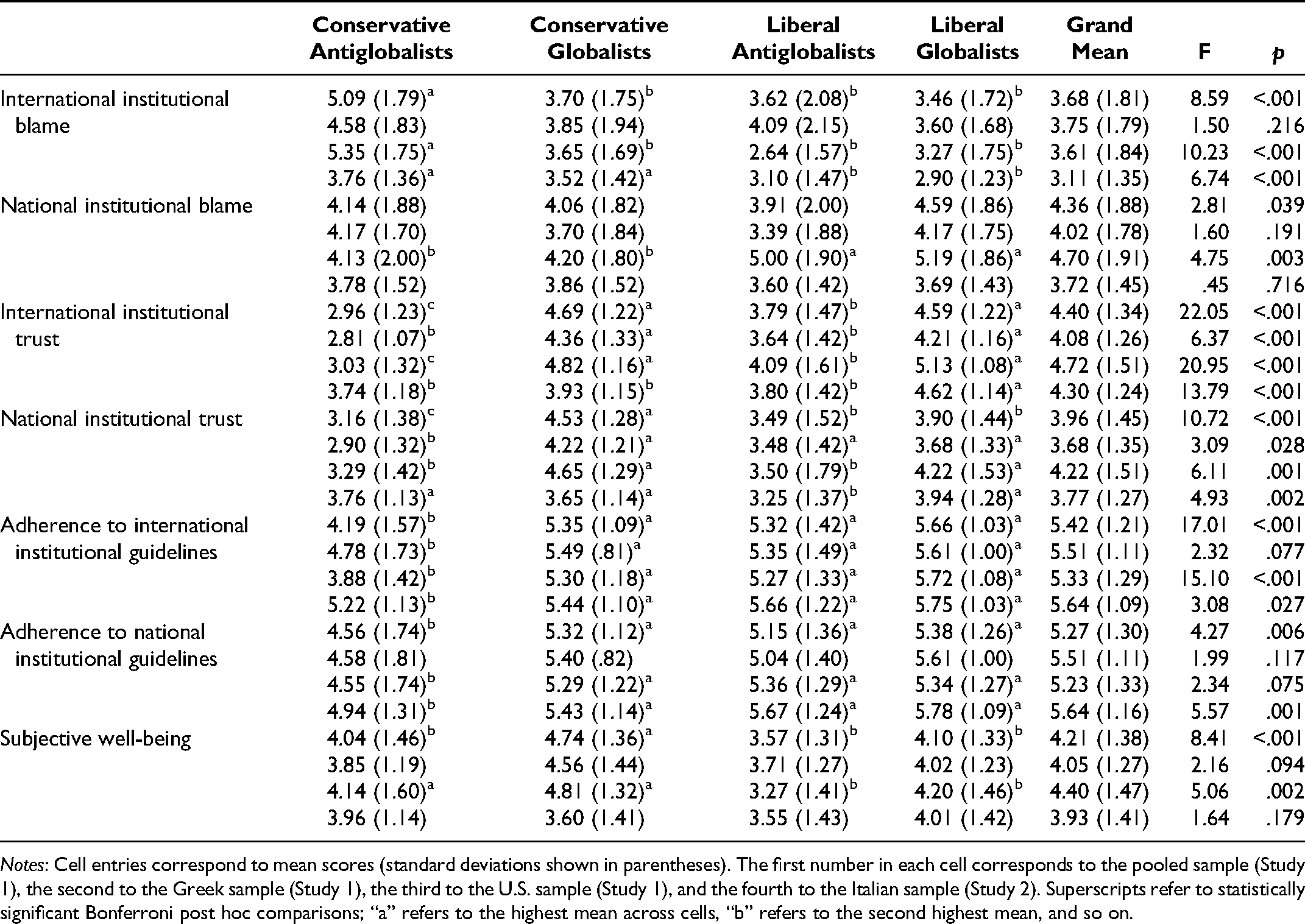
Notes: Cell entries correspond to mean scores (standard deviations shown in parentheses). The first number in each cell corresponds to the pooled sample (Study 1), the second to the Greek sample (Study 1), the third to the U.S. sample (Study 1), and the fourth to the Italian sample (Study 2). Superscripts refer to statistically significant Bonferroni post hoc comparisons; “a” refers to the highest mean across cells, “b” refers to the second highest mean, and so on.
The results show interesting differences in crisis reactions by group. Conservative antiglobalists (8.9% of the sample; Mage = 37 years, 60% male) blame international institutions more for the mismanagement of the crisis, exhibit high levels of distrust in both national and international institutions, and report the lowest intention to follow their health guidelines. Conservative globalists (24.9% of the sample; Mage = 33 years, 65.3% male) assign equal levels of blame to both national and international institutions and report the highest level of institutional trust among all groups. They also report high levels of well-being and adherence to institutional guidelines. Liberal antiglobalists (8.6% of the sample; Mage = 32 years, 58.8% male) blame national and international institutions to similar extents but report low levels of trust, especially in national institutions. Despite not trusting international institutions strongly, they follow health advice issued by these institutions. They also report the lowest levels of well-being among groups. Finally, liberal globalists (57.6% of the sample; Mage = 29 years, 60.4% male) blame national institutions, report high levels of international institutional trust, and have the strongest adherence to institutional guidance.
We tested the typology’s stability by conducting the analyses in the high- and low-impact country samples separately. Although the results are largely robust across samples, we observe some noteworthy differences. First, U.S. respondents were more pessimistic about the future of the pandemic, as they reported significantly higher scores on a scale measuring their expectations about the persistence of the crisis in the long run (MUSA = 4.21, SD = 1.12 vs. MGR = 3.66, SD = 1.24, t = 4.573, p < .001). Second, the U.S. sample reported higher variance in blame, trust, and well-being scores, suggesting intense polarization in U.S. citizens’ perceptions about who is at fault for the crisis and who should be trusted to guide them out of it. Finally, the U.S. sample was comprised of disproportionately higher percentages of conservative globalists and antiglobalists than the Greek sample, likely explaining the increased frequency of passive (e.g., rejection of health guidance, neglect of hygiene advice) and active (e.g., antilockdown protests, antimask rallies) anti-institutional behaviors in the United States (similar to other countries heavily impacted by the pandemic).
Study 2
Time of Data Collection and Country Selection
We conducted an online experiment with a sample of Italian consumers. Data were collected during the period February 5–10, 2021. On the dates of data collection, Italy was experiencing the second wave of the pandemic, with an average of 12,000 new cases and 360 deaths per day. Collecting data during this period offers the opportunity to draw contrasts with the findings of Study 1, observe how the patterns of the hypothesized relationships had changed across the two waves of the pandemic, and assess the stability of our conceptual model over time.
Because we opted for an experimental manipulation of respondents’ perceived relative local impact in Study 2, we had to choose a country for which both relatively high and relatively low impact perceptions could be manipulated in a credible manner. Italy served this purpose as it was one of the countries that was heavily affected by the pandemic’s first wave (thus, perceptions of high local impact can be easily primed) but also one of the countries that did far better than other similar countries (e.g., the United Kingdom, France, Spain) during the second wave of the pandemic (thus, perceptions of low local impact can also be credibly construed).
Participants and Method
Participants
Four hundred two participants (54.8% male, 43.6% female, .9% other/undisclosed; Mage = 27.11 years, SDage = 7.95) were recruited through Prolific Academic based on their country of residence, in return for monetary compensation.
Procedure and measures
We asked participants to participate in a study exploring their perceptions of the impact of COVID-19 in their country and randomly assigned them to one of the two following conditions: high impact of COVID-19 and low impact of COVID-19. We manipulated perceptions of local impact using factual data about the country’s epidemiological image drawn from OurWorldinData.org, a scientific online database run by the University of Oxford. We achieved the experimental manipulation of relative local impact by comparing Italy across several epidemiological metrics (e.g., number of daily/cumulative deaths, number of new cases, progress of vaccinations) with other similar countries (in terms of, e.g., population, geographic location, economy) that could prime subjects to think that Italy did either better or worse than its counterparts (see the Appendix).
Following the experimental manipulation, we measured international and national attribution dimensions using one sample item for each from the Causal Dimension Scale (Russell 1982) (locus: “The pandemic had its origins outside/inside the international [national] institutions”; stability: “How the international [national] institutions handled the pandemic changed over time/remained stable over time”; controllability: “The international [national] institutions could do nothing/could do more to control the development of the pandemic”). To measure institutional blame, we asked respondents about the extent to which they blame specific institutions (International: WHO, European Union, United Nations; National: national government, national health system, Ministry of Health).
We measured international institutional trust, national institutional trust, adherence to international and national institutional guidelines, globalization attitudes, political ideology, and subjective well-being the same way as in Study 1. We added a measure for compliance to COVID-19 guidelines, asking participants about the extent to which they were wearing face masks, washing hands frequently, staying at home, avoiding crowded places, and practicing social distancing. Finally, we measured consumer well-being using the scale from Lee et al. (2002), which asks respondents the extent to which they received support (e.g., health care, financial, social, psychological, legal) from national (e.g., national government, national health system) and international (e.g., WHO, European Union, United Nations) institutions during the COVID-19 pandemic. All questions were answered on seven-point scales.
Next, participants completed a manipulation check item about the extent to which they believed their country was affected by COVID-19, relative to other similar countries. We also asked respondents about the impact COVID-19 has had on their life by reporting if they had contracted COVID-19 themselves, whether a friend or relative had contracted COVID-19, and whether they knew someone who died from COVID-19 (1 = yes, 0 = no). We summed the positive answers to compose a COVID-19 impact index. Finally, participants reported their age, gender, socioeconomic status, and educational level. All questions were translated and back-translated from English to Italian by a bilingual translator (Behling and Law 2000). Finally, participants were debriefed and thanked for their participation.
Analysis and Results
Manipulation check
Respondents exposed to the high local impact condition perceived their country as more heavily affected by the COVID-19 pandemic compared with other similar countries than respondents exposed to the low local impact condition (Mhigh_impact = 5.13, SD = 1.24 vs. Mlow_impact = 4.22, SD = 1.41, t = 6.85, p < .001). Thus, although all respondents were Italian citizens, our manipulation successfully primed their perceptions of relative local impact in opposing directions.
Causal attributions
In our conceptualization, we argued that controllability is central to attributions of institutional blame while locus and stability are less relevant in the context of a global crisis. Using the Russell (1982) measures completed in this study, we find that respondents (1) perceived the origins of the crisis to be outside the locus of both national and international institutions (Minternational = 2.62, SD = 1.59; Mnational = 2.76, SD = 1.76), (2) assessed institutional reactions as evolving over the course of the crisis (Minternational = 2.71, SD = 1.48; Mnational = 2.59, SD = 1.54), but (3) believed that both national and international institutions could do more to prevent the consequences of the crisis (Minternational = 5.42, SD = 1.47; Mnational = 5.27, SD = 1.56). Thus, in line with our expectations, controllability judgments appear to be the most important attribution base in the context of the pandemic.
Measurement model assessment
A CFA indicates good fit of the model to the data (χ2 = 1,194.76, d.f. = 524, RMSEA = .057, CFI = .926, SRMR = .045) and sound measurement for all multi-item scales. All scales have satisfactory psychometric properties, including Cronbach’s alphas (ranging from .801 to .906), CRs (ranging from .811 to .907), and AVEs (ranging from .467 to .749). In support of discriminant validity, all squared correlations are smaller than the minimum of the corresponding AVEs (Fornell and Larcker 1981) (see Table 8).
Construct Measurement and Psychometric Properties (Study 2).

Structural equations model estimation
We test our conceptual model through covariance-based structural equation modeling in AMOS using maximum likelihood estimation and item parceling of multi-item scales. In this model, we also include consumer well-being as an additional dependent variable and an extended set of controls (age, gender, socioeconomic status, education, and the COVID-19 impact index). Having established the effectiveness of our manipulation and acknowledging that perceptions of local impact are not binary but instead vary across a wide range, we use the continuous manipulation check item as a single item indicator of the “perceived local impact” construct to avoid the downsides of using a dichotomous independent variable (i.e., the experimental condition) in the structural model (e.g., reduction in statistical power; Fitzsimons 2008). Estimating the model using the experimental condition leads to similar (satisfactory) estimates of model fit and path estimates with only minor substantive changes.
The results suggest that the model fits to the data well (χ2 = 34.36, d.f. = 23, p = .060, RMSEA = .035, CFI = .991, SRMR = .023). Perceived relative local impact has a positive effect on international institutional blame (β = .102, p < .05) and national institutional blame (β = .235, p < .001). International institutional blame has a negative effect on international institutional trust (β = −.423, p < .001), and national institutional blame has a negative effect on national institutional trust (β = −.365, p < .001). International institutional trust exerts a positive effect on adherence to international guidelines (β = .431, p < .001); however, as in Study 1, it does not have an influence on either subjective well-being (β = −.052, p = .597) or consumer well-being support (β = −.072, p = .488). In contrast, national institutional trust positively influences adherence to national guidelines (β = .372, p < .001), subjective well-being (β = .191, p < .05), and consumer well-being support (β = .378, p < .001).
Positive globalization attitudes have a negative effect on international institutional blame (β = −.098, p = .088) and no significant effect on national institutional blame (β = .023, p = .701), consistent with Study 1. Beyond its effects through blame, globalization attitude has a positive direct effect on both international institutional trust (β = .288, p < .001) and national institutional trust (β = .236, p < .001), leading to significant positive total effects. Turning to conservative ideology, we find a positive effect on international institutional blame (β = .195, p < .001); however, unlike Study 1 we do not observe any significant negative effect on national institutional blame (β = −.019, p = .733). We find no evidence of direct effects of conservative ideology on national (β = −.052, p = .287) or international institutional trust (β = .063, p = .204), suggesting that the effects of political ideology in this study are fully mediated through blame attributions. Corroborating the findings of Study 1, we observe negative direct effects of conservative ideology on adherence to both national (β = −.109, p < .05) and international guidelines (β = −.172, p < .001) but no direct effects on either subjective (β = .066, p = .204) or consumer well-being (β = −.041, p = .475). (Tables 5 and 6)
Overall, Study 2 largely replicates the findings of Study 1 and supports all hypotheses except H3b and H4b. Regarding H3, although we cannot offer a formal test of this explanation due to differences in the design between the two studies, it seems that as the pandemic crisis evolves over time, the protective influence of conservative ideology on national institutions (observed during the first wave) gradually fades out. Regarding H4b, the lack of significant effects of international institutional trust on either subjective or consumer well-being across both studies highlights the importance of national (over international) institutions for safeguarding citizens’ well-being from the crisis’s consequences.
Effect size comparisons
We conducted a formal test to compare the effect sizes of perceived local impact on international and national institutional blame. Unlike Study 1, in which local impact had symmetrical effects, we find that setting the two effects equal leads to a substantial deterioration in model fit (Δχ2 = 6.51, Δd.f. = 1, p = .011), suggesting that the two effects differ significantly in size (despite both being significant). As in the original model, the effect of local impact on national institutional blame is stronger than its effect on national institutional blame; thus, we conclude that in this study, consumers were more punitive toward national institutions, further supporting the assertion that as a global crisis evolves over time, consumers have higher expectations of national institutions to resolve it locally.
Typology
We tested the replicability of the typology proposed in Study 1 regarding how different consumer segments based on globalization attitudes and political ideology react to global crises. The results paint a consistent picture. Conservative antiglobalists exhibit the strongest anti-institutional reactions (e.g., high blame, low trust, low adherence to institutional guidelines), in contrast to liberal globalists, who are more welcoming to institutional interventions and hold a more positive stance toward institutions (Table 7).
General Discussion
Theoretical Contribution
Our findings add to crisis management, institutional trust, and consumer well-being literatures. We discuss these contributions further in the subsections that follow.
Relativity in local impact perceptions matters
Although the impact of global shocks on the economy (e.g., global financial crises), the environment (e.g., climate change), or the geopolitical landscape (e.g., immigration) has a sui generis nature in every country (Berkmen et al. 2012; Mendelsohn, Dinar, and Williams 2006), most previous related research has adopted a macro-level perspective in assessing the consequences of global crises (e.g., global financial indices, CO2 emissions, immigration flows) at the expense of their micro-level determinants (e.g., citizens’ beliefs about the handling of a crisis, psychological reactions to crises, subjective well-being). However, people react to a global crisis differently depending on whether they perceive that the crisis has affected their country more severely than other similar territories. Our findings contribute to global crisis literature by showing that perceived discrepancies in the local impact of an otherwise global crisis are key to map citizens’ understanding of the crisis and their responses to the institutional actors responsible for regulating it. As global crises unfold around the world and awareness of their impact across different countries is facilitated by the forces of global integration (e.g., the spread of global media, ease of international travel), citizens develop informed beliefs about the impact of the crises across different areas, they compare their crisis-evoked grievances with those of other countries, and they use these relative judgments to shape their evaluations of national and international crisis-regulating institutions. This relativity dimension is endemic in analyzing global crises and holds a central role in understanding cross-national changes in trust.
Global crises erode institutional trust and well-being
Institutional trust literature offers conflicting conclusions about the impact of global crises on people’s confidence in institutions. While some research has shown that institutional trust increases during crisis conditions as a consequence of people’s need to back the institutional options available to them to overcome ongoing threats (Greenaway and Cruwys 2019; Sibley et al. 2020), others have found that crises lead to declines in institutional trust in the long run (e.g., Bangerter et al. 2012), which explains the institutional trust deficit observed globally (Dustmann et al. 2017) and conspiracy theories about the presence of dark institutional interests behind global crises (Van Prooijen and Van Dijk 2014). Our findings reconcile these conflicting perspectives by establishing that global crises are more likely to hurt institutional trust when their impact at the national level is perceived as more severe than that on other similar countries and less likely to lead to institutional trust erosion when their impact is proportional across comparable territories. These discrepant changes in institutional trust determine consumers’ subjective assessments of life satisfaction and adequacy of institutional support.
Global versus local contrasts in institutional crisis attributions
As negative events with severe well-being consequences, global crises motivate people to make causal judgments about whether a crisis could be controlled or prevented. Controllability judgments determine the blame people assign to crisis-regulating institutions. As global crises require interventions at both the national and the international levels, blame for ineffective crisis mismanagement is assigned to both national and supranational institutions, to the extent that they are perceived as politically legitimate actors in crisis resolution. Unlike locally confined crises, global crises represent trust-building exercises not only for national governments but also for international organizations. As international institutions lack the privilege of direct democratic representation (Machida 2009), global crises offer them the opportunity to justify their existential legitimacy and gain the trust of distinct national audiences by showcasing their contributions in contexts where they are most needed. Thus, research on international institutional trust should not rely only on globally aggregated trust measures, as they likely conceal sizable institutional trust deficits in some countries that may be ignored simply because equivalent surpluses counterbalance them in others.
National prominence in global crisis management
Although both national and international institutions must engage in global crisis resolution, our findings postulate a pronounced role for national institutions in global crisis management. Our findings suggest that (1) well-being is more strongly affected by national (than international) institutional trust, (2) blame for ineffective national interventions become stronger as the global crisis unfolds and its local impact grows over time, and (3) even people who consider international institutions as morally and functionally responsible to resolve the crisis deem national institutions accountable for the local (mis)management of it. Thus, for crises with a global reach, crisis management at the local level is critical to retain citizens’ national trust.
The local impact paradox
Our findings offer a theoretical explanation of counterintuitive cases of anti-institutional behaviors during the pandemic (e.g., participation in mask burning protests, antilockdown rallies), which have been paradoxically observed more frequently in countries severely hit by the pandemic than in countries less affected by it. We suggest that this paradox is partly explained by drops in institutional trust and subsequent rejection of institutional well-being guidelines brought about by the disproportional grievances these countries experience after the crisis. Alarmingly, this phenomenon seems to trigger a self-reinforcing vicious cycle (whereby severe local crisis impact leads to public rejection of crisis-prevention measures, which, in turn, results in further deterioration of local impact) that cannot be plausibly broken unless institutional trust is externally restored.
Ideological variance in global crises reactions
Finally, our findings suggest that reactions to global crises are politically grounded and depend on people’s fundamental views about globalization’s desirability. Conservatives view national and international institutions as competitive trust referents, propound the role of national institutions in handling a global crisis, transfer the blame for crisis grievances from national to international institutions, and place more trust in local institutions to guide them out of hardship. In contrast, globalists view national and international institutions as collaborative trust referents, refrain from blaming international institutions for global crises, retain institutional trust in both national and international institutions, and promote adherence to both local and global crisis-prevention guidance. As globalization attitudes cross ideological lines, we propose a typology of consumer groups (conservative antiglobalists, conservative globalists, liberal antiglobalists, and liberal globalists). Using this typology, we find that declines in institutional trust following global crises and limited enforcement of crisis-mitigating guidance are mostly attributed to conservative antiglobalists. Considering trends of increasing antiglobal sentiment (Witkowski 2005) and declining liberal identification (Coggins and Stimson 2019), this growing segment is critical for the public perception and potency of crisis institutions.
Practical Implications
Our findings have implications for policy makers, political marketers, crisis communicators, and for-profit organizations actively engaged in global crisis management. We discuss each in turn in the following subsections.
Implications for national policy makers
Policy makers in countries severely hit by a global crisis (e.g., national governments, regional health organizations) are advised to follow certain crisis monitoring and management policies to retain their constituents’ trust during a crisis. First, national policy makers should closely monitor the development of a global crisis in countries with a similar profile to theirs (in terms of, e.g., demographic composition, geographic location, economic structure, climate) to allow for meaningful crisis impact comparisons. Second, they should engage in international benchmarking by studying other similar countries that emerge as good “crisis handlers” and consider adopting best crisis management practices (Timmis and Brüssow 2020). Third, they should collaborate with other national governments that face similar crisis symptoms and identify commonalities and differences in the local manifestation of the global crisis that would allow more effective institutional interventions. Such strategies should close cross-country impact gaps, protect citizens’ well-being, and make citizens more trustful of national institutions.
Implications for international policy makers
International crisis-regulating institutions (e.g., the WHO, United Nations, European Union) should localize their crisis interventions by adapting them to countries suffering disproportionately from the crisis. This can be achieved in several ways. First, they should engage in crisis resolution at the national level by closely collaborating with national governments to address idiosyncratic, local manifestations of the crisis (e.g., through allocating global resources for local research or needs, visiting and inspecting local areas of increased concern, providing advice tailored to the situation on the ground, issuing country-specific guidance following consultation with local authorities, facilitating cross-country collaboration for crisis resolution). Second, they should diffuse expert knowledge from the successful handling of the crisis in certain countries to areas struggling locally by redirecting best practices and consulting national governments. Third, they should communicate their contributions to crisis resolution at the country level to show local engagement and build trust. Good examples of such practices include the European Commission’s proposal to EU member states to allow transfers of COVID-19 patients across countries with different intensive care capacities (Boffey 2020) and the WHO-led Global Health Cluster Unit mobilized to offer operational support and technical expertise to areas most vulnerable to the pandemic (WHO 2021).
Implications for political marketers and institutional brand managers
As citizens hold political institutions accountable for local crisis development, global crises represent serious threats to the survival of political brands (e.g., governing parties, supranational organizations, individual politicians). In Italy, the measures taken by the national government have resulted in aggressive manifestations and vandalism across major cities, with severe consequences for the government’s political capital. Donald Trump’s defeat in the recent U.S. presidential election has been now clearly linked with his administration’s inability to halt the spread of COVID-19 in the country, as evidenced by strong negative correlations between his vote share and COVID-19 transmission rates across states (Baccini, Brodeur, and Weymouth 2021). Recently, severe public backlash has erupted against European governments’ “overcautious” decision to suspend distribution of specific vaccines in their countries despite limited scientific evidence to warrant concerns. These developments highlight the role of effective crisis communications to avoid loss of political brand capital. To avoid such loss, political marketers should use relative metrics when talking about the development of the local crisis and justify their crisis interventions vis-à-vis interventions of fellow similar states when reporting and communicating information related to the local impact of a global crisis to their constituents. As people rely on relative beliefs about the severity of the crisis when assessing political interventions, such reporting is necessary.
Implications for nudging and message framing
As institutional guidance is critical for citizens’ well-being, communication of crisis guidelines through appropriate message design, framing, and targeting is paramount for the public adoption of crisis-mitigating behaviors (Claeys and Cauberghe 2014). The same applies for nudging policies sought by national and international institutions to create default crisis-mitigating behaviors that were found effective during COVID-19 lockdowns in some countries (e.g., India; Debnath and Bardhan 2020) but not in others (e.g., the United Kingdom; Sanders et al. 2021). Our findings offer one explanation for these discrepancies as adherence to institutional guidelines depends on people’s position on the political spectrum and their globalization attitudes. Our typology suggests that conservative anti-globalists (i.e., the population segment with the lowest intention to follow health-protective guidelines) are relatively more trusting of national institutions. Thus, nudges and well-being messaging addressed to them are more likely to be successful if they come from a national source. In contrast, conservative and liberal globalists generally trust both national and international institutions, thus exhibiting the highest likelihood of reacting positively to nudging and institutional communications. This classification is also useful in understanding anti-institutional behaviors in many countries severely hit by the pandemic, such as antimask rallies, anti-lockdown protests, neglect of hygiene advice, and social distancing rules. Our findings suggest that such behaviors—ironically observed more often in countries most affected by the pandemic—are more frequent among conservative antiglobalist population segments. This finding stresses the role of conservative (i.e., ideologically congruent) national governments, leaders, and spokespersons in influencing this segment compared with liberal (i.e., ideologically incongruent) ones.
Implications for for-profit brands
Global crises represent opportunities for for-profit organizations to build public goodwill and strengthen affective bonds with consumers. This is exemplified by companies in industries with direct relevance to the pandemic (e.g., vaccine manufacturers, pharmaceutical companies, brands selling personal protective equipment, private health care providers). These businesses have an indirect influence in the development of the crisis (e.g., through vaccine research, providing excess equipment to public health care systems) and thus inadvertently claim an institutional role in the context of the crisis, which, if fulfilled, can foster consumers’ trust even after the crisis is over. Similarly, global crises create opportunities for sophisticated corporate social responsibility initiatives (e.g., crisis-oriented cause-related marketing campaigns, corporate philanthropy activities) in which for-profit brands can engage with the purpose of winning consumers’ trust.
Limitations and Future Research
Our findings are subject to limitations, which offer future research directions. First, the particularity of our empirical context (i.e., the COVID-19 pandemic) limits bold generalizations of our findings to other types of global crises with different qualitative characteristics. Although we expect the identified theoretical mechanism of institutional trust building, and the role of the global–local contrast in crisis impact, to hold in the context of other global crises, every crisis is unique in terms of both its causes (e.g., national vs. international origin, controllable vs. uncontrollable) and its national or international intervention potential (e.g., addressing a crisis’s global causes vs. handling its local symptoms). Similarly, differences in the severity of a global crisis in terms of its impact (e.g., human lives lost due to the pandemic vs. global terrorist acts) or the crisis’s general domain (e.g., financial disruptions vs. environmental disasters) could lead to different conclusions. Thus, replications and extensions of the current study in other crisis contexts would be useful.
Second, our studies focused on individual-level drivers of global crisis reactions. However, countries with different cultural or economic profiles likely react to global crises differently. For example, low-power-distance cultures may experience smaller declines in trust than high-power-distance cultures. Citizens of more economically developed countries may perceive their governments as more capable (and more trustworthy) in managing global crises locally. Countries with high percentages of vulnerable consumers (e.g., bottom of the pyramid markets) might also react to global crises differently. Future research should investigate country-level determinants of institutional (dis)trust following global crises.
Third, our study assesses trust and well-being at two distinct and incomparable points in time following a crisis outbreak. However, global crises are ongoing challenges that evolve over time, and institutional assessments of crisis management policies change continuously as crises unfold. Longitudinal studies would allow investigation of the trust dynamics developed during a developing crisis and the long-term effects of national and international interventions on institutional blame, trust, and citizens’ well-being.
Fourth, global crises offer a unique context to study the relative political legitimacy of national and international institutions, especially when their crisis guidelines are at odds or in outright conflict (e.g., countries following a “herd immunity” approach to the COVID-19 pandemic against WHO guidelines). Divergence in global crisis policies is not uncommon (e.g., anti-immigration policies of populist EU governments opposing EU immigration directives, the decision of the Trump administration to exit the United Nations’ Paris climate agreement). How trust differences in national governments versus supranational organizations affect intentions to follow national or international guidelines when they are in direct conflict is an area of significant public policy relevance that future research should explore in more depth.
Finally, future research should investigate how global crises influence consumption-related outcomes indirectly linked with well-being (decisions to invest in, e.g., education, property, insurance, pensions) as well as consumers’ dispositions toward globalization (e.g., global/local identities, consumer ethnocentrism, cosmopolitanism; Diamantopoulos et al. 2019) as a force with the potential to threaten and improve their well-being simultaneously.
Footnotes
Appendix: Experimental Manipulation (Study 2)
Respondents saw the following text in their respective conditions.
Acknowledgments
The authors thank the JIM review team for their constructive comments.
Associate Editor
Amir Grinstein
Declaration of Conflicting Interests
The author(s) declared no potential conflicts of interest with respect to the research, authorship, and/or publication of this article.
Funding
The author(s) received no financial support for the research, authorship, and/or publication of this article.
