



Abstract
While interfunctional collaboration remains well-studied within the marketing literature, this research is the first to empirically explore the effects of sales–supply chain management (S-SCM) collaboration among salespeople selling internationally. Survey data from 310 international salespeople provide initial empirical evidence showing that S-SCM collaboration can positively predict international salesperson performance outcomes. To show that the effect is unique and provide rare empirical evidence, the authors simultaneously account for the effects of multiple forms of cross-functional collaboration (i.e., sales–marketing collaboration and sales–research and development collaboration). Matching the survey responses with objective country-level data, the authors also find that the value of S-SCM collaboration varies across countries. In particular, the positive effects of S-SCM collaboration were amplified by logistics capacity (or “logistics friendliness”) at the country level. The study's findings also indicate that the positive performance returns provided by S-SCM collaboration are even stronger for international salespeople focused on customer acquisition (vs. customer retention). Broadly, the study implies that, for optimal firm performance, those who are responsible for managing global supply chains should coordinate activities with those responsible for selling to global customers.
Keywords
Global supply chain disruptions (e.g., Goodman 2021; Helper and Soltas 2021) have recently created additional challenges for salespeople selling internationally. 1 For example, product shortages due to factory closures in parts of the world, shipping delays due to congested ports and labor shortages, increased prices, and the like have only increased the levels of uncertainty and risk that salespeople must manage with their international buyers. Moreover, unfulfilled orders due to supply chain issues have left many buyers in search of new suppliers (i.e., wanting to diversify the supply base; Alicke et al. 2022). To effectively navigate such challenges (e.g., manage global customer expectations) and capitalize on emergent opportunities (meet global customer demand), salespeople and sales organizations must adapt. Accordingly, this research explores cross-functional collaboration with supply chain management (SCM) as a factor that might help international salespeople adapt (Mohsen and Eng 2016) and be a source of competitive advantage (Allred et al. 2011; Foerstl et al. 2013).
Against this background, the current research was motivated by two related literature gaps and makes two primary contributions. First, with few exceptions (e.g., Hohenberg and Homburg 2016; Zhou and Charoensukmongkol 2022), very little is known about the drivers of job performance for international salespeople in general (Schrock et al. 2018). Further, the lack of knowledge about specific forms of cross-functional collaboration driving salesperson performance in an international context has been noted (Panagopoulos, Rapp, and Ogilvie 2017). While the sales function's relationships with research and development (R&D; Ernst, Hoyer, and Rübsaamen 2010), service (Rapp et al. 2017), and marketing (e.g., Chernetsky, Hughes, and Schrock 2022) have received various attention in the literature, the sales function's relationship with SCM operations within a firm remains overlooked. This gap is noteworthy to the extent that, in practice, sales and SCM are indeed interdependent (e.g., sales forecasting activities; Glatzel, Großpietsch, and Silva 2011) and the ability of salespeople—particularly international salespeople—to meet customer needs is aided or constrained by a firm's SCM capabilities. 2 Compared with domestic analogues, international purchase and fulfillment processes can be more complex (e.g., customs clearance processes, inventory and transportation from origin considerations; David 2022) and carry more uncertainty and risk (e.g., information security risk, regulatory risk; Luo 2022). Thus, we believe an exploration of the effects of S-SCM collaboration in an international selling context is both apt and timely, as managing uncertainty and mitigating risk are top priorities for salespeople and global supply chain managers alike (Alicke et al. 2022; Ulaga and Kohli 2018). It is worth noting here that intrafirm collaboration is an area of focus among SCM scholars (e.g., Esper et al. 2010; Oliva and Watson 2011; Pellathy et al. 2019). Table 1 delineates ways in which our research complements and extends this important work (e.g., distinct research focus, level of analysis, research implications). With a focus on international salespeople, the current research thus contributes initial empirical evidence to advance understanding of the effects of sales–supply chain management (S-SCM) collaboration. Importantly, the evidence accounts (controls) for the effects of other forms of cross-functional collaboration (i.e., sales–marketing collaboration, sales–R&D collaboration).
This Article and Other Relevant Literature Focused on SCM's Cross-Functional Collaboration.

Notes: N.A. = not applicable.
Second, although a positive impact of S-SCM collaboration on international sales performance is logical and expected in the main, assuming equally positive effects across countries and sales activities is questionable and may lead to inefficient resource allocation or suboptimal strategies. Indeed, cross-functional collaboration literature in marketing (e.g., sales–marketing interface literature) has been “concentrated geographically” and lacks insight into how effects might vary across countries (Chernetsky, Hughes, and Schrock 2022). Thus, and to augment understanding of boundary conditions for the effects of S-SCM collaboration, we conceptualize S-SCM collaboration as a job resource for salespeople and leverage the job demands–resources (JD-R) theory (e.g., Bakker and Demerouti 2007). Accordingly, we examine logistics capacity as a country-level resource that has synergistic effects with S-SCM collaboration. Moreover, we examine customer acquisition focus as a job demand that strengthens S-SCM collaboration's performance effects. As such, this research also contributes to an improved understanding of varying performance implications of S-SCM collaboration as a job resource across international selling contexts. For managers, this research broadly suggests that, for optimal performance, S-SCM collaboration should be a strategic consideration within the firm. More specifically, the study indicates that international salespeople selling to countries with high levels of logistics capacity and/or those focused on customer acquisition receive higher returns to S-SCM collaboration.
The rest of this article is organized as follows. We next describe our theoretical background, introduce the study's focal constructs, and develop hypotheses. We then discuss the research methodology and results. Finally, we offer research limitations and directions for future research.
Theoretical Background and Hypothesis Development
Applying the Job Demands–Resources Theory
Proposition 1 of the JD-R theory (Bakker and Demerouti 2017) states that all job characteristics or working conditions fall into one of two categories: job demands and job resources. Job demands are “physical, psychological, social or organizational aspects of the job that require sustained physical or psychological (cognitive and emotional) effort or skills” (Bakker and Demerouti 2007, p. 312). Job resources are all aspects of the job that facilitate work goal attainment and personal development (Bakker and Demerouti 2007). The theory states that job demands and job resources have main and multiplicative effects that can predict or explain job performance as well as other job outcomes (Bakker and Demerouti 2014). For a theoretical understanding of relationships among the key constructs in our model, we leverage JD-R theory as a guide.
Consistent with extant research on the nature of collaboration (e.g., Bedwell et al. 2012; Lin, Wang, and Kung 2015), we define S-SCM collaboration as the degree to which the sales and supply chain management functions within a firm coordinate objectives, actively engage in joint activities, and have a productive working relationship. Importantly, S-SCM collaboration encompasses more than a simple willingness to politely email documents back and forth (Ashkenas 2015). Rather, at high levels of S-SCM collaboration, the two functions share goals and incentives (Chernetsky, Hughes, and Schrock 2022), cooperate (e.g., Malshe and Al-Khatib 2017), learn from each other and develop mutual understanding (e.g., Le Meunier-FitzHugh and Piercy 2007a), and work together as a team (e.g., Malshe, Johnson, and Viio 2017). This conceptualization parallels extant views of sales–marketing collaboration (e.g., Le Meunier-FitzHugh and Piercy 2007b) and marketing–SCM collaboration (e.g., Jüttner, Christopher, and Baker 2007). Accordingly, we theorize S-SCM collaboration as a job resource for salespeople, to the extent that the collaboration represents an organizational or social aspect of the job facilitating work goal attainment (Demerouti et al. 2001).
Logistics capacity refers to the “logistics friendliness” of a given country, a conceptualization consistent with the World Bank's country-level operationalization of “logistics performance” (The World Bank 2018a). The World Bank's Logistics Performance Index accounts for six components, selected based on empirical research and the input from logistics professionals from around the globe (World Bank 2018a). The components are (1) border management clearance and customs efficiency, (2) trade and transportation infrastructure quality, (3) “the ease of arranging competitively priced shipments” (World Bank 2018a), (4) the quality and competence of logistics services, (5) the “ability to track and trace consignments” (World Bank 2018a), and (6) the timeliness with which shipments reach their destinations. In the most recent survey available (The World Bank 2018b), Germany received the highest score on this measure; Afghanistan received the lowest. Taking a JD-R theoretic perspective, we conceptualize logistics capacity as a collection of resources (e.g., infrastructure such as ports, roads, or railroads) that varies by country and can be leveraged to the salesperson's advantage. To the extent that SCM capabilities can be enhanced by infrastructure, technology, and visibility (Dolgui and Ivanov 2022), a theoretical accounting for this form of resource is of modern and practical importance.
Customer acquisition focus refers to the degree to which salespeople spend their time engaged in activities aimed at developing relationships with new customers (e.g., generating and following leads; Sabnis et al. 2013). This focus reflects the extent to which salespeople spend time exploring new business opportunities and “hunting” prospects (Lam, DeCarlo, and Sharma 2019). This focus can be contrasted with a customer retention focus (Carter et al. 2014), or the degree to which salespeople spend time exploiting existing customer relationships or “farming” (Lam, DeCarlo, and Sharma 2019). Importantly to a JD-R theoretic perspective, customer acquisition involves high levels of uncertainty, pressure, learning, risk, discomfort, and rejection (Lam, DeCarlo, and Sharma 2019). Accordingly, we theorize customer acquisition as a job demand that carries psychological costs and requires significant effort and skill (Bakker and Demerouti 2007). For two primary reasons, our research focuses on customer acquisition as a job demand. First, as Lam, DeCarlo, and Sharma (2019) describe, customer acquisition can be considered a more “difficult task” associated with “a higher rate of failure than farming existing customers” (Lam, DeCarlo, and Sharma 2019, p. 672). Second, to the extent that global customers are increasingly looking to diversify their supply bases (e.g., during and since the COVID-19 pandemic; Alicke et al. 2022), a theoretical accounting for this job demand is of real-world importance for marketing and sales organizations today.
S-SCM Collaboration as a Driver of International Sales Performance
Proposition 2 of JD-R theory states that job resources have positive motivational effects, which should increase job engagement and job effectiveness (Bakker and Demerouti 2017). Correspondingly, and for two main reasons, we expect that S-SCM collaboration, a job resource, will positively affect salesperson performance. First, we expect that salespeople well-integrated with SCM operations at their firm can effectively reduce some uncertainty and risk inherent to customer decision making. Particularly during—and after—international crises such as the COVID-19 pandemic (Gunessee and Subramanian 2020), we anticipate that effective salespeople can better resolve buyer uncertainties about product availability, processing times, carrier prices, whether deliveries will be made when and where needed, and so on. This expectation complements perspectives that view managing customer uncertainty as a primary role of salespeople (i.e., a role that can indeed require cross-functional support; Ulaga and Kohli 2018). Second, salespeople well-integrated with SCM operations at their firm should be better able to effectively manage—and thus meet—customer expectations. We anticipate that these salespeople can, for example, more quickly and accurately share pertinent information with customers about inventory issues or parts shortages (which could slow production, delay shipping, lengthen lead times, lead to stockouts and rationing, cause conflict and customer dissatisfaction, etc.).
Conceptualizing cross-functional relationships as a job resource for salespeople is consistent with the work of Sleep, Bharadwaj, and Lam (2015, p. 477), who took a JD-R theory perspective when suggesting the following: “In order to meet long-term customer-oriented objectives, the sales function should develop relationships with other functions within the firm to acquire resources.” This suggestion aligns with the longstanding view that salesperson effectiveness is a function of selling-firm resources (Weitz 1981), including information and expertise stemming from intrafirm relationships (e.g., Steward et al. 2010). The foregoing considered, we propose the following hypothesis:
The Moderating Role of Logistics Capacity
As noted previously, we conceptualize logistics capacity as a collection of resources that varies by country and can be leveraged to the salesperson's advantage. We propose that salespeople who are well-integrated with SCM operations at their firm can better utilize those resources (e.g., high-quality logistics services). From the organizational buyer's perspective, we expect that S-SCM collaboration is an evaluative criterion that receives more (less) attention and is deemed more (less) important in countries with maximum (minimum) logistics capacity.
Accordingly, we expect a synergistic interaction between S-SCM collaboration and logistics capacity (see Figure 1). For example, we expect that the ability of salespeople who are well-integrated with SCM operations to reduce customer uncertainty about lead times should be strengthened when border control agency processes are quick, relatively simple, and predictable. Similarly, these same salespeople's ability to reduce buyer uncertainty about carrier prices should be strengthened when it is relatively easy to arrange competitively priced shipments from many carriers. Otherwise, we expect that the ability of salespeople who are well-integrated with SCM operations to manage (and thus meet) customer expectations is enhanced in countries with high levels of logistics capacity. For example, these salespeople's ability to share timely information and manage customer expectations should be enhanced when relevant telecommunications/IT infrastructure is in place at ports and when the ability to trace shipments is high. Consistent with this rationale, we expect that S-SCM collaboration and logistics capacity are resources that complement each other's ability to drive international salesperson performance. It is worth noting that JD-R literature has not focused on resource × resource interactions to date. Thus, a test of the following interactive effect hypothesis also represents a novel application of JD-R theory:
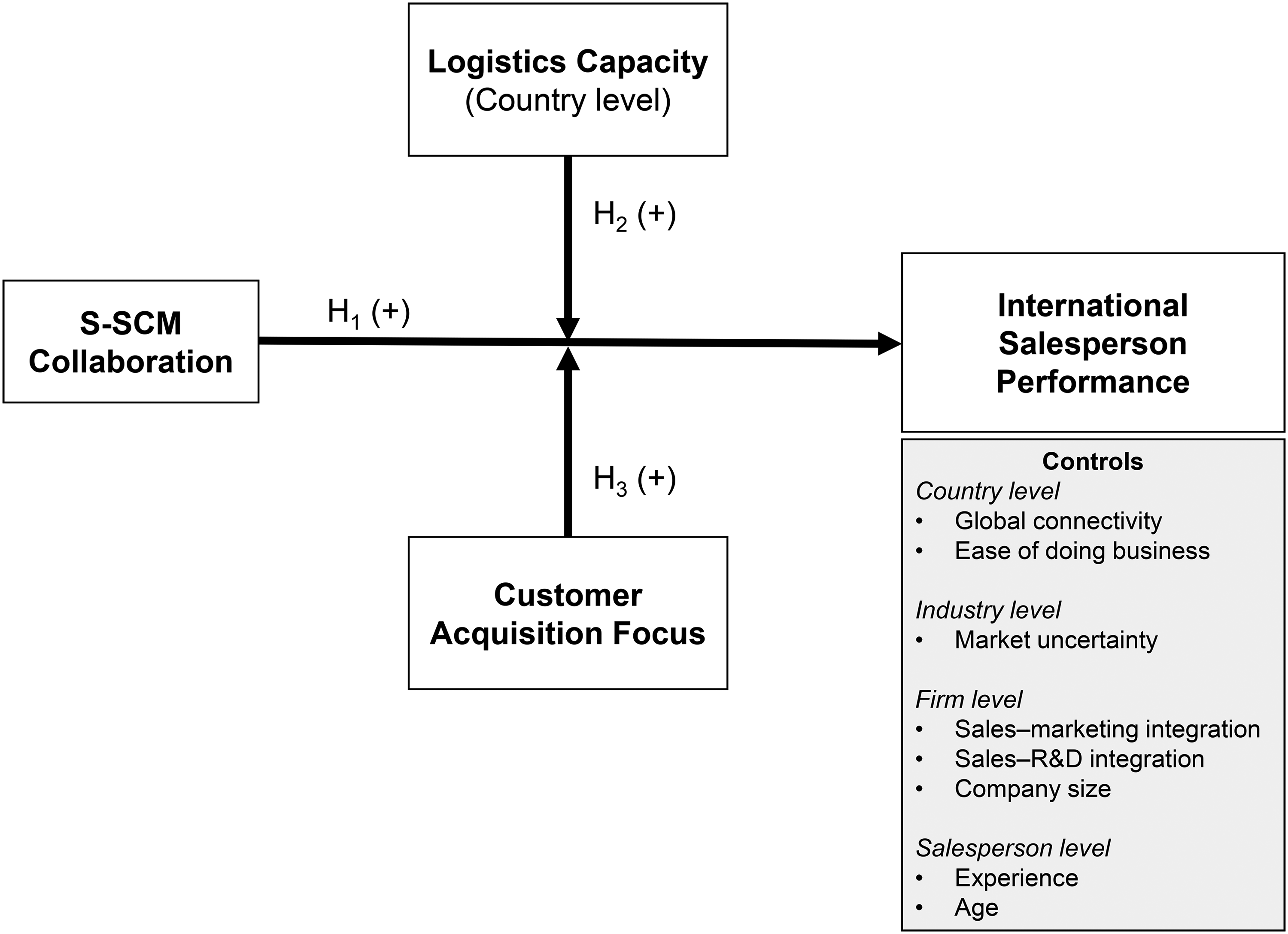
Conceptual Model.
The Moderating Role of Customer Acquisition Focus
Proposition 4 of JD-R theory states that job resources become “particularly useful and motivating” when job demands are high (Bakker and Demerouti 2017, p. 275). That is, challenging job situations (e.g., converting an unknown prospect into a customer) can activate employees to engage, learn, and take advantage of available and needed resources at work (Bakker and Demerouti 2017). In accordance with this theoretical proposition, we propose that S-SCM collaboration is a more (less) advantageous resource for salespeople in selling situations geared toward customer acquisition (retention). In particular, we anticipate that S-SCM collaboration's capacity to reduce customer uncertainty and positively affect sales performance is heightened in selling situations characterized by the uncertainty and risk inherent to a lack of personal relationships (e.g., no history of trust and fairness) and a lack of business results (e.g., unknown ability to meet customer expectations).
We expect that buyer mindsets differ in buying situations that consider taking on new suppliers, compared with buying situations with existing suppliers. In selling situations focused on retaining or growing existing business, we expect that the salesperson's history of promises kept (or not kept) is a chief evaluative criterion for buyers. For buyers in these situations, there are fewer unknowns. Moreover, in these situations, we expect that S-SCM collaboration, as a selling point, is already accounted for and thus creates less incremental revenue for salespeople. In contrast, in buying situations that consider taking on a new supplier, we expect that promises made—and, importantly, the resources that allow salespeople to keep their promises (Grönroos 2009)—are chief concerns. There are more unknowns for buyers in these situations (e.g., the selling firm's capability to deliver on promises made). Accordingly, we expect that S-SCM collaboration gains importance in these selling situations, particularly at a time when supply chain disruptions are prevalent globally. Ultimately, and consistent with Proposition 4 of JD-R theory, we expect that S-SCM collaboration, as a salesperson resource and driver of buyer behavior, becomes more advantageous in international selling situations focused on acquiring new business.
Methodology
Sample and Data Collection
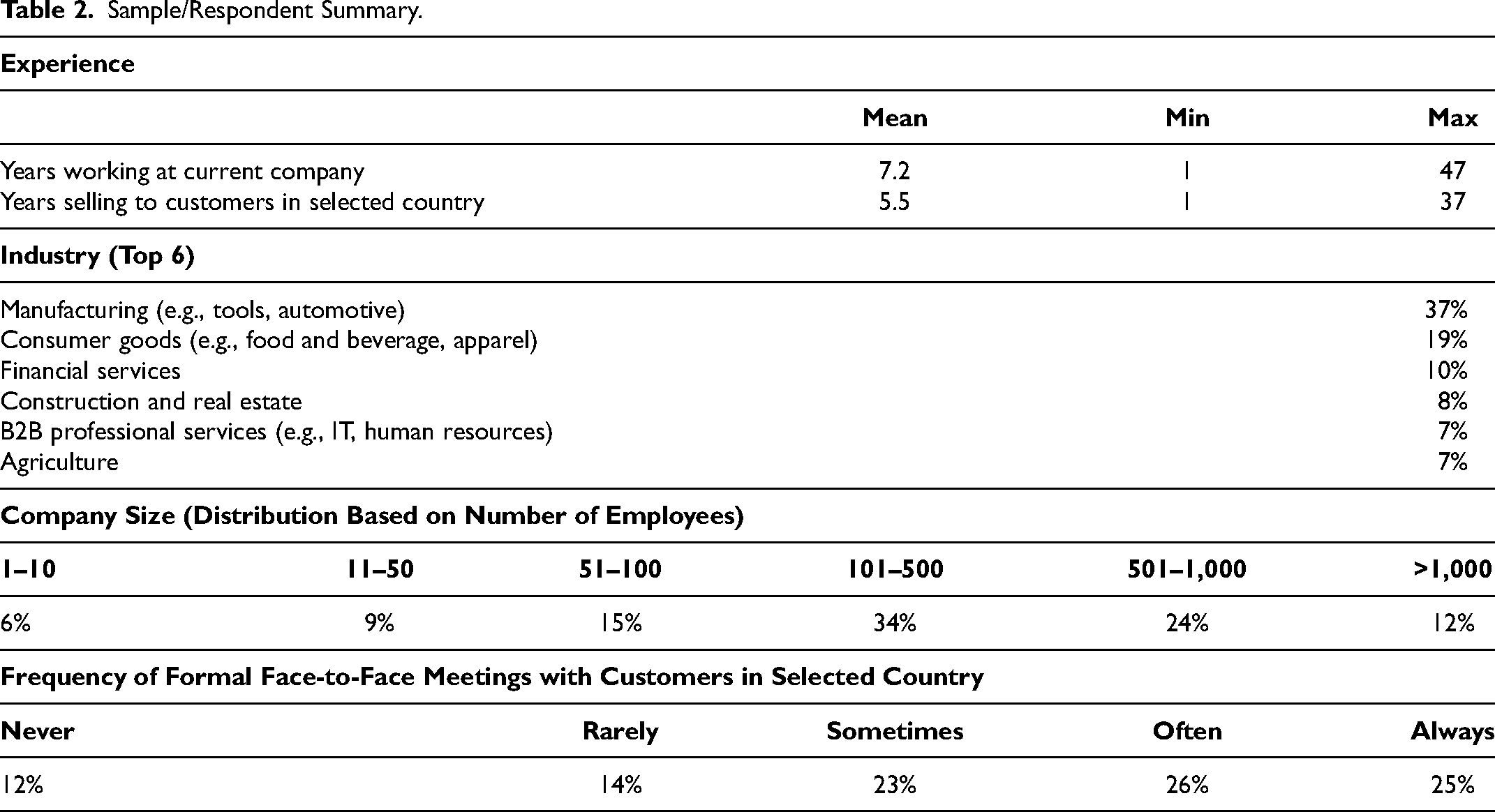
With the assistance of a leading market research firm, we collected data from salespeople working in the United States who sell internationally. To qualify for the study, participants needed one of the following job titles: salesperson, sales manager, export manager, global account manager, or account executive. Additionally, qualifying respondents had to report that at least 5% of their individual sales since 2019 were generated from international buyers. Respondents passing these screening questions were then asked to identify the country responsible for the majority of their international sales revenue. Three hundred ten salespeople qualified and participated in the study. On average, 51% of the salespeople's revenue was from international buyers. The salespeople identified 31 countries as primarily responsible for their international sales revenue. The top ten countries were the United Kingdom, Canada, Germany, China, Japan, France, Mexico, Australia, South Korea, and India. Table 2 shows summary information about the sample.
Sample/Respondent Summary.
Measures
Items measuring international sales performance indicated how well salespeople performed in the specific country identified in the screening question since the COVID-19 pandemic (1 = “much worse,” and 5 = “much better”). According to Bolander et al. (2021), this financial performance measure can be classified as outcome-based and comparative. The S-SCM collaboration measure was developed based on items from Troilo, De Luca, and Guenzi (2009) as well as intrafirm collaboration literature highlighting the importance of relationship quality (e.g., Le Meunier-FitzHugh, Massey, and Piercy 2011; Malshe, et al. 2017; Massey and Dawes 2007). The measure of customer acquisition focus was adapted from Carter et al. (2014). Salespeople were given 100 percentage points to allocate and asked to indicate how they spend their time in three categories (acquiring new customers, retaining existing customers, and educating customers) for two time periods: before and since the COVID-19 pandemic. The two time periods were used to create a change score (i.e., after COVID − before COVID). Thus, the acquisition focus measure reflects the extent of a “strategic pivot” on the part of the salesperson and aligns with the nature of the outcome variable (i.e., sales performance since COVID). The country-level measures of logistics capacity were from The World Bank's “Logistics Performance Index” (The World Bank 2018a). We controlled for several country- (ease of doing business, global connectivity), firm- (sales–marketing collaboration, sales–R&D collaboration, company size), industry- (market uncertainty), and salesperson- (age, experience) level variables. Table 3 shows descriptive statistics and correlations. The Appendix shows all constructs, items, and data sources.
Descriptive Statistics and Correlations.

Notes: Bold font = statistically significant at the .05 level (two-tailed). AVE values are on the diagonal.
Results
Measurement
We evaluated reliability, convergent validity, and discriminant validity for all latent constructs. Composite reliabilities for the latent variables ranged from .75 to .92, indicating that the measures are internally consistent. Factor loadings for all manifest indicators on their related latent variables were significant and positive. Moreover, the average variance extracted (AVE) values for all latent constructs were higher than .50. The AVE values were also higher than the squared correlations with other variables, indicating that discriminant validity is not a concern (Fornell and Larcker 1981). A measurement model with all latent constructs studied fit the data well (comparative fit index = .945; root mean square error of approximation = .047; standardized root mean square residual = .047).
We believe that common method variance (CMV) should not significantly impact our effects of interest for two reasons. First, we use distinct data sources, including secondary sources (e.g., The World Bank) and primary sources with questions in different formats (e.g., time allocation percentages; see the Appendix). Second, given that it generally deflates interaction effects in regression models, CMV should not be able to account for any statistically significant interaction effects (Podsakoff, MacKenzie, and Podsakoff 2012; Siemsen, Roth, and Oliveira 2010). Yet, to assess the presence of CMV, we use the marker variable technique with a measure of “blue attitude” (Miller and Simmering 2022). High correlations between the (theoretically unrelated) marker variable and the model's focal constructs would indicate the presence of common method bias (Lindell and Whitney 2001). We find that the average correlations between “blue attitude” and the study's focal constructs (rperformance = −.006, n.s.; rS−SCM collab. = .067, n.s.; racq. focus = −.061, n.s.) were not statistically different from zero. Moreover, when we partial out the effects of the marker variable, the sign and significance of all correlations in our study do not change (Lindell and Whitney 2001). Collectively, these findings provide evidence that CMV does not bias our results.
Endogeneity
To account for potential endogeneity, we include a robust set of control variables (Sande and Ghosh 2018). Further, we took measures to assess the possibility of endogeneity issues in the model with two-stage least squares estimation (Ullah, Zaefarian, and Ullah 2021). We use a measure of product variety as an instrument. Prior research indicates that the need for supply chain collaboration within the firm increases with levels of product variety (Shou et al. 2017), in support of the relevance criterion. Simultaneously, extant research indicates that product variety's effects on performance are equivocal (Zhao et al. 2020), in support of the exclusion criterion. As expected, we find that product variety is positively correlated with the endogenous regressor (S-SCM collaboration; r = .19, p < .05) but uncorrelated with the dependent variable, sales performance (r = .07; n.s.). The first-stage F-statistic (10.963) was positive and significant, suggesting that the chosen instrument is strong and relevant. The Durbin (p = .717) and Wu–Hausman (p = .719) tests were also both insignificant, indicating that endogeneity is not an issue in our model (the null hypothesis is that the predictors are exogenous; e.g., Ullah, Zaefarian, and Ullah 2021). Based on the suggestion that ordinary least squares (OLS) is more efficient in such situations (Ullah, Zaefarian, and Ullah 2021), we report the OLS results in Table 4 (Sande and Ghosh 2018).
OLS Results.

*p < .05.
**p < .01.
Notes: All p-values are based on two-tailed tests.
Hypothesis testing
We tested our hypotheses using OLS regression in Stata 15. We centered the independent and moderator variables when creating interaction terms. H1 posits that S-SCM collaboration is positively associated with international salesperson performance. The results in Table 3 indicate a positive and significant relationship between the two variables (β = .15, p < .05), supporting H1. H2 suggests that the positive relationship between S-SCM collaboration and international salesperson performance is strengthened at high levels of logistics capacity. As indicated in Table 3, the interaction term was positive and significant (β = .14, p < .05). To confirm the nature of the interaction, we plotted the results (Figure 2, Panel A) and conducted simple slopes analysis. The interaction plot and simple slopes analysis provide support for H2. At high levels of logistics capacity, the relationship between S-SCM collaboration and international sales performance (B = .39, p < .01) is stronger than the relationship between the two variables at low levels of logistics capacity (B = .01, n.s.). H3 suggests that the positive relationship between S-SCM collaboration and international sales performance is strengthened as customer acquisition focus levels increase. As indicated in Table 3, the interaction term was positive and significant (β = .10, p < .05). To confirm the nature of the interaction, we plotted the results (Figure 2, Panel B) and conducted simple slopes analysis. The interaction plot and simple slopes analysis provide support for H3. At high levels of customer acquisition focus, the relationship between S-SCM collaboration and international salesperson performance (B = .32, p < .01) is stronger than the relationship between the two variables at low levels of customer acquisition focus (B = .07, n.s.).

S-SCM Collaboration and International Salesperson Performance Under Varying Levels of Logistics Capacity and Customer Acquisition Focus.
Discussion
Motivated by in-depth interviews with international salespeople, this research explored S-SCM collaboration as a job resource that might help salespeople navigate global SCM challenges. We found that S-SCM collaboration can explain significant variance in international sales performance, controlling for various country-, industry-, firm- (e.g., sales–marketing, sales–R&D collaboration), and salesperson-level variables. Results also show that the value of S-SCM collaboration as a resource varies across countries. Specifically, the positive effects of S-SCM collaboration were amplified by logistics capacity (“logistics friendliness”) at the country level. The study's findings also indicate that S-SCM collaboration can particularly facilitate performance for those international salespeople focused on customer acquisition (vs. retention).
Our study complements and pushes the boundaries of extant international marketing and sales literature, including studies on cross-functional teamwork in global SCM (Hult et al. 2000) and studies noting the importance of coordinating international sales activities with other functional departments (Schrock et al. 2018). The theoretical implications are threefold. First, we contribute needed insight into drivers of performance for international salespeople. While meta-analyses are dedicated to salesperson performance drivers (Verbeke, Dietz, and Verwaal 2011), according to a recent review (Schrock et al. 2018), only roughly 6% of sales articles are international in scope. Moreover, salesperson performance drivers specified in an international context are often personal characteristics or selling techniques, such as cultural intelligence (Zhou and Charoensukmongkol 2022), emotional intelligence (Kadic-Maglajlic et al. 2016), and adaptive selling (Rippé et al. 2016). Thus, our study helps build practically relevant and needed knowledge about organizational determinants of international salesperson success. Broadly, our results indicate that international salespeople benefit 3 from information flows about SCM operations at their firm, which may now be “inherently global” in nature (e.g., foreign suppliers and foreign buyers; David 2022, p. 54).
Second, and relatedly, this study contributes to interfunctional coordination literature. While the sales function's relationships with R&D, service, and marketing functions have received considerable research attention over time, its relationship with the SCM function has not. Thus, our exploration of S-SCM collaboration augments understanding of cross-functional collaboration in marketing literature and responds to calls for research into the relationship between sales and nonsales employees in an international context (Panagopoulos, Rapp, and Ogilvie 2017). Further, within the broader interfunctional coordination literature, sales–marketing interface research specifically has recently called for studies that account for “various country-level indices” and noted a lack of insights about country-level contingencies (Chernetsky, Hughes, and Schrock 2022, p. 167). Although the focus of this study is not the sales–marketing interface, the results indicate that the impact of cross-functional collaboration does vary across countries.
Third, building on the work of Sleep, Bharadwaj, and Lam (2015), we leverage JD-R theory to study a specific form of cross-functional collaboration as a job resource for salespeople. In particular, our theoretical model specifies that the value of S-SCM collaboration as a job resource is contingent on job demands (customer acquisition activities) and other job resources (logistics capacity at the country level). From a JD-R theory perspective, our test of a resource × resource interaction is theoretically novel and provides a new lens for examining complementary job resources that might facilitate job performance. Moreover, and for international salespeople in particular, our results indicate that job resources can be conceptualized and measured at the country level.
As performance returns to S-SCM collaboration may vary significantly across countries, we recommend as an early step that managers assess relevant countries’ logistics capacity levels. According to our data, it is important for salespeople selling in high-logistics-capacity countries (e.g., Germany) to be well-integrated with SCM operations at their firm. It is in these countries where S-SCM collaboration can pay the most dividends for salespeople. Differently, S-SCM collaboration may be less advantageous for salespeople selling to low-logistics-capacity countries (e.g., Afghanistan), as the value of such collaboration is constrained by various elements of infrastructure, customs clearance process efficiencies, the availability and quality of transportation services, and so on. Finally, our data suggest that S-SCM collaboration pays the most dividends for salespeople focused on acquiring new customers. Thus, for international sales organizations with hunter–farmer structures, our data imply that hunters should be especially attuned to SCM operations at their firm. Otherwise, sales force structure notwithstanding, our data suggests that S-SCM collaboration can be particularly helpful (i.e., a performance-enhancing job resource) for salespeople looking to establish new business relationships globally. Broadly, we hope that our research redirects some of the significant practitioner attention paid to the sales–marketing interface (Chernetsky, Hughes, and Schrock 2022). More specifically, we hope to spur a wider conversation about internal collaboration in global sales settings, such that it also includes the importance of international logisticians and supply chain managers (David 2022).
Limitations and Future Research Directions
Our research has limitations that we hope will impel future studies. First, we stop short of exploring how S-SCM collaboration develops. Thus, future research specifying antecedents and providing step-by-step guidance for international sales managers would be valuable. Second, this research does not specify mechanisms linking S-SCM collaboration to international salesperson performance. As such, future research can identify salesperson-level (e.g., self-efficacy) and customer-level (e.g., perceptions of expertise; McClure et al. 2022) mediators of our focal relationship. Third, given our across-firm survey methodology, we rely on self-reported performance measures. While we recognize support for the validity of such measures (e.g., Sharma, Rich, and Levy 2004), we also recognize that objective performance measures have benefits. Fourth, financial performance is the only outcome that we investigate in the current research. Interesting future research could account for a wider range of outcomes (e.g., measures of customer retention, customer education outcomes). Examining multiple outcomes simultaneously could shed light on interesting trade-offs or unintended consequences.
Fifth, we recognize that our study does not distinguish between specific areas within the SCM function (e.g., procurement, operations, logistics), and a given firm may not have a single SCM department. Rather, and consistent with existing research (e.g., Pellathy et al. 2019), our survey instrument asked about “supply chain management operations” more generally. As such, one potentially fruitful opportunity for future research is inquiry aimed at teasing out the effects of collaboration between the sales function and specific departments that might constitute the SCM function within the firm. Sixth, our research is focused on S-SCM collaboration (given our measures, among other factors). Yet, we acknowledge that scholars have distinguished between collaboration and cooperation (e.g., Ashkenas 2015), and others have distinguished between collaboration and integration (e.g., Le Meunier-FitzHugh and Piercy 2007b). To the extent that these constructs exist on a continuum (e.g., cooperation as lowest form and integration as highest form), future research unraveling the effects of these related-but-different forms of cross-functional exchange would provide novel insights.
Footnotes
Appendix: Construct Measures
Acknowledgments
The authors would like to express their gratitude to Evangelia Demerouti and Justin Lawrence for their helpful input in the development of this paper. The authors would also like to thank the JIM review team for their helpful guidance throughout the review process.
Special Issue Editors
Nawar Chaker, Johannes Habel, Alex Zablah, and Kelly Hewett
Declaration of Conflicting Interests
The author(s) declared no potential conflicts of interest with respect to the research, authorship, and/or publication of this article.
Funding
The author(s) disclosed receipt of the following financial support for the research, authorship, and/or publication of this article: This research was supported financially by a Dean’s Office Summer Research Grant from the Eli Broad College of Business and a UCRCA research grant from the University of Nebraska at Omaha.
