



Abstract
Scarcity appeals in marketing have long captured the attention of scholars and practitioners, yet we know little about their effectiveness across different cultures. Drawing on cultural differences (i.e., self-concept, need for uniqueness, and susceptibility to normative influence), the authors investigate the impact of culture on the effectiveness of (demand- vs. supply-based) scarcity appeals. The authors also study the impact of product visibility while considering the moderating effect of culture on the effectiveness of scarcity appeals (demand- vs. supply-based). To do so, the authors conducted experimental research with participants from Pakistan and France. The authors find that (1) demand-based scarcity appeals were more effective than supply-based scarcity appeals in Eastern cultures, whereas the reverse was found in Western cultures; (2) such moderating role of culture was stronger for high-visibility products than for low-visibility products; and (3) the respective prevalence of interdependent (vs. independent) self-construal and its subsequent impact on susceptibility to normative influence and need for uniqueness mediated the moderating role of culture. The authors conclude by discussing the key theoretical contributions and managerial implications of these findings and suggesting future research directions.
Keywords
Top brands allocate substantial expenditures to advertising (Guolla, Belch, and Belch 2017). Many of these brands operate internationally (Okazaki, Mueller, and Taylor 2010). Thus, managers need to know how to promote their brands with a highly effective advertising strategy by choosing the most appropriate advertising appeal (Marshall and Roberts 2014) and considering cross-cultural consumer behavior (De Mooij 2014). Scarcity appeals are among the most commonly used advertising appeals (Aguirre-Rodriguez 2013; Barton, Zlatevska, and Oppewal 2022; Cialdini 1993; Gupta et al. 2023; Jung and Kellaris 2004). These appeals indicate restrictions on the available quantity of a product (Mukherjee and Lee 2016).
Scarcity appeals in marketing have long captured the attention of scholars and practitioners, yet we know little about their effectiveness across different cultures. Thus, this research aims to investigate the effectiveness of scarcity appeals in cross-cultural settings.
Despite the frequent use of scarcity appeals, these appeals are not used in a single standard form. Verhallen (1982) classifies scarcity appeals into two categories: scarcity appeals based on supply and scarcity appeals based on demand. Existing literature differentiates the effects of supply-based and demand-based scarcity appeals (Eisend 2008; Gierl and Huettl 2010; Roy and Sharma 2015). Supply-based scarcity appeals communicate a shortage due to limited production or distribution of a product, whereas demand-based scarcity appeals communicate a shortage caused by higher product demand. Consequently, these two appeals send a different signal to the marketplace; that is, demand-based scarcity appeals signal bandwagon consumption, whereas supply-based scarcity appeals signal snob consumption (Irmak, Vallen, and Sen 2010; Roy and Sharma 2015). In bandwagon consumption, the consumer perceives that other consumers’ demand for the product implies value (Worchel, Lee, and Adewole 1975). Thus, demand-based scarcity appeals increase product desirability. In contrast, when engaging in snob consumption, consumers want to differentiate themselves from others (Worchel, Lee, and Adewole 1975). Therefore, a limited edition or exclusive supply increases product desirability (Leibenstein 1950). The most common examples of supply-based scarcity are “limited edition,” which refers to limited production, and “at selected stores only.” Common examples of demand-based scarcity are “nearly sold out due to high demand” and “80% of our stock already sold.”
Understanding culture's impact on advertising effectiveness is one of the most important factors in the international marketing literature (Özsomer and Simonin 2004; Walsh, Shiu, and Hassan 2014). Hofstede (1980, p. 24) referred to culture as “the collective programming of the human mind.” The definition of self is one of the most culturally significant elements programmed in people's minds (Shavitt and Barnes 2020). It is one of the core concepts of cross-cultural psychology (Santamaría et al. 2010). The difference between Western and Eastern cultures relates to the opposition between individualism and collectivism, based on the respective primacy of the self versus the group (Hofstede 2001; Triandis 1989). In this research, we specifically investigate the effectiveness of supply-based and demand-based scarcity appeals in Eastern and Western cultures.
To further understand the cross-cultural differences in the effectiveness of scarcity appeals, we investigate how consumers viewed themselves and their relation to others. These differences could be attributed to consumers’ varying types of self-construals, which reflect the degree to which people differentiate or connect themselves to others (Bolton, Keh, and Alba 2018; Gardner, Gabriel, and Lee 1999; Liu, Zhang, and Keh 2019; Markus and Kitayama 1991). Researchers have widely used these self-construals in cross-cultural studies as independent and interdependent self-construals. People with dominant independent self-construal consider themselves autonomous, independent, and distinct from others, whereas people with dominant interdependent self-construal consider themselves members of a social group and tend to focus on their connectedness with others (Madan et al. 2018; Markus and Kitayama 1991). Although these two self-construals may coexist within any individual or culture, Western cultures indicate a higher degree of independent self-construal, whereas Eastern cultures indicate a higher degree of interdependent self-construal (Madan et al. 2018; Markus and Kitayama 1991).
In addition to self-construals, we also studied the cross-cultural effects of the need for uniqueness (NFU) and susceptibility to normative influence (SNI) on the effectiveness of scarcity appeals (supply-based vs. demand-based). NFU is a psychological construct to measure snob and counterconformity behavior (Kastanakis and Balabanis 2012; Tian, Bearden, and Hunter 2001), whereas SNI is a psychological construct to measure confirmatory behavior (Bearden, Netemeyer, and Teel 1989), which is related to bandwagon consumption (Kastanakis and Balabanis 2012). The degree of NFU and SNI also varies based on culture. Consumers from Western cultures have higher NFU than consumers from Eastern cultures (Bian and Forsythe 2012; Eisend 2008; Schumpe, Herzberg, and Erb 2016; Tafarodi, Marshall, and Katsura 2004), whereas consumers from Eastern cultures have higher SNI than those from Western cultures (Bian and Forsythe 2012; Eisend 2008; Schumpe, Herzberg, and Erb 2016; Tafarodi, Marshall, and Katsura 2004).
In addition, consumers’ motives to buy the same products may vary from Eastern to Western cultures (Wong and Ahuvia 1998). Consumers from Eastern cultures, which are based on interdependent self-construal, value group norms and focus more on the outer self; this motivates them to have visible possessions or products to conform with others and display their group membership. In contrast, consumers from Western cultures, which focus more on one's independent and inner self (Wong and Ahuvia 1998), tend to reflect this focus in their purchase habits as they buy and use products to express their inner values (Chiou 2000). Moreover, motives to conform with others or differentiate oneself vary from Eastern to Western cultures (Burns and Brady 1992; Khare et al. 2011; Kim and Markus 1999; Lynn and Snyder 2002; Markus and Kitayama 1991; Mourali, Laroche, and Pons 2005; Triandis 1989; Tsai, Yang, and Liu 2013). For example, compared with their Western counterparts, people from Eastern cultures have higher motives to conform with others. In contrast, people from Western cultures have higher motives to differentiate themselves from others than people from Eastern cultures. These motives to conform to or to distinguish oneself from others depend on the visibility of the behavior (Burnkrant and Cousineau 1975; Tian, Bearden, and Hunter 2001). Based on this notion, we can argue that product visibility may affect consumers’ motives to conform or differentiate.
This discussion leads to two fundamental questions: First, does culture moderate the effectiveness of scarcity appeals, and if so, how? Second, does product visibility moderate the interaction of culture and scarcity appeal?
This research addresses these questions and fills the gaps in the existing literature regarding the effectiveness of scarcity appeals, as identified by Eisend (2008), Roy and Sharma (2015), Shi, Li, and Chumnumpan (2020), and Ladeira et al. (2023). Specifically, Eisend and Roy and Sharma highlight the potential influence of culture on the effectiveness of scarcity appeals in their limitations. In a recent meta-analysis, Ladeira et al. highlight the need to consider the differences in the effectiveness of scarcity appeals across various segments. To address these gaps, this research investigates the effectiveness of scarcity appeals in two key segments: geographic (Eastern vs. Western cultures) and psychographic (interdependent vs. independent self-construals). Additionally, we expand on Shi, Li, and Chumnumpan’s suggestion by examining scarcity's various uses and its generalization and validation across different product categories (high vs. low visibility), considering the multifaceted nature of scarcity appeals and the lack of comprehensive understanding of their effectiveness (Ladeira et al. 2023; Shi, Li, and Chumnumpan 2020).
Therefore, this research aims to investigate the moderating effect of culture on the effectiveness of scarcity appeals via the impact of culture on NFU and SNI and self-construal as mediators of this effect. Furthermore, it also investigates the moderating effect of product visibility on the impact of culture on the effectiveness of scarcity appeals.
Conceptual Background and Hypotheses
Culture and Scarcity Appeals
In this research, we aim to compare the two groups (Eastern vs. Western cultures) based on their psychological construct (i.e., self-construals, SNI, and NFU) and their subsequent effects on the effectiveness of scarcity appeal. The main difference between Western and Eastern cultures relates to the opposition between individualism and collectivism, based on the primacy of self versus group (Hofstede 2001; Triandis 1989). From the psychological and cultural point of view, the focus on individualism versus collectivism can be considered to summarize the fundamental differences that explain the relationship between individual and society, whether an individual or a social group is considered to be a basic unit of analysis, and how this relationship should be interpreted (Oyserman, Coon, and Kemmelmeier 2002).
The differences between individualism and collectivism can impact the effectiveness of demand-based versus supply-based scarcity appeals. This notion can be attributed to the differences in the inferences suggested by these two types of appeals (i.e., bandwagon and snob consumption). As mentioned, these two appeals signal differently to the marketplace; that is, demand-based scarcity appeals signal bandwagon consumption, whereas supply-based scarcity appeals signal snob consumption (Irmak, Vallen, and Sen 2010; Roy and Sharma 2015). In the cross-cultural context, Mason (1993) suggests that cultural differences can affect the nature and pattern of snob and bandwagon consumption. For instance, in bandwagon consumption, consumers purchase products to conform with members of a group they want to be associated with (Leibenstein 1950). Triandis (1989) notes that in Eastern cultures, obedience, conformity, and reliability are particularly emphasized. Therefore, we can synthesize that demand-based scarcity appeals would be more effective in Eastern cultures. In contrast, snob consumption reflects consumers’ desire to be special and different and to dissociate themselves from others (Leibenstein 1950; Tsai, Yang, and Liu 2013). Thus, based on this synthesis, we can argue that supply-based appeals would be more effective in Western cultures.
In line with the preceding argument, there has been some discussion on whether cultural differences exist in susceptibility to scarcity claims. For instance, Shi, Li, and Chumnumpan (2020) conduct a comprehensive review on scarcity appeals, covering a wide range of consumer characteristics relating to product scarcity. In one of the knowledge gaps they identify, they specifically highlight a strong need to understand the effects of scarcity appeals in different countries and cultures. They further suggest that the usefulness of scarcity can vary based on different cultures. Moreover, according to Lee et al. (2015), culture can be one of the most critical factors to impact the effectiveness of scarcity appeals. In addition, Eisend (2008) suggests that the effectiveness of scarcity appeals may depend on various cultural factors. In this regard, Jung and Kellaris (2004) indicate that individualists may consider scarcity as an expression of individuality, whereas collectivists may consider scarcity as social proof by inferring that it signals a product's popularity.
Despite strong theoretical support, no study has explored the effectiveness of scarcity appeals (supply vs. demand) as a function of culture (Western vs. Eastern). In this research, we studied the effect of supply-based versus demand-based scarcity appeals on ad responses (i.e., attitude toward ad, attitude toward brand, and perceived value) and purchase intentions and how culture moderates this relationship. These constructs represent ad effectiveness, as used by Roy and Sharma (2015). Building on this, we hypothesize:
Self-Construals, Culture, and Scarcity Appeals
The concept of self plays an essential role in evaluating and consuming products and services (Alden, He, and Chen 2010; Sirgy 1985). Self-construal is one of the most critical aspects of the self-concept; it has been widely studied in cross-cultural studies as independent and interdependent self-construals (Markus and Kitayama 1991). These self-construals define the degree to which people differentiate themselves from others or connect themselves to others.
Markus and Kitayama (1991) view culture and self as mutually constituted. They suggest that culture influences an individual's focus on self versus others when making a decision. Mainly, individuals from collectivist cultures rely on interdependent self-construal, and individuals from individualist cultures rely on independent self-construal in any situation (Usunier, Lee, and Lee 2005). Moreover, it is believed that individuals in Western cultures hold a more independent self-concept than non-Western individuals (Markus and Kitayama 1991).
Research suggests that in Eastern cultures, individuals tend to have a higher interdependent self-construal; they focus more on their social roles and relationships and care more about how people around them judge their behaviors (Kim, Sung, and Drumwright 2018; Markus and Kitayama 1991). Considering this view, people from Eastern cultures try to conform with the people around them. According to Leibenstein (1950), they consequently engage in bandwagon consumption. These consumers find demand-based scarcity appeals more attractive because these appeals imply bandwagon consumption. In contrast, in Western cultures, the independent self is emphasized, and people tend to pay more attention to themselves than others (Kim, Sung, and Drumwright 2018; Markus and Kitayama 1991).
Moreover, people from Western cultures rely more on self-affirmation and differentiation from others (Markus and Kitayama 1991). Consequently, they engage in snob consumption, which, according to Leibenstein (1950), reflects their desire to be different. Therefore, they would find supply-based scarcity appeals more attractive.
NFU, Culture, and Scarcity Appeals
NFU refers to consumers’ need to differentiate themselves from others (Sharma, Verma, and Sharma 2018; Tian, Bearden, and Hunter 2001). NFU varies across different cultures, and the degree to which it varies is based on the particular culture (Snyder and Fromkin 1980).
NFU has been considered one of the defining factors of individualism (e.g., Cai et al. 2018; Kim and Markus 1999; Lynn and Snyder 2002; Markus and Kitayama 1991; Oyserman, Coon, and Kemmelmeier 2002). For instance, Kim and Markus (1999) find that respondents from Eastern cultures value conformity behavior. In contrast, respondents from Western cultures value uniqueness behavior. Similarly, Burns and Brady (1992) find that NFU varies from Western to Eastern cultures; consumers from the United States (Western culture) show a higher degree of NFU than consumers from Malaysia (Eastern culture).
NFU also relates to self-construals. Kastanakis and Balabanis (2014) find that individuals with a higher independent self-construal score higher on NFU and engage in snob luxury consumption. In addition, several research streams discuss the relationship between NFU and scarcity appeals. For instance, a stream of research suggests that consumers with high NFU are more persuaded by scarcity appeals than consumers with low NFU (Eisend 2008; Fromkin 1970; Snyder 1992). Another stream of the literature argues that NFU's impact varies based on the type of scarcity appeal, that is, scarcity due to excess demand versus scarcity due to limited supply (Gierl and Huettl 2010; Van Herpen, Pieters, and Zeelenberg 2005; Roy and Sharma 2015). For instance, Gierl and Huettl (2010) suggest that consumers satisfy their NFU by using products that are scarce due to supply. This notion was empirically tested by Roy and Sharma (2015). Their findings confirm that the supply-based scarcity appeals were effective for consumers with higher NFU than for consumers with low NFU. This means that consumers with higher NFU choose scarce products based on supply, which can ultimately help them stand out from others (Tian, Bearden, and Hunter 2001).
The research mentioned previously indicates several streams within NFU: it varies based on culture (Burns and Brady 1992; Snyder and Fromkin 1977), is positively associated with independent self (Kastanakis and Balabanis 2012, 2014), and impacts the effectiveness of scarcity appeals (Lynn 1991; Roy and Sharma 2015; Van Herpen, Pieters, and Zeelenberg 2005). A close review of these streams establishes a need to develop an integrated framework for assessing the role of NFU in moderating the effectiveness of scarcity appeals in cross-cultural settings by using the existing framework of Roy and Sharma (2015) and Kastanakis and Balabanis (2012, 2014). This research aims to fill this gap by developing an integrated framework that draws from both of these approaches. We propose that the impact of NFU on the effectiveness of scarcity appeals depends on culture (Eastern vs. Western) and self-construal (interdependent vs. independent). We also put forth the idea that the supply-based scarcity appeals will be more effective in Western cultures because independent self-construal prevails in Western cultures (Markus and Kitayama 1991), which leads to higher NFU and, therefore, increases (positively moderates) the effectiveness of supply-based scarcity appeals in comparison with demand-based scarcity appeals (see Figure 1).
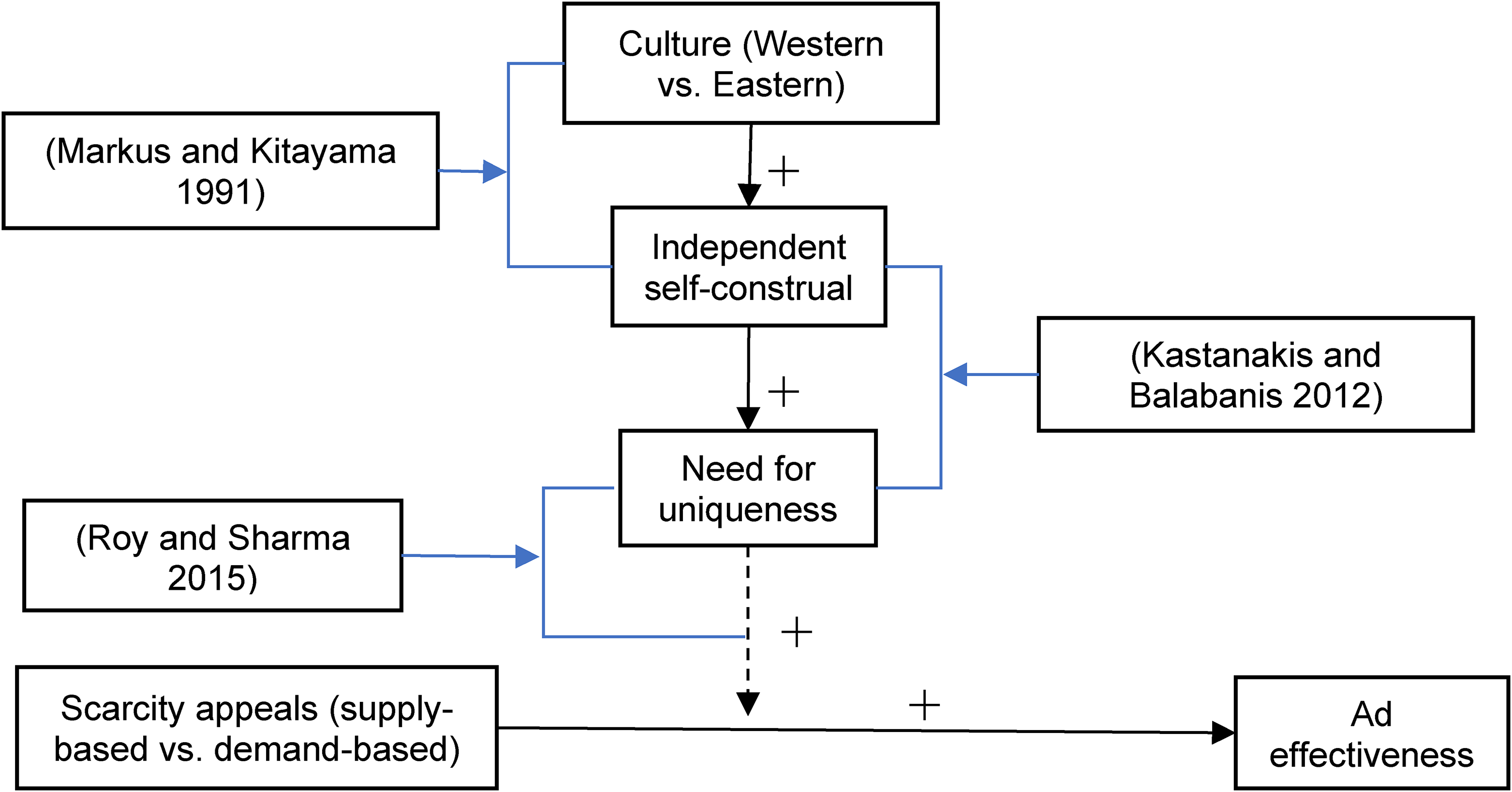
Conceptual Model Explaining the Moderating Effect of Culture Through Self-Construals and NFU.
SNI, Culture, and Scarcity Appeals
Social influence is one of the most powerful determinants of consumer behavior. It affects consumer choice during decision making (e.g., Cohen and Golden 1972; Kassarjian and Robertson 1981; Khare et al. 2011; Moscovici, Mugny, and Van Avermaet 1985; Sherif 1935). Social influence is generally called conformity, an act of going along with a visible majority (Jahoda 2016). It can be measured through normative influence (Burnkrant and Cousineau 1975).
Bearden, Netemeyer, and Teel (1989) provide a scale developed to measure susceptibility to social influence through a construct of “susceptibility to interpersonal influence.” Susceptibility to interpersonal influence is further categorized as informational or normative (Bearden, Netemeyer, and Teel 1989). SNI is defined as “influence to conform to the expectations of another person or group” (Burnkrant and Cousineau 1975, p. 207). Susceptibility to informational influence is “an influence to accept information obtained from another as evidence about reality” (Deutsch and Gerard 1955, p. 629). Informational influence depends on the receiver's judgment about the credibility of information, whereas normative influence implies social pressure to conform to the expectations of social groups (Deutsch and Gerard 1955; Filieri 2015). Research suggests that SNI indicates cross-cultural differences, but susceptibility to informational influence does not differ across cultures (see Mourali, Laroche, and Pons 2005, p. 169). For instance, Ebren (2009) finds a direct negative impact of individualism on SNI but does not find any significant effect of individualism on susceptibility to informational influence.
Similarly, Mourali, Laroche, and Pons (2005) find that Western orientation has a negative influence on SNI, whereas they do not find any significant effect of individualistic orientation on susceptibility to informational influence. Oh (2013) specifically find that SNI is higher in Eastern cultures, whereas susceptibility to informational influence does not differ across cultures. Therefore, they suggest that cross-cultural differences only exist in the case of normative influence and not in the case of informational influence. Thus, in this research, we only take SNI into account.
Thus, the cross-cultural variations of SNI may also indicate cross-cultural variations in bandwagon consumption, which in turn may increase the effectiveness of demand-based versus supply-based scarcity appeals. Moreover, relational bandwagon consumption enhances interdependent self-construal, which is mediated by SNI (Kastanakis and Balabanis 2012).
Based on this discussion, we postulate that SNI would increase the effectiveness of demand-based scarcity appeals and decrease the effectiveness of supply-based scarcity appeals. Our research extends the cross-cultural research of Mourali, Laroche, and Pons (2005) and Yim et al. (2014) by using the SNI construct used by Kastanakis and Balabanis (2012) to understand its moderating effect on the effectiveness of scarcity appeals in cross-cultural settings. To the best of our knowledge, SNI has never been studied in the context of scarcity appeals. Thus, studying the moderating effect of SNI will further extend the framework to an understanding of the effect of demand- versus supply-based scarcity appeals (Figure 2).
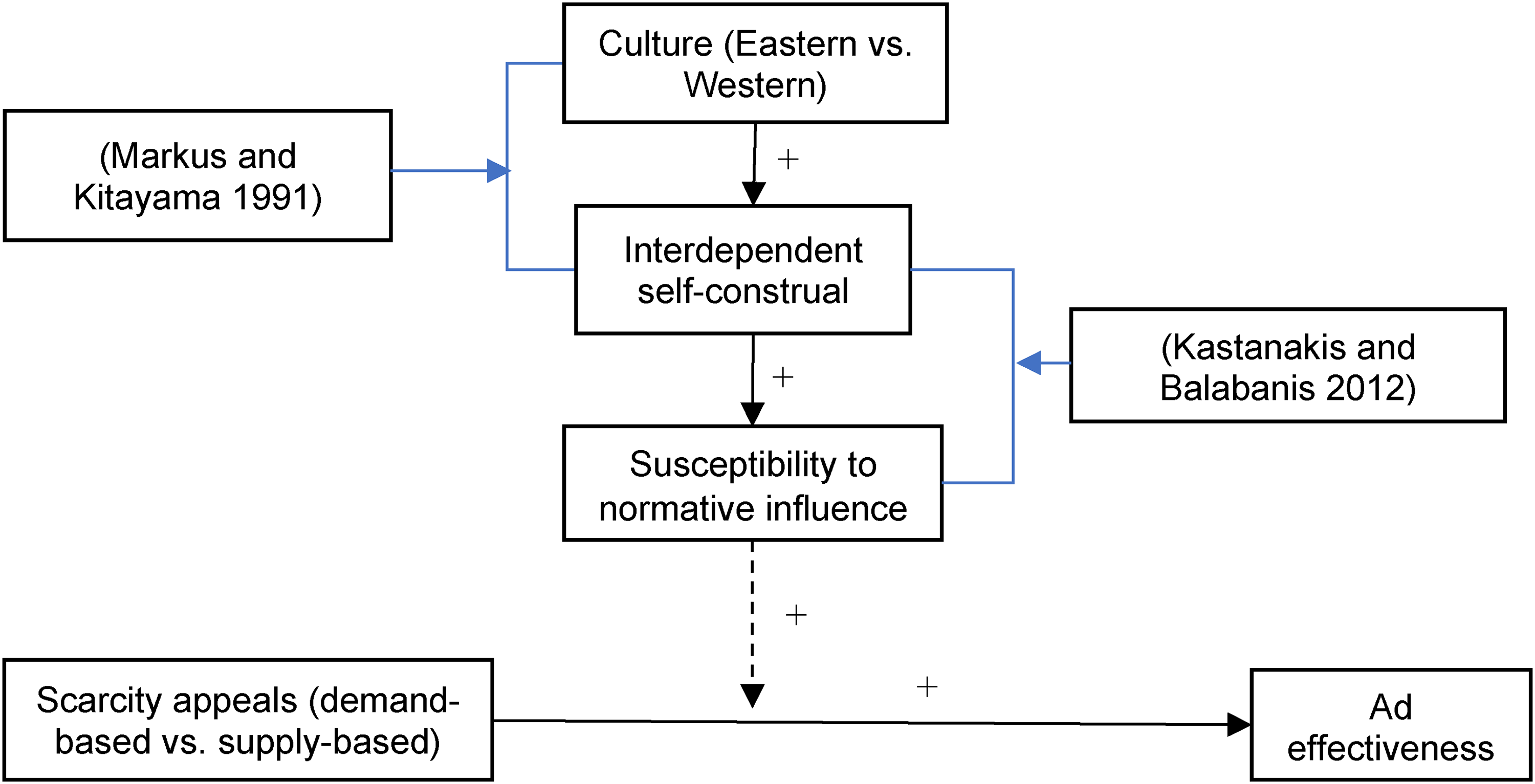
Conceptual Model Explaining the Moderating Effect of Culture Through Self-Construals and SNI.
Altogether, our preceding discussion of the theoretical background and framework leads to the following hypothesis, which postulates the serial mediation of the moderating effect of culture, such that the moderating effect of culture (Eastern vs. Western) is mediated by serial mediation of interdependent self-construal versus independent self-construal, SNI, and NFU.
In Eastern cultures, interdependent self-construal prevails over independent self-construal (H2a), whereas the reverse occurs in Western cultures (H2b). SNI and NFU moderate the effectiveness of scarcity appeals in opposite directions: SNI favors higher effectiveness of demand-based rather than supply-based scarcity appeals (H2c), whereas NFU favors higher effectiveness of supply-based rather than demand-based scarcity appeals (H2d). The prevalence of interdependent (vs. independent) self-construal favors (vs. limits) SNI (H2e), but limits (vs. strengthens) NFU (H2f), and thus moderates the effectiveness of scarcity appeals, leading to higher (vs. lower) effectiveness of demand-based rather than supply-based scarcity appeals (H2g). Altogether, the preceding parts of this hypothesis suppose a serial mediation of the moderating role of culture (see Figure 3): culture exerts an indirect moderating effect on the effectiveness of scarcity appeals via the prevalence of interdependent (vs. independent) self-construal and its impact on both SNI and NFU (H2h).
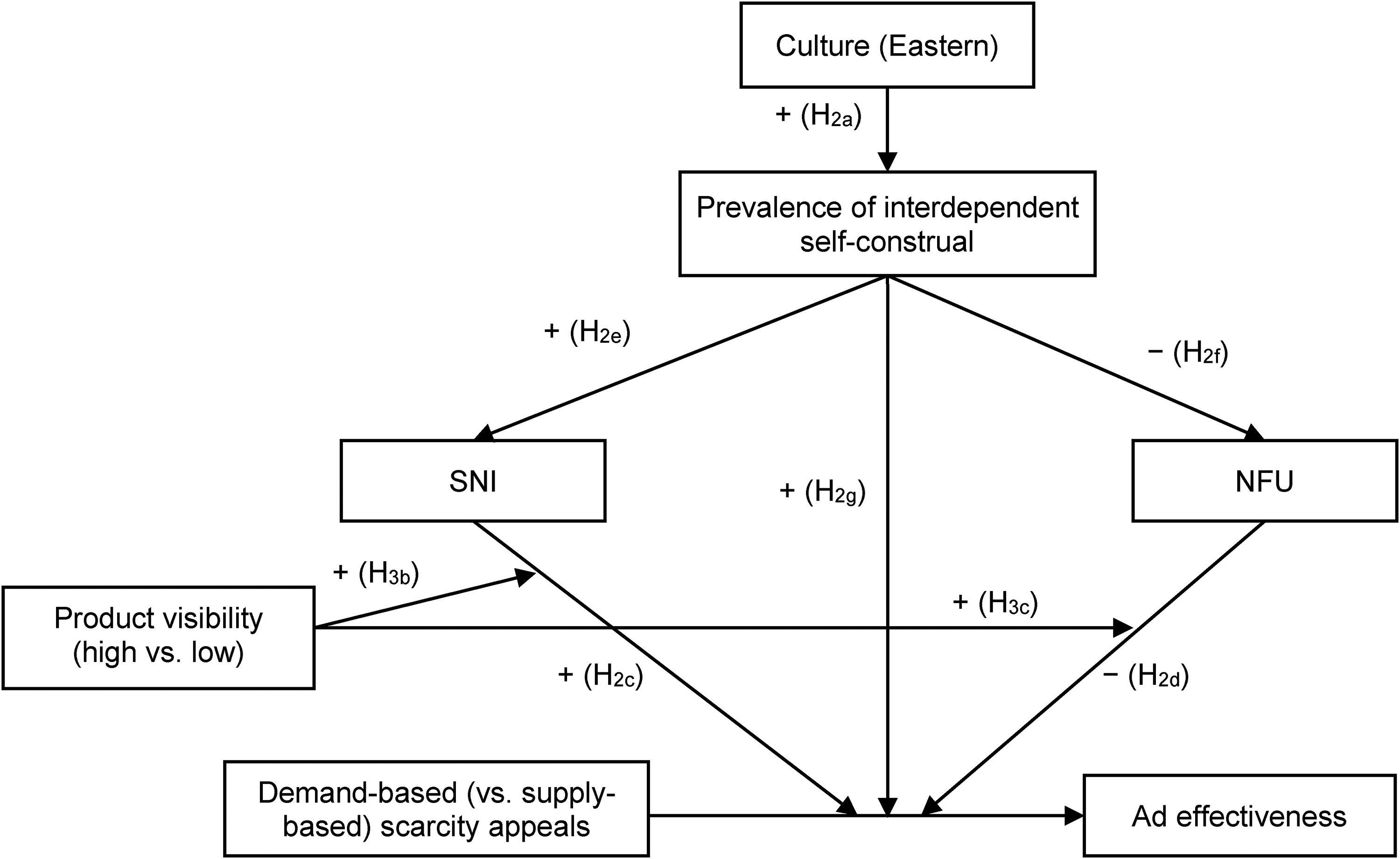
Chain Mediation of the Moderating Role of Culture.
Product Visibility, Culture, and Scarcity Appeals
Research suggests that situational factors can affect consumers’ behavioral intentions (e.g., Belk 1975; Bourne 1957; Dickson 1982; Stayman and Deshpande 1989). Product visibility is a situational factor that may affect consumers’ behavioral intentions. It refers to “the consumption of items that are readily observable in anonymous social interactions, and that are portable across those interactions” (Charles, Hurst, and Roussanov 2009, p. 426). The consumption of products ranges from high visibility to low visibility (Gierl and Huettl 2010; Jang et al. 2015). For example, toothpaste, shampoo, soap, and perfumes are low-visibility products, whereas mobile phones, cars, sunglasses, clothes, and handbags are examples of high-visibility products.
Literature suggests that product visibility is one of the factors that enhances conformity and the effect of social influence on product or brand choice (Bourne 1957; Fisher and Price 1992; Lascu and Zinkhan 1999). This is because normative social influence is achieved through compliance, and compliance will only occur if the consumer believes that their behavior is visible or known to others (Burnkrant and Cousineau 1975). Moreover, the degree to which a consumer believes that the consumption of a product is socially visible enhances the effects of social influence on purchase intentions (Graeff 1996).
Apart from conformity, product visibility is also related to NFU. According to uniqueness theory, NFU is based on counterconformity motivation, which refers to “a motivation for differentiating the self via consumer goods and the visual display of these goods” (Tian, Bearden, and Hunter 2001, p. 52). This suggests that the underlying goal of NFU is to enhance the social image, which can only occur by displaying the consumption or use of products. Since consumers with high NFU try to differentiate themselves through product choices that are exclusive and highly visible, they are more likely to purchase high-visibility products over low-visibility products.
Based on the literature mentioned previously, we can say that the visibility of the behavior makes the motivation to conform or differentiate salient. It also suggests that the previously proposed moderating effect of SNI and NFU on the effectiveness of scarcity appeals (demand vs. supply) may vary depending on the product's visibility. Specifically, it supports the view that the influence of both moderating variables will be stronger when the product's visibility is high than when it is low (Bourne 1957; Burnkrant and Cousineau 1975; Fisher and Price 1992; Graeff 1996; Lascu and Zinkhan 1999; Tian, Bearden, and Hunter 2001). Despite the substantial conceptual foundation for this view, it has not been empirically tested in cross-cultural settings regarding scarcity appeals. Considering these foundations, we propose the following:
Methodology
This research is based on 2 (culture: Western vs. Eastern) × 2 (product visibility: high vs. low) × 2 (scarcity appeal: demand vs. supply) between-subjects experimental design, resulting in eight experimental conditions in which participants were randomly assigned (except for culture). The sample of this research is based on one country representing Western cultures and one country representing Eastern cultures: France and Pakistan, respectively. As this study relates to two different products (high and low visibility), initially, a pretest was carried out to select products based on their respective visibility, after which the actual experiment was conducted.
Pretest: Product Selection
A pretest was carried out to select two products characterized by high versus low visibility. We recruited adults at shopping malls, bus stands, and railway stations and offered them compensation for their participation. Our sample for the pretest consisted of 40 participants (20 from France and 20 from Pakistan). The sample was strictly balanced on gender and included consumers ranging from 20 to 39 years of age. We classified education into two categories: university education (bachelor’s degree, master’s degree, and PhD/doctorate) and education below the university degree (no diploma, high school diploma, and associate degree). All the Pakistani respondents selected had a university education, while 18 of 20 French respondents had a university education.
We used 15 categories to capture the profession of respondents. We coded these professions according to the INSEE (Institut National de la Statistique et des Études Économiques, or National Institute of Statistics and Economic Studies) typology of socioprofessional categories (PCS), which categorizes professions into lower (PCS−) and upper (PCS+) classes. Among the Pakistani participants included in the study, 40% were in the PCS+ category (public or private sector senior executives, liberal professions, high intellectual professions, police [senior]) and 60% were in the PCS− category (intermediate professions, farmers, craftspeople, workers, employees, shopkeepers, police, housewife/househusband, people searching for a job, and students). In contrast, 35% of French participants were in the PCS+ category, and 65% were in the PCS− category.
First, we defined visibility as follows: “Product visibility refers to the fact that others can easily see a product and know its brand when someone uses it.” Then, participants were asked to rate the visibility of 17 products (see Table 1) issued by Gierl and Huettl (2010) and Jang et al. (2015). Responses were collected on 11-point scales (0 = “very low visibility,” and 10 = “very high visibility”).
Means (Standard Deviations) of Product Visibility Across Countries.

Ratings indicated that the automobile was perceived as the most visible and the MP3 player was perceived as the least visible among the products (see Table 1). However, given that the research considers purchase intent as an essential output, we needed to select two products that significantly differ in visibility but are priced similarly, avoiding obvious bias. So, we decided to select a shirt (high visibility: M = 7.35) and perfume (low visibility: M = 4.82; t(39) = 3.66, p < .001), which meet this condition. In addition, the respective visibility of these two products did not significantly vary as a function of culture (high visibility: t(38) = .824, p = .415; low visibility: t(38) = −1.73, p = .098), which is an obvious prerequisite.
Participants, Design, and Procedure
The research participants were between 24 and 35 years of age. The choice was guided by the learning that market-based reports about perfumes and clothes suggest that this age group contributes the most to the markets of both products (Future Market Insights 2023; Global Data Report Store 2017; Mintel 2016, 2022; Statista 2022a, b).
The random sample approach was adopted to collect the data from both countries using face-to-face questionnaires. Questionnaires were administered in English (original version) in Pakistan and in French in France, using the translation–back translation method with native speakers. Data were collected from two cities in France (Aix-en-Provence and Marseille) and one city in Pakistan (Karachi). The participants were recruited at shopping malls, bus stands, and railway stations and were offered compensation for their participation.
The total sample includes 417 participants, 211 from France and 206 from Pakistan. Four demographics were considered: gender, age, education, and socioprofessional class. In the total sample, 223 of the participants were male and 194 were female. By country, 133 participants were male and 73 were female in Pakistan, whereas 90 were male and 121 were female in France. In the sample from Pakistan, most of the respondents were 25 to 29 years of age (54% of total respondents), whereas in the French sample, most of the respondents were 30 to 34 years of age (33% of total respondents). We classified participants in terms of education into two categories: university education (bachelor’s degree, master’s degree, and PhD/doctorate) and education below the university degree (no diploma, high school diploma, and associate degree). Most of the participants had a university education in both countries (i.e., in Pakistan, 175 participants had a university education, and the remaining 31 participants had below university education; in France, 181 participants had a university education, and the remaining 30 participants had below university education). We used 15 categories to capture the profession of respondents (Table 2), coded according to the INSEE typology of socioprofessional categories. Study 1 includes 31% PCS+ respondents (public or private sector senior executives, liberal profession, high intellectual professions, police [senior] 1 ) and 69% PCS− respondents across the two countries. In Pakistan and France, 73% and 65% of respondents were in the PCS− category, respectively.
Socioprofessional Class Distribution Across Countries.

We used an experimental research design. In line with Roy and Sharma’s (2015) procedure, we used different scenarios to manipulate product visibility and scarcity appeal. On the one hand, participants were asked to imagine “you want to buy a perfume [a casual shirt], and you are looking around in the market. You do not have any preference regarding the brand. Suddenly, you see an advertisement for an Italian brand, ‘Fabio Lorenzi’, at one of the perfume [shirt] stores, which has newly joined the Pakistani [French] market.” Next, participants were presented with a print ad (see the Web Appendix) about a high-visibility product (that is, a shirt, N = 200) or a low-visibility product (that is, a perfume N = 217). In both cases, we used a fictitious Italian brand called “Fabio Lorenzi” that was supposed to have been launched recently. The choice of an Italian brand aimed to limit a possible ethnocentric bias resulting from a country-of-origin effect (see, e.g., Balabanis and Diamantopoulos 2004), especially for French participants, given that there are many French brands in both the perfume and shirt markets. Based on Roy and Sharma’s procedure, scarcity appeals were manipulated by explicitly pointing out high demand for the product (N = 203) versus limited product distribution (N = 214). The English versions of the print ads were given to Pakistani respondents, and the French versions of the print ads were given to the French participants. In the English version, in the first case (demand-based scarcity), the ad stated that “Almost all the stock is already sold “and “Only few copies of this perfume [shirt] are still available.” In the second case (supply-based scarcity), the ad stated, “Very limited distribution” and “Perfume [shirt] in exclusive sale in a very small number of selected stores.” Other elements were held constant across conditions (e.g., color, font, picture, logo, and brand claim). In the French version, the ad in the first case (demand-based scarcity) stated “Quasi-totalité des stocks déjà vendue” and “Seulement quelques exemplaires de ce parfum [ces chemises], encore disponibles.” In the second case (supply-based scarcity), the ad stated, “Distribution très limitée” and “Parfum [chemises] en vente exclusive dans un très petit nombre de boutiques sélectionnées” (see the Web Appendix).
Measures and Manipulation Checks
After participants were exposed to the ad print, four measures captured the effectiveness of the ad: (1) attitude toward the ad, (2) attitude toward the brand, (3) perceived value, and (4) intent to purchase the advertised product. Then, interdependent and independent self-construals, NFU, SNI, and product involvement were measured.
Monroe (1973) suggests that price influences consumers’ choice because, to a consumer, it indicates the cost of purchasing. Therefore, price perception was measured, using an item adapted from Urbany et al. (1997). To do so, participants were asked to rate the price of the advertised product on an 11-point scale (0 = “Affordable,” and 10 = “Expensive”). In the end, participants were individually debriefed about the study's objectives. Unless otherwise specified, all ratings were collected on 11-point scales (0 = “totally disagree,” and 10 = “totally agree”).
Dependent variable
Ad effectiveness was the dependent variable in this study. According to Brown and Stayman (1992), we considered attitude toward the ad and attitude toward the brand as two major indicators of ad effectiveness. These two constructs were measured by rating both the ad and the brand on three items issued by Roy and Sharma (2015): “interesting,” “attractive,” and “favorable.” Given that scarcity may increase the perceived value of products (Eisend 2008; Lynn 1991, 1992), the perceived value of the advertised product was also measured using three items from Eisend (2008): “attractive,” “favorable,” and desirable.” Besides, we considered purchase intentions to get a conative measure of brand effectiveness, which is regarded as more predictive of actual behaviors than attitudinal measures (see, e.g., Ajzen and Fishbein 1977; Webb and Sheeran 2006). To do so, we used Juster’s (1966) probability scale to measure the intent to purchase the advertised product on an 11-point scale (0 = “no chance, almost no chance (1 in 100),” and 10 = “certain, practically certain (99 in 100).” Such a scale that associates each point with both a statement and a probability offers higher validity and better predicts behavior, compared with other scales (Brennan and Esslemont 1994; McDonald, Karg, and Lock 2010).
Control variables
Participants’ independent and interdependent self-construals were each measured by six items from Singelis’s (1994) scale. Apart from that, participants’ NFU was measured using items issued from the scale developed by Ruvio, Shoham, and Makovec Brenčič (2008). Furthermore, the six items forming the subscale of SNI developed by Bearden, Netemeyer, and Teel (1989) were used to measure this construct. We also measured product involvement using items issued by Roy and Sharma (2015) to control for this variable that has been found to influence attitude toward the ad and the brand (e.g., Vakratsas and Ambler 1999). For details, refer to Table 3.
Constructs, Full Phrasing of Items, Coding, and Authors.

Manipulation checks
We checked the manipulation of product visibility by asking participants to rate the visibility of the advertised product (perfume vs. shirt) on an 11-point scale (0 = “low visibility,” and 10 = “high visibility”). All participants rated two items to check the manipulation of scarcity: one for demand-based scarcity: “the advertised product seems to be highly demanded,” and one for supply-based scarcity: “there seems to be limited supplies of the advertised product.”
Analysis and Results
Measurement Model
Cross-cultural measurement invariance
To make a meaningful comparison between France and Pakistan, we tested measurement invariance. The test of measurement invariance tests the equivalence of constructs in two or more groups to ensure that the constructs are being assessed the same in each group (Chen, Sousa, and West 2005). To test whether our measurement model of latent variables is equivalent in France and Pakistan, we considered three levels of measurement invariance: configural invariance, metric invariance, and scalar invariance.
Configural invariance and model respecifications
Configural invariance is a test of the null hypothesis pertaining to confirming that the pattern of free and fixed parameters imposed on the items (i.e., observed variables) is equivalent across groups (Horn and McArdle 1992). This test aims to measure that the same constructs (latent variables) are measured across the groups.
Hu and Bentler (1999) suggest that the values of the Tucker–Lewis index (TLI) and comparative fit index (CFI) greater than .95 indicate a good model fit. They further suggest that root mean square error of approximation (RMSEA) less than .06 and standardized root mean square residual (SRMR) less than .08 reveal a good fit. Our first model (Model 1) did not meet these criteria (see Table 4). Therefore, we performed successive respecifications of the initial model by deleting items that did not load enough of the considered latent variable. According to Comrey and Lee (1992), the cutoff value was fixed to loading not greater than .70 in both samples. However, we kept at least three items per latent variable, as recommended (Hair et al. 2016; Little, Lingenberger, Nesselroade 1999; MacCallum et al. 1999; Raubenheimer 2004). Table 4 presents items that were successively dropped and the fit indices of the related model. On the basis of this procedure, five items were dropped to improve model fit (see Table 4). Specifically, the dropped items are Its6, Its3, Ids6, Sni3, and Sni6. The full questions for these items are given in Table 3.
Fit Indices for the Measurement Model and Respecifications.

Notes: “Its” represents items of interdependent self-construal. “Sni” represents items of susceptibility to normative influence. “Ids” represents items of independent self-construal.
Lastly, as Byrne (2013) suggested, we also improved the measurement model by adding correlations among some residual errors of items related to the same latent variable. Two correlations were added, on the one hand, between measurement errors of Ids 2 and Ids3 (items of independent self-construal) (Model 3) that were positively correlated for both Pakistan and France and, on the other hand, between measurement errors of Its1 and Its2 (items of interdependent self-construal) (Model 4) that were positively correlated for both Pakistan and France. Model 4 met all cutoff criteria suggested by Hu and Bentler (1999): TLI was .952, CFI was .959, RMSEA was .029, and SRMR was .0523, indicating that configural invariance was achieved.
After comparing the models, we checked for convergent and discriminant validity. We assessed convergent validity on the bases of Joreskog’s (1971) rho and average variance extracted (AVE) from Fornell and Larcker (1981). Ringle, Sinkovics, and Henseler (2009) suggest that the AVE should be above .50 to achieve sufficient convergent validity. Table 5 indicates that all the latent variables met these criteria in both countries, except the AVE of SNI in Pakistan, which was .44. However, given that AVE is a very conservative test, some values greater than .40 can be acceptable (Malhotra and Dash 2011).
Convergent and Discriminant Validity for Pakistan (France).
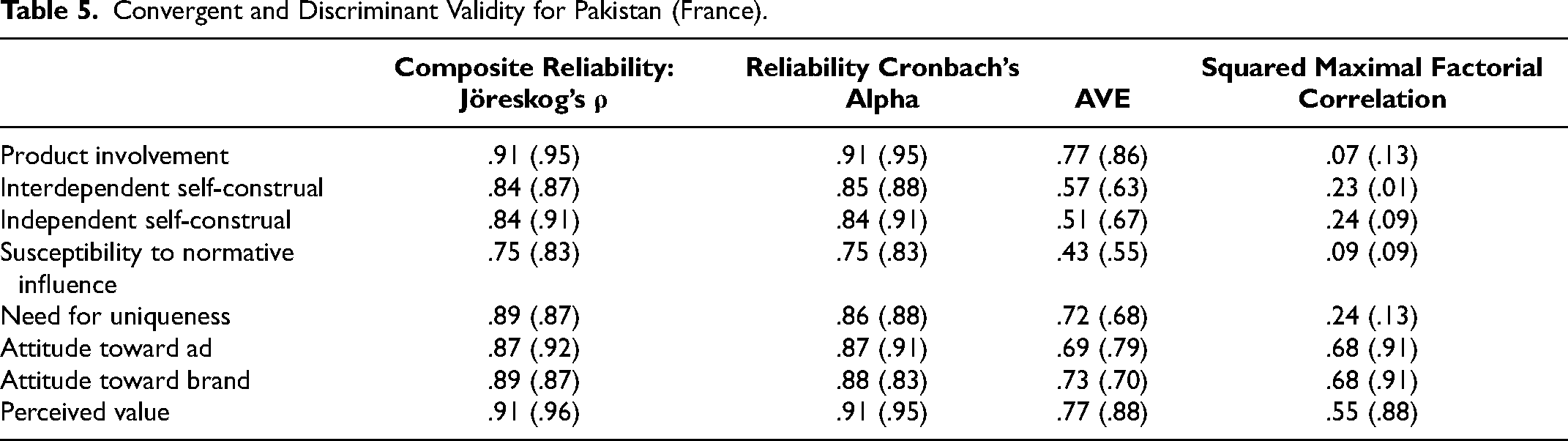
In addition, according to Fornell and Larcker (1981) discriminant validity is achieved when all squared correlations among latent variables are lower than the AVE. Table 5 indicates that this was not the case with attitude toward the ad, attitude toward the brand, and perceived value in the French sample. Similarly, for the French sample (see Table 6), the heterotrait–monotrait ratios, which constitute approximate correlations among latent variables, were greater than .85, with respect to relationships among attitude toward the ad, attitude toward the brand, and perceived value. As Henseler, Ringle, and Sarstedt (2015) suggest, such a pattern revealed that discriminant validity was not achieved in the French sample due to collinearity among these three latent variables. We fixed that problem by grouping these three latent variables related to ad effectiveness onto a second-order factor (Model 5) as ad responses using the method suggested by Kock and Lynn (2012). This second-order factor was named “ad responses.” Model 5 achieved a good fit, meeting all cutoff values suggested by Hu and Bentler (1999), indicating that configural invariance was achieved, (see Table 4).
Heterotrait–Monotrait Ratio for Pakistan (France).

The convergent validity of ad responses was achieved in both countries, with the rho value above .70 and AVE above .50 (see Table 7). Furthermore, discriminant validity was also achieved: all squared correlations among latent variables were lower than the AVE (see Table 7), and all heterotrait–monotrait ratios were below .85 (see Table 8).
Convergent and Discriminant Validity of Model 5 for Pakistan (France).

Heterotrait–Monotrait Ratio in Model 5 for Pakistan (France).

Metric invariance and scalar invariance
Metric invariance implies that the difference in an item associated with a latent variable indicates the same differences across the groups (Rudnev et al. 2018). It is verified when the factor loadings are equivalent across groups. Model 6, which constrained all loadings to be equivalent across groups (full metric invariance), met Hu and Bentler’s (1999) cutoff values (see Table 9). However, Model 6 fit the data worse than Model 5 (configural invariance), indicating that full metric invariance was not achieved. Thus, according to Byrne, Shavelson, and Muthén (1989), we relied on partial metric invariance. Model 7 represents the partial metric invariance in Table 9.
Model Fit and Model Comparisons for Testing Metric and Scalar Invariance.

We also tested scalar invariance. Scalar invariance relates to the equivalence of intercepts across groups (Widaman and Reise 1997). It is achieved when constraining the intercepts of observed variables (factors) for first-order (second-order) latent variables does not significantly decrease the model fit. Model 8 (scalar invariance), which constrains all intercepts to be equivalent across groups, fits the data well, but worse than Model 7 (see Table 9). This indicates that scalar invariance is not achieved. Therefore, as recommended by Byrne, Shavelson, and Muthén (1989), we relied on partial scalar invariance. Model 9 in Table 9 shows that partial scalar invariance is achieved.
Structural Model
Manipulation checks
First, we ran a 2 (culture: France vs. Pakistan) × 2 (scarcity appeal: demand-based vs. supply-based) × 2 (product visibility: low vs. high) between-group general linear model (GLM) on manipulation checks of scarcity appeals and product visibility, controlling for the effects of gender, age group, socioprofessional class, and product involvement. On one hand, this model shows that the supply of the advertised product was regarded as more limited when scarcity appeals were supply based (M = 6.46, SD = 2.48) rather than demand based (M = 4.69, SD = 2.25; F(1, 405) = 60.82, p < .001, partial η2 = .13), whereas the perceived demand for the advertised product was seen as higher when scarcity appeals were demand based (M = 6.45, SD = 2.32) rather than supply based (M = 4.16, SD = 2.46; F(1, 405) = 102,27, partial η2 = .20). The values of partial η2 indicate that the effect size was larger in the condition of demand-based scarcity appeals (partial η2 = .20) compared with supply-based scarcity appeals (partial η2 = .13). On the other hand, it confirmed that the product visibility was higher for shirts (M = 6.25, SD = 2.06) than for perfumes (M = 4.26, SD = 2.41; F(1, 405) = 82.93, p < .001, partial η2 = .17). No significant effect of culture (including possible interactions) was observed (Fs < 2), indicating that the effectiveness of manipulations did not vary across culture. Thus, the manipulation of scarcity appeals and product visibility was successful in both cultures. No other effect reached significance (Fs < 3), except product involvement, which was positively related to limited supply (β = .25, t = 3.85, p < .001, partial η2 = .04), to demand prominence (β = .25, t = 3.62, p < .001, partial η2 = .03), and to product visibility (β = .19, t = 3.15, p < .001, partial η2 = .02). This pattern of results suggested that involved consumers pay more attention to information related to the advertised product (see, e.g., Dholakia 1997), and overestimate product visibility because they consider the product category as a means of self-expression (Michaelidou and Dibb 2006). In addition, the results related to price revealed that the mean of price perception in Pakistan was 4.41 (SD = 2.62) and the mean in France was 4.02 (SD = 2.47), and the difference between these two countries was not significant (p = .124), suggesting that the price perception in both countries was almost the same.
Ad responses
A similar between-group GLM was performed on composite scores of ad responses, controlling for the effects of gender, age group, socioprofessional class, and product involvement (here, higher scores indicate higher ad response). This model (see Table 10) revealed that ad responses were positively related to product involvement (β = .16, t = 3.98, p < .001, partial η2 = .04), but they were negatively related to age group (β = −.10, t = −2.16, p < .04, partial η2 = .01), suggesting that involved and younger consumers were more prone to accept new brands and products. Moreover, we controlled product involvement because product involvement can influence consumers’ attitude toward brand and advertisement, as Roy and Sharma (2015) suggest. The effects of gender and socioprofessional class did not reach significance (Fs < 3).
Mean and Standard Deviation of Ad Response as a Function of Culture, Scarcity Appeal, and Product Visibility.

Covariates appearing in the model are evaluated at the following values: gender = 1.47, age = 2.22, socioprofessional category = 2.38, product involvement = 5.92.
Although overall ad responses were more favorable among Pakistani (M = 5.40) rather than French (M = 4.34) consumers (F(1, 405) = 33.96, p < .001, partial η2 = .08), the two-way interaction of culture and scarcity appeals also reached significance (F(1, 405) = 35.20, p < .001, partial η2 = .08). Using the partial η2 as the measure of effect size, the interaction between scarcity appeals and culture accounted for 8% of the total variability in the ad response. Indeed, in France, supply-based scarcity (M = 4.97) was more effective than demand-based scarcity (M = 3.71; t = 5.12, p < .001), confirming H1a. Conversely, in Pakistan, demand-based scarcity (M = 5.80) was more effective than supply-based scarcity (M = 4.99; t = 2.91, p < .01), supporting H1b.
As predicted, the three-way interaction was significant (F(1, 405) = 6.84, p < .01, partial η2 = .02), indicating that product visibility moderated the interaction of scarcity appeals and culture. The value of partial η2 indicates that the three-way interaction between the culture, the product visibility, and the scarcity appeal accounted for 2% of the total variability in the ad response. Indeed, planned contrasts showed that such two-way interaction reached significance for both high-visibility (t = 5.77, p < .001, partial η2 = .09) and low-visibility visible (t = 2.38, p < .02, partial η2 = .01). However, this interaction was stronger when product visibility was high rather than low (t = 6.30, p < .001), supporting H3a. All other effects did not reach significance (Fs < 3).
Purchase intentions
A similar between-group GLM was run on purchase intentions (Table 11), which provided a complementary measure for the effectiveness of scarcity appeals: the higher the intent to purchase, the higher the effectiveness of the scarcity appeals. Similar to ad response, intent to purchase was positively related to product involvement (β = .17, t = 2.35, p < .02, partial η2 = .01), whereas the effects of gender, age group, and socioprofessional class did not reach significance (Fs < 3).
Mean and Standard Deviation of Purchase Intent as a Function of Culture, Scarcity Appeal, and Product Visibility.

Covariates appearing in the model are evaluated at the following values: gender = 1.47, age = 2.22, socioprofessional category = 2.38, product involvement = 5.9150.
Overall, purchase intentions were higher with respect to Pakistani consumers (M = 5.46) compared with French consumers (M = 3.93; F(1, 405) = 37.06, p < .001, partial η2 = .08). In addition, the main effect of scarcity appeals (F(1, 405) = 5.33, p < .03, partial η2 = .01) revealed that supply-based scarcity appeals (M = 4.97) were more effective than demand-based scarcity appeals (M = 4.41). However, as predicted, the two-way interaction between culture and scarcity appeals reached significance (F(1, 405) = 35.70, p < .001, partial η2 = .08). The measure of effect size indicates that the interaction between scarcity appeals and culture accounted for 8% of the total variability in the purchase intention. Such interaction indicates that in France, supply-based scarcity (M = 4.92) was more effective than demand-based scarcity (M = 2.93; t = 5.79, p < .001), confirming H1a. In contrast, in Pakistan, demand-based scarcity (M = 5.90) was more effective than supply-based scarcity (M = 5.02; t = 2.16, p < .03), supporting H1b.
As predicted, the three-way interaction was significant (F(1, 405) = 8.77, p < .01, partial η2 = .02), confirming that product visibility moderated the interaction of scarcity appeals and culture. The partial η2 indicates that the three-way interaction between the culture, the product visibility, and the scarcity appeals accounted for 2% of the total variability in the purchase intention. Planned contrasts show that such two-way interaction reached significance for both high-visibility (t = 6.06, p < .001, partial η2 = .10) and low-visibility products (t = 2.02, p < .05, partial η2 = .01). However, this interaction was stronger when product visibility was high rather than low (t = 6.37, p < .001), supporting H3. All other effects do not reach significance (Fs < 3).
The findings on ad response and intent to purchase were similar and provided significant support for both H1 and H3.
Mediation of the moderating role of culture
First, one-way analyses of variance controlling for product involvement, gender, age group, and socioprofessional class indicated that Pakistani consumers (M = 7.58, SD = 1.64) reported higher interdependent self-construal than French consumers (M = 6.05, SD = 1.47; F(1, 411) = 89.55, p < .001, partial η2 = .18), whereas the reverse was found for reported independent self-construal (respectively, M = 5.75, SD = 1.66 vs. M = 6.27, SD = 1.87; F(1, 411) = 8.53, p < .01, partial η2 = .02). Given that the hypotheses relate to the prevalence of one self-construal over the other one, the composite score of independent self-construal was subtracted from the composite score of interdependent self-construal to create a new variable that captured the prevalence of interdependent self-construal. A one-way analysis of variance indicated that such prevalence was stronger among Pakistani consumers (M = 1.83, SD = 1.59) than among French consumers, who tend to favor independent self-construal (M = −.22, SD = 2.31; F(1, 411) = 99.59, p < .001, partial η2 = .20), supporting H2a and H2b respectively.
Consistently, SNI was higher among Pakistani consumers (M = 5.45, SD = 1.32) than among French consumers (M = 3.44, SD = 1.63; F(1, 411) = 247.45, p < .001, partial η2 = .38), whereas the reverse was found regarding NFU (respectively, M = 4.90, SD = 1.64 vs. M = 5.79, SD = 1.87; F(1, 411) = 41.09, p < .001, partial η2 = .09). As predicted, the prevalence of interdependent self was positively related to SNI (rbp = .43, p < .001), but it was negatively related to NFU (rbp = −.23, p < .001), thus supporting H2e and H2f.
Then, a path analysis was conducted to further investigate such relationships and their impact on ad response and purchase intentions. To do so, culture and scarcity appeals were contrast-coded (respectively: −1 for France vs. +1 for Pakistan, and −1 for supply-based appeals vs. +1 for demand-based appeals). Next, the interaction term (i.e., the product of culture and scarcity appeal) was residual-centered to orthogonalize main and interaction effects, as Little, Bovaird, and Widaman (2006) recommend. Residual-centering was also applied to interaction terms implying culture and each of the following three numerical variables: SNI, NFU, and prevalence of interdependent self-construal. In addition, according to Hayes (2009), 5,000 bias-corrected bootstraps were performed to determine 95% confidence intervals around total, direct, and indirect effects and to estimate their significance. This path analysis confirmed that culture moderates the effect of scarcity appeals on both ad responses (γ = .15, p < .001) and intentions (γ = .15, p < .001), supporting H1: as predicted, Eastern cultures increased the effectiveness of demand-based appeals at the expense of supply-based appeals. SNI and NFU also moderated the impact of scarcity appeals on both ad responses (respectively: γ = .21, p < .001, and γ = −.08, p < .05) and purchase intentions (respectively: γ = .17, p < .001, and γ = −.18, p < .001), confirming H2c and H2d. As predicted, these two moderations operated in opposite directions: SNI increased the effectiveness of demand-based appeals at the expense of supply-based appeals, whereas the reverse was found with regard to NFU. In addition, the prevalence of interdependent self-construal favored SNI (γ = .39, p < .001), but limited NFU (γ = −.30, p < .001), supporting H2e and H2f. Consequently, the moderating role of the prevalence of interdependent self-construal reached significance for ad responses (γ = .13, p < .01) and purchase intentions (γ = .12, p < .01), supporting H2g: the prevalence of interdependent self-construal increased the effectiveness of demand-based appeals at the expense of supply-based appeals (Figure 4).

Standardized Regression Weights in Path Analysis of the Impact of Scarcity Appeal on Ad Responses and Purchase Intentions.
Based on these findings, the indirect moderating effect of culture on the effectiveness of scarcity appeal, via the prevalence of interdependent self and its impact on both SNI and NFU, was tested using bootstrapping (Table 12). This indirect moderating effect achieved significance for ad responses (γ = .10, p < .02) and purchase intentions (γ = .08, p < .03), confirming H2h. As the direct moderating effect of culture was also significant with regard to ad responses (γ = .15, p < .01) and purchase intentions (γ = .15, p < .01), this pattern of results indicates partial mediation of the moderating role of culture. More particularly, on the one hand, Eastern cultures directly increased the effectiveness of demand-based appeals at the expense of supply-based appeals. On the other hand, Eastern cultures fostered a prevalence of interdependent self-construal that, in turn, favored SNI, which increased the effectiveness of demand-based appeals, but limited NFU, which increased the effectiveness of supply-based appeals. Thus, these two additive effects strengthened the effectiveness of demand-based scarcity appeals. In other words, these findings suggest that the moderating role of culture partially resulted from a serial mediation, with the first level related to the prevalence of interdependent (vs. independent) self-construal and the second level related to its positive (vs. negative) impact on SNI but negative (vs. positive) impact on NFU. Finally, the model predicted well both ad responses (R2 = .37) and purchase intentions (R2 = .46).
Estimates (with 95% Confidence Intervals) of Standardized Total, Direct, and Indirect Effects of the Moderating Role of Culture on Ad Responses and Purchase Intentions.

*p < .05. **p < .01. ***p < .001.
The moderating effect of product visibility on the moderating effect of SNI and NFU
Another path analysis was conducted to investigate the moderating effect of product visibility on the moderating effect of SNI and NFU on ad effectiveness. In the case of ad response, the findings indicated the moderating effect of SNI and NFU was moderated by product visibility (respectively, γ = .18, p < .01, and γ = −.27, p < .001), confirming H3b and H3c. As predicted, these two moderations operated in opposite directions, suggesting when the product visibility was high, the moderating effect of SNI was stronger in the case of demand-based appeals at the expense of supply-based scarcity appeals, whereas the moderating effect of NFU was stronger when the product visibility was high in the case of supply-based scarcity appeals versus demand-based scarcity appeals. Similarly, in the case of purchase intentions, the results revealed the moderating effect of SNI and NFU is moderated by product visibility (respectively, γ = .26, p < .001, and γ = −.28, p < .001), confirming H3b and H3c. The addition of this interaction improved the R2 value in both cases, namely, ad response (R2 = .44) and purchase intentions (R2 = .54). Other results are mentioned in Figure 5. Overall, these results suggest that product visibility plays a crucial role in shaping consumers’ responses to scarcity appeals.

Standardized Regression Weights in Path Analysis of the Impact of Scarcity Appeal on Ad Responses and Purchase Intentions (Moderating Effect of Product Visibility Included). *p < .05. **p < .01. ***p < .001.
Discussion and Implications
This research addresses whether the culture moderates the effectiveness of scarcity appeals. If yes, then how? Moreover, it also addresses whether product visibility moderates the interaction of culture and scarcity appeal. To address these questions, we developed a comprehensive framework based on different streams of research (e.g., Gierl and Huettl 2010; Jang et al. 2015; Kastanakis 2010; Ku, Kuo, and Kuo 2012; Markus and Kitayama 1991; Roy and Sharma 2015; Van Herpen, Pieters, and Zeelenberg 2005). Three main hypotheses were formulated and tested to address the research questions and the subsequent objectives.
First, the moderating role of culture on the effectiveness of scarcity appeals was confirmed, as higher effectiveness of demand-based (vs. supply-based) scarcity appeals was observed in Eastern (vs. Western) culture. On the one hand, higher effectiveness of supply-based (vs. demand-based) scarcity appeals were observed in Western (vs. Eastern) culture. This means that Eastern consumers were influenced by popularity inference and inferred value from other consumers’ demand of the product as suggested. On the other hand, supply-based scarcity appeals were effective in Western cultures, which means that Western consumers inferred the value of a product based on shortage, which signals exclusivity.
Second, the results showed that interdependent self-construal prevailed in Eastern cultures, whereas independent self-construal prevailed in Western cultures. In addition, the respective prevalence of interdependent (vs. independent) self-construal in Eastern (vs. Western) cultures made demand-based (vs. supply-based) scarcity appeals more effective. As hypothesized, results also indicated that SNI and NFU moderated the effectiveness of scarcity appeals in opposite directions: SNI favored higher effectiveness of demand-based rather than supply-based scarcity appeals, whereas NFU favored higher effectiveness of supply-based rather than demand-based scarcity appeals. Altogether, the path analysis confirmed the indirect moderating effect of culture on the effectiveness of scarcity appeals via the prevalence of interdependent (vs. independent) self-construal and its impact on both SNI and NFU. This suggests that people with higher interdependent self-construal would be concerned about other members of the ingroup while making a purchase decision and would try to conform with them through buying popular or high-demand products. Subsequently, they would engage in bandwagon consumption and find demand-based scarcity appeals more attractive.
In contrast, people with higher independent self-construal would be less concerned about other members of the ingroup, pay more attention to personal goals, and rely on self-affirmation and differentiation from others. Therefore, they would prefer supply-based scarcity appeals. Thus, demand-based scarcity appeals provide Eastern consumers with means to ensure group affiliation and conformation. In contrast, supply-based scarcity appeals provide Western consumers a way to satisfy their desire for self-differentiation.
Third, the moderating role of product visibility on the interaction of scarcity appeals and culture was also confirmed, indicating that the cultural effect was higher when product visibility was high rather than low. Moreover, the findings also confirmed that the product visibility moderated the moderating effect of SNI and NFU on the effectiveness of scarcity appeals. The moderating effects of SNI and NFU were stronger when product visibility was high than when it was low. Additionally, the R2 value improved in both cases, suggesting that the addition of the interaction between product visibility and the moderating variables improved the overall model's explanatory power. Thus, the results confirmed that consumer behavior to conform to or differentiate from others depends on the visibility of the behavior (Burnkrant and Cousineau 1975; Tian, Bearden, and Hunter 2001).
Theoretical Contribution
Based on the developed framework and findings, this study makes several significant contributions to knowledge in the domain of consumer behavior. This study's first and most significant theoretical contribution is extending the marketing literature on scarcity appeals by investigating culture as a new moderator of the effectiveness of scarcity appeals based on the type of scarcity appeal. This study mainly addresses the gap highlighted by Eisend (2008), Roy and Sharma (2015), and Shi, Li, and Chumnumpan (2020). Eisend specifically highlights that supply-based scarcity appeals may be effective in individualist culture due to high NFU, and demand-based scarcity appeals may be effective in Eastern cultures due to low NFU. Roy and Sharma also suggest that their model, which explains the moderating role of NFU on the effectiveness of supply-based and demand-based scarcity appeals, should be tested in different cultures. After reviewing product scarcity comprehensively, Shi, Li, and Chumnumpan highlight this as one of the knowledge gaps in this literature. Apart from that, previous studies on the effectiveness of scarcity appeals were carried out separately in either Western or Eastern culture. We considered these gaps and investigated the effectiveness of supply-based and demand-based scarcity appeals in Eastern and Western cultures. Indeed, this study demonstrates that the relative effectiveness of demand-based and supply-based scarcity appeals is sensitive to culture. In this research, we found that demand-based (vs. supply-based) scarcity appeals were effective in an Eastern culture, whereas supply-based (vs. demand-based) scarcity appeals were effective in a Western culture.
Second, this study enriches the literature by providing a comprehensive framework to understand the effectiveness of scarcity appeals in Eastern and Western cultures. The existing literature has mainly focused on the impact of NFU on the effectiveness of scarcity appeals based on its types (supply-based and demand-based) (see, e.g., Jang et al. 2015; Roy and Sharma 2015; Snyder 1992; Van Herpen, Pieters, and Zeelenberg 2005). However, cross-cultural differences can arise from different psychological factors, leading to a difference in the effectiveness of demand-based (vs. supply-based) scarcity appeals. So, to further understand the effects of culture on the effectiveness of scarcity appeals, this study provides evidence of cultural nuances that could explain the moderating effect of culture and advances the theory of scarcity appeals by investigating the impact of other constructs, such as culture, self-construals, SNI, and product visibility, as new moderators for the effectiveness of scarcity appeals. To do so, we combined two different streams of research, integrating the models proposed by Roy and Sharma (2015) and Kastanakis and Balabanis (2012, 2014). Roy and Sharma propose a model in which they investigated the moderating role of NFU on the effectiveness of scarcity appeals. On the other hand, Kastanakis and Balabanis propose a framework that highlights self-construals, NFU, and SNI as constructs to predict the snob effect and bandwagon effect. Our adapted model successfully investigates the constructs (self-construals, NFU, and SNI) that explain the moderating role of culture and their subsequent effects on the effectiveness of scarcity appeals.
Third, this research is the first that empirically tests the moderating effect of product visibility on the interaction of scarcity appeals and culture. Notably, the results show that the effect of culture on the effectiveness of scarcity appeals is stronger for high-visibility products than for low-visibility products.
Managerial Implications
Considering the frequency of scarcity appeals, it is essential to document the impact of scarcity appeals on the business performance, particularly in terms of “what” (i.e., the product), “who” (i.e., customers), “where” (i.e., culture, country, and context), and “how” (i.e., type of appeals) they can add to the success of a firm (Shi, Li, and Chumnumpan 2020). This research tries to aid practitioners in almost all of these dimensions. Specifically, we suggest that marketers should deploy demand-based scarcity appeals in Eastern cultures to promote their products. In contrast, they should deploy supply-based appeals in Western cultures to promote their products. Specially, this research is important for the fashion industry, especially the apparel industry in Eastern and Western countries. The apparel industry is one of the world’s important industries. According to the Organisation for Economic Co-operation and Development (2020), consumers in France spent almost 35.5 billion euros (almost 3% of total annual spending) on clothing in 2019. There is no such data indicating the annual spending of Pakistani consumers on clothing, but a report by Brandsynario (Hassan 2015) indicates that the highest spending out of the home was in the clothing industry (such as J. Junaid Jamshed and GulAhmed). Our research contributes to this segment by providing working guidelines for the use of scarcity appeals in the clothing industry. In particular, we suggest that marketers should use demand-based scarcity appeals in Eastern cultures. Some Pakistani brands already use these appeals. For instance, GulAhmed, one of the famous clothing brands in Pakistan, quite often uses demand-based scarcity appeals, such as “be fast, not all designs last” (Sulaiman 2019) and “Twenty designs sold out in the pre-booking phase. Book now” (ProPakistani 2020). We also suggest that marketers use supply-based scarcity appeals in Western cultures. H&M is in the top ten apparel brands in France (4.3% market share) (Statista 2023). Sometimes H&M uses supply-based scarcity appeals. In 2005 it started selling limited-edition products that continue to be sold today, such as the Lagerfeld for H&M line (Strouvens 2018). These examples indicate that some clothing companies already deploy demand-based and supply-based scarcity appeals based on culture. We suggest that other apparel companies can also use these appeals by keeping the culture and type of scarcity appeal in mind. In addition, this study provides advertising and marketing practitioners the critical insight that they should consider consumers’ self–other focus (independent vs. interdependent self-construal) while choosing the type of scarcity appeals. Specifically, marketers and advertisers should choose demand-based scarcity appeals for consumers with dominant interdependent self-construal. In contrast, they should choose supply-based scarcity appeals for consumers with dominant independent self-construal.
Limitations and Future Research
The effects of self-construals on the effectiveness of scarcity appeals were directly measured by using the scale proposed by Singelis (1994), and we did not manipulate the salience of independent versus interdependent self-construal. Priming the self-construals can further explain the causal role of self-construals (Gardner, Gabriel, and Lee 1999). Thus, future research should manipulate the salience of self-construals to confirm their causal effect on the effectiveness of scarcity appeals. Moreover, our findings are bound to two cultural samples (France and Pakistan) and two cultural dimensions (individualism and collectivism). These countries were selected based on scores on the individualism/collectivism dimension. It would be interesting to collect data from other countries to validate our findings and framework.
Conclusion
This study contributes to the literature by studying the effectiveness of scarcity appeals across various cross-cultural settings. In a nutshell, we find that culture significantly moderates the effectiveness of scarcity appeals, and culturally prevailing self-construal, NFU, and SNI successfully explained this moderation. We also find that product visibility moderates the impact of culture on the effectiveness of scarcity appeals.
Supplemental Material
sj-pdf-1-jig-10.1177_1069031X231191100 - Supplemental material for Scarcity Appeals in Cross-Cultural Settings: A Comprehensive Framework
Supplemental material, sj-pdf-1-jig-10.1177_1069031X231191100 for Scarcity Appeals in Cross-Cultural Settings: A Comprehensive Framework by Ubedullah Khoso, Eric Tafani and Asim Qazi in Journal of International Marketing
Footnotes
Associate Editor
Ana Valenzuela
Declaration of Conflicting Interests
The authors declared no potential conflicts of interest with respect to the research, authorship, and/or publication of this article.
Funding
The authors received no financial support for the research, authorship, and/or publication of this article.

Notes
References
Supplementary Material
Please find the following supplemental material available below.
For Open Access articles published under a Creative Commons License, all supplemental material carries the same license as the article it is associated with.
For non-Open Access articles published, all supplemental material carries a non-exclusive license, and permission requests for re-use of supplemental material or any part of supplemental material shall be sent directly to the copyright owner as specified in the copyright notice associated with the article.
