



Abstract
This study examined the effectiveness of an adult career development program designed to reflect the diversity and demands of career choices, the low level of comfort many have with career choices, and the limited resources available to resolve complex adult career problems. A possible selves process was used, delivered through a blend of computer and one-on-one counseling. Compared with a control group offered general career counseling, the program was particularly effective in raising participants’ level of comfort with career direction, particularly for those with very low scores on this dimension. Similarly, the possible selves process was effective in increasing the level to which participants were decided about their career direction. Interviews with practitioners found the computerized possible selves-based approach to be effective in engaging clients where career and personal issues were intertwined, and in helping clients find solutions to career problems.
This article addresses one of the core dilemmas of career counseling: how can career practitioners best help their adult clients balance the demands of frequently complex career problems with the limited time and resources available to both clients and practitioners? Changing labor markets, obligations to others, and shifts in job and personal roles all make adult career work challenging. At the same time, the need to find meaning and connection may be getting stronger as adults move through the life course (Bloch, 2005; Levinson, Darrow, Klein, Levinson, & McKee, 1978). Consequently, career transitions are frequent, diverse, and often challenging in their nature, and require complicated judgments about the self and the world. But in practice, adult career interventions are often very short, despite the challenges that clients face (Oliver & Spokane, 1988). The eclectic and varied nature of what career practitioners do is also an important design issue in career programs (Fretz & Simon, 1992; Savickas, 1995). How counselors deliver career programs in practice, as opposed to theory, also needs to be considered.
The research described in this article tested the effectiveness of a combined computer-mediated and possible selves counseling approach to career counseling with diverse clients, counselors, and settings. This research emphasizes ecological validity because of the diversity of counselors, clients, resources, and contexts. This article outlines the challenges to effective career practice, suggests why in some circumstances possible selves might meet that challenge, and describes how a computer-assisted plus face-to-face career counseling approach might do that best. It also examines counselor process in using this approach.
Adult Career Development
Although there are many different models of “new” careers, they commonly emphasize how workers construct their own careers by moving within and between organizations and sectors. Examples of recent career models include: the “protean career” (Hall, 1996), the “boundaryless career” (Briscoe, Hall, & Frautschy DeMuth, 2006), and more recently the “butterfly” (McCabe & Savery, 2007) and “kaleidoscope” career models (Sullivan & Baruch, 2009). These new models tend to assume that workers have high levels of choice and agency, low emotion, have limited obligations to others, and are chameleon-like in their ability to reconstruct themselves. They share a common thread of addressing a more diverse workforce, less predictable life stages and career paths, the ability of individuals to act on the environment, and to be motivated. Communion, or other aspects of relationships with others, is prone to neglect in adult career theory (Arthur, Inkson, & Pringle, 1999). Anxiety is a common issue in adult career change because of the attendant risks to family, finances, and identity that it engenders (Christopher, Thomas, Jon, & Ellie, 2004). Self-efficacy and role conflict are two particular issues that women experience (Betz & Schifano, 2000).
Possible Selves and Career Development
Possible selves are a concept which, arguably, has a good fit with adult career development requirements, and may elicit effective career counseling. In particular they are future-focused, which corresponds well to the decision-making aspect of much career work. They are holistic, in that they cross different life domains. This allows for the complexity of a person in context to be addressed, such as social identity, obligations to others, and affect. As they include expectancies, they allow explorations of self-efficacy and other agency-related constructs in counseling. Because they include the social context of clients’ lives, the use of possible selves in counseling can also help clients build support for career transition (Brown et al., 2003).
Possible Selves
Possible selves theory is a set of constructs that concern all the thoughts, images, and senses a person has about their future (Markus & Nurius, 1986). It interprets the self-concept as multifaceted, and includes both cognitive and affective aspects of the self. Possible selves incorporate images, values, emotions, and goals, as well as strategies to actualize those selves. This richness means they are well-suited to adult career development complexity.
Possible selves are schematic cognitive representations of what people expect, hope, or fear that they may become, and thus are guided strongly by expectancies about outcomes. Possible selves can maintain general themes but can alter in response to changes in the life course and other issues of context (Cross & Markus, 1991). Thus, a possible self as “successful” can evolve from a more specific self-representation, such as being a school teacher, to being a well-organized corporate trainer, to being a good human resource manager. Possible selves are also changeable: thus they can help with adapting to new positions (Markus & Nurius, 1986).
Possible selves have several practical applications for career counseling (Meara, Day, Chalk, & Phelps, 1995). Elaborating positive possible selves can give purpose to the mundane and stressful tasks that often accompany adult career transition (Ruvolo & Markus, 1992). Making possible selves more specific (i.e., vivid and concrete) and a consequence of personal effort enhances motivation by adding meaning, making the end goal more accessible. As possible selves include both pursuit and avoidance goals, they allow both strengths and barriers to be addressed. Addressing feared selves can help overcome career transition barriers. In some cases, a balance of hopes and fears in the same domain can be effective in raising motivation (Oyserman & Markus, 1990).
Possible selves also explicitly aid current performance in several ways. Firstly, the elaborate schema attached to positive well-developed possible selves means more effective attention and processing of relevant information, in a similar manner to expert systems. Thus, the well-developed schema means faster and more adaptive processing of information, and more effective relevant memory retrieval. An elaborate possible self in, say, a new career is more likely to notice, process, and remember job advertisements, study opportunities, and performance techniques (Plimmer, Smith, Duggan, & Englert, 2000). Well-elaborated possible selves are likely to include some rehearsal and simulation, which is likely to improve performance (Cross & Markus, 1994). This is likely to be particularly relevant in emotionally demanding career transition tasks such as exploration, job search, and establishment in new positions.
Emotional possible selves, such as to be happy, can be used as goals in themselves, or as sources of energy or priorities for decision making. In career development, an elaborated positive possible self will more likely notice, remember, and process effectively career-related information. It will also be more resistant to setbacks and be more likely to persist with difficult tasks, such as the job-seeking process (Plimmer & Schmidt, 2007). In adult career development, schemas provide frameworks to develop and test provisional selves during career transition (Ibarra, 1999). As they represent client perspectives, they also provide a means of building empathy between client and practitioner (Martz, 2001). They also enable the holistic client-centered approach commonly preferred by adult clients (Kirschner, Hoffman, & Hill, 1994). A possible selves-based approach can engender the planful attitudes, self and environmental exploration, and informed decision making to develop the adaptability commonly needed in adult career transitions (Savickas, 1997). Although possible selves apparently have a good fit with the complexity of adult career development, how the possible selves concept is used requires thought because of the limited time and other resources that often occurs in career counseling work. Career development program design needs to balance effectiveness and efficiency, client and practitioner needs and constraints, and what works in practice as well as theory.
Design Issues
Although all types of interventions produce effects, individual counseling produces the largest effects per client session or hour, followed by group counseling (Whiston, Brecheisen, & Stephens, 2003). Ongoing “face-to-face interaction,” part of Swanson’s (1995, p. 219) definition of career counseling, does not in reality seem to be a major component of career practice (Whiston, Sexton, & Lasoff, 1998). Single sessions are common, and can be effective, particularly when supported by tools. Feedback and test interpretation, workbooks, decision making, and attention to support-building all cumulatively improve effectiveness (Brown et al., 2003).
If intervention types are combined, a combination of computer session plus counseling may be most cost-effective, by combining the low cost of computer applications aided by the more intense work of a counseling session (Whiston et al., 1998). Assessment tools and instruments can encourage new ways of thinking, and need not provide traditional diagnosis through comparison against norms (Mitchell & Krumboltz, 1996). Computer-based instruments can lead to more specific client questions and be particularly helpful with more concerned clients (Kapes, Borman, & Frazier, 1989; Rayman, 1990). Feedback and interpretation, helping clients with insight and challenge, helping them think effectively and be confident, all seem to be particularly useful design features (Kirschner et al., 1994; Lent, Brown, & Larkin, 1987). Although the ideal outcomes of career counseling are debatable, clients often want help making decisions and to be less anxious and more comfortable about the challenges they face (Heppner, 1998; Jones & Lohmann, 1998).
Career Counselors—The Neglected Stakeholders
Career counselor behaviors are often neglected in career studies, beyond exhortations to apply a particular theory or tool, and then (possibly) be monitored for treatment integrity (Borgen, 1992). They are more eclectic in what they do than has sometimes been recognized, and they vary in effectiveness (Fretz & Simon, 1992; Savickas, 1995). They mix approaches together rather than apply them singly and completely to clients (Borgen).
During the 1990s, eclectic counseling became a popularly taught approach to counseling in New Zealand (Hermansson, 1998). The approach stemmed from frustration with the limited practical use of psychodynamic approaches, and the repeated exploration and lack of focus of client-centered approaches. It provides a structured career counseling process in which different theoretical approaches can fit. It emphasizes the importance of the counselor–client relationship, context, client perspectives and meanings, the “intention to empower” (Hermansson, p. 14), and the distinctiveness and uniqueness of client experiences. Hermansson contributes specific career counseling processes, into which different approaches and theories can fit. Eclectic counseling is a common, legitimated and to some extent formalized career counseling approach.
The preceding section briefly describes what is known about what counts, but there are still serious gaps about what works in actual practice. Much career counseling research lacks ecological validity because of nonnaturalist settings, rigid prescribed approaches, and lack of attendance to how interventions work in the real-world (Borgen, 1992). From a research perspective, what from the lab perspective might be imprecision and lack of control may be a legitimate responsiveness to ecological validity and environmental noise (Peterson & Trierweiler, 1999). In some ways, this represents a shift from the medical concept of efficacy to the more environmental concept of effectiveness.
The interventions themselves that are evaluated and reported in the literature are often lengthy and tightly structured, which does not actually reflect the work of counselors (Borgen, 1992). Evaluations also tend not to measure the degree to which recommended treatments are adhered to (Whiston et al., 1998). The overall picture is one of researchers assuming that practitioners dutifully follow the components of interventions with representative but homogenous client groups over sometimes lengthy structured interventions, after random assignment, or appropriate screening, to identify the correct form of intervention. There is little evidence in the literature of this actually being the case in practical settings (Whiston et al., 1988). Instead, the manner and degree of treatment appears to be a function of time resources, and the preferences of, and interactions between, the career intervention provider and the client. This gap between research and practice is also reflected in the ways that instruments are assessed.
The Purpose of This Research
This research sought to evaluate the effectiveness of a possible selves approach in adult career development. The intervention was intended to have a strong focus on practical usefulness in intervention settings.
The intervention sought to be effective with a diverse client group, in particular adults facing career issues beyond entry to the workforce. It was intended to address the importance of career development for these groups. In being adaptable and relevant to a wide range of age groups and circumstances, the intervention sought to address the search for new goals and expression of the self, obligations to others, motivation, and other factors that are important to adult career development.
Particular features of the intervention included: A future-focused, whole-of-life approach using possible selves across the four life domains of skills and interests, career options, values and beliefs, and client lifestyle. Integration of a computerized tool and counseling. Possible selves were identified using a computerized questionnaire that covered hopes, fears, and expectances, and identified when those selves had been experienced—past history and context. The instrument was idiographic, and intended to develop effective cognitions, encourage thinking about the future, motivate, and elicit good counseling practice. Brief counseling to help clients explore meanings, understand relationships, identify possibilities, develop learning goals, and act on them. An applied practical research approach to fit the context of naturalist career development settings.
Method
Sample
Participants were 83 adult career clients. In all 47 participants took part in the possible selves group (36 females, 11 males) and 36 (25 females, 11 males) in the comparison group. All clients had voluntarily sought career guidance. Regarding age, in the possible selves group, 8% were under 19, 37% between 20 and 29, 22% between 30 and 39, 24% between 40 and 49, and 7% over 49. In the comparison group, 23% were under 20, 46% were between 20 and 29, 11% between 30 and 39, 11% between 40 and 49, and 9% over 50. In all 78% of participants overall defined themselves as European, 11% as New Zealand Maori, and the remainder represented a mix of other ethnicities.
Career Settings
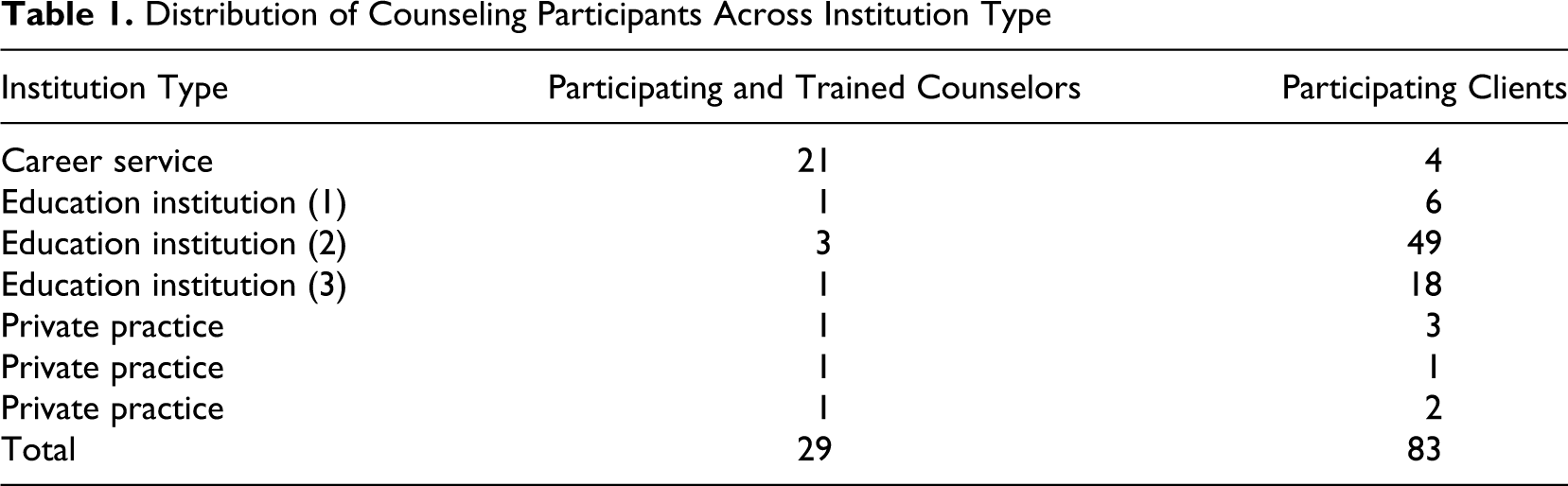
The research settings were eight adult career development centers that provided self-referral services to career clients, had steady work flow, computer access, and representation of the diversity of adult career clients. In practice, career development centers in tertiary education institutions contributed the most participants. These settings had the time and commitment to participate in research, had suitable clients, and did not have time sheets or billable targets, which can restrict the ability to try new approaches. In one large career service institution information technology (IT) failures prevented large-scale project implementation. The distribution of counselors across the types of institutions that offer career counseling is in Table 1 .
Distribution of Counseling Participants Across Institution Type
Procedure
This research was in two phases. The first was a quantitative study on outcomes. The second was a qualitative study on the content and processes that lead to those outcomes. This was conducted at the completion of data collection for the first study.
Research Study 1: Program Outcomes
Measures
The client measures were the career decidedness and comfort subscales of the Career Decision Profile (CDP; Jones & Lohmann 1998). Thus, it recognizes that clients can be undecided but comfortable, and vice versa. Examples items for decidedness and comfort are “I have an occupational field in mind that I want to work in (for example, medicine, agriculture, management, or the performing arts)” and “I have decided on the occupation I want to enter (for example, electrical engineer, nurse, or cook)” and “I feel at ease and comfortable with where I am in making a career decision.”
The profile has high face validity and is proximal to expected gains from a career intervention outcome—that they have made a decision about what to do and are comfortable with that decision. Cronbach’s α coefficients are usually in the mid-70s (Jones, 1998). The appeal of the career decision profile is that it recognizes career decision as a multidimensional construct and does not assume that careers follow definable sequences. The scale fits logically with a career intervention designed to aid career-directedness and the pursuit of personalized goals. It has also been used as an outcome in a previous career intervention with adults, where it was sensitive to an intervention (Heppner, Multon, Gysbers, Ellis, & Zook, 1998) .
Fretz and Leong (1982) note that gender differences in career treatment effects occasionally occur and should therefore be controlled for. Assumptions of gender equivalency of treatments are risky. For these reasons, and because gender effects were identified in exploratory analysis, gender was included in subsequent analysis.
Process
This quasi-experimental field study went through an initial pilot implementation, which led to substantial changes to the original design. Initially, in the pilot phase, a tighter experimental design was sought including random assignment, comparison against the Strong Interest Inventory, and counseling based on personality types and their implications for career choice. Despite initial expectations and counselor agreement, little data was collected. Counselors subsequently reported that they adapted their counseling approach to meet client needs and did not think either the Strong Interest Inventory or possible selves-based approach was necessarily suitable for all their clients. It was argued that client, rather than research needs, should determine the counseling tool and approach used. Consequently, instead of random assignment, allocation to control or experimental groups was based on perceived client needs.
In both phases, posters were displayed in offices to attract client participants. Counselors conducted a brief preassessment, usually of around 10 min in length. Clients filled in consent forms and pretest measures prior to the commencement of the intervention. The counselor allocated clients agreeing to participate in the experiment to either the possible selves group or a comparison group.
Prior to any further treatment, baseline measures of the dependent variables and demographic information were collected. Counselors were trained to give clients dependent variable questionnaires at the end of the first and last counseling sessions. The procedure was to issue the client with a questionnaire along with a sealable envelope, and to then leave the client alone to complete the questionnaire and seal it in the envelope. Clients were then allocated to the possible selves or comparison group and then “treated.” In all, 71% had only one session. Outcome data was collected for Research Study 1 at the end of the first session.
Possible Selves Group
In the possible selves group, clients completed a computerized software program prior to treatment, followed by counseling. In the comparison group, they were taken through the counselors’ own career counseling approach.
The Possible Selves Computerized Tool
Possible selves were recorded and displayed via a computerized tool, with results displayed graphically and then printed. The computerized tool first asked clients to write in their own words their hopes and fears (described as the free text section). Clients were then presented with a series of items with responses sought on Likert scales. Items were identified through qualitative research into the possible selves of New Zealanders (Plimmer, 2002). Because possible selves are idiosyncratic, clients could add their own items. Clients rated each item on a 7-point scale (ranging from very strong hope to very strong fear), including a middle option that it was neither a hope nor a fear. If the item was rated as a hope or fear, participants rated how likely it was to become real (a 5-point scale from very unlikely to very likely), and whether that self had occurred yet—a 3-item scale covering yes, no, and maybe possibilities. This tool was primarily designed to mediate thinking and counselor/client interactions, rather than assess. However, psychometric properties have been researched. Concurrent validity results were with self-esteem (adjusted R 2of .22), optimism/pessimism (adjusted R 2of .21), and life satisfaction (adjusted R 2of .27; Plimmer, 2002). Test–retest was between .73 and .75.
Results were then presented back to the client via a printout. These results included the client’s own free text. Item responses were plotted graphically, with the hope/fear responses on the Y-axis and the perceived likelihood plotted on the X-axis.
Thus, clients and counselors see a constellation of hopes and fears rated as likely or unlikely to take place. For the sake of memorability, likely hopes were classified as opportunities, unlikely hopes as dreams, unlikely fears as dreads, and likely fears as threats. Small symbols next to the item indicate whether the hopes or fears about the future are “past” or “present,” or “to date not-yet experienced.”
Responses to the question “Is this a [skill or interest] you have now and/or have had in the past?” were identified in the feedback by different symbols.
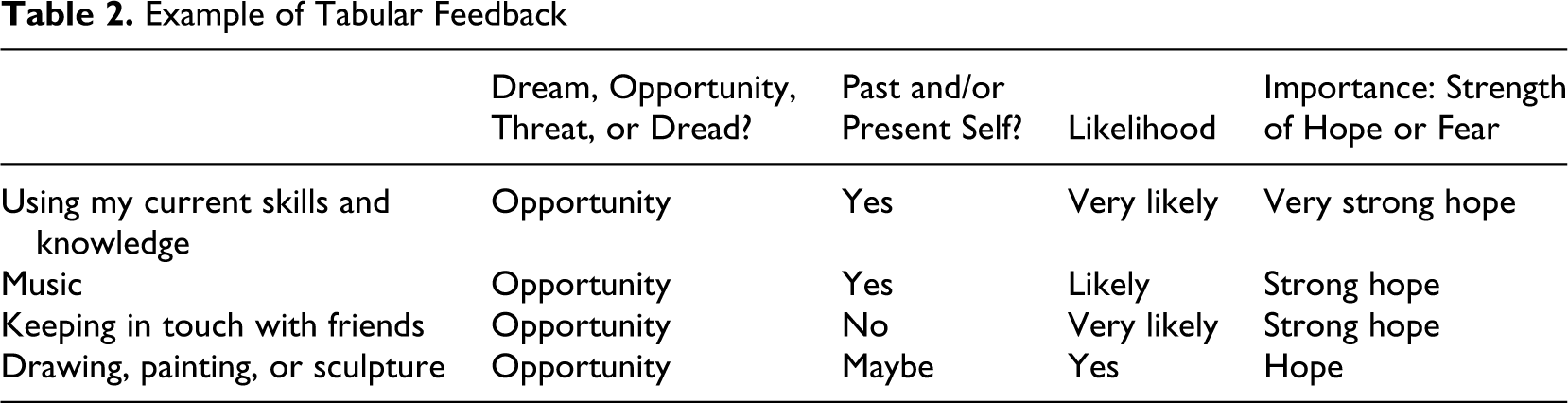
Hope/fear scale responses are plotted against the likelihood scale. Therefore, strengths of hope and fear and likelihood are shown by placement on the graph (see Figure 1 and Table 2 ).

Example of graphic feedback.
Example of Tabular Feedback
Possible Selves Counseling
Career counselors were trained and given memory aids (such as a manual) and resources to meet ethical and research requirements. Training included interpretation of the computerized feedback, understanding current and past selves, exploring possible selves, developing new ones, elaborating desirable ones, recognizing and managing fears, and planning.
Comparison Group
The comparison group clients went through the eclectic career counseling approach. This sometimes included the use of other instruments, such as the Knowdell Card Sort or the Self Directed Search, but was universally described as client centered.
Results
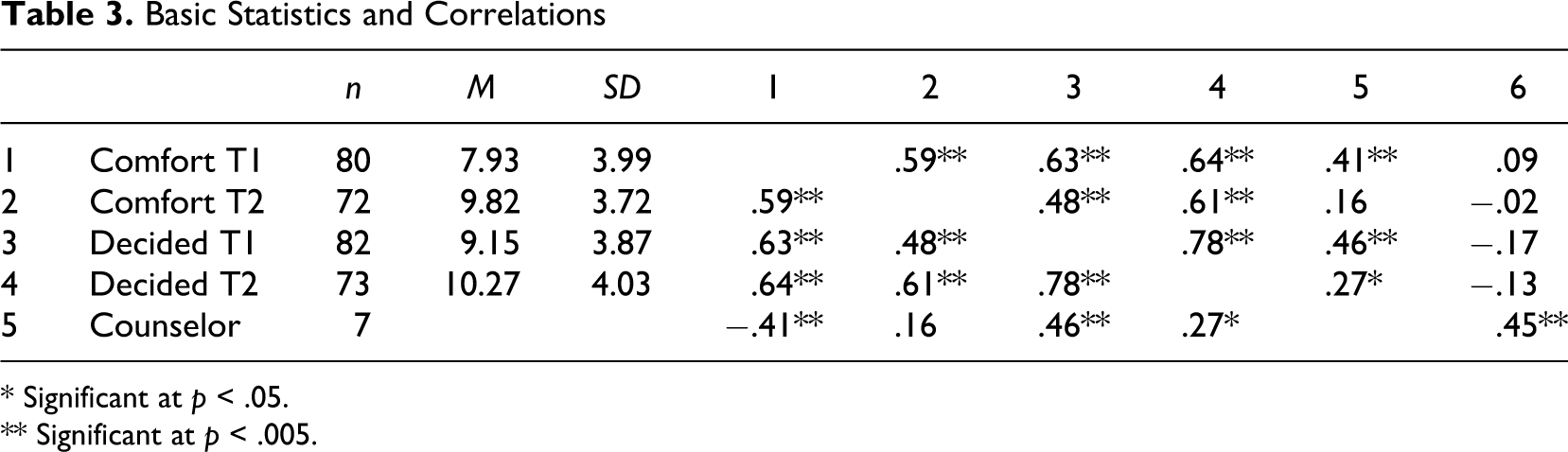
Means, standard deviations, and Spearman correlations were computed to identify the pattern of results for the dependent variables of comfort and decidedness (preintervention [T1] and postintervention [T2]), counselor effects, and number of sessions.
The αs for the dependent variables at baseline and postintervention phases (after the first counseling session) were: decidedness (.85 and .84) and comfort (.80 and .85). The scales were assessed for their normality. Their means and standard deviations are shown in Table 3 . Other analysis found no significant impact of counselor, or number of sessions, on the preceding analysis.
Basic Statistics and Correlations
* Significant at p < .05.
** Significant at p < .005.
The effect of the intervention on decidedness was measured using the postintervention decidedness scale as a dependent variable, with the baseline decidedness scale and gender treated as independent variables. Group membership (possible selves or general career counseling) was treated as a dummy independent variable (Pedhazur, 1997). A power analysis was conducted to determine whether the sample size was adequate to detect moderate sized effects at the .05 level of significance (Cohen, 1977). The analysis indicated statistical power of .80. Thus, there was a moderately low probability of a Type II error.
Multiple regressions and partial correlations were calculated because of their ability to manage nonrandom assignment, unequal Ns in cells and covariance (Kerlinger, 1986; Pedhazur, 1997). The partial correlations between the dependent variables (decidedness and comfort with career direction) and the independent variables (group membership) shows the treatment effect, when the linear effects of the other independent variables (preintervention comfort or decidedness, and gender) in the model have been removed from both independent and dependent variables.
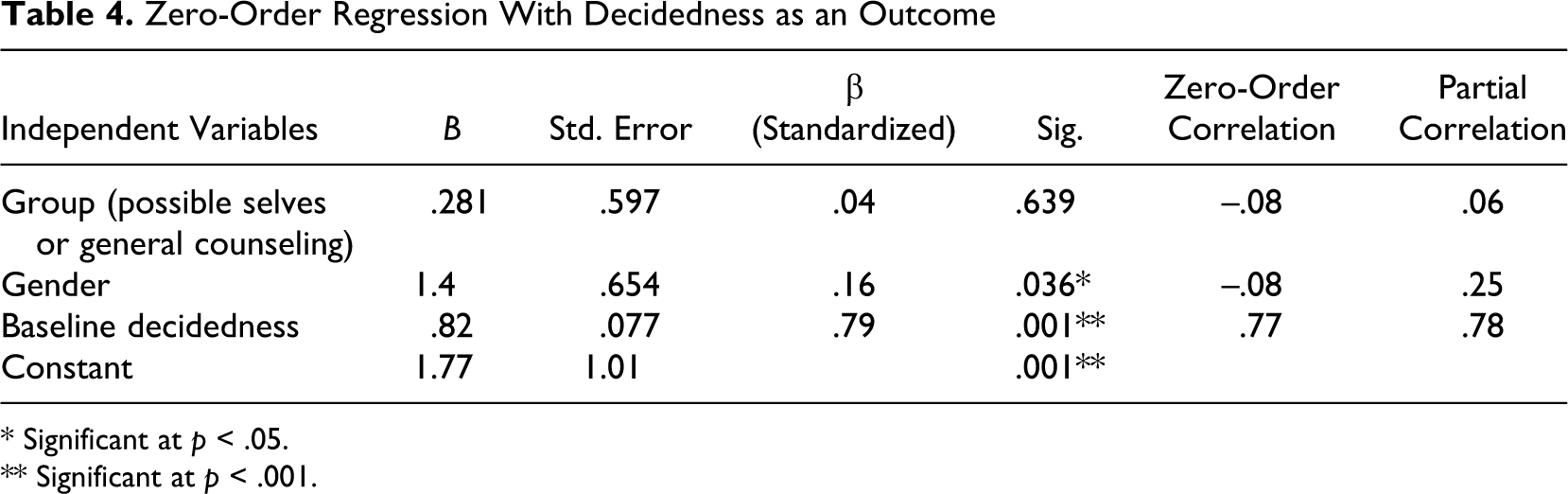
Using zero-order entry with decidedness as a dependent variable, the overall model showed an R 2 of .62, and an adjusted R 2 of .60, F(3, 70) = 38.082, p < .001. Precounseling decidedness was a strong and significant predictor of subsequent decidedness. Gender showed a moderate effect, with the β weight indicating that females were slightly more responsive to either career intervention than men. Group membership (possible selves or comparison group) did not significantly predict differences (see Table 4 ).
Zero-Order Regression With Decidedness as an Outcome
* Significant at p < .05.
** Significant at p < .001.
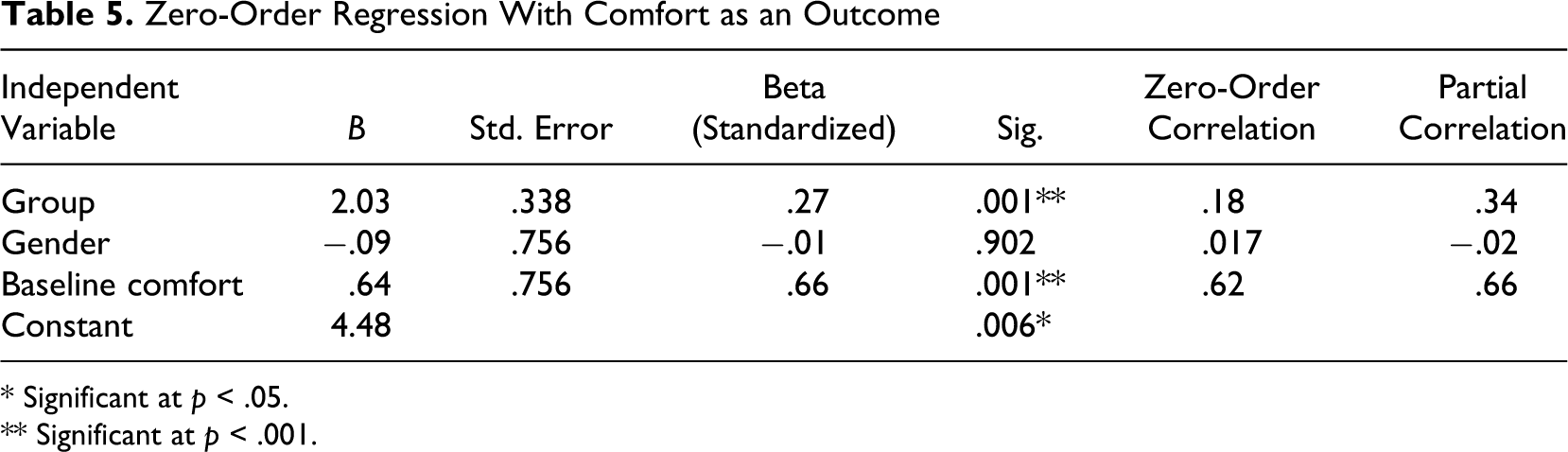
The effect of the intervention on comfort was measured in a similar manner. The dependent variable of postcounseling comfort was regressed against precounseling comfort, dummy coded treatment type and gender. The overall model showed an R 2 of .45 and an adjusted R 2 of .43, F(3, 68) = 18.755, p < .001. This showed a moderate relationship between group membership and postintervention comfort, particularly when the influences of gender and precounseling comfort were statistically controlled for in the partial correlation. Regarding comfort, the partial correlation of .34 in Table 5 shows that when gender and precounseling comfort are controlled for, group membership accounts for around 12% of the variance in comfort at the end of the first counseling session.
Zero-Order Regression With Comfort as an Outcome
* Significant at p < .05.
** Significant at p < .001.
The possible selves approach had a greater increase than the comparison group in this comfort dimension. Changes in mean comfort levels of the two groups are depicted below (Figure 2 ).
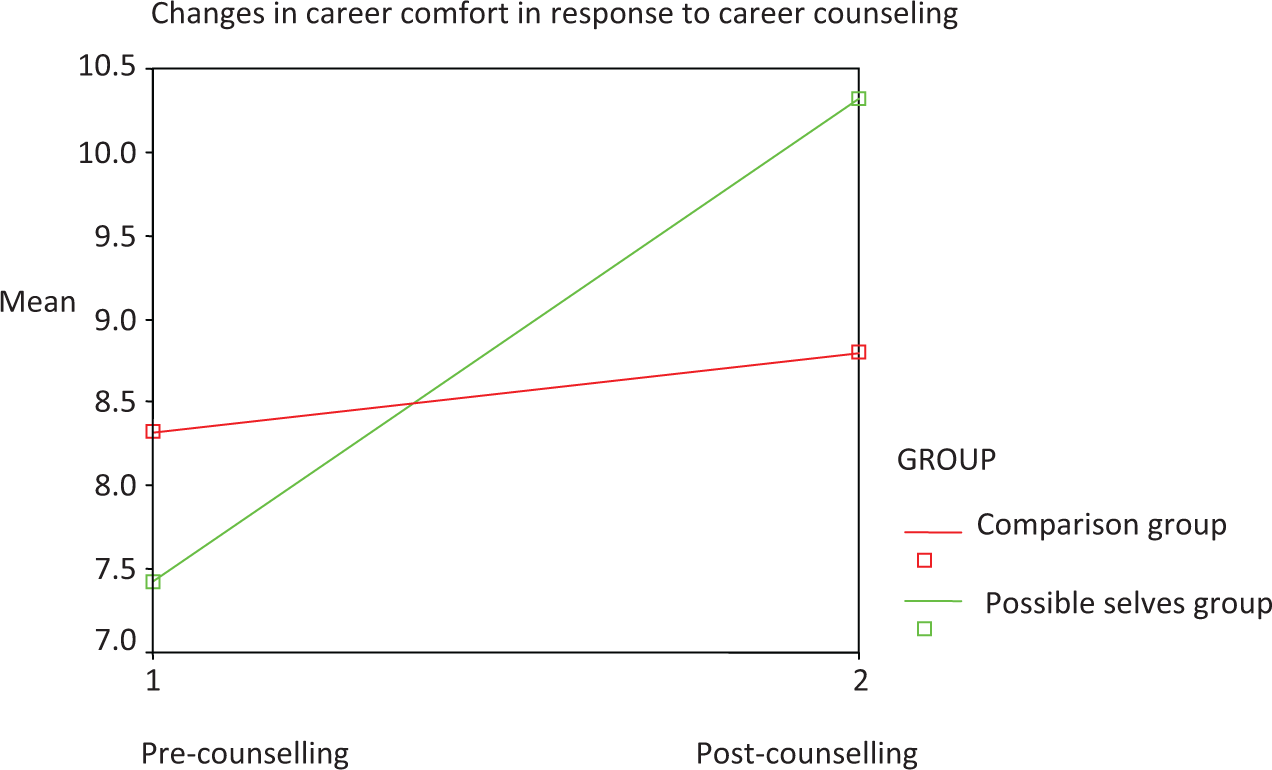
Changes in career comfort in response to career counseling.
To control for the potential influence of counselor differences, a further regression was carried out. It replicated the analysis of comfort but used only one counselor, who had taken through the most clients in both the comparison and possible selves groups. Using postcounseling comfort as a dependent variable, with group membership and pretest comfort added as predictors, group membership failed to predict outcomes in a statistically significant way (standardized β = .29, p < .059). The partial correlation for group membership was .28. The overall formula lead to an R 2 of .46, an adjusted R 2 of .42, F(2, 26) = 11.265. Similar analyses were conducted for decidedness, with no significant results for type of intervention.
Discussion of Study 1—the Client Outcomes Study
The most significant finding in this study was that the possible selves intervention group had greater increases in comfort with their career choice than did the general counseling group, despite reporting less comfort at the start of their session. This increase was moderate but useful. The failure to replicate the analysis using a subsample may reflect the small sample size as the results were in the right direction.
Both groups experienced raises in decidedness. Group membership did not significantly predict the extent of the rise. In some situations, decidedness may be the more important of the two dependent variables, assuming that people go to career counselors primarily to decide what to do. Alternatively, the result may also reflect the requirements of the new world of work. Being undecided can be wise and may reflect adaptability (Krumboltz, 1992). Seen in this light, the possible selves approach may be effective in reducing career anxiety and increasing adaptability, since adaptability is in some ways a reframing of being undecided. An intervention using possible selves may give a clearer view of options and alternatives, and clients may be more at ease with indecision as a result.
This study demonstrated that brief treatments can be effective in the short term, and that the effectiveness of such brief treatments is sensitive to differences in treatment styles. The study also demonstrated a meaningful effect across a range of counselors, counseling environments, and client types that could be measured in the presence of considerable noise. These findings suggest that counselors adapt practice to suit client needs very tactically. That ability to adapt may predict outcomes better than any particular theory. It lends support to the general efficacy of career counseling.
The lack of random assignment can be considered a confound or an ecologically valid design feature. Counselors do not randomly assign their clients to treatments. In reality, counselors have different client types, and both counselors and clients vary in their skill.
Although this study indicates that a possible selves-based intervention can be superior to other types of intervention in the presence of real-world “noise,” the process by which it was effective also warrants attention. Knowledge of processes, which counselors used with the possible selves approach, can also shed light on the effectiveness and practicality of the intervention. In applied settings, outcome studies often lack the control, or the timeframe, needed to make conclusive judgments (Scriven, 1993). Outcome studies can also fail to identify areas for improvement or risks. Process research informs the weight that can be placed on outcome information, and how the outcomes were achieved.
Research Study 2: Counselor Processes in Using the Possible Selves Program
Counselor experiences are important for their formative value, information they provide on adherence to the program, and because discussions about how the counseling works shed light on what clients gain from the counseling (Whiston et al., 1998).
Participants
Participants were seven counselors who had participated in the field study and who responded to telephone or e-mail invitations to be interviewed about their experiences. In practice, these seven career counselors had taken 93% of all participating clients through Research Study 1.
Measures and Process
Counselors had been informed at the beginning of the research that such an interview was planned. Two of the seven counselors chose to be interviewed by telephone, one chose to provide only brief information by e-mail, and the remainder were interviewed in person at their place of work. Semistructured interviews addressed the program’s strengths, weaknesses, the usability of the software, the usefulness of the feedback, adherence to the training and manual, comparisons with other instruments, and whether counselors would use the possible selves programs again. Notes were taken during interviews, written up and returned to participating counselors for comment prior to analysis. The interviews were also an opportunity to thank participating counselors and were conversational in style.
Results
Final interview results were coded into the semistructured interview topics and then, using the cutting and sorting method, accorded to themes. Three strong themes emerged, concerning capacity to address whole-of-life issues, weaknesses at dealing with narrower, more specific concerns, and capacity to help clients face barriers. Program adherence and software problems were also commented on. More detailed coding was not possible because of the lack of unambiguous data. The three themes are discussed below.
Capacity to Address Whole-of-Life Issues
Whole-of-life issues that affect career development, including emotions, self–beliefs, and lifestyles could be screened through the computerized questionnaire, patterns recognized and facilitated through the medium of the visual display. One counselor said: It opens up the territory, brings out wider issues, maybe because the computer is good at dealing with personal issues.
It gave permission for people to talk about their lives.
Watching people go through is really interesting, watching reactions you get a lot out of it. Particular questions cause consternation.
Huge physical gap on the landscape between where they want to be and where they are—they could see the need to move from where they were.
Really useful for me—I can see the chunks, corners, where things were at.
Weaknesses With Narrowly Focused Career Issues
The second theme concerned weaknesses at dealing with more narrowly focused career issues. This theme mainly concerned the items in the work options section, which were seen as “clunky,” in that they did not apply to many of the career issues facing clients and the language was inappropriate. One counselor said the skills and interests were not sufficiently work-related to be useful, and suggested that work competencies be used instead. One counselor was disappointed in it as a career instrument because it was perceived as not providing anything new to the client. Creative visualization was suggested as a better option because it encouraged more creative thinking. For specific career issues, the Self Directed Search and various card sorts were preferred by some counselors.
The importance of this distinction between whole-of-life and narrowly focused career counseling was reflected in the particular client groups of participating counselors. One counselor who used it with older adults said that its broad focus quickly brought out the key issues and that career and wider life issues were often interrelated. In contrast, a counselor dealing largely with early adult tertiary students said it was often unsuitable because clients at that age group wanted specific, narrowly focused career options and did not want to discuss wider issues. However, the intervention worked well with mature students.
Identifying Barriers
A third strong theme was that the intervention was good at identifying barriers in people’s lives, particularly through discussion of threats, and to a degree, hopes that were unlikely to be realized. One counselor said: Very simple things stop people, but obvious solutions come up.
Some counselors were critical of the word fear, because it was seen as inappropriately emotional. Some also considered the instrument too long, although one said it was difficult to see which areas to cut. Some questions were seen as repetitive.
Overall, counselors reported that clients found the software easy to use, although for one counselor the “continue” button was too small for some clients to easily see. The narrative section, in which people write their hopes, expectations, and fears in their own words, was seen as useful by most counselors because it brought out what was most important, acted as a warm-up, and made it easier to identify themes that came up in the graphs. There were other comments that people did not write detailed or useful comments in the narrative/free text section.
Criticisms of the graphs were that occasionally responses overprinted and that the abbreviations of the items were not sufficiently informative. The tables were either not used at all or were used only for clarification, when the graphs were unclear.
The degree to which the possible selves counseling program was formally adhered to varied. One counselor went through the manual thoroughly and reported it as very useful, another hardly referred to it at all. Several counselors commented that they adapted the program to their own counseling style, with one adding that it was an advantage being able to do that, as it felt more comfortable. Only one counselor used specific features of the possible selves program, such as elaboration.
Counselors reported that possible self-related concepts such as setting personalized goals, analyzing beliefs, emotions, and other schema-related concepts were applied not from declarative adherence to the manual and training, but because they stemmed implicitly from the graphs and normal counselor practice. A final question sought summative information by asking whether the counselor would use the intervention again. All but one said yes, but they also emphasized that it would be used only in situations where personal and career issues were likely to be intermeshed.
Discussion: Study 2—Counselor Processes in Using the Program
The software questioning and graphs seemed to create a whole-of-life future focus because of the structured questioning of the feedback and graphs, including expectancies and coverage across domains such as values, beliefs, and lifestyle. The strongest finding of this study was support for the program by the participating counselors, when career and personal counseling were closely intermeshed. Mature adults with obligations to others seemed to be most suitable for the possible selves program in its current form. If the issues were very vocationally focused, the program was less relevant because it only reported back what was mostly already known, and many of its questions were about wider life issues.
A surprising finding of this study was that responding to the computerized questionnaire engaged people in the counseling process and consequently speeded up the process of disclosure and counseling generally. Social cognition processes apply to people’ interaction with computers because innate cognitive processes are poor at distinguishing different sources of social information (i.e., human or computer; Reeves & Nass, 1996). In the present case, the short but personal and valued counseling that sometimes took place may have occurred because counseling had begun with responding to the instrument. The implications of this for software design are intriguing. Social and personality psychology may be much more relevant to human–computer interaction than has been acknowledged.
Computer instruments, like other tools, can help people think in new ways. For instance, they can make counseling more effective by collecting information systematically, freeing up counselor time for more “human” or client-centered processes. Visual displays of information can help manage mental load, which may be particularly valuable in counseling because it often involves concerned arousal (Anderson, 1990). A well-structured display could reduce a tendency by clients and counselors to focus on information that is most readily available, or that fits the preconceived notions of counselors (Heppner & Frazier, 1992).
The extent of program adherence can be looked at in two ways. The pessimistic interpretation is that adherence was low because the potential strengths of a possible selves instrument and approach were not recognized. The optimistic interpretation is that much of the adherence to the intervention was done implicitly. The evidence that this latter interpretation may have been correct are counselor comments that the graphs were influential in the counseling process. The graphs’ future focus and clients’ use of them to think about cognitions, emotions, and other schema-related facets imply that many aspects of the program were in fact followed.
Limitations of this study are the self-selected sample and the demand characteristics of having the program developer conduct the evaluation. Client perspectives would be a valuable addition. A more fine grained, detailed analysis on career counseling processes would shed better light on program adherence and causal pathways.
Overall Discussion
The quasi-experimental field study using a comparison group exposed to eclectic career counseling, sometimes accompanied by the use of other instruments, found the computer-enhanced possible selves approach moderately better than the comparison program at making clients more comfortable with their career decision status but not better at making them decided. Career counselors found the software usable and that it aided working with their clients, when career and other issues were intertwined. The compelling nature of the graphs and the ability to identify barriers seemed to be its strongest points.
This article began with the dilemma of how to deal quickly with the often complex, high stakes, and limited resources of adult career work. It was hoped that a possible selves approach would do so, for many reasons including the motivating, changeable, and multifaceted nature of the construct.
That the possible selves program provides direction and comfort (and appears to be stronger in providing comfort than other interventions) is encouraging because of the anxiety created in the new world of work (Jones, 1998). Results of the present study indicate that comfort is important and is sensitive to an intervention. It may be that a possible selves approach fosters comfort by reminding clients of the variety of options (or selves) they have, and that they are more than their immediate career problem. Anecdotal conversations with counselors since the study suggest that coverage across different life aspects in detail may have acted to affirm their clients’ sense of wholeness and make them aware of choices. It may also be that clients had more intense conversations with their counselors.
Where the intervention worked well, it seemed to help clients identify what they really wanted, as opposed to what they thought they should want or what other people wanted for them. It also seemed to help people identify barriers, solutions, and opportunities. The charts’ ability to identify gaps between the current and the desired situation must have been challenging, so the capacity to increase comfort with career direction is somewhat surprising. It may well be that the instrument and associated counseling work in promoting autonomy and other aspects of well-being (Ryff & Keyes, 1995). The whole-of-life approach might have widened perceptions of what is possible. Counselors’ ability to quickly tackle personalized threats lends support to the argument that quick and efficient cognitively based counseling is effective (Oliver & Spokane, 1988).
One finding from this research is that many clients do not want their “whole-of-life” to be dealt with, and are instead focused on narrow career-specific issues such as what subject to major in when they return to university. The scope of what is required in career interventions varies widely, and counselors and researchers should not assume that clients want more than they do. The overall lesson is that different interventions work well for some clients and less well for others. A possible selves-based approach may work best with clients who are more anxious, and lack vocational identity and efficacy (Brown & Krane, 2000). Benefits to clients who are primarily seeking information and help with exploration seem slight.
Despite research intentions to reach a wider group, most of the subjects in the field study were relatively young. They had succeeded in the education system to tertiary level and thus were relatively high in their functioning. At the same time, they were of an age when they had few obligations to others. The possible selves construct, as construed in this research, is likely to be most effective as a counseling approach, when people experience career issues, want to consider them in the wider context of their life, and have barriers and problems around motivation.
The benefit of other instruments, such as interest inventories, is that they provide specific options that are new to clients, but which do not necessarily challenge them to think through wider, more difficult issues. These instruments provide the mystique of science through new, apparently objective information that may or may not be valid, but which seems to be useful in helping make choices. In contrast, the possible selves instrument provides subjective information, but provides it in an objective way. This worked well for some clients but not others. It sheets responsibility back to the individual, when the latent client agenda in counseling may sometimes be to externalize, to simplify the problem, and to get advice rather than be protean.
Some contemporary career theories wisely exhort career clients to be adaptable, to have boundaryless careers, or butterfly or socially contextualized careers (Arthur et al., 1999; Savickas, 1997). However, for example, protean actors require self-knowledge of skill and limitations as much as having a near chameleon-like ability to change. Arthur et al.’s (1999) proposal that people need to constantly adapt and reconfigure themselves to anticipate change is sound but the question of how much people can change and adapt remains unanswered.
Arthur et al. (1999) also emphasize the ability to use social networks and create opportunities where others might miss them, and the sometimes haphazard nature of career development. An implication of this is that any possible self-based counseling needs to encourage action on multiple fronts, through provisional selves, rather than pursue a single, narrow-minded decision (Ibarra, 1999). In possible selves theory, well-developed, broad, future-focused schemas should help people attend to opportunities that would otherwise be missed. Possible self-based counseling could, instead of encouraging more specific, actionable goals quickly, focus on developing a repertoire of selves to draw on. Such an approach might be particularly effective (although difficult) with mature clients whose future self-concepts may be becoming narrower (Cross & Markus, 1991).
Young and Collin (2004) emphasizes the need to connect interweaving strands of different items, to consider context issues such as social class, and the multiplicity, subjectivity, and changing nature of these meanings to deal with the changing nature of both careers and the self. This process of identifying meanings appears be what counselors began to do in the field study. It could be that a possible selves approach helps build metaphors and narratives that allow clients to better understand and appreciate their lives. This is a topic for much more research.
Savickas (1995) recommends a similar approach, by first adopting a constructivist approach whereby the client develops a life plot, and through that a series of stories about identity and life projects. Themes and underlying assumptions are then revealed and related to the current career problem. With careful client questioning, the graphs developed in the present study could provide the entry point for such a metaphor- or allegorical-based approach. A metaphor-based approach might be highly effective, but it would perhaps require lengthy sustained sessions.
Smith (1982) makes distinctions between theoretical, applied, and practical psychology. Theoretical psychology is the study of underlying reasons and hypotheses; applied psychology is the use of this knowledge to explain or improve real-world settings; and practical psychology emphasizes the importance of usability and the importance of fit with environmental constraints. In addressing the practical constraints of careers and career counseling, career theories need to recognize the limited resources of clients and counselors, the context of the intervention and how the theory is likely to be, or can be, applied in practice. The application of possible selves theory in a computer-based instrument shows promise in the real-world conditions of career counseling with clients who lack comfort with the direction of their careers.
Footnotes
The author(s) declared the following potential conflicts of interest with respect to the research, authorship, and/or publication of this article: The author is a director of FutureSelves, a company based on the research in this article.
The author(s) received no financial support for the research, authorship, and/or publication of this article.