




Abstract
The present study explores what mechanism might be responsible for the reported link between presence of a calling in one’s career and life satisfaction. It is proposed that vocational identity achievement acts as one important mediator of this relation and that the effects can be observed even when controlling for core self-evaluations (CSEs). The study used a short-term longitudinal design based on a sample of 269 German college students from different majors. The results confirmed the mediation model, with calling predicting vocational identity achievement 6 months later and identity serving as a stronger predictor of life satisfaction, all controlling for CSEs. However, contrary to previous research, presence of calling was not directly related to life satisfaction and even showed a negative relation when vocational identity achievement was controlled. The results are interpreted to suggest a multifaceted relation between calling and life satisfaction.
The fields of vocational psychology and management have developed a recent interest in the concept of calling in career due to, among other things, its presumed importance to personal well-being and adjustment. For example, having a sense of calling in one’s career and work is described as the ultimate form of subjective career success (Hall & Chandler, 2005). Approaching one’s career as a calling also is proposed to give a person a sense of meaning and purpose in work and, more generally, in life (Steger, Pickering, Shin, & Dik, 2010; Wrzesniewski, 2003). This perspective is relevant to the current interest in positive psychology as well, whereby meaning and purpose in life have been established as major cornerstones of happiness and life satisfaction (Peterson, Park, & Seligman, 2005; Steger & Frazier, 2005). Consequently, research has shown positive relations between the presence of calling and life satisfaction among college students and working adults (Duffy, Allan, & Bott, 2012; Duffy, Manuel, Borges, & Bott, 2011; Duffy & Sedlacek, 2010; Peterson, Park, Hall, & Seligman, 2009; Steger et al., 2010; Wrzesniewski, McCauley, Rozin, & Schwartz, 1997). However, research on how these effects can be explained and whether they are mediated by other variables is just beginning to emerge (Duffy, Allan, et al., 2012).
The present study makes a contribution to the emerging literature on calling by investigating whether vocational identity achievement is partially responsible for the positive relation between calling and life satisfaction. Vocational identity achievement refers to the conscious awareness of one’s occupational interests, abilities, goals, and values and the structure of meanings in which such self-perception is linked with career roles (Ibarra & Barbulescu, 2010; Skorikov & Vondracek, 2007). The study also considers that more basic personality dispositions might be responsible for the positive relation between calling and life satisfaction and investigates the effects of core self-evaluations (CSEs) on this relation. Specifically, the aims of the present study are (1) to investigate whether the positive association of the presence of calling with life satisfaction is mediated by vocational identity achievement; (2) to evaluate whether the presence of calling predicts vocational identity achievement above and beyond CSEs; and (3) to examine whether the presence of calling and vocational identity achievement predict life satisfaction above and beyond CSEs.
Presence of Calling and Life Satisfaction
Recent research has highlighted the personal and organizational benefits of work that is perceived to be a calling. Several definitions of calling propose that people who approach their work in such a manner engage in work that they perceive to be deeply meaningful to themselves and to society more generally (Dik & Duffy, 2009; Wrzesniewski, 2003; Wrzesniewski et al., 1997). As such, callings can be a major source of meaningful work and meaning in life (Steger et al., 2010; Wrzesniewski, 2003). Life meaning is in turn an important component of psychological well-being, happiness, and life satisfaction (Baumeister & Vohs, 2002; Peterson et al., 2005; Steger, Oishi, & Kashdan, 2009). Moreover, Peterson, Park, Hall, and Seligman (2009) stated that people with a sense of calling in career enact their core strengths at work, which is a major source of work and life satisfaction (Peterson, Ruch, Beermann, Park, & Seligman, 2007). Consistent with this theorizing, empirical research has found weak to moderate relations between a calling orientation to work and life satisfaction among working adults (Peterson et al., 2009; Wrzesniewski et al., 1997) as well as between the presence of calling and life satisfaction among different and diverse groups of U.S. college students (Duffy, Allan, et al., 2012; Duffy, Manuel, et al. 2011; Duffy & Sedlacek, 2010; Steger et al., 2010).
Based on those theoretical and empirical grounds, we propose our first hypothesis:
Hypothesis 1: Presence of calling predicts higher life satisfaction.
The Mediating Role of Vocational Identity Achievement
More recently, research has begun to examine the underlying processes that can explain the positive relation between calling and work and psychological outcomes. Duffy, Dik, and Steger (2011) investigated whether the effects of presence of calling on work outcomes, in terms of organizational commitment, withdrawal intentions, and job satisfaction, were mediated by career commitment. Their study of university employees showed, among other things, that the effects of calling on job satisfaction were fully mediated by increased career commitment. In relation to life satisfaction as an outcome of calling, Steger, Pickering, Shin, and Dik (2010) examined whether the effects of the presence of calling on psychological adjustment (which included life satisfaction) were mediated by meaning in life among college students. Their results supported a full mediation model, indicating that one reason why the presence of calling is related to more life satisfaction is its positive relation to meaning in life. In another study, Duffy, Allan, and Bott (2012) found that the link between presence of calling and life satisfaction among U.S. undergraduate students was moderated by CSEs but did not depend on a student’s degree of religiousness or living one’s calling. Moreover, the effects of calling on life satisfaction were fully mediated by academic satisfaction and meaning in life.
Those studies are important starting points to further our understanding of why calling in a career might be beneficial for individuals and organizations, by investigating potential mediating mechanisms of calling and its proposed outcomes. The present study expands this emerging research base by examining a previously uninvestigated mediator and applying a longitudinal research design, which separates predictor and criterion variables by time. Specifically, in this study, we focus on a central construct in vocational psychology that has been established to be closely related to well-being: vocational identity achievement. Vocational identity is a core construct in career and life-span development (Super, 1990), and various studies have repeatedly shown that identity achievement relates positively to psychological adjustment, including life satisfaction (see Skorikov & Vondracek, 2007, for a review). Based on this research, we propose our second hypothesis:
Hypothesis 2: Vocational identity achievement predicts higher life satisfaction.
Within the present study, we conceptualize vocational identity achievement according to Marcia’s (1980) identity status model, which distinguishes different identity statuses with the two dimensions of commitment and exploration. According to this model, identity achievement is only reached after a thorough phase of identity crisis and identity exploration. Hence, identity achievement is characterized by high degrees of identity commitment and identity exploration. This is an important distinction from the frequently applied identity definition and measurement proposed by Holland (1997; Holland, Johnston, & Asama, 1993), which only focuses on the decidedness/commitment component of vocational identity. Holland’s approach is not able to distinguish between identity achievement and identity foreclosure (Brisbin & Savickas, 1994), which is the premature commitment to an environmentally imposed identity. Conversely, taking into account both exploration and decidedness/commitment, we can obtain a more distinguished perspective on identity development and identity statuses (Vondracek, 1992). In fact, numerous studies have applied Marcia’s (1980) model and supported its relevance for vocational identity development among adolescents, college students, and working adults (Hirschi, 2011a; Luyckx, Duriez, Klimstra, & De Witte, 2010; Luyckx, Schwartz, Goossens, Soenens, & Beyers, 2008; Skorikov & Vondracek, 1998).
Theoretically, a sense of calling in career is closely related to vocational identity achievement because calling also entails a clear sense of what one wants to do with one’s working life (Dik & Duffy, 2009; Elangovan, Pinder, & McLean, 2010). In this line, Hall and Chandler (2005) stated that calling might be positively related to career metacompetences, such as identity and adaptability. Empirical research among college students and working adults has confirmed that a higher sense of calling was positively related to several constructs that are similar to vocational identity, including occupational identification (Bunderson & Thompson, 2009), career commitment (Duffy, Dik, et al., 2011), self-concept clarity (Duffy & Sedlacek, 2007; Treadgold, 1999), and career decidedness (Duffy & Sedlacek, 2007; Hirschi, 2011b; Steger et al., 2010). Hence, based on theory and empirical research, we can expect a close connection between calling and vocational identity. Specifically, we expect that the presence of a calling facilitates the development of a clear sense of who one is and how one’s work is meaningful to oneself, hence facilitating the development of vocational identity achievement. Formally stated, our third hypothesis is:
Hypothesis 3: Presence of calling predicts greater vocational identity achievement.
Extending one step further, the present study investigates whether vocational identity achievement acts as a potential mediator between the relation of calling and life satisfaction. Specifically, we expect that the positive effects of calling on life satisfaction can be partially explained in the way that calling promotes vocational identity achievement, which in turn leads to higher life satisfaction.
Based on Hypotheses 1–3, we propose our forth hypothesis:
Hypothesis 4: The association of the presence of calling and life satisfaction is partially mediated by vocational identity achievement.
Controlling for the Effects of CSEs
One important component that has not yet been investigated in previous research is whether the effects of calling on work and life outcomes might also be attributed to more basic personality dispositions. It is well-established that personality has significant effects on both life and job satisfaction (Diener, Suh, Lucas, & Smith, 1999; Judge, Heller, & Mount, 2002). Likewise, the relation between vocational identity development and personality is supported by many studies (Holland et al., 1993; Skorikov & Vondracek, 2007). Although the relation of calling and personality has not received much theoretical or empirical attention thus far, based on the research on personality and vocational identity, we can expect that these two are also meaningfully related. This presumed relatedness of life satisfaction, vocational identity achievement, and calling makes it important to take personality dispositions into account for the present study.
Specifically, we focus on the construct of CSEs. According to Judge, Erez, Bono, and Thoresen (2003), these represent the “basic, fundamental appraisal of one’s worthiness, effectiveness, and capability as a person” (p. 304). The construct represents the trait-like common core of neuroticism, self-esteem, self-efficacy, and locus of control beliefs (Judge, Erez, Bono, & Thoresen, 2002). An increasing number of studies have shown that this trait is significantly related to career development, job, and life satisfaction (e.g., Heller, Judge, & Watson, 2002; Judge, Bono, Erez, & Locke, 2005; Judge & Hurst, 2008; Judge, Locke, Durham, & Kluger, 1998). In general, people with more positive evaluations of themselves are more successful in their career development and report greater job and life satisfaction.
Previous research among German university students (Hirschi, 2011b) and U.S. undergraduates (Duffy, Allan, et al., 2012) showed that, on average, CSEs were moderately but significantly related to the presence of calling. Other research established a positive link between CSEs and vocational identity achievement among adolescents (Hirschi, 2011c). Hence, when investigating the relation of calling on life satisfaction and vocational identity achievement, it seems important to control for the influence of this more basic personality trait. Specifically, controlling for CSEs allows stronger inferences regarding the relations between the assessed variables and reduces the possibility that significant relations might be spurious and attributable to a third underlying variable. However, we assume that the proposed relations between calling, vocational identity achievement, and life satisfaction are not merely an artifact of more basic CSEs. Hence, we expect that the previously stated hypotheses are true even when controlling for the effects of CSEs.
Method
Participants
German undergraduate students (N = 589) from diverse majors participated in the study. The majors ranged from engineering to social work, with the largest groups enrolled in Business Psychology (31%), Business Administration (10%), and Applied Cultural Studies (7%). The study was conducted at a public university in northern Germany with approximately 4,700 undergraduate students enrolled at the time of the study. The participants were 68% female; their mean age was 23.46 (SD = 3.38). Students in their first year comprised 49% of the sample, 27.8% were in their second year, and 23% in their third year of their 3-year bachelor program. At the second measurement point (T2), 269 (45.67%) participated again, with 69.5% female, M age = 23.32, SD = 3.49, M Semester = 3.67, SD = 2.48. The students who participated at both measurement points did not differ regarding their distribution of gender, age, or semester from the group who participated only at the first measurement point (T1). No differences were found for the variables assessed at T1 between the students who participated at both measurement points and the ones who only participated at T1; calling: t(587) = 0.73, p = .465; CSEs: t(587) = −0.31, p = .75.
Procedure
Participants were recruited through a study invitation posted in two university newsletters, which were sent out to all undergraduate students. Data were collected through an online questionnaire, and participants were offered participation in a lottery of five 60-€ vouchers as an incentive. Participation was voluntary, and students indicated their consent for participation by ticking an appropriate box at the beginning of the questionnaire. At the end of the questionnaire, they were asked whether they would be willing to participate in a second study and provide their e-mail addresses for this purpose. Approximately 6 months after the first assessment, the students who provided this information and consent (56% of the sample) were invited again for participation via e-mail, with two reminder e-mails, each 1 week apart. Among the students contacted for continued study participation 82% completed the survey, resulting in a 45.7% response rate of the initial sample.
The questionnaires included measures for sociodemographics, presence of calling, and CSEs at T1 and vocational identity achievement and life satisfaction at T2. Missing values on single-scale scores were estimated with the expectancy-likelihood algorithm before the data analysis.
Instruments
Presence of calling
Calling was assessed with the Brief Calling scale (BCS) from Dik, Eldridge, Steger, and Duffy (2012) in the German version adapted by Hirschi (2011b). The BCS presence of calling subscale consists of 2 items, which ask students to indicate on a 5-point scale ranging from 1 (not at all true of me) to 5 (totally true of me) how much they agree with two statements: “I have a calling to a particular kind of work” and “I have a good understanding of my calling as it applies to my career.” Supporting its construct validity, previous research with this scale showed significant relations among career decision self-efficacy, intrinsic work motivation, religious commitment, and meaning in life (Dik & Steger, 2008; Duffy & Sedlacek, 2007; Steger et al., 2010). In the present sample, the 2 items showed a bivariate correlation of r = .66.
Vocational identity achievement
Consistent with Marcia’s (1980) conceptualization of identity statuses (Schwartz & Dunham, 2000) and other research on vocational identity statuses (Hirschi, 2012, 2011a), vocational identity achievement was measured as the combination of career decidedness and career exploration. Career decidedness was assessed with the Vocational Identity scale (Holland, Daiger, & Power, 1980; Jörin, Stoll, Bergmann, & Eder, 2004). The measure asks students to indicate on a 5-point scale the degree to which seven statements (e.g., I’m not sure yet which occupations I could perform successfully) resembled their personal situation by rating them from 1 (not at all) to 5 (completely). Research with the German-language version showed that the scale correlated significantly with more career decidedness, career planning, and career exploration among adolescents and college students (Hirschi & Läge, 2007; Hirschi, Niles, & Akos, 2011; Jörin Fux, 2006). The Cronbach’s α in the present sample was .89.
Career exploration was assessed with the Career Exploration scale by Hirschi (2009). The measure consists of 10 statements whereby students indicate on a 5-point scale the degree to which they engaged in self-reflective behaviors (4 items, e.g., reflection about personal interests) and environment exploration (6 items, e.g., gathering information about interesting career paths), with answers ranging from 1 (seldom/few) to 5 (much/a lot). This measure is similar to other career exploration scales (Kracke, 1997; Zikic & Klehe, 2006), and previous research showed positive correlations between this scale and other measures of career exploration, career decidedness, career planning, and career choice congruence (Hirschi, 2010; Hirschi et al., 2011). The Cronbach’s α in the present sample was .90. Vocational identity achievement was then calculated as the sum of the standardized values of career decidedness and career exploration (Hirschi, 2011a; Schwartz & Dunham, 2000). Higher scores indicate more vocational identity achievement (i.e., higher values of both decidedness and exploration). The reliability of the vocational identity achievement scale (i.e., the unit-weight composite score of career decidedness and career exploration) in the present sample was .91. It was computed based on the Wang and Stanley composite reliability formula (Wang & Stanley, 1970).
Core self-evaluations
CSEs were measured with the German-language version of Judge et al.’s original scale (2003), translated and validated by Stumpp, Muck, Hülshegger, Judge, and Maier (2010). The scale consists of 12 items (e.g., I am confident that I will get the success I deserve in life), which were answered on a 5-point scale ranging from 1 (strongly disagree) to 5 (strongly agree). The criterion-related validity of the original scale is supported, for example, by its relations with job satisfaction, career success, job stress, or organizational commitment (Brunborg, 2008; Judge & Hurst, 2007; Kacmar, Collins, Harris, & Judge, 2009). Stumpp and others (Stumpp, Hülsheger, Muck, & Maier, 2009; Stumpp, Muck, Hülshegger, Judge, & Maier, 2010) reported support for the validity of the German scale in terms of its factorial structure and significant relations with job and life satisfaction, organizational commitment, and career success. The Cronbach’s α was .81 in the present sample.
Life satisfaction
Satisfaction with life was assessed with the German-language version of the Satisfaction with Life scale by Diener, Emmons, Larsen, and Griffin (1985). The scale consists of 5 items (e.g., The conditions of my life are excellent), and answers were provided on a 5-point scale ranging from 1 (strongly disagree) to 5 (strongly agree). Numerous studies reported excellent reliability and validity of the scale (e.g., Lucas, Diener, & Suh, 1996). The German-language version showed properties similar to the original version among a group of Swiss adults (Peterson et al., 2007). The Cronbach’s α was .78 in the present sample.
Results
Before testing the stated hypotheses, the correlations between the measures were examined. As can be observed in Table 1, positive relations were observed between calling and vocational identity achievement as well as vocational identity achievement and life satisfaction. CSEs were positively related to calling, vocational identity achievement, and life satisfaction. However, the presence of calling was not related to life satisfaction.
Summary of Intercorrelations, Means, and Standard Deviations for Scores on CSE, Calling, VID, and SWL (N = 269)
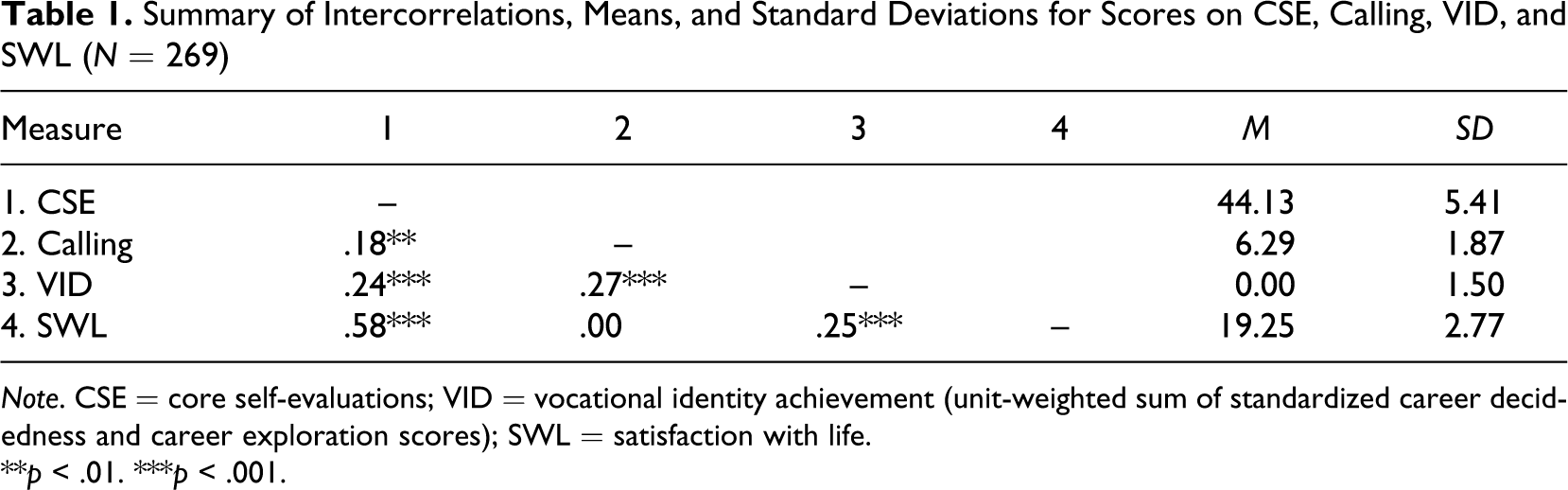
Note. CSE = core self-evaluations; VID = vocational identity achievement (unit-weighted sum of standardized career decidedness and career exploration scores); SWL = satisfaction with life.
**p < .01. ***p < .001.
Test of the Hypotheses
To test the hypothesis that vocational identity achievement would partially mediate the relation between calling and life satisfaction, the four steps to assess mediation effects, according to Baron and Kenny (1986) were applied with multiple hierarchical regression analysis. In all models, the effects of gender, age, and CSEs were controlled.
In the first step of the analysis, a regression was performed to test the hypothesis that calling predicts life satisfaction. Hypothesis 1 was not supported; that is, calling did not predict life satisfaction above and beyond the effects of CSEs, age, and gender, β = −.074, p = .145, ΔR 2 = .005. This disconfirmed our expected mediation model according to Baron and Kenny (1986) because the initial variable was not related to the outcome. However, Shrout and Bolger (2002) argued that a statistically significant relation between predictor and outcome is not a necessary requirement when testing for mediation, particularly if the predictor and outcome are separated in time, as is the case in the present study. Thus, despite not confirming Hypothesis 1, we proceeded to the second step.
Therein, we established that the mediator (vocational identity achievement) significantly predicted life satisfaction above and beyond the control variables, supporting Hypothesis 2, β = .158, p = .002, ΔR 2 = .022. In the third step, the relation between calling and vocational identity achievement was examined while controlling for the effect of gender, age, and CSEs. Hypothesis 3 was supported, with presence of calling predicting vocational identity achievement, β = .207, p < .001, ΔR 2 = .040. We then tested Hypothesis 4, that is, whether the relation between calling and life satisfaction is mediated by vocational identity achievement after controlling for CSEs, age, and gender. The results showed that vocational identity achievement still predicted life satisfaction when controlling for the presence of calling, β = .183, p < .001, ΔR 2 = .028. Surprisingly, the relation of calling to life satisfaction was of greater negative value (β = −.183) and significant (p = .027) when taking into account the effect of vocational identity achievement. This indicates a suppression effect in that calling, which is unrelated to vocational identity achievement, emerges as a significant negative predictor of life satisfaction. Finally, a test proposed by Sobel (1982) was used to determine whether there is a significant effect of the mediation. The test indicated a significant mediation effect for life satisfaction (z = 2.326, SE = .02, p = .020), supporting Hypothesis 4. Table 2 provides a summary of all results obtained in the regression analysis.
Hierarchical Multiple Regression Analysis Predicting Life Satisfaction From Calling and Vocational Identity Achievement (N = 269)

Note. VID = vocational identity achievement.
Coding: Gender: 1 = female, 2 = male.
* p < .05. ** p < .01. *** p < .001.
Because results did not support the classic mediation model according to Baron and Kenny (1986), we conducted a post hoc analysis to test whether the effects of calling on life satisfaction would be moderated by vocational identity achievement. However, the interaction term of calling and vocational identity achievement within the hierarchical regression analysis was not significant, β = −.034, p = .490, ΔR 2 = .001, indicating no moderating effect. This means that calling was not directly related to life satisfaction, regardless of the degree of vocational identity achievement.
Discussion
The goal of the present study was to investigate how the presence of calling affects life satisfaction among a diverse group of German college students. Based on theoretical considerations and previous empirical research, we expected that vocational identity achievement would act as a partial mediator of calling and satisfaction with life. The study also considered that personality dispositions, in terms of CSEs, might affect the proposed relations, and thus, we controlled for CSEs as well as the sociodemographic variables of gender and age. Expanding previous cross-sectional studies, the present investigation used a short-term longitudinal design, which separated the predictor (i.e., the presence of calling and CSEs) from the criterion variables (i.e., vocational identity achievement and life satisfaction) by time.
As expected, CSEs were significantly related to the presence of calling, vocational identity achievement, and life satisfaction. This might mean that whether students perceive a sense of calling in their career also depends on their positive evaluations of themselves, and having a positive self-view could facilitate the emergence of a calling in a career. Also confirmed was that calling predicts greater vocational identity achievement. This supports the theoretical assumption and previous U.S. research that the presence of a calling is strongly related to a higher degree of career decidedness, self-awareness, and goal clarity in one’s career (Duffy & Sedlacek, 2007; Hall & Chandler, 2005; Steger et al., 2010).
The present study also showed that the relation between calling and life satisfaction might be more complex than previously assumed. Surprisingly, and contradicting previous studies with U.S. undergraduates (Duffy, Allan, et al., 2012; Duffy, Manuel, et al., 2011; Duffy & Sedlacek, 2010; Steger et al., 2010) and predominantly U.S. samples of working adults (Peterson et al., 2009; Wrzesniewski et al., 1997), the presence of calling was not directly related to life satisfaction among the group herein investigated. One explanation might be the different cultural contexts of Germany and the United States, indicating that calling might not have the same meaning and implications across cultural contexts. Another possible explanation is that among college students, who are not yet working, the presence of calling does not have as strong effect on their lives as among working adults, hence reducing its effects on life satisfaction compared with working samples. It might also be that vocational interests and work values act as a moderator of the link between calling and life satisfaction. For example, Dik and Duffy (2009) proposed that calling entails a prosocial orientation. Although Hirschi (2011b) found among German students that this is not a necessarily the case, it is conceivable that the presence of calling shows different relations to life satisfaction for students with a prosocial motivation compared to students with different career orientations.
Finally, the study also found that one component of calling might in fact be negatively related to life satisfaction: After removing vocational identity achievement in the relation of calling to life satisfaction, this relation becomes negative. This indicates that when students have a calling but are not advanced in their vocational identity development, they may actually be less satisfied with life. Although the presence of a calling is, on average, significantly related to vocational identity achievement, the two constructs correlate only on a moderate level, which indicates that they are not identical. One component of the reported presence of calling might therefore be a vague feeling that one has a calling but no clear sense of personal values and goals. This might be similar to the concept of search for calling, which, according to Duffy and Sedlacek (2007), relates negatively to self-clarity, career decidedness, and career choice comfort. As also shown by Duffy and Sedlacek (2007), although search and the presence of calling are negatively related, the magnitude of the correlation (r = −.48) indicates that they are not merely opposing ends of one continuum. Possibly, discovering one’s calling might be an ongoing process which involves constantly seeking or increasing one sense of calling (Duffy & Sedlacek, 2007). The same might be true for the presence of and the search for meaning in life more generally (Steger, Frazier, Oishi, & Kaler, 2006). Hence, it seems that the presence of calling can also entail a general and vague sense of a calling in life that is unrelated to vocational identity achievement and possibly accompanied by a search for the specifics of one’s calling and meaning in life. This diffuse feeling that one has a calling but at the same time a lack of clarity regarding one’s vocational personality and goals might in turn promote lower life satisfaction.
Limitations and Implications for Research and Practice
One strength of the present study was its longitudinal design, which separated predictor and criterion variables by time. This research design reduces shared method bias among the assessed constructs and allows stronger inferences regarding the proposed relations compared to existing cross-sectional research in this field (Podsakoff, MacKenzie, Lee, & Podsakoff, 2003). However, more longitudinal research that investigates the developmental processes of calling in relation to other variables in addition to vocational identity achievement would be important. The study also showed that research on calling outside the United States can provide important new insights that might differ from results obtained with U.S. samples. Future research might continue to explore the construct of calling among different student and working populations across different cultural contexts. Hence, we encourage other international research on this topic to gain a better general understanding of the phenomena of calling in career.
For career counseling and career assessment practice, the study implies that counselors who are working with their clients toward the goal of finding their callings in their careers (see Dik, Duffy, & Eldridge, 2009; Dik & Steger, 2008) should pay particular attention to helping clients base their sense of calling on a clearly established vocational identity, that is, a clear sense of personal interests, values, and goals. Furthermore, it would be an important goal of career counseling to help clients with a vague sense of calling in their careers to develop their vocational identities, hence specifying their respective callings. However, counselors need to be aware that the presence of a calling, vocational identity achievement, and life satisfaction are also affected by clients’ more basic self-evaluations. Hence, addressing issues of self-efficacy, locus of control, emotional balance, and self-esteem can be important components for interventions aimed at increasing the client’s sense of calling, vocational identity, and, ultimately, life satisfaction and well-being.
Footnotes
Declaration of Conflicting Interests
The authors declared no potential conflicts of interest with respect to the research, authorship, and/or publication of this article.
Funding
The authors received no financial support for the research, authorship, and/or publication of this article.