



Abstract
The goal of the present study was to test the psychometric properties of the Italian version of the Career Decision-Making Profile (CDMP) questionnaire with a sample of 1,835 adolescents. Gati, Landman, Davidovitch, Asulin-Peretz, and Gadassi suggested that the way individuals make career decisions should not be described by a single decision-making style but rather by a multidimensional profile based on a consideration of 11 dimensions. The results showed that the Italian version of the CDMP has adequate psychometric properties and structural validity. As hypothesized, the scores of the Problem-Solving Inventory were correlated with the information-related dimensions of the CDMP. Decided adolescents had more adaptive CDMP profiles than undecided adolescents, supporting the concurrent validity of the CDMP. Female adolescents were more likely to consult with and depend on others, invest greater effort, and, consequently, take more time to make a decision. Theoretical and counseling implications are discussed.
Keywords
Over the last decade, changing occupations has become more and more frequent. Events like globalization, rapid technological advances, less clearly definable occupations, and widespread perception of work instability are increasing (Duarte, 2004; Guichard & Dumora, 2008). These changing conditions require individuals to construct their professional life more actively and to acquire occupational adaptability, which is the propensity to handle changes in an adaptive way, with versatility, flexibility, time perspective, and optimism (Savickas, 2005; Savickas et al., 2009). Starting in their adolescent years, individuals need to make better career decisions to build up a competence portfolio which would efficaciously be manifested in their professional life (Gati & Tal, 2008; Savickas, 2008).
To be able to make better decisions, adolescents need to learn to distinguish between more important and less important decisions. They should invest more effort in the former by selecting adaptive goals, recognizing several resolution options, and selecting the one that is better than the others and will enable them to achieve their desired outcome and pursue the goal they set for themselves (Byrnes, 2002; Soresi & Nota, 2009).
Two questions arise: How do individuals approach this challenge? And what are the implications of the individual differences in the way they actually make their career decisions? Making decisions about one’s future is a complex decision, especially for adolescents to make (Gati & Saka, 2001; Nota & Soresi, 2010). To address this issue, Gati and Asher (2001) proposed a prescriptive decision-making model that divided the decision-making process into three stages: prescreening, in-depth exploration, and choice. Career indecision reflects difficulty in entering the decision-making process, or at one or more of these stages (Gati & Tal, 2008).
Individuals use various strategies at different stages of the career decision-making process. Furthermore, individuals differ in various aspects of the way they make career decisions (Harren, 1979), as well as other decisions (Scott & Bruce, 1995). Recently, Gati, Landman, Davidovitch, Asulin-Peretz, and Gadassi (2010) claimed that using a single label (e.g., rational, intuitive, dependent; Harren, 1979) to characterize the way individuals make career decisions, based on the individual’s dominant decision-making style, is an oversimplification. Rather, they suggested using multidimensional profiles to characterize the way individuals make career decisions.
Career Decision-Making Profile (CDMP) is a complex, multidimensional construct that reflects both personality and situational influences on the decision-making behavior. Gati et al. (2010) developed the CDMP model, which comprises 11 dimensions characterizing the way individuals make career decisions. These 11 dimensions were derived from 40 styles or types described in previous research (e.g., fatalistic, impulsive, logical; see details in table 1 in Gati, Landman, Davidovitch, Asulin-Peretz, & Gadassi, 2010). They developed the CDMP questionnaire to test the proposed multidimensional model and reported good psychometric properties for Israeli and U.S. students. The main aim of the present research was to test the psychometric properties of the Italian version of the CDMP and to investigate the question whether different cultural contexts influence the strategies (profiles) characterizing the way career decisions are made.
Means, Standard Deviations, and Cronbach α Internal Consistency Reliabilities for the 11 Scales of the Career Decision-Making Profile (CDMP) Questionnaire
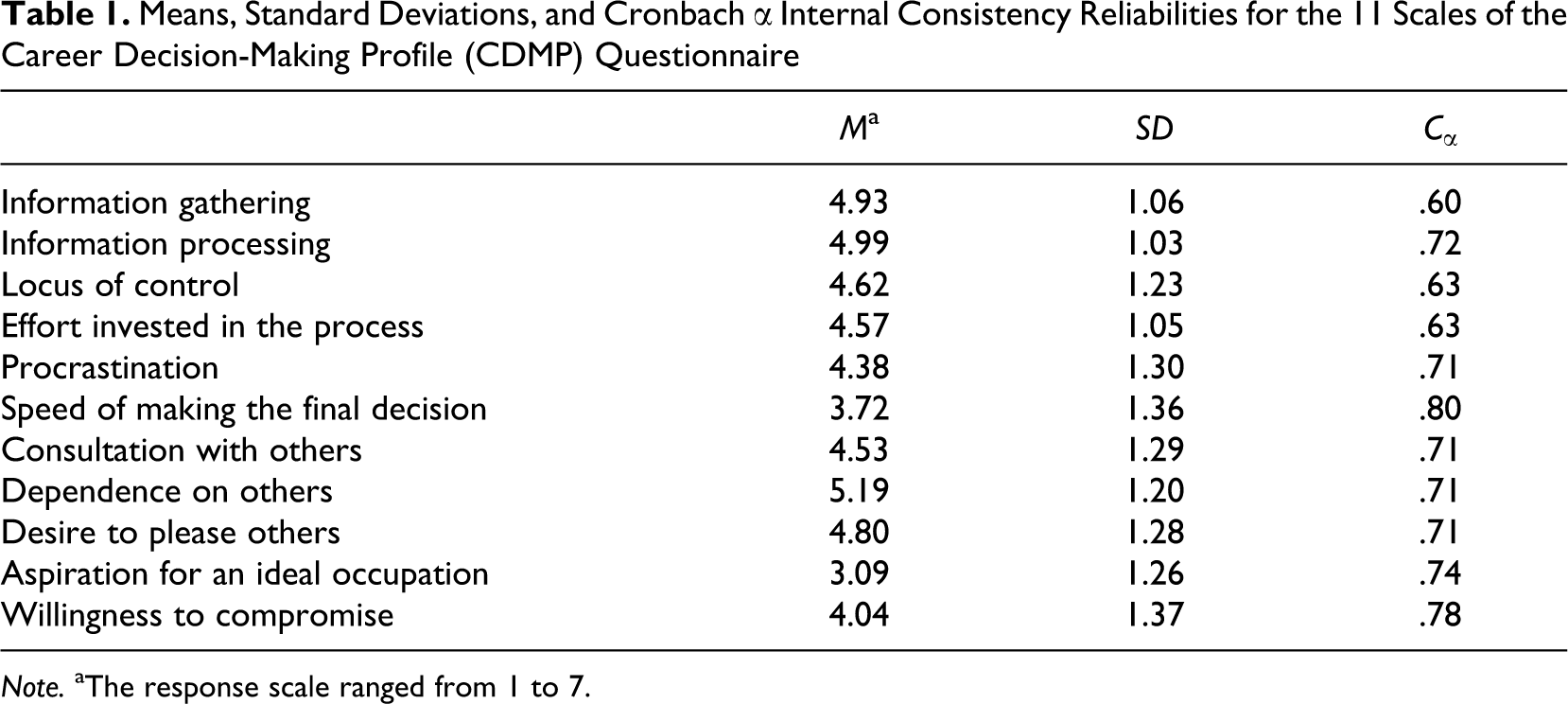
Note. aThe response scale ranged from 1 to 7.
The 11 dimensions of the CDMP are (Gati et al., 2010): collection and organization of information, information processing, locus of control, amount of time, and mental effort invested in the decision-making process, speed of making the final decision once the information has been collected and compiled, tendency to procrastinate entering the career decision-making process, tendency to consult with others during the various stages of the decision process, propensity to depend on others, wish to satisfy the expectations of significant others (e.g., parents, partner, and friends), aspiration for a perfect occupation, and willingness to compromise on the preferred alternative.
Most career decisions are complex, and there is considerable inter- and intraindividual variability in the ways individuals deal with such decisions. Some individuals may be more likely to feel anxiety, confusion, and indecision (Nota & Soresi, 2004; Saka, Gati, & Kelly, 2008). Gati, Krausz, and Osipow (1996) suggested a taxonomy of career decision-making difficulties based on decision theory. This taxonomy makes a distinction between difficulties that may occur before trying to make a decision (e.g., lack of readiness due to low motivation, general indecisiveness, and dysfunctional beliefs) and those that emerge while the process is underway (e.g., lack of information about the process, self, and occupations; inconsistent information due to the unreliable information or internal and external conflicts).
Focusing on indecisiveness, Saka, Gati, and Kelly (2008) explored its possible sources—specifically, the personality and emotional factors that might contribute to it. They suggested three clusters of factors that can hinder career decision making: (a) pessimistic views about the process of decision making, the world of work, and personal control, (b) anxiety about the process, the uncertainty involved, making a choice, and possible outcomes, and (c) self and identity factors associated with generalized anxiety, self-esteem, uncrystallized vocational identity, and interpersonal conflicts.
Brown and Rector (2008, 2010) adopted a bottom-up, data-driven approach to indecision (rather than a top-down rational/theoretic approach, as Gati and his colleagues did) and obtained a four-factor model of career indecision (Neuroticism/Negative Affectivity, Choice/Commitment Anxiety, Lack of Readiness/Immaturity, Interpersonal Conflicts). This model is empirically significant and of practical help in the conceptualization of career decision-making difficulties. Both approaches focus on the underlying sources of indecision and help us understand them.
Previous research has found that undecided youth tend to have maladaptive approaches to career decision making (Amir & Gati, 2006; Germeijs, Verschueren, & Soenens, 2006; Nota & Soresi, 2004; Saunders, Peterson, Sampson, & Reardon, 2000). They are not much inclined to minutely gather information useful for comparing options (Creed, Prideaux, & Patton, 2005), they have high scores in decisional procrastination (Feldman, 2003; Ferrari & Dovidio, 2000), they think they have fewer responsibilities in the decision process, and they are more easily influenced by significant others (Bacanli, 2006; Chartrand, Rose, Elliott, Marmarosh, & Caldwell, 1993; Nota, Ferrari, Solberg, & Soresi, 2007). The present study aims at contributing to the study of indecision by considering the CDMP of adolescents and focusing especially on the strategies that may be involved in career indecision.
Gender also seems to be involved in the profile, as girls tend to invest more time and effort in choice tasks (Costa, Terracciano, & McCrae, 2001; Gati et al., 2010), are more influenced by others when making a decision (Gati et al., 2010; Sanz de Acedo Lizarraga, Sanz de Acedo Baquedano, Oliver, & Closas, 2009) and (maybe as a consequence) are slower than boys in making their final decision (Gati et al., 2010; Rassin & Muris, 2005). Thus, a further aim of the present study was to compare the differences between the CDMP profiles of boys and girls, as well as youth who were either decided or undecided about their future.
Finally, attention was focused on the relations between career decisions and problem-solving abilities. For most people, making a choice about the future is a challenge—a real-life situation that needs an effective answer, possibly not immediately available or clear, but necessary for maintaining a good level of adaptation (D’Zurilla & Goldfried, 1981; D’Zurilla, Nezu, & Maydeu-Olivares, 1995). Reardon and collaborators conceptualized career problems as a perceived gap between an existing state of indecision and a desired state of decidedness (Reardon, Lenz, Sampson, & Peterson, 2000; Heppner, 2008; Nota & Soresi, 2004), which can be associated with anxiety, confusion, depressive attitudes, and indecision. Thus, career choice can be viewed as a problem, requiring problem-solving skills to find a solution effectively. This requires the processing of relevant information and discovery of possible solutions, each with its own advantages and disadvantages.
Efficacious management of complex problem situations requires, of course, problem-solving abilities (D’Zurilla & Nezu, 1982; Heppner, 2008) and young people need to be positively oriented toward these problems, to think of themselves as able to deal with them, to accurately define them, and to use strategies that lead to a number of options for resolving them. The aim is to identify several potential solutions and implement the most advantageous option, the one that will have the best outcome (Heppner, Witty, & Dixon, 2004; Nota, Heppner, Soresi, & Heppner, 2009). In this connection, Deniz (2004) found that individuals with good problem-solving skills also had high decisional self-esteem and a vigilant decision-making style. Morera et al. (2006) observed that analytical decision making was positively correlated with a positive orientation toward problems and rational problem solving, while it was negatively associated with dysfunctional problem-solving patterns, impulsivity, carelessness, and avoidant styles of problem solving. Complementariness seems to emerge between decisional abilities and problem solving.
The goal of the current study was to test the Italian version of the CDMP—its psychometric properties, and its structural and concurrent validity—and to see how it is associated with the Problem-Solving Inventory (PSI). Specifically, we predicted that:
The internal consistency estimates of the 11 scales representing the dimensions of the Italian version of the CDMP would be adequate (i.e., at least .60; Nunnally & Bernstein, 1994).
The structure of the 11 dimensions of the Italian version would be similar to that reported by Gati et al. (2010).
The association between the CDMP and the PSI would be different in the 11 dimensions. Specifically, we predicted positive correlations between the dimensions of information gathering, information processing, and effort invested, on one hand, and the PSI, on the other; however, we did not predict any associations between the dimensions of Consultation with others, Dependence on others, Desire to please others, and Willingness to compromise, on one hand, and the PSI, on the other.
The CDMP of decided adolescents would be different from that of undecided adolescents. The observed differences should indicate which pole of each dimension is more adaptive.
Method
Participants
The data were collected from 1,835 adolescents, 943 (51.4%) boys and 892 (48.6%) girls, mean age 17.2 years (SD = 0.40, median = 17.07, interquartile range 17.03–17.10). All participants attended high schools in northeast Italy. Of this sample, 530 students (28.9%; 238 boys, 44.9%, and 291 girls, 55.1%) attended a lycée (which is a 5-year school and aims specifically at preparing students for university education), 928 students (50.6%; 461 boys, 49.7%, and 467 girls, 50.3%) attended a technical school, and 377 students (20.5%, 244 boys, 64.7%, and 133 girls, 35.3%) attended a vocational school.
Instruments
The CDMP questionnaire
The CDMP (Gati et al., 2010) includes 36 statements. For each statement, the participants were asked to rate on a 7-point Likert-type scale the degree to which they agreed with each statement (1 = do not agree at all, 7 = agree very much). The first item of the CDMP is a warm-up item: “I am currently concerned about my future field of study or occupation.” Two validity items (i.e., I try to choose the option that is best for me, It makes no difference to me what career I will have in the future) were embedded in the questionnaire to ensure that the students replied only after reading the items attentively and gave their responses adequate consideration.
Each of the remaining 33 statements represented one of the two poles of each of the 11 dimensions of the CDMP (3 items for each dimension; see Appendix A); for example, “I do not feel that I need to thoroughly check all the existing alternatives before I make a decision” represents information gathering; and “I usually analyze the various alternatives into a number of factors and consider the advantages and disadvantages of each factor” represents analytical information processing.
A previous study conducted by Gati et al. (2010) showed that the CDMP had acceptable internal consistency reliability estimates (the median Cronbach α of the 11 dimensions was .81) and high (2-week) test–retest reliabilities—median .82 (range: .76 to .86). The median internal-consistency reliability estimates in the present study were .71 (range: .60 to .80; see details in Results section).
The CDMP was translated into Italian using the following procedure: First, two native Italian speakers fluent in English translated each of the items independently. They then compared their translations to achieve a common Italian version of each item. Next, the Italian translations were back-translated by a professional Italian–English translator. Once the back-translation was complete, the professional Italian–English translator and another native Italian speaker fluent in English compared each back-translated item to the corresponding original English item. Three items required revision. Each of these items was translated into Italian once again and then back-translated and compared to the original English version until semantic equivalence of the items was achieved (see Mallinckrodt & Wang, 2004).
PSI for adolescents
The PSI is a 35-item inventory with a 6-point Likert-type scale (1 = strongly agree to 6 = strongly disagree). The PSI assesses individuals’ self-perception of their problem-solving style rather than actual problem-solving skills. Higher scores indicate an individual’s assessment of himself/herself as a relatively successful problem solver. The PSI has a total score (i.e., the sum of the three factors) and another three scores reflecting the factors derived from exploratory and confirmatory factor analyses, χ2(206) = 1,346.89, p < .001, root mean square error approximation (RMSEA) = .073, comparative fit index (CFI) = .092; Heppner et al., 2010. The three factors are (a) tendency to engage in problem solving (10 items; e.g., When faced with a problem, I first look at the situation to get all the important pieces of information; α = .83); (b) self-efficacy in problem-solving ability (7 items; e.g., I’m almost sure that my plans to solve a problem will work; α = .76); (c) the ability to find solutions and assess their efficacy (5 items; e.g., I often make quick decisions and regret them later; α = .66). Previous studies have shown that the PSI has good reliability, with Cronbach α ranging from .65 to .81 for the Italian version (Heppner et al., 2010). In the present study, the reliabilities of the three factors and the total PSI scores were .83, .76, .66, and .84, for the three factors and the total PSI score, respectively.
Demographical data
We asked the students to report age, gender, and grades. Next they were asked whether they had already decided what to do upon completing high school (yes/no). A majority of the students reported that they were undecided (57%).
Procedure
The participants were asked to join school-based vocational guidance activities and fill out a battery of measures in group-testing sessions. The measures were administered to small groups by educational psychologists. The students were asked to read the instructions for the instruments before each questionnaire and were informed that they would receive feedback based on their responses once the data had been processed. The time required to fill out the questionnaires ranged from 30 to 40 min. The feedback provided to the students about 3 weeks later included their decisional profile and level of problem-solving ability, as well as suggestions for improving them. Individual counseling was offered to the students.
Results
Psychometric Properties of the CDMP
First we reversed some of the items so that a higher rating on all the items of the same scale represented the positive pole of the dimensions (e.g., low on procrastination). Then we checked the skewness and kurtosis of the responses to identify items with appropriate values (e.g., skewness and kurtosis values between +1 and –1; Crocker & Algina, 1986). In addition, we computed the correlations between each item and the 11-scale scores (with the item excluded from its scale score). This analysis revealed that all the items had higher correlations with their own scale than with the other 10 scales (median: .56, interquartile range: .49 to .61). The correlations between an item and each of the other scales were lower than .47.
The means, standard deviations, and Cronbach α internal-consistency reliabilities of the 11 scales of the Italian CDMP are presented in Table 1. As can be seen, the 11 scales representing the dimensions have different means, and the standard deviations indicate appropriate within-dimension variance. The median Cronbach α internal-consistency reliability of the 11 scales was .71 (range: .60 to .80), which can be considered as acceptable considering that there are only 3 items in each scale (Nunnally & Bernstein, 1994).
The Structure of the 11 Scales of the CDMP
Confirmatory factor analysis of the CDMP
We compared three models for the internal structure of the CDMP—the hypothesized model and two alternative models. The hypothesized model (labeled H: 33-11) suggests that all 11 dimensions are required to adequately characterize an individual’s CDMP, but that the 11 scales cannot be combined into a single total score (i.e., there are 11 first-level factors). We compared this model with two alternative models. The first alternative model (labeled A1: 33-11-1) hypothesizes that the 33 items can be clustered into the 11 scales and that the 11 scales represent a single factor—namely, the 11 first-level factors can be combined into a single second-order factor. The third model (labeled A2: 33-1) hypothesizes that all 33 items correspond to a single factor. We predicted that the 33-11 model would fit the data better than the alternative models. The results of the confirmatory factor analysis are presented in Table 2.
Fit Indices for Confirmatory Factor Analyses of the Career Decision-Making Profile (CDMP)
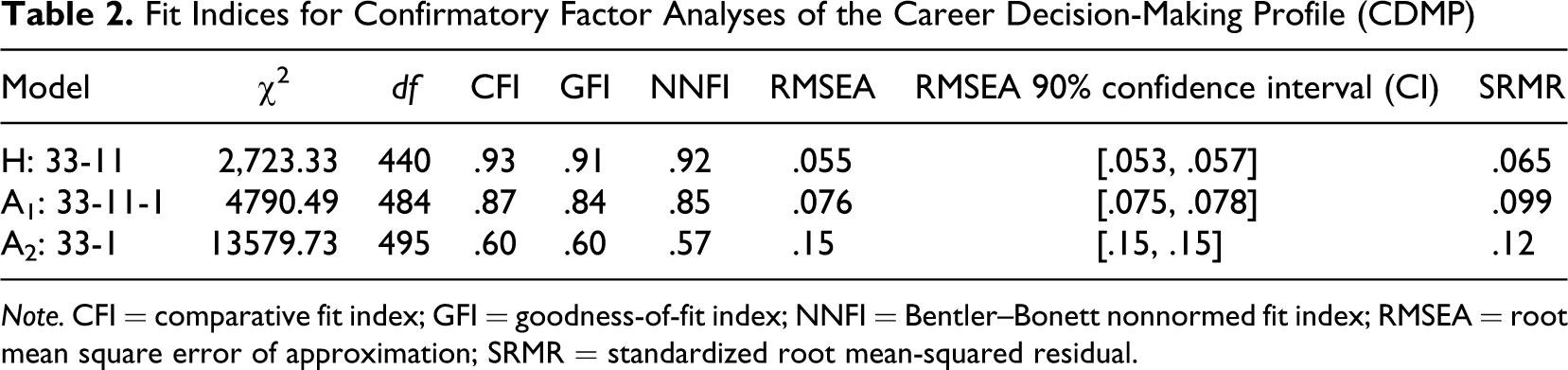
Note. CFI = comparative fit index; GFI = goodness-of-fit index; NNFI = Bentler–Bonett nonnormed fit index; RMSEA = root mean square error of approximation; SRMR = standardized root mean-squared residual.
As can be seen in Table 2, the hypothesized 33-11 model fits the data best. This is shown by the fact that it has the lowest χ2, the highest CFI (.95), and the lowest RMSEA (.052). The hypothesized model (H: 33-11) fits the data better than the 33-11-1 alternative model, Δχ2(44) = 2,067.16, p < .001. The 33-1 alternative model has the lowest fit of the three. The results of the confirmatory factor analysis support the claim that the 33 items do cluster into the 11 scales, and that the 11 scales represent fairly independent dimensions that should not be combined into a single overall score.
The relations among the 11 dimensions
To test the degree of independence of the 11 dimensions, we computed the intercorrelations among the 11 scale scores (see Table 3). The median of these correlations was .06, interquartile range −.11 to .21, reflecting that in general the dimensions were independent. However, a few dimensions were moderately correlated; the highest correlations (.47 and .46) were between information processing and effort invested in the process and between procrastination and speed of making the final decision.
The Intercorrelations Among the 11 Dimensions of the Career Decision-Making Profile Questionnaire
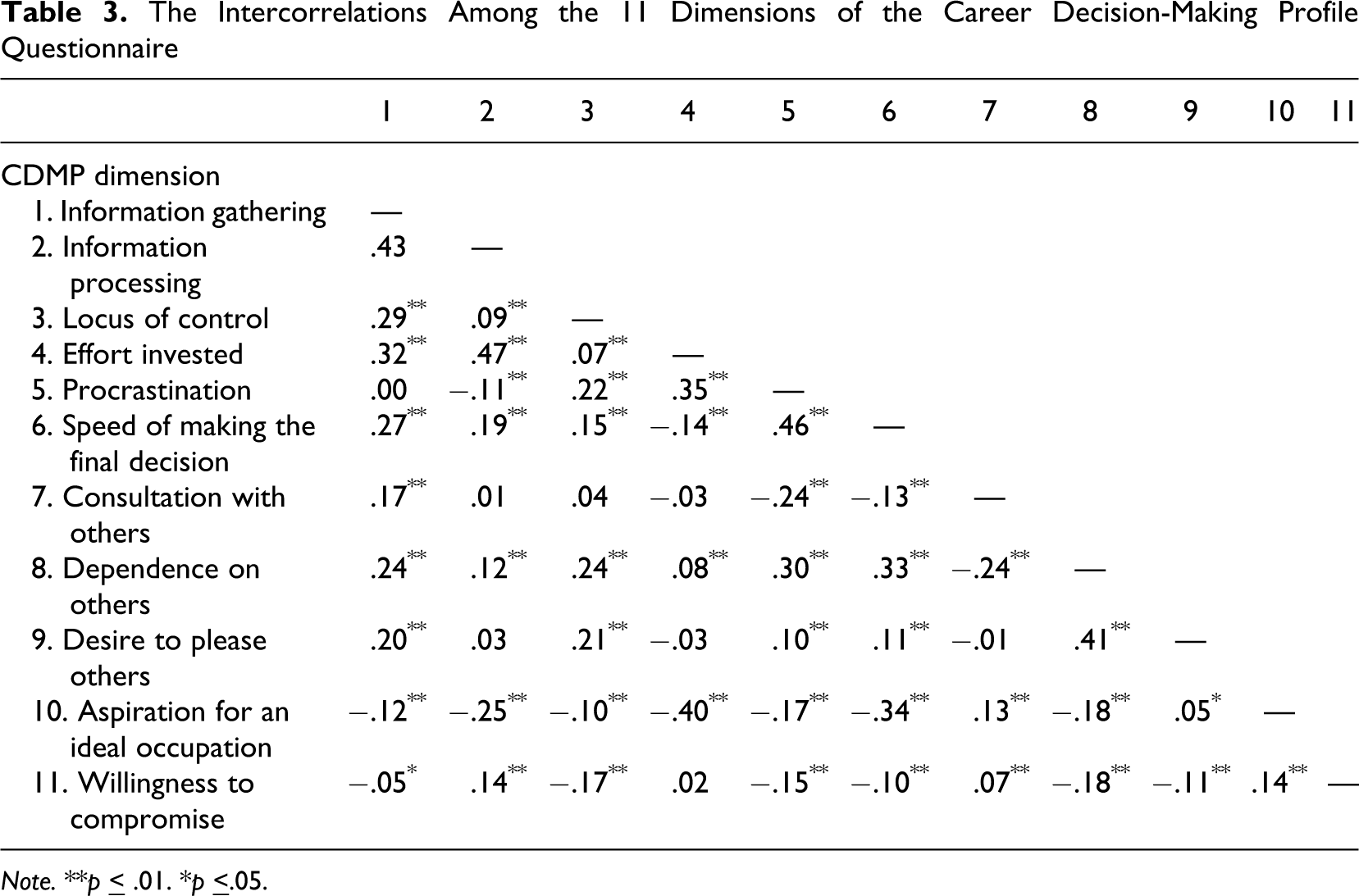
Note. **p
Associations between the CDMP scales and the PSI factors
Table 4 presents the correlations between the 11 scales of the CDMP and the three factors of the PSI. As predicted, the scales of information gathering, information processing, and effort invested of the CDMP were all correlated (median: r = .30, range: .16 to .46) with the three factors of the PSI; the correlations of these dimensions with the total PSI score were .40, .48, and .35, respectively. Furthermore, as predicted, 4 scales of the CDMP—consultation with others, dependence on others, desire to please others, and willingness to compromise—had low or negligible correlations with the three PSI factors (median: r = .04, range: −.22 to .23). Interestingly, the scale of speed of making the final decision was moderately correlated with the factor of self-efficacy for problem-solving ability (.38), but not with the other two factors of the PSI (r = .00 and .01).
Correlations Among the 11 Scales of the Career Decision-Making Profile (CDMP) and the Three Factors of the Problem-Solving Inventory (PSI)
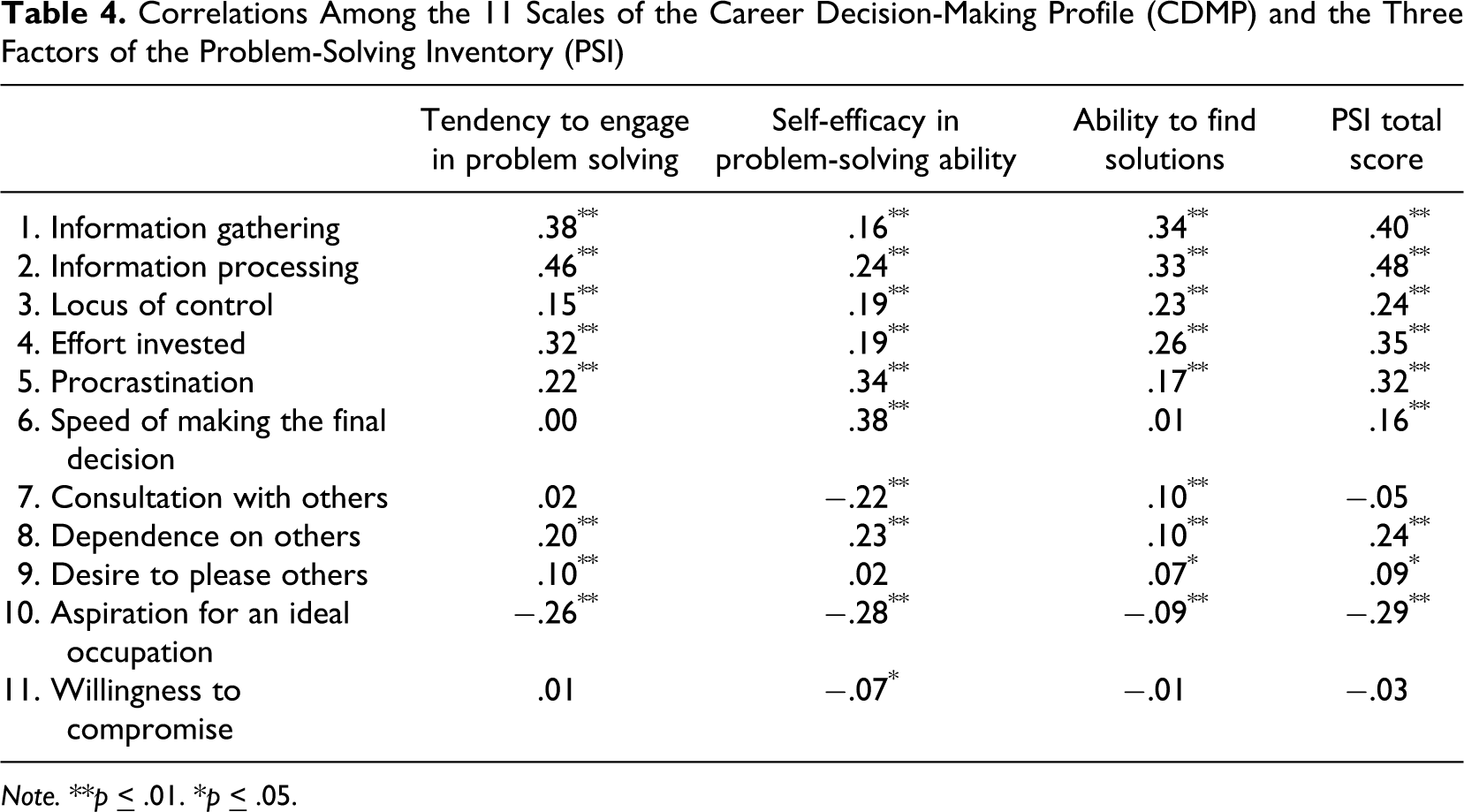
Note. **p
Differences between boys and girls, and between decided and undecided students
Table 5 presents the means (and SDs) for decided and undecided boys and girls in the 11 CDMP dimensions. We carried out a three-way mixed-design multivariate analysis of variance (MANOVA) with Gender and Decision-status as the between-subject factors and the 11 CDMP dimension scores as the within-subject factor. As hypothesized, this analysis revealed differences in the mean scores among the 11 dimensions, F(10, 1,826) = 510.01, p < .001, η2 = .22. Main effects for Gender, F(1, 1,826) = 85.80, p < .001, η2 = .04, and Decision status, F(1, 1,826) =23.85, p < .001, η2 = .04, also emerged, reflecting Gender and Decision status differences in the CDMP, across all dimensions. The MANOVA revealed a negligible three-way interaction between the 11 dimensions, Gender and Decision status, F(10, 1,826) = 2.05, p < .05, η2 = .001, and significant interactions between Dimensions and Gender, F(10, 1,826) = 21.68, p < .001, η2 = .01, and between the Dimensions and Decision status, F(10, 1,826) = 52.60, p < .001, η2 = .03.
Means (and SDs) of Career Decision-Making Profiles (CDMP) as a Function of Gender and Decision Status (n = 1,830)

With regard to gender differences, further inspection of the means of the dimensions revealed that the lowest score was aspiration for an ideal occupation for both men and women; whereas dependence on others was highest for both boys and girls. For eight dimensions, the gender differences were statistically significant: girls’ scores were higher than boys’ on desire to please others, t(1,833) = 10.604, p < .001, d = .49, information gathering, t(1,833) = 9.201 p < .001, d = .43, consultation with others, t(1,833) = 8.308, p < .001, d = .39, locus of control, t(1,833) = 4.143, p < .001, d = .20, aspiration for an ideal occupation, t(1,833) = 4.234, p < .001, d = .19, effort invested in the process, t(1,833) = 2.408, p < .05, d = .11, and dependence on others, t(1,833) = 2.134, p < .05, d = .09; the boys’ scores were higher than the girls’ on speed of making a final decision, t(1,833) = 4.633, p < .001, d = .22.
Regarding Decision status, further inspection of the dimensions’ means revealed that the lowest score was for aspiration for an ideal occupation for both decided and undecided students. Additionally, for eight dimensions, the differences were statistically significant. Specifically, the undecided adolescents’ scores were higher than those for the decided adolescents on aspiration for an ideal occupation, t(1,828) = 11.662, p < .001, d = .48, consultation with others, t(1,828) = 5.725, p < .001, d = .26, willingness to compromise, t(1,828) = 2.449, p < .05, d = .12. The decided adolescents’ scores were higher than those of the undecided students on procrastination, t(1,828) = 13.776, p < .001, d = .65, speed of making the final decision, t(1,828) = 8.759, p < .001, d = .41, and effort invested in the process, t(1,828) = 6.906, p < .001, d = .33, dependence on others, t(1,828) = 3.884, p < .001, d = .18, locus of control, t(1,828) = 2.412, p < .05, d = .11.
Discussion
The goal of the current study was to test the Italian version of the CDMP—specifically, its psychometric properties, including the internal consistency of the scales, its internal structure validity, its association with the PSI, and its concurrent validity—as well as to test for gender differences in the decisional profiles of adolescent boys and girls.
With regard to internal consistency and construct validity, results suggest that the CDMP is a psychometrically adequate measure for describing individual differences in the manner in which career decisions are made, similar to the original United States and Hebrew versions of the CDMP (Gati et al., 2010). The reliability estimates of scores on the 11 scales were in the moderate-to-high range, although somewhat lower than those for the English and Hebrew versions. A confirmatory factor analysis supported an 11-dimension structure for the CDMP and suggested that the scale scores should not be combined into a single total score, supporting the claim that the way individuals make career decision should be described in terms of a multidimensional profile rather than a single style or score.
As predicted, decided and undecided adolescents differ in several dimensions of the CDMP. Specifically, decided students reported a more internal locus of control and greater commitment (investing more effort in the process and making the final decision more quickly), less of a tendency to procrastinate, or consult with others. This shows that decided adolescents approach career decision making differently than those who are undecided. Such a discrepancy between a desired perfection and propensity to compromise could favor persistence of indecision and inadequate reflection on the future (Hartley, 2009; Saunders et al., 2000).
As in previous studies (Gati et al., 2010), a few differences between girls and boys emerged in the CDMP profiles. Girls tend to invest more effort in the process, consult more with others, depend less on others, and be more inclined to please others, whereas boys make the final decision faster than girls. These findings are consistent with Gati et al.’s (2010) findings on women being more conscientious, and consequently taking more time to make a decision. Italian girls also have higher scores than boys in information gathering and internal locus of control, all of which can affect the time needed to make a choice.
Regarding the associations between the CDMP and the PSI, the predicted positive correlations between the CDMP scales focusing on the more cognitive aspects of the career decision-making process and the PSI indeed emerged, where information processing, information gathering, and effort invested in the process were correlated with the PSI factors. On the other hand, no correlations were observed between the CDMP scales involving the interaction with and role of significant others (e.g., consultation with others, dependence on others, and desire to please others) and the PSI factors. Furthermore, willingness to compromise was not correlated with the PSI. These results support the construct validity of the CDMP dimensions, namely, that they capture both cognitive and not-cognitive aspects of the ways individuals make career decisions.
Limitations and future directions
Before discussing the present study’s implications, its limitations have to be acknowledged. First, the internal consistency reliabilities of a few scales were lower than desirable and lower than those obtained for the Hebrew and English versions. This can be attributed, at least in part, to the fact that the participants were younger than those in the Gati et al.’s (2010) study. Future research should test the reliabilities of the CDMP as a function of the age of the adolescents; moreover, future research should investigate reliability differences between groups of individuals experiencing different life situations (e.g., either employed or unemployed), as well as test the Italian CDMP with older participants. Second, the findings reported herein are for residents of northeastern Italy. It is hoped that future research will involve participants from other Italian regions, with the aim of verifying the generalizability of the conclusions. Third, to avoid carryover from the PSI to the CDMP, the order of these two questionnaires was not counterbalanced, and this could have affected the responses to the PSI. Future research should use a counterbalanced design and study the associations of the CDMP with other career decision-making measures (e.g., CDMSE, Taylor & Betz, 1983; CDDQ, Gati, Krausz, & Osipow, 1996).
Implications
The compatibility of the Italian CDMP version’s structure with those obtained from the United States and Israeli samples provides support for the validity of the proposed multidimensional model that characterizes the way individuals make career decisions in terms of levels along the dimensions and suggests that using a single label to characterize individuals based on their dominant style or a single total score are oversimplifications. Despite the limitations, the results indicate that the CDMP is an adequate multidimensional measure for assessing the way individuals make career decisions in the Italian context as well. Of the strategies used by the Italian, Israeli, and U.S. participants, the dimension dependence on others was the lowest-scoring one, while aspiration for an ideal occupation was the highest-scoring one. In all three different cultural contexts, the tendency to delegate the responsibility for the decision to others is fairly low. This is consistent with the notion that the social context in Italy encourages adolescents and adults to show some sort of self-determination (Nota, Soresi, Ferrari, & Wehmeyer, 2011; Soresi, Nota, & Ferrari, 2004). At the same time, there is also some propensity to search for one’s ideal occupation. The tendency to aspire to an ideal occupation may be specific to Western cultures and in future studies, it should be replicated in Eastern cultures. Contextual differences notwithstanding, the results of the present study suggest that there are some core dimensions that could be used to facilitate comparisons between research studies and discussions among researchers from different countries, as well as testing the relative efficacy of vocational guidance and counseling procedures.
This conclusion has also practical implications. The CDMP allows for a multidimensional assessment of the way individuals make career decisions, and thus can be used in vocational guidance to assess the ways individuals approach and handle career decisions. This can help practitioners pay special attention to clients with less advantageous profiles, encourage reflections on the advantages and disadvantages associated with such patterns, and stimulate their clients to make use of strategies that can be more efficacious in the decisional task they are facing. With undecided adolescents, it would be useful to discuss the disadvantages associated with the desire to please others or depending on others to make the decision for them, and the advantages of greater personal effort in making a choice for the future (Albion, 2000). In addition, the CDMP can be used for the early identification of at-risk individuals with nonadaptive profiles. It can also be used to stimulate the planning of differentiated interventions that are as personalized as possible, to strengthen adolescents’ abilities and competencies and facilitate their choices of schools and careers. The CDMP may also be useful in testing the efficacy of career guidance interventions whose aim is to improve decisional competencies, just as the CDDQ may be used to assess the effectiveness of interventions for reducing career decision-making difficulties (Gati et al., 1996).
Footnotes
Appendix A
List of the 36 Items and 11 Dimensions of the Career Decision-Making Profile (CDMP) Questionnaire
| Dimensions | Item |
|---|---|
| 1. Information gathering (Higher scores indicate that individual is more meticulous and thorough in collecting and organizing information) | 3. Generally, I am not thorough in gathering information; I usually manage with easily accessible facts 15. I do not feel that I need to thoroughly check all the existing alternatives before I make a decision 27. I usually do not try to collect all the available information about the occupations I am considering |
| 2. Information-processing (Higher scores indicate higher tendency to analyze information into its components and to process information according to these components) | 2. I usually analyze the various alternatives into a number of factors and consider the advantages and disadvantages of each factor 14. I usually make my decisions analytically, that is, I analyze the information in terms of specific characteristics and compare the alternatives along these characteristics 26. After collecting the necessary information about the various occupational alternatives, I analyze each in terms of its characteristics |
| 3. Locus of control (Higher scores indicate that individual believes he/she controls his/her occupational future and feels his/her decisions affect his or her future career opportunities) | 4. I am not the only one responsible for the results of my decision; fate and luck greatly affect my future career. 16. Factors outside of my control (like fate) greatly influence my career choice and its outcomes 28. It really doesn't matter what I choose; fate will ultimately influence my future career anyway |
| 4. Effort invested in the process (Higher scores indicate more time and mental effort invested in the decision-making process) | 5. I invest a lot of effort in the decision-making process 17. I immerse myself entirely in the decision-making process 29. When I need to make a decision, I invest a lot of time and attention in the matter |
| 5. Procrastination (Higher scores indicate that individual does not delay beginning the career decision-making process and advancing through it) | 7. I tend to postpone my career decision 19. I do not delay my career decision making 31. I tend to postpone the decision-making process as much as I can |
| 6. Speed of making the final decision (Higher scores indicate that individual is fast to make the final decision once the information has been collected and compiled) | 6. When I get to the stage where I have to decide, I hesitate quite a lot before actually making the decision 18. Even after collecting the relevant information, it takes me a lot of time to make the final decision 30. Even after I have all of the necessary information, I need a long time to make a decision |
| 7. Consultation with others (Higher scores indicate that individual consults with others during the different stages of the decision process) | 8. I usually consider my choices and make my decision without consulting others 20. I do not need to consult with others to make the right decision 32. I usually do not consult with other people when making my decision |
| 8. Dependence on others (Higher scores indicate that individual accepts full responsibility for making the decision (even if one consults with others) | 9. When I am faced with such an important decision, I want someone else to decide for me 21. I do not want to make the decision alone; I want other people to share some of the responsibility 33. I prefer that other people share the responsibility for my decision |
| 9. Desire to please others (Higher scores indicate that individual does not attempt to satisfy the expectations of significant others) | 10. It is important for me to choose the option that will satisfy my family and close friends 22. I will eventually choose one of the options that will please the people closest to me 34. The expectations of those closest to me are an important factor in my decision |
| 10. Aspiration for an ideal occupation (Higher scores indicate that individual believes there is not a perfect or flawless occupation for him or her) | 11. I believe that I can find a perfect vocation that will fulfill all my dreams 23. I believe that I can find an occupation that will provide what I am looking for 35. I believe that there is one occupation that is perfect for me |
| 11. Willingness to compromise (Higher scores indicate that individuals are willing to be flexible about their preferred alternative when they encounter difficulties in actualizing it). | 12. If I am not accepted for my first-choice major or training program, I will compromise and opt for my second choice 24. If I cannot realize my first choice, I will be willing to compromise 36. If I am not able to enter a degree program in my chosen field, I will compromise and look for another one that is right for me |

Acknowledgments
The authors thank Lisa Asulin-Peretz, Naomi Goldblum, and Nimrod Levin for their helpful comments on an earlier version of this article. This research was supported in part by the Samuel and Esther Melton Chair of Itamar Gati.
Declaration of Conflicting Interests
The authors declared no potential conflicts of interest with respect to the research, authorship, and/or publication of this article.
Funding
The authors received no financial support for the research, authorship, and/or publication of this article.