



Abstract
This study examined the relationship between emotional intelligence (EI) and styles of decision making. Two hundred and six Italian high school students completed two measures of EI, the Bar-On EI Inventory, based on a mixed model of EI, and the Mayer Salovey Caruso EI Test, based on an ability-based model of EI, in addition to the General Decision-Making Style Questionnaire. The findings suggest that both mixed model and ability-based models are related to decision-making style, but that ability-based EI does not predict decision-making style beyond the effects of the mixed model. This study reveals how varied dimensions of EI, especially self-assessment of one’s emotional skills and personal qualities, are related to decision-making style. The assessment of EI may be useful in understanding career decision-making difficulties and in identifying strategies for promoting adaptive career decision making.
Considerable scholarly work has focused on defining and assessing career decision making (Driver, 1979; Driver, Brousseau, & Hunsaker, 1990; Friedman & Mann, 1993; Harren, 1979; Janis & Mann, 1977; Radford, Mann, Ohta, & Nakane, 1993; Scott & Bruce, 1995). Although the rational aspects of career decision making have long been recognized, the role of emotions in decision making is gaining increased attention, with scholars now criticizing models that focus exclusively on rational processes (Caruso & Wolfe, 2001; Di Fabio & Blustein, 2010; Emmerling & Cherniss, 2003). Rational models may offer limited understanding of decision making for students and young workers who expect to face multiple career transitions in an uncertain and unpredictable global economy (Krieshok, Black, & McKay, 2009; Savickas, 2000; Van Vianen, Pater, & Preened, 2009). Given the need to choose between one’s needs and desires and the realities of an ever-changing labor market, emotions inevitably impact the decision-making process (Brown, George-Curran, & Smith, 2003). As a result, personal characteristics, such as adaptability, knowledge of self and the external world, and the ability to cope effectively with ambivalence, uncertainty, and conflict may be increasingly vital in managing the numerous decisions and transitions that now characterize the typical work or career trajectory (Fouad & Bynner, 2008; Krieshok et al., 2009).
In efforts to better understand how emotional factors impact decision making, research in the United States and Italian contexts has begun to examine the relationship of emotional intelligence (EI) with career decision making (Brown et al., 2003; Di Fabio & Blustein, 2010; Di Fabio & Kenny, 2011). EI has been prevalent in the popular press since the publication of Goleman’s best selling book in 1995 (Goleman, 1995). Since that time, scholars (e.g., Bar-On, 1997; Mayer & Salovey, 1997; Mayer, Salovey, & Caruso, 2002, 2008) have sought to enhance the conceptualization and scientific validity of the construct, with some debate concerning the extent to which EI overlaps with personality factors or should be conceptualized and assessed exclusively as a set of abilities. The Bar-On (1997, 2002) model, also referred to as the mixed model, conceptualizes EI as a mixture of personality and social–emotional abilities and is assessed through a self-report measure. The intrapersonal and interpersonal dimensions of EI in the Bar-On mixed model relate to self-awareness of emotions and awareness of and the ability to respond to the feelings of others. The stress management, adaptability or flexibility in dealing with daily problems, and general mood dimensions of the Bar-On mixed model reflect a mixture of social–emotional skills and personality factors.
Mayer and colleagues (Mayer et al., 2002; Mayer, Roberts, & Barsade, 2008; Mayer, Salovey, & Caruso, 2008) are critics of the mixed-model conceptualization of EI, and advocate for an exclusively ability-based model. The model specifies four sets of skills related to the perception, understanding and management of emotions, and the use of emotions to enhance thinking, which are assessed through objective performance tests. Mayer et al.’s model strives to identify and assess social–emotional abilities as distinct from self-reported personality and is emerging as the prototype for EI training. Despite debate concerning the definition and measurement of EI, research developed from both models has established significant relationships between EI and psychological well-being, effective social relationships, productive work relationships, and academic competence (Mayer, Salovey, & Caruso, 2008).
Existing research within the Italian context (e.g., Di Fabio & Blustein, 2010; Di Fabio & Palazzeschi, 2008a, 2009b) has examined the relationships between varied models of decision making and components of EI as assessed through the Bar-On mixed model (1997, 2002). Intrapersonal and interpersonal awareness, adaptability, and stress management as defined by Bar-On logically relate to the social–emotional skills specified in recent conceptualizations of decision making. As in other Western contexts, Italy is experiencing high levels of job instability, complicating the process of career decision making for young people. Research with Italian high school students and young workers engaged in paid professional training reveals hypothesized associations between components of EI as assessed by the Bar-On mixed-model scale and difficulties in career decision making (Di Fabio & Palazzeschi, 2008a, 2009b). EI as conceptualized by Bar-On has also been associated with effectiveness in dealing with decisional conflicts among Italian high school students and apprentices in training (Di Fabio & Blustein, 2010; Di Fabio & Palazzeschi, 2007). The findings across these studies reveal, furthermore, that varied personality and social–emotional competencies as assessed by components of the Bar-On are related with different decision-making assets and limitations.
Di Fabio and Palazzeschi (2008a), for example, found that the intrapersonal dimension of EI was a consistent inverse predictor of the three dimensions of career decision difficulty (Gati, Krausz, & Osipow, 1996), including lack of readiness, lack of information, and inconsistent information. In addition, the interpersonal and adaptability dimensions were negatively related to inconsistent information, and stress management was negatively related to lack of readiness. With regard to research on style in managing decisional conflicts (Di Fabio & Palazzeschi, 2007; Di Fabio & Blustein, 2010), the Bar-On Intrapersonal scale was inversely related to maladaptive styles of responding to decisional conflict, including avoidance, procrastination, and hypervigilance. Procrastination in decision making was also negatively associated with self-reported interpersonal or social awareness as assessed by the Bar-On scale. The adaptability scale of the Bar-On, reflecting self-reported ability to deal with daily problems in a flexible manner, was positively related with the vigilant style, an adaptive response to decisional conflict involving careful and precise consideration of options. This research suggests that a lack of awareness of one’s own emotions contributes to a variety of difficulties in making decisions and dealing effectively with decisional conflicts, with interpersonal or social awareness, adaptability, and stress management also contributing to the explanation of decision-making difficulties and conflicts.
The concept of decisional style, proposed in the literature by Harren (1979) and developed in further research by Scott and Bruce (1995), has gained recent interest as a way of understanding the value of varied approaches to decision making as a function of the decision-making context. Scott and Bruce (1995) define decisional style as “the learned habitual response pattern exhibited by an individual when confronted with a decision situation. It is not a personality trait, but a habit-based propensity to react in a certain way in a specific decision context” (p. 820). Individuals often use a combination of styles in making important decisions, and the style preferred in one decision-making situation may shift in another. Scott and Bruce (1995) developed the General Decision-Making Style (GDMS) questionnaire based upon four styles (rational, intuitive, dependent, and intuitive) specified by Harren (1979), with a fifth style (spontaneous) emerging in their research.
The relationship between decisional style using the GDMS (Scott & Bruce, 1995) and self-reported EI with the Bar-On model (1997, 2002) has also been examined in the Italian context in a study of university students (Di Fabio & Palazzeschi, 2008b). The adaptability dimension of EI was related to the rational style, suggesting that the ability to dealing flexibly in solving problems is related to a decisional style characterized by a careful and systematic evaluation of alternatives. The interpersonal dimension of EI, involving social awareness and a recognition of the feelings and needs of others, was significantly related with the intuitive style, characterized by confidence in one’s own intuitions and feelings. The Intrapersonal dimension of EI, related to awareness of one’s own feelings, was inversely related to the dependent style, suggesting that a limited awareness of one’s own feelings may lead to seeking advice from others. Intrapersonal EI was also a significant negative predictor of the Avoidant decisional style, suggesting that low awareness of one’s own feelings may contribute to an avoidance of decision making. Adaptability or flexibility in decision making was inversely related to the spontaneous decisional style, suggesting that a lack of flexibility may contribute to a tendency to make decisions immediately and instinctively. That study did not include ability-based assessment of EI.
The current study seeks to further advance the investigation of EI and decisional styles. First of all, we seek to replicate the relationships between the dimensions of mixed-model EI and decisional style identified by Di Fabio & Palazzeschi (2008b). Because decisional style is a promising construct in understanding adaptive career decision making, further evidence regarding the validity of the relationships observed in prior research is warranted. Second, given that EI training as part of the high school curriculum has been shown to enhance EI as assessed through both mixed-model and ability-based measures (Di Fabio & Kenny, 2011), we have chosen to study high school students. Studying high school students is compelling additionally because some of the first critical career decisions, such as choice of high school and higher education, take place before or during secondary school. Finally, given the increased attention to the Mayer et al.’s (2002, 2008) ability-based model as the prototype for EI training, we were interested in whether the ability-based dimensions of EI would contribute to a more complete understanding of the emotional skills related to decisional style.
The relationship between ability-based models of EI and decisional style has not been explored in prior research. Mayer et al. (2008) argue that ability-based conceptions of EI are important in distinguishing the construct as a unique ability, beyond personality characteristics. Consistent with the Mayer et al.’s (2008) position, research in the Italian context has shown ability-based EI, especially skills in managing emotions (ME), to predict scholastic aptitude (Di Fabio & Palazzeschi, 2009a), beyond the effects of a mixture of personality and self-report social–emotional skills assessed by mixed-model EI (Bar-On, 1997, 2002). Decision-making style reflects a habit-based propensity, which although not a personality trait, may be impacted by personal characteristics of the decision maker as well as the decision-making context (Scott & Bruce, 1995; Thunholm, 2004). For these reasons, we were interested in examining the contributions of both self-report and ability-based conceptualizations of EI with decision-making style.
Following from our review of the literature, this study was designed to assess among a sample of Italian high school students the relationships of decision-making style with (1) self-report mixed-model EI and (2) ability-based EI. In addition, we explored whether ability-based EI adds to the explanation of decision-making style beyond the effects of mixed-model measures. We expected that self-report EI based upon the mixed model would be related to career decision-making style among high school students similar to the findings for college students (Di Fabio & Palazzeschi, 2008b). We also expected that ability-based EI would be related to career decisional-making style and, consistent with research on scholastic success (Di Fabio & Palazzeschi, 2009a), would add to the explanation of decisional style beyond self-reported mixed-model assessment.
Method
Participants
Two hundred and six high school students, 86 male and 120 female, attending high school in Tuscany participated in the study. One hundred and twelve students (54%) attended a college preparatory high school and 94 students (46%) attended a technical high school. Participants ranged in age from 16 to 19 (M = 17.53; SD = .64) and were predominantly White Italians from middle-class backgrounds. Questionnaires were completed in the school setting with respect to local laws regarding privacy.
Measures
Decision-making style
Decision-making style was measured using the Italian version (Di Fabio, 2008) of the 25-item 5-scale GDMS questionnaire (Scott & Bruce, 1995). The instrument is composed of 25 items with response options on a 5-point Likert-type scale, ranging from 1 (strongly disagree) to 5 (strongly agree). The GDMS assesses five decisional styles: Rational (RA) identifies the tendency to have a logical and systematic approach to decision making, with extensive use of information; Intuitive (IN) identifies an approach-based primarily on intuitions and feelings; Dependent (DI) identifies a style of making decisions by seeking advice, ideas, and recommendations from others; Avoidant (EV) identifies discomfort with and consequent avoidance of decision making; Spontaneous (SP) identifies a style of quick and instinctive decision making. The Italian version was developed through the back-translation procedure and yielded the following reliability values: α = .73 for Rational; α = .73 for Intuitive; α = .80 for Dependent; α = .84 for Avoidant, and α = .78 for Spontaneous (Di Fabio, 2008). Confirmatory factor analysis demonstrated goodness of fit for the five-factor structure. The first factor (Avoidant) explained 15.32% of the variance, the second factor (Dependent) explained 15.09% of the variance, the third factor (Spontaneous) explained the 8.24% of the variance, the fourth factor (Intuitive) explained the 4.03% of the variance, and the fifth factor (Rational) explained the 3.38% of the variance. Moderate-level correlations with the Melbourne Decision-Making Questionnaire (Mann, Burnett, Radford, & Ford, 1997), consistent with theoretical expectations, offer evidence for concurrent validity (Di Fabio, 2008). For the current study, αs range from .72 to .81.
Mixed-model EI
The Italian version (Franco & Tappatà, 2009) of the 133-item Bar-On EI Inventory (Bar-On, 1997) was used to assess self-reported mixed-model EI. Item response options on a 5-point Likert-type scale range from from 1 (not at all true of me) to 5 (absolutely true for me). The questionnaire provides a total score (EQ total), and scores for five separate dimensions: Intrapersonal, associated with awareness of one’s own emotions, one’s strengths and weaknesses, and the ability to express one’s own feelings; Interpersonal, linked to social awareness and interpersonal relationships, being able to recognize emotions, feelings, and needs of others, and being able to establish and maintain cooperative, constructive, and satisfactory relationships; Adaptability, reflecting the ability to cope with everyday problems in a flexible manner; Stress Management, showing the ability to cope with stressful situations in an adaptive way and being able to beneficially manage emotions; General Mood, demonstrating the capacity to maintain optimism, knowing how to try and express positive feelings and being able to enjoy the presence of other people. Confirmatory factor analysis supported the 5-scale structure for the Italian version, developed through the back-translation procedure (Franco & Tappatà, 2009). Construct validity is evidenced through negative correlations with the subscales of the Toronto Alexithymia scale (Bagby, Parker, & Taylor, 1994), which assesses difficulties in identifying feelings and describing emotions, and through moderate positive correlations (Di Fabio & Palazzeschi, 2009b) with the Extraversion, Agreeableness, Conscientiousness, Emotional Stability, and Openness scales of the Big Five Observer (Caprara, Barbaranelli, & Borgogni, 1994). Cronbach αs for the Italian version were .91 for the Intrapersonal dimension, .84 for the Interpersonal dimension, .81 for Adaptability, .87 for Stress Management, .83 for General Mood, and .95 for the Emotional Quotient (QE) total (Franco & Tappatà, 2009). For the current sample, Cronbach α was .86 for the Intrapersonal dimension, .82 for the Interpersonal dimension, .80 for Adaptability, .83 for the Stress Management, .81 for the General Mood, and .91 for the EQ total.
Ability-based EI
The Italian version (D’Amico & Curci, 2010) of the Mayer Salovey Caruso Emotional Intelligence Test (MSCEIT; Mayer, Salovey, & Caruso, 2002) was used to evaluate ability-based EI. The 141-item measure provides a total score (Emotional Intelligence Quotient) and four branch or dimension scores: Perceiving Emotions (PE), that is, the ability to perceive emotions in oneself and others, as well as in objects, art, stories, music, and other similar stimuli; Facilitating Thought (FT), that is, the ability to generate, use, and feel emotions to communicate feelings or employ them in other cognitive processes; Understanding Emotions (UE), that is, the ability to understand emotional information, how emotions combine and progress through relationship transitions, and to appreciate such emotional meanings; and Managing Emotions (ME), that is, the ability to be open to feelings and to modulate them in oneself and others so as to promote personal understanding and growth. Split half reliabilities for the subscale scores on the Italian version, developed through back-translation, were .90 for PE, .77 for FT, .75 for UE, and .72 for ME (D’Amico & Curci, 2010). With regard to construct validity, factor analyses reflect the four-branch or dimensional structure of the model. Convergent and discriminant validity is supported by findings of weak correlations between MSCEIT scores and personality and positive correlations with fluid intelligence (D’ Amico & Curci, 2010; Di Fabio & Palazzeschi, 2009a). For the current sample, split half reliabilities for the subscale scores were .87 for PE, .76 for FT, .73 for UE, and .75 for ME.
Results
Descriptive statistics and correlations among all study scales are presented in Table 1. Two sets of regression analyses were completed first to assess (1) the contribution of five dimensions of self-reported EI to each of the five decision-making styles and (2) the contribution of four dimensions of ability-based EI to each of the five decision-making styles. Given that each set of regressions included five analyses, we set the significance level at .01 (.05/5) to guard against Type-1 error.
Standard Deviations and Correlations Relative to General Decision-Making Style (GDMS), Bar-On EQ, and Mayer Salovey Caruso Emotional Intelligence Test (MSCEIT)

Note. N = 206
GDMS F1 = Rational; GDMS F2 = Intuitive; GDMS F3 = Dependent; GDMS F4 = Avoidant; GDMS F5 = Spontaneous; Bar-On Intra = Intrapersonal; Bar-On Inter = Bar-On Interpersonal; Bar-On Stress man = Bar-On Stress management; Bar-On Adapt = Bar-On Adaptability; Bar-On Gen mood = Bar-On General mood; MSCEIT PE = Perceiving emotions; MSCEIT FT = Facilitating thought; MSCEIT UE = Understanding Emotions; MSCEIT ME = Managing emotions.
*p < .05. **p < .01.
The results of the analyses with mixed-model EI (Table 2) reveal that adaptability was a significant positive predictor of rational decision making, intrapersonal intelligence was a negative predictor of the dependent and avoidant styles, and stress management and adaptability were negatively related to the spontaneous style.
Regression. The Contributions of Bar-On EQ Dimensions to Decision-Making Style (N = 206)
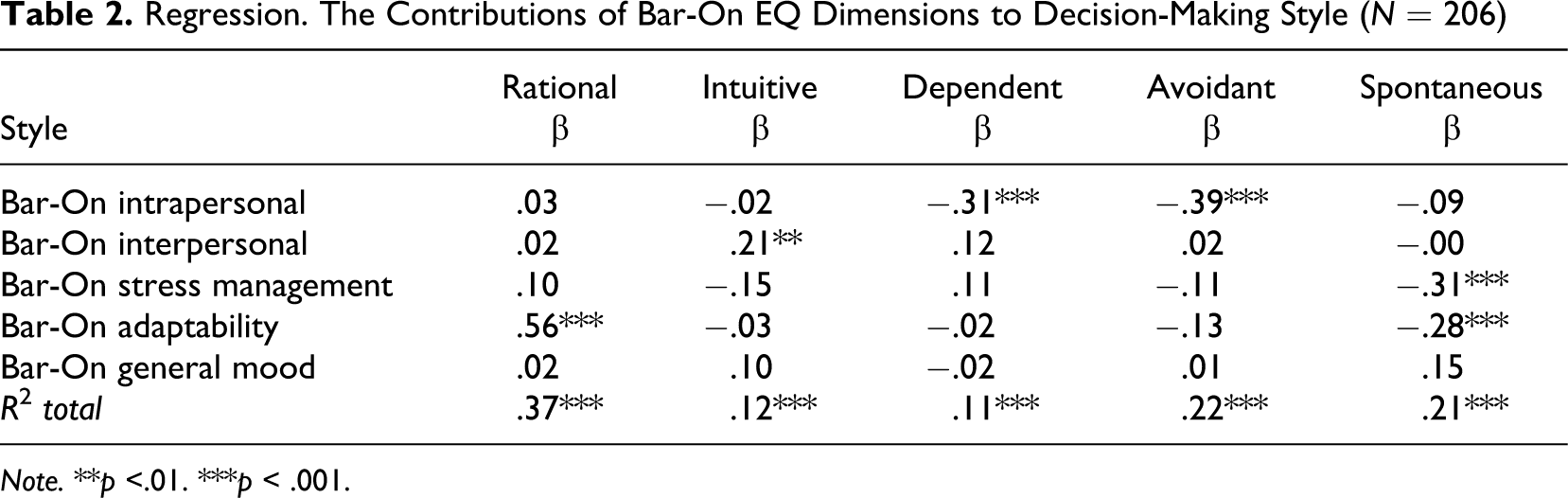
Note. **p <.01. ***p < .001.
For the ability-based dimensions (Table 3), the four scales as a set explained significant variance for avoidant and spontaneous decision making. Among the subscales, FT contributed negatively and significantly to the Avoidant style. None of the other individual subscales were significant at the .01 level. Hierarchical multiple regression analyses were completed next to determine whether ability-based dimensions contributed to the explanation of decision-making styles beyond the contribution of mixed-model dimensions (Table 4). The ability-based dimensions did not add significant variance either individually or as a set over the variance explained by the mixed-model scales.
Regression. The Contributions of the Mayer Salovey Caruso Emotional Intelligence Test (MSCEIT) Dimensions to Decision-Making Style (N = 206)

Note. **p <.01. ***p < .001.
Hierarchical Regression. The Contributions of Bar-On EQ Dimensions and Mayer Salovey Caruso Emotional Intelligence Test (MSCEIT) Dimensions to Decision-Making Style (N = 206)

Note. **p < .01. ***p < .001.
Discussion
The findings affirm the relationship of EI with decision-making style. The findings also provide further evidence that particular styles of decision making are related to unique dimensions of EI. The findings concerning the salient dimensions of the Bar-On mixed model replicate prior research among university students (Di Fabio & Palazzeschi, 2008b), suggesting that the observed relationships between specific components of EI and decision-making style are not spurious and are evident by the high school level. These relationships make psychological sense and have now been observed across samples at two educational levels. The findings suggests that persons who are low in intrapersonal EI or emotional self-awareness may exhibit an avoidant style, being prone to avoiding making a decision, or they may evidence a dependent style, relying on others to make decisions for them. Persons who are weak on adaptability EI, lacking flexibility in coping with everyday problems, or who have difficulty managing stress may adopt a spontaneous decision making style, making decisions quickly just to get over them. On the other hand, strength in EI adaptability may contribute to the selection of a rational approach to decisions.
Although our findings affirm the relationship of EI with decision-making style, when conceptualized as a broad mix of self-report personality and emotional skills, EI as conceptualized and assessed as a performance-based ability, only contributed to two styles of decision making. The findings with regard to EI abilities suggest that persons who tend to shirk or avoid decision making may not be able to effectively integrate emotions in decision making and those who are prone to quick decision making may also have difficulty in managing emotions. Ability-based EI ability was not a significant predictor of decision-making style, beyond the effects of EI as assessed through the mixed-model components in the hierarchical analyses. With regard to controversy and criticism of EI when assessed as a mixture of personality and emotional skills (Mayer, Salovey, & Caruso, 2008), our findings suggest that the mixed-model conceptualization of EI is meaningful when explaining decision-making style. A person’s self-assessment of their emotional skills and personal qualities appear to be an important determinant for choice of decision-making style, more so than their measured EI abilities.
In prior research predicting high school success as assessed by Grade Point Average (GPA), both mixed-model and ability-based EI contributed unique and significant variance (Di Fabio & Palazzeschi, 2009a). The reason why ability-based EI was less significant in the current study is not clear, but may relate to the concept of style, rather than skill, in decision making. Although decision-making style is a habitual response, individuals often respond to varied decision-making situations with different styles. The choice of a single or combination of decisional styles in a specific situation may be related to personal style, as related to a broad range of socioemotional attributes and skills, or to the demands of the decision-making context. Some situations, for example, may necessitate a more rational approach, whereas intuition may be needed to a greater degree in other decisional contexts. In our study, the clearly maladaptive styles of decision making, spontaneous and avoidant, were explained by both mixed-model and ability-based EI, whereas the generally adaptive rational decision-making style was explained by one self-report component of EI. Persons who are low on EI may be limited in their flexibility or choice in selecting adaptive coping styles. Further research is needed to explore this explanation.
Our findings must, of course, be interpreted with consideration of the limitations of the study. The sample characteristics limit generalizability of the findings to Italian high school youth. It would thus be desirable to replicate this study with students in other national contexts. Future research should also include a larger sample of both boys and girls and should assess whether the relationships between EI and decisional style differ by gender. The findings of our study are correlational and thus do not imply causation. It is not clear whether improvements in emotional skills would actually change decision making.
Despite these limitations and the need for further research, this study extends research that documents relationships between EI and decision making (Di Fabio & Blustein, 2010; Di Fabio & Palazzeschi, 2009b; Krieshok et al., 2009). Whereas prior research demonstrated relationships between mixed-model EI and indecision and decisional conflict, the current study assesses relationships between both mixed-model and ability-based EI and decisional style. The relationships between self-report EI and decisional styles were more pervasive, however, suggesting that confidence in one’s ability to perceive and express emotions may be more relevant to the choice of a decision-making style in a particular situation than actual EI skill. Despite some evidence (Di Fabio & Palazzeschi, 2009a) that ability-based EI may contribute to some outcomes, such as scholastic performance, beyond the contributions of self-report EI, mixed-model EI has also been found to be a stronger correlate of some attributes, such as perceived social support (Di Fabio & Kenny, 2012), than ability-based EI. More research is needed to understand when and how self-report/mixed model and ability-based EI are related to a variety of adaptive human attributes. Given the relevance of situational and personal characteristics for decision making (Thunholm, 2004), further research should consider the contexts and decision-making situations in which varied components of EI and decision-making style are most helpful and whether these vary across cultures. Replication of our study with measures of decision-making skill or adequacy might also help clarify the types of attributes most related to self-report mixed model and ability-based indices of EI.
The findings also have implications for career counseling. Career counselors need to consider ways, such as psychoeducation, to promote varied aspects of EI that support adaptive career decision-making styles, discourage less adaptive styles, and can be elicited in response to different decision-making challenges. Clients may become more effective decision makers when they possess a variety of EI competencies and when provided with increased awareness of how their EI contributes to varied facets of decision making. When career decision-making difficulties are already evidenced, assessment of client styles of decision making and EI may be helpful in identifying strategies for overcoming personal decisional obstacles. The findings also add to evidence that EI may be an important component in prevention programming. In addition to the relationship of EI with decisional style documented in this study, research in the United States and Italian contexts support the significance of EI as a factor related to numerous positive developmental outcomes, including scholastic success, progress in career development, and career decision making (Brackett et al., 2009; Di Fabio & Blustein, 2010). Research also indicates that both self-report and ability-based aspects of EI can be enhanced through specific psychoeducational intervention at the high school level (Di Fabio & Kenny, 2011). EI training thus has promise as a psychoeducational component of career development intervention and school-based workforce readiness development. Given the promise of EI to contribute to decision making and other adaptive qualities, programs that train career counselors should introduce students to EI theory and research and prepare them to consider the range of skills in academic, social, and emotional functioning that interrelate with career decision making.
Footnotes
Declaration of Conflicting Interests
The authors declared no potential conflicts of interest with respect to the research, authorship, and/or publication of this article.
Funding
The authors received no financial support for the research, authorship, and/or publication of this article.