



Abstract
Two studies examined the conceptualization of career interests as traits using self–other agreement data. Study 1 participants were 114 college student–friend dyads, and Study 2 participants were 93 student–parent dyads. In each study, students provided interest (using Holland’s realistic, investigative, artistic, social, enterprising, and conventional [RIASEC] dimensions) and personality (using the Big Five factors) self-ratings, and friends/parents completed parallel measures on which they rated the students. Self–other agreement for interests was similar in magnitude to that for personality, providing support for a trait conceptualization. Student–parent dyads were in closer agreement regarding realistic than investigative or conventional interests, but among friends the degree of agreement across RIASEC interest dimensions did not differ. The magnitude of agreement between friends was comparable to that of student–parent dyads, but whereas one index of agreement between student–parent dyads was associated with students’ vocational identity, agreement with friends was unrelated to vocational identity. Implications for theory, intervention, and research are presented.
Helping clients to clarify and understand their interests is a key goal of many career interventions. Counselors frequently use interest inventories, such as the Strong Interest Inventory (SII; Donnay, Morris, Schaubhut, & Thompson, 2005) or the Self-Directed Search (SDS; Holland, Fritzsche, & Powell, 1997), to facilitate this understanding. Holland’s (1997) model—encompassing the realistic, investigative, artistic, social, enterprising, and conventional (RIASEC) types—is the most widely used framework for organizing clients’ interest inventory results (Gottfredson & Holland, 1996). Holland (1997, 1999) viewed RIASEC interests as expressions of people’s personalities and argued that interest inventories are personality inventories.
If RIASEC interests are reflections of people’s personalities, then they should exhibit trait-like qualities. In fact, some research supports this conceptualization. For example, RIASEC interest scores derived from the SII have a median test–retest correlation of .84 over an interval of up to 23 months (Donnay et al., 2005), thereby demonstrating the trait-like quality of being stable over time. RIASEC interest scores also demonstrate the trait-like quality of being predictive of people’s behaviors, as individuals’ inventoried RIASEC interests have been linked to their career choices and persistence (e.g., Donnay & Borgen, 1999; Donohue, 2006).
A third characteristic of “good traits” (Funder, 1995, p. 656) is that they should be visible, or capable of being judged by others. For decades researchers have studied self–other agreement for personality as a way of gathering information about the veridicality of the notion of traits (Kenrick & Funder, 1988; Watson & Clark, 1991), and it has long been established that self–other agreement exists for many personality factors (e.g., Costa & McCrae, 1992). Surprisingly, a literature search revealed no empirical examinations of self–other agreement with respect to interests. Thus, the assumption of self–other agreement that should be met if RIASEC interests are traits has not been tested. The purpose of this research was to examine the degree to which self–other agreement for career interests exists. As described below, I generated several hypotheses based on what we know about self–other agreement for personality.
Magnitude of Self–Other Agreement
Personality assessment may occur at a broad or specific level, and personality inventories are frequently organized hierarchically (Gustafsson, 2002). For example, the NEO-PI-3 (McCrae, Costa, & Martin, 2005) comprises 30-facet scales that define the broader factors (openness to experience, conscientiousness, extraversion, agreeableness, and neuroticism [OCEAN]) of the Big Five model (Costa & McCrae, 1992; Goldberg, 1990). Self–other agreement is typically higher when personality is assessed at the facet level than when assessed at the level of broader traits (e.g., McCrae, 2008).
When assessed at the broad trait level, self–other agreement correlations are typically around or above .40 on measures of the Big Five, although agreement regarding agreeableness is sometimes lower (Watson, Hubbard, & Wiese, 2000). I expected that RIASEC interest scores, given that they represent the broadest level of abstraction for interests, would exhibit a level of self–other agreement that would be similar to that for the Big Five personality factor scores. If so, this would lend additional support to the conceptualization of interests as traits and Holland’s (1997, 1999) conceptualization of interests as expressions of personality.
Differential Self–Other Agreement Within Personality and Interest Domains
The level of self–other agreement with respect to personality varies across traits due to a trait-visibility effect. Easily observable traits (i.e., those with clear, frequent behavioral manifestations) yield better self–other agreement than do more internal, subjective traits (Funder, 1995; John & Robins, 1993). For example, self–other agreement tends to be highest for extraversion, which has obvious behavioral manifestations, whereas self–other agreement tends to be lower for agreeableness, which reflects more internal states (John & Robins, 1993).
Might there also be a trait-visibility effect within the domain of career interests? Conceptually and empirically, two bipolar dimensions (working with people–things and working with data–ideas) underlie the RIASEC types (Prediger, 1982). Realistic and social interests, which fall directly along the people–things dimension, would seem to be more easily observable than would interests that fall along the data–ideas dimension because they would be expressed via the manipulation of tangibles or social interactions. Because interests that correspond to working with data and ideas tend to manifest themselves in the form of inner reflection and solitary activities, they may be more difficult for others to assess. Consequently, I hypothesized that self–other agreement would be stronger for realistic and social interests than for other interests.
Moderators of Self–Other Agreement
Numerous studies (e.g., Biesanz, West, & Millevoi, 2007; Starzyk, Holden, Fabrigar, & MacDonald, 2006) have shown that self–other agreement for personality improves with increasing levels of acquaintanceship—called the acquaintanceship effect. People make available to each other more relevant information as their acquaintanceship develops, and people make more accurate appraisals of each other when they have had opportunities to view behaviors across several contexts (Funder, 1995). If self–other agreement for career interests exists, it seems likely that the acquaintanceship effect may also be seen in this realm. Individuals who have known each other longer and who are closer will have had more opportunities and contexts from which to gather accurate information about career-related likes and dislikes than will less-familiar acquaintances. Accordingly, I hypothesized that self–other agreement with respect to interests would be associated with increasing levels of acquaintanceship. Examining this acquaintanceship effect is important because it helps to rule out the possibility that self–other agreement is simply a function of people’s stereotyped beliefs (e.g., that a person must have social interests because his or her major is social work).
In addition, Funder (1995) argued that some individuals may be “good targets” (p. 656). In other words, there are some people for whom it is easier to make accurate judgments about personality than others because they exhibit tendencies in a more consistently visible manner. For example, the traits of individuals who are highly sociable should be easier for others to judge because such individuals will offer more cues in the form of verbalizations or behaviors in contexts where they can be observed (Funder, 1995). With respect to career interests, I hypothesized that vocational identity (VI)—the degree to which one has a clear “picture of one’s goals, interests, and talents” (Holland, 1997, p. 5)—may serve a similar function. Those with more crystallized vocational identities may have interests that are more visible to others because they demonstrate those interests behaviorally more consistently (e.g., through their selections of hobbies, career plans, and choices). I hypothesized that self–other agreement for interests would be stronger in magnitude among those whose vocational identities are more crystallized than among those with less clear vocational identities.
The Current Research
To test the hypotheses, I conducted two studies in which I examined college students’ agreement with others regarding their career interests and personality. Because the importance of peer relationships increases throughout adolescence (Berndt, 1996), I examined self–other agreement between college students and their friends in Study 1. Nevertheless, because adolescents rely more heavily on parents than on peers when seeking help for educational and career concerns (Sebald, 1989), it was also important to examine self–other agreement within parent–child dyads. This was the focus of Study 2.
Study 1
Method
Participants and Procedure
The participants were 114 college student–friend dyads (N = 228 total participants) from a large, public, Midwestern university. At least one member of each dyad was enrolled in a psychology course for which credit could be earned by participating in research. Students signed up for the study on the participant pool bulletin board. Sign-up sheets indicated that students must “sign up for the study with a friend you know well (same-sex or opposite-sex pairs are ok).” Both members of the dyad were required to be present at the session.
Participants attended small group data-collection sessions. After informed consent was obtained, the members of each pair identified themselves, and each pair was given a unique dyad identification number that allowed their responses to be linked. One member was randomly designated as the “participant,” and the other as the “friend.” “Participants” received a questionnaire to complete with themselves as referents, whereas “friends” were given a parallel version of the questionnaire with instructions to complete it with their friend as the referent. The members of each dyad were asked not to talk with one another in order to ensure independent responding. After completing the measures, the students were debriefed.
Among those designated as “participants” were 46 (40%) men and 68 (60%) women. Ninety-six (84%) participants identified themselves as Caucasian/European American, 12 (11%) as Black/African American, 5 (4%) as Asian/Asian American/Pacific Islander, and 1 (1%) as Hispanic/Latino/latina. Sixty-one (54%) participants were freshmen, 28 (25%) were sophomores, 18 (16%) were juniors, 5 (4%) were seniors, and 2 (2%) were graduate students. The mean age was 19.55 years (SD = 1.92). There were 64 (56%) female–female friend dyads, 16 (14%) male–male friend dyads, and 34 (30%) mixed-sex friend dyads.
Measures
Both participants and friends completed the SDS (Holland et al., 1997), the Big Five Inventory (BFI; John & Srivistava, 1999), and the Personal Acquaintance Measure (Starzyk et al., 2006). The participants, but not the friends, also completed My Vocational Situation (MVS; Holland, Daiger, & Power, 1980).
SDS
I used portions of the SDS-Form R to calculate RIASEC interest scores. This 228-item inventory has four sections: activities, competencies, occupations, and self-estimates. In the activities section, participants rate (like or dislike) 11 activities (e.g., sketch, draw, paint) for each of the RIASEC dimensions. In the competencies section, they indicate (yes or no) whether they could do well or competently the 11 activities for each RIASEC dimension. In the occupations section, they indicate (yes or no) whether 14 occupations for each RIASEC dimension interest or appeal to them. In the self-estimates section, they use a 7-point scale (1 = low, 4 = average, 7 = high) to rate two abilities for each RIASEC dimension.
I calculated six RIASEC interest scores by summing the responses to relevant items from the activities and occupations sections; these scores had a potential range of 0–25. I did not use scores from the competencies and self-estimates sections because these assess perceived abilities rather than interests. A precedent for calculating SDS ability scores separately from interest scores was set by Hall, Kelly, Hansen, and Gutwein (1996). All together, each participant received 12 interest scores (one self-rated score for each RIASEC type and one friend-rated score for each RIASEC type).
Previous research has shown that the KR-20 internal consistency estimates for the SDS range from .72 to .92 for the activities and occupations sections (Holland et al., 1997). In previous research, correlations between corresponding interest types on the activities and occupations sections of the SDS (e.g., realistic occupations scores with realistic activities scores) have been shown to range from .59 to .75 for women and from .63 to .79 for men (Holland et al., 1997). Internal consistency estimates for the items comprising the self- and friend-rated interest scores from this study are shown in Table 1. Evidence for the concurrent validity of SDS scores has been obtained by showing that they correspond well with people’s chosen occupations or occupational aspirations (Holland et al., 1997).
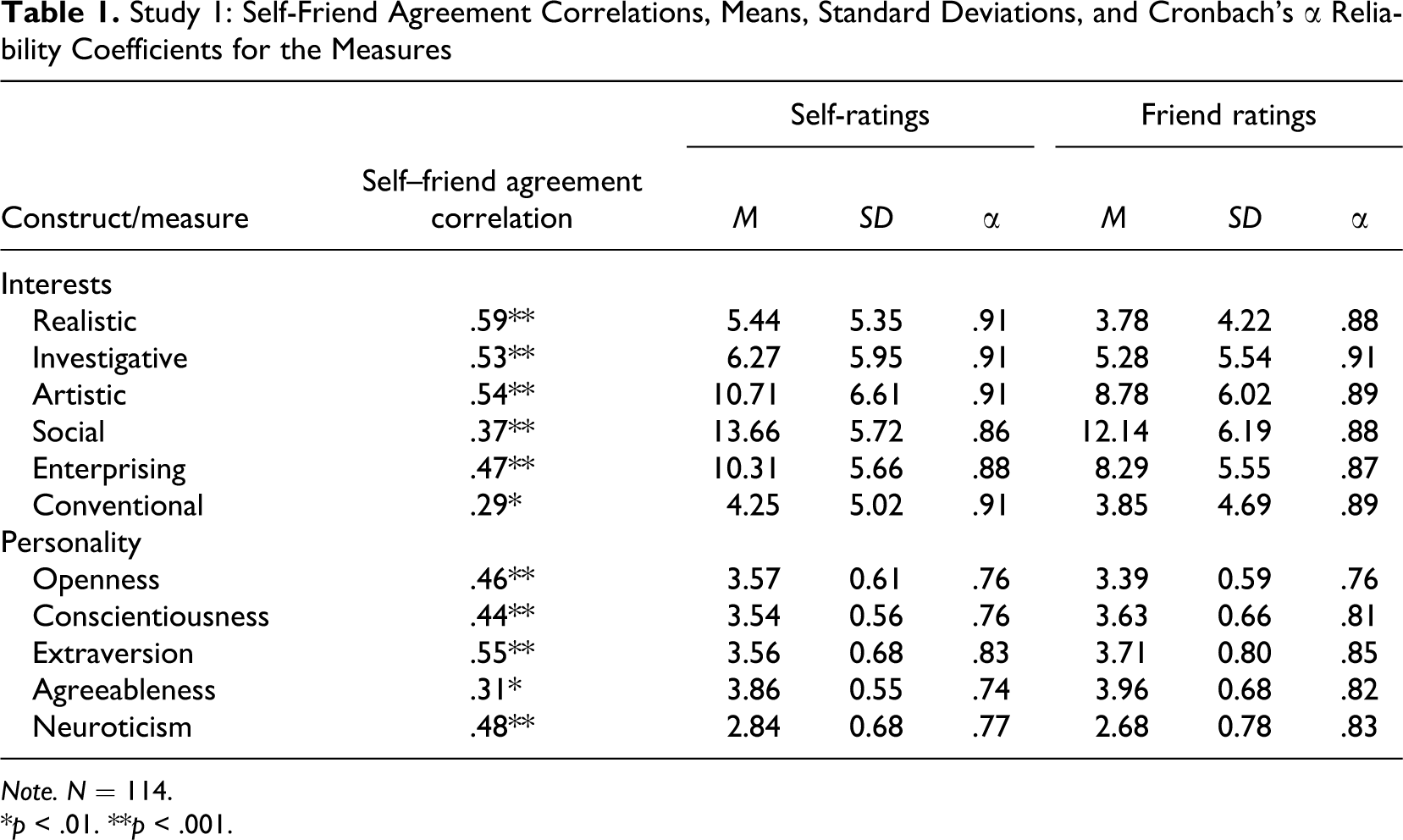
Study 1: Self-Friend Agreement Correlations, Means, Standard Deviations, and Cronbach’s α Reliability Coefficients for the Measures
Note. N = 114.
*p < .01. **p < .001.
BFI
Personality was assessed by the BFI, a 44-item measure on which participants rate themselves (or their friend, in this study) using a scale ranging from 1 (strongly disagree) to 5 (strongly agree). Separate scores for each of the OCEAN factors are calculated by summing responses to appropriate items. Each participant received 10 personality scores (one self-rated score for each OCEAN factor and one friend-rated score for each factor). Previous research has shown the Cronbach’s α reliabilities for the subscale scores to range from .76 to .90 (Mehl, Gosling, & Pennebaker, 2006; Watson et al., 2000). In this study, Cronbach’s α for the self-rated personality scores ranged from .74 to .83 and α for the friend-rated personality scores ranged from .76 to .83. Support for the BFI scores’ construct validity has been obtained by showing that the BFI scales are highly correlated with other Big Five measures (Watson & Hubbard, 1996).
Personal Acquaintance Measure (PAM)
The PAM assessed the closeness of the dyads’ relationships. On this 18-item measure, respondents use a 5-point Likert-type scale (0 = strongly disagree; 4 = strongly agree) to rate the duration of their acquaintance, frequency of their interactions, knowledge of each other’s goals, physical intimacy, degree of self-disclosure, and familiarity with each others’ social network. Summing item responses yields a total score that ranges from 0 to 72, with higher scores reflecting greater closeness. In this study, the mean PAM score as rated by participants was 45.65 (SD = 11.02) and as rated by friends was 45.02 (SD = 11.57). Scores in this range are consistent with participants’ ratings of someone they have known “for a moderate duration of time, with whom their interactions have had some variety, or both” (Starzyk et al., 2006, p. 835). In previous research self–other agreement correlations for PAM scores among friend dyads was .51 (Starzyk et al., 2006); in this study the correlation between participants’ and friends’ PAM ratings was .68. Because a single PAM score for each dyad was needed, I averaged the participant and friend PAM scores.
Previous research has shown PAM total scores’ internal consistency reliability to be .90 (Starzyk et al., 2006); in this study, α was .85 for participant-rated scores and .86 for friend-rated scores. PAM scores correlate positively with the total amount of time acquaintances have known each other, with scores on other measures of relationship closeness, and (if relevant) the total amount of time acquaintances have lived together (Starzyk et al., 2006).
MVS
The VI subscale of the MVS assessed the degree to which students possess a clear sense of their goals, skills, and interests. The VI subscale score is calculated by summing participants’ responses to 18 true–false items, with higher numbers reflecting a stronger VI. Holland, Daiger, and Power (1980) reported a KR-20 reliability coefficient of .89 for college students on the MVS VI subscale. In this study, KR-20 for the VI subscale was .91. Test–retest reliability for the VI subscale over a 3- to 5-month period has been reported as .64 (Lucas, Gysbers, Buescher, & Heppner, 1988). Support for the MVS scores’ validity has been obtained by Lucas, Gysbers, Buescher, and Heppner (1988) who showed that MVS scores distinguish university freshmen with undeclared majors and adults seeking career counseling from populations of these participants in general.
Results
Table 1 shows the self- and friend-rated means and standard deviations, internal consistency estimates, and self–other agreement correlations for the SDS and BFI scale scores.
The first research question was whether self–other agreement for interests would resemble that for personality. The self–other agreement correlations for all six interest and five personality dimensions were significant and positive. The sample size of N = 114 provided sufficient power to detect a sample correlation as weak as .18 at the .05 α level, but all 11 correlations were stronger than that. Even for the weakest correlation (r = .29) power was .88. The mean self–other agreement correlation across the 6 RIASEC interest scores was .48 and across the Big Five personality dimensions was .45. Because the reliability estimates for the personality scores were lower than those for the interest scores, I also computed average disattenuated correlations across constructs (see Nunnally & Bernstein, 1994). The average disattenuated self–other agreement correlation across the six RIASEC interest scores was .53 and across the Big Five traits was .57. The magnitude of the agreement correlations for personality and interests was thus comparable.
The second question was whether there would be an interest trait-visibility effect, with some interests having higher self–other agreement than others. The agreement correlations for interest scores had quite a bit of variability, ranging from .29 to .59, but it was important to determine whether these correlations differed significantly from one another (e.g., whether self–other agreement for realistic interests was significantly higher than agreement for conventional interests). To determine which of these correlated but nonoverlapping correlations differed significantly from one another, I conducted 15 pairwise comparisons (i.e., realistic agreement compared with investigative agreement, realistic agreement compared with artistic agreement, and so on) using a version of the Pearson–Filon formula based on the difference in Fisher r- to Z-transformed correlations (ZPF) as described in Raghunathan, Rosenthal, and Rubin (1996). Using a conservative Bonferroni-adjusted α of .003, none of the six agreement correlations differed significantly in magnitude from any other. Thus, I did not find support for the hypothesis that realistic and social interests would have higher self–other agreement than would the other interests.
The remaining research questions were (a) whether there is an acquaintanceship effect such that closer friends have better agreement regarding interests than do more distant friends and (b) whether agreement is moderated by VI. To answer these questions, it was necessary to index the degree of similarity in personality and interest profiles rated by the participant and friend.
According to Cronbach and Gleser (1953), trait profiles can vary in three key ways: elevation (the average level of scores), scatter (the variability of scores), and shape (the pattern of scores). Participant- and friend-rated interest profiles would be similar in elevation if, for example, both persons rated the participant as high on all RIASEC interests. The self- and friend-rated profiles would have similar scatter if, for instance, both indicated great variability among the participant’s RIASEC scores. Finally, self- and friend-rated profiles would be similar in shape if they agreed with respect to the rank ordering of the RIASEC interests. Cronbach and Gleser (1953) developed three indices—D2, D′2, and D′′2—to quantify the three sources of profile variability. D2, the sum of squared Euclidian distances between self- and other-ratings of traits, reflects differences in elevation, scatter, and shape. D′2, which is calculated by summing the squared distances between self-rating and other rating of traits after centering each profile around its mean, is sensitive to differences only in scatter and shape. Finally, D′′2, the sum of squared distances between self-rated and other rated profiles after each profile has been standardized, is sensitive only to differences in shape. Although D2, D′2, and D′′2 are typically correlated, by operationalizing profile similarity using all three it was possible to determine, first, whether similarity of ratings between the self and friend correspond to acquaintanceship and VI and, if so, which aspect/aspects of similarity account for such relationships. Note that higher scores reflect less agreement between participants and friends because they represent distance.
The degree of acquaintanceship between friends was significantly related to agreement regarding interests as operationalized by D2 (r = −.19, p = .05) but did not reach significance when operationalized by D′2 (r = −.18, p = .06) or D′′2 (r = −.18, p = .06). Thus, there was only modest support for the hypothesis that closer friends would be in better agreement regarding perceptions of the participant’s interests. Because the significant D2 reflects distance between self-rating and other rating, which accounts for elevation, scatter, and shape, whereas the nonsignificant D′2 accounts for scatter and shape, this suggests it was greater similarity in elevation of peer and participant ratings of interests that is associated with greater acquaintanceship.
Self–other agreement with respect to interest profiles as quantified by D2 (r = −.06, p = .50), D′2 (r = .05, p = .60), and D′′2 (r = .03, p = .74) was not significantly related to participants’ VI scores. Thus, the hypothesis that self–other agreement would be moderated by VI was not supported.
Study 2
Study 1 suggested that self–other agreement for career interests exists and is similar in magnitude to that for personality. Because this was the first study to examine agreement for interests, however, it was important to determine whether the results would replicate with a new sample. In addition, on the basis of Holland’s (1997) conceptualization of VI as a clear and stable picture of one’s tendencies that affects one’s behaviors (e.g., choices of majors or careers), I had expected that those participants with more crystallized vocational identities would have the highest agreement with others regarding their interests, but this was not the case in Study 1. A potential explanation for this unexpected finding is that whereas peer influences surpass parent influences for determining one’s choice of social activities during adolescence, parent influences still remain predominant for influencing career-related choices (Sebald, 1989). Thus, self–other agreement for career-related constructs might have a stronger association with one’s VI when conceptualized as agreement between college students and their parents because students might avail more information about their career-related struggles and aspirations to their parents.
Study 2 replicated Study 1 using parent–child dyads instead of friend dyads. As in Study 1, I expected self–other agreement for interests to be similar in magnitude to that for personality. I again explored the trait-visibility effect by examining whether agreement for some RIASEC interests was higher than for others, and I again tested the relationship of interest self–other agreement to VI.
Method
Participants and Procedure
Two hundred thirty-eight students from the same university as in Study 1 were recruited via the psychology participant pool. Students attended small group data-collection sessions. Informed consent was obtained, and then students completed the SDS, BFI, and MVS. They were then asked via a voluntary supplemental consent form to provide an e-mail address for a parent/guardian so I could invite the parent/guardian to complete a web-based questionnaire. Finally, the students were debriefed.
Of the 238 students, 177 (74%) provided a parent/guardian e-mail address. Thirty-one e-mail invitations were returned undeliverable; thus, 146 parents/guardians actually received invitations to participate by completing a web-based version of the SDS and BFI using their child as the referent. Each parent/guardian invitation contained a unique identification number that the parent provided on the questionnaire so I could link the responses to her or his child’s. One hundred and three parents/guardians (71% of those who received invitations) completed the questionnaire. The final sample comprised the 93 student–parent dyads (N = 186 total participants) for whom complete data were available; 10 dyads were not included in analyses because of extensive missing data from either the student (n = 7) or the parent (n = 3).
Among the students in the final sample were 65 (70%) women and 28 (30%) men. Eighty-five (91%) student participants identified themselves as Caucasian/European American, 5 (5%) as Black/African American, 1 (1%) as Asian/Asian American/Pacific Islander, and 1 (1%) as Hispanic/Latino/Latina; 1 student (1%) did not indicate her or his race/ethnicity. Thirty-three (35%) student participants were freshmen, 24 (26%) were sophomores, 23 (25%) were juniors, 12 (13%) were seniors, and 1 (1%) was a graduate student. The mean age of the student participants was 20.01 years (SD = 1.81). The parents included 67 (72%) mothers/female guardians and 22 (24%) fathers/male guardians; the sex of the other 4 parents/guardians was not known.
Results
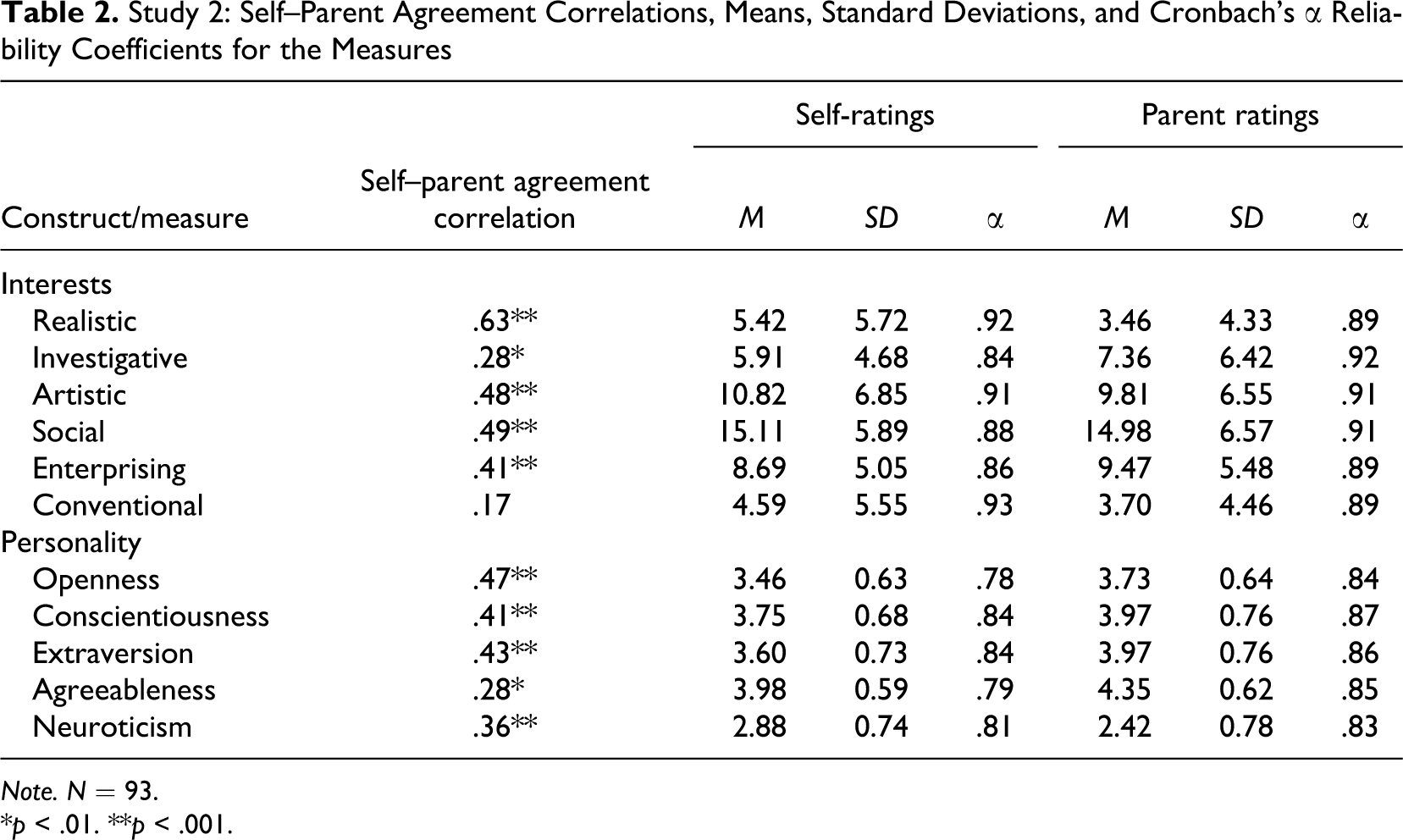
Table 2 shows the means and standard deviations, internal consistency estimates, and self–other agreement correlations for the self- and parent-rated SDS and BFI scale scores. With the exception of that for conventional interests, all agreement correlations were significant. The sample size of N = 93 provided sufficient power to detect a sample correlation as weak as .21 at the .05 α level. The mean self–other agreement correlation across the RIASEC interest scores was .41 and across the Big Five dimensions was .39. The average disattenuated self–other agreement correlation across the RIASEC interest scores was .46, and across the Big Five dimensions it was .48. Thus, as in Study 1 self–other agreement was similar in magnitude for interests and personality.
Study 2: Self–Parent Agreement Correlations, Means, Standard Deviations, and Cronbach’s α Reliability Coefficients for the Measures
Note. N = 93.
*p < .01. **p < .001.
As an exploratory set of analyses, I used z tests to compare the mean self–other agreement correlations among friends from Study 1 with those of the parent–child dyads in Study 2. All 11 z tests were nonsignificant (ps > .05); thus, the magnitude of agreement between students and their friends versus between students and their parents was not significantly different.
As in Study 1, I examined trait visibility by comparing the strength of the six interest agreement correlations with one another using the ZPF (Raghunathan, Rosenthal, & Rubin, 1996) statistic. Using a Bonferroni-adjusted α of .003, these pairwise comparisons revealed that agreement for realistic interests was significantly higher than that for both investigative and conventional interests, providing partial support for the hypothesis that interests falling along the people–things dimension would demonstrate greater agreement. No other agreement correlations differed significantly from one another.
Finally, I examined whether VI moderates the degree of self–other agreement. As in Study 1, I operationalized agreement using D2, D′2, and D′′2. VI was significantly related to parent–child agreement regarding interests as quantified by D2 (r = −.28, p < .01) but not when quantified by D′2 (r = −.10, p = .34) and D′′2 (r = −.12, p = .23). Thus, it appears that greater similarity only with respect to the elevation of parent and participant ratings of interests was associated with a stronger VI.
General Discussion
The results of these two studies replicated earlier findings that, with the exception of agreeableness, self–other agreement correlations for the Big Five personality factors are generally in the range of .40 or higher (Costa & McCrae, 1992; Watson et al., 2000). Moreover, this level of agreement held across both friend and parent–child dyads. The novel contribution of this study was the finding that, among both friend and parent–child dyads, self–other agreement correlations for interests were comparable in magnitude to those for personality. Thus, college students’ friends and parents are able, to a reasonable degree, to observe and draw inferences about their likes and dislikes with respect to career-related activities and occupations. The finding of comparable self–other agreement correlations for interests and personality traits is consistent with Holland’s (1997, 1999) conceptualization of interests as expressions of personality. As a whole, interests appeared to be about as easy to judge in others as were personality traits and thus satisfy one criterion for “good traits” (Funder, 1995).
In both studies, the pattern of self–other agreement correlations was such that agreement regarding realistic interests was the strongest and for conventional interests was the weakest, but among friends none of these self–other agreement correlations differed significantly in magnitude from the others. Among parent–child dyads, agreement regarding conventional interests was not statistically significant, and agreement regarding both conventional and investigative interests was significantly lower than that for realistic interests. Thus, among parent–child dyads, but not among friend dyads, the trait-visibility effect for interests aligned to some degree with Prediger’s (1982) people–things dimension. It appears that interests involving a preference for working with things may be relatively easier for parents to observe and draw conclusions about than are types involving work with data and ideas.
The acquaintanceship effect among friends that has been detected with personality traits (e.g., Biesanz et al., 2007) also held for interests when using a measure of agreement that was sensitive to elevation differences. Friends who rated their relationship as closer were generally in better agreement regarding the elevation of the participant’s interests than were more distant friends. On the other hand, more casual acquaintances did not differ from closer friends with respect to their agreement regarding the scatter and shape of interest profiles. This suggests that people may, to some degree, use stereotypes when drawing conclusions about a person’s interests. A casual acquaintance who knows that someone is a biology major may be able to infer that that person has more investigative interests than artistic interests. However, it appears that it is necessary to know someone well in order to be in agreement regarding the level of their interests. Thus, agreement for interests is not solely the product of stereotyped assumptions.
I had expected to find a relationship between interest self–other agreement and VI, but the data from these studies were not wholly consistent with this idea. Among friends, this expected relationship was not at all supported. Among parent–child dyads, the association between self–other agreement and identity depended on the manner in which agreement was operationalized. When quantified in a way that was sensitive to differences in the elevation of interest scores, parent–child agreement regarding interests was associated with the child’s VI. Thus, parents are better able to describe the strength of the student’s interests when VI is more crystallized. Perhaps strength of interests is more consistent over time among students with crystallized identities, and that consistency provides parents with more accurate information. When operationalized using indices of similarity that reflect only differences in shape and scatter of interest profiles, parent–child agreement with respect to personality and interests was unassociated with VI. Thus, paralleling the findings that greater acquaintanceship among friends is associated with better agreement regarding the elevation of one’s interests, it appears that it may be only the elevation of interests that is expressed more consistently to parents when identity is more crystallized.
The finding that agreement among parent–child dyads but not friend dyads was associated with VI is consistent with research (Sebald, 1989) suggesting parent influence is more strongly associated with career decisions than is peer influence. This finding is intriguing, however, because the overall magnitude of agreement was comparable for parents and friends. Thus, parents do not necessarily have more or better information than do friends. It will be necessary for future studies to address the question of why VI moderated the level of parent–child agreement regarding the elevation of the child’s interests but not the level of agreement among friends. One possibility is that parent–child disagreement presents greater challenges to VI development than does disagreement between friends. Some parents may provide less instrumental assistance (e.g., financial support for college or seeking information to share with the child) when they believe a child is making choices that are inconsistent with the level of her or his interests. For example, in this study parents tended to appraise their children’s realistic interests as lower than did the children. Some parents could express dismay and nonsupport if their children intend to enroll in realistic sorts of classes (e.g., bowling). Such challenging of the child’s choices may contribute to the child’s questioning her or his aspirations and thus lead to a less solid VI. Friends likely have less investment in one another’s career development, so disagreements about the wisdom of one’s choices of classes probably do not result in conflict. Obviously longitudinal research would be needed in order to examine the causal nature of the relationship between self–other agreement regarding interests and VI.
Implications for Practice
Given that career decision-making difficulties are associated with distress (Multon, Heppner, Gysbers, Zook, & Ellis-Kalton, 2001), it is not surprising that people frequently turn to others for career advice and help. Professional career counseling is an option, but most people seek career assistance from informal sources, such as from friends or relatives (Herr, Cramer, & Niles, 2004). From the perspective of person–environment fit theories, such as Holland’s (1997), having friends and family members who are familiar with one’s interests and characteristics would be an asset, because career advice from such individuals would potentially lead to a good-fitting choice. To the degree that people act on the career advice they frequently solicit from friends and family, the results of these studies may be reassuring because they suggest that friends’ and parents’ perceptions tend to resemble students’ own perceptions. Advice from parents and friends clearly should not be a substitute for professional career counseling, but it appears the informal route many people take for career assistance at least has the potential to validate their self-perceptions.
When people do seek professional assistance for career decision-making difficulties, interest inventory interpretations are common. The results of this study are largely consistent with Holland’s (1997) conceptualization of interests as expressions of people’s personalities and thus lend support for the practice of trait-like interpretations to clients.
Existing interest inventories rely on client self-reports. The practice of making interpretations on the basis of self-reports is well founded because clients undoubtedly make career decisions on the basis of what they believe to be true about themselves, regardless of the accuracy of those beliefs. Personality researchers have long used peer judgments as key evidence in the validation of self-ratings (e.g., Watson & Clark, 1991), and the results of this study provide some support for the validity of self-ratings of interests as well. Yet there is clearly some level of disagreement about interests between young adults and their friends and parents, too, especially regarding conventional interests. The most logical assumption may be that the self has the most “accurate” perceptions and that others lack access to relevant information regarding this type, but it may also be that the “truth” lies somewhere between self-rating and other rating. It may be useful for clients to solicit and bring to counseling information about how their friends and parents perceive them as a way of providing a more thorough examination of the self.
Limitations and Recommendations for Future Research
We now know self–other agreement for interests exists, but does self–other agreement have practical relevance for career development? It appears that parent–child agreement regarding interests may have some bearing on VI, at least when assessed concurrently, but future research might examine whether self–other agreement is longitudinally associated with greater satisfaction with one’s eventual career choice, as would be expected by person–environment theorists (e.g., Holland, 1997) if people act on career advice from others.
In this study, self–other agreement was assessed via reports from students and a single friend or parent. It may be informative in future research to examine the degree to which multiple friends or both parents overlap in their views given that previous research (Kolar, Funder, & Colvin, 1996) has shown that the aggregate ratings of two acquaintances are superior to the ratings of a single judge when predicting behavior from personality ratings.
No specific hypotheses about differential levels of self–other agreement among friends of different racial/ethnic groups are obvious based on relational theories of career development, but future research is needed to determine whether the findings of this study hold across more diverse samples. There are known gender differences in adolescents’ and young adults’ friendships that may contribute to differences in self–other agreement. For example, girls’ and women’s friendships tend to be characterized by more empathy (DeWied, Branje, & Meeus, 2007) and emotional intimacy (Radmacher & Azmitia, 2006), whereas boys’ and men’s are characterized by more shared activities (Radmacher & Azmitia, 2006). Empathy, intimacy, and shared engagement in activities all might contribute to self–other agreement with respect to individual difference variables, but do they do so to an equal degree? The small samples of men in these studies precluded separate analyses for female–female, male–male, and female–male friendships and family relationships, but this would be an interesting area for future research.
Finally, Cronbach (1955) argued that self–other agreement may be, in part, an artifact of people associating with those who are similar to them. Rather than judging others on the basis of reality, they may instead use self-perceptions to draw conclusions about others. Studies of friend dyads have shown little evidence of similarity with respect to personality traits (Funder, Kolar, & Blackman, 1995), but perhaps friends do share career interests. This may be especially true among college peers who formed relationships through shared majors. Likewise, because family members tend to share interests (Betsworth et al., 1994), parents may use knowledge of themselves when estimating their children’s characteristics. Asking friends and parents to complete the SDS and BFI for themselves and for their friend/child in a single study would have been quite demanding, but controlling for self-ratings when examining self–other agreement in future studies would be useful.
Footnotes
Author’s Note
The author thanks Katharine Adler, Kelly Whitton, and Kerianne Johnstin for assistance with the data collection and also Jeffrey H. Kahn for reviewing a previous version of this article.
Declaration of Conflicting Interests
The author declared no potential conflicts of interest with respect to the research, authorship, and/or publication of this article.
Funding
The author received no financial support for the research, authorship, and/or publication of this article.