



Abstract
In the field of career development, there is an acknowledged relationship between career assessment and career counseling. Traditional career assessment and more recent narrative approaches to career counseling are perceived as having an uneasy relationship because of their different philosophical bases. A sustainable future story for the field could be constructed that is guided by the complementarities of both. This article considers this potential complementarity and describes a qualitative Integrative Structured Interview (ISI) Process to construct stories about Holland’s Self-Directed Search (SDS). Narrative career counseling and the story telling approach are the foundation of a qualitative ISI process based on story crafting questions to demonstrate the complementarity of career assessment and story telling.
Keywords
As the first decade of the 21st century comes to a close, the profession of career counseling finds itself facing considerable challenges as the demand for, and opportunities to provide, services increase. A critical challenge concerning the relationship between career assessment and career counseling, in particular narrative career counseling, is how this relationship may best position itself in terms of theory and practice in order to move forward in a sustainable way.
Assessment has been embedded in vocational guidance, the forerunner of career counseling, since its inception. For example, Parsons (1909) developed a self-assessment questionnaire that involved his clients in a comprehensive process of self-reflection through self-analysis and conversations with others. Parsons’ tripartite model of self-knowledge, world of work knowledge, and “true reasoning” (p. 5), that is a decision-making process based on the relationship between such information, has been the cornerstone of assessment and career counseling since that time.
Parsons’ (1909) model underpins a body of theory and an approach to career counseling variously termed a trait and factor, person–environment fit, or matching approach. This approach, predicated on assessment, has served the field well and remains dominant in career counseling (Sharf, 2010). In the latter part of the 20th century, however, as rapid change and globalization became critical features of society, questions were raised about the adequacy of this approach to deal with the complex career issues facing people of diverse backgrounds seeking career counseling (e.g., Savickas, 1993). Possibly as a result of the changed context of career counseling and such questions, career counseling has experienced considerable recent influence from constructivist or social–constructionist approaches such as narrative career counseling (Amundson, 2009; Guichard, 2009; Savickas et al., 2009). An unfortunate outcome of the expansion of such approaches is that an either/or debate about the future identity of career counseling has ensued that has been divisive to the field (Sampson, 2009).
This debate can be considered in terms of the philosophical foundations of both quantitative career assessment and narrative career counseling which place emphasis on different constructs. The logical positivist philosophy that informs trait and factor or matching approaches values objectivity and measurement, linear and cause/effect processes, and studies individuals independently of their environment (Brown, 2002). The constructivist (Brown & Brooks, 1996) and social constructionist (Brown, 2002) philosophies that underpin narrative career counseling value subjectivity, active agency, meaning making, the importance of context and the interconnection of individuals and environments. Thus, for some time, an uneasy relationship between quantitative career assessment and career counseling has existed (e.g., Goldman, 1994; Super, 1957).
The present article contends that an opportunity exists in career counseling for a sustainable future story to be constructed that draws on the strengths of both quantitative career assessment and narrative career counseling, a story that is founded on the complementarities of both philosophical positions. Thus, a both/and story could prevail.
This article considers this potential complementarity and describes a qualitative Integrative Structured Interview (ISI) process using Holland’s (1985) Self-Directed Search (SDS) and story crafting questions derived from the story telling approach. Career assessment and the SDS are briefly overviewed. Narrative career counseling and the story telling approach are described as the basis of an ISI process used to demonstrate the complementarity of career assessment and story telling.
Career Assessment
A goal of career assessment is to promote both career exploration and self-exploration (de Bruin & de Bruin, 2006) and to assist individuals with decision making (Sampson, 2009). However, Sampson also points out that assessment used in uncritical ways to provide “quick and simple answers to complex problems” (p. 92) through a matching process is not sound practice. Unfortunately, matching has been depicted simplistically as being focused on answers such as an occupational option, whereas Sampson reminds us that assessment is best used to stimulate exploration. Similarly, Blustein and Flum (1999) suggested that career assessment be judged by the degree to which it promotes a self-exploration process in clients rather than confirms an end product, for example, a career choice. De Bruin and de Bruin point out that such a self-exploratory process differs from more traditional perspectives of career assessment. In some sense, it could be argued that career assessment is less about the instrument used and more about the process in which it is used (Hartung & Borges, 2005; Sampson, 2009). This brings us to consider one of the most widely used instruments in the field of career assessment, the SDS (Holland, 1985).
The SDS
The SDS (Holland, 1985) is a “standardized assessment instrument” (Reardon & Lenz, 1999, p. 105) in booklet format that is self-administered and self-scored. Based on Holland’s (1997) theory of personalities and work environments, the SDS provides individuals with scores on each of the six personality types, that is, Realistic, Investigative, Artistic, Social, Enterprising, and Conventional, known as a RIASEC model. It is supported by an Occupations Finder (Holland, 2000) and an interpretive guide (Holland, Powell, & Fritzsche, 1994). At a simplistic level, the SDS offers a model for matching personality types (i.e., individual personal attributes) with work environment types by providing individuals with a three-letter code that can be matched to the three-letter code ascribed to work environments. Holland (1997) suggests that individuals should seek work environments that are well matched to their personality types thus allowing for the greatest degree of fit or congruence (Spokane, Luchetta, & Richwine, 2002). He claims that a work environment that is congruent to a personality type will provide opportunities to flourish and reward individual needs. Further, certain types have more in common with each other. Consequently, the more related the three letters of an individual’s code are, the more consistent the individual’s personality type is. How separate an individual’s typology scores are from each other provides an indication of differentiation, that is, how crystallized the individual’s interests are. Identity relates to consistency and differentiation and, according to Holland, refers to the strengths of the personality and work environment types (Spokane et al., 2002).
Sampson (2009) concludes that standardized assessment such as the SDS represents one construction of reality that needs to be balanced with individuals’ own multilayered stories of their experiences that “construct their perceptions of themselves” (p. 92). Similarly, half a century before this, Super (1957) expressed reservations about how standardized career assessment instruments were used: So many factors affect vocational development, these factors are so interdependent and interactive, and our means of assessment are still so limited in nature, that to confine appraisal to the use of a few tests, or to an interview, or to a brief combination of these two, is to risk getting an incomplete and unbalanced picture of the person and of his prospects. (p. 305)
Narrative Career Counseling
Narrative career counseling has gained more prominence in the field of career psychology (Stebleton, 2010), stimulated to some extent by emergent needs for approaches that are responsive to more diverse clientele and more complex career issues. The distinction between approaches developed in the modern era and those proposed in the postmodern era has been emphasized. For example, Savickas (1993) metaphorically advocated that a move from the dominant test and tell metaphor evident in career assessment to that of a narrative metaphor or from scores to stories is needed in the postmodern era.
The move toward a narrative metaphor reflects the growing influence of constructivist and social–constructionist philosophies in career development. Consistent with these philosophies is greater recognition of individuals as active agents in the construction of their careers, the importance of story in the construction of their identity, and the importance of meaning making as a way of making sense of life experience. Further, emphasis has been placed on the connectedness between individuals and the contextual location of their experiences and corresponding stories. A rapid expansion of narrative and storied approaches to career counseling that are underpinned by such constructs is evident in the field. Consistent with these approaches to career counseling, a proliferation of philosophically compatible qualitative career assessment processes has been described. However, by contrast, an uneasy divide has been evidenced in the relationship between narrative career counseling and traditional quantitative career assessment. Given the dominance of approaches based on quantitative career assessment, a major challenge is how to value the traditions and strengths of both quantitative career assessment and narrative career counseling. The present article is focused on how quantitative career assessment can be complemented through the use of narrative career counseling, specifically a story telling approach (McMahon, 2005, 2006, 2007, 2009; McMahon & Watson, 2010).
The Story Telling Approach
Consistent with other narrative approaches to career counseling, the story telling approach to career counseling has at its core the practice dimensions of agency, meaning making, and connectedness. Two further dimensions that are core to the story telling approach are reflection and learning. Connectedness is a complex and multidimensional process that is variously understood. For example, in a social context, it relates to relationships with others (e.g., a career counselor). More broadly, it may be understood in the context of the culture and environment in which an individual’s career is constructed. Reflection is a process by means of which individuals take stock of situations by examining their thoughts, feelings, and responses to an issue or situation about which they may be doubtful or in which they may be experiencing a problem. This process could be subjective or facilitated in a dialogical process with another individual such as a career counselor. Meaning making is a process, whereby individuals make sense of their past, present, and future experiences. Meaning making and story are integrally related. Individuals derive meaning by telling themselves and others stories about their experiences. In turn, such meaning influences the way individuals live their lives and construct their careers. Learning is a process of constructing and transforming experience into knowledge, skills, attitudes, values, beliefs, and emotions. Meaning making is important to learning. In the story telling approach, career counseling is regarded as a learning process. Agency is indicative of intentionality and an individual’s capacity to construct careers for themselves. Action taken by individuals demonstrates agency. Thus, the story telling approach invites clients to actively engage in the career counseling process by telling stories, reflecting, learning, and applying such learning and meaning to the construction of future stories which they then enact.
As with other narrative career counseling approaches, the telling and construction of stories is emphasized. Throughout life, individuals engage in a range of experiences which they describe and explain to themselves and to others by telling stories. Such stories provide an organizing framework through which individuals come to better understand and make meaning out of their life experiences (Gibson, 2004; White, 2007). Consistent with the constructivist philosophy, the context in which stories are constructed is critical. Because life is complex and multifaceted, an individual’s stories will reflect a variety of familial, social, historical, and cultural contextual influences (McAdams, 2006). Thus, individuals encounter multiple experiences about which multiple stories are told. Such stories may seem unrelated, disconnected, and fragmented. Narrative career counseling affords an opportunity to identify the themes and patterns that connect stories and provides individuals with a more unified sense of themselves and their life experiences (Campbell & Ungar, 2004)
Similarly, career assessment may seem unrelated to, and disconnected and fragmented from, an individual’s life experiences. For many career counselors, especially those employing narrative approaches, a question arises about how to contextualize career assessment and how to facilitate connectedness between career assessment and stories of life experiences narrated by individuals. Therefore, a challenge for career counselors is to integrate narrative approaches such as story telling with quantitative career assessment processes in order to construct future stories for clients. In essence, how can a meaningful story be constructed around a career assessment process?
The ISI Process
In considering the preceding question, the authors aimed to develop a model that would provide a practical example for career counselors about how to use quantitative career assessment in narrative and story telling approaches to career counseling. Narrative approaches to career counseling have been described as a work in progress because to date they are grounded more philosophically than practically (Reid, 2006). Thus, there are few models to guide career counselors in integrating narrative career counseling with quantitative career assessment processes.
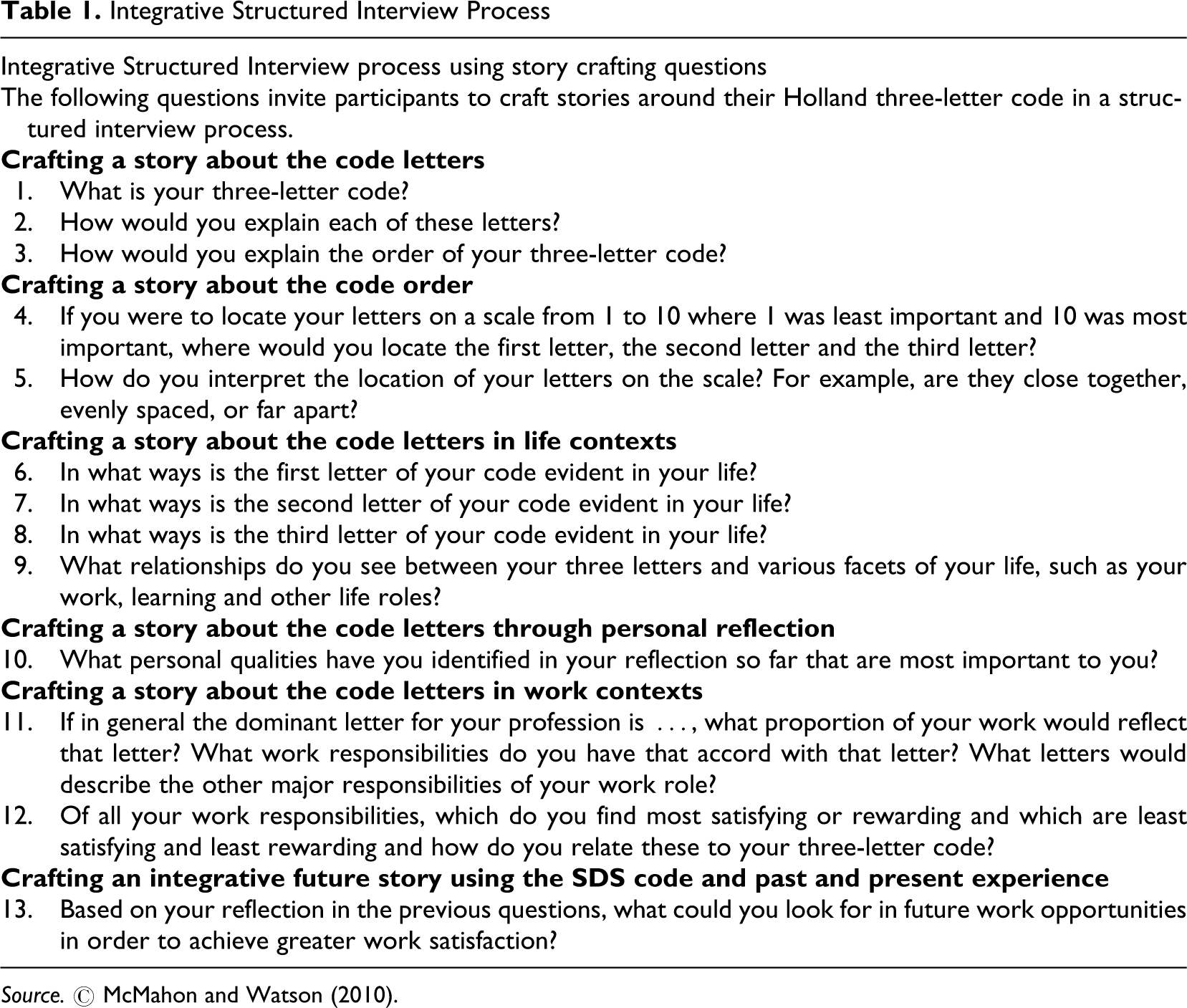
The ISI process (see Table 1) facilitates self-exploration through the use of story crafting questions that value both constructs from Holland’s theory of personality and work environment types as evidenced in his SDS and also constructs of the story telling approach. Previous authors (e.g., Osborn & Zunker, 2006) have suggested that the SDS may be used to assist individuals to expand their occupational and leisure options. Further, these authors suggest that the three-letter code could form the basis for an interactive process between career counselors and clients. However, to the best of the present authors’ knowledge, there is no suggested model to guide this self-exploration process. For example, while Rayman (1998) detailed a comprehensive interpretation of the SDS by career counselors in terms of 10 questions, he did not detail the role of the client. In terms of Parsons’ (1909) concept of “true reasoning” (p. 5), it is debatable how much self-exploration is derived from the use of the SDS typology scores, especially considering its emphasis on “self-direction” and its direct relationship with similarly coded occupations. To the extent that such exploration is not facilitated, there is a tendency to use the SDS in a more limited “matching” way, finding occupations that match the individual’s typology code, rather than as an exploratory process that can facilitate greater self-awareness. For example, Reardon and Lenz (1999) expressed concern that “Too many practitioners simply obtain the three letter summary code from the completed SDS and conclude that is the end of the assessment process” (p. 111).
Integrative Structured Interview Process
Source. © McMahon and Watson (2010).
Table 1 presents an ISI process that uses story crafting questions to translate the quantitative information of the SDS three-letter code into qualitative understanding that supplements clients’ self-knowledge and understanding of contextual influences. There are several factors related to the practice dimensions of the story telling approach that need to be considered in adopting it for a qualitative interpretation of Holland’s SDS results. Consistent with other narrative approaches, story telling values constructing a relationship that provides a reflective space in which the client and counselor engage in a respectful dialogical exploration of the client’s story. Indeed, Holland (1997) himself suggested that a relationship built on respect for the client, genuineness, and empathic understanding (Rogers, 1957) may promote effective counseling. In essence, a dialogical exploration of clients’ SDS three-letter codes is needed in order to relate it to other facets of their lives and to invest them with meaning. This is reflected in the following case study of Margaret, a hospital administrator who had begun her working life as a nurse. Margaret had come to career counseling because she was feeling unfulfilled and wanted a change. Margaret explained that she was not desperate to change immediately but wanted to “get the wheels in motion.” Brief illustrative excerpts from the case study of Margaret’s ISI process are now provided. The complete interview is not provided due to word length restrictions.
Beginning the ISI Process
In initiating the ISI process, the counselor acknowledged Margaret’s role and agency in the counseling process by introducing the process and seeking Margaret’s permission to proceed as follows: “In my experience, it is helpful for people to think about their SDS codes and try to see if there is a relationship between their work, their life and their codes and to see what this might suggest about their future career decisions and choices. With your permission, I could guide us through such a process if you think you would find it helpful to you.” With Margaret’s consent, the ISI process began.
Crafting a story about the code letters What is your three-letter code? SIE How would you explain each of these letters? Well the S is easy. I just love being around people and helping them and working with them. If I’m on my own for long, I really start to miss people contact. The I is fairly easy too because I like to find out why things happen. When I did my nursing degree, I liked anatomy because it seemed to make so much sense. Once you knew how something functioned you could begin to understand symptoms patients had. I’m not as sure about the E. Enterprising is just not how I have considered myself. But I guess I’ve needed some of those qualities like managing people and being sociable in my admin job. How would you explain the order of your three-letter code? The order makes a lot of sense although I’m a little surprised by the E being there and I’m not all surprised that it is down the list from the other two.
Crafting a story about the code order If you were to locate your letters on a scale from 1 to 10 where 1 was least important and 10 was most important, where would you locate the first letter, the second letter and the third letter? How do you interpret the location of your letters on the scale? For example, are they close together, evenly spaced, or far apart? Well, the S is just way out there at the top of the scale. I’m just a people person so for me it’s just people, people, people and if I can help them it’s even better. And finding out how things work and looking for solutions is challenging for me and I like that. So I is pretty important to me but nowhere near as important as S. And then E . . . hmmm . . . I’m still wrapping my mind around that one but it’s starting to make a bit of sense so it’s down the list quite a bit.
Crafting a story about the code letters in life contexts
In what ways is the first letter of your code evident in your life? You mean anywhere in my life not just work”. (Counselor nods) “I guess I’m just a people person. I’m actually the President of a migrant support group. We meet new migrants coming into our community and assist them to transition into their new life. It’s just such a great thing to do. The people really appreciate our help and it is so rewarding to assist them to find work and to see their children begin to progress at school. Until I belonged to this committee and met so many new people, I didn’t realize how much we take for granted and just how basic the needs of some people are. I think that the E, even though it surprises me, is actually there in my admin job and in my migrant work. You know, when I negotiate a work arrangement with one of my staff or plan a new initiative I think that’s probably my E.
In what ways is the second letter of your code evident in your life?
In what ways is the third letter of your code evident in your life?
What relationships do you see between your three letters and various facets of your life, such as your work, learning and other life roles? That’s a bit of a tough question really. I guess I loved nursing and I liked that because we sometimes worked in teams and I love caring for the patients which is the bit I miss most in my current job. I really enjoy working with the other people in my migrant support group to find good solutions for the people we help. Sometimes their needs are great and their situations can be very tricky and we have to negotiate with employers or schools and be sensitive to everyone’s needs. It’s a real balancing act sometimes but it’s so good when it all works out. So I guess a lot of that is about the S and some about the I. You know, I have just loved being a Mum and my children’s friends all come around to our place and some of them think I’m their second mother. Our house is a bit of a social hub for them. And I’m the main one in my family who organizes family gatherings and I do a family tree. I’ve become really interested in that so I guess that is about the I. You know, now that I have begun to think about this, I see the S just dominating my life – home, work, interests and I’m beginning to see more of the I as well.
Crafting a story about the code letters through personal reflection.
What personal qualities have you identified in your reflection so far that are most important to you? I don’t get to talk about myself much I’m always looking for the qualities in others. It feels a bit funny talking about myself in this way. I guess though, I’m very generous with my time and I genuinely like to help others and I am very committed to my volunteer work with the migrants. We have to be quite creative at times to come up with workable solutions for some of our people but I don’t mind that when it’s a bit challenging. It makes me think and problem solve . . . yes, I like that part of it.…
Crafting a story about the code letters in work contexts
If in general the dominant letter for your profession is . . ., what proportion of your work would reflect that letter? What work responsibilities do you have that accord with that letter? What letters would describe the other major responsibilities of your work role? When I was a nurse the biggest proportion of my time was spent on people, being with them, talking to them, helping them, providing care. Now, it’s paperwork, rosters, meetings. Occasionally I get to assist a staff member with a problem but that’s not my role really. I like to interact with colleagues at meetings but that genuine helping and caring that I enjoy is not present in my work at the moment. Interesting - most of my work would probably fit in these C and R areas and I didn’t score very high on those.
Of all your work responsibilities, which do you find most satisfying or rewarding and which are least satisfying and least rewarding and how do you relate these to your three-letter code? In some ways I’ve just answered that and I know I loved nursing with a passion. But I’m also aware that I don’t want to go back to nursing as such. I’m older now and it’s mainly shift work and sometimes it can be heavy work moving patients so I really don’t think I’m up to it. I also earn more in this job and wouldn’t like my pay to drop.
Crafting an integrative future story using the SDS code and past and present experience
Based on your reflection in the previous questions, what could you look for in future work opportunities in order to achieve greater work satisfaction? Clearly being able to help people and care for them is just so important to me. It’s interesting but as we’ve talked I keep thinking about my migrant work. I just get on and do it and it’s a relief from my work and something I enjoy. It’s not nursing but I still find it very rewarding. You’ve got me wondering if I might find something outside the hospital or health fields. I never saw myself moving from there but I’ve never really thought so much about my volunteer work before.…
By valuing and encouraging Margaret’s role as an active agent in the process, the career counselor becomes a facilitator of a process in which emphasis is placed on process and meaning rather than content, and on listening rather than telling, explaining, or predicting, in order to coconstruct the client’s future story. During the process of career counseling, life themes are identified that enable connectedness between stories that may have been previously viewed as disconnected or discrete events. Such themes facilitate the construction of a future story that is both believable and actionable because it is scaffolded in the context of the client’s experiences in past and present stories (Gergen & Gergen, 2006). Scaffolding conversations (White, 2007) enables the construction of a future story that is believable because clients can conceptualize it in the context of their past and present actions and experiences. In essence, the SDS score has to be scaffolded in the context of the individual’s past and present experiences.
The career counseling process of the ISI facilitates a qualitative exploration of a quantitative assessment instrument by offering an approach for “appraising and fostering career exploration and choice in an integrated career assessment and counseling approach” (Hartung & Borges, 2005, p. 439). The guidelines for using qualitative career assessment proposed by McMahon and Patton (2002) are relevant to the conduct of the ISI process. For example, the ISI is individualized for the client, it is the client’s prerogative whether to engage in the process, and the client is supported through the process. Further, the ISI serves to some extent, as a debriefing process for the SDS. Importantly, just as stories have beginnings, middles, and ends, so does the career counseling process (Reid &West, 2011). In this regard, the ISI is no different and, as reflected in Table 1 and the case study, the ISI process progresses through discrete stages, until the final stage that looks toward the future story that is scaffolded in the stories of the past and the present.
There has been concern expressed that narrative approaches toward assessment could prove time-consuming (e.g., Sampson, 2009) but the ISI process can be completed within one career counseling session following the completion of the SDS. Alternatively, it can be used in group settings where dyadic or larger group exploration of the SDS codes can be facilitated around the story crafting questions. Indeed, such group processes provide a valuable learning experience for counselor educators to offer their students thus addressing Niles, Engels, and Lenz’s (2009) call for the creation of innovative training.
Story Crafting
In facilitating story telling of the career assessment process, careful choice of language by the career counselor encourages reflection, connectedness, meaning making, learning and client agency and, in turn, the construction of a future story. The metaphor of construction has been variously used in the narrative career counseling literature. In particular, the term coconstruction has been used to describe the process, whereby a counselor and a client together write a future story in which career assessment can be influential.
The metaphor of construction suggests putting pieces together, building, framing, or devising (Butler, 2009). The present authors prefer the term story crafting as a metaphor. Crafting by definition suggests a more refined and detailed level of construction, an art requiring special skill, dexterity, and ingenuity. Story crafting is facilitated in career counseling through language usage that reflects the core practice dimensions of connectedness, reflection, meaning making, learning, and agency. A set of story crafting questions that operationalize these practice dimensions so that stories of the client’s SDS can be crafted are provided in the ISI process found in Table 1.
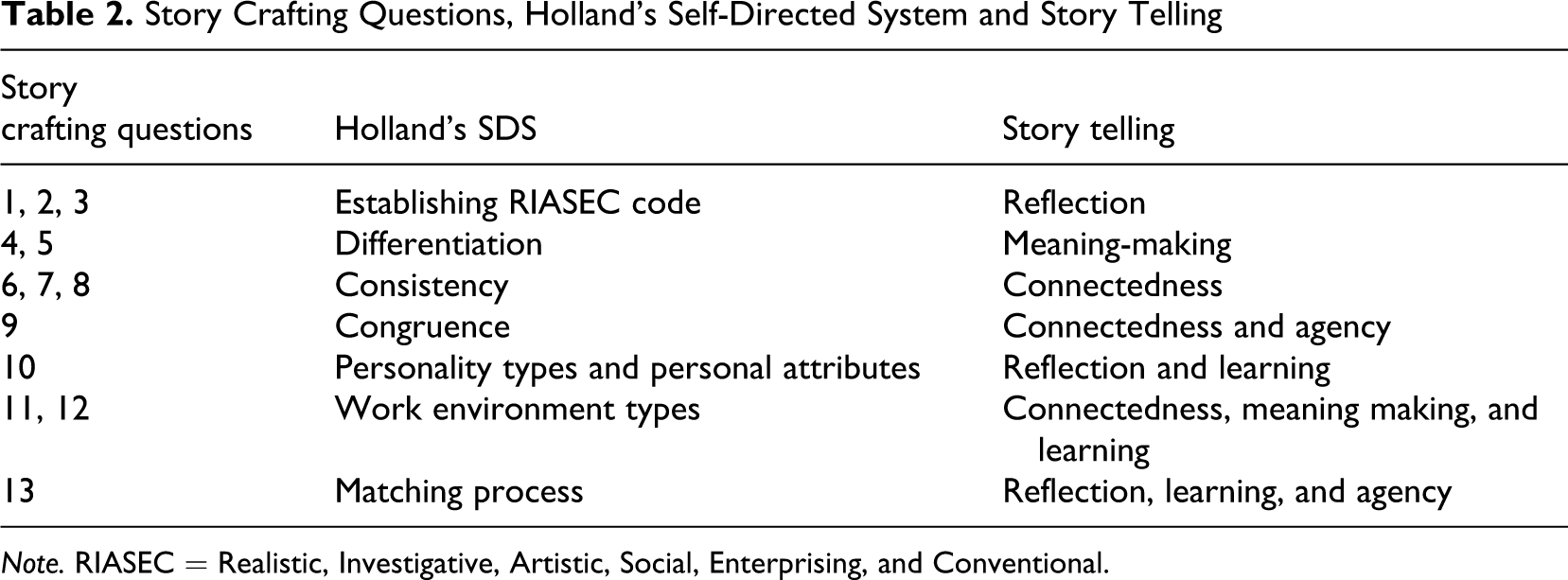
Table 2 provides a more detailed understanding of the integration of story telling, story crafting questions, and Holland’s SDS. As evident in Table 2, each of the story crafting questions operationalizes elements of Holland’s SDS and also dimensions of the story telling approach. Connectedness is operationalized by questions that explore the dynamics of an individual’s SDS code in various life contexts. Such questions invite individuals to relate their three-letter code to personal preferences and to past and present experiences in contexts such as learning, school, work, and family. Story crafting questions related to reflection invite clients to think about or take stock of their feelings, attitudes, or experiences in relation to their SDS code. More than reflection, meaning making strengthens understanding by inviting individuals to draw conclusions about the recursiveness (Patton & McMahon, 2006) or relationships between elements of their stories. For example, a relationship between SDS code letters and experiences in the workplace is facilitated in Questions 11 and 12. Learning is an important dimension of story telling that generalizes meaning into other life contexts. As reflected in the story crafting questions, agency is facilitated through questions that emphasize the individual’s role in the process of making sense of the SDS and its application in their life contexts. Moreover, agency is fostered through questions that invite the client to plan a future story that considers and plans actions they may take.
Story Crafting Questions, Holland’s Self-Directed System and Story Telling
Note. RIASEC = Realistic, Investigative, Artistic, Social, Enterprising, and Conventional.
Story crafting is a collaborative, gentle, and respectful process that invites individuals to become explorers in their lives (Peavy, 1998) and to tell stories of their past and present experience in order to craft future stories that are invested with meaning. Career counselors become facilitators of a process in which they model a genuine curiosity to find out more about individuals’ life experiences. Further career counselors, using the ISI process, invite individuals to become curious about their SDS three-letter code within their life contexts. As such the ISI process illustrates Savickas’s (1992) contention that a narrative approach to career assessment encourages an understanding of an individual’s traits (as evidenced in scores) in relation to the individual’s life patterns.
Conclusion
The ISI process is offered as a response to long-standing concerns about the need for richer understandings about assessment results in relation to individuals’ career development (e.g., Sampson, 2009; Super, 1957). Morgan (2000) suggests that in narrative counseling “thin descriptions” result in “thin conclusions” (p. 12). Using the ISI process would result in the crafting of thick and rich career stories that include career assessment scores in a narrative career counseling process and thus invests them with meaning.
Constructing a new identity for career counseling that is inclusive of the traditions of career assessment and the growing movement toward narrative approaches represents an important and significant challenge to the field. Thus, a future story for the field that values a both/and story can be constructed. This future story for the field needs to be scaffolded (Gergen & Gergen, 2006; White, 2007) in the context of past and present stories of career assessment and of narrative career counseling. Such scaffolding facilitates the construction of future stories for the field that are sustainable because of their strong foundations in proven career assessment and career counseling practices of the past and present.
Footnotes
Declaration of Conflicting Interests
The authors declared no potential conflicts of interest with respect to the research, authorship, and/or publication of this article.
Funding
The authors received no financial support for the research, authorship, and/or publication of this article.