




Abstract
The authors report further validity evidence for the Chinese version of a U.S. adult social self-efficacy inventory, the “Perceived Social Self-Efficacy” (PSSE) scale in Chinese populations. Study 1 participants were 323 new graduate students enrolled at a large university in an east coast city of the People’s Republic of China. Differential item functioning analysis indicated that the internal structure of the Chinese PSSE scale was invariant over individuals with different levels of respect for authority. Study 2 participants were 204 undergraduate students enrolled at a medium-sized university in the southeast region of China. Chinese PSSE scores were significantly related to scores in the three components of subjective well-being: life satisfaction, positive affect, and negative affect. Personal self-esteem and two collective self-esteem dimensions were found to mediate the above relationships.
Keywords
Bandura’s (1986, 1997) self-efficacy theory has been one of the most influential individual difference theories in psychology. Over the years many specific self-efficacy concepts and measures have been developed, which have greatly enhanced our understanding of human behaviors in various contexts (for a comprehensive review, see Bandura, 1997). However, we know little about adults’ self-efficacy perception within the social interaction domain. The majority of studies on social self-efficacy have focused on children or adolescents (e.g., Connolly, 1989; Wheeler & Ladd, 1982) rather than adults. Even though several adult social self-efficacy measures exist in the literature, they tend to be either psychometrically problematic or conceptually too narrow for general use (for a review, see Smith & Betz, 2000).
One recent development was that Smith and Betz (2000) developed a 25-item adult social self-efficacy measure—the “Perceived Social Self-Efficacy (PSSE)” scale. Smith and Betz define social self-efficacy as “an individual’s confidence in his/her ability to engage in the social interactional tasks necessary to initiate and maintain interpersonal relationships” (p. 286). PSSE items cover social tasks related to making friends, social assertiveness, pursuing romantic relationships, performance in public situations, and receiving and giving help. PSSE scores have been shown to have a single-factor structure, high internal consistency and test–retest stability, excellent convergent and discriminant validity, and a meaningful correlation pattern with related constructs in the nomological network (Lin & Betz, 2009; Smith & Betz, 2000). In short, Smith and Betz’s work represents a key step toward understanding adult social self-efficacy.
The primary purpose of our research program is to develop a valid measure of adult social self-efficacy appropriate in Chinese populations. Given the central role of interpersonal relationships in any society, the need for such a measure in Chinese societies, where none currently exists, is hard to dispute. During the past three decades, China has been transitioning from a government planned economic system to a partial market economic system. Accompanying this huge transition and the rapid economic development are several fundamental changes in the labor market and social structure (Fan, Meng, Gao, Lopez, & Liu, 2010). For instance, prior to the transition, career choice and career management was unheard of because most people held government-assigned jobs and stayed at the same company during their entire career. Now, workforce movement has become a norm: College students hunt for their first full-time jobs, current employees enjoy career and job mobility, and the unemployed actively consider alternative career paths. Furthermore, with drastic improvements in housing conditions in China, the close social ties within the traditional extended family and among neighbors have become weaker, simply because people now live physically farther apart. In addition, driven by the industrialization process, tens of millions of Chinese people from rural areas have been leaving their homes, social networks, and agricultural origins for better opportunities in urban areas where they hardly know anyone. These fundamental, society-level changes make it all the more important to understand Chinese adult social self-efficacy and its role in the processes and outcomes of contemporary Chinese adults’ career and psychological adjustment.
We began our research by examining the conceptual domain of Chinese adult social self-efficacy through qualitative methods such as interviews and focus group discussions (Fan et al., 2010). The qualitative data led to the identification of two major components of Chinese adult social self-efficacy: (a) perceived ability to engage in assertive behaviors in independent social contexts, that is when interacting with people the individual does not know well and (b) perceived ability to maintain interpersonal harmony in interdependent social contexts, that is when interacting with people the individual knows quite well (Fan et al. 2010). After inspecting Smith and Betz’s (2000) PSSE items, we concluded that PSSE items as a whole appropriately measure the independent component of Chinese adult social self-efficacy. As for the interdependent component of Chinese adult social self-efficacy, a new measure was deemed necessary.
As an initial step, we chose to focus on the independent component of Chinese adult social self-efficacy by translating and validating Smith and Betz’s (2000) PSSE scale in Chinese populations. After translating the original English PSSE items into Chinese and modifying or rewritten several original items to better suit Chinese language and culture, we conducted two initial validation studies on the Chinese PSSE scale (Fan et al., 2010). Results showed that like the U.S. version, Chinese PSSE scores had a single-factor structure, and demonstrated excellent reliabilities and good convergent and discriminant validity. Furthermore, Chinese PSSE scores were found to be moderately positively correlated with scores in personal self-esteem, general self-efficacy, and collective self-esteem (CSE) but were strongly negatively correlated with scores in social anxiety. In addition, Chinese PSSE scores predicted self-reported social adjustment scores prospectively (with a 6-month time lag) and peer-rated social competence scores concurrently. These empirical findings provided initial support for our argument that social self-efficacy in independent social contexts as measured by the Chinese PSSE scale is an important component of Chinese adult social self-efficacy and proves relevant within contemporary Chinese societies.
Construct validation is an ongoing process (Cronbach & Meehl, 1955). Leong (1997) urged cross-cultural scholars to comprehensively examine the psychometric properties of translated and adapted measures, moving beyond simply looking at reliabilities and factor structure. In this article, we continue to focus on the independent component of Chinese adult social self-efficacy and present further validity evidence for the Chinese PSSE scale. Study 1 addressed one construct validity issue, to be discussed subsequently. In Study 2 we focused on the criterion-related validity by linking Chinese PSSE to subjective well-being (SWB; Diener, Suh, Lucas, & Smith, 1999). More importantly, we proposed and tested a mediated model that explains potential psychological mechanisms underlying the above relationships.
Study 1
We were concerned whether the internal structure of the Chinese PSSE scale is invariant when a cultural characteristic variable, respect for authority ([RFA] Yang, Yu, & Yeh, 1989), is considered. This issue was brought to attention during our prior validation studies. Specifically, a small percentage of participants appeared confused and concerned about the relative social status between themselves and the target person in some Chinese PSSE items. For instance, one item reads, “How much confidence do you have you could ask a potential friend out for coffee/tea?” These participants inquired whether the target person had a higher, similar, or lower social status than them. This suggests that participants with varying levels of sensitivity to power differential may respond to some Chinese PSSE items differently, which might in turn result in differential functioning items. The existence of too many differential functioning items would severely limit the utility of the Chinese PSSE scale in general Chinese populations.
In this study, we use the mean and covariance structure (MACS; Sörbom, 1974)—based item response model to detect differential functioning items. Within the MACS model of item response, differential item functioning (DIF) analysis concerns two parameters of interest: the item intercept and the factor loading (Everson, Millsap, & Rodriguez, 1991). The item intercept refers to the mean item response value when the latent trait is fixed at zero. The factor loading refers to the influence of the latent trait on item response. Conceptually, the item intercept parameter indicates item difficulty, while the factor loading parameter indicates item discrimination (Chan, 2000; Everson et al., 1991). The higher the item intercept, the less “difficult” an item is. The higher the factor loading, the higher ability the item has in distinguishing individuals high versus low on the latent trait variable. DIF exists when either the item intercept or the factor loading is different across comparison groups. The former is referred to as uniform DIF, whereas the latter is known as non-uniform DIF (Chan, 2000). A factor loading difference essentially involves an interaction between latent trait level and group membership such that one unit change in the latent trait results in different magnitudes of change in item response across comparison groups (Chan, 2000).
In personality measures, the higher the item difficulty parameter (i.e., item intercept), the more “attractive” the item is (Lanning, 1991); the higher the item discrimination parameter (i.e., factor loading), the less “ambiguous” the item is (Roskam, 1985). The fact that some participants in our earlier validation studies needed clarification on and were concerned with the relative social status issue suggested that these participants, presumably high on RFA, perceived some Chinese PSSE items to be more ambiguous and less attractive than other participants. Thus, if RFA moderates the internal structure of the Chinese PSSE scale, we would expect both factor loadings and item intercepts for some Chinese PSSE items to be significantly lower within the high RFA group than within the low RFA group. However, no a priori hypothesis was proposed on which specific items will demonstrate DIF.
Method
Participants and Procedure
Participants were newly enrolled graduate students at a large university in an east coast city of the People’s Republic of China. At this university, all incoming graduate students go through a mandatory psychological assessment coordinated by the Student Counseling Center. The Chinese 16PF was included in the assessment. Research assistants went to the assessment classrooms where they distributed flyers after new graduate students had completed the assessment. The flyer explained the purpose of the study, listed the study website, and invited students to participate in a 10-min online survey. The online survey included the Chinese PSSE scale, a measure for RFA, and several other measures. Students were asked to provide their student ID number for the purpose of linking the online survey data to the psychological assessment data. Students were assured of the confidentiality of their participation.
According to the Student Counseling Center, 1,683 new graduate students completed the psychological assessment that year. We obtained complete data from 323 new graduate students from the online survey, with a response rate of 19%. In this sample, 67.5% were female, and the average age was 24 years. The sample consisted of a wide variety of majors. The Student Counseling Center provided us with some information about that entire cohort such as age, gender, and Chinese 16PF mean scores. Preliminary analyses indicated that our sample did not differ from the entire cohort with respect to age and gender. Further, the mean score differences in the Chinese 16PF factors were minimal, with Cohen’s (1992) ds ranging from .01 to .14. Thus, we conclude that we have obtained a highly representative sample of that entire cohort.
Measures
The Chinese PSSE scale
The Chinese PSSE scale (Fan et al., 2010) measured adult social self-efficacy in independent social contexts. Participants rated their degree of confidence in successfully completing 25 social tasks on a 5-point scale ranging from 1 (no confidence at all) to 5 (complete confidence). The α coefficient was .93 in the current sample.
RFA
The 15-item RFA subscale from the Chinese Individual Traditionality Inventory (Yang et al., 1989) measured individuals’ sensitivity to relative social status. Items were rated on a 5-point Likert-type scale ranging from 1 (strongly disagree) to 5 (strongly agree). One sample item is, “The best way to avoid mistakes is to follow the instructions of senior persons.” A factor analysis indicated that a single-factor structure fit the current data well (RMSEA = .06). The α coefficient was .76 in this sample. This measure has been successfully used by other cross-cultural researchers. For instance, Farh, Leong, and Law (1998) investigated the cross-cultural validity of Holland’s career interest model in a sample of Hong Kong college students. These authors found that Holland’s model fit much better among students with low scores on the RFA scale (presumably holding weaker traditional values) than among students with high scores on this scale.
Results and Discussion
We followed Chan’s (2000) procedure in conducting the MACS-based DIF analysis. First, the entire sample was median split into the high RFA group (n = 164) and the low RFA group (n = 159). Item descriptives and intercorrelations for both groups indicated that item skewness (−.78 to .47, IMI = .22) and kurtosis (.44 to −1.20, IMI = .61) were substantially smaller than the cutoffs recommended by West, Finch, and Curran (1995) for violation of normality (skew > 2, kurtosis > 7). Thus, the maximum likelihood estimation method is appropriate. For all MACS models, several constraints were imposed for identification purposes: (a) the factor loading was fixed to 1.0 in both groups for one set of identical items serving as the reference indicators, (b) the latent factor mean was fixed to 0 in the high RFA group, and (c) the reference indicator intercepts were constrained to be equal across two groups (Chan, 2000). LISREL 8 (Jöreskog & Sörbom, 1996) was used in DIF analyses.
Given that the DIF analysis assumes unidimensionality of scales, we tested this assumption by a multigroup CFA in which a single-factor structure was imposed on both groups; all factor loadings and item intercepts (except for those constraints imposed for identification purposes) were freely estimated. The results indicated that the single-factor structure fit the data reasonably well, χ2 = 1,327.85, df = 550, p < .01, NNFI = .94, CFI = .95, and SRMR = .07. This model was also called the “fully unconstrained” model (Chan, 2000).
Next, a “fully constrained” model was fit to the data in which equality constraints were imposed on all corresponding factor loadings and item intercepts across two groups. Then the modification index (MI) associated with individual parameters was used to detect DIF items (Oort, 1998). The MI is equivalent to a χ2 difference test with 1 degree of freedom. Given that multiple χ2 difference tests were conducted at each step, a Bonferonni correction was used to control the inflation of family-wise α. The “fully constrained” model had acceptable model fit: χ2 = 1348.86, df = 598, p < .01, NNFI = .95, CFI = .95, and SRMR = .07. We first looked at the non-uniform DIF. At this step, 24-factor loading parameters were constrained to be equal, and accordingly the individual α level was set at .05/24 = .002. It turned out that the largest MI was 1.59, p = .21, indicating no non-uniform DIF. Next, we examined the uniform DIF. The individual α level was again set at .05/24 = .002. The largest MI associated with item intercepts was 3.14, p = .08. Thus, no uniform DIF was evident, either. It should be noted that even if we had not used the Bonferonni corrections, none of the MIs for item intercepts and factor loadings would reach the conventional significance.
To further confirm the above findings, we compared the “full constrained” model with the “full unconstrained” model. The χ2 difference test was not significant: Δχ2 = 21.01, Δdf = 48, p > .50. Inspection of item intercepts and factor loadings across the two comparison groups in the “fully unconstrained” model revealed no evidence that the high RFA group tended to have lower model parameters than the low RFA group. Therefore, the null findings cannot be attributed to lack of statistical power. Based on the above results, we conclude that the internal structure of the Chinese PSSE scale was invariant across high and low RFA groups. In other words, the influence of RFA on the internal structure of the Chinese PSSE scale was quite weak and thus should not raise serious concerns. These null findings may sound uninspiring from the conceptual perspective; however, this is good news from the assessment standpoint. This means we do not need different items for Chinese adults with varying levels of RFA when measuring the independent component of Chinese adult social self-efficacy.
Study 2
In study 2, we attempted to collect evidence for the criterion-related validity of the Chinese PSSE scale by examining whether Chinese PSSE could predict SWB—a set of well-recognized and extensively studied life outcome variables (Diener et al., 1999). Furthermore, we proposed and tested a model that specifies two potential pathways linking Chinese PSSE to SWB: One through personal self-esteem and the other through CSE (see Figure 1 for the proposed model).
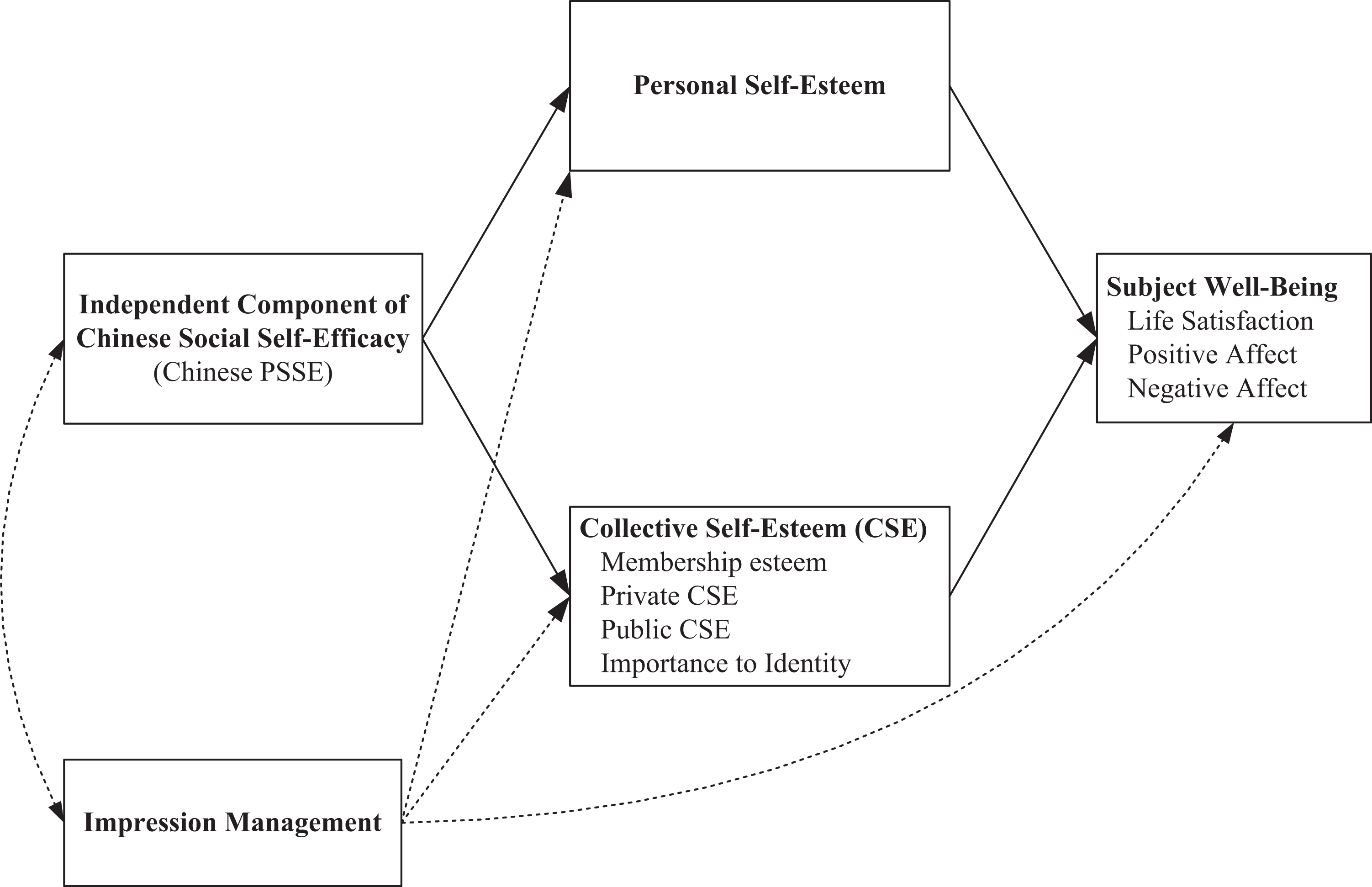
The proposed theoretical model.
Chinese PSSE – SWB
Despite different views among scholars regarding specific components of SWB, there has been a general consensus that SWB should at least include life satisfaction, positive affect, and negative affect (Steel, Schmidt, & Shultz, 2008). Whereas the first component represents a cognitive evaluation of one’s overall life satisfaction, the latter two components are affective evaluations of one’s mood and emotions (Diener et al., 1999).
Research has firmly established extroversion and neuroticism as the two most powerful personality predictors of SWB (Diener et al., 1999; Lucas & Fujita, 2000; Steel et al., 2008). Given the conceptual overlap between PSSE and extraversion, significant relations between Chinese PSSE and SWB can be expected. Furthermore, according to the personality–environment fit view of SWB (e.g., Diener, Larsen, & Emmons, 1984), social involvement is required by all societies; Chinese adults with a high PSSE score are more likely to develop new social relationships and have wider social networks than Chinese adults with a low PSSE score. Thus, they would have better personality–environment fit and in turn would be happier. Accordingly, we expected Chinese PSSE to have positive relations with life satisfaction and positive affect and a negative relation with negative affect.
Personal and CSE—SWB
Research has also identified positive self-regard as important predictors of SWB (DeNeve & Cooper, 1998; Diener et al., 1999). Positive self-regard can be derived from the personal, individual self (personal self-esteem), and/or social self, that is various social groups the individual belongs to (CSE; Luhtanen & Crocker, 1992). Having a favorable view about the individual self and/or social self should weigh positively in forming one’s SWB judgment. Empirical evidence supports this argument. Personal self-esteem has consistently been found to be a strong personality predictor of SWB in both Western societies (Diener et al., 1999) and more industrialized Asian societies such as Japan, Korea, Singapore (e.g., Diener & Diener, 1995), and Hong Kong (e.g., Kwan, Bond, & Singelis, 1997). More recent studies conducted in Mainland China—a society that has been through rapid modernization—also yielded similar findings (e.g., Geng & Zheng, 2008; Xu, Wu, & Qiu, 2005).
According to Luhtanen and Crocker (1992), CSE consists of four dimensions: (a) membership esteem—individuals’ judgment of their worthiness as members of their social groups, (b) private CSE—individuals’ private judgment of their social groups’ worthiness, (c) public CSE—individuals’ judgment of outsiders’ evaluation of their social groups’ worthiness, and (d) importance to identity—individuals’ perceived importance of their social group memberships to their self-concept. Several empirical studies conducted in the United States (e.g., Bettencourt & Dorr, 1997; Crocker, Luhtanen, Blaine, & Broadnax, 1994) and in China (e.g., Zhang, 2005; Zhang & Xu, 2007) reported significant CSE total scale – SWB relations, even after personal self-esteem was controlled for. With respect to CSE dimensions, membership esteem and private CSE were identified by both Crocker et al. (1994; in their Asian student subsample) and Bettencourt and Dorr (1997) as significant predictors of SWB. Unfortunately, the two Chinese studies (Geng & Zheng, 2008; Xu et al., 2005) were not very informative in that CSE dimension scores were not used in the analyses. Based on the above discussions, we expected that both personal and CSE should be positively related to life satisfaction and positive affect but negatively related to negative affect. However, which specific CSE dimensions will emerge as significant predictors remain unclear and is an issue we explore in the current study.
Personal and CSE as Mediators
Both self-esteem (personal and collective) and SWB are variables that represent global constructs, with the former focusing on overall self-worth and the latter on overall perceptions of psychological well-being. In contrast, Chinese PSSE is a construct that is defined at a lower, domain level. According to the level of generality concept (c.f., Bandura, 1997), self-esteem (personal and collective) should be much closer to SWB than Chinese PSSE in the nomological network. This implies that self-esteem (personal and collective) may overshadow the effect of Chinese PSSE on SWB. In other words, when personal and CSE are controlled for, the Chinese PSSE – SWB links are likely to become weaker, a necessary condition for mediation (Baron & Kenny, 1986).
To sufficiently establish mediation, there must be significant links between Chinese PSSE and personal and CSE. The PSSE – personal self-esteem link is pretty straightforward. As mentioned earlier, Chinese individuals with a high PSSE score tend to make more new friends and thus have more social capital compared to their low PSSE counterparts. Given the importance of social interaction in all societies, these individuals should also have higher self-regard, that is higher personal self-esteem. This link has received strong empirical support in studies conducted in the United States (Smith & Betz, 2000) and in China (Fan et al., 2010).
Fan et al. (2010) reasoned that Chinese PSSE should also have positive relationships with some of the CSE dimensions. Specifically, membership esteem focuses on the individual’s contribution to his or her social groups. Chinese individuals with a strong PSSE tend to reach out to other individuals and actively participate in group activities. Thus, a positive relationship between Chinese PSSE and membership esteem can be expected. According to Tajfel and Turner (1986), individuals are motivated to maintain both positive personal and social identity. It follows that individuals with strong PSSE are likely to have positive views about their personal self and collective self. This implies a positive relation between Chinese PSSE and private CSE. Research has documented the tendency of Asians’ public CSE to be highly correlated with their private CSE (e.g., Crocker et al., 1994), implying a positive relationship between Chinese PSSE and public CSE. Finally, there does not appear to be a substantial conceptual connection between Chinese PSSE and the importance to identity dimension of CSE. In our prior validation studies (Fan et al., 2010), we found Chinese PSSE had moderately positive and significant correlations with member esteem (r = .37), private CSE (r = .30), and public CSE (r = .32) but had a weaker, nonsignificant correlation with importance to identity (r = .12). We expected to replicate these findings in an independent sample.
To summarize, we hypothesize that Chinese PSSE should have significant relationships with SWB, and that personal self-esteem and some dimensions of CSE should mediate the above relationships. However, we did not specify which CSE dimensions should be significant mediators. Given that all the variables in the proposed model were measured by self-reports, we controlled for impression management to address the common method variance concern.
Method
Participants and Procedure
Participants were undergraduate students enrolled in a mandatory education course at a medium-sized teacher’s university in the southeastern region in China. In the Chinese higher education system, students within a particular major follow a standardized course sequence for that major. As such, the sample consisted of one class of 117 junior math majors and one class of 87 junior political science majors, equaling to a total sample size of 204. The average age was 21 years, and 53% were female in the combined sample.
Instructors of these classes were contacted and permission was obtained to utilize 20 min of their class time. Research assistants attended one lecture in these classes, explained the purpose of the study, and invited students to participate. Participation was voluntary and participants also received a ballpoint pen worth 4 Chinese Yuan (US$0.60) as a gift. All students present in the classes agreed to participate. Students completed a survey package in class and were assured of the confidentiality of their participation.
Measures
The Chinese PSSE scale
The same 25-item Chinese PSSE scale was used. The α coefficient was .92 in the current sample.
Impression management
Participants’ tendency to engage in socially desirable responding when completing the survey packet was measured by the 20-item Chinese version (Fan et al., 2008) of the Impression Management (IM) scale from the Balanced Inventory of Desirable Responding (BIDR; Paulhus, 1988). One sample item is, “I never swear.” The alpha coefficient was .70 in the current sample.
Personal self-esteem. The Chinese version (Wang, Wang, & Ma, 1999) of Rosenberg’s (1965) Self-Esteem scale was used. Items were rated on a 5-point Likert-type scale, ranging from 1 (strongly disagree) to 5 (strongly agree). Following our earlier validation studies, we removed item 8, “I wish I could have more respect for myself,” from subsequent analyses, because it had a vague meaning in Chinese culture and a low item total correlation of .20. The resulting scale had an α coefficient of .80 in the current sample.
CSE
CSE was measured by the Chinese version (Xie, Leong, & Feng, 2008) of the 16-item general version of Collective Self-Esteem Scale (CSES) [Luhtanen & Crocker, 1992]. The CSES has four subscales: membership esteem, private CSE, public CSE, and importance to identity. In the current sample, the α coefficients were .60, .69, .66, and .59, respectively for the four CSES subscales. These α coefficients were generally comparable to those reported by Xie. Leong, and Feng (2008) and Fan et al. (2010). Prior CSE studies suggest that these four CSE dimensions are conceptually and empirically distinct from each other (Bettencout & Dorr, 1997; Crocker et al., 1994). Crocker et al. (1994) explicitly recommended against collapsing CSE dimensions to calculate a CSE total score, a recommendation we followed in this study.
Life satisfaction
The 5-item Satisfaction with Life scale (SWLS; Pavot & Diener, 1993) measured participants’ cognitive evaluation of SWB. Items were rated on a 7-point Likert-type scale, ranging from 1 (strongly disagree) to 7 (strongly agree). According to Pavot and Diener’s (1993) review, the SWLS has been widely used in SWB research and has exhibited excellent psychometric properties. In the present study, we used the Chinese version of SWLS translated by Mantak Yuen (for a detailed discussion of Chinese SWLS scores’ psychometric properties, see Wang, Yuen, & Slaney, 2009). The α coefficient for scores of the Chinese SWLS was .83 in the current sample.
Positive and negative affect
We used 20 Chinese mood adjectives translated from Watson, Clark, and Tellegen’s (1988) Positive and Negative Affect Schedule (PANAS) scale and additional 4 Chinese mood adjectives from Qiu, Zheng, and Wang’s (2008) Chinese PANAS scale to measure affective components of SWB. Participants rated to what extent they have experienced various moods in general on a 5-point Likert-type scale ranging from 1 (very slightly or not at all) to 5 (extremely). We then conducted exploratory factor analyses with oblique rotation on these ratings. The scree plot and the interpretability of the rotated factor loading matrix clearly indicated that a 2-factor model was preferred. Eight adjectives with low loadings (< .50) or large cross-loadings after rotation were removed from subsequent analyses. Among the retained adjectives, 9 measured positive affect, with an α coefficient of .86; 9 measured negative affect, with an α coefficient of .87.
Results and Discussion
Table 1 presents the means, standard deviations, and correlations among study variables with and without impression management scores being controlled for. Inspection of the correlation pattern suggests preliminary support for our hypotheses. For instance, Chinese PSSE was significantly correlated with potential mediators as well as the three components of SWB. For the most part, correlations between potential mediators and various SWB components were significant. Notably, even when the impression management scores were controlled for, the above correlation patterns remained.
Means, Standard Deviations, and Intercorrelations of Variables in Study 2
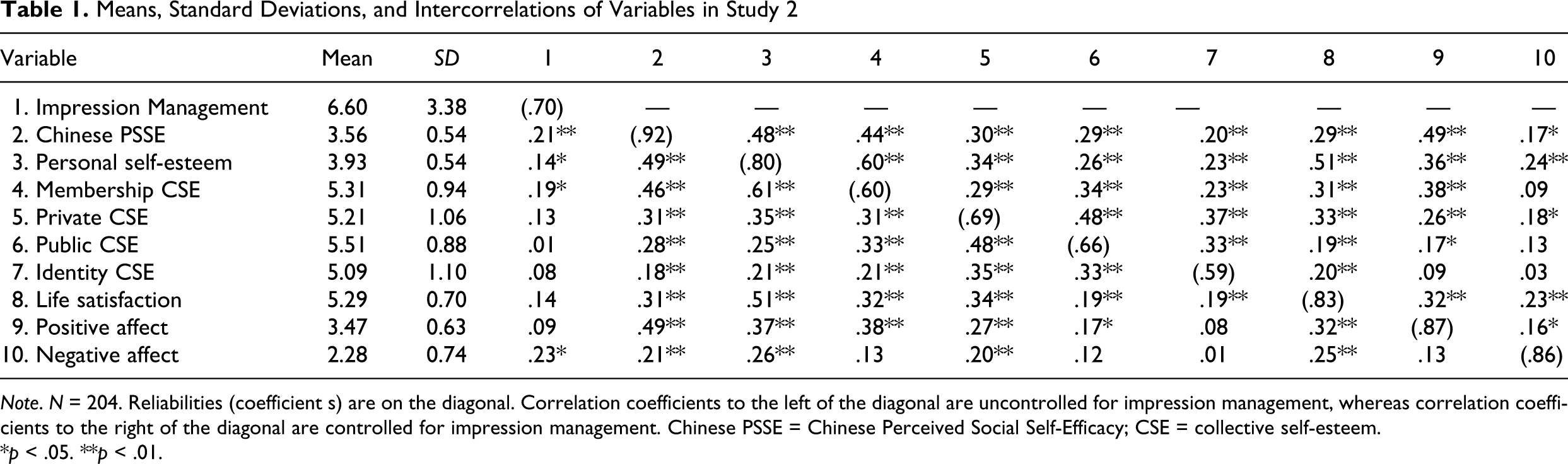
Note. N = 204. Reliabilities (coefficient αs) are on the diagonal. Correlation coefficients to the left of the diagonal are uncontrolled for impression management, whereas correlation coefficients to the right of the diagonal are controlled for impression management. Chinese PSSE = Chinese Perceived Social Self-Efficacy; CSE = collective self-esteem.
*p < .05. **p < .01.
Testing our hypothesized model involves testing multiple mediations. Historically, the most widely used method to test mediation is the causal steps approach popularized by Baron and Kenny (1986). However, this method has been criticized on two grounds: (a) the significance of indirect effect is inferred rather than directly tested and (b) the demonstration of a significant association between the independent variable (IV) and the dependent variable (DV) is now considered unnecessary (Shrout & Bolger, 2002). Sobel (1982) proposed the product-of-coefficient approach to directly test the significance of indirect effect. It involves computing the indirect effect (the product of the path coefficient between the IV and the mediator and that between the mediator and the DV) and its standard error. However, one limitation of the Sobel test is its assumption that the sampling distribution of the indirect effect follows a normal distribution, which holds only in very large samples. MacKinnon, Lockwood, Hoffman, West, and Sheets (2002) suggested the distribution of the product approach, which takes into account the skew of the distribution of products. Unfortunately, the extension of this method from simple mediation to multiple mediations has not been worked out as of yet (Preacher & Hayes, 2008).
In the present study, we used the bootstrapping method to test multiple mediations. Bootstrapping is a non-parametric technique that empirically generates an approximation of the sampling distribution of the parameter of interest and thus avoids the normality assumption. In the case of multiple mediation models, the bootstrapping method re-samples the actual sample with replacement to generate thousands of bootstrap samples (Preacher & Hayes, 2008). For each bootstrap sample, individual indirect effects and the total indirect effect are calculated. The sampling distributions of these effects are then formed, and the corresponding percentile-based confidence intervals (CIs) are constructed (Preacher & Hayes, 2008). In the present study, we used an improved version of percentile bootstrap CIs, the bias-corrected and accelerated (BCa) CIs, per Preacher and Hayes’ recommendation. Contrasts of specific indirect effects can be easily done by constructing CIs for the differences between specific indirect effects. We used the SPSS macro written by Preacher and Hayes to test our models. To provide more rigorous tests, we controlled for impression management in all models.
Table 2 presents point estimates and BCa bootstrap CIs of indirect effects based on 5,000 bootstrap samples for multiple mediation models. For the model with life satisfaction as the DV, the results revealed that personal self-esteem and the four CSE dimensions together as a set significantly mediated the Chinese PSSE-life satisfaction relationship, with the point estimate of the total indirect effect being 0.5935, and the BCa 95% CI of [0.3571, 0.8493]. Furthermore, personal self-esteem and private CSE were the two significant mediators in the multiple mediations model. In addition, a contrast indicated that personal self-esteem was a statistically stronger mediator than private CSE: The point estimate of the difference was 0.3825 and its BCa 95% CI [0.1316, 0.6357] did not contain zero.
Multiple Mediation of the Indirect Effects of Chinese PSSE on SWB Through Personal Self-esteem, Membership Esteem, Private CSE, Public CSE, and Importance to Identity
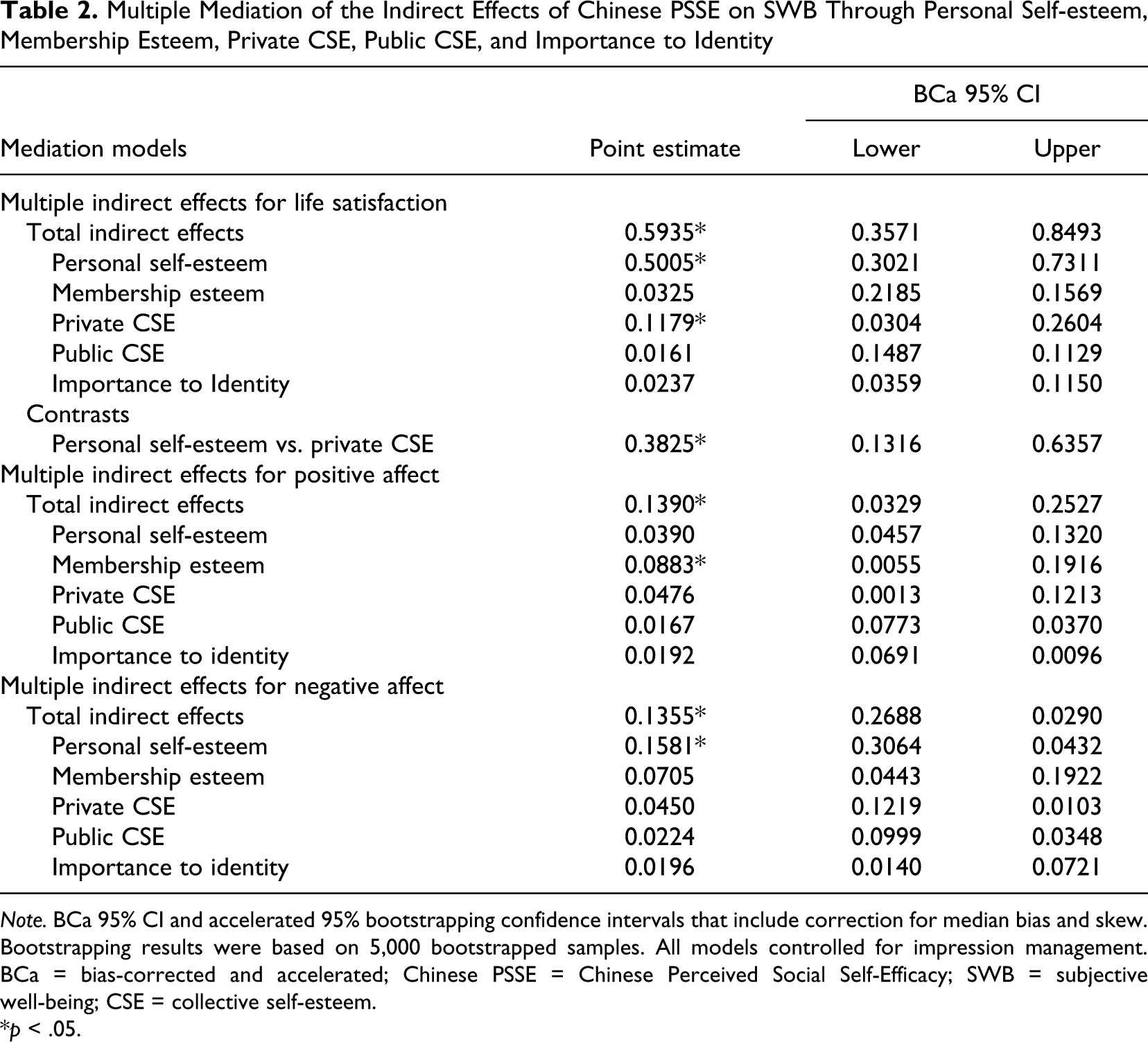
Note. BCa 95% CI and accelerated 95% bootstrapping confidence intervals that include correction for median bias and skew. Bootstrapping results were based on 5,000 bootstrapped samples. All models controlled for impression management. BCa = bias-corrected and accelerated; Chinese PSSE = Chinese Perceived Social Self-Efficacy; SWB = subjective well-being; CSE = collective self-esteem.
*p < .05.
For the model with positive affect as the DV, the results of the simultaneous, multiple mediations model indicated that personal self-esteem and the four CSE dimensions together as a set significantly mediated the Chinese PSSE-positive affect relationship: The point estimate of the total indirect effect was 0.1390, with the BCa 95% CI of [0.0329, 0.2527]. Among these mediators, membership CSE emerged as the only significant mediator.
Finally, for the multiple mediations model with negative affect as the DV, the results revealed that personal self-esteem and the four CSE dimensions together as a set significantly mediated the Chinese PSSE-negative affect relationship: The point estimate of the total indirect effect was −0.1355, with the BCa 95% CI of [−0.2688, −0.0290]. Personal self-esteem turned out to be the only significant individual mediator.
Taken together, the above results provided some support for our theoretical model. Chinese PSSE was significantly related to all three components of SWB, thus substantiating its criterion-related validity. Personal self-esteem and a couple of CSE dimensions were found to mediate the Chinese PSSE-SWB relationships, even after impression management scores were controlled for. Specifically, personal self-esteem was the dominant mediator of the Chinese PSSE-life satisfaction and negative affect links. Membership esteem emerged as the dominant mediator of the Chinese PSSE-positive affect link. Private CSE also demonstrated unique mediating ability along with personal self-esteem in mediating the Chinese PSSE-life satisfaction relationship. These findings shed light on the psychological mechanisms behind the Chinese PSSE-SWB links. The differential mediation relationships also reaffirmed the multidimensionality of SWB.
Our findings regarding personal and CSE as two mediators between Chinese PSSE and SWB were almost a mirror image of the results reported by Bettencourt and Dorr (1997). In two samples of predominantly White, U.S. college students, Bettencourt and Door found that CSE mediated the relationship between allocentrism (individual-level collectivism) and psychological well-being, even after personal self-esteem was controlled for. Of particular interest is their secondary finding: Personal self-esteem was a reliable predictor of psychological well-being in various regression models, and allocentrism was significantly and positively correlated with personal self-esteem. This suggests that personal self-esteem might be another mediator between allocentrism and psychological well-being that Bettencourt and Dorr might have missed. Similarly, Kwan, Bond, and Singelis (1997) tested and found empirical support for a model in which personal self-esteem mediated the relationship between independent self-construal and life satisfaction, whereas relationship harmony (a collectivistic construct) mediated the relationship between interdependent self-construal and life satisfaction. However, Kwan et al. also found, unexpectedly, that adding a positive link from independent self-construal to relationship harmony significantly improved the model fit.
These converging results challenge the more subtle version of the dichotomous view of cultural differences, which assumes that individualistic/collectivistic constructs should be strongly related to individualistic/collectivistic constructs, but individualistic constructs should not be related to collectivistic constructs. Although the first part of the assumption has received much empirical support, the second part does not appear to fit well with the aforementioned empirical findings. We therefore encourage cross-cultural scholars to adopt a more complex view of cultural differences and seriously examine the possibility that individualistic constructs might have meaningful relations with collectivistic constructs and vice versa.
General Discussion
The purpose of this article was to report additional validity evidence for the Chinese version of the PSSE scale (Smith & Betz, 2000), building on our earlier validation efforts (i.e., Fan et al., 2010). Two major findings are noteworthy. First, the internal structure of the Chinese PSSE scale did not appear to be unduly influenced by the culturally characteristic variable of RFA. Second, Chinese PSSE significantly predicted various components of SWB. Furthermore, personal self-esteem and a couple of CSE dimensions were identified as mediators of the Chinese PSSE – SWB relationships.
Based on our prior and current validation results, we conclude that we have marshaled convincing evidence for the Chinese PSSE scale as a valid measure of Chinese adult’s social self-efficacy in independent contexts. In the process, we have also established the relevance of the independent component of Chinese adult social self-efficacy in contemporary Chinese societies. We encourage scholars to use the Chinese PSSE scale to investigate Chinese adult’s career and psychological adjustment process and outcomes. For instance, the Chinese PSSE scale can be used to test social cognitive theories of career decisions and development (e.g., Hackett & Betz, 1981) or psychological well-being models (e.g., Lent, 2004). In both theories, social self-efficacy is a critical variable. Mental health practitioners may use the Chinese PSSE scale as a diagnostic tool to assess the need for some sort of social skills training and also as an evaluation tool to assess the efficacy of such trainings.
Limitations and Future Research Directions
The present research has several limitations. First, our undergraduate/graduate student samples may pose the generalizability issue. Future research is needed to replicate our findings within different occupation groups and within older Chinese populations. However, we want to point out that Chinese adults in their 20s are a very special group of Chinese population. They are the first generation who grew up in a politically stable, economically affluent, and resourceful environment. Most of them are the only child of the family. They are, or are on the verge of entering into the workforce within the next decade. As such, it is timely to examine their social self-efficacy perception and how it affects their career and psychological adjustment processes. The second limitation is that although we have established the mediated link of Chinese PSSE-personal and CSE-SWB, given the survey nature of our study, we cannot rule out the reversed causality direction. Future research manipulating Chinese PSSE is needed to fully establish causality.
More importantly, our mission of developing a valid measure for Chinese adult social self-efficacy has only been half-accomplished—we know very little about the interdependent component of Chinese social self-efficacy. Thus, the most urgent future research item is to develop a new measure for the interdependent component of Chinese social self-efficacy. In fact, this research team is currently pilot testing initial items for the new measure. After establishing its psychometric properties, we will be in a position to investigate some interesting questions—for instance, whether the independent and interdependent components of Chinese social self-efficacy are independent of each other, whether these two components have different antecedents, correlates, and consequences, and which component has the higher predictive power of important life and career outcomes.
Further down the road, it is perhaps not too far fetched to entertain the possible existence of the interdependent component of adult social self-efficacy in Western societies. After all, Westerners also need to interact with people they already know quite well such as relatives, friends, and coworkers. In these interdependent social contexts, does the ability to engage in assertive behaviors continue to prove useful in Western societies? Is a different set of social skills called for, such as the ability to maintain interpersonal harmony as observed in Oriental societies? These are interesting questions awaiting future research. We hope that through programmatic research we will eventually be able to build a unified, pan-cultural model of adult social self-efficacy.
Footnotes
Authors’ Notes
Jinyan Fan and Hui Meng contributed equally to this manuscript. This research was partially supported by a Shanghai Pujiang Program awarded to Hui Meng.
Declaration of Conflicting Interests
The authors declared no potential conflicts of interest with respect to the research, authorship, and/or publication of this article.
Funding
The authors disclosed receipt of the following financial support for the research, authorship, and/or publication of this article: This research is partially supported by a grant from the Shanghai Pujiang Program, China, Grant 10PJC034, awarded to Hui Meng, and a grant from the Department of Education, China, Grant DFA100233, awarded to Bihua Zhao.