




Abstract
The factorial structure of the Career Decision Self-Efficacy Scale–Short Form (CDSES-SF) was examined in a sample of 796 Chinese graduate students recruited from five universities in Beijing. A single-factor model is recommended on the basis of two of this study’s findings. First, confirmatory factor analyses revealed that the parsimonious single-factor model fit the data well as the competing multi-factor models did. Second, the original theoretical factors of the CDSES-SF were found to be highly homogeneous and to fail to demonstrate the necessary incremental validity over and beyond the total score. Consistent with the previous studies, the CDSES-SF was found to have sound internal consistency (α = .91). The implications of the current study are discussed.
Career decision self-efficacy is a salient construct in understanding the career decision-making process (Betz, Hammond, & Multon, 2005). Although substantial empirical research has reported career decision self-efficacy to be associated with multiple adaptive career behavior constructs and to have strong implications for career interventions (see Betz, Hammond, & Multon, 2005, for a review), a fundamental debate remains as to whether career decision self-efficacy is a multifaceted construct involving specific career choice tasks or a single-factor construct for accessing general career decisions (Robbins, 1985; Taylor & Popma, 1990).
Career decision self-efficacy refers to an individual’s beliefs regarding his or her ability to complete successfully the necessary tasks required in making career decisions (Taylor & Betz, 1983). Based on a model of career maturity (Crites, 1961, 1978), the 50-item Career Decision Self-Efficacy scale (CDSES; Taylor & Betz, 1983) and its 25-item short form (CDSES-SF; Betz, Klein, & Taylor, 1996) were designed to measure five specific career choice competencies, namely, self-appraisal, occupational information gathering, goal selection, planning, and problem solving. Given the theoretical task-specific nature of the competencies, the response to each item of the CDSES/CDSES-SF is expected to reflect an individual’s perceived difficulty in completing a certain task (e.g., “choose a career that will fit my interests”) and provide grounds for developing interventions to enhance the respondent’s task-specific confidence and skills (Peterson & delMas, 1998; Taylor & Betz, 1983).
The existing empirical evidence on the factor structure of the CDSES/CDSES-SF is inconsistent. Some researchers have claimed that career decision self-efficacy is a multidimensional construct, although no consensus has been achieved with regard to the number of underlying factors required for different samples. For example, when the CDSES was applied to young Israel adults, the theoretical five-factor structure was obtained using cluster analyses after eliminating items with low item total correlations or overly high correlations with other scales (Gati, Osipow, & Fassa, 1994). However, in a study of South African university students, it was found that the CDSES-SF did not fit the five-factor model very well (Watson, Brand, Stead, & Ellis, 2001).
Three studies (Betz et al., 1996; Chaney, Hammond, Betz, & Multon, 2007; Peterson & delMas, 1998) using principal component analysis (PCA) with varimax rotation have argued that career decision self-efficacy comprises, at least, the two broad components of information gathering and decision making. However, further inspection of the specific indicators for these two underlying factors has revealed substantial inconsistency. In the two-factor solution to the CDSES proposed by Peterson and delMas (1998), the first factor, labeled Information Gathering, comprising seven items drawn from the original occupational information subscale and three from the planning subscale. The Decision Making factor contained four goal selection items, one planning item, and one self-appraisal item. However, in the two-factor solution to the CDSES-SF proposed by Betz, Klein, and Taylor (1996), the indicators loading on the Decision Making factor included five goal selection and four planning items, whereas the indicators for Information Gathering comprised four occupational information and four problem solving items. Obviously, this inconsistency in the composition of the indicators makes it difficult to name the factors clearly and reliably. In the third study, Chaney, Hammond, Betz, and Multon (2007) claimed that the CDSES-SF was best represented by a four-factor solution, with a large first factor emphasizing the two components of Information Gathering and Decision Making. However, this large first factor appears to be of a general nature, as it contained items from all five theoretical subscales.
Two studies conducted outside the United States reported that the CDSES-SF contained three underlying factors and suggested that the factor structure of career decision self-efficacy may vary across different cultural populations (Creed, Patton, & Watson, 2002; Hampton, 2005). However, neither study seems to have provided adequate empirical evidence to support the multidimensional nature of the CDSES-SF. Using a principal axis factoring analysis with oblique rotation, Creed, Patton, and Watson (2002) identified a three-factor model (Decision Making, Information Gathering, and Problem Solving) of the CDSES-SF for Australian and South African high school students. In each model, the huge discrepancy in the Eigenvalues between the first and second factors in each sample strongly suggested the possibility of a unidimensional structure. In particular, the failure to adopt and report multiple criteria (e.g., the scree test) to determine the number of underlying factors (Fabrigar, Wegener, MacCallum, & Strahan, 1999; Tinsley & Tinsley, 1987) leaves this type of three-factor solution open to question.
In another study, Hampton (2005) retained 13 of the 25 items of the CDSES-SF and proposed a three-factor model for Chinese college students. Hampton acknowledged that despite the similar factor labels to those proposed by Creed et al. (2002), the corresponding indicators of each factor were quite different. The author further compared this Chinese three-factor model with the Australian and South African three-factor models of Creed et al. (2002), the two-factor model of Peterson and delMas (1998), and the theoretical five-factor model. Although the Chinese three-factor model was the most favored, it was not directly compared with a single dimensional model, which may provide a similar close fit, though in a more parsimonious way. After all, the notably high factor intercorrelations (rs = .60 – .77) in Hampton’s (2005) model suggested that there was substantial content overlap among these three factors.
In fact, some researchers have argued that the CDSES/CDSES-SF may only tap into a single general factor. Factor analyses of the CDSES/CDSES-SF using samples of college and high school students in the United States and China consistently showed an unclear structure when five factors were imposed and then extracted by PCA with varimax rotation (Hampton, 2006; Peng & Long, 2001; Taylor & Betz, 1983; Taylor & Popma, 1990). Most items cross-loaded on more than one factor and showed the highest loadings on the first factor. The newly formed factors contained mixed items from different original subscales. Moreover, the intercorrelations among the factors were quite high. Robbins (1985) also questioned the usefulness of the subscales, as his study found that the information gathering, planning, and problem solving subscales of the CDSES did not uniquely and significantly contribute to the variance when discriminating different vocational identity groups.
The foregoing literature review highlights four problems. First, little research has applied confirmatory factor analysis (CFA) to examine and compare the two basic hypotheses, namely, the theoretical five-factor model and the single factor model. Second, studies arguing for the multifaceted nature of the CDSES/CDSES-SF have not achieved consensus on the number of factors or the defining items for each factor. Furthermore, high factor intercorrelations have been consistently found in the majority of the multiple-factor solutions (e.g., Creed et al., 2002; Hampton, 2005). Little research has examined the possibility that a meta-factor may further account for the covariance among the highly intercorrelated underlying factors (Kahn, 2006).
Third, to justify the theoretical multidimensional nature of career decision self-efficacy, the uniqueness and incremental validity of the different dimensions should be demonstrated beyond the total score. Few studies have sought to address this issue. Finally, the majority of the previous studies tested the factor structure of the CDSES/CDSES-SF among college or high-school students. It is worthwhile extending this test to other student populations. In China, most university students enter graduate schools directly after completing their undergraduate studies and do not engage in any substantial career exploration activities (Wang, Ma, & Cao, 2006). Accordingly, they make their career decisions at a later stage than do college students and are thus more mentally mature when they do so. To understand career decision making among Chinese graduate students and provide effective tailor-made interventions, the CDSES-SF needs to be validated in this population.
Thus, the current study examines the factor structure of the CDSES-SF using a sample of Chinese graduate students and extends the extant research in the following ways. First, three competing models (i.e., a theoretical five-factor model, a five first-order factors with one second-order factor model, and a one-general factor model) specified a priori are directly examined and compared using CFA. Second, the usefulness of the theoretically based factors is assessed by examining their correlations with the Big Five personality traits with and without controlling for the total score of the CDSES-SF, which is consistent with previous studies utilizing dispositional indices as validity measures of the CDSES-SF (Betz et al., 2005; Hartman & Betz, 2007).
Method
Participants and Procedures
Eight hundred and seventy-eight graduate students were recruited from five universities in Beijing, China. Eighty-two questionnaires were excluded because the respondents did not complete the whole questionnaire. Thus, a total of 796 valid questionnaires were obtained from 468 (58.8%) male and 328 (41.2%) female participants, with a mean age of 24.85 (SD = 1.85). All were enrolled in 3-year master programs, majoring in either Science (415, 52.1%) or the Humanities and Social Sciences (379, 47.6%), except for two (.3%) who did not indicate their majors. The participants included first-year (337, 42.3%), second-year (207, 26.0%), and third-year (243, 30.5%) students, apart from 9 students (1.1%) who did not complete this item. The questionnaires were distributed, completed, and collected in class. Those who endorsed the informed consent forms spent about 20 min completing the questionnaires and received a small gift for their participation.
Measures
CDSES-SF. The CDSES-SF (Betz et al., 1996) contains 25 items. The participants indicated how confident they felt about each statement on a 5-point Likert-type scale, from no confidence at all (1) to complete confidence (5). Higher scores represent greater levels of career decision self-efficacy. Betz, Hammond, and Multon (2005) reported α coefficients ranging from .78 to .87 for the subscales and from .93 to .95 for the entire scale across samples. In terms of validity, the CDSES-SF has been found to be significantly correlated with adaptive vocational behavior constructs, such as career certainty, vocational identity, and goal stability (Betz et al., 2005).
The current study used a Chinese version of the CDSES-SF (Long, 2003), which showed Cronbach’s αs ranging from .68 (problem solving) to .79 (planning) for the subscales and .85 for the whole scale. Items 2 and 23 (i.e., “Select one major from a list of potential majors you are considering” and “Find information about graduate or professional schools”) were excluded because they were not relevant to the participants (i.e., they were already in graduate study). The modified Chinese version of the CDSES-SF thus consisted of 23 items.
NEO Five-Factor Inventory (NEO-FFI). The 60-item NEO-FFI (Costa & McCrae, 1992) assesses five personality traits, namely, neuroticism (N), extroversion (E), openness to experience (O), agreeableness (A), and conscientiousness (C). Items are rated on a 5-point Likert-type scale ranging from strongly disagree (0) to strongly agree (4). The current study used a Chinese version of the NEO-FFI (Zhang, 2000), obtaining α coefficients of .83, .75, .54, .79, and .79 for the N, E, O, A, and C scales, respectively.
Results
Internal Consistency Reliability
The means, standard deviations, α coefficients, inter-item correlations, and corrected item total correlations were calculated for each original subscale and the entire scale. As shown in Table 1, the inter-item correlations and corrected item total correlations were positive, with substantial magnitudes across subscales and the total scale. αs for the subscales, which ranged from .62 to .75, were slightly lower compared with previous studies based on college students in China and the United States, whereas the estimate for the whole scale, α = .91, was consistently high (Betz et al., 2005; Hampton, 2005; Long, 2003).
Descriptive Statistics and Internal Consistency of the CDSES-SF (N = 796)
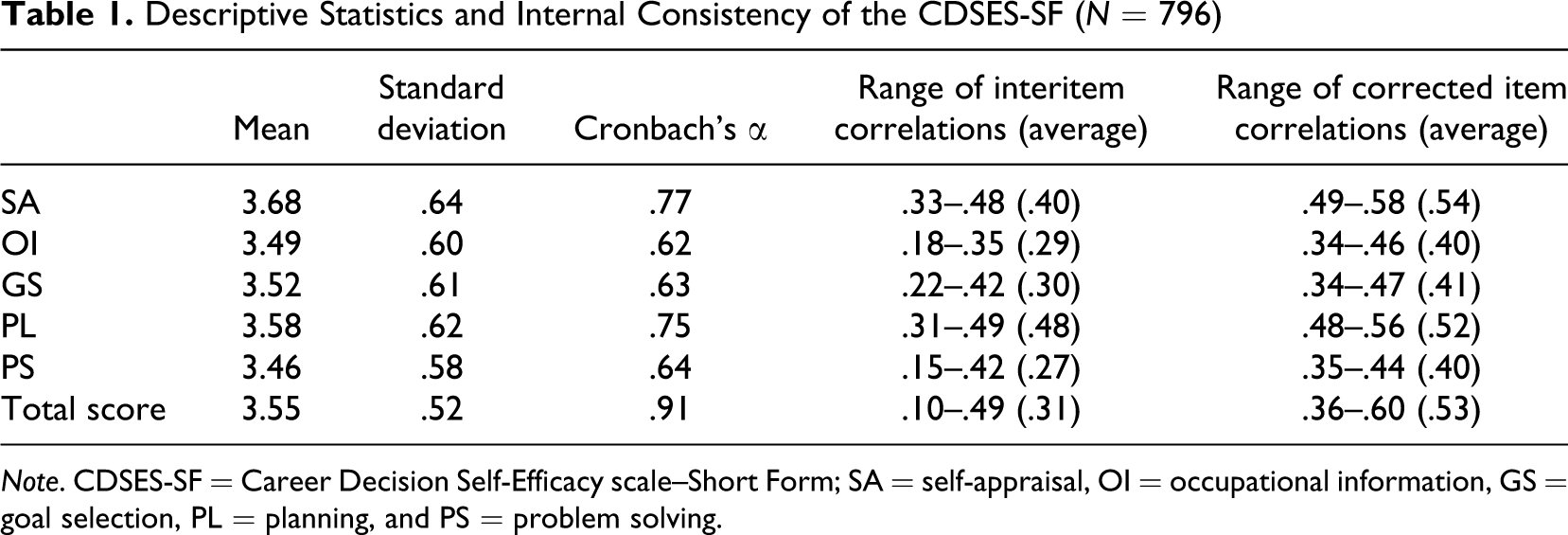
Note. CDSES-SF = Career Decision Self-Efficacy scale–Short Form; SA = self-appraisal, OI = occupational information, GS = goal selection, PL = planning, and PS = problem solving.
Confirmatory Factor Analysis
To examine the factor structure of the CDSES-SF, three competing models were specified a priori and compared using Amos 4.0.1 (Arbuckle, 1999). As illustrated in Figure 1, Model 1 was specified as a first-order model with five correlated factors. The items were loaded onto the respective factors they were designed to measure. Model 2, which was a second-order model based on Model 1, tested whether there was a higher order general factor underlying the five original factors. Model 3 was a first-order model, with only one general factor to account for the covariance among the 23 items. All error covariances among items were constrained to zero across the models, and no cross-loadings were allowed.
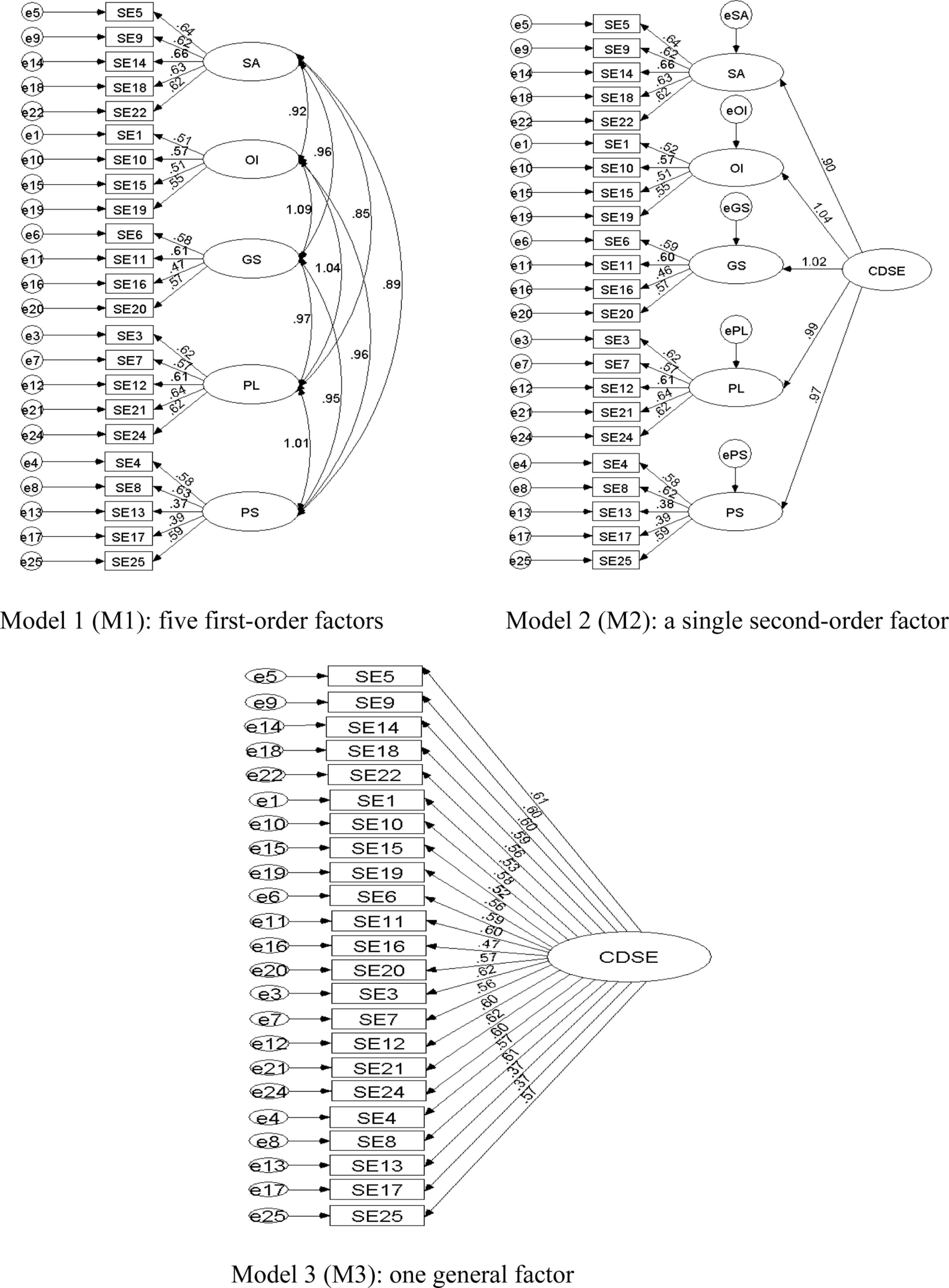
Competing models of the CDSES-SF with 23 items (N = 796). CDSES-SF = Career Decision Self-Efficacy scale–Short Form.
Multivariate normality was tested to determine the estimation method. Preliminary analyses showed that the items were univariate normally distributed, with skewness ranging from −.58 to .12 and kurtosis ranging from −.66 to .36, which are lower than the cutoff values of 1 suggested by Kline (1998). However, Mardia’s normalized estimate was 35.43, which is greater than the cutoff value of 5 suggested by Bentler (2006), indicating that this data set was not multivariate normally distributed. Therefore, a bootstrap estimation method with 250 replications (Nevitt & Hancock, 1998) was used in the following CFAs.
Following Kline (2005), multiple indices were selected to evaluate the model data fit. These included the comparative fit index (CFI; Bentler, 1990), root mean square error of approximation (RMSEA; Steiger & Lind, 1980), standardized root mean square residual (SRMR), and the expected cross-validation index (ECVI; Browne & Cudeck, 1993). According to (Hu & Bentler, 1999), an acceptable model requires a CFI in excess of .95, an estimate of RMSEA lower than .06, and an estimate of SRMR less than .08. Among the competing models, the smallest value of the ECVI indicates the best fit (Byrne, 2001).
The overall goodness-of-fit indices for the three competing models are displayed in Table 2. The results showed that all models provided acceptable fit to the data based on the criteria of an RMSEA <.08 and SRMR <.08. However, the CFIs did not exceed .90. This result is reasonable, given the constraints of no error covariance and cross-loading on the 23 items. In general, there were only negligible differences in the fit indices across the models. As a general principle, when competing models generate similar fit indices, the most parsimonious, Model 3 in this case, is preferred.
Summary of Fit Indices for Competing Measurement Models of the CDSES-SF (N = 796)
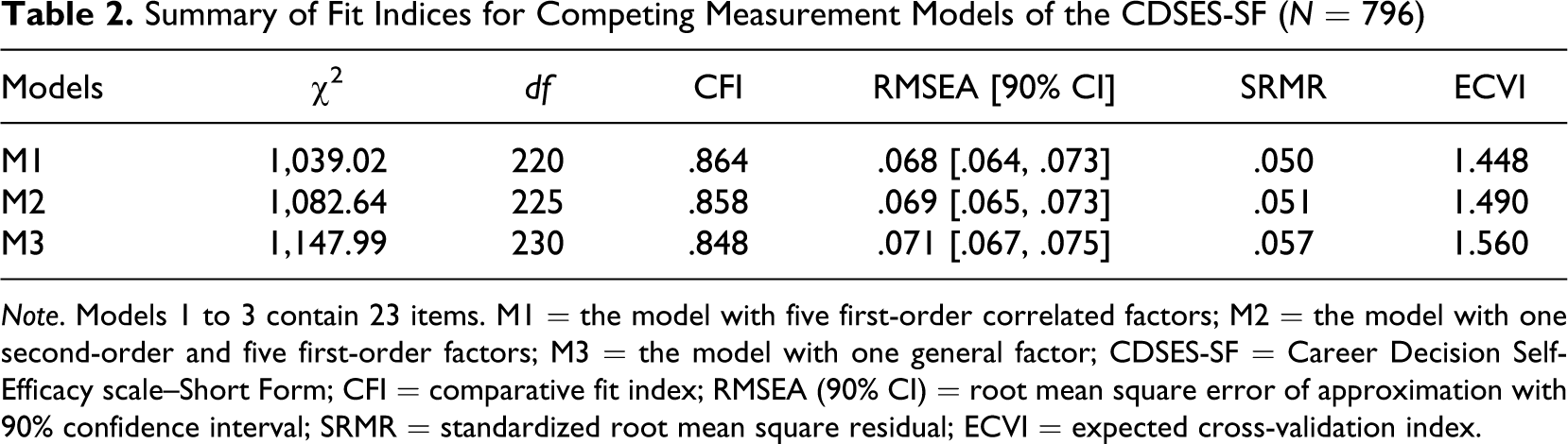
Note. Models 1 to 3 contain 23 items. M1 = the model with five first-order correlated factors; M2 = the model with one second-order and five first-order factors; M3 = the model with one general factor; CDSES-SF = Career Decision Self-Efficacy scale–Short Form; CFI = comparative fit index; RMSEA (90% CI) = root mean square error of approximation with 90% confidence interval; SRMR = standardized root mean square residual; ECVI = expected cross-validation index.
At the parameter estimates level, as shown in Figure 1, the standardized factor loadings for the 23 items were all positive and statistically significant (p < .001), with substantial magnitudes ranging from .37 to .66 across the models. It should be noted that the first-order latent factor intercorrelations in Model 1 and the second-order factor loadings in Model 2 were equal to or larger than .85. These results indicate a high degree of multicollinearity in the data (Jöreskog, 1999), providing substantive evidence of the existence of a single general factor.
Correlation Analysis
To test the validity and usefulness of the individual factors underlying the CDSES-SF, the correlations between the five original factors and the Big Five personality traits were calculated with and without controlling for the total score of the CDSES-SF. Zero-order correlations were computed first to examine the relationships between the five theoretical factors of the CDSES-SF and the Big Five personality traits. As shown in Table 3, all five original factors of the CDSES-SF were correlated with personality traits in very similar ways, as was the total score. According to Cohen (1992), the magnitudes of correlations of .10, .30, and .50, respectively, indicate small, medium, and large effect sizes. In this regard, compared with openness and agreeableness, the relationships of neuroticism, extroversion, and conscientiousness to the CDSES-SF total score and each factor was more robust and meaningful due to the large sample size. To test the extent to which the five original dimensions of the CDSES-SF can provide incremental information, semipartial correlations were calculated while controlling for the total score. As can be seen in Table 3, most of the correlations between the five theoretical factors of the CDSES-SF and the personality traits became negligible, and none of their effect sizes was greater than .30. Even for the largest coefficient, the additional information was very limited (e.g., .232 × 100% = 5.3%). These findings suggest that there was little need to differentiate the five factors, as most of the information was retained by the total score of the CDSES-SF.
Zero-Order and Semipartial Correlations Between Career Decision Self-Efficacy and Big Five Personality Traits (N = 796)
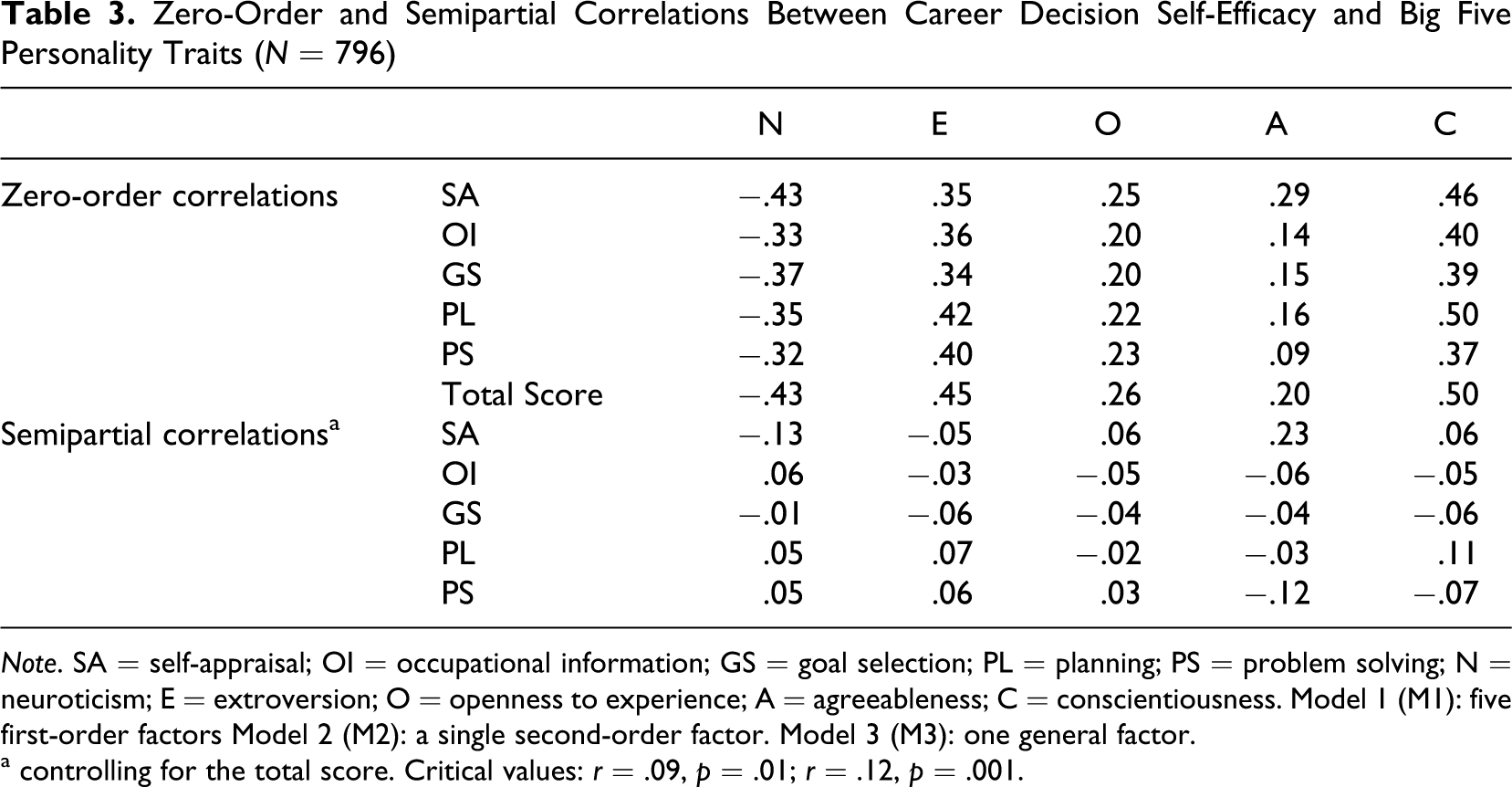
Note. SA = self-appraisal; OI = occupational information; GS = goal selection; PL = planning; PS = problem solving; N = neuroticism; E = extroversion; O = openness to experience; A = agreeableness; C = conscientiousness. Model 1 (M1): five first-order factors Model 2 (M2): a single second-order factor. Model 3 (M3): one general factor.
a controlling for the total score. Critical values: r = .09, p = .01; r = .12, p = .001.
Discussion
Adopting a deductive approach, Taylor and Betz (1983) proposed a theoretical five-factor model of career decision self-efficacy based on a model of competencies representing career maturity (Crites, 1978). However, studies have continually failed to support this five-factor model, and other multidimensional alternatives have been proposed for different racial and ethnic samples (Chaney, et al., 2007; Creed et al., 2002; Hampton, 2005, 2006). The current study examined the factor structure of the widely used CDSES-SF in terms of a sample of Chinese graduate students. The original five-factor model was compared with two alternatives, namely, a second-order model containing five first-order factors and a one-general factor model. The results indicated that the fit indices of the former two models were no better than that of the one-general factor model. Moreover, considerable overlap among the five theoretical dimensions was found. The one-general factor model was therefore preferred as it had the most parsimonious pattern, demonstrating the unitary nature of career decision self-efficacy. Because the CDSES-SF measures a domain-specific construct, such a unidimensional structure may imply that career decision making is a systematic process in which specific tasks are interwoven. As a result, the self-efficacy for specific tasks would not be clearly differentiated.
The one-factor structure of career decision self-efficacy was further supported by comparing the zero-order and semipartial correlations between the theoretical subscales of the CDSES-SF and the Big Five personality traits before and after controlling for the total score of the CDSES-SF. It was found that the majority of the semipartial correlations were trivial and none exceeded .30, thereby supporting the argument that there is limited usefulness in differentiating the five theoretical dimensions (Robbins, 1985). Career decision self-efficacy can thus be treated as a unidimensional construct in an economical manner. Further research is suggested to reduce the redundancy among the original items. In addition, new typical decision-making tasks are expected to arise in terms of theories, changing social and economic contexts, and indigenous cultures, such as the self-efficacy required for social network building among Chinese students (Zheng & Zhang, 2002). In this sense, a new door may have opened for employing an inductive paradigm based on qualitative research to identify the real-life decision-making tasks encountered by today’s decision makers.
An additional finding was the moderate-to-high correlations between the total score of the CDSES-SF and three of the five personality traits. Consistent with research in a Western context (Hartman & Betz, 2007), neuroticism, conscientiousness, and extroversion were found to have the strongest correlations with career decision self-efficacy. Participants who reported lower levels of neuroticism and higher levels of conscientiousness and extroversion exhibited more confidence in dealing with the necessary tasks involved in the career decision-making process.
Although the unidimensional factor structure of the CDSES-SF was favored in the current study, the theoretical framework of the CDSES-SF cannot simply be ignored, as pointed out by Taylor and Popma (1990), when designing interventions to facilitate career decision self-efficacy and reduce decision-making difficulties. In fact, the assumption of task-specific self-efficacy requires interventions that engage in concrete activities, such as information gathering and goal selection. Future studies may wish to utilize experimental designs to examine the unique contributions of the factors.
Consistent with previous studies (e.g., Betz et al., 1996; Hampton, 2005, 2006), the current study confirmed that the total scale of the CDSES-SF has a high level of internal consistency reliability among Chinese graduate students. It should be noted that the subscales of occupational information, goal selection, and problem solving showed relatively low αs. This may have been due to the reduced number of items included in these subscales. Alternatively, the low degree of reliability may indicate that certain tasks included in the goal selection and problem solving subscales are not appropriate for different cultural populations, particularly for those from collective cultures (Creed et al., 2002; Hampton, 2005).
There are several limitations to this study. First, to maintain the completeness of the scale and for comparison purposes, it did not explore the new CDSES-SF factor structure resulting from the deletion of weak items. Research on the factorial validity of the CDSES-SF indicated that more distinct and interpretable latent factors can emerge if items with high cross-loadings or low item total correlations are removed (Gati et al., 1994; Hampton, 2005; Peterson & delMas, 1998). It is likely that career decision self-efficacy could be accurately assessed using a more concise version of the scale. Second, this study was carried out using a large sample drawn from five universities located in the same city, which may limit the generalizability of the findings to some extent. Replication based on different samples would be helpful.
Footnotes
Declaration of Conflicting Interests
The authors declared no potential conflicts of interest with respect to the research, authorship, and/or publication of this article.
Funding
The authors received no financial support for the research, authorship, and/or publication of this article.