



Abstract
Building on the Psychology of Working Framework, the current study explored the extent to which work volition functioned as a moderator in the relation between positive affect, core self-evaluations, perceived organizational support (POS), and work self-efficacy to job satisfaction. In a diverse sample of 206 employed adults, work volition was found to be a significant moderator in the relations of self-efficacy and POS to job satisfaction. Specifically, as work volition increased, the relation of self-efficacy to job satisfaction increased, whereas the relation of POS to job satisfaction decreased. Results of this study lend initial support to the proposition that the strength and direction of established predictors of job satisfaction depend, in part, on an individual’s level of work volition. Implications for research and practice are discussed.
What makes people happy at work? For decades, researchers have attempted to answer this question, ultimately finding that being happy with one’s job is due to a variety of factors such as self-efficacy, personality, organizational support, core self-evaluations (CSEs), person–environment fit, and goal behavior, to name a few (Duffy & Lent, 2009; Spector, 1997). Unfortunately, the study of these predictors of job satisfaction has most often included samples of adults who are well-educated, middle- to upper-middle-class, and who subsequently have high levels of choice in the jobs they ultimately pursue. Vocational psychologists, in particular, have questioned how results such as these can be extended to populations that have little to no choice in the careers they pursue (see Blustein, 2006; Diemer & Ali, 2009). Indeed, several scholars have posited that what makes people happy at work may be very different for individuals with high and low levels of work volition (Blustein, 2006; Duffy & Dik, 2009). In the present study, we address this proposition by examining how work volition moderates the link between numerous established predictors (e.g., self-efficacy, CSEs) and job satisfaction among a diverse sample of employed adults.
Theoretical Background
Work volition refers to the perceived capacity to make occupational choices despite constraints (Duffy, Diemer, Perry, Laurenzi, & Torrey, 2012). Those high in work volition would likely feel unconstrained in their career decision making and have the ability to choose careers that best suit their needs, interests, and values. Those low in work volition would likely perceive high levels of constraints in their ability to make career choices they desire, often the result of oppression based on intersections of social class, race, disability status, sexual orientation, immigration status, gender, poverty, and lack of access to resources (Blustein, Kenna, Gill, & Devoy, 2008). The importance of acknowledging and identifying an individual’s perceived volition has been spearheaded by Blustein and colleagues (e.g., Blustein, 2006, 2008), who place volition as a centerpiece within the Psychology of Working Framework (PWF).
Blustein’s (2006) PWF is viewed as a supplement to traditional career theories and is unique in its focus on the experience of those who have limited choice in selecting jobs that match their interests and values. PWF proposes that through work, three main human needs can be fulfilled: (a) survival and power, (b) social connection, and (c) self-determination, described as the internalization of external motivation. However, having limited job choice may limit a person’s ability to meet these primary needs. Considering that numerous studies have found that limited work choice relates to diminished job satisfaction (Ellingson, Gruys, & Sackett, 1998; Feldman & Turnley, 2004; Holtom, Lee, & Tidd, 2002; Krausz, 2000; Krausz, Brandwein, & Fox, 1995), it follows that factors that have predicted job satisfaction for samples with high volition may not be the same for those with low volition. In other words, for working adults with low work volition who may not be able to use work to meet their primary needs, the factors that predict satisfaction with work may differ when compared to those with high work volition, who have the opportunity to experience a “grand career narrative,” where work matches personal interests and the developing self (Blustein, 2006; Super, Savickas, & Super, 1996, p. 135).
Within a counseling setting, the importance of assessing and understanding an individual’s volition and accompanying potential constraints is critical (Blustein, 2008; Duffy & Dik, 2009). Although some select individuals may be completely unconstrained in their ability to make the career decisions they so desire, most adults, and especially those seeking career counseling, will likely be making decisions within the context of their volitional constraints. As such, work volition may be just as necessary, if not more so, to attend to as a client’s interests, skills, values, and personality style.
Predictors of Job Satisfaction
Over the last few decades, thousands of studies have examined predictors of job satisfaction. In order to select the most robust and established predictors for the current study, we searched the literature for recognized job satisfaction models. The recently developed social cognitive model of job satisfaction (Lent & Brown, 2006) is integrative in nature and pools numerous predictors from prior research. The model has been empirically supported in two studies (see Duffy & Lent, 2009; Lent et al., 2011), each finding three variables to be significant predictors of job satisfaction: positive affect, perceived organizational support (POS), and work-related self-efficacy. The predictors in the model were found to account for a large percentage of variance in predicting job satisfaction (75% and 41%, respectively). Accordingly, we decided to explore how work volition moderates the relation of these three predictors to job satisfaction. Additionally, we chose to examine CSEs as a predictor of job satisfaction. Although this variable is not included in Lent and Brown’s (2006) model, it has been a dominant construct in job satisfaction research for the last 15 years (see Judge, Locke, Durham, & Kluger, 1998) and may add unique variance in the prediction of job satisfaction above and beyond the variables in the social cognitive model. In the following section, we briefly discuss how each of these predictors has been related to job satisfaction.
Positive affect
There is a rich literature that points to the relation of positive affect, characterized as a predisposition for positive emotions (Watson, Clark, & Tellegen, 1988), with job satisfaction. In addition to studies testing the social cognitive model (Duffy & Lent, 2009; Lent et al., 2011), several meta-analytic studies have found moderate to strong correlations (.25 to .49) between positive affect and work satisfaction (Connolly & Viswesvaran, 2000; Judge, Heller, & Mount, 2002; Thoresen, Kaplan, Barsky, Warren, & de Chermont, 2003). These findings suggest that those with positive dispositions are more likely to experience job satisfaction. In the current study, we examine whether having a positive disposition equally predicts job satisfaction for those with high versus low volition.
Perceived organizational support
POS is defined as employees’ beliefs that employers value them and their well-being and provide resources to support them (Eisenberger, Huntington, Hutchison, & Sowa, 1986). In both tests of the social cognitive model, POS was found to strongly correlate with job satisfaction and add unique variance after accounting for other model variables (Duffy & Lent, 2009; Lent et al., 2011). Moreover, meta-analytic findings show that POS strongly relates to job satisfaction across dozens of studies (r = .59; Rhoades & Eisenberger, 2002). This research suggests that those who perceive their organization as supportive are more likely to be happy at work. In the current study, we explore if having a supportive organization is more or less important in predicting an individual’s job satisfaction based on their level of work volition.
Work self-efficacy
Self-efficacy, the belief about one’s ability to complete particular behaviors, especially those related to tasks and goals, has also been linked to job satisfaction (Duffy & Lent, 2009). A myriad of results show significant positive correlations between work-related self-efficacy and job satisfaction (e.g., Duffy & Lent, 2009; Lam, Chen, & Schaubroeck, 2002; Schaubroeck, Lam, & Xie, 2000). These findings suggest that when individuals are more confident in their ability to complete work-related tasks and goals, they tend to be more satisfied with their work. In the current study, we examine if levels of work volition alter the strength of the relation between confidence in one’s work tasks and job satisfaction.
Core self-evaluations
Unlike positive affect, POS, and work self-efficacy, CSEs was not included in the social cognitive model of job satisfaction. However, a large number of studies indicate a strong link between CSEs and work satisfaction, supporting its inclusion as a predictor of job satisfaction in the present study. CSEs combine the measurement of four separate traits (locus of control, neuroticism, self-esteem, and generalized self-efficacy) into one construct, which represents an individual’s overall positive versus negative self-evaluation. Judge and Bono (2001) conducted a meta-analysis and found that each of the four traits positively related to job satisfaction. Moreover, Judge et al. (1998) found that CSEs had moderately strong direct and indirect effects on job satisfaction in three independent samples. This research suggests that the higher an individual’s CSEs, the greater her or his job satisfaction. In the current study, we explore the extent to which an individual’s work volition alters the strength of the relation between CSEs and job satisfaction.
The Present Study
A comprehensive literature exists that links positive affect, organizational support, work self-efficacy, and CSEs to job satisfaction. Additionally, research has found a direct link between the experience of choice and control in one’s career decision making and positive work-related experiences (Feldman, Doerpinghaus, & Turnley, 1994; Feldman & Turnley, 2004; Holtom, Lee, & Tidd, 2002; Krausz, 2000; Krausz, Brandwein, & Fox, 1995). To date, however, researchers have not explored how the perceived capacity to make career decisions despite constraints (work volition) may moderate the relations between each of these established predictors and job satisfaction.
Considering that those who lack work volition may hold jobs that do not match their personal interests and goals and where fulfillment of basic needs may not be met, predictors may relate differently to job satisfaction when compared to those with higher degrees of volition. Accordingly, in the present study, we explore how levels of volition moderate the links between the four predictor variables of interest—positive affect, POS, work self-efficacy, CSEs—and job satisfaction. More simply, do these four variables relate differently to job satisfaction based on a person’s level of work volition? This question is examined in a diverse sample of employed adults, where the significance and strength of the interactions of work volition and the four predictor variables will be assessed in their ability to predict job satisfaction.
Method
Participants
Participants were 206 currently employed adults. Of this group, 93 were female (45%) and 113 were male (55%). Additionally, 136 participants identified as White, 62 as Asian/Asian American, 4 as African American, 3 as American Indian/Eskimo, 3 as Mexican, 1 as Middle Eastern, 1 as South American, 1 as Caribbean, 1 as Pacific Islander, and 1 as Cuban. The age of participants ranged from 18 to 68, with a mean age of 32. The annual personal income of participants was as follows (in thousands of US$): Less than $25 (n = 77, 38%), $26–$50 (n = 69, 34%), $51–$75 (n = 31, 15%), $76–$100 (n = 20, 10%), $101–$125 (n = 3, 2%), $126–$150 (n = 1, .5%), $151–$175 (n = 1, .5%), $176–$200 (n = 1, .5%), $201+ (n = 1, .5%), and unknown (n = 2, 1%). Participants reported employment in a wide variety of occupations, the most prevalent of which include education (22, 11%), business (18, 9%), finance (18, 9%), information technology (13, 6%), customer service (12, 6%), food service (10, 5%), computer engineering (9, 4%), management (7, 3%), medicine (7, 3%), and research (6, 3%).
Instruments
Work volition
Participants’ perceived capacity to make occupational choices despite constraints was measured by the Work Volition scale (WVS; Duffy et al., 2012). The WVS contains 13 items with three subscales: volition (4 items), structural constraints (4 items, reverse coded), and financial constraints (5 items, reverse coded). Example items include, “I’ve been able to choose the jobs I have wanted,” “Due to my financial situation, I need to take any job I can find,” and “The jobs I would like to pursue don’t exist in my area.” Items were answered on a 7-point Likert-type scale ranging from strongly disagree to strongly agree. Duffy et al. found the scale to have good internal consistency reliability (α = .84) and correlate in the expected directions with work locus of control, career barriers, and job satisfaction. For the current study, the total scale was found to have an estimated internal consistency reliability of .90 and subscales were found to have the following estimated internal consistency reliabilities: volition (.82), structural constraints (.81), and financial constraints (.86).
Positive affect
The degree to which participants experience a positive mood was measured using the 10 positive affect items from the Positive and Negative Affect Schedule scales (PANAS; Watson et al., 1988). Participants were presented with a list of 10 emotions (e.g., inspired, attentive) and asked to indicate the extent to which they felt each during the past few weeks using a 5-point Likert-type scale ranging from very slightly to extremely. The scale has been shown to have strong internal consistency and correlate in the expected directions with state anxiety, depressive symptoms, job satisfaction, and POS (Duffy & Lent, 2009; Watson et al., 1988). In the current study, the estimated internal consistency reliability of this scale was .93.
POS
The degree to which participants feel supported by their organization was measured with the POS scale–Short Form (POSS-SF; Eisenberger et al., 1986). This scale contains 8 items and is a shortened version of the original 36 item scale. Items were answered on a 7-point Likert-type scale ranging from strongly disagree to strongly agree. Example items include, “The organization values my contribution to its well-being” and “The organization cares about my general satisfaction at work.” Studies using both the original and the shortened version of this scale found it to be reliable and correlate in expected directions with job satisfaction, organizational commitment, and withdrawal intentions (Rhoades & Eisenberger, 2002). In the current study, the estimated internal consistency reliability was .94.
Work self-efficacy
The degree to which participants feel confident in performing work tasks was measured by the Personal Efficacy Beliefs Scale (Riggs, Warka, Babasa, Betancourt, & Hooker, 1994). The scale consists of 10 items, and participants responded to items along a 5-point Likert-type scale ranging from strongly disagree to strongly agree. Example items include, “I have confidence in my ability to do my job” and “I have all the skills needed to perform my job very well.” Previous research (Lam, Chen, & Schaubroeck, 2002; Schaubroeck, Lam, & Xie, 2000) found this instrument to have good internal consistency reliability and correlate positively with job satisfaction. In the current study, the estimated internal consistency reliability was .85.
Core self-evaluations
CSEs is a broad personality trait comprised of four surface traits: self-esteem, generalized self-efficacy, neuroticism, and locus of control. This construct was measured using the 12-item Core Self-Evaluations Scale (CSES; Judge, Erez, Bono, & Thoreson, 2003). Example items include, “When I try, I generally succeed” and “I am capable of coping with most of my problems.” Participants responded to these items on a 5-point Likert-type scale ranging from strongly disagree to strongly agree. Judge et al. (2003) found that scores from the CSES correlated positively with job satisfaction and job performance, had good internal consistency reliability, and had a test–retest reliability of .81. In the present study, the scale had an estimated internal consistency reliability of .87.
Job satisfaction
Job satisfaction was measured with a 5-item job satisfaction instrument developed by Judge, Locke, Durham, and Kluger (1998), which was based on the original Brayfield–Rothe Job Satisfaction Index (Brayfield & Rothe, 1951). Example items include “I feel fairly well satisfied with my present job” and “Each day of work seems like it will never end” (reverse scored). Items were answered on a 7-point Likert-type scale ranging from strongly disagree to strongly agree. Judge et al. (1998) found an internal consistency reliability of .88 and significant correlations with CSEs and perceptions of work characteristics. In the present study, the scale had an estimated internal consistency reliability of .89.
Procedure
Participants for this study were recruited through the online data collection service, Mechanical Turk (MTurk). MTurk is a website where participants from across the globe can take surveys and receive compensation for their efforts. Specifically, a link to the survey was posted on the MTurk website; participants were told the survey concerned their experiences with work and they would be compensated $1 for their efforts. Participants were recruited via this method first to gather data from adults who were currently employed. On the link to the survey, we informed participants that we were recruiting employed adults. Second, we sought a sample of adults who were diverse in terms of income level, race/ethnicity, and job type. Indeed, experts in survey methodology have concluded that participants using this website are slightly more diverse than other Internet samples, and data obtained through this service are at least as valid and reliable as traditional Internet survey methods (Buhrmester, Kwang, & Gosling, 2011). After all data were collected, to ensure the validity of our sample, we inspected the occupations listed by the participants and removed participants who noted they were a student and only working part-time; we retained students who worked full-time. We also removed participants who failed to complete a part or all of the scales used to measure the six key variables. Thus, the final total sample consisted of 206 participants.
Results
Preliminary Analyses
Several preliminary analyses were conducted prior to assessing the study’s main goals. First, we explored the normality of each of the six variables. For each variable, absolute skewness and kurtosis levels did not exceed one, and, upon visual inspection, none appeared to be unevenly distributed. Importantly, work volition scores were normally distributed at all points on the continuum, with the overall mean (57.96) being slightly above the midpoint for the entire scale (52). Given these preliminary findings, we left all six variables in their original format for analysis. Second, we explored the interrelations among each of the variables. As seen in Table 1, work volition was strongly correlated with job satisfaction (.70), CSEs (.60), and POS (.51), and weakly correlated with positive affect (.28) and work self-efficacy (.27). Additionally, all predictor variables were correlated with job satisfaction: work self-efficacy (.22), positive affect (.37), POS (.67), and CSEs (.54). These correlational findings supported the moderation analyses. Finally, given the newness of the WVS, we conducted a confirmatory factor analysis based on the hypothesized three factor structure: χ2 = 125.02, root mean square error of approximation (RMSEA) = .09 (90% confidence interval (CI) = [.07, .10]) Comparative Fit Index (CFI) = .94, standardized root mean square residual (SRMR) = .05. These findings signify adequate model fit and are analogous to results from the scale development study (Duffy et al., 2012).
Descriptive Statistics and Correlations of Job Satisfaction With Work Volition and Predictor Variables.
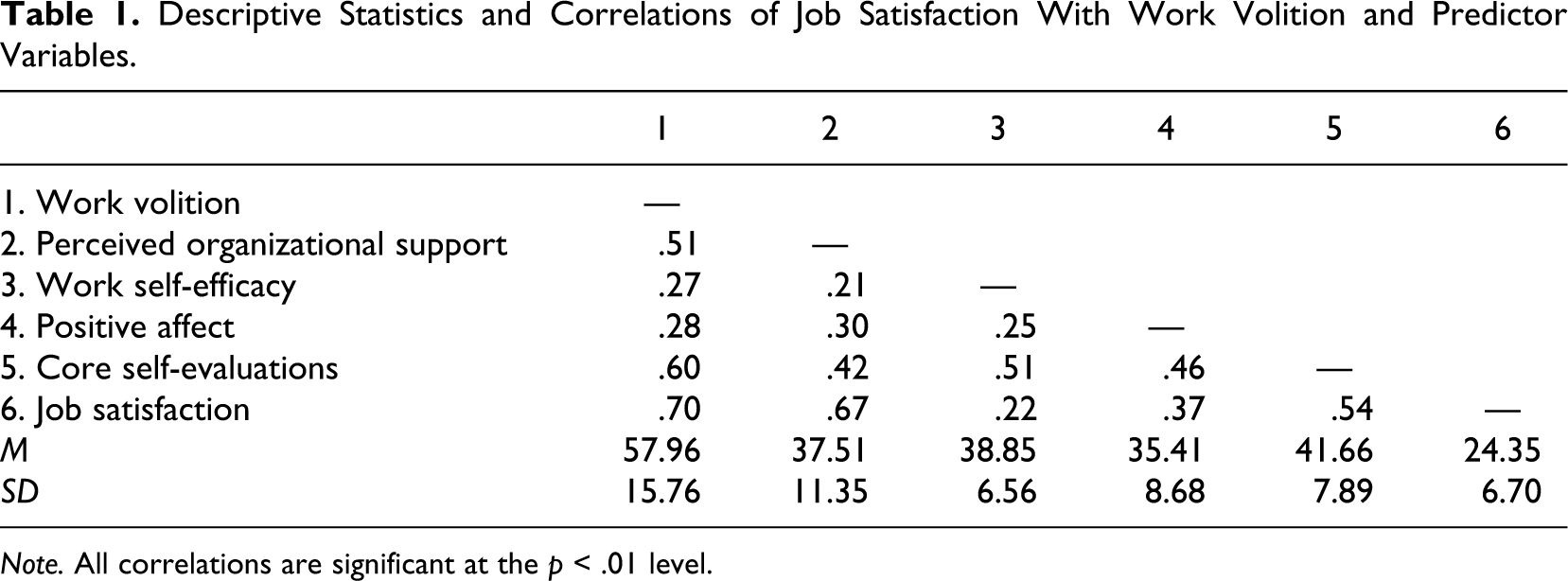
Note. All correlations are significant at the p < .01 level.
Multiple Regression
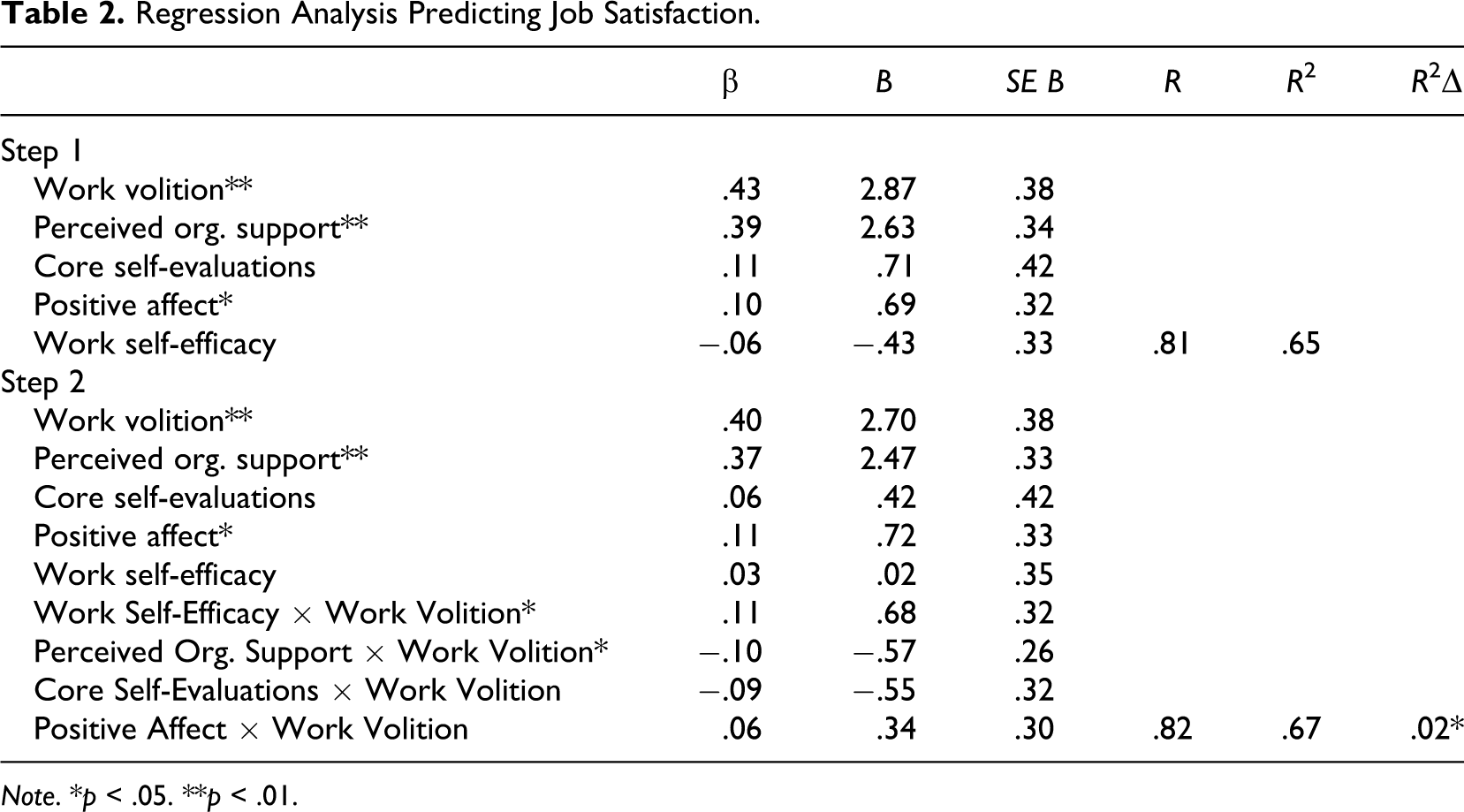
To assess the moderating role of work volition, we followed the steps proposed by Frazier, Tix, and Barron (2004). First, we standardized the predictor variables and work volition. Next, we conducted a hierarchal regression analysis predicting job satisfaction with two steps. Work volition, POS, CSEs, positive affect, and work self-efficacy were entered in Step 1 of the regression equation. As seen in Table 2, all these variables, except work self-efficacy and CSEs, were found to add significant, unique variance in the prediction of job satisfaction. Together, these variables accounted for 65% of the variance in job satisfaction.
Regression Analysis Predicting Job Satisfaction.
Note. *p < .05. **p < .01.
In Step 2, the interactions of work volition with the four predictor variables were entered. The interactions of work volition with work self-efficacy and POS were both significant. These interactions are shown in Figures 1 and 2, with the three different lines representing individuals with work volition at −1 (42.20), 0 (57.96), and 1 (73.72) SDs from the mean. Following regression procedures outlined by Aiken and West (1991), we decomposed each interaction by testing its simple slopes at ±1 SD from the mean (standardized) work volition score.
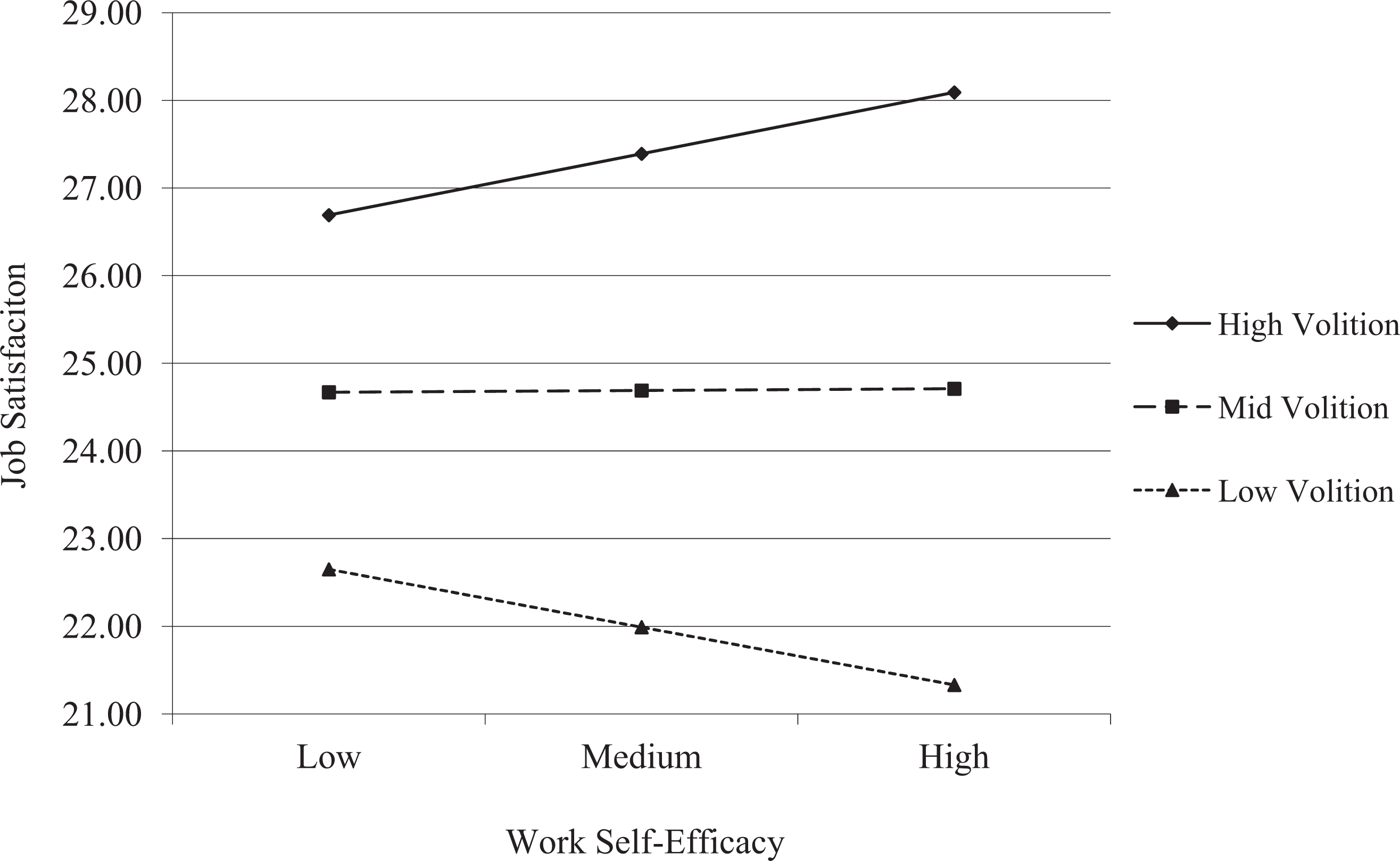
Work volition as a moderator between work self-efficacy and job satisfaction.

Work volition as a moderator between perceived organizational support and job satisfaction.
The relation between work self-efficacy and job satisfaction was positive but nonsignificant for individuals with high (+1 SD) work volition (β = .10, b = .70, SEb = .55, p = .21) whereas for those with low (−1 SD) work volition the same relation was marginally negative (β = −.098, b = −.66, SEb = .39, p = 097). Conversely, the relation between POS and job satisfaction was most pronounced for individuals with low work volition (β = .45, b = 3.05, SEb = .42, p < .001) and less so for those with high work volition (β = .28, b = 1.90, SEb = .43, p < .001) though both simple slopes were significantly positive. Collectively, the four interaction terms were found to add 2% extra variance in the prediction of job satisfaction above and beyond the predictors in Step 1, and all the significant predictors in Step 1 remained significant. In total, the predictors and interaction terms were found to account for 67% of the variance in job satisfaction.
Discussion
There has been a recent call by scholars to examine how individuals’ sense of work volition affects their experiences at work (e.g., Blustein, 2006), and this study is the first to explore how volition moderates the relation of established predictors to job satisfaction. In today’s world of work, most adults are likely making career decisions within the context of potential volitional constraints. Although matching one’s personal preferences with job options is optimal, career counselors are most likely working with clients facing limits to a sense of choice within their career decision making. Indeed, one’s sense of volition may have a meaningful impact on how an individual experiences satisfaction with work. In the present study, at a basic level and mirroring previous research (Duffy et al., 2012), work volition predicted job satisfaction even after accounting for work self-efficacy, positive affect, CSEs, and POS. This suggests that having a sense of personal agency, or choice, in one’s work life has a strong influence on one’s level of job satisfaction, above and beyond the influence of previously examined predictors. Importantly, all of these variables are core components of established job satisfaction models, furthering the importance of including work volition as a variable when attempting to account for job satisfaction.
The two critical findings of this study concern the moderating role work volition played in the relation of self-efficacy and POS to job satisfaction. First, the relation of self-efficacy to job satisfaction differed significantly based on individuals’ level of work volition. For those low in work volition in particular, having greater self-efficacy in one’s job linked to lower job satisfaction. This is a particularly intriguing finding given the complete change in direction among the slopes that occurs when accounting for levels of volition. It appears that the effect of one’s level of work-related confidence on satisfaction is predicated, to some degree, on an individual’s perception that they can freely choose the work they want to pursue. Individuals in this study with low work volition may have felt forced to take their particular jobs, which may have neither matched their personal preferences nor required advanced skills and education. As a result, being efficacious in their jobs may have no effect on satisfaction or may actually result in being less satisfied. Though broader conclusions cannot be drawn from a single study, this finding does strongly support the importance of assessing an individual’s volition when examining the relation of self-efficacy to job satisfaction.
Second, work volition significantly affected the strength of the relation between POS and job satisfaction. This relation was more pronounced for those with low work volition. Having a supportive work environment appears to be especially critical for individuals who have low volition in their work lives. It may be that a supportive work environment, which helps employees feel valued and recognized, serves to buffer the negative consequences that low volition may have on job satisfaction.
In sum, this is the first study where work volition was explored as a moderator between four established predictors of job satisfaction—positive affect, work self-efficacy, POS, and CSEs—and job satisfaction itself. Overall, work volition predicted job satisfaction after accounting for the above predictors. When work volition was included as a moderator to each of the predictors, unique relations were found. Specifically, the relation of self-efficacy to job satisfaction was less pronounced (and even negative) for those with low volition, whereas the relation of POS was more pronounced for those with low volition. These findings highlight the importance of assessing an individual’s work volition when attempting to predict job satisfaction and may have important implications for practice and future research.
Limitations and Future Research Directions
The results and conclusions from this study need to be considered in light of a number of limitations, each which may offer areas for future research. First, in order to ensure a diverse sample of employed adults, we recruited participants through an online data collection service. Although scholars have found this to be a reliable method of data collection, it limits our ability to ascertain when and how participants completed the surveys. Second, data were collected cross-sectionally, which precludes the ability to examine the cause and effect of the variables at hand. Guided by theory, in the current study we assumed that job satisfaction would be an outcome variable predicted by work volition, CSEs, self-efficacy, positive affect, and organizational support. However, it may be that in some cases, satisfaction comes prior to these variables. Testing the temporal relations among these constructs—especially work volition—is a critical next step in this line of research.
Third, the current study tested the bivariate relations among the various predictor variables and satisfaction, as opposed to examining them in a more unified job satisfaction model. This method was chosen given the lack of research on work volition’s role as a moderator among the various predictor variables and job satisfaction. However, this precluded testing of the interplay between the predictor variables (i.e., self-efficacy and POS), which previous tests of the social cognitive model have found to mediate one another in predicting job satisfaction (Duffy & Lent, 2009; Lent et al., 2011). As such, it is important that future research test more complex models to specifically explain what leads people to be happy at work and work volition’s role in that process.
Practical Implications
We want to close by highlighting counseling and organizational implications of this study’s results. As the American public struggles with increasing unemployment (and underemployment), many likely feel limited volition in the work they pursue and may feel forced to work in one or more unsatisfying jobs (Leana & Feldman, 1995; Wanberg, 1995). Especially for individuals in this group, it is important for practitioners and organizations to understand how and to what extent specific variables predict satisfaction with work.
From a career-counseling perspective, we recommend initially assessing a client’s level of work volition, perhaps using the brief, 13-item WVS or through supportive dialog. We believe assessing a client’s volition in the first session is critical due to the likelihood that, for clients with low volition, using traditional career counseling matching strategies may prove less effective than finding careers that conform to the variety of constrains that confront a client. Even for clients who have moderate to high volition, having an initial conversation about any potential constraints can help better frame a client’s experiences at work (especially considering work volition’s high correlation with job satisfaction) and experiences looking for new employment if so desired.
At a practical level, to help boost job satisfaction for clients with low levels of volition, who are likely working in jobs that are not the best match for their personal preferences, counselors are advised to specifically focus on building supportive work environments as these may help buffer the impact of low work volition. Individuals who feel valued at work may be satisfied even if they do not feel much choice in the work they are pursuing. Strategies for helping clients proactively get more support at work (Bailyn, 2011; Barkway, 2006; Pronk & Kottke, 2009) have been proposed.
Perhaps most important, however, are the potential organizational implications of these results. Most organizations are committed to seeing their employees happy at work, and most organizations are also likely to have a group of employees who feel low volition in their careers. In an effort to increase employee satisfaction, organizations are encouraged to actively support employees in the workplace. As is evidenced by the moderator figures, individuals with high organizational support are happier with their jobs at all levels of work volition. However, it is with low-volition employees where working to increase organizational support can have more meaningful impact on satisfaction. We believe individuals with the ability to influence employees within their organizations would benefit from considering these results.
Footnotes
Declaration of Conflicting Interests
The authors declared no conflicts of interest with respect to the research, authorship, and/or publication of this article.
Funding
The authors received no financial support for the research, authorship, and/or publication of this article.