



Abstract
This article describes the development and validation of the Career Competencies Indicator (CCI); a 43-item measure to assess career competencies (CCs). Following an extensive literature review, a comprehensive item generation process involving consultation with subject matter experts, a pilot study and a factor analytic study on a large sample yielded a seven-factor structure; goal setting and career planning, self-knowledge, job performance, career-related skills, knowledge of (office) politics, career guidance and networking, and feedback seeking and self-presentation. Coefficient α reliabilities of the seven dimensions ranged from .93 to .81. Convergent validity was established by showing that all 7-CCs loaded substantially onto a single second-order factor representing the general CC construct. Discriminant validity was established by showing less than chance similarity between the 7-CCI subscales and the Big Five personality scales. The results also suggested criterion-related validity of the CCI, since CCs were found to jointly predict objective and subjective career success.
Keywords
Introduction
Dramatic changes in work organizations have created new “career realities” that focus on the individual and require them to take responsibility for their own career development (Kidd, 2002); however, there has been little research into the reality of career self-management and no comprehensive taxonomy of the qualities necessary for effective career management is available. Some authors in this respect looked at what has been described as career strategies (e.g., Gould, 1979; Uzoamaka, Hall, & Schor, 2000), while others focused on career competencies (CCs). Competencies continue to be enthusiastically used by employers to structure processes and standardize human resource functions (Chartered Institute of Personnel and Development [CIPD], 2001). However, many authors describe the benefits that competencies can bring to career development, such as a method for assessment of personal strengths and a focus on aspirations of the individual and expectations of the organization (Craig, 1992; Rothwell & Lindholm, 1999).
Hackett, Betz, and Doty (1985) first used the term CCs to describe the competencies necessary for women’s pursuit of professional-level academic careers. The development of a taxonomy was based on interviews with 50 women working in one academic institution and contained eight major categories; communication skills, interpersonal skills, political skills, organizational skills, general-career planning and management skills, career-advancement skills, job-specific skills, and adaptive cognitive strategies. Unfortunately, there are several problems with this taxonomy. First, the authors do not provide a clear definition of what they understand CCs to be and no objective validation of the taxonomy was presented. Second, the restricted range of the sample limits the generalizability of the results. As yet no operationalization of the taxonomy has since been provided.
Another approach that focused on CCs is the intelligent career model (Arthur, Claman & DeFillipi, 1995). According to Arthur, Inkson, and Pringle (1999), CCs are defined as personal competencies that an individual puts at the disposal of the employing organization. They are seen as accumulations of knowledge that are developed over time and facilitate successful career management (DeFillipi & Arthur, 1994). Arthur and colleagues describe CCs as three areas of knowing: knowing-why (why do we do a job), knowing-how (how do we do a job), and knowing-whom (with whom do we work). Knowing-why relates to a person’s identification with the culture of the employing organization (Arthur et al., 1995) and stems from their values, interests, and beliefs (DeFillipi & Arthur, 1994). It embodies the factors that influence a person’s overall commitment and adaptability to the employment situation, such as career motivation, personal meaning, and sense of purpose. It also incorporates accommodation of family and other nonwork factors. Knowing-how refers to the expertise and abilities that a person brings to an organization’s know-how. It reflects career-related skills and job-related knowledge and is based on occupational learning and the accumulation of experience. Knowing-whom refers to the individual’s contribution to organizational communication (Norhia, 1992 in DeFillipi & Arthur, 1994). It describes the social contacts, relationships, reputation, and attachments that are established within as well as outside of the organization while in pursuit of a career (Inkson & Arthur, 2001). These areas form the basic structure of CCs and have been supported by various studies, for example, Eby, Butts, and Lockwood (2003).
It is fundamental to the intelligent career model that the three areas of knowing are not independent, but interdependent (Parker & Arthur, 2002). Support for this assumption comes from Colarelli and Bishop (1990, in Day & Allen, 2004) who looked at personal and situational correlates of career commitment, a variable that according to the above definition represents knowing-why. They found that having a mentor, which relates to knowing-whom, was the most robust correlate, increasing career commitment by three means. Day and Allen (2004) showed that mentorship was also related to career motivation, which is another measure for knowing-why—protégés reported more career motivation than did nonprotégés. A mentoring relationship provides individuals with information about their role, thus feeding into their knowledge of how to behave in their job.
Arthur, Amundson, and Parker (2002) introduced an operationalization of the three areas of knowing in the form of the Intelligent Career Card Sort (ICCS). The ICCS provides individuals with a valuable insight about their subjective career investments. While the ICCS is currently used in different career development contexts with different groups of people, it requires extensive exploration and does not lend itself to use as a basis for immediate recommendations on career development. What is more the ICCS lacks an empirical basis and no information regarding its psychometric properties has so far been published.
Against the societal background described above, and the relatively underdeveloped operationalization of CCs, Kuijpers and Scheerens (2006) developed a multidimensional assessment of CCs relevant for the modern career. Based on a review of the literature, qualitative interviews and factor analyses of data from a large sample of employees in the Netherlands, researchers identified six CCs employees need to possess to realize career self-management; career–actualization–ability, career reflection, motivation reflection, work exploration, career control, and networking. CCs in this study were defined as competencies that are relevant for all employees regardless of the specific job they have. However, Kong (2010) argues that CCs may differ across individuals, groups, or cultures.
Recently, Kong (2010) developed an instrument to measure CCs among hotel managers in China. Inspired by Arthur, Claman, and DeFillipi’s (1995) intelligent career model, Kong identified eight factors relevant for career development; networking within the hotel, networking outside of the hotel and mentoring (as a function of knowing-whom); career-related skills and career identity (as a function of knowing-how) and career insight, openness to experience and proactive personality (as a function of knowing-why). Based on the higher order portion of the CC model, Kong investigated the relationship between CCs and subjective career success (SCS), that is, an individuals’ own perception of their career measured against personal standards. Results showed that all three areas of knowing positively correlated with SCS. Although they made similar contributions, among them knowing-why made the greatest contribution, followed by knowing-whom and knowing-how. The finding regarding the knowing-why competency was consistent with that of previous research (e.g., Eby, Butts, & Lockwood, 2003).
Although personal meaning of career success has become more important, objective career success (OCS), which is concerned with social role and official position, reflects shared social understandings and provides a more or less tangible indicator of an individual’s career situation (Arthur, Khapova, & Wilderom, 2005). Acknowledging the SCS–OCS duality, Kuijpers, Schyns, and Scheerens (2006) invited 1,579 employees to complete a competence inventory that included the six CCs identified by Kuijpers and Scheeren (2006). Results indicated that career–actualization–ability, career control and networking had a significant positive effect on intrinsic career success, defined as “the person’s own appreciation of his or her career actualisation,” whereas career–actualization–ability and networking both contributed to extrinsic career success, that is, salary and occupational status. In contrast to expectations motivation, reflection had a significant negative impact on both intrinsic and extrinsic career success suggesting that employees who examined whether their job corresponds with their personal values experienced less career success than those who did not examine their job in this way.
Most competency models and CCs as introduced by Arthur et al. (1995) in particular, include personality aspects. However, there is some confusion as to whether competencies should be defined in terms of personality traits. For example, personality is often defined as individual differences that predispose people to behave in a certain way (Robertson & Callinan, 1998, cited in Truch, Bartram, & Higgs, 2004). However, predisposition does not guarantee that the predicted behavior will follow because other factors related to the situation such as beliefs, consequences, expectations of personal efficacy, and motivation moderate what behavior an individual will actually display (Moloney, 2000). Bartram, Robertson, and Callinan (2002) refer to the attributes necessary for someone to produce desired behaviors as “competency potential.” Competency, however, is described in behavioral terms, disregarding the underlying characteristics and predispositions of a person. The significance of competency for performance at work is the main difference between competency and other psychological constructs such as traits (Kurz & Bartram, 2002). Furthermore, personality traits are generally described in a nonjudgmental way. They are neither good nor bad, they simply are (Moloney, 2000). However, competencies focus on effective performance and are therefore imbued with values and aspirations. They communicate a message to employees about what qualities are desired.
Another issue that needs addressing is trainability. For example, Eysenck et al.’s (1975, in Truch et al., 2004) definition of personality emphasizes that personality is seen to be relatively stable over time. This argument has been widely supported by research (e.g., Judge, Kammeyer-Mueller, & Bretz, 2004; Robins, Fraley, Roberts, & Trzesnieswki, 2001) and a genetic basis (Digman, 1989) and heritability of the personality dimensions has been suggested (Jang, Livelsey, & Vernon, 1996). In contrast, the emphasis in competencies is on the changeability of behavior. For example, Mirabile (1998) goes as far as to argue that competencies are only useful and of value if they can be influenced in some way, for example, through training, coaching, and so on. Overall then, it can be seen that competency and personality are related but separate concepts.
Current Study
This research aims to develop a theory-driven and empirically sound measure of CCs which clearly discriminates between CCs and the Big Five personality traits. Building on the intelligent career model and its assumptions, the study adopts the competency definition from Kurz and Bartram (2002) to take a new approach to CCs. CCs are here perceived as learned capabilities that result in successful performance in individual career management and defined as behavioral repertoires and knowledge that are instrumental in the delivery of desired career-related outcomes. To further investigate the criterion-related validity of the measure, this research also seeks to investigate the relationship between CCs and career success. It is assumed that individuals, who actively engage in the acquisition and application of CCs, are more likely to be successful in their careers.
Study 1: Scale Development
This aim of this study was to develop an instrument to measure CCs under the theoretical assumption of a threefold structure (Arthur et al., 1995): knowing-why, knowing-how, and knowing-whom. A further aim of this study was to assess the validity of the categorization of CCs into three overarching competency areas. Another aim was to provide empirical support for the so far solely theoretical assumption concerning the interrelatedness of the CC dimensions.
Method
Participants and procedure
An online questionnaire was developed and launched on a dedicated website through a private provider. An e-mail including a link to the survey was sent to over 1,000 individuals working in various organizations in the United Kingdom inviting them to participate in the study. Individuals were given a 3-week deadline for completion of the survey. Six hundred and thirty two responses were received. Participants included 316 (51%) men and 304 (49%) women. The majority of participants were aged between 26 and 45 (63%), were educated to General Certificate of Secondary Education (GCSE) level (34%) and had 21–25 years work experience (18%). Four hundred and forty-seven participants were employed by the police service (72%), 73 by a University (12%), 58 in the private sector (9%), 38 in the public sector (6%), and 9 by some other organization (1%).
Measures
The Career Competency Indicator (CCI) was developed in four stages. In Stages 1 and 2 of the indicator construction the main focus lay on item selection and refinement. Arthur and colleagues’ (1995) CC model served as the conceptual framework for the initial item generation. To operationalize the three areas of knowing, a theory-driven approach was chosen, since many of the other methods of competency development have been criticized with regard to their reliability and validity. Following suggestions by DeVellis (1991) and Kline (1993), an extensive list of concepts were formulated on the basis of a thorough literature review. Above all, concepts were chosen on the grounds of their correspondence to one of the three CC areas. They also had to conform to the definition of CCs as behavioral repertoires and knowledge instrumental in the delivery of desired career-related outcomes. This not only required that concepts were phrased in behavioral or knowledge terms but also that they had an established relationship with career success. In addition, since the CCI was being created for use in self-development, only concepts that had the potential to be converted into observable measures and could be influenced in some way by conscious behavior were selected. Ten concepts shown to be reliable and related to career success were selected; goal setting and career planning, self-knowledge, career resilience (as subdimensions of knowing-why), job-related performance effectiveness, career-related skills, knowledge of (office) politics and opportunity structures (as subdimensions of knowing-how), establishment of mentoring relationship, networking, feedback seeking, and self-presentation (as subdimensions of knowing-whom).
Items reflecting these concepts were chosen from already existing scales. Only items from scales with acceptable reliability (α = .70) were selected. Some items were also generated from information gained through preliminary research, that is, input from 28 experts in the field of career development and 4 competencies on factors they perceived to be important for successful individual career development. The design of these items was based on already existing items, definitions found in the literature and/or information from the preliminary interview studies. Attention was directed at delineating each of the three areas of knowing, avoiding overlap between dimensions. Ninety items were selected. Using a 5-point Likert-type scale (e.g., 1 = strongly agree, 5 = strongly disagree) participants were asked the extent to which they agreed/disagreed with various statements.
Four knowledgeable experts in the field of career theory served as a review panel to assess items for clarity and meaningfulness. This resulted in the rewriting of some items, deletion of others, and inclusion of a few new items. In addition, one of the selected concepts “Knowledge of politics and opportunity structures” was split into two subconcepts “Knowledge of (office) politics” and “Keeping informed.”
In Stage 3, 91 items retained and/or developed after consultation with experts were translated into an online survey and piloted with a convenience sample of 31 individuals. This trial aimed to check the readability and ambiguity of the items, as well as the accurate recording of the data (Oppenheim, 1992). It also sought to highlight any potential problems which respondents may encounter when answering the questions. Respondents’ additional comments were also used to further refine the items. As a result, some of the items were slightly reformulated, others were excluded and categories were reorganized. In total, 87 items were retained.
In Stage 4, a survey was conducted with a larger sample (N = 632) employed in various work settings to determine the factor structure of the 87 items, the reliabilities of the intended indicator and the correlations between these factors.
Results
In the case of a large enough development sample, DeVellis (1991) suggests splitting the sample into two subsamples, using one as the primary development sample to conduct factor analysis, compute αs, evaluate items, and arrive at a final version of the scale that appears optimal and the other to cross-validate the findings. DeVellis states that formal confirmatory methods are not required to confirm the factor structure on the second subsample. Instead, conventional factoring methods can be used to derive groupings that can be compared to the a priori item groupings the scale developer had in mind. DeVellis suggests that confirmation of an item structure using this approach was more reassuring, because the analysis had not been instructed to look for a specific pattern. In addition, if the α values across the two subsamples remain fairly constant, it can be assumed that these values are not distorted by chance, that is, that the derived scales are relatively stable (DeVellis, 1991).
Following DeVellis’s recommendation, the sample was split randomly into two groups G1 and G2. This allowed for a good sample size of 316 participants and an acceptable participant–item ratio of 3:1. Chi-square tests were carried out to establish that there were no significant differences between G1 and G2 with regard to the demographic data collected. Independent sample t-tests were also carried out on all 87 items to assess whether there were differences in responses to the items between the two groups. Only 6 items showed statistically significant differences across groups (p < .05). It was therefore concluded that the sample had been split in a random and unbiased way.
Exploratory factor analysis (EFA)
The data for G1 were subjected to principal axis factoring using SPSS. The Bartlett test of sphericity was significant (p = .000) and the Kaiser–Meyer–Olkin (KMO) measure of sampling adequacy was .919, suggesting that the data were suitable for factor analysis. The eigenvalue distribution of the scree plot suggested that either six or seven factors should be extracted.
Since the three CC areas of knowing-why, knowing-how, and knowing-whom, are claimed to be theoretically correlated, oblique rotation was chosen as the rotation method. The factors were extracted using direct oblimin and the factor solutions were examined. The pattern matrix that contains information about the unique contribution of a variable to a factor was used as the basis for the interpretation of the subdimensions. In addition, the structure matrix that takes the relationships between the factors into consideration was consulted, to cross-check if the same factors emerged.
The derived correlation matrix showed that the factors were interrelated, justifying the oblique rotation approach and suggesting that the constructs were also interrelated. The six-factor solution and the seven-factor solution were compared. The seven-factor solution was chosen because it accounted for more common variance (i.e., 48% instead of 46%). The seven-factor solution also offered a clearly identifiable factor structure, hence providing more diversified information on CCs. Looking at the items that loaded on each factor (see Table 1), the factors were described as follows: feedback seeking and self-presentation (FSSP), job-related performance effectiveness (JPER), goal setting and career planning (GSCP), self-knowledge (SELF), career guidance and networking (GNET), career-related skills (CRS), and knowledge of (office) politics (POL).
Factor Loadings for the 87 Items in Group 1.

Note. FSSP = feedback seeking and self-presentation; JPER = job-related performance effectiveness; GSCP = goal setting and career planning; SELF = self-knowledge; GNET = career guidance and networking; CRS = career-related skills; POL = knowledge of (office) politics.
Reliability
Subsequent scale development followed an iterative process. First, coefficient α for each subscale was calculated based on the total number of items loading above .30 on each factor. Then, the standard deviation of each item was assessed and the item dropped if it exhibited little variance (SD below .50). According to DeVellis (1991) low variance, suggests that the item will not discriminate well among individuals and, therefore, would not be of much value. Reliability of the scales was computed again in tandem with item removal until an acceptable trade-off between coefficient α and scale length was achieved. The final α levels of the subscales can be found in Table 2. After removal of the items, the factor analysis was run again to ensure that the deletion of items had not affected the factor structure. In total, 43 items were retained.
Cronbach’s α Reliabilities of Final Subscales.
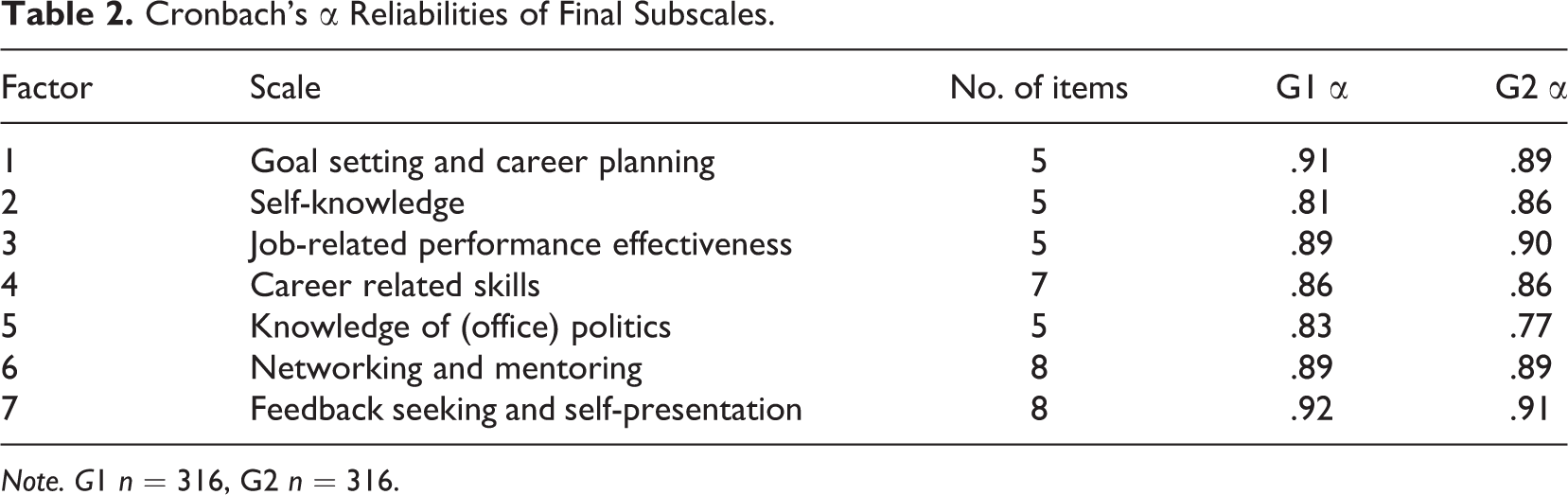
Note. G1 n = 316, G2 n = 316.
Replication of the Factor Structure
In order to provide evidence for the construct validity of the CCI, G2 was subjected to an identical factor analysis to G1 (i.e., utilizing all 87 items). Comparisons between the two analyses were made following an approach presented by Hashemi (1981, in Kline, 1994). Apart from two dimensions (knowledge of politics, self-presentation, and feedback seeking) that were missing 1 item each, the structures of the subscales were replicated by the factor analysis of the responses of G2. Looking at the mean absolute factor loadings of scale items, the minimum factor loading was .49 and the maximum was .80, with a mean of .65. Thus, the factor structure of the scales can be said to have been well replicated in G2. The internal consistency values of the subscales for sample G2 were also computed. They remained fairly constant compared to sample G1, suggesting that these values were not distorted by chance, that is, that the derived scales are relatively stable (DeVellis, 1991; see Table 2).
Convergent Validity
If the subscales measured one overarching concept of career competency, they could be expected to converge conceptually and statistically into a higher order construct (i.e., the sum of the subscales should be interpretable as an indicator of overall career competency). One way to assess this is through conducting a second-order factor analysis (Briggs & Cheek, 1986). Initial principal axis factoring (using oblique rotation) of the G1 subscales on the 43-item measure revealed the presence of two factors with Eigenvalues greater than 1, explaining 42.7% and 7.7% of variance, respectively. An inspection of the factor matrix showed that all subscales loaded highly (above .4) on the first factor, suggesting that they measure one overarching concept. Therefore, in a second step only this factor was extracted. The loadings of the subdimensions on the extracted single factor all exceeded .35.
Discussion
Study 1 described the development of the CCI, a measure to assess CCs. Following an extensive literature review, a comprehensive item generation process involving consultation with subject matter experts, a pilot study and a factor analytic study on a large sample yielded a seven-factor structure instead of the expected threefold structure. Study 1 also provided provisional support for the validity and reliability of the CCI.
Some of the concepts expected to load onto one of the three CC areas remained as single factors (i.e., as CC subscales in their own right) for example, job-related performance effectiveness, and goal setting and career planning. This suggested that the items representing these concepts were not similar enough, with regard to what they measured, to load onto one factor. Instead, they appeared to belong to different clusters of variables. For instance, items measuring goal setting and career planning and self-knowledge, while conceptually similar, were not similar enough to load onto one factor. Conversely, some items expected to measure different concepts loaded onto one factor and were subsumed accordingly, for example, establishment of mentoring relationship and networking.
A possible explanation may be found in the choice of concepts to represent knowing-why, knowing-how, and knowing-whom. On one hand, some concepts may have been too dissimilar, or may not have fitted their proposed CC area. However, this is unlikely, since the selection was based on the conceptual definition of the CC areas and confirmed by subject matter experts. On the other hand, the loading of items from different concepts onto the same factor suggested some concepts to be very similar. For instance, networking and mentoring both relate to very similar behaviors, that is, interacting with others with the aim of obtaining information or support. This would explain the loading of the respective items onto one factor. Similar to this, feedback seeking and self-presentation are concepts that build on personal assertiveness, which might be the reason for them emerging as one factor. However, the activities underlying these four concepts are different which would explain why they do not emerge as one “knowing-whom” factor.
Some of the concepts identified from the literature review and expert panel did not feature at all in the subscales developed on the basis of the factor analysis, for example, career resilience, keeping informed. Concept and/or item selection might be responsible for this. The items chosen to represent career resilience, for instance, might not have been clear cut enough to emerge as one factor, that is, the interrelationships between the items might not have been high enough. Furthermore, the fact that career resilience did not cluster together with other concepts selected to represent knowing-why suggested conceptual differences. This is not to say that career resilience is not of importance for career development, but that its items do not correlate as a concept with any of the other selected concepts. As such, it does not appear to measure aspects of CC as conceptualized in this study. Following the advice by Whiddett and Hollyforde (2003) that it was not necessary to include all aspects of competency, these concepts were, therefore, excluded from further use. Overall, the emergent seven-factor structure may suggest that the concept of CCs is too complex to be grouped into three broad areas of knowing.
The theoretical assumption of interrelatedness of the CC dimensions was supported by the results of this study. In line with the hypotheses, the CC dimensions were found to be positively correlated with each other. In factor analysis, factors attempt to account for correlations between items. Even oblique rotation, which allows for the factors to be interrelated, forces the data into a certain format. Thus, constructing the CCI using a factor analytical approach does not make allowances for the fact that the relationship between factors may change over time. Instead, it is assumed that the multicollinearity between the subscales is lasting. All this suggests that the findings of Study 1 and the factor analysis should not be interpreted strictly.
Finally, Study 1 provided initial evidence for the construct validity of the CCI since the factor structure was replicated in a second subsample. Convergent validity was also established by showing that all 7-CCs loaded substantially onto a single second-order factor representing the general CC construct.
Study 2: Testing for Reliability and Validity
Study 2 continues the analysis of the psychometric properties of the CCI and is divided into three stages. First, it seeks to confirm the evidence of reliability of the CC dimensions as presented in the previous study. Second, it examines the discriminant validity of the CCI. Assuming that both CCs and personality traits are different constructs, cross-construct correlations are expected to be low demonstrating discriminant validity. Finally, Study 2 analyzes the criterion-related validity of the CCI dimensions, using both OCS and SCS as dependent variables.
Method
Participants and Procedure
A self-completion survey in an online format was e-mailed to a convenience sample of police officers (n = 1,000) and University employees (n = 650). Individuals were given a 3-week deadline to complete the survey. Four hundred and six responses were received. Participants included 258 (64%) men and 148 (36%) women, with a mean age of 40.57 years (SD = 8.77). Two hundred and ninety-six (73%) participants were employed by the police force and 110 (27%) were employed by a University. The mean number of years work experience was 21.69 (SD = 8.69), mean tenure was 10.95 years (SD = 8.69). The majority of participants indicated that they were either police constables (50%) or professionals (13%), married (64%) and educated to GCSE level (31%).
Measures
Personality (Big Five)
Various questionnaire versions are available to measure the Big Five. Some of these are rather lengthy and time consuming, for example, NEO (Costa & McCrae, 1992). Therefore, in order to maximize response rate and minimize respondent burden, Saucier’s (1994) “Mini-Markers,” representing the Big Five personality dimensions of extraversion (α = .82), agreeableness (α = .76), conscientiousness (α = .66), emotional stability (α = .77), and intellect (α = .79) were applied. Individuals were asked to rate how accurately 40 adjectives described them, using a 9-point scale ranging from 1 = extremely accurate to 9 = extremely inaccurate. 1 Saucier’s inventory has been found to have a robust factor structure (Mooradian & Nezlek, 1996) and an acceptable degree of reliability (Saucier, 1994). In addition, its criterion-related validity has been demonstrated to be comparable to Goldberg’s 100 adjective inventory (Dwight, Cummings, & Glenar, 1998). Furthermore, its psychometric properties overall have been found to be similar to those of the NEO-FFI (Mooradian & Nezlek, 1996).
Career competencies: To assess CCs, the 7-CCI dimensions developed in the previous study were used: (1) goal setting and career planning (GSCP, 5 items), (2) self-knowledge (SELF, 5 items), (3) job-related performance effectiveness (JPER, 5 items), (4) career-related skills (CRS, 7 items), (5) knowledge of (office) politics (POL, 5 items), (6) career guidance and networking (GNET, 8 items), and (7) feedback seeking and self-presentation (FSSP, 8 items). Individuals were asked to rank the extent to which they agreed with the respective statements on a 5-point Likert-type scale, ranging from 1 = strongly agree to 5 = strongly disagree.
Objective career success: OCS was assessed using income and number of promotions since joining the organization. A promotion was defined as a job move that involves more than one of the following: significant increase in scope of responsibility, annual salary, changes in level in the employing company and/or becoming eligible for bonuses, or incentives. This broader understanding of promotion was applied to ensure that not only movements up the hierarchical/rank ladder but also into lateral, more specialist roles were considered. Income was measured by asking participants to state their current pay band (e.g., Chênevert & Tremblay, 2002).
Subjective career success: SCS was assessed using the 5-item Career Satisfaction scale (CSS) by Greenhaus, Parasuraman, and Wormley (1990, α = .85). In addition, an adapted version of the SCS measure by Gattiker and Larwood (1988), containing scales on job success (JS, 5 items, α = .62), financial success (FS, 3 items, α = .72), hierarchical success 2 (HS, 3 items, α = .62), interpersonal success (IS, 3 items, α = .76), and life success (LS, 3 items, α = .74) was also used. Responses to all scales were collected using a 5-point Likert-type scale (1 = strongly agree to 5 = strongly disagree).
Results
Replication of the Factor Structure
Following the same procedure described in Study 1, the 43 CC items for the whole sample (N = 406) were subjected to an EFA. Principal axis factoring was used to assess whether the factor structure could be replicated. In a first step, the suitability of the data for factor analysis was tested. The KMO value was .92, exceeding the recommended value of .6 (Kaiser, 1970, 1974, in Tabachnick & Fidell, 2001). The Barlett’s Test of Sphericity (Bartlett, 1954, in Tabachnick & Fidell, 2001) reached statistical significance, supporting the factorability of the correlation matrix. Seven factors explaining a total of 47.7% of the variance were extracted. To aid the interpretation of the seven factors, Direct Oblimin rotation was performed. Direct Oblimin was used to allow for the hypothesized intercorrelation of the CCs subscales. The rotated solution partially replicated the seven-factor structure, that is, the majority of the variables loaded substantially on the respective factors (see Table 3). The lowest concordance was found for knowledge of (office) politics, with only 60% of items replicated.
Percentage Replication of Factor Structure and Internal Consistencies of Career Competency Subscales.
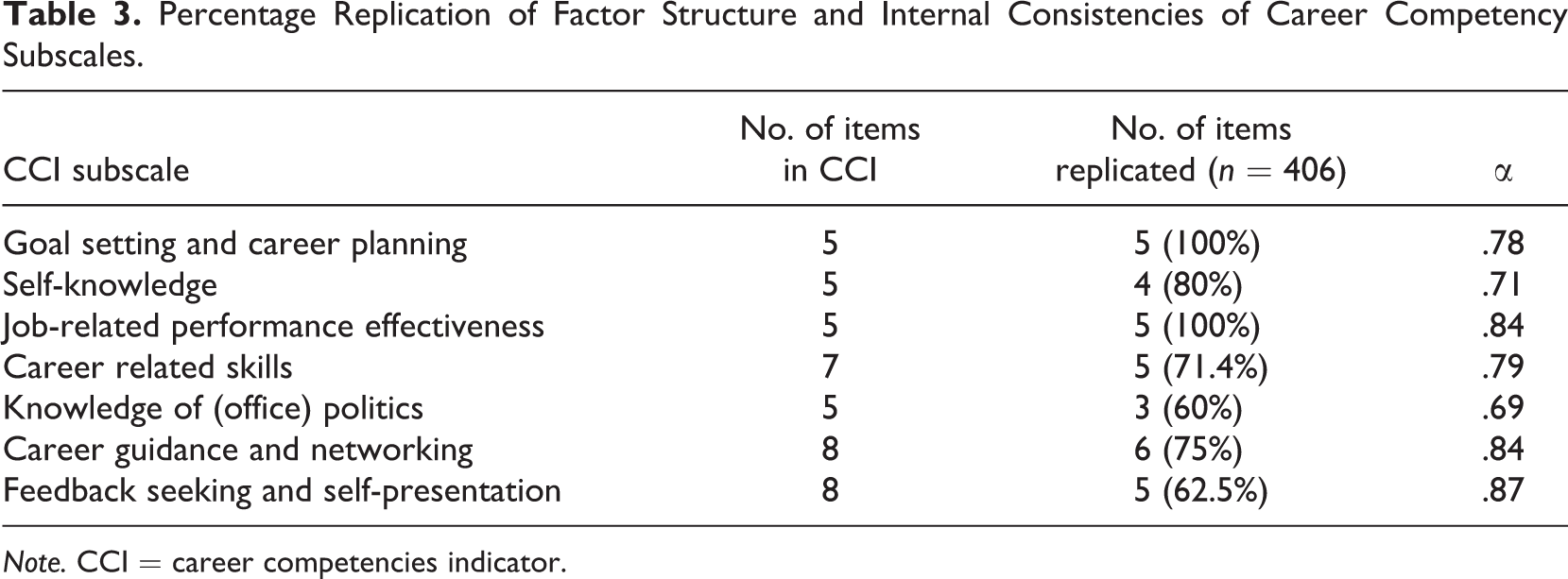
Note. CCI = career competencies indicator.
Reliability
In a next step, the internal consistency of each of the 7-CC scales was analyzed in the form of the coefficient α. Looking at the whole sample (N = 406), the α values were found to range from .69 to .87 (see Table 3). Only the competency dimension of knowledge of (office) politics fell just below the .70 α level suggested by Tabachnick and Fidell (2001) as a desirable minimum for constructs in early stages of formulation. Overall, the internal consistency of the CC subscales can be seen as demonstrated.
Analysis of Discriminant Validity
To measure the degree to which any two measures are unrelated/related to each other, generally the pattern of intercorrelation between them is calculated. Correlations between theoretically similar measures would be expected to be high, while correlations between theoretically dissimilar measures would be expected to be low. Unfortunately, there are no exact rules as to how high or how low the correlations should be.
Francis-Smythe and Robertson (1999) point out that, based on average α coefficients of .7, the maximum correlation between two measures of the same construct is .72. Hence, the proportion of variance these measures might have in common is .52. Accepting a minimum of 33% of overlap as indicative of more than chance similarity, Francis-Smythe and Robertson argue that a minimum correlation of .41 (squared root of 1/3 of .52) can be taken as a criterion of similarity. Thus, assuming that both CCs and personality characteristics are different constructs, cross-construct correlations are expected to be low, that is, below .41, demonstrating discriminant validity.
Results of the correlational analysis between the 7-CC subscales and the Big Five are presented in Table 4. Only JPER showed above chance similarity with Conscientiousness. All the other CC dimensions showed less than chance similarity with the personality dimensions (r < .41), providing evidence of their discriminant validity.
Correlation Analysis: Career Competencies and Big Five Personality Dimensions.
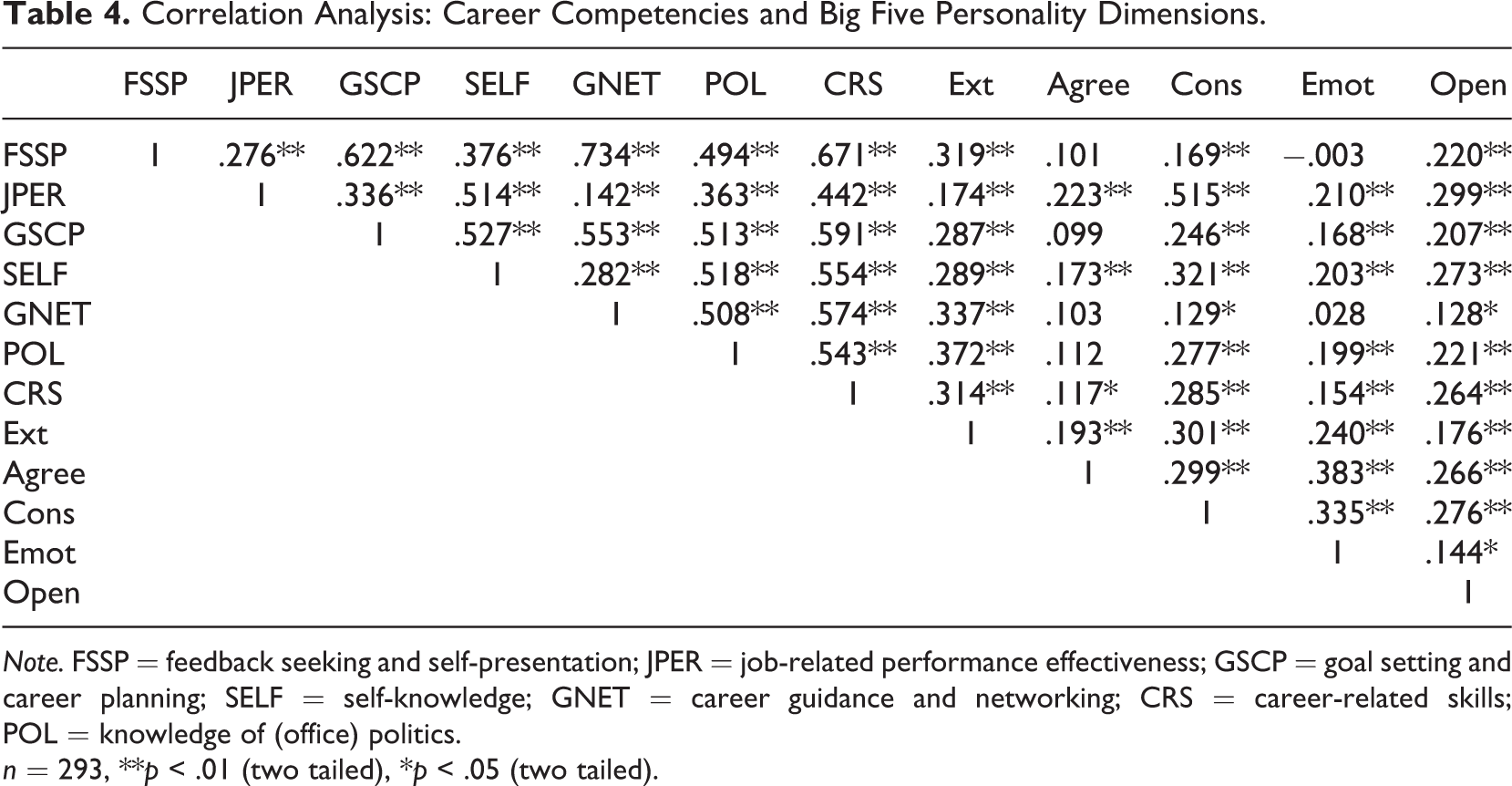
Note. FSSP = feedback seeking and self-presentation; JPER = job-related performance effectiveness; GSCP = goal setting and career planning; SELF = self-knowledge; GNET = career guidance and networking; CRS = career-related skills; POL = knowledge of (office) politics.
n = 293, **p < .01 (two tailed), *p < .05 (two tailed).
To further analyze the interdependencies of the two constructs, in a second step the CC and the personality dimensions were subjected at scale level to principal component analysis, using Direct Oblimin rotation. Three factors with an Eigenvalue above 1 emerged, explaining 49.9% of variance. The CCs of GNET, FSSP, CRS, GSCP, and POL were found to form one component, while Agreeableness, Emotional stability, and Extraversion formed another. The CCs of JPER and SELF formed a third factor, together with Conscientiousness and Intellect. Thus, it appeared that Conscientiousness and Intellect shared some communality with some of the CCs.
Criterion Related Validity: SCS and OCS
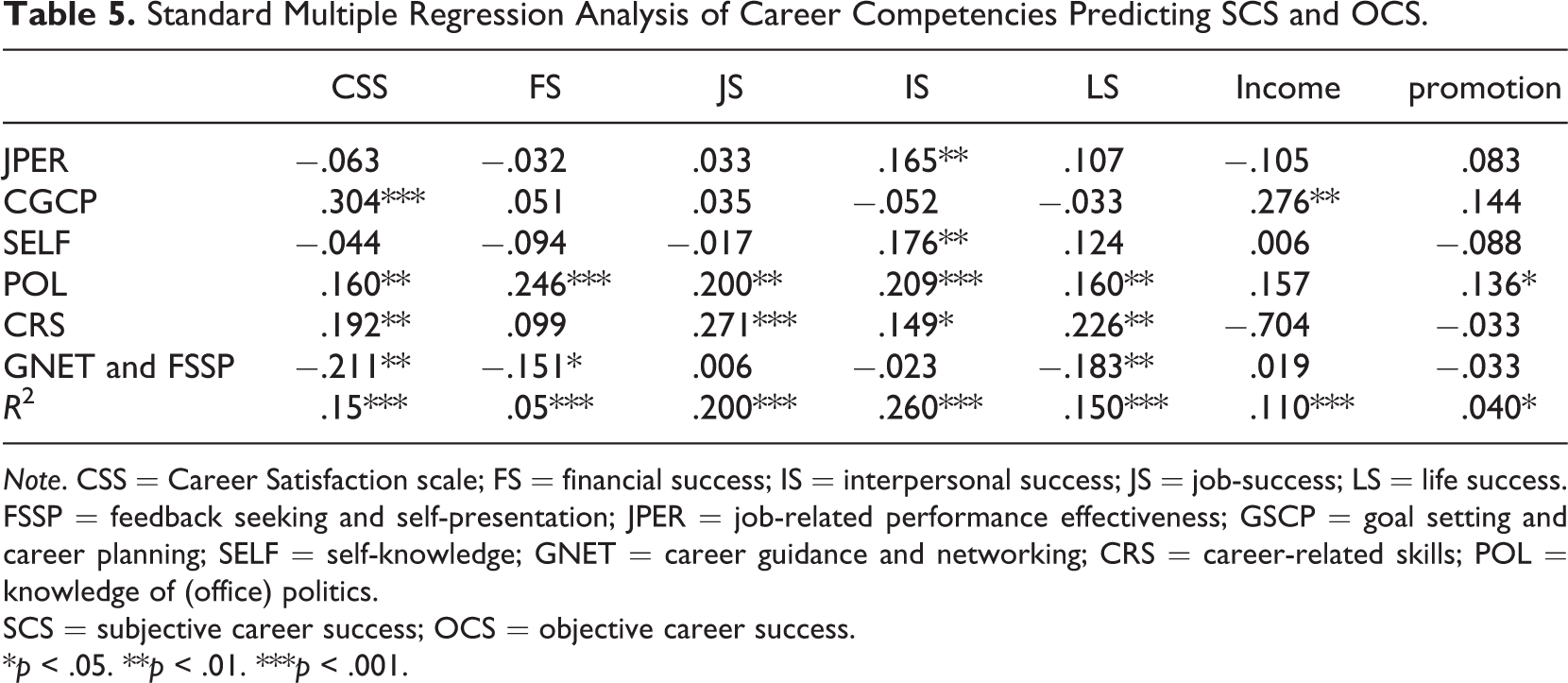
To analyze the relationship between CCs and SCS, a standard multiple regression approach was used. The hierarchical importance of the different competencies was thought to vary over time and from individual to individual, depending on the career issues faced at different points. Therefore, no overall hierarchical order was thought to exist among them. Consequently, all 7-CC subscales were entered into the equation simultaneously (N = 406). The results are presented in Table 5. R was significantly different from zero, F(6, 394) = 11.3, p < .001, providing support for the assumption that CCs would predict career satisfaction. Four IVs contributed significantly to the prediction of career satisfaction: CGCP, POL, CRS, and GNET and FSSP combined. Altogether, 15% of variability in career satisfaction was predicted by CCs.
Standard Multiple Regression Analysis of Career Competencies Predicting SCS and OCS.
Note. CSS = Career Satisfaction scale; FS = financial success; IS = interpersonal success; JS = job-success; LS = life success.
FSSP = feedback seeking and self-presentation; JPER = job-related performance effectiveness; GSCP = goal setting and career planning; SELF = self-knowledge; GNET = career guidance and networking; CRS = career-related skills; POL = knowledge of (office) politics.
SCS = subjective career success; OCS = objective career success.
*p < .05. **p < .01. ***p < .001.
Standard multiple regression analyses were conducted to test whether CCs predicted the other measures of SCS, namely financial success, job success, interpersonal success, and life success. To reduce skewness the variable life success was log transformed to improve normality (Tabachnick & Fidell, 2001). Collinearity statistics indicated multicollinearity for the IVs of feedback seeking and self-presentation and career guidance and networking. Considering the relatively high correlation of .75 between these two variables, a score combining the two was calculated and used in subsequent analyses. The results can be found in Table 5. R for all the regressions was significantly different from zero: financial success, F(6, 394) = 3.46, p < .01, job success, F(6, 394) = 16.64, p < .001, interpersonal success, F(6, 394) = 22.67, p < .001, and life success, F(6, 394) = 11.64, p < .001. CCs jointly predicted 5%, 20%, 26%, and 15% of the variability in financial success, job success, interpersonal success, and life success, respectively. However, different IVs contributed significantly to the prediction of the different aspects of SCS, as highlighted in Table 5. Overall, the results suggest that CCs are significant predictors (p < .00) of SCS.
A standard multiple regression analysis was performed between the OCS measures as dependent variable DVs and CCs as IVs. First, income was used as the DV. R was significantly different from zero, F(6, 251) = 5.07, p < .001. Only one IV, GSCP, contributed significantly to the prediction of income. Altogether, 11% of variability in income was predicted by knowing the scores on the CCs. Second, a standard multiple regression was performed between the number of promotions received and the CCs as IVs. Because the variable “number of promotions” was moderately positively skewed, a square root transformation was applied to improve the normality of the data (Tabachnick & Fidell, 2001). The results of the regression analysis can be found in Table 5. R was significantly different from zero, F(6, 395) = 2.82, p < .05. CCs explained 4% of the variability in the number of promotions. Again, only one IV, POL, contributed significantly to the prediction.
Discussion
Study 2 had three main aims: (1) to reconfirm the evidence of reliability of the CCI, (2) to examine the discriminant validity of the CCI, and (3) to analyze the criterion-related validity of the CCI. First, the factor structure of the CCI was partially replicated by this study. Some of the CC subscales were perfectly reproduced, for example, JPER and GSCP, while others, for example, POL only found partial reproduction. A possible explanation for this is offered by Field (2005). He argues that the outcome of multivariate analyses, that is, the correlation coefficient, will fluctuate to some degree based on sample size. According to Velicer (1974), the main problem arising from fluctuating correlation coefficients is that factor stability is likely to be weak. In Study 1 for example, both samples had an equal share of participants (316) and the factor structure was well replicated. In Study 2, however, the sample size differed by nearly 25% (406) which may explain why some of the items did not load on the appropriate factors.
Comparison of the emergent competency areas with results reported by Hackett et al. (1985) provide further support for the structure identified in this study. For example, Hackett and colleagues found eight areas to be of importance for successful career development: communication skills, interpersonal skills, political skills, organizational skills, general-career planning and management skills, career-advancement skills, job-specific skills, and adaptive cognitive strategies. The 7-CC areas identified in this study conceptually accommodate the majority of the above CCs. For instance, the competency of adaptive cognitive strategies, which involves aspects such as realistic and internal self-appraisal, can be placed under the subscale of self-knowledge. Furthermore, the competency of political skills touches on a wide range of issues, including promoting oneself and knowing the system, and as such is reflected in the subscales of feedback seeking and self-presentation, and knowledge of (office) politics. Only communication skills are not explicitly covered by the CCs found in this study. In the context of the present study, communication skills is considered to be a metacompetency (i.e., a skill required to prepare an individual for learning how to learn) that is indirectly involved in all of the CC areas.
All the CC subscales except knowledge of (office) politics were shown to have acceptable levels of reliability. However, it could be criticized that this evidence of reliability is exclusively based on internal consistency without considering other alternatives, such as alternate form reliability and test–retest reliability. It was at this stage not possible to analyze alternate form reliability, as the 7-CCI subscales contained not enough items to warrant a split into two versions. Due to time restrictions, test–retest reliability was not assessed.
Evidence was also provided concerning the discriminant validity of the CCI, since the 7-CCs showed less than chance similarity with the Big Five personality dimensions. Only JPER showed an above chance similarity with conscientiousness. JPER looks at whether a person meets deadlines, completes all the tasks that are expected of them, and so on. Individuals who comply with this might be described as organized, careful, thorough, and efficient, adjectives used to represent Conscientiousness. As such, the two variables appear to have much in common. Further analysis of the interdependencies between CCs and personality, using principal component analysis, extracted three components. The first component represented only CCs and the second only personality variables. However, the third combined a mixture of CCs and personality variables, namely job-related performance effectiveness, self-knowledge, Conscientiousness, and Intellect.
To explore possible reasons why these variables loaded onto one component, a closer inspection of their content at item level is necessary. Thoroughness and effectiveness have already been discussed as possible similarities between Conscientiousness and job-related performance effectiveness. Self-knowledge looks at issues such as self-awareness, knowledge of strengths, weaknesses and preferences, all of which require a certain degree of reflection and introspection. Intellect is described through adjectives such as bright, reflective, and complex, indicating that intellectual individuals are more introspective and deep. Therefore, being thorough and reflective might be the descriptive characteristics that form the communality of these four variables. Consequently, the results can be interpreted as evidence of discriminant validity of the CCI. As such, they provide support for the argument to keep the two concepts, competencies and personality, separate.
Study 2 showed that the CCs presented in the CCI significantly predicted both SCS as well as OCS. However, the extent to which the CCs explained variance in the outcome variables varied between measures. With regard to SCS, CCs accounted for 20% of the variability in job success, 26% of the variability in interpersonal success, 15% of the variability in both career satisfaction and life success, and 5% of the variability in financial success. The low value with regard to perceived financial success can possibly be attributed to the modest α reliability and the 3-item scale measuring this SCS variable. Further research using alternative and/or broader measures of perceived financial success is warranted to assess the reliability of these findings.
CCs had a relatively small, but significant influence on OCS. This is in contrast to Kuijpers et al. (2006) who found that “career actualization ability” and “networking” contributed to extrinsic career success (i.e., salary and occupational status). Restriction of range using only the data that provided information on all dependent and control variables (N = 293), may be responsible for the present findings. The problem was caused by an error that occurred on the website where the survey was hosted. Combined with the large number of missing values regarding the OCS of income, this reduced the usable sample size to N = 158, a level that did not comply with the minimum requirement for case-IV ratio. Therefore, the results need to be interpreted with caution. Future research considering a larger sample is required to confirm the meaningfulness and generalizability of the findings.
Considering the relatively low, albeit significant, influence of CCs on OCS, the findings could be interpreted to the effect that the CCs in this study are not as strongly linked to career outcomes related to objective measures (e.g., remuneration), as they are to more intrinsic measures (e.g., job success). This lower impact of CCs on outcome variables related to OCS might be due to the fact that there are numerous external barriers that impact on the achievement of promotion and income. Results from a study by Ayree, Chay, and Tan (1994) support this argument. Ayree et al. (1994) found that structural or work variables explained most of the variance in hierarchical and financial success. For instance, the income span in public sector organizations is generally more restricted than in private sector organizations, thus limiting the remuneration an individual is able to obtain. These organizational boundaries might restrict an individual’s scope to influence OCS outcomes by applying CCs.
An alternative explanation could be that individuals employed CCs, but due to organizational restrictions they could not apply them to an extent that yielded an impact on decisions on promotion or remuneration. It is important to recognize that not everybody works in an environment that allows them to use CCs in the most effective way. Not all individuals will have the same degree of influence and control over their careers and the extent to which they can engage in career-related behaviors. External issues, which were not analyzed in this study, need to be taken into consideration. This is in line with King’s (2001) suggestion that it might be wrong to assume that any desired career outcomes can be achieved, given appropriate human and social capital and behavior. King (2001) concludes that career outcomes are to some degree outside an individual’s direct control. While career self-management would enhance the perception of control, it operates in a context where absolute control is not available (King, 2004). This would account for the rather large amount of variance left unexplained in the above analyses.
The contribution of the different CCs to the regression models was found to vary depending on the outcome variable. For instance, all CCs apart from job-related performance effectiveness and self-knowledge contributed significantly to career satisfaction. On the other hand, all CCs except goal setting and career planning and the combined variable of whom (career guidance and networking and feedback seeking and self-presentation) contributed significantly to interpersonal success. This might suggest that certain CCs are more important for some career outcomes than for others. Even though these findings are noteworthy, the analysis of the separate contributions of each CC to the regression models was not the main focus of this study. At this stage of instrument development, the extent to which the CCs jointly explained variance in the outcome variables was of particular interest. Future studies should analyze more closely the way in which each variable individually contributes to the various aspects of career success.
The findings that people who engaged in CC behaviors reported higher levels of SCS and OCS are consistent with the suggestion that people can actively shape their environments and thus create favorable outcomes for themselves; however, the impact of CCs on perceived CS is also important for organizations. Various authors found perceived CS to be positively related to organizational commitment and negatively related to turnover intentions (e.g., Joiner, Batram, & Garreffa, 2004). The retention of skilled and talented human resources is one of the main objectives of human resource management (Arthur, 1994). Therefore, helping individuals develop their CCs may represent a means to not only influence individuals’ perceptions but also reduce turnover within the organization.
General Limitations
There are a range of limitations regarding the research design and methodology that should be considered. The first critical issue that needs mentioning is the format of data collection, using an online survey approach. The more general risks connected with conducting research over the Internet include lower response rates, technology errors, and measurement errors. However, one specific aspect that is of particular relevance to this study is the possibility of range restrictions due to the self-selection of the sample. Individuals might have chosen to participate in the study for certain reasons, which might be reflected in their responses. For example, it is noteworthy that some of the responses to the career outcome variables showed a positive skew in distribution. For instance, the results indicated a high degree of overall satisfaction with life in the sample. This could indicate that people working in the two participating organizations were, by and large, very happy with their lives. However, it could also mean that especially those individuals who were happier, chose to participate.
Also linked to the issue of range restrictions is the fact that participants in Study 2 only came from two organizational backgrounds, both of which form part of the public sector. What is more, since the majority of respondents worked in a police setting, the sample was not representative of the general population. This also restricts the generalizability of the findings. That said comparisons of responses from police and nonpolice participants using independent sample t-tests showed no differences. In addition, the mixed-split sample confirmatory approach to establishing the factor structure should have counteracted potential biasing effects. Future research needs to be conducted to establish the extent to which the results obtained in this study can be generalized to other organizational contexts.
There are some issues related to the use of a factor analytic approach that must be taken into consideration when interpreting the results of this study (Kline, 1990). The main potential problem is more an issue of interpretation than statistical artefact. Factor analysis does not provide unequivocal results, but is subject to interpretation (Kline, 1990). The researcher’s judgment regarding factor extraction and subsequent explanation of the factors has a direct impact on the outcomes of the analysis. This can be compounded by tautologous factors. If some items are essentially paraphrases of other items, a factor analysis will produce a set of related factors that are simply repeats of the same factor. With only paraphrases and no other items loading on them, the factors are merely bloated specifics (Cattell, 1957, in Kline, 1990). In the present study, factor analysis and subsequent scale development resulted in some subscales containing only 5 items, all similar in content. To rule out the possibility of bloated specifics and to cross-validate and confirm the factor-structure as emerged here, further replication studies possibly involving a larger set of items, representing all seven identified competency areas are necessary.
Another issue that needs to be considered when evaluating the results of this study is the validity and reliability of self-report measures. If future research could implement an additional form of objective assessment of the variables measured, it would strengthen the validity argument made by this study. Another potential problem that bears mentioning is the issue of response sets. Even though different measures were applied in the development of the CCI to avoid response sets, for example, making items as clear as possible, using only positively phrased items might still have affected responses. It is recommended that a future study assesses the impact response sets might have had, by intermixing an equal number of positively and negatively worded items. Another way to assess the impact of bias is through the inclusion of a social desirability measure or impression management scale. These scales generally assess individuals’ tendencies to project favorable images of themselves during social interactions (Podsakoff & Organ, 1986). What is more, from a theoretical perspective, since the intelligent career model emphasizes the interrelationship of the three areas of knowing, taking a factor analytic approach may appear restrictive.
Several multiple regression analyses were conducted to assess the criterion related validity of the CCI dimensions with career satisfaction, OCS and SCS, and dependent variables. However, it is clear that the more tests you perform the more likely you are of obtaining a type 1 error, that is, sooner or later you would find a statistically significant result by chance alone. Several statistics have been proposed to counteract this problem. The most commonly used approach is the Bonferroni correction, which is calculated by dividing .05 by the number of tests performed. Reanalysis of the data in Table 5 using the Bonferroni correction (where p = .007) revealed that R remained significantly different from zero for all measures of career satisfaction, SCS and OCS except for promotions. Overall, the results suggest that jointly CCs are significant predictors (p < .001) even after correcting for type 1 error.
Finally, it cannot be guaranteed that the concepts and items included in the development of the CCI represent the whole range of possible CCs. They were selected to represent the three areas of knowing, on the basis of a literature review and results from the preliminary studies. As such, they may not include all the career-relevant skills used by individuals since only fitting concepts/items were selected. For instance, some authors may argue that more organizational citizenship behavior (OCB)–related items, such as altruism and courtesy might have added additional value to the measure. By not considering these aspects of OCB, the CCI omits issues such as helping others and not abusing the right of others. Due to the confusion surrounding the definition of the concept of OCB (see Podsakoff, MacKenzie, Paine, & Bachrach, 2000) and considering Whiddett and Hollyforde’s (2003) advice that it is neither possible nor necessary to provide examples of all indicators within a competency, it was not considered to a large extent in this study.
This article described the development of the CCI, a measure to assess CCs. In addition it provided support for the reliability of the CCI demonstrating acceptable α levels for all CCI subscales. It also provided evidence for the: content validity of the CCI, established during the development process through professional judgments of the items with regard to the aim of the instrument (Bartram, 1990); construct validity of the CCI since the factor structure in Study 1 was replicated using the split-sample approach; convergent validity by showing that all 7-CCs loaded substantially onto a single second order factor representing the general CC construct; and discriminant validity by showing less than chance similarity between the 7-CCI subscales and the Big Five personality scales. The results also suggested criterion-related validity of the CCI, since CCs were found to jointly predict OCS and SCS. Having established the psychometric properties of the CCI, the next step would be to use the CCI in an applied setting to foster the development and utilization of CCs and facilitate the achievement of career-related outcomes.
Footnotes
Declaration of Conflicting Interests
The authors declared no potential conflicts of interest with respect to the research, authorship, and/or publication of this article.
Funding
The authors disclosed receipt of the following financial support for the research, authorship, and/or publication of this article: This research was part-funded by West Mercia Constabulary, UK and University of Worcester, UK.