



Abstract
Ultraorthodox men spend years studying religion and delay entry into the workforce until their early 30s. They then face barriers such as insufficient education and work experience, religious restrictions, and a lack of career information and self-knowledge. Although there is considerable interest in assessment, no measure has been validated within this population. The current research assessed the reliability and validity of the Strong Interest Inventory (SII), as well as the underlying circumplex model of interests. The degree of interest in specific careers was also explored. Participants included 192 ultraorthodox Jewish men transitioning from religious study to secular employment, who completed the SII. Results indicated that participants displayed an overall negative response bias. The vast majority of scales were reliable and valid, and the circumplex model fit the data. Interests differed from norms and a few scales functioned poorly. Theoretical and interpretative implications are discussed.
Orthodox Judaism is a broad category consisting of numerous religious and cultural groups that share a comprehensive meaning system premised on belief in God, unconditionally acceptance of the Torah’s (Jewish Bible) divine origination, and strict adhere to Talmudic law, which infuses everyday life with religious consequence (Schnall, 2006). Within Orthodox Judaism, a key distinction can be made between the more religiously traditional ultraorthodox and the more the moderate modern orthodox (Loewenthal & Rogers, 2004), although these groups are not distinct and appear to form a spectrum (Schnall, 2006). Ultraorthodox Jews generally reside in cloistered communities adhering to a religious ideology that limits contact with the outside world (Huppert, Siev, & Kushner, 2007). Although specific population data are not available, sizable ultraorthodox communities exist throughout the United States, Canada, and Israel (Gonen, 2000). As described by Helmreich (2000), ultraorthodox education focuses on religious texts (e.g., the Talmud) and includes only an elementary, and perhaps minimal secondary, secular education. The vast majority of ultraorthodox males continue to study Talmud through their early 20s, when most marry and establish families (Shai, 2006).
In recent years, there has been a growing trend for ultraorthodox men to continue their religious studies after marriage, and thereby delay entry into the workforce for many years (Gonen, 2000; Shai, 2006). During this period, wives, religious institutions, and extended family generally support young ultraorthodox families (Shai, 2006). However, the orthodox lifestyle obligates significant expenses such as large families and private religious schooling, and most ultraorthodox men need, and indeed desire, secular employment by their late 20s or early 30s (Gonen, 2000). There are significant barriers to obtaining employment, however. Most saliently, insufficient education and work experience, religious–culture barriers to specific careers, loss of the religious scholar identity, and related interpersonal conflicts (e.g., family and communal expectations). In addition, because exposure to the outside world is limited, most lack basic career information and even the self-knowledge to accurately assess interests and abilities.
Consequently, the community has developed several programs that provide culturally sensitive counseling and education for ultraorthodox men desiring to transition from religious study to secular employment (e.g., Gafni, 2003, p. 26), and there has been increased interest in psychometrically sound career assessment. However, no career test has been validated for use within this population, which limits the inferences that can be drawn from assessment results (American Psychological Association, 1999). The aim of the current research is to assess the reliability and validity of the Strong Interest Inventory (SII; Dirk & Hansen, 2004), as a means for clarifying career goals and interests within this population.
Strong Interest Inventory
The SII is a 288-item self-report questionnaire based on Holland’s (1997) RIASEC model designed to assess career-related interests, preferences, and personal styles. The SII was selected because of its variety and comprehensiveness (over 50 subscales), strong theoretical and empirical validity, and widespread use in the general population (Donnay, Thompson, Morris, & Schaubhut, 2004). The RIASEC model posits that career interests can be broadly categorized into six types—realistic, investigative, artistic, social, enterprising, and conventional. These are related to each other in a circumplex pattern such that adjacent, alternative, and opposite categories are increasingly less correlated (Figure 1). This model was initially proposed by Holland (1959) and has since been generally supported within U.S. samples (Rounds & Tracey, 1993; Tracey & Rounds, 1993), although the cross-cultural relevance of the RIASEC model remains unclear (e.g., du Toit & de Bruin, 2002; Einarsdóttir, Rounds, & Su, 2010). Beyond basic scales measuring RIASEC dimensions, the SII also contains more narrow content-based scales examining specific careers (Basic Interest scales [BIS]) and personal preferences (Personal Style scale [PSS]). Additional description of these scales and their development is available in the Method section and in Dirk and Hansen (2004). In summary, the current research proposes to examine the reliability and validity of the SII for use within the ultraorthodox male population, with the aim of providing a pragmatic and empirically supported tool for career interest assessment within this community.
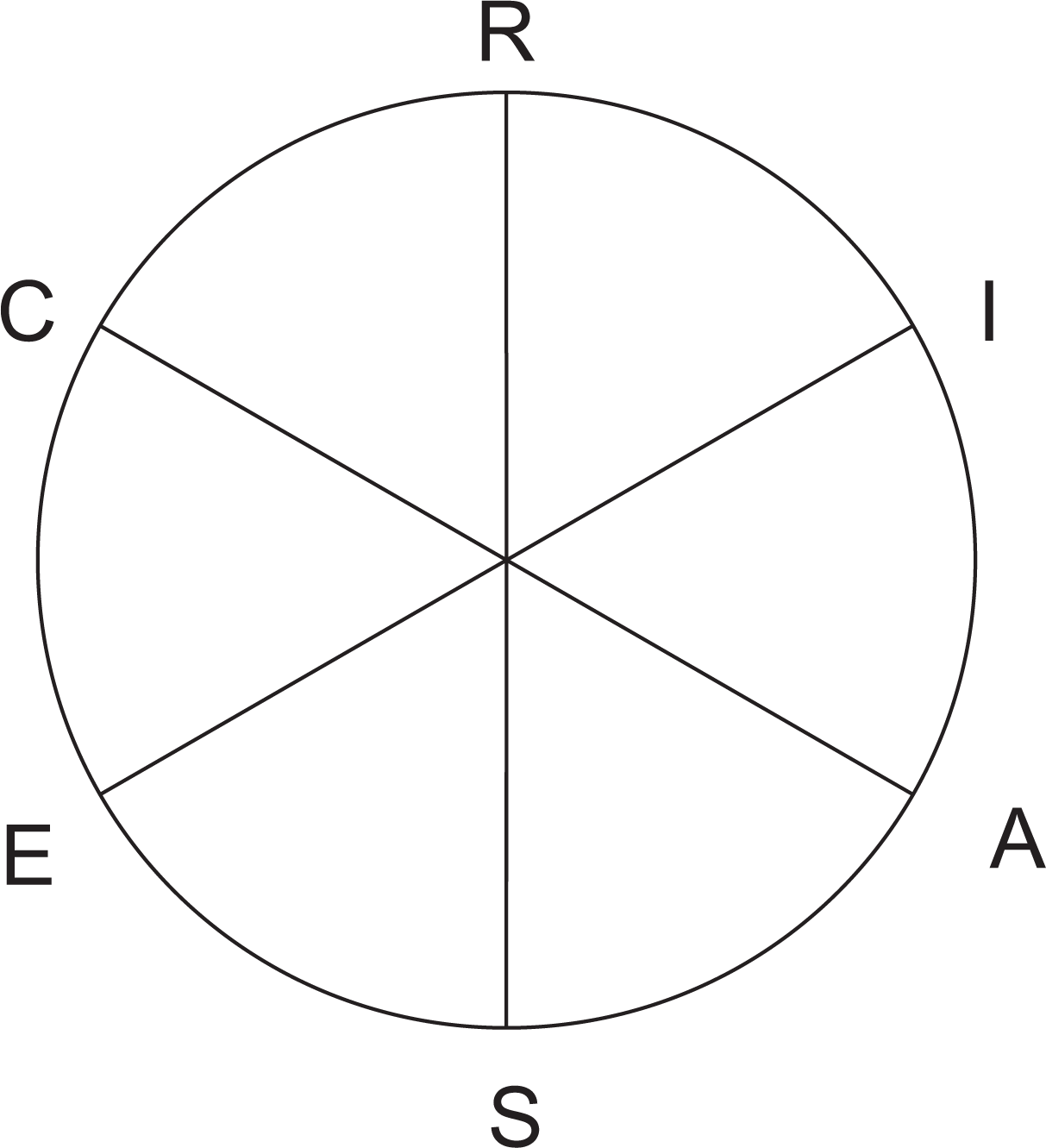
RIASEC circular model.
Method
Procedure and Participants
Participants were 192 ultraorthodox male students currently attending a postsecondary religious education program in the greater New York metropolitan area, ranging in age from 22 to 37 (M = 27.89, SD = 3.76), with 83% married, and a mean number of children of 3.29 (SD = 2.09). These participants were drawn from a convenience sample of individuals seeking career counseling services at a community agency that serves this specific population. From October 6, 2009 until February 24, 2011, all eligible participants seeking services at this agency were given an information packet describing the study and those who consented to participate were administered the SII and received a single career counseling session incorporating the results of this assessment. The SII was administered through a commercially available online system (SkillsOne), participants were not compensated monetarily, and institutional approval was obtained for this study.
Measures
General occupational themes (GOT)
The GOT consist of six broad scales that align with Holland’s (1997) RIASEC model of career interests. These scales are comprised of 21–31 items each that ask respondents to rate how much they like or dislike a variety of occupations, academic subjects, activities, and work settings on a 5-point scale ranging from strongly like or strongly agree (+2) to strongly dislike or strongly disagree (−2). Sample items include “Machinist” (realistic), “Determining the cause of a disease” (investigative), “Art” (artistic), “Training new employees” (social), “Am interested in managerial responsibilities” (enterprising), and “Bank teller” (conventional).
BIS
The BIS includes 30 homogenous scales, each designed to assess interest in a specific career area such as law, performing arts, and office management. Each scale consists of 6–12 items which are similar to the GOT items described above. For example, the Mechanics and Construction scale asks respondents to rate items including “Auto mechanic,” “Civil engineer,” “Have mechanical inventiveness,” while Counseling and Helping includes “social worker,” “psychology,” and “helping others overcome their difficulties.”
PSS
The PSS does not address specific careers but rather examines general preferences for working, learning, and life. These six scales are bipolar and associate a specific style with both high and low scores. For example, Work Style ranges from a preference to work with ideas and things versus a preference to work with people. Other scales include Learning Environment (practical vs. academic), Leadership style (by example vs. directing others), Risk taking (safety vs. chances), and Team Orientation (independent vs. team). Items on these scales included “Interviewing prospective customers,” “Doing data entry,” and “Dangerous activities.” They are rated identically to the GOT and BIS items described above.
Typicality index
This index identifies unusual response patterns. It consists of 24 empirically identified pairs of highly related items, such as “Actor/Actress” and “Acting.” The index reflects the total number of consistent responses to a pair and scores range from 0 (no consistent responses) to 24 (all consistent). A cutoff score of 17 was identified as providing adequate sensitivity and specificity within the normative sample, and profiles with fewer than 17 consistent responses reflect a highly unusual and inconsistent response style (Dirk & Hansen, 2004).
Statistical Analysis
To assess the reliability and validity of SII scales among ultraorthodox males, a series of analyses were conducted. First, overall response styles (item response percentages and typicality indices) were compared to those within the normative sample. Internal reliabilities of GOT, BIS, and PSS scales were then calculated (Cronbach’s α) and compared to those obtained in the normative sample using the Hakstian and Whalen test (1976). Scales with significantly poorer reliability were further assessed using item-total correlations to identify potentially discrepant items.
We then used confirmatory factor analysis (SEM package for R; Fox, 2006) to assess if the pattern of interests within our sample matched the structure of relationships predicted by Holland’s (1997) RIASEC circular model. As proposed by Rounds, Tracey, and Hubert (1992), this model can be operationalized using three parameters to describe the intercorrelations of the six GOT variables. Parameters represents correlations between adjacent types (r1, e.g., conventional and realistic), alternate types (r2, e.g., conventional and investigative), and opposite types (r3, e.g., conventional and artistic). Given that the distance between each adjacent type is assumed equal in the RIASEC model, parameters were constrained to be equal across all pairs. Adequate fit for the model was indicated by a nonsignificant Chi-square, CFI, and NNFI above .90, and an root mean square error of approximation (RMSEA) value less than .1 (Kline, 2005). Similarly, we explored the convergent and divergent validity of the BIS and PSS scales by computing correlations between BIS, PSS, and GOT scales and comparing these to correlations within the normative sample using Fisher’s transformation as described by Cohen, Cohen, West, and Aiken (2003). Given the large number of items on these scales, there was insufficient statistical power to conduct a confirmatory factor analysis of the measurement model (Gagne & Hancock, 2006).
Finally, we assessed differences in interest between ultraorthodox Jewish males and the normative sample by comparing mean scores on GOT, BIS, and PSS scales. Given the large sample size, we expected that several comparisons would be significant. Consequently, as recommended by Vacha-Haase and Nilsson (1998), we focused on the effect size of any differences, using Cohen’s (1988) guidelines for a small (.2), medium (.5), and large (.8) effect. Although these mean score comparisons did not provide validity information, given that SSI scores are generally interpreted normatively, significant mean differences between ultraorthodox scores and the normative sample suggests that interpretation of individual scores should also include comparison to ultraorthodox-specific norms (American Psychological Association, 1999). In all analyses, inflation of Type 1 error due to multiple comparisons was controlled using the Bonferroni correction (p < .0001).
Results
Response Style and Reliabilities
To assess overall response styles, we compared how frequently each response option (e.g., strongly like, strongly dislike) was selected in our sample to the expected frequency reported in the normative sample. Results indicated that our sample significantly differed, χ2(4, 191) > 34.80, p < .0001, such that orthodox participants were more likely to endorse strongly dislike (20.44%) and dislike (22.5%) and were less likely to endorse like (21.94%) and strongly like (8.7%), suggesting that orthodox participants were overall less interested in all occupational categories and activities as compared to the normative sample. In regard to the consistency of responses as measured by the typicality index, mean typicality in our sample (M = 21.85, SD = 1.74) was well within the normative range and no participants scored less than the cutoff of 17, indicating that the response style in our sample was consistent.
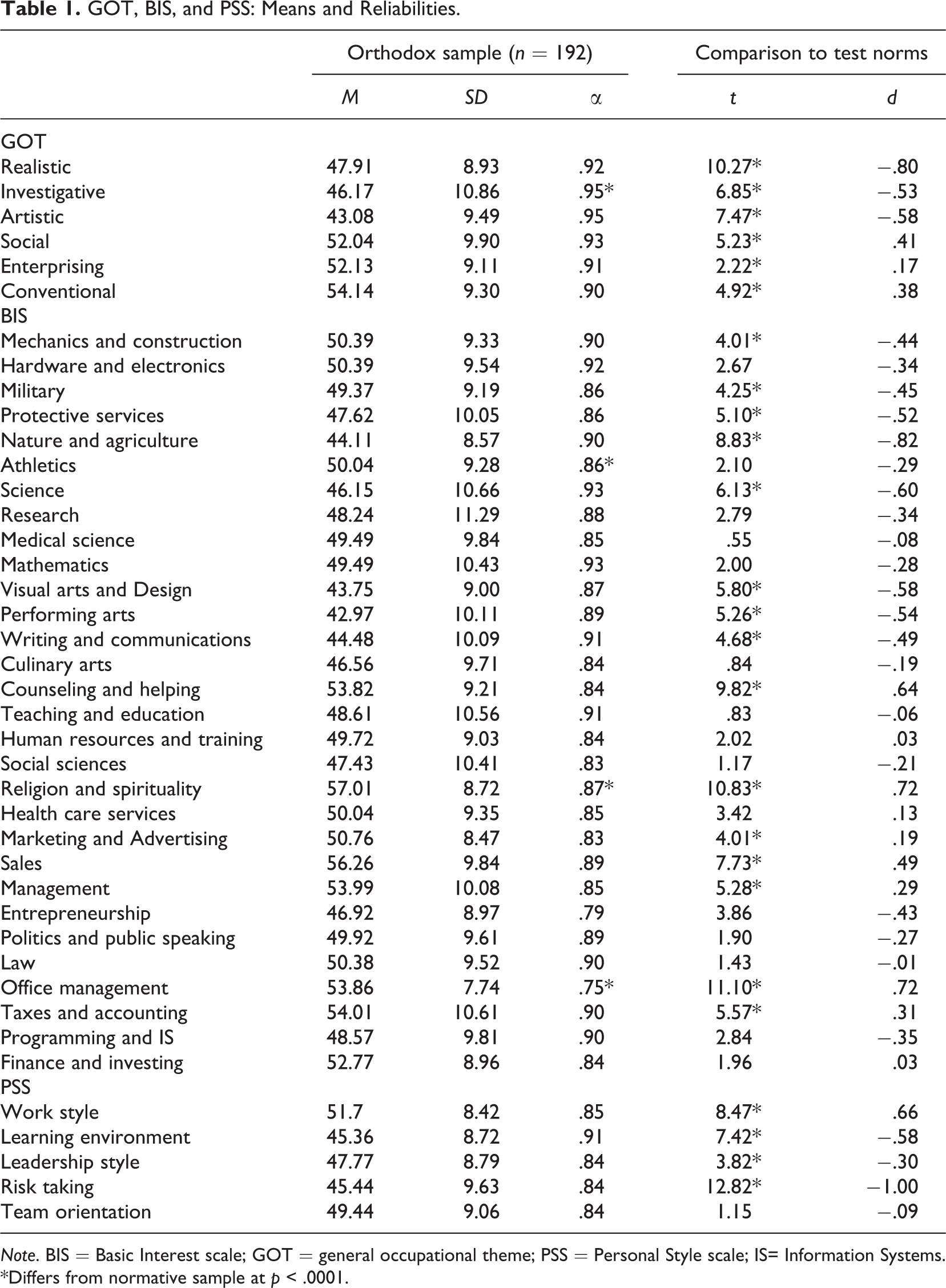
Internal reliabilities (Cronbach’s α) were then computed for all GOT, BIS, and PSS scales (Table 1). Results indicated that internal reliabilities for all scales fell within the adequate to excellent range (George & Mallery, 2003; M = .88, SD = .04, range = .75−.95), although three had significantly poorer reliability than those found within the normative sample—Athletics, Religion and Spirituality, and Office Management. Item-total correlations revealed that “Physical education” (r = .53, p < .001) and “Physical education teacher” (r = .52, p < .001) were less likely to be endorsed than other items on the Athletics scale, and that “Religious music” (r = .37, p < .01, Religion and Spirituality) and “Managing a business or office” (r = .28, p < .01, Office Management) were more likely to be endorsed than other items on the corresponding scales.
GOT, BIS, and PSS: Means and Reliabilities.
Note. BIS = Basic Interest scale; GOT = general occupational theme; PSS = Personal Style scale; IS= Information Systems.
*Differs from normative sample at p < .0001.
Convergent and Divergent Validity: RIASEC Model and Correlations
Results of the confirmatory factor analyses assessing the fit of Holland’s circumplex RIASEC model for GOT scales suggested that adjacent interests were more highly correlated (r = .48, p < .0001), than alternative (r = .42, p < .0001), and opposite types (r = .21, p < .0001). Overall model fit was adequate with a CFI of .95, NNFI of .95, and RMSEA of .09. The Chi-square was significant, χ2(12, 192) = 33.19, p < .001, indicating that a significant portion of the variance remained unexplained. However, this statistic is highly sensitive to sample size and model complexity and may reject even appropriate models (Decoster, 1998). Thus, given the simplicity of our model (three parameters), large sample size (n = 192), and adequate fit of all comparative statistics, results suggest that a strict circular RIASEC model adequately described the structure of interests within our sample.
To further explore convergent and divergent validity of BIS and PSS scales, we computed a series of bivariate correlations between each BIS and PSS scales and the broader GOT scales. These were then compared to analogous correlations within the normative sample. Results are reported in Table 2 and indicate that the vast majority of correlations did not significantly differ from those within the normative sample, suggesting that BIS and PSS scales displayed adequate convergent and divergent validity within our sample. For example, as expected, higher scores on realistic interests (GOT) were correlated with higher scores on mechanics and construction (BIS), and lower scores on work style (PSS) indicating a preference for working with things as opposed to people. A few correlations differed significantly from the normative sample, however, and speculative interpretations of these differences are presented in the discussion. Overall the BIS and PSS scales appear to have convergent and divergent validity among ultraorthodox Jewish Males.
Correlations of BIS and PSS Scales With GOT Scales.

Note. BIS = Basic Interest scale; GOT = general occupational theme; PSS = Personal Style scale; IS = Information Systems.
*Correlations were significantly larger than those in the normative sample at p < .0001.
Normative Differences
Mean scores on all GOT, BIS, and PSS scales were then compared to the normative sample, to assess if career interests in our sample differed from those within the normative sample (Table 1). Given the large sample size, analysis focused on differences with moderate to large effect sizes (d > .50). Results indicated that the participants in this sample reported significantly less interest in realistic occupations (realistic, nature, and agriculture, protective services), investigative occupations (investigative and science), artistic occupations (artistic, visual arts, and design, performing arts), academics (learning environment), and risk taking. On the other hand, participants reported significantly more interest in working with people (work style), religion and spirituality, counseling and helping, and office management. As discussed below, these differences appear consistent with orthodox Jewish religious culture and suggest that the SII is a valid measure of interests within this population. Interpretative implications are discussed below.
Discussion
Ultraorthodox Jewish males face particular career-related challenges including lack of exposure, self-knowledge, secular education, and work experience. In recent years, several community-based programs have begun providing culturally sensitive counseling and education, and consequently, interest in psychometrically sound career assessment is increasing. Existing assessments, however, have not been validated for use within this population. The current research aimed to address this gap by examining the validity and reliability of the SII (Dirk & Hansen, 2004) among ultraorthodox men.
Results indicated that participants had a significant negative bias overall, such that they were more likely to endorse strongly disagree and disagree and less likely to endorse strongly agree and agree on any item, as compared to the normative sample. Although the current research did not explore the reasons for this difference, several possibilities appear plausible and warrant further research and interpretative attention. For example, ultraorthodox culture highly values religious scholarship, which is imbued with intrinsic spiritual value, and is an important source of self-esteem, identity, and community standing (Zittoun, 2006). Thus, ultraorthodox young adults, who generally invest many years in religious study, are likely reticent to leave Talmudic scholarship and may be negatively inclined toward any secular career (Stadler, 2002). In addition, family structure within this community centers on the husband’s role as a religious scholar (Shai, 2006), and leaving these studies may disrupt family patterns, role responsibilities, and disappoint the expectations of both immediate and extended family members. Finally, ultraorthodox adolescents and young adults are generally discouraged from pursuing any part-time work, volunteering, or secular education (Helmreich, 2000; Stadler, 2002) and may therefore be unfamiliar with the world of work and feel unprepared for careers of any type.
These possibilities require future research but have potential implications for interpretation of SII scores. Specifically, a large number of ultraorthodox males can be expected to have their highest interest scores in the moderate–low range, which renders traditional comparisons to the general reference group uninformative. As recommended by Hansen (1992), interpretation of these profiles should focus on an individual’s areas of relative greatest interest. Scores could also be compared to the community norms reported in the current research to establish relatively higher or lower interest. In addition, the reasons behind overall depressed scores should be assessed, and strategies developed to address any barriers (e.g., encouragement of career exploration activities, direct discussion with family members and trusted religious leaders).
In regard to reliability and validity, scales showed high internal reliability and convergent and divergent validity—fitting Holland’s (1997) strict circular RIASEC model and displaying a pattern of intercorrelations that were consistent with those found in the normative sample. Moreover, the few differences found appeared consistent with ultraorthodox culture. Specifically, items reflecting an interest in physical education were only weakly correlated with the overall Athletic BIS, perhaps because ultraorthodox culture, while permitting some informal involvement in sports, does not encourage involvement in regular physical activity or organized sports (Taha et al., 2001). Religious music was weakly correlated with the Religion and Spirituality BIS, likely because ultraorthodox almost exclusively listen to religious music and this may not reflect a specific interest in a religious career (Barzilai-Nahon & Barzilai, 2005). Finally, social and investigative interests were more highly correlated with Religion and Spirituality and a preference for academic learning, perhaps because religiosity generally focuses on investigative religious scholarship that traditionally is studied socially, in pairs or small groups. In summary, scales displayed adequate validity and reliability, suggesting that the SII is a reliable and valid instrument for assessing career interests among ultraorthodox men.
However, interests in the sample significantly differed from the normative sample in several respects. In particular, artistic interests were below those of the normal sample, perhaps because art is highly gendered, viewed as distracting from religious studies (Stadler, 2002), and generally does not provide the stable income necessary to support a large family (e.g., Reardon, Vernick, & Reed, 2004). This may also explain why artistic and realistic interests, and artistic interest and risk taking were more highly correlated within the sample, since artistic interests are generally discouraged and may necessitate an increased willingness to take risks counter to community norms and find their expression in more acceptable realistic interests. Realistic interests were also lower, perhaps reflecting focus on scholarship and learning to the exclusion of practical material pursuits (Stadler, 2002). Similarly, investigative interests were lower, perhaps due to religious disapproval of secular science, limited science and math education, and the intensive and lengthy training needed for many of these careers (e.g., Reardon et al., 2004). Previous research corroborates these findings, suggesting that ultraorthodox men generally pursue conventional, enterprising, and social themed work (Gonen, 2000). Individuals with artistic, realistic, or investigative interests may face particular challenges, and the collaborative development of religiously and culturally acceptable alternatives may be necessary.
In regard to more specific BIS and PSS scales, interests in religion and spirituality were generally much higher in the sample, which is consistent with the religion-centric culture of the ultraorthodox community. Similarly, consistent with the considerable emphasis on “chesed” or kindness (Shai, 2008), Counseling and Helping scores were elevated. The sample was also moderately risk averse and disinclined to pursue academic learning, perhaps because of their large families and advanced age of entry. Scores in these areas should be interpreted cautiously and considered in the context of other SII scales.
Limitations and Future Directions
The current research has several limitations. First, the sample was too small to allow for more rigorous statistical methods of assessing reliability and validity (i.e., confirmatory factor analysis). Second, although correlations between divergent and convergent SSI scales were used to examine construct validity, the lack of data from other instruments and behaviors, such as career choice, limits the strength of the conclusions. Finally, we did not directly assess participant’s religious–cultural attitudes, behaviors, and circumstances. Each of these limitations provides directions for further research using larger samples, alternative measures and methods, and including more direct tests of the specific religious–culture informed hypotheses about career interest and choice described above.
In conclusion, the SII appears to have adequate reliability and validity for use within the ultraorthodox male population and may represent a valuable tool for career exploration and assessment. Nevertheless, there were some significant differences from the normative population, which require further research and interpretative caution. Additional research exploring the nature and causes of these difference, effective strategies for overcoming cultural-specific challenges, as well as the relationship between interests and employment is necessary.
Footnotes
Declaration of Conflicting Interests
The author declared no potential conflicts of interest with respect to the research, authorship, and/or publication of this article.
Funding
The author received no financial support for the research, authorship, and/or publication of this article.