



Abstract
This study explored the role of decision-making orientation and post-decision thinking in one’s satisfaction with their choice of college major, as well as their motivation for tasks related to their major, perceptions of competence in major coursework, and their academic performance. Three hundred and seventy-eight college students in their junior or senior year completed a survey assessing the above variables. Results suggested that a maximizing decision-making orientation positively related to students’ tendency to engage in upward counterfactual thinking or evaluative thoughts toward the favorable outcomes of an alternative decision. Upward counterfactual thinking, in turn, negatively related to students’ satisfaction, value for coursework, perceived competence, and autonomous regulation within their major, as well as their overall grade point average, controlling for major college. The implications of these findings are discussed.
Choosing a college major is one of the most important tasks of a student’s academic career. College major determines the student’s specific degree plan and may carve the path toward a career or graduate study. However, students are prone to change their major throughout their undergraduate term (Porter & Umbach, 2006). This calls into question what determines students’ satisfaction with their chosen major and how characteristics of the decision-making process may influence a student’s continued motivation for tasks related to their degree requirements within that major. A number of factors may play a role; however, decision-making maximization versus satisficing or the extent to which an individual feels it is necessary to seek out the perfect option versus merely a satisfactory option is likely to be an important factor. Further, once a decision has been made, the extent to which a student experiences counterfactual thoughts or thoughts that allow one to evaluate the possible outcomes of alternative decisions (Epstude & Roese, 2008; Roese, 1994, 1997; Roese & Olson, 1995) is a likely consequence of decision-making maximization and may in turn contribute to one’s satisfaction with their college major and motivation for tasks related to their major.
This study explores the role of decision-making maximization and counterfactual thinking in students’ satisfaction with their college major, motivation in courses associated with their major, and academic performance. The purposes of this investigation were (1) to explore whether decision-making maximization relates to students’ satisfaction, value, perceptions of competence, and autonomous regulation in courses related to their college major, as well as their overall academic performance either directly or indirectly through counterfactual thinking and (2) to examine if students vary in their decision-making experiences, academic satisfaction, motivation, or achievement outcomes as a function of their chosen college major.
Academic Major Satisfaction
Satisfaction with one’s college major, or feelings of fulfillment regarding one’s field of study, is of particular interest given the important consequences of one’s choice of major (Braskamp, Wise, & Hengstler, 1979; Nauta, 2007; Ware & Pogge, 1980). In particular, major satisfaction has been positively linked to academic performance, as measured by grade point average (GPA; e.g., Dandan, Shiye, Xin, & Jie, 2006; Nauta, 2007). Suhre, Jansen, and Harskamp (2007) showed major satisfaction to have a positive effect on motivation, which appeared to mediate the relationship between satisfaction and study behaviors. Previous studies have also found that dissatisfaction with one’s field of study associated with higher withdrawal rates among college students (e.g., Kowalski, 1982; Suhre, Jansen, & Harskamp, 2007). Likewise, Ware and Pogge (1980) found students’ level of major satisfaction related positively with the likelihood of pursuing potential careers related to their current major.
Given the importance of college major satisfaction in a student’s long-term outcomes, a number of approaches have been taken to determine what factors may contribute to students’ satisfaction with their college major. Previous studies have examined the congruence of person–environment fit as a predictor of academic major satisfaction (Allen & Robbins, 2008; Feldman, Smart, & Ethington, 1999; Porter & Umbach, 2006; Smart, Feldman, & Ethington, 2000). Using Holland’s (1966, 1985) theory of careers, researchers have examined the match between students’ personalities and their academic environments. Results have indicated students experience greater major satisfaction when there is congruity between the person and the environment. Other researchers have taken a more motivation-based approach or have examined environmental supports that seem to enhance major satisfaction. For example, academic major satisfaction has been linked to students’ perceptions of positive interactions with and strong support from faculty (Braskamp et al., 1979). Likewise, other research has found greater self-efficacy and goal progress in one’s major coursework (Lent, Singley, Sheu, Schmidt, & Schmidt, 2007), social encouragement from friends (Lent et al., 2007), involvement in major-related organizations and activities (Abrahamowicz, 1998; Kuh, 1995; Strapp & Farr, 2010), availability of and satisfaction with student services and career counseling (Lent et al., 2007; Wachowiak, 1972), students’ perceptions of their coursework as interesting and useful for future careers (Shim & Morgan, 1990), satisfaction with university atmosphere (Shim & Morgan, 1990), and an affirming and dedicated attitude toward one’s major (Shim & Morgan, 1990) predicted greater satisfaction with major.
The current study seeks to contribute to the literature on students’ satisfaction with their choice of college major by considering other possible predictors. Specifically, one conspicuous set of factors in students’ college major satisfaction that has yet to be investigated is students’ decision-making orientation and post-decision thinking. That is, presently, no studies (to our knowledge) have examined the role of decision-making approaches and counterfactual thinking in students’ satisfaction with academic major. In the next section, we discuss the broader literature on decision-making maximization and counterfactual thinking and attempt to highlight the relevance of these factors to the college major decision and college success.
Decision-Making Maximizing and Satisfaction
In general, the decision-making process involves creating a list of requirements and comparing available options to that list. Traditionally, economists relied on rational choice theory to understand decision-making outcomes, assuming individuals have well-ordered and known preferences and that satisfaction will be maximized by simply comparing options and choosing the option which best maximizes their preferences (von Neumann & Morgenstern, 1944). Recognizing the limitations of rational choice theory, Simon (1955, 1956, 1957) suggested people will make affordances for the level of satisfaction they wish to achieve upon making a decision and will engage in satisficing, the act of accepting a choice that is good enough, but is not necessarily perfect.
Building on these basic tenets of rational choice theory and the ideas of Simon (1955, 1956, 1957), recent work on decision-making processes has suggested that people may differ in the goals and strategies they pursue while making a choice, and these individual differences may affect subsequent decision satisfaction (e.g., Schwartz, 2004; Schwartz et al., 2002). More specifically, individuals may fall into one of the two general orientations toward decision making: maximizing and satisficing (Schwartz, 2004; Schwartz et al., 2002).
Maximizers seek to find the best option among alternatives. They believe there is a perfect match to their wants and needs and seek to determine that option. For the maximizer, an increasing number of options can be problematic because their goal requires them to examine all the alternatives before making a choice. Therefore, the impracticalities of exhaustively examining every option, especially when there are many, makes subsequent doubt and regret about decisions likely. In contrast, satisficers are content with the option that meets their minimum requirements. For these individuals, the products of their decision making must only be good enough. Because satisficers seek an option that is “good enough” rather than ideal, new options provide an opportunity to make a satisfactory choice if one has not already been made. Further, the goal of “good enough” makes post-decision regret less of a threat, even if new and better options are revealed.
For their efforts, maximizers often find the best decision (Iyengar, Wells, & Schwartz, 2006; Polman, 2010; Schwartz, 2004; Schwartz et al., 2002). However, despite making good decisions, research has suggested they are often less satisfied with the outcomes of their decisions (Iyengar et al., 2006; Polman, 2010; Schwartz, 2004; Schwartz et al., 2002). For example, Iyengar, Wells, and Schwartz (2006) found maximizing graduating seniors accepted job offers with higher salaries than satisficing graduating seniors. However, the maximizers experienced less satisfaction and greater negative affect, such as being more tired, stressed, and depressed than their satisficing counterparts. Similarly, Schwartz and colleagues (2002) found maximization positively correlated with regret, depression, and perfectionism, and negatively correlated with happiness, self-esteem, optimism, and life satisfaction (being satisfied with one’s life in the present moment). Maximizers were also found to be less satisfied with decisions and experienced more post-decision regret than satisficers. Polman (2010) replicated those findings and further illustrated the paradoxical nature of maximizing, showing that maximizers will often exert great amounts of effort while making a decision in order to maximize their desired outcome. However, during the decision-making process, the likelihood for a negative outcome is also maximized which, in turn, produces negative affect. Based on these findings, it seems likely that students who engage in maximizing decision making to a greater extent will experience greater regret and dissatisfaction with their subsequent major choice.
Counterfactual Thinking
One potentially detrimental consequence of adopting a maximizing decision-making strategy is the tendency to reevaluate a decision after it has been made (Schwartz et al., 2002). Counterfactual thinking may occur when one is reconfronted with alternative options after a decision has been made (Schwartz et al., 2002). In counterfactual thinking, an individual will consider what an alternative would have been like and how things might have turned out differently if an alternative option had been selected (Epstude & Roese, 2008; Roese, 1994, 1997; Roese & Olson, 1995).
Counterfactual thoughts can be downward, comparing the option selected to a less desirable alternative, or upward, comparing the option selected to a more desirable alternative (Epstude & Roese, 2008; Roese, 1994, 1997; Roese & Olson, 1995). For example, when engaging in downward counterfactual thinking, a college student could think, “If I were a Nursing major I would have had to take chemistry, which I don’t care for.” Alternatively, when engaging in upward counterfactual thinking, he could think, “If I had been a Business major I might have a job as soon as I graduate.”
Not surprisingly, downward counterfactual thoughts tend to evoke more positive feelings for a decision, whereas upward counterfactual thoughts are expected to lead one to be less satisfied with their decision (Roese, 1997). Specifically, upward counterfactuals have been linked to guilt, shame, distress, regret, disappointment, and sadness (e.g., Davis, Lehman, Wortman, Silver, & Thompson, 1995; Mandel, 2003; Niedenthal, Tangney, & Gavanski, 1994). Further, maximizing seems to be linked with the tendency to engage in counterfactual thinking. Specifically, Schwartz and his colleagues (2002) found maximizing positively predicted counterfactual thinking when purchasing recent products. Consequently, it seems that much of the regret and dissatisfaction maximizing individuals experience with respect to their decisions is the result of upward counterfactual thinking.
There is some preliminary evidence to suggest that maximizing and counterfactual thinking may play an important role in satisfaction with one’s college major. Galotti (1999) found in a survey of first-year students regarding the academic major decision-making strategies over the course of 2 years that students’ decision-making efforts did not predict satisfaction with their major. The researcher suggested that students who reviewed more options may have been overwhelmed by the cognitive effort needed to come to a decision. This parallels the maximizing paradox. That is, maximizing students may be less satisfied with their ultimate decision due to the fact that the overwhelming number of academic major options that need to be considered during the decision-making process limits their ability to make the “perfect” choice. Given the impracticalities of fully evaluating every possible option, maximizing students may be more likely to engage in post-decision counterfactual thoughts regarding the eliminated options, resulting in lowered satisfaction and, possibly, disappointment, regret, and sadness when those counterfactual thoughts are upward in nature. In sum, it seems likely that students who engage in greater maximizing decision making may experience diminished satisfaction with major choice because maximizing increases their upward counterfactual thinking about their choice of major.
Are There Consequences of Maximizing and Counterfactual Thinking for College Decisions and Academic Outcomes?
Maximizing and counterfactual thinking may also have consequences for academic motivation and performance outcomes. Within the academic environment, Nasco and Marsh (1999) found a link between upward counterfactual thinking in students and future behavioral intentions and enhanced academic performance. To make these relations more concrete, these findings suggest that students will be motivated to regulate their behavior in academically adaptive ways when they have thoughts such as “If only I had studied, I would have performed better on that test” or “If only I had worked harder on that paper, I would have gotten a better grade and learned more.” These findings suggest that maximizing and counterfactual thinking can indeed have consequences for academic motivation and achievement. However, while this prior literature has suggested upward counterfactual thinking can have a positive effect on subsequent motivation and academic behavior when those counterfactual thoughts are directed at past regretted academic actions and outcomes, it might too diminish motivation and adaptive academic behaviors when those counterfactual thoughts are regarding one’s major as a whole.
Generally, students’ majors provide direction for one’s academic and career path, suggesting that one’s choice of major plays an important role in one’s long-term goals. Parker, Bruine de Bruin, and Fischoff (2007) found that maximizers were more likely to make spontaneous decisions and feel less competent in their decision making. It seems likely that those who use a maximizing decision-making strategy may not only experience lower satisfaction with their major, but might experience less perceived competence for major-related coursework due to a diminished feeling of competence during the decision-making process. Similarly, recent work by Sparks, Ehrlinger, and Eibach (2012) showed maximizers were unable to make a commitment to their choices which led to their dissatisfaction. Maximizing students may lack commitment to their major choice which could spur upward counterfactual thoughts, which in turn may lower the value, autonomous activity, and engagement in courses or tasks related to one’s academic major.
We thought it was particularly important to investigate the links between decision-making orientation and counterfactual thinking with various motivation outcomes, given the long history of motivation research showing that like college major satisfaction, students’ values for school-related tasks, perceptions of competence, and autonomous forms of motivation that emphasize engaging in school tasks because they are self-endorsed have consequences for their academic performance (e.g., Eccles & Wigfield, 1995; Ferla, Valcke, & Schuyten, 2010; Fortier, Vallerand, & Guay, 1995; Nauta, 2007; Wigfield et al., 1997). Thus, all in all, it seemed important to examine the role of decision-making orientations and post-decision thinking in not only academic major satisfaction, but in additional motivation-based outcomes with known consequences for achievement and learning, as well as in academic achievement itself.
The Present Study
In this study, we explored the role of decision-making orientation and post-decision thinking in one’s satisfaction with their choice of college major, as well as their motivation for tasks related to their major and their academic performance. To address these questions, we surveyed 378 college students in their junior or senior year regarding their tendency toward decision-making maximizing, experience of upward counterfactual thinking with their choice of college major, as well as their major satisfaction, motivation, and academic performance. We hypothesized greater maximizing would relate to greater upward counterfactual thinking. In turn, we expected that greater upward counterfactual thinking would relate to less satisfaction with one’s academic major decision, reduced motivation, and reduced academic performance.
Method
Participants
Participants were 378 juniors and seniors from a large tier-one research university in the southwest region of the United States. Juniors and seniors were the focus of the study because students at this university are required to select a major by their junior year. Thus, all participating students would have already made decisions about their college major. All students participated in the study as a requirement while enrolled in one of the several introductory courses in the department of Educational Psychology. Two hundred and ninety-nine (79.1%) students were female and 78 (20.6%) were male. One participant did not specify gender. The average age of the sample was 21. One hundred and twelve students (29.6%) were juniors and 266 (70.4%) were seniors. The majority (184; 48.7%) reported being White/Caucasian, 79 students (20.9%) were Hispanic/Latino, 68 students (18%) were Asian American, 31 students (8.2%) were Black/African American, 13 students (3.4%) reported some other race or ethnicity, 2 participants (.5%) did not specify ethnicity, and 1 (.3%) was Native American. Participants ranged in GPA from 1.06 to 4.00 on a 4.00 scale, with an average GPA of 3.20.
In order to make analyses more parsimonious, we chose to collapse the university major colleges into three categories using Biglan’s (1973) classification of academic disciplines as a model. Biglan used the following three dimensions to categorize college majors: hard versus soft, life system versus nonlife system, and pure versus applied. We chose to group all of the applied majors together to form an Applied Sciences group. The pure majors were separated into two groups; hard majors were grouped into natural sciences and soft into liberal/fine arts. Liberal/fine arts included majors such as psychology, sociology, history, theater, dance, and music. Natural sciences included biology, chemistry, engineering, and geosciences majors, among others. Applied arts included education, communication, nursing, social work, and business. One hundred and eighty-one (47.9%) students were in applied sciences, 115 (30.4%) in liberal/fine arts, and 82 (21.7%) in natural sciences.
Procedures and Materials
Participants completed a single 53-item survey online which contained demographic questions and six measures. The six measures included the Maximization scale (Schwartz et al., 2002), a scale of counterfactual thinking explicitly designed for the purposes of this study based on previous research (Epstude & Roese, 2008; Roese, 1997), the Academic Major Satisfaction scale (AMSS; Nauta, 2007), a brief measure of subjective task value (Wigfield et al., 1997), the Perceived Competence subscale from the Activity-Feeling scale (Reeve & Sickenius, 1994), and the Learning Self-Regulation Questionnaire (LSRQ; Black & Deci, 2000). The survey was administered 5 weeks into the fall semester.
Maximizing
The Maximization scale (Schwartz et al., 2002) assesses one’s trait-like tendency to maximize or satisifice when making a decision (13 items). Examples of items from the Maximization scale include, “Whenever I’m faced with a choice, I try to imagine what all the other possibilities are, even ones that aren’t present at the moment,” and “I never settle for second best.” Participants rated the extent to which they agreed with each item on a 7-point Likert-type scale (7 = strongly agree; 1 = strongly disagree). Nenkov, Morrin, Ward, Schwartz, and Hulland (2008) reported the scale had reasonable construct validity. Previous research has suggested the scale has acceptable reliability (α =.71; Schwartz et al., 2002). Cronbach’s α for the present study was .68, which is consistent with previous studies (α = .60 to .73; Schwartz et al., 2002; α = .62; Polman, 2010).
Counterfactual Thinking
Using the literature on counterfactual thinking, we designed a scale that would assess the extent to which students experience upward counterfactual thoughts about their academic major decision. While previous literature has used an open-ended question method to assess the presence of counterfactual thinking (e.g., Landman, Vandewater, Stewart, & Malley, 1995; Pierro et al., 2008; Roese & Olson, 1993; Tsiros & Mittal, 2000), we felt it would be more informative to provide targeted examples of upward counterfactual thinking related to one’s college major decision and assess the extent to which students felt they often engaged in that type of thinking. A 5-item scale was created to measure upward counterfactual thinking following one’s college major decision (e.g., “I often consider how other majors would have allowed me more career opportunities/options”). Participants were asked to indicate on a 7-point Likert-type scale the extent to which each statement was representative of them (7 = very much like me; 1 = not at all like me).
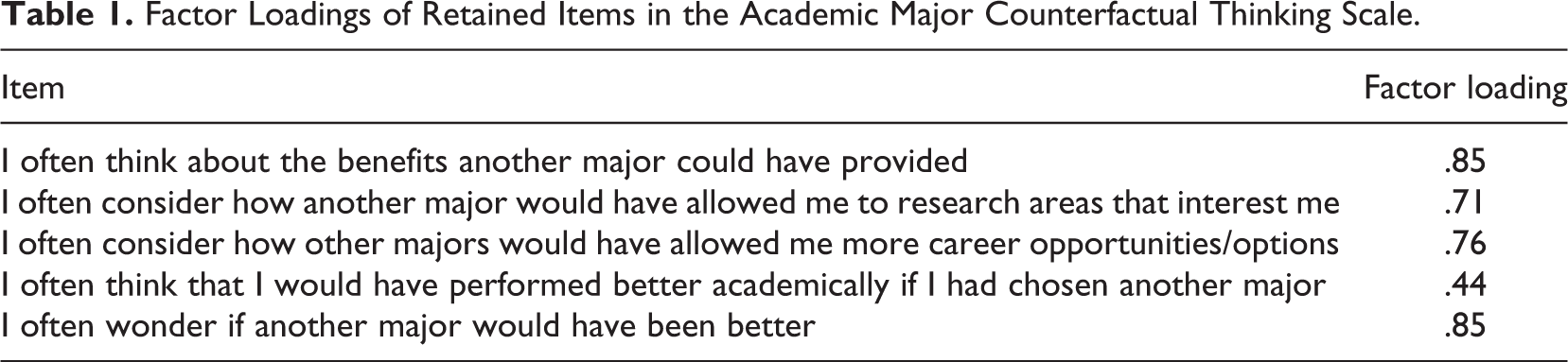
To examine the structure of the academic major counterfactual thinking scale, the 5 items were submitted to an exploratory factor analysis using principal axis extraction with oblique (oblimin) rotation. We sought the solution that best approximated a simple structure—that is, the one in which most items loaded on at least one factor and each item loaded on only one factor. Results of the Kaiser–Meyer–Olkin (KMO) measure of sampling adequacy (KMO = .81) suggested the data were indeed suitable for factor analysis. Likewise, Bartlett’s test of sphericity, χ2(10) = 859.03, p < .001, indicated the items were significantly correlated in order to proceed with the analysis. Both the Kaiser–Guttman retention criterion and Cattel’s scree plot suggested a one factor solution. The factor accounted for 53.99% of the variance with an eigenvalue of 2.70. All items loaded adequately on the factor, ranging from .44 to .85 (see Table 1). Items were averaged to form a counterfactual thinking score with higher values indicating increased likelihood to engage in upward counterfactual thoughts. The scale had acceptable reliability with a Cronbach’s α of .83.
Factor Loadings of Retained Items in the Academic Major Counterfactual Thinking Scale.
Academic Major Satisfaction
The AMSS is a 6-item scale that measures a student’s satisfaction with their academic major decision. An example item is, “I feel good about the major I’ve selected.” Four of the items are reverse-scored. Students were asked to rate their level of agreement with each item using a 7-point Likert-type scale (7 = strongly agree; 1 = strongly disagree). Previous research has suggested the scale has good reliability (α = .94; Nauta, 2007). Likewise, the Cronbach’s α was .91 in the present study. The validity of the scale has been supported in past research (Nauta, 2007).
Task Value
Value related to tasks in one’s academic major was measured with 6 items adapted from a subjective task value scale created by Wigfield and colleagues (1997). Two items assessed each of the following: intrinsic value (i.e., how interesting or fun doing the work for courses in their major was), attainment value (i.e., how important students thought being good at their major courses was), and utility value (i.e., how useful what they were learning in major courses was). Students were asked to indicate how true each item was for them on a 7-point Likert-type scale (7 = very true; 1 = not at all true). Example items from this scale include, “I like doing the work required in my major courses,” and “Compared to most other courses, what I learn in the courses for my major is useful.” Prior research has suggested the scale has acceptable reliability across the three factors (α = .64 on average) over a 3-year study in various domains (Wigfield et al., 1997). In the present study, the Cronbach’s α for all items was .87. Previous research has demonstrated excellent face, predictive, and discriminate validity (see Eccles, O’Neill, & Wigfield, 2005, for a review).
Perceived Competence
Perceived competence was assessed using 3 items from the Activity-Feeling scale developed by Reeve and Sickenius (1994). These items were adapted to measure one’s sense of competence while engaging in tasks within their major. Items were rated on a 7-point Likert-type scale (7 = very true; 1 = not at all true). An example item is, “When engaged in tasks related to my academic major, I feel achieving.” Both prior research (Reeve & Sickenius, 1994) and this study have suggested the scale has good reliability (α = .90 and .93, respectively). Reeve and Sickenius reported good predictive and construct validity for this scale during the scale development.
Autonomous Regulation
Students also completed the autonomous regulation subscale of the LSRQ (Black & Deci, 2000). For the purposes of this study, items from the LSRQ were modified to inquire about participants’ autonomous self-regulation for learning in the domain of their college major. Two possible reasons were provided for three activities: participating actively in one’s major, following instructors’ suggestions for studying in major courses, and working to expand knowledge in ones’ major. An example of an item assessing one’s autonomous regulation in their college major is, “The reason that I will work to expand my knowledge about my major is because it’s interesting to learn more about my major.” Participants were asked to indicate how true each reason was for them on a 7-point Likert-type scale (7 = not at all true; 1 = very true). Black and Deci (2000) reported a Cronbach’s α of .75 for the autonomous scale. In this study, we found a Cronbach’s α of .83. Additionally, Black and Deci reported acceptable construct validity for the scale.
Student Demographics
Finally, participants were asked to provide demographic information about their classification, age, sex, major college, and GPA. They were asked to state how many different majors they have had in their academic career and how many majors they considered before choosing their current major.
Results
Preliminary Analyses
Before conducting analyses to test our hypotheses, we examined the distribution of scores on each variable for outliers. Grubbs’ (1950) test was applied and identified outliers were set at the next nearest value. Grubbs’ test was repeated after substitutions to detect additional outliers. Additional outlying values were again set to the next nearest value. This procedure was repeated until no additional outliers were detected. This procedure revealed two outliers. One outlier was found on both the measure of task value for major course work and on the measure of autonomous regulation.
Variation in Satisfaction, Motivation, and Achievement as a Function of Selected Major
We conducted a series of one-way analyses of variance to determine if participants varied on any of the variables (maximization, upward counterfactual thinking, satisfaction, task value, perceived competence, autonomous regulation, and GPA) depending on their college major (applied sciences, liberal/fine arts, and natural sciences). Table 2 shows the means and standard deviations for each major on all variables. Tukey’s adjustment was used in post hoc comparisons to interpret specific group differences. Analyses suggested students varied on two of the seven variables as a function of their chosen major using a p value of less than .01 to guard against Type I error: upward counterfactual thinking, F(2, 375) = 7.82, p < .001, and autonomous regulation, F(2, 375) = 6.84, p = .001. Follow-up comparisons suggested that students in applied arts displayed fewer upward counterfactual thoughts and greater autonomous regulation than students in liberal/fine arts and natural sciences. No other comparisons were statistically significant.
Means and Standard Deviations (SDs) for Decision-Making and Academic Variables by Major College.

Correlations Among Decision Making, Satisfaction, Motivation, and Performance Variables
Table 3 shows the Pearson correlation coefficients between maximization, upward counterfactual thinking, satisfaction, task value, perceived competence, and autonomous regulation, and GPA. In line with prior research, we expected satisfaction with and motivation in one’s academic major would relate to students’ academic performance. As expected, a significant positive relationship between GPA and major satisfaction was found. Not surprisingly, a positive relationship was also observed between satisfaction in one’s college major and value, perceived competence, and autonomous regulation for courses and activities related to one’s major. Likewise, strong positive relations were observed among all three of the motivational variables. Further, both value and perceived competence related to GPA. In line with the expectation that maximizing may be related to greater upward counterfactual thinking, a positive correlation was observed between the two variables. Likewise, in line with the hypothesis that maximizing and upward counterfactual thinking might negatively impact students’ satisfaction with their major, a significant negative relationship was found between maximization and satisfaction, as well as between upward counterfactual thinking and satisfaction. Further, upward counterfactual thinking was negatively correlated with students’ value, perceived competence, and autonomous regulation for courses and activities related to one’s major, as well as their overall GPA.
Pearson Correlations Among Decision Making and Academic Variables.
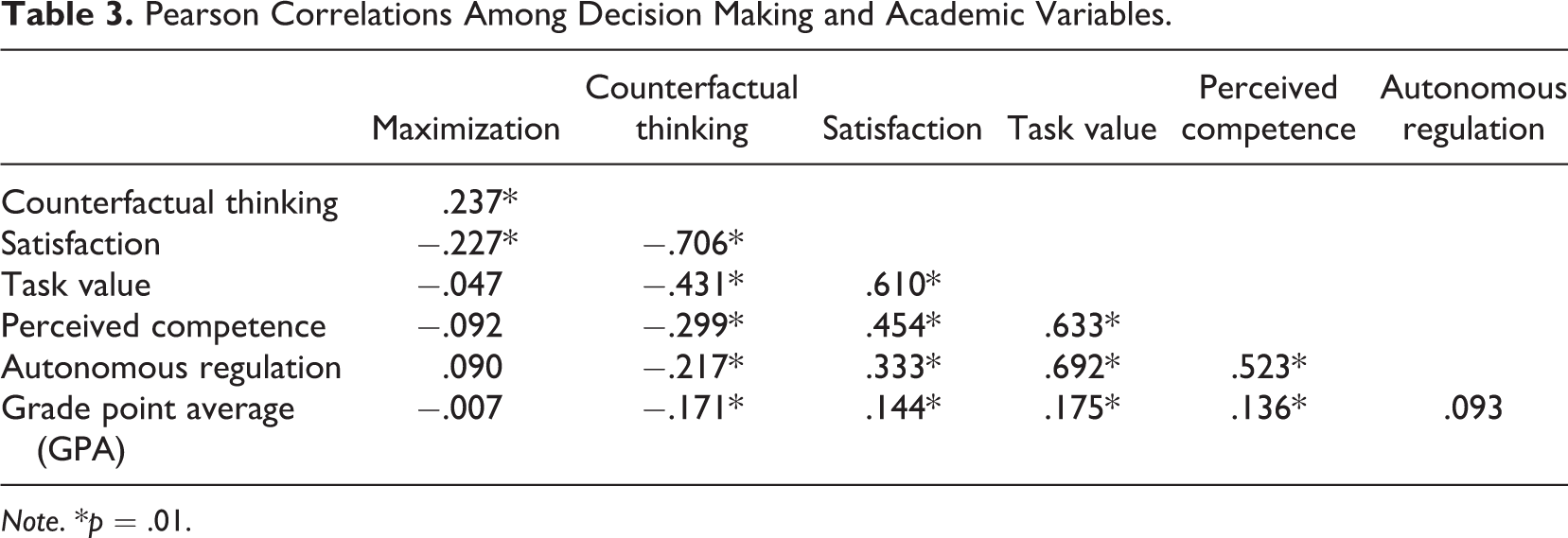
Note. *p = .01.
The Role of Maximizing and Upward Counterfactual Thinking in Academic Major Satisfaction, Motivation, and Performance
Next, we examined the hypothesis that maximization would predict upward counterfactual thinking and that those thoughts would, in turn, predict academic major satisfaction, motivation, and performance. For these analyses, we utilized criteria recommended by MacKinnon, Lockwood, Hoffman, West, and Sheets (2002) for determining mediation and conducted a series of hierarchical regression analyses in a test of joint significance. In line with these recommendations, we concluded that a mediated pathway from maximizing to each outcome through upward counterfactual thinking existed when (1) the relationship between the independent and mediating variable was significant, (2) the relationship between the mediating and dependent variable was significant, and (3) a test of the indirect effect using the Sobel test was significant.
We thus conducted a series of hierarchical regression models for each outcome separately. In the first model, we regressed upward counterfactual thinking on maximizing, controlling for major college in the model. The major college variable was dummy coded such that applied arts served as the reference group. The first dummy-coded group was the natural science majors, with a code of 1 for this group and zeros for both other groups. The liberal/fine arts majors were dummy coded as a second variable, receiving a 1 and both other groups were labeled with 0. This model provided the first part of the indirect effect estimate. In a second set of additional models, we regressed each outcome variable on both maximizing and upward counterfactual thinking, controlling for major college. These models provided the second part of our indirect effect estimate, as well as the estimate of the direct effect of maximizing on each outcome.
First, we examined the relation between maximization and upward counterfactual thinking, controlling for major college. Maximization significantly and positively predicted upward counterfactual thinking (β = .26, p < .001), suggesting that students with a greater tendency toward maximizing decision-making strategies engaged in more upward counterfactual thinking. Maximizing accounted for 7% of the variance in upward counterfactual thinking after controlling for major college. We next regressed satisfaction with college major on maximization and upward counterfactual thinking, controlling for major college. We found that upward counterfactual thinking was a significant negative predictor of satisfaction (β = −.70, p < .001), suggested that students who engaged in more upward counterfactual thinking were less satisfied with the college major. There was not a statistically significant direct relation between maximizing and satisfaction controlling for the mediator (β = −.06, p = .14). Maximizing and upward counterfactual thinking accounted for 50% of the variance in satisfaction, controlling for major college. The Sobel (1982) test indicated that upward counterfactual thinking was a significant mediator of the relation between maximization and college major satisfaction (z = −5.14, p < .001). The proportion of mediated effect (PME) for the relation between maximization and college major satisfaction was .75, suggesting that upward counterfactual thinking partially, though substantially, mediated the relation between maximizing and satisfaction.
We conducted this analysis for each of the motivation and academic achievement outcomes, as well. Upward counterfactual thinking was a significant negative predictor of task value (β = −.43, p < .001), perceived competence (β = −.29, p < .001), autonomous regulation (β = −.22, p < .001), and GPA (β = −.16, p < .01), controlling for both maximizing and major college. These results suggest that students who engaged in more upward counterfactual thinking expressed less value toward courses, perceptions of competence, autonomous regulation, and reported lower GPAs. There was not a statistically significant direct relation between maximizing and task value, perceived competence, and GPA, controlling for the mediator (β = .05, p = .29; β = −.03, p = .62; and β = .02, p = .73, respectively). However, there was a significant direct positive relation between maximizing and autonomous regulation (β = .13, p < .05) even after controlling for the mediator and major college. Maximizing and upward counterfactual thinking accounted for 17%, 9%, 5%, and 2% of the variance in task value, perceived competence, autonomous regulation, and GPA, respectively, controlling for major college. The Sobel (1982) test indicated that upward counterfactual thinking was a significant mediator of the relation between maximization and task value (z = −4.60, p < .001), perceived competence (z = −3.68, p < .001), autonomous regulation (z = −3.22, p < .01), and GPA (z = −2.27, p < .05). The PME was .77 for the relation between maximization and task value, .75 for perceived competence, .31 for autonomous regulation, and .66 for GPA, suggesting that upward counterfactual thinking partially, though substantially, mediated the relation between maximizing and these motivation outcomes and academic achievement. The results of these analyses are available in Tables 4 and 5. 1
Hierarchical Regression Analyses for Predictors of Upward Counterfactual Thinking and Academic Major Satisfaction.
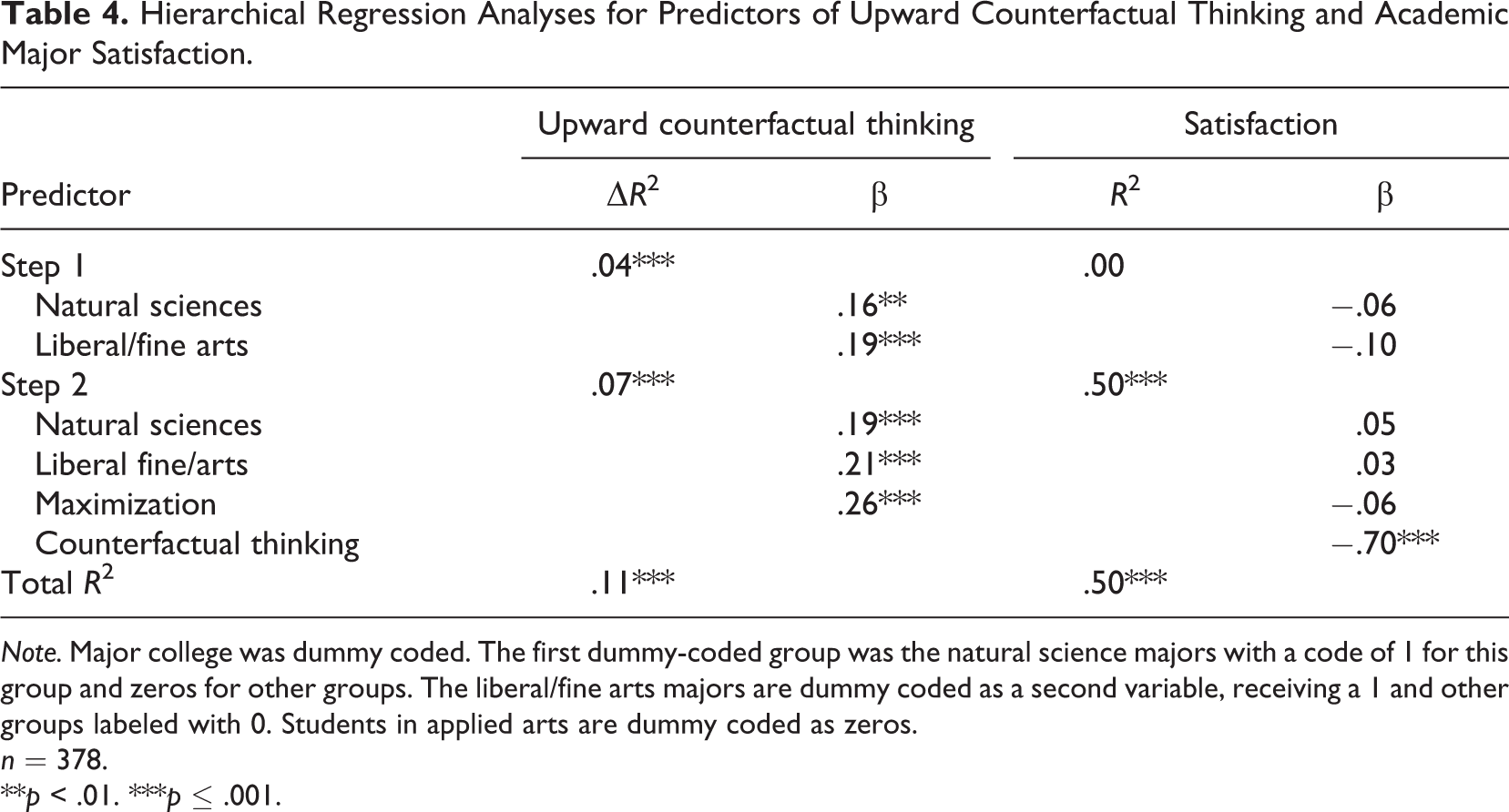
Note. Major college was dummy coded. The first dummy-coded group was the natural science majors with a code of 1 for this group and zeros for other groups. The liberal/fine arts majors are dummy coded as a second variable, receiving a 1 and other groups labeled with 0. Students in applied arts are dummy coded as zeros.
n = 378.
**p < .01. ***p ≤ .001.
Hierarchical Regression Analyses for Predictors of Motivation and Academic Performance.
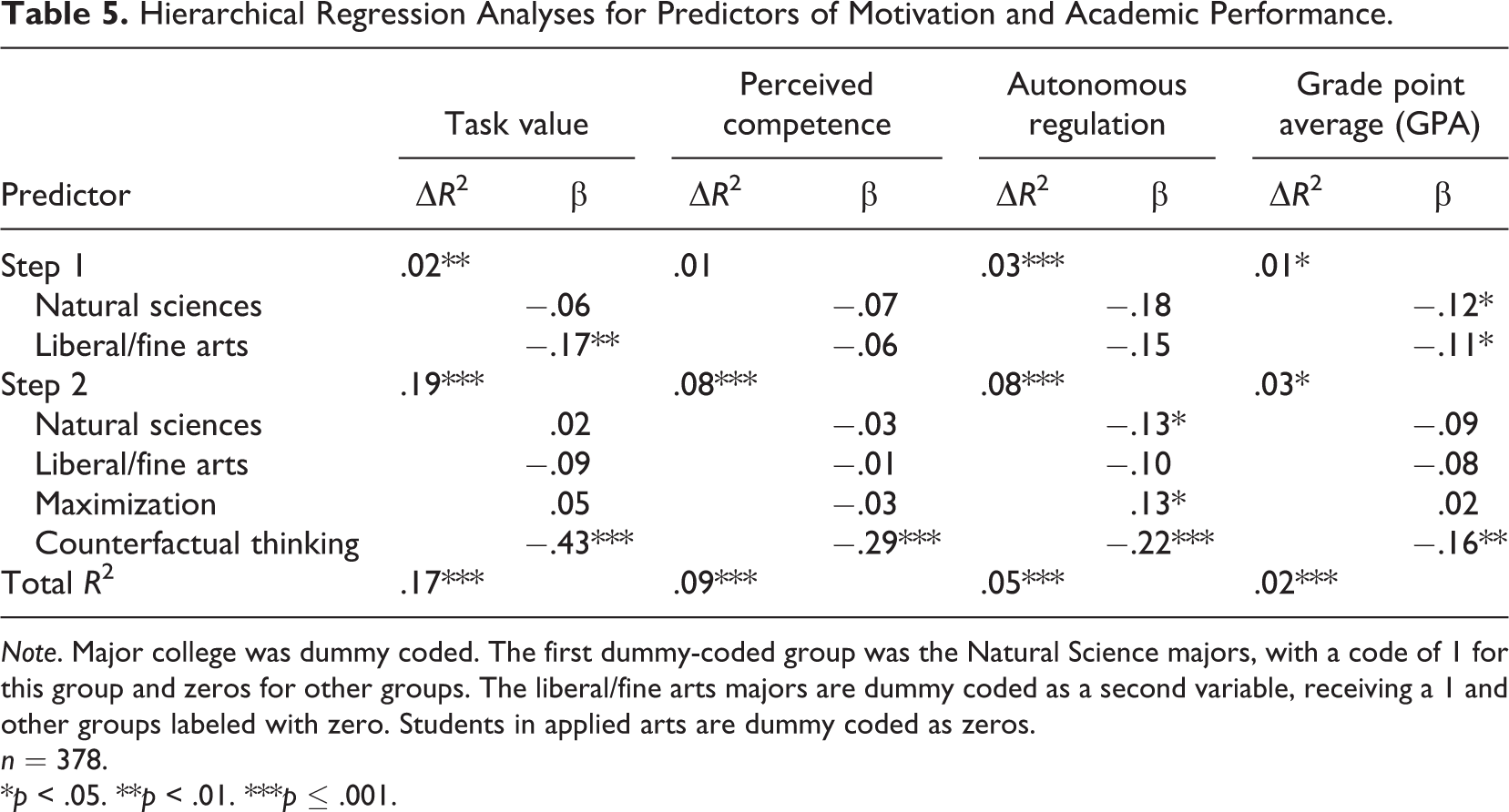
Note. Major college was dummy coded. The first dummy-coded group was the Natural Science majors, with a code of 1 for this group and zeros for other groups. The liberal/fine arts majors are dummy coded as a second variable, receiving a 1 and other groups labeled with zero. Students in applied arts are dummy coded as zeros.
n = 378.
*p < .05. **p < .01. ***p ≤ .001.
Discussion
The purpose of this study was to examine the role of maximizing as a decision-making strategy and counterfactual thinking in academic major satisfaction, as well as for motivation and performance outcomes. In line with our predictions, results suggested that students who have a greater tendency to use maximizing decision-making tendencies are more likely to also experience upward counterfactual thoughts about the benefits that another college major might have provided. In turn, students who, to a greater extent, thought about the benefits that other college major options may have provided—compared to his or her own decision of college major—had lower satisfaction. Our results also indicated students who often considered “what might have been” appeared to have lower value for their major courses and a diminished belief that they will do well in these courses. For these students, the reasons for engaging in major-related coursework were less intrinsic. As a result of all the consequences of this maladaptive post-decision thinking, it is little wonder that their overall GPA also suffered. One interesting finding that emerged was that maximization positively predicted autonomous regulation in activities related to one’s major even when upward counterfactual thinking was included as a mediator. This form of inconsistent mediation may simply indicate that upward counterfactual thinking is operating as a suppressor variable in this relation. Alternatively, it is possible that maximizing has an effect on autonomous regulation through multiple pathways. That is, maximizing may lead to a reduced autonomous regulation through greater counterfactual thinking. On the other hand, maximizing may influence autonomous regulation positively because those students who exert more effort during the college major decision-making process to make the very best decision may take ownership of his or her goals, despite considering the benefits of alternative options. Future research could tease apart these relations to determine the precise mechanism to explain these findings.
At a practical level, it is worth noting that our results revealed differences across majors. Specifically, applied arts majors appeared to experience fewer counterfactual thoughts and greater autonomous regulation than the other majors in our study. Our findings suggest applied arts majors may be more intrinsically motivated to succeed in their courses than other majors. An interesting result was that liberal/fine arts and natural science majors produced more upward counterfactual thoughts than other majors. Since only juniors and seniors participated in this study it is possible that these students are concerned about employment opportunities within these fields. They may be questioning the benefits of the courses they have taken. Academic advisors and career counselors could encourage and organize job shadowing and internship opportunities in these students’ fields of interest. These students’ involvement in their future careers could influence their interest and engagement in their major courses. Also, these career-related activities could reduce post-decisional thoughts questioning the benefit of liberal, fine art, or natural science courses. Students may view these career-related opportunities as rewards for their decision-making efforts.
This study has several potential limitations. Most notably, the study relied on self-report measures at a single time point. It is important to mention our results were based on correlational evidence and should not be taken to imply causation. It is entirely possible students who are less satisfied with or motivated regarding their college major may subsequently develop counterfactual thinking rather than the reverse. It is more difficult to imagine maximizing could be the result of counterfactual thinking, satisfaction, and motivation outcomes as it is conceptualized and measured as a relatively stable trait. Likewise, this study relied on the self-reporting of academic performance and college major rather than school records. That said, recent evidence has suggested students may be relatively good reporters of their academic achievements. For example, Herman and Nelson (2009) found actual GPA and self-reported GPA were correlated very strongly, r = .91 for females and r = .90 for males in the study. Another limitation was that students may have been in-between majors or pursuing degrees in more than one major. We instructed students to answer questions in reference to the major in which they had completed the most credits, if applicable, or the major most closely aligned with their intended career path. Those who were in-between majors were asked to choose the major they were expecting to enter. The potential problem is that the student may not have enough experiences in the new major to accurately assess their satisfaction and motivation. Finally, this study relied on a new scale to measure counterfactual thinking which provided limited validation. Prompting participants to consider counterfactual thoughts (which may not have existed otherwise) may have decreased satisfaction and motivation in the context of completing survey items.
Future research can take several directions. Longitudinal studies should be conducted to explore the long-term effects of maximizing and counterfactual thinking on major satisfaction and career satisfaction, post-graduation, and better establish causal relations. It would also be important to examine the role career counseling plays in the relations between maximizing, counterfactual thinking, and major satisfaction, as well as subsequent career satisfaction. It is possible that a strengths-based (relying on a student’s assets) form of counseling could decrease the effects of maximizing decision-making tendencies on satisfaction by reducing upward counterfactual thoughts. This form of counseling would help students see how their skills, knowledge, and interests align with their majors and future careers. These findings would be beneficial in assessing current techniques and developing innovative ways to improve the major to career transition. An additional point of interest would be to consider these students’ post-graduation plans. Do dissatisfied students go into the workforce or continue onto graduate or professional programs?
Research on academic major satisfaction has implications for policy makers, administrators, staff, educators, and students within higher education, as well as potential employers. Understanding the antecedents of satisfaction can provide individuals with the knowledge needed to make informed decisions, whether the decision is to change curricula, offer more information sessions about potential majors, seek out information about possible options, or choose rewarding careers. Satisfaction with one’s major has the likelihood to increase retention in colleges and universities. Additionally, this research is important for career development. As university personnel strive to make decisions, knowledge regarding student major choice can help provide direction in shaping students’ career goals. Therefore, knowledge about how best to increase satisfaction by minimizing the negative effects of maximizing strategies and reducing upward counterfactual thoughts is essential to the growing body of knowledge of college student retention and career development.
Footnotes
Declaration of Conflicting Interests
The authors declared no potential conflicts of interest with respect to the research, authorship, and/or publication of this article.
Funding
The authors received no financial support for the research, authorship, and/or publication of this article.