



Abstract
The purpose of the present research was to develop an original self-report questionnaire to assess the structure of the reasons underlying the retirement decision process among French entrepreneurs using the push pull anti-push anti-pull view. Three studies were conducted to examine the reliability and validity of the Reasons for Entrepreneurs’ Retirement Decision Inventory (RERDI). The first study involved creating a list of items leading to a preliminary version of the RERDI. In the second study, 167 French entrepreneurs were surveyed to test the factor structure of the RERDI and to select the final items leading to a 16-item inventory. This tool comprises four reliable subscales: (a) push, (b) pull, (c) anti-push, and (d) anti-pull, with adequate internal consistency. Using confirmatory factor analysis, this four-factor structure was confirmed in the third study (n = 255). The RERDI’s convergent validity and temporal stability were also confirmed. The importance of this inventory for further research and practice is discussed.
Keywords
An entrepreneur is commonly defined as someone who is self-employed (Van der Sluis, Van Praag, & Vijverberg, 2008) and more precisely as someone who perceives an opportunity and creates an organization to pursue it (Bygrave & Hofer, 1991). The entrepreneur can be a business founder (Brandstätter, 2011), a purchaser, or a venture successor (Westerberg & Wincent, 2008), but whatever the entrepreneurial mode chosen, all entrepreneurs can be simply defined as owner–managers (Pierce, Kostova, & Dirks, 2001).
Like other working populations in Western countries, a large proportion of entrepreneurs are “baby boomers”, and the European Commission (2006) estimates that a third of European entrepreneurs will retire within the next 10 years.
This final career stage is associated with a wide variety of issues (Pinquart & Schindler, 2007), and many studies have emphasized that the disengagement process is a major and complex psychosocial transition (Pinquart & Schindler, 2007; Wang, 2007) affecting all spheres of life, patterns of everyday activities, and social network composition (Kim & Moen, 2002). Moreover, the developmental retirement theory (Super, 1957) showed that the life roles could be affected by retirement decision and that this roles change was a heterogeneously experienced process (Nordenmark & Stattin, 2009). Mainly for this reason, retirement transition has become a topic of increasing interest to both researchers and career counselors. More specifically, a large body of scientific literature is devoted to the reasons underlying workers’ decisions to retire and to their consequences (e.g., Feldman, 1994; Wang & Shultz, 2010). The strong connection between these reasons and adjustment to postprofessional life has been widely demonstrated (Wang, Henkens, & Van Solinge, 2011). However, there has been little research on the specific reasons of entrepreneurs’ retirement decisions (e.g., DeVaney & Kim, 2003; Leroy, Manigart, & Meuleman, 2008), most studies concerned with entrepreneurial exit focusing on management succession and business survival (Perryer & Te, 2010). There is thus a real gap in the research field of the termination of entrepreneurial careers.
Entrepreneurs make up a specific socioprofessional group based on personality traits (e.g., need for achievement and control, autonomy, proactiveness; see Brandstätter, 2011; Zhao, Seibert, & Lumpkin, 2010) and strong attachment to their professional activity (Cardon, Zietsma, Saparito, Matherne, & Davis, 2005). Some entrepreneurs’ identity is so closely linked to their working life (Potts, 2001; Wagner, Parker, & Christiansen, 2003) that they even refer to their firm as their “baby” (Cardon et al., 2005). Consequently, the retirement transition is particularly complex for this population and even considered potentially as a traumatic career stage (Bonanno, Boerner, & Wortman, 2008). Moreover, entrepreneurship exit has two other specific features: (a) individuals can choose when they retire and (b) it is a multilevel phenomenon in that it concerns both individuals and enterprises (DeTienne, 2010; Leroy et al., 2008). Indeed, with the entrepreneur’s exit, the firm may also exit from the market or continue its activity with another management team, be acquired by another company, transferred to family members, or become publicly traded (DeTienne & Cardon, 2006). The issue of entrepreneurs’ final career stage is thus recognized as being highly important for socioeconomic development (Justo & DeTienne, 2008).
It therefore seems important to understand precisely how entrepreneurs decide to end their career and to study the key factors which influence the entrepreneurial retirement decision-making process.
In the research area of conventional transition to retirement (i.e., for the general working population), numerous studies have tried to identify the main reasons for career termination. For example, some authors have found that health is one of the major personal reasons for the decision to retire (e.g., Kalwij & Vermeulen, 2008; Topa, Moriano, Depolo, Alcover, & Morales, 2009). The broader context in which the decision is made (e.g., health, financial status, family ties, workplace interaction, leisure) has also been examined (e.g., Feldman & Beehr, 2011; Kim, Dimitri, & Annelies, 2011). In the same vein, other researchers have highlighted the importance of psychosocial factors in the retirement decision, such as negative attitudes toward the professional activity versus positive attitudes toward retirement (Topa et al., 2009). In sum, most researchers consider that this decision involves complex and multiple considerations at the personal, professional, and societal levels (Robertson, 2000). Some have therefore tried to make this research area clearer by developing models to structure the diversity and nature of the potential factors underlying the decision to retire (e.g., Beehr, Glazer, Nielson, & Farmer, 2000; Wang & Shultz, 2010). For example, Cliff (1991) made a distinction between voluntary (i.e., freely chosen) and involuntary (i.e., forced) career termination, while Beehr (1986) identified the personal, work, and environmental factors related to the retirement decision. Moreover, empirical reports show that the decision to retire often results from an interaction between different types of reason linked to both current and future retirement life. Thus, investigation of the key variables influencing the personal decision to retire has highlighted the need to consider both the push and the pull factors (e.g., Potocnik, Tordera, & Péiro, 2009; Reitzes, Mutran, & Fernandez, 1998; Van Oorschot & Jensen, 2009). Push factors have been defined as negative considerations, such as poor health or dislike of one’s job, that induce older workers to retire (Shultz, Morton, & Weckerle, 1998; Van Oorschot & Jensen, 2009). Conversely, pull factors are typically positive perceptions of retirement, such as having more free time or being able to pursue leisure interests (Shultz et al., 1998; Van Oorschot & Jensen, 2009). Two others dimensions (i.e., anti-push and anti-pull) were later explored by Mullet, Dej, Lemaire, Raiff, and Barthorpe (2000) in their study examining the decision of young French people to go and study or work in another European country. The anti-push factor has been conceptualized as attachment to the present situation, and anti-pull factors as the costs and risks perceived in the future situation. This model seemed particularly relevant for understanding a complex decision process, and it was therefore used by Fernandez, Stephan, and Fouquereau (2006) to examine the decision to retire from elite sport.
The Present Research
This push pull anti-push anti-pull framework (Mullet, Dej, Lemaire, Raiff, & Barthorpe, 2000) seemed to us to be particularly appropriate for studying the complex process of deciding to retire by entrepreneurs. This article presents a series of three studies reporting the development and validation of an original self-report questionnaire to assess the reasons of retirement decision process (i.e., Reasons for Entrepreneurs’ Retirement Decision Inventory, RERDI) among French entrepreneurs using the push pull anti-push anti-pull framework. The first study involved creating a list of items leading to a preliminary version of the RERDI. Study 2 aimed to test the underlying factor structure of this inventory and to select the final items. The factorial structure of the RERDI was tested in Study 3 using confirmatory factor analyses. In addition, the convergent validity and temporal stability of the inventory were evaluated. Finally, taking a traditional exploratory step, we retained standard variables used in the literature to identify entrepreneurs’ career exit decision (e.g., Justo & DeTienne, 2008; Leroy et al., 2008) and examined the relationships between gender, marital status, subjective health, and the four RERDI’s subscales.
This multidimensional tool could be very useful for both researchers and counselors helping entrepreneurs prepare for retirement. For example, it could help researchers to study in depth the complex relationships between individual cognitive balance, effective retirement decision, and certain outcomes (e.g., well-being) in later life. It could also help counselors to precisely identify the importance of each factor in the decision to retire and thus offer more targeted counseling strategies.
Study 1
The purpose of Study 1 was to develop a preliminary pool of items from a review of the relevant literature and from face-to-face interviews. First, a broad review of the relevant psychological literature was conducted in order to cover the field of the career transition process and to delineate the conceptual boundaries of the measure. Second, given that only a few studies have examined the specific retirement decision-making process among entrepreneurs, we decided to conduct face-to-face semi-structured interviews. The aim of this complementary approach was to heighten our understanding of the individual process and analyze how entrepreneurs viewed the termination of their career.
Method
Participants and Procedure
Data were collected from 20 French entrepreneurs (14 men and 6 women), aged 55–60 (M age = 58.1; SD age = 1.52). They were contacted by telephone via the lists of the Confederations of French Enterprises and the French Chamber of Trade and Industry. They managed ventures in various sectors (e.g., business trading, different types of industry or service). To ensure that the final version of the RERDI would be sensitive to the experiences of people undergoing the transition from entrepreneurship, we only recruited individuals who estimated they were close to retirement (under 5 years).
The interviewer was a psychology doctoral student trained in interviewing techniques. Questions were based on the push pull anti-push anti-pull framework. The participants were asked to answer the following four open questions: (a) “What reasons would lead you to end your entrepreneurial career?” (b) “What aspects of life would make you want to go into retirement?” (c) “What reasons would encourage you to continue your entrepreneurial career?” and (d) “What particular worries do you have about ending your entrepreneurial career?”
The interviews lasted approximately 1 hour during which the participants were encouraged to speak freely about their transition from entrepreneurial activity. The interviews were tape-recorded and transcribed to ensure accuracy and to provide extensive data. Content analysis techniques were applied to classify the textual information into a smaller number of relevant content units (Krippendorff, 2004). More precisely, we developed a classification system by identifying, defining, labeling, and classifying the data. We used previous literature in this research area based on the push pull framework (e.g., Brougham & Walsh, 2007; Potocnik et al., 2009; Shultz et al., 1998) to interpret and categorize some raw data into themes. Twenty percent of items were obtained from literature (e.g., Having fewer opportunities to see other people, Shultz et al., 1998) and 80% were obtained from interviews (e.g., Not wanting to lose contact with customers and other business people).
Finally, we attempted to identify significant themes and patterns that could represent possible reasons for staying in or terminating the entrepreneurial career based on the interviews and relevant literature. This content validity was examined by a panel of three researchers specialized on career termination and agreed on the retained themes.
Results and Discussion
A set of 88 potential items was first generated from the literature and the interviews. We followed guidelines for item wording to make them as precise, clear, and short as possible (Clark & Watson, 1995). Next, this set of items was pilot tested with 10 additional participants (6 men and 4 women) aged 55–61 (M age = 57.9; SD age = 2.13) to rate the clarity of each item, using a 5-point Likert-type scale ranging from 1 (totally unclear) to 5 (totally clear). Participants were invited to give comments and alternative formulations for items that were not totally clear. Using the ratings and the comments provided by the entrepreneurs, a few minor changes in wording were made on 5 items. In this way, 88 items were retained and constituted an initial version of the RERDI.
Study 2
The aim of Study 2 was to conduct an initial psychometric evaluation of the RERDI based on item reliability and exploratory factor analysis. To enable the RERDI to be used in combination with other instruments in future research, and because entrepreneurs are commonly defined as people whose time is truly limited (Bruno & Tyebjee, 1985), we decided to develop a short scale with 4 items in each factorial dimension to ensure that the questionnaire had adequate internal consistency and validity while maintaining reasonable length (Tabachnick & Fidell, 2007).
Method
Participants and Procedure
Two thousand French entrepreneurs were sent a questionnaire by post, with a prepaid envelope for return postage. These entrepreneurs were randomly selected from the lists of the Confederations of French Enterprises and the French Chamber of Trade and Industry. A cover letter described the background of the research and its objectives, together with information about the procedure and confidentiality. Participants were instructed to be truthful and to complete their questionnaire individually in a quiet environment. One hundred and eighty questionnaires were returned, a return rate of 9%. Thirteen participants were excluded because their questionnaires were incomplete or improperly completed (i.e., systematic response pattern). Thus, 167 entrepreneurs (144 men and 23 women) aged 54–66 (M age = 58.03; SD age = 2.59) from various sectors of activity took part in the present study. Of these, 136 (81.43%) had fewer than 10 employees, and the average time that they had managed their firm was 22.98 years (SD = 9.71). The average time within which they intended to end their career was 3.61 years (SD = 2.45).
Measures
Each participant completed a questionnaire that included demographic information (e.g., age, gender) and the preliminary 88-item version of the RERDI. Instructions given to participants were “As you engage in deciding about retirement, how important are each of the following reasons for you?” for the push and pull items and “As you engage in deciding to not retire, how important are each of the following reasons for you?” for the anti-push and anti-pull items. The inventory included an overall 10-point rating scale ranging from 1 (not important at all) to 10 (very important).
Results and Discussion
An exploratory factor analysis with oblimin rotation was conducted on the 88 items. An examination of the scree plot showed clear discontinuity in the slope after four factors, suggesting that extracting four factors was appropriate (Tabachnick & Fidell, 2007). In order to create a short and homogeneous measure of the reasons for entrepreneurs’ retirement decision process, we selected the four highest loading items on each factor, following a successful approach used in previous studies (e.g., Eisenberger, Stinglhamber, Vandenberghe, Sucharski, & Rhoades, 2002). We checked that the selected items were not redundant in content.
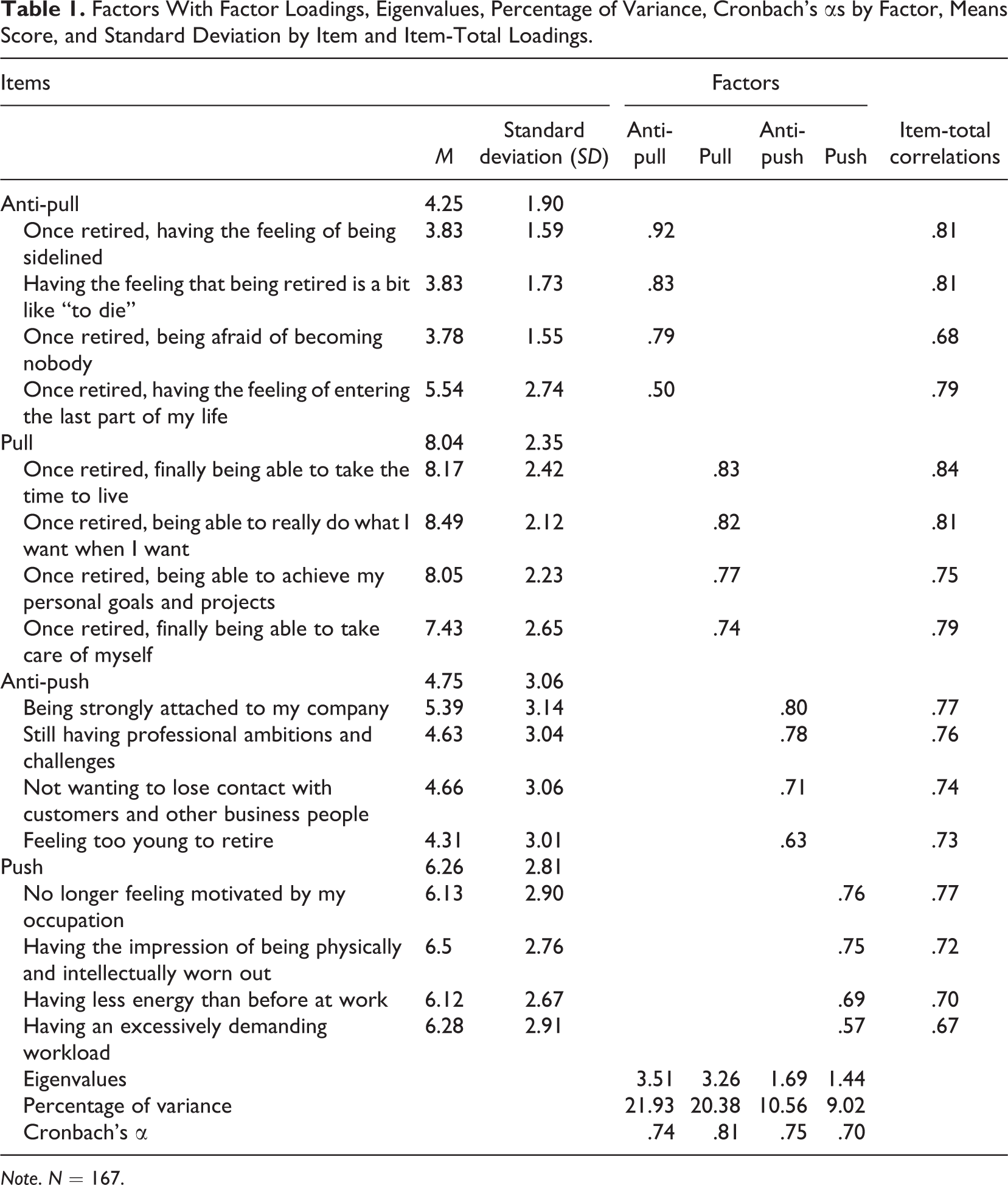
The four-factor solution explained 61.89% of the variance of the final 16-item version of the RERDI (see Table 1). Based on the item content, the four factors were named as given below. Anti-pull items (α = .74) express the negative aspects of retirement such as “Once retired, having the feeling of being sidelined.” Pull items (α = .81) refer to positive perceptions of postprofessional life such as “Once retired, finally being able to take the time to live.” Anti-push (α = .75) items express positive assessments of the entrepreneur’s present life such as “Being strongly attached to my company.” Finally, push (α = .70) items refer to the negative aspects of the entrepreneur’s present situation that would induce them to end their career, such as “No longer feeling motivated by my professional activity.” Overall, the results of Study 2 provided initial support for the reliability and validity of the RERDI.
Factors With Factor Loadings, Eigenvalues, Percentage of Variance, Cronbach’s αs by Factor, Means Score, and Standard Deviation by Item and Item-Total Loadings.
Note. N = 167.
Study 3
The purpose of Study 3 was 4-fold: (1) to confirm the factorial structure of the RERDI with a confirmatory factor analysis, (2) to study the convergent validity of the RERDI by examining the relationships of the four subscales to retirement anxiety and work engagement, (3) to evaluate the temporal stability of the RERDI, and (4) to examine the relationships between a number of individual characteristics (i.e., gender, marital status, and self-rated health) and the four RERDI’s subscales. As mentioned above, many studies have indicated that these individual characteristics were particularly decisive retirement antecedents (e.g., Jensen, 2005; Wang & Shultz, 2010). However, there has been no previous research on reasons for entrepreneurs’ retirement decision based on the push pull anti-push anti-pull framework. Thus, no hypotheses were put forward.
Retirement anxiety is defined as the salient concerns that may contribute to apprehension about life after retirement (Fletcher & Hansson, 1991), and we therefore expected that the anti-pull and pull subscales would, respectively, show positive and negative correlations with retirement anxiety. Finally, based on previous studies suggesting that the degree to which individuals are committed to their work influences their desire to remain a member of the workforce (Adams, Prescher, Beehr, & Lepisto, 2002), we also expected that the anti-push and push subscales would, respectively, show positive and negative correlations with work engagement.
Method
Participants and Procedure
Two thousand French entrepreneurs were sent a questionnaire with a prepaid envelope for return postage. As in Study 2, these entrepreneurs were randomly selected from new lists of Confederations of the French Enterprises and the French Chamber of Trade and Industry. A further 500 entrepreneurs were contacted by e-mail. For both groups, a cover letter explained the background of the research and its objectives, together with information about the procedure and confidentiality. The questionnaire was completed and returned by 255 entrepreneurs (217 men and 38 women), aged 52–69 (M age = 59.6; SD age = 3.03) working in various sectors of activity. The return rate was 11.8% for the postal questionnaires and 3.8% for online questionnaires. The average number of employees in the participants’ firms was 12. The average time they had managed their venture was 21.09 years (SD = 9.94). The average time within which they intended to end their career was 3.33 years (SD = 1.85).
Measures
Each participant completed a questionnaire including (a) demographic information (e.g., gender, marital status), (b) psychosocial information (e.g., self-rated health), (c) the final version of the RERDI, (d) the Retirement Anxiety scale (Hayslip, Beyerlein, & Nichols, 1997), and (e) the short form of the Utrecht Work Engagement scale (UWES-9; Schaufeli, Bakker, & Salanova, 2006).
Self-Rated Health
In line with existing research (e.g., DeSalvo, Bloser, Reynolds, He, & Muntner, 2006), self-rated health was assessed with a single question: “As a whole, how do you rate your current health?” with a Likert-type scale ranging from 1 (excellent) to 5 (very poor).
Retirement Decision Process
Participants completed the final version of the RERDI using a 10-point Likert-type scale ranging from 1 (not important at all) to 10 (very important).
Anxiety About Retirement
Anxiety about retirement was measured with a translated 14-item version of the Retirement Anxiety scale developed by Hayslip, Beyerlein, and Nichols (1997). This scale is designed to assess concerns and emotions about life after retirement (e.g., health, income, mental well-being). Respondents are asked to indicate the extent to which they agree with the statements on a 5-point scale from 1 (don’t agree at all) to 5 (totally agree). Past studies have shown that this scale is a valid and reliable measure (e.g., Gana et al., 2009; Hayslip et al., 1997). In the present study, the Cronbach’s α coefficient was .85.
Work Engagement
Work engagement was evaluated using a translated version of the 9-item UWES-9 (Schaufeli et al., 2006). This questionnaire is a self-report measure assessing work engagement, a positive work-related state of fulfillment characterized by vigor, dedication, and absorption. Respondents are asked to indicate how often they have various feelings about their work (e.g., At my job, I feel strong and vigorous). Answers are given on a Likert-type scale ranging from 0 (never) to 6 (always). Results of past studies (Balducci, Fraccaroli, & Schaufeli, 2010; Schaufeli et al., 2006) confirm that the UWES-9 has acceptable psychometric properties and transcultural validity (Littman-Ovadia & Balducci, 2013). In the present study, the Cronbach’s α coefficient was .90.
Results and Discussion
Factorial Structure
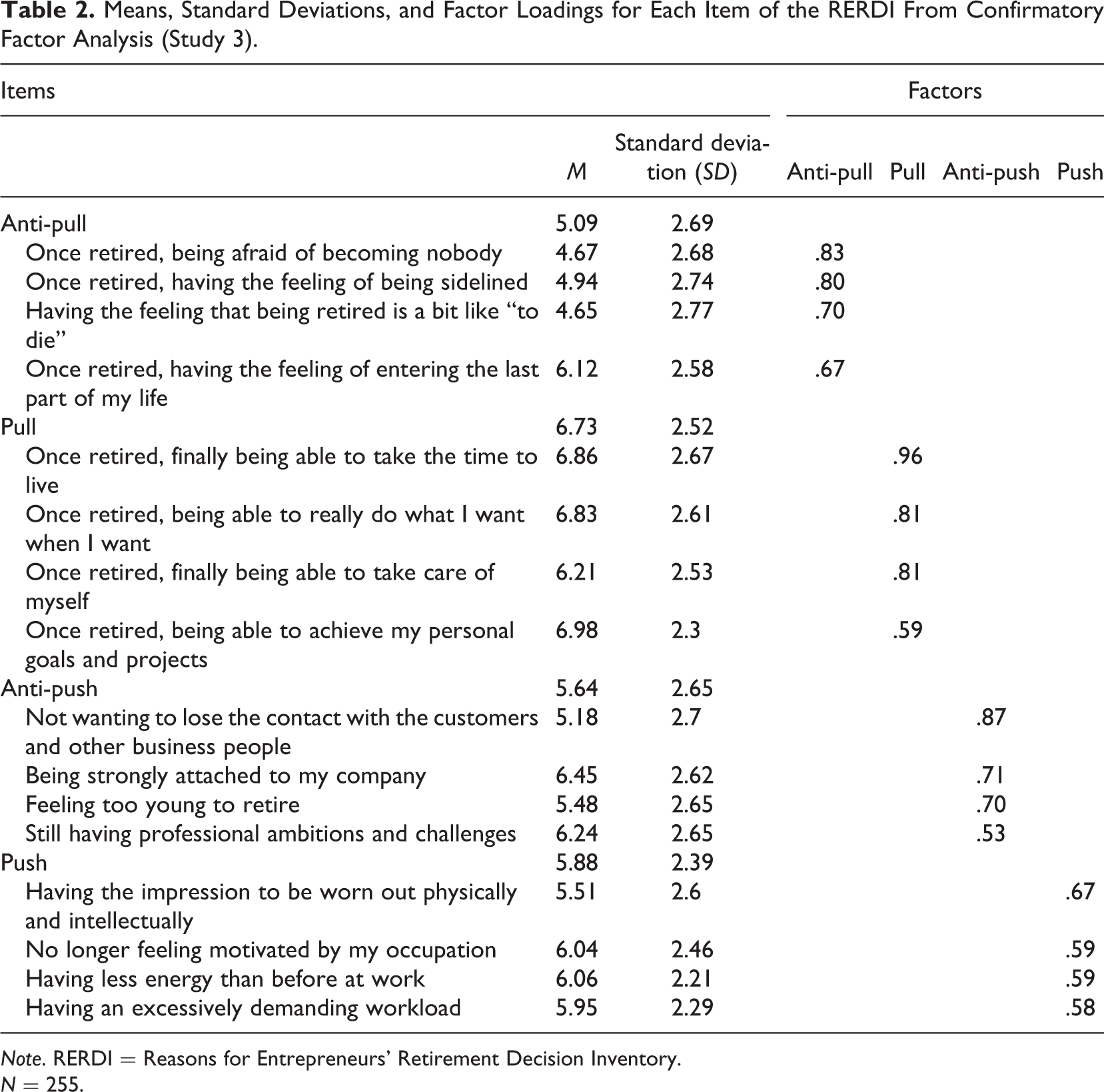
A confirmatory factor analysis using the LISREL 8.30 software (Jöreskog & Sörbom, 1999) was conducted to test the fit of a four-factor structure of the RERDI. Before performing the analysis, we examined the skewness and kurtosis of the data. All parameters were between −1 and 1, indicating that the univariate data were normally distributed. The factor analysis was conducted on a covariance matrix and the solution was generated on the basis of the robust maximum likelihood estimation method. By the subjective criteria of fit measures (Bentler, 1988), results supported the goodness of fit of the hypothesized four-factor structure: Comparative Fit Index [CFI] = .96; Incremental Fit Index [IFI] = .96 and root mean square error of approximation [RMSEA] = .06. In addition, standardized loadings were all significant and greater than or equal to .50 (see Table 2). Finally, Cronbach’s αs ranged from .73 to .87. We have also conducted two other confirmatory factor analyses with the present data (i.e., a two-factor model and a model with a second-order factor). The results showed that the four-factor model yielded better fit indices than the two-factor model (CFI = .85, IFI = .85, NNFI = .83 and RMSEA = .13) and the model with a second-order factor (CFI = .95, IFI = .95, NNFI = .94 and RMSEA = .07).
Means, Standard Deviations, and Factor Loadings for Each Item of the RERDI From Confirmatory Factor Analysis (Study 3).
Note. RERDI = Reasons for Entrepreneurs’ Retirement Decision Inventory.
N = 255.
Convergent Validity
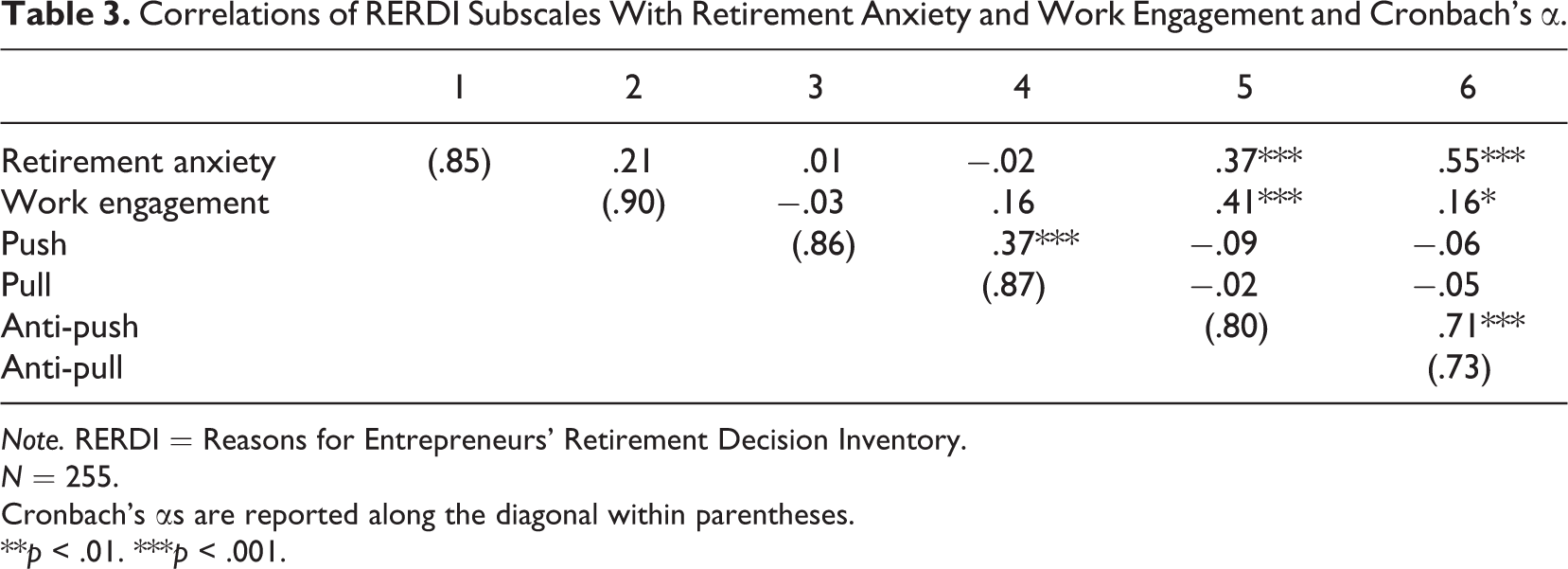
The convergent validity of the RERDI was tested using Hayslip et al.’s (1997) measure of anxiety about retirement and the short version of Schaufeli, Bakker, and Salanova’s (2006) work engagement scale. Table 3 displays all correlations of the RERDI subscales with related variables.
Correlations of RERDI Subscales With Retirement Anxiety and Work Engagement and Cronbach’s α.
Note. RERDI = Reasons for Entrepreneurs’ Retirement Decision Inventory.
N = 255.
Cronbach’s αs are reported along the diagonal within parentheses.
**p < .01. ***p < .001.
As might be predicted, the anti-pull subscale was positively correlated to anxiety (r = .55, p < .001) and the anti-push subscale was positively correlated to work engagement (r = .41, p < .001). Contrary to our expectations, the pull and push subscales were not significantly correlated to anxiety and engagement, respectively.
Test–Retest Reliability
To examine the temporal stability of the RERDI, a follow-up questionnaire was sent to 20 volunteer entrepreneurs 3 weeks after the initial measure. Respondents were 13 males and 7 females, aged 55–63 (M age = 57.90; SD age = 2.50). The test–retest coefficients of reliability were comprised between .76 and .85 (p < .001) for the four subscales, suggesting acceptable medium-run temporal stability.
Exploratory Analyses
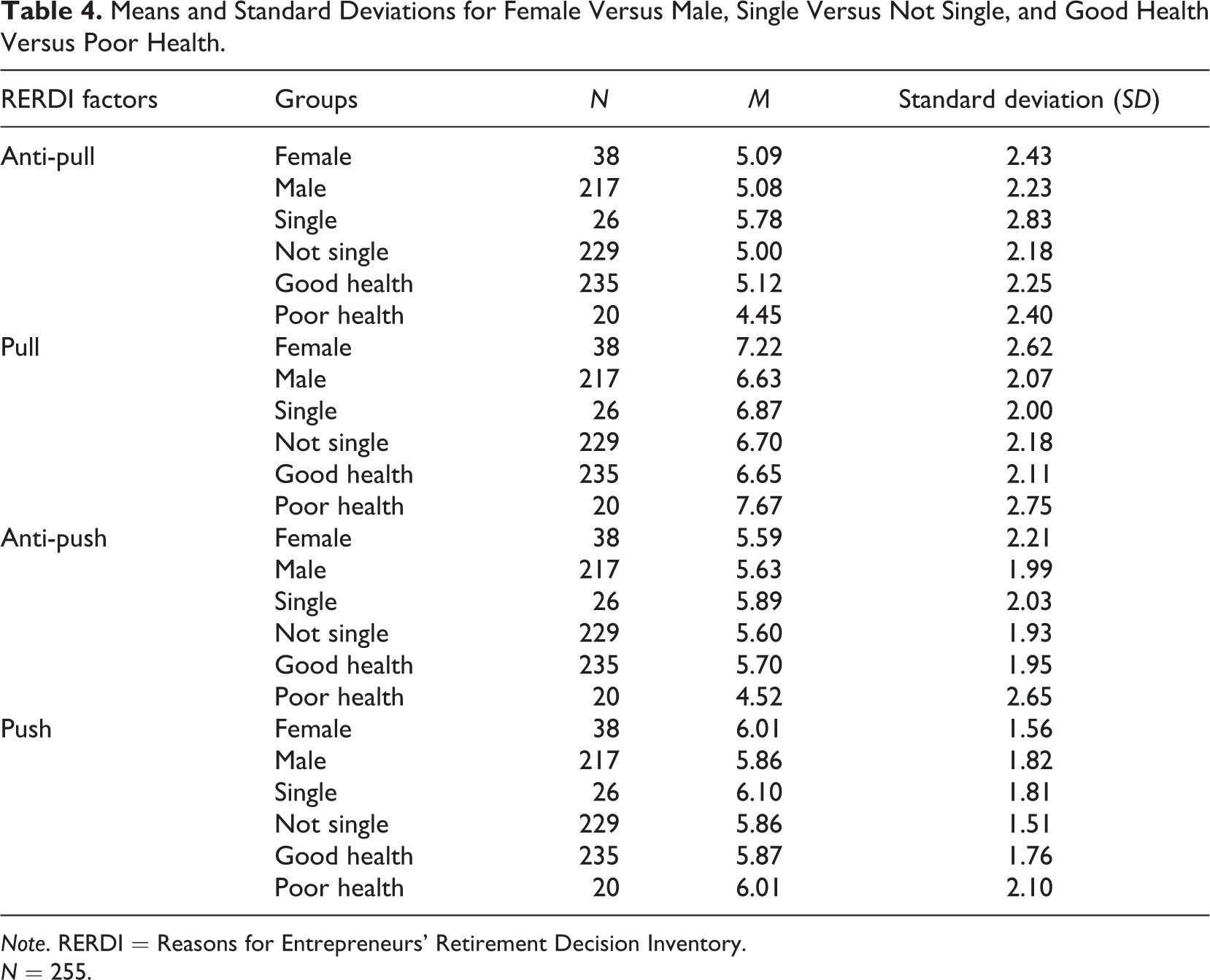
To explore the relationship between individual characteristics and the reasons for retirement decision process, four multivariate analyses of variance (MANOVAs) were conducted. The four RERDI subscales served as the dependent variables in each analysis and three personal variables (i.e., gender, marital status, and self-rated health) comprised the independent variables. Due to the limited size of our sample, self-rated health responses were merged into two classes (1 = excellent, very good, and good and 2 = poor and very poor). Results of the MANOVA with gender were statistically nonsignificant, F(4, 245) = .48, p = .74. Similarly, there was no effect of marital status (single vs. not single), F(4, 245) = .95, p = .43. Finally, results were statistically significant for self-rated health, F(4, 245) = 2.01, p < .01. A one-way analysis of variance (ANOVA) was conducted on each dependent variable as a follow-up to the MANOVA. The ANOVA results were all nonsignificant except for the anti-push subscale, F(1, 250) = 5.46, p < .05. Entrepreneurs with good self-rated health (M = 5.70) had higher scores on the anti-push subscale than those with poor self-rated health (M = 4.52; see Table 4).
Means and Standard Deviations for Female Versus Male, Single Versus Not Single, and Good Health Versus Poor Health.
Note. RERDI = Reasons for Entrepreneurs’ Retirement Decision Inventory.
N = 255.
To sum up, the results of Study 3 confirmed the four-factor structure of the RERDI. The RERDI’s convergent validity was partially established by its correlations with retirement anxiety and work engagement. Temporal stability was also confirmed.
General Discussion
The purpose of the present research was to fill an important gap in the research literature about retirement by developing a new short instrument specifically designed to assess the reasons of retirement decision process among entrepreneurs (i.e., the RERDI) based on the push pull anti-push anti-pull theoretical framework. Although the complexity of the retirement transition for this specific population has already been noted in the literature (Bonanno et al., 2008; Leroy et al., 2008), no other scale has been developed to appraise clearly the individual perceptions of these reasons.
Overall, the final 16-item version of the RERDI showed good psychometric qualities. The results of exploratory and confirmatory factor analyses clearly supported a four-factor solution corresponding to the four theoretically relevant dimensions: push, pull, anti-push, and anti-pull. The first factor (anti-pull) concerns the perceived difficulties and costs associated with postcareer life. The second factor (pull) corresponds to the positive aspects of retirement. The highest mean item score (for the item Once retired, being able to achieve my personal goals and projects) was observed on this factor, indicating that this reason was perceived as crucial in the retirement decision process for this population. And besides, it is widely accepted that achievement motivation is a prominent characteristic of entrepreneurs (Stewart & Roth, 2007). The third factor (anti-push) refers to the attachment to the entrepreneurial career. The last factor (push) involves negative views of the entrepreneur’s present life.
Our results also demonstrated the reliability and temporal stability of the RERDI’s subscales. However, convergent validity was only partially demonstrated. We hypothesized that the anti-pull and pull subscales would show, respectively, positive and negative correlations with retirement anxiety, and that the push and anti-push subscales would be negatively and positively correlated with work engagement, respectively. Consistent with previous research (Adams et al., 2002; Fletcher & Hansson, 1991), the results provided support for the convergent validity of the anti-pull and anti-push subscales, but, contrary to our expectations, the pull and push subscales did not correlate significantly with anxiety about retirement and work engagement, respectively. Hence, further research is needed to examine the convergent validity of the push and pull subscales in relation to similar constructs such as work amotivation (Gagné et al., 2010) and attitudes toward retirement (Anson, Antonovsky, Sagy, & Adler, 1989). Moreover, the administration of the RERDI should be associated with a social desirability scale in order to control this indicator. Finally, to complete the validation work, the discriminant validity of the RERDI should be examined.
In sum, apart from the need for further studies that always accompanies the development of any new measure, the RERDI seems to be a reliable, valid, and innovative research tool. It should help researchers to better understand the complexity of the perceptions of the reasons underlying entrepreneurs’ decisions to retire. Indeed, it provides a comprehensive view of how entrepreneurs oscillate between push pull anti-push and anti-pull factors, and could, for example, determine the comparative weight of these four dimensions in the retirement decision.
From a practical perspective, this new parsimonious questionnaire could be used in counseling situations to clarify a diagnosis when its use is combined with a thorough clinical interview. The RERDI could also help draw up appropriate intervention strategies and offer entrepreneurs psychological support with individual counseling. For instance, entrepreneurs with a RERDI profile characterized by many worries about their postcareer life would benefit from counseling targeted at reducing anxiety and anticipating their future life roles. Similarly, entrepreneurs approaching retirement age and who are still strongly committed to their work would benefit from counseling focused on developing new goals or establishing plans to enlarge their relationships with other people. The RERDI is the first validated instrument to provide practitioners with an overall view of the reasons, beyond the commonly used push and pull dimensions, which can lead entrepreneurs to end their career, and consequently help them prepare these professionals better for this final career transition. This instrument could thus prove to be of great value in research and practice.
Furthermore, this is the first study to explore the relationship between the pattern of reasons for retirement measured by the RERDI and a number of personal characteristics including gender, marital status, and self-rated health. The descriptive analysis showed no significant differences with regard to gender or marital status. Only a significant correlation between self-rated health and the anti-push subscale was observed. As mentioned above, there have been no relevant studies in the specific field of reasons of entrepreneurs’ decision to terminate their career based on the push pull anti-push anti-pull framework, and it is therefore difficult to interpret these results further. However, our findings indicate that the observation of a single aspect of the retirement process is not necessarily valid for a multifaceted approach of this process. Thus, while some previous studies have demonstrated that married people are more likely to consider retirement (Holtmann, Ullmann, Fronstin, & Longino, 1994), this individual variation in the global pattern of reasons for retirement was not noticed. This should encourage researchers aiming to develop a differentiated approach to the cognitive processes underlying the retirement decision not to limit their investigation to the determinants of the present situation or those of the future, but to identify the main antecedents of the complex combination of push pull, anti-push, and anti-pull factors. Another promising line of research could be to carry out a longitudinal study to provide an in-depth analysis of how entrepreneurs fluctuate between the four RERDI subscales during the retirement decision-making process, that is to say, whether the importance of each of the four RERDI subscales varies at different times of the retirement process, and whether this fluctuation depends on external or internal factors.
Despite these encouraging findings, our study has a number of limitations. First, although the samples used for these studies were adequate for the statistical tests, they were relatively small and were convenience rather than representative samples. Moreover, our samples only included French entrepreneurs, and while it was not the aim of the present research, the validation process of the RERDI would benefit from a cross-cultural examination of its structure and psychometric characteristics. Indeed, vocational development theories suggest that workers’ career aspirations in general and retirement decisions in particular can be influenced by the social context (Vondracek, Lerner, & Schulenberg, 1986).
Although, the validation process needs to be continued in future research, we hope that the use of the RERDI will contribute to a better understanding of the complex retirement decision process among entrepreneurs and thus add to the small body of research examining the many pathways leading to the postcareer in this population. Moreover, such a multifaceted tool could be interesting and useful for others professional groups.
Footnotes
Declaration of Conflicting Interests
The authors declared no potential research, authorship, and/or publication of this article.
Funding
The authors received no financial support for the research, authorship, and/or publication of this article.