



Abstract
This study compared the congruence between chosen occupation and vocational personality with the congruence between chosen occupation and parent’s occupation, investigating the effects of regulatory focus, career self-efficacy, and parental support. Gender differences were also explored. A sample of 260 undergraduate students completed questionnaires measuring their own and their parent’s vocational personality type, the quality of the parent–child relationship, and their own career self-efficacy and regulatory focus. Vocational congruence was calculated by C-index. The results show that regulatory focus of promotion and both low and high self-efficacy were related to a significantly higher level of congruence between chosen occupation and vocational personality than between chosen occupation and parent’s occupation. However, none of the variables was found to explain the level of congruence between vocational personality and chosen occupation, and no relationship was found between vocational congruence and satisfaction with the chosen profession. The findings indicate the importance of vocational inclinations over parental influence and personality traits in occupational choice. Theoretical and practical implications are discussed.
Keywords
The literature on occupational psychology contains extensive reference to parents’ influence over their children on both the theoretical (Gottfredson, 1981; Roe, 1956; Super, 1957) and empirical (Forfeli, Wang, & Hartung, 2008; Otto & Call, 1985) levels. Thus, for example, psychoanalyst Roe (1956) claimed that the relationship with the family plays an important role in the child’s professional development and that there is a great deal of parental influence on the child’s career choice. According to Roe, people raised by parents who provide protection, love, and warmth are likely to choose people-oriented service professions, whereas those who grew up in a nonloving home generally prefer object-oriented professions, such as science or engineering.
In contrast, Holland (1997) posited that vocational choice is mainly a function of vocational personality, defined as the stable and prominent components in an individual’s personality, which are expressed in both personal and social contexts. Holland proposed the Realistic, Investigative, Artistic, Social, Enterprising, Conventional (RIASEC) model, a hexagonal arrangement of six vocational personality types in which location in the hexagon is significant: The closer the types are to one another, the greater the psychological similarity and harmony between them.
RIASEC personality types can also serve to characterize occupations, on the assumption that people are drawn to professions that fit their personality. Based on the results of questionnaires administered to large samples in a wide variety of occupations, Gottfredson and Holland (1996) published a dictionary of the RIASEC personality types that characterize thousands of occupations. The personality found to best fit pilots, for instance, is RIE, that is, Realistic as the primary marker, along with Investigative and Enterprising. The level of compatibility between an individual’s personality and a given occupation is called congruence.
Congruence
Holland (1985a, 1997) claimed that professional satisfaction, diligence, and success depend on the congruence between an individual’s personality and their occupation or field of studies (see also, Spokane, Meir, & Catalano, 2000). Indeed, many studies have found that congruence is a significant factor that distinguishes those who persevere in their occupation over time from those who have changed, or want to change, occupations (Donohue, 2006; Meir, Esformes, & Friedland, 1994).
Several indices have been developed to compute level of congruence based on three-letter RIASEC codes (Brown & Gore, 1994; Camp & Chartrand, 1992; Young, Tokar, & Subich, 1998). The current study chose to employ Index C (Brown & Gore, 1994), as it is consistent with Holland’s theory and was indeed recommended by him (Holland, 1997). Moreover, it is easy to apply, is very commonly used, and is sensitive to the location of the codes in the hexagon (Miller, Wells, Springer, & Cowger, 2003).
The Development of Vocational Personality
Although Holland did not directly discuss the process by which vocational personality emerges (Holland, 1997), he claimed that it is created when young people become aware of their skills, develop abilities and talents that fit these skills, and consequently begin to understand their inherent wishes and preferences. In addition, he argued that parents influence the development of vocational personality by means of their parenting style, actions, and choice of friends, and tend to create environments that encourage and develop patterns in their children that are similar to their own. In fact, the more similar children are to their parents, the more they are rewarded (Holland, 1973). These assertions have been supported by numerous studies (DeWinne, Overton, & Schneider, 1978; Grandy & Stahman, 1974; Helwig, 1984; Miller, 1994; Miller et al., 2003).
Parents’ Influence on Occupational Development
In a review of the literature on the parenting factors that affect their offspring’s vocational development, Bryant, Zvonkovic, and Reynolds (2006) found that parents may influence their children throughout the process, helping them to discover and develop knowledge-seeking desires and abilities, construct beliefs and values about the work market and existing professions, examine tendencies toward specific professions, formulate academic aspirations, and finally, choose a satisfactory occupation. Moreover, their emotional support can help reduce the stress and mental pressure associated with the process of occupational choice (Blustein, Preszioso, & Schultheiss, 1995).
Two highly significant issues stand out in the literature (Bryant, Zvonkovic, & Reynolds, 2006): the quality of the parent–child relationship and the child’s sense of self-efficacy. The current study examined the impact of these two factors on vocational development.
Quality of the Parent–Child Relationship
Numerous studies have shown that adolescents’ career development, including tasks such as exploration, decision making, commitment to an occupation, and sense of self-efficacy to achieve their chosen career and make a career plan (Erikson, 1963; Super, Savickas, & Super, 1996), may be affected by the quality of the adolescent–parent relationship (Fisher, 1999; Ketterson & Blustein, 1997; O’Brien, 1996; Scott & Church, 2001; Tracey, Lent, Brown, Soresi, & Nota, 2006; Vignoli, Croity-Belz, Chapeland, de Fillipis, & Garcia, 2005). For example, it was found that the closer children feel to their parents and the better their relationship, the easier it is for them to make career-related decisions (Emmanuelle, 2009). Supportive parents who express confidence in their child’s abilities have been shown to help the child to engage in career exploration activities (Kracke & Noack, 2005), adapt better to academic life (Cutrona, Cole, Colangelo, Assouline, & Russell, 1994), and positively affect their offspring’s coping with the acquisition of skills that reduce stress at university (Walker & Satterwhite, 2002).
Consequently, in order to explore the quality of the parent–child relationship and its contribution to career choice, the current study employed the variable of parental support, defined as explicit behaviors by parents toward their child which make the child feel comfortable around them and reinforce the child’s perception that they are accepted and loved by the parents (Rollins & Thomas, 1979). In the context of the present investigation, it relates to parents’ assistance in developing career-related skills, serving as a model of career-related behaviors, praise and encouragement for education and career development, and support for the feelings expressed by adolescents in regard to these issues.
Self-Efficacy
Career self-efficacy is defined as one’s perceived sense of confidence in performing tasks associated with career exploration and choice, such as self-exploration, professional search, and questioning of others (Solberg, Good, & Nord, 1994). Studies have found that low self-efficacy is linked to indecision in choosing an occupation, as expressed by switching study majors and difficulty developing a clear professional identity (Betz & Hackett, 1981).
Parents may play an important role in the development of their child’s career self-efficacy, as they have been found to be the adolescent’s primary source of modeling and verbal persuasion (Bandura, 1982). Moreover, low expectations on the part of the parents can result in low self-expectations in the child (Eccles, 1994). Indeed, research has found that parents’ perceptions of their children’s abilities are better predictors of the children’s perceived self-efficacy than their actual successes (Lapan, 2004). On the other hand, a perception of family support as accessible has been shown to be related to children’s subsequent adult self-efficacy and intention to persevere in the face of difficulties in college (Torres & Solberg, 2001). Thus, by strengthening their children’s belief in themselves and supporting their academic achievements and occupational wishes, parents can help enhance their sense of career self-efficacy.
Self-Regulation
According to Higgins (1997, 1998), there are two basic types of self-regulation: promotion focus and prevention focus. People characterized by promotion focus are motivated by a need for growth, are achievement oriented, and have a long-term perspective. They therefore adopt a strategy of progress in an attempt to achieve desired goals and goal achievement invokes joy and satisfaction. In contrast, people characterized by prevention focus are motivated by a need for security, try to preserve what they have, are sensitive to social pressure, and have a short-term perspective. Their behavior is therefore conservative and cautious, and they tend to invest effort in a goal only if it is defined as obligatory or is easy to achieve (Liberman, Idson, Camacho, & Higgins, 1999).
In line with this analysis, Oren (2004) found that people characterized by promotion focus tend to choose occupations that afford them a sense of self-fulfillment, challenge, and autonomy, whereas those characterized by prevention focus are more likely to choose occupations that provide them with security and stability. This suggests that the students in our sample who display promotion focus would be apt to choose a profession high in congruence with their vocational personality, rather than with their parents’ occupations, in a desire for self-fulfillment. In contrast, students characterized by prevention focus would tend to choose a profession relatively high in congruence with their parents’ occupations in their search for security.
Hypotheses
On the basis of the literature, the following hypotheses were formulated:
Method
Participants
The sample consisted of 260 undergraduate students in a college that trains students for a specific occupation, such as physiotherapy, social work, or civil engineering. Of these, 47.3% were men and 52.7% were women. Most of the participants (69.2%) were single. Age ranged from 19 to 38, with a mean age of 24.48 (SD = 3.01). Mean years of education were 13.53 (SD = 1.48).
Instruments
Holland’s Vocational Personality Types Questionnaire was used to determine both parents’ and students’ personality type. In respect to the parents, the students were asked to answer the following question: “Please indicate your father’s and your mother’s occupation. If one of the parents is currently unemployed or retired, please indicate their last occupation.” The parents’ occupations, as reported by the student, were located in the Dictionary of Holland’s Occupational Codes (Gottfredson & Holland, 1996), and the appropriate three-letter vocational personality code was noted. If a certain occupation was not found, the code for a similar occupation was used.
The participant’s vocational personality was measured by means of the Self-Directed Search (SDS) questionnaire (Holland, 1994). SDS is a self-reporting instrument containing three sections: activities (e.g., “I like to fix electrical home appliances”), competencies (e.g., “I can draw and paint with water colors”), and occupations (e.g., “Banker”). Each section consists of six scales based on Holland’s six vocational personality types (RIASEC). Participants were asked to respond to each item by marking yes or no.
A “yes” response was scored as 1 point, and a “no” response as 0. The points for each of the six personality types were totaled to obtain a general score for each type. For instance, the total points of the three scales (activities, competencies, and occupations) of R (Realistic) created the final score of that personality type. The participant’s vocational personality type was defined as the three-letter code representing the three types on which he or she scored highest, in descending order. The questionnaire’s inner consistency, as reported by Holland, is α = .7 to .89 (Holland, 1985b).
Finally, the three-letter code representing the student’s field of studies and/or expected future profession was located in the Dictionary of Holland’s Occupational Codes (Gottfredson & Holland, 1996). If a certain occupation was not found, the code for a similar occupation was used.
The Career-Related Parent Support scale (Turner, Alliman-Brissett, Lapan, Udipi, & Ergun, 2003) was employed to assess the quality of the parent–child relationship. The questionnaire consists of 27 items in four subscales consistent with Bandura’s (1997) four sources of self-efficacy: instrumental assistance, that is, parental support in developing career-related skills among their adolescents, 7 items (e.g., My parents teach me things that I can use in my work in the future); career-related modeling, 7 items (e.g., My parents tell me things that happen to them at work); verbal encouragement, that is, parental praise and encouragement for education and career-related issues, 6 items (e.g., My parents told me they expect me to complete my studies); and emotional support, that is, parental support for feelings expressed by their offspring concerning education and career development, 7 items (e.g., My parents talk to me when I’m worried about my future career).
The students were asked to mark their responses on a 6-point Likert-type scale ranging from 1 (strongly disagree) to 6 (strongly agree), with higher scores indicating greater parental support. Internal consistency of the four scales ranged between α = .78 and α = .85, and was α = .83 for the scale as a whole.
The Career Decision-Making Self-Efficacy scale (Betz & Taylor, 2001) was used to assess the participant’s perception of self-efficacy in making career choices. The questionnaire consists of 25 items, 5 in each of five subscales: goal selection (e.g., “To make a career-related decision and not be worried if it was right or wrong”); occupational information (e.g., “To find information in the library about occupations that interest me”); problem solving (e.g., “To persevere in my educational or occupational goal even if I feel frustrated”); planning (e.g., “To plan my goal for the next five years”); and self-appraisal (e.g., “To evaluate my competencies accurately”). Participants were asked to rate how confident they are that they could perform the task in each item on a 6-point Likert-type scale ranging from 1 (no confidence at all that I could) to 6 (complete confidence that I could), with higher scores indicating a greater sense of career self-efficacy. The internal consistency of the five scales ranges between α = .78 and α = .87, and is α = .94 for the scale as a whole (Betz, Hammond, & Multon, 2005).
The Schwartz’s Portrait Questionnaire (Schwartz, Lehmann, & Roccas, 1999) was used to measure regulatory focus, with 6 items indicative of promotion focus and 8 items of prevention focus. Participants were asked to rate the degree to which the statement in each item is descriptive of them, marking their responses on a 6-point Likert-type scale ranging from 1 (not at all like me) to 6 (very much like me). The internal consistency of the scale is α = .78.
The following two scales were employed to partial out the affect of contaminating variables and obtain better validity and reliability.
The Marlowe–Crowne Social Desirability scale, which measures the tendency of respondents to answer questions in a manner that will be viewed favorably by others (Reynolds, 1982), was devised by Crowne and Marlowe (1964) and adapted and validated by Ben-Zur (1999), and has been used in numerous studies of occupational choice (e.g., Meurs, Gallagher, & Perrewé, 2010; Sanz-Vergel, Demerouti, Moreno-Jiménez, & Mayo, 2010). The scale consists of 8 items relating to personal attitudes, and participants are asked to indicate whether they consider each item true (scored 1) or false (scored 0). Each participant was assigned a social desirability score equal to the sum of his or her answers, with higher scores indicating a greater tendency toward social desirability. The internal consistency of the questionnaire is α = .88 (Crowne & Marlowe, 1964).
Positive and Negative Affectivity scale (Watson, Clark, & Tellegen, 1988), a 12-item questionnaire measuring the dimensions of negative (6 items) and positive (6 items) afffectivity, has also been employed in previous studies of occupational choice (Bacharach, Bamberger, Biron, & Horowitz-Rozen, 2008; Bajor & Baltes, 2003; Bright, Pryor, & Harpham, 2005). Participants were asked to indicate the degree to which each item described their present mood. The internal consistency for positive affect is α = .86, and for negative affect, α = .84 (Watson et al., 1988).
A demographic questionnaire was administered to obtain information such as age, education, and economic status.
C-index (Brown & Gore, 1994) was used to calculate congruence between personality type and chosen occupation. The formula for C-index is C = 3(X) + 2(X) + (X), where X is a number between 0 and 3 representing the distance in Holland’s hexagon between the three letters in the two RIASEC codes. Specifically, 3 = identical individual and occupation letters, 2 = adjacent letters, 1 = alternate letters, and 0 = opposite hexagonal letters. C can therefore range from 0 to 18, with higher scores indicating higher levels of congruence.
Results
In the first stage of analysis, correlations were calculated between the study variables and the three measures of congruence, that is, congruence between the student’s chosen occupation and either their own vocational personality, their father’s occupation, or their mother’s occupation. The results appear in Table 1.
Pearson Correlations Between the Three Congruence Measures and Self-Efficacy, Parental Support (Mother/Father), and Self-Regulatory Focus (Promotion/Prevention).

Note. *p < .005. **p < .01.
As Table 1 shows, congruence between chosen occupation and vocational personality was found to correlate positively with self-efficacy, so that the higher the self-efficacy, the greater the congruence. A positive correlation was also found between parental support from one of the parents and the choice of that parent’s occupation. This correlation was higher for the mother than for the father. In addition, the demographic variable of economic status correlated positively with vocational congruence, and the control variable of negative affect correlated negatively with this measure of congruence.
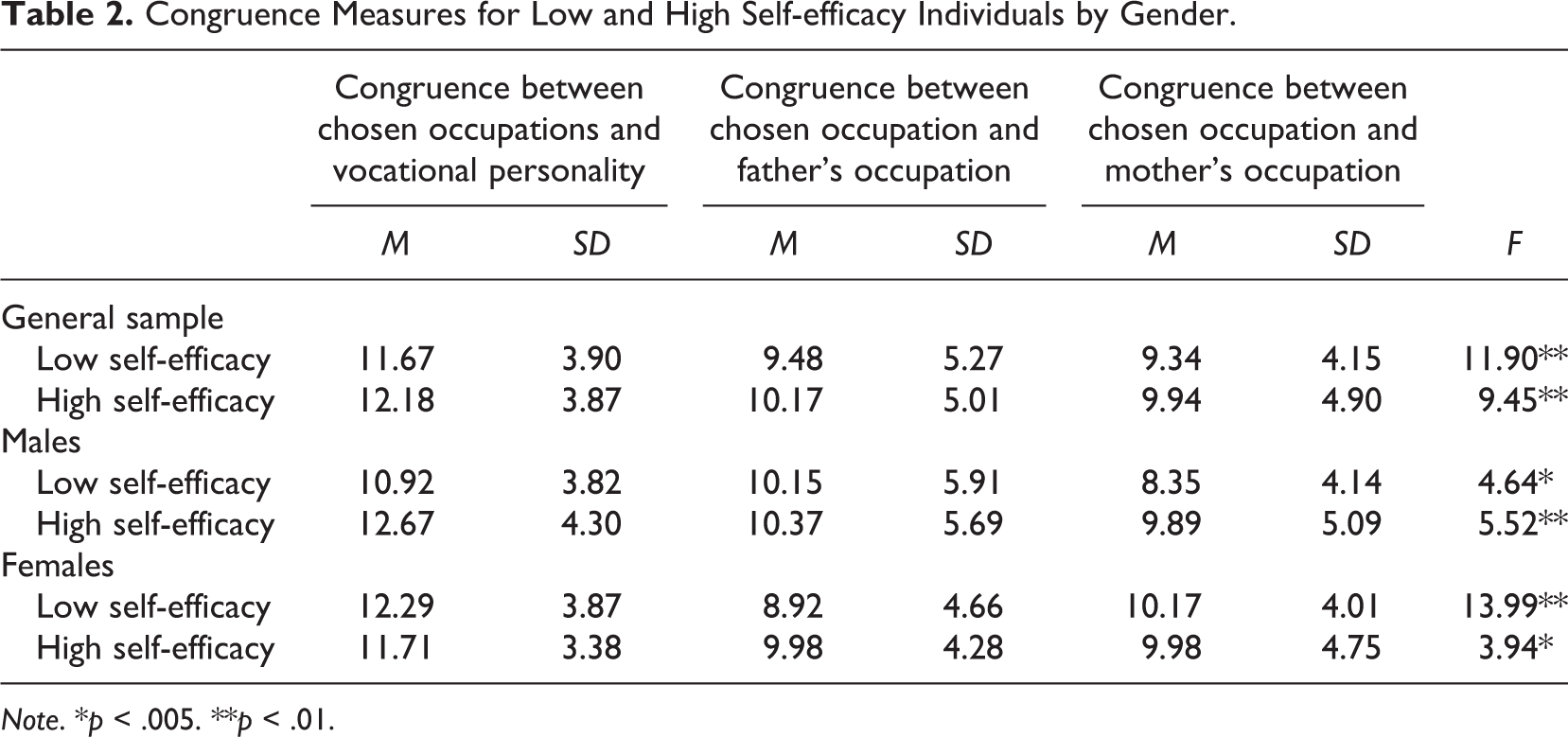
Hypothesis 1 predicted that among students high on career self-efficacy, the highest levels of congruence would be found on the measure of chosen occupation and vocational personality whereas low self-efficacy participants would show higher congruence between chosen occupation and parents’ occupations. To examine this hypothesis, repeated within-subject measures analysis of variance were conducted. The analysis was also performed separately for males and females. The results are displayed in Table 2.
Congruence Measures for Low and High Self-efficacy Individuals by Gender.
Note. *p < .005. **p < .01.
As can be seen from Table 2, Hypothesis 1 was confirmed only in part. As expected, the level of congruence between chosen occupation and vocational type was found to be significantly higher than the congruence between chosen occupation and either of the parent’s occupations for individuals high on self-efficacy, F(2, 254) = 9.45, p < .01. However, contrary to expectation, the same pattern was also found for those low on self-efficacy, F(2, 262) = 11.90, p < .01.
In respect to gender, differences were found between the three congruence measures for all four groups: low self-efficacy males, F(2, 118) = 4.64, p < .05, and females, F(2, 142) = 13.99, p < .01; and high self-efficacy males, F(2, 124) = 5.52, p < .01, and females, F(2, 128) = 3.94, p < .05. Women with both low and high self-efficacy exhibited a significantly higher level of congruence between chosen occupation and vocational personality than between chosen occupation and either parent’s occupation. The same was found for high self-efficacy men. In contrast, while low self-efficacy men exhibited a significantly higher level of congruence between chosen occupation and vocational personality than between chosen occupation and mother’s occupation, no similar significant difference was found in regard to congruence with father’s occupation.
Next, a multivariate analysis of variance was performed to examine whether a difference would emerge between high and low self-efficacy participants in the level of congruence between chosen occupation and personality type for either gender. The results indicate a significant difference among men, so that high self-efficacy males are more congruent than those low on self-efficacy. No significant difference was found for women.
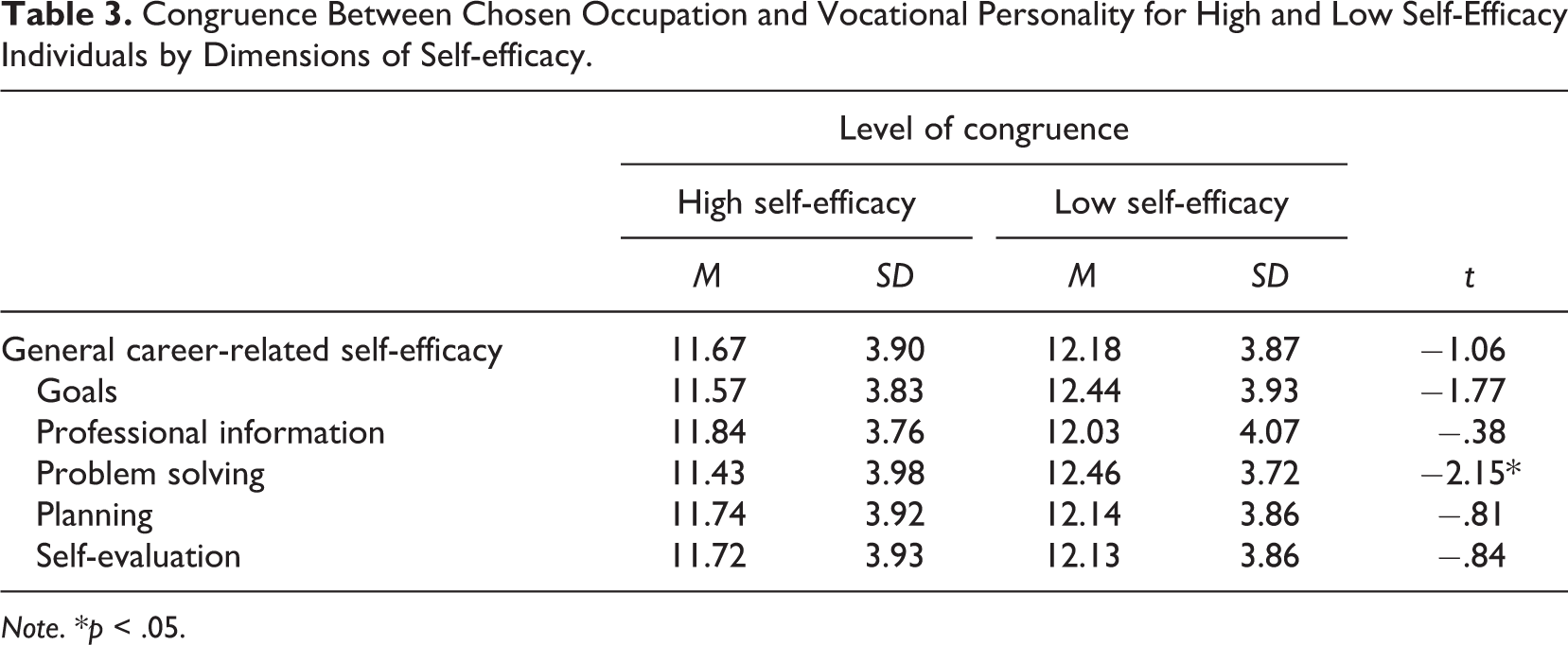
Finally, a t-test for independent samples was performed to examine congruence differences between chosen occupation and vocational personality between participants high and low on specific dimensions of career self-efficacy (using the median). The findings appear in Table 3.
Congruence Between Chosen Occupation and Vocational Personality for High and Low Self-Efficacy Individuals by Dimensions of Self-efficacy.
Note. *p < .05.
As Table 3 indicates, a significant difference was found only for problem solving. Individuals confident in their ability to solve problems and persevere in their professional goals displayed a higher level of congruence between chosen occupation and vocational personality than those low on this dimension.
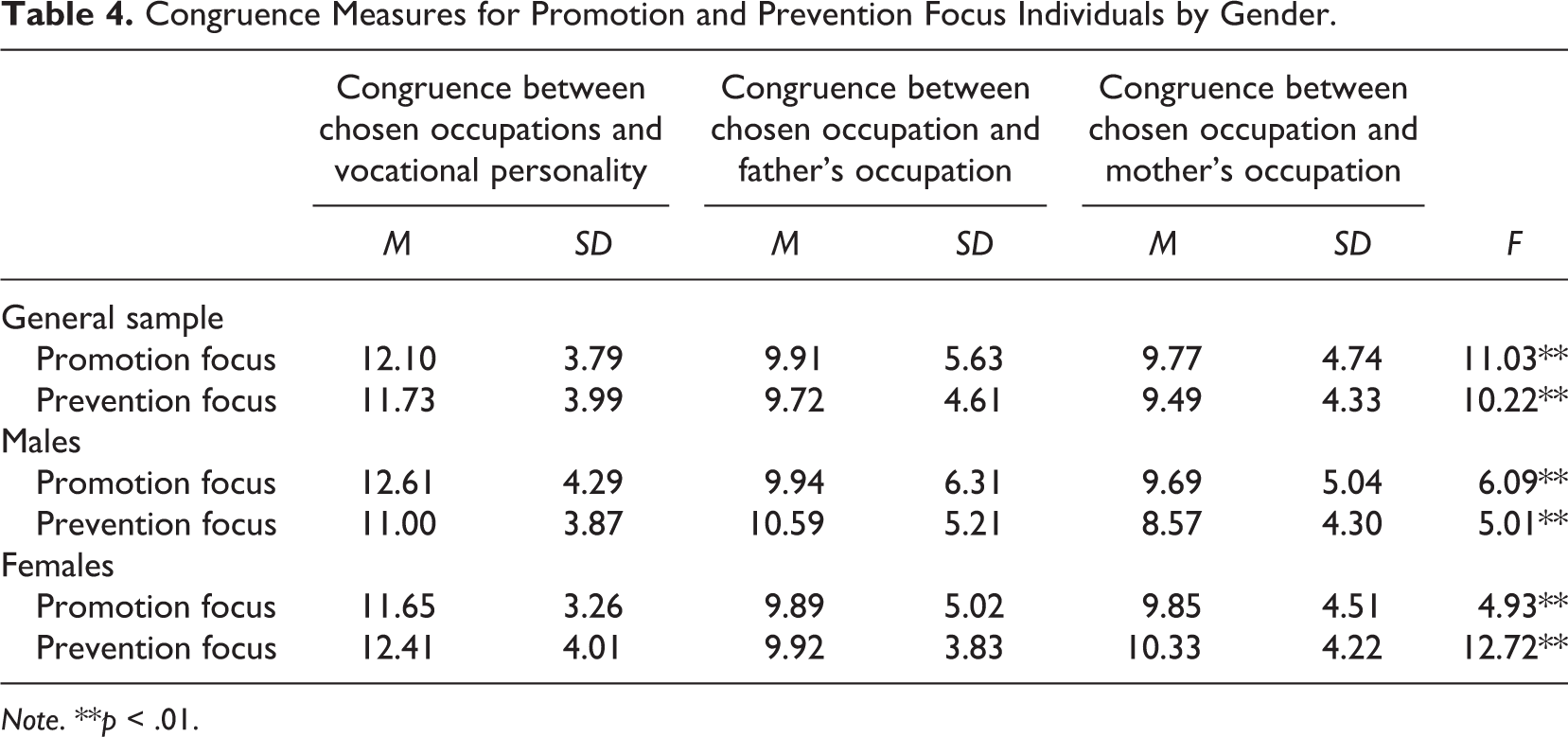
In the next stage of analysis, repeated within-subject measures were conducted to examine Hypothesis 2, predicting that chosen occupation would be more congruent with vocational personality than with parents’ occupations among students characterized by promotion focus, and the opposite pattern would emerge among those displaying prevention focus. Separate analyses were again performed for males and females. The findings are shown in Table 4.
Congruence Measures for Promotion and Prevention Focus Individuals by Gender.
Note. **p < .01.
As can be seen from Table 4, Hypothesis 2 was also confirmed only in part. The level of congruence between chosen occupation and vocational personality was significantly higher than the congruence between chosen occupation and either of the parent’s occupations among individuals characterized by promotion focus, F(2, 264) = 11.03, p < .01, as predicted, but, contrary to expectations, also among those characterized by prevention focus, F(2, 252) = 10.22, p < .01.
In respect to gender, differences were found between the three congruence measures for all four groups: promotion focus males, F(2, 122) = 6.09, p < .01, and females, F(2, 140) = 4.93, p < .01; and prevention focus males, F(2, 120) = 5.01, p < .01, and females, F(2, 130) = 12.72, p < .01. Men and women characterized by promotion focus exhibited a significantly higher level of congruence between chosen occupation and vocational personality than between chosen occupation and either parent’s occupation. The same was found for women with promotion focus. In contrast, while men characterized by prevention focus exhibited a significantly higher level of congruence between chosen occupation and vocational personality than between chosen occupation and mother’s occupation, no similar significant difference was found in regard to congruence with father’s occupation.
Finally, a t-test for independent samples was conducted to examine whether a difference would emerge for either gender between prevention and promotion focus individuals in the level of congruence of any of the three congruence measures. The results indicate a difference only for men, with the level of congruence between chosen occupation and vocational personality higher among males characterized by promotion focus than among those displaying prevention focus.
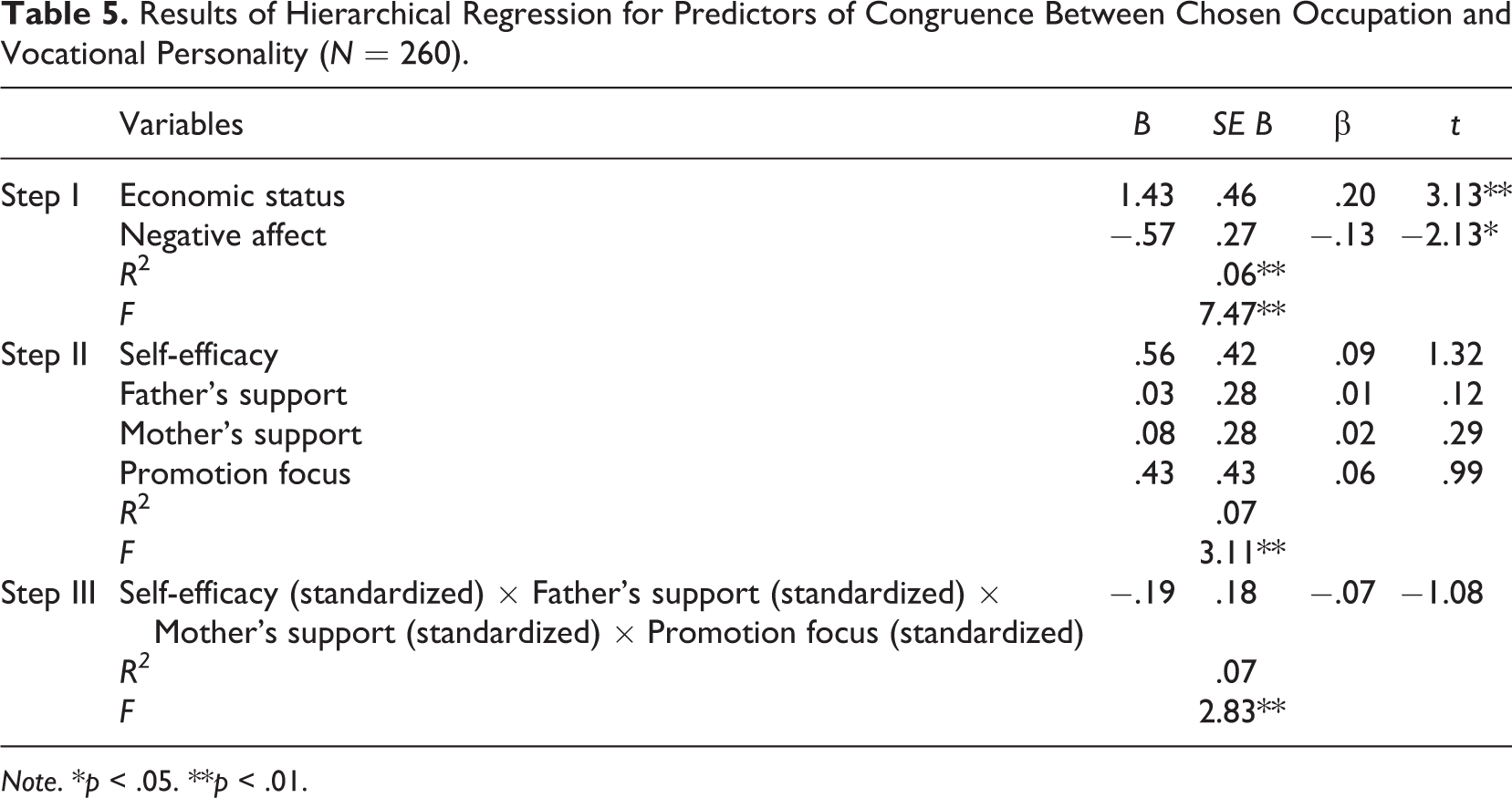
Hypothesis 3 predicted higher congruence between chosen occupation and vocational personality among individuals high on promotion focus, self-efficacy, and parental support, as compared to those low on these three variables. A hierarchical regression was performed to examine this hypothesis. The demographic and control variables correlating significantly with the level of congruence between chosen occupation and vocational personality were entered in Step 1. The variables of promotion focus, self-efficacy, and parental support (father and mother) were entered in Step 2, and the cross-product term of these variables (representing a three-way interaction) in Step 3. The results are presented in Table 5.
Results of Hierarchical Regression for Predictors of Congruence Between Chosen Occupation and Vocational Personality (N = 260).
Note. *p < .05. **p < .01.
As Table 5 reveals, Step 1 explained 5.5% of the variance in congruence between chosen occupation and vocational personality, F Change (2, 257) = 7.47, p < .01, with economic status and negative affect yielding a significant effect. Individuals reporting high economic status (M = 13.31, SD = 3.77) displayed higher congruence than those indicating low economic status (M = 10.43, SD = 3.79), and self-reported negative affect was associated with a lower level of congruence. Step 2 did not prove to be significant, F Change (4, 253) = 0.94, p > .05, explaining only 1.4% of the variance in congruence, with none of the variables individually found to predict congruence. Nor was Step 3 significant, F Change (1, 252) = 1.16, p > .05, explaining a mere 0.4% of the variance in congruence between the student’s chosen occupation and vocational personality. In addition, no interaction was found between the variables. Thus, the regression indicated that the level of congruence between chosen occupation and vocational personality cannot be explained by the variables of self-regulation focus, self-efficacy, or parental support.
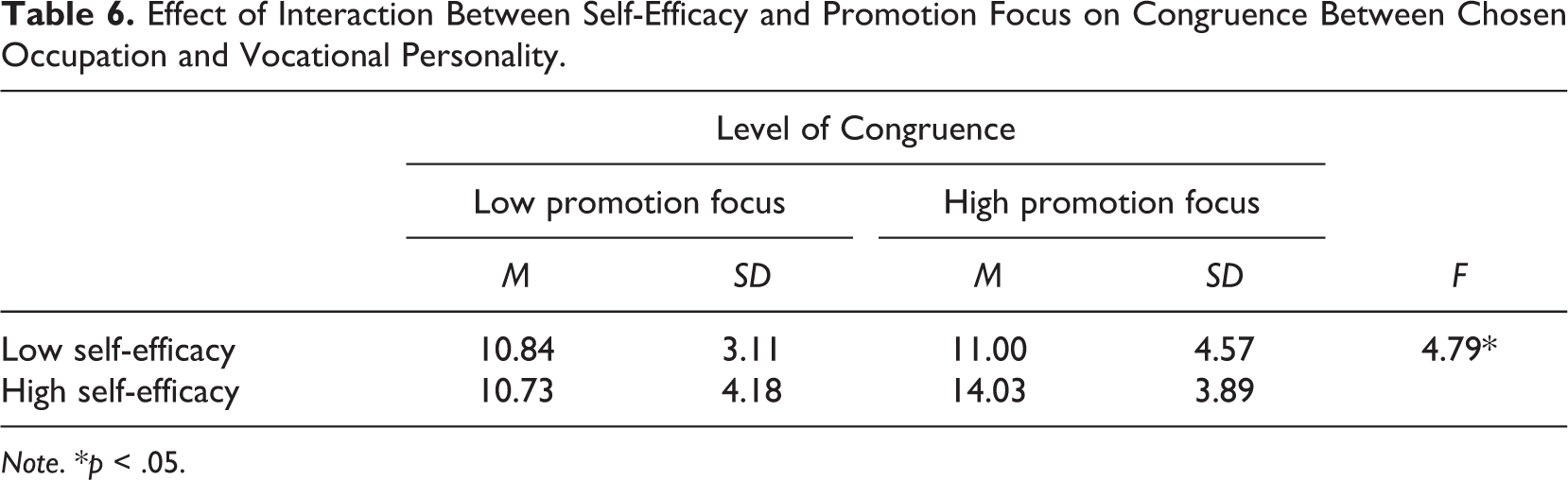
To examine gender differences, a two-way analysis of variance was performed separately for each gender. Table 6 presents the results of this analysis.
Effect of Interaction Between Self-Efficacy and Promotion Focus on Congruence Between Chosen Occupation and Vocational Personality.
Note. *p < .05.
As can be seen from Table 6, no differences were found for females. Among men, however, a difference in congruence was found between high and low self-efficacy individuals, F(1, 119) = 4.13, p < .05, so that those high on self-efficacy (M = 12.67, SD = 4.30) exhibited higher congruence between chosen occupation and vocational personality than those low on this trait (M = 10.92, SD = 3.82). A difference in congruence was also found between men characterized by high and low promotion focus, F(1, 119) = 5.80, p < .05, with those displaying high promotion focus (M = 12.51, SD = 0.49) exhibiting higher congruence than those low on promotion focus (M = 10.78, SD = 0.52). Finally, an interaction was found between self-efficacy and promotion focus, F(1, 119) = 4.79, p < .05; higher congruence was found for individuals scoring high on both variables.
Hypothesis 4, relating to the connection between type of congruence and occupational satisfaction, was examined by means of Pearson correlations. No significant correlations were found between satisfaction and any of the three congruence measures: congruence between chosen occupation and vocational personality (r = −.01, p > .05), father’s occupation (r = .02, p > .05), or mother’s (r = −.02, p > .05) occupation. When these correlations were again calculated separately for students who had switched majors, they similarly proved to be insignificant.
Finally, t-tests for independent samples were conducted to examine whether differences in satisfaction with chosen occupation would emerge between students who had and had not switched majors. This analysis yielded no significant differences, t = −.55, df = 258, p > .05. Further t-tests examining differences in congruence between chosen occupation and vocational personality among these two groups of students indicated higher congruence for those who switched majors (M = 12.58, SD = 3.12) than for those who did not (M = 11.83, SD = 3.97), but the difference was not significant, t = −1.01, df = 258, p > .05.
Discussion
Choosing the right profession requires consideration of a great number of factors. The current study sought to examine what part the personality traits of self-efficacy and self-regulation and the external support of parents play in making this decision.
We expected individuals high on all three variables to display a higher level of congruence between chosen occupation and vocational personality than between chosen occupation and parents’ occupations. These predictions were confirmed only in part. Chosen occupation was more congruent with vocational personality for all participants. In addition, no effect was found for any of the variables on the level of this measure of congruence.
The findings suggest that the first consideration when choosing an occupation is congruence with professional–occupational tendencies (Holland, 1997), while personality traits, important though they may be, take second place. Thus, by and large, even individuals with a low perception of self-efficacy, or those characterized by prevention focus, appear to prefer to follow their own occupational inclinations. Such people might believe that attraction to a certain profession may be translated into motivation and perseverance, thereby compensating for, or even improving, personal traits, such as a lack of self-confidence.
The importance of choosing an occupation that is congruent with the individual’s professional inclinations has been discussed extensively. Holland (1997) claimed that satisfaction, perseverance, and professional success depend on this congruence, and others argue that the level of congruence affects the individual’s mental well-being (Meir, 1989). Indeed, the concept of congruence is so fundamental that it might be perceived as “common sense.” This belief may persuade individuals to choose a profession that is first and foremost in line with their occupational inclinations, beyond personality traits or parents’ occupations.
The distinction found here between the role of general personality traits and occupational inclinations in occupational choice is in line with Barrick, Mount, and Gupta (2003), who argue that these are two parallel, but not interchangeable, models for classifying personality. In fact, both the five-factor model of personality traits and Holland’s (1973, 1985a, 1997) RIASEC model of vocational personality have served as the basis of studies of interpersonal differences and work-related results. Although their focal points are different, it is obvious that personality traits and vocational inclinations are related constructs. Holland (1978) himself claimed that vocational preferences could be another aspect of personality traits. Nevertheless, the focus on the occupational implications of personality appears to be of primary importance in predicting occupational congruence. This conclusion is supported by the finding that congruence between chosen occupation and vocational personality is higher than congruence between chosen occupation and either parent’s occupation, beyond the effect of other seemingly relevant personality traits.
Several limitations of the study should be noted. First, it relied solely on self-reports, which might evoke an “acquiescence” response whereby participants might tend to agree or disagree with a statement without really considering its content. A second drawback of self-report questionnaires is what is known as extreme and moderate response style. That is, the participant might be inclined to answer a certain portion of the questionnaire consistently at the middle or either end of the scale. In addition, self-reports are more prone than other tests to a social desirability bias and may be more affected by the respondent’s mood at the time (affectivity bias). Although social desirability and positive and negative affectivity instruments were employed in the current study in an attempt to factor out these biases, the possibility that they may have affected the results cannot be entirely ignored.
Furthermore, the study did not examine parameters indicating the quality of occupational choice, such as job perseverance or success. Future studies investigating the variable of quality might help to clarify the long-term implications of the current findings. In addition, some of the variables examined here (e.g., satisfaction with chosen occupation) were measured by means of a single statement in order to keep the questionnaire to a reasonable length. This issue has been addressed in previous studies (e.g., Judge, Ilies, & Dimotakis, 2010). A further limitation relates to the cross-sectional design of the study, which reveals relationships between variables but does not allow for conclusions regarding causality. For example, it is impossible to know whether students who chose their father’s occupation did so because they perceived it to be prestigious or whether the occupation was perceived as prestigious after it was chosen. Moreover, the study defined chosen occupation as the participant’s course of studies rather than his or her job. Accordingly, factors not considered here, such as pay and accessibility, might affect the eventual choice of actual occupation, with obvious implications for congruence. Finally, the three-letter vocational personality code may be problematic for a number of reasons (Arnold, 2004). First, three-letter codes may not sufficiently differentiate between individuals. While the code represents the order of the letters, it does reflect the size of the gaps between them. Moreover, two people with identical codes could have obtained very different scores on the various dimensions. Second, the three letters receiving the lowest scores are ignored when determining the three-letter code, although it is possible that the difference between the third and fourth letters is quite small, and perhaps even smaller than the differences between the letters included in the code.
Implications of the Study
The findings of this study stress the importance of vocational personality over other personality traits and the influence of family relations in occupational choice. On the practical level, this understanding could help professionals, such as guidance counselors, to better comprehend the factors affecting occupational choice. In view of the results, for example, the counselor might choose to help students examine the family pressures on them. Awareness of these pressures could help young people to focus on a more balanced consideration of their options. Such an approach could aid in improving the quality of their occupational choice and minimizing the potential for dropout due to incompatibility.
Footnotes
Declaration of Conflicting Interests
The author(s) declared no potential conflicts of interest with respect to the research, authorship, and/or publication of this article.
Funding
The author(s) received no financial support for the research, authorship, and/or publication of this article.