



Abstract
This study analyzed the role of working alliance in individual career counseling. The level of career decision difficulties and satisfaction with life of 188 clients was assessed at the beginning and at the end of career counseling. Clients’ perceived working alliance was assessed after the third session, and their satisfaction with the intervention (SWI) was assessed at the end of the intervention. Results showed that working alliance (1) moderated the decrease of lack of career information, (2) predicted SWI, and (3) played a mediator role in the decrease of inconsistent career information. The study confirmed the importance of relational factors in career counseling, particularly of the client–counselor agreement about intervention goals and tasks.
Keywords
Career counseling is considered a particular type of personal counseling, adopting intervention methods, and techniques adapted to clients who present career-oriented demands (Gysbers, Heppner, & Johnston, 2009). Therefore, there is a need to examine its specific effectiveness in terms of outcomes and also to identify the process variables influencing these outcomes. Several authors point out the need to reinforce the bidirectional connections between research and field, for example, to gather data to help counselors work more effectively with their clients (Bernes, Bardick, & Orr, 2007). In this sense, a central question emerging from the literature is the role that relational factors, such as working alliance, may play in the career counseling process (Whiston & Rahardja, 2008). While relational aspects have been proven to influence psychotherapy and personal counseling (Horvath, 2005), their importance in career counseling has not been clearly articulated.
Meta-analyses have pointed out that career counseling is moderately effective, with mean effect sizes varying between .30 and .50 (Brown & Ryan Krane, 2000; Whiston, Sexton, & Lasoff, 1998). These analyses also stress that face-to-face career counseling is a particularly effective intervention modality. Career counseling seems to positively influence both career-specific outcomes and more general outcomes (Masdonati, Massoudi, & Rossier, 2009). Career indecision is a popular career-specific indicator of the effectiveness of career counseling. It is defined as the “inability to make a decision about the vocation one wishes to pursue” (Guay, Senécal, Gauthier, & Fernet, 2003, p. 165). Authors make a distinction between undecideness, or developmental indecision, and indecisiveness, also called chronic indecision (Brown & Rector, 2008; Guay, Ratelle, Senécal, Larose, & Deschênes, 2006). According to Gati, Krausz, and Osipow (1996), career indecision may be explained by three categories of decision difficulties: lack of readiness to make a decision, lack of information, and inconsistent information about decisional issues. Satisfaction with life may be considered a general outcome of career counseling. Actually, life satisfaction often correlates with domain-specific satisfaction, like career satisfaction (Lent et al., 2005; Lounsbury, Park, Sundstrom, Williamson, & Pemberton, 2004). Life satisfaction is defined as the result of the comparison between self-imposed standards and actual life conditions (Diener, Emmons, Larsen, & Grifffin, 1985; Pavot & Diener, 1993).
Authors have identified a lack of knowledge concerning the processes leading to effective career counseling (Multon, Ellis-Kalton, Heppner, & Gysbers, 2003). Whiston and Rahardja (2008) point toward the need to explore in greater depth the influence of clients’ characteristics and client–counselor relational aspects on career counseling outcomes. The latter may be operationalized using the construct of working alliance (Castonguay, Constantino, & Grosse Holtforth, 2006; Gelso & Samstag, 2008). According to Bordin (1979), three components define working alliance: counselor–client agreement about the goals of counseling or therapy; their agreement about the tasks leading to these goals; and the emotional bond between them. For about 35 years, working alliance has been considered a fundamental variable influencing both psychotherapy and personal counseling effectiveness (Castonguay et al., 2006; Duff & Bedi, 2010; Horvath, 2005; Martin, Garske, & Davis, 2000). Research has also found that clients and counselors perceive levels of working alliance differently, with clients’ ratings showing greater consistency, reliability, and ability to predict intervention outputs (Elad-Strenger & Littman-Ovadia, 2012; Fitzpatrick, Iwakabe, & Stalikas, 2005; Horvath, 2005). It is also stressed that assessing working alliance early in the intervention process is adequate to establish a relationship between alliance and outcomes (Gelso & Samstag, 2008; Multon, Heppner, Gysbers, Zook, & Ellis-Kalton, 2001).
Since it was assumed that relational factors are less important in career counseling than in psychotherapy and personal counseling, little research has been conducted on the role of the working alliance in career counseling (Bedi, 2004; Elad-Strenger & Littman-Ovadia, 2012; Heppner & Heppner, 2003). In the last 10 years, authors have begun to suggest that career counseling belongs to the general category of psychological interventions, and thus shares similar aspects or characteristics with personal counseling (Gysbers et al., 2009). They point to the need to further investigate the role of process variables and relational aspects in career counseling as well (Heppner & Hendricks, 1995; Heppner & Heppner, 2003; Lewis, 2001). Others assume that working alliance may play an important role in career counseling, and call for a better description of the specific characteristics and functioning of working alliance in this field (Amundson, 1995; Bedi, 2004; Elad-Strenger & Littman-Ovadia, 2012; Gysbers et al., 2009; Meara & Patton, 1994). A recent study on the Working Alliance Inventory (WAI) revealed that this instrument has similar psychometric properties both in personal counseling and in career counseling (Perdrix, de Roten, Kolly, & Rossier, 2010). These results seem to confirm the pertinence of investigating the role of the working alliance in career counseling as well.
Research on the role of working alliance in career counseling is quite rare and has produced equivocal findings (Lewis, 2001; Whiston & Rahardja, 2008). On one side are studies finding that working alliance is as important in career counseling as in personal counseling and psychotherapy (Lewis, 2001). In his literature review, Bedi (2004) indicates, for example, that research shows that working alliance in career counseling predicts employment status, motivation, readiness, job satisfaction, perception of future employment prospects, and distress. Elad-Strenger and Littman-Ovadia (2012) found out recently that clients’ perceived working alliance predicts career exploration. On the other side are studies stressing the weakness or even the absence of a link between working alliance and career counseling outcomes (Heppner, Multon, Gysbers, Ellis, & Zook, 1998; Multon et al., 2001). For example, Multon and colleagues found out that working alliance predicts only 1–12% of the outcome variance, compared to 26% in psychotherapy. The small sample size of the study (n = 42) may have influenced these results.
A study was recently conducted in Switzerland assessing the effectiveness of counseling and the impact of working alliance. The study investigated cognitive and relational components of career counseling and career-specific or general outcome indicators: clients’ career decision difficulties (Gati, Krausz, & Osipow, 1996), satisfaction with the intervention (SWI; Massoudi, Masdonati, Clot-Siegrist, Franz-Pousaz, & Rossier, 2008), satisfaction with life (Pavot & Diener, 1993), and working alliance between clients and counselors (Horvath & Greenberg, 1989). Results obtained on a subsample of 101 participants indicated that clients were satisfied with the intervention and that their career decision difficulties decreased with career counseling. Working alliance was positively tied to SWI and negatively tied to career decision difficulties at the end of career counseling (Massoudi et al., 2008). Long-term analyses on a subsample of 84 participants showed that the decrease in career decision difficulties persisted after counseling and that most clients had implemented their career project 1 year after the end of counseling (Perdrix, Stauffer, Masdonati, Massoudi, & Rossier, 2012).
Another subsample of this study, composed of 89 participants, was compared with a group of students who did not seek career counseling. Results confirmed that the intervention was effective in decreasing participants’ career decision difficulties. Their satisfaction with life increased significantly throughout career counseling (Masdonati et al., 2009). Correlations were also carried out on the same subsample to investigate the role of working alliance. Results showed significant, small-to-medium partial correlations between working alliance and the final level of clients’ career decision difficulties and satisfaction with life, controlling for the initial level. They also pointed out strong correlations between working alliance and SWI. The sample size and use of simple partial correlations call for further investigation of the role of working alliance, including a larger sample and regression statistics.
Based on these preliminary results, the aim of the present study was to test on a large sample of career counseling clients the direct, moderator, and mediator effects of working alliance on the outcomes of career counseling. Working alliance may be conceptually considered both as a moderator and as a mediator factor (Holmbeck, 1997). Moderation would indicate that working alliance affects the strength of the relation between preintervention (predictor) and postintervention (criterion) levels of counseling outcome indicators. Mediation would stress the mechanism through which preintervention levels of outcome indicators (predictor) influence working alliance, which in turn influences postintervention levels (criterion). The first hypothesis was that working alliance moderated the decrease of clients’ career decision difficulties and the increase of their life satisfaction. The second hypothesis was that working alliance played a mediation role between initial (preintervention) and final (postintervention) levels of clients’ career decision difficulties and life satisfaction. The third hypothesis was that working alliance directly influenced clients’ SWI.
Method
Participants
The study was carried out in Switzerland with 188 participants, 96 females and 92 males, aged 14–56 (M = 21.4, SD = 7.10). The wide age range of participants is representative of the age range of people currently attending career counseling services in Switzerland. Of the participants, 89.5% were of Swiss nationality and 69.7% were studying (at high school, college, or university level), while 11.9% were unemployed and 18.4% were working. Participants took part in a career counseling intervention at the counseling center of the University of Lausanne. This center is intended for people specifically and voluntarily seeking career counseling, and offers career counseling interventions complementarily to public career counseling services. Unlike the public services, the counseling center of the University of Lausanne is not free, and normally offers clients longer and more in-depth interventions. All clients attending the counseling center of the University of Lausanne from October 2004 to December 2008 were invited to take part in the study at the end of the first counseling session. Study participation was then on a voluntary basis, and almost all participants accepted to participate in the study.
Intervention
The face-to-face counseling intervention was carried out in French by counselors-in-training at the master in career counseling at the University of Lausanne, supervised by qualified career counselors. The intervention generally consisted of four to five 1-hr sessions, in accordance with Brown and Ryan Krane’s (2000) recommendation about the duration of effective career counseling. It commonly comprised four of the five ingredients of effective career counseling interventions, that is, workbooks and written exercises, individualized interpretation and feedback, world of work information, and attention to building support (Brown et al., 2003). Despite this relatively structured procedure, the intervention did not consist in a rigid, manualized treatment. The duration and ingredients of the intervention could then slightly vary according to the specific clients’ characteristics and needs.
The intervention comprised three phases: demand clarification, goal definition, and anamnesis (usually one session); assessment and seeking/processing information (usually one or two sessions); and decision making and planning (usually one or two sessions). Its structure was then compatible with the phases of a standard career counseling intervention, as suggested by Gysbers, Heppner, and Johnston, (2009), that is, client goal or problem identification, clarification and specification, and client goal or problem resolution. The theoretic approach of the intervention can be considered as eclectic, intervention form being adapted to the client’s specific needs and characteristics (Masdonati et al., 2009; Rossier, Meier-Eggenberger, & Perdrix, 2012). The main theoretical influences were the theory of work adjustment and the social cognitive career theory. The standardization of the intervention was guaranteed through the supervision process, which included videotaping, in vivo supervision, systematic feedback to counselors-in-training, and regular meetings of the team of supervisors.
Instruments
WAI
The WAI is a 36-item scale assessing working alliance. It is divided into three 12-item subscales, corresponding to the three dimensions of working alliance: goals, tasks, and bond. Clients filled in the WAI at the end of the third counseling session (Horvath & Greenberg, 1989). Participants were asked to rate the quality of the perceived working alliance on a 7-point Likert-type scale ranging from never to always. This inventory shows a high internal consistency (.93 for total working alliance, .88 for goal and task, .85 for bond; see Horvath & Greenberg, 1994), which was only partially confirmed in the present study (respectively .87, .65, .76, and .76). The WAI-French version (Perdrix et al., 2010) was used in this study.
Career Decision Difficulties Questionnaire (CDDQ)
The CDDQ is a 34-item questionnaire assessing the overall level of career decision difficulties (total CDDQ) as well as three difficulty dimensions and 10 subscales (Gati et al., 1996; Gati, Osipow, Kraus, & Saka, 2000). The first dimension is lack of readiness; it encompasses three subscales: lack of motivation, general indecisiveness, and dysfunctional beliefs. Lack of information is the second dimension, comprising four subscales: lack of information about the process, about self, about occupations, and about ways of obtaining information. The third dimension is inconsistent information, and includes the three subscales: unreliable information, internal conflicts, and external conflicts. Participants estimate their level of decision difficulties on a 9-point scale, ranging from does not apply to me to fully applies to me. Gati and colleagues (1996) found internal consistencies of .95, .63, .95, and .89, respectively, for total CDDQ, lack of motivation, lack of information, and inconsistent information. The coefficients in the present study were similar, that is, respectively .85, .61, .81, and .77 at Time 1, and .91, .68, .90, and .85 at Time 2. The CDDQ–French version (Marro, 2009) was used in this study.
SWLS
The SWLS assesses general life satisfaction and is composed of 5 items (Diener et al., 1985; Pavot & Diener, 1993). Answer modalities range from strongly disagree to strongly agree on a 7-point Likert-type scale. Authors report an α of .87, very similar to the one found in the present study (.86 at Time 1 and .87 at Time 2). The SWLS-French version (Blais, Vallerand, Pelletier, & Brière, 1989) was used in this study.
Satisfaction With the Intervention (SWI)
The SWI is a French, 10-item scale assessing clients’ subjective satisfaction with the career counseling intervention (Massoudi et al., 2008). It was specifically constructed for the career counseling center of the University of Lausanne. Participants judged the quality of the proposed services on a 5-point Likert-type scale, ranging from very unfavorable to very favorable. Its internal consistency is .87.
Procedure
Study participation was voluntary and in compliance with American Psychological Association ethical standards. At the end of the first counseling session, the counselors-in-training presented the study to the clients and invited them to take part in it. Clients who accepted were asked to complete the CDDQ and the SWLS right after the end of this first session (Time 1). Participants completed the WAI at the end of the third session, as suggested in the literature (Multon et al., 2003). At the end of the counseling intervention process, participants completed the CDDQ and the SWLS again, as well as the SWI (Time 2).
Data Analyses
Moderation effects were calculated using the procedure suggested by Judd, Kenny, and McClelland (2001) for within-subject designs: regressions of the working alliance on the Time 2 − Time 1 (pre–post) difference scores were calculated in order to test the moderator effects of working alliance on the evolution of the effect indicators. This statistic was preferred to the stepwise multiple regression and the structural equation modeling procedure suggested by Holmbeck (1997) because of systematically high multicollinearities (tolerance < .10). Concerning mediation, Judd and colleagues’ technique for within-subject designs was not appropriate for the present study, since the working alliance was assessed only once, whereas Judd and colleagues’ procedure would have implied its assessment both at the beginning and at the end of the intervention. Since mutlicollinearity is not a threat for assessing mediation effects, Holmbeck’s procedure was used for the assessment of working alliance mediation effects. Regressions were calculated in order to test four conditions: (a) the influence of Time 1 indicators (predictor) on working alliance (mediator); (b) the influence of Time 1 indicators on Time 2 indicators (criterion); (c) the influence of working alliance on Time 2 indicators; and (d) the influence of Time 1 indicators on Time 2 indicators, controlling for working alliance. Working alliance is considered a partial mediator factor when the four influences are significant and when the impact of Time 1 indicators on Time 2 indicators is weaker after controlling for working alliance—that is, when β regression coefficients in the (d) condition are lower than those in the (b) condition. A complete mediation would imply that conditions (a), (b), and (c) are significant, but that the impact of Time 1 indicators on Time 2 indicators is not significant after controlling for working alliance (d).
Results
The aim of the study was to test the moderator (Hypothesis 1) and mediator (Hypothesis 2) effects of working alliance on the decrease of clients’ career decision difficulties and the increase of their life satisfaction, and to test its direct effects on their SWI (Hypothesis 3). Table 1 presents means and standard deviations of the independent, dependent, and moderator/mediator variables, as well as their published norms. Preliminary analyses were carried out in order to identify Time 1 − Time 2 changes and possible relationships between age and the outcome indicators. T-tests indicated positive Time 1 − Time 2 changes of the two pre–post outcome indicators. First, clients’ decision difficulties significantly decreased between Time 1 and Time 2, Total CDDQ, t(1, 187) = 13.47, p < .001, d = .98; lack of information, t(1, 187) = 16.86, p < .001, d = 1.23; inconsistent information, t(1, 187) = 6.33, p < .001, d = .46; except for the dimension lack of readiness, t(1, 187) = −.90, ns, d = .07. Second, clients’ life satisfaction significantly increased between Time 1 and Time 2, t(1, 187) = −5.76, p < .001, d = .41.
Means, Standard Deviations, and Published Norms.

Note. CDDQ = Career Decision Difficulties Questionnaire.
N = 188.
aWorking Alliance Inventory: Corbière, Bisson, Lauzon, and Ricard (2006; n = 150); Satisfaction With the Intervention: Massoudi, Masdonati, Clot-Siegrist, Franz-Pousaz, and Rossier (2008; n = 101); Satisfaction With Life scale: Blais, Vallerand, Pelletier, and Brière (1989; n = 457); and CDDQ: Masdonati, Massoudi, and Rossier (2009; n = 84).
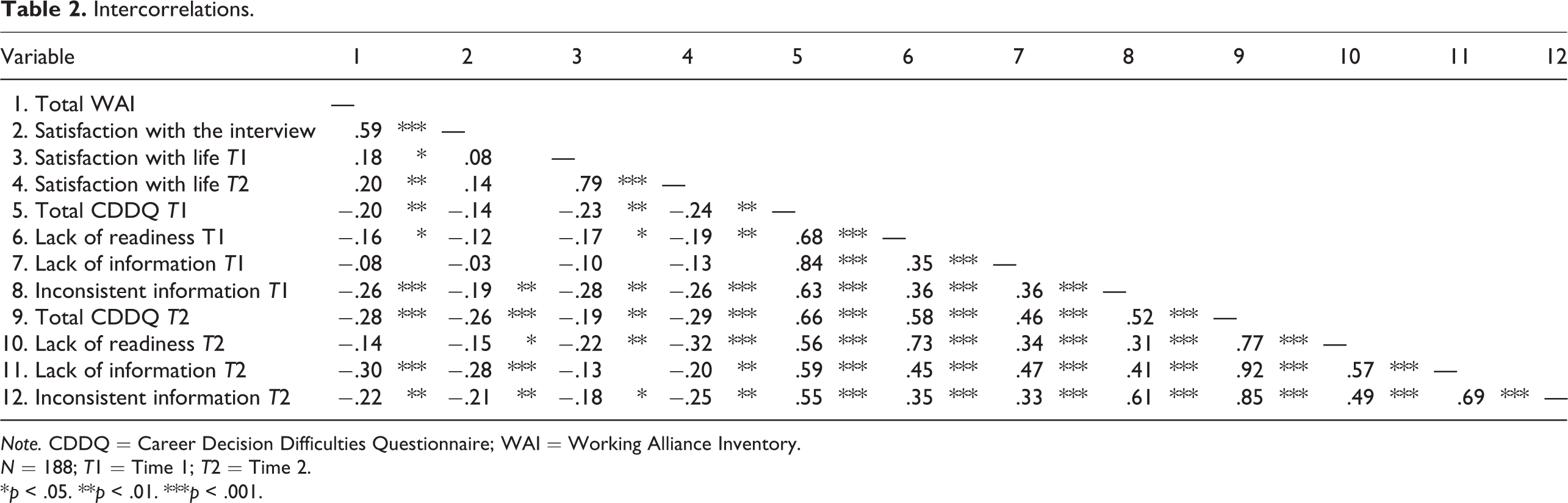
Age did not correlate with working alliance and its subscales, Pearson’s r ranging from .07 and .09, p > .05. Age correlated negatively, but with small effect sizes (.10 ≤ |r| < .30), with life satisfaction, SWLS Time 1, r = −.21, p < .01, Time 2, r = −.22, p < .01, and with career decision difficulties, total CDDQ Time 1, r = −.17, p < .05, Time 2, r = −.18, p < .05. According to the weak or nonexistent relationships between age and the dependent, independent, and moderator/mediator variables, age was not controlled in further analyses. This choice is also supported by previous analyses on the same sample, indicating that age did not influence the short-term effects of career counseling (Perdrix et al., 2012). Table 2 presents Pearson’s r intercorrelations for all variables, excluding the WAI subscales. Intercorrelations for WAI subscales ranged from .53 (p < .001) to .79 (p < .001). As indicated in Table 2, there was a significant moderate positive correlation between working alliance and SWI. Time 1–Time 2 correlations were strong and positive both for the CDDQ and for the SWLS.
Intercorrelations.
Note. CDDQ = Career Decision Difficulties Questionnaire; WAI = Working Alliance Inventory.
N = 188; T1 = Time 1; T2 = Time 2.
*p < .05. **p < .01. ***p < .001.
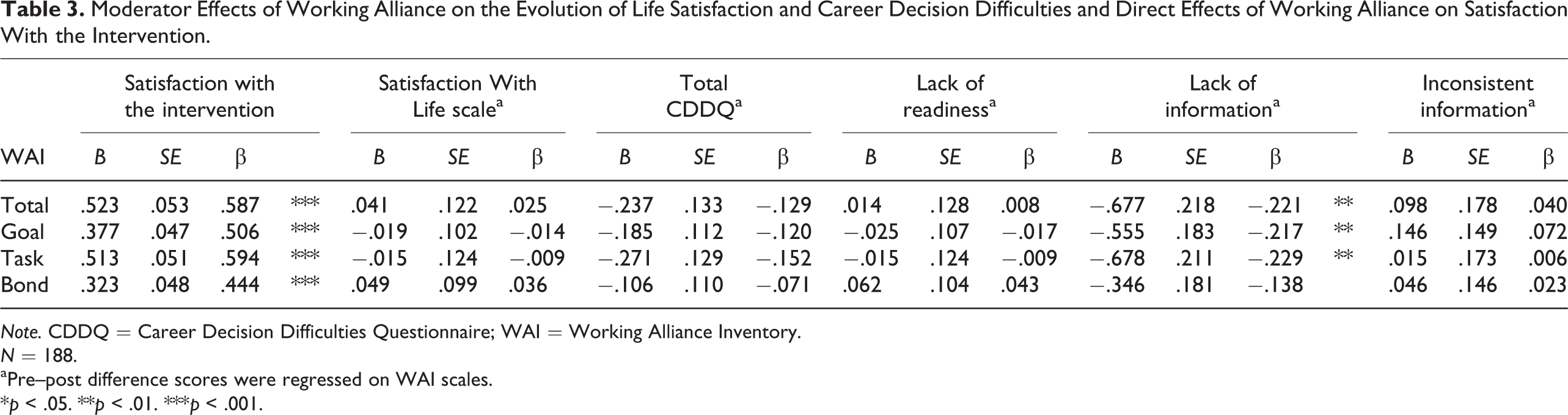
Concerning the first hypothesis, working alliance had significant moderator effects on the evolution of the CDDQ dimension lack of information, except for its bond dimension (Table 3). Concretely, the higher the working alliance level—mainly agreement about career counseling goals and tasks to reach the goals—the stronger the decrease of lack of information. The pre–post evolution of total career decision difficulties was also moderated by the task dimension of the working alliance: The higher the agreement about tasks needed to reach intervention goals, the stronger the decrease of general decision difficulties. Working alliance did not moderate the evolution of SWL, lack of readiness, and inconsistent information. Table 3 also shows that the Hypothesis 3 was verified: Working alliance directly predicted client’s SWI.
Moderator Effects of Working Alliance on the Evolution of Life Satisfaction and Career Decision Difficulties and Direct Effects of Working Alliance on Satisfaction With the Intervention.
Note. CDDQ = Career Decision Difficulties Questionnaire; WAI = Working Alliance Inventory.
N = 188.
aPre–post difference scores were regressed on WAI scales.
*p < .05. **p < .01. ***p < .001.
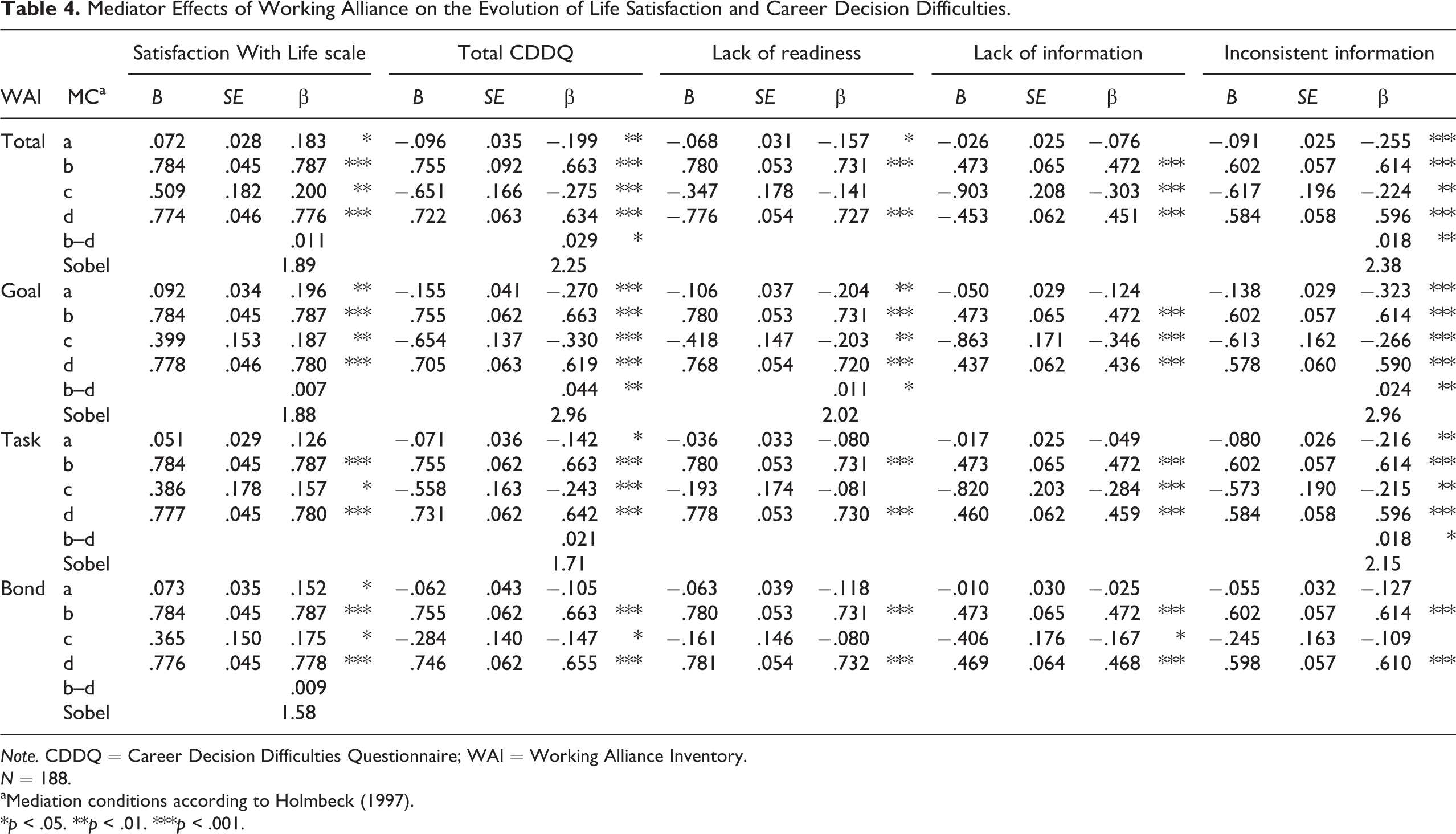
Concerning the second hypothesis, Table 4 presents an overview of mediation effects. When Holmbeck’s (1997) four conditions were met, Sobel test identified significant β decrease between the second (b) and the fourth (d) mediation conditions, that is, when introducing the mediator in the Time 1–Time 2 regressions. Results stressed that total WAI partially mediated the evolution of total career decision difficulties. Agreement about goal was the working alliance dimension that better mediated the decrease of total career decision difficulties. The decrease of the dimension inconsistent information was mediated by total working alliance and its two dimensions: goal and task. The goal dimension also mediated the decrease of lack of readiness. Finally, the bond dimension of the working alliance did not play any mediator role, and the decrease of the CDDQ dimension lack of information was not mediated by the working alliance.
Mediator Effects of Working Alliance on the Evolution of Life Satisfaction and Career Decision Difficulties.
Note. CDDQ = Career Decision Difficulties Questionnaire; WAI = Working Alliance Inventory.
N = 188.
aMediation conditions according to Holmbeck (1997).
*p < .05. **p < .01. ***p < .001.
Discussion
In summary, the working alliance tended to play a moderator, a direct, and a mediator role on career counseling effectiveness. The type working alliance impacts were different depending on its specific components and to the effectiveness indicators considered. Working alliance moderated the decrease of lack of information and was directly tied to SWI. A high level of working alliance strengthened the improvement career information throughout career counseling and enhanced the chances of being satisfied with the intervention. Agreement about the tasks needed to reach intervention goals seems to be the working alliance dimension that was most relied on career counseling effectiveness, since it moderated the decrease of lack of information and general career decision difficulties, and predicted SWI. Working alliance was a partial mediator of the Time 1–Time 2 evolution of career decision difficulties, particularly of inconsistent information. Agreement about the intervention goals was the working alliance dimension that stronger mediated these positive changes. Thus, working alliance, and particularly agreement about goals, explained the mechanism through which decision difficulties, mainly inconsistent information, decreased through career counseling.
The three CDDQ dimensions—lack of readiness, lack of information, and inconsistent information—did not have similar links with the working alliance. Working alliance moderated the decrease of lack of information and mediated the relation between initial and final levels of inconsistent information. Concerning lack of information, it is presumed that getting career information is often an explicit demand when entering a counseling process. Agreement about goals and ways to reach them may then logically lead to more effective, information-centered interventions. Even if also relied with informational concerns, inconsistent information may represent a more complex concern than a simple lack of information. In this case, a strong working alliance might be an intervention condition leading to a reduction in inconsistencies. Otherwise said, working alliance may function as a key intervention ingredient in two distinct ways: as a factor that strengthens the improvement of the quantity of career information (moderator effect on lack of information) and as a mechanism by which clients better the quality of career information (mediator effect on inconsistent information). However, lack of readiness did not decrease throughout the intervention, and was globally not related with working alliance. This could mean that working alliance neither strengthens nor explains any change concerning more emotional or motivational career decision difficulties. Difficulties relied to readiness may then be seen as factors that block or delay clients’ involvement to the career counseling process. It could then be more difficult and time consuming for counselors to build an alliance with “unready” clients.
The distinction between emotional and cognitive factors might also explain the different forms of influences of the three working alliance dimensions on the effectiveness of career counseling. The emotional dimension of the working alliance (bond) neither moderated nor mediated the impacts of career counseling. Contrary to the results from psychotherapy research (e.g., Lo Coco, Gullo, Prestano, & Gelso, 2011), these results suggest that an emotional relationship between client and counselor neither strengthens nor explains positive effects of career counseling. On the contrary, working alliance cognitive dimensions (task and goal) tended to either moderate (task) or mediate (goals) the impacts of career counseling. Whereas an emotional bond is not a condition or a facilitator of career counseling effectiveness, the latter may then partly depend on the capacity to set common goals and seems to be strengthened when client and counselor share the way to reach these goals. These results are interesting in terms of similarities and differences between career counseling and psychotherapy. On one side, working alliance as a whole seems to be a fundamental factor both in career counseling and in psychotherapy (Bedi, 2004). On the other side, career counseling and psychotherapy seem different from the viewpoint of the working alliance central components leading to effective interventions.
Two nuances must be pointed out concerning the importance of the working alliance in career counseling. First, as already discussed, the role of the two “agreement” dimensions of the working alliance (task and goal) seemed clear, while the influence of the bond dimension of the working alliance was not apparent. Two hypotheses should then further be tested: (1) the emotional dimension of working alliance could play a weaker role in career counseling than in personal counseling; (2) less cognitively based outcome indicators (e.g., emotion-related decision difficulties, as suggested by Gati, Asulin-Peretz, & Fisher, 2011) could be more affected by the client’s evaluation of the bond dimension of the working alliance. Second, the links between working alliance and clients’ satisfaction with life are also not discernible. If career counseling is generally able to improve clients’ life satisfaction (Masdonati et al, 2009), working alliance neither moderates nor mediates its evolution. In other words, if relational aspects are somehow and certainly important, they might not be the most important factors contributing to career counseling efficacy on more general, noncareer-specific outcomes.
Some limitations of the study need to be mentioned. First, as study participation is voluntary, selection biases cannot be excluded: Clients less involved in the process after the first counseling session would probably also be less motivated to take part in the study. Second, Time 1 assessment occurred at the end of the first career counseling session. For this reason, it was not a mere preintervention assessment. As suggested by Heppner and Heppner (2003), the main challenges concerning the link between working alliance and career counseling are tied to the need to analyze in greater depth input or process factors influencing working alliance, such as counselor behaviors and characteristics, other client attributes or different client profiles.
Further research should then take into account other client characteristics, such as sex, cultural variables, and age. Although presenting nonexistent to weak relationship with the variables considered in the present study, the latter should drive particular attention in future analyses, since participants’ age range was high in the present study. For example, previous analyses on the same sample stressed that although age did not influence the short-term effects of career counseling, younger participants decision difficulties continued to decrease 9 and 12 months after counseling, whereas older participants’ ones did not (Perdrix et al., 2012). It would also be worthwhile to compare clients’ and counselors’ working alliance ratings and to assess the evolution of working alliance in a career counseling process (Elad-Strenger & Littman-Ovadia, 2012). Finally, it would be important to test possible differentiated effects of working alliance on career counseling outputs according to the different issues addressed during career counseling or to specific intervention modalities and techniques.
Despite the above-mentioned limitations, this study demonstrates that working alliance is a relevant and important process variable to consider when studying career counseling effectiveness. This study tend to reduce ambiguities about this variable, in favor of conceiving working alliance as a key factor of career counseling, as suggested, for example, by Bedi (2004). Results support the argument for considering career counseling as analogous to personal counseling (Bedi, 2004; Heppner & Heppner, 2003; Lewis, 2001). From this point of view, the present study also contributed to meeting the need, highlighted in the career counseling literature, to better understand the role of the working alliance in career counseling (Amundson, 1995; Gysbers et al., 2009; Meara & Patton, 1994). Particularly, it seems (1) that the working alliance plays a direct, a moderator, and a mediator role and (b) that its three dimensions do not have the same kind of influence on career counseling.
This study may have some concrete implications for career counseling practice, stressing the need to form and inform counselors and counselors-in-training about the central role played by relational aspects of career counseling. Counselors should be sensitive to clients’ levels and type of career decision difficulties at the beginning of career counseling, and especially to the importance of quickly fixing intervention goals that are explicit, clear, and negotiated with clients. Given the moderator and the mediator effects of the working alliance on career counseling effectiveness, agreement on goals and on the ways to reach them should also be considered a key intervention component, not only to increase involvement in the career counseling process but also to boost and to lead to career counseling effectiveness itself.
Footnotes
Acknowledgments
We wish to thank all the clients and the clinicians who participated in this study.
Declaration of Conflicting Interests
The authors declared no potential conflicts of interest with respect to the research, authorship, and/or publication of this article.
Funding
The authors disclosed receipt of the following financial support for the research, authorship, and/or publication of this article: This research was supported by Swiss National Science Foundation Grant no. 100014-12315 awarded to Jérôme Rossier, Jonas Masdonati, and Jean-Pierre Dauwalder.