



Abstract
Work stressors are related to poor psychological detachment (i.e., mentally “switching off”) from work during nonwork time, which in turn is related to low levels of recovery and health. This article examines two general personality orientations, attachment avoidance and attachment anxiety, and one vocation-specific personality tendency, overcommitment, as buffers of the work stressors–psychological detachment relationship. Survey data were collected from a sample of Israeli employees (N = 210) and their significant others (N = 109) to avoid same-source bias of psychological detachment assessments. Analyses showed that attachment avoidance moderated the negative association between workload and psychological detachment (self-reported), but attachment anxiety did not moderate the associations of role conflict and role ambiguity with psychological detachment. Overcommitment was a full mediator between job stressors (workload and role conflict) and psychological detachment. This study demonstrates the importance of personality, especially vocational personality, in the work stressor–psychological detachment relationship.
In the past decade, employees have increasingly faced psychological stressors such as workload, role ambiguity, and role conflict (Sonnentag, Binnewies, & Mojza, 2010; Sonnentag & Kruel, 2006), which increase the risk of health problems (de Lange, Taris, Kompier, Houtman, & Bongers, 2003; Sonnentag & Frese, 2003). High work stress requires active coping strategies and efforts that consume personal resources (Meijman & Mulder, 1998). The more effort invested, the greater the consequent exhaustion and related health problems. When these stressors are removed in off-work time, recovery begins and contributes to resources restoration, reduced stress, and greater well-being (Sonnentag, Binnewies, & Mojza, 2010; Sonnentag & Fritz, 2007).
Previous research reported reduced levels of stress and burnout immediately after extended respites such as vacations, although this effect lasted only 4 weeks (Westman & Etzion, 2001). Sonnentag and Bayer (2005) argued that recovery processes such as psychological detachment in daily occurring off-work time can also reduce stress and burnout.
Psychological Detachment
Psychological detachment was first introduced by Etzion, Eden, and Lapidot (1998, p. 579) and described as an “individual’s sense of being away from work situations”. These researchers studied the effect of reserve military service, a special case of respite, on stress and burnout. They found that psychological detachment, which played a moderating role between respite and stress and burnout, contributed to a significant decline in job stress and burnout. Psychological detachment was further broadened to include nonengagement in work-related behavioral obligations, thoughts, or feelings (Sonnentag & Fritz, 2007).
Several theoretical models shed light on the role of psychological detachment in the stress-recovery process. Boundary theory (Ashforth, Kreiner, & Fugate, 2000; Clark, 2000) explains the transition between life roles as processes of segmentation and integration. High role segmentation implies well-defined boundaries between life roles, while high integration implies blurred, ambiguous boundaries. Research shows that work–home segmentation is positively related to psychological detachment (Park, Jex, & Fritz, 2011). According to the effort-recovery model (Meijman & Mulder, 1998), high work demands require investment of effort, which in turn consumes resources. The recovery stage, in which resources are replenished, can only begin when employees are no longer exposed to the demands of their work (Schabracq, Winnubst, & Cooper, 2003). Psychological detachment can help ensure that employees are not cognitively, emotionally, or behaviorally engaged in work demands, allowing recovery to begin (Sonnentag, Binnewies, & Mojza, 2010). According to the conservation of resources model (Hobfoll, 1989), people seek to gain, maintain, and protect (tangible and intangible) personal resources. Psychological detachment generates a recovery process that helps replenish resources depleted by high demands at work (Sonnentag & Fritz, 2007), and may contribute to increased positive mood, higher life satisfaction, and lower levels of emotional exhaustion (Fritz, Yankelevich, Zarubin, & Barger, 2010).
Extensive empirical findings regarding psychological detachment show that psychological detachment is positively related to life satisfaction and emotional stability (Sonnentag & Fritz, 2007), higher work engagement and well-being (Sonnentag, Binnewies, & Mojza, 2010), improved work performance and lower exhaustion (Fritz, Yankelevich, et al., 2010; Sonnentag & Bayer, 2005; Sonnentag & Fritz, 2007), increased positive mood (Sonnentag, Mojza, Binnewies, & Scholl, 2008), and reduced psychosomatic complaints (Sonnentag & Fritz, 2007). A longitudinal study by Fritz, Sonnentag, Spector, and McInroe (2010) found that psychological detachment during the weekend was positively related to increased positive mood during the same weekend and in the subsequent work week.
Although psychological detachment is an internal process, it is observable by others (Sonnentag, Kuttler, & Fritz, 2010). Therefore, this study expands previous studies by adding a significant-other-report measure of psychological detachment.
Work Stressors and Psychological Detachment
Work is often experienced as stressful and can cause exhaustion (Linden, Earle, Gerin, & Christenfeld, 1997). Research regarding work stressors often distinguishes between the reactivity stage, which occurs in the presence of a stressor stimulus and requires high resource investment, and the recovery stage, which occurs when the stimulus is no longer present or when it ceases to constitute a threat (Linden et al., 1997). In situations with psychological rather than physical stressors, it is less easy to make a clear distinction between reactivity and recovery. When a person continues to think or to react emotionally to stressors outside the workplace, when such stressors are no longer present, the reactivity stage does not properly end and the recovery stage cannot begin (Sonnentag, Binnewies, & Mojza, 2010). Consequently, psychological work stressors can reduce, impede, or disable psychological detachment (Sonnentag, 2011). In the following section, we review three common psychological work stressors and their relation with psychological detachment.
Workload
High workload is categorized as a task-related stressor that implies that an employee must accomplish more work than the time available for the task (Borman, Ilgen, & Klimoski, 2003). Employees experiencing high workload may be more willing to take their unfinished work home with them or may be more prone to continue contemplating or expressing emotions such as anger, frustration, or anxiety regarding their incomplete or future tasks (Sonnentag & Kruel, 2006). For such employees, psychologically detaching becomes more difficult. Studies have found a strong negative association between high workload and psychological detachment (Sonnentag & Bayer, 2005; Sonnentag & Kruel, 2006; Sonnentag, Kuttler, & Fritz, 2010). The present study seeks to reproduce these results using an Israeli sample.
Role Ambiguity
Role ambiguity is categorized as a role stressor and implies inconclusive or unclear information or expectations regarding one’s work role (Borman, Ilgen, & Klimoski, 2003). Ambiguous role definitions may lead employees to cognitive preoccupation with work, which in turn can hinder psychological detachment, although empirical findings are inconclusive (Sonnentag & Fritz, 2007; Sonnentag & Kruel, 2006). The present study examines the association between role ambiguity and psychological detachment using a diverse occupational Israeli sample.
Role Conflict
Role stress theory defines role conflict as contradicting or mutually exclusive role expectations imposed by colleagues or superiors in the employee’s work environment (Borman, Ilgen, & Klimoski, 2003; Katz & Kahn, 1978). Even when a compromise is achieved between contradicting expectations, it is reasonable to assume that this compromise requires an investment of cognitive or emotional resources, which potentially inhibits psychological detachment (Sonnentag & Kruel, 2006). The present study examines the relationship between role conflict and psychological detachment on a heterogenic Israeli sample in terms of work seniority and experience.
Integrating Personality Traits in the Work Stressor–Detachment Relationship
Literature concerning psychological detachment focuses primarily on situational predictors such as work stressors (Sonnentag, 2011). However, the definition of psychological detachment (Etzion, Eden, & Lapidot, 1998) allows for cognitive and emotional components that are personal by nature. To explore the integration of personality traits in the stressor–detachment relationship, this study examines two personality measures that have yet to be tested in the detachment literature: attachment orientations and overcommitment to work.
Attachment Orientations
Attachment theory (Bowlby, 1969/1982) states that infants are born with a psychological system that motivates them to seek closeness, assurance, and support from significant others, especially in times of need. An infant who generally achieves assurance through closeness will develop a secure attachment orientation; otherwise, the infant develops an insecure (anxious/avoidant) attachment orientation.
Attachment and Work
In recent years, attachment orientations have been studied as an antecedent for a variety of work-related variables including leadership, trust, work attitudes, and stress (e.g., Barrick & Mount, 1991; Judge, Heller, & Mount, 2002). Hazan and Shaver (1990) found that employees with secure attachment reported greater job satisfaction, fewer psychosomatic complaints, and fewer health problems. More recent studies reported that people with insecure attachment orientations (avoidant/anxious) reported that work disrupts their personal life (e.g., Sumer & Knight, 2001).
Attachment Anxiety
Attachment anxiety refers to a helpless and pessimistic attitude toward life, a tendency to perceive hardship as uncontrollable and negative expectations regarding one’s ability to control and manage stress successfully (Hazan & Shaver, 1990; Mikulincer & Shaver, 2007). Individuals high in attachment anxiety tend to seek confirmation, assurance, and attention from attachment figures; a concurrent process, however, causes them to experience these relationships as unsafe and uncertain (Hazan & Shaver, 1990; Mikulincer & Shaver, 2007). Role conflict and role ambiguity are two work stressors that might include an interpersonal aspect as well as potential pleasing component. Role conflict can create a conflict between two potential attachment figures, and role ambiguity does not allow an appropriate pleasing of these potential figures (e.g., two supervisors). Accordingly, we argue that employees high in attachment anxiety will react strongly to role conflict and role ambiguity and consequently show diminished psychological detachment.
Attachment Avoidance
Attachment avoidance reflects a lack of confidence in interpersonal relationships, a lack of trust in others’ intentions, and a desire for autonomy and emotional distance (Mikulincer & Shaver, 2007). Although no existing research has explored the potential impact of attachment avoidance on psychological detachment, there is empirical evidence showing that individuals high in attachment avoidance tend to be less inclined to stop working or even to take leaves, and tend to use their work to remain occupied and thus reduce the anxiety associated with unfulfilled or unsatisfying attachment needs (Hazan & Shaver, 1990). Therefore, it seems that work functions as a defense mechanism against interpersonal interactions. Lack of psychological detachment potentially enables abstention from social interactions and can provide the autonomy and emotional distance necessary for individuals high in attachment avoidance. Accordingly, we argue that high attachment avoidance individuals will not be influenced by the extent of their workload, while workload will be negatively associated with psychological detachment in low attachment avoidance individuals.
Overcommitment
Overcommitment to work was first introduced by Siegrist (1996) as part of the effort–reward imbalance (ERI) model of job stress. According to this model, perceptions of balance between the effort employees believe they invest in their work and the rewards they receive promotes health and satisfaction, whereas imbalance can lead to a sustained stress response.
The ERI model predicts that the experience of ERI is more frequent and damaging in employees who are excessively committed to work. Overcommitment is defined as “a set of attitudes, behaviors and emotions that reflect excessive striving in combination with a strong desire of being approved and esteemed” (Siegrist, 2001, p. 55). Studies of the ERI model have found overcommitment to be associated with work stress, emotional and physical exhaustion, burnout, and psychosomatic symptoms (Siegrist, 1996; Tei-Tominaga, Akiyama, Miyake, & Sakay, 2009; van Vegchel, de Jonge, Bosma, & Schaufeli, 2005). Overcommitment to work, which is an intrinsic motivation (Siegrist, 2001), may affect one’s ability to psychologically detach from one’s work, beyond the impact of situational work stressors (e.g., workload, role ambiguity, and role conflict), although research has yet to explore overcommitment’s potential influence on psychological detachment. We hypothesize that the relationship between work stressors, specifically workload, role ambiguity, and role conflict, and psychological detachment is at least partially mediated by overcommitment to work.
In this study, we explore the potential contribution of personality to the documented stressor–detachment relationship. We expect work stressors to be negatively associated with psychological detachment, in line with previous studies (e.g., Sonnentag & Fritz, 2007; Sonnentag & Kruel, 2006), and further expect these relationships to be moderated by attachment orientations and mediated by overcommitment.
Method
Participants
We used a snowball sampling method to enroll potential community-based employees through online electronic mail and social networks. The electronic message included a cover letter and a link to an electronic survey. To obtain a heterogeneous sample representing a range of industries, positions, tenure periods, and occupations, we surveyed 210 Israeli employees (52.4% men) in a wide variety of organizations, who had been employed in their current workplace for at least 6 months. In our sample, participants worked an average of 44 hr per week (standard deviation [SD] = 11.7) and had mean tenure of 5.84 years (SD = 8.59). The majority of the sample was married (51%) with ages ranging from 22 to 65 (M = 34.7, SD = 10.8). Our sample mainly comprised salaried employees (93.7%) who had a mean of 15 years of education (SD = 2.52). Participants worked in diverse occupations, including service-related (64.3%), technical (14.8%), manufacturing (4.8%), and clerical (16.2%) occupations. Of the 210 study participants, 109 individuals returned surveys completed by significant others. The majority of the significant-other-reports were completed by spouses (56%), and the remainders were completed by close friends (22%), colleagues (16.5%), and close family members (5.5%).
Procedure
Participants responded to an e-mail or social network message of the study. The message emphasized that the questionnaires were anonymous and requested individuals who met the inclusion criterion (6 months’ employment with their current employer) to complete them voluntarily (without compensation), with no time limit. Participants were also asked to send a link of the questionnaire to a significant other. This link contained the significant other version of the psychological detachment questionnaire. In the 2-month data collection period, we sent a reminder via electronic mail and social networks every 10 days. The order of questionnaire items was scrambled after 100 participants in order to rule out primacy or fatigue effects.
Measures
Role conflict and ambiguity, workload, attachment orientations, overcommitment, and psychological detachment measures were assessed by study participants. An additional measure of psychological detachment was assessed by participants’ significant others. All items were in Hebrew.
Psychological Detachment
We measured psychological detachment using self-report and significant-other-report measures, based on four well-validated psychological detachment items developed by Sonnentag and Fritz (2007). Respondents reported their answers on a 5-point Likert-type scale from 1 (strongly disagree) to 5 (strongly agree). A sample item for this scale is “During after-work hours, I forget about work.” Documented Cronbach’s α for this scale is .89 (Sonnentag & Fritz, 2007). The items were translated into Hebrew using the back translation technique (Brislin, 1970; Rom & Mikulincer, 2003). Cronbach’s α for this scale in the present study was .85 for self-report and .89 for significant-other-report.
Role Conflict and Ambiguity
We assessed role conflict and ambiguity using the Hebrew version (Aviad-Hayblum, 1992) of the Role Conflict and Ambiguity scales (Rizzo, House, & Lirtzman, 1970), ranging from 1 (very false) to 7 (very true). The role conflict scale contains 8 items (Items 1–8). A sample item for this scale is “I do unnecessary things at work.” The role ambiguity scale contains 6 items (9–14), with similar 7-point scales, all of which were reversed scored. A sample item for this scale is “I know exactly what is expected of me.” Cronbach’s α reported for this measure is .83 for the role conflict subscale and .78 for the role ambiguity subscale (Rizzo et al., 1970). The Hebrew version yielded αs of .78 for the role conflict subscale and .87 for the role ambiguity scale (Aviad-Hayblum, 1992). Cronbach’s αs for this measure in the present study were .85 for the role conflict subscale and .87 for the role ambiguity subscale.
Workload
Workload was measured using the Quantitative Workload Inventory (Spector, 1987; Spector & Jex, 1998). This measure contains 5 items. Respondents indicate how often each item occurs, on a scale ranging from 1 (less than once a month or never) to 5 (several times a day). Scores range from 5 to 25 and high score indicates a high workload. A sample item for this scale is “How often does your job require you to work very quickly?” Cronbach’s α reported for this scale is .82 (Spector & Jex, 1998). This scale was also translated into Hebrew using the back translation technique (Brislin, 1970; Rom & Mikulincer, 2003). Cronbach’s α found in this study was .86.
Attachment Orientations
Attachment orientations were measured using the experiences in close relationships questionnaire (Brennan, Clark, & Shaver, 1998), which includes two 18-item scales, one measuring attachment anxiety and the other measuring attachment avoidance. Participants rate the extent to which each item describes them in close relationships, on a 7-point scale ranging from 1 (not at all) to 7 (very much). Sample items are “I worry a fair amount about losing my connections with others” (anxiety) and “I don’t feel comfortable opening up to other people” (avoidance). The scale was translated from English into Hebrew by Mikulincer and Florian (2000), who also demonstrated the measure’s intended two-factor structure in Israeli samples. In the present study, the internal reliabilities of the anxiety and avoidance scales were .92 and .87, respectively.
Overcommitment
We measured overcommitment with 6 items from the ERI questionnaire (Siegrist, 1996). Items are scored on a 4-point scale from 1 (strongly disagree) to 4 (strongly agree). A sample item is “People close to me say that I sacrifice too much for my job.” Reported internal reliability ranged from .74 to .88 (Siegrist et al., 2004). This scale was also translated into Hebrew for this study using the back translation technique (Brislin, 1970; Rom & Mikulincer, 2003). Cronbach’s α found in this study was .85.
Demographical Variables
We included demographic variables (gender, age, education, family status, tenure, income level, job description, and work hours) in our analysis.
Construct Validity
Psychological detachment is defined as “individual’s sense of being away from work situations” (Etzion et al., 1998, p. 579). Overcommitment is described as the inability to withdraw from work obligations (Siegrist et al., 2004). We examined whether psychological detachment and overcommitment constitute two distinct constructs by conducting a confirmatory factor analysis using Amos 20. A two-factor model yielded good fit (χ2 = 68.496; df = 34; p < .001; Normed Fit Index [NFI] = 0.93; Incremental Fit Index [IFI] = 0.96; Tucker–Lewis Index [TLI] = 0.94; Comparative Fit Index [CFI] = 0.96; Root Mean Square Error of Approximation [RMSEA] = 0.070) with all standardized factor loadings significant with a conservative α of .001 and above .44. When we attempted to fit a one-factor model to include both psychological detachment and overcommitment, the results yielded inadequate fit (χ2 = 336.367; df = 36; p < .001; NFI = 0.63; IFI = 0.66; TLI = 0.47; CFI = 0.65; RMSEA = 0.200).
Results
Preliminary Analysis
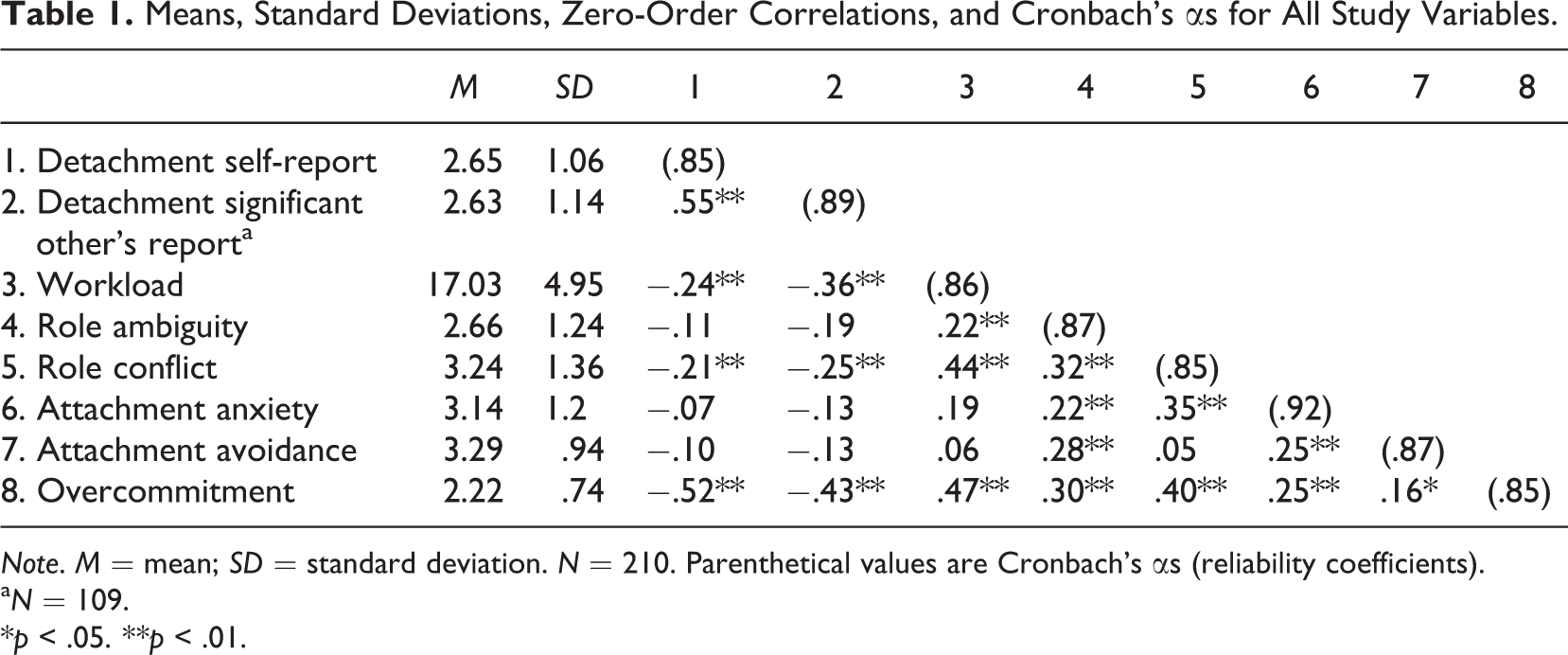
From the demographical measures we tested, only work hours were significantly associated with study variables. Accordingly, this measure was controlled throughout the study. Correlations between all study measures, scale reliabilities, means, and SDs are presented in Table 1. Although psychological detachment was first introduced and measured on an Israeli sample (Etzion et al., 1998), the most frequently used, up-to-date measure, which was developed by Sonnentag and Bayer (2005), was not tested on Israeli population. Therefore, preliminary analysis examines the consistency across reporting sources of the psychological detachment scale in an Israeli sample. We expect to find high-to-moderate correlations between the reporting sources measures, consistent with previous studies (Sonnentag & Kruel, 2006; Sonnentag, Kuttler, & Fritz, 2010; r = .44; r = .52, respectively). Though moderate, these correlations are within the typical range of correlations reported between self-report and peer-report measures (Harris & Schaubroeck, 1988; Sonnentag & Kruel, 2006). In addition, all study hypotheses were tested for both reporting sources’ outcome measures. Results revealed significant positive associations between self-reported and other’s-reported measure of psychological detachment (r = .55, p < .001; see Table 1). These results are consistent with previous results found in a Swiss population (Sonnentag, Kuttler, & Fritz, 2010).
Means, Standard Deviations, Zero-Order Correlations, and Cronbach’s αs for All Study Variables.
Note. M = mean; SD = standard deviation. N = 210. Parenthetical values are Cronbach’s αs (reliability coefficients).
a N = 109.
*p < .05. **p < .01.
Work Stressors Hypotheses
Pearson correlations were calculated in order to test Hypotheses 1a, 1b, and 1c. As hypothesized, results revealed significant negative associations between workload and role conflict to the self-report measure (r = −.24, p < .01 and r = −.21, p < .01, respectively) and to the significant other measure (r = −.36, p < .01 and r = −.25, p < .01, respectively). Hypothesis 1b was not supported. The association between role ambiguity and psychological detachment was not significant with either self-report or other-report source (r = −.11, p = ns; r = −.19, p = ns, respectively). These results taken together partially support Hypothesis 1. Psychological detachment shared its variance with workload and role conflict but not with role ambiguity.
Attachment Hypotheses
Attachment Anxiety
Four hierarchal regression analyses (two for each reporting source of psychological detachment) were performed to examine the extent to which attachment anxiety moderated the associations between role conflict and role ambiguity and psychological detachment (dependent variable). In all regressions, work hours was entered in Step 1 (control), followed by standardized scores of role ambiguity (predictor) and attachment anxiety (moderator) for Hypothesis 2a, and role conflict (predictor) and attachment anxiety (moderator) for Hypothesis 2b. To test moderation effects, Standardized Role Ambiguity × Attachment Anxiety scores were entered in Step 3 for Hypothesis 2a, and Standardized Role Conflict × Attachment Anxiety scores for Hypothesis 2b. For Hypothesis 2a, the controlled variable had significant contribution in the self-report detachment analysis (β = −.15, p < .05); however, the main effects and the interaction did not (see Table 2). As for Hypothesis 2b, neither the controlled variable nor attachment anxiety had a significant contribution. However, role conflict was significantly associated with self-reported psychological detachment (β = −.19, p < .01). The interaction in Step 3 was not significant (see Table 3). Hypotheses 2a and 2b were not supported.
Regression Coefficients: Predicting Self-a and Significant-Other-b (Presented in Parenthesis) Reported Psychological Detachment From Attachment Anxiety and Role Ambiguity.

Note. a N = 210. b N = 109. Results in parentheses predicting significant-other’s reported detachment. The coefficients are standardized β weights.
*p < .05.
Regression Coefficients: Predicting Self-a and Significant-Other-b (Presented in Parenthesis) Reported Psychological Detachment From Attachment Anxiety and Role Conflict.

Note. a N = 210. b N = 109. Results in parentheses predicting significant-other-reported detachment. The coefficients are standardized β weights.
*p < .05. **p < .01.
Attachment Avoidance
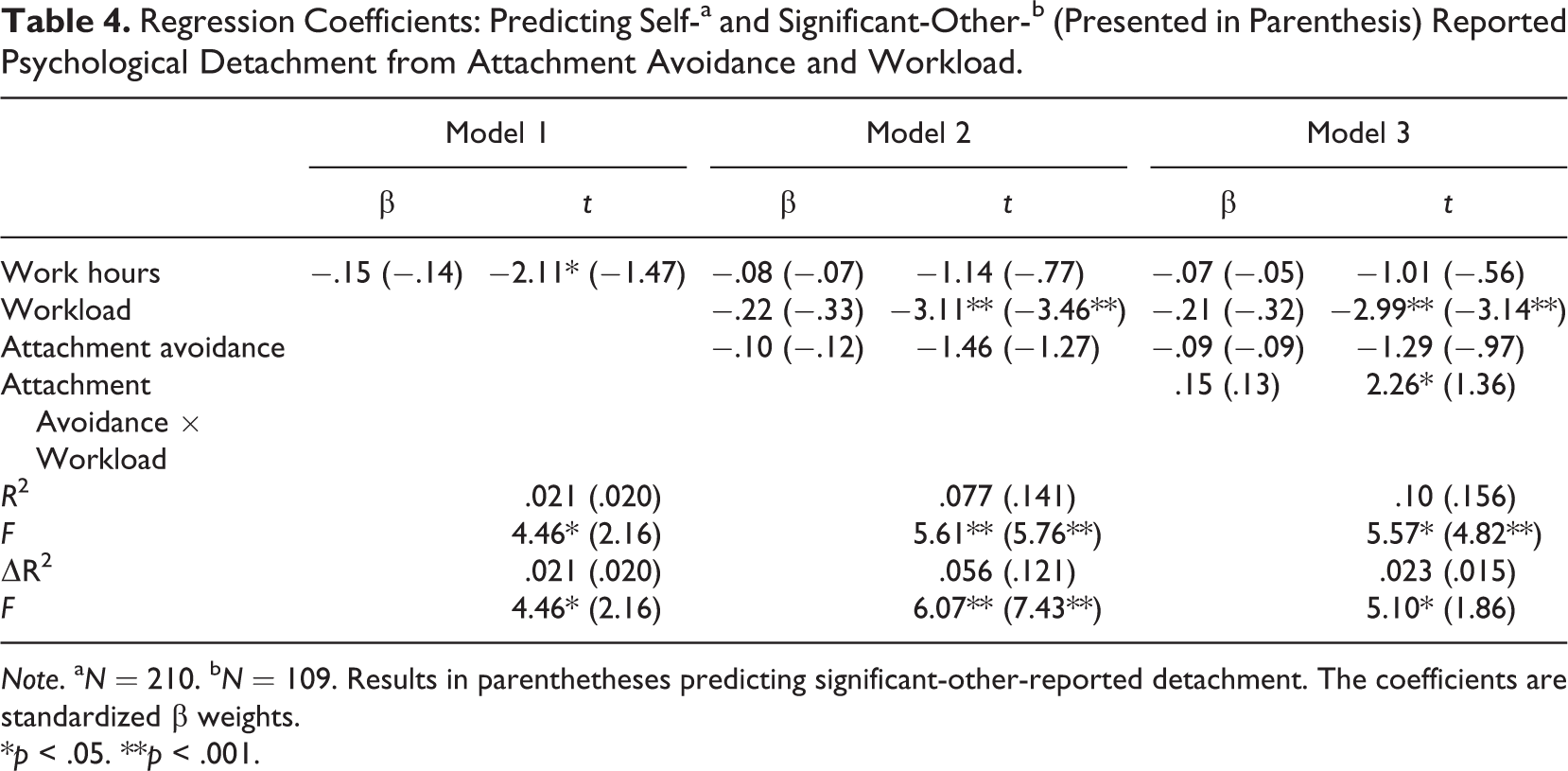
Two hierarchal regression analyses (one for each reporting source of psychological detachment) were performed to examine the extent to which attachment avoidance moderated the associations between workload and psychological detachment (dependent). Work hours was entered in Step 1 (control), followed by standardized scores of workload (predictor) and attachment avoidance (moderator). To test moderation effect, Standardized Workload × Attachment Avoidance scores were entered in Step 3. Results showed that the controlled variable had significant contribution (β = −.146, p < .05) in Step 1, but this contribution lost its significance when the two main effect variables were introduced in Step 2. Workload, but not attachment avoidance, was significantly associated with self- and significant-other-reported psychological detachment (β = −.21, p < .001; β = −.32, p < .001, respectively). The Workload × Attachment avoidance interaction was significantly associated with the self-report measure (β = .15, p < .05) but not with the significant other measure (see Table 4). Hypothesis 3 was partially supported.
Regression Coefficients: Predicting Self-a and Significant-Other-b (Presented in Parenthesis) Reported Psychological Detachment from Attachment Avoidance and Workload.
Note. a N = 210. b N = 109. Results in parenthetheses predicting significant-other-reported detachment. The coefficients are standardized β weights.
*p < .05. **p < .001.
Simple slope analysis, conducted to reveal the source of interaction for the self-report measure (Aiken & West, 1991), revealed that the association between workload and psychological detachment variable was significant in the low (−1 SD) attachment avoidance condition (t = 3.489, p < .001, β = −.52) but was not significant in the high (+1 SD) attachment avoidance condition (p = ns; see Figure 1). In other words, increasing workload was associated with decreasing psychological detachment among low attachment avoidance individuals but was unrelated to psychological detachment among high attachment avoidance individuals.
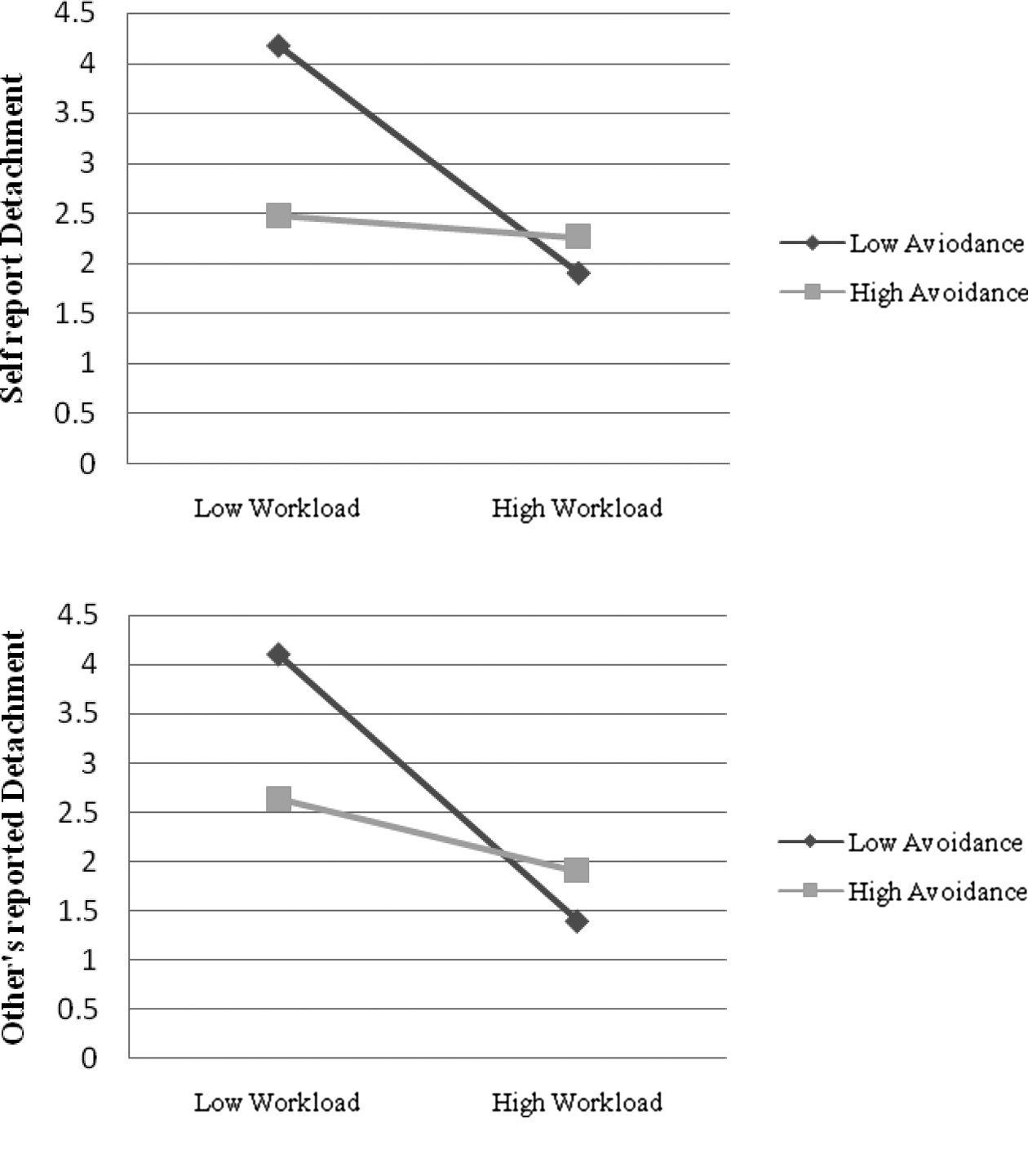
Simple slope for the interaction effect of workload and attachment avoidance on psychological detachment.
Overcommitment Hypotheses
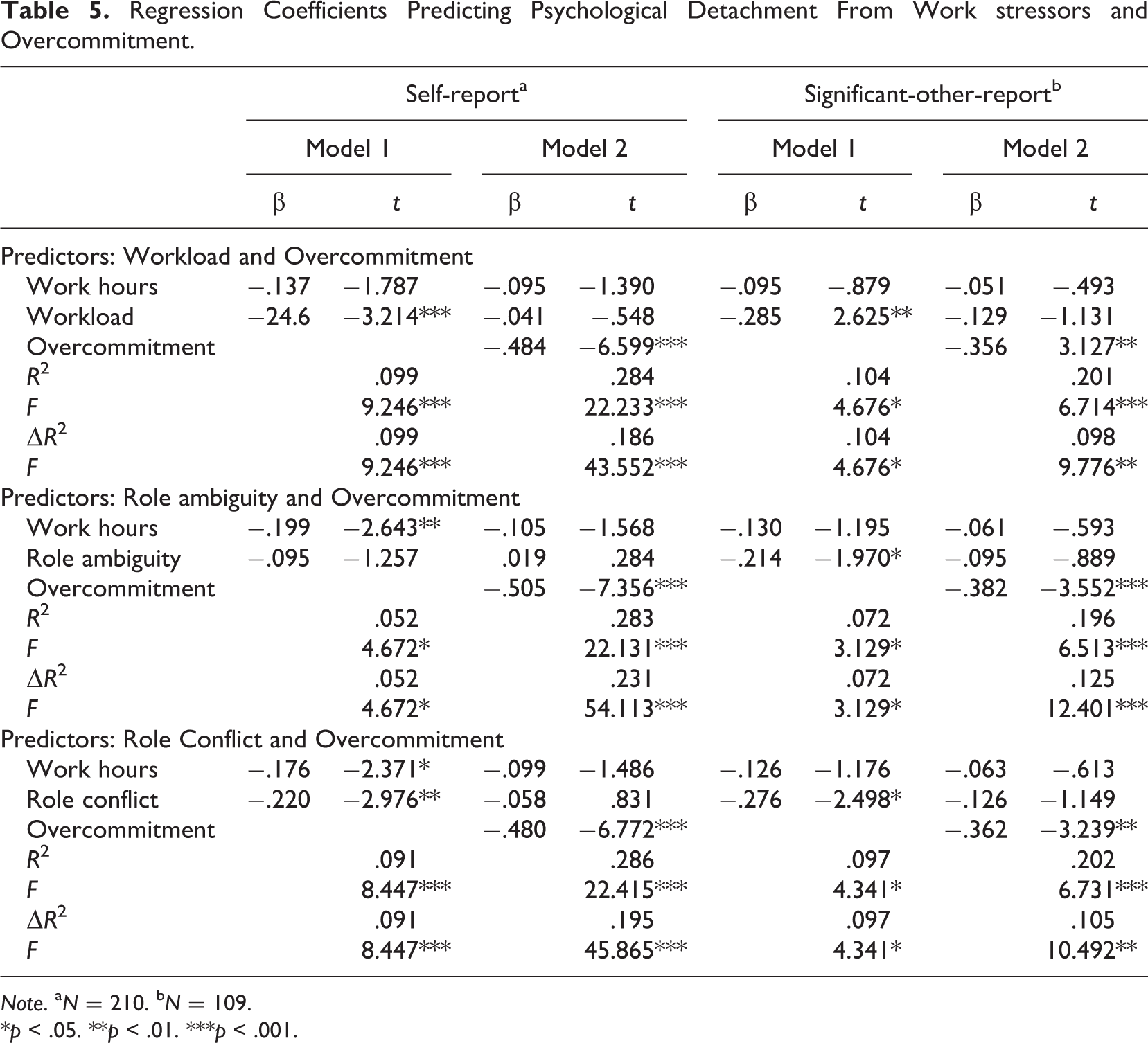
Hypotheses 4a, 4b, and 4c were tested using Baron and Kenny’s (1986) approach, which defines four conditions of mediation. The first condition states that the predictor variables (work stressors) must be significantly related to the mediator (overcommitment). As Table 1 shows, all work stressors (workload, role ambiguity, and role conflict) satisfied this condition. To meet the second condition, the mediator must be significantly related to the outcome variable (psychological detachment). As Table 1 shows, this condition was also satisfied for both the self-report and the significant-other-report measures. To satisfy the third and fourth conditions, the predictors must be significantly related to the outcome variable, and this relationship must be reduced when the mediator is introduced into the regression equation. Three hierarchal regression analyses were performed for each outcome variable (see Table 5), entering a different work stressor (workload, role ambiguity and role conflict) in each regression analysis; in all six regressions, the mediator and outcome variables were overcommitment and psychological detachment, respectively. In these analyses, we also control for work hours (entered in Step 1). Results revealed that workload and role conflict were negatively related to psychological detachment in the self-report version in Step 1, and this significant association disappeared when the mediator (overcommitment) was introduced in Step 2, satisfying the third and fourth conditions of mediation. Results for role ambiguity indicated that the control variable (work hours) was associated with psychological detachment in Step 1, but role ambiguity was not. Therefore, overcommitment is not a mediating factor between role ambiguity and psychological detachment.
Regression Coefficients Predicting Psychological Detachment From Work stressors and Overcommitment.
Note. a N = 210. b N = 109.
*p < .05. **p < .01. ***p < .001.
Regression analyses for other-reported psychological detachment revealed that all work stressors (workload, role ambiguity, and role conflict) were negatively related to psychological detachment in Step 1 and that these associations disappeared when the mediator (overcommitment) was introduced in Step 2 (see Table 5), which satisfied Baron and Kenny’s (1986) fourth condition. Sobel tests indicated a significant indirect effect of workload (z = 4.71, p < .001) and role conflict (z = 4.13, p < .001) via overcommitment on self-reported psychological detachment; and a significant indirect effect of workload (z = 2.70, p < .01), role ambiguity (z = 2.47, p < .05), and role conflict (z = 2.66, p < .01) via overcommitment on other-reported psychological detachment. Furthermore, the regression weights of all predictors (see Model 2 in Table 5) lost their significance entirely when overcommitment was entered, suggesting full mediation.
Discussion
In this study, we examined the utility of integrating personality traits in the stressor–detachment relationship. Specifically, we tested the moderating roles of attachment orientations (anxiety and avoidance) and the mediating role of overcommitment. The analyses suggest that attachment avoidance moderates the association between workload and psychological detachment; however, attachment anxiety did not moderate the association between psychological detachment and either role conflict or ambiguity. Further analyses suggested that overcommitment fully mediated the relationships between psychological detachment to role conflict and workload. However, when we tested these hypotheses on significant-other-reported data, overcommitment fully mediated all three work stressors, role ambiguity included.
As for attachment avoidance, the self-reported detachment analysis revealed that workload was negatively associated with psychological detachment only in the low avoidant attachment condition, suggesting that highly avoidant employees’ off-work time detachment is not influenced by the extent of their workload. Highly avoidant participants might be less capable of psychological detachment, regardless of their perceived workload. These findings suggest that the tendency to prefer autonomy, emotional distance, and solitude through work (Hazan & Shaver, 1990) may be observable even in the absence of work stressors. Data from significant-other-reports did not provide further support, although a simple slope analysis revealed a similar trend for the self-reported data (see Figure 1).
As hypothesized, the direct negative links found between workload and self-reported psychological detachment and between role conflict and self-reported psychological detachment, and the negative associations between all three stressors, including role ambiguity, and detachment based on significant-other-reported data, disappeared when controlling for overcommitment. These findings suggest that work stressors are associated with overcommitment, which in turn may inhibit detachment. Overcommitment is a behavioral pattern described as a combination of internal motivation reflecting excessive striving and a strong desire for approval and esteem (Siegrist, 2001). In previous studies, overcommitment was found to consume resources and lead to a sustained stress reaction, emotional and physical exhaustion, burnout, and psychosomatic symptoms (e.g., Joksimovic et al., 1999). These outcome variables were also found to be associated with low psychological detachment (e.g., Fritz, Sonnentag, Spector, & McInroe, 2010; Sonnentag & Fritz, 2007). Thus, present study findings suggest that exhaustion, burnout, and psychosomatic symptoms, which previous studies found in participants high in overcommitment, may be predicted by low psychological detachment from work. Furthermore, the mediating role of overcommitment was supported by the self-report data and the significant-other-report data in this study, thereby supporting our hypotheses and overcoming potential same-source bias concerns (Podsakoff, MacKenzie, Lee, & Podsakoff, 2003; Sonnentag & Kruel, 2006).
Sonnentag, Kuttler, and Fritz (2010) highlighted the importance of an additional viewpoint on a person’s psychological detachment. In their study, they argue that a lack of detachment can be observed by one’s partner. The moderate-to-high correlations found in this study between reporting sources of psychological detachment are consistent with previous studies on European populations (Sonnentag & Kruel, 2006; Sonnentag, Kuttler, & Fritz, 2010) and consistent with the typical range of correlations reported between self-report and peer-report measures (Harris & Schaubroeck, 1988; Sonnentag & Kruel, 2006). These findings suggested consistency of the psychological detachment measure across European and Israeli populations, and further validated this already well-validated measure (Fritz, Sonnentag, et al., 2010).
We hypothesized that high anxiety attachment participants who experience high role conflict and ambiguity will experience lower detachment. However, the moderating role of attachment anxiety in the stressor–detachment association was not supported. It may be that the dual mechanism that leads anxious individuals to pursue attachment figures (which may inhibit their ability to psychologically detach) on one hand, and leads to excessive sensitivity and negative emotions when doing so (which may induce them to detach) on the other hand, resulted in a nonsignificant relationship with detachment from work.
Limitations
These study findings should be interpreted in light of its limitations. First, all of our variables were measured with a cross-sectional design, which requires caution in interpreting causality. Therefore, future studies should include longitudinal designs in order to strengthen this potential causality chain. Second, we used a snowball sampling method that makes the generalization of our findings difficult. The majority of our study participants were salaried employees, who worked in the service sector and had 15 years of education (SD = 2.52). Third, our sample included a variety of occupations and demographical characteristics. Although this should potentially increase generalizability, it also statistically increases unexpected confounding variables that make results interpretation difficult.
Implications for Future Research and Practice
Our study examined the utility of integrating personality characteristics in a well-documented stressor–detachment relationship (e.g., Sonnentag, 2011; Sonnentag & Bayer, 2005; Sonnentag & Fritz, 2007; Sonnentag &Kruel, 2006; Sonnentag, Kuttler, & Fritz, 2010). Future research can extend this examination by including additional personality traits and situational variables. Additionally, psychological detachment is a recovery experience that can be distinguished from other recovery experiences (Sonnentag & Fritz, 2007). To extend the job stress recovery literature, future research should explore the possible integration of personality traits in other stressor–recovery relationships as well.
Our study has implications for future practice. Preserving human capital should serve as a high priority for organizations. Previous studies have shown that employees who psychologically detach themselves from work in off-work time can replenish their resources and reduce work-related stress (e.g., Park, Jex, & Fritz, 2011; Sonnentag & Fritz, 2007). The present study suggests that personality traits affect these employees’ psychological detachment. Thus, organizations should acknowledge that not only work stressors can cause reduced psychological detachment from work. In addition to efforts to cultivate a culture that endorses employees’ psychological detachment in off-job time, organizations may develop specific training programs in psychological detachment for different groups based on their personality profiles.
Footnotes
Authors’ Note
This research is based on a masters’ dissertation prepared by the first author under the supervision of the second (corresponding) author.
Declaration of Conflicting Interests
The authors declared no potential conflicts of interest with respect to the research, authorship, and/or publication of this article.
Funding
The authors received no financial support for the research, authorship, and/or publication of this article.