



Abstract
The current study examines the relationship between individual differences in entrepreneurship and vocational interests in a sample of 565 adults. Specifically, it investigates associations between vocational interests (as assessed by Holland’s realistic, investigative, artistic, social, enterprising, and conventional model), entrepreneurial potential (as assessed by measure of entrepreneurial tendencies and abilities [META]), and entrepreneurial activity, both within and outside organizations. Results reveal predictable associations between Holland’s taxonomy of vocational interests and entrepreneurial outcomes. Incremental validity tests show that Holland’s vocational interests predict entrepreneurial activity even when entrepreneurial potential and demographic variables are taken into account. Furthermore, structural equation modeling indicates that META is the strongest and most consistent predictor of entrepreneurial activity. Practical and theoretical implications for vocational guidance and career assessment are considered.
Entrepreneurship is a major source of employment, economic growth, and technological progress (Kuratko, 2003; Reynolds, Bygrave, & Autio, 2004). The growing interests in entrepreneurship research is thus hardly surprising, despite having emerged only in the last 25 years (Baron & Henry, 2010; Hisrich, Langan-Fox, & Grant, 2007). Indeed, entrepreneurship has been examined by economists, sociologists, and management scientists (Hisrich et al., 2007), but the most common denominator of this research has been an understanding of the psychological characteristics associated with entrepreneurship.
This so-called trait approach assumes that entrepreneurship results from the actions and behaviors of individuals. Theoretically, therefore, there should be a direct link between individual differences in cognitive and noncognitive traits and entrepreneurial outcomes. Although a great number of traits have been examined in the field, very few of these efforts have focused on interests. Yet, there is wide consensus about the fact that interests are a core component or “pillar” of individual differences (Armstrong, Su, & Rounds, 2011; Chamorro-Premuzic, 2011).
In recent years, there has been a revival of the study of interests with a particular focus on vocational interests. Vocational interests have been suggested as a strong predictor of career-related outcomes, including entrepreneurship (Schmitt-Rodermund, 2004). However, there is insufficient empirical evidence to support this hypothesis. Thus, the present study attempts to fill what appears to be an important void in the entrepreneurship literature, by examining the validity of vocational interests in predicting a variety of entrepreneurial outcomes. We also extend the analysis to scrutinize the incremental validity of interests beyond other individual differences and demographic variables. Finally, we investigate the conceptual and empirical overlap between vocational interests and a personality-based measure of entrepreneurship. In the following sections, we provide a succinct theoretical framework to understand the conceptual links between vocational interests and entrepreneurship.
Vocational Interests
Vocational interests reflect preferences for particular behaviors and activities, the context in which these preferences occur and their associated outcomes (Rounds, 1995). There is robust evidence indicating that genetic dispositions influence which environments people prefer and tend to inhabit (Chamorro-Premuzic, 2011). Such “niche picking” behaviors are crucial to understand career choices and their associations with individual differences. In line, theories of vocational interests suggest that individuals gravitate toward working environments (occupations and jobs) that are congruent with their personalities.
The most influential theory of individual differences in vocational interests is no doubt Holland’s (1959, 1997) theory (see also Armstrong et al., 2011). Holland’s model focuses on the linkages between individuals and their environments. Within this framework, an individual’s personality is articulated as preferences for work activities, and work environments are defined in terms of the activities performed by the people who work in them (Armstrong, Allison, & Rounds, 2008; Armstrong, Day, McVay, & Rounds, 2008).
According to Holland (1959, 1997), both individuals and environments can be categorized into one of the six types: realistic (R), investigative (I), artistic (A), social (S), enterprising (E), and conventional (C)—represented by the RIASEC acronym. An interesting feature of Holland’s taxonomy is the relationship among the six types, usually depicted as arrayed on a hexagon (Cole, Whitney, & Holland, 1971). The types more proximal to each other are conceptually and empirically more interrelated than those farther apart from each other. For instance, conventional and artistic types have very little in common, whereas conventional and realistic are very similar. In other words, people with conventional interests also tend to like realistic occupations, while people with artistic interests are quite attracted to investigative jobs.
Entrepreneurship
The definition of entrepreneurship has been notoriously problematic (Busenitz et al., 2003). Indeed, the one issue that entrepreneurship scholars agree on is that the definition of entrepreneurship and the nature of the activities that constitute entrepreneurial behavior remain elusive (Chell, 2008; Hisrich et al., 2007). While entrepreneurship has commonly been conceptualized as the creation of business (see Gartner, 1988; Shane, 2008), numerous authors have criticized this definition for narrowing and decontextualizing the term (cf. McKenzie, Ugbah, & Smothers, 2007). Accordingly, Kuratko (2007) maintains that entrepreneurial activity can occur outside organizations (e.g., a student organizing events to earn some money) or within organizations (i.e., corporate entrepreneurship; Morris, Kuratko, & Covin, 2008); and that entrepreneurship does not always involve commercial activities (e.g., social entrepreneurship; Mair & Marti, 2006). Thus, while the creation of business may be one of the outcomes of entrepreneurial activity, it is neither necessary nor sufficient for entrepreneurship (McKenzie et al., 2007). Although numerous perspectives of entrepreneurial activity/behavior have been presented, the only recurrent themes in the literature are recognition and exploitation of opportunities, innovation/change, and value creation (Gartner, 1988; Kuratko, 2007; McKenzie et al., 2007; Schumpeter, 1911; Shane & Venkataraman, 2000). Importantly, this view of entrepreneurship asserts that entrepreneurial activity (i.e., the recognition and exploitation of opportunities, innovation, and value creation) is a function of individuals’ personality (Kuratko, 2007; McKenzie et al., 2007).
Vocational Interests and Entrepreneurship
Integrative models of individual differences point out that a person’s future behavior will be influenced not only by personality and ability but also by interests, and the interplay between these three domains of individual differences over time (Chamorro-Premuzic, 2011). As Armstrong, Su, and Rounds (2011) note, “there is a reciprocal feedback loop between interests, personality and abilities, with personality and abilities contributing to interests by influencing how individuals function in environments, and interest-based self-selection of educational and work environments influencing which personality traits and abilities are developed and refined by new experiences” (p. 620).
Thus, interests “pull” individuals toward certain activities and influence which behavioral tendencies and skills they develop. It is therefore likely that interest will be significant predictors of career-related behaviors, including entrepreneurship. However, few studies have looked at this relationship, especially looking at entrepreneurship beyond business start-ups (e.g., Fraboni & Saltstone, 1990; Schmitt-Rodermund, 2004). Accordingly, the first aim of the current study is to address this gap in the literature by investigating the validity of vocational interest as predictors of a wider range of entrepreneurial activities.
Given the evidence on the stability of vocational interests and their overlap with personality traits (Chamorro-Premuzic & Furnham, 2010), a second aim of this study is to demonstrate their incremental validity over other individual differences, as well as demographic variables. Specifically, the purpose of this study is to assess the incremental validity of vocational interests beyond entrepreneurial personality traits. To this end, a measure of entrepreneurial tendencies and abilities (META; Ahmetoglu, Leutner, & Chamorro-Premuzic, 2011) is included. This measure assesses individual differences in the ability to recognize and exploit opportunities, innovate and create change (Ahmetoglu et al., 2011). META is based on the premise that entrepreneurship constitutes a set of activities or behaviors and that individuals are more or less entrepreneurial, depending on their tendency and ability to engage in these activities or behaviors. Given that this measure is designed specifically to predict entrepreneurial outcomes (Ahmetoglu et al., 2011), it is deemed a useful inventory for the assessment of the incremental validity of vocational interests. This is particularly the case, given that there is a conceptual overlap between the entrepreneurial personality assessed by META and the enterprising type (often called the entrepreneurial type) of RIASEC. Thus, in accordance with the arguments above, we hypothesize that:
Method
Participants
Five hundred and sixty-five individuals (407 females and 158 males) participated in this study. Eighty-five percent of participants indicated that they were employed and 18% indicated that they were self-employed (note that participants were allowed to select multiple options, i.e., employed and self-employed). A regression analysis (N = 545, only the subjects that had selected either of the occupations were used in this particular analysis) revealed that there was no effect of sex on type of occupation, F(1, 543) = 1.89; p = .17.
Measures
Occupational Information Network (O*NET) Interest Profiler Short Form
The Interest Profiler is an O*NET scale that measures Holland’s types of vocational interest (Rounds, Su, Lewis, & Rivkin, 2010). In the computerized version of the measure, participants are instructed to rate on a 5-point Likert-type scale (ranging from strongly dislike to strongly like) how much they would like to do the activity described in the statements presented. The short form consists of 60 items with 10 items per type: realistic (e.g., “Set up and operate machines to make products”), investigative (e.g., “Investigate the cause of a fire”), artistic (e.g., “Write scripts for movies or television shows”), social (e.g., “Take care of children at a day care center”), enterprise (e.g., “Negotiate business contracts”), and conventional (e.g., “Keep shipping and receiving records”).
META
This self-report inventory assesses four aspects of entrepreneurial personality, namely, entrepreneurial awareness (EA; e.g., “I am quick to spot profitable opportunities”), entrepreneurial creativity (EC; “In groups, I usually have the most innovative ideas”), opportunism (O; “I try to take advantage of every profitable opportunity I see”), and vision (V; “I want to make a difference in the world;” Ahmetoglu et al., 2011). It also gives participants an overall “Total Entrepreneurial Potential Score,” which is obtained by adding together the scores of all individual facets. The scale consists of 61 items and respondents are instructed to rate them using a 5-point Likert-type scale that ranges from completely disagree to completely agree. In line with previous research (see Ahmetoglu et al., 2011), a (varimax rotated) principal component analysis revealed four underlying factors corresponding to EA (11 items), EC (12 items), O (18 items), and V (20 items). The reliabilities of the scales were acceptable (see Table 1).
Bivariate Correlations, Descriptive Statistics, and Reliabilities of O*NET Interest Profiler, META, and Entrepreneurial Outcomes.
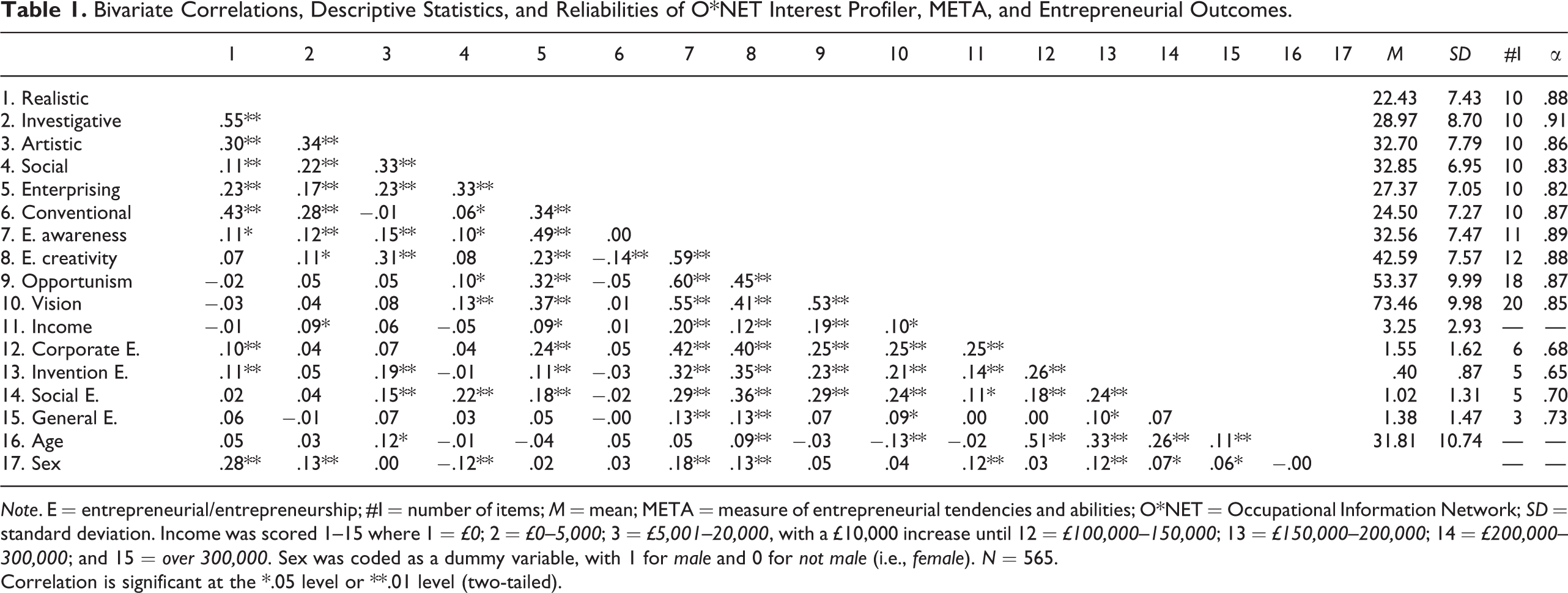
Note. E = entrepreneurial/entrepreneurship; #I = number of items; M = mean; META = measure of entrepreneurial tendencies and abilities; O*NET = Occupational Information Network; SD = standard deviation. Income was scored 1–15 where 1 = £0; 2 = £0–5,000; 3 = £5,001–20,000, with a £10,000 increase until 12 = £100,000–150,000; 13 = £150,000–200,000; 14 = £200,000–300,000; and 15 = over 300,000. Sex was coded as a dummy variable, with 1 for male and 0 for not male (i.e., female). N = 565.
Correlation is significant at the *.05 level or **.01 level (two-tailed).
Entrepreneurial Outcomes
Twenty items relating to past (biographical) and current entrepreneurial achievements and activities were included in the survey in order to assess individual differences in entrepreneurial success. All items were rationally generated based on the most common themes in the literature (e.g., Schumpeter, 1911; Shane, 2008; Shane & Venkataraman, 2000), namely, entrepreneurial activities to generate income outside main job (e.g., by selling things, providing services, or organizing events); corporate entrepreneurship (e.g., making improvements to the organization’s product or service lines); social entrepreneurship (e.g., engaging homeless welfare initiatives, creating a student organization); and entrepreneurship through innovation/invention (in line with the Creative Achievement Questionnaire; Carson, Peterson, & Higgins, 2005). The items referred to actual outcomes, outside and within organizations, rather than to preferences or tendencies. A (varimax rotated) principal component analysis was conducted to investigate the underlying structure of these items. Six factors with Eigenvalues above 1 were extracted. An examination of the screeplot revealed four independent factors. All items loaded on their hypothesized factor, with 1 item (organizing events) not loading well (below .3) on any factor. This item was excluded from the analysis. The four factors were named: general (3 items; α =. 73), corporate (6 items; α = .68), invention (5 items; α = .65), and social entrepreneurship (5 items; α = .70). One additional item “income” was included in the analysis, given that it represents a common operationalization of (entrepreneurial) success in the literature (Zhao & Siebert, 2006).
Procedure
Participants completed the survey online, through a website that was advertised via social media sites, e-mail, and psychology websites. First, participants answered some biographical information related to entrepreneurial activities and achievements. Next, they completed the vocational interest inventory (O*NET Interest Profiler) and the entrepreneurial measure (META). After completing the survey, participants received feedback on their RIASEC and META scores.
Results
Bivariate correlations are presented in Table 1, together with descriptive statistics and internal consistency reliabilities. Intercorrelations between types of the O*NET Interest Profiles (Table 1) revealed that the internal structure replicates the circular ordering of RIASEC. The types closest to each other present the highest correlations, whereas the correlations decrease in those with greater distance.
As excepted, META scales presented the highest correlations with enterprising interests, although EC correlated moderately also with artistic interests (.33). Vocational interests presented small to moderate correlations with some of the entrepreneurial outcomes, whereas META scales had modest to moderate correlations with all those outcomes. Given these results, we proceed to test the validity of these constructs in the prediction of entrepreneurship.
Structural Equation Modeling (SEM)
In order to investigate the concurrent and discriminant validity of the facets of META and RIASEC, SEM was carried out using AMOS 5.0 (Arbuckle, 2003). Given the intercorrelations between the META scales and the intercorrelations between the outcome measures (see Table 1), we tested a parsimonious model where a latent META factor and a latent “Total Entrepreneurial Activity (TEA)” factor (onto which all outcomes were loaded) were specified. In this model, the variables age and gender were exogenous, or covariates; personality and vocational interest (i.e., META scales and RIASEC dimensions) were mediators; and entrepreneurial outcomes were endogenous variables. The variables were entered as observed covariates, with the exception of the two latent factors. The directionality of the model is conceptual, considering that sex and age are the variables less affected by environmental factors, followed by personality and interest constructs, and finally entrepreneurial activities.
The model’s goodness of fit was assessed via the χ2 statistic (Bollen, 1989; which tests the hypothesis that an unconstrained model fits the covariance or correlation matrix as well as the given model); the Goodness-of-Fit Index (GFI; Tanaka & Huba, 1985; values close to 1 are acceptable); the Comparative Fit Index (CFI; Bentler, 1990; values above .96 are acceptable); the Root Mean Square Error of Approximation (RMSEA; Browne & Cudeck, 1993; values of .06 or below indicate reasonable fit for the model); and the Expected Cross Validation Index (ECVI; Browne & Cudeck, 1989; smaller values indicate better fit).
In the saturated model, paths from the covariates to the mediators and the dependent variable (DV) and from the mediators to the DV were added. This model, which included 11 paths between exogenous and endogenous variables, did not fit the data well: χ2(86 df) = 343.32, p < .01; GFI = .93; CFI = .88; RMSEA = .07 (.07 to .08); ECVI = .79.
Accordingly, modifications were made based on the AMOS modification indices, expected parameter change statistics, and standardized residuals. Parameters were added only if they made substantive sense. Two observed variables, social entrepreneurship and general entrepreneurship, were found to be poor indicators of their latent TEA factor. These paths were subsequently freed. Based on the modification indices and expected parameter change, four direct paths were added to the model; these were from the latent META variable to social (β = .35) and general (β = .14) entrepreneurship, from social interests to social entrepreneurship (β = .19), and from artistic interests to inventive entrepreneurship (β = .14). These paths were added one at a time, and all other path coefficients and fit statistics were examined after each addition to determine its effect on these values. In addition, several paths were found to have nonsignificant values and were subsequently removed from the model one parameter at a time, starting with the lowest t value. The modified model, shown in Figure 1, fitted the data well: χ2(84 df) = 175.55, p < .01; GFI = .96; CFI = .96; RMSEA = .04 (.03 to .05); ECVI = .50.
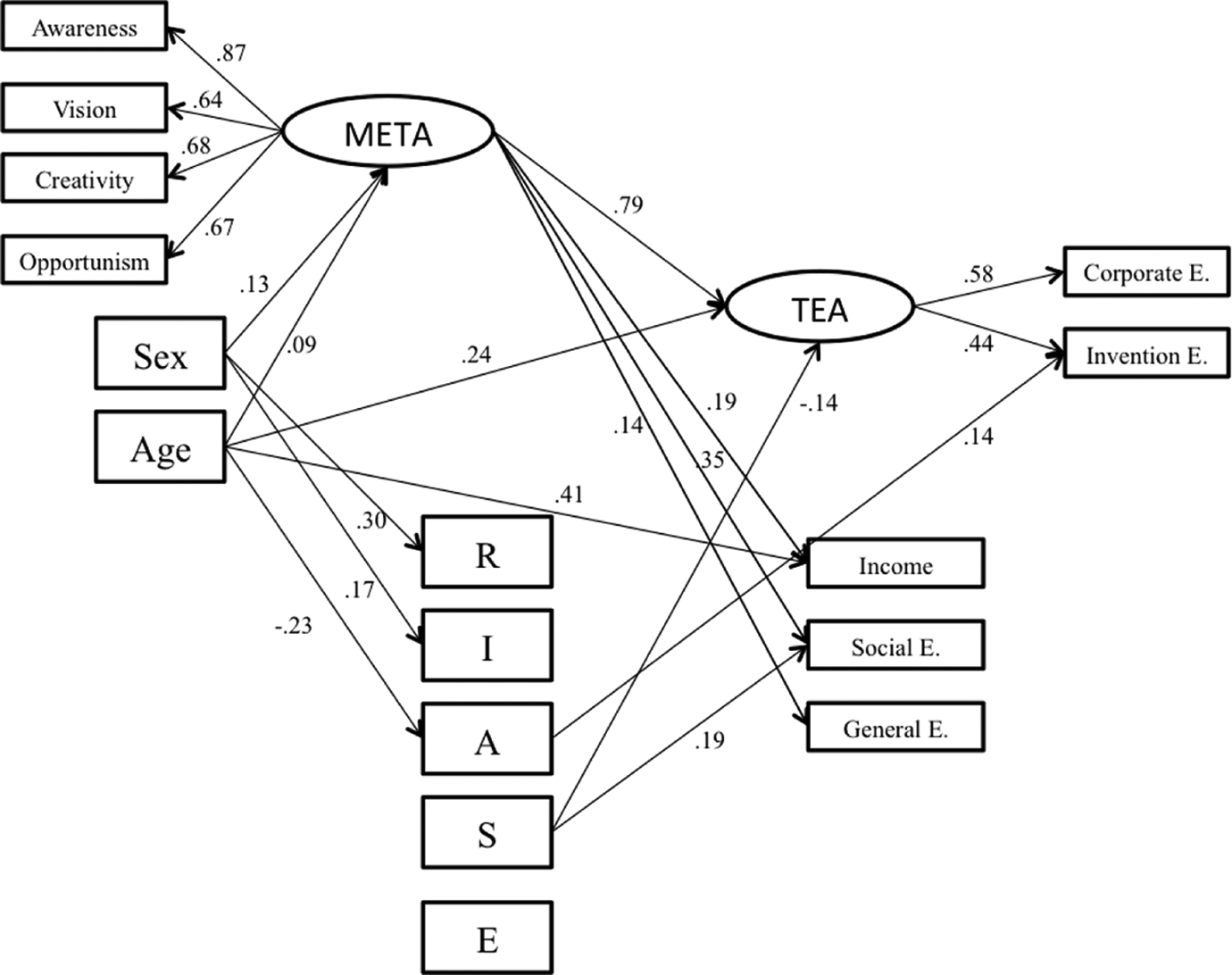
The modified model.
As shown in Figure 1, vocational interests significantly predicted several entrepreneurship outcomes even when META and demographic variables were included in the model. Specifically, social interests loaded significantly on the latent entrepreneurship factor, as well as the observed social entrepreneurship factors, and artistic interests loaded significantly on invention entrepreneurship. The results further demonstrated that the latent META factor was the strongest predictor of entrepreneurship outcomes. AMOS-squared multiple correlations revealed that the relevant predictors combined accounted for 75% of the variance of the latent entrepreneurship factor, 22% of income, 2% of general entrepreneurship, and 16% of social entrepreneurship.
Discussion
The main purpose of this study was to explore the relationship between entrepreneurship and vocational interests. As hypothesized (Hypothesis 1), the analysis revealed that the enterprising dimension of the RIASEC displayed the highest correlations with META scales. The artistic dimension presented the second highest correlation with META (i.e., EC). This suggests that entrepreneurial individuals tend to gravitate toward enterprising and creative activities. The lowest RIASEC correlates of META scales were the conventional and realistic types. Conversely, these two types were the highest RIASEC correlates of the enterprise dimension, clearly distinguishing between the construct of enterprising as conceptualized in RIASEC and the entrepreneurial personality as assessed by META. Thus, entrepreneurial individuals are characterized primarily as enterprising and creative, and to some degree as social and investigative.
SEM showed, as predicted (Hypothesis 2), that several of the RIASEC dimensions were related to entrepreneurship. Specifically, social types are more likely to engage in social entrepreneurship, which includes activities aimed at improving student and community welfare, organizing events, and taking initiative to enhance education. Artistic types on the other hand had higher entrepreneurial inventive achievements, involving a higher likelihood to build a prototype of a design, and seeking investment in, receive orders, and/or selling an invention. Interestingly, social types had lower overall entrepreneurial achievements, as indicated by the negative correlation between this type and total entrepreneurial achievement, suggesting that these individuals are less likely to act entrepreneurially within organizations and to engage in creative entrepreneurship activities (i.e., creating and pursuing new designs and inventions).
As hypothesized (Hypothesis 4), the predictive power of vocational interests remained even when other personality and demographic variables were included in the analyses—a finding that is likely to be important for the entrepreneurship literature. Thus, the results of our study stress the importance of considering the domain of interests in entrepreneurship research. As Armstrong et al. (2011) and others (e.g., Chamorro-Premuzic, 2011) have noted, more integrative models of individual differences, which include domains of personality, ability, motivations, and interests, are needed in order to understand any psychological or behavioral phenomena in full. This study is a testament to the importance of vocational interests in the prediction of entrepreneurial activity, both outside and within organizations.
In addition to the RIASEC–entrepreneurship link, the current study showed that META, as expected, significantly predicted (all) entrepreneurship outcomes (Hypothesis 3). In particular, the power of META to predict entrepreneurial outcomes was significantly stronger and more consistent than both RIASEC and demographic variables, with magnitudes of effect sizes exceeding .7 (compared with the highest RIASEC weight coefficient which was less than .2). Given that META was specifically developed to assess entrepreneurial potential its comparatively higher validity in predicting entrepreneurial activity makes sense. Nevertheless, considering the current knowledge gaps regarding the psychology of entrepreneurship (Hisrich et al., 2007), the present results may have substantial practical implications.
Limitations and Future Research
The current study has some limitations, such as the demographics of participants. Specifically, females were overrepresented in our sample. In contrast, research shows that females are underrepresented, particularly among self-employed individuals (Shane, 2008). Thus, future research should aim to have more evenly distributed sample in terms gender. Nevertheless, the current sample incorporated a sufficient number of participants from each occupational status, as well as different professions. Thus, combined with the large sample size, the current study is still based on a more representative sample than many studies within the field.
A second limitation is that all the criteria utilized in this study were assessed via self-report. Therefore, the inclusion of objective measures of entrepreneurial outcomes would be advisable in future research. It should however be noted that the sample completed our survey in “low stakes” setting and to receive feedback on their results (which minimizes the occurrence of deception and “faking good”). Finally, it would be desirable to include a generic measure of personality, such as the “Big Five” or five-factor model to assess the incremental validity of META and RIASEC in the prediction of entrepreneurial activity.
Implications
The current results have implications for various areas of application. The first is personnel selection: Selecting individuals based on their RIASEC and META scores may be of significant interest to organizations, as this may act as a foundation for increased competitive advantage. Indeed, growing evidence suggests that large companies that employ individuals who act entrepreneurially tend to gain and retain competitive advantage in their markets (e.g., Lumpkin, 2007). Second, governmental bodies that encourage entrepreneurial activity and venture creation may want to use vocational interests tests, in addition to personality inventories, to decide the most appropriate candidates for financial (and nonfinancial) assistance.
A third implication relates to vocational guidance. RIASEC dimensions are excellent tools for providing vocational guidance for young (and old) individuals (Chamorro-Premuzic, 2011). This study suggests that guidance for high scorers on the social and artistic dimensions may also be important in terms of nurturing future entrepreneurial activity. Finally, relevant personality and vocational interests profiling could be used as placement tool in private and public sector organizations, where individuals are promoted or relocated into roles where entrepreneurial commotion and thinking is beneficial, or necessary.
Conclusion
Entrepreneurship is thought to be a major source of employment, economic growth, and technological progress (Kuratko, 2003; Reynolds et al., 2004). In order to understand and facilitate this process, we need more integrative predictive models, which include both personality and vocational interests (Revelle, Condon, & Wilt, 2011). Our research supports this notion. It suggests that individual differences shape the process of entrepreneurship, both directly through the actions of entrepreneurial individuals and indirectly by the vocational choices that these individuals make.
Footnotes
Declaration of Conflicting Interests
The author(s) declared no potential conflicts of interest with respect to the research, authorship, and/or publication of this article.
Funding
The author(s) received no financial support for the research, authorship, and/or publication of this article.