



Abstract
The purpose of the present research was to provide additional evidence for the construct validity of Mitchell, Holtom, Lee, Sablynski, and Erez’s Job Embeddedness Questionnaire (JEQ). While most studies have focused on building the nomological network of job embeddedness with organizationally relevant outcomes, scant research has focused attention on the psychometric properties of the JEQ. To this end, this study explores the meta-analytic relationships of the JEQ with job satisfaction and organizational commitment measures to help build additional evidence for the discriminant validity of the job embeddedness construct. Results revealed that the organizational dimensions of links, fit, and sacrifice and job satisfaction measures have differential relationships with perceived desirability and ease of movement variables thereby lending support to the construct validity of the JEQ. In addition, the content and factorial validity of the JEQ was examined using a cross-industry, multioccupational sample from 542 respondents. Results indicated that while the three-factor model for both organizational and community embeddedness had the best fit to the data, other psychometric properties were somewhat questionable. Recommendations were provided to refine the current operationalization of the JEQ and to expand the nomological network of job embeddedness by exploring predictors and outcomes of individual dimensions of organizational embeddedness and community embeddedness.
Keywords
In the past decade, researchers have frequently examined job embeddedness in the careers and organizations literature (e.g., Allen, 2006; Holtom, Burton, & Crossley, 2012; Mitchell, Holtom, Lee, Sablynski, & Erez, 2001; Ng & Feldman, 2007, 2010). Job embeddedness was developed as an alternative to traditional job attitudes and in order to explain why employees become enmeshed or “embedded” in their job as the result of numerous organizational and community forces (e.g., Lee, Mitchell, Sablynski, Burton, & Holtom, 2004; Mitchell & Lee, 2001; Mitchell et al., 2001). In general, researchers have found consistent support that indicates employees with higher levels of job embeddedness will also have lower levels of turnover (Crossley, Bennett, Jex, & Burnfield, 2007; Felps et al., 2009; Mallol, Holtom, & Lee, 2007; Mitchell et al., 2001). Also, studies have found that organizational embeddedness assists in the direct and indirect prediction of job performance and organizational citizenship behaviors (e.g., Lee et al., 2004; Sekiguchi, Burton, & Sablynski, 2008). Finally, more recent studies have explored the buffering effects of job embeddedness toward negative shocks such that employees who are more embedded are less likely to withdraw, search for jobs, or engage in counterproductive work behaviors and more likely to engage in in-role and extra-role performance when they experience negative shocks (Burton, Holtom, Sablynski, Mitchell, & Lee, 2010; Holtom et al., 2012).
Job embeddedness is a unique construct in that it involves both organizational and community influences and consists of two main factors—organizational embeddedness (i.e., on-the-job embeddedness) and community embeddedness (i.e., off-the-job embeddedness). Mitchell, Holtom, Lee, Sablynski, and Erez, (2001) developed the Job Embeddedness Questionnaire (JEQ) to assess organizational embeddedness and community embeddedness and to capture the broad constellation of influences on employee retention. The 34 items from the JEQ cover six dimensions (organizational fit, organizational sacrifice, organizational links, community fit, community sacrifice, and community links). The JEQ was developed based on the theoretical framework proposed by Mitchell and Lee (2001) and includes reference to embedded figures and field theory (Lewin, 1951) and the unfolding model of turnover (Lee & Mitchell, 1994; Lee, Mitchell, Holtom, McDaniel, & Hill, 1999).
Subsequent job embeddedness studies using the JEQ have supported its utility for predicting turnover, job performance, job satisfaction, and organizational citizenship behaviors (Allen, 2006; Crossley et al., 2007; Halbesleben & Wheeler, 2008; Harris, Wheeler, & Kacmar, 2011; Lee et al., 2004; Sekiguchi et al., 2008; Swider, Boswell, & Zimmerman, 2011). Further, the JEQ has shown predictive validity in not only U.S. samples but also in samples from China (Hom et al., 2009), India (Ramesh & Gelfand, 2010), and Israel (Lev & Koslowsky, 2012) and samples gathered from the U.S. Hispanic and Latino community (Mallol et al., 2007). To this end, these results provide preliminary validity evidence for the JEQ as a fairly good operationalization of organizational embeddedness and community embeddedness. Further, research studies that have used the JEQ are steadily growing and thus more could be known about the psychometric properties and construct validity of this instrument. With that being said, very few researchers have looked at the six embeddedness dimensions despite Lee, Mitchell, Holtom, McDaniel, and Hill (1999) and Lee, Mitchell, Sablynski, Burton, and Holtom (2004) recommendations that future studies should examine profiles of the dimensions and that items underlying the dimensions require additional development.
The purpose of the present research was to provide conceptual clarity on the construct of job embeddedness and additional evidence for the construct validity of Mitchell et al.’s (2001) JEQ. Since construct validation is an ongoing process that consists of accumulating evidence from multiple validation procedures (e.g., Anastasi, 1986; Angoff, 1988; Shepard, 1993), the present research explored the psychometric properties of Mitchell and colleagues’ (2001) JEQ using a cross-industry and multioccupational sample to assess reliability, content validity, and factorial validity. Another important objective of this study was to include meta-analytic estimates between job embeddedness, job satisfaction, and organizational commitment measures, along with perceived desirability and ease of movement measures, in order to evaluate the construct validity of the JEQ. To this end, a final objective of this study was to provide recommendations for improving and refining the JEQ.
Overview of Job Embeddedness Literature
Job embeddedness was introduced as a new multidimensional construct in the turnover literature in order to provide a potential explanation as to why people stay with their organization (e.g., Lee et al., 2004; Mitchell & Lee, 2001; Mitchell et al., 2001). Essentially, job embeddedness “represents a broad constellation of influences on employee retention” (Mitchell et al., 2001, p. 1104) and includes organizational and community factors such as community involvement, home ownership, coworker relationships, and organizational benefits. Organizational embeddedness is synonymous with the individual becoming enmeshed to the organization, whereas community embeddedness is equated with the individual becoming more connected within the community. As such, job embeddedness consists of three main factors—links, fit, and sacrifice—that predict the extent to which one will develop strong attachments to the organization and community. Links represent informal and formal connections to people and groups within the organization and community. Specifically, links are financial, psychological, and social ties that connect the employee and his or her family to organization and community friends, groups, and even the physical environment. Mitchell et al. (2001) posited that higher numbers of links would result in stronger connections to the organization and community. Fit characterizes the extent to which the employee’s goals and values are congruent with the job, organization, and community. Mitchell et al. proposed that better fit would lead to stronger personal and professional ties with the organization and community. Sacrifice embodies perceived financial and social costs that may be foregone if the individual leaves the organization or community and gives up benefits such as nonportable compensation, friendships, and community desirability. Mitchell et al. suggested that greater perceived costs would be related to stronger embeddedness to the organization and community. Mitchell and his colleagues conjectured:
Embeddedness suggests that there are numerous strands that connect an employee and his or her family in a social, psychological, and financial web that includes work and non-work friends, groups, the community, and the physical environment in which he or she lives. (p. 1104)
Job Embeddedness: Similarities and Differences to Job Satisfaction and Organizational Commitment
Although job embeddedness was presented as a key construct to understanding why employees stay with their jobs in the employee attachment and turnover literature (e.g., Mitchell & Lee, 2001; Mitchell et al., 2001), the on-the-job portion of this construct, known as organizational embeddedness, possesses striking conceptual similarities to both job satisfaction and organizational commitment. Typically, researchers have differentiated job embeddedness from traditional constructs used in the turnover literature (e.g., Crossley et al., 2007; Mitchell & Lee, 2001; Mitchell et al., 2001). However, the conceptual similarity between job embeddedness and other traditional job attitudes and their measures has not been thoroughly examined. If the constructs and the measures of these constructs are conceptually similar, then it behooves researchers to understand these similarities in order to know when to employ these constructs in theoretical models and how to apply these constructs at a practical level.
Job Embeddedness and Job Satisfaction
Job satisfaction is one of the most frequently studied job attitudinal constructs and has been the subject of more than 10,000 studies (Spector, 1997). Job satisfaction has numerous antecedents and outcomes. The most notable antecedents include dispositions (Connolly & Viswesvaran, 2000; Judge, Locke, & Durham, 1997; Watson & Slack, 1993), job characteristics (Fried & Ferris, 1987; Hackman & Oldham, 1976), organizational constraints (O’Connor, Peters, Rudolf, & Pooyan, 1982; Peters, O’Connor, & Rudolf, 1980), and role-related variables (Jackson & Schuler, 1985). Furthermore, job satisfaction impacts a number of attitudes and behaviors such as job burnout (Lee & Ashforth, 1996), life satisfaction (Judge & Watanbe, 1993; Tait, Padgett, & Baldwin, 1989), organizational citizenship behavior (Organ & Ryan, 1995), turnover intentions (Tett & Meyer, 1993), and turnover (Griffeth, Hom, & Gartner, 2000). One of the most frequently used definitions of job satisfaction is “ … a pleasurable or positive emotional state resulting from the appraisal of one’s job or job experiences” (Locke, 1976, p. 1300). In this definition, Locke (1976) makes the argument that one’s cognitive appraisal of the job impacts affective feelings toward the job. Similar to needs-satisfaction researchers, Locke extends the construct of job satisfaction to both affective and cognitive domains. In comparing job satisfaction to job embeddedness, it is apparent that job embeddedness includes community factors that are not encompassed by job satisfaction measures. Thus, this article will focus on the organizational component of job embeddedness known as organizational embeddedness. Further, Mitchell and his colleagues (2001) propose that job satisfaction is more affective in nature, while organizational embeddedness is both affective and cognitive laden. However, some researchers have suggested that no pure affective or cognitive measure of job satisfaction exists, and the majority of job satisfaction measures consist of both affective and cognitive components (Weiss, 2002). To this end, empirical evidence from several studies suggests that popular measures of job satisfaction include varying levels of affective and cognitive satisfaction (Brief & Roberson, 1989; Williams, 1998).
Based on the review of extant literature, the composite of organizational embeddedness from the JEQ along with several measures of job satisfaction, Job Satisfaction Survey (JSS: Spector, 1997); Overall Job Satisfaction (OJS: Mitchell et al., 2001), Job in General Scale (Russell et al., 2004), Minnesota Satisfaction Questionnaire (Weiss, Dawis, England, & Lofquist, 1967), and Michigan Organizational Assessment Questionnaire (Cammann, Fichman, Jenkins, & Klesh, 1979) have been used frequently in job embeddedness research (e.g., Halbesleben & Wheeler, 2008; Harris et al., 2011; Hom et al., 2009; Lee et al., 2004; Lev & Koslowsky, 2012; Swider et al., 2011; Wheeler, Harris, & Harvey, 2010). However, the most popular job satisfaction measures in job embeddedness research include Spector’s (1997) JSS and Mitchell et al.’s (2001) OJS. Typically, the composite of organizational embeddedness is used as opposed to the individual dimensions of fit, sacrifice, and links (cf. Crossley et al., 2007; Cunningham, Fink, & Sagas, 2005; Harman, Blum, Stefani, & Taho, 2009; Mallol et al., 2007; Mitchell et al., 2001; Ramesh & Gelfand, 2010). In early job embeddedness research (e.g., Mitchell et al., 2001), job satisfaction, when measured with the JSS, had strong relationships with organizational embeddedness (grocery store employees: n = 232, r = .60, p < .01; hospital employees: n = 232, r = .65, p < .01). Using the OJS and JEQ with Caucasian and Hispanic/Latino bank employees, Mallol, Holtom, and Lee (2007) also found strong relationships between organizational embeddedness and job satisfaction (South Florida Caucasian bank employees: n = 177, r = .69, p < .01 and South Florida Hispanic and Latino bank employees: n = 177, r = .72, p < .01). Although previous research has demonstrated that organizational embeddedness has incremental validity beyond that of job satisfaction in the prediction of turnover, the strong correlations between organizational embeddedness and job satisfaction raise intriguing questions about the discriminant validity of the JEQ.
Job Embeddedness and Organizational Commitment
Organizational commitment has become one of the most frequently studied organizational constructs because of its robustness in predicting important outcomes such as job performance, organizational citizenship behavior, stress, turnover, and work–family conflict (Mathieu & Zajac, 1990; Meyer, Stanley, Herscovitch, & Topolnytsky, 2002). Organizational commitment has been defined as “ … the strength of an individual’s identification with and involvement in a particular organization” (Porter, Steers, Mowday, & Boulian, 1974, p. 604) and also “ … as a psychological state that characterizes the employees’ relationship with the organization and has implications for the decision to continue membership in the organization” (Meyer & Allen, 1991, p. 67). Porter, Steers, Mowday, and Boulian (1974) focused on one dimension of organizational commitment, that of affective or attitudinal commitment. In contrast, Meyer and Allen (1991, 1997) conceptualized organizational commitment to consist of two additional factors that included continuance and normative commitment.
In comparing organizational commitment to job embeddedness, it is important to note that organizational commitment only examines organizational factors, while job embeddedness looks at both organizational and community factors (e.g., Mitchell et al., 2001). Thus, our discussion will focus solely on factors that comprise organizational embeddedness and Meyer and Allen’s (1991, 1997) three-component model of organizational commitment. As with job satisfaction, a review of the job embeddedness literature suggests that the composite of organizational embeddedness from the JEQ has been frequently used as opposed to the individual dimensions of links, fit, and sacrifice when exploring the relationship with organizational commitment. Further, organizational commitment has been consistently measured with either Meyer and Allen’s (1997) Organizational Commitment Questionnaire (OCQ; e.g., Mallol et al., 2007; Mitchell et al., 2001; Ramesh & Gelfand, 2010) or Meyer and Allen’s (1997) Affective Commitment Questionnaire (ACQ; e.g., Crossley et al., 2007; Cunningham et al., 2005; Halbesleben & Wheeler, 2008; Harman, et al., 2009; Hom et al., 2009; Lee et al., 2004; Lev & Koslowsky, 2012). When using the JEQ and OCQ, correlations between organizational embeddedness and organizational commitment have been moderate to strong across studies (e.g., Mallol et al., 2007: South Florida Caucasian bank employees: n = 177, r = .55, p < .01 and South Florida Hispanic and Latino bank employees: n = 177, r = .50, p < .01; Mitchell et al., 2001: grocery store employees: n = 232, r = .64 p < .01 and hospital employees: n = 232, r = .67, p < .01). Correlations between organizational links and organizational commitment have been substantially weaker across studies using the JEQ and OCQ (e.g., Mallol et al., 2007: South Florida Caucasian bank employees: n = 177, r = .23, p < .01 and South Florida Hispanic and Latino bank employees: n = 177, r = .15, ns; Mitchell et al., 2001: grocery store employees: n = 232, r = .15, p < .05 and hospital employees: n = 232, r = .28, p < .01). In contrast, correlations between organization-related sacrifice and organizational commitment have been very strong (e.g., Mallol et al., 2007: South Florida Caucasian bank employees: n = 177, r = .68, p < .01 and South Florida Hispanic and Latino bank employees: n = 177, r = .73, p < .01; Mitchell et al., 2001: grocery store employees: n = 232, r = .58, p < .01 and hospital employees: n = 232, r = .67, p < .01). Finally, correlations between organizational fit and organizational commitment have also been strong (e.g., Mallol et al., 2007: South Florida Caucasian bank employees: n = 177, r = .65, p < .01 and South Florida Hispanic and Latino bank employees: n = 177, r = .54, p < .01; Mitchell et al., 2001: grocery store employees: n = 232, r = .58, p < .01 and hospital employees: n = 232, r = .52, p < .01). In response, conceptual similarities and differences were explored between (a) affective commitment and organizational fit, (b) continuance commitment and organization-related sacrifice, (c) normative commitment and organizational links, and (d) affective commitment and organization-related sacrifice.
Affective Commitment and Organizational Fit
Affective commitment and organizational fit have some conceptual similarities in that both constructs are representative of organizational commitment as refined by Kell and Motowildo (2012). Obviously, affective forces are captured heavily in Meyer, Allen, and Smith’s (1993) affective commitment measure. Specifically, affective commitment looks at “ … emotional attachment to, identification with, and involvement with the organization” (Meyer et al., 2002, p. 21). Meyer et al.’s (1993) measure consists of affective items such as “I really feel as if this organization’s problems are my own” and “I do not feel a ‘strong’ sense of belonging to my organization.” In contrast, organizational fit considers the extent to which the individual’s abilities match organizational requirements and the individual’s values are congruent with organizational culture. Organizational fit is purported not to be as affect driven as affective commitment and more representative of a cognitive belief (Mitchell et al., 2001). Indeed, closer examination of Mitchell et al.’s (2001) JEQ organizational fit measure reveals items that reflect specific examples of perceived compatibility to and identification with the organization. In fact, several of the items such as “My job utilizes my skills and talents well” and “I fit with my organization’s culture” are excellent examples of value congruence and identification with the organization. To this end, correlations between organizational fit and affective commitment have been very strong across studies (e.g., Cunningham et al., 2005: National Collegiate Athletic Association [NCAA] Division I Softball Coaches: n = 213, r = .67, p < .05 and NCAA Division I athletic operations employees: n = 189, r = .68, p < .05; Mitchell et al., 2001: grocery store employees: n = 232, r = .61, p < .01 and hospital employees: n = 232, r = .69, p < .01). Based on these correlations and the previous discussion, it appears the ACQ and the organizational fit dimension of the JEQ possesses some content overlap.
Continuance Commitment and Organization-Related Sacrifice
Continuance commitment and organization-related sacrifice also possess several conceptual similarities and differences. Specifically, both constructs entail the importance of perceived costs of material or psychological benefits associated with foregoing benefits and leaving the organization. For example, both Meyer and Allen (1991) and Mitchell and his colleagues (2001) use items that look at the importance of sacrificing or losing benefits when leaving the organization. In addition, the items that comprise the organization-related sacrifice dimension of the JEQ and the continuance commitment dimension of the OCQ are mostly cognitive as opposed to tapping affective content. At the same time, the operationalization of these two constructs is different in that organization-related sacrifice does not include items that address job alternatives. Further, the items that comprise organization-related sacrifice are much more specific (e.g., use distinct foci of sacrifice such as compensation, coworkers, and promotional opportunities) as compared to the general items that are used in Meyer and Allen’s (1991) continuance commitment scale (e.g., emphasis on staying or leaving the entire organization). Not surprisingly, correlations between continuance commitment and organization-related sacrifice are much smaller ranging from .24 (grocery store employees: n = 232, p < .01) to .27 (hospital employees: n = 232, p < .01) in Mitchell and colleagues’ study to negligible (assisted living facility employees: n = 232, r = .01, ns) in Crossley, Bennett, Jex, and Burnfield’s (2007) study. In sum, the organization-related sacrifice dimension of the JEQ appears to have a high degree of discriminant validity with the continuance commitment dimensions of the OCQ.
Normative Commitment and Organizational Links
Normative commitment and organizational links are also conceptually similar constructs, whereas the former is based on the perceived obligation to remain with the organization due to organizational socialization processes, the latter is the result of informal or formal connections with colleagues and the corresponding normative pressures to stay with the organization. Although the definitions of these constructs are very similar, the operationalization of each is very different. Specifically, normative commitment looks at employee perceptions of obligations to their job and organization in the form of Likert-type questions, but organizational links explores concrete numbers based on coworker interaction, job and organizational tenure, and team membership as open-ended questions. Not surprisingly, Mitchell and his colleagues (2001) found that these correlations were the smallest (grocery store employees: n = 232, r = −.01, ns; and hospital employees: n = 232, r = .11, ns). In sum, the organizational links dimension of the JEQ appears to have a high degree of discriminant validity with the normative commitment dimensions of the OCQ.
Affective Commitment and Organization-Related Sacrifice
Although not discussed in the job embeddedness literature, affective commitment and organization-related sacrifice do exhibit discriminant validity. As noted earlier, affective commitment encompasses one’s emotional attachment to the organization. Organization-related sacrifice captures the perceived costs of material or psychological benefits that would be foregone if the individual leaves the organization. To this end, the definition and operationalization of these constructs are very different; yet, correlations have been strong (e.g., Cunningham et al., 2005: NCAA Division I Softball Coaches: n = 213, r = .49, p < .05 and NCAA Division I athletic operations employees: n = 189, r = .49, p < .05; Mitchell et al., 2001: grocery store employees: n = 232, r = .58, p < .01 and hospital employees: n = 232, r = .67, p < .01). One potential explanation that lends support to the discriminant validity of these constructs is that established empirical relationships with perceived ease of movement variables demonstrate that organization-related sacrifice, as compared to affective commitment, has stronger negative relationships with job alternatives and job search behavior (JSB; e.g., Crossley et al., 2007; Harman et al., 2009). Specifically, organization-related sacrifice entails the evaluation of perceived costs of leaving the organization in terms of what would be foregone (e.g., benefits, compensation, etc.), whereas affective commitment encompasses the feeling of being emotionally attached to the organization. Thus, organization-related sacrifice captures the extent to which individuals are involved in a longer, deliberate, cognitive evaluation process of the organization as compared to affective commitment which measures a shorter, less intense reaction associated with an affective mind-set. This reasoning ties into the unfolding model of voluntary turnover, and more specifically to shocks, in that it may explain why people do not leave when they experience shocks. Further, it provides the basis of empirical and theoretical support as to why organization-related sacrifice and affective commitment are distinct constructs despite strong correlations. Finally, another possible explanation as to why the relationships are consistently strong, yet the constructs still are distinct, is that affective commitment consists of primarily affective, emotionally laden worded items (feel and liking) and organization-related sacrifice contains largely behavioral worded items (leaving the job).
Study 1
Method
Literature Search
In order to evaluate the construct validity of the JEQ, meta-analytic estimates were provided for organizational embeddedness, perceived desirability, and ease of movement measures. To further explore the extent of relationships between the JEQ and these measures, the researcher searched for all published studies, excluding dissertations, available in PsychLit (2001—May 2012), PsychInfo (2001—May 2012), and ProQuest (2001—May 2012) databases using the key words job embeddedness, organizational embeddedness, community embeddedness, on-the-job embeddedness, off-the-job embeddedness, organizational fit, organizational related sacrifice, organizational links, community fit, community sacrifice, and community links. The researcher chose the year 2001 to begin this search because the first formal attempt to measure job embeddedness with job embeddedness theory was developed in the early part of 2001. In addition, the researcher reviewed all studies in the databases that referenced any of the above studies.
To be included within the meta-analysis, the study had to use the JEQ and report zero-order correlations with job satisfaction, organizational commitment, job alternatives, JSB, intent to leave, and voluntary turnover. Studies using measures other than the JEQ for job embeddedness were excluded from the meta-analysis. In total, 19 independent samples involving 7,100 employees from 14 published studies were identified.
Meta-Analytic Strategy
Hunter and Schmidt’s (2004) meta-analysis method was used to explore the correlates of organizational embeddedness, organizational links, organization-related sacrifice, and organizational fit. Each correlation was corrected for attenuation due to unreliability in both the predictor and the criterion variables based on internal consistency reliability (i.e., α coefficients). Of particular importance, reliability estimates for turnover were assumed to be equal to 1.00. When reliability estimates were not reported in the original studies, the researcher used a weighted average of the reported reliability estimates for similar measures and used these values to correct the correlations. Besides reporting estimates for corrected correlations, 80% credibility intervals and 95% confidence intervals (CIs) around the estimated population correlations are included. In addition, the percentage of variance in effect sizes that were explained by study artifacts is reported.
Table 1 provides results for analyses involving correlates of organizational embeddedness, organizational links, organizational sacrifice, and organizational fit. Hunter and Schmidt (2004) advised that if at least 75% of the variance in study correlations is explained by artifacts, then it is unlikely moderators are present. For the majority of the analyses, less than 75% of the variance in study correlations was explained by artifacts. Thus, when sufficient data were available, moderator analyses were conducted. Specifically, the moderating effects of the form of job satisfaction, organizational commitment, and JSB measure were examined. With regard to measure, separate analyses were conducted for Spector’s (1997) JSS and Mitchell et al.’s (2001) OJS, Meyer and Allen’s (1997) OCQ and ACQ, and Blau’s (1994) measure of JSB, and Kopelman, Rovenpor, and Millsap (1992) Job Search Behavior Index (JSBI). It is important to note that some authors made modifications to these published measures by eliminating or modifying items. Because of the limited number of published studies, the decision was made to include these studies in the primary analyses and in the subgroup analyses. Table 1 also provides results for the subgroup analyses.
Correlates of Organizational Embeddedness.
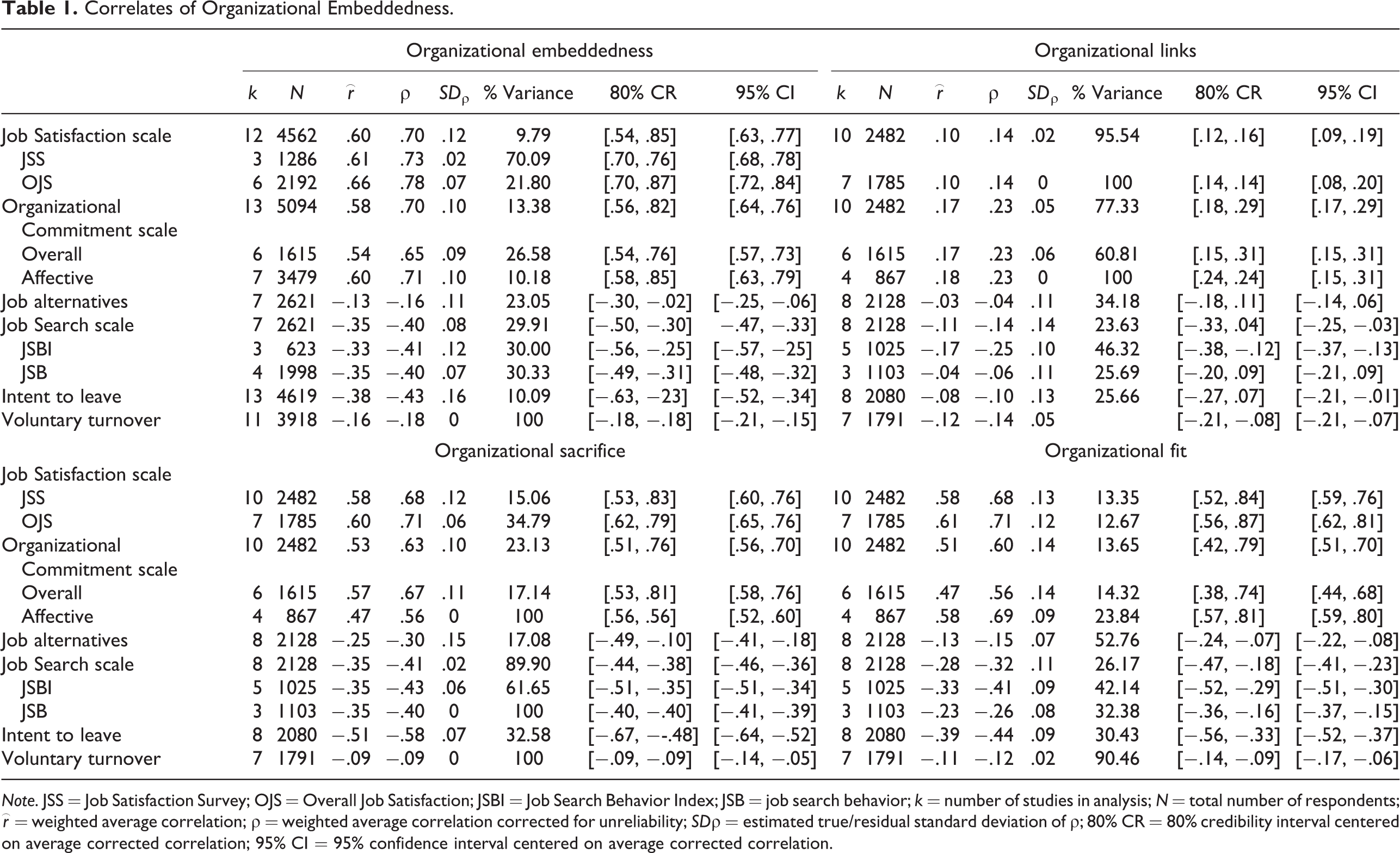
Note. JSS = Job Satisfaction Survey; OJS = Overall Job Satisfaction; JSBI = Job Search Behavior Index; JSB = job search behavior; k = number of studies in analysis; N = total number of respondents;
Job Satisfaction
As expected, the pattern of correlations between organizational embeddedness, organization-related sacrifice, and organizational fit with job satisfaction was strong. In contrast, the relationship between organizational links and job satisfaction was modest. Organizational embeddedness was strongly related to job satisfaction (ρ = .70). Additional analyses revealed that organizational sacrifice was strongly related to job satisfaction (ρ = .68) and organizational fit was strongly related to job satisfaction (ρ = .68). Organizational links had a weak positive correlation with job satisfaction (ρ = .14). Correlations with Mitchell and colleagues’ (2001) OJS followed similar patterns of relationships for organizational embeddedness (ρ = .78) and the underlying dimensions of links (ρ = .14), sacrifice (ρ = .71), and fit (ρ = .71). Correlations with Spector’s (1997) JSS were similar for organizational embeddedness (ρ = .73). However, there were not enough studies to analyze the relationship with individual dimensions of organizational embeddedness and additional measures of job satisfaction.
Organizational Commitment
As expected, the pattern of correlations between organizational embeddedness, organization-related sacrifice, and organizational fit with organizational commitment were strong. In contrast, the relationship between organizational links and organizational commitment was modest. Organizational embeddedness was strongly related to organizational commitment (ρ = .70) and had similar patterns of relationships with the OCQ (ρ = .65) and ACQ (ρ = .71). Organizational links had a positive correlation (ρ = .23) with organizational commitment and was the same for both the OCQ (ρ = .23) and the ACQ (ρ = .23). Additional analyses revealed that organizational sacrifice was strongly related to organizational commitment (ρ = .63), the OCQ (ρ = .67), and the ACQ (ρ = .56). Organizational fit was also strongly related to organizational commitment (ρ = .60), the OCQ (ρ = .56), and the ACQ (ρ = .69).
Additional Correlates
As expected, the pattern of relationships between organizational embeddedness, the individual dimensions of organizational embeddedness, and additional correlates were negative. Organization-related sacrifice correlated most strongly with job alternatives (ρ = −.30), followed by organizational embeddedness (ρ = −.16), organizational fit (ρ = −.15), and organizational links (ρ = −.04). Correlations with withdrawal cognitions were stronger than those with turnover. Specifically, the strongest correlations were obtained for organization-related sacrifice (ρ = −.58), followed by organizational fit (ρ = −.44), organizational embeddedness (ρ = −.43), and organizational links (ρ = −.10). In comparison with turnover, the strongest correlations were found for organizational embeddedness (ρ = −.18), followed by organizational links (ρ = −.14), organizational fit (ρ = −.12), and organization-related sacrifice (ρ = −.09). As expected, the pattern of correlations between organizational embeddedness, organization-related sacrifice, and organizational fit with JSB were moderate. In contrast, the relationship between organizational links and JSB were weaker. Further, the relationship between organizational embeddedness and the individual dimensions with JSB was stronger for Kopelman et al.’s (1992) JSBI as compared to Blau’s (1994) JSB. Organizational embeddedness was moderately related to JSB (ρ = −.40) and had similar patterns of relationships with the JSBI (ρ = −.41) and JSB (ρ = −.40). Organizational links had a negative correlation (ρ = −.14) with JSB, a stronger relationships with the JSBI (ρ = −.25), and a weaker relationship with the JSB (ρ = −.06). Additional analyses revealed that organizational sacrifice was moderately related to JSB (ρ = −.41), the JSBI (ρ = −.43), and the JSB (ρ = −.40). Organizational fit was also moderately related to JSB (ρ = −.32), the JSBI (ρ = −.41), and the JSB (ρ = −.26).
Study 2
A multigroup sample was used to examine the reliability of all facets for both organizational and community embeddedness, followed by an item-level analysis of the questionnaire, and finally supplemented by confirmatory factor analysis to assess and propose the best factor structure with modification to items with inadequate content.
Before moving further, it is also important to directly address methodological propositions that were asserted by Mitchell et al. (2001). Specifically, they suggested that job embeddedness was a formative construct that consisted of multiple formative indicators. While this point is well taken, several scenarios are possible in this situation. First, job embeddedness is best represented by formative indicators and is viewed as an index. In this conceptualization, the indicators cause changes in the latent variable. When developing formative constructs, the methodological process would adhere to index construction strategies (cf. Diamantopoulos & Winklhofer, 2001). Second, job embeddedness consists of reflective indicators and is operationalized as a scale. For this convention, reflective indicators are functions of the latent variable. Thus, reflective constructs would follow traditional scale development procedures (cf. DeVellis, 2003; Netemeyer, Bearden, & Sharma, 2003; Spector, 1992). Regardless of the nature of the construct, the item pool generation phase will be identical for both types of constructs (Diamantopoulos & Siguaw, 2000). 1 After this phase, deviation in the index and scale generation process occurs. Specifically, the index generation process would require a global item that assesses the latent construct and that is used to determine the extent to which the items measure the purported construct (Diamantopoulos & Winklhofer, 2001). However, to the author’s knowledge, no global item was created. Therefore, the remainder of this article is devoted to examining content and factorial validity from the standpoint of traditional scale development techniques.
Participants
Data for the present study consist of the combination of data collected from four independent samples that included master of business administration (MBA) students (Sample 1), regional banking employees (Sample 2), undergraduate senior business students (Sample 3), and university classified staff (Sample 4). 2 Data were drawn from multiple samples and multiple organizational contexts in order to further understand the job embeddedness construct across the widest possible range of demographic and occupational subgroups (cf. Hinkin, 1995).
For Sample 1, surveys were distributed to 430, part-time MBA students at a large university in the Mid-Atlantic region of the United States. The survey was completely voluntary, had no bearing on grades, and the confidentiality of surveys was assured to all respondents. Of these 430 surveys, 146 (34.0%) surveys were returned. All of the returned surveys were usable. The most commonly seen occupations were financial services representatives, low-level management, and information technology specialists.
For Sample 2, we contacted and gained access to data from a regional financial institution in the Eastern United States. Surveys were mailed to 150 employees from the financial institution. Self-addressed, stamped envelopes were provided for the return of completed surveys. The confidentiality of surveys was guaranteed to all respondents. A follow-up letter was sent to employees to remind them to participate. From these 150 surveys, 48 (32.0%) usable surveys and 2 unusable surveys were returned. The financial institution sample was well stratified in that it consisted of responses from top management team members, bank tellers, and mortgage specialists.
Sample 3 consisted of senior business students. Surveys were distributed to 185 undergraduate business students in the capstone course at a Southern university and 80 undergraduate business students in a senior business ethics course at a Northeastern university. The students completing the survey were offered bonus points. In contrast, the students who chose not to participate were offered an alternative bonus assignment. Many of these students worked in occupations ranging from computer technicians to insurance underwriters. Of these 265 surveys, 228 (86.0%) surveys were returned. Two surveys were not usable because they were identifiable but blank. Thus, the total usable sample was 226 surveys for a response rate of 85.3%. Besides qualitative differences in geographic location, no significant differences were found between the two student samples.
For Sample 4, surveys were distributed to 474 classified staff in six divisions at medium size university in the Southern United States via campus mail. Self-addressed, stamped envelopes were provided for the return of completed surveys. The confidentiality of surveys was guaranteed to all respondents. A follow-up letter was sent to employees to remind them to participate. Of the 474 surveys, 123 surveys (25.9%) were returned. One survey was not used because the consent forms were not signed. Thus, the total usable sample was 122 which represents a 25.7% response rate. As with the other samples in this study, the classified staff sample represented a variety of occupations that included academic advisors, administrative assistants, internal auditors, and physical plant employees.
The majority of the multigroup sample worked full time (62.6%), while the remainder of the sample worked part time (31.7%) or were students (5.7%). For the entire sample, 51.1% were males and 48.9% were females. The average tenure was 4.36 years (SD = 6.16) but ranged from less than 1 month to 44.5 years. In regard to ethnicity, the vast majority of the sample was Caucasian (79.5%) followed by African American (8.3%) and Asian (5.2%). The respondents’ mean age was 30.66 (SD = 11.77, range = 19–76). Based on this information, a major goal was met in that the multigroup sample represented a wide range of demographic and occupational subgroups.
Procedures
Structural equation modeling was used to examine the degree of fit of the data to the three-factor model of organizational embeddedness and the three-factor model of community embeddedness (e.g., Bollen, 1989; Byrne, 1998). LISREL 8.8 was selected to examine the measurement models (Jöreskog & Sörbom, 1993). Input for the estimation of the model was obtained from Statistical Package for the Social Sciences 11.5 in the form of a covariance matrix. Confirmatory factor analysis was chosen for this study because the structure of the measurement models was based on empirical research and theory (Bollen, 1989). However, model modification (e.g., Kaplan, 1988; MacCallum, 1986) was used to develop a more parsimonious and theoretically consistent model.
Measures
Job Embeddedness
Job embeddedness was measured with Mitchell et al.’s (2001) job embeddedness scale. This measure consists of 34 items that consist of Likert-type, fill-in-the-blank, and yes–no responses. For the items that use the Likert-type items, 5-point responses were used with responses ranging from strongly disagree (1) to strongly agree (5). Previous research has indicated reliabilities of .84 and .82 for organizational and community embeddedness, respectively (Lee et al., 2004). 3 For the multigroup sample, organizational embeddedness had a coefficient α of .89, whereas community embeddedness had a Cronbach’s α of .86.
Results
Reliabilities
For each subscale underlying the job embeddedness measure, Cronbach’s coefficient α and the corresponding CIs were calculated (Duhachek & Iacobucci, 2004). Coefficients that were greater than or equal to .70 were deemed as acceptable and values greater than .80 are judged as good (Nunnally & Bernstein, 1994). With the multigroup sample, the reliability of each dimension was acceptable with the exception of the community links dimension (α = .63, 95% CI = [.58, .68]). This result was also found with each of the individual samples for the community links dimension. In fact, coefficient α was negative and the CI included zero for the classified staff sample. For the individual samples with the community sacrifice dimension, coefficient α was lower than acceptable values, and the lower end of the CIs was below the acceptable value of .70. Finally, for the undergraduate and classified sample and with the organizational links subscale, the coefficient α and/or the CIs were lower than the acceptable value.
Interitem Analysis for Organizational Embeddedness
Table 2 shows the means, standard deviations, and correlations for organizational embeddedness items with the multigroup sample. All of the interitem correlations between items measuring organizational fit and organizational sacrifice were highly significant. The correlations ranged from .11 to .71. In comparison, the majority of interitem correlations between items measuring organizational links and items measuring organizational fit and organizational sacrifice were not significant. Of the correlations that were significant, many relationships were marginal. Further, these significant relationships generally included Items 6 and 7 that dealt with team and work committee participation. In regard to correlations between fit items, Items 1–3, Items 4–5, and Items 6–7, exhibited stronger interitem correlations.
Means, Standard Deviations, and Correlations for Organizational Embeddedness—Multigroup Sample.a
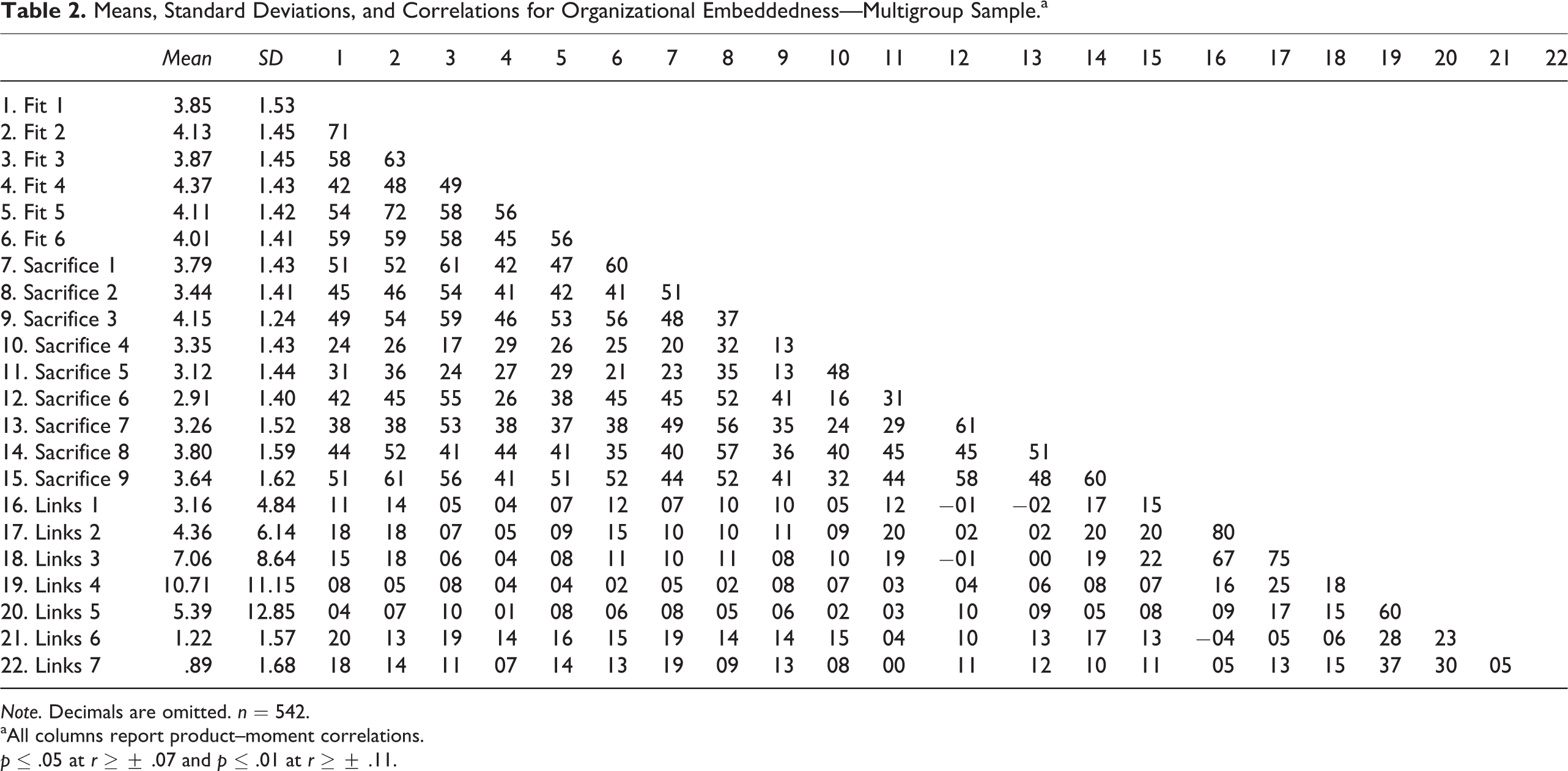
Note. Decimals are omitted. n = 542.
aAll columns report product–moment correlations.
p ≤ .05 at r ≥ ± .07 and p ≤ .01 at r ≥ ± .11.
Content and Factorial Validity for Organizational Embeddedness
The three-factor model for the 22-item organizational embeddedness scale was fit to the multigroup sample. This model consisted of organizational fit, organizational sacrifice, and organizational links as three latent, correlated factors. The results suggest this model was a mediocre fitting model, χ(206) 2 = 1584.37, root mean square of approximation (RMSEA) = .11, standardized root mean square residual (SRMR) = .09, normed fit index (NFI) = .90, comparative fit index (CFI) = .91, and nonnormed fit index (NNFI) = .90. Upon further examination of the measurement model and modification indices, the worst-fitting item from each subscale was removed. 4 Items were removed that would result in significant chi-square changes if allowed to cross load on other factors. Thus, organizational fit Item 3 was deleted, because it also loaded onto the latent factor of organizational sacrifice; and organizational sacrifice Item 3 was removed because it loaded onto the latent factor of organizational fit. Second, any items that did not significantly load onto their hypothesized latent factor were also removed. This resulted in organizational links Item 6 being deleted. Although further analysis of modification indices suggests correlated measurement residuals for several indicators of the latent variables, it did not make sense to allow these residuals to freely correlate especially given the cross-sectional and common method used to collect data (cf. Bagozzi, 1983). With these minor modifications, the fit of the respecified model was significantly improved, Δχ2 (57) = 618.86, including the fit indices, χ(149) 2 = 965.51, RMSEA = .10, SRMR = .08, NFI = .91, CFI = .92, and NNFI = .91. All of the fit indices indicated good to excellent fit with the exception of the RMSEA of .10, which illustrates mediocre fit. Although the correlation between organizational links and organizational sacrifice was .18 and the correlation between organizational links and organizational fit was .19, organizational fit and organizational sacrifice were correlated at .80.
To examine the robustness of the three-factor model, two alternative models were proposed. The first model consisted of two correlated factors. The impetus for this model was based on the strong correlations between fit and sacrifice. The results of this analysis indicate the two-factor model was a worse fit than the three-factor model, χ(151) 2 = 1280.98, RMSEA = .12, SRMR = .08, NFI = .89, CFI = .90, and NNFI = .88, and a large difference from the overall fit of the three-factor model, Δχ2 (2) = 315.47. A second alternative model consisted of one general factor with all items loading onto this factor. It is quite possible that all organizational embeddedness items are best represented by a unidimensional construct. The fit of the single-factor model was the worst-fitting model as indicated by the poor fit indices, χ(153) 2 = 2283.91, RMSEA = .16, SRMR = .12, NFI = .79, CFI = .80, and NNFI = .77, and the large decrement from the overall fit of the three-factor model, Δχ2 (4) = 1318.40. Thus, the revised three-factor model represents the best fitting model to the data. In conclusion, organizational embeddedness is a multidimensional construct and is best represented by a three-factor model that consists of organizational fit, organizational sacrifice, and organizational links; however, there are several weaknesses with the indicator variables even after minor model modifications.
Interitem Analysis for Community Embeddedness
Table 3 presents descriptive information and the correlations for community embeddedness items with the multigroup sample. The majority of interitem correlations were significant both within and between items for different subscales. The strongest pattern of correlations was found between items examining fit and sacrifice. In contrast, the weakest pattern of correlations was found with the links items.
Means, Standard Deviations, and Correlations for Community Embeddedness—Multigroup Sample.a

Note. Decimals are omitted. n = 542.
aAll columns report product–moment correlations.
p ≤ .05 at r ≥ ± .07 and p ≤ .01 at r ≥ ± .11.
Content and Factorial Validity for Community Embeddedness
The three-factor model of community embeddedness consisting of community fit, community sacrifice, and community links was examined with the multigroup sample. The fit of this model was excellent, χ(51) 2 = 182.52, RMSEA = .07, SRMR = .07, NFI = .97, CFI = .98, and NNFI = .97. Upon evaluation of modification indices, 2 items from the links subscale showed cross loadings with the fit and sacrifice subscales. 5 Although both items showed cross loadings with other subscales, both items could not be removed as links would be left with two indicators. Thus, community links Item 4 was deleted from the model, as it showed both cross loadings with other subscales and was nonsignificant. The fit of the new model with 11 items was very good, χ(41) 2 = 132.88, RMSEA = .06, SRMR = .07, NFI = .98, CFI = .98, and NNFI = .98, and the fit of model was also significantly improved, Δχ2 (10) = 49.64. Although the correlations between community links and community fit was .20 and community links and community sacrifice was .19, community fit and community sacrifice were correlated at .89.
A final test for goodness of fit and factorial validity of the three-factor model involved comparing two equally plausible models of community embeddedness. First, the two-factor model is supported by empirical relationships that demonstrate strong correlations between community fit and community sacrifice and weaker relationships between these subscales and community links. Although fit of the two-factor model is excellent, χ(43) 2 = 161.88, RMSEA = .07, SRMR = .07, NFI = .97, CFI = .98, and NNFI = .97, a comparison of this model with the three-factor model reveals that the later model is still the best fit to the data, Δχ2 (8) = 29.00. In contrast, the one-factor model was a poor fitting model, χ(44) 2 = 738.18, RMSEA = .17, SRMR = .13, NFI = .76, CFI = .77, and NNFI = .70, and showed no improvement in model fit, Δχ2 (7) = 605.30. In conclusion and taken with the previous analysis of the measurement model, the three-factor model is quite robust and represents the best fit to the data. Thus, community embeddedness is best represented by a three-factor model that consists of community fit, community sacrifice, and community links.
Discussion
The results of these studies help provide additional evidence for the construct validity and psychometric properties of the JEQ. Specifically, the results of Study 1 provide meta-analytic estimates of true relations between organizational embeddedness, individual dimensions of organizational embeddedness, and perceived desirability and ease of movement correlates identified in traditional models of employee attachment and voluntary turnover. Further, Study 2 examines the content and factorial validity of the JEQ. As such, these results allow us to evaluate the discriminant validity of the JEQ is relation to job satisfaction and organizational commitment measures, the content validity of items comprising the JEQ, and the factorial validity of underlying dimensions of the JEQ.
First, the JEQ dimensions of organizational embeddedness, organizational sacrifice, and organizational fit do not have a high degree of discriminant validity with job satisfaction measures. Specifically, correlations between JEQ dimensions of organizational embeddedness, organizational sacrifice, and organizational fit and job satisfaction measures are strong but do not necessarily imply construct redundancy. The reason for the strong correlation between organizational embeddedness and job satisfaction is because organizational embeddedness is a composite of links, fit, and sacrifice. While organizational links have a weak relationship with job satisfaction, organizational fit and organizational sacrifice have strong relationships with job satisfaction. This begs the question as to why these relationships are strong. One potential explanation is some of the items used in the JEQ for sacrifice and fit pertain to satisfaction with the job and the organization. Not surprisingly, the correlations between these dimensions and satisfaction with specific aspects of the job are strong. In fact, Mitchell and his colleagues (2001) noted that the JEQ had some overlap with job satisfaction facet measures that look at pay satisfaction and benefit satisfaction. To this end, a review of empirical research suggests that these dimensions have differential relationships with a variety of organizationally relevant outcomes. Indeed, multiple independent studies have provided strong evidence that organizational embeddedness predicts organizational citizenship behavior, performance, and turnover beyond that of job satisfaction, organizational commitment, and job alternatives (e.g., Crossley et al., 2007; Felps et al., 2009; Lee et al., 2004; Mallol et al., 2007; Mitchell et al., 2001). Furthermore, extant research (e.g., Crossley et al., 2007; Cunningham et al., 2005; Harman et al., 2009; Mallol et al., 2007; Mitchell et al., 2001; Ramesh & Gelfand, 2010) has demonstrated that the JEQ organizational dimensions of links, fit, and sacrifice and job satisfaction measures have differential relationships with other outcomes that are used in models of employee turnover. Finally, the results from the meta-analysis revealed that the individual dimensions had differential relationships with job alternatives, JSB, intent to leave, and voluntary turnover. Thus, this empirical evidence lends additional support to the construct validity of the JEQ and suggests that both job satisfaction and the individual dimensions of organizational embeddedness should continue to be included in efforts to understand employee retention and turnover.
Second, the JEQ dimensions of organizational embeddedness, organization-related sacrifice, and organizational fit do not exhibit a strong degree of discriminant validity with organizational commitment measures. Specifically, the strongest correlations were between affective commitment, organizational commitment, organizational fit, and organization-related sacrifice. Although the correlations were strong, they were not strong enough to suggest construct redundancy. Mitchell and colleagues (2001) suggested that some overlap was possible between affective commitment and organizational fit. While organizational fit is not as affect driven as affective commitment, closer examination of Mitchell et al.’s JEQ organizational fit measure suggests that organizational fit consists of both affective and cognitive components. In addition, some of the items for this measure reflect specific examples of perceived compatibility to and identification with the organization. The current version of the JEQ organizational fit measure may actually serve to supplement the weaknesses in the ACQ measure (cf. Kell & Motowildo, 2012). At the same token, there is also overlap between the JEQ measure of organization-related sacrifice and the OCQ. As noted earlier, this relationship, albeit strong, is not indicative of construct redundancy. Indeed, not only is the definition of organization-related sacrifice and affective commitment dissimilar, the operationalization of the constructs is also very different. Furthermore, these constructs and their measures have differential relationships with perceived ease of movement variables such that organization-related sacrifice has stronger negative relationships with job alternatives and JSBs. To this end, these relationships may help explain why individuals do not always leave their organizations when negative shocks occur. Specifically, their affective reactions may be negatively impacted but the evaluation of perceived costs of material or psychological benefits that may be foregone if the individual leaves the organization helps to buffer the individual from the negative shocks (Holtom et al., 2012). Finally, the correlations between organizational commitment and organizational links are much weaker, such that discriminant validity is strong for organizational links. In sum, the accumulation of empirical evidence, along with theoretical support, lends more weight to the construct validity of the JEQ and suggests that both organizational commitment and the individual dimensions of organizational embeddedness should continue to be included in efforts to understand employee retention and turnover.
Third, this study represents some of the first, robust psychometric evidence for the content and factorial validity of job embeddedness. Reliability coefficients are similar to previous research (e.g., Lee et al., 2004; Mitchell et al., 2001). However, there are notable problems with the organizational and community links dimensions. These findings are especially disconcerting, given that reliability is a necessary condition for construct validity. Confirmatory factor analyses supported the three-factor structure of both dimensions, as this structure was superior to the one- and two-factor models. Therefore, both organizational embeddedness and community embeddedness consist of three distinct dimensions that include fit, sacrifice, and links. However, as can be seen with the item factor loadings, some of the items that act as indicators of links have low loadings. This problem could be attributable to the wording of the items, the dichotomous nature of these items, and/or the open-ended content of some items. To compound these noted problems, several of the interitem correlations for the items underlying the same scale were very low while correlations with items from different scales were very high. Therefore, multicollinearity poses a significant threat for the JEQ. In sum, empirical and theoretical evidence supports the view that links, sacrifice, and fit are distinguishable components of organizational and community embeddedness. Meanwhile, empirical support for the content validity of the individual dimensions of the JEQ is substantially weaker.
Limitations
There are several important limitations to this study. First, this study used several samples to examine the validity of job embeddedness. One could argue that the results of the study do not extend to certain employee groups; but all in all, the samples were demographically and occupationally diverse and consisted of both full-time and part-time employees. Second, the measure used in this study was a self-report survey. Thus, common method variance may influence the relationships among the constructs in this study. More specifically, the relationships between each of the constructs may become artificially inflated because the items were assessed with the same survey. At the same time, the mixed response format for job embeddedness lessens the effects of common method variance. In congruence with Spector’s (2006) piece on common method variance, future studies may benefit from using longitudinal designs and multiple sources to eliminate potential biases associated with the constructs in monomethod studies. A final limitation of the study relates to the meta-analytic estimates between job embeddedness, job satisfaction, and organizational commitment. While we completed a comprehensive, up-to-date search of all published literature, we did not include unpublished literature or dissertations in these estimates. Thus, the sample of retrieved studies is potentially biased.
Contributions
The current research is important for several reasons. First, from a practical standpoint, organizational decision makers need reliable and valid measures of job embeddedness to measure the extent of employee attachment. Further, validated measures of job embeddedness will provide important diagnostic tools for understanding and shaping employee retention. From a theoretical perspective, the content validity of a construct is important, as the inferences made from the construct’s measure will be severely limited given that the measure overrepresents, underrepresents, or omits critical information from the construct domain (Haynes, Richard, & Kubany, 1995). In contrast, confirming the factor structure of job embeddedness represents an important step toward establishing a robust measure and is congruent with American Educational Research Association, American Psychological Association, and National Council on Measurement in Education standards (1999). Given that valid measures are necessary to advance theoretical models that incorporate job embeddedness, it stands to reason that a content and factorial validation study is an important contribution to advancing job embeddedness theory.
This study also represents the growing interdisciplinary nature of vocational psychology in that this study pulls together theory from organizational behavior, industrial and organizational psychology, and vocational psychology and applies the results of these studies to human resource management practices. Specifically, this study provides strategic value to vocational psychologists because it provides empirical and theoretical support that individuals become embedded in their organizations and communities across a variety of occupations and organizations. In essence, there are numerous constraints on employee mobility, such that individuals are predisposed to stay with their organization and within their community, and ultimately their occupation, because of employment stability and greater job security. These results are congruent with Feldman’s (2002) thesis that individuals become embedded in their occupations and that occupational embeddedness evolves across stages of career development (Ng & Feldman, 2007).
Future Directions
Not only has this study contributed to the research on job embeddedness theory by providing evidence for construct validity of the JEQ, but it also offers multiple directions for future research. To this end and in line with Mitchell et al.’s (2001) suggestions, future research should refine the JEQ. One important step in this direction was the development of the global measure of job embeddedness (Crossley et al., 2007). However, reliable and valid measures of the individual dimensions of the JEQ are also necessary for future studies. First, the underlying dimensions of job embeddedness should be refined for conceptual clarity and to improve the precision of the original measure. Therefore, an important avenue for future research would involve efforts similar to the Crossley et al. (2007) study that introduced a global measure of job embeddedness, except the focus would be on developing psychometrically sound measures for organizational and community fit, sacrifice, and links. As such, organizational and community embeddedness would be characterized as superordinate constructs and operationalized using second-order factor models.
Second, the JEQ links has notable weaknesses and the underlying content of items should be improved. Specifically, the links dimensions typically have very low reliability, are anchored with a yes–no and open-ended format as opposed to the Likert-type format for the other dimensions, and do not thoroughly encompass financial, psychological, and social ties. Further, a notable deficit in the JEQ measure for links is the lack of emphasis on participation and involvement with organization and community activities. By looking at Holtom, Mitchell, and Lee’s (2006) examples of organizational links and community links, the element of participation and involvement in organizational and community activities appears to be a significant indicator of links. In terms of improvement to community links, the current emphasis on marriage in community links negates the importance of living with a significant other or being in a domestic partnership. Further, the connection to the community through participation in leisure and cultural activities is not currently addressed in the JEQ, but Mitchell and his colleagues (2001) note the importance of these activities. Thus, future revisions of the JEQ community links should include the following revisions: (a) an item that addresses marriage, living with a significant other, or being in a domestic partnership; (b) an item that examines the extent of nonwork friends in the community; (c) an item that looks at participation in cultural activities; (d) an item that includes participation in recreational activities; and (e) an item that looks at participation in community organizations. Also, the JEQ community links should continue to include (a) an item that asks about home ownership and (b) an item that looks at family roots or ties to the community. Future revisions of the JEQ organizational links should look at the following additions/changes: (a) an item that examines interaction with one’s supervisor; (b) an item that looks at participation with employee resource groups; (c) an item that evaluates interaction with coworkers during work hours; (d) an item that evaluates interaction with coworkers after work hours; (e) an item that looks at participation with organization-related fundraisers and charities; (f) an item that examines the dependency of coworkers on the employee; and (g) an item that examines participation in unique organization programs such as tuition reimbursement programs, employee referral bonus programs, and peer recognition programs. In terms of continued inclusion of job, organizational, and occupational tenure, it is suggested that these aspects of tenure be used as control variables as opposed to items for organizational links. The reason is that these items confound measurement across different levels of embeddedness (Feldman & Ng, 2007).
Third, given that the pattern of relationships between current JEQ dimensions of organizational sacrifice and organizational fit do not have a high degree of discriminant validity with job satisfaction and organizational commitment measures, future research should examine the extent to which these dimensions, and organizational links, have differential relationships with other variables of interest and also explain variance beyond that of job satisfaction and organizational commitment. While several studies were mentioned that incorporated the individual dimensions of organizational embeddedness, only two published studies to the author’s knowledge have actually examined predictors and outcomes of the organizational dimensions of links, fit, and sacrifice (cf. Dawley, Houghton, & Bucklew, 2010; Ramesh & Gelfand, 2010). If research continues to accumulate that supports the predictive validity of these dimensions beyond that of perceived desirability and ease of movement variables, then continued emphasis should be placed on testing models that look at different antecedents and outcomes. To this end, this approach to future research overcomes the weaknesses in composite measures such that multiple measures are not additively combined into a single composite and individual perception of different dimensions and constructs are given more weight (Crossley et al., 2007). Further, dimensions and their measures tap into specific components of the organization and community and help gauge an overall evaluative or affective judgment.
Conclusion
In conclusion, a strong body of research has accumulated to support the construct validity of job embeddedness. Empirical evidence has demonstrated that organizational embeddedness has predictive validity beyond that of traditional job attitudes in the prediction of turnover, task performance, and organizational citizenship behaviors. Further, researchers have found organizational embeddedness acts as both mediator and moderator with newcomer socialization, dispositions, employee–organization relationships, and leader–member exchange relationships in the prediction of organizational relevant variables. In this article, we have provided conceptual clarity on the construct of job embeddedness and additional evidence for the construct validity of Mitchell et al.’s (2001) JEQ by addressing the content and factorial validity of the JEQ and unified these results with previous research. The underlying message is that future studies should evaluate and report the inclusion/exclusion of existing and new items to the JEQ. Further, future research should also investigate the role of individual dimensions of organizational embeddedness and community embeddedness with different antecedents and outcomes in order to expand the nomological network of job embeddedness.
Footnotes
Declaration of Conflicting Interests
The author declared no potential conflicts of interest with respect to the research, authorship, and/or publication of this article.
Funding
The author received no financial support for the research, authorship, and/or publication of this article.