



Abstract
The Strengths Self-Efficacy scale (SSES) was developed to allow career counselors, educators, and researchers to assess individuals’ perceived abilities to build their personal strengths and apply them in their daily life. An exploratory factor analysis was conducted with 275 adults and resulted in one factor: general strengths self-efficacy. The internal consistency was .96 and SSES was weakly related to social desirability. A confirmatory factor analysis was performed using another sample of 302 adults, and results verified the one-factor structure. The results suggested that the 11-item SSES demonstrated strong internal consistency (α = .95) and that SSES scores were moderately related to self-esteem and life satisfaction and weakly related to social desirability. Finally, a test–retest reliability analysis on a sample of 36 adults indicated that SSES scores were stable over a 3-week period. Implications for career counseling and mental health practices as well as research applications of this new measure were discussed.
Strength is the ability to provide consistent, near-perfect performance in a specific task (Hodges & Clifton, 2004) and to behave in a manner that allows optimal functioning during the pursuit of tasks and outcomes that are valued (Linley & Harrington, 2006). Strengths assessment is consistent with counseling psychology’s philosophy that focusing on an individual’s strengths can lead to an improvement in vocational and psychological health and well-being. Subsequently, a strengths-based approach, or the emphasis on identifying and utilizing strengths within each individual to maximize one’s capabilities and performances, has increasingly gained attention by various professionals. To assist professionals in effectively providing strengths-based services, measures such as the Clifton StrengthsFinder (Rath, 2007) and Values in Action (Peterson & Seligman, 2004) were developed to assess an individual’s perceptions of their own strengths. Strengths-based measures help people identify personal strengths and provide a framework and language to classify these strengths. The hope is that when people are aware of their strengths, they are more likely to capitalize on the use of these strengths in approaching day-to-day tasks as well as life challenges. Career counseling is a likely setting where career practitioners help individuals develop their strengths and apply them to their career decision making or at their jobs.
A review of empirical literature revealed that strengths assessments demonstrated their usefulness in several avenues. For instance, Nickerson and Fishman (2009) found that a self-report measure of personal strengths was positively correlated to students’ interpersonal and intrapersonal strengths, school functioning, affective strengths, adaptability, social skills, and leadership as well as the level of students’ family involvement. Furthermore, the administration of the Clifton StrengthsFinder assessment and a subsequent discussion among graduate students in business revealed that understanding strengths was a positive factor in their academic, career, and future job search success (Hohn, 2009). Hodges and Harter (2005) reviewed several studies about strengths development and concluded that students’ productivity, life choices, self-confidence, and academic success were positively impacted by strengths development.
In addition to strengths development, research suggested that people who apply strengths in their daily life increased their satisfaction and happiness. A qualitative study indicated that significant determinants of career satisfaction and development were demonstrating (a) a commitment to do something in which one had experienced success and (b) exhibiting a range of personal strengths (Henderson, 2000). Fisher (2010) reviewed the literature about happiness at work and concluded that work engagement and job satisfaction can be enhanced by applying strengths in the work setting. Finally, a review of cross-sectional, longitudinal, and experimental studies revealed that happiness can improve workplace outcomes (Boehm & Lyubomirsky, 2008). Thus, the use of strength-related assessments in career counseling can facilitate individuals’ strengths awareness and development and lead to positive career outcomes.
Nevertheless, awareness of one’s strengths alone may not be sufficient. For example, Lopez and Louis (2009) proposed five foundations of a strengths-based education. Measurement addressed the importance of being able to assess and identify students’ strengths using strengths measures. Individualization pointed to the significance of a deeper level of awareness in students’ strengths where students explored how their unique, individualized strengths could benefit them and developed a plan to use their strengths to achieve their personal goals. Networking recognized one’s need for affirmations and recognition of one’s strengths from people around them. After individuals were able to identify, understand, and receive affirmations about their strengths, they were better equipped to apply them in various settings (deliberate application). Finally, in intentional development, Lopez and Louis argued that it was important that individuals committed to continue developing and maximizing their strengths, and sharing their strengths with others who could assist them in using their strengths throughout their career.
An ideal strengths approach includes the identification of positive personal and interpersonal traits or talents, and these should be integrated into one’s view of self (Clifton & Harter, 2003), so that they are translated into everyday behaviors. According to Bandura (1997), “perceived self-efficacy is concerned with people’s beliefs in their capabilities to mobilize the motivation, cognitive resources, and courses of action needed to exercise control over task demands” (p. 316). Thus, developing strong self-efficacy beliefs in terms of applying one’s strengths is an important next step after one has developed awareness of personal strengths. Robust strengths self-efficacy beliefs are theorized to motivate a person to approach situations where they could implement their strengths and to influence their task performance (Bandura, 1997). To maximize one’s potential, a carefully designed plan to gain control and strategically implement one’s strengths across different roles and settings is critical.
The importance of self-efficacy in behaviors was also clearly evidenced in the literature. For instance, a meta-analysis study revealed a positive effect between individuals’ academic-related self-efficacy beliefs and their academic performance and persistence (Multon, Brown, & Lent, 1991). Betz (2004) also highlighted the value of self-efficacy in career counseling based on more than 20 years of research and suggested that efficacy-based interventions can and should be applied in career assessment and counseling. Results from these studies suggest that self-efficacy can play an important role in task performance and vocational outcomes. In other words, self-efficacy had the potential to assist people in achieving higher levels of satisfaction in school and work. Given the significance of self-efficacy theory as well as its potential to enhance understanding and use of strengths, a logical next step in the area of strengths-based psychology is to develop a measure to assess individuals’ belief in one’s capabilities to apply personal strengths in their daily lives. When used in conjunction with strengths assessments, this scale can help career counselors to effectively deliver strengths-based interventions for college students and career clients. Furthermore, the design and development of a reliable and valid measure of this type can further advance vocational psychology research and practice.
Purpose of the Current Study
To date, a number of measures have been developed to assess multifaceted features of self-efficacy in different context and situations (e.g., Chen, Gully, & Eden, 2001; Schwarzer & Jerusalem, 1995; Sherer et al., 1982) and to measure self-efficacy for specific tasks (e.g., Brenowitz & Tuttle, 2003; Resnick & Jenkins, 2000; Solberg et al., 1994; Zimmerman & Kitsantas, 2005). However, no instrument exists to assess strengths self-efficacy. Thus, the purpose of this investigation was to develop and evaluate the Strengths Self-Efficacy scale (SSES) using the guidelines for developing self-efficacy measures (Bandura, 2001) and recommendations for best practices in scale development research (e.g., Roznowski, 1989; Spector,1992; Worthington & Whittaker, 2006). This article reports on two phases of the development of the SSES. The first phase involved initial development, revision, and initial factor validity with an adult sample. The second phase used an independent sample to examine additional validity and reliability of the SSES. These phases are described as Study 1 and Study 2, respectively, in the following section.
Study 1: Initial Reliability and Validity Testing
Method
Development of SSES Items
A team of eight advanced graduate students and three professors in psychology with knowledge and expertise in vocational and/or positive psychology generated items for the scale based on self-efficacy theory (e.g., Bandura, 1997, 2001, 2006) and literature related to development of strengths (e.g., Biswas-Diener, Kashdan, & Minhas, 2011; Clifton & Harter, 2003; Hodges & Clifton, 2004; Seligman & Csikszentmihalyi, 2000). Strengths self-efficacy was operationalized to include skills in utilizing strengths across different settings (i.e., work, school, home, daily life). The team generated a total of 29 items to assess strengths self-efficacy, which were then reviewed to ensure that they were clear, concise, readable, distinct, and reflect the scale’s purpose as suggested by Worthington and Whittaker (2006). After the items were reviewed, 7 additional items were developed, which yielded a total of 36 items in the initial pool.
Expert Review
To assess the items’ quality and representativeness of the construct, four experts in positive psychology were asked to use a 3-point Likert-type scale (1 = not relevant/clear to 3 = very relevant/clear) to independently determine the extent to which the initial pool of 36 items (a) reflected the definition of strengths self-efficacy (relevancy) and (b) were clearly and simply written (clarity; for a full list of the initial pool of items, please contact the first author). The experts were also instructed to freely edit any of the items, suggest new items, and provide any additional feedback for improvement of the scale. Based on the experts’ feedback, we examined and modified the items. Items were retained if the average rating on relevancy and clarity was 2.0 or higher. Three items were dropped because they were deemed to be a poor indicator of the construct, 1 item was added, and 5 items were revised to improve clarity. The revised version of the scale contained 34 items (for a full list of the 34 Strengths Self-Efficacy items, please contact the first author).
Measures and Procedures
After obtaining institutional review board approval for the study, the authors developed an online survey, containing an informed consent form, a demographic questionnaire, the 34-item SSES, one validity item, and the Marlowe–Crowne Social Desirability Scale–Short Form (MCSDS-S). Before participants completed the SSES, they were prompted with the definition of strengths self-efficacy and were asked to list up to five of their perceived strengths. The SSES asked participants, “How confident are you in your ability to … ” and was follow by 34 items that included skills to utilize personal strengths. Participants responded to the items using an 11-point scale, as recommended by Bandura (2001) and included the following anchors: 0 (not at all confident), 5 (moderately confident), and 10 (extremely confident). Responses were averaged to obtain a scale score; high scores reflect strong degrees of strengths self-efficacy. In addition, one validity item (select ‘5’ for this item) was added to the survey to identify participants who responded to the survey randomly. The MCSDS-S, a short version of the MCSDS (Ballard, 1992), included 13 true–false items. Scores range from 0 to 13, with high scores suggesting a strong likelihood that the participant is responding in a socially desirable manner. According to Reynolds (1982), the 13-item form had an acceptable level of reliability of .76 and was highly correlated to the original form (r = .93). The MCSDS-S had single dimensionality and was recommended as a viable form to use in assessing social desirability (Reynolds, 1982). An invitation to participate in the study was then posted on online discussion forums and distributed on professional listservs to solicit participants who were 18 or older. We also used a snowballing technique to collect data, where participants were asked to forward the link to people they know to maximize the number of participants in this study.
Participants
A total of 306 complete surveys were obtained. Thirty-one were excluded because participants did not respond correctly to the validity item and 275 surveys were retained. There were 212 (77.1%) females and 63 (22.9%) males. Participants’ age ranged from 18 to 73 (M = 36.1, SD = 12.5). The majority of participants (91.6%, n = 252) self-identified as heterosexual, 3 (1.1%) identified as gay men, 1 (0.4%) identified as lesbian, 16 (5.8%) identified as bisexual, and 2 identified as queer (0.7%). One participant did not respond to this item and was coded as missing. The self-reported racial/ethnic background of the sample was as follows: 226 (82.2%) were Caucasian American, 3 (1.1%) were African/African American, 12 (4.4%) were Latino/Latina American, 25 (9.1%) were Asian/Asian American, 6 (2.2%) identified themselves as biracial/mixed, and 2 (0.7%) were “other.” One participant did not respond to this item and was coded as missing. In terms of education, 76 (27.6%) completed doctoral or professional school, 107 (38.9%) completed a master’s degree, 67 (24.4%) completed a 4-year college or university, 14 (5.1%) completed a 2-year college, 8 (2.9%) completed high school or general equivalency diploma (GED), and 3 (1.1%) completed middle school or less. Participants reported having various occupations including student, manager, consultant, housewife, engineer, teacher, retired, self-employed, and secretary.
Results
Exploratory Factor Analysis (EFA)
An EFA was conducted with principal axis factoring on the initial pool of 34 items to identify a probable factor structure (for a full list of the initial pool of items, please contact the first author). Results of the scree plot, eigenvalues, item factor loadings, and overall factor interpretability were used to determine the factor solution (Worthington & Whittaker, 2006). Items were dropped if their factor loading was <.40 (Raubenheimer, 2004). Finally, the Kaiser–Guttman rule (i.e., eigenvalue ≥1) was taken into account to decide on the number of factors extracted.
The Kaiser–Meyer–Olkin index was found to be .97, which indicates that the sample was appropriate for factor analysis. Additionally, Bartlett’s test of sphericity was found to be significant (p < .001) suggesting that item correlation matrix is not an identity matrix and factor analysis is appropriate. Results of EFA yielded one dominant factor with an eigenvalue greater than 21, explaining 63% of the total variance, and three subsequent factors with eigenvalues slightly greater than 1, each explaining 2–3% of the total variance. The scree plot provided initial support for a one-factor solution. Next, we examined the item factor loadings for two-, three-, and four-factor solutions using both orthogonal rotation (Varimax) and oblique rotation (Promax) to determine the most meaningful solution (Burton & Mazerolle, 2011; Gable, 1993). Specifically, we examined the strength of factor loadings, deleted items with high cross-loadings, excluded factors with less than 3 items, and investigated overall factor interpretability. Based on these results, a one-factor solution seemed to be the most meaningful solution, and 11 items were retained (see Table 1). This factor was labeled as general strengths self-efficacy. The general strengths self-efficacy factor included items such as “use your strengths at work,” “use your strengths at any time,” and “practice your strengths in areas where you excel.” All items loaded highly on this factor, ranging from .55 to .85. The α coefficient for the 11-item SSES was .96. The mean and standard deviation for each item are reported in Table 1.
Exploratory Factor Analysis of the Strengths Self-Efficacy Scale.
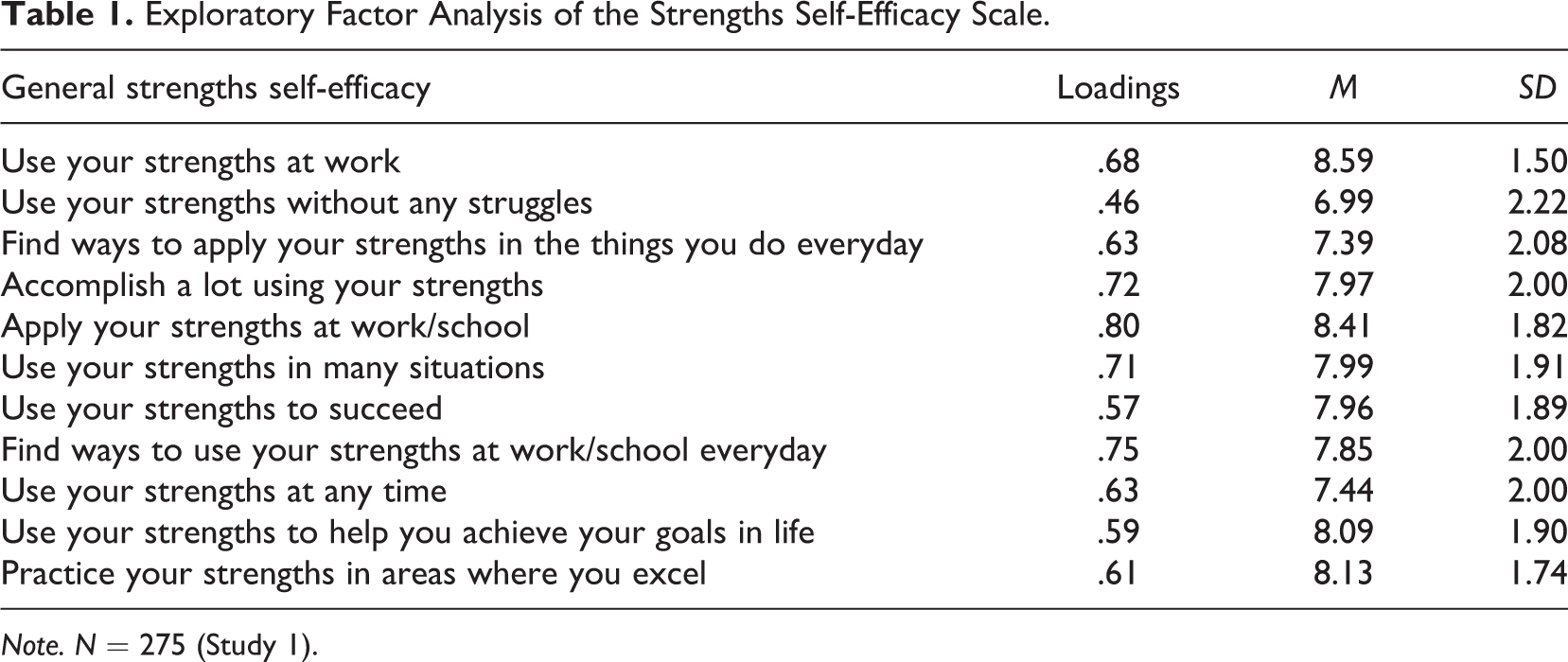
Note. N = 275 (Study 1).
Other Validity Estimate
We examined the association between SSES scores and the social desirability. Our results indicated that social desirability had a positive, low correlation with SSES scores (r = .12, p < .05). Given a large sample size (n > 100), such significance had little practical implications (Taylor, 1990). The low association between social desirability and SSES scores provided some evidence of discriminant validity.
Study 2: Additional Validity and Reliability of SSES
Method
Measures and Procedures
Study 2 was conducted to cross-validate the SSES in an independent sample by applying confirmatory factor analysis (CFA) as well as to further evaluate its psychometric properties. Following the same procedure from Study 1, we created an online survey including a demographic form, the 11-item SSES produced by Study 1, the MCSDS-S, along with the Rosenberg Self-Esteem scale (RSES) and the Satisfaction with Life scale (SWLS).
The RSES (Rosenberg, 1965) was designed to measure global self-esteem. It consists of 10 statements that evaluate individuals’ subjective views of self-worth. With a response on a Likert-type scale between 1 (strongly agree) and 4 (strongly disagree), the RSES total scores range from 10 (low self-esteem) to 40 (high self-esteem). Flaming and Courtney (1984) reported a 1-month test–retest reliability of RSES scores to be .82. Gloria (1993) reported a satisfactory internal reliability of RSES scores, which was indicated by a Cronbach’s α of .86. In addition, evidence of construct validity was noted by Blascovich and Tomaka (1991), who found significant positive correlations between RSES scores and other self-esteem measures. The RSES was included to test convergent validity of SSES scores. Literature suggested that strengths use was positively correlated with self-esteem (Proctor, Maltby, & Linley, 2011), and self-esteem and self-efficacy were positively associated with each other and were significant predictors of work performance as well as work satisfaction (Judge & Bono, 2001; Judge, Erez, Bono, & Thoresen, 2002).
Life satisfaction was measured by the SWLS (Diener, Emmons, Larsen, & Griffin, 1985). The SWLS is a 5-item instrument (e.g., “In most ways, my life is close to my ideal”). Participants respond by indicating their level of agreement with each statement on a 7-point scale (1—strongly disagree, 7—strongly agree). SWLS scores have been found to yield adequate estimates of internal and 2-month test–retest reliability as well as to predictably relate with alternative measures of life satisfaction (Diener et al., 1985) and positive and negative affect (Waston, Clark, & Tellegen, 1988). The SWLS was also included to test convergent validity of SSES scores. Based on the literature, individuals who were able to apply their strengths in their daily life would have higher work and life satisfaction (Henderson, 2000; Park, Peterson, & Seligman, 2004; Peterson, Ruch, Beerman, Park, & Seligman, 2007).
Participants
A total of 323 adults completed the online survey. We deleted surveys that contained incorrect response to the validity item, and there were 302 surveys retained. These surveys were found to have less than 5% missing values, and had no patterns among the missing values. Therefore, an Expectation–maximization algorithm method was used to replace the missing values.
Participants in this study were 213 (70.5%) females, 87 (28.8%) males, and 2 (0.7%) who indicated as “other.” Participants’ age ranged from 18 to 73 (M = 31.2, SD = 11.0). The majority of participants (92.7%, n = 280) self-identified as heterosexual, four (1.3%) identified as gay men, two (0.7%) identified as lesbian, and nine (3.0%) identified as bisexual men and women. There were seven participants (2.3%) did not report their sexual orientation and were coded as missing. The self-reported racial/ethnic background of the sample was as follows: 198 (65.6%) were Caucasian American, 6 (2.0%) were African/African American, 11 (3.6%) were Latino/Latina American, 77 (25.5%) were Asian /Asian American, 1 (0.3%) was Arab/Arab American, 1 (0.3%) was Native American, and 3 (1.0%) identified themselves as biracial/mixed. Five participants (1.7%) who did not respond to this item were coded as missing. In terms of education, 41 (13.6%) reported having completed doctoral or professional school, 96 (31.8%) completed a master’s degree, 102 (33.8%) completed a 4-year college or university, 29 (9.6%) completed a 2-year college, 23 (7.6%) completed high school or GED, and 11 (3.6%) completed middle school or less. Participants reported having various occupations including programmer, student, manager, teacher, housewife, administrator, counselor, professor, and secretary.
Results
CFA
To test the factor structure of the 11-item SSES, we conducted a CFA with a maximum likelihood estimation method in AMOS 17.0. The data were fit with the one-factor measurement model. The results of CFA showed that all items exhibited acceptable factor loadings (i.e., greater than .60; Bagozzi & Yi, 1988). This suggested that no additional items should be deleted. The initial model fit indices for the CFA were found to be as follow: χ2(df = 44) = 238.33, p < .001, χ2/df = 5.42; comparative fit index (CFI) = .93; root mean square error of approximation (RMSEA) = .12, 90% confidence interval (CI) [0.11, 0.14]; standardized root mean square residual (SRMR) = .04. The CFI and SRMR were in the acceptable range, and the RMSEA was higher than the cutoff criteria (Byrne, 1994; Hu & Bentler, 1999).
After investigating the modification indices, we added a correlation between the error of Item 6 (i.e., “accomplish a lot by using your strengths”) and Item 7 (i.e., “apply your strengths at work/school”). Since the majority of our participants were students and employees, it seemed plausible that the amount of accomplishment using strengths would be related to the ability to apply strengths at work or school. See Table 2 for factor loadings for the modified model. The model fit indices for the revised model were as follows: χ2(df = 43) = 206.19, p < .001, χ2/df = 4.80; CFI = .94; RMSEA = .11, 90% CI [0.10, 0.13]; SRMR = .04. The correlation between the error terms for Items 6 and 7 was found to be .35. Additionally, the chi-square difference test produced a significant result, χ2(df = 1) = 32.14, p <. 001, suggesting that adding the correlation between the error terms of Items 6 and 7 significantly improved the explanation of the data (Yuan & Bentler, 2004). Therefore, we concluded that the revised model fitted the data better.
Confirmatory Factor Analysis of the Strengths Self-Efficacy Scale.
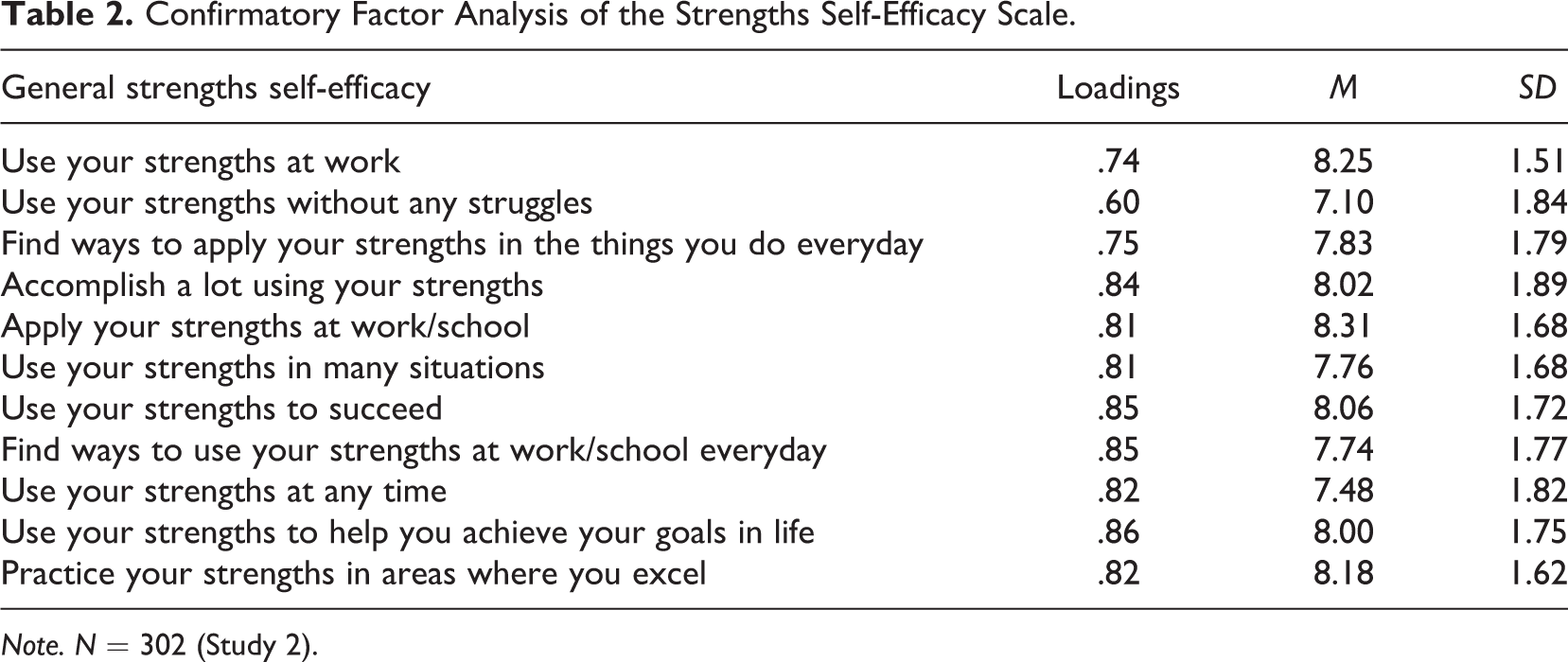
Note. N = 302 (Study 2).
Other Validity Estimates
Pearson correlations were calculated to examine the associations between participants’ self-esteem, life satisfaction, social desirability, and the 11-item SSES (see Table 3). Self-esteem was moderately correlated with SSES scores (r = .57, p < .01). Similarly, life satisfaction was moderately correlated with SSES scores (r = .49, p < .01). The results provided support of convergent validity for the SSES. These results indicated that SSES scores were moderately related to self-esteem or life satisfaction, but not to a point where they were measuring the same construct.
Descriptive Statistics.
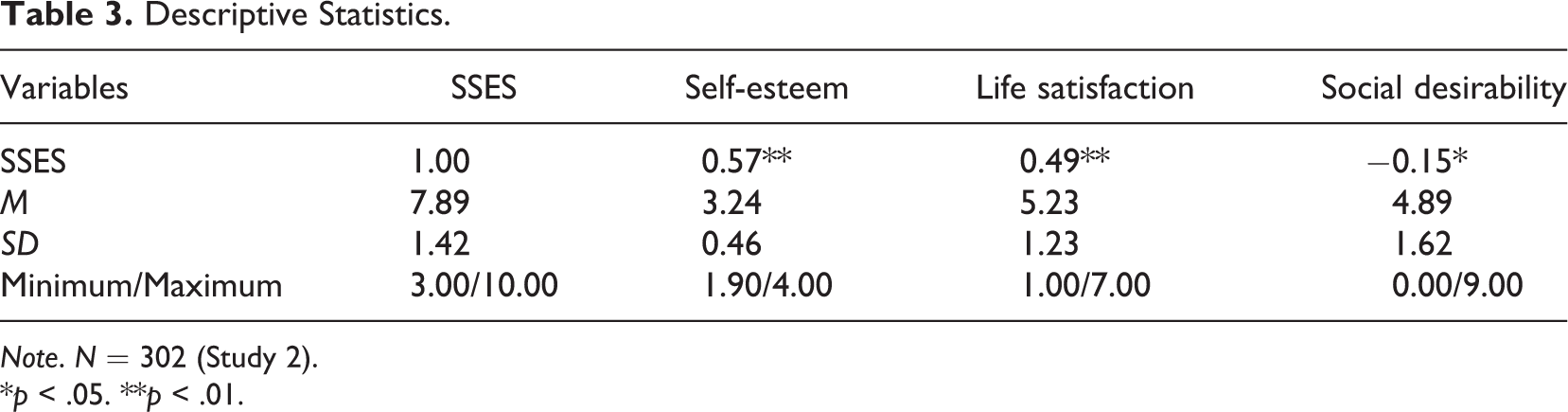
Note. N = 302 (Study 2).
*p < .05. **p < .01.
We also examined the association between SSES scores and social desirability. The results indicated that participants’ social desirability had a significant but low correlation with SSES (r = −.15 p < .05). Such negative and low correlation suggested that participants’ response on the SSES had a very weak association with social desirability. Given a large sample size (n > 100), this significance had little practical implication (Taylor, 1990). The results provided evidence supporting the discriminant validity of SSES.
Reliability Estimates
The internal consistency was also examined for the 11-item SSES by calculating Cronbach’s α coefficient. The 11-item SSES had an α value of .95. This result suggested excellent reliability of SSES scores. In addition, 36 participants in Study 2 were asked to complete the 11-item SSES twice across a 3-week time interval. The test–retest reliability results showed that SSES pretest and posttest scores had a positive, high correlation (r = .88, p < .001). This result suggested excellent temporal stability of the 11-item SSES.
Discussion
The purpose of these studies was to develop and validate the SSES to assess individuals’ perceived efficacy in utilizing their personal strengths in their daily life across a variety of contexts, including work and educational settings. The results of this study suggested that 11 items loaded on one factor: general strengths self-efficacy, and the 11-item SSES had good validity and reliability evidence. One of the main strengths of the SSES was reflected in its careful developmental process. Strong content and construct validity of the SSES were evidenced by the incorporation of important literature, theoretical supports such as the guidelines for developing self-efficacy measures (Bandura, 2001), and the best practices in scale development research (Worthington & Whittaker, 2006). In addition, the results of this study provided adequate psychometric support for the SSES scores. SSES scores displayed strong internal consistency and test–retest reliability, and our results demonstrated that SSES scores had good convergent and discriminant validity. Specifically, SSES scores were moderately related to life satisfaction and self-esteem, and weakly correlated to social desirability. We also noticed that SSES had a positive association with social desirability with one sample and a negative one in the other. This inconsistency may be due to sampling errors, though the magnitude of the relationship across both samples was relatively low.
Additional psychometric properties of the SSES were found in the CFA and test–retest reliability analysis. The CFA results showed that our hypothesized model was a good fit to the data in Study 2. Although some modifications were made to adjust the model fit, these modifications were standard and legitimate procedures (i.e., adding correlation between error terms). After model modification, our final results successfully verified the factor structure of the SSES and provided strong validity evidence for the SSES. In addition, the test–retest reliability estimate showed high stability of SSES scores in a 3-week period. These results suggested that individuals’ strengths self-efficacy did not change in a short period of time (e.g., 3 weeks). Both CFA results and the test–retest analysis strengthened the psychometrics support for scores on the SSES.
The study had a number of limitations. First, the sample was not random due to the use of snowballing technique in the data collection process. Although the sampling procedure was successful in recruiting adults with different occupations, the results could still be biased toward those who were willing to participate in the study. These participants’ average SSES scores were positively skewed, which may also be the result of our sampling procedures. It is important for future validation studies to use samples of clients in career counseling or to collect data from individuals who are struggling with their strengths self-efficacy. Similarly, the participants were predominantly Caucasian American, heterosexual, females who were highly educated. Our use of snowballing techniques may have led to such limitation. It is important that future studies of the SSES include a more diverse sample to increase generalizability of the SSES. Future research may also examine whether the factor structure is consistent in samples across developmental stages (i.e., adolescence, young adulthood, middle adulthood).
In sum, the current study introduced the SSES and provided initial support for the internal consistency, test–retest reliability, content validity, factorial validity, and convergent and discriminant validity of the scale scores. Despite the limitations previously mentioned, the SSES offers a potentially useful instrument for studying individuals’ strengths self-efficacy in career counseling, educational advising, and future research. For educators, such information can significantly refine and optimize strengths-based approaches to empower and assist students to achieve their fullest potential. Similarly, career counselors can use this measure when working with clients. The SSES can serve as a checklist to help clients identify personal skills to utilize their strengths. Career counselors can assist clients who are having difficulty in utilizing their strengths at school and work to increase their application of strengths by developing interventions based on Bandura’s (1997) four sources of self-efficacy (performance accomplishments, vicarious learning, verbal persuasion, and emotional arousal). An example of the intervention would be a mentoring or coaching program that specifically focuses on enhancing clients’ strengths and strengths self-efficacy. The mentor or coach can help track the clients’ accomplishments, be a good role model, provide encouragement, and motivate the clients to apply their strengths. When used in conjunction with other career assessments such as an interest inventory and work values scale, information gleaned from the SSES can address the extent to which individuals are able to implement their strengths in work and educational settings. The SSES can be used as an outcome assessment. It can be administered before and after career counseling or given at the end of every session to track changes of clients’ strengths self-efficacy.
Moreover, the addition of a psychometrically sound strengths self-efficacy measure can advance career counseling research. For example, researchers can explore the effects of the four sources of efficacy on the development of strengths self-efficacy beliefs. Researchers can also examine whether strengths self-efficacy contributes to job tenure, job performance, job satisfaction, and overall life satisfaction. Similarly, educational trainings and workshops and career interventions that aim to increase individuals’ strengths and their application of strengths in school and work settings can utilize the SSES to evaluate the effectiveness of their interventions. Ultimately, we hope that the SSES will contribute to the trend that emphasizes the benefits of identifying strengths and the importance of utilizing one’s strengths in educational and vocational pursuits.
Footnotes
Declaration of Conflicting Interests
The author(s) declared no potential conflicts of interest with respect to the research, authorship, and/or publication of this article.
Funding
The author(s) received no financial support for the research, authorship, and/or publication of this article.