



Abstract
Hemisity refers to binary thinking and behavioral style differences between right and left brain-oriented individuals. The inevitability of hemisity became clear when it was discovered by magnetic resonance imaging (MRI) that an anatomical element of the executive system was unilaterally embedded in either the right or the left side of the ventral gyrus of the anterior cingulate cortex in an idiosyncratic manner that was congruent with an individual’s inherent hemisity subtype. Based upon the MRI-calibrated hemisity of many individuals, a set of earlier biophysical and questionnaire hemisity assays was calibrated for accuracy and found appropriate for use in the investigation of the hemisity of individuals and groups. It had been reported that a partial sorting of individuals into hemisity right and left brain-oriented subgroups occurred during the process of higher education and professional development. Here, these results were extended by comparison of the hemisity of a putative unsorted population of 1,049 high school upper classmen, with that of 228 university freshmen. These hemisity outcomes were further compared with that of 15 university librarians, here found to be predominantly left brain-oriented, and 91 academically trained musicians, including 47 professional pianists, here found to be mostly right brainers. The results further supported the existence of substantial hemisity selection occurring during the process of higher education and in professional development.
Introduction
Popularization of the idea of sorting people into right or left brain-oriented categories occurred after discovery of the cerebral asymmetries uncovered by “split-brain” research in the 1960s (Gazzaniga, 1967; Sperry, 1961, 1968). Hemisphericity (Bogen, 1969) was an emergent concept that an individual had a characteristic right brain or left brain thinking and behavioral orientation that fell somewhere on a gradient between the two extremes. False starts, improper definitions, and lack of quantitative methods led to the subsequent confusion and collapse of the hemisphericity field in the 1980s (Beaumont, Young, & McManus, 1984).
As our understanding of the brain has increased through enhanced sophistication of instrumentation and consequent amplification of the ability to gather appropriate data, the idea of cerebral asymmetry has arisen once again. Several researchers have put forth compelling evidence to support this theory. Gadzella (1995) suggested that differences in academic achievement may be a function of hemisphericity. Merckelbach, Muris, Horselenberg, and de Jong (1997) suggested that α power measured by electroencephalography corresponded to subjects’ self-reported hemisphericity using the Preference Test (Zenhausern, 1978). Tamagni, Mantei, and Brugger (2009) suggested that performance on lateralized lexical decision tasks was directly correlated to hemisphericity determined by line bisection bias. And as recently as 2011, Gupta, Dubey, Saxena, and Pandey suggest that individual differences in hemispheric preference correlated with a person’s ability to regulate emotional stimuli.
Recently, a new term, Hemisity, has been created to describe hemispheric activity asymmetry based on the hypothesis that a unilateral executive element exists and is imbedded within one or the other side of the bilateral brain (Morton & Rafto, 2010). Morton (2001, 2002, 2003a, 2003b) developed and validated internally consistent biophysical measures that accurately identify an individual’s hemisity. In addition, Morton and Rafto (2006, 2010) identified, through magnetic resonance imaging (MRI), differences in the size of the corpus callosum as well as asymmetries of the anterior cingulate cortex that correlate directly with hemisity as determined by biophysical measures. Using these biophysical methods, Morton (2002, 2003c, 2012a) developed behavioral orientation questionnaires that are not only highly internally consistent but are also very accurate in predicting hemisity. This research has defined two very distinct behavioral profiles that mirror the opposing two segregated analytical functions of the cerebral hemispheres. Briefly, right brain-oriented persons (RPs) appear to have a propensity to use bottom-up, inductive information processing (lumpers–globalists), to be more concrete and intuitive, and to be more emotionally intense, verbally assertive, and bold. Left brain-oriented people (LPs) tend toward top-down, deductive information processing (splitters–detailers), to use more abstract reasoning, but also to be more sensitive, emotionally and verbally restrained, and cautious in public (Morton, 2002, 2003c, 2012a).
These findings led researchers to hypothesize that hemisity might significantly influence an individual’s migration through the education and into the professions. In order to test this hypothesis, researchers studied the hemisity composition of groups of students at various levels in a university, and that of faculty and other professionals. It was observed that while entry into college resulted in modest hemisity sorting, continued college education, going to graduate school, or entry into a specialized profession greatly increased the selection of hemisity subclasses. For example, about three quarters of the astronomers sampled were found to be RPs while only one quarter of particle physicists were RPs (Morton, 2003d).
Theoretical Rationale
Based on the aforementioned evidence, it is clear that some form of brain laterality indeed does exist in humans. Further, not only does this asymmetry, here called hemisity, lead to differences in self-selected preferences for learning, emotions, and behavior, but also to differences in one’s ultimate career selection and beyond, for example, political orientation and religiosity. The idea of hemisity is based in part on the theoretical underpinnings of a working memory model (Baddeley & Hitch, 1974). This model suggests that a central executive system exists and controls information input and output necessary for a wide range of cognitive activities including comprehension, learning, and reasoning. In 1995, D’Esposito et al. reported in Nature that the central executive system appears to involve portions of both the dorsolateral prefrontal cortex and the anterior cingulate cortex. In addition, they found great individual variability in lateral distribution of these activated regions among individuals, suggesting bilateral differences in their neurological architecture. From functional MRI evidence, Collette and van der Linden (2002) and Collette, Hogge, Salmon, and van der Linden (2006) proposed a hypothesis that the central executive system may be a distributed cerebral network involving region specificity for various tasks. Extrapolating from this research, as well as from our previous data on behavior-related anterior cingulate asymmetries (Morton & Rafto, 2010), we hypothesize that these variations in lateral activity may reflect idiosyncratic lateral differences in the location of the central executive system, which then automatically produce the binary behavioral contrasts of hemisity (Morton, 2012a, 2013).
To test our hypothesis, we chose to extend the current research on hemisity sorting among established professionals, as well as to look at two populations in which it is thought that hemisity sorting has not yet occurred and one population where such sorting may have begun. First, to extend the research on sorting among functioning professionals (Morton, 2003d), we chose to analyze the hemisity of two groups: university librarians and university musicians. If hemisity exists and strongly influences individual preferences for career specialization, then we would predict significant sorting of hemisities within these two professional populations.
Second, we analyzed populations where we would expect that sorting has not yet occurred. If hemisity indeed exists, then in populations where selective pressures have yet to take effect, we should see equal numbers of RPs and LPs. Because public education (primary and secondary schools) in the United States is open to all applicants, enrollment is compulsory, and all must complete a similar general core curriculum to graduate, U.S. high school students comprise an ideal population of hemisity unsorted individuals to investigate. In addition, it was predicted that distribution of these hemisities within the sexes in this group should be random (i.e., gender should not influence hemisity).
Finally, to determine at what point hemisity sorting may occur, we utilized already gathered data from a population of incoming college freshman. We hypothesize that hemisity sorting should occur after admission into a school or organization where entrance is competitive and selective. Thus, we predict a nonrandom distribution of RPs and LPs would begin to appear at the freshman level.
Material and Method
Populations
In this research, we determined the hemisity of 1,428 persons. These studies met the guidelines of the Committee on Human Studies of the University of Hawaii Institutional Review Board and posed no significant risk to participants.
Professionals (N = 106)
From the Hamilton Library at the University of Hawaii at Manoa, we measured the hemisity of staff science librarians (N = 15, 89% participation, 66% were female, in 1995). From Bucknell University, Lewisburg, Pennsylvania, we measured the hemisity of college music students (N = 44, 86% participation, 73% female) and the hemisity of performers from an international network of professional pianists (N = 47, 85% participation, 66% were female, in 2005).
Unsorted Populations (N = 1,049)
From Kapolei High School on Oahu, Hawaii, we measured the hemisity of students in the junior (17 years avg.) and senior (18 years avg.) classes (n = 703, 84% participation, in 2005). From Provo High School in Provo, Utah, USA, we measured the hemisity of students in the junior (17 years avg.) and senior (18 years avg.) classes (n = 346, 80% participation, in 2011).
Transition Population (N = 228)
From the University of Hawaii at Manoa, Honolulu, Hawaii, we had previously (Morton, 2003d) measured the hemisity of entering college students taking a required course, Western Civilization (19.5 years avg.; n = 228, 62% participation, in 1997).
Dependent Measures
Two constructs were used to measure hemisity: the Best-Hand Task and the Polarity Questionnaire. Participants were given 10 min to complete both pencil and paper tasks.
Best-Hand Task
We constructed a two-hand line bisection task, derived from Schenkenberg, Bradford, and Ajax (1980) and named the Best-Hand Task (Morton, 2003b). It consisted of 20 horizontal lines, separated vertically by 1 cm, on a standard sheet of paper. Lines varied by 10 mm in length from 70 to 160 mm, and existed in duplicate—one set increasing in length down the page, the other decreasing in length. Each line was positioned laterally in a semi-random manner, so as to avoid any obvious vertical midline patterns.
Rapid grading of the Best-Hand Task was accomplished by use of a transparent overlay, as described by Morton (2003b). At the bottom of each page, the average of the individual’s 20 midline estimates was computed to give the average right (+) or left (−) bisection deviation error for each hand, recorded in hundredths of a millimeter. For the final score, the average midline estimation error (+ or − millimeter) of both the right- and the left-hand estimates was recorded, followed by the absolute directional difference between the averages of the two hands (in millimeter), importantly with the right-hand estimate used as the reference. For example, an overall result might be: +0.50R, −2.30L, and −2.80D, one of the four hemisity categorical possibilities. These categories are illustrated in Figure 1, of Morton (2003b, 2003d) and are essential for understanding and applying this method.
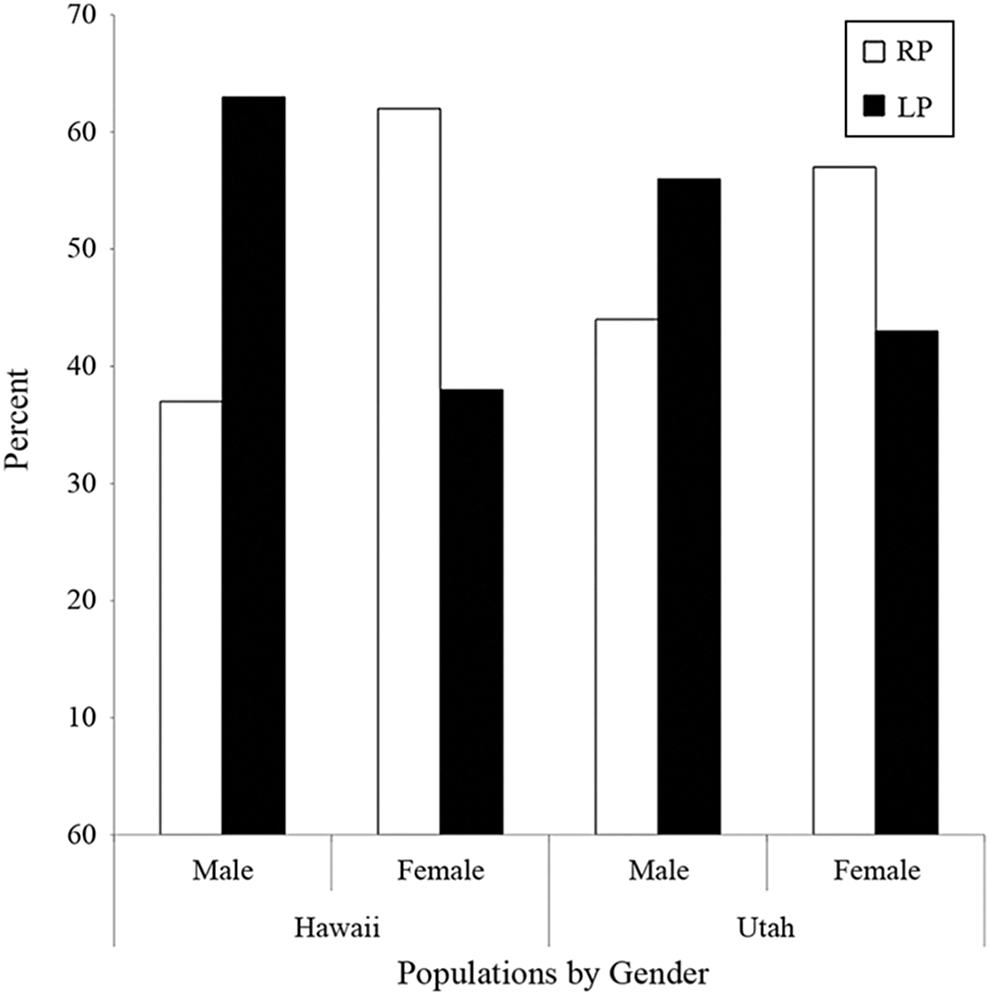
Reciprocal complementary relationship between hemisity and gender in both Hawaiian and Utahan populations of high school students.
The survey included demographic data (age, sex, and parental ethnicity) in addition to an identifier. Directions stated, “Using your RIGHT hand, mark the center of each of the 20 lines below.” Next, subjects were directed to mark with their left hand an identical set of 20 lines on a second page. At the bottom of the second page students self-reported answers to questions regarding handedness (Chapman & Chapman, 1987), whether subjects preferred using a left appendage for any process, and whether their pen-grasp posture was non-inverted or inverted as illustrated by the examiner (Levy & Reid, 1976). In group testing, the four hand-grasp position possibilities for pen grasp (Levy & Reid, 1976) were illustrated and emphasized at the beginning of the task in order to obtain as accurate a self-report as possible. This was important because Best-Hand Task results for left, but not right-handed subjects using an inverted writing grasp, required a reversal to match the subject’s hemisity manifest in the five other reference methods (Morton, 2001, 2002, 2003a, 2003c; Zenhausern, 1978). No phase correction was required for those rare left-handed subjects using a non-inverted hand posture, or right-handers using either posture. These issues are further elaborated in Morton (2003b).
This survey has been previously calibrated against an MRI-based primary standard for hemisity assessment based upon the size laterality of the ventral anterior cingulate cortex of 149 previous subjects (Morton & Rafto, 2010). In general, a forearm and its hand are controlled by the opposite side of the brain (Gazzaniga, Bogen, & Sperry, 1967). After the pen posture corrections are made, the hand giving more accurate bisections can be used to indicate the hemisity of the individual with about 80% accuracy.
Polarity Questionnaire
The following 11 statement true–false preference questionnaire (Morton, 2002) gave hemisity assessments highly correlated with outcomes of the biophysical assays (Morton, 2002, 2003a, 2003b) and MRI calibration (Morton & Rafto, 2010).
Recognizing that everyone has access to both sides of their brain, and that there are no incorrect answers here, mark the following statements True or False (T or F), depending on how well you feel the statement fits you personally. ___1. When I become upset, after cooling down I don’t need to talk, I need to be alone. ___2. I tend to be introspective, self-conscious, thin-skinned, and psychological. ___3. I would rather maintain and use good old solutions than find new, better ones. ___4. I talk about thoughts, things, or acquaintances more than entertainment, sports, or politics. ___5. I am comfortable and productive in the presence of disorder and disorganization. ___6. I find it very difficult to tolerate when my mate (or important other) becomes defiant to me in private. ___7. I don’t need a lot of physical contact from my mate. ___8. I like daily small reassurances of my mate’s love more than monthly large rewards. ___9. I tend not to be very romantic or sentimental. ___10. I am more strict than lenient with our children (or I would be if I had children). ___11. Given the opportunity, I am more of an early morning person than a late night person.
Polarity Questionnaire statements alternated between left and right brain orientations. To simplify, scores were reported as the number of possible left brain-oriented answers. That is, marking odd numbered questions True, and even numbered questions False, gave 11 left brain-oriented answers. Subjects whose scores were 4 or fewer left brain answers were considered right brain oriented, while subjects with scores of 5 or more were placed in the left brain orientation group.
Statistics
Analyses were conducted with the aid of the Statistica 5.0 software package. For each population, the hypothesis of an equal distribution (50% RP and 50% LP) was put forth as the null and compared to the observed values in a χ2 goodness-of-fit test. α was set to .05.
Results
Professionals
Librarians
Among librarians, we see some evidence of hemisity sorting. We would predict an even distribution between left and right orientation if no sorting occurs. Instead, we see that 73% of librarians are LPs, χ2(1, N = 15) = 3.27, p = .07; see Table 1. Although levels did not reach significance due to low sample size, the trend is apparent. This LP majority is consistent among both males and females. In addition, we see a gender disparity with two thirds of the population being female.
The Apparent Hemisity of University Science Librarians.

Musicians
Among professional and student musicians, we find more evidence of hemisity sorting, as illustrated in Table 2. We see that among student pianists, only 28% are LPs (i.e., 72% were RPs); among professional pianists, 38% are LPs; among music students who are not pianists, 21% are LPs. Again, the sorting is consistent between genders. Overall, among professionally trained musicians, only 32% are LPs, the opposite sorting from that of librarians, χ2(1, N = 91) = 13.0, p < .01. However, we see an equal gender discrepancy with two thirds of the population again being female.
The Apparent Hemisity of University Musicians.a

Note. aOne subject was not academically trained. Two specialized in Jazz. The rest performed primarily from the standard classical repertoire.
*Indicates significance at p < .05. **Indicates significance at p < .01.
Unsorted Populations: U.S. Public High School Students
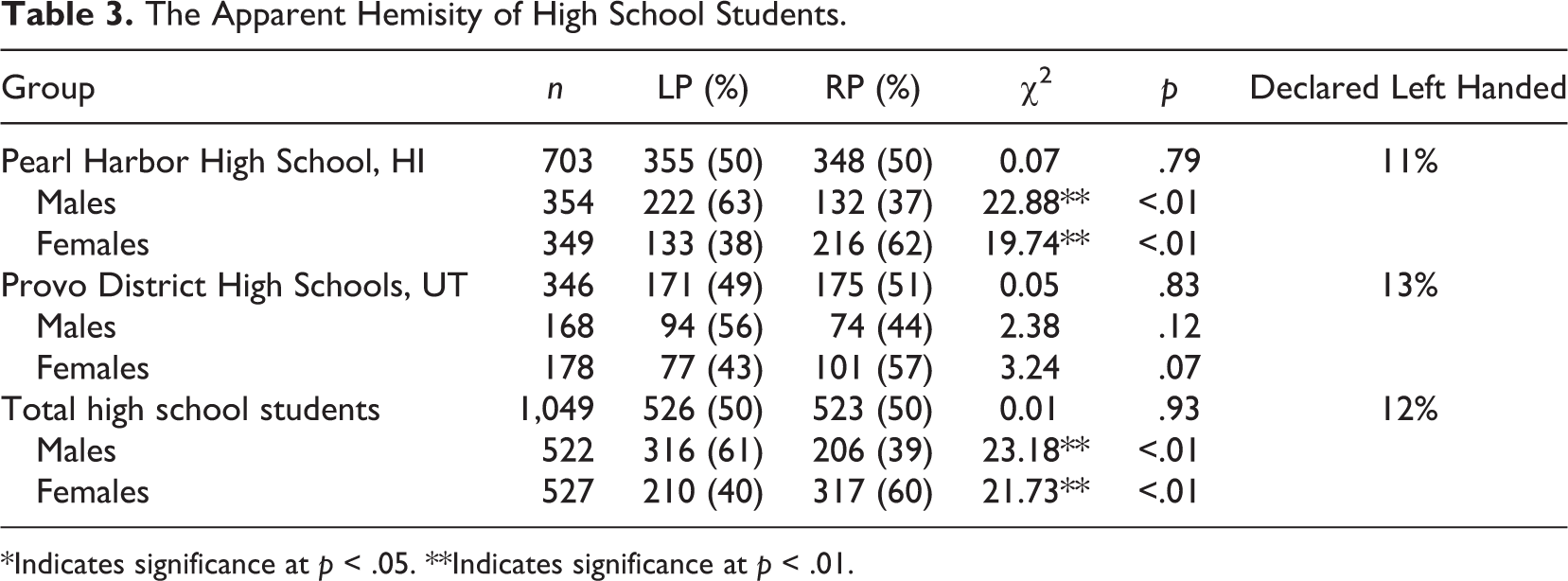
Among high school juniors and seniors, a population in which we predicted to see no sorting occurring due to the compulsory and nondiscriminate enrollment, we found an even distribution of RPs and LPs. Among 703 students at Kapolei High School near Honolulu, Hawaii, we found a nearly even split between RPs and LPs (see Table 3). The same relationship was found among 346 students attending high schools in the Provo School District in Provo, Utah: an even distribution of RPs and LPs.
The Apparent Hemisity of High School Students.
*Indicates significance at p < .05. **Indicates significance at p < .01.
Interestingly, among genders an even distribution is not seen. Instead, among the Hawaiian students, we see (Figure 1) a reciprocal complementary relationship between RP males (37%, N = 132) and LP females (38%, N = 133) and correspondingly between LP males (62%, N = 216) and RP females (63%, N = 222). This same reciprocal complementary relationship was found among genders in the Provo population between RP males (44%, N = 74) and LP females (43%, N = 77) and correspondingly between LP males (56%, N = 94) and RP females (57%, N = 101). A two-way contingency table analysis was conducted on the total high school population to evaluate whether gender was related to hemisity. Here, gender and hemisity were found to be significantly related, Pearson χ2(1, N = 1,049) = 44.90, p < .01.
Transitional Population
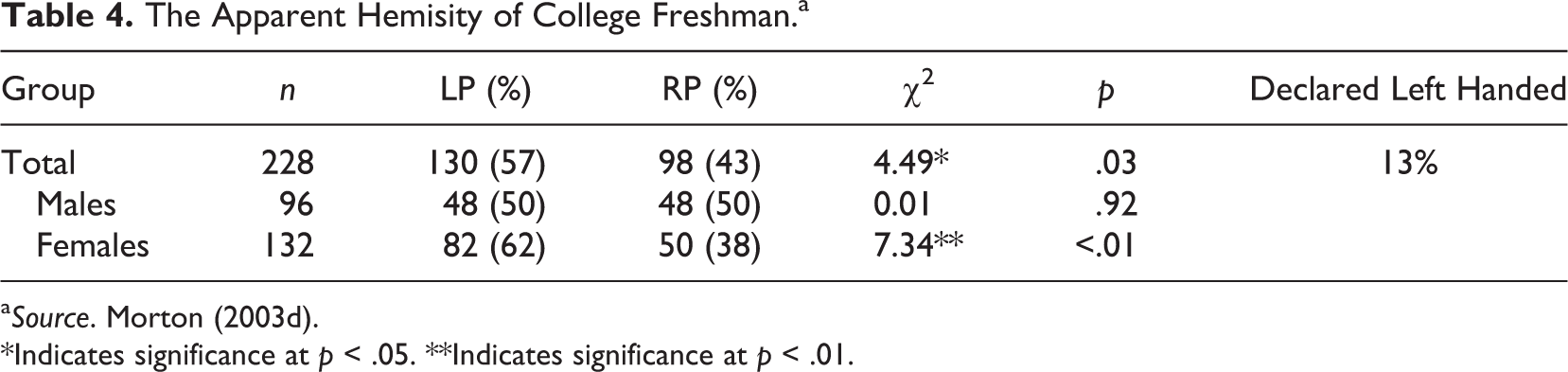
In contrast to the high school population, this even distribution and complementarities among genders was lost among college freshmen (N = 228) admitted into the University of Hawaii at Manoa, also near Honolulu. Not only were there significantly more females (58%, N = 132) than males (42%, N = 96), but there were also more LPs (57%, N = 130) than RPs (43%, N = 98), especially among females. These differences indicate that hemisity sorting had begun, although differences were not as significant as seen among upper classmen, or working professionals (Morton, 2003d), or among the librarians or professional musicians studied here.
Discussion
Over the past half century, surgical procedures to severe the large band of nerve fibers connecting the right and left cerebral hemispheres (the corpus callosum) have been used to minimize the spread of epileptic seizures. Careful investigation of individuals who had this surgery makes it clear that the two cerebral hemispheres are functionally and behaviorally quite different (Gazzaniga, 1967; Sperry, 1961, 1968). Since the popularization of this “split-brain” research in the early 1960s, the concept of hemisphericity, in which individuals are thought to show inherent right brain or left brain-oriented behavioral and cognitive differences (Bogen, 1969), became popular within the general population.
For academic psychologists, however, the issue of brain hemisphere orientation has been problematic (Beaumont, Young, & McManus, 1984) because no quantitative measures previously existed to determine the hemisphericity of either individuals or of groups. This was due in part to the lack of a proper definition for hemisphericity itself. Rather than existing as a range between two extremes as formerly conceived in hemisphericity, the new context of hemisity is viewed as a heritable “either right or left brain-oriented” binary phenomenon. This idea is partly based upon the theoretical underpinnings of a working memory model that suggests the existence of a central executive system (Baddeley & Hitch, 1974). Thus, we hypothesize by necessity to be located in one hemisphere or the other of the bilateral brain. Functional MRI studies have confirmed asymmetric activation of distinct regions within the prefrontal cortex and anterior cingulate during cognitive processes requiring working memory (Collette, Hogge, Salmon, & van der Linden, 2006; Collette & van der Linden, 2002; D’Esposito et al., 1995). These issues have been further resolved by the development of independent biophysical measures of hemisity, using nonverbal hand, eye, or ear-dependent measurements (Morton, 2001, 2002, 2003a, 2003b). This advance led to the discovery of two different brain structural differences (the thickness of the corpus callosum and the asymmetry of the anterior cingulate) between right brain- and left brain-oriented individuals and to the proposal of a unilateral executive element (Morton & Rafto, 2006, 2010).
Hemisity is shown to influence the manifestation of behavioral preferences as evidenced by the high correlation between the hemisity questionnaires (Morton, 2002, 2003c, 2012a) and the biophysical methods (Morton, 2001, 2002, 2003a, 2003b) and MRI hemisity results (Morton & Rafto, 2006, 2010). We hypothesized from this that these preferences would significantly influence the selection of one’s college and/or professional track. Our results for the college librarians and professional musicians in this study add further support to the idea that hemisity influences one’s chosen profession (Morton, 2003d). Interestingly, while both professional tracts analyzed in this study are predominated by females (a two-thirds majority), librarians tended to be LPs while musicians tended to be RPs. This indicates that gender is not linked to predominant hemisity and rather that hemisity is linked to the profession. Perhaps it was not surprising that university science librarians, people skilled in the assessment of details, tended to be enriched in LPs (73%) and only 4 of the 15 (27%) were RPs. It is predicted that corpus callosal size will be lower than average among LP librarian groups because LPs have been found to have significantly smaller corpus callosal cross-sectional areas than RPs (Morton & Rafto, 2006).
The determination of the hemisity of 47 professional pianists reported here contributes significantly to the growing body of research concerning musicians and the process of making music. The abundance of right brain-oriented individuals in music does not imply that music is strictly a right hemisphere property, but it does raise issues for further study. It is widely recognized that neural networks for music are distributed throughout the left and right cerebral and cerebellar hemispheres (Parsons, 2001; Peretz & Zatorre, 2003), but that the right and left hemispheres have different specializations in processing musical elements. The right hemisphere, for example, is thought to process melody and meter (the beat), while the left hemisphere processes specific intervals (the space between pitches) and rhythm (regular patterns or groupings; Altenmüller, 2001; Parsons, 2001; Peretz & Zatorre, 2005). However, the melodic and harmonic processing tasks that are processed in the right hemisphere by amateurs and nonmusicians appear to shift to the left hemisphere in professional musicians (Altenmüller, 2001; Ohnishi et al., 2001). The hemisphere switch in professionals has been attributed to their inner speech, where professional musicians begin to automatically name intervals and harmonies while they process them, thus being more analytical in the way in which they process music (Altenmüller, 2001).
Altenmüller and Gruhn (1997) showed that different teaching methods during music instruction resulted in different brain activation patterns. Verbal instruction about music produced increased activation of the left frontotemporal brain regions, while a group that participated by singing and playing showed increased activation of the right frontal and bilateral parieto-occipital lobes. Since the teaching of a musical instrument is participatory and experiential, would someone who has a right hemisphere dominance self-select an activity that is taught in a manner that emphasizes the right brain, and might that account for the preponderance of RP musicians?
Will the majority of all musicians, not just pianists, be found to be right brain oriented? In Table 2, the observation that 15 of the 19 university music students not specializing in piano were also RPs must be relevant to the answer of this question. In another regard, the corpus callosal size of musicians, although the literature on corpus callosum size in musicians is mixed (Ozturk, Tasciogiu, Aktekin, Kurtogiu, & Erden, 2002), it may be relevant that RPs in general were found to have larger corpus callosal cross-sectional areas than LPs (Morton & Rafto, 2006).
This is the first study to analyze hemisity in an unsorted population of humans. Based on the hypothesis that hemisity is an inborn physiological property, we predicted that, with no selection pressures at play (e.g., selective enrollment, competitive admittance, etc.), equal proportions of RP and LP individuals should exist in such a population. Indeed, we found that within populations of juniors and seniors attending public high schools in both Hawaii (N = 703) and Utah (N = 346), equal numbers of right brain- and left brain-oriented individuals were present. This supports our hypothesis and provides us with a baseline from which to draw inferences regarding the sorting of hemisity subtypes into more specialized groups. Based upon the apparent inherent and immutable nature of hemisity, logic would demand that in adulthood within the entire general population the number of RPs and LPs would remain equal. However, in older populations, it remains to be seen where there might be selective attrition of one hemisity subclass.
Since only a portion of the general population are admitted to and attend college or other applicant-selective institutions, sex and hemisity sorting is expected to occur within members of those organizations. For example, some hemisity selection indeed appears to have resulted in the competitive process of entrance of first-year students into the University of Hawaii. That is, the hemisity and sex distributions of freshmen at the University of Hawaii were unequal (Morton, 2003d). Of the 228 students studied in that group (Table 4), only 43% were RPs and 57% were LPs, while 42% were males and 58% were females. Thus, more females and/or more left brain-oriented applicants were present, presumably because they met the academic entrance requirements for university acceptance.
The Apparent Hemisity of College Freshman.a
a Source. Morton (2003d).
*Indicates significance at p < .05. **Indicates significance at p < .01.
Regarding gender, the sex ratio for the entire world population of humans is 102–108 males to every 100 females (James, 1987). Therefore, we would expect our populations to reflect this ratio if they are an accurate representation of the general population. Indeed, we saw an equal number of males and females in both the Hawaii and the Utah high school populations. However, it was interesting that males and females exhibited different ratios of RPs to LPs and that the ratios were inversely related to one another. A Pearson χ2 analysis showed that gender is indeed correlated with hemisity in some way. To review the phenomenon (Figure 1), males were enriched in LPs while females were enriched in RPs. In addition, LP males matched RP females in frequency and RP males matched LP females in frequency. More intriguing is that the direction of this inequality was consistent and almost equal between both high school populations, despite the geographic and quite likely ethnographic diversity between the populations.
Beyond pointing out this striking phenomenon, our data do not explore nor confirm any causal mechanism underlying this disparity. Perhaps we might offer several possible hypotheses. Because males appear to be enriched in LPs and females with RPs in an unsorted population, it leads to the famous debate of nature versus nurture. While it would seem genetically and physiologically that the lateral placement of the central executive system should be random in an unsorted population, an alternative may lie in a putative nurturing role that favors LP traits in males, while favoring RP traits in females. This nurture hypothesis may be consistent with our finding that professions tend to select one hemisity subtype over another.
An alternative possible explanation may lie in the age-old adage, “Opposites attract,” suggesting that LP males are more sexually compatible with RP females and vice versa. From these crosses, males and females, by nature or nurture, ultimately end up the same hemisity as the parent of the same gender. This would perpetuate the LP/RP ratios in a given population in fairly equal numbers of hemisity-opposite pairs, as seen here. This topic has been further developed (Morton, 2012b). Certainly, it is an intriguing phenomenon that merits more study to determine genetic and/or societal influences.
Conclusions
This investigation puts hemisity, a new context of brain behavioral laterality, to the test. First, two large population U.S. public high school students, one in Hawaii, the other in Utah, were found to not only to be essentially equal in number of males and females but also in numbers of RPs and LPs. In both high school populations, there was a predominance of right brain-oriented females (RFs) and left brain-oriented males (LMs) over right brain-oriented males (RMs) and left brain-oriented females (LFs). Interestingly, in both samples, the more common RFs and LMs were quite similar in number, as were the less abundant RMs and LFs in an apparent “opposite matching” manner (Morton, 2012b).
Based upon the sex and hemisity distributions of students accepted into the research campus (Manoa) of the University of Hawaii, both sexual selection and hemisity selection resulted in a predominance of females and LPs among these “freshmen.” As previously assessed (Morton, 2003d), this sex and hemisity selection continued to increase as they became upper classmen, then graduate students, and finally professionals. Here, a confirmatory replication of the effect of specialized education upon the selection of sex and hemisity was performed. In contrast to sex and hemisity unsorted high school students, University of Hawaii Librarians were found to be predominantly female and LPs. In contrast, a cosmopolitan group of university musicians were also predominantly female but found to be highly enriched in RPs. All of the above results further support the existence of hemisity and of substantial hemisity sorting in higher education and in professional development.
Implications for the Use of Hemisity in Career Assessment
Correlation of ventral gyrus of the anterior cingulate cortex (vgACC) laterality, the primary standard for hemisity, with the Best-Hand Test, was r = .83, p = .000, n = 142. For the Polarity Questionnaire, it was r = .63, p = .00, n = 133 (Morton & Rafto, 2010). These are quite high, as they should be, since both are tapping the same construct, hemisity.
Although both instruments were used here, the viability of using the more easily administered Polarity Questionnaire (Morton, 2002) alone to determine the hemisity of large groups was considered by comparing its outcomes here with those of the Best-Hand Test alone (Morton, 2003b). For a high school population (n = 703), the outcomes of the two methods differed in only 5.6% of cases. Further, the Polarity Questionnaire was able to assess the hemisity of the 10.4% individuals whose Best-Hand Test results were indeterminate. This supported the idea that, not only are the two measures complimentary but also that perhaps future studies using the Polarity Questionnaire alone might be acceptably accurate for the estimation of hemisity and familial polarity of large English-speaking populations. However, the extreme outcome sensitivity to wording of Polarity Questionnaire statements (Morton, 2002, 2003c) suggests that great care must be taken in its translation into other languages and cultures. In contrast, biophysical hemisity methods, such as the Best-Hand Test, while more demanding to assess, appear to be language and culture independent.
The grading of the Best-Hand Test as a research instrument is complex, technical, and not practical for use by professional career assessors. As indicated above, similar results are easily obtained by the Polarity Questionnaire. Further, it has been shown that the combined use of three other rapid hemisity questionnaires that have been developed: The Asymmetry Hemisphere (Morton, 2003c), the Binary Questionnaire (Morton, 2012a), and the Hemisity Questionnaire (Morton, 2012a), enhances the 80% certainty of the result of a single questionnaire to about 95% for combined use. The correlations of these hemisity questionnaires with the vgACC brain laterality primary standard are for the Polarity Questionnaire, r = .57, p = .000, n = 132; Asymmetry Questionnaire, r = .48, p = .000, n = 111; Binary Questionnaire, r = .43, p = .000, n = 112; and Hemisity Questionnaire, r = .53, p = .000, n = 79.
With hemisity subtype of the career advisee in hand (as determined by combining these rapidly completed and easily graded hemisity questionnaires), the career counsellor can use the 30 “either-or” choice difference between RPs and LPs (Morton, 2012a), and also an analysis of the 17 professions with observed differences in hemisity subtypes (Morton, 2003d, this report) to assist the individual in career guidance. A general review of hemisity (Morton, 2013) is pending, which describes the topic in much greater detail than space permits here.
Footnotes
Acknowledgments
The authors gratefully acknowledge the generous assistance of the many colleagues, teachers, and students who so enthusiastically participated in this unfunded work.
Declaration of Conflicting Interests
The author(s) declared no potential conflicts of interest with respect to the research, authorship, and/or publication of this article.
Funding
The author(s) received no financial support for the research, authorship, and/or publication of this article.