



Abstract
This article explores the role of selected work-based constructs and social support in the prediction of school engagement in a sample of Italian high school students. A total of 137 high school students from Central Italy completed measures of social support (including teacher, peer, and parental support), career decision-making satisfaction, career planfulness, and school engagement, each of which had been translated to Italian from English. The results reveal that high levels of career decision-making satisfaction, career planfulness, and teacher support were statistically significant predictors of school engagement. The findings are discussed in relation to career development theory, educational and counseling practice, and prevention.
The challenges of educating youth for the 21st century workforce presently confront nearly all nations in that students need high levels of academic skills to adapt to an increasingly competitive labor market. Central to the preparation of an effective and productive 21st century workforce is a rigorous education that requires considerable school engagement on the part of students (Kenny, 2013; Kenny, Blustein, Haase, Jackson, & Perry, 2006). Fredricks, Blumenfeld, and Paris (2004) argue that the presence of school engagement may serve as a particularly useful antidote to declining academic motivation and achievement of students, which occur as students experience numerous challenges that interfere with academic and career progress (Kenny et al., 2007). In order to build comprehensive prevention and treatment programs that target the dropout problem at the secondary education level, scholars have attempted to identify factors that contribute to both positive school engagement and disengagement. In this study, we seek to expand this knowledge base by examining the role of social support and various indices of career development in the prediction of school engagement among Italian high school students.
The study of school engagement has become increasingly important in recent years, given the need to understand the noncognitive factors that contribute to academic performance. Fredricks, Blumenfeld, and Paris (2004) define school engagement in terms of three dimensions: (a) behavioral engagement (e.g., school effort, attendance, homework completion, attention, and extracurricular activities); (b) cognitive engagement (e.g., self-regulated learning strategies that promote investment in school and preference for challenging work); and (c) emotional engagement, a psychosocial process, as manifested by how students identify with the value or purpose of school, feel that they belong in school, take pride in their school, and relate to the personnel (e.g., teachers, administrators) and structural aspects (e.g., environment, curriculum) of school.
Consistent with the previous research on school engagement (e.g., Blustein et al., 2010; Kenny, Blustein, Chaves, Grossman, & Gallagher, 2003), we have adopted developmental-contextual theory as the macro-level conceptual framework for this investigation. Developmental-contextual theory, as articulated by Lerner (2002), posits that human behavior is a function of reciprocal relationships between individuals and their contexts. Developmental-contextual scholars propose that intraindividual factors (biological and genetic attributes) intersect in complex and systemic ways with resources and barriers in one’s proximal and distal contexts.
Related to the factors that influence youth development, one of the foci of this study is the concept of social support (e.g., support from family, peers, and teachers). Building on the relational theory of working (Blustein, 2011), we propose that social support is a key ingredient in fostering progress in school engagement in Italian youth. One of the underlying assumptions of relational theory is that social connections can facilitate and/or inhibit various aspects of work-related challenges and tasks (Blustein, 2001; Flum, 2001). Perceived social support, a key component of relational theory, is defined as one’s perception of the availability of support from others. Consistent with relational theory (Blustein, 2001), social support has the potential to provide both emotional and instrumental resources that are helpful for students in negotiating the challenges of school.
Significant research has shown that social support from parents and teachers is integral to students’ engagement in school (Close & Solberg, 2008; Kenny et al., 2003; Murray, 2009; Perry, Liu, & Pabian, 2010; Simons-Morton & Chen, 2009). Moreover, high school students who perceive their peers as valuing school are also more likely to be academically engaged (Kenny & Bledsoe, 2005). Beyond school engagement, a number of studies have demonstrated that social and relational support is related to progress in career decision making (e.g., Phillips, Christopher-Sisk, & Gravino, 2001). Research emerging from Bowlby’s (1988) attachment theory, for example, has demonstrated that secure attachment to significant others is associated with positive career exploration and progress in career decision making (Blustein, Prezioso, & Schultheiss, 1995). For example, in a study on college students, DeMania (1999) found that attachment to parents predicted college students’ reported subjective satisfaction with their academic major and career preference along with the congruence of their interests and academic majors.
Work-related factors (i.e., career planfulness and career decision-making satisfaction) have also emerged in the recent literature as relevant to school engagement. Research and theory have pointed to the importance of students’ capacity to internalize the connection between school and future work as a means of promoting school engagement (Kenny, 2013; Kenny et al., 2006). Despite the intuitive appeal of this premise, far more research is needed to fully understand the role of work-based attitudes and behaviors in the prediction of school engagement, especially across varied contexts. Using life span, life space (Super, 1990), social cognitive (Lent, Brown, & Hackett, 1994), and motivational theories (e.g., Ryan & Deci, 2000), Lapan (2004) proposed that an adaptive level career planfulness and positive career expectations can provide a sense of purpose, opportunity, and choice to youth who otherwise might feel academically discouraged. Similarly, Ryan and Deci (2000) have presented a compelling argument and empirical evidence indicating that developing meaningful goals can provide students with purpose and motivation.
Career planfulness (i.e., having goals and a plan about ways to achieve those goals) and confidence in one’s capacity to achieve these goals have been associated with adaptive achievement-related beliefs among urban high school students in the United States (Kenny, Walsh-Blair, Blustein, Bempechat, & Seltzer, 2010). According to Kenny et al. (2010), these beliefs include the enjoyment of learning, the belief that school is relevant to one’s future, and the feeling of confidence about one’s capability to succeed at school. In addition to career planfulness, we included an index of students’ satisfaction with their progress in career decision making. Consistent with developmental-contextual theory (Lerner, 2002), this construct provides a means of assessing students’ construction of their progress in developing their plans for the future. One of the fundamental assumptions of career development education is that students who are planful and satisfied with their career decision making will be more likely to feel connected to school (Blustein, 2006; Lapan, 2004).
A major limitation of career development scholarship, and, indeed, psychological research in general, is the insular focus on problems, samples, and proposed solutions for populations residing in North America (Arnett, 2008). To redress this circumscribed focus, we have examined the topic of school engagement in an Italian context, which provides a wider angle with which to understand how social support and work-related factors impact students’ involvement in school. In order to contextualize the argument for this study, a brief review of the Italian educational context is warranted. Similar to the United States, a critical problem in the Italian educational system is premature school dropout. An analysis carried out by the Italian Ministry of Public Education in 2006 indicated that both failure at school and dropout are prevalent. As detailed by Soresi, Nota, and Ferrari (2005), Italian youth who are 14 or 15 years old have to make important decisions regarding their future educational and professional lives. These decisions are significant in that students choose from several types of high schools upon completion of middle school (e.g., scientific lycée [focus on science and math]; classical lycée [focus on humanities]; linguistic lycée [focus on languages]). The type of school selected by students strongly influences their career path and requires a focus on a particular specialization starting from the ninth grade.
In addition to these complex decisional challenges, Italian students, like students throughout the rest of the world, face an uncertain future as globalization and radical economic changes dramatically recast the world of work (Blustein, 2006). Soresi et al. (2005) report that 11.5% of young adolescents in Italy are indecisive and insecure about their future and likely to feel a lack of control over their future lives. As such, many of the problems that students face in the U.S. schools also are relevant to Italian youth. Students struggle with shifting levels of motivation, coupled with considerable concern about the meaning of their school work in advancing their hopes for their adult lives (Soresi et al., 2005). As such, career development factors that have emerged in the U.S. context as related to school engagement warrant attention in research among Italian youth. We expect that social support will also be relevant to school engagement among Italian youth. Given the value of collectivism and ongoing family connections evident throughout the life span for many Italian families, we would anticipate that social support would emerge as a particularly important factor in the prediction of school engagement among Italian students.
Drawing from the developmental-contextual framework (Lerner, 2002), the examination of work-related factors and perceived social support may inform understanding of environmental risks and protective factors that impact the school engagement of the Italian youth. Knowledge of the most adaptive array of predictors associated with school engagement may inform the design of support services and educational curricula to enhance the involvement of the Italian high school students in their educational pursuits.
In sum, existing research among the U.S. samples reveals that school engagement is conceptually linked to progress in career development and the availability of relational support. We argue that these factors are relevant for Italian youth and hypothesize that higher levels of perceived social support, career decision-making satisfaction, and career planfulness will be predictive of greater school engagement among Italian high school students.
Method
Participants and Procedure
This study uses a quantitative, post hoc correlational design in studying the school engagement among Italian high school students. One of the authors randomly selected two schools from a province in the Tuscany region in Italy for data collection, wherein all students enrolled in these schools were invited to participate in the study. The students were informed that they would receive individual feedback and would be able to benefit from a subsequent guidance session in return for their participation. Completed questionnaires were collected from a sample of 137 Italian middle class high school students who were enrolled in the last 2 years of the high school within the spring semester of 2008 (39 males, 98 females). Of the students, 74 (54%) attended a college preparatory school and 63 (46%) of them attended a technical school. Of the 74 students who attended a college preparatory high school, 12 (16.22%) were males and 62 (83.78%) were females. Of the 63 students who attended technical high school, 27 (42.86%) were males and 36 (57.14%) were females. This distribution is similar to the gender distributions in other Italian studies. For example, Pombeni and Chiesa (2008) reported that there is a strong majority of females in college preparatory high schools and a relatively equal proportion of males and females in technical high schools. The questionnaires were administered within the classroom at a time agreed upon by the schools and in accordance with ethical guidelines. The administration order of the instruments was counterbalanced in order to control the effects of presentation order. By adapting prior scales that measure these constructs, steps were taken to ensure that the information provided by the instruments was stable, accurate, and could be used to address the research questions in a culturally responsive manner.
In accordance with Mallinckrodt and Wang’s (2004) suggestions regarding the translation/back translation process, three translators, who are native Italian speakers and strongly identify with the Italian culture, were responsible for the translations of the questionnaires. First, two translators, English as second language instructors, did the translation of the questionnaires to Italian independently. Second, the third translator did the back translation of the instruments. Finally, one of the coauthors, who is fluent in both Italian and English and knowledgeable about the measured constructs of the study, made comparisons between the final version of the translation and the original questionnaires and verified the equivalence of the translated and original versions item by item.
Measures
Demographic Questionnaire
A brief demographic questionnaire was constructed to ascertain the participants’ gender, age, and school types.
Perceived social support
The Social Support Scale for Children and Adolescents (SSSCA; Harter, 1985) is an 18-item scale that assesses the extent to which students perceive their parents, teachers, and close friends as supportive. The SSSCA measure has three subscales, each consisting of 6 items to assess the level of support from parents, teachers, and close friends, respectively. Using a “structured alternative format” (Kenny & Bledsoe, 2005, p. 261), respondents are first presented with a choice between two descriptions of children/adolescents, such as “Some teenagers don’t have a close friend who they like to spend time with … BUT … Other teenagers do have a close friend who they like to spend time with.” Respondents first answer the question, “Which is true of you?” The next step is for respondents to indicate how true the statement is of them (either “really true” or “sort of true”). Items are scored on a 4-point scale, with a 4 representing the highest level of support and a 1 representing the lowest level of support. For example, a respondent who chooses a statement suggesting higher level of support within the first step and responds that the statement is “really true” receives the highest score of 4. On the contrary, a respondent who chooses a statement suggesting a lower level of social support and determines that the chosen statement is “really true” for them receives the lowest score of 1. Then, the respondents, who indicate a statement is “sort of true” for them, receive scores of either 2 or 3 based on the direction of that statement. In prior research, the internal consistency subscale reliabilities for two middle school samples were .86–.88 for parent support, .84 for teacher support, and .77–.83 for friend support; additionally, these subscales have been found to correlate with global self-worth (Harter, 1985). For a sample of urban ninth graders, Cronbach’s αs were .74 for close friend, .75 for family, and .69 for teacher (Kenny & Bledsoe, 2005). In this study, relatively similar internal consistency coefficients were obtained (parent support, .81; peer support, .82; teacher support, .77). In addition, previous research using this instrument has resulted in findings that are consistent with theoretical expectations (e.g., Kenny & Bledsoe, 2005), thereby providing some support for the validity of the measure.
Career decision-making satisfaction
The Satisfaction with Career and Academic Preferences Questionnaire (SATCAP; DeMania, 1999) is a 20-item scale assessing students’ subjective satisfaction with their academic (e.g., I am satisfied that my choice of academic major is right for me”) and career-related decisions (e.g., I believe that my career path will satisfy my needs”). Items of the SATCAP are divided equally between the academic and the career domains. Items are rated on a 7-point-Likert-type scale ranging from “strongly disagree” (1) to “strongly agree” (7), with high scores reflecting higher levels of satisfaction with one’s academic and career-related decisions. The SATCAP was used with college students with an internal consistency reliability of .81 (DeMania, 1999). In this study, the internal consistency coefficient for the SATCAP was .88. In addition, the results of the DeMania study yielded results that were consistent with theory, thereby providing some initial support for the validity of the SATCAP.
Career planfulness
The career planning subscale (CPS) of the Career Development Inventory (Super, Thompson, Lindeman, Jordaan, & Myers, 1981) is a 20-item scale assessing engagement in career planning activities and self-reported career knowledge. Items relating to the level of involvement in career planning activities are rated on a 4-point scale ranging from “strongly disagree” (1) to “strongly agree” (4) and items pertaining to knowledge of careers are rated on a 4-point scale ranging from “no knowledge” (1) to “a good deal of knowledge” (4). Higher scores on the CPS indicate higher levels of the student’s career knowledge and involvement in career planning. In prior research, the CPS was used with ninth-grade students, demonstrating an internal consistency reliability of .89 (Super et al., 1981). Lightfoot and Healy (2001) found an α of .96 for the students aged 14–23; in this study, the α was .65. Several studies have reported results with the CPS that are consistent with the theoretical assumptions of the construct. For example, research with college students has shown that career planning is associated with future optimism and integration between past, present, and future aims (Hernandez & DiClementi, 1992). Blustein (1988) also reported that higher scores on the CPS were related to one’s sense of commitment to a specific career plan in a sample of college students.
School engagement
The 16-item Identification with School Questionnaire (IS; Voelkl, 1996) assesses attitudinal aspects of school engagement, including the degree to which students feel a sense of belongingness at school and value school and school-related outcomes. Nine items measure the students’ sense of belongingness at school (e.g., “People at school are interested in what I have to say,” “I feel proud of being a part of my school”) and 7 items measure the degree to which students value school and school-related outcomes (e.g., “Most of what I learn in school will be useful when I get a job,” “School is often waste of time”). Students rate each item in the questionnaire using a 4-point scale ranging from 1 (strongly agree) to 4 (strongly disagree), with higher scores indicating lower levels of school identification. School identification scores have been linked to classroom participation and academic achievement among ethnically diverse students such as White and African American eighth-grade students. Reported internal consistency reliability for the total score was .84 (Voelkl, 1997) among African American and White 8th graders and .82 among racially diverse 10th to 12th graders (Voelkl & Frone, 2000). The internal consistency for the IS in this study was .70. Evidence of the validity of the IS can be inferred from Voelkl’s (1997) findings in which the IS was correlated in predictable ways with academic achievement and classroom participation. In addition, Perry, Liu, and Pabian (2010) indicated that the IS was associated with work-based variables in his study of urban high school youth in the United States. According to the results of Perry et al., career preparation (i.e., career planning and career decision-making self-efficacy) and parental and teacher support influenced school engagement, which in turn influenced high school students’ grades.
Results
To address the questions central to this study, quantitative data analysis techniques were used. Quantitative analysis included the calculation of descriptive statistics to describe the characteristics of the sample on the predictor and outcome measures as well as correlation coefficients (see Table 1). In addition, forced-entry multiple regression was completed to explore the relationship between the predictor variables (i.e., perceived social support, career decision-making satisfaction, and career planfulness) and the outcome variable: the school engagement of Italian high school students.
Means, Standard Deviations (SD), Cronbach’s α and Pearson Correlation Coefficients for All Variables.
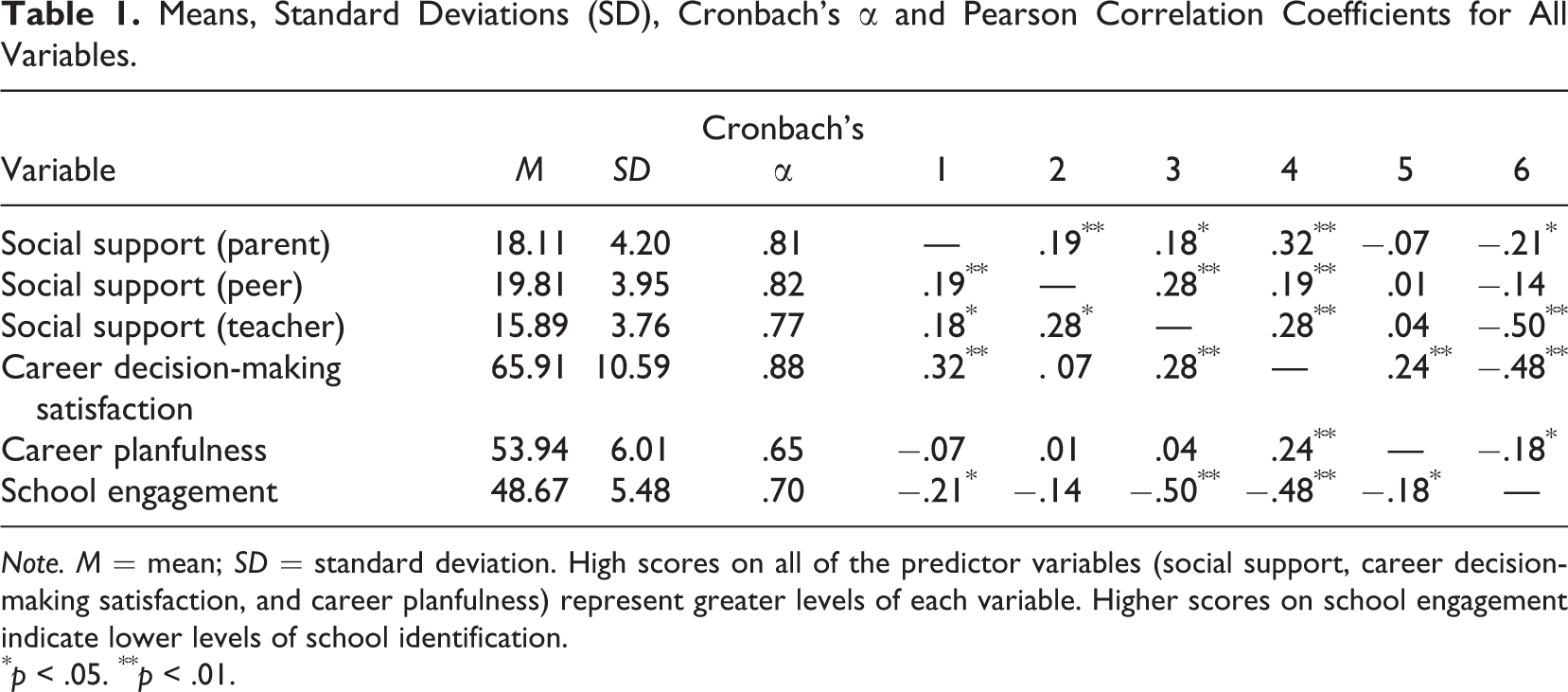
Note. M = mean; SD = standard deviation. High scores on all of the predictor variables (social support, career decision-making satisfaction, and career planfulness) represent greater levels of each variable. Higher scores on school engagement indicate lower levels of school identification.
*p < .05. ** p < .01.
As is displayed in Table 2, the results of the multiple regression analysis indicated that the full model was significant, with three of the predictor variables emerging as significantly related to the outcome variable of school engagement (F = 16, 78; p < .001). Together, these variables accounted for approximately 39% of the variance in school engagement scores of the students (R 2 = .388). Perceived social support from teachers (β = −.41, p < .001), career decision-making satisfaction (β = −.34, p < .001), and career planfulness (β = −.26, p < .05), significantly predicted school engagement. As reported in Table 2, all of the variables have negative β coefficients that are consistent with theoretical predictions as high scores on the Identification with School Questionnaire reflect lower levels of school engagement.
Summary of Multiple Regression Analysis for Variables Predicting School Engagement (N = 137).

Note. n.s. = not significant; SE = standard error. High scores on all of the predictor variables (social support, career decision-making satisfaction, and career planfulness) represent greater levels of each variable. Higher scores on school engagement indicate lower levels of school identification.
*p < .05. **p < .01.
Discussion
The results of the present study indicate that high levels of career decision-making satisfaction, social support from teachers, and career planfulness are positively associated with school engagement among Italian high school students. The findings from this study provide partial support for the relational theory informed notion that social support is facilitative of school engagement (Blustein, 2011). In this study, teacher support emerged as a potent predictor of school engagement, whereas peer and parent support were not significant predictors.
Our results with teacher support are consistent with the results reported by Perry et al. (2010) using a U.S. sample, suggesting that the experience of caring teachers is a positive attribute in two relatively diverse educational and cultural contexts. One plausible explanation for the strength of the findings in our study and the Perry et al. investigation is that the support of teachers may reflect the importance of a solid connection between students and caring adults in the schools. It may be that the support of peers and parents is less vital in the school engagement context. For example, peer support may have a wide array of influences on students depending on the extent to which the peers themselves value school (Kenny & Bledsoe, 2005). In addition, the support of teachers may be particularly relevant for students, given that they nearly always value school and its role in people’s lives. Alternately, peer and family support may have a more distal relationship to school engagement, moderated by other factors not examined in this study.
Indices of progress in career development emerged as significant predictors of school engagement, which is consistent with theory (Kenny, 2013; Lapan, 2004) and previous research (e.g., Kenny et al., 2006; Perry et al., 2010). In this study, students who were planful and who expressed satisfaction with their progress in decision making tended to report high levels of school engagement. The two specific variables—career planfulness and career decision-making satisfaction—each affirm core aspects of the career development education-school engagement nexus. The role of career planfulness as a significant predictor of school engagement underscores the importance of a future orientation and the utility of developing goals to guide behavior (cf. Ryan & Deci, 2000). The strong impact of career decision-making satisfaction suggests that students’ constructions of their developmental progress are important in predicting how they negotiate their educational tasks. When considered collectively, these findings are consistent with one of the fundamental tenets of career development education, which posits that students with clear ideas about their future and the role of education in attaining that future are more likely to feel engaged to school (Lapan, 2004).
The results of this study suggest that counseling efforts in Italian high schools might be a useful means of delivering support while also facilitating the development of planfulness and career decision-making satisfaction. Counselors also might consider offering preventive programming that assists students in developing career planning and decision-making skills, which may help students envision a future that requires academic success and engaged attitudes toward school. These attempts would provide students with educational, vocational, and emotional support as they make critical decisions regarding their future education and careers and, optimally, increase their involvement in their education.
The present study adds to an emerging body of research on school engagement, relational support, and work-based attitudes and behaviors (e.g., Blustein, 2006; Kenny, 2013; Lapan, 2004; Perry et al., 2010) that was initiated in the United States and has now been extended to Italy. Our findings suggest that those concerned about the academic achievement and career attainment of the Italian youth may find it useful to examine career decision-making satisfaction and career planfulness. The identification of these and other processes may clarify the mechanisms by which career development education can contribute to school engagement and the academic achievement of Italian high school students. Given that Italian youth select a specific school type prior to entry to ninth grade and that school type has a major influence in shaping students’ academic and career trajectories, more attention may be given to the school choice process and career decision-making satisfaction. Our findings suggest that students who are dissatisfied with their school and hence career pathways may be at risk for school disengagement.
The results of this study have important implications for professionals from multiple disciplines working with youth in the United States and Italy. Counselors may find assessment tools that tap work-related attitudes, relational support, and school engagement to be helpful in developing preventive programs to reduce student disengagement. For example, the use of self-report measures or other assessments may provide counselors and educators with data on students who are at risk for disengagement. In a broader sense, the relationships identified herein suggest that tangible support from teachers may be particularly helpful in promoting school engagement. Furthermore, the connection between career development education and school engagement, as detailed in theory and research as well as in this study, supports the use of career interventions as a means of helping students internalize the connection between school and future work options. Finally, the findings function to extend the horizons of knowledge on school engagement outside of North American boundaries, thereby enacting Arnett’s (2008) thoughtful call for an expanded cultural palate for psychological scholarship and practice.
Despite its strengths, the limitations of the present study must be considered in interpreting the findings and in considering directions for future studies. It is important to recognize that the modest sample of the present study (N = 137) is not representative of all Italian high school students. In addition, the sample may have been circumscribed by the fact that the most disengaged students were probably not available due to truancy. This study is also limited due to the self-report nature of the measurement tools. Furthermore, caution needs to be exercised in deriving inferences from the results due to the post hoc nature of this study.
The measurement of some of the constructs also introduced notable limitations. For example, the school engagement measure used in this study primarily examines the behavioral and emotional indices of school engagement. Designing and utilizing a new measurement tool with cognitive indices of school engagement, such as self-regulated learning strategies, would help to expand the scope of the school engagement construct. Furthermore, the internal consistency reliability of .65 for the Career Development Inventory was relatively modest in comparison to samples in other studies (e.g., Blustein, 1988; Lightfoot & Healy, 2001). Similarly, the α coefficient of .70 for the IS measure was relatively modest, particularly in light of the significance of the school engagement variable within the present study. These modest α levels suggest that caution needs to be exercised in interpreting the results due to the additional error variance that has been introduced into the data analyses. Finally, some of the cultural nuances of a given measure may be lost or obscured in the translation/back translation process, which may have influenced the participants’ responses (cf. Mallinckrodt & Wang, 2004).
Despite the aforementioned limitations, the results from this study advance our knowledge of the predictors of school engagement. The fact that the findings are consistent with relational theory (Blustein, 2011) and with the emerging perspective linking career development education with school engagement (Kenny, 2013) underscores the importance of the results. In closing, we hope that these results stimulate further research on the predictors of school engagement and also inspire scholars to explore the relationship among relational, work-based, and educational constructs in international settings.
Footnotes
Declaration of Conflicting Interests
The author(s) declared no potential conflicts of interest with respect to the research, authorship, and/or publication of this article.
Funding
The author(s) received no financial support for the research, authorship, and/or publication of this article.