



Abstract
In two studies, we assessed the effectiveness of a careers in psychology course in increasing students’ career decision self-efficacy, and the role of increased career decision self-efficacy in predicting motivation as well as course, and major satisfaction. Students completed assignments involving career self-exploration, planning future semesters, resume creation, job search, interviewing a professional in the field, exploring subfields, visiting a research lab, and internship opportunities. In Study 1, paired-sample t-tests for 79 students revealed significant increases in career decision self-efficacy. In Study 2, at pretest and posttest, 226 students completed measures of career decision self-efficacy, self-determined motivation, career information, course, and major satisfaction. Regression analyses indicated that career self-efficacy explained significant variance in self-determined motivation, course, and major satisfaction. Further, perceived gains in career information mediated the relationship between increased career self-efficacy and self-determined motivation, course, and major satisfaction. Finally, assignments providing concrete professional experiences predicted increases in career self-efficacy.
A majority of undergraduate students enter college often feeling unsure about their major course of study or area of specialization. Even after deciding on a specific major, many approach graduation without adequate skills for transitioning to the next step of securing a job or gaining admission to graduate school (Roscoe & Strapp, 2009). For instance, although students majoring in psychology are often convinced about their strong interest in psychology, they are less knowledgeable about various career options available to them upon graduation (Thomas & McDaniel, 2004). Given the large number of psychology graduates and the challenges involved in securing a job with a bachelor’s degree, it is important that psychology majors receive adequate guidance regarding the nuts and bolts of finding a job (Scott & Ciani, 2008). For instance, the results of a recent 2009 national survey by the U.S. Census Bureau indicate that psychology degree holders had a lower mean salary than the average and were far more dispersed in their type of employment (Rajecki, 2012).
The difficulties involved in navigating the employment market when seeking a job or the academic environment when seeking admission to a graduate program, raise some critical questions. For example, can undergraduate programs address inadequacies in career exploration and career development by providing relevant information and activities to increase students’ career self-efficacy and knowledge about careers? Could career uncertainty be reduced by offering a course to strengthen students’ career decidedness and career self-efficacy? Can strengthening career self-efficacy be associated with positive outcomes such as increased motivation and satisfaction with the major? To answer such questions, we evaluated the effectiveness of a course, careers in psychology, in increasing students’ self-efficacy for pursuing potential career opportunities.
Benefits of Increasing Career Self-Efficacy
There is some evidence suggesting that increasing students’ career self-efficacy can benefit them in various ways. For instance, high career self-efficacy is typically reflected in an individual’s self-confidence in competently completing career-related tasks, and the anticipation of positive outcomes tends to influence further career exploration and decidedness (Betz & Voyten, 1997). Similarly, Betz and Klein (1996) found that students’ career self-efficacy is associated with generalized self-efficacy as well as global self-esteem. In comparison, low career self-efficacy is associated with lack of confidence in making career decisions (Taylor & Betz, 1983). For instance, Rivera, Blumberg, Chen, Ponterotto, and Flores (2007) found that Hispanic college students who perceived barriers in pursuing male-dominated careers restricted the range of careers they explored and selected female-dominated careers that they perceived to be more achievable. In contrast, improved career self-efficacy is associated with increased persistence in college (Sandler, 2000) and greater certainty in achieving success in the world of work and increased career opportunities (Fouad & Guillen, 2006; Smith & Fouad, 1999). For example, strengthening nurses’ career decision self-efficacy is associated with increased efforts being devoted to moving up the career ladder (Doherty, 2011), and with higher performance effectiveness, subjective career success, and salary (Day & Allen, 2004). However, despite this evidence regarding the benefits associated with enhanced career self-efficacy, some researchers have reported that increasing self-efficacy has little effect on other career-related outcomes such as career indecision (Creed, Patton, & Prideaux, 2006), suggesting that further investigation of the outcomes associated with increased career self-efficacy is essential.
Fostering Career Self-Efficacy
As some of the benefits associated with strengthening career self-efficacy include enhanced career exploration, development, and advancement, identifying the factors that contribute to fostering career self-efficacy would be useful (Betz & Schifano, 2000). Bandura’s (1997) social cognitive theory identifies four information sources that make important contributions in cultivating self-efficacy: experiencing successful performance, receiving encouragement and verbal persuasion, learning vicariously by observing role models, and learning to manage emotional arousal. For instance, Kraus and Hughey (1999) noted that implementing an intervention that reassured and supported female students’ efforts at career exploration reduced gender differences in career self-efficacy that occur due to traditional socialization practices. Similarly, support and encouragement were identified as being important for nurturing self-efficacy and positive career outcomes for college students making career choices (Lee & Park, 2012). Career-counseling interventions informed by Bandura’s sources of efficacy have also been successful at increasing and sustaining career self-efficacy over a 6-week period (Sullivan & Mahalik, 2000).
Likewise, experimental studies have demonstrated that exposing students to various subfields of psychology and incorporating students’ self-reported reactions resulted in a significant increase in career-related knowledge that persisted over a 4-week period (Maynard, Maynard, & Rowe, 2004). Finally, a sample of culturally diverse college students was empowered to develop career self-efficacy by reflecting on past achievements for strengthening feelings of accomplishment, peer presentations for vicarious learning, practicing relaxation techniques for managing anxiety, and instructor feedback to provide encouragement (Grier-Reed & Nicole, 2010). Thus, it appears that a focus on strengths, self-reflection, and developing problem-solving skills is useful in promoting career self-efficacy.
Courses That Enhance Career Self-Efficacy
In an effort to go beyond brief interventions for promoting career self-efficacy, several college courses are being offered as systematic curricular opportunities and these appear to be effective in enhancing career self-efficacy. For example, courses delivered with the main goal of increasing career decision self-efficacy have yielded various benefits, such as reducing difficulties related to career decision making (Fouad, Cotter, & Kantamneni, 2009). Likewise, students who took a careers course experienced less difficulty in obtaining occupational information, setting career goals, and planning their careers (Reese & Miller, 2006). Similarly, students in a career-planning course significantly increased their perceived knowledge of career options, their career decision-making confidence, and movement toward achieving their vocational identities relative to a group of students who did not complete the course (Thomas & McDaniel, 2004). Other advantages of completing a course aimed at increasing career self-efficacy include increased commitment to the major, enhanced information-finding strategies, and greater likelihood of degree completion (Landrum & Mulcock, 2007); as well as increased knowledge and familiarity with research, curriculum requirements, career options with a bachelor’s degree, and admission to graduate school (Dillinger & Landrum, 2002). Thus, increasing students’ knowledge and familiarity with information regarding careers, career planning, and future career options seems to aid with career decision making.
Besides providing information about careers, some courses have been fruitful in preparing students to adopt strategies leading toward career success. For example, sophomores exposed to four stages of career development (self-assessment, career exploration, how to gain professional experience, and implementing a plan) reported plans for obtaining professional experience and meeting with a career counselor (Prehar & Ignelzi, 2012). Similarly, juniors and seniors receiving information about preparing for the Graduate Record Exam, as well as choosing, applying, and financing graduate studies reported making substantial changes to the type of degree they planned to pursue (doctoral or master’s) and proactively obtaining graduate school financing through a variety of options including applying for grants, fellowships, or assistantships (Dodson, Chastain, & Landrum, 1996). Thus, there appears to be mounting evidence that courses aimed at increasing career decision self-efficacy are useful in enhancing career self-efficacy.
However, only a limited number of studies have examined other important outcomes of strengthening career self-efficacy such as increasing academic motivation, satisfaction with the course, and satisfaction with the major (Dodson et al., 1996). A few have investigated why career development courses are effective in increasing self-efficacy. For instance Nota, Soresi, and Zimmerman (2004) found that self-regulation strategies such as setting up self-consequences by imagining a reward or punishment for meeting or failing to meet goals enhanced motivation for further career development. However, a lot more work is needed to document the associated gains that accompany enhanced career self-efficacy and also explain the specific mechanisms that explain why these courses or interventions are effective in increasing career self-efficacy. The current study focused on this gap in the literature by investigating (1) whether a course formulated on Bandura’s social cognitive framework was effective in increasing career decision self-efficacy, (2) whether the increase in career decision self-efficacy was associated with increases in self-determined motivation, course satisfaction, and satisfaction with the major, and (3) which aspects of the course were effective in yielding positive outcomes. We hypothesized that:
Method
We used a pretest–posttest design to assess the effectiveness of a one-credit, careers in psychology course required for all psychology majors, across each of the six consecutive fall and spring semesters. We designed the newly introduced course with the specific purpose of helping students understand themselves and their major, increase their knowledge, skills, and self-efficacy regarding potential careers, and make them more aware of the complex interactions that exist among these three crucial domains. As recommended by Betz (2007), the course was developed based on Bandura’s social cognitive theory (1997) and the in-class activities as well as homework assignments were based on the four foundations of information that nurture career self-efficacy. These four sources are as follows: facilitate success in performance, provide social support and encouragement, provide role models, and reduce anxiety by managing emotional arousal. Each of these four domains was addressed through specific aspects of the curriculum and these are described as follows: Facilitate success in performance: This was accomplished by learning about personal interests, skills, and values as they relate to career choice; reflecting on the decision to attend college, selecting a major, current skills, interests and strengths, and exploring future options after completing college; learning basic American Psychological Association (APA) format guidelines by proofreading a paper; visiting a departmental research lab to learn about the responsibilities and benefits of an undergraduate research assistant position; visiting a preprofessional practicum site to become familiar with the process for securing an internship and the benefits an internship offers; creating a poster describing an ideal career, the educational qualifications and skills it requires, and a plan for achieving this dream career; learning the steps involved in applying to graduate school; practicing the steps of searching for a job with a bachelor’s degree; exploring career opportunities available for a masters, or doctoral degree in psychology; and exploring the various subfields in psychology. Provide social support and encouragement: Receiving feedback from the teaching assistant on what a student is doing well and how to improve in areas of growth; meeting with the teaching assistant for a one-on-one discussion of career interests; becoming familiar with useful departmental and campus resources; and attending student club meetings and networking with peer psychology majors. Provide role models and vicarious learning: Interviewing a professional in the field and learning about career paths and how to be successful at work; attending an undergraduate student panel consisting of senior-level students who discuss how they found mentors and gained various types of extra research, teaching, and internship experiences; attending a graduate panel consisting of graduate students sharing their perspectives on how they were successful in getting a job and or getting admission into graduate school; and hearing faculty members discuss their career paths and career opportunities in their subfields. Reduce anxiety and manage emotional arousal: Clarifying expectations by reviewing requirements and offerings for the course and the major; learning about various types of financial aid options and how to manage money; developing a clear 4-year curriculum plan for completing degree requirements; learning how to compute a grade point average and developing problem-solving skills to avoid academic probation or suspension; practicing a behavior modification exercise to reduce procrastination or improve study skills; practicing how to search for a job, writing and revising a resume based on feedback, writing a cover letter for a job application, and learning how to develop a supportive network.
Procedure
We conducted the study in two waves (Study 1 and then Study 2). On the first day and last day of each of six consecutive fall and spring semesters, students were requested to complete the survey at the end of the class section. Study 1 included data from the first two semesters and Study 2 included data from the four semesters that followed. Students did not receive any course or extra credit for completing the survey and were free to leave if they chose not to complete the survey.
Study 1
To assess course effectiveness, across two consecutive fall and spring semesters, we obtained pretest and posttest data from a sample of 79 students (∼30% males and 70% females, 80% freshmen, 90% psychology majors) using a survey that included a 25-item Career Decision Self-Efficacy scale (Betz & Taylor, 2001) and a 28-item Academic Motivation scale (Vallerand et al., 1992).
Measures
The 25-item Career Decision Self-Efficacy scale (Betz & Taylor, 2001) includes five subscales designed to assess career choice competencies: accurate self-appraisal, gathering occupational information, goal selection, planning for the future, and problem solving. This scale has well-established psychometric properties (Betz, Hammond, & Multon, 2005) and showed good reliability in the current sample, as Cronbach’s reliability α for the overall scale was .93 (pretest) and .95 (posttest). Further, each subscale showed good reliability, at pretest (.77, .75, .82, .77, .77) and at posttest (.82, .75, .86, .86, .83) respectively for each subscale.
The 28-item Academic Motivation scale (Vallerand et al., 1992) has three subscales: intrinsic motivation, extrinsic motivation, and amotivation. Sample items include the following: “Because I experience pleasure and satisfaction while learning new things,” “Because with only a high-school degree I would not find a high-paying job,” and “Honestly, I don’t know; I really feel that I am wasting my time in school.” Each subscale of this measure also showed good psychometric properties in the current sample, Cronbach’s reliability α = .91, .88, .82, respectively, at pretest, and .94, .87, and .90, respectively, at posttest.
Results
Paired-samples t-tests indicated that from the beginning to the end of the semester, students reported significant increases in total career decision self-efficacy, t(78) = 5.82, p < .001, d = .63, as well as all five career decision self-efficacy subscales of self-appraisal, t(78) = 4.23, p < .001, d = .46, occupational information, t(78) = 4.69, p < .001, d = .653, goal selection, t(78) = 3.78, p < .001, d = .42, planning, t(78) = 6.51, p < .001, d = .73, and problem-solving, t(78) = 4.36, p < .001, d = .50 (see Table 1). These results support Hypothesis 1 which stated that at the end of the course, students would have higher career self-efficacy than they did at the start of the semester. In addition, students reported significant decreases in extrinsic motivation from the beginning of the semester to the end of the semester, t(77) = −3.02, p = .003, d = .36.
Study 1: Paired-Samples t-Test Scores, Means, and Standard Deviations for Career Decision Self-Efficacy (CDSE) Subscales and Academic Motivation Subscales.

Note. Cohen’s d: .20 = small, .50 = medium, .8 = large.
**p < .01. ***p <.001.
Study 2
Subsequently, following Study 1, we wanted to examine whether gains in career self-efficacy from the beginning to the end of the semester were associated with gains in self-determined motivation as well as satisfaction with the course and with the psychology major. To answer this question, we obtained pretest–posttest data from a matched sample of 226 undergraduates (∼30% males and 70% females, 80% freshmen, 90% psychology majors) enrolled during four consecutive Fall and Spring semesters using a survey including the Career Decision Self-Efficacy scale (Betz & Taylor, 2001), the Academic Motivation scale (Vallerand et al., 1992); and assessments of knowledge about career information, satisfaction with the course, satisfaction with the major, and a rating of the usefulness of each of nine career-related assignments.
Measures
The 25-item Career Decision Self-Efficacy scale (Betz & Taylor, 2001) and the 28-item Academic Motivation scale (Vallerand et al., 1992) were both used in study 2, and showed good pre- and posttest reliability (see Table 2 for reliability information of all measures used in Study 2). In addition, an index for self-determined motivation was calculated based on weights for each of the subscales of the Academic Motivation scale and a higher score indicated higher self-determination and intrinsic motivation (Vallerand, personal communication, 2011).
Study 2: Sample Size, Number of Items, Range, Mean, Standard Deviation, and Cronbach’s α.

Career Information was measured using a 6-item scale (Thomas & McDaniel, 2004), with sample items, “I have a clear understanding of the kinds of work done by different types of psychologists (e.g., clinical, social, experimental, organizational),” and “If I decide to become a psychologist, I know what steps I will have to take to accomplish this goal.” This scale provided a measure of students’ perceptions of how much knowledge they had gained regarding career information.
The helpfulness of nine career related assignments was rated on a 5-point scale from 1 (very unhelpful) to 5 (very helpful). The assignments were 4-year plan for completing college, searching for a job, practice resume and cover letter, interviewing a professional in the field, self-exploration paper, visiting a research lab, visiting an internship site, proofreading for correct APA format, and meeting with an advisor.
Course Satisfaction was measured using 4 items, with a sample item, “I am glad I took this Careers in Psychology course,” and Satisfaction with the major included 3 items, with a sample item, “I think I will like being a psychology major” (see Table 2).
Results
In order to test Hypothesis 2 which stated that the increase in students’ careers self-efficacy (from pretest to posttest) would explain significant variance in students’ self-determined motivation as well as satisfaction with the course and with the psychology major, career decision self-efficacy difference scores were created for each student, by subtracting their pretest score from their posttest score. This was a measure of their gain in self-efficacy. Correlation and regression analyses were conducted using students’ career decision self-efficacy difference scores to predict their self-determined motivation, satisfaction with the course, and satisfaction with the psychology major (see Tables 3 and 4). We found support for Hypothesis 2; specifically, career decision self-efficacy differences scores significantly predicted self-determined motivation, β = .244, t(225) = 3.77, p < .001, satisfaction with the course, β = .132, t(225) = 1.99, p = .048, and satisfaction with the psychology major, β = .235, t(225) = 3.63, p < .001.
Study 2. Correlations Between the Career Decision Self-Efficacy Difference Scores (CDSE) Subscales and Self-Determined Motivation, Course Satisfaction, and Satisfaction With the Major.
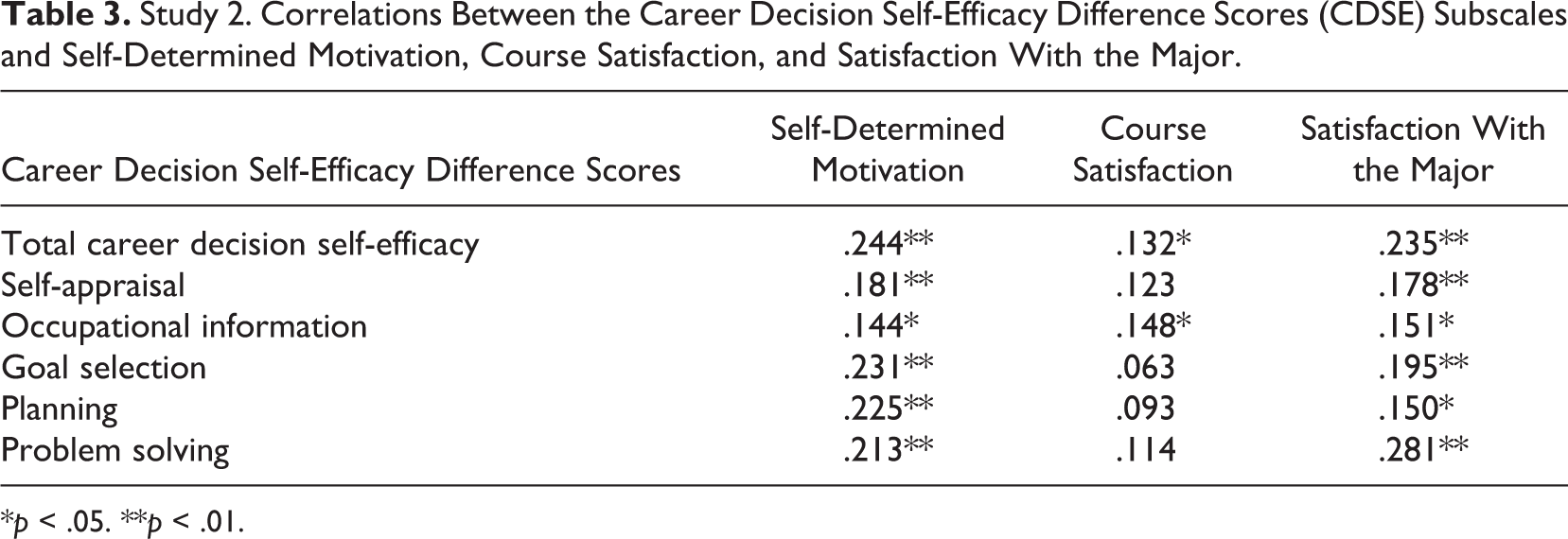
*p < .05. **p < .01.
Study 2. Regression Analyses With the Career Decision Self-Efficacy Difference Scores Regressed Separately on Self-Determined Motivation, Course Satisfaction, and Satisfaction With the Major.
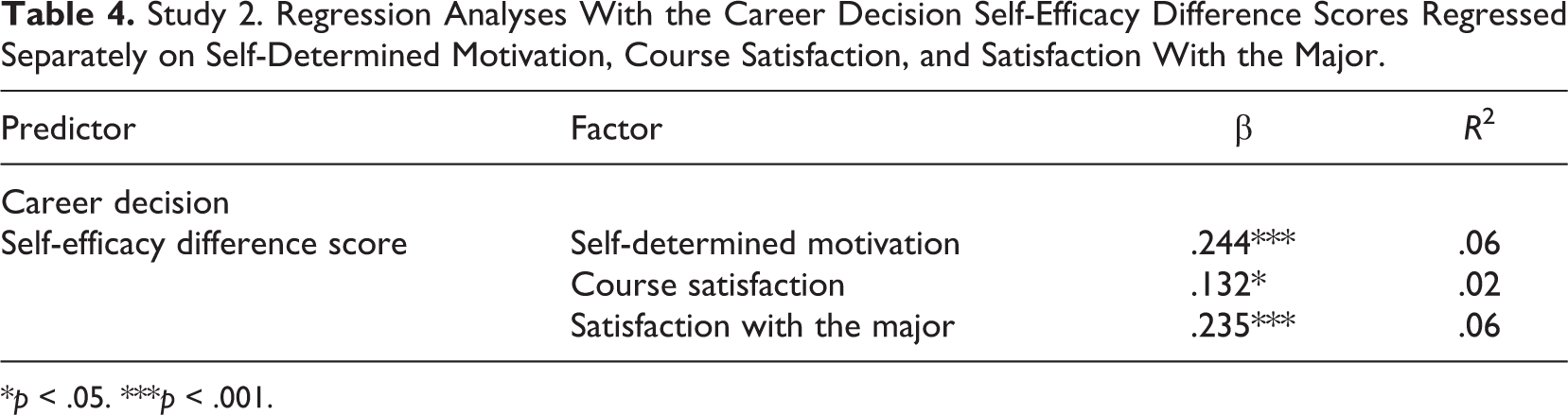
*p < .05. ***p < .001.
For Hypothesis 3, which stated that students’ perceived knowledge of career information would explain the relationship between increased career self-efficacy (from pretest to posttest) and each of the three outcome variables: self-determined motivation, satisfaction with the course, and satisfaction with the major, we conducted regression analyses to test for mediation using normal theory method (Baron & Kenny, 1986). Using this method, the first step was previously established when testing Hypothesis 2. The second step was to establish the relationship between the predictor and mediating variable. Career decision self-efficacy difference scores significantly predicted scores for perceived gain in knowledge about career information, β = .335, t(225) = 5.34, p < .001. The third and fourth steps, establishing that the mediator significantly predicts the outcome, and then showing that the initial predictor is no longer a significant predictor of the outcome when the mediator is included in the model, were done using three additional regression analyses.
Students’ perceived gain in knowledge about career information partially mediated the relationship between career decision self-efficacy difference scores and self-determined motivation, as perceived gain in knowledge about career information significantly predicted self-determined motivation, β = .219, t(223) = 3.25 p = .001. Though career decision self-efficacy difference scores still significantly predicted students’ self-determined motivation, β = .171, t(223) = 2.54, p = .012, using a Sobel test, it was found that partial mediation occurred, p < .05 (see Figure 1). Students’ perceived gain in knowledge fully mediated the relationship between career decision self-efficacy difference scores and course satisfaction, as perceived gain in knowledge significantly predicted course satisfaction, β = .368, t(223) = 5.60, p < .001, while career decision self-efficacy difference scores were no longer a significant predictor of course satisfaction, β = .011, t(223) = .16, p = .87 (see Figure 2). Finally, students’ perceived gain in knowledge also fully mediated the relationship between career decision self-efficacy difference scores and major satisfaction, as perceived knowledge gain significantly predicted satisfaction with the psychology major, β = .400, t(223) = 6.32, p < .001, while career decision self-efficacy difference scores were no longer a significant predictor of satisfaction with the psychology major, β = .102, t(223) = 1.62, p = .11 (see Figure 3).
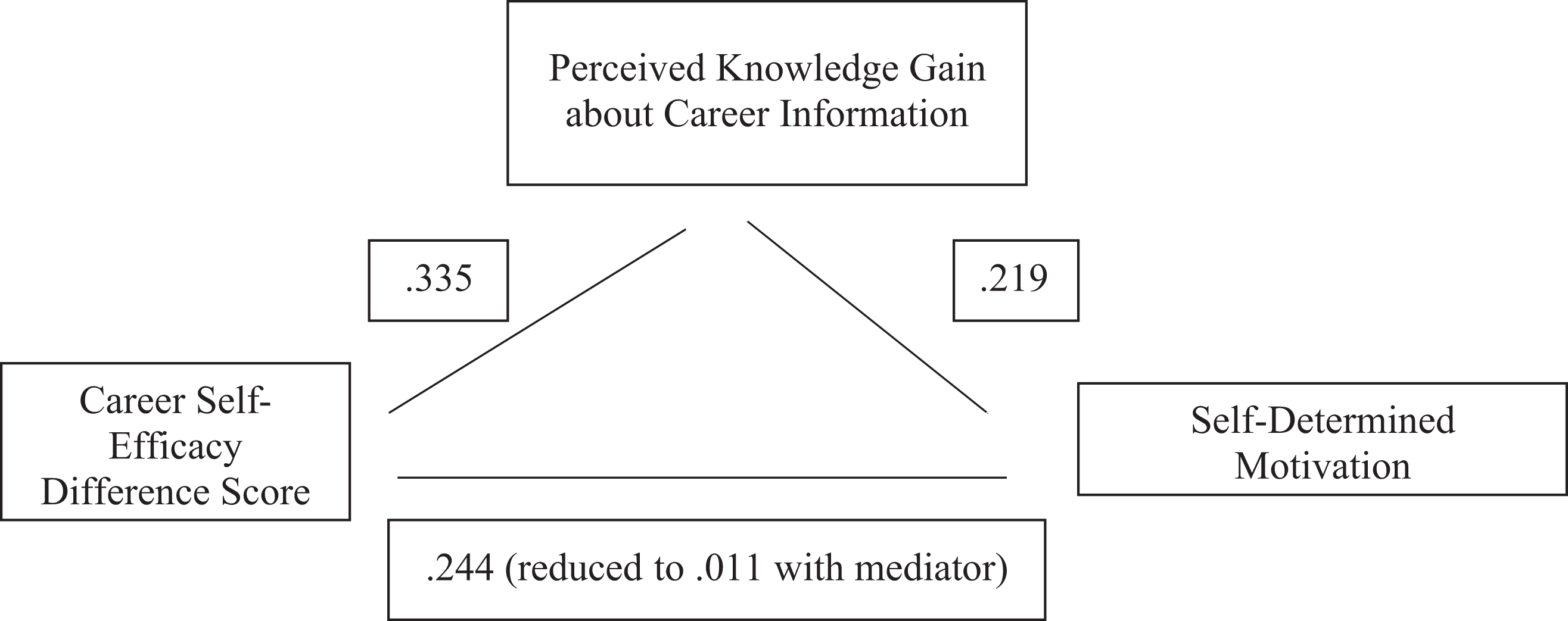
Mediation analyses showing perceived knowledge gain about career information partially mediating the relationship between career decision self-efficacy and self-determined motivation.
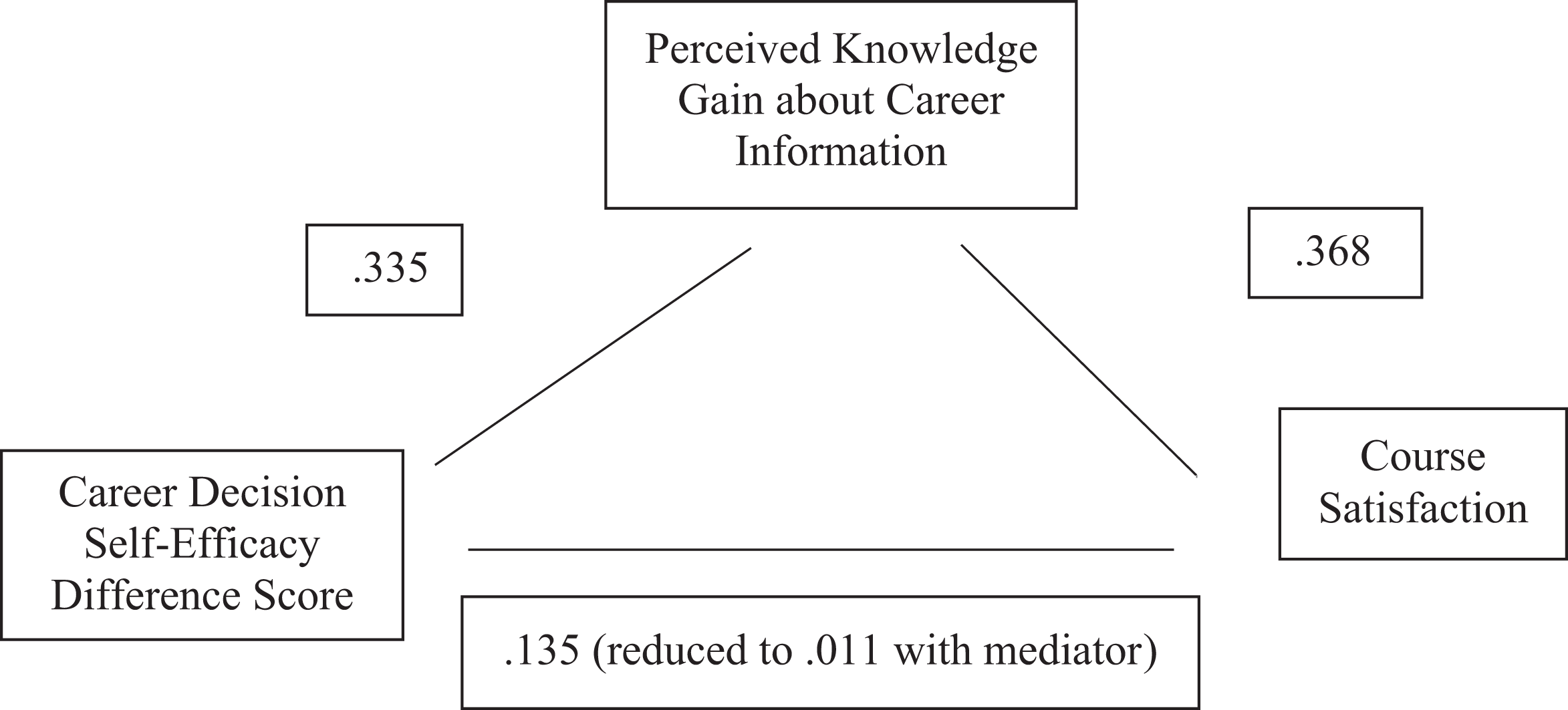
Mediation analyses showing perceived knowledge gain about career information fully mediating the relationship between career decision self-efficacy and course satisfaction.

Mediation analyses showing perceived knowledge gain about career information fully mediating the relationship between career decision self-efficacy and satisfaction with the major.
Finally, in an attempt to understand which career assignments were associated with career decision self-efficacy difference scores, a stepwise regression analysis was conducted using the nine career assignments (4-year plan for college, searching for a job, practice resume and cover letter, interviewing a professional in the field, self-exploration paper, visiting a research lab, visiting an internship site, proofreading for APA format, and meeting with an advisor) to predict career decision self-efficacy difference scores. The perceived helpfulness of the career assignment, “visiting a research lab” explained significant variance (5.5%) in career decision self-efficacy difference scores, F(1, 103) = 5.95, p = .02, adjusted R 2 = .05.
Discussion
First, results of Study 1 establish that the course, careers in psychology, was effective in enhancing students’ self-efficacy in several aspects of career decision making. In particular, the increase in overall career self-efficacy and the increase in confidence in career planning (one specific subscale), had moderate to large effect sizes, Cohen’s d (see Table 1). These findings demonstrate that what students learned in the course made them more self-assured about assessing their own interests and abilities, having knowledge about careers in psychology, effectively planning their career path, selecting options that were relevant to their goals, and knowing how to overcome frustrations and barriers they may encounter in pursuing their careers. Further, increased confidence in accurately assessing abilities, interests, and values was associated with less interest in obtaining a college degree mainly for extrinsic reasons such as getting a good job.
Second, results of Study 2 indicated that increased career decision self-efficacy is a significant predictor of self-determined motivation, satisfaction with the course, and satisfaction with the major. Students who felt more confident about obtaining career-relevant information and solving career-related problems were more intrinsically motivated, felt more fulfilled by taking the course, and were more satisfied with the major they had selected. In particular, this was because the students believed they had gained valuable knowledge about their careers and this helped them understand the steps required for moving forward in their careers.
Additionally, although students were assigned nine career-related assignments, we discovered that the assignment that provided them concrete and practical knowledge was the sole significant predictor of increased career self-efficacy. Specifically, visiting a research lab provided students with concrete experiences that facilitated their learning about what it is like to be part of a research lab and the different types of experiences they could gain by becoming a research assistant. During these visits to research labs, students had an opportunity to see the labs, speak with professors or research assistants, become familiar with the topics that were being researched, learn about the process involved in joining a lab, the tasks and responsibilities assigned to undergraduate research assistants, the number of course credits available from obtaining such an experience, and how these course credits were counted toward the major. Students typically hear about research endeavors during a lecture class, but these personal visits to research labs located in the department seemed to provide a tangible context for gaining potential research experience.
Cumulatively, our results support the value of a course directed at enhancing career development. At the same time, we also acknowledge some limitations to our studies and offer some recommendations for future researchers. First, although we used a pretest–posttest design, our study lacked a control group to control for other events or processes happening in students’ lives that could have influenced the results. As such, conclusions regarding causality need to be drawn with caution. In addition, since the participants were primarily psychology majors, the generalizability of the findings are limited to a similar population. Also, the use of surveys relies on self-report data that could be open to threats to validity. However, the use of scales with high reliability helps support the use of these data. Further, Study 2 did not examine the importance of self-determined motivation, course satisfaction, or satisfaction with the major in relation to academic performance. As there is support for a positive relationship between satisfaction and overall performance variables such as grade point average and retention (Aitken, 1982; Allen & Robbins, 2010; Bean & Bradley, 1986; Tracey & Robbins, 2006), future researchers could examine the relationship between major satisfaction and students’ success in graduate school or overall work performance. Finally, since only one career-related assignment emerged as a significant predictor of increased career self-efficacy, future researchers should continue to examine specific aspects of courses, such as assignments, in-class activities, and projects, to identify what it is about the courses that contributes to enhanced confidence in career exploration and decision making.
Taken together, our findings support the usefulness of offering a course devoted to educating students about career paths within psychology. Students enrolled in the course reported becoming familiar with the mechanisms for gaining important professional experiences and various ways of using their degree in the future. This knowledge was directly related to increasing their career decision self-efficacy, their satisfaction with the course and their major, and also predicted their self-determined motivation. Most importantly, in completing carefully developed assignments that simulated real-world experiences, students acquired the confidence to navigate the path toward entering the workplace or attending graduate school. Thus, our studies establish that the course was beneficial on a multitude of levels from increasing students’ intrinsic motivation to influencing feelings of satisfaction with the course and fulfillment in choosing the right major.
Footnotes
Declaration of Conflicting Interests
The author(s) declared no potential conflicts of interest with respect to the research, authorship, and/or publication of this article.
Funding
The author(s) received no financial support for the research, authorship, and/or publication of this article.