



Abstract
The present study examined whether college students who have academic majors that are incongruent with their career aims experience diminished career development. Because the value placed on self-expression differs across cultures, we tested hypotheses in both the United States (N = 301) and South Korea (N = 200). Similar proportions of American (20.2%) and South Korean students (25.5%) reported having an incongruent major. In both samples, students with incongruent majors reported significantly lower levels of career decision self-efficacy, meaningful work, and calling, with medium effect sizes. Potential moderators and mediator in the link of major incongruence to calling and meaningful work were also examined. The patterns of relations among major incongruence and career development indicators (i.e., career decision self-efficacy, meaningful work, and calling) did not differ by nationality or the levels of collectivism, indicating no significant moderating effects. Career decision self-efficacy was found to partially mediate the relation of major incongruence to calling and meaningful work in both samples. These results indicate that major incongruence relates to lower sense of calling and meaningful work in part because of decreased career decision self-efficacy. Directions for future research are discussed.
College is a critical time for students to learn the distinctive repertoire of professional and personal self-perceptions, competencies, attitudes, interests, and values of future careers. In fact, most college students list good postcollege career opportunities as one of the important factors they consider in choosing a major, along with their interests, values, and abilities in the particular subject (Galotti & Kozberg, 1987). In many cases, undergraduate students’ course of study provides a foundation upon which their successful transition to future careers is built. A key part of this foundation is the choice of an academic major. Despite the significant role of students’ academic major in career development, several factors may lead students to choose an academic major that is essentially incompatible with their most-desired future career. We refer to this state of affairs as “major incongruence.”
Career development is one of the most essential aspects of a college student’s overall development, and students expect college to transform them into employable adults. A survey of 12,500 college students by the Canadian University Survey Consortium showed that nearly 70% of them had decided to attend university to “get a good job” or “train for a specific career” (“Students want jobs,” 2011). Despite college students’ career aspirations, most appear uncertain about their career choices when they enter college (Cueso, 2005), and between 17% and 22% of college students explicitly report being distressed by vocational and career concerns (Benton, Robertson, Tseng, Newton, & Benton, 2003; Multon, Heppner, Gysbers, Zook, & Ellis-Kalton, 2001). Moreover, the risk of dropping out of college increases among students who lack a clear understanding of their career options (Cueso, 2005). Taken together, achieving positive career development represents a critical part of college success making it crucial to better understand the factors that impede the career development process. Broader efforts to support successful college career development have received substantial attention both in research and in practice domains, yet there has been little empirical study directed at career development among students with incongruent majors. In the present study, we attempted to fill this gap in the literature on college student career development by examining whether (1) college students with incongruent majors experience diminished career decision self-efficacy (CDSE), calling, and meaningful work, (2) the proportion of major incongruence and its relation to CDSE, calling, and meaningful work differs across nationality and the level of collectivism, and (3) CDSE mediates the relation of major incongruence to calling and meaningful work.
Major Incongruence
Major incongruence may occur for several reasons. First, students may choose their major before they have sufficient knowledge about available majors or what careers are aligned with which majors. Adding to this, students often are required to choose their major at relatively young age—as early as high school in South Korea or prior to junior year in the United States (Gahagan & Hunter, 2006; “South Korea,” n.d.). Research suggests that college students may not make a confident career choice until later in their college years. Nearly half of the U.S. undergraduates are undecided about a career (Gianakos, 1999), and most SK students begin career exploration after matriculation (Lim, Jung, & Sang, 2001). Further, many college students report that they chose their academic major without considering ramifications for their future career (Galotti, 1999). Research indicated that over 50% of the college students will change major at least once during college, with many doing so two and three times (Orndorff & Herr, 1996).
Second, some students may be prevented from declaring their desired major because of a failure to meet certain requirements (e.g., low GPA) or because they are intimidated by course requirements. For example, psychology majors feel daunted by required physiology or biology classes, and engineering or premed/preveterinarian majors may be deterred by required math and advanced biology classes.
Third, even when career considerations filter into major choice, they sometimes manifest in the form of family pressures to adopt specific, “marketable” majors that may be not necessarily aligned with a student’s most desired future career. For example, research has found that many immigrant Asian American parents express a strong desire for their children to choose majors that prepare them for professions that are financially secure, earn high salaries, and are practical or marketable, such as the professions of engineer, physician, and computer scientist (Tang, Fouad, & Smith, 1999). East Asian cultural factors, such as family pressure and expectations to “carry on the family tradition and accomplish the wishes of the older generation” (Tang et al., 1999, p. 144), appear to influence Asian American students’ choices of major and career. These factors may increase the risk that students will experience major incongruence.
Finally, compounding the problems of insufficient information, perceived curricular barriers to specific majors, and cultural and family pressures, students may also perceive obstacles to switching out of incongruent majors. The longer it takes to determine which major is most congruent with a student’s career plans, personality, and values, the more “backtracking” students might feel they face. Although there may be few formal costs or penalties for switching into or out of a given major, the sequence of courses and prerequisites specific to any new major could force students to delay their time to graduation, creating hidden costs. At a time when college tuition is far outpacing income growth for the vast majority of students (Ronan, 2005), the extra costs in tuition and incurred debt, as well as deferred income, can present real, insurmountable barriers for many students. As a result, some students may be unable to switch their majors. When all of these factors are considered together, perhaps it should come as no surprise that educational choices rank as the most frequently identified regrets in the lives of Americans (Roese & Summerville, 2005). Among many potential indicators of career development, we focused on CDSE, meaningful work, and calling because each reflects a different aspect of students’ personal investment in their careers. First, career decision self-efficacy refers to the degree to which individuals believe that they can successfully complete tasks that are necessary in making career decisions (Taylor & Betz, 1983). CDSE appears to be a pillar of successfully pursuing and navigating career development among college students. For example, a higher sense of CDSE is closely related to students’ actual career behaviors and other positive career-related outcomes such as vocational identity (Gushue, Scanlan, Pantzer, & Clarke, 2006), career decision-making attitudes (Luzzo, 1993), and preference for growth in one’s career (Gianakos, 2001).
Second, meaningful work is defined as people’s approach to their work as a source of valued meaning or contribution (Steger & Dik, 2009). Meaningful work includes work that serves a purpose, serves as an important source of meaning in life as a whole, and reflects motivations to make a positive impact on the greater good (Steger, Dik, Duffy, 2012). Increasing evidence shows that having a higher sense of meaningful work is closely related to various optimal work outcomes/orientations and general well-being. For example, people who judge that their work is meaningful are more deeply engaged with their jobs and experience deeper levels of commitment and persistence in their work (Serow, Eaker, & Ciechalski, 1992). They also experience greater well-being (Arnold, Turner, Barling, Kelloway, & McKee, 2007) and greater work and life satisfaction (Steger & Dik, 2010).
Finally, calling is conceptualized as perceiving one’s work to be originating from an external or transcendent source (e.g., higher power, social needs), generating a sense of purpose and meaning, and contributing to others and society in a positive way (Dik & Duffy, 2009). Calling has been linked to various positive career and well-being indicators. For example, college students endorsing higher levels of calling reported more positive work-related outcome expectations and intrinsic motivation to work, greater career decision self-efficacy, higher career decidedness, choice comfort, vocational self-clarity, academic satisfaction, use of adaptive coping strategies (Dik, Sargent, & Steger, 2008; Dik & Steger, 2008; Duffy, Allan, & Dik, 2011; Duffy & Sedlacek, 2007), and higher levels of life meaning and life satisfaction (Duffy & Sedlacek, 2007; Wrzesniewski, McCauley, Rozin, & Scchwartz, 1997). It is also notable that the construct of calling is found to be salient among the U.S. college students (Duffy et al., 2011) and relevant for not only religious but also nonreligious people (Steger, Pickering, Shin, & Dik, 2010). The relevance of both calling and meaningful work in SK society is supported by recently increased research on these topics. For instance, the Korean version of the Calling and Vocation Questionnaire (CVQ-K) was developed and validated with Korean undergraduates (Shim & Yoo, 2012). A higher sense of calling and meaningfulness in work has been linked to higher job satisfaction among Korean social workers working with adolescents (Lea, 2011) and career identity and life satisfaction of Korean college students (Yang & Lea, 2012).
The Present Study
No research to date has explored the relation between pursuing incongruent majors and these career variables. The goals of the current study were threefold. First, we drew upon self-determination theory (SDT; Ryan & Deci, 2000) to support our central hypothesis that experiencing major incongruence will be inversely related to career development. SDT defines autonomy as self-endorsed functioning with a sense of personal choice, volition, and freedom. In contrast, control is defined as feeling pressured or obligated to meet certain internal or external demands. Extensive research on SDT has demonstrated the negative effects that lack of agency can have on individuals’ motivation, performance, and adjustment. Major incongruence suggests students’ academic and/or career engagement may not be aligned with their genuine self-expression or choice, core values and interests, or intrinsic motivation. Thus, their sense of autonomy in academic or career pursuit is likely to be thwarted. Autonomy also relates to CDSE, calling, and meaningful work because these constructs are commonly rooted in an individual’s ability to formulate and pursue personally valued goals through one’s career. Recent organizational research has begun to emphasize the significance of self-determination for optimal employee functioning and well-being at work (e.g., Gagné & Deci, 2005; Van den Broeck, Vansteenkiste, De Witte, & Lens, 2008). Higher perceptions of autonomy and freedom have been linked to higher levels of work satisfaction (e.g., Lam, & Gurland, 2008; Richer, Blanchard, & Vallerand, 2002), work engagement, organizational commitment, and job attitudes of viewing their work as opportunities to express their true selves (e.g., Bono & Judge, 2003; Gagné, Chemolli, Forest, & Koestner, 2008; Graves & Luciano, 2013; Otis & Pelletier, 2005).
Second, the present study collected data from the United States and South Korea as an attempt to address the role of cultural contexts in shaping vocational behaviors. Although we acknowledge the heterogeneity within each nation and do not believe that country and culture are identical, we considered the United States and South Korea as exemplars of Western and Eastern cultures, respectively, following the conventions of previous cross-cultural studies (e.g., Singelis, Triandis, Bhawuk, & Gelfand, 1995; Triandis, & Gelfand, 1998).
Based on prior research on a higher prevalence of collective and dependent career decision-making styles in East Asian cultures (e.g., Leong & Chou, 1994) as well as lack of opportunities for career exploration in educational system of South Korea (Hwang, Kim, Ryu, & Heppner, 2006; Lee, 2001), we hypothesized that SK college students would be more likely to experience major incongruence than American students. In the context of vocational psychology, researchers have noted in East Asian cultures, the emphasis tends to be on collective decisions and conforming to the familial and societal expectations, whereas making personal choices or having one’s own opinions is greatly encouraged and highly valued in Western cultures. Research showed higher levels of dependent decision-making styles and lower levels of career maturity and vocational identity among Asian American students than European Americans (Leong, 1991), more career decision difficulties among Taiwanese students (Mau, 2001), and lower levels of career maturity among SK students (Lee, 2001) than American students. Thus, major choices of students in East Asian cultures may be more impacted by external factors such as parental aspirations rather than by students’ own aspirations (Leong & Chou, 1994). Furthermore, in general, SK students are less likely than American students to work before they graduate from school, which possibly makes it more difficult for SK students to obtain confidence in their career aspiration (Lim et al., 2001). Most SK students do not have any formal career counseling within their elementary and secondary educational system and thus have little opportunity to explore their own careers until they enter college. Secondary students place a much greater emphasis on pursuing entrance into the most prestigious college and majors than on exploring interests as would be more typical in the U.S. students (Hwang et al., 2006; Lee, 2001).
Next, drawing upon debate about the cross-cultural relevance of SDT, we explored whether patterns of the relations among major incongruence and career development differ by culture. We chose not only nationality but also a level of collectivism (Singelis et al., 1995) as potential moderators to examine the role of a specific cultural construct. SDT proposes that the significance of autonomy in individuals’ positive development and functioning is universal across cultures (e.g., Chirkov, Ryan, Kim, & Kaplan, 2003; Ryan & Deci, 2000). Findings from studies within the SDT tradition provided considerable data demonstrating that autonomy, self-endorsed goals, and intrinsic motivation are important to well-being not only within Western samples but also within non-Western samples. For example, a higher sense of autonomy and self-concordance was associated with the psychological well-being of Chinese college students (Vansteenkiste, Lens, Soenens, & Luyckx, 2006), positive school functioning of SK students (Jang, Reeve, Ryan, & Kim, 2009), and positive coping in Japanese high school students (Hayamizu, 1997). Engaging in self-concordant goals with a sense of autonomy also contributed to subjective well-being in the United States as well as in China, South Korea, and Taiwan (Sheldon et al., 2004).
However, much controversy also exists regarding the cross-cultural relevance of autonomy (e.g., Markus, Kitayama, & Heiman, 1996). For example, some researchers argued that the basic propositions of SDT should not apply to people in cultures with different cultural values (e.g., Markus & Kitayama, 2003; McInerney & Van Etten, 2004). They specifically noted that Eastern collectivistic cultures do not value the experience of autonomy in the same way that Western individualistic cultures do. Instead, Eastern collectivistic cultures more greatly emphasize values such as conformity, social harmony, and family interdependence over values such as individuality, uniqueness, and independence (e.g., Markus & Kitayama, 1994; Triandis, 1997). They further suggested that in cultures that place less value on autonomy, psychological need satisfaction might not yield the same positive psychological benefits found in Western samples (e.g., Tseng, 2004). Thus, the idea that East Asian and Western students might have similar experiences when they experience major incongruence is far from settled. Given this controversy and the absence of previous research, our approach was largely exploratory in testing the moderating effects of nationality and collectivism on the relations between major incongruence and the career variables.
Finally, we examined CDSE as a potential mediator that may explain the relation of major incongruence to calling and meaningful work. To date, little is known about mediators in the relation of these constructs. CDSE was chosen as a potential mediator because it has been found to correlate with academic- and career-related variables such as academic major satisfaction (Nauta, 2007), affective major commitment (Conklin, Dahling, & Garcia, 2013), and calling (Dik et al., 2008) in previous research with college students. CDSE was also found to partially mediate the relation of academic satisfaction and calling (Duffy et al., 2011). Students lacking perceived connection between their academic major and desired career may feel less confident in their career decision making and lacking decision-making confidence may relate to difficulty perceiving a sense of calling and meaningful work. We hypothesized that students with incongruent majors will report lower levels of calling and meaningful work in part because they are less confident in their career decision making.
Method
Procedure and Translation
Participants were recruited from universities in both the United States and South Korea. All measures used for the SK sample, which do not have a corresponding Korean version, were translated into Korean using a back translation procedure. Following the recommendation by Brislin (1980), the first author and a Korean female doctoral student in a counseling psychology program in South Korea who is fluent in both Korean and English translated the survey from English into Korean. Different wording by the two translators was discussed. Second, back translation from Korean to English was conducted by two doctoral students in counseling psychology program in the United States, who were unfamiliar with the purpose of this study. The minor discrepancies in the translated surveys were then discussed and corrected. Third, a native English speaker who was a doctoral student in counseling psychology compared the original items and the back translated items to evaluate semantic equivalence and accuracy. The final Korean version was provided for SK participants to complete.
American Sample
Participants
The U. S. participants were recruited through the psychology participant pool from a large Western university (N = 301, 68.8% female; 79.8% European American, 5.2% Hispanic American/Latino, 2.3% African American, and 1.6% Asian American/South Asian; 85.4% freshmen and sophomore; M age = 19.5 years, standard deviation [SD] = 2.4 years) using an online survey during the spring semester of 2009. Advertisements for the study were posted on a website that presented all study participation opportunities and students were free to select any opportunities. All participants who signed up for this study provided informed consent and the study was conducted with approval of the college’s institutional review board. Participants were compensated with credits toward a course requirement for research participation. The survey took approximately 20 min to complete. From the total of 307 participants, six participants who self-identified them as Asian American or East/South Asian were removed from the data set to avoid potential cultural confounds.
Measures
Major Incongruence
Major incongruence was assessed using a single, face-valid item for the sake of efficiency of administration (i.e., “Is your academic major congruent with your desired major?”). Students were directed to answer either yes or no. Single-item indicators have been considered to be useful in assessing subjective well-being such as life satisfaction (e.g., Cummins, 1995; Lounsbury, Park, Sundstrom, Williamson, & Pemberton, 2004). Several vocational variables have also been assessed using single-item measures such as work setting congruence (“To what degree do the physical conditions of your workspace match your personal preferences?”), satisfaction with the work setting (“How satisfied are you with the physical conditions of your workspace?”), and work satisfaction (“When you consider all aspects of your job, how satisfied are you with it?”; Lachterman & Meir, 2004).
This question uses students’ perceived congruence of their academic major. The person–environment (P-E) fit literature differentiates perceived fit from objective fit (Kristof-Brown, Zimmerman, & Johnson, 2005). Perceived fit assesses the individual’s belief of their fit with the environment, whereas objective fit assesses the match between the individual and the environment independent of the person’s perception of it (Kristof, 1996). This study focused on perceived fit because research on P-E fit has emphasized that perceived fit showed stronger relations to individuals’ actual attitudes and behaviors than did objective fit (Kristof-Brown et al., 2005). For example, Wessel, Ryan, and Oswald (2008) reported that students’ perceived fit with major showed stronger positive correlation with their affective major commitment and academic self-efficacy than did their objective fit that was assessed using an interest inventory.
Meaningful Work
We used the Meaningful Work Index from the Work and Meaning Inventory (WAMI; Littman-Ovadia & Steger, 2010) to assess people’s attitudes toward work as a source of meaning and purpose. The full WAMI is comprised of 17 items and was initially developed to assess several dimensions of meaningful work. Consistent with other cross-cultural research, the present study used a 7-item Meaningful Work Index (Littman-Ovadia & Steger, 2010). Respondents rated each item from 1 (strongly agree) to 7 (strongly disagree). The internal consistency was good (Cronbach’s α = .81) in the present U.S. sample.
Calling
We used the presence of calling subscale from the Brief Calling Scale (BCS; Dik et al., 2008) to assess the degree to which people feel they have a calling. The scale consists of a description of calling followed by 2 items gauging people’s beliefs that they have a calling. Respondents rated from 1 (not at all true of me) to 5 (totally true of me). The BCS is a highly efficient and useful instrument in assessing the extent to which a person believes she has a calling or is seeking one generally, without further examining the underlying dimensions of calling (Dik, Eldridge, Steger, & Duffy, 2012). Research has supported score reliability and validity (Dik et al., 2008; Dik et al., 2012; Duffy & Sedlacek, 2007; Steger et al., 2010). The two items were strongly correlated in the present U.S. sample (r = .76).
Career Decision Self-Efficacy
The short form of the Career Decision Self-Efficacy scale (CDSE-SF; Betz, Hammond, & Multon, 2005) was used to measure people’s efficacy expectations in relation to making decisions about career-related issues. Participants responded to the 25-item CDSE-SF from 1 (no confidence at all) to 5 (complete confidence). Research has supported score reliability (e.g., Nilsson, Schmidt, & Meek, 2002). The internal consistency was very good (Cronbach’s α = .95) in the present U.S. sample.
Collectivism
Following published suggestions (e.g., Singelis et al., 1995; Triandis, 1996), we combined the horizontal collectivism (H-C) and vertical collectivism (V-C) subscales from the Horizontal and Vertical Individualism and Collectivism scale (INDCOL; Singelis et al., 1995) to generate a single collectivism score. The INDCOL has 32 items measuring four dimensions of V-C and H-C and vertical and horizontal individualism. It has reported satisfactory convergent and discriminant validities and was used in studies with multiple cultures (e.g., Triandis, Chan, Bhawuk, Iwao, & Sinha, 1995; Triandis & Gelfand, 1998).
The V-C subscale assesses the degree to which the individual emphasizes the integrity of the in-group and shows a willingness to sacrifice his or her personal goals for the sake of in-group goals (8 items, such as “It’s important to me that I respect decisions made by my group”). The H-C subscale measures the extent to which individuals feel responsible for and connected to others at the same social stratum (8 items, such as “It is important to consult close friends and get their ideas before making a decision”). Participants responded from 1 (definitely no) to 7 (definitely yes). The Cronbach’s α reliability from the original study (Singelis et al., 1995) was .68 for V-C subscale and .74 for H-C subscale. The reliability for the combined collectivism scale was acceptable (.74) in the present U.S. sample.
South Korean Sample
Participants
South Korean participants were recruited from psychology classes at a large university in Seoul (N = 200, 54.5% female; 66% freshmen and sophomore; M age= 19.6 years, SD = 1.95 years) using a survey packet during the spring semester of 2008. All students participated on a voluntary basis and participants were compensated with extra credits. Research assistants passed the survey packet out directly to the students who wanted to participate, and the survey took approximately 20 min to complete.
Measures
Meaningful Work
Although the WAMI is not validated with SK samples, it has been used with an Israeli sample with scores reflecting satisfactory reliability (Cronbach’s α = .75; Littman-Ovadia & Steger, 2010). The internal consistency was .79 in the present SK sample.
Calling
The 2 items in the BCS were strongly correlated in the present SK sample (r = .77).
Career Decision Self-Efficacy
We used the Korean version of the CDSE-SF (Lee & Lee, 2000) to measure SK students’ career decision self-efficacy. This survey contained all 25 items of the original CDSE-SF (Betz, Klein, & Taylor, 1996). Research has supported score reliability (Cronbach’s αs = .92–.94; Lee, Nam, & Lee, 2008; Nam, Yang, Lee, Lee, & Seol, 2011) and validity (Lee & Lee, 2000). A recent psychometric evaluation of the Korean version of CDSE-SF found the conceptual equivalence of the Korean CDSE-SF, suggesting that the Korean CDSE-SF is a culturally valid instrument that allows for comparisons of the career decision-making experiences of individuals in Korea and in the United States (Nam et al., 2011). The internal consistency was good (Cronbach’s α = .87) in the present SK sample.
Collectivism
We used the combined score of H-C and V-C subscales from the Korean-translated version of INDCOL (Singelis et al., 1995). The measure has shown acceptable to satisfactory reliability and factorial validity when used with Korean students (Triandis & Gelfand, 1998). The internal consistency of the combined collectivism subscale was acceptable (.71) in the present SK sample.
Results
Mean scores were 88.1 (SD = 11.99) and 95.1 (SD = 15.8) for CDSE, 26.3 (SD = 4.48) and 27.8 (SD = 5.0) for meaningful work, and 3.0 (SD = 1.1) and 3.4 (SD = 1.2) for calling, for the SK and the U.S. sample, respectively.
First, we assessed whether measures of CDSE, calling, and meaningful work were correlated. In both samples, CDSE was positively correlated with meaningful work (r = .62 and .52 in SK and United States, respectively) and calling (r = .46 and .38 in SK and United States, respectively). Calling and meaningful work were also positively correlated (r = .63 and .60 in SK and United States, respectively). We next assessed for differences in career development between those with major incongruence and those without (Table 1). In support of our hypotheses, the major incongruence group reported significantly lower levels of career decision self-efficacy, meaningful work, and calling than the congruence group, with medium effect size (d = .42–.51) in both samples. To compensate for a possible increased risk in committing Type 1 errors via multiple analyses on the same data set, we used a more conservative significance level than an α of .05.
Mean Scores on Career Decision Self-Efficacy, Meaningful Work, and Calling for Congruence and Incongruence Groups.
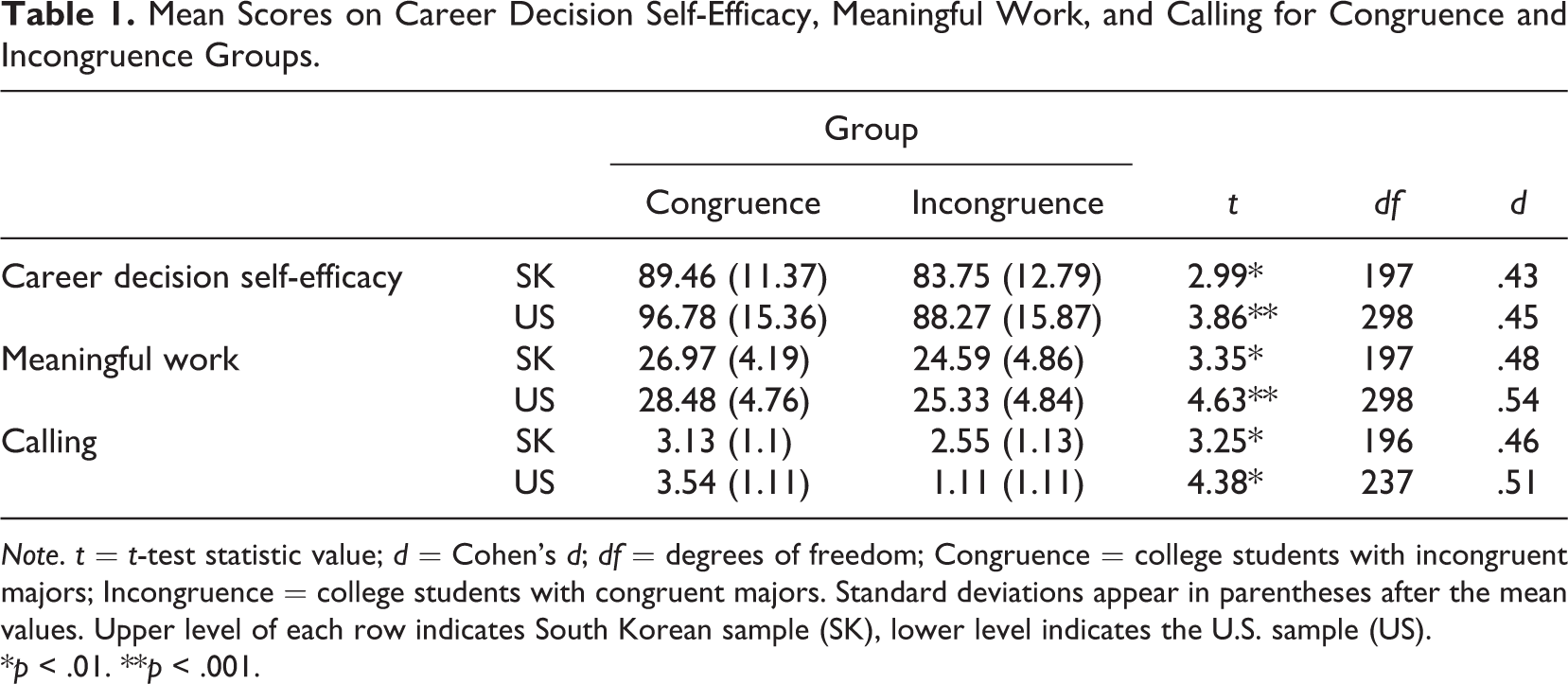
Note. t = t-test statistic value; d = Cohen’s d; df = degrees of freedom; Congruence = college students with incongruent majors; Incongruence = college students with congruent majors. Standard deviations appear in parentheses after the mean values. Upper level of each row indicates South Korean sample (SK), lower level indicates the U.S. sample (US).
*p < .01. **p < .001.
Next, using respondents’ “yes” and “no” answers to the major incongruence item to create two groups, we assorted participants into groups: 25.5% of the SK sample reported major incongruence versus 20.2% of the students within the U.S. sample. In contrast to our hypothesis, rates of major incongruence did not differ between the two countries, χ2(1) = 1.610, p = not significant.
We explored whether nationality and collectivism moderated the relations of major incongruence to calling, meaningful work, and CDSE using hierarchical regression analysis. Major incongruence and the hypothesized moderators were included in Step 1, and in Step 2 the interaction of major incongruence and each of the moderators were included. Interaction terms between major incongruence and nationality did not account for a significant proportion of the variance in the three career development indicators, t(489) = −.87 for CDSE; t(489) = −.67 for meaningful work; and t(485) = −.37 for calling, all ps > .05. Interaction terms between major incongruence and collectivism did not account for a significant proportion of the variance in the three career development indicators, t(289) = 1.58 for CDSE; t(289) = −.17 for meaningful work; and t(286) = −.18 for calling, all ps > .05 in the U.S. sample, and t(194) = 1.12 for CDSE; t(194) = .44 for meaningful work; and t(194) = .93 for calling, all ps > .05 in the SK sample. Neither nationality nor collectivism was found to significantly affect the relation of major incongruence to calling, meaningful work, and CDSE.
Finally, the mediation hypotheses were examined using statistical package for the social sciences macro developed by Preacher and Hayes (2004). The analyses were conducted separately in the U.S. and SK samples, and we tested two models, one for calling and the other for meaningful work. For calling, as shown in Figure 1, the regression coefficients for the direct effect of major incongruence to CDSE (−8.01 in the United States and −5.64 in SK) and the direct effect of CDSE to calling (.03 in the United States and .04 in SK) were both significant. The relation of major incongruence to calling was also significant (−.67 in United States and −.58 in SK). With the addition of the mediator, the path from major incongruence to calling decreased from −.67 to −.47 in the U.S. sample and from −.58 to −.35 in the SK sample, signifying a partial mediation. The indirect effect of major incongruence on calling, as mediated by CDSE, was also significant (−.20 in the United States and −.24 in SK).
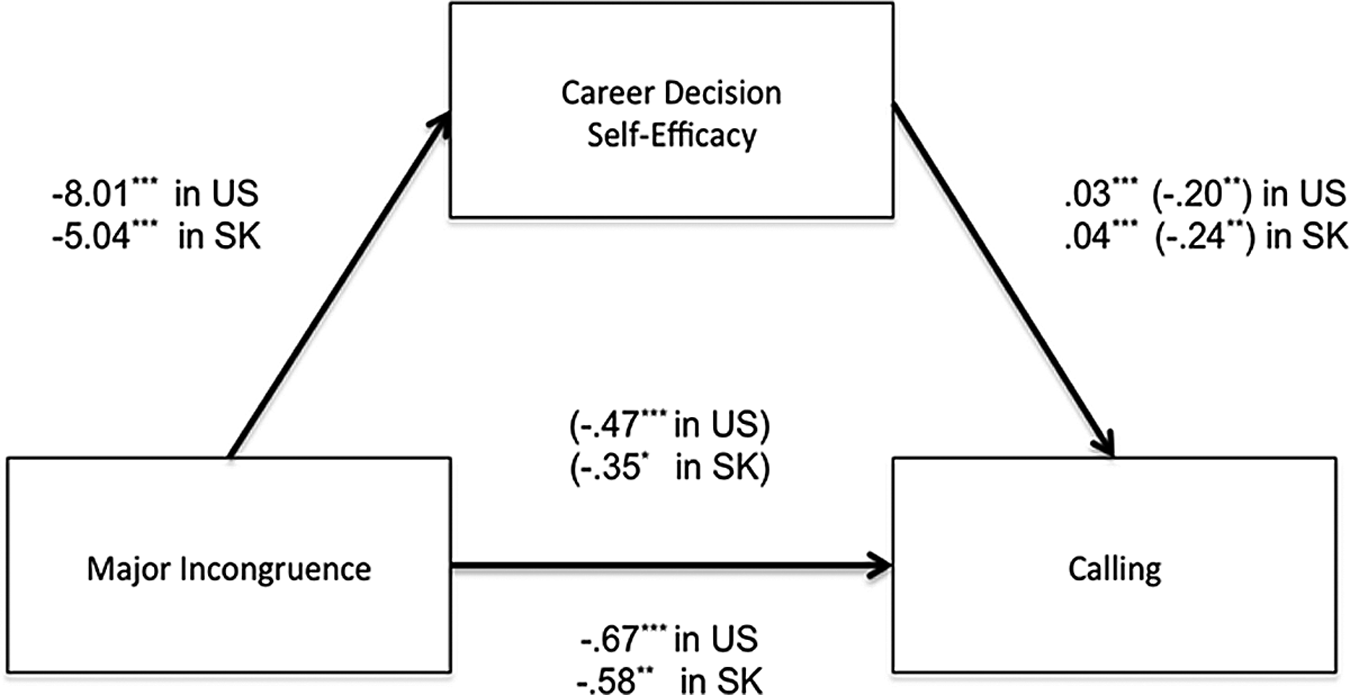
Mediator model examining the direct and indirect relationship of major incongruence and calling. Numbers in parentheses represent the indirect effect of major incongruence on calling through career decision self-efficacy (CDSE) and direct effect of major incongruence on calling after accounting CDSE. US indicates the U.S. sample (N = 291) and SK indicates the South Korean sample (N = 198). *p < .05. **p < .01. ***p < .001.
For meaningful work, as shown in Figure 2, the regression coefficients for both the direct effect of major incongruence to CDSE (−8.37 in the United States and −5.71 in SK) and the direct effect of CDSE to meaningful work (.15 in the United States and .22 in SK) were significant. The relation of major incongruence to meaningful work was also significant (−3.05 in the United States and −2.38 in SK). With the addition of the mediator, the path from major incongruence to meaningful work decreased from −3.05 to −1.77 in the U.S. sample, from −2.38 to −1.10 in the SK sample, signifying a partial mediation. The indirect effect of major congruence on meaningful work as mediated by CDSE was also significant (−1.28 in the United States, −1.28 in SK).
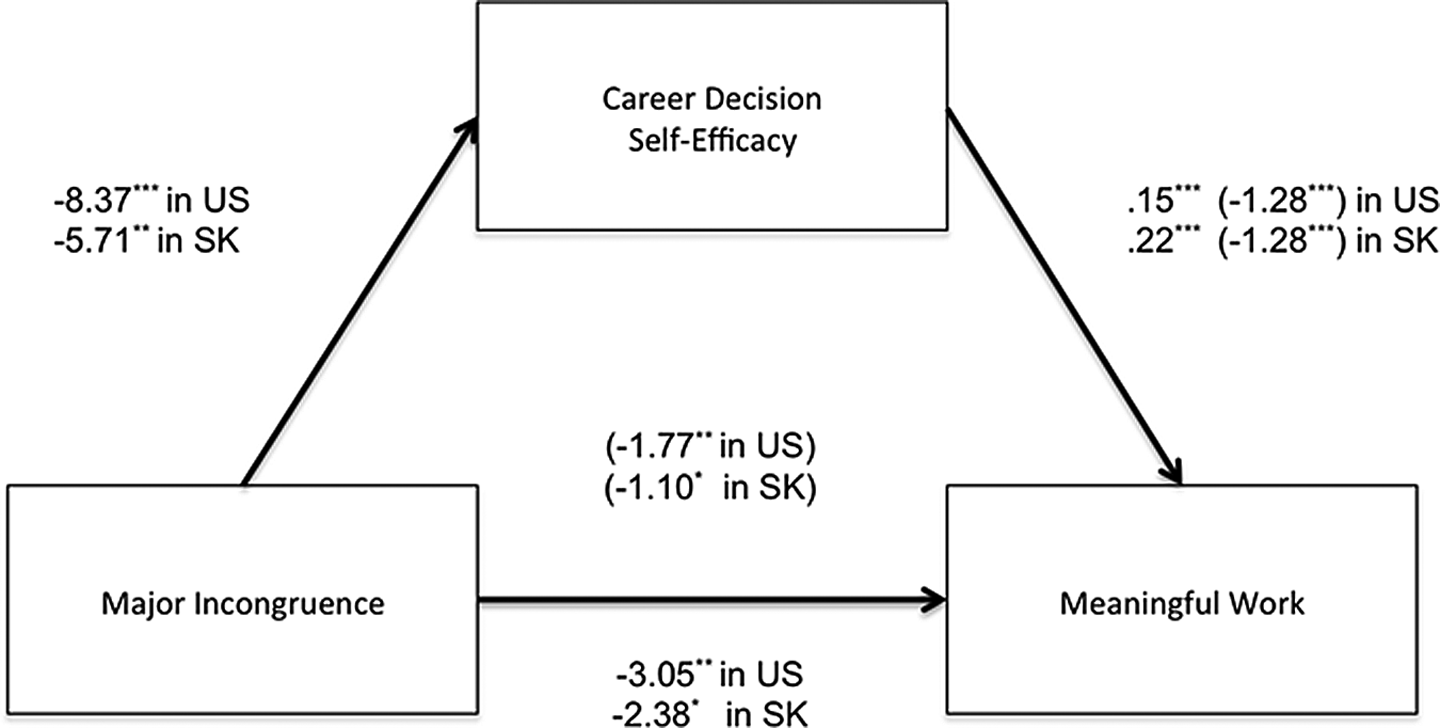
Mediator model examining the direct and indirect relationship of major incongruence and meaningful work. Numbers in parentheses represent the indirect effect of major incongruence on meaningful work through career decision self-efficacy (CDSE) and direct effect of major incongruence on meaningful work after accounting CDSE. US indicates the U.S. sample (N = 294) and SK indicates the South Korean sample (N = 199). *p < .05. **p < .01. ***p < .001.
In both models, major incongruence was found to have a significant, indirect effect on calling and meaningful work via CDSE. However, scholars have advised that the significance of these effects is best tested by bootstrapping techniques (Preacher, Rucker, & Hayes, 2007; Shrout & Bolger, 2002). Following the suggestions of these authors, we created 5,000 bootstrap samples using the Preacher and Hayes (2004) mediation macro. The confidence intervals of the indirect effect for each of the models were examined in both the samples at a 95% confidence interval. A significant finding is suggested by confidence intervals that do not include zero. Support was found for the indirect effect of major incongruence on calling as mediated by CDSE (standard error [SE] = .07, CI = [−.35, −.09] in the United States and SE = .09, CI = [−.43, −.08] in SK) and for the indirect effect of major incongruence on meaningful work as mediated by CDSE (SE = .36, CI = [−2.04, −.61] in the United states and SE = .44, CI = [−2.18, −.45] in SK).
Discussion
Despite reports that a substantial number of college students may be foundering in their efforts to select an appropriate major, little is known about the consequences of choosing a major that is essentially incompatible with one’s career aspirations. This study sought to understand how major incongruence relates to college students’ career development. Results from two nations supported our main hypotheses, showing that American and SK college students with incongruent majors report less career decision self-efficacy, meaningful work, and calling. These findings can be understood from SDT that links the satisfaction of the autonomy need to students’ positive psychological functioning (e.g., Ryan & Deci, 2000). Students with incongruent majors may experience their academic and career-related behaviors as less integrated within and endorsed by the self, which may, in turn, decrease positive expectations for their future career to be a meaningful reflection of their core identities, interests, or values. SDT also suggests that environments that support the individual’s autonomy will make the satisfaction of competency need more likely. Thus, it makes sense that students feeling controlled and pressured may feel less competent in dealing with tasks for career decision making.
The present study provides an initial estimate of how prevalent major incongruence is among American and SK college students. Approximately one fifth of the American students and one fourth of the SK students reported pursuing incongruent majors in their academic work. The good news, of course, is that most students at these two universities appear to feel their academic major is aligned with their desired career. The bad news is that such a large percentage of students do not experience this compatibility between major and career to the detriment of their career development and self-perceived potential to experience meaningful work and a calling. To the extent that 4-year postsecondary educational institutions are supposed to prepare students for future work, these expectations seem to be left unmet for a large number of students. In a tough economy, some students may feel they have less control over their choices and increasingly focus on selecting majors based on the need for survival. Thus, these potential influences of socioeconomic contexts need to be considered in the study of major incongruence and career development among college students. It is notable that the percentage of students with incongruent majors and the pattern of its relationships with positive career development are similar in both countries. This finding implies that major incongruence is a salient phenomenon across the two cultures, regardless of the cultural differences in career choices and development (e.g., Lee, 2001; Leong & Chou, 1994; Mau, 2001). These findings may indicate detrimental effects of major incongruence regardless of different cultural values placed on the experience of autonomy. This is consistent with previous findings that have shown the benefits of psychological need satisfaction on adjustment and well-being with members in collectivistic cultures, where autonomy is not valued in the same way that Western individualistic cultures do (e.g., Chirkov et al., 2003; Deci et al., 2001; Vansteenkiste et al., 2006). Even in a society in which family or social obligations and the communal good are emphasized and autonomy support is not a popular parenting or teaching style (Quoss & Zhao, 1995), students seem to suffer from feeling controlled and pressured in their academic- and career-related behaviors.
Despite the similar proportion and pattern of major incongruence in the United States and South Korea, the documented differences in cultural value orientation and opportunity for career exploration might give rise to different reasons why the proportion and career development associations of major incongruence are similar. For example, American students might be more likely to be in incongruent majors because of insufficient career-relevant information despite career exploration opportunities currently available, whereas SK students being more likely to be in incongruent majors because of external influences like family wishes. We could not test this hypothesis in the present study, but this would be an important subject to address in future cross-cultural research.
Our mediation findings revealed that CDSE links major incongruence to calling and meaningful work in both United States and SK samples. This seems to indicate that those with incongruent majors felt a diminished sense of calling and meaningful work, in part, because of decreased confidence in career decision making. These findings enhance our understanding as to why pursuing incongruent majors may be detrimental to career development of college students. This can be understood from SDT perspective in that autonomy is suggested as a context where competency can be nurtured (Ryan & Deci, 2000). Bandura’s (1997) social cognitive theory, which presents contextual support as one of the important sources of self-efficacy, also allows another possible explanation. A student’s academic major usually serves as an important source of supports and resources that assist the student in reaching career goals. Although a student’s college major may not be the only source for building career self-efficacy, it usually provides numerous opportunities to obtain career-relevant knowledge and information, emotional support and encouragement, and vicarious learning experiences through observing and modeling others in certain careers. These opportunities may be less accessible and available for those students with incongruent majors. Moreover, students with incongruent majors may perceive more barriers in pursuing their desired career, rooted in the idea that their academic major is not preparing them to succeed in their desired career. Thus, students with incongruent majors may have lower career development self-efficacy, and this undermined self-efficacy should make it difficult for them to develop positive outcome expectations and successful goal-related performances. Although we cannot determine the direction of these relations, the finding that CDSE serves as a significant mediator indicates that, perhaps, the potential cost from major incongruence for calling and meaningful work could be adjusted by boosting CDSE.
Implications for Practice
The current study has several implications for colleges and universities as well as employers. Finding employment has already become one of the most challenging and pressing issues for both American and SK college students, reflected by an increasing number of U.S. college graduates who are struggling with unemployment (Dell, 2011) and an alarming increase in suicide attempts attributed to unemployment among SK college graduates (Aviles, 2011). Major incongruence appears to operate as an additional challenge in students’ career development, discouraging their persistent career pursuit. Furthermore, the potential cost of major incongruence extends to financial disadvantage because across all fields, as new college graduates who were in jobs matching their majors earned more than those who were not (Barrett, 2008). Thus, colleges and universities should address the unique challenges and needs of these students to effectively help them. One possible approach will be helping students develop certain competencies such as collaboration, problem solving, and communication, which are not necessarily developed in a specific major but increasingly demanded by employers. Employers, in turn, may be advised that a significant minority of college graduates may have majors that are not compatible with their career aims. A continued focus on competencies required for specific positions seems superior to accepting a specific major as a proxy for competence.
In a related vein, these results reiterate the significance of providing ongoing support for students’ academic decision-making process throughout their college life. Colleges and universities provide various services to support the choice of major, but students with a declared major may not be targeted for these services. The present study suggests that many students who have declared a major may still require ongoing support because of major incongruence. These students may feel stuck and confused and may not actively seek help in changing majors or exploring diverse career options. Even as they advance into their junior and senior years, upper level students need to be encouraged not only to “choose” their majors but also continuously to “connect” their academic work and future career aspirations. Colleges and universities could facilitate this process in various ways. For example, integrative services could be designed in collaboration among academic advisors, career centers, and university counseling centers to help students gain clarity about themselves and their desired future career along with how college majors facilitate those pursuits.
Limitations and Future Research
The current study has several limitations. First, we used a single, yes-or-no question to identify students with incongruent majors. We believe our focus on perceived fit was appropriate in comparison to using a measure of objective fit, but single-item measures do not always have robust psychometric properties. Additional items might yield a more reliable instrument and illuminate additional facets of major incongruence. Future research using qualitative or focus group methods might reveal a variety of ideas about reasons major incongruence has emerged. This information could be used to fashion a more comprehensive assessment tool. Improved measurement of this construct also could reveal that degrees of incongruence are important. The forced-choice measurement approach used in this study dichotomizes incongruence, preventing an analysis of whether even small amounts of perceived incongruence might relate to career development.
Second, participants in the current study were mostly first- and second-year students, somewhat limiting the degree to which these results may generalize to upper level students. It is interesting that even students in their early college years, who have possibly formed a vague concept of desired career and have relatively more opportunities to switch majors than more advanced students, still exhibited significant differences in career development. Given that career preparedness becomes more urgent and salient as college students approach graduation, understanding experiences of upper level students is important for future research.
Finally, a cross-sectional study cannot determine the directionality of relationships among major incongruence and career development indicators. Low career maturity could lead to a poor choice in major, or major incongruence could lead to a divestment in career development. Well-designed longitudinal research could shed light on the causal direction between major incongruence and career development.
Conclusion
Implicit work on college student development seems to be the idea that students will be active participants in shaping their career paths. A sizable amount of research on motivation and human optimal functioning points to the benefits of pursuing a path that is congruent with one’s personality, values, and interests. Yet, little research has looked at whether college students who are lacking congruence between their academic major and their career goals. The present study confirms the theoretical importance of congruence and suggests that experiencing major incongruence is linked to worse career development in both the United States and South Korea. Major incongruence should receive attention from scholars and practitioners working with college student populations and career development issues.
Footnotes
Acknowledgments
We thank Nahyun Yoo for her assistance in data collection in South Korea. We also thank Bryan J. Dik for his helpful comments on a draft of this article.
Authors’ Note
Part of this article was presented at the annual meeting of the American Psychological Association, August 2010, San Diego, CA.
Declaration of Conflicting Interests
The author(s) declared no potential conflicts of interest with respect to the research, authorship, and/or publication of this article.
Funding
The author(s) received no financial support for the research, authorship, and/or publication of this article.