



Abstract
The present study examined the role of goals in the relation between calling and life satisfaction in a diverse, adult sample. Building off the self-concordance model of goal progress, the current study explored whether career goal self-efficacy (CGSE) mediated the relation between calling and life satisfaction and whether this mediation was moderated by intrinsic, extrinsic, self-transcendence, or physical self goal aspirations. We found CGSE to partially mediate the relation between calling and life satisfaction. Additionally, self-transcendence goals and physical self goals moderated this mediation such that, for people high in calling, the mediation only existed for those with high self-transcendence goals or low physical self goals. These results suggest that people with callings may need to have self-transcendence goals and avoid physical self goals in order for the confidence in their ability to achieve career goals to mediate the relation between their sense of calling and life satisfaction. Limitations and implications for future research are discussed.
Recent scholarship in positive psychology has begun to focus on what it means to have a calling (Dik & Duffy, 2009). Although definitions can vary throughout the literature, Dik and Duffy (2009) proposed an integrated conceptualization of calling as a personally meaningful career that works toward the greater good and originates from a source external to the self. People who view their careers as callings consistently report higher well-being (e.g., Peterson, Park, Hall, & Seligman, 2009; Wrzesniewski, McCauley, Rozin, & Schwartz, 1997) often represented by increased life meaning or satisfaction within specific life domains (Duffy, Allan, & Bott, 2012; Duffy, Allan, & Dik, 2011; Duffy & Sedlacek, 2010; Steger, Pickering, Shin, & Dik, 2010). However, the link between calling and life satisfaction has not been fully explored, and the reason why this relation exists is unclear. One untapped area of research concerns how callings interact with personal goals, which have also consistently been shown to play an important role in cultivating subjective well-being (Sheldon & Elliot, 1999). Therefore, building off the self-concordance model of goal progress (Sheldon & Elliot, 1999), the current study explores the role of goals in the link between calling and life satisfaction among a diverse sample of adults.
Theoretical Framework
Although many studies have linked calling to different well-being variables, such as job satisfaction, life satisfaction, and life meaning (e.g., Duffy, Allan, Autin, & Bott, 2013; Duffy, Bott, Allan, Torrey, & Dik, 2012), few have attempted to situate calling into an existing theory of well-being. The self-concordance model of goal progress offers a unique framework to understand why calling may be linked to well-being outcomes (Sheldon & Elliot, 1999). First, it has been used in many studies to help understand the link between certain variables and life satisfaction, such as core self-evaluations (Judge, Bono, Erez, & Locke, 2005), proactive personality (Greguras & Diefendorff, 2010), and coping strategies (Smith, Ntoumanis, Duda, & Vansteenkiste, 2011). Some of these studies have also examined the self-concordance model directly within the work domain (e.g., Greguras & Diefendorff, 2010). Second, scholars have identified goal setting and progress as crucial in understanding motivation and satisfaction in the world of work (Latham & Pinder, 2005). Therefore, calling, as a vocational variable, may lead to well-being through its ability to generate, organize, and accomplish goals (Dik, Sargent, & Steger, 2008). Thus, although theory has been neglected in research on calling, the self-concordance model of goal progress may be uniquely suited to organize research in this area.
Broadly, self-concordance theory describes how goal selection and attainment lead to enhanced well-being. Following from self-determination theory (Deci & Ryan, 1985), the model explains how goals are selected along a continuum from externally motivated to intrinsically motivated. Intrinsic or identified goals are self-concordant because they are derived from one’s true interests and values. Self-concordant goals are pursued more readily and receive greater sustained effort over time, leading to a greater likelihood of goal attainment (Sheldon & Kasser, 1998). Some research suggests that self-efficacy beliefs may also facilitate this process. Previous research has linked self-efficacy beliefs to sustained effort toward goals (Sheldon & Elliot, 1999), goal progress (Koestner et al., 2006), and goal commitment (Wieber, Odenthal, & Gollwitzer, 2010), all variables that would lead to greater goal attainment. Theoretically, when self-concordant goals are achieved, they meet the basic human needs of competence, autonomy, and relatedness. Meeting these psychological needs feels good and tends to increase subjective well-being (Sheldon & Elliot, 1999). Therefore, in this model, only goals that are self-concordant are hypothesized to lead to well-being.
The self-concordance model was developed based on self-determination theory, which focuses on the continuum of extrinsic and intrinsic motivation. Grouzet and colleagues (2005) extended this model to include another dimension of goal aspirations. The authors conducted a survey of goal content across 15 cultures with 2,000 participants and grouped items into 11 goals, which were not only shared cross-culturally but organized in a similar way. Specifically, the authors found the goals to fall on a two-dimensional, orthogonal circumplex, with intrinsic goals and extrinsic goals comprising one dimension and physical self goals and self-transcendence goals comprising the other. While extrinsic goals (e.g., image: “My image will be one other’s find appealing”) are pursued to gain external rewards from others, intrinsic goals (e.g., self-acceptance: “I will feel good about my abilities”) are pursuits that self-actualize the individual (Kasser & Ryan, 1996; Ryan & Deci, 2000; Sheldon & Elliot, 1999). On the other dimension, physical self goals (e.g., hedonism: “I will have a lot of excitement in my life”) are concerned with survival and pleasure whereas self-transcendence goals (e.g., spirituality: “I will find satisfying religious and/or spiritual activities”) reflect a desire to have spiritual understanding and a sense of community. Therefore, Grouzet et al.’s results suggest that the self-concordance model of goal progress could be extended to a new dimension of goal aspiration: self-transcendence and physical self goals.
Goal Aspirations and Well-Being
A great deal of research has focused on the effects of intrinsic versus extrinsic goals on individuals’ well-being, with the majority of studies linking intrinsic goals to positive well-being and extrinsic goals to negative well-being (e.g., Kasser & Ryan, 1993; Niemiec, Ryan, & Deci, 2009; Sebire, Standage, & Vansteenkiste, 2009). Although no studies have directly linked self-transcendence goals and physical self goals as defined by Grouzet et al. (2005) to life satisfaction, scholars have connected constructs similar to these variables to various aspects of well-being. For example, community goals (i.e., goals aimed at improving the world through helping others) are related to higher self-esteem and secure attachment (Park, Troisi, & Maner, 2010), and spiritual goals have specific links to self-transcendence strivings, satisfaction with life, meaning in life, psychological well-being, other-oriented values, self-actualization, and successful interpersonal relationships (Emmons, Cheung, & Tehrani, 1998; Fiorito & Ryan, 2007; Leak, DeNeve, & Greteman, 2007). Moreover, engaging in interpersonal relationships without concern for reciprocation has been linked to other-oriented goals and increased relatedness whereas attending to others needs out of a concern for one’s own needs has been related to decreased relatedness and increased negative affect (Park et al., 2010). Similarly, self-oriented goals have been found to be unrelated to life satisfaction and negatively related to intimacy and self-actualization (Leak et al., 2007). Overall, this research suggests that individuals who adopt intrinsic goals and self-transcendence goals are better able to reap the well-being benefits of goal attainment.
Calling, Goal Self-Efficacy, and Life Satisfaction
This foundation of research on the self-concordance model, goal aspirations, and their links to well-being outcomes offers an intriguing framework to explore if and how calling plays a role in this process. Specifically, calling could create the impetus for self-concordant goals that, when attained through self-efficacy beliefs, lead to life satisfaction. In the literature, findings have linked calling to goal self-efficacy, goal self-efficacy to satisfaction, and calling to satisfaction. For example, calling has been linked to career self-efficacy strivings (Dik et al., 2008), which are beliefs about one’s capability to achieve career goals (i.e., career goal self-efficacy [CGSE]), and to career decision self-efficacy (Dik & Steger, 2008). Moreover, studies have linked goal self-efficacy to lower levels of depression and anxiety (Karoly, Okun, Ruehlman, & Pugliese, 2008; Offerman, Schroevers, van der Velden, de Boer, & Pruyn, 2006; Pomaki, ter Doest, & Maes, 2006), greater personal growth and positive coping strategies (Kraaij et al., 2008), increased quality of life (Boersma, Maes, Joekes, & Dusseldorp, 2006), and greater career and life satisfaction (Verbruggen & Sels, 2010). Calling has also been linked to increased satisfaction in a number of domains, such as life satisfaction (Duffy, Allan, & Bott, 2012), academic satisfaction (Duffy, Allan, & Dik, 2011), and job satisfaction (Duffy, Dik, & Steger, 2011). Finally, more complex models indicate that self-efficacy beliefs can mediate the relation between calling and satisfaction. Dik and Steger (2008) found a calling infused workshop to increase career decision self-efficacy in relation to a waitlist control. Moreover, Duffy, Allan, and Dik (2011) found career decision self-efficacy to mediate the relation between calling and academic satisfaction for college students. These findings lend support to a model whereby calling relates to increased well-being via career self-efficacy.
The Present Study
In light of this previous research on both goal aspirations and calling, the present study sought to investigate if: (1) CGSE mediated the relation between calling and life satisfaction and (2) if this mediation was moderated by different types of goal aspirations (i.e., intrinsic, extrinsic, physical self, and self-transcendence). For Step 1, based on previous research (e.g., Duffy, Allan, & Dik, 2011), we hypothesized that the link between calling and life satisfaction would be mediated by CGSE. For Step 2, as discussed above, intrinsic and self-transcendence goals have been linked to well-being and extrinsic goals and physical self goals have not. Calling has also been differentially linked to different types of goals. For example, striving for a calling is related to intrinsic motivation and not related to extrinsic motivation or materialism (Dik et al., 2008). Having a calling may also be related to self-transcendence goals, which focus on striving for a sense of community, conforming to societal norms, and attaining spiritual understanding and growth. By definition, callings are rooted in “other-oriented” values and have a transcendent, spiritual component (Dik & Duffy, 2009). Furthermore, pursuing goals related to one’s calling is associated with pursuing spiritual goals (Dik et al., 2008), and colloquial definitions of calling include references to altruistic motives (Hunter, Dik, & Banning, 2010) and meaningful contributions to one’s community (Coulson, Oades, & Stoyles, 2012). Given this background, we hypothesized that the link of calling to CGSE will be more pronounced for adults with intrinsic and self-transcendence goals.
Method
Participants
A total of 230 participants aged 18–66 completed the survey (M = 30.59, standard deviation [SD] = 10.17). Of this group, 45.7% were male (N = 105) and 54.3% were female (N = 125); 53.9% identified as White (N = 124), 34.8% as Asian (N = 80), 3.9% as Hispanic (N = 9), 3.0% as multiracial (N = 7), 3.0% as African American (N = 7), and 3.0% as other (N = 8). Of the participants, 45.2% were American (N = 104), 30% Indian (N = 69), 13% Canadian (N = 30), 6.4% European (N = 15), and 5.0% other (N = 12). In terms of level of education, 38.3% (N = 88) had a graduate or professional degree, 36.1% (N = 83) had a college degree, 16.5% (N = 38) had some college, 0.9% (N = 2) had vocational school, 4.3% (N = 10) had a high school diploma, and 3.9% (N = 9) had less than a high school diploma. In terms of income per year, 36.5% (N = 84) made less than US$25,000; 28.3% (N = 65) made between US$25,000 and US$50,000; 15.7% (N = 36) made between US$51,000 and US$75,000; 10% (N = 23) made between US$76,000 and US$100,000; 3.5% (N = 8) made between US$101,000 and US$125,000; 3.0% (N = 7) made between US$126,000 and US$150,000; 2.6% (N = 6) made over US$151,000; and 0.4% (N = 1) were missing.
Instruments
Demographic Covariates
As covariates, we evaluated income and level of education. Income was assessed with the question, “On average, what is the combined yearly income of your household?” Participants responded on a 9-point scale (1 = less than US$25,000 per year to 9 = US$200,000+ per year). Level of education was assessed with the question, “What is the highest level of education you achieved?” Participants answered on a 7-point scale (1 = grade school to 7 = graduate school).
Calling
To measure calling, we used the 12-item presence subscale from the Calling and Vocation Questionnaire (CVQ; Dik, Eldridge, Steger, & Duffy, 2012). Items on this subscale were answered on a 4-point scale (1 = not at all true of me to 4 = absolutely true of me). Sample items include, “My career is an important part of my life’s meaning,” “My work contributes to the common good,” and “I was drawn by something beyond myself to pursue my current line of work.” Dik, Eldridge, Steger, and Duffy (2012) found the CVQ presence subscale to correlate positively with work hope, prosocial work orientation, meaning in life, life satisfaction, and other measures of calling. The authors also reported an internal consistency of α = .89 and a test–retest reliability of r = .75. The internal consistency in the present study was α = .87.
CGSE
CGSE was measured with a scale developed for this study, which was based on Dik, Sargent, and Steger’s (2008) career development strivings. Participants were asked to list five long-term or short-term career goals they were currently working toward. They then responded on a 5-point scale asking how confident they were in their ability to achieve each goal (1 = not at all confident to 5 = completely confident). Answers were summed to create CGSE total scores. Principal axis factoring revealed all 5 items to load on a single factor, which explained 36.98% of the variance. This factor had an Eigenvalue of 1.85, and all items loaded at .50 or above. The internal consistency in the present study was α = .74.
Life Satisfaction
Life satisfaction was measured with the Satisfaction with Life scale (SWLS), which consists of 5 items on 7-point scale (1 = strongly disagree to 7 = strongly agree; Diener, Emmons, Larsen, & Griffin, 1985). Sample items include, “I am satisfied with my life” and “The conditions of my life are excellent.” Diener and colleagues (1985) found good internal consistency (α = .87) and test–retest reliability (r = .82). The scale correlated expectedly with other measures of well-being, including positive and negative affect. Other researchers have found the SWLS to correlate in the expected directions with measures of self-esteem, neuroticism, dysphoria, and euphoria (Arrindell, Heesink, & Feij, 1999). The internal consistency of this scale in the present study was α = .88.
Goal Content
We measured goal aspirations with the Aspiration Index (Grouzet et al., 2005). In this measure, participants rate the personal importance of 47 goals on 9-point scale (1 = not at all important to 9 = extremely important). Sample goals include, “I will be admired by many people” and “The things I do will make other people’s lives better.” The scale is grouped into 11 different goal domains, which are further grouped into two dimensions on a circumplex. The intrinsic cluster (i.e., community feeling, affiliation, and self-acceptance) is set in contrast to the extrinsic cluster (i.e., image, popularity, and financial success goals), and the self-transcendence cluster (i.e., community feeling, spirituality, and conformity goals) is set in contrast to the physical self cluster (i.e., financial success, hedonism, safety, and physical health goals). The actual scores used for analysis are relative centrality measures, which assess the degree to which people rate aspiration types in relation to one another (see Kasser & Ryan, 1993). These are obtained by calculating the means of each subscale as well as calculating a grand mean for all subscales combined. Subscale scores are then finalized by subtracting out the grand mean. The internal consistency ratings of the four clusters in this study were intrinsic (α = .88), extrinsic (α = .91), transcendent (α = .89), and physical self (α = .89).
Procedure
In order to collect data from a diverse, adult sample, we recruited participants in two ways. First, a link to the survey was posted on social networking and online classified websites, specifically recruiting employed adults. In this case, people volunteered to complete the survey. Other individuals participated in this study through the online data collection service Mechanical Turk (MTurk), where employed adults were also recruited. This service allows people from across the globe to be compensated for completing surveys online. Repeated reviews and studies have concluded that MTurk is an efficient and useful tool (Buhrmester, Kwang, & Gosling, 2011; Mason & Suri, 2012) that produces comparable reliability, validity, and results to traditional laboratory samples (Buhrmester et al., 2011; Johnson & Borden, 2012; Sprouse, 2011). However, samples are usually older (Mason & Suri, 2012) and more diverse (Buhrmester et al., 2011). Participants who completed the survey this way received US$0.40 for completing the survey. Participants were provided with informed consent and were able to drop out of the study at any time without penalty. In total, 51.58% (N = 163) of the participants joined from the first method, and 48.42% (N = 153) of the participants joined from MTurk.
Results
Preliminary Analyses
To ensure the quality and reliability of the data, we conducted several preliminary analyses. First, we assessed the data for outliers. Upon inspection of the box plots for each variable, both the intrinsic and the physical self goal types appeared to have several outliers. We removed scores that exceeded 3.5 SDs above or below the means for these variables. We removed three cases in total. Next, we assessed each variable for normality. Neither the skew nor the kurtosis for any variable approached one, and the visually inspected histograms appeared normally distributed. However, Kolmogorov–Smirnov tests for all variables, except for calling, were significant. Therefore, we performed Blom (1958) transformations on the non-normal variables. This transformation converts the proportion responding to a certain level of a variable to the corresponding z-score on a standard normal curve (Blom, 1958). This normalized each variable, so we used the Blom transformed scores for the following analyses.
Our analysis plan included three steps. In Step 1, we examined correlations. In Step 2, we explored whether or not CGSE mediated the calling and life satisfaction relation. Finally, in Step 3, we tested if the mediation found in Step 2 was moderated by the four goal aspiration types: intrinsic, extrinsic, self-transcendence, and physical self.
Step 1: Correlations
Correlations among study variables are displayed in Table 1. As expected, calling, CGSE, and life satisfaction moderately correlated with one another. However, intrinsic goals negatively correlated with life satisfaction, which contradicts previous research (Kasser & Ryan, 1993, 1996). We examined our data and the literature to generate potential hypotheses for this finding. A possible confound was our diverse, international sample. Some researchers (Brdar, Majda, & Dubravka, 2009) have suggested that intrinsic and extrinsic goals may have different meanings in contexts where people are struggling to meet basic needs. In these countries, Brdar, Majda, and Dubravka (2009) assert that extrinsic goals may provide opportunities for well-being in these contexts, which is opposed to the pursuit of extrinsic goals for power or social status. In other words, the effect of goal types may depend on the context (Sagiv & Schwartz, 2000), and Brdar et al. speculate that intrinsic goals may lead to lower well-being in an environment that does not encourage intrinsic goals. For example, studies in less wealthy countries, such as Croatia, have shown extrinsic goals to have no relation or a positive relation to well-being. Therefore, this argument states that the cultural meaning of intrinsic and extrinsic goals might be different in varying contexts. Therefore, regardless of individual wealth, poorer countries might create contexts where extrinsic goals are considered more desirable.
Descriptive Statistics and Correlations of Calling, Career Goal Self-Efficacy, Life Satisfaction, and Goal Aspirations.
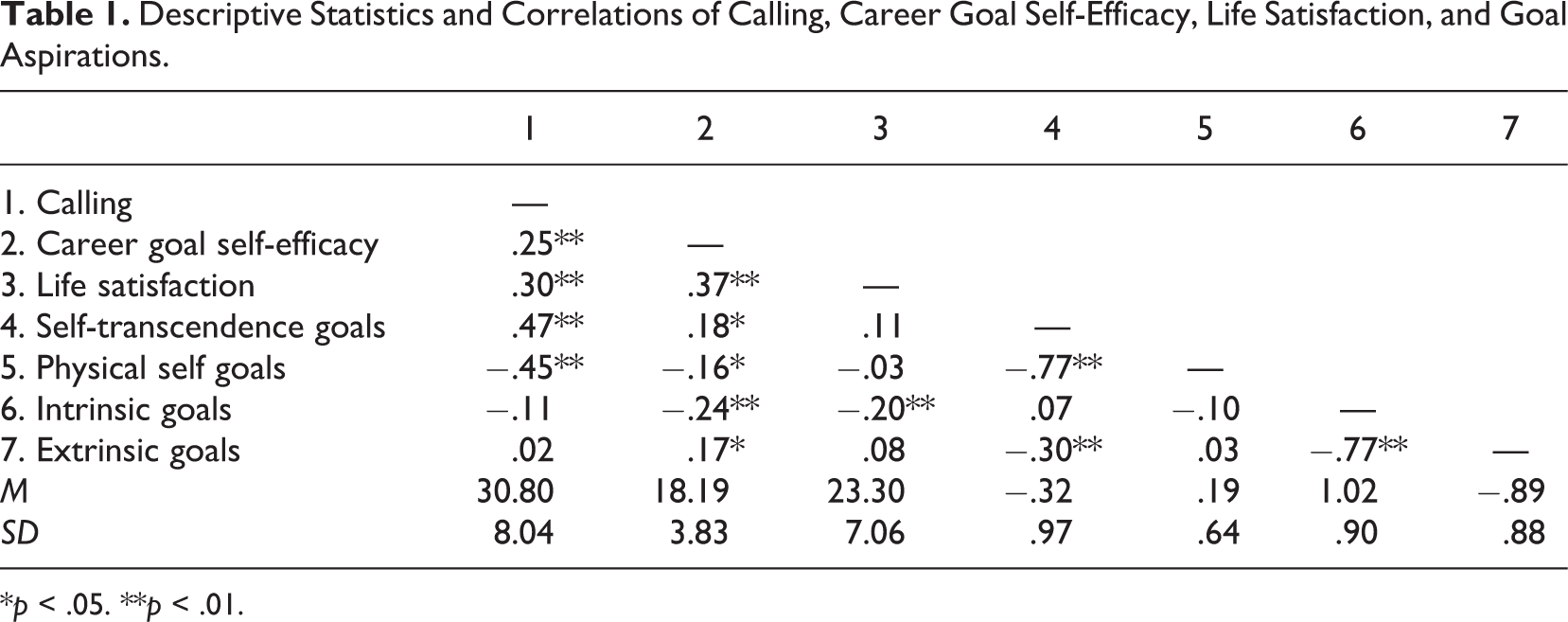
*p < .05. **p < .01.
Although none of the studies mentioned above have found a negative relation between intrinsic goals a well-being, we hypothesized that we could use this argument to create a variable that could act as a covariate to control for this unexpected result. Therefore, we examined estimates of gross domestic product per capita from the World Bank (2011) for each country represented in our sample. There was a clear split in the wealth of countries. In the high group, countries made well over US$10,000 per capita (e.g., Germany, US$43,689; United States, US$48,442). Mostly countries for North America and Western Europe were represented in this group. In the low group, countries made less than US$10,000 per capita (e.g., India, US$1,489; Romania, US$8,405). Countries in this group were mostly from Asia and Eastern Europe. We calculated a dummy code for those from or not from a wealthy country and tested this in a hierarchical model to attempt to explain the relation of intrinsic goals to life satisfaction. After controlling for country wealth, intrinsic goals no longer significantly predicted life satisfaction (B = −.12, standard error [SE] = .07, ns). Therefore, we included country wealth as a covariate in the following analyses. Country wealth was a predictor of each study variable, including life satisfaction (r = −.19, p < .001), CGSE (r = −.38, p < .001), self-transcendence goals (r = −.25, p < .001), physical self goals (r = .28, p < .001), intrinsic goals (r = .53, p < .001), and extrinsic goals (r = −.44, p < .001).
Step 2: Mediation
Next, we tested whether CGSE mediated the relation between calling and life satisfaction. Using the Statistical Package for the Social Sciences mediation macro developed by Preacher and Hayes (2008), we performed a mediation analyses based on 5,000 bootstrapped samples using bias corrected and accelerated 95% confidence intervals (CIs). This analysis allowed us to calculate the direct paths between our variables, in the form of regression weights, and the significance of the indirect path, which is the reduction of the relation between calling and life satisfaction when CGSE is included in the model. The indirect path is significant when the 95% CI does not include 0. For the analysis, we z-transformed all the variables so variable effect sizes could be compared. While controlling for country wealth (β = .03, SE = .14, ns), calling had significant, direct paths to CGSE (β = .14, SE = .07, p < .05) and life satisfaction (β = .20, SE = .07, p < .01). CGSE also had a significant direct path to life satisfaction (β = .31, SE = .06, p < .001). When CGSE was included in the model, calling had a reduced relation with life satisfaction (β = .16, SE = .07, p < .05), and the reduction in this relation was significant (SE = .05, CI = [.01, .10]). Therefore, CGSE partially mediated calling and life satisfaction. The total model was significant, F(3, 217) = 13.36, p < .001, and explained 16% of the variance in life satisfaction.
Step 3: Testing the Moderated, Mediator Model
The next step in our analysis was to test whether goal types moderated the mediation found in Step 1. To test moderated mediation (MODMED), we used the MODMED macro developed by Preacher, Rucker, and Hayes (2007). This macro allowed us to assess whether a particular mediation effect is contingent upon the level of a moderating variable by providing coefficients for both the mediator and the dependent variable models and allowing us to probe whether or not the mediation exists at specified levels of the moderator. We did not find significant moderation for intrinsic and extrinsic goals, as evidenced by a nonsignificant interaction in the MODMED models. However, as depicted in Figure 1, self-transcendence goals and physical self goals did moderate the mediation.

Moderated mediation model examining the moderating effect of self-transcendence and physical self goals on the mediation of calling and life satisfaction by career goal self-efficacy.
Table 2 shows the relevant parts of the MODMED output for self-transcendence goals. We z-transformed all variables before entering them into the model in order to compare effect sizes and reduce multicollinearity. First, there are two multiple regression models: the mediator variable model predicting CGSE and the dependent variable model predicting life satisfaction. The significant interaction between calling and self-transcendence goals in the mediator model suggests that the indirect effect from calling to life satisfaction is moderated by self-transcendence goals. The positive sign implies that the indirect effect is larger for those higher in self-transcendence goals. The significant interaction gives us precedent to probe the indirect effect at different levels of the moderator. The default output of MODMED provides normal theory tests of the conditional indirect effects at ±1 SD from the mean. As Table 2 shows, the mediation is significant at the mean and 1 SD above the mean. Preacher et al. (2007) recommend verifying these results with bootstrapped standard errors used to create 95% CIs. Therefore, we probed the conditional indirect effects at the mean and 1 SD above and below it using 95% bias accelerated and corrected CIs with 5,000 bootstrapped resamples. The CIs at 1 SD below the mean {−.07, .10}, the mean {.02, .15}, and 1 SD above the mean {.03, .26} corroborated the results from the normal theory tests.
Moderated Mediation Analysis for Self-Transcendence Goals Moderating CGSE’s Mediation of Calling and Life Satisfaction.

Note. CGSE = career goal self-efficacy; SD = standard deviation; SE = standard error. The conditional indirect effect is calculated (a 1 + a 3 W)b 1 where a 1 is the path from calling to CGSE, a 3 is path from the interaction of calling and self-transcendence goals to CGSE, W is self-transcendence goals, and b 1 is the path from CGSE to life satisfaction.
*p < .05. **p < .01.
The MODMED results for physical self goals are presented in Table 3. The direction of the significant interaction in the mediator model suggests that the indirect effect is only significant at lower levels of physical self goals. This was confirmed when we probed the indirect effects at the mean and 1 SD above and below it using normal theory tests. We again verified these results with 95% bias accelerated and corrected CIs using 5,000 bootstrapped resamples. The results at 1 SD below the mean {.05, .26}, the mean {.02, .15}, and 1 SD above the mean {−.08, .07} confirmed the findings from the normal theory tests.
Moderated Mediation Analysis for Physical Self Goals Moderating CGSE’s Mediation of Calling and Life Satisfaction.
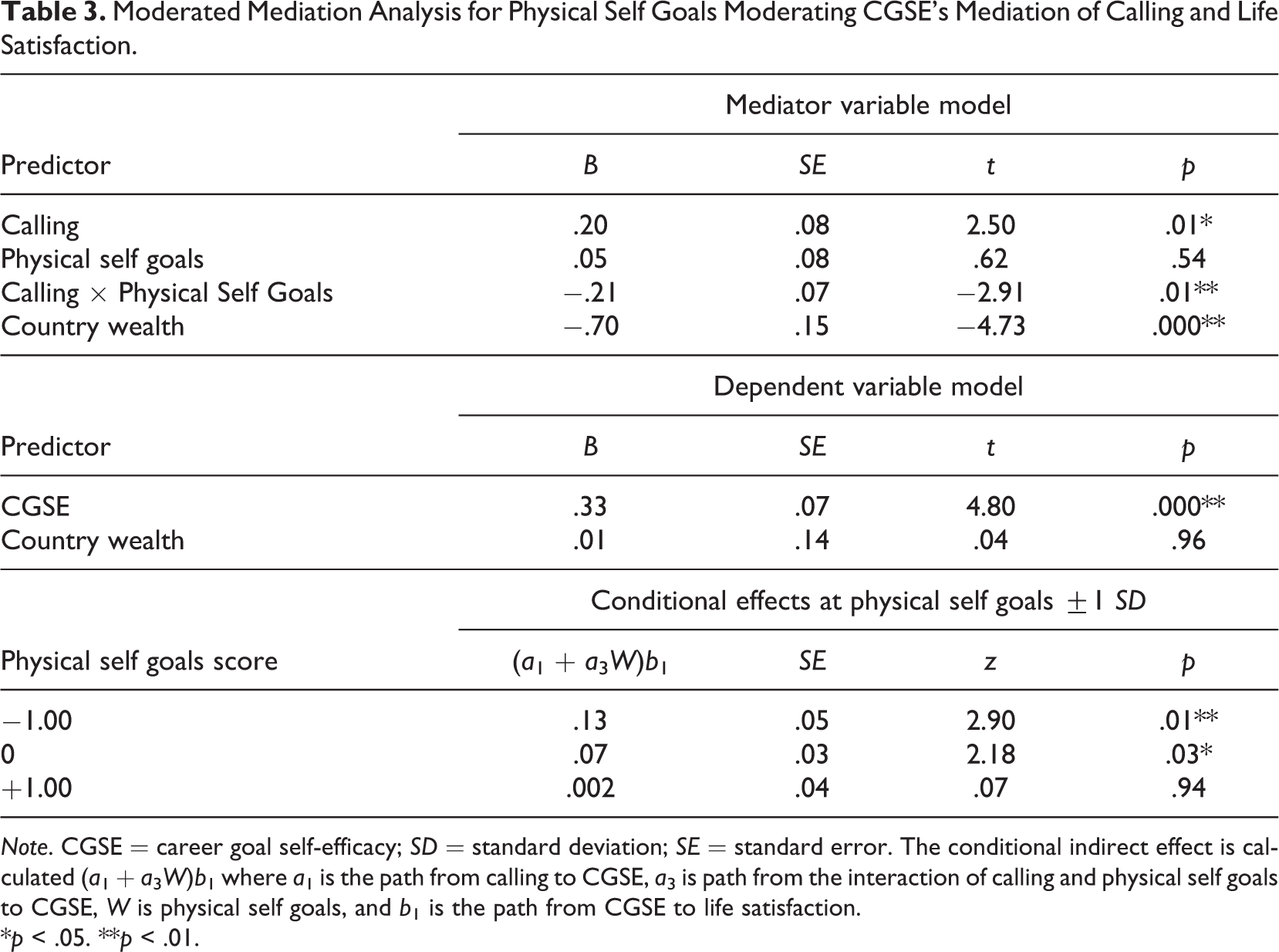
Note. CGSE = career goal self-efficacy; SD = standard deviation; SE = standard error. The conditional indirect effect is calculated (a 1 + a 3 W)b 1 where a 1 is the path from calling to CGSE, a 3 is path from the interaction of calling and physical self goals to CGSE, W is physical self goals, and b 1 is the path from CGSE to life satisfaction.
*p < .05. **p < .01.
Discussion
The primary goal of this study was to explore the links between calling, goal aspirations, and life satisfaction. Specifically, we investigated whether CGSE mediated the relation between calling and life satisfaction and if goal aspirations moderated this mediation. Through mediation analysis, we found CGSE to partially explain the relation between calling and life satisfaction. Furthermore, we found that this mediation was moderated by self-transcendence goals and physical self goals such that calling was only connected to life satisfaction through CGSE for those high in self-transcendence goals and low in physical self goals.
Our correlations revealed that calling was positively related to self-transcendence goals and negatively related to physical self goals. This finding supported our suspicions and is in line with previous research linking spiritual and community goals to calling and well-being (Dik et al., 2008; Emmons et al., 1998; Park et al., 2010). Conversely, calling was not related to extrinsic or intrinsic goals, which failed to support our hypotheses and conflicted with previous research linking calling to intrinsic motivation (Dik et al., 2008). Therefore, calling may not exist on the intrinsic–extrinsic dimension and instead lie on the self-transcendence–physical self dimension. We also found intrinsic goals to negatively correlate with life satisfaction, which contradicts previous research (Kasser & Ryan, 1993, 1996). Following from Brdar et al. (2009), we suspected that this may have resulted from differences in wealth of the countries represented in our diverse, international sample. This hypothesis was supported by the fact that intrinsic goals failed to have a unique relation to life satisfaction after controlling for country wealth. Another possibility is that this result is actually being caused having intrinsic aspirations that are not being met, which could lead to findings that appear to contradict the literature. However, without measuring goal progress and attainment, this possibility could not be examined. Although full exploration of this curious result was beyond the scope of this study, this finding opens up avenues for future research.
Next, supporting our initial hypotheses, we found that CGSE partially mediated the relation between calling and life satisfaction. This suggests that calling may be related to life satisfaction in part because having a calling increases CGSE, which in turn increases well-being. However, our MODMED analysis revealed that this was only true for those high in self-transcendence goals or low in physical self goals. The mediation was not affected by participants’ levels of intrinsic and extrinsic goals. This may mean that in order for people with callings to feel confident about their abilities to accomplish their career goals and reap well-being benefits, having high self-transcendence goals and avoiding physical self goals is important. As previously discussed, callings are careers with other-oriented values that often have a component of spirituality (Dik & Duffy, 2009). Clearly, callings fit well self-transcendence and would provide a means to accomplish self-transcendence goals. When people with callings are low in self-transcendence goals or high in physical self goals, there is discordance between their careers aimed toward prosocial, spiritual gains and their goals that do not share this end. This discordance may cause people to have a lack of confidence in their abilities to achieve their career goals. People who lack confidence in their ability to accomplish career goals may not attain their goals as effectively, which would relate to decreased life satisfaction.
Another possible interpretation is offered by self-concordance theory. Self-concordance theory states that only accomplishing intrinsic goals, which meet basic psychological needs, lead to well-being (Sheldon & Elliot, 1999). However, this assertion is based on a one-dimensional construction of goals: an intrinsic–extrinsic dimension. If we consider Grouzet et al.’s (2005) two-dimensional model, which includes the self-transcendence–physical self dimension, a new possibility emerges. Perhaps people with callings present a special case within the work domain where the attainment of self-transcendence goals is analogous to attaining self-concordant goals, which may increase well-being. Our data suggest that this may occur by influencing self-efficacy beliefs, which affect goal attainment and subsequent well-being. Though this interpretation is tentative given our results, it opens up new possibilities for future research.
Limitations and Future Directions
This study had several limitations that suggest areas for future research. For example, the cross-sectional nature of this study created several problems. First, causal relationships could not be determined from our data, so the conclusions drawn in our study should be considered tentative. Second, our study did not allow us to test longitudinal variables important to our theoretical argument, such as goal progress and goal attainment. This may especially be an issue with our finding that intrinsic goals had a negative relation with life satisfaction. This result could potentially be caused by intrinsic goals not being met, leading to contradictory results. Future studies should address this by testing the implications of our study. Specifically, our interpretation implies that calling should predict higher goal attainment and goal progress, which would lead to higher well-being. Furthermore, our model suggests that for people with callings this should only occur for those who are high in self-transcendence goals and low in physical self goals, regardless of their levels of intrinsic and extrinsic goals. In addition, CGSE should partially mediate these relations, especially between self-concordant goal formation and goal progress and attainment. Though this study did not take into account the specific content of the career goals rated for self-efficacy, future studies should improve on this by assessing self-efficacy of goals in specific aspiration domains, such as intrinsic goal self-efficacy.
Next, our study did not include a number of other goal variables that may play an important role in calling’s relation to well-being. Examples include mastery versus performance goals, approach versus avoidance goals, and constitutive versus instrumental goals. Calling may be particularly related to constitutive goals that, contrary to instrumental goals, are pursued for their own sake, rather than for a specific end (Fowers, Mollica, & Procacci, 2010). However, this possibly suggests that calling may relate more to eudaimonic well-being than measures of hedonic well-being, such as life satisfaction. Therefore, future studies should address the cross-sectional limitation of our study with longitudinal designs and expand on this study by exploring different goal variables and measures of well-being.
Finally, our sample presented several challenges in terms of generalizability. Our sample was highly educated with a level of income greater than what would be expected. Also, the sample was internationally diverse, which may have led to atypical findings. Therefore, our obtained results may only apply to an educated sample, and it is unclear how different cultural contexts were affecting the study’s results. Efforts should be made to extend these findings in explicit cross-cultural studies and studies that examine the influence of varying levels of income, education, and class on the variables in question.
Footnotes
Declaration of Conflicting Interests
The author(s) declared no potential conflicts of interest with respect to the research, authorship, and/or publication of this article.
Funding
The author(s) received no financial support for the research, authorship, and/or publication of this article.