



Abstract
Given the alarming unemployment rates among emerging adults in the United States, this study investigates the relationships among volunteering, length of unemployment, likelihood/quality of reemployment, and job search strategies in a sample of emerging adults. Two hundred and sixty-five emerging adults aged between 21 and 29, all of whom were unemployed 6 months prior to taking the survey, completed an online survey. Results affirm positive associations between volunteering and likelihood of reemployment 6 months later. The number of hours spent volunteering was significantly related to reemployment status as was the length of unemployment. The use of an exploratory job search strategy, in contrast to the use of a focused or a haphazard job search strategy, was associated with reemployment. Implications of the findings and suggestions for further research are discussed along with the limitations of the present study.
Introduction
Emerging adulthood, a developmental period ranging in age between 18 and 29, is characterized by identity exploration, high levels of self-focus, feeling in between, and instability in functioning (Arnett, 2006; Konstam, 2007, 2013). During this developmental period, individuals encounter major challenges in the emotional, social, and vocational domains. The identification and consolidation of a career is an onerous process for emerging adults trying to navigate an uncertain and unstable economy. Although the economic downturn and its sequelae have resulted in heightened risk of unemployment among all adults, it has had an alarming impact on the lives of emerging adults. In May 2013, for example, the unemployment rate for emerging adults in the United States (13.2%) was nearly twice the rate of unemployment in all other age groups (ages 25–34, 7.2%; ages 35–44, 6.2%; ages 45–54, 5.9%; age 55 and older, 5.3%; U.S. Department of Labor, Bureau of Labor Statistics, 2013).
Without structural supports and mentoring options to guide and bolster their job-seeking efforts, emerging adults are emotionally vulnerable and predisposed to lack of time structure, social contacts, collective purpose, social identity/status, and activity (Jahoda, 1981). Furthermore, there is consistent data documenting the detrimental impact of unemployment on the mental health of emerging adults including increased risk of developing mental illness (Kuwabara, Van Voorhees, Gollan, Alexander, 2007), and increased symptoms of depression and anxiety (McKee-Ryan, Song, Wanberg, & Kinicki, 2005; Paul & Moser, 2009).
Besides the adverse impact on mental health functioning, the current economic environment has resulted in challenges to successful career consolidation for emerging adults. In 2011, only 11% of workers aged 18 to 24 reported that their current job was a career possibility (Pew Research Social & Demographic Trends, 2012). Employed emerging adults are more likely to be working in low-wage and low-skill jobs that do not match their interests and abilities; turnover intent is high (Hamilton & Hamilton, 2006). There is a trend of “degree inflation” whereby low-wage and low-skill jobs are increasingly requiring bachelors’ degrees (Rampbell, 2013). Although college graduates may feel fortunate to hold these jobs, at the same time, they find themselves unable to make a living wage (Rampell, 2013).
Consequently, at this critical developmental juncture, given an unpredictable, fluid, and highly competitive economic environment, further research is needed to identify processes and strategies that can assist emerging adults identify and procure satisfying employment. As Koen, Klehe, Van Vianen, Zikic, and Nauta (2010) suggest, assisting emerging adults in the process of finding suitable jobs that are appropriate and satisfying is key; the lens by which we measure reemployment status needs to be broader in scope and incorporate employee satisfaction and turnover intentions and behavior.
Volunteering and Reemployment
Volunteering is an important yet understudied behavioral strategy with regard to increasing employment possibilities for emerging adults (Shore & Tashchian, 2013; Wilson, 2000). Happenstance Learning Theory (Krumboltz, 2009; Krumboltz & Levin, 2010) provides a theoretical framework for understanding the contribution of volunteering to career development and reemployment. Individuals, according to Krumboltz (2009), engage in behaviors in both planned and unplanned contexts that result in cumulative learning experiences; these experiences influence future actions and are associated with the acquisition of newfound skills, interests, knowledge, beliefs, preferences, sensitivities, and emotions. Krumboltz emphasizes the importance of engaging in actions that create unplanned opportunities to capitalize on these beneficial unplanned events (Krumboltz, 2011; Krumboltz, Foley, & Cotter, 2013). Volunteering is one example of an exploratory activity that has the potential to generate beneficial outcomes and events, including hands-on experiences that can lead to mastery of new skills (Krumboltz, 2009; Krumboltz et al., 2013).
Further theoretical support for understanding the contribution of volunteering to career development and decision making can be found in Krieshok’s theoretical work related to occupational engagement (Krieshok, 1998; Krieshok, Black, & McKay, 2009). Career decision making is an ongoing process that involves engagement with other individuals and the world that they inhabit (Krieshok, 1998). Through these cumulative experiences, individuals develop vocational and self-schemas that enable them to make more adaptive and informed vocational judgments (Krieshok et al., 2009). Volunteering activities provide opportunities for individuals to come into contact with others and engage in enriching experiences that lead to ongoing accumulation of knowledge and life experiences. “Through occupational engagement, vocational and self-schemas evolve and vocational judgments and decisions are more informed, as are judgments about the larger host of life matters” (Krieshok et al., 2009, p. 284). The Occupational Engagement Scale acknowledges the import of volunteering as evidenced by the following item: “I volunteer in an area that I find interesting” (Krieshok et al., 2009, p. 286).
Research related to volunteer behavior tends to focus on motivations driving adult volunteering; however, the literature is characterized by failure to clearly distinguish between volunteering activities that are in the service of altruistic and other-directed motivations versus activities that are in the service of self-directed, job-focused motivations (Hall, Lasby, Gumulka, & Tryon, 2006; Hodgkinson & Murray, 1996; Piliavin, 2005). It is therefore difficult to interpret the degree to which emerging adults are engaging in volunteering activities to improve their job prospects and career-related social contacts. Nevertheless, theoretically it has been suggested that volunteering contributes to the career development of individuals (Ellis, 1993; Krieshok et al., 2009; Krumboltz et al., 2013). In addition, altruistic personality traits are positively related to volunteering (Pearce, 1993) and increase the likelihood of reemployment (Shore & Tashchian, 2013).
The link between volunteering and reemployment has been reported in various empirical studies (e.g., Goić & Jeronćić, 2012; Hirst, 2001; Shore & Tashchian, 2013). In a recent national survey conducted in the United States, a significant and stable association between volunteering and employment was found among individuals older than 16 years of age (Spera, Ghertner, Nerino, & DiTommaso, 2013). Yet, findings to date are scarce and may not be generalizable to emerging adults navigating the current marketplace, specifically in terms of finding high-skill and high-paying jobs (Rampell, 2013).
There is a dearth of research specific to emerging adults which examines the effects of volunteering on employment quality after a period of unemployment (Wilson, 2000). Reemployment quality includes the assessment of job satisfaction, needs-supply fit, and turnover intentions (Koen et al., 2010). It can be argued that volunteering allows for the exploration of one’s skills and interests and increases possibilities for securing a satisfying job consistent with one’s skillset and abilities. In support of this assertion is the finding by Tuffrey (2003) who reports that effective corporate Employee Volunteer Programs significantly increase levels of job satisfaction.
Furthermore, longitudinal studies have reported that volunteering appears to have long-term positive effects on career development (e.g., Astin, Sax, & Avalos, 1998; Wilson & Musick, 2003). In a 9-year survey among college freshmen, Astin et al. (1998) found that students who volunteered during their college years were more likely to obtain graduate degrees and higher paying jobs. Wilson and Musick (2003) in contrast found that women who volunteered were not better positioned to be employed 18 years later; however, they were more likely to have higher status jobs in comparison to those who had not volunteered. Wilson and Musick posit that their findings can be attributed to the human capital that participants accrued during their volunteer experiences, including the acquisition of job skills and social contacts. In other words, as in compound interest that accumulates over time, the authors suggest that participants continued to reap the rewards of their volunteering activities over time.
In summary, extant but limited research findings suggest that individuals benefit from engaging in volunteer activities, most likely by accruing social capital and job-related skills. However, the research is frequently not generalizable to unemployed emerging adults and therefore it is imperative to investigate the potential contribution of volunteer work to reemployment in this population of vulnerable individuals caught in the throes of a tumultuous, economic environment. In addition, the findings neglect to address an important area of inquiry, reemployment quality.
Job Search Strategies, Volunteering, and Reemployment
Job search strategies and their interaction with reemployment is a related and relevant body of literature (Crossley & Highhouse, 2005; Koen et al., 2010; McKee-Ryan et al., 2005). Stevens and Turban (2001) identified three types of job search strategies: exploratory, focused, and haphazard. In using a focused strategy, the individual knows what he or she is looking for in a job and attends to activities consistent with and limited to specified interests and established job search criteria (Crossley & Highhouse, 2005; Stevens & Turban, 2001). Using an exploratory strategy, the individual is open to new opportunities and the exploration of all potential employment options (Crossley & Highhouse, 2005; Stevens & Turban, 2001). In contrast, the individual who tends to rely on a haphazard strategy engages in random job search strategies and pursues potential jobs that he or she may or may not qualify for. The person is unclear in terms of what he or she is looking for in a job and often accepts the first available job offer (Crossley & Highhouse, 2005; Stevens & Turban, 2001).
Although there is limited research on the effects of job search strategies on reemployment status, the existing studies provide evidence for a relationship between job search strategies and reemployment quality. Crossley and Highhouse (2005), for example, found that haphazard, exploratory, and focused search strategies were related to job satisfaction and the search process. More specifically, although the use of a haphazard job search strategy predicted number of job offers negatively, an exploratory search positively predicted number of job offers over and above demographic considerations (i.e., age, education, gender, etc.). Koen et al. (2010) found that although a focused job search strategy was associated with an increase in job offers, it was not significantly associated with reemployment quality in adults.
There are two primary vehicles by which volunteering may affect job search strategies as posited in the literature: increasing job skills and developing social contacts (Day & Devlin, 1998; Ellis, 1993; Haski-Leventhal, 2008; Wilson & Musick, 2003). Volunteering increases job-related skills and knowledge and therefore may increase the likelihood of using more focused job search strategies. Likewise, volunteering may increase the emerging adult’s social contacts (Wilson & Musick, 2003), which is associated with an increase in job offers and exploratory job search strategies (Crossley & Highhouse, 2005; Koen et al., 2010). Therefore, in this study, the association between volunteering and job search strategies is examined in order to extend our understanding of how volunteering contributes to the likelihood and quality of reemployment among emerging adults.
Present Study
The existing literature on volunteering highlights the importance of volunteer activity in promoting career development and increasing possibilities for obtaining social contacts and job-related skills. However, the literature is limited with regard to the association between volunteering and likelihood and quality of reemployment in emerging adults, a population that is vulnerable to alarming rates of unemployment in this economic environment. To address these limitations in the literature, the present study aims to examine the associations between volunteering, job search strategies, reemployment status, and reemployment quality. More specifically, we hypothesize that:
Methods
Participants
The total sample consisted of 265 emerging adults between the ages of 21 and 29 (M = 25.6, standard deviation (SD) = 2.29) living in the United States who were unemployed 6 months prior to participation in the study. As seen in Table 1, the sample was relatively diverse regarding race, education, employment status, and income. In our sample, 93 participants reported that they were currently reemployed at the time of the survey (i.e., were currently employed after being unemployed 6 months prior).
Demographics of the Sample.
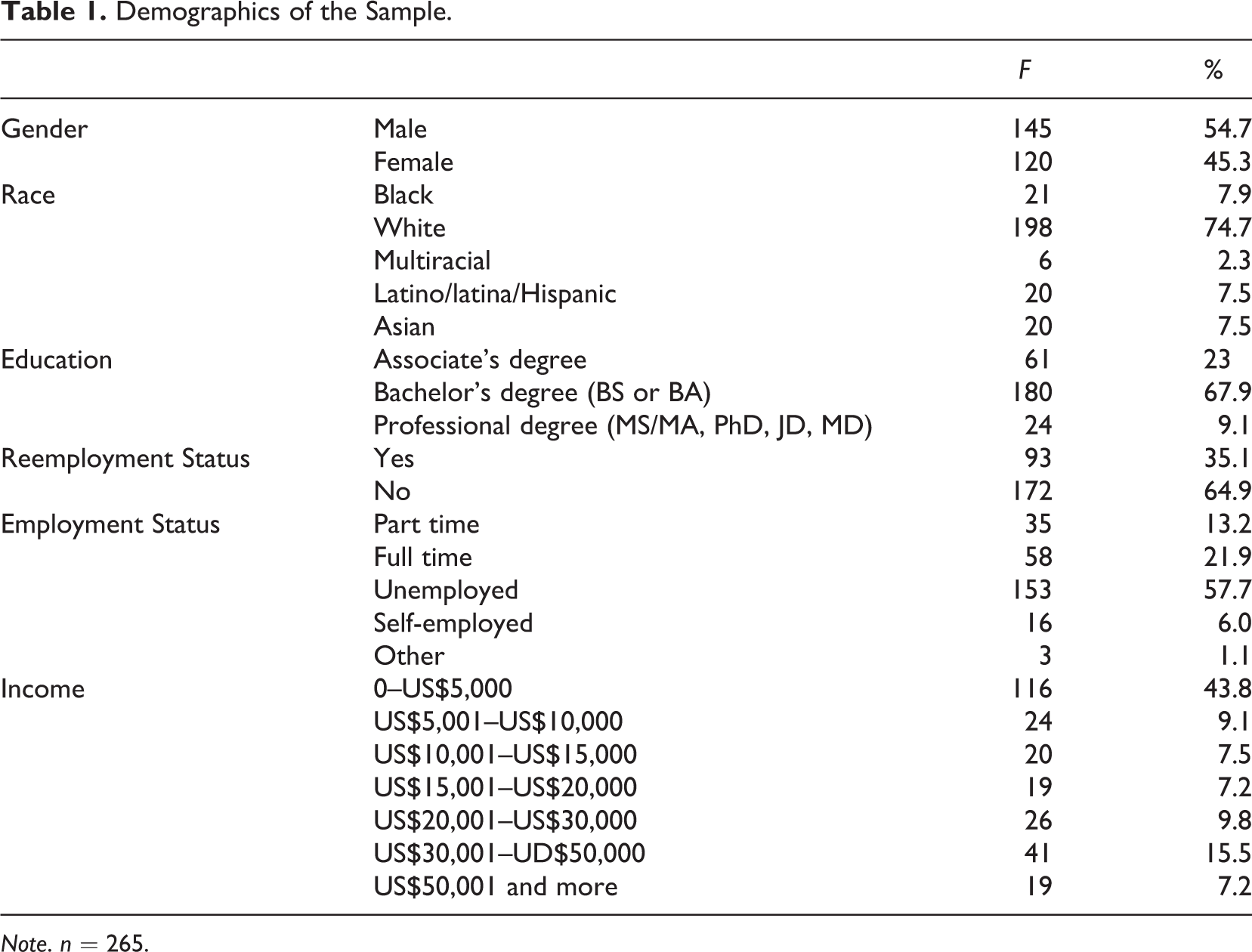
Note. n = 265.
Procedure
After Institutional Review Board approval was obtained, data were collected through the online crowdsourcing marketplace platform, Amazon’s Mechanical Turk (MTurk), over the duration of a month. In order to participate, participants had to meet the following criteria: (a) 21 to 29 years of age, (b) currently living in the United States, (c) a minimum of an associate’s degree, and (d) not employed 6 months prior to participating in the study. A link including an informed consent page and the survey was posted on MTurk. All of the survey items were intended to measure the current state of the subject six months after experiencing unemployment.
Buhrmester, Kwang, and Gosling (2011) examined data collected via MTurk and concluded that the obtained data were as valid and reliable as traditional Internet survey methods. Moreover, Buhrmester et al. reported that participants are slightly more diverse demographically than standard Internet samples and are significantly more diverse than American college samples.
Instruments
Time volunteering
Participants were asked to indicate the number of hours per week devoted to volunteer activity or activities among the choices “Less than 1 hour,” “ 2–3 hours,” “4–5 hours,” “6–7 hours,” and “8 hours or more.” This is intended to measure the number of volunteering hours in a typical week.
Reemployment status
Participants were asked whether they were currently reemployed or not, Yes indicating that they found a full-time or part-time job within the last 6 months.
Length of unemployment
Length of unemployment was measured by one question: How long were you unemployed prior to six months ago (since your last full-time job?). Response options were Never been employed full time, 3 years or less, 2 years or less, 1 year or less, and 6 months or less.
Job search strategies
Job search strategies of the participants were assessed by the “Information Search Strategies Items”, developed by Crossley and Highhouse (2005) based on a typology (Stevens & Beach, 1996) and measures (Stevens & Turban, 2001) of information search strategies. The measure aims to assess the degree to which participants engaged in three different types of job search strategies: exploratory, focused, and haphazard. It is a 16-item Likert-type scale ranging from “1 = Strongly disagree” to “5 = Strongly agree”. Six statements measure an exploratory strategy, such as “I gathered as much information about all the companies that I could” (Crossley & Highhouse, 2005, p. 260). Six statements measure a focused strategy, such as “I targeted my job search toward a small number of employers” (Crossley & Highhouse, 2005, p. 260). The remaining four statements measure a haphazard strategy, such as “My job search was more or less haphazard” (Crossley & Highhouse, 2005, p. 260). Final scale scores for each subscale were averaged across questions, with higher values indicating more likelihood to utilize the job search strategy. Crossley and Highhouse (2005) found that the questions had adequate internal consistency, ranging from .64 to .77. In a more recent study among unemployed adults, the coefficient αs were found to be .74, .70, and .59 for exploratory, focused, and haphazard strategies, respectively (Koen et al., 2010). In the present study, the internal consistency coefficients were .85, .74, and .78, for exploratory, focused, and haphazard job search strategies, respectively.
Reemployment quality
Participants who became reemployed within a 6-month time were asked to characterize their current job experience using three criteria: (l) job satisfaction; (2) turnover intentions; and (3) need supplies fit.
Job satisfaction
Job satisfaction refers to the attitudes of an employee toward his or her job (Brayfield & Rothe, 1951). Job satisfaction was measured by 5-point Likert-type scale ranging from “1 = Strongly disagree” to “5 = Strongly agree” developed by Brayfield and Rothe (1951). It consists of 5 items such as “I feel fairly satisfied with my present job” and “Most days I am enthusiastic about my work.” The 5 items are summed, after reverse scoring 2 items, with a range between 5 and 25, with higher scores indicating more job satisfaction. It is a well-validated instrument with high reliability (Judge, Heller, & Klinger, 2008; Koen et al., 2010). In the present study, the internal consistency coefficient was .66.
Turnover intent
Intention to turnover is a scale developed by Colarelli (1984) to measure a person’s intention to quit his or her job. It consists of 3 items (e.g., “I frequently think of quitting my job”) and is scored on a 5-point scale ranging from “1 = Strongly disagree” to “5 = Strongly agree.” The 3 items are summed with higher values indicating more intent to quit his or her job. A Cronbach α of .75 was reported for the internal consistency of the scale (Colarelli, 1984). In a recent study, internal consistency was reported to be .80 (McNall, Masuda, & Nicklin, 2010). In the present study, the internal consistency coefficient was found to be .88.
Needs supply fit
The perceived fit between an employee’s needs and the supplies that the job provides was measured by a 3-item Likert-type scale that was developed by Cable and DeRue (2002). An example of a question designed to assess need-supplies fit is: “The attributes that I look for in a job are fulfilled very well by my present job.” The 3 items are averaged with higher scores indicating better fit. Reliability was reported to be excellent (approximately .90). In the present study, the internal consistency coefficient was .89.
Data Analysis
To analyze hypothesis 1, contingency tables were created to examine the number of hours participants engaged in volunteer-related activities and their reemployment status and a chi-square was calculated. Similarly, to analyze hypothesis 2, contingency tables were created to investigate the length of unemployment and the number of hours participants engaged in volunteer-related activities and a chi-square was calculated. To analyze hypothesis 3, mean differences in search strategy scores based on reemployment status were calculated and compared using an analysis of variance (ANOVA). Finally, hypothesis 4 focuses on the subsample of emerging adults currently employed. Mean differences were compared in this subsample based on time spent on volunteering activities for both job satisfaction and turnover intent using an ANOVA. All analyses were conducted using SPSS Version 19.0.
Results
Preliminary Analysis
The results showed a significant relationship between reemployment status and education level, χ2(2) = 6.65, p = .036. Those with higher education levels were more likely to be reemployed. However, in our sample of emerging adults, education levels were not associated with the number of volunteer hours reported, χ2(6) = 8.34, p = .214. Therefore, education level was not treated as a covariate in our analysis of the effects of volunteering.
Volunteering, Reemployment, and Length of Unemployment
Results indicated that there was a significant relationship between the amount of hours that an individual volunteered and their reemployment status, χ2(3) = 11.63, p = .009. Frequencies are displayed in Table 2. Among the participants reporting zero volunteer hours, 72% of those were unemployed. In comparison, among all participants reporting at least some volunteer hours, only 53% were unemployed. These two proportions significantly differed, z = 3.39, p < .001.
Frequency of Reemployment Based on Volunteer Hours.

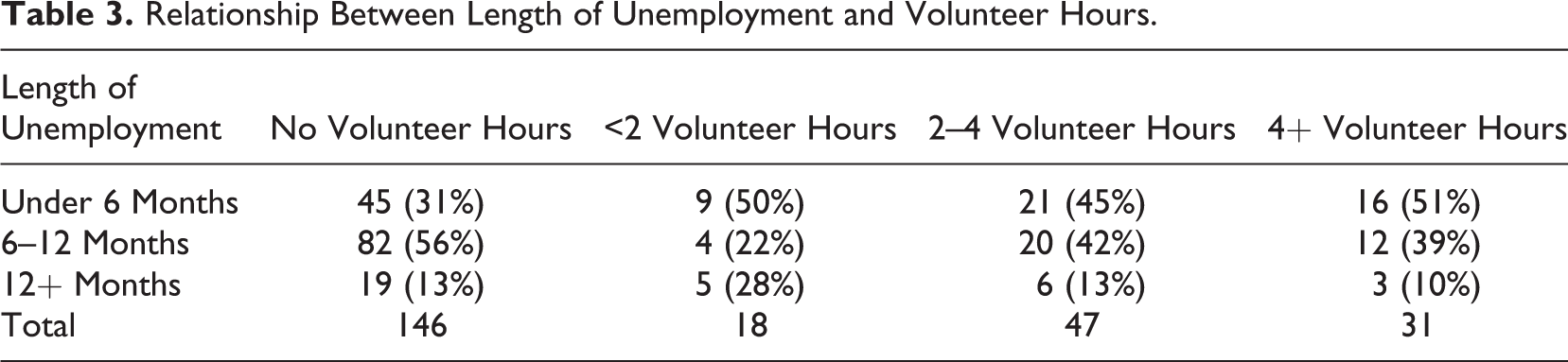
There was also a significant relationship between the length of the participants’ unemployment and the amount of hours they volunteered, χ2(6) = 13.08, p = .042, with frequencies displayed in Table 3. Of the participants who reported zero volunteer hours, 31% reported unemployment lengths of less than 6 months. However, among the participants reporting at least some volunteer hours (i.e. < 2, 2-4 or 4+), the aggregate proportion was significantly larger than those without volunteer hours, 48%, z = −2.66, p = .023.
Relationship Between Length of Unemployment and Volunteer Hours.
Effect of Volunteering on Job Search Strategies
Those emerging adults who reported a greater number of hours committed to volunteering also reported higher levels of exploratory job search strategies, F(3, 261) = 3.32, p = .020. Moreover, those participants who reported 4 or more hours of volunteer work also reported the highest mean scores with respect to exploratory job search strategy (M = 23.3), with lower levels when volunteering 2–4 hours (M = 21.1), <2 hours (M = 19.5), and no volunteer hours (M = 20.7). On the other hand, there was no significant differences with regard to number of volunteer hours for haphazard search strategy, F(3, 261) = 0.61, p = .609, and focused search strategy, F(3, 261) = 0.52, p = .668.
Effect of Volunteering on Those Employed
Analyses were performed on those participants who were currently employed to determine the impact of volunteering on reemployment status with respect to job satisfaction, turnover intent, and needs supply fit. No significant differences were found in job satisfaction levels based on the number of hours of reported volunteer work, F(3, 89) = 0.78, p = .508. Likewise, reported levels of turnover intent, F(3, 89) = 0.34, p = .800, and needs supply fit, F(3, 89) = 0.51, p = .678, were not significantly different based on the reported hours of volunteer work.
Discussion
Although the emerging adults in this study represent a wide range of careers, skillsets, and sociocultural backgrounds, those who elected to volunteer, even for a minimal investment in time (less than 2 hr per week), were more likely to procure employment 6 months later. Although there is no sufficient evidence in the literature supporting the association between volunteering and likelihood of reemployment (Shore & Tashchian, 2013, Wilson, 2000), there are a few studies that highlight the link between these 2 areas of study (Goić & Jeronćić, 2012; Hirst, 2001; Shore & Tashchian, 2013). It has been suggested that the improvement in career development is implicated in the direct link between volunteering and likelihood of employment volunteering (Ellis, 1993) and that the underlying motivations of those individuals who volunteer, such as increasing social contacts and job-related skills, may increase job prospects (Hall et al., 2006; Hodgkinson & Murray, 1996). As suggested by Krieshok and colleagues (2009), individuals who volunteer become engaged with work in ways that are conducive to the development and refinement of vocational and self-schemas and in the process, vocational judgments and decisions become more informed (Krieshok et al., 2009).
Several studies suggest that hope serves an important role not only in propelling volunteer behavior but also in increasing possibilities for the pursuit of graduate degrees and jobs that yield greater monetary compensation (Astin et al., 1998; Wilson & Musick, 2003). Further studies are needed to unpack the relationships between and among hope, volunteering activity, and reemployment status in this population of participants. Despite challenging life circumstances, hope and optimism are characteristics of this generation of emerging adults and likely to inform the behaviors of emerging adults seeking employment (Arnett, 2000; Konstam, 2007, 2013; Murphy, Blustein, Bohlig, & Platt, 2010).
An important finding of this study relates to the number of hours emerging adults volunteer and its relationship to reemployment status. Even a minimal investment in time expenditure (less than 2 hr per week) yielded a greater likelihood of reemployment. This finding suggests that for unemployed emerging adults, only a few volunteer hours per week can make a considerable difference in terms of reemployment outcome. It may be that the shift in the education-to-work model in the United States accounts in part for the results obtained. Tony Wagner (as cited by Friedman, 2013, A21) suggests that education is no longer equated with what one can do on the job; rather demonstrated value in the workplace is key to increasing the likelihood of obtaining employment. “A degree document is no longer a proxy for the competency employers need” and the competencies are not taught in colleges but rather in the workplace (Sharef as cited by Friedman, 2013, A21).
Employers are no longer interested in training potential applicants who may do an outstanding job based on academic promise; rather, they expect applicants to be overqualified and to have demonstrated competence in the jobs they are seeking. Individuals seeking jobs are likely to be rejected for two primary reasons according to Sharef: (1) inability to demonstrate how an applicant will assist and add value to the organization and (2) lack of knowledge regarding what the applicant wants as well as lack of demonstration of skills associated with the job. Volunteering activities provide opportunities for emerging adults to master specific skillsets and to demonstrate proof of competency and value. Employers privilege what a potential employee can do and equally important what the individual can do to reinvent himself or herself in this fluid, fast-paced, evolving marketplace (Sharef as cited by Friedman, 2013, A21). Recent surveys conducted among employers support the above-mentioned assessment; findings emphasize the importance of critical thinking skills, applied knowledge in real-world settings, complex problem-solving abilities, and written and oral communication skills over and above a college degree (Fischer, 2013; Hart Research Associates, 2013).
Emerging adults who volunteered a greater number of hours were more inclined to report the use an exploratory job search strategy. In contrast to our assumptions, volunteering was not related to a focused job search strategy. A number of possibilities may underlie this result. Previous research provides evidence that volunteering increases career-related social contacts (Hall et al., 2006; Hodgkinson & Murray, 1996; Wilson & Musick, 2003) and it is possible that by increasing social contacts, volunteering promotes an open-minded approach toward different careers, hence the use of an exploratory job search strategy. In addition, volunteering may increase career-related information and skills in a variety of job-related areas in a way that broadens, not focuses, the career interests and options for emerging adults seeking employment. The finding that there is no significant relationship between volunteering and haphazard job search strategy can be explained by the possibility that potential employers reject candidates who are unclear about their career goals.
The present findings did not identify a relationship between volunteering and needs supply fit, turnover intentions, or job satisfaction, which collectively refers to reemployment quality. This finding suggests that while volunteering may increase the likelihood of finding a job, volunteer experience does not aid the emerging adult with regard to finding the right job. This finding is consistent with previous findings reported by Koen et al. (2010) suggesting that an exploratory job search strategy, although associated with the increased likelihood of reemployment, is associated with lower reemployment quality. As hypothesized by Koen et al., job seekers using an exploratory job search strategy may be searching for many types of jobs that do not fit their needs. However, the lack of a significant association may be due to the low number of employed participants in the sample of the present study (n = 93), the short duration of employment (all employed participants were employed for less than 6 months), and low reliability of the job satisfaction scale (α = .66).
Implications
A small increase in volunteer hours significantly increased the likelihood of reemployment within 6 months for emerging adults facing unemployment. This finding has important implications for vocational counselors and related personnel working with a growing number of unemployed emerging adults. Volunteering appears to be an efficacious behavioral strategy for emerging adults across a wide range of career-related interests and academic degrees. As Krieshok et al. (2009) suggest engagement with work involves ongoing judgments and periods of reassessment; in the process of engaging with volunteering activities, the emerging adult encounters opportunities for self-appraisal and can determine shifts in interests, values, passions, skills, and priorities. It is important to note that participants in this study were diverse with respect to demographics including race, gender, socioeconomic status, and education level. Volunteering appears to be an effective strategy for emerging adults across cultural and economic contexts.
The finding that volunteering was not associated with an increase in needs supply fit and job satisfaction with reemployment or a decrease in turnover intentions also has important implications. Although vocational counselors and related personnel can encourage emerging adults to engage in volunteering activities, they also need to relay a message of caution with respect to the positive association of volunteer activity with job satisfaction. It is imperative that vocational counselors emphasize the exploration of one’s skills, abilities, and interests in addition to qualities of a position with respect to job satisfaction. Furthermore, emerging adults can be encouraged to volunteer as well as consider the qualities of a job that render it satisfactory to the individual seeking employment. In this way, the individual’s job search efforts can lead to satisfying employment instead of taking an approach whereby the individual simply accepts the first job offer she or he receives.
Limitations and Future Research
Several limitations are worth mentioning regarding the findings of this study. First, the data were collected using self-report measures and therefore may risk the reliability of the findings. In addition, the participants were asked about their current volunteer activity. Their volunteer hours may have been different 6 months or a year prior to the study. Further longitudinal research is warranted to extensively investigate the causal relationships between and among these variables. In addition, data regarding the specifics of the jobs held by the participants was not obtained nor was the length of current employment collected. Information about the jobs held by the participants including whether or not the jobs procured are in fields related to their training, and the degree to which opportunities for growth and promotion exist, would have enhanced this study. The length of current employment would also have enhanced the study by allowing the researchers to consider the relationship between length of current employment and job satisfaction. Additionally, the job satisfaction measures may have a lower reliability due to the short tenure of some of the participants in their current job as all have been employed less than 6 months. The survey also did not collect data regarding the length of time spent on the current job search, which could also be related to our study variables.
The present study identifies volunteering as a valuable activity to be considered in terms of increasing the likelihood of reemployment; we posit possibilities for this important finding and link our findings to the work of career counselors and related personnel, individuals who are in critical positions in terms of informing and counseling emerging adults in the throes of seeking employment in the current marketplace. Future research is needed to determine what aspects of volunteering assist unemployed emerging adults in the reemployment process. By examining factors such as job-related social contacts, increased demonstrated career-related knowledge and skills, and increased use of an exploratory job search strategy, the most significant aspects of volunteering can be identified and implemented and therefore, a more evidence-based approach to counseling emerging adults can occur. Additionally, future research is needed to determine how specific volunteer opportunities interface with specific careers.
The characteristics of the sample serve as another limitation of the present study. The sample consisted of individuals holding a minimum of an associate’s degree, which limits the generalizability of the study findings. Our study would be enhanced by replicating this study with a noncollege sample and comparing these two groups of emerging adults with respect to the impact of volunteering and likelihood of increasing employment prospects.
An additional and final limitation of the study worth noting is that the data were collected via a crowdsourcing marketplace platform, MTurk. The limitations that have been cited regarding this platform include (l) lack of control of the participants’ environment; (2) possibility of a nonrepresentative sample; (3) deceptive responding; and (4) market shifts that influence the sample in the MTurk (Buhrmester et al., 2011). Kahan (2013) suggests that data collected via MTurk are prone to low validity due to selection bias, the possibility of participant’s repeated exposure to the study measures, and misrepresentation of U.S. residents. In order to reduce the potential risks to the validity of the findings, we used two quality control questions to confirm that the participants were reading the items closely. The data received from participants who answered the validity check questions incorrectly were eliminated (n = 12). We also blocked repeated Internet protocol addresses to prevent any one person from completing the survey more than once under different aliases. The survey was open to U.S. residents only in order to limit the sample with respect to generalizability. Furthermore, although Buhrmester et al. (2011) reported that the data collected via MTurk was as reliable as those obtained from traditional methods, further research that eliminates or reduces the inherent limitations of Internet-based data collection is needed to increase the validity and reliability of findings.
Conclusions
Volunteering, even minimally (an hour a week), increased the likelihood of reemployment and led to a greater likelihood of utilizing an exploratory search strategy yet was not related to job satisfaction measures. The use of the exploratory search strategy is not only associated with a higher likelihood of obtaining a job but a higher likelihood of a lower quality job (Koen et al., 2010). For practitioners working with unemployed emerging adults, engaging in volunteering activities appears to be a worthwhile expenditure of time and effort, given the goal of reemployment for emerging adults in a challenging economic environment.
Footnotes
Declaration of Conflicting Interests
The author(s) declared no potential conflicts of interest with respect to the research, authorship, and/or publication of this article.
Funding
The author(s) received no financial support for the research, authorship, and/or publication of this article.