



Abstract
This study analyzed the influence of the occupational context on the conceptualization of career satisfaction measured by the career satisfaction scale (CSS). In a large sample of N = 729 highly educated professionals, a cross-occupational (i.e., physicians, economists, engineers, and teachers) measurement invariance analysis showed that the CSS was conceptualized according to occupational group membership, that is, 4 of the 5 items of the scale showed measurement noninvariance. More specifically, the relative importance, the response biases, and the reliabilities associated with different career satisfaction content domains measured by the CSS (i.e., achieved success, overall career goals, goals for advancement, goals for income, and goals for development of new skills) varied by occupational context. However, results of a comparison between manifest and latent mean differences between the occupational groups revealed that the observed measurement noninvariance did not affect the estimation of mean differences.
Keywords
Career success is an important topic within career research (e.g., Abele, Spurk, & Volmer, 2011; Boehm & Lyubomirsky, 2008; Hall & Chandler, 2005; Ng, Eby, Sorensen, & Feldman, 2005). Most people strive for career success, which is related to many different forms of career-related behavior and well-being, like proactivity, mentoring, networking, organizational learning climate, self-management, mobility, positive affectivity, and life satisfaction (Abele & Spurk, 2009; Boehm & Lyubomirsky, 2008; De Vos & Soens, 2008; Eby, Butts, & Lockwood, 2003; Joo & Ready, 2012; Verbruggen, 2012). Career satisfaction is one central indicator of subjective career success and can be seen as a crucial component of career success in actual labor market generations (cf. Hall & Chandler, 2005; Ng et al., 2005). However, career-related behavior and specifically career success should be investigated and interpreted in a context such as the social one (cf. Gunz & Heslin, 2005; Gunz & Mayrhofer, 2011; Morgeson, Dierdorff, & Hmurovic, 2010). Yet, to date, research that explicitly considers the influence of occupational context on career satisfaction is scarce.
Therefore, the aim of this study was to analyze the influence of the occupational context on the conceptualization of career satisfaction. We tested whether one of the most prominent scales to measure career satisfaction, the career satisfaction scale (CSS, Greenhaus, Parasuraman, & Wormley, 1990), is affected by interpretation and response biases due to occupational group membership. In this study, we will concentrate on four different occupational groups reflecting different occupational contexts, namely, physicians, economists, engineers, and teachers. We decided to analyze these groups because individuals within every single group track relatively unique career paths and work within relatively distinct occupational contexts and socioeconomical environments. In different words, one might expect relatively comparable structural career/occupational conditions within each group but different structural career/occupational conditions between the groups. Moreover, work values and occupational interests are strongly tied to the occupational context in which careers unfold (Holland, 1997; Super, 1970). An occupation-specific work value and interest profile may affect the conceptualization of career satisfaction, as it affects the understanding and interpretation of different career satisfaction content domains. Following, we assumed that the conceptualization of career satisfaction varies by occupational groups. Measurement invariance analysis was applied, as it is a recommended procedure to detect similarities and differences in the conceptualization of psychological constructs, like career satisfaction (e.g., Cheung & Rensvold, 1999; Hofmans, Dries, & Pepermans, 2008). In our case, we tested cross-occupational measurement invariance of the CSS. Such an analysis provides insights into different occupational groups’ responses to the items of the CSS. As the CSS measures varying facets of career success (i.e., achieved success, overall career goals, goals for advancement, goals for income, and goals for development of new skills), this measurement invariance analysis allows to draw conclusions about which, and to what extent, career success content domains are influenced by occupational context.
It is important to note that occupational groups may differ by objective career success (e.g., physicians earn more than teachers or general management earns more than marketing; Abele & Spurk, 2009; Seibert, Crant, & Kraimer, 1999; U.S. Bureau of Labor Statistics, 2013) and that objective career success is positively related to career satisfaction (Judge, Cable, Boudreau, & Bretz, 1995; Ng et al., 2005). Subsequently, one might expect that occupational groups with higher objective career success (e.g., physicians) are more satisfied with their careers than occupational groups with lower objective success (e.g., teachers). However, empirical research repeatedly found less quantitative occupational differences in career satisfaction in comparison to objective career success (Abele & Spurk, 2009; Seibert et al., 1999). Different conceptualizations of career satisfaction between occupational groups might be one explanation. Based on this background, we aimed to explore the influence of occupational differences in the conceptualization of career satisfaction on the occupation-specific estimation of quantitative mean differences in career satisfaction. Consequently, we estimated manifest and latent mean differences between all occupational groups in the study. The latent mean estimations considered different conceptualizations (i.e., measurement noninvariance) of career satisfaction due to the occupational context. Therefore, if manifest and latent mean differences do not differ, then the interpretation of mean differences is not affected by different conceptualizations of career success.
Altogether, this study provides a deeper insight into the influence of the occupational context on career outcomes and knowledge that might be important for theoretical advancements in career research and for the practical work of career counselors. For a better understanding of our hypotheses, we will first give a short overview of relevant theories and research that consider occupational contexts as an important factor for work- and career-related attitudes and behavior. In the following, the technical background of cross-occupational measurement invariance, latent mean differences, and how these methods relate to our hypotheses will be presented.
Career Satisfaction, CSS, and Occupational Context
Career satisfaction as individuals’ idiosyncratic evaluations of their own careers is often seen as one central indicator of subjective career success (Abele et al., 2011; Ng et al., 2005). The CSS measures career satisfaction as the evaluation of an individual’s progress toward meeting different career-related goals (e.g., income, advancement, development, and overall career goals) and global career-related successes (see also Hofmans et al., 2008). Hofmans, Dries, and Pepermans (2008) reported that the CSS has been used in more than 240 studies (Social Sciences Citation Index citations referring to research applications of the measure). In the last years, several more studies have been conducted with the scale (e.g., Francis-Smythe, Haase, Thomas, & Steele, 2013; Guan et al., 2013; Spurk, Abele, & Volmer, 2011). Other researchers called the scale “the best measure available in the literature” for measuring career satisfaction (Judge et al., 1995, p. 497). The CSS is a one-dimensional measure with high reliabilities across reported studies. Moreover, the CSS showed high levels of construct validity and is related to constructs like objective career success, career self-management, or networking behaviors and has been used in cross-sectional, longitudinal, and intervention studies (Abele & Spurk, 2009; Raabe, Frese, & Beehr, 2007; Wolff & Moser, 2009).
Research on career satisfaction has examined different occupational groups across studies. Among others, these groups were comprised of emergency physicians (Pachulicz, Schmitt, & Kuljanin, 2008), teachers (Erdogan & Bauer, 2005), information technology consultants (Tak & Lim, 2008), masters of business administration (Schneer & Reitman, 1997), managers, information technologists, and clericals (Lounsbury et al., 2003). However, to date, differences in the conceptualization of career satisfaction across different occupational groups have not been investigated. Such an investigation is especially important due to the potential influence of different occupational conceptualizations of career satisfaction on quantitative analyses (Steinmetz, Schmidt, Tina-Booh, Wieczorek, & Schwartz, 2009). For example, a study by Lounsbury et al. (2003) analyzed the moderating influence of occupational groups on the relationship between career satisfaction and several other variables, like personality, teamwork, and leadership. However, it remains unclear whether such past findings were affected and whether future findings will also be affected by different conceptualizations of career satisfaction, unless research sheds more light on the measurement invariance question.
To date, there is only little research comprehensively analyzing occupational context within occupational and organizational psychology research, as well as career research (Grant, Fried, Parker, & Frese, 2010; Gunz & Mayrhofer, 2011; Morgeson et al., 2010; Vondracek, 2007). Occupation is described as “a group of work roles spanning multiple organizations that share a similar set of work requirements (e.g., tasks and responsibilities), methodologies, objectives, or worker requirements (e.g., knowledge, skills, abilities)” (Morgeson et al., 2010, p. 352), and occupational context is “the environment surrounding an occupation” (Morgeson et al., 2010, p. 353). In sum, different occupations have their own “cultural” correlates that can be as powerful as the effects typically attributed to organizational or foreign cultures (Morgeson et al., 2010; Steinmetz et al., 2009). Johns (2006, p. 386) defined context as “situational opportunities and constraints that affect the occurrence and meaning of organizational behavior ….”. Furthermore, context, among other manifestations, is an important bundle of stimuli and also a shaper of meaning (Johns, 2006). There are at least three reasons to assume that the occupational context also shapes the conceptualization of career satisfaction.
First, individual work values and occupational interests are strongly tied to the occupational context in which careers unfold (Holland, 1997; Super, 1970). Dawis and Lofquist (1984) speak of six “occupational values” within their theory of work adjustment. Safety reflects occupational contexts that are predictable and stable. Achievement reflects occupational contexts that reinforce accomplishment and utilization of one’s abilities. Comfort reflects occupations that are convenient and low of stress. Autonomy reflects occupations that reward and stimulate creativity and innovation. Status reflects occupations that provide recognition, prestige, and income. Altruism reflects occupations that foster harmony, belongingness, and service to others. A closer inspection of these occupational values and the CSS reveals a considerable overlap in content of occupational values and the CSS items. For example, satisfaction with meeting goals for income obviously overlaps with the occupational value of status. Satisfaction with meeting goals for advancement and development overlaps with the occupational value of achievement. Satisfaction with meeting overall career goals and career-related success can be expected to overlap with several occupational values, like autonomy, or comfort. Hence, a difference in occupational values might affect the conceptualization of career satisfaction across occupational groups. Furthermore, occupational groups are related to Holland’s vocational interests (realistic, investigative, artistic, social, enterprising, and conventional; Holland, 1997). Different interest profiles, again, might affect the conceptualization of career satisfaction because of a shift in the relative importance of career success content domains tapped by different items of the measurement.
Specifically, the analyzed occupational groups in our study differ by their Holland’s interest code (physicians: social, investigative, and realistic; economists: investigative, conventional, and enterprising; electrical engineering technologists: realistic, investigative, and conventional; teachers: social, artistic, and enterprising; O*NET, 2014), as well as by their occupational values (physicians: achievement, recognition, and independence; economists: working conditions, independence, and achievement; electrical engineering technologists: support, working conditions, and achievement; teachers: relationships, achievement, and working conditions; O*NET, 2014). First named interests, or values, represent a higher importance. Consequently, every occupation in our study has its occupation-specific interest and value profile.
Besides values and interests, occupational context is assumed to affect work design characteristics, like task variety or task autonomy (Morgeson et al., 2010). Work design characteristics in turn affect personal characteristics like personal control or self-efficacy (Frese, Garst, & Fay, 2007). Also, longitudinal research has shown that specific occupational experiences, like career success, occupational attainments, work autonomy, work stimulation, work involvement, resource power, and financial security shape personality and self-concept in the early career stages (Roberts, Caspi, & Moffitt, 2003; Sutin & Costa, 2010). These specific personal characteristics in turn may also affect the conceptualization of career satisfaction by means of different cognitive and emotional interpretations when evaluating CSS items about the progress of career goals and career content domains.
Third, career success theories (Dries, Pepermans, & Carlier, 2008; Gunz & Heslin, 2005; Hall & Chandler, 2005) assume that the conceptualization of career satisfaction is a contextualized phenomenon. As occupations are vehicles for a budding career (Arthur, Hall, & Lawrence, 1989), the occupational context can be seen as one source of differences in structural career characteristics, like employment qualities, speed and opportunities of promotions, salary growth, regular developmental/career stages, and required career skills/abilities. This, subsequently, shapes an individual’s conceptualization of career satisfaction. For example, under conditions of high employment security, items about career progress might be interpreted differently than under conditions of low employment security because of different future career perspectives.
In sum, we assume that the conceptualization and measurement properties of the CSS vary in dependence of occupational context. For a better understanding, before explicitly stating our hypotheses, we will refer to the concepts and methods of measurement invariance and latent mean differences.
Cross-Occupational Measurement Invariance and Latent Mean Differences
Measurement invariance can be described as the degree to which measurements conducted under different conditions show identical psychometric properties (Cheung & Rensvold, 1999). In cross-group measurement invariance analyses, these different conditions refer to the different groups involved in a study. If these groups are related to occupational group membership, it can be named cross-occupational measurement invariance (i.e., tests for occupational context effects). By placing equality constraints on specific model parameters, three different forms of measurement invariance can be tested. Two of these forms, namely weak and strong measurement invariance, provide a test of the conceptualization of the underlying construct (Cheung & Rensvold, 1999; Hofmans et al., 2008). Weak invariance implies equal factor loadings across occupational groups. Equal factor loadings indicate that the occupational groups calibrate the measure (i.e., the CSS) in the same way. Hence, the values on the manifest scale have the same meaning across groups (Vandenberg & Lance, 2000). Weak invariance also tests whether all content aspects of the construct have the same relative importance in all occupational groups (Steinmetz et al., 2009). Specifically, in our case of career satisfaction, weak invariance would mean that the conceptualization of the construct does not vary across the occupational context and that the items of the CSS show the same relative importance across occupational groups (Steenkamp & Baumgartner, 1998).
Strong invariance answers the question if pronounced response biases in a particular occupational group are evident when answering the CSS (Cheung & Rensvold, 1999). Item intercepts can be interpreted as systematic biases in the responses of a group to an item. As a result, the manifest mean can be systematically higher or lower (upward or downward biased), than one would expect, based on the groups’ latent mean and factor loadings. In our case, answering the items representing career satisfaction may be systematically biased by the occupational context. In other words, the strict invariance test verifies whether occupational groups use different (self-set) anchors for their satisfaction evaluations. Strong invariance is present if the degree of upward or downward bias of the manifest variable is equal across groups.
The third form, strict invariance, tests whether the reliabilities, and therefore the precision of measurement of the single items, are equal across all occupational groups. Thus, a test of strict invariance answers our question, whether some aspects of career satisfaction (e.g., income and development) are measured equally precisely across the occupational contexts (Hofmans et al., 2008). Based on the above theoretically explained influence of the occupational context on career success, we state the following hypotheses:
Next to the stated hypotheses, the study’s aim is to exploratively investigate whether manifest mean comparisons are affected by different occupational conceptualizations of career satisfaction. The validity of testing group differences in manifest scores depends on the accuracy of the assumptions underlying such comparisons. Specifically, both, the factor loadings, and the item intercepts, have to be equal (i.e., weak and strong invariance) because manifest mean differences can be caused either by a latent mean difference or a difference in the loadings, intercepts, or both (Millsap & Everson, 1991). Our study tests whether weak or strong deviations from measurement invariance affect occupational mean differences in career satisfaction, that is, by comparing the results of a latent with a manifest mean difference analysis.
Method
Sample
This study is part of a larger prospective longtime project about the career development of academics in different occupational fields. The main objective was to analyze processes associated with career success, work–life balance, and life satisfaction. More specifically, we tested our hypotheses with data of a large sample of professionals who had graduated from a German university in 1995. Due to address protection reasons, we were not allowed to send out the first questionnaire ourselves. Instead, the university’s graduation office sent (or gave) it to the graduates. Participants were asked to complete and return the questionnaire together with their addresses because of future participation reasons in the study. At this first measurement point, the response rate of sent questionnaires in relation to received questionnaires was 46%. Participants were representative with respect to gender, age, and grade point average within the studied occupational groups in Germany. As incentives, a lottery drawing and a short overview of descriptive results of the study was provided.
Career satisfaction was measured 15 years after graduation (Wave 6 of the study project). We decided to analyze a point in time in which occupational socialization is vastly completed, and consequently, the effect of occupational context on the conceptualization of career satisfaction was assumed to be at its optimum. The sample comprises physicians (N = 160, 43.80% women), economists (N = 174, 36.80% women), engineers (N = 198, 8.60% women), and teachers (N = 197, 62.90% women). The total sample consisted of 729 participants (37.70% women; response rate in relation to invited participants at this measurement point: 83%; drop-out rate in relation to first measurement point at graduation: 47.21%). The mean age was M = 42.07 (standard deviation [SD] = 2.19), participants worked M = 35.21 (SD = 11.73) hr per week. A drop-out analysis comparing the present sample with the initial sample at Wave 1 revealed the same distribution of gender and study major. Further, there were no differences with respect to grade point average and age.
Occupational Groups
We decided to analyze the present occupational groups, as individuals within every single group follow relatively unique career paths, and work within relatively distinct occupational contexts, and socioeconomical environments. In other words, we expect relatively comparable structural career/occupational conditions within each group, but different structural career/occupational conditions between the groups.
In Germany, after graduation, physicians usually work as assistant physicians within a hospital, with the goal to become a medical specialist. After the completion of the medical specialist (usually 3–5 years), they mostly either work in the hospital or become a practitioner in a private practice. In both cases, physicians usually earn high salaries and have bright career perspectives in Germany. Main occupational tasks of all physicians are diagnosing, treating, or providing continuous care to patients (O*NET, 2014).
Economists usually work in the industry with good career growth opportunities in the sense of traditional upward mobility careers. Typical tasks of economists are studying economic and statistical data in certain fields, such as finance, labor, or agriculture. Furthermore, they compile, analyze, and report data to explain economic phenomena and forecast market trends, applying mathematical models, and statistical techniques (O*NET, 2014).
Engineers typically work in the industry after graduation. They have positive career and secure employment opportunities. Electrical engineering technologists, for example, diagnose, test, or analyze the performance of electrical components, assemblies, or systems. They review electrical engineering plans, to ensure adherence to design specifications, and compliance with applicable electrical codes and standards (O*NET, 2014).
After university graduation, teachers typically finish an occupational internship, called “second state examination,” in Germany. After 1–2 years of occupational internship, teachers usually work as full-time teachers in public service organizations, like primary, middle, or secondary schools. These employments are secure, but restricted to upward mobility, in terms of salary or promotions. Main tasks of teachers are to establish and enforce rules for behavior and procedures for maintaining order among students. Additionally, they instruct through lectures, discussions, and demonstrations in one or more subjects, such as English, mathematics, or social studies (O*NET, 2014).
Measure
Career satisfaction was measured by the CSS (Greenhaus et al., 1990; Cronbach’s αoverall sample = .90, Cronbach’s αphysicians = .92, Cronbach’s αeconomists = .92, Cronbach’s αengineers = .89, Cronbach’s αteachers = .88). We used a German version of the scale that showed good psychometrical properties and construct validity in other studies (e.g., Abele & Spurk, 2009; Wolff & Moser, 2009). In all analysis, the items are used as follows in the same consecutive order: I am satisfied with the success I have achieved in my career. I am satisfied with the progress I have made toward meeting my overall career goals. I am satisfied with the progress I have made toward meeting my goals for income. I am satisfied with the progress I have made toward meeting my goals for advancement. I am satisfied with the progress I have made toward meeting my goals for the development of new skills.
Data Analysis and Hypotheses Testing
To test our Hypotheses 1–3, we began with examining cross-occupational measurement noninvariance, in order to evaluate whether occupational groups differ in their conceptualization of career satisfaction. Second, we compared manifest and latent mean differences. The latent mean differences are based on the measurement models that may account for measurement noninvariance. Hence, with these analyses, we evaluate whether occupational group differences in the conceptualization of career satisfaction affect quantitative mean differences between the occupational groups. All latent analyses were performed with Mplus version 7 (Muthén & Muthén, 1998–2013).
Cross-occupational measurement invariance
Prior to applying any invariance constraints, we estimated a baseline model to test the stability of the CSS’s factorial structure across occupational groups (configural invariance, see Byrne, Shavelson, & Muthén, 1989; Vandenberg & Lance, 2000). Consequently, we modeled one latent factor (CSS) in each occupational group. Support for this baseline model also signals the absence of major differences in the number of conceptualized factors/dimensions of career satisfaction across the analyzed groups. After testing configural invariance, further constraints test for different, increasingly restrictive assumptions of cross-occupational measurement invariance (Hypotheses 1–3).
First, for testing weak invariance (Hypothesis 1), we constrained the factor loadings to be equal across occupational groups. A χ2 difference test was conducted to test whether the factor loading–constrained model differs significantly from the baseline model. Second, based on the weak invariance model, we constrained the intercepts to be equal across occupational groups to evaluate strong invariance (Hypothesis 2). A nonsignificant χ2 difference test between the baseline and strong invariance models indicates that intercepts are invariant over time. In a next step, we tested strict invariance (Hypothesis 3). Based on the strong invariance model, we constraint the residual variances of the same indicators to be equal across occupational groups. A nonsignificant χ2 difference between the baseline and strict invariance models indicates that item uniqueness is invariant over time, satisfying strict invariance. In the latter case, the reliabilities for all items remain the same across occupational groups (Wu, Chen, & Tsai, 2009). As our hypotheses postulate measurement noninvariance, significant χ2 difference tests in the described measurement invariance analysis would provide support for our Hypotheses 1–3.
Finally, again, by means of a χ2 difference test, we tested for the same CSS factor variances across occupational groups, as this represents a common test in measurement invariance analysis. Unequal factor variances, again, would provide support for a different conceptualization of career satisfaction due to occupational context (Cheung & Rensvold, 1999).
The performed measurement invariance approach is shown in Figure 1 (in the following, we use Greek letters as abbreviations of the tested model parameters: σ2 = variances, µ = means, λ = factor loadings, ∊ = residual variances, and τ = intercepts). If some, but not all items show measurement invariance, we will speak of partial measurement invariance (or noninvariance). To provide statistics for the overall fit of the final model to the empirical data, we calculated, as recommended in the structural equation literature (e.g., Bollen, 1989), the comparative fit index (CFI; values above 0.95 indicate a very adequate model fit), the root mean square error of approximation (RMSEA; values below .05 indicate a very adequate model fit), and the standardized root mean square residual (SRMR; values below .05 indicate a very adequate model fit). CFI differences were used as additional test for measurement invariance. CFI differences of equal or more than 0.002 indicate measurement noninvariance between groups (Meade, Johnson, & Braddy, 2008).

Cross-occupational measurement invariance modeling approach.
Latent and manifest mean differences across occupational groups
To analyze the influence of cross-occupational measurement noninvariance on CSS mean comparisons, we compared latent means with manifest means. The latter was executed by using a one-factorial analysis of variance (ANOVA) to test for manifest mean differences between the occupational groups regarding career satisfaction. These results were compared with the results from a latent mean difference analysis, using the data matrix resulting from the final model in the above conducted invariance analysis (cf. Vandenberg & Self, 1993). In the latent mean difference analysis, two models were estimated. In the first model, latent means were freely estimated, whereas in the second model, all latent means were constrained to be equal across occupational groups. Then, the models were compared by means of a χ2 difference test, in which a significant deterioration in fit would result in the rejection of the assumption of equal latent means. This test is analogous to the omnibus F-test of the one-factorial ANOVA; however, in our analysis, this test is taking interpretation or response biases due to occupational group membership into account. Expressed differently, if latent and manifest mean differences are equal—despite measurement noninvariance—the interpretation of mean differences is valid, in spite of a different, occupational context-specific conceptualization of career satisfaction.
Results
Cross-Occupational Measurement Invariance
Results of the model comparisons and fit indices of the tested models in the cross-group invariance analysis are shown in Table 1.
Competing Model Fits for Cross-Occupational Measurement Invariance Tests.

Note. N = 729. CFI = comparative fit index; RMSEA = root mean square error of approximation; SRMR = standardized root mean square residual. All models are compared to the configural invariance model; model comparisons indicate weak, partial, and strict occupational measurement noninvariance; aWeak invariance was relaxed on Item 2 (engineers), Item 3 (teachers), Item 4 (economists and teachers), and Item 5 (teachers). bStrong invariance was relaxed on Item 2 (economists), Item 3 (teachers), and Item 5 (economists and teachers). cStrict invariance was relaxed on Item 2 (physicians), Item 3 (economists), Item 4 (economists), and Item 5 (economists and teachers). *p < .05. **p < .001.***p < .001.
The baseline model (configural invariance) had a satisfactory model fit (χ2 = 39.69, df = 20, CFI = 0.99, RMSEA = .07, SRMR = .02), indicating that a one-factorial solution represents the data across all occupational groups well. A closer look at the χ2 value contributions from each group in relation to the overall χ2 value confirmed that the one-factorial structure is adequate across all groups (χ2 values: physicians = 14.10, economists = 6.66, engineers = 8.45, teachers = 10.47). The test of weak invariance showed that the weak invariance model differed from the baseline model, Δχ2(12) = 22.25, p < .05, supporting Hypothesis 1. Therefore, we applied the recommended backward method and relaxed the equality constraints of some factor indicators, as suggested by the model modification indices (Wu et al., 2009). The resulting unstandardized factor loadings, item intercepts, and residual variances of the final and best fitting model are shown in Table 2. Altogether, the unstandardized factor loadings ranged from 0.56 to 1.16 (standardized factor loadings from 0.54 to 0.94), all ps < .001; the intercepts ranged from 3.67 to 4.09, all ps < .001; and the residual variances of the factor indicators ranged from 0.09 to 0.65, all ps < .001. The estimations of all factor loadings were above 0.40, as recommended in structural equation literature (Bollen, 1989).
Factor Parameters of the Career Satisfaction Scale Across Four Occupational Groups.
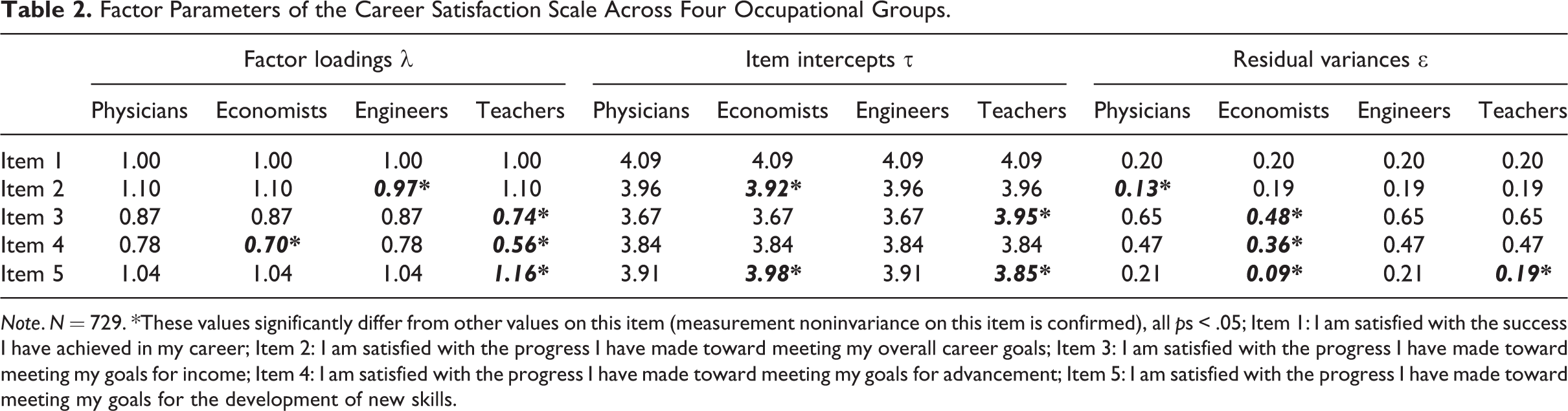
Note. N = 729. *These values significantly differ from other values on this item (measurement noninvariance on this item is confirmed), all ps < .05; Item 1: I am satisfied with the success I have achieved in my career; Item 2: I am satisfied with the progress I have made toward meeting my overall career goals; Item 3: I am satisfied with the progress I have made toward meeting my goals for income; Item 4: I am satisfied with the progress I have made toward meeting my goals for advancement; Item 5: I am satisfied with the progress I have made toward meeting my goals for the development of new skills.
Engineers (λ = 0.97) showed lower factor loadings on Item 2 (satisfaction with progress of meeting overall career goals) than the other three groups (λ = 1.10). In other words, the engineers attributed relative less importance on meeting overall career goals in their conceptualization of career success than the other tested occupational groups. The group of teachers (λ = 0.74) showed a lower factor loading on Item 3 (satisfaction with progress of meeting goals for income) than the other three groups (λ = 0.87), and hence, attributed relatively less importance to income-related aspects in interpreting career satisfaction. Economists (λ = 0.70) and teachers (λ = 0.56) showed lower factor loadings on Item 4 (satisfaction with progress of meeting goals for advancement) than the other two groups (λ = 0.78). Meaning, compared to the other two groups, the conceptualization of advancement within career satisfaction is less important. Moreover, teachers attributed relatively less importance to this career success content domain than engineers. Finally, teachers (λ = 1.16) showed a higher factor loading and relative importance on Item 5 (satisfaction with progress of meeting goals for development) compared to the other three groups (λ = 1.04). In sum, partial weak invariance across occupational groups was observed, Δχ2(6) = 0.05, ns.
The full strong, Δχ2(27) = 48.27, p < .01, as well as the full strict, Δχ2(41) = 83.65; p < .001, invariance models yielded significantly worse χ2 values in comparison to the baseline model, and therefore, supporting Hypotheses 2 and 3. Having applied the backward method in the strong invariance test, the relaxed constraints were related to lower values of the intercept of Item 2 (satisfaction with progress of meeting overall career goals) for economists (τ = 3.92) compared to the three other groups (τ = 3.96). This means that economists answered the overall career goal questions more downward biased than the other occupational groups. Teachers (τ = 3.95) had a higher intercept on Item 3 (satisfaction with progress of meeting goals for income) compared to the other three groups (τ = 3.67). Furthermore, teachers (τ = 3.85) had a lower, and economists (τ = 3.98) had a higher intercept on Item 5 (satisfaction with progress of meeting goals for development of new skills) compared to the other two groups (τ = 3.91). Therefore, teachers’ expression of career satisfaction related to income/development was more upward/downward biased than in the other groups. Economists have a downward tendency in biasing their answers on skill development aspects compared to the other occupational groups. Finally, teachers’ answers with regard to the progress of meeting goals for development of new skills were more downward biased than the answers of economists. In sum, partial strong invariance across occupational groups was observed, Δχ2(17) = 8.04, ns.
Regarding strict invariance, the equality constraints related to the residual variances of Item 2 (satisfaction with progress of meeting overall career goals) had to be relaxed due to lower values of physicians (∊ = 0.13) compared to the other three groups (∊ = 0.19). On Items 3 and 4, lower values emerged for economists (Item 3: ∊ = 0.48 and Item 4: ∊ = 0.36) compared to the three other groups (Item 3: ∊ = 0.65 and Item 4: ∊ = 0.47), and on Item 5, lower values emerged for economists (∊ = 0.09) and teachers (∊ = 0.19) compared to the two other groups (∊ = 0.21). Economists had lower values than teachers as well. A lower residual variance is related to higher reliability of the item. Consequently, items with lower residual variances measured the associated aspects of career satisfaction more precisely and less error prone. In sum, partial strict invariance across occupational groups was observed, Δχ2(27) = 14.54, ns.
Finally, factor variances for the CSS were not constant across occupational groups, Δχ2(3) = 6.35, p < .10. Physicians (σ2 = 0.88) had a higher CSS factor variance than the other three groups (σ2 = 0.66). As stated previously, different factor variances are a further test for different conceptualizations of a construct. Therefore, this finding confirms our basic assumption of different conceptualizations of career satisfaction across occupational groups.
As stated previously, we did not solely rely on χ2 difference statistics to evaluate measurement invariance. We analyzed CFI differences as additional indicator for measurement invariance (see Table 1). All CFI differences between the full invariant models and the baseline model were greater than .002 and therefore, confirm the results of the χ2 difference tests (cf. Meade et al., 2008).
Latent and Manifest Mean Differences Across Occupational Groups
For a stricter test of the influence of the above found partial weak, strong, and strict invariance of the CSS on quantitative mean differences between the occupational groups, we compared latent and manifest mean difference patterns between all studied occupational groups. Latent and manifest means and standard errors of the CSS separated by occupational group membership, as well as latent and manifest occupational group differences are shown in Table 3.
Latent Means, Manifest Means, Standard Errors, and Matrix of Latent Mean Differences and Manifest Mean Differences of Career Satisfaction Across Four Occupational Groups.
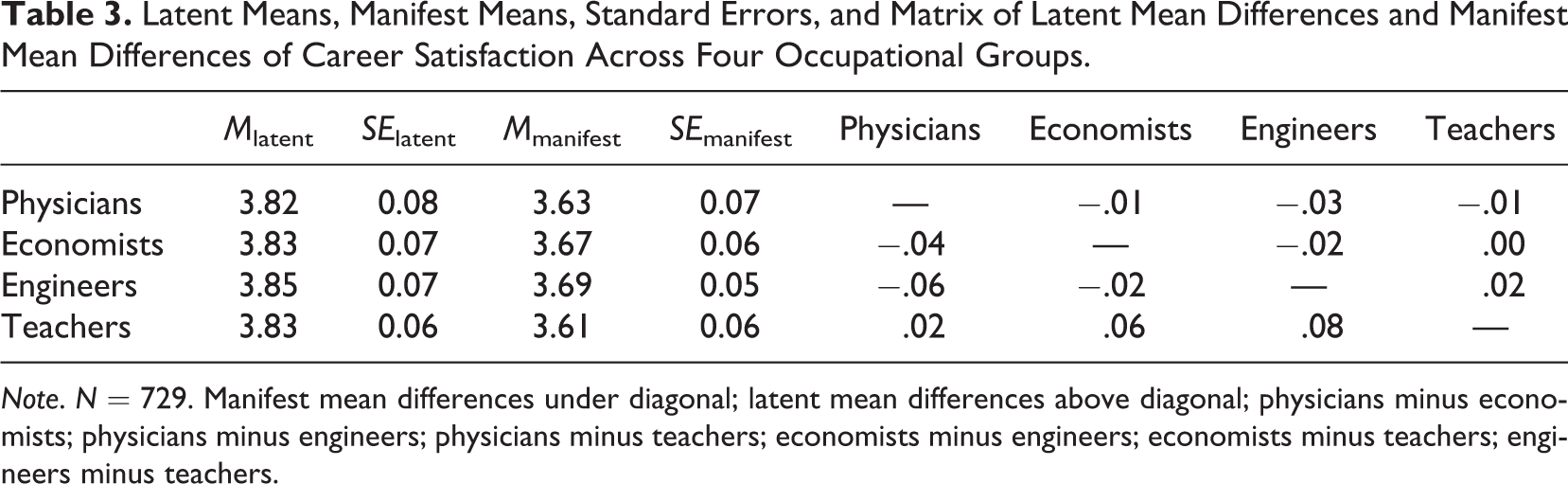
Note. N = 729. Manifest mean differences under diagonal; latent mean differences above diagonal; physicians minus economists; physicians minus engineers; physicians minus teachers; economists minus engineers; economists minus teachers; engineers minus teachers.
A closer inspection of Table 3 indicates that the latent CSS means are slightly higher than the manifest CSS means (latent Ms: 3.82–3.85; manifest Ms: 3.61–3.69). However, more interesting and indicative for the studied research question is the latent and manifest difference pattern. Altogether, the difference pattern is relatively stable across latent and manifest mean differences (manifest mean differences: −.06 to .08, latent mean differences: −.03 to .02). Both mean difference tests, the ANOVA for manifest mean differences, F(3) = .35, ns, and the χ2 difference test for latent mean differences, Δχ2(3) = 1.50, ns, were nonsignificant. In sum, neither analyzing manifest nor latent means reveals mean differences in career satisfaction between the studied occupational groups of physicians, economists, engineers, and teachers.
Discussion
Replying to recent calls by organizational and career researchers to pay more attention to occupational and career contexts (Gunz & Mayrhofer, 2011; Morgeson et al., 2010; Vondracek, 2007), the aim of this study was to analyze the influence of the occupational context on the conceptualization of career satisfaction, measured by the CSS. Therefore, we first analyzed whether the CSS shows cross-occupational measurement invariance (i.e., physicians, economists, engineers, and teachers). Second, we compared manifest and latent mean differences to investigate whether estimated occupational group differences are affected by interpretation or response biases of the CSS. As predicted, the CSS factor loadings, factor indicator’s intercepts, and factor loading’s residual variances differed by occupational group membership. Results of a latent mean analysis revealed no CSS mean differences between occupational groups. However, and even more interesting, the observed deviations from measurement invariance, that is, different conceptualizations of the scale by different occupational contexts, did not affect the cross-occupational mean stability in career satisfaction.
Occupational Context and the Conceptualization of Career Satisfaction
We found weak measurement noninvariance of the CSS across occupational groups. Therefore, technically speaking, the intervals of the scale are calibrated in different ways (Lievens, Anseel, Harris, & Eisenberg, 2007). In other words, the different aspects of career satisfaction, as conceptualized by the different items of the CSS (e.g., income, advancement, and overall success), do not have the same relative importance across the occupational groups. Four of the 5 items varied considerably, and three of the four occupations interpreted at least 1 item differently than the other occupations. Together with the finding that the CSS factor variance of physicians is also noninvariant from the other three groups, we draw the conclusion that career satisfaction does differ in its conceptualization across the occupational contexts analyzed in our study.
Besides confirming weak measurement noninvariance, we also confirmed strong measurement noninvariance across occupational groups. However, as in the weak invariance analysis, partial strong measurement noninvariance describes the findings best. Technically, differences in intercepts can occur because of an upward or downward measurement bias in the content domain measured by the specific item (Steenkamp & Baumgartner, 1998). Hence, the items of the CSS are differentially conceptualized by occupational context. Three of the 5 item intercepts varied considerably, and two of the four occupations biased at least 1 item differently, compared to the other occupations, when answering the CSS.
Results on strict measurement noninvariance provide a further impression of how occupational context effects are represented on an empirical level. Due to residual variances of the items differing by occupational context, the CSS measures career satisfaction with varying reliability, and therefore, with varying precision. For example, the lowest residual variance for Item 2 (satisfaction with meeting overall career goals) for physicians makes the latter more reliable and less error prone for physicians than in the three other occupational groups. Interestingly, the majority of the CSS items, namely Item 3 (satisfaction with progress of meeting goals for income), Item 4 (satisfaction with progress of meeting goals for advancement), and Item 5 (satisfaction with progress of meeting goals for development of new skills) are most reliable in the group of economists.
The results suggest that satisfaction with global success achieved in the career—Item 1 was the only full invariant item on all tested parameters—is most stable interpreted across occupational contexts. This item also does not include goals as a basis for evaluation. This supports the argument that referring to idiosyncratic goals, as part of the item wording, leads to invariance that might not be related to objective career experiences. Thus, it might be important for various research purposes to measure individual career goals or values as additional parameter when analyzing career satisfaction.
Different work values between occupational groups are one explanation for the occupational context to affect the conceptualization of career satisfaction (Dawis & Lofquist, 1984; Dierdorff & Morgeson, 2013). A closer inspection of the results revealed that certain items were differently interpreted or biased in occupational groups, in which related values have differed from other occupational groups in past research. For example, social occupations (e.g., teachers) normally value prestige, status, and achievement less, and development of new skills more than other occupations (Knafo & Sagiv, 2004; Super, 1970; Zytowski, 1994). This is one explanation why teachers showed other interpretations on the respective items about income, advancement, and the development of new skills. Interestingly, teachers showed relative lower/higher importance on income/development of new skills, but at the same time, their answers on these items were more/less biased.
The results of the measurement invariance analysis fit well into theoretical approaches that career success is (a) a “subjectivistic” and (b) a contextualized construction (Abele et al., 2011; Gunz & Heslin, 2005). Our study shows that occupational context affects important career outcomes and therefore supports the meaning of careers as occupations (Arthur et al., 1989). Experiences, stimuli, and roles associated with career paths within an individual’s occupation have the potential to affect the collectivistic conceptualization of career satisfaction within the occupational group.
Across all conducted measurement invariance tests, an explanation for the finding that not all items were noninvariant on a paired comparison between all studied occupational groups might be that the analyzed occupational groups also share some common characteristics. All analyzed groups were highly educated and held a university degree. All participants graduated from the same university, so that the educational socialization process those participants were confronted with over several years might explain partially invariant interpretations of career satisfaction. Finally, many participants stayed in the region of their university after graduation, so that the participants within all occupational groups were also homogeneous with respect to geographical or regional “cultures” and therefore, shared also common bundles of stimuli that might have shaped their common conceptualization of career satisfaction (Johns, 2006).
We only know of two other studies that were concerned with the measurement invariance of the CSS. Hofmans et al. (2008) found that men and women tend to interpret the CSS differently. However, Spurk, Abele, and Volmer (2011) showed that the CSS is rated relatively stable over a 5-year time span. Findings from existing studies and this study suggest that the conceptualization of career satisfaction varies more across gender and occupational groups than over time.
Mean Differences Between Occupational Groups
One main finding of our study was that the manifest mean difference tests were confirmed in the latent mean difference analysis. Consequently, mechanisms underlying the conceptualization of career satisfaction are more strongly related to occupational contexts than the comparisons of quantitative mean differences. This finding provides evidence that quantitative findings about career satisfaction and occupational groups from other studies (e.g., Abele et al., 2011; Lounsbury et al., 2003; Seibert et al., 1999) are valid and not biased by different occupational conceptualizations of the underlying construct. Interestingly, our results suggest that the somehow paradox findings of occupational differences in objective career success, but not in career satisfaction (e.g., Abele & Spurk, 2009; Seibert et al., 1999), cannot be explained by different conceptualizations of career satisfaction.
The finding that occupational groups do not differ in the level of career satisfaction can be explained theoretically. Although career satisfaction is a so-called self-referent subjective success measure, that is, individuals evaluate their career success in relation to self-set standards, one might argue that occupational contexts nonetheless set occupational standards, which can be used to evaluate the progress of one’s own career goals (e.g., Heslin, 2005). These standards may differ between occupations; however, evaluations of individuals are equally distributed around this occupational standard (i.e., speed of progress and typical steps associated with career progress within the occupation). Moreover, none of the studied occupational groups in our study can be regarded as underprivileged with respect to employment opportunities or career development. At the time the study was conducted, secure employments with positive career perspectives could be expected for all studied groups. Consequently, employment rates and times did not differ within our sample. It might be that a mean comparison of privileged (e.g., academics) versus less privileged (e.g., low educated) groups might result in more pronounced mean differences.
The finding that manifest and latent mean differences do not differ between occupational groups can also be explained methodologically. Strictly speaking, weak invariance is a necessary precondition for all quantitative analyses, and strong invariance is a necessary precondition for the analysis of latent mean differences (Steinmetz et al., 2009). However, other researchers already stated that patterns of partial measurement invariance may be a sufficient basis for quantitative analyses (Byrne et al., 1989; Steinmetz et al., 2009). Put together, although the conceptualization of career satisfaction is affected by occupational context, the interpretation of mean differences was not affected.
Practical Implications
Our results illustrate that career satisfaction has its own idiosyncratic conceptualization within occupational groups. Hence, we recommend career counselors to not assume that clients from different occupational and career contexts understand items of the scale in the same way. Aspects of career satisfaction might be differentially important in dependence of a client’s occupational group membership. Occupation-specific norms should be developed when interpreting career measurements related to career satisfaction. Alternatively, career goals or values that might be the basis for self-referent career success judgments should be measured to provide a better guidance within career counseling.
One other important practical implication from this study is that although the conceptualization of career satisfaction is affected by occupational context, the CSS can be used as an outcome measure in solely quantitative cross-occupational career intervention programs (e.g., Raabe et al., 2007), as different conceptualization (i.e., qualitative shifts/measurement noninvariance) did not affect quantitative mean comparisons between the analyzed groups.
Finally, as Hofmans et al. (2008) suggest, the applied researcher might consider the possibility to adapt the CSS or develop other measures of career satisfaction. Our results suggest that the global and career goals independent item, regarding employees’ satisfaction with their career success, did not differ by occupational context. Therefore, future investigations focusing on occupational group differences in career satisfaction might use extensions of this item formulation to measure career satisfaction unbiased by occupational context.
Limitations and Future Research
Besides various strengths, our study has some limitations to be considered in interpreting the reported results. We used a large sample with four relatively homogeneous and at the same time distinct occupational groups. However, all analyzed occupational groups held a university degree and graduated from the same university. Even though the applied design controls for confounding variables possibly affecting the conceptualization of career satisfaction (e.g., education- or university-specific socialization), future studies should clearly expand the analyzed occupational groups in (a) number, (b) different levels of education, and (c) different types of occupational training.
Our study provided a very differentiated and profound analysis of main effects of the occupational context on measurement properties and mean differences of the CSS. However, the occupational context may also play a crucial role as a moderating variable (Morgeson et al., 2010). For instance, the relationship between career satisfaction and other variables such as personality, or other types of career success, might be moderated by occupational context. A study by Lounsbury et al. (2012) found no noteworthy differences in the correlation pattern of career satisfaction and personality between scientists and employees in the industry. Abele, Spurk, and Volmer (2011), however, illustrated that income was only related to career satisfaction in the industry and self-employment sector, but not in the public service sector. Steinmetz, Schmidt, Tina-Booh, Wieczorek, and Schwartz (2009) argued that weak invariance is a necessary precondition in such analyses. Although the results of our study suggest such analyses should not necessarily be affected by different conceptualizations of career satisfaction, further studies should be conducted.
Occupational context is not the only context potentially related to the conceptualization of career success. Subsequently, future studies about career satisfaction or career success should analyze the role of further important contextual influences, such as culture or organization.
Finally, the CSS is not the only possibility to measure subjective career success or career satisfaction. Further studies are recommended to test the measurement invariance of other measures (e.g., career satisfaction: Lounsbury et al., 2003 or Martins, Eddleston, & Veiga, 2002; perceived career success: Turban & Dougherty, 1994; other-referent career subjective success scales: Heslin, 2005) to derive a more comprehensive picture about the influence of occupational context on subjective career evaluations.
Conclusion
This study analyzed the influence of the occupational context on the conceptualization of career satisfaction, measured by the CSS. Cross-occupational measurement invariance analyses revealed the CSS to be partially conceptualized differently between physicians, economists, engineers, and teachers. However, the stability of the quantitative mean differences of the CSS was not affected by different occupational conceptualizations of the CSS. In sum, this study shows that occupational context is a crucial variable within career success research and affects subjective career evaluations meaningfully. Therefore, researchers and career counselors should analyze individual careers as contextualized phenomenon and not independently from situational factors. Researchers should carefully investigate whether different occupational conceptualizations of career satisfaction do have an impact on the interpretation of the results of other research questions or not.
Footnotes
Declaration of Conflicting Interests
The author(s) declared no potential conflicts of interest with respect to the research, authorship, and/or publication of this article.
Funding
The author(s) disclosed receipt of the following financial support for the research, authorship, and/or publication of this article: The present research was supported by a grant from the German Research Council to the second author (AB 45/8-1/2/4/6)