




Abstract
This study tested for the measurement equivalence of a four-factor measure of career indecision (Career Indecision Profile-65; CIP-65) in U.S. and South Korean samples. The study was conducted in three phases. In the first phase, we tested the measurement equivalence of the CIP-65 with samples of participants from the United States (n = 488) and South Korea (n = 574). Finding a lack of evidence for configural invariance, we randomly split the South Korean sample to establish a version of the CIP-65 that would better fit the South Korean data. First, we conducted an exploratory factor analysis on data collected from 200 participants. A five-factor model of career indecision emerged that contrasted with our four-factor model. Second, we tested the five-factor structure by conducting a confirmatory factor analysis on data collected from 374 participants. The results revealed that the five-factor model fit the data well. Implications from these findings for counseling and future research are discussed.
Career indecision has been of interest in vocational research and career counseling for the last 40 years. Understanding the sources of career indecision is an important goal because it may allow counselors to better match their counseling strategies to the major sources of their clients’ decision-making problems (see Brown & Ryan Krane, 2000; Rounds & Tinsley, 1984). Career indecision has been linked to a number of other constructs such as anxiety proneness and other traits (e.g., neuroticism), states (e.g., choice anxiety), interpersonal conflicts, and external barriers. Over the years, several rationally developed models of sources of indecision have appeared in the literature (e.g., Chartrand, Robbins, Morrill, & Boggs, 1990; Gati, Krausz, & Osipow, 1996; Saka, Gati, & Kelly, 2008; Sampson, Reardon, Peterson, & Lenz, 2004). However, several recent studies have explored career indecision using data-driven methods. These efforts have revealed an empirically constructed four-factor model of career indecision in U.S. college samples (Brown et al., 2012; Brown & Rector, 2008). The four factors were labeled as Neuroticism/Negative Affectivity (NNA), Choice/Commitment Anxiety (CCA), Lack of Readiness (LR), and Interpersonal Conflicts (IC) (Brown et al., 2012).
The first factor, NNA, was described by Brown and colleagues (2012) as involving tendencies to (a) focus on what could go wrong with decisions, (b) experience negative affect or vulnerability during the decision-making process, (c) rely on the input of others in decision making, and (d) prematurely foreclose as a way to avoid and cope with decision-making difficulties. CCA consists of (a) needs for self- and occupational information, (b) approach–approach conflict, (c) feelings of anxiety during decision making, and (d) an inability to commit to a choice for numerous reasons (e.g., wide-ranging interests or concern that interests may change). LR is defined by low levels of career decision-making self-efficacy, goal directedness, conscientiousness, and rational decision-making styles. Finally, IC reflect a lack of support from important others about career plans and perceptions that others provide unreliable information (Brown et al., 2012).
Hacker, Carr, Abrams, and Brown (2013) developed the Career Indecision Profile-65 (CIP-65) to measure each of the four latent sources of career indecision. Using data collected from 488 U.S. college students, they subjected the interitem covariance matrix to a confirmatory factor analysis (CFA). The results suggested that the model was acceptable and fit the data better than two alternative models. All items loaded saliently on their assigned factor. Three of the four scales (with the exception of IC) were able to discriminate between general undergraduate students and students enrolled in a career exploration course. Additionally, all four factors correlated negatively and significantly with self-reported levels of career indecision (−.24 for NNA to −.71 for CCA; Hacker et al., 2013).
The four-factor model of career indecision and the CIP-65 have therefore received support in U.S. college student populations. Several additional studies have explored how well the model and the measure fit in four Western European countries (Iceland, France, French-speaking Switzerland, and Italy). Collectively, these studies have suggested that the four-factor model measured by the CIP fit well in all four countries and that the factors seem to be interpreted similarly by young adults in the United States, France, and French-speaking Switzerland as well as by younger Italian adolescents (Carr et al., 2014). One exception to this consistent pattern of findings was a lack of factor loading equivalence (metric invariance) on the CCA and IC scales among a sample of Icelandic young adults (Abrams et al., 2013). The former (CCA) seemed to be defined less by anxiety and commitment problems and more by information deficits in Iceland than in the United States, while items on the latter (IC) were not as salient in Iceland as in the United States. Nonetheless, extant international data suggest that the four-factor model of career indecision may represent a viable model of indecision in at least four Western European countries and that the CIP-65 can be used to assess these four major sources of indecision in all four countries as long as within country norms are used to interpret scores.
Although the degree of measurement equivalence varied somewhat across countries, all studies to date have been conducted in Western European countries, which generally share many cultural characteristics with the United States. A logical next step in understanding the universality of the four-factor model of career indecision and the usefulness of the CIP-65 would be to test its equivalence in non-Western cultures.
The primary goal of this study was to test the measurement equivalence of the CIP-65 with data collected from South Korean participants. We expected less measurement equivalence to be demonstrated in this sample than in the Western European samples but did not expect that our initial set of analysis would suggest nonequivalence at the configural level—that the four-factor structure did not provide an adequate fit to the data in South Korea. After conducting the initial configural invariance tests, we then sought to find a better model to explain item covariances in the South Korean sample by conducting an exploratory factor analysis (EFA) on a randomly selected subset of the South Korean sample. We then tested the comparative fit of two alternative models suggested by the EFA results via CFA in a second subset of South Korean participants. We present the procedures and results for all three sets of analyses: (a) the initial configural invariance tests, (b) EFA results, and (c) CFA tests of the alternative models.
Method
Participants
In the first phase of our study, we tested the configural invariance of the CIP-65 with data collected from South Korean participants. Configural invariance represents the first step in measurement invariance analyses and assesses whether the same factor structure fits the data in different countries. Further measurement invariance tests require the establishment of configural invariance. The data from the South Korean participants were compared to previously collected data from the United States.
U.S. sample description
The U.S. sample was the same sample that we had used in our previous measurement invariance studies (Abrams et al., 2013; Carr et al., 2014; Hacker et al., 2013). This sample was comprised of 488 students ranging in age from 18 to 58 (M = 21.83, standard deviation [SD] = 6.02, median = 20, mode = 19). The students were recruited from two Midwestern universities (one urban and one suburban) and were enrolled in a variety of undergraduate courses (psychology, research methods, statistics, education, and career development). The sample primarily consisted of women and Caucasian participants (76.6% and 68.4% of the sample, respectively). Other ethnicities included the following: African American (7.8%), Latino/Latina American (9.3%), Asian American (7.2%), and Multiracial (5.1%). The remaining 2.2% of the sample either did not answer the race/ethnicity question (1.1%) or indicated their race/ethnicity to be “other” (1.1%).
South Korean sample description
South Korean participants were recruited from seven separate South Korean high schools. Participants were recruited from both Academic and Career–Technical Education (CTE) curriculum track schools. The majority of the sample was 11th graders (80.8%) but also consisted of 10th (9.4%) and 12th (9.8%) graders. The final sample (n = 574) had a mean age of 17.96 (SD = .48, range = 17–19). However, it should be noted that since Koreans recognize newborns as 1 year old upon birth, the equivalency to U.S. age standards would be 16.96 (range = 16–18) years old. The South Korean participants were on average significantly younger than the U.S. participants, t(1,049) = 15.18, p < .001, but similar in age to the Italian adolescents studied by Carr et al. (2014). The gender composition of the sample was more balanced than the U.S. sample with females comprising 62.4% of the Korean sample versus 76.6% of the U.S. sample. There was also a statistically significant difference in the level of decidedness, t(1,059) = 6.29, p < .001, d = .39, with the Korean participants being somewhat less career decided (M = 4.05, SD = 1.45, range 1–6) in comparison to the U.S. sample (M = 4.61, SD = 1.38, range = 1–6).
EFA sample description
For the second (EFA) phase of the research, we used the random sample selection procedures in Statistical Package for the Social Sciences to select 200 cases from the larger South Korean database. This sample had a mean age of 17.94 (SD = .50, range = 17–19) and was comprised of 66.5% female and 33.5% male students. The majority of the sample was 11th graders (76.5%) but also contained 10th (11.5%) and 12th (12.0%) graders.
CFA sample description
The remaining 374 participants from the larger Korean database were used in the last phase (CFA) of this research. This sample had a mean age of 17.97 (SD = .46, range = 17–19). Females comprised 60.2% of the sample while 39.8% were male. Once again the majority of the sample was 11th graders (83.1%) but also consisted of 10th (8.3%) and 12th (8.6%) graders. The sample was highly comparable to the sample used for the EFA phase of this research.
Instrument
The CIP-65 (Hacker et al., 2013) consists of 65 items measuring four facets of career decision-making difficulties. Responses are given on a 6-point scale (1 = strongly disagree, 6 = strongly agree) with higher scores reflecting greater career indecision. Scores on all four scales have yielded high Cronbach’s α estimates ranging from .88 for IC to .96 for CCA (Hacker et al., 2013). Also included with the CIP-65 was a demographic information page to collect information on participants’ ages, gender, ethnicity/nationality, year in school, and self-reported level of decidedness (1 = very undecided, 6 = very decided).
The NNA scale contains 21 items assessing career decision-making difficulties due to excessive worry, depressive affect, self-consciousness, and a dependency on others to make a decision. Sample items include “I think I take failures and setbacks harder than a lot of people I know” and “I really have a hard time making decisions without help.” The CCA scale contains 24 items assessing career decision-making difficulties due to choice anxiety, a need for occupational and self-information, approach–approach conflict, and an inability to commit to a choice. Sample items include “I need to learn more about what I want from a career,” “I often feel nervous when thinking about having to pick a career,” and “I am uncomfortable committing to a career choice now.” The LR scale contains 15 items assessing career decision-making difficulties due to low decision-making self-efficacy beliefs, a lack of goal-directedness and conscientiousness, and minimal use of a rational decision-making process. Sample items on this scale include “I always think carefully about decisions I have to make,” “I strive hard to achieve my goals,” and “I am confident that I will achieve my career goals.” Responses to all 15 items are reverse scored. The IC scale contains 5 items assessing career decision-making difficulties due to interpersonal conflicts and includes such items as “Important people in my life have discouraged me from pursing the career I want” and “I’d be going against the wishes of someone important to me if I follow the career path that most interests me.”
Translation Procedure
Several steps were taken in order to create a Korean version of the CIP-65. First, the original English version of the CIP-65 was translated into Korean and then back-translated to English by the bilingual Korean author of this article. Second, the back-translated version of the CIP-65 was returned to the U.S. authors for comment. Third, the research team in South Korea made minor wording adjustments on the basis of comments from the U.S. team and created a final Korean version of the CIP-65.
Data Analytic Procedures
Tests for configural invariance
Single-group CFAs using LISREL 8.80 (Jöreskog & Sörbom, 2006) were conducted on the full U.S. and South Korean samples independently to test the configural invariance of the four-factor model. The CFA models were analyzed via maximum likelihood estimation using the covariance matrix. The goodness of fit for the hypothesized measurement model was evaluated through four separate measures of fit. The root mean square error of approximation (RMSEA) and the standardized root mean square residual (SRMSR) were used to assess model absolute fit, while the nonnormed fit index (NNFI) and the comparative fit index (CFI) were used to assess model relative or incremental fit. Following the standards used in previous literature (Browne & Cudeck, 1989; Hu & Bentler, 1998), models were judged as having acceptable fit with RMSEA and SRMSR values less than .08 and as having good fit if their values were .05 or less. For NNFI and CFI, the standard for acceptable fit is .90 and good fit is .95 (Bentler, 1990; Bentler & Bonett, 1980).
EFA
In the second phase of our study (after finding a lack of configural invariance), we conducted an EFA to identify a potential alternative factor structure for the CIP-65 in the South Korean sample. The interitem correlation matrix of the 65 items was subjected to a principal factor analysis with an oblique (direct oblimin) rotation. Four major criteria were used to determine the number of factors to extract before rotation. These criteria included the (a) scree test (Cattell, 1966), (b) parallel analysis (Horn, 1965; O’Connor, 2000), (c) an examination of the incremental fit of solutions with an increasing number of factors (see Fabrigar, Wegener, MacCallum, & Strahan, 1999), and (d) factor intepretability. The maximum Wishart likelihood (MWL) procedure in the Comprehensive Exploratory Factor Analysis software program 3.02 (Browne, Cudeck, Tateneni, & Mels, 2008) was the factoring method used to produce the RMSEA for solutions with a differing number of factors (see Fabrigar et al., 1999). The items were sufficiently univariate normal (skew < 2.00 and kurtosis < 7.00; see Fabrigar et al., 1999) to justify the use of the MWL factoring method.
CFA
In the last phase of this study, we conducted a CFA test of the fit of the factor structure revealed in our EFA using the second South Korean subsample. A CFA was conducted on the covariance matrix (via maximum likelihood estimation) using LISREL 8.80 (Jöreskog & Sörbom, 2006). Items were only allowed to load on the factor in which they loaded saliently in the EFA. Because our EFA results revealed that some of the factors showed low intercorrelations, we compared the fit of an oblique model with an alternative orthogonal model. The oblique model allowed the factors to correlate with one another. The orthogonal model fixed the factor intercorrelations to be 0.
The goodness of fit for the models was evaluated through the same four measures of fit we used in our earlier single-group CFAs (i.e., RMSEA, SRMSR, NNFI, and CFI). The same standards were used to judge model fit.
Results
Tests for Configural Invariance
The four CIP-65 scales showed acceptable normality in both samples (skew < 2.00, kurtosis < 7.00). The internal consistency estimates were comparable in each of the samples with Cronbach’s α ranging from .88 (LR) to .97 (CCA) in the U.S. sample and .75 (IC) to .92 (NNA) in the full South Korean sample. Internal consistency estimates obtained on the IC scale scores were somewhat lower in Korea (α = .75) than in the United States (α = .89). The South Korean sample had significantly higher mean scores than the U.S. sample across all four scales of the CIP-65, NNA, t(1,060) = 9.51, p < .001, d = .58; CCA, t(1,060) = 12.65, p < .001, d = .78; LR, t(1,060) = 21.34, p < .001, d = 1.31; and IC, t(1,060) = 11.34, p < .001, d = .70.
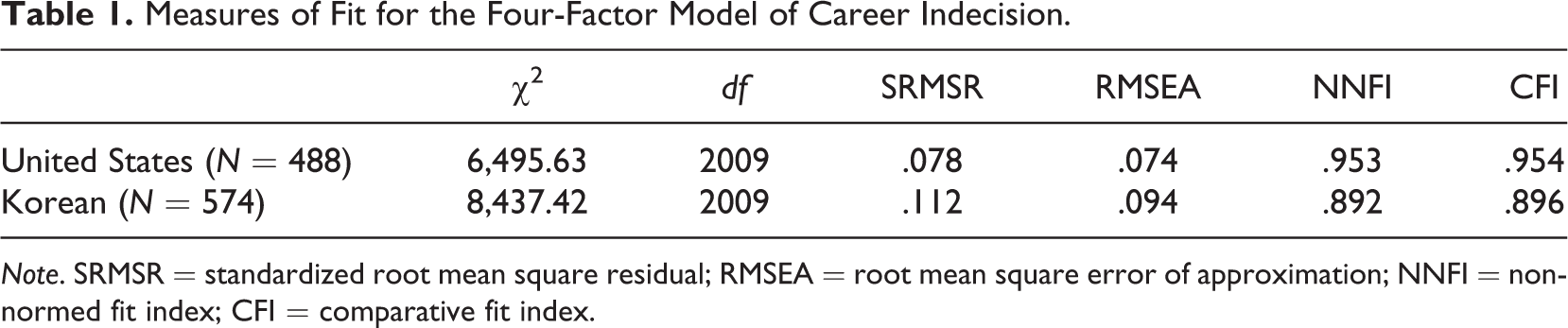
Independent CFA’s on each group revealed that the hypothesized four-factor model fit the data better for the U.S. sample than for the South Korean sample (see Table 1). Further, the RMSEA, SRMSR, and NNFI values did not reach the threshold for acceptable fit in the South Korean data set. Thus, configural invariance was not established. As a result, we did not move forward with additional analyses of measurement invariance and instead decided to explore whether an alternative structure would better fit the South Korean data.
Measures of Fit for the Four-Factor Model of Career Indecision.
Note. SRMSR = standardized root mean square residual; RMSEA = root mean square error of approximation; NNFI = nonnormed fit index; CFI = comparative fit index.
EFA
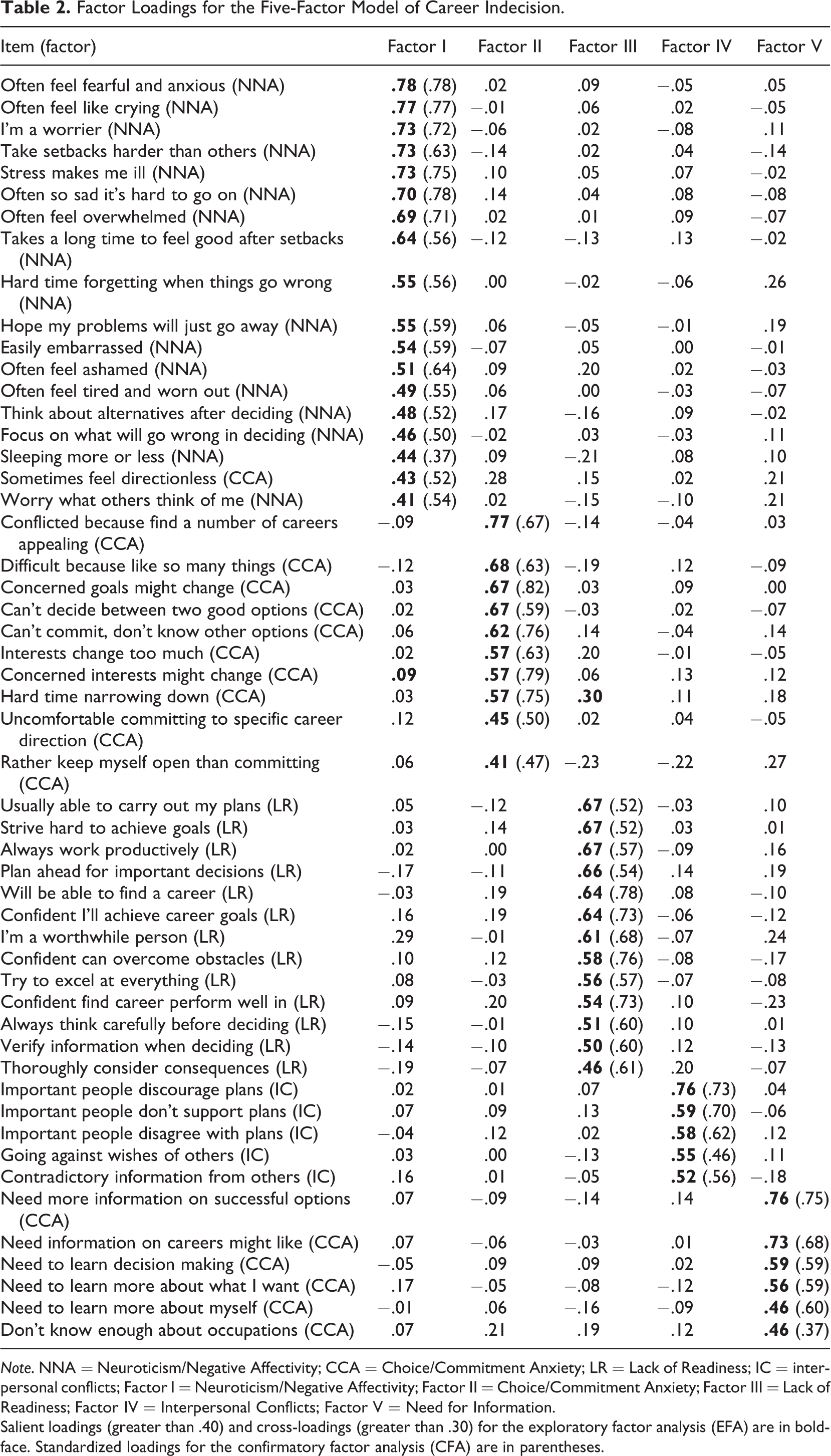
The results of the scree test and the MWL factoring method suggested the presence of five factors. The parallel analysis suggested retaining eight factors. Thus, we extracted five to eight oblique factor solutions and inspected the resulting pattern and structure matrices. A five-factor model yielded the most interpretable solution, but all items did not load saliently (loadings > .40) on one of the five factors and some loaded saliently (loading > .30) on more than one factor. We eliminated these items and reextracted a second five-factor oblique solution. Table 2 presents the results of the reextracted and rotated five-factor solution (the items in boldface are saliently loading items). All the items saliently loaded on only one factor with the exception of one cross-loading item (“I’m having a hard time narrowing down my career interests”). We decided to retain this item since it saliently loaded onto the appropriate factor and the cross-loading was at the .30 threshold. The new five-factor solution accounted for 48.5% of the variance in the reduced correlation matrix.
Factor Loadings for the Five-Factor Model of Career Indecision.
Note. NNA = Neuroticism/Negative Affectivity; CCA = Choice/Commitment Anxiety; LR = Lack of Readiness; IC = interpersonal conflicts; Factor I = Neuroticism/Negative Affectivity; Factor II = Choice/Commitment Anxiety; Factor III = Lack of Readiness; Factor IV = Interpersonal Conflicts; Factor V = Need for Information.
Salient loadings (greater than .40) and cross-loadings (greater than .30) for the exploratory factor analysis (EFA) are in boldface. Standardized loadings for the confirmatory factor analysis (CFA) are in parentheses.
The five-factor model replicated the four-factor model previously established with one notable difference. Some of the items that had previously loaded on the CCA factor now loaded on a separate fifth factor. Items assessing a fear of commitment, approach–approach conflict, and choice anxiety continued to load saliently on the CCA factor. However, items that assessed needs for self and occupational information, and information on the process of career decision making loaded on a separate factor. Based on the content of these items, we labeled the new factor a Need for Information (NI) factor. The only other difference between the four- and five-factor models was that 1 item (I sometimes feel directionless), which had previously loaded on our CCA factor, now saliently loaded on the NNA factor.
Contrary to previous findings (Abrams et al., 2013; Carr et al., 2014; Hacker et al., 2013), all the factors were not significantly correlated. The CCA factor did not significantly correlate with the LR factor (r = .04, p = .583) and the newly established NI factor did not correlate with the IC factor (r = .02, p = .781). The remaining correlations were all significant and ranged from .17 (NNA with IC) to .36 (CCA with NNA). The LR and NI factors correlated negatively (r = −.23).
CFA
We tested the fit of two alternative five-factor models via CFA. One model was an oblique model in which factor intercorrelations were freed to be estimated. The other model was an orthogonal model that fixed the factor intercorrelations to 0.00. The same five factors were tested in each model: NNA, CCA, LR, IC, and NI. Items were allowed to load only on the factor on which they loaded in the EFA.
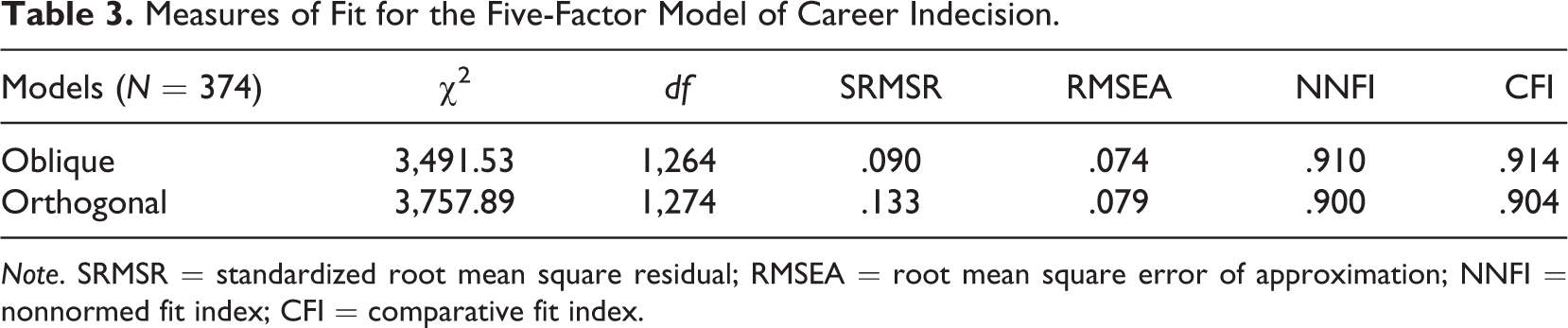
An examination of the fit indices revealed that the oblique five-factor model fit the data better than the orthogonal model (see Table 3). Further, a χ2 difference test confirmed that the oblique model fit the data significantly better than the orthogonal model, Δχ2(10, N = 374) = 266.36, p < .001. All items in the oblique model loaded significantly (p ≤ .05) on their respective factors.
Measures of Fit for the Five-Factor Model of Career Indecision.
Note. SRMSR = standardized root mean square residual; RMSEA = root mean square error of approximation; NNFI = nonnormed fit index; CFI = comparative fit index.
The factors accounted for a substantial amount of the variance in their respective items. The first factor (NNA) accounted for 13.5–60.8% of the variance in the items. The individual items loadings on Factor I ranged from .37 to .78 (see the items in parentheses in Table 2). Factor II (CCA) accounted for 21.9–67.8% of the variance in the items. The individual item loadings on the second factor ranged from .47 to .82. Factor III (LR) accounted for between 27.2% and 61.0% of the variance in the items. The loadings on the third factor ranged from .52 to .78. Factor IV (IC) accounted for 21.2–53.0% of the variance in the items. The factor loadings for these items ranged between .46 and .73. Finally, Factor V (NI) accounted for 13.6–56.1% of the variance in the items with factor loadings ranging between .37 and .75.
All of the correlations between the factors were significant with the exception that the LR factor did not correlate significantly with either the NNA or the CCA factors. Scores on the IC and the new NI factor also were statistically uncorrelated. The remaining factor correlations ranged from .12 (LR and IC) to .39 (CCA and NI). Once again the LR and NI factors were negatively correlated (r = −.33). In sum, the five-factor model uncovered by our EFA was replicated and confirmed as a good fitting model: It had an adequate fit to the data, all items loaded saliently on their assigned factors, and the factors were unique, but interrelated.
Discussion
The results of this study revealed that the four-factor structure of the CIP-65 did not have measurement equivalence across the U.S. and South Korean samples. The initial test of measurement invariance (configural invariance) revealed that the four-factor structure of the CIP-65 did not replicate in the South Korean sample. Subsequent EFAs on a subset of the Korean sample suggested a five-factor correlated model that was supported in a CFA with a second subset of South Korean participants. The main difference between the four- and five-factor models was that the 7 items representing needs for self- and occupational information that had originally loaded on the CCA scale formed a separate factor labeled NI. Also, scores on the NI scale correlated positively with scores on the CCA scale and negatively with scores on the LR scale. These data suggest that needs for self- and occupational information do not define CCA (as they did in the U.S. sample), but rather correlate with feelings of choice and commitment anxiety. Stated another way, needs for self- and occupational information may not become prominent concerns for U.S. young adults until they begin to feel anxious about making and committing to a choice (perhaps when choice or work entry becomes imminent). On the other hand, among the South Korean adolescents, needs for information may become concerns in two different contexts—when they begin to develop goals and plans for career exploration (when they become ready to make a decision) or when they are beginning to feel anxious about choosing or committing to a career path.
Whether these differences reflect age or culture influences is, unfortunately, not clear at this time. In an effort to begin to try to tease out the influences of age and culture, we reanalyzed the data provided by Italian adolescents (Carr et al., 2014) who were the same age as the current South Korean participants by extracting a five-factor oblique solution via EFA. Carr et al. (2014) found that the four-factor CIP-65 model fit the data well in this Italian adolescent sample (configural invariance) and that the factor loadings were invariant (metric invariance) with the U.S. sample. The fifth factor in our EFA had no saliently loading items and the NI items continued to load on (define) the CCA factor in the Italian adolescent sample. In fact, when we conducted similar five-factor EFAs on the Swiss, French, and Icelandic data sets (Abrams et al., 2013; Carr et al., 2014), needs for information did not emerge as a fifth factor in any of these Western European data sets; in all cases, NI items continued to define the CCA factor. Thus, we tentatively lean toward a cultural explanation for the differences found in this study. In other words, needs for information may not become prominent concerns for young adults and adolescents living in the United States and other Western countries we have studied until they become anxious and have trouble committing to a choice. On the other hand, among the South Korean adolescents in our sample, information needs do not define choice or commitment anxiety but rather represent a separate source of concern associated with CCA and with increasing choice readiness (i.e., as these adolescents become more goal directed and planful, they concomitantly feel needs for additional information).
One explanation for these cultural differences may revolve around the future orientation of South Korean society. A variety of multinational studies (e.g., Brodbeck, Chhokar, & House, 2007; Gupta, Hanges, & Dorfman, 2002; Hofstede, 1991) have identified future orientation as one (of several) defining cultural characteristic of South Korea. Societies with a high degree of future orientation tend to value and reinforce among its members planning, investing in the future, persistence, perseverance, and the ability to delay gratification. It is thus possible that South Korean adolescents are more planful than U.S. adolescents and young adults and view the gathering of self- and occupational information as part of the planning, goal-setting, and decision-making process. The fact that the NI scale scores also correlated with CCA scale scores suggests that information needs are also important for South Korean adolescents who are having trouble committing to a choice. The difference is that the NI items exclusively defined the CCA factor among our United States and other Western European samples (which score somewhat lower than South Korea on future orientation); suggesting that the gathering of self- and occupational information is not viewed as particularly important until trouble is encountered deciding among options and committing to them.
The emergence of a separate NI factor in the South Korean sample might also be explained by the current context of Korean society, in which college entrance, especially entrance into a prestigious university, is highly desirable. Although college entrance after high school graduation has always been valued in South Korean society for those adolescents enrolled in academic tracks in high school, the perceived value for a college education may have become more wide spread in recent years. For example, more than 60% of students enrolled in CTE tracks now pursue postsecondary education after high school graduation (Korean Educational Development Institute, 2011). South Korean high schools also seem to provide more limited career guidance activities than other Organization for Economic Cooperation and Development countries with career guidance activities focusing largely on college entrance (Lim, 2009). Thus, South Korean students in our sample may have been expressing a need for increased career-focused guidance activities by their responses to the need for self and occupational information items, especially when they start thinking about their future careers (as opposed to ensuring college entrance) in a more goal-oriented and planful manner.
This study has two major limitations. First, the sample used in this study was younger than the U.S. sample. Although our post hoc analyses with other data sets tended to support a cultural explanation for factor structure differences between the U.S. and South Korean samples, we cannot say with certainty that the differences are more culture related than age related. Further research with the CIP and other multifactor measures of career indecision exploring specifically for age and cultural influences on career choice difficulties is clearly called for.
Second, this study took an etic rather than an emic approach to the exploration of cultural similarities and differences in the measurement of career indecision. Our approach was to test the fit of a model and measure developed in the United States to another culture. After finding a lack of configural invariance, we conducted an exploratory analysis with all of the CIP-65 items to uncover a more adequate factor structure specific to the South Korean data. However, the items in the CIP-65 may not have comprehensively covered all the major sources of indecision in South Korea. Thus, future research on sources of career indecision needs to take a more emic approach by developing items for the CIP-65 (and other measures of career indecision) that may be unique to South Korea.
Nonetheless, the results suggest that the 52-item South Korean version of the CIP-52 developed in this study may be used to help counselors identify major sources of indecision with their South Korean adolescent clients as long as within-country norms are used to interpret the scores. The CIP-52 may also be used as an outcome measure in research on interventions designed to facilitate career choice making among South Korean adolescents. The CIP-52 and relevant normative data are available upon request from the last author.
Footnotes
Declaration of Conflicting Interests
The author(s) declared no potential conflicts of interest with respect to the research, authorship, and/or publication of this article.
Funding
The author(s) disclosed receipt of the following financial support for the research, authorship, and/or publication of this article: Andrea Carr was supported by a graduate assistantship from the Graduate School of Loyola University Chicago.