



Abstract
Self-efficacy in the mathematics/science domain is conceptualized as partially determining whether science, technology, engineering, and mathematics (STEM) students would persist toward reaching important milestones like graduating with a bachelor’s degree. The authors conducted a longitudinal study to examine if mathematics/science self-efficacy would significantly predict graduation status 4 to 8 years later after high school academic performance and mathematics aptitude were controlled in a university sample of introductory science students. Moreover, they looked at whether mathematics/science self-efficacy would significantly predict graduation status 4 to 8 years later after first semester grade point average (GPA) was controlled in addition to prior performance and aptitude. The sample consisted of 211 university students who graduated with a bachelor’s degree and 69 university students who did not graduate with a bachelor’s degree. The authors reported that mathematics/science self-efficacy significantly predicted graduation status 4 to 8 years later after controlling for prior performance and aptitude. The addition of mathematics/science self-efficacy improved the accuracy of identifying which participants dropped out before graduation by 4.4% in this sample. When first semester GPA was included in the control variables, the incremental contribution of mathematics/science self-efficacy to the prediction of retention status was null as expected. Findings are related to theory and prior research.
Keywords
Albert Bandura (1986) conceptualized confidence (i.e., self-efficacy) in a particular domain to partially determine people’s persistence in that domain. Lent, Brown, and Hackett (1994) developed an extension of Bandura’s (1986) Social Cognitive Theory and named it Social Cognitive Career Theory (SCCT). In this model, they asserted that self-efficacy in specific academic domains like engineering (e.g., Betz & Hackett, 1981) and mathematics would partially determine whether people would persist in completing long-term academic goals like retention and completion of mathematics, science, engineering, and technology (STEM) coursework. Given that most universities require coursework in mathematics and the sciences in general education requirements, SCCT theory would posit that mathematics/science self-efficacy would be central to persisting through to graduation especially for students in the sciences. The goal of the present study was to investigate the role of mathematics/science self-efficacy in the prediction of one primary long-term academic goal, namely graduation with a bachelor’s degree in a sample of first semester university students taking introductory science courses.
The empirical literature was scant when the search was limited to only mathematics/science self-efficacy and retention with only two studies located (Lent et al., 2003; Sawtelle, Brewe, & Kramer, 2012). Lent and colleagues found engineering self-efficacy to significantly relate to the number of semesters (0–3) students completed (r = .18, p < .05). Sawtelle and colleagues showed physics self-efficacy to differentiate who did and did not complete a university introductory physics course. Neither study included aptitude or achievement indicators as control factors.
More studies specifically examining the role of mathematics/science self-efficacy in predicting retention are sorely needed. Likewise, more longitudinal studies are needed whereby retention is operationalized as graduation. Finally, studies are needed that control for well-established ability indices. This is important because in order for mathematics/science self-efficacy to be useful in predicting retention, it needs to contribute additional variance above and beyond achievement and aptitude and not serve as a placeholder for either.
A related body of literature has accumulated that can inform the current study. These authors have examined the broader domain of academic self-efficacy rather than specifically mathematics or science self-efficacy. Within those studies, we were interested in those studies that had controlled for well-established predictors of retention, namely prior academic achievement and aptitude.
Role of Academic Self-Efficacy in the Prediction of Retention
Robbins and colleagues (2004) presented an influential meta-analysis in Psychological Bulletin in which they examined the incremental contribution of what they called psychosocial and study skills factors (PSFs) to the prediction of college retention. As part of their analyses, Robbins and colleagues removed the variance due to aptitude scores (e.g., Scholastic Aptitude Test scores) and high school grade point average (GPA). One of those PSFs was academic self-efficacy, which was shown to incrementally contribute to college retention although the percentage was quite small (1.5%).
Retention in the previously mentioned study was broadly measured and included intent to persist (k = 2), enrollment after first semester (k = 1), enrollment after two semesters (k = 1), and retention to graduation (k = 2). Of those six studies, only the two studies in which retention was measured as “intent to persist” revealed academic self-efficacy to be significantly related to retention. One may conclude that academic self-efficacy broadly defined does not predict retention beyond persistence intentions. Since Robbins and colleagues’ (2004) meta-analysis, a few studies have been conducted examining academic self-efficacy with conflicting results, as reviewed subsequently.
Two studies found supportive evidence for the role of academic self-efficacy in persistence. Brown and colleagues (2008) used the fully corrected correlation coefficients (i.e., measurement error had been removed) from Robbins and colleagues’ (2004) meta-analysis and used a path analytic model to examine SCCT’s assertion that academic self-efficacy should both directly and indirectly (through goals) predict academic persistence. Instead of removing both aptitude scores and high school GPA as Robbins and colleagues (2004) had done, they removed either aptitude or high school GPA. In both cases, academic self-efficacy had a significant direct effect on persistence (ρ = .25 when the American College Testing [ACT] or Scholastic Assessment Test [SAT] score was removed and ρ = .20 when high school GPA was removed). Retention still included intention to persist. It is likely that academic self-efficacy’s relation to retention would have been significantly reduced if the variation in retention due to both aptitude and high school GPA was removed, and if intent to persist was not considered part of the definition of retention.
Gore (2006) measured retention as enrollment status at the second and third semesters. After the ACT scores were removed, academic self-efficacy was significantly related to students’ return to college. The effect was observed for both second semester and third semester, but the effect sizes were small. Although these two studies provide some support for the role of academic self-efficacy in incrementally predicting retention, other studies have reported contrary or null findings.
One study found counterintuitive findings. Porchea, Allen, Robbins, and Phelps (2010) sampled 21 community colleges and found unexpected findings in a multinomial logistic regression. They removed variation due to high school GPA and ACT standardized scores and found that higher academic self-confidence was negatively related to the completion of an associate degree or transferring to a 4-year institution. However, the magnitude of the effect was quite small.
Two studies reported null findings. Robbins, Allen, Casillas, Peterson, and Le (2006) removed variation due to both the ACT and high school GPA and found that academic self-efficacy did not predict 1-year retention. McLaughlin, Moutray, and Muldoon (2007) found academic self-efficacy combined with a second measure did not predict graduation status 3 years later in a sample of student nurses in Ireland enrolled in a 3-year program.
Problems in the Literature to Be Addressed
The mathematics/science self-efficacy and retention literature specifically does not control for aptitude and ability, includes only two studies, and does not measure retention beyond three semesters. Clearly, more studies are needed. The broader academic self-efficacy and retention literature since Robbins and colleagues (2004) meta-analysis includes more studies but reveals inconsistencies. It may be due to several shortcomings, which we sought to address in the present study.
First, retention was often measured in semesters enrolled or as intentions to persist rather than as whether or not students completed their bachelor’s degrees. The meta-analytic findings by Robbins and colleagues (2004) that were supportive of academic self-efficacy as a predictor of persistence were heavily weighted by persistence being measured as intent to persist. Whether students intend to persist or even persist until their third semester is not nearly as critical as to whether they persist until completion of the degree. In the job market, young people are evaluated based on whether or not they have a college degree. Their retention to the second or third semester in college is important, but only in so far as it is a stepping-stone to graduation. Since Robbins and colleagues’ meta-analysis, two notable studies did measure graduation status from a nursing school in Ireland and from community colleges (McLaughlin et al., 2007; Porchea et al., 2010). No studies were located in which graduation status was operationalized as completion of a bachelor’s degree. In the current study, the authors defined retention as whether or not the participant received a bachelor’s degree.
Second, academic self-efficacy is a helpful general construct; however, a more domain-specific self-efficacy construct would be more in line with SCCT and also more informative as to the construct itself. For example, Lent and colleagues (2003) measured engineering self-efficacy when sampling engineering students. Many researchers (e.g., Sitzmann & Ely, 2011; Marsh et al., 2005; Porchea et al., 2010) have speculated that students’ confidence in mathematics and science in particular is especially relevant to completing academic requirements for general education requirements and for a wide range of majors; research that examines mathematics and science self-efficacy specifically would be especially appropriate for examining academic retention of introductory science students. In this study, the authors focused on students who were intending to major in the sciences. This allowed the researchers to choose a population in which mathematics/science self-efficacy would be particularly relevant.
Third, researchers need to clearly ascertain if mathematics/science self-efficacy predicts retention defined as graduation after well-established predictors of aptitude and achievement have been controlled. It may be that mathematics/science self-efficacy would not add additional variance in the prediction of graduation status if aptitude and high school achievement were controlled. The authors in the current study did control for prior achievement and mathematics aptitude specifically to be consistent with the focus on the STEM domain.
Related to this point, researchers need to add an additional marker of achievement, namely early academic achievement at the college or university. It may be that mathematics/science self-efficacy is a placeholder for early academic achievement (i.e., first semester GPA; see Lubinski, 2010, for a full discussion). We do not know if mathematics/science self-efficacy would contribute above and beyond early academic achievement in the university setting when the precollege mathematics aptitude and achievement indicators have been controlled. It is also reasonable to assume that mathematics/science self-efficacy may serve as a placeholder for first semester performance in an introductory science student population.
Purpose of the Current Study
Specifically, the purpose of this investigation was to examine if mathematics/science self-efficacy measured early in introductory science students’ first year at a university would emerge as a predictor of whether or not these students graduated after variation due to precollege mathematics aptitude and high school performance have been removed. Related to the primary purpose, we were also interested in mathematics/science self-efficacy as a placeholder for first semester GPA. That is, we expected that mathematics/science self-efficacy would significantly predict whether or not a student graduated, even after precollege performance and mathematics aptitude were controlled; however, we anticipated that this significant effect would disappear once the first semester GPA was included in the model as a predictor.
Method
Participants
Originally, 311 students enrolled at a large Midwestern University were recruited from introductory science courses (e.g., biology) across three semesters. Of those, 31 people were omitted from the sample due to missing data or missing transcripts. The sample with complete data included 280 participants consisting of 103 men and 177 women. The average age was M = 18.50 years (SD = 0.60) and the students were predominantly first-year students (96%) and unmarried (99%). Approximately 84% of the students were Caucasian, 3.9% were African American, 3.9% were Asian American, 3.6% were Hispanic American, 2.9% identified as other, 1.4% were international students, and one student did not identify. Initially, 97% of the students identified either as a STEM major or a STEM career (e.g., physician).
With students’ written permission, the high school transcripts were obtained in the first year of data collection; the university transcripts were collected up to 8 years later. Based on the participants’ college transcripts collected 4 to 8 years later, participants were classified as either having graduated (n = 211) or not graduated (n = 69). The group who graduated took from 5 semesters to 13 semesters to graduate; the group who did not graduate was enrolled from 1 semester to 9 semesters. The majors identified at graduation were predominantly STEM majors (78%) or were non-STEM majors who had completed premed requirements in order to pursue a medical degree (11%). This university does not have a premed option as an educational major choice and many premed students graduate with majors that are not STEM majors.
Procedure
Across three fall semesters, participants were asked by their course instructors in introductory science courses at a Midwestern university to participate in the study in the first month of the fall semester. Students signed an informed consent form, allowing researchers to access their high school transcripts, college transcripts, and ACT/SAT scores. Participants completed the demographic information (i.e., age, ethnicity, and year in school) and the mathematics/science self-efficacy subscale. Other measures were also collected that are not included in this study. The time required to complete the measures was about 15 to 30 min. Students received no compensation for their participation. High school transcripts were obtained from the registrar’s office. College transcripts were also obtained from the registrar’s office 4 to 8 years later to determine graduation status.
Criterion Variable: Graduation Status
Graduation status was determined from the participants’ college transcripts 4 to 8 years later.
Predictor Variables
High school GPA
High school GPA reported in the high school transcript was used as a measure of prior academic performance.
Mathematics ACT score
The mathematics ACT assesses mathematical skill learned up until 12th grade (ACT, Inc.) and was used in this study to measure mathematical aptitude.
Mathematics/science self-efficacy
The mathematics/science self-efficacy subscale (Smith & Fouad, 1999) describes the confidence an individual has in mathematics/science tasks. The subscale includes 6-point Likert-type items in which four items measure mathematics self-efficacy and five items measure science self-efficacy. Example items included “Earn an A in a Calculus course” and “Design and describe a chemistry experiment that I want to do.” Mathematics/science self-efficacy were examined separately but were retained as one construct due to the high correlation between them (r = .81). Scores were determined by averaging the responses for all 9 items; higher numbers indicated higher mathematics/science self-efficacy. Smith and Fouad (1999) reported the Cronbach’s α for the mathematics/science self-efficacy subscale was α = .85. The internal consistency of the current sample was α = .89.
First semester college GPA
Cumulative GPA was calculated from the introductory science student’s first 16-week semester at the university reported on the participant’s transcript (summer performance was excluded).
Results
Initial Analyses
To determine if the semester in which the data were collected varied significantly across the variables of interest, a series of one way analyses of variance (ANOVAs) were conducted. Here, semester of data collection was the independent variable, and high school GPA, mathematics ACT score, first semester GPA, and mathematics/science self-efficacy were the dependent variables. In all analyses, semester was not significant. Correlations, means and standard deviations for high school GPA, mathematics ACT score, first semester GPA, and mathematics/science self-efficacy by persistence (graduated/did not graduate) are shown in Table 1. Three independent t-tests were conducted, with the independent variable being persistence (graduated/did not graduate). Significant differences at the p < .001 were present for all variables: high school GPA t(278) = 6.47, mathematics ACT score t(278) = 3.85, first semester GPA t(278) = 7.32, and mathematics/science self-efficacy t(278) = 3.69 as shown by Table 1. The correlations by persistence were not significantly different with the exception of first semester GPA (z = 2.76, p = .006). For the total sample, mathematics/science self-efficacy was significantly correlated with high school GPA (r = .22, p < .001), first semester GPA (r = .23, p < .001), and the ACT mathematics score (r = .31, p < .001).
Summary of Bivariate Correlations, Means, and Standard Deviations for All Variables by Graduation Status (Graduated or Did Not Graduate).
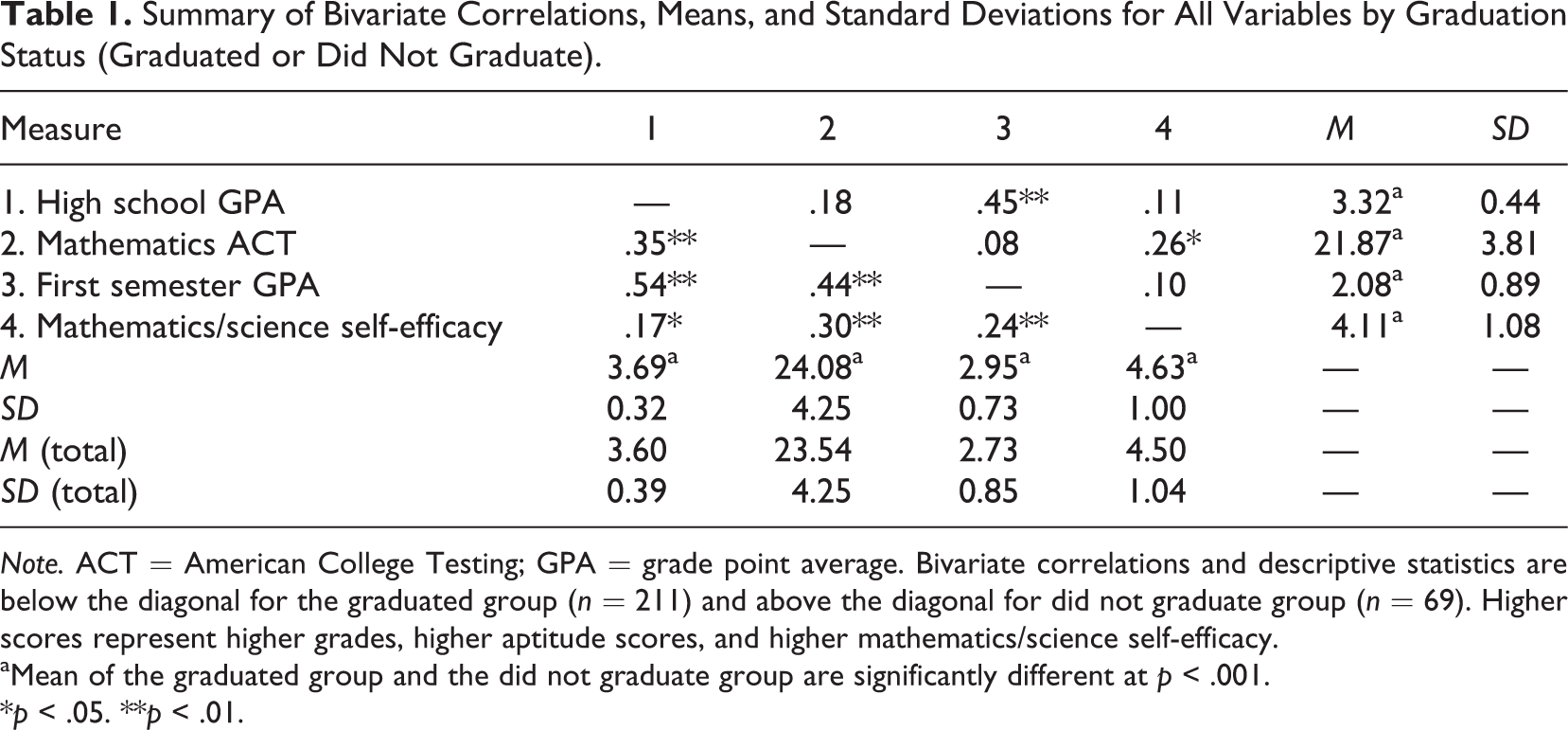
Note. ACT = American College Testing; GPA = grade point average. Bivariate correlations and descriptive statistics are below the diagonal for the graduated group (n = 211) and above the diagonal for did not graduate group (n = 69). Higher scores represent higher grades, higher aptitude scores, and higher mathematics/science self-efficacy. aMean of the graduated group and the did not graduate group are significantly different at p < .001.
*p < .05. **p < .01.
Predicting Persistence Excluding First Semester GPA
Using the Statistical Package for the Social Sciences (SPSS), a binary hierarchical logistic regression (Peng, Lee, & Ingersoll, 2002) was conducted to test the hypothesis that mathematics/science self-efficacy would contribute a significant amount of variance to whether or not a student would graduate with a bachelor’s degree after removing the variation due to high school GPA and mathematics ACT scores . Persistence was the criterion variable. In the first step, the predictor variables, the mathematics ACT score and the high school GPA, were entered into the model. In the second step, mathematics/science self-efficacy was added. The predictor variables were standardized in order to reduce multicollinearity (Cohen, Cohen, West, & Aiken, 2003; Frazier, Tix, & Barron, 2004).
In the first step, high school GPA and the mathematics ACT score significantly differentiated between those who did and did not graduate, χ2(2) = 49.63, p < .001, and predicted approximately 16.2% of the variance in retention using the Cox and Snell (1989) R 2 statistic, which is meant to approximate the R 2 statistic in multiple regression. An examination of the individual predictors in the first step revealed that high school GPA was a significant predictor in the binary logistic regression (high school GPA: β = −.94, p < .001; mathematics ACT scores: β = −.17, p = .08). The classification table showed that mathematics ACT scores and high school GPA combined accurately predicted 94.8% of the students who graduated and 36.2% of those students who did not graduate, resulting in an overall hit rate of 80.4%.
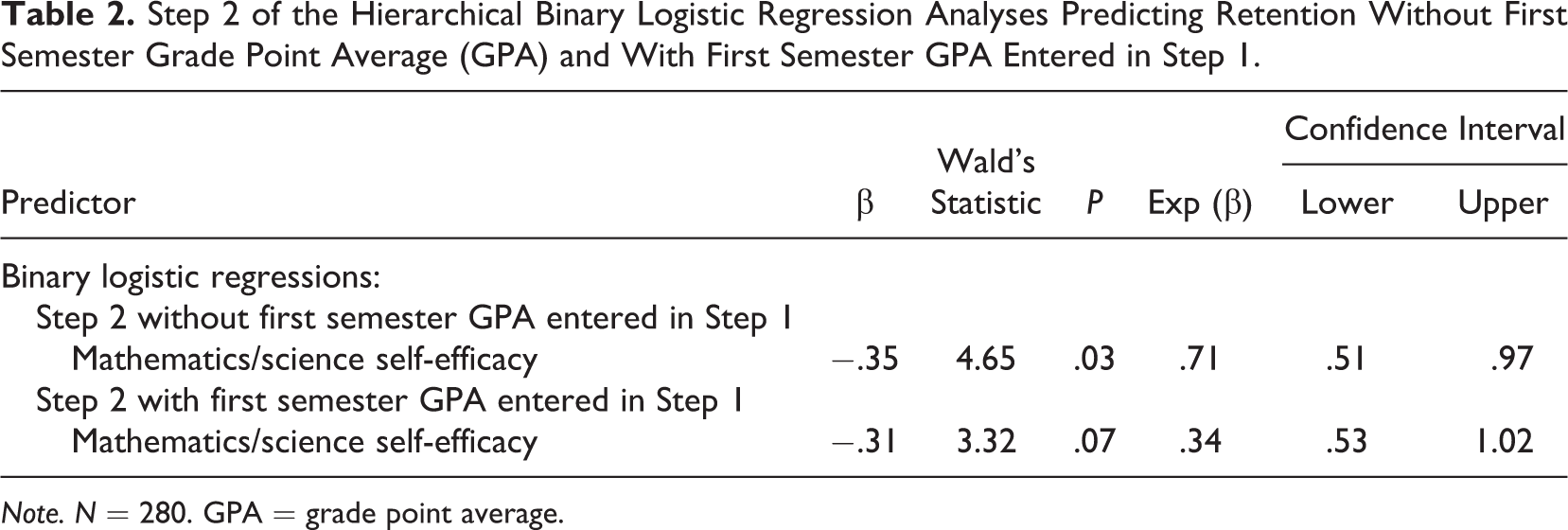
Mathematics/science self-efficacy was added in the second step in order to test the hypothesis that mathematics/science self-efficacy would significantly differentiate whether or not a student graduated after accounting for the variation due to the mathematics ACT score and high school GPA. As expected the second step was significant, χ2(1) = 4.62, p = .03, and predicted 17.6% of the variance, which added 1.4% more variance to the model in predicting persistence using the Cox and Snell R 2 statistic. Table 2 presents the β and the confidence intervals surrounding the unstandardized β weight. The classification table revealed that the model including mathematics/science self-efficacy accurately predicted 94.3% of the students who graduated and 40.6% of the students who did not graduate, resulting in an overall hit rate of 81.1%.
Step 2 of the Hierarchical Binary Logistic Regression Analyses Predicting Retention Without First Semester Grade Point Average (GPA) and With First Semester GPA Entered in Step 1.
Note. N = 280. GPA = grade point average.
Predicting Persistence Including First Semester GPA
In the second binary logistic regression, first semester GPA was included in the first step along with high school GPA and the mathematics ACT scores. These three predictors significantly differentiated between those who did and did not graduate, χ2(3) = 66.33, p < .001, and predicted approximately 21.1% of the variance using the Cox and Snell (1989) R 2 statistic. An examination of the individual predictors in the first step revealed that high school GPA and first semester GPA were significant predictors in the binary logistic regression (high school GPA: β = −.60, p < .002; first semester GPA: β = −.78, p < .001; mathematics ACT scores: β = −.18, p > .05). The classification table showed that these three predictors combined correctly classified 94.8% of the students who graduated and 42% of the students who did not graduate, resulting in an overall hit rate of 81.8%.
Mathematics/science self-efficacy was added in the second step in order to test the second hypothesis that mathematics/science self-efficacy would not significantly differentiate whether or not a student graduated after the effect of first semester GPA was controlled for in the binary logistic regression. As expected, the second step yielded null findings, χ2(1) = 3.29, p > .05. Table 2 presents the β and the confidence intervals surrounding the unstandardized β weight. Mathematics/science self-efficacy did not contribute significantly above and beyond the contribution of mathematics ACT scores, high school GPA, and first semester GPA.
Table 3 presents a summary of the hit rates across the binary logistic regressions that accurately predict graduation status; that is, the percentage of participants in the group who graduated and the group who dropped out that were correctly identified by the regression equation. A correct identification would be one in which the regression equation accurately predicted that a person would graduate or drop out. The rows of the table break down the overall hit rates for the group who graduated and the group who dropped out. The reader can see that the percentage of students correctly identified as graduating changes from 100% in the chance column (the computer assigns everyone initially as all graduating and no one dropping out) to somewhere between 93.4% and 94.8%. The most noticeable improvement in prediction has to do with predicting which participants will drop out. One can see that when high school GPA and mathematics ACT are entered as predictors, the percentage of participants correctly identified as dropouts increased from 0% to 36%. The addition of mathematics/science self-efficacy increased the accuracy for predicting who will drop out from 36% to 40.5%. Further, when the first semester GPA was included with high school GPA and mathematics ACT scores, the percentage of students correctly identified as dropping out increased to 42%.
Classification Table of Hit Rates for Accurately Predicting Graduation Status When the First Semester Grade Point Average (GPA) Is Included and Not Included in the First Step in the Binary Hierarchical Logistic Regression.

Note. N = 280. ACT = American College Testing; GPA = grade point average. Graduation status includes 211 students who graduated and 69 students who did not graduate.
*p < .05.
Discussion
The role of mathematics/science self-efficacy in predicting graduation status 4 to 8 years later was examined. The results provide some support for SCCT but also some sobering findings. First, mathematics/science self-efficacy from the first semester at a university significantly contributed to graduation status 4 to 8 years later. Moreover, mathematics/science self-efficacy contributed significantly above and beyond measures of prior achievement and mathematics aptitude. This is the first study that the authors are aware of that has shown mathematics/science self-efficacy to contribute to academic persistence 4 to 8 years later. This is consistent with SCCT and supports the unique role of self-efficacy in contributing to retention. The two studies used in Robbins and colleagues’ (2004) meta-analysis that defined persistence with the stricter criterion of graduation status reported null findings. Likewise, more recent studies using academic self-confidence as a predictor of graduation status found null findings in a sample of student nurses (McLaughlin et al., 2007) or found contrary findings in a community college sample (Porchea et al., 2010). Reasons for supportive findings in this study may be that mathematics/science self-efficacy was used rather than the more broadly defined academic self-efficacy. Moreover, the students in our sample were predominantly majoring in the sciences so that mathematics/science self-efficacy was domain specific for that population.
It is true that in this sample, mathematics/science self-efficacy was shown to incrementally contribute to the prediction of graduation status 4 to 8 years later after precollege aptitude and performance was controlled. However, it is also important to note that the magnitude of the effect mathematics/science self-efficacy had on retention was relatively small. In the current study, the estimated unique percentage of variance accounted for by mathematics/science self-efficacy was 0.8%, which was similar to the percentage of variance (1.5%) accounted for by academic self-efficacy in the meta-analysis by Robbins and colleagues (2004). This improvement in the overall percentage of variance can easily be argued to be of no practical value. It is important, however, to note that adding mathematics/science self-efficacy did increase the accuracy of identifying participants who did not graduate. The hit rate for that group with the addition of mathematics/science self-efficacy rose by 4.4% from 36.2% to 40.6% as shown in Table 3. For academic advisers, earlier identification of more students at risk for dropping out would be quite beneficial.
In short, mathematics/science self-efficacy does contribute to successful graduation for these introductory science students, but the effect was small. Moreover, these results provide support for SCCT (Lent et al., 1994) in showing that mathematics/science self-efficacy did incrementally contribute to academic retention as expected. This is important since both prior achievement and mathematics aptitude were controlled and retention was measured up to 8 years after mathematics/science self-efficacy was measured.
We asked the next question, namely whether mathematics/science self-efficacy is acting as a potential placeholder for academic performance: If first semester GPA is added to the model before mathematics/science self-efficacy, does mathematics/science self-efficacy still contribute a significant amount to determining whether a student graduates or does not graduate? As expected, the significant findings disappeared and mathematics/science self-efficacy did not contribute above and beyond the contribution of high school achievement, mathematics aptitude, and first semester GPA in predicting whether or not these students graduated from college.
Adherents of SCCT (Lent et al., 1994) may rightly point out that mathematics/science self-efficacy likely contributed to first semester GPA. In fact, if first semester GPA had been entered after mathematics/science self-efficacy, the results would have been identical to the last column in Table 3 and would have been a significant incremental increase in the prediction of retention status. If researchers or academic admissions offices don’t have access to first semester GPA, (e.g., because it is early in the first semester), including mathematics/science self-efficacy beyond traditional indicators may improve our ability to identify who may be at risk for dropping out of college. The increase is practically meaningful in our data, going from 36.2% to 40.6% accuracy in predicting dropouts. However, if one does have access to first semester GPA it is a better choice than students’ mathematics/science self-efficacy, since the identification of those dropouts is 42% without self-efficacy in the equation. Moreover, adding mathematics/science self-efficacy provides no additional incremental variance overall, nor does it aid in increasing the identification of students who either graduate or drop out. This evidence supports our assertion that mathematics/science self-efficacy serves as a placeholder for first semester GPA and does an acceptable job when GPA is unavailable but is redundant when it is available.
The limitations of this study include a sample from only one university and students who are 80% Caucasian and unmarried. Future studies would want to examine retention focused exclusively on ethnically diverse students. Researchers may also want to include other operational definitions of mathematics/science self-efficacy or include other domains beyond mathematics and science. We would argue that mathematics/science self-efficacy is relevant for most college students in persisting through to graduation. The strength of the study lies in its focus on introductory science students that are followed over time. Moreover, access to high school transcripts and college transcripts is especially valuable for moving beyond self-report measures and for incorporating indices of ability into our understanding of the role of mathematics/science self-efficacy.
Conclusion and Implication
Mathematics/science self-efficacy and retention has been insufficiently examined. Only two studies were located and neither of them controlled for precollege aptitude and achievement and retention was measured no longer than three semesters. Even within the larger domain of academic self-efficacy and retention, the prior literature since Robbins’ and colleagues’ (2004) meta-analysis was inconsistent. The results of the current study clarify the picture. Mathematics/science self-efficacy contributed above and beyond precollege performance and mathematics aptitude in identifying who would or would not graduate with a bachelor’s degree 4 to 8 years later. The contribution was small but seems to be of practical value in identifying groups of introductory science students who may be at risk for dropping out. Early identification would be the first step in early intervention efforts. The results of this study also provided evidence that mathematics/science self-efficacy may be a placeholder for early academic achievement in college for students pursuing STEM majors. When the first semester GPA was combined with precollege aptitude and achievement, mathematics/science self-efficacy no longer significantly contributed to the prediction of persistence. For academic advisers and career counselors, having access to early indicators of academic achievement in college will be a better indicator of persistence than mathematics/science self-efficacy.
The implications of this study center on identification of students who may be at risk for dropping out of college. The usefulness of mathematics/science self-efficacy measured early in one’s college career for identifying at risk students will in part depend on how early in the student’s academic career the intervention would occur. For some colleges and for some students, mathematics/science self-efficacy would be particularly valuable to include in early assessments when interventions are geared to incoming first year students. This may be particularly helpful because mathematics/science self-efficacy can be increased through mastery, modeling, verbal persuasion, and lowering mathematics anxiety (Lent, Brown, & Hackett, 1996). This study also provides additional support for high school grades and mathematics aptitude to be used in selecting students for admission and also for using these indicators to identify students at high risk of dropping out.
Footnotes
Acknowledgments
We would like to acknowledge the following undergraduate and graduate research assistants for their help in collecting and entering data: Arnold Kong, Justin Dedecker, Sy Goose, Katrina Field, Curtis Donelson, Thomas Oren, Holli Gericke, John Peddicord, Ryan Drewiaka, and Haley Groh.
Declaration of Conflicting Interests
The author(s) declared no potential conflicts of interest with respect to the research, authorship, and/or publication of this article.
Funding
The author(s) received no financial support for the research, authorship, and/or publication of this article.