



Abstract
This study examines the effects of implicit and explicit motives at work. Specifically, we hypothesize that congruency of implicit and explicit motives (i-e congruency) affects work motivation. Integrating research on age-related gains in self-regulation strength, we expect that negative effects of low i-e congruency on work motivation are more detrimental for younger than older workers, because they possess fewer self-regulation skills. The age moderation effect should be further qualified by motive-specific incentives, such that low i-e congruency has most detrimental effects for younger workers when many, as compared to few incentives, are present at work. We tested our hypotheses in a study with N = 756 workers at three measurement points. Results supported the main effect of i-e congruency on work motivation in the achievement and affiliation motive domains, and the moderation effects of age and incentives in the achievement motive domain. Implications for theories of motivation and age-sensitive counseling and coaching interventions are discussed.
Keywords
Researchers and career counselors argue that the alignment of peoples’ motives to incentives of the environment (e.g., at work) is essential for motivation and performance (e.g., Kristof-Brown & Guay, 2011, for a review). In addition to conscious motives that are rather easily accessible for a client or a counselor, unconscious motives might be considered for a more complete prediction of motivation. Indeed, theories of human motives suggest that a person–environment fit perspective needs to consider both explicit (conscious) and implicit (nonconscious) motives, as well as their alignment (i-e congruency) because low i-e congruency may cause intraindividual motive conflicts that can reduce motivation (e.g., Kehr, 2004b; McClelland, Koestner, & Weinberger, 1989). We extend research by applying this general principle to the work context where work motivation is a central precursor of performance and well-being (Crawford, LePine, & Rich, 2010; Van Eerde & Thierry, 1996). If i-e congruency has substantial effects on work motivation, considering i-e congruency may be an important (but neglected) part of occupational counseling interventions.
In this study, we show that i-e congruency predicts motivation at work in addition to mere effects of explicit (conscious) motives. Additionally, we provide evidence on moderators that determine when i-e congruency effects are most detrimental. Building on life-span theories suggesting age-related gains in workers’ self-regulation strength, we show that low i-e congruency yields stronger effects for younger as compared to older workers. Moreover, we show that negative effects of low i-e congruency are particularly present when the work context offers many (as compared to few) motive-specific incentives. This suggests that negative effects of low i-e congruency and related motive conflicts cannot simply be dissolved by higher incentives in a given work environment, which further speaks to an in-depth consideration of i-e congruency in career counseling and related fields.
Work Motivation
Work motivation can be defined as a set of psychological processes “that influences how personal effort and resources are allocated to actions pertaining to work, including the direction, intensity, and persistence of these actions” (Kanfer, Chen, & Pritchard, 2008, p. 5). Although empirical studies often focus on more narrow conceptualizations of work motivation, such as different parts of the action process (e.g., motivation and volition; Heckhausen & Gollwitzer, 1987) or different activation sources (e.g., intrinsic motivation and extrinsic motivation; Gagné & Deci, 2005), we adopt a broad conceptualization of work motivation for three reasons. First, such a conceptualization captures the full range of motivational experiences (physical, cognitive, and emotional activation) and behaviors (direction, intensity, and persistence of behaviors) at work, which is in line with other more general concepts of work motivation (e.g., work engagement; Crawford et al., 2010; Schaufeli, Salanova, González-Romá, & Bakker, 2002). Second, in cross-sectional research, a broad conceptualization may capture different motivational experiences and behaviors at work more validly, given that workers often follow multiple intrinsic and extrinsic incentives at different states at the same time. Third and more importantly, high motivation at work is generally vital to organizations—regardless of their origin in the action process or their activation source. Thus, a general measure as compared to specific measures of work motivation may be a better predictor of workers’ general performance, well-being, and organizational effectiveness (e.g., Crawford et al., 2010; Fried & Feris, 1987; Van Eerde & Thierry, 1996).
In general, work motivation can be considered as a four-step process (McClelland, 1987): (i) Situations, demands, or cues at work (ii) offering incentives (iii) which fit to a specific motive (iv) result in an aroused motive that is experienced as high motivation by the worker. In this process, motives constitute mental networks linking cognitions on a specific theme (e.g., achievement) with pleasant experiences, goal states, or incentives (e.g., feeling proud after mastery of a challenging task), that may be activated by motive-specific situations, demands, or cues at work (e.g., the opportunity to perform on a challenging task; Schultheiss, 2008). A strong motive has the potential to create a strong mental preoccupation that selects behavior, directs behavior in time and space, and energizes behavior in order to achieve desired goals or incentives (Schultheiss, 2008).
The Theory of Dual Motives
Dual motive theory distinguishes three broad domains of motives: achievement, affiliation, and power (McClelland et al., 1989). Achievement motives are directed toward surpassing standards of excellence. Affiliation denotes the motive to establish, maintain, or restore friendships or friendly relationships, whereas power describes the motive to influence other persons or groups, and to gain high levels of status and prestige (McClelland, 1987).
Importantly, each motive domain is further separated into an implicit and an explicit motive system (cf. Schultheiss & Brunstein, 2010): Explicit motives constitute conscious cognitions that reflect what people value, whereas implicit motives are unconscious spontaneous preferences for activities that offer affectively pleasant incentives (Schultheiss, 2008). According to dual motive theory, explicit and implicit motives are aroused by different classes of incentives (Stanton, Hall, & Schultheiss, 2010, for a review): Explicit motives are aroused by incentives that are socially demanded or valued (i.e., social incentives), which are typically associated with a specific goal. For example, a manager high in explicit achievement seeks challenging goals at work. In contrast, implicit motives are aroused by incentives that are intrinsic to a task or activity (i.e., task incentives). For instance, a manager with a strong implicit achievement motive is more likely to experience feelings of excitement, interest, and flow while performing a challenging task (Job & Brandstätter, 2009). Moreover, both motive systems predict different classes of behavior (e.g., Sokolowski, Schmalt, Langens, & Puca, 2000; Spangler, 1992): An aroused explicit motive is associated with cognitions about social incentives and evokes cognitive choices and controlled behavior to achieve social incentives, whereas an aroused implicit motive is associated with affective experiences concerning task incentives and evokes spontaneous behavior as well as long-term behavior trends to achieve task incentives (Kehr, 2004b; McClelland et al., 1989).
I-e congruency
The propositions of dual motive theory are well supported by empirical findings, for example, it has been shown that measures of implicit and explicit motives of a specific domain are usually not correlated with each other (Spangler, 1992). Consequently, both systems may differ in motive strength and four prototypical configurations of congruency can generally emerge (Thrash, Cassidy, Maruskin, & Elliot, 2010): Implicit and explicit motives may be congruent, (1) both strong or (2) both weak, or motives may be incongruent with (3) the implicit motive exceeding the explicit motive in strength, or (4) the explicit motive exceeding the implicit motive in strength. Note, strength of implicit and explicit motives vary continuously in the population (McClelland, 1987).
The Compensatory Model of Work Motivation and Volition
Building on and extending dual motive theory (McClelland et al., 1989), the compensatory model of work motivation and volition (Kehr, 2004b) states that discrepancies between implicit and explicit motives cause motivational conflicts. These conflicts may be manifested in conflicting behavioral tendencies at work and decrease the effort workers may be able to invest for specific goals and incentives, resulting in low work motivation. Such motivational conflicts are possible because implicit and explicit motives address different classes of behavior: Explicit motives initiate the adoption of goals that are socially demanded or valued at work (i.e., what people want), whereas implicit motives constitute a spontaneous preference for affectively pleasant activities that offer affectively pleasant incentives (i.e., what people like; Kehr, 2004b; McClelland et al., 1989).
Conflicting behavior tendencies within a motive domain occur when the explicit motive is strong but the implicit motive is weak. In this case, workers consciously seek motive-specific goals, but they lack the supporting motivational energy and the resulting positive affect from a strong implicit motive (Brunstein, Schultheiss, & Grässmann, 1998; Lang, Zettler, Ewen, & Hülsheger, 2012). For instance, a worker who explicitly values achievement is likely to seek challenging goals at work. If this worker, however, does not experience intrinsic enjoyment during striving for such goals, the resulting work motivation should be rather low. Conflicting behavior tendencies within a motive domain are also likely when the explicit motive is weak but the implicit motive is strong. In this case, workers consciously neglect motive-specific goals that would have the potential to satisfy their implicit motives (Lang et al., 2012). As a consequence, the likelihood to experience satisfying situations at work should be diminished, and the worker might not anticipate motive satisfaction in the future, resulting in low work motivation.
In contrast, high i-e congruency should increase the likelihood that workers adopt goals at work that are congruent with their implicit motive structure (Brunstein et al., 1998; Kehr, 2004b). Subsequently, the achievement of incentives leads to positive affect that in turn reinforces the striving for these incentives (Brunstein et al., 1998), resulting in high work motivation. Note, Kehr’s (2004b) model suggests that even weak (congruent) implicit and explicit motives might not harm work motivation due to an absence of motivational conflicts. In sum, high i-e congruency should be experienced as energizing and should be manifested in high motivation at work.
Indeed, initial research outside of the work context has demonstrated a positive link between i-e congruency and motivation. Schüler (2010), for instance, conducted three studies in different achievement contexts (sports and education) and showed that high i-e congruency in the achievement domain is a necessary condition for flow experience. However, in the context of occupational work, no study has linked i-e congruency to a general measure of work motivation so far. Based on our rationale, we hypothesize:
Age as a Moderator of the I-e Congruency—Work Motivation Relationship
Although we assume that low i-e congruency has generally negative effects on work motivation, these effects can be (partly) compensated by workers’ self-regulation competencies. According to Kehr’s (2004b) model, workers may overcome motive conflicts by using volitional strategies. Volition comprises a set of self-regulatory processes of planning and realization of goals (Heckhausen & Gollwitzer, 1987), that is, the capacity of people to override and alter their responses, to change their behavior, and to bring their behavior and psychological states into line with specific standards or goals (Baumeister & Vohs, 2007). Important volitional strategies target on peoples’ motivation (i.e., motivation control that recalls positive anticipations when workers face difficulties in goals striving), emotions (i.e., emotion control that adjusts emotions to work demands), attention (i.e., attention control that focuses attention on core aspects to realize goals), decision making (i.e., decision control to decide quickly and to avoid rumination), and behavioral impulses (i.e., impulse control that suppresses unwanted behavior tendencies; Kehr, 2004b; Kuhl & Fuhrmann, 1998). Such strategies may be used in case of motive conflicts in order to support explicit behavior tendencies and/or to suppress unwanted implicit behavior tendencies (Kehr, 2004b). If workers use volitional strategies, they might conserve high work motivation even in light of motive conflicts. In such situations, the origin of motivation at work may shift from intrinsically rewarding goals and incentives to volitional regulation.
However, using volitional strategies is not an effortless automatic process but requires volitional strength. Apart from dispositional influences, volitional strength is also developed over time. Specifically, the self-control strength model (Muraven & Baumeister, 2000) predicts that repeated practice and rest can improve volitional strength in the long term—like a muscle. However, this process needs time and thus is more likely for older workers who have experienced more situations in which volitional regulation is required. Similar to age-related enhancements of emotion-related skills (Charles, 2010; Heckhausen, Wrosch, & Schulz, 2010), older workers should possess higher volitional strength than younger workers. As a consequence, low i-e congruency should have less severe effects on work motivation for older as compared to younger workers. Indeed, older workers may be more able to shift their motivation at work from intrinsically rewarding goals and incentives to volitional regulation and thus conserve their overall motivation at work. Together, we predict:
Effects of Motive-Specific Incentives
We further expect that the moderation effect of age is qualified by the extent to which the work environment offers motive-specific incentives. Incentives are defined as situational cues in the environment which are associated with potential motive satisfaction (Schüler, 2010; cf. McClelland, 1987). Specific incentives in the achievement motive domain include opportunities to master a challenging task (i.e., doing something good, better or best, or achieving a surpassing standard of excellence), incentives in the affiliation domain constitute opportunities for friendly contacts with others, whereas incentives in the power domain are either situations in which a person may have impact on others or situations in which a person can exhibit high status or prestige (McClelland et al., 1989; Stanton et al., 2010).
We expect that motive conflicts due to low i-e congruency are particularly severe in work environments that offer many (as compared to few) motive-specific incentives (cf. Schüler, 2010). If the explicit motive is strong and the implicit motive is weak, incentives in the work environment may arouse the explicit motive and the worker would consciously seek to strive for motive-specific incentives. However, this striving is not energized by a corresponding implicit motive, resulting in low work motivation. If the implicit motive is strong, but the explicit motive is weak, incentives in the work environment may arouse the implicit motive, but the worker would consciously neglect to strive for motive-specific incentives. However, neglecting incentives would result in low work motivation. In both cases of low i-e congruency, work environments with many (as compared to few) motive-specific incentives should frequently trigger motive conflicts and thus should result in even lower work motivation. This should be particularly the case for younger workers, who are less able than older workers to compensate the lack of motivation by using volitional strategies. In contrast, low i-e congruency should have smaller effects in work environments with few motive-specific incentives because neither implicit nor explicit motives are aroused. In such a work situation, the absence of motive-specific incentives should be generally accompanied by lower work motivation.
While initial laboratory studies provide evidence that motive-specific incentives can moderate the i-e congruency–outcome relationship in nonwork settings (e.g., Schüler, 2010), this effect has not yet been examined in the work context. Together, we hypothesize:
Method
Participants and Procedure
Participants were recruited from a large online panel. An online panel consists of a pool of registered persons who have agreed to take part in web-based studies (Göritz, Wolff, & Goldstein, 2008). The sample comprised N = 756 workers (340 male) who worked at least half-time with a mean age of M age = 43.59 years (SD = 10.80; age range: 20–75 years), 1 and M = 10.74 years of organizational experience (SD = 10.00). Using Holland’s (1997) taxonomy to classify jobs, 15.1% of the participants described their occupations as realistic (e.g., roofer), 11.5% as investigative (e.g., research assistant), 3.3% as artistic (e.g., actor), 27.2% as social (e.g., nurse), 20.4% as enterprising (e.g., sales management representative), and 22.5% as conventional (e.g., secretary). Regarding educational attainment, 35.4% reported to hold a university degree, 24.1% a German A-level high school degree (German “Abitur”), and 39.9% a German B- or C-level high school degree (German “Mittlere Reife” and “Hauptschulabschluss,” respectively), and 0.7% no degree.
Data were collected in three separate online surveys. Specifically, we measured predictor variables (i.e., implicit and explicit motives) at Time 1, 2 and both motive-specific incentives and work motivation at Time 2 (time-lag 6 months) and at Time 3 (time-lag 9 months). Measurement of predictor and criterion variables was separated by at least 6 months in order to reduce thread of common method bias (Podsakoff, MacKenzie, Lee, & Podsakoff, 2003). Repeated measurement of both motive-specific incentives and work motivation was conducted in order to show that our predictions can be replicated in two consecutive surveys. A total of N = 756 workers participated at both Time 1 and 2. Of these N = 756 workers, a total of N = 556 workers participated at Time 3. Participants received 3.50 EUR and a general result report as an incentive.
Measures
Implicit and explicit motives (Time 1)
Implicit motives were assessed with the Multi-Motive-Grid (MMG; Sokolowski et al., 2000). The MMG is a semiprojective measure that combines features of classical projective measures (i.e., pictures; e.g., the Thematic Apperception Test [TAT]) with advantages of self-report measures (i.e., multiple choice response alternatives). Participants received a set of 14 pictures covering all three motive domains (i.e., achievement, affiliation, and power) and different levels of ambiguity. For each picture, participants are asked to respond to yes-/no-statements addressing a specific motive domain (e.g., “Feeling confident to succeed at this task” in the achievement motive domain; cf. Sokolowski et al., 2000, for details). The implicit motive scores were derived by summing up the “yes” responses of the hope of success, hope of affiliation, and hope of control items, respectively.
Previous research has demonstrated that the MMG is a reliable and valid measure of implicit motives. Internal consistencies typically range between Cronbach’s α = .70 and .90 (e.g., Kehr 2004a; Schüler, 2010; Schüler, Bandstätter, & Sheldon, 2012; cf. Sokolowski et al., 2000). Experts agree that the MMG—similarly to the Picture Story Exercise (PSE, Pang & Schultheiss, 2005)—satisfies the defining criteria of an implicit motive measure (cf. Baumann, Kazén, & Kuhl, 2010; Schüler et al., 2012, for reviews): The MMG acknowledges that an implicit motive has (1) an extended network of need-related episodes, (2) an implicit level of awareness, and (3) an affective apperception, that is, a need-related interpretation of perceptual input. Although MMG scales typically show intercorrelations between r = .40 and .70, which potentially reflects a higher order factor of approach motivation (Kehr, 2004a; Sokolowski et al., 2000), several studies have confirmed the criterion validity of the MMG (e.g., Nikitin & Freund, 2011; e.g., Torelli & Shavitt, 2010; cf. Schüler et al., 2012, for a review), including its incremental validity above and beyond explicit measures of motives (i.e., i-e congruency; Kehr, 2004a; Schüler, 2010; Schüler, Job, Fröhlich, & Brandstätter, 2008, 2009; Schüler, Sheldon, & Fröhlich, 2010; Thielgen, Rauschenbach, Krumm, & Hertel, in press). Moreover, the MMG has yielded similar results as alternative measures of implicit motives in multisample studies (e.g., Schüler et al., 2008; Schüler et al., 2009; Schüler et al., 2012; Thielgen et al., in press).
Strength of explicit motives was assessed with the affiliation, achievement, and power/dominance scales of the German version of the Personality Research Form (PRF; Stumpf, Angleitner, Wieck, Jackson, & Beloch-Till, 1985). The scales consist of 16 self-report statements (affiliation: e.g., “I go out my way to meet people.”; achievement: e.g., “I don’t mind working while others are having fun;” power/dominance: e.g., “I feel confident when directing the activities of others”). Participants responded to each item on a “yes” and “no” scale. Reliabilities typically range between r = .67 and .96. Furthermore, the PRF scales show convergent validity with self-rating and other ratings and other personality measures (Stumpf et al., 1985). Moreover, the PRF scales show discriminant validity particularly in research on i-e congruency (e.g., Kehr, 2004a; Pang & Schultheiss, 2005; Schultheiss, Yankova, Dirlikvo, & Schad, 2009).
Chronological age (Time 1)
Chronological age was used as a measure for age for three reasons (for a discussion of different age measures, see Kooij, de Lange, Jansen, & Dikkers, 2008). First, age is closely related to all the other age concepts (see Kooij et al., 2008). Second, this concept is a proxy for age-related gains in volitional strength in this study. Third, age functions as a proxy for an age-differentiated human resource management.
Volitional strength (Time 2)
Volitional strength was assessed by the Volitional Components Inventory (VCI; Kuhl & Fuhrmann, 1998). Similar to a study by Kehr (2004a), five subscales of the VCI were used: motivation control (e.g., “considering positive incentives concerning this matter”), emotion control (e.g., “cheering myself up to make things work”), attention control (e.g., “trying consciously to keep my attention stable”), decision control (e.g., “having no difficulties with spontaneous decisions”), and impulse control (e.g., “When I am working at a task, I can suppress distracting thoughts”). The general question “How often did you recently experience the following processes/situations at work?” was followed by items from aforementioned scales, which are rated on a 4-point scale (from 1 = not to be true to 4 = to be true). The five subscales were aggregated to obtain a composite measure of volitional strength. Following Kehr (2004a), we used the composite score as an estimate of volitional strength, since people who indicate that they often employ volitional strategies are likely to have a higher volitional strength as compared to those people who report using such strategies less often. Earlier studies have shown reliabilities of the used scales above r = .70, as well as validity of the VCI scales (Fröhlich & Kuhl, 2004), particularly in the context of i-e congruency (Kehr, 2004a).
Motive-specific incentives (Time 2 and Time 3)
Since currently no established measures of motive-specific incentives exist, we measured motive-specific incentives with the Munster Work Value Measure (MWVM; Krumm, Grube, & Hertel, 2013). This measure provides self-reported needs and supplies in several work-related value domains. In the current study, we used self-reported supplies in the domain of achievement to measure achievement-specific incentives (4 items; “How many opportunities do you have to perform well at work?” “ … to achieve good work results?” “ … to learn?” and “ … to retrieve feedback”). Additionally, we captured supplies in the domains of affiliation (3 items; “How many opportunities do you have to get in contact with other people at work?” “ … to have good social relationships at work?” and “ … to make new social contacts at work?”) and power (3 items; “How much opportunities do you have to influence other people at work?” “ … to have professional and/ or personnel responsibilities at work?” and “ … to make career?”). Participants responded to all items on a 6-point Likert-type scale (from 1 = few to 6 = many). 3 Research has reported initial evidence for the reliability and validity of the MWVM (Krumm et al., 2013), which is further supported by current findings (cf. Table 1).
Descriptive Statistics, Bivariate Correlations, and Cronbach’s αs of the Main Variables.
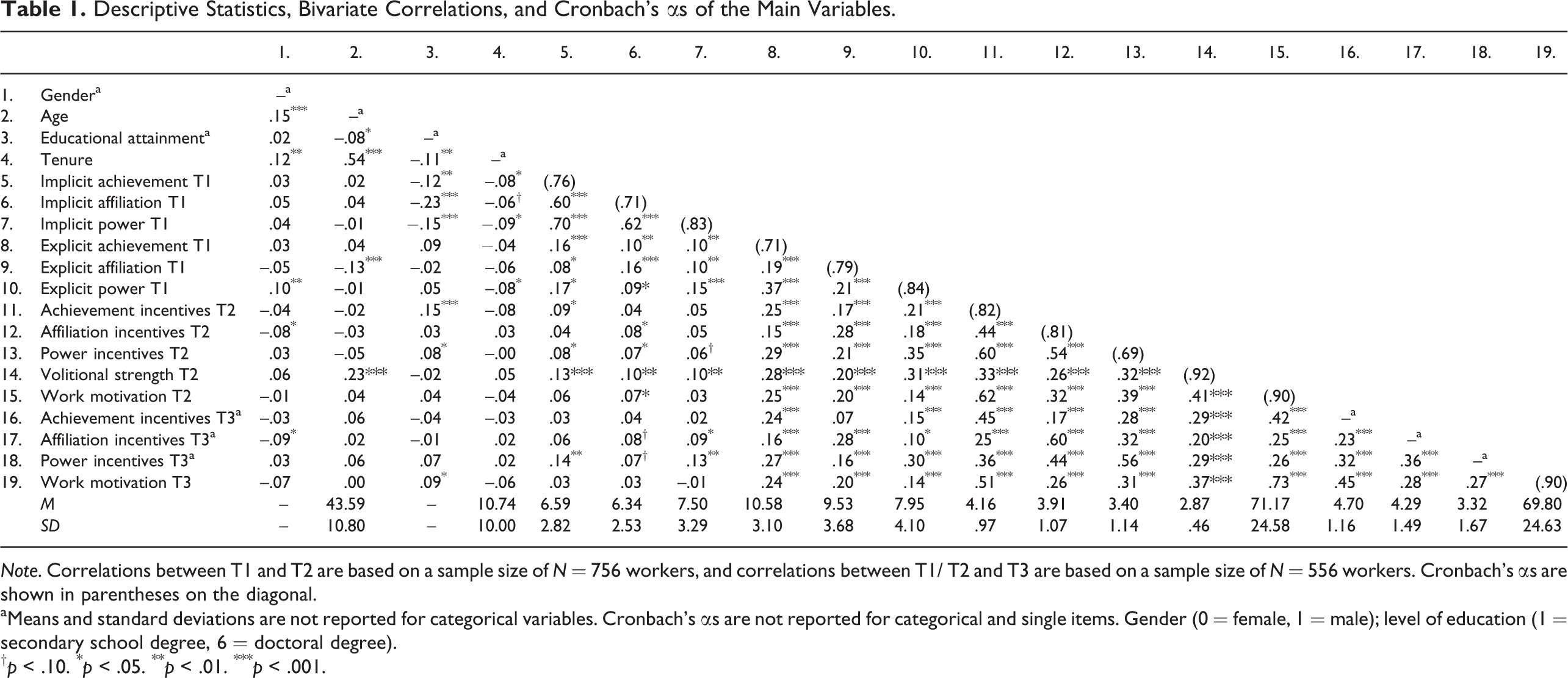
Note. Correlations between T1 and T2 are based on a sample size of N = 756 workers, and correlations between T1/ T2 and T3 are based on a sample size of N = 556 workers. Cronbach’s αs are shown in parentheses on the diagonal.
aMeans and standard deviations are not reported for categorical variables. Cronbach’s αs are not reported for categorical and single items. Gender (0 = female, 1 = male); level of education (1 = secondary school degree, 6 = doctoral degree).
† p < .10. * p < .05. ** p < .01. *** p < .001.
Work motivation (Time 2 and Time 3)
Work motivation was assessed with three typical work motivation items adopted from Hertel (2002; e.g., “For the last three months, I have been enjoying my work.”). Two of these items were scored on a 5-point scale (from 1—I do not agree to 5—I agree), whereas 1 item (“On a scale from 0—not motivated to 100—motivated, how motivated have you been for the last three months?”) was answered by positioning a slider on this scale. Items were converted to the same numeric scale before the mean was computed. Since we asked participants to rate their motivation in the last 3 months, measurement of work motivation was separated from the predictor variables by at least 3 months. We conducted a pilot study (N = 175 workers), where the scale showed high reliability (Cronbach’s α = .90), high convergent validity (i.e., work engagement from the Utrecht Work Engagement Scale, r = .75; cf. Schaufeli et al., 2002) and high discriminant validity (strain: exhaustion, r = −.41; resources: e.g., job control, r = .16, support by coworkers and supervisor, r = .19, and r = 30; demands: e.g., time pressure, r = .11, social stressors by coworkers and supervisor, r = −.29, and r = −.40).
Control variables
According to Ng and Feldman (2010), gender, organizational tenure, and level of education are important moderators of the contingency of age on job attitudes. In order to account for other than the targeted effects on work motivation in an age diverse sample, we included these variables in our analyses.
Statistical Analysis
Hypotheses 1, 3, and 4 were tested by applying moderated polynomial regression with response surface analysis (Edwards, 2011; Shanock, Baran, Gentry, Pattison, & Heggestad, 2010). This procedure examines whether the relationship between the congruency of two variables (i.e., implicit and explicit motives) and an outcome variable (i.e., work motivation) is moderated by an additional variable (e.g., age; cf. Devloo, Anseel, & De Beuckelaer, 2011). Polynomial regression avoids drawbacks of classical difference scores and provides more explanatory potential than these scores (Edwards & Parry, 1993; Shanock et al., 2010). According to Edwards and Parry (1993), we defined the following equation (Equation 1) 4 :
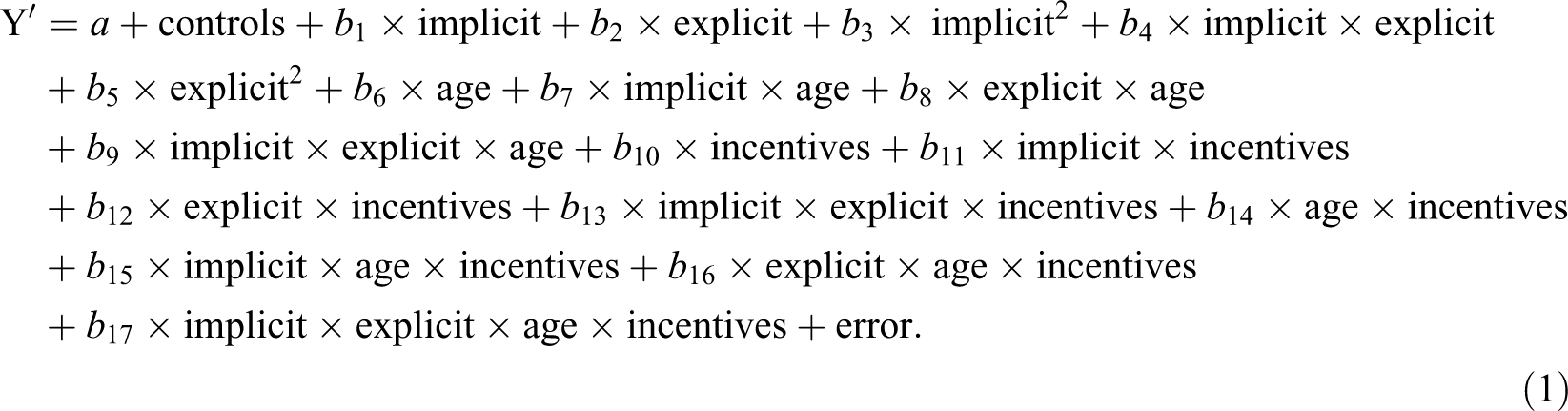
Before computing regression terms and running the analysis, predictors were z-standardized in order to adjust scores to the same numeric scale (Dawson & Richter, 2006; Shanock et al., 2010). Moderated polynomial regression analyses were conducted hierarchically with the control variables entered in Step 1, implicit and explicit motives in Step 2 (b 1 to b 5), age in Step 3 (b 6), the moderation terms of age in Step 4 (b 7 to b 9), incentives in Step 5 (b 10), the moderation terms of incentives in Step 6 (b 11 to b 13), and finally, the moderation terms of age and incentives in Step 7 (b 14 to b 17). Note, that a necessary condition for our results being considered in line with Hypotheses 3 and 4 is that the moderated models yield a significant increment in explained variance (cf. Devloo et al., 2011).
Results of moderated polynomial regression analysis were further qualified by response surface analysis (Devloo et al., 2011; Edwards, 2011). The first step of a response surface analysis is to visualize the relationship between three variables in a three-dimensional chart (e.g., see Figure 1). In the second step, two reference lines in the three-dimensional chart are analyzed: in our case, the implicit = explicit (i-e congruency) line and the implicit = −explicit (i-e incongruency) line (cf. Shanock et al., 2010). The i-e congruency line runs from the back corner to the front corner of the surface chart, indicating the relative degree of i-e congruency (e.g., see Figure 1). The i-e incongruency line runs from the left corner to the right corner, indicating the relative degree of i-e incongruency. For each reference line, a coefficient representing the slope (coefficients a 1 and a 3) and the curvature (coefficients a2 and a 4) of the surface can be derived and tested for statistical significance (see Table 3).

Surface charts of hypotheses 1 and 3.
Hypothesis 1 assumes that both types of i-e incongruency (higher implicit than explicit motive and higher explicit than implicit motive) negatively affect work motivation, suggesting a negative and significant curvature coefficient (a 4) for the i-e incongruency line. Regarding Hypothesis 3, we expect that the curvature coefficient of the i-e inconcongruency line (a 4) is more negative for younger workers as compared to older workers. Regarding Hypothesis 4, we expect that the curvature coefficient of the i-e inconcongruency line (a 4) is most negative for younger as compared to older workers who report that many motive-specific incentives are present at work (or work situations with few motive-specific incentives). Concerning interaction hypotheses (cf. Hypotheses 3 and 4), Dawson and Richter (2006) argue that both a large sample size and reliable variables are necessary in order to achieve a test power of at least 80% to detect three- or four-way interactions. Accounting for these recommendations and considering the pioneering character of this research the (two-tailed) α level was adjusted to .10. Finally, we tested Hypothesis 2 by regressing volitional strength on control variables (gender, education, and tenure) and age.
Results
Descriptive statistics, bivariate correlations, and reliabilities are shown in Table 1. All the reliability estimates are above r tt = .69 and are thus considered to be satisfactory.
Results regarding Hypothesis 1 (i-e congruency is positively correlated with work motivation) are shown in Table 2. In the achievement motive domain, Step 2 of the polynomial regression analysis reveals a significant increment in explained work motivation variance at Time 2 (▵R 2 = .07, p < .001) and at Time 3 (▵R 2 = .07, p < .001). To further investigate the nature of this interaction, we examined slopes and curvatures of the surface chart (cf. Table 3) illustrating the 3-fold relationship between implicit motive, explicit motive, and work motivation (cf. Figure 1). 5 For Time 2, we examined both the curvature coefficient and the slope coefficient of the i-e incongruency line. The curvature coefficient is negative, that is, lower i-e congruency is associated with lower work motivation, but this coefficient does not reach the conventional significance threshold at Time 2 (a 4 = −2.01, p = .14). The corresponding slope coefficient is negative and significant (a 3 = −4.99, p < .001). Thus, only one type of low i-e congruency is associated with lower work motivation at Time 2. Examination of the surface chart reveals that workers with a strong implicit motive but a weak explicit motive report the lowest levels of work motivation. For Time 3, the curvature coefficient of the i-e incongruency line is negative and significant (a 4 = −4.85, p < .01). Moreover, the corresponding slope coefficient is negative and significant (a 3 = −4.94, p < .01). Thus, both types of low i-e congruencies are associated with lower work motivation at Time 3, whereas workers with a strong implicit but a weak explicit motive again report the lowest levels of work motivation. Together, Hypothesis 1 is largely supported in this domain.
Polynomial Regression Analysis Predicting Work Motivation From I-e Congruency.

Note. β = standardized regression coefficients; T2 = measurement of work motivation and incentives 6 months after measurement of motives; T3 = measurement of work motivation and incentives 9 months after measurement of motives.
† p < .10. *p < .05. **p < .01. ***p < .001.
Achievement I-e Congruency Effects on Work Motivation: Analysis of Slopes and Curvatures.
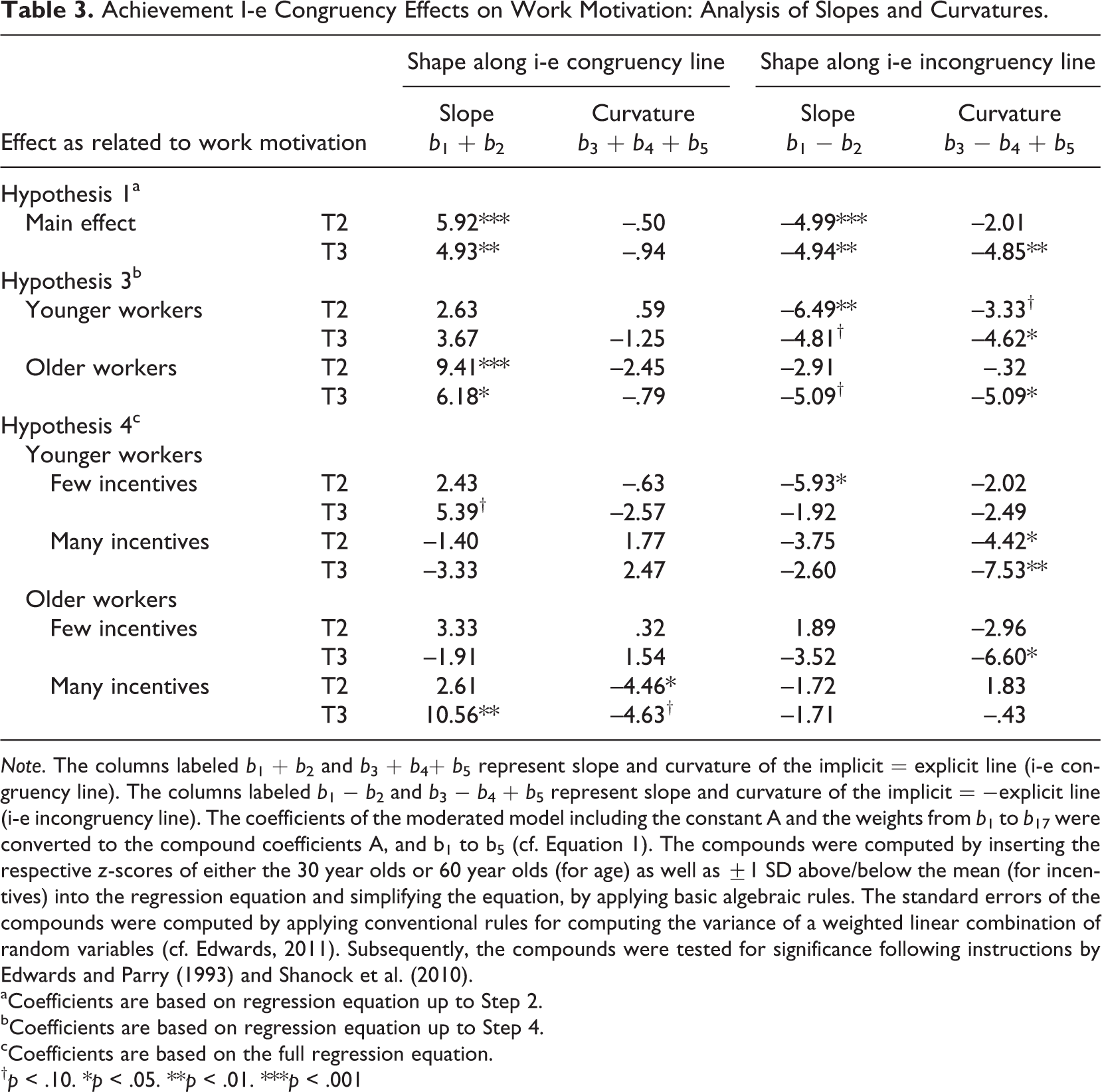
Note. The columns labeled b 1 + b 2 and b 3 + b 4+ b 5 represent slope and curvature of the implicit = explicit line (i-e congruency line). The columns labeled b 1 − b 2 and b 3 − b 4 + b 5 represent slope and curvature of the implicit = −explicit line (i-e incongruency line). The coefficients of the moderated model including the constant A and the weights from b 1 to b 17 were converted to the compound coefficients A, and b1 to b5 (cf. Equation 1). The compounds were computed by inserting the respective z-scores of either the 30 year olds or 60 year olds (for age) as well as ±1 SD above/below the mean (for incentives) into the regression equation and simplifying the equation, by applying basic algebraic rules. The standard errors of the compounds were computed by applying conventional rules for computing the variance of a weighted linear combination of random variables (cf. Edwards, 2011). Subsequently, the compounds were tested for significance following instructions by Edwards and Parry (1993) and Shanock et al. (2010).
aCoefficients are based on regression equation up to Step 2.
bCoefficients are based on regression equation up to Step 4.
cCoefficients are based on the full regression equation.
† p < .10. *p < .05. **p < .01. ***p < .001
We find the same pattern in the affiliation motive domain: Step 2 of the analysis reveals a significant increment in explained work motivation variance at Time 2 (▵R 2 = .04, p < .001) and at Time 3 (▵R 2 = .06, p < .001). Thus, we examined slopes and curvatures (cf. Table 3) and the surface chart. 5 For Time 2, the curvature coefficient of the i-e incongruency line is negative but not significant (a 4 = −0.33, p = .82). The slope coefficient of the i-e incongruency line is negative and significant (a 3 = -3.44, p < .05). Thus, only one type of low i-e congruency is associated with lower work motivation at Time 2. Examining the surface chart reveals that workers with a strong implicit motive but a weak explicit motive report the lowest levels of work motivation. For Time 3, we find a negative and significant curvature coefficient of the i-e incongruency line (a 4 = −4.26, p < .05). The corresponding slope coefficient of the i-e incongruency line is negative and significant (a 3 = −3.74, p < .05). Thus, both types of low i-e congruences are associated with lower work motivation at Time 3, whereas workers with a strong implicit motive but a weak explicit motive again report the lowest levels of work motivation. Together, Hypothesis 1 is largely supported in this domain.
Regarding the power motive, Step 2 of the polynomial regression analysis reveals a significant increment in explained work motivation variance at Time 2 (▵R 2 = .02, p < .01) and at Time 3 (▵R 2 = .02, p < .05). However, the curvature coefficients of the i-e incongruency line are not significant (Time 2: a 4 = 1.42, p = .35; Time 3: a 4 = 0.15, p = .93). Thus, Hypothesis 1 is not supported in the power motive domain.
Next, we examined the contingency between volitional control strategies and age (Hypothesis 2), revealing that age is positively correlated with volitional strength of participants (β = .29, p < .001). This result generalizes across all facets of volitional strength (decision control: β = .27, p < .001, attention control: β = .27, p < .001, motivation control: β = .18, p < .001, emotion control: β = .18, p < .001, and impulse control: β = .28, p < .001). 6
Hypothesis 3 predicts that age moderated the relationship between i-e congruency and work motivation, such that the contingency of i-e congruency on work motivation is stronger for younger as compared to older workers. In the achievement motive domain, the interaction between age, implicit motive, and explicit motive reveals a significant increment in explained work motivation variance at Time 2 (Step 4, ▵R 2 = .01, p < .10). Thus, we examined both the coefficients of slope and curvature (cf. Table 3) and the surface chart (cf. Figure 1, bottom part). Consistent with our expectations, younger workers yield a negative and significant curvature coefficient of the i-e incongruency line (a 4 = −3.33, p = .06), while this effect is not significant for older workers (a 4 = −0.32, p = .87). Moreover, the slope coefficient at the i-e incongruency line is negative and significant for younger workers (a 3 = −6.49, p < .01) but not for older workers (a 3 = −2.91, p = .21). Examining the surface charts reveals that workers with a strong implicit motive but a weak explicit motive report the lowest levels of work motivation. However, this pattern is not replicated at Time 3 as Step 4 of the polynomial regression analysis does not reveal a significant increment in variance (▵R 2 = .00, p = .90). Together, Hypothesis 2 is supported in the achievement motive domain when work motivation was measured at Time 2 but not at Time 3. In the affiliation and power motive domains, however, we did not find moderation effects of age.
Hypothesis 4 predicts that motive-specific incentives amplify the age moderation effect of the relationship between i-e congruency and work motivation, such that the age moderation effect is stronger if the work environment offers many (as compared to few) motive-specific incentives. Table 1 indicates that motive-specific incentives are generally positively associated with work motivation at both Time 2 and Time 3. Results of the polynomial regression analysis testing Hypothesis 4 are displayed in Table 2. In the achievement motive domain, including interaction terms with achievement-specific incentives and age into the polynomial regression equation reveals a significant increment in explained work motivation variance (Step 7, Time 2: ▵R 2 = .01, p < .05; Step 7, Time 3: ▵R 2 = .02, p < .05). Thus, we examined both the coefficients of slope and curvature (cf. Table 3) and the surface charts (cf. Figure 2). 5 As expected, the curvature coefficients of the i-e incongruency line are negative and significant for younger workers who report that their work offered many achievement incentives (Time 2: a 4 = −4.42, p < .05; Time 3: a 4 = −7.53, p < .01). In line with Hypothesis 4, these curvature coefficients are not significant for older workers who report that their work offered many achievement incentives (Time 2: a 4 = 1.83, p = 37; Time 3: a 4 = −0.43, p = .88). Moreover, in the case of few incentives, we find either no significant curvature for younger workers (Time 2: a 4 = −2.02, p = .23; a 4 Time 3: −2.49, p = .26) or only a significant curvature for older workers at Time 3 (Time 2: a 4 = −2.96, p = .14; Time 3: a 4 = −6.60, p < .05). Together, results generally confirm the assumed four-way interaction as postulated in Hypothesis 4. In the affiliation and power motive domains, no significant moderation effects are found.

Surface charts of hypothesis 4.
Noteworthy, the descriptive result pattern is similar when the aforementioned analyses were conducted on the basis of differences scores as opposed to polynomial regression analyses. Moreover, the above-mentioned effects remain stable when conducting the analyses separately for the four occupational themes (Holland, 1997) that comprise more than N = 100 participants (albeit not always reaching significance due to reduced sample sizes).
Discussion
Researchers and career counselors argue that the alignment of peoples’ characteristics and supplies or incentives at work generally promotes their motivation and performance (Kristof-Brown & Guay, 2011). In this research, we show that such a person–environment fit hypothesis may be limited to people with high i-e congruency. Indeed, low i-e congruency might be an important and persistent handicap for individuals’ work motivation. However, it might be often overlooked by both employees and career counselors due to the unconscious nature of implicit motives (Baumann, Kaschel, & Kuhl, 2005). Thus, this research may contribute to a better understanding of person-related factors (i.e., implicit and explicit motives, as well as age) and situation-related factors (i.e., motive-specific incentives) as predictors of peoples’ motivation at work.
The results of this study generally support the hypothesized relationship between i-e congruency and work motivation in the achievement and affiliation motive domains (cf. Hypothesis 1): Workers with low as compared to high i-e congruency reported lower levels of work motivation, which is in line with the reasoning that low i-e congruency leads to motive conflicts and conflicting behavior tendencies (cf. Kehr, 2004b) that, in turn, burden overall motivation at work. Noteworthy, among the two different configurations of low i-e congruency, the lowest level of work motivation was found for workers with strong implicit but weak explicit motives in both achievement and affiliation motive domains. Despite their strong implicit motives, these workers do not seem to anticipate (and thus seem not to pursue) high motive satisfaction in both domains. In contrast, workers who explicitly value a motive domain despite a weak implicit motive reported at least some work motivation, probably because striving for these explicit goals is in line with their self-concept (cf. McClelland et al., 1989). In sum, our findings support the proposed contingency between i-e congruency and general motivation at work for two of the three motive domains, at two measurement points in a longitudinal design across 6 and 9 months, which demonstrates the robustness of this effect.
In addition, the results provide evidence for the proposed moderators. As a person-related moderator, we tested age based on the assumption that low i-e congruency is more severe for younger as compared to older workers because the former possesses lower volitional strength. First, our results show the assumed positive relation between age and volitional strength (Hypothesis 2) which is in line with the self-control strength model (Muraven & Baumeister, 2000), assuming that repeated practice and rest can improve self-control strength in the long term. Moreover, this result might also speak to life-span theories of human motivation, suggesting that people increasingly develop and use voluntary problem solving strategies to master challenges and obstacles (Charles, 2010; Heckhausen et al., 2010).
Second, the results also show the proposed moderation effect of age on the contingency between i-e congruency and motivation at work (Hypothesis 3) in the achievement motive domain. This finding underlines the need for an age-differentiated perspective and supports our process assumption (at least indirectly) that negative aspects of low i-e congruency can be compensated by volitional strategies. The fact that younger workers with low i-e congruency reported lower levels of work motivation as compared to older workers with low i-e congruency suggests that the latter—who obtained higher volitional strength in our study—seem to be more capable to shift their motivation from intrinsically rewarding goals to volitional regulation, maintaining overall motivation at work.
As a situation-related moderator, we tested the assumption that motive-specific incentives amplify the age moderation of the relationship between i-e congruency and work motivation, such that the age moderation effect is stronger if the work environment offers many (as compared to few) motive-specific incentives (cf. Hypothesis 4). Indeed, our results confirmed the moderating effect of motive-specific incentives in the achievement motive domain. Extending previous research from laboratory settings (Schüler, 2010) to the workplace, we demonstrated that detrimental effects of low i-e congruency on work motivation were stronger for younger as compared to older workers particularly if the work place offers many motive-specific incentives. Thus, motive-specific incentives in the work context seem to amplify motive conflicts with respect to this motive domain, and in turn decrease general work motivation. Together, these results are well in line with dual motive theory (McClelland et al., 1989), proposing that motive-specific incentives are important context conditions that may moderate effects of implicit and explicit motives on behavior.
However, it should be noted that our assumptions were mainly confirmed in the domains of achievement (Hypotheses 1, 3, and 4) and (partly) of affiliation motives (Hypothesis 1), but not in the power motive domain. A plausible explanation of these differences is that motive satisfaction is associated with different experiences within each of the motive domains (cf. McClelland, 1987; McClelland et al., 1989). Motive satisfaction in the achievement domain is typically associated with feelings of interest, excitement and flow, which translates directly into general work motivation. In a similar way, motive satisfaction in the affiliation domain is associated with enjoyment and well-being that is also rather directly related to work motivation. In contrast, motive satisfaction in the power domain is more likely associated with feelings of impact strength (Job & Brandstätter, 2009) which might only weakly affect measures of general work motivation. Future research should consider distinct relationships between motive domains and work-related outcomes.
Another important difference between the three motive domains is the time perspective of motive fulfillment. Achievement striving typically has a future-oriented time focus because investing effort in achievement related goals usually is not reinforced immediately but after a certain standard of excellence is achieved in the future (Baumann et al., 2005; Heckhausen, 1965). Due to this delay of gratification, self-control and related volitional strategies might be particularly relevant in this motive domain. In contrast, affiliation motives and power motives can be satisfied immediately from the onset of the motivational episode, for example, when a manager engages in a friendly contact with a colleague or when a manager delegates goals to a subordinate. Thus, it seems plausible that the observed moderation effect of age, which is assumed to be based on differences in volitional strength, only occurred in the achievement motivation domain. Future research should consider motive-specific goals at work, including their proximity and distance.
Theoretical Implications
This study has several theoretical implications. First, we showed that considering unconscious implicit in addition to conscious explicit motives significantly increases the predictive precision of motivational outcomes. Specifically, the relative congruency of both motive systems was a significant predictor of motivation at work. Thus, this study further strengthens recent calls to incorporate implicit motives in research on work motivation and puts forward to a more integrated approach to human motivation in the work context (e.g., Kanfer, Chen & Pritchard, 2008; Thielgen et al., in press, for similar research on i-e congruency effects on job satisfaction).
Second, in this study, we linked theories on human motives (Kehr, 2004b; McClelland et al., 1989) with approaches from life-span research that propose age differences in personal resources and competencies (e.g., Charles, 2010; Heckhausen et al., 2010), providing not only a more differentiated perspective on motivational processes but also a better understanding of underlying mechanisms. The observed moderation effect of age together with the positive correlation between age and volitional strength provides initial evidence for the assumption that low i-e congruency can be compensated by self-control strategies (Kehr, 2004b). Of course, future research is desirable that replicates and further scrutinizes this finding, using more direct measures and manipulations.
Third, the integrated moderation effect of motive-specific incentives at work complements the current theoretical approach with contextual moderators. In doing so, we are able to explain seemingly contraintuitive findings. For instance, whereas a person–environment fit approach (e.g., Kristof-Brown & Guay, 2011) would suggest that offering workers incentives that fit to their motives generally increases workers’ motivation, the i-e congruency approach predicts that this assumption only holds for workers with high i-e congruency. Although motive-specific incentives were generally positively related to work motivation, workers with low i-e congruency reported significantly lower work motivation even in work situations that offered many motive-specific incentives. Thus, considering both explicit and implicit motives together with both person-oriented (age) and contextual conditions (incentives) increases the predictive validity of approaches on human motivation.
Practical Implications
This study provides various implications for coaching and counseling in work contexts. First, this study suggests that focusing only on explicit motives in coaching or counseling settings might be limited, as important determinants of work motivation (i.e., implicit motives) might be neglected. Indeed, assessing the congruency between what workers believe of what is important to them (explicit motives) and what fits to their dispositional profile (implicit motives) might be a good starting point for a more thorough psychological diagnostic. As shown in this research, low i-e congruency might have detrimental effects on work motivation. The fact that workers are usually not aware of their implicit motives increases the risk that these influences might be neglected. However, it also increases the need to clearly communicate and convince a client about the value to consider implicit motives. Empirical research such as the current study might be helpful in this respect.
Moreover, a better understanding of the dynamics and outcomes of i-e congruency contributes to the development of means and interventions to address low i-e congruency. As already noted, making clients aware of their i-e congruency profile using measures such as in the this study might provide an initial step in a coaching process. Potential incongruencies can be addressed in a more elaborated coaching work. Given that implicit motives are rather stable and not easily changed (cf. Thrash et al., 2010), coaching processes will usually focus on explicit motives of a client and potential adjustments in the explicit self-perception (e.g., Kehr, 2002; e.g. Schultheiss & Brunstein, 1999).
In addition, as indirectly illustrated in the current study, further interventions might include training of volitional strategies as ways to compensate low i-e congruency at work (at least in the short run). Moreover, the observed moderator effect of age suggests that counseling and coaching interventions may be particularly beneficial for younger workers who might lack volitional strength to compensate low i-e congruency. Finally, adjusting motive-specific incentives at work to the workers’ implicit and explicit motive profile might become an important part of a differentiated job crafting approach (e.g., Petrou, Demerouti, Peeters, Schaufeli, & Hetland, 2012). In addition to increasing the number of task-inherent incentives that matches specific motives of a worker, it might be important to reduce incentives triggering motive conflicts due to low i-e congruency.
Limitations and Future Research
Among the limitations of this study, we only used self-report measures. Although the longitudinal design used in our study should have prevented overly same source biases due to same measurement time (cf. Podsakoff et al., 2003), future research is desirable that replicates and extents this research by using different sources (e.g., supervisor ratings). However, given that congruency between implicit motives and explicit traits has already been shown to predict supervisor-rated in-role and extra-role performance (Lang et al., 2012), our general pattern may be by and large replicated with data from different sources. Second, we did not distinguish between contextual incentives for implicit and explicit motives. While implicit incentives originate from a specific task and are experienced while a person is performing this task, explicit incentives originate from social demands and norms and inform a person about socially desired standards. For instance, an opportunity to perform well on challenging goals may rather constitute an implicit achievement incentive, whereas an opportunity to perform well on target agreements may rather constitute an explicit achievement incentive (cf. Schultheiss, 2008). However, given that no established measure separating both types of incentives is available today (cf. Stanton et al., 2010), we followed previous research applying a global measure of motive-specific incentives (e.g., Schüler et al., 2008; Schüler et al., 2009; Schüler et al., 2010). More importantly, we found effects of motive-specific incentives despite the use of a global measure of such incentives. Thus, we believe that our measure of incentives is appropriate to test our research question. Finally, we did not measure implicit and explicit motives both at Time 2 and Time 3, and thus a fully cross-legged design would be desirable. However, i-e congruency is proposed to be a rather stable motive disposition (Baumann et al., 2005), and thus we expect that such a design will reveal similar results.
Conclusion
In this research, we showed that implicit motives and congruency between implicit and explicit motives is significantly related to persons’ motivation at work. Moreover, we demonstrate that this effect is moderated by both person-related (age) and contextual moderators (amount of motive-specific incentives at work). Together, this research extends our understanding of motivational processes at work and provides interesting implications for a more profound and complete diagnostic step in coaching and counseling interventions.
Footnotes
Authors’ Note
This research was conducted at the University of Münster, Germany.
Declaration of Conflicting Interests
The author(s) declared no potential conflicts of interest with respect to the research, authorship, and/or publication of this article.
Funding
The author(s) disclosed receipt of the following financial support for the research, authorship, and/or publication of this article: This research was supported by a grant from the German Research Foundation (DFG) awarded to Guido Hertel (He 2745/11-3).