




Abstract
Higher education institutions intend to provide young people with a range of capabilities and skills that will prepare them to face transition into the labor market. In modern societies, however, marked by structural unemployment, forms of temporary work prevail, offering increasingly unstable conditions, lower security, and fewer social rights. At this critical historical and social juncture, it becomes important for both the research and social agenda to understand the meanings Portuguese higher education students attribute their transition from education to work. In Study 1, based on a sample of 712 Portuguese higher education students, words associated with the transition from higher education to work were collected and they were grouped by their semantic proximity. These semantic groups served to build items for a first version of the Scale of the Meanings of Transition from Higher Education to Work (SMTHEW). Study 2 was developed based on this version, with a sample of 546 participants. An exploratory factor analysis yielded a version of the SMTHEW consisting of four subscales (Professional Achievement, Uncertainty, Unemployment, and Professional Responsibility) with psychometric qualities we considered appropriate. In Study 3, based on data from 505 participants, a confirmatory factor analysis of the SMTHEW was conducted, defining thus its final version, which revealed appropriate levels of adjustment to the proposed model.
Introduction
In postmodern Western societies, the different actors and mechanisms involved in education are intent on equipping young people with a wide range of abilities and competences to prepare them to face the several transitions of development. This has created the expectation of a sort of island of dreams and happy youth, contrasting sharply with the life waiting for them as adults (Elias, 1991). The recognition of the growing scarcity and instability of employment (Bridges, 1994; Méda, 1995; Rifkin, 1995), regardless of the level of academic and professional qualification, echoes the many signs of societies at risk which tend to make it difficult for people to achieve a full sense of security (Beck, 1992, 2000). The rising of structural unemployment conveys feelings of uncertainty, insecurity, and lack of control, with unavoidable impacts on several dimensions of individual lives (Bauman, 2000). In the neoliberal economies of Western societies, professional relations are rooted in disentailment and superficiality, in the lack of emotional ties and is restricted, at best, to just a professional contract that defines what each person has to do (Sennett, 1998). Professional ties are increasingly more unstable, in the name of flexibility, innovation, competition, the goals defined at the organizational level, becoming temporary in many cases, often generating strong personal and social instability (Gonçalves, 2008).
Postmodern Western societies are today deeply marked by uncertainty and unpredictability (Azevedo, 1999; Marris, 1996). Thus, the possibilities of building meanings for human experience, weaving a viable narrative, become more complex, because the great narratives that ensure some measure of security and social cohesion are definitely at stake (Gonçalves & Coimbra, 2000; Lyotard, 1979). The “guiding line” is fading, the time line by which we find our place in history as beings endowed with a definitive past and a predictable future (Giddens, 1990).
In this context, it is difficult to understand how a narrative can be built with meaning between the past and future, increasingly unpredictable, when young people come closer to such an important phase of transition in their lives, that is, their transition from higher education to the labor market. It is also inseparable from their transition to adulthood, since it involves going from education to a job, establishing long-term romantic relationships, possibly entering parenthood, among many other psychological transformations (Young et al., 2011).
According to Young and colleagues (2011), the perspective of a long transition to adulthood or a slow process of growing up evolved over the 20th century. Several social and economic factors have contributed to the appearance of a long transition period, such as expanding the systems of formal education and the fact that they have taken in larger numbers of people for longer periods of time. Portuguese universities were no longer for the elites, although this occurred decades after other Western countries. In Portugal, the number of students attending higher education increased progressively since the 1960s (Alves, 2007). At the end of the 1980s, higher education had become widespread, and the number of students rose 165% between 1987 and 1997 (Medina & Duarte, 1999). However, although time spent in schooling expanded in most of the so-called Western societies for many youths, the structural links between school and work tend to be few and rather weak (Lent, Hackett, & Brown, 1999; Mortimer, Zimmer-Gembeck, Holmes, & Shanahan, 2002), raising obstacles and creating challenges to young people going through the transition.
Specifically, with regard to transition from formal education to working life, vocational psychology is rich in its diversity of explanations and theoretical interpretation of the process, and several lines of research have focused on this matter (e.g., Krumboltz & Worthington, 1999; Savickas, 1999; Swanson & Fouad, 1999; Young et al., 2011).
In this article, transition from higher education to work is conceptualized as a developmental transition, which implies the need to adapt and to reorganize experiences (Campos, 1993; Schlossberg, 1981). These transitions require students to change their assumptions about themselves and about the world, as well as a change in their behavior and how they relate to that which surround them (Campos, 1993). Transition impacts the lives of those experiencing it, changing roles, relations, and routines (Schlossberg, 2011). The ability to adapt in this specific transition, according to Schlossberg’s (1981) model of human adaptation to transitions, also depends on the perception one may have of the transition. Young people are experiencing increased difficulties particularly in the southern European countries, resulting from the current unfavorable economic environment, and it is likely that adaptation to the transition from higher education to working life is increasingly affected by a perspective of a loss of roles (e.g., they are no longer students, but there is no immediate substituting role); by a negative effect (not finding a job is accompanied by painful feelings); by a protracted transition (when getting a job does not happen within the time considered appropriate to their age); by uncertainty about the length of the transition and the degree of stress this provokes. Indeed, high levels of stress brought on by the negative effect are related to the degree of uncertainty (Schlossberg, 1981).
Understanding the meanings attributed by students to the transition from higher education to work becomes even more relevant at a time when Portugal is experiencing an unprecedented period in its history of declining job opportunities for university graduates looking to enter the labor market. Such circumstances have led to a rise in the emigration of young people. The Portuguese emigrant today tends to look for temporary flows, is young (more than 55% are aged under 30), of the male gender (although women already account for 40% of the emigration flow), and the number of young people with medium and high levels of schooling is rising ( Instituto de Ciências Sociais da Universidade de Lisboa, 2012; Malheiros, 2011). The option to emigrate may represent an opportunity for young people to no longer delay their transition to adulthood and enter the labor market. They can thus accomplish other projects, such as achieving independence, leaving their parents’ home, and constituting their own family. These difficulties can be considered a consequence of moving into a distinct stage in life called emerging adulthood by Arnett (2000, 2001).
The Study
This study aims to present the stages in the construction of the Scale of the Meanings of Transition from Higher Education to Work (SMTHEW). The scale is intended as an answer to the lack of instruments to assess specifically the meanings students attribute the transition from higher education to work, in a context of uncertainty and structural unemployment. Study 1 describes the procedure employed to build the scale’s first version. Study 2 presents an exploratory factor analysis (EFA), showing its factor structure in the results. Finally, Study 3 presents the results of a confirmatory factor analysis (CFA).
Study 1
Method
Procedure
In June 2011, we used an online platform to collect the representations of the transition to work from higher education students based on four words they selected. Student associations and groups were contacted (by telephone or e-mail) asking them to forward an e-mail to their mailing lists. The e-mail contained a request for collaboration in the research and a link to the questionnaire. The respondent students participated in this study willingly and without any form of compensation. To collect the words, participants were given the following instruction: “What spontaneous ideas (representations, thoughts, and feelings) come to mind when you think about the transition at the end of your degree to the world of work? Answer the question using only loose words (nouns, adjectives, and verbs) which you think reflect your thoughts and feelings about the transition to work/employment, such as, for example, responsibility, insecurity, uncertainty, transform … ”. This procedure has been used in several studies on the development of instruments in Portugal, with highly satisfactory outcomes (Gonçalves, 2008).
Participants
Seven hundred twelve students participated in the study, with a mean age of 23.7 (SD = 7.2) from undergraduate and master’s courses at Portuguese public and private universities and polytechnic institutes. Females account for 78.4% of the sample. Of all students, 83.6% were attending undergraduate courses and 16.4% attended postgraduate courses. It is noted that 88.7% of the students were from public higher education institutions and 11.3% were from private higher education institutions. Of all students, 60.3% attended university education institutions and 39.7% attended polytechnic institutions. With regard to the students’ fields of study, 31.9% were taking a degree in Health, Earth, and Life Sciences; 13.2% a degree in Exact Sciences, Engineering, and Technologies; and 53.9% a degree in the field of the Arts, Humanities, and Social Sciences, whereas 1% did not answer this question.
Results
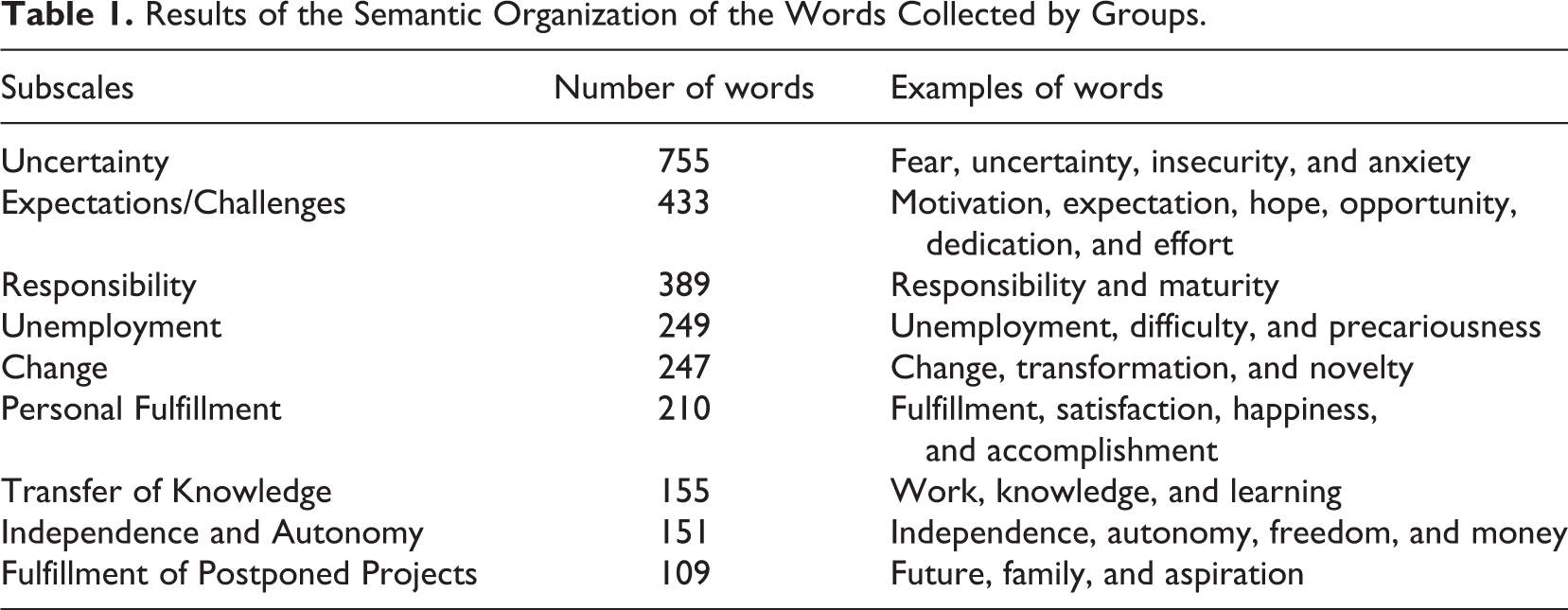
A total of 2,848 words were collected from 712 participants in the survey. The words collected were initially grouped by the first author according to semantic closeness. The first step in this process was to identify repeated words and the number of times they were mentioned by the students. The words included in each group were qualitatively compared so as to ensure their closeness in meaning. Thirteen groups resulted from this process whose semantic closeness varied between 109 and 755 words in each group. Each isolated word or each repeated word was considered as word to be counted (see Table 1). The groups of words, as well as the words listed in each group, were presented to five experts with PhDs in psychology, in order to obtain independent feedback on the grouping work conducted and on the words included in each group. Based on this feedback, we proceeded to join or merge some groups that were considered semantically close. Thus, we obtained a total of nine different groups/dimensions, in accordance with the main theoretical lines of postmodern social theories (Bauman, 2000, 2001; Beck, 1992, 2000; Elias, 1991; Giddens, 1990, 1991; Lyotard, 1979; Sennett, 1998) and the operational concepts found in the literature, such as uncertainty (Abbott, 2005; Greco & Roger, 2003; Marris, 1996), professional achievement (Solbrekke, 2008), and labor instability and difficulties (Bridges, 1994; Méda, 1995; Rifkin, 1995). It should be noted that 150 words do not fit any conceptually relevant group.
Results of the Semantic Organization of the Words Collected by Groups.
Ninety-eight items were built bearing in mind the groups created and the most used words in each one, following the main conceptual approaches mentioned in the literature and their multiple relations in postmodern societies (e.g., Bauman, 2000, 2001; Beck, 1992, 2000; Elias, 1991; Giddens, 1990, 1991; Marris, 1995; Méda, 1995; Rifkin, 1995; Sennett, 1998) and in transition to work (e.g., Krumboltz & Worthington, 1999; Lent et al., 1999; Savickas, 1999; Schlossberg, 1981, 2011; Schoon & Silbereisen, 2009; Swanson & Fouad, 1999; Young et al., 2011).
As an example, in the Uncertainty group, the most often referred words were “insecurity,” “uncertainty,” and “anxiety,” creating the item “Not knowing what the future holds in store for me professionally makes me anxious.” All items were checked and analyzed independently by five experts/researchers with PhDs in psychology, so as to check for their suitability, bearing in mind each of the groups considered and their suitability to the Portuguese context and culture. The feedback from the five senior researchers led to a few changes in some of the items. A discussion was later held with four higher education students (two of the male gender and two female) to ensure that each item was understood by the students as intended. This process resulted in a scale with 98 items distributed over nine dimensions (uncertainty, responsibility, change, unemployment, professional achievement, transfer of knowledge, independence/autonomy, expectations/challenges, and postponed projects).
Study 2
Procedure
Using the version of the scale resulting from Study 1, and based on an online survey platform, a pilot study was conducted, collecting data in May and June 2013. This study followed identical procedures, in which higher education student associations and groups were contacted (by telephone and e-mail) requesting collaboration in collecting the data. We requested that an e-mail be forwarded asking students to collaborate in the research and a link was provided to the online questionnaire. The respondent students participated in this study willingly and without any form of compensation. Students who stated having more than 2 months of working experience were excluded from the sample, because it was considered that they may already have built meanings about the transition from higher education to work and that their work experience could bias the results. Based on the data collected, processed on Statistical Package for Social Sciences (SPSS) software (version 20), an EFA was performed, with varimax orthogonal rotation, following the principal component method and applying a factor-loading criterion of >.50.
Participants
Five hundred forty-six undergraduate and master’s students with a mean age of 21.14 years (SD = 2.08), from public and private universities and polytechnics, participated in the study (who did not have more than 2 months of regular work experience). Females dominated the sample, representing 76.6%. Of all students, 69.2% were attending undergraduate degrees and 30.8% were attending postgraduate courses. It is noted that 83.5% of the students were from public higher education institutions and 16.5% were from private higher education institutions. Of all students, 77.5% attended university education institutions and 22.5% attended polytechnic institutions. With regard to the students’ fields of study, 40.3% were taking a degree in Health, Earth, and Life Sciences; 21.8% a degree in Exact Sciences, Engineering, and Technologies; and 37.9% a degree in the field of the Arts, Humanities, and Social Sciences.
Results
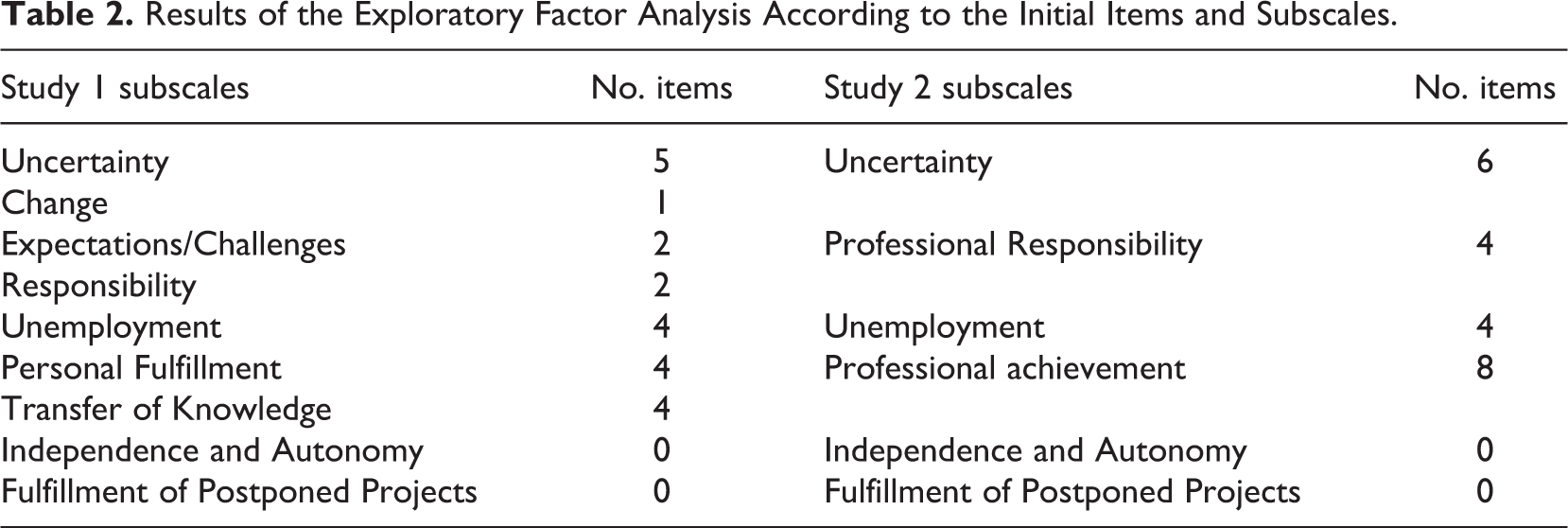
The EFA with varimax orthogonal rotation, following the principal component method with a factor-loading criterion of >.50 and an unrestricted number of factors, yielded a high number of factors (13), which made it very difficult to interpret the data. Thus, we decided to conduct the EFA with varimax orthogonal rotation, following the principal component method and applying a factor-loading criterion of >.50, but now restricting the number of factors, testing for different possibilities with nine to four factors. In all these possibilities, items with loading and/or communalities values below .50 were eliminated. Each removal of items was followed by a new varimax orthogonal rotation, following the principal component method and applying a factor-loading criterion of >.50, but maintaining the same number of factors. The option with four factors revealed the best suitability, despite a few differences found with regard to the original instrument resulting from the Study 1. A total of 76 items were eliminated because they did not achieve the loading value defined by the criterion used, had a higher loading value in more than one factor, or presented low figures in the communalities (lower than .50). Having concluded the EFA, we found that none of the items loaded in the Independence subscale and the Autonomy and Fulfillment of Postponed Projects subscale. Hence, as they lacked items, they were removed from the instrument. Two items of the Expectations and Challenges subscale were merged with another 2 items of the Responsibility subscale, creating a new subscale, Professional Responsibility. Finally, the items of the Personal Fulfillment subscale were merged with those of the Transfer of Knowledge subscale, creating a new subscale, professional achievement (Table 2).
Results of the Exploratory Factor Analysis According to the Initial Items and Subscales.
Based on a total of 98 items, we obtained an instrument with 22 items distributed over four factors: Professional Achievement (8 items), Uncertainty (6 items), Unemployment (4 items), and Professional Responsibility (4 items). In terms of the psychological dimensions underlying each factor, we can say that the Professional Achievement subscale expresses satisfaction and happiness with work, that is, satisfaction with the opportunity to put into practice the knowledge acquired in higher education. The Uncertainty subscale expresses fear and anxiety provoked by the inability to foresee the future, to predict what will happen in the transition to work. The Unemployment subscale reveals that students expect to face difficulties in finding a job. Finally, the Professional Responsibility subscale conveys the feeling of responsibility for tasks related to having a job, that is, the challenge of living up to what is expected of them (Table 3).
Results of the Exploratory Factor Analysis With Loading per Item.
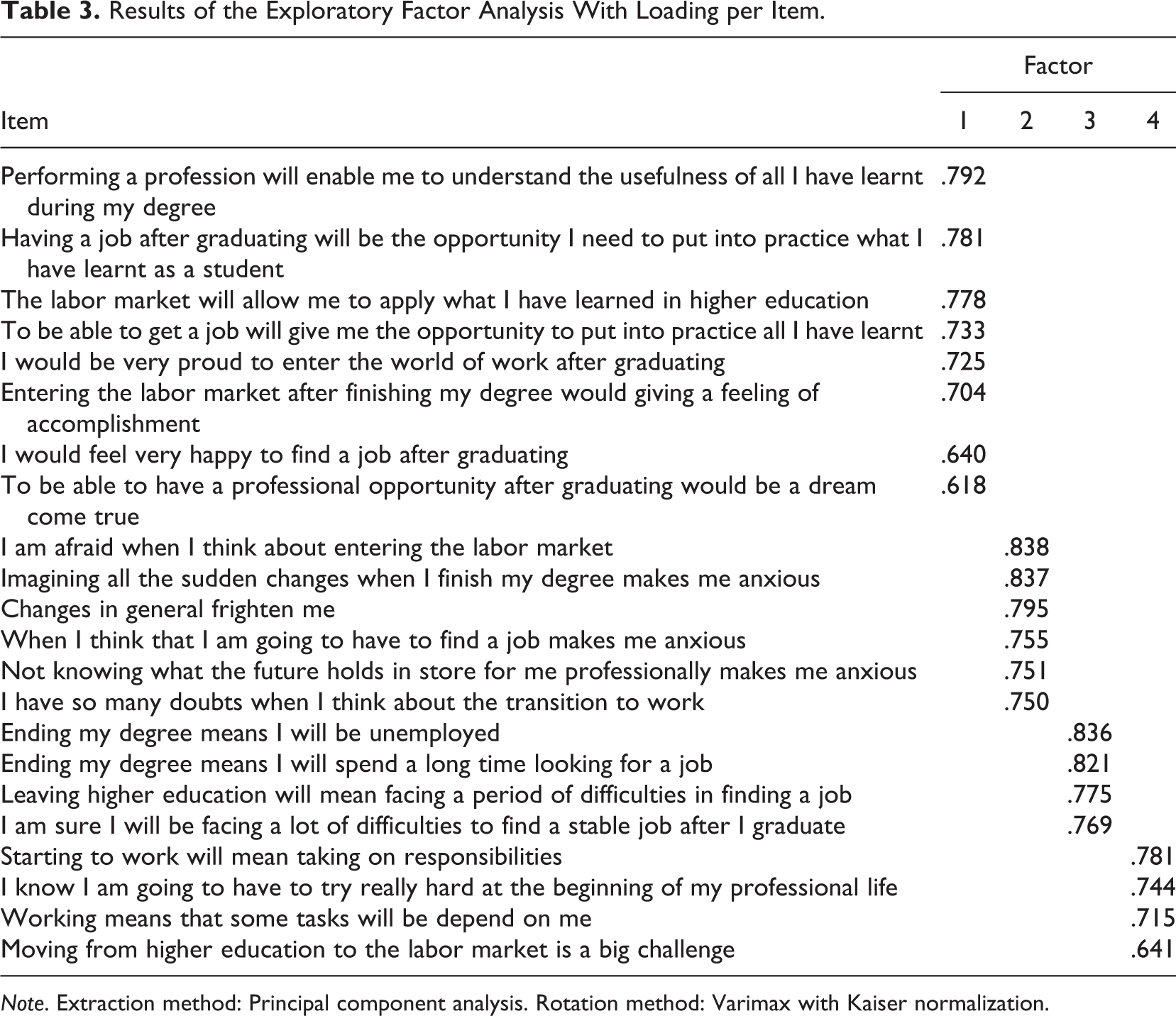
Note. Extraction method: Principal component analysis. Rotation method: Varimax with Kaiser normalization.
Each factor resulting from the EFA showed high levels of internal consistency, with Cronbach’s αs between .79 and .90. The total explained variance is 64.75%.
Study 3
Procedure
Using the version resulting from Study 2, a new study was conducted in October 2013. The same procedures as in the previous studies were employed to build the sample. A CFA was performed with the data collected, using SPSS AMOS 22 software.
Participants
Five hundred and five undergraduate and master’s students with a mean age of 20.61 years (SD = 2.21), from public and private universities and polytechnics, participated in the survey. Females represented 78.8% of the sample. Of all students, 69.3% were attending undergraduate degrees and 30.7% were attending postgraduate courses. It was observed that 90.9% of the students were from public higher education institutions and 9.1% were from private higher education institutions. Of all students, 75.8% attended university education institutions and 24.2% attended polytechnic institutions. With regard to the students’ fields of study, 46.5% were taking a degree in Health, Earth, and Life Sciences; 21.2% a degree in Exact Sciences, Engineering, and Technologies; and 32.3% a degree in the field of the Arts, Humanities, and Social Sciences.
Results
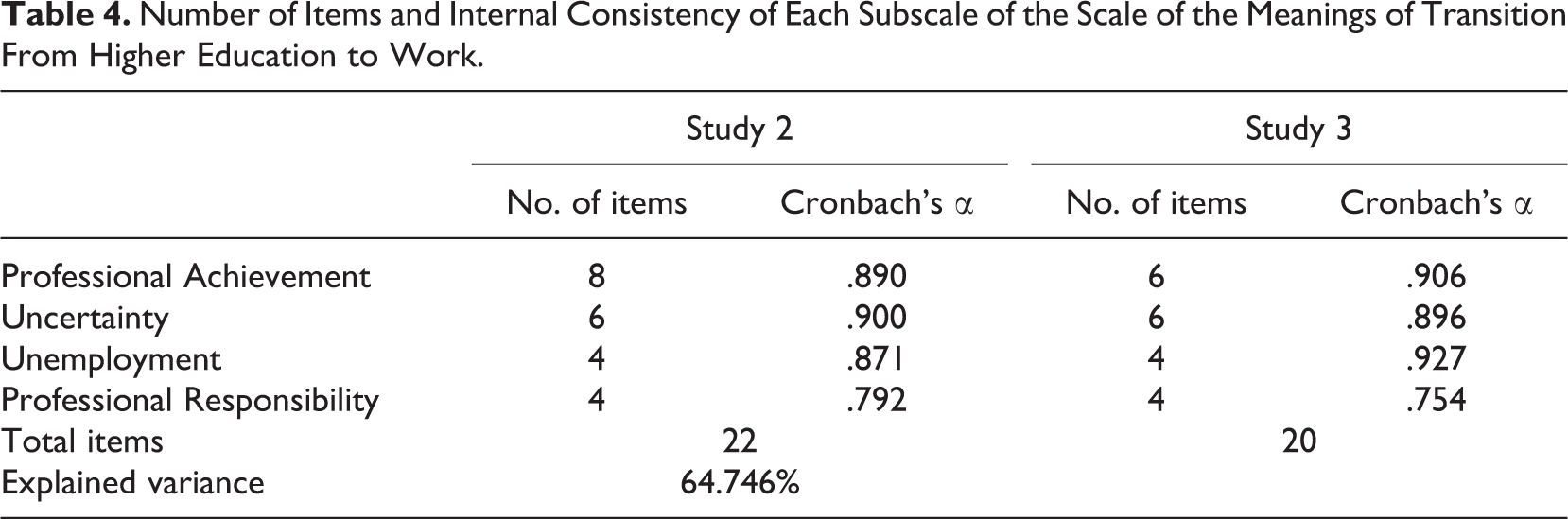
The model tested in the CFA raised a number of difficulties in terms of the adjustment values, most notably a comparative fit index (CFI) value below 0.90. After repeating the procedure, but removing the 2 items with the lowest factor weight (belonging to the professional achievement subscale), we obtained a model with only 20 items, indicating a satisfactory fit as can be seen in the figures obtained (CFI = 0.912 and root mean square error of approximation = 0.082). Furthermore, the factor weights of the factors’ items show suitable values, ranging between 0.62 and 0.93. We thus decided to remove the 2 items, a solution that improves the model’s fit. The internal consistency of each SMTHEW factor remains similar to that obtained in Study 2 (Table 4).
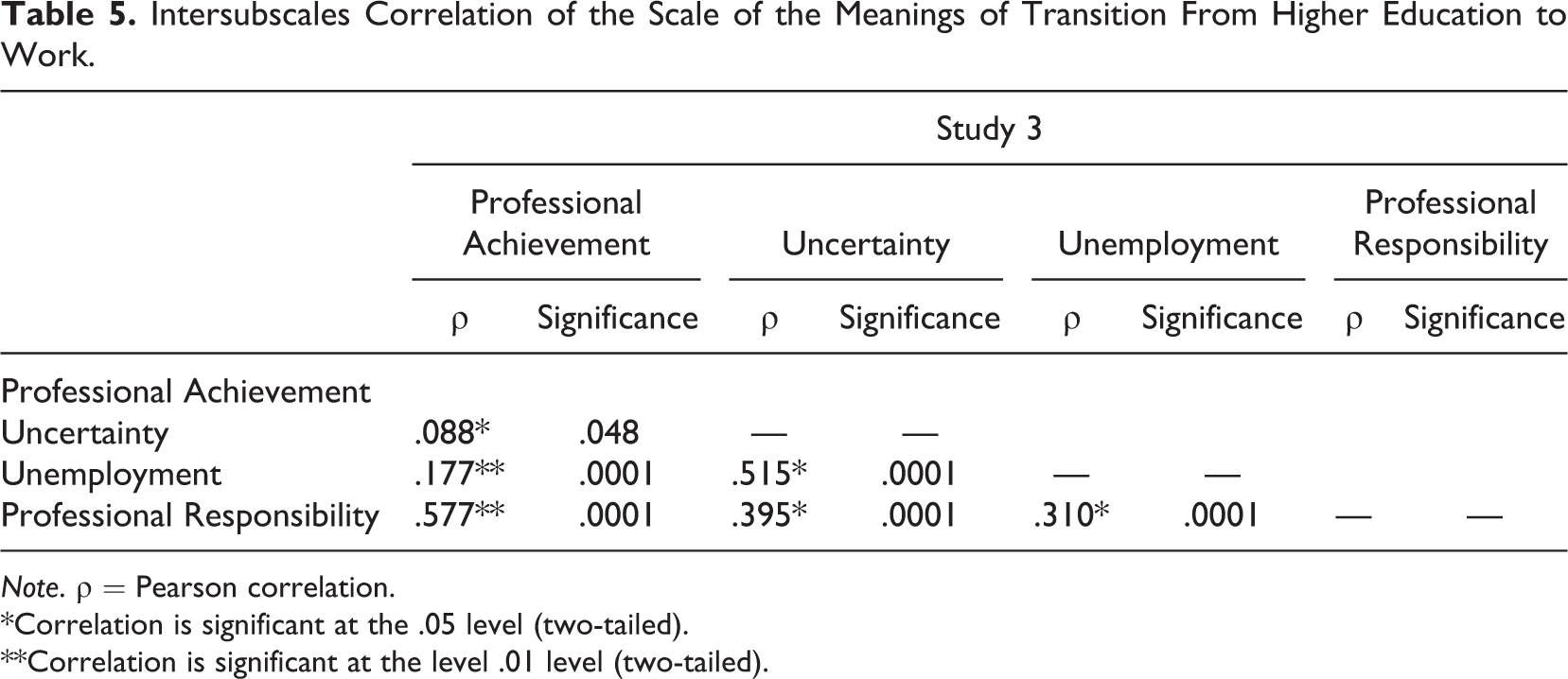
The data from Study 3 indicate low and moderate internal correlations among the different subscales of the SMTHEW (the Pearson’s coefficient varied between .088 and .577), which confirms that each dimension of the scale evaluates the dimension intended differently and autonomously with regard to the others (Table 5).
Number of Items and Internal Consistency of Each Subscale of the Scale of the Meanings of Transition From Higher Education to Work.
Intersubscales Correlation of the Scale of the Meanings of Transition From Higher Education to Work.
Note. ρ = Pearson correlation.
*Correlation is significant at the .05 level (two-tailed).
**Correlation is significant at the level .01 level (two-tailed).
Discussion
The initial version of the SMTHEW with nine factors used in Study 2 proved unsuitable in several tests and for the criteria defined by the researchers in the EFA. It was reduced to four factors, which is nevertheless consistent with the relevant literature. The reduction of 98 items to 22 is also justified because the researchers had developed a high number of items for selection through the EFA. The fact that we opted for a demanding factor loading value, that is, .50, was intended to decrease the scale’s total number of items without losing thoroughness and ensuring that each dimension would be assessed. The factor structure with four factors results from the removal of two original factors from the two groups containing less words (Independence/Autonomy and Fulfillment of Postponed Projects), and the merging of the factors such as Uncertainty and Change, Expectations/Challenges and Responsibility and Personal Fulfillment, and Transfer of Knowledge. The factors Independence/Autonomy and Postponed Projects disappear, but we cannot ignore that these are based on a very low number of words/expressions produced by the participants in study 1, 151 and 109, respectively. For example, the Uncertainty factor was formed by 755 words/expressions and the Responsibility and Expectations/Challenges factor was based on 822 words. Hence, the Personal Fulfillment factor is merged with the Transfer of Knowledge factor (giving rise to the factor hence called Personal Fulfillment); that is, the results seem to indicate that the learning taking place in higher education, when transferred to practice, is a source of personal fulfillment. The Responsibility factor was merged with the Expectations/Challenges factor (creating the new Responsibility factor). This merging is understandable in light of the responsibility the students expect to face when dealing with the challenge raised by the transition to work. The Uncertainty factor absorbs an item from the Change factor (creating the factor now called Uncertainty), conveying that each change can create uncertainty since it means facing the unknown. The Unemployment factor is comprised of the original items, maintaining thus its name. The joining of three factors, apart from making sense from a theoretical standpoint, given their conceptual similarities, provides for a robust instrument that is also more manageable in terms of the number of items.
The presence of these four factors (Uncertainty, Responsibility, Personal Fulfillment, and Unemployment) in the final instrument is in line with the main theoretical models and the research developed over the last few decades focused on the current conditions young people face in postmodern Western societies in their transition from higher education to working life (Beck, 1992; Krumboltz &Worthington, 1999; Lent et al., 1999; Méda, 1995; Rifkin, 1995; Savickas, 1999; Schlossberg, 1981, 2011; Sennett, 1998; Swanson & Fouad, 1999; Young et al., 2011).
With regard to Uncertainty, we can say that young people today are faced with a paradox in terms of planning their lives, which forces them to make decisions despite the lack of reliable guidelines for their life paths and they do so under highly uncertain circumstances (Schoon & Silbereisen, 2009). Uncertainty and risk are the marks of modern times (Beck, 1992, 2000; Marris, 1995). During their academic career, contact with situations of uncertainty is already a reality university students are experiencing (Martin, Nejad, Colmar, & Liem, 2013). Thus, extending uncertainty to the context of the transition from higher education to work is perfectly understandable in a society that recurrently confronts people with the paradox of the need to plan their future but simultaneously produces the unknown they need to face (Abbott, 2005). Uncertainty, as a powerful source of stress (Greco & Roger, 2003), seems to take charge of the lives of students, becoming disturbingly real at a stage when they are preparing to abandon the stability of their academic training.
The transition from higher education to work seems to represent a move to greater responsibility, occurring usually at the same time as the transition to the responsibility of adulthood. It is in this line that Guerreiro and Abrantes (2007) mention that, today, it seems appropriate to consider the transition to adulthood as a path in two tempos: the first lacking major concerns and dedicated to experiences and the second dominated by responsibility. Many professionals today work in organizations that are influenced and governed by complex internal and external interests. Such situations mean that professionals are subject to multiple commitments and the influence of the varied interests of colleagues, bosses, or employers (Solbrekke, 2008). University students seem to be anticipating work as the need to assume responsibilities with others, whether they be those who they will serve in their profession, or those with whom, or for whom, they will work.
Pais (1993) had already noted that whereas young blue-collar workers favor money and job security, more qualified youths show greater concern with professional achievement. Fernandes (2012) found identical results in his research with Brazilian youths. Modernity has introduced transformations not only in the labor market but also in the private sphere. In modern times, individuals are free to build their projects and life paths and to continuously transform them. Identities and biographies become profoundly individual, reflexive, and complex, the object of choices and decisions (Giddens, 1991; Lash, Giddens, & Beck, 1994). This process opens the door to new opportunities for personal fulfillment, but it also implies new risks and responsibilities (Guerreiro & Abrantes, 2007).
Finally, in terms of unemployment, this has, in recent times, profoundly marked Western societies in general and Portugal in particular. At the end of the third trimester of 2013, the unemployment rate in Portugal was 15.6%, but the unemployment rate among young people, aged 15 to 24, was 36.0% ( Instituto Nacional de Estatística, 2013). Bauman (2001) suggests that enrollment in universities has not suffered a very significant decline mainly because of their role as temporary shelter, as a way to buffer structural unemployment. Azevedo (1999) also states that schools are like parking lots for the potentially unemployed, increasing the level of qualification and certification of the unemployed instead of decreasing unemployment. Such a mechanism means the newcomers can postpone for a few years the moment of truth that surfaces when they need to face the harsh reality of the labor market (Bauman, 2001). Azevedo and Fonseca (2006) state that there are currently general social trends that affect the labor market in Europe, such as young people remaining more years in the schooling system and thus entering the world of work much later; population decline which decreases the pressure on the labor market; the rise in female employment; progressive population ageing; the continuous restructurings of the economy and the state, all this taking place in an increasingly more uncertain and less predictable, less controllable social environment than in previous periods.
Thus, we can consider that the meanings students attribute the transition from higher education to work are represented in the final instrument, from which factors were removed that, from the beginning, included the less expressive and relevant words/expressions collected initially. In contemporary societies, the transition to adulthood is still strongly associated with achieving financial independence, which depends in its turn on entering the labor market (Guerreiro & Abrantes, 2007). Given that this entry is more and more difficult for young people, the transition from higher education to work is no longer regarded, at least for a majority of the students, as a door to their independence and the fulfillment of their projects.
To conclude, given the psychometric qualities revealed by the SMTHEW in the EFA (percentage of explained variance at 64.75% and internal consistency αs of each of its subscales between .79 and .90), given the high levels of the CFA’s fit and its capacity to support the main conclusions proposed by recent research on the matter, we believe this will be a consistent instrument that is able to assess the meanings attributed to the transition from higher education to work. It should however be noted that the SMTHEW has yet to be validated. It is the research team’s aim to further develop the instrument in the near future, undertaking studies focused on its convergent and discriminatory validity.
Having determined, based on the review of the literature in this domain, that there was a lack of instruments to assess this highly relevant, emerging social phenomenon, the SMTHEW we are developing may contribute to the study of this issue in future research.
Footnotes
Declaration of Conflicting Interests
The author(s) declared no potential conflicts of interest with respect to the research, authorship, and/or publication of this article.
Funding
The author(s) received no financial support for the research, authorship, and/or publication of this article.