



Abstract
The mediation of career decision-making self-efficacy on the link of ambiguity tolerance (AT) with career indecision was examined in a sample of college students (N = 253). It was hypothesized that AT could help reduce career indecision through increasing career decision-making self-efficacy, where this effect would vary by different types of indecision. Results supported the differential mediation hypothesis, finding that career decision-making self-efficacy mediated the link of AT with lack of motivation, general indecisiveness, lack of information, and inconsistent information. The mediation effect of career decision-making self-efficacy on the link of AT with lack of motivation was relatively weak. The implications of this study are discussed and suggestions for future research are provided.
Career decision making is conceived by many theorists (e.g., Holland, 1997; Parsons, 1909; Sampson, Lenz, Reardon, & Peterson, 1999) as a process of collecting information about oneself and the world of work and then using information to find an area of match. However, this process depends upon the quality of information gathered and also the ability to put the information together in terms of determining a reasonable match. It is a difficult process and is fraught with ambiguity. So a key aspect in career decision making is the ability to deal with this ambiguity. Xu and Tracey (2014) revealed that ambiguity tolerance (AT) was negatively associated with career indecision, where individuals who were tolerant of ambiguity had less indecision. As self-efficacy has been acknowledged as a central variable closely linking to a variety of career outcomes (Lent & Brown, 2013; Lent, Brown, & Hackett, 1994), we sought to examine whether career decision-making self-efficacy could help explain the positive effect of AT in regard to career decision making. The focus of this study was to examine the mediation effect of career decision-making self-efficacy on the link of AT with career indecision.
AT With Career Decision Making
Career decision making has been conceptualized for a long while as a process of collecting information regarding the vocational world and the self and then using the information collected to find an area of match, as Parsons (1909) proposed. This model is based on rational choice theory, which involves the key hypothesis that people have access to all the information and can make a rational choice based on the information. However, this hypothesis is commonly unmet because of the inevitable variance in the information available and the common conflicts in the information that is available (Xu & Tracey, 2014). This informational ambiguity is especially salient in career decision making because of the lack of clear criteria for the optimal career choice and the increasing complexity of the vocational world in the 21st century.
There has been research supporting the role of informational ambiguity in complex decision making. Kahneman and Tvesky’s groundbreaking work (Kahneman & Tversky, 1979; Tversky & Kahneman, 1981) has demonstrated that uncertainty plays a significant role in the decision-making process, which cannot be explained by the rational choice theory. As opposed to the rational choice theory conceiving decision making as a process of comparing expected utilities, Kahneman and Tversky found that in the condition of loss or gain, people tend to prefer or avoid uncertainty, respectively (Kahneman & Tversky, 1979; Tversky & Kahneman, 1981). The results thus portrayed uncertainty as an important factor in the complex decision-making process. Hsu, Bhatt, Adolphs, Tranel, and Camerer (2005) portrayed ambiguity as a construct of a high level of uncertainty and differentiated ambiguity tasks from regular uncertain tasks. They conceived uncertainty as a product due to known event probabilities and conceived ambiguity as a product due to unknown event probabilities. Neuropsychological evidence of the functional magnetic resonance imaging supported the conceptual differentiation by finding the activation of the orbitofrontal cortex and the amygdala only in the ambiguous condition. The informational ambiguity is salient in career decision making because the career decision-making process has few clues to the prospect of any career choice and is of extensive uncertainty (Xu & Tracey, 2014). Given this role, it is expected that how people handle informational ambiguity would affect career decision-making outcomes.
One functional way of handling informational ambiguity could be building tolerance with ambiguity. AT has been defined as the way individuals perceive and respond to ambiguous situations or stimuli characterized by an array of unfamiliar, complex, or inconsistent clues (Budner, 1962; Furnham & Ribchester, 1995). According to Furnham and Ribchester (1995), people with low levels of AT tend to experience stress, react prematurely, and avoid ambiguous stimuli, while those with high AT perceive ambiguous situations/stimuli as desirable and interesting and do not deny or distort the complexity of incongruity. Therefore, AT portrays the individual difference in terms of how people handle information unavailability and conflict (i.e., ambiguity) and would be anticipated to relate to career decision-making outcomes as argued earlier.
There has been empirical evidence supporting the positive link of AT with career decision making. Endres, Chowdhury, and Milner (2009) found support for the link of AT with self-efficacy in a complex decision task, suggesting that AT is a positive attribute in ambiguous decision-making situations. Xu and Tracey (2014) have found that AR negatively predicted different areas of career indecision directly when controlling for amount of career exploration regarding the self and the world of work. A key assumption made in this study was that the association of AT with career decision making would be mediated by career decision-making self-efficacy.
Mediation of Career Decision-Making Self-Efficacy
The construct of career decision-making self-efficacy was largely derived from Bandura’s seminal work of general self-efficacy (Betz & Luzzo, 1996; Taylor & Betz, 1983), which postulated self-efficacy to be an important mediator of individual behaviors, goals, and outcomes (Bandura, 1977). As a domain-specific self-efficacy, career decision-making self-efficacy describes an individual’s belief regarding his or her ability to successfully complete tasks necessary to making career decisions. Based on Crites’ (1978) model of career maturity, five processes of career decision making were conceived as critical for career decisions and thus these five processes were regarded as the specific behavioral domains where career decision-making self-efficacy should be measured (Betz & Luzzo, 1996; Taylor & Betz, 1983). These five domains consisted of (a) self-appraisal, (b) occupational information, (c) goal selection, (d) planning, and (e) problem solving.
Along with Bandura’s (1977) work, the Social Cognitive Career Theory (SCCT; Lent & Brown, 2013; Lent et al., 1994) proposed career decision-making self-efficacy to be a pivotal mediator explaining the career decision-making behaviors and the decision-making outcomes. The link of career decision-making self-efficacy with career indecision has been well studied and solidly supported by previous research. Betz, Klein, and Taylor (1996) revealed a strong association of career decision-making self-efficacy with career decision certainty and career indecision. Brown et al.’s (2012) study indicated that lack of career decision-making self-efficacy marked one type of career indecision. Osipow and Gati (1998) also showed that career decision-making self-efficacy was strongly associated with two measures of career indecision. Using a meta-analytic approach, Choi et al. (2012) revealed a large association of career decision-making self-efficacy with career indecision among the existing studies.
A key structural path from AT to career decision-making self-efficacy and then to career indecision was proposed in this study based on the arguments of SCCT. The SCCT emphasizes the preceding social learning experiences, which forms the foundation of the self-efficacy beliefs. The self-efficacy beliefs then act as the pivotal internal cognitive unit affecting the subsequent behaviors and outcomes. One could argue that individuals with low AT tend to have less positive experiences in the decision-making processes either in the career domain or in other life domains because they are likely to have difficulty in handling complex decision-making situations. These negative experiences would then be expected to form the basis of beliefs regarding one’s career decision-making abilities, which could lead to less adaptive career decision-making behaviors and greater career indecision.
However, the research has demonstrated that career indecision is not a unidimensional construct (e.g., Brown et al., 2012; Gati, Krausz, & Osipow, 1996). Gati, Krausz, and Osipow’s (1996) multi-dimensional model of career indecision was developed based on an adaptation of decision-making theory to the context of career decisions. It originally proposed three overarching domains of career indecision, consisting of lack of readiness, lack of information, and inconsistent information. There has been a good deal of data supporting the reliability and validity of this model among college students (e.g., Gati et al., 1996; Gati & Saka, 2001; Osipow & Gati, 1998). However, the previous research has also indicated that the three indicators of the lack of readiness domain diverged from each other as demonstrated in the low correlations among the indicators and the low alpha coefficients compared to the other two domains (e.g., Gati et al., 1996; Gati & Saka, 2001; Osipow & Gati, 1998). This suggested that lack of readiness was a less homogeneous factor. Instead, lack of readiness should be treated more as three distinct indecision types. Based on these previous findings, we specified and adopted a revised model in the current study by breaking down the lack of readiness domain into three indecision types, anticipating that it would be a better representation of the data. The five resulting domains of career indecision were thus lack of motivation (RM), general indecisiveness (RI), dysfunctinal beliefs (RD), lack of information (LI), and inconsistent information (II). Xu and Tracey (2014) provided support for the structural validity of this revised model in the findings of satisfactory model data fit and factor loadings. The revised multidimensional model acknowledged the various aspects of career indecision and enabled us to investigate the potentially differential predictions on domains of career indecision.
We hypothesized that the mediation effect of career decision-making self-efficacy occurs on the paths from AT to all the five domains of career indecision. As argued earlier, people with poor AT are more likely to have poor self-efficacy regarding career decision making. They would be anticipated to have less motivation for career decision making, as it could be a challenging activity for them to avoid. They tend to have more general indecisiveness and dysfunctional beliefs, as they hold less faith with their career decision-making abilities and with the possibilities of optimizing their career choices. With the poor self-efficacy in mind, they are also likely to have more information deficit and conflict, as they tend to engage in less functional information searching and integration behaviors.
However, the associations of career decision-making self-efficacy with lack of motivation, general indecisiveness, and dysfunctional beliefs were proposed to be weaker than the ones with lack of information and inconsistent information. We argued that poor information collecting behaviors resulting from poor self-efficacy could largely contribute to lack of information and inconsistent information, whereas individual values and personality independent of self-efficacy could significantly account for lack of motivation, general indecisiveness, and dysfunctional beliefs. The differential hypotheses resonated with Gati et al.’s (1996) indecision model that lack of motivation, general indecisiveness, and dysfunctional beliefs were grouped together as they were more of chronological and characteristic issues arising before the career decision-making progress, while lack of information and inconsistent information were grouped together as they were more of developmental and behavioral issues arising during the career decision-making process. Osipow and Gati (1998) have shown a similar pattern of differential associations between career decision-making self-efficacy with different domains of indecision in the findings of stronger correlations between career decision-making self-efficacy with lack of information and inconsistent information.
Based on Xu and Tracey (2014)’s preliminary finding of AT being negatively associated with career indecision, this study was intended to advance the research topic by investigating how this effect occurs and specifically examine one possible meditational path proposed by an important career model of SCCT. The meditational examination has never been conducted regarding the link of AT with career indecision to our best knowledge and the mechanism of how AT leads to less career indecision is still unclear. The mediation of career decision-making self-efficacy is especially important for career counseling practice with the SCCT framework, where career decision-making self-efficacy is the central vehicle of the model and insights regarding the predictors of self-efficacy are needed for a more effective intervention. Xu and Tracey (2014) investigated the link of AT with career indecision in a sample of major undecided freshman students. In order to enhance generalizability, a more diverse sample that varied from the one used by Xu and Tracey (2014) was selected in this study, consisting of both major decided and undecided students in various grades.
Research Hypothesis
To sum up, the model of the hypothesized structural relations is depicted in Figure 1. As noted earlier, AT predicts career decision-making self-efficacy (path a) because ambiguity-tolerant people tend to have positive decision-making experiences and could form a better decision-making self-efficacy. Career decision-making self-efficacy predicts all the five domains of career indecision (paths b, c, d, e, and f) because people confident in their career decision-making skills tend to have more adaptive career decision-making activities, which could help assuage the indecision due to lack of motivation, general indecisiveness, dysfunctional beliefs, lack of information, and information inconsistency. Finally, career decision-making self-efficacy has stronger predictions on lack of information and inconsistent information than on lack of motivation, general indecisiveness, and dysfunctional beliefs (i.e., b < e, b < f, c < e, c < f, d < e, and d < f).
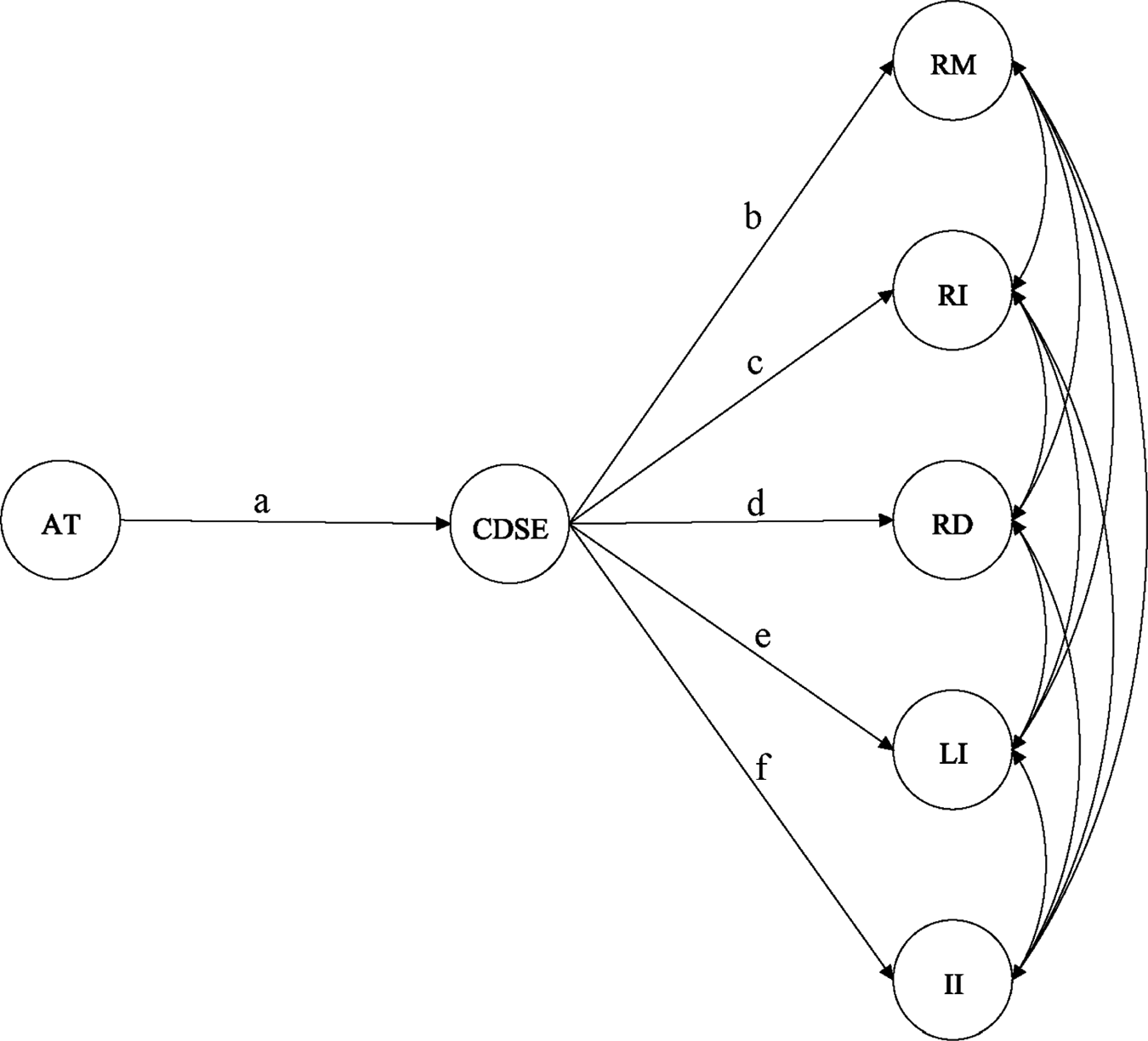
The hypothesized mediation model. Note. AT = ambiguity tolerance; CDSE = career decision self-efficacy; RM = lack of motivation; RI = general indecisiveness; RD = dysfunctional beliefs; LI = lack of information; II = inconsistent information.
Method
Participants
The sample consisted of 253 undergraduate students recruited from a southwest state university. They ranged in age from 18 to 42 (M = 19.37, SD = 2.27). Of the sample, 34.8% were male (n = 88), 64.8% were female (n = 164), and 0.4% were self-identified as others (n = 1). In terms of race/ethnicity, 5.9% (n = 15) were African American/Black, 6.7% (n = 17) were Asian/Asian American, 24.9% (n = 63) were Latino or Latina/Hispanic, 51.4% (n = 130) were Caucasian/White, 2.0% (n = 5) were Native American, 8.3% (n = 21) were Multi-racial, and .8% (n = 2) were self-identified as others. In terms of major, 54.9% (n = 139) were in an exploratory program and the other 45.1% (n = 114) were from a variety of majors.
Measurement
The Multiple Stimulus Types Ambiguity Tolerance Scale II
The Multiple Stimulus types Ambiguity Tolerance Scale II (MSTAT-II; McLain, 2009) is a 13-item measure designed to measure an individual’s tolerance for situations that are unfamiliar, insoluble, or complex (Budner, 1962). The MSTAT-II measures the participants’ degree of AT based on following five stimulus types: ambiguous stimuli in general, complex stimuli, uncertain stimuli, new/unfamiliar/novel stimuli, and insoluble/illogical/internally inconsistent stimuli (e.g., “I try to avoid situations that are ambiguous” and “I prefer familiar situations to new ones”). Items would be rated on a 5-point Likert-type scale ranging from 1 (strongly disagree) to 5 (strongly agree). Higher scores indicate higher AT. McLain (2009) reported Cronbach’s a of .83. Xu and Tracey (2014) reported an αcoefficient of .76. Validity evidence of high correlations with other common AT measures and risk-taking propensity and low correlation with social desirability were reported as well (McLain, 2009). An α estimate of .82 was obtained using the current sample.
The Career Decision Self-Efficacy Short Form
The Career Decision Self-Efficacy Short Form (CDSE-SF; Betz, Klein, & Taylor, 1996) is a 25-item measure designed to assess the self-efficacy for five skill domains viewed as crucial for effective career decision making (Crites, 1978). These five domains consist of (a) accurate self-appraisal (e.g., “Accurately assess your abilities”), (b) gathering occupational information (e.g., “Use the internet to find information about occupations that interest you”), (c) goal selection (e.g., “Choose a career that will fit your preferred lifestyle”), (d) making plans for the future (e.g., “Make a plan of your goals for the next 5 years”), and (e) problem solving (e.g., “Change majors if you did not like your first choice”). Responses would be scored on a 5-point Likert-type scale ranging from 1 (no competence at all) to 5 (complete competence). The internal consistency α for the CDSE-SF ranges from .93 to .94 (Betz & Luzzo, 1996). There is an extensive body of data supporting the validity of CDSE-SF (e.g., Betz & Luzzo, 1996), including its significant correlations with career indecision, fear of occupational commitment, career maturity, and career exploratory behaviors. The current data revealed an α coefficient of .94.
The Career Decision-Making Difficulty Questionnaire
The Career Decision-Making Difficulty Questionnaire (CDDQ; Gati et al., 1996) was developed based upon Gati and his colleagues’ (1996) taxonomy of career decision-making difficulties. The 3-item Lack of Motivation (RM) scale measures career indecision due to lack of motivation (e.g., “I know that I have to choose a career, but I do not have the motivation to make the decision now”). The 3-item General Indecisivenss (RI) scale measures career indecision due to inhibiting indecisiveness (e.g., “It is usually difficult for me to make decisions”). The 4-item Dysfunctional Beliefs (RD) scale measures career indecision due to dysfunctional cognition (e.g., “I believe there is only one career that suits me”). The 12-item Lack of Informtion (LI) scale measures career indecision due to information deficit (e.g., “I find it difficult to make a career decision because I still do not know which occupations interest me”). The 10-item Inconsistent Information (II) scale measures career indecision due to informational conflicts (e.g., “I find it difficult to make a career decision because I have contradictory data about the existence or the characteristics of a particular occupation or training program”). Participants were asked to rate on a 9-point Likert-type scale ranging from 1 (does not describe me) to 9 (describes me well). Gati, Ryzhik, and Vertsberger (2013) reported αcoefficients as .66, .64, .61, .89, and .79 for the RM, RI, RD, LI, and II scales, respectively. Xu, Hou, and Tracey (2014) found αcoefficients of .66, .72, .63, .93, and .89 for the RM, RI, RD, LI, and II scales, respectively. Osipow and Gati (1998) found a strong positive association of the CDDQ with the Career Decision Scale and a strong negative association of the CDDQ with the Career Decision Self-Efficacy Scale, providing evidence for the validity of the CDDQ. This study found α coefficients of .70, .72, .52, .96, and .93 for the RM, RI, RD, LI, and II scales, respectively.
Procedure
College students participating in career development, introduction to psychology, or university orientation classes were invited to participate in this study as an extra credit opportunity. Voluntary participants filled a demographic questionnaire and the package of research instruments online. All the individual responses were kept as anonymous and confidential through analysis. Of the 260 total participatns, 7 participants withdrew from the study and did not answer the CDDQ. They were not included in the final data set. According to the setting of the online survey, participants were required to answer all items before they could move to the next part. Thus, there were no missing data in the final data set.
Analysis
Mplus 7 was employed to conduct the latent variable Structural Equation Modeling (SEM) because such an approach would enable the examination among error-free latent contstructs instead of error-laden manifest variables. Given the low reliability of some of the indecision scales, such an approach makes the most sense. The means for the five subscales of MSTAT-II, corresponding to the five theoretical stimulus types, were used as the indicators of the latent AT. The means for the five subscales of CDSE-SF, corresponding to the five theoretical behavioral domains crucial to career decision making, were used as the indicators of the latent career decision-making self-efficacy. The manifest items of the RM, RI, and RD subscales of CDDQ were used as the indicators of the latent RM, RI, and RD domains. The subscales under the domains of LI and II were used as the indicators of the latent LI and II domains.
The latent variable SEM enabled us to examine the structural relations without the confound of the measurement error and thus results in a more precise examiantion. The fit of the models would be evaluated using the criteria recommended by Hu and Bentler (1999) which include robust chi-square, comparative fit index (CFI), root mean square error of approximation (RMSEA), and standardized root mean square residual (SRMR). With the purpose of making the statistical tests robust to nonnormality, we adopted the robust maximum likelihood parameter estimation. A nested model comparison approach was used to precisely examine which model represented the data better. Differences between nested models were compared using the Santorra–Bentler scaled chi-square difference test (Muthén & Muthén, 2012).
The SEM bias-corrected bootstrapping approach (n = 1,000) of mediation test was used in this study, given its superior performance in the simulaiton studies (Cheung & Lau, 2008). As Cheung and Lau (2008) suggested if the 95% confidence interval (CI) does not contain zero, then the mediation effect is significant at the α level of .05.
Results
Table 1 showed the means, SDs, and bivariate correlations of AT, career decision-making self-efficacy, and domains of career indecision. Table 2 summarizes the fit indices of all the models. We first examined the measurement model of the proposed model (Model 1), in which career decision-making self-efficacy mediates the relation of AT to different domains of career indecision.
Means, Standard Deviations, Cronbach α, and Correlations of Variables.
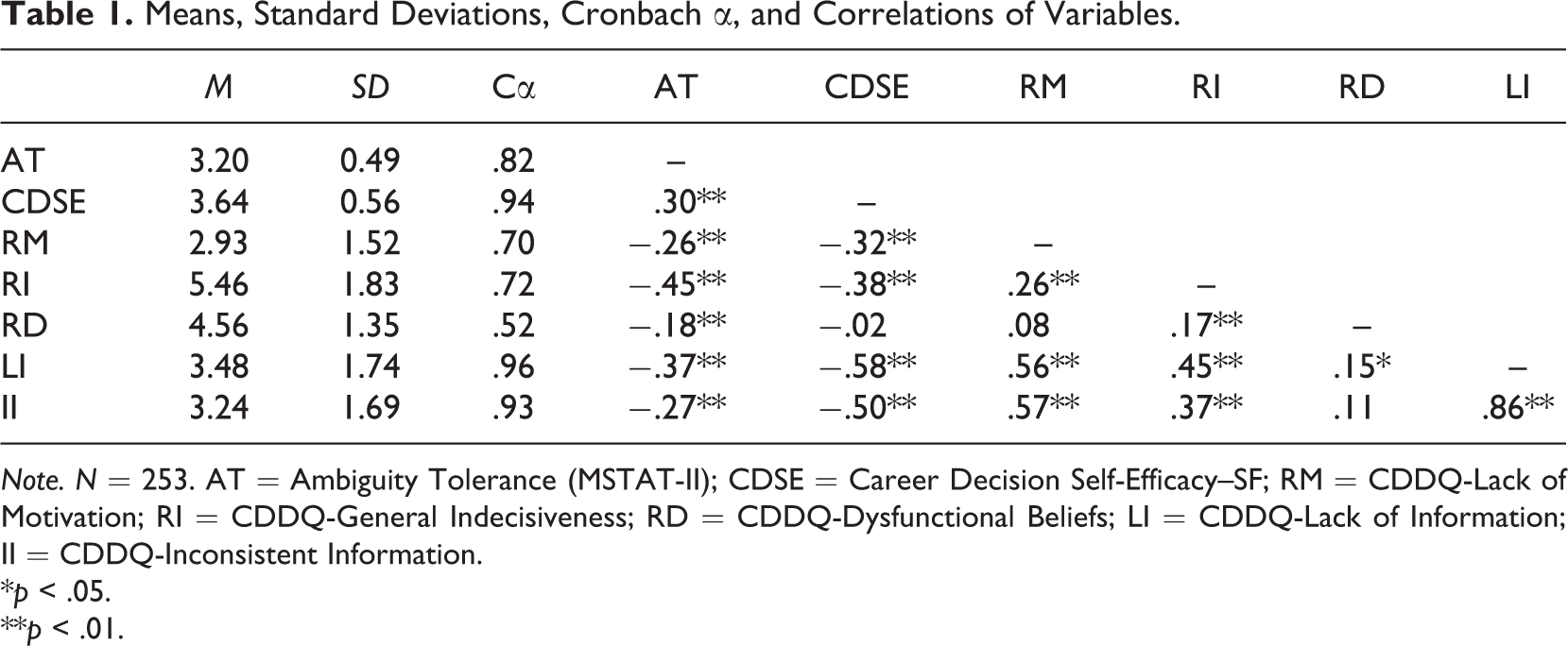
Note. N = 253. AT = Ambiguity Tolerance (MSTAT-II); CDSE = Career Decision Self-Efficacy–SF; RM = CDDQ-Lack of Motivation; RI = CDDQ-General Indecisiveness; RD = CDDQ-Dysfunctional Beliefs; LI = CDDQ-Lack of Information; II = CDDQ-Inconsistent Information.
*p < .05.
**p < .01.
Summary of Model Fit Index for Model Comparison.
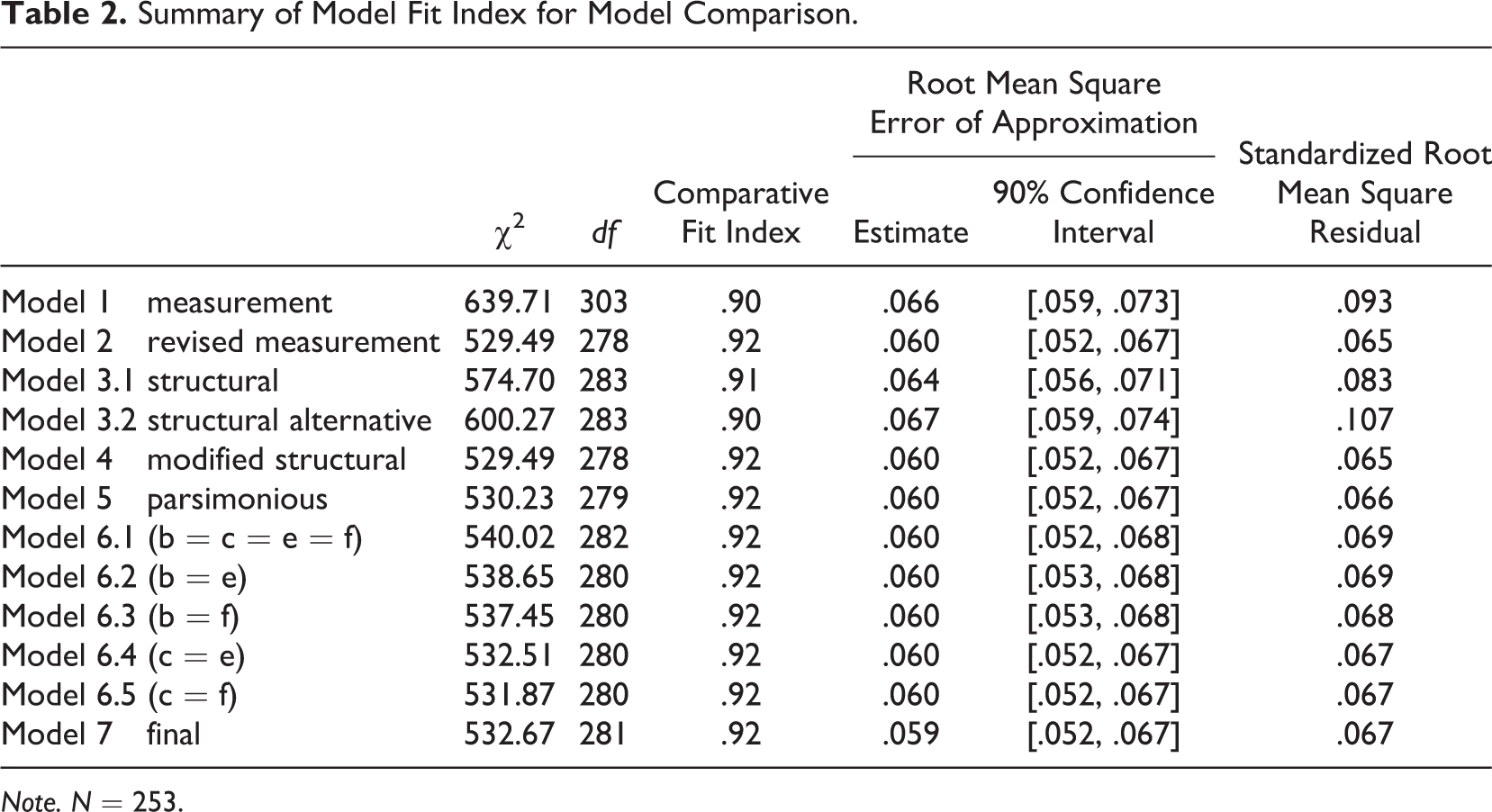
Note. N = 253.
The measurement model was found to fit the data adequately with respect to the RMSEA (.066) and the CFI (.90); however the SRMR (.093) was above the recommended levels. An examination of the modification indices as well as the factor loadings indicated that 1 item (CDDQ10) in the RD scale had significant cross loadings on all the other domains of career indecision (i.e., RM, RI, LI, and II) and on CDSE, whereas its factor loading on the latent RD was poor (.12). The CDDQ10 literally asked individuals the degree to which “I expect that through the career I choose I will fulfill all my aspirations.” It was plausible to suggest that the career belief reflected in this item was more associated with the individual optimism or self-efficacy, instead of the dysfunctional rigidity among the population being investigated in this study. We thus dropped this item in the following analysis and examined the revised measurement model (Model 2) again. As can be seen by the values of CFI (.92), RMSEA (.060), and SRMR (.065), this model fits the data acceptably. The individual factor loadings for all the latent factors were found to be significant and of moderate to large magnitude, further supporting the structure validity of all the latent variables.
We then examined the full structural model (Model 3.1). The values of CFI (.91) and RMSEA (.064) indicated an adequate model data fit. However, one problem with structural analysis based on cross-sectional data is that the reverse model could fit the data equally or even better. We thus tested the alternative model (Model 3.2) of career decision-making self-efficacy leading to AT and to career indecision. As can be seen from the values of CFI (.90), RMSEA (.067), and SRMR (.107), the model fit was marginal. The original model had slightly better fit indicators, indicating that the original structural model was a better representation of the data than the alternative one.
However, the value of SRMR (.083) of the original structural model (Model 3.1) was above the ideal level, indicating that this model was a mediocre representation of the data. The significant result of the corrected chi-square difference test also indicated that this model omitted some important paths in the saturated model, scaled Δχ2(5, N = 253) = 59.97, p < .05. The modification indices suggested that AT directly predicted the five domains of career indecision (i.e., RM, RI, RD, LI, and II) as well. We thus specified a modified model (Model 4) based on Model 3.1 but adding the paths from AT to lack of motivation (path g), general indecisiveness (path h), dysfunctional beliefs (path i), lack of information (path j), and inconsistent information (path k). The Model 4 was found to fit the data adequately as can be seen from the values of CFI (.92), RMSEA (.060), and SRMR (.065). This model included all the possible structural paths and thus represented the data equivalently as the saturated measurement model. The examination of the individual regression coefficients revealed one nonsignificant path from career decision-making self-efficacy to dysfunctional beliefs (path d), indicating that career decision-making self-efficacy was not associated with dysfunctional beliefs.
We then continued to specify a more parsimonious model (Model 5) by dropping the nonsignificant path in Model 4 (path d). As can be seen from the values of CFI (.92), RMSEA (.060), and SRMR (.066), this model was found to fit the data adequately. The scaled chi-square difference test indicated that this model did not significantly worsen the model data fit compared to Model 4 and the measurement model, scaled Δχ2(1, N = 253) = .37, p > .05.
Based on Model 5, we constrained the paths b, c, e, and f in Model 6.1 to test whether there were differential predictions of career decision-making self-efficacy on different domains of indecision. This model was found to fit the data adequately as can be seen from the values of CFI (.92), RMSEA (.060), and SRMR (.069). The corrected chi-square difference test between Model 6.1 and Model 5 was significant, scaled Δχ2(3, N = 253) = 7.81, p < .05, indicating that the fully constrained model was a worse representation of the data and thus there were differences in the paths b, c, e, and f. We then constrained one pair of paths each time (i.e., b = e, b = f, c = e, and c = f respectively) to precisely examine the hypothesis of differential predictions.
Model 6.2 constrained the paths b and e. As can be seen from the values of CFI (.92), RMSEA (.060), and SRMR (.069), this model fits the data adequately. The corrected chi-square difference test between Model 6.2 and Model 5 was significant, scaled Δχ2(3, N = 253) = 7.14, p < .05, indicating that paths b and e were different. It was thus suggested that career decision-making self-efficacy was more predictive of lack of information than lack of motivation.
Model 6.3 constrained the paths b and f. As can be seen from the values of CFI (.92), RMSEA (.060), and SRMR (.068), this model fits the data adequately. The corrected chi-square difference test between Model 6.3 and Model 5 was significant, scaled Δχ2(3, N = 253) = 6.18, p < .05, indicating that paths b and f were different. It was thus suggested that career decision-making self-efficacy was more predictive of inconsistent information than lack of motivation.
Model 6.4 constrained the paths c and e. As can be seen from the values of CFI (.92), RMSEA (.060), and SRMR (.067), this model fits the data adequately. The corrected chi-square difference test between Model 6.4 and Model 5 was not significant, scaled Δχ2(3, N = 253) = 2.33, p > .05, indicating that path c and path e were equal. It was thus suggested that career decision-making self-efficacy was equally predictive of lack of information and general indecisiveness.
Model 6.5 constrained the paths c and f. As can be seen from the values of CFI (.92), RMSEA (.060), and SRMR (.067), this model fits the data adequately. The corrected chi-square difference test between Model 6.5 and Model 5 was not significant, scaled Δχ2(3, N = 253) = 1.63, p > .05, indicating that paths c and f were equal. It was thus suggested that career decision-making self-efficacy was equally predictive of inconsistent information and general indecisiveness.
Using these results, we specified a partially constrained model (Model 7) in which paths c, e, and f were set to be equal. Model 7 was found to fit the data adequately as can be seen from the values of CFI (.92), RMSEA (.059), and SRMR (.067). The corrected chi-square difference test indicated that Model 7 did not significantly worsen the model data fit compared to Model 5, scaled Δχ2(2, N = 253) = 2.29, p > .05. Therefore, this model was endorsed as the final model based on the revised indecision model (see Figure 2 for all the standardized coefficients).
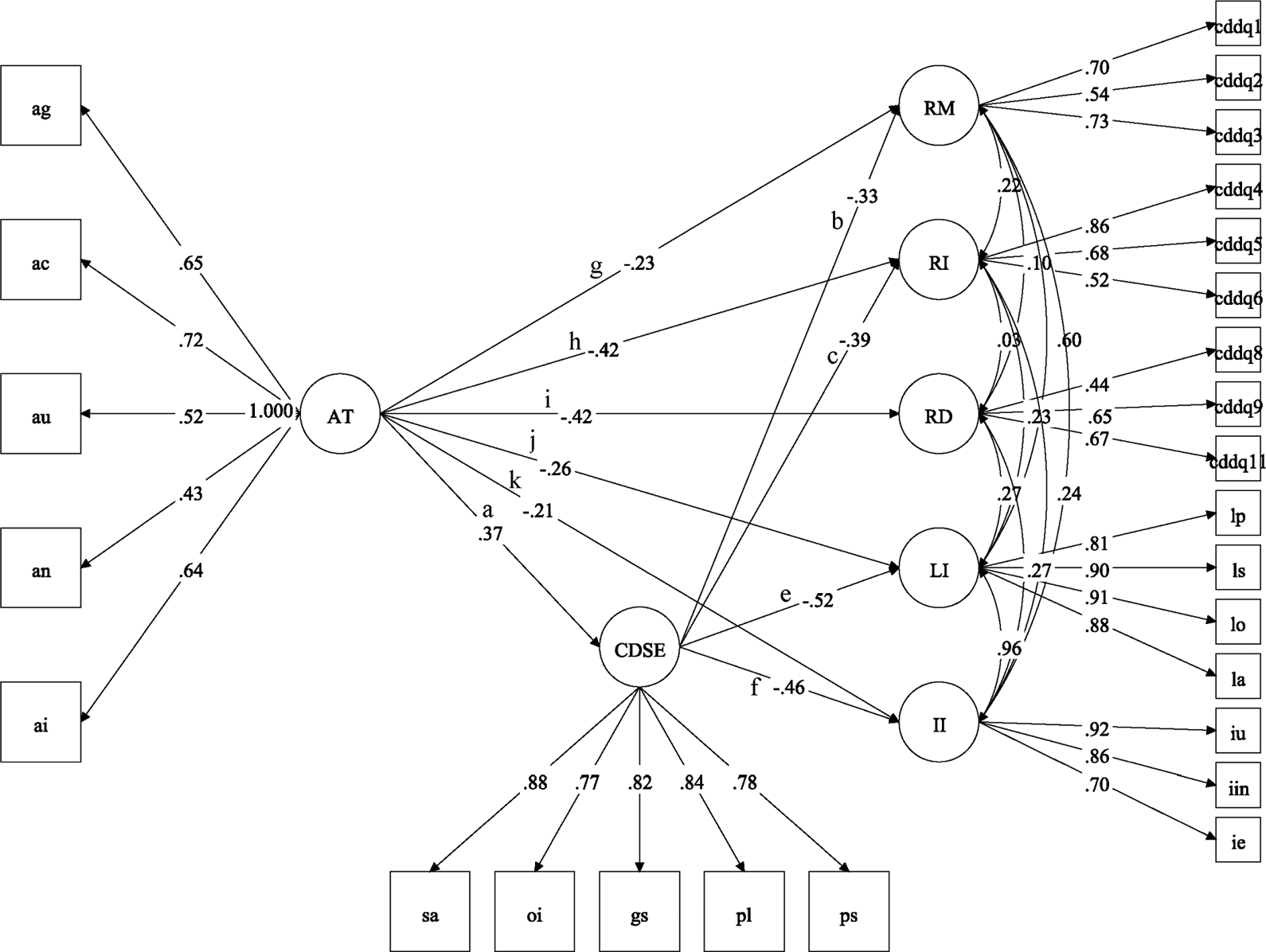
The final model. Note. AT = ambiguity tolerance; CDSE = career decision self-efficacy; RM = lack of motivation; RI = general indecisiveness; RD = dysfunctional beliefs; LI = lack of information; II = inconsistent information.
Although we used an altered model of indecision in our analysis, based on past research, we also examined our model using Gati et al. (1996)’s original indecision model in relation to AT and career decision-making self-efficacy. The values of CFI (.92), RMSEA (.074), and SRMR (.060) indicated that the structural model was an acceptable representation of the data. The regression coefficients also revealed a similar structural pattern (i.e., differential paths) with the final model (Model 7). However, the poor factor loading of dysfunctional beliefs on lack of readiness (.15) brought into question the construct validity of Gati et al. (1996)’s original model in the current sample. Therefore, our final model based on the revised indecision model was selected as the best representation of the data.
Table 3 presented the results of the SEM bias-corrected bootstrapping analysis of the mediation effect of career decision-making self-efficacy based on the final model. As can be seen from the 95% CIs for the paths a and b [−.20, −.04], a and c [−.20, −.08], a and e [−.28, −.11], and a and f [−.24, −.10], it was well supported that career decision-making self-efficacy mediated the predictions of AT on lack of motivation, general indecisiveness, lack of information, and inconsistent information. Results suggested that people with high AT tend to have a better career decision-making self-efficacy, which could contribute to the relief of career indecision due to lack of motivation, general indecisiveness, lack of information, or inconsistent information. The mediation effect of career decision-making self-efficacy on the link of AT with dysfunctional beliefs was not revealed in the current study.
The SEM Bias-Corrected Bootstrapping Test of the Mediation Effect of Career Decision-Making Self-Efficacy.

Note. N = 253.
Discussion
Overall, the key structural hypothesis that career decision-making self-efficacy mediated the link of AT with career indecision was supported by the current results, although variations existed with different domains of career indecision. Career decision-making self-efficacy was found to mediate the link of AT with lack of motivation, general indecisiveness, lack of information, and inconsistent information, while the link of career decision-making self-efficacy with dysfunctional beliefs was not revealed in this study. The results thus suggested that individuals with more tolerance to ambiguity tend to have better self-efficacy regarding career decision making and consequently tend to have more motivation for career decision making, less general indecisiveness, less informational deficit, and less informational conflict. The SCCT (Lent & Brown, 2013; Lent et al., 1994) has proposed career decision-making self-efficacy to be a pivotal mediator explaining the outcome of the career decision-making process and the close connection of career decision-making self-efficacy with career indecision has been unequivocally demonstrated (Choi et al., 2012). Although Xu and Tracey (2014) have revealed the negative association of AT with career indecision, this study further suggested that the benefits of AT with respect to career decision making could be attributable to the increased self-efficacy beliefs regarding one’s critical career decision-making skills. Since the current data were only cross-sectional, a longitudinal examination in the future would be helpful providing more validity to the temporal mediation hypothesis.
The differential associations of career decision-making self-efficacy with different domains of career indecision were supported in this study, although the differential pattern was not exactly the same as we hypothesized. The results showed that the association of career decision-making self-efficacy with lack of motivation was weaker than the ones with general indecisiveness, lack of information, or inconsistent information. It was thus suggested that an increased career decision-making self-efficacy resulted from more tolerance with ambiguity would be more beneficial with the issues of general indecisiveness, informational deficit, and informational conflict in career decision making than with the issue of motivation shortage. This piece of data was consistent with Gati et al. (2013)’s finding that the effect of a career workshop on lack of motivation was small compared to the effect on other domains of career indecision and career decision-making self-efficacy, thus calling for more future research investigating the important predictors unique to this domain. It was plausible that individual value could be a promising candidate. The differential associations also resonated with the distinction between career indecision and career indecisiveness (Germeijs, Verschueren, & Soenens, 2006) that indecision is more associated with career cognition/behaviors and indecisiveness is more associated with chronic dispositions.
Among the five domains of career indecision, the domain of dysfunctional beliefs was not found to associate with career decision-making self-efficacy, indicating that the positive effect of AT with dysfunctional beliefs revealed in Xu and Tracey (2014)’s study was not directly related to an increased career decision-making self-efficacy. Characteristics of dysfunctional beliefs are the rigidity and the compulsivity of beliefs. The research has demonstrated the relation of cognitive inflexibility with obsessive–compulsive personality traits (DeBerry, 2012) and the rigidity of attitudes (Martin & Rubin, 1995). Together with these studies, this study suggested that the positive effect of AT with dysfunctional beliefs did not go through the cognitive beliefs regarding one’s career decision-making skills, rather it might be mediated by another cognitive orientation––the cognitive flexibility. It would be interesting to see future research investigating the mediation of cognitive flexibility on the link of ambiguity with career indecision, especially the domain of dysfunctional beliefs.
Along with the indirect effect of AT on domains of career indecision through career decision-making self-efficacy, this study also revealed significant direct predictions of AT on all the five domains of career indecision. This finding was consistent with the previous research portraying AT as one important predictor accounting for some unique variances in career indecision. Xu et al. (2014) have found that environmental exploration and self-career exploration did not contribute to the relief of career indecision as much as Parsons (1909) proposed. Xu and Tracey (2014) revealed that AT additively predicted domains of career indecision when controlling for the amount of career exploration. This study extended this research line by showing that AT accounted for the unique variance in career indecision that could not be explained by the construct of self-efficacy, which has been acknowledged as a central variable in the career development research (Lent & Brown, 2013; Lent et al., 1994). The incremental validity of AT in predicting career indecision indicated in this study thus further supported the important role of AT in career decision making. Individuals of high tolerance with ambiguity were likely to show a pattern of less career indecision across different indecision domains, which warranted the necessity and benefits of addressing this topic in career counseling.
There are several limitations regarding the conclusions drawn from this study. First, the study only sampled college students so that the results cannot be generalized to younger or older individuals. The study is cross sectional and thus the sequential ordering of variables cannot be definitively determined. Longitudinal examinations are needed. Further, although the study supported the revised indecision model used, it was different from the one proposed by Gati et al. (1996) and this difference could be attributable to sample error. However, a similar structure was supported in Xu and Tracey (2014), providing some support for the indecision dimensions used in this study.
On a whole, this study addressed one important question regarding how AT leads to less career indecision through the mediation of enhanced career decision-making self-efficacy. Although the bivariate association of AT with career indecision has been revealed in Xu and Tracey’s (2014) study, the mechanism of this effect has not been explored. Limited knowledge about the mechanism makes the substantive meaning of the construct of AT with respect to career indecision unclear and thus prevents it from generating greater application in career counseling. This study provided another piece of evidence in addition to Xu and Tracey (2014) supporting the importance of AT with career decision making. More importantly, AT has been revealed by this study to lead to less career indecision through one specific path mediated by career decision-making self-efficacy, which additionally helps explain the positive effect of AT with respect to career decision making. Along with the general mediation pattern, this study also found differential predictions of career decision-making self-efficacy on different domains of career indecision, suggesting that an increased self-efficacy resulted from more AT would have differential effects on different domains of indecision. Specifically, the domains of lack of motivation and dysfunctional beliefs tended to benefit less as opposed to general indecisiveness, lack of information, and inconsistent information. As the association of career decision-making self-efficacy with career indecision has been solidly revealed (Choi et al., 2012), this study adds into the literature by revealing heterogeneity in the efficacy–indecision link. Thus, although the substantive utility of AT in career counseling is further supported by this study, intervention strategies tailed to different indecision types are also warranted.
Footnotes
Declaration of Conflicting Interests
The author(s) declared no potential conflicts of interest with respect to the research, authorship, and/or publication of this article.
Funding
The author(s) received no financial support for the research, authorship, and/or publication of this article.