



Abstract
In this study, the authors build a model to examine the relationship between college socialization tactics, fit perceptions (person major fit and person group fit), and adjustment outcomes (academic satisfaction, grade point average, and helping behaviors). College socialization tactics are categorized into three clusters, namely tactics via school administrations and departments, tactics via senior schoolmates, and tactics via peers. Longitudinal survey data from 181 undergraduates during their freshman year indicated (1) the three clusters of tactics related differently to various forms of adjustment; (2) perceived person major fit mediated the relationship between tactics via school administrations and departments, tactics via senior schoolmates, and academic outcomes; (3) perceived person group fit mediated the relationship between tactics via peers and helping behaviors. The results suggest that different entities within colleges play different roles in facilitating student adjustment.
The socialization of individuals before they begin their professional roles is a matter of increasing interest (Weidman & Stein, 2003). More recently, researchers propose that socialization processes in college may be critical as well (Wang, Cullen, Yao, & Li, 2013), because if students fail to understand college norms and values, their short- and long-term value orientation, academic performance, and subsequent career success will be adversely affected (Wang et al., 2013; Weidman & Stein, 2003). Recognizing the importance of socialization, organizations have employed various socialization tactics to help new employees develop and adjust to their careers. Those tactics have been found to effectively shape job attitudes and performance (for a review, see Bauer, Bodner, Erdogan, Truxillo, & Tucker, 2007). Nevertheless, we know surprisingly little about how similar strategies help college students adjust.
Thus far, research on college student adjustment has generally focused on individual (e.g., attachment style) and relational (e.g., family structure) adjustment predictors (Holmbeck & Wandrei, 1993; Mattanah, Hancock, & Brand, 2004; Rice, 1992). Less attention has been paid to contextual indicators such as college socialization tactics. Understanding the role of contexts in which individuals are embedded is important because individual factors alone cannot fully account for development outcomes (Kenny et al., 2007; Lerner, 2002). In this study, we attempt to bridge those gaps by examining college socialization tactics as they affect various forms of freshmen adjustment.
Most recently, the social capital theory of socialization (Fang, Duffy, & Shaw, 2011) argues that newcomers can use socialization tactics to interact with various intraorganizational entities, such as the department, peers, and experienced organizational members, to obtain resources that are critical for effective adjustment. Although each entity is distinctive, the literature lacks research into how socialization tactics associated with different entities differ in their influences on newcomer adjustment (Kammeyer-Mueller & Wanberg, 2003). We seek to extend the socialization literature by taking a more analytical approach to socialization tactics. We link tactics to different entities at colleges—the academic department is equated with organization departments; peers are equated with other newcomers; and senior schoolmates are equated with experienced organizational members—and test how tactics associated with those entities affect freshmen’s interpersonal and academic adjustment.
Furthermore, person–environment (P-E) fit theories, popular in the socialization and career development fields (Holland, 1959), can add to the study of college socialization tactics (Ashford & Nurmohamed, 2012)—the major objective of socialization tactics is to help individuals integrate into their new environment (Kim, Cable, & Kim, 2005). Drawing from the P-E framework, we investigate fit perceptions as they mediate the relationship between college socialization tactics and various forms of adjustment. By examining the “tactics–fit–adjustment” linkage, we hope to expand understanding of college adjustment and offer new insights into career development and decision making.
College Socialization Tactics as a Three-Dimension Model
Socialization tactics have been defined as “the ways in which the experiences of individuals in transition from one role to another are structured for them by others in the organization” (Van Maanen & Schein, 1979) and have been identified as being either institutionalized or individualized, depending on whether newcomers experience structured or random socialization processes (Bauer et al., 2007; Jones, 1986). When organizations provide structured socialization programs (i.e., institutionalized tactics), they actively disseminate information to newcomers and reduce ambiguity; individualized tactics, on the other hand, lack structure and thus create ambiguity (Bauer et al., 2007; Cable & Parsons, 2001). Institutionalized tactics, critical in facilitating newcomer adjustment, are positively related to fit perceptions, job performance, job satisfaction, and organizational commitment, and negatively related to role ambiguity, role conflict, and turnover intention (Saks, Uggerslev, & Fassina, 2007).
Although the socialization literature has recognized that tactics are important to newcomer adjustment, the conceptualization of tactics is controversial (Ashforth, Saks, & Lee, 1997). In a one-factor bipolar model, tactics were classified as either institutionalized or individualized (Jones, 1986). In a six-factor bipolar model, tactics were shown to have six aspects: collective (individual), formal (informal), sequential (random), fixed (variable), serial (disjunctive), and invested (divested; Van Maanen & Schein, 1979). In a three-factor model, the six dimensions were further grouped into three broader aspects of socialization such as content (collective and formal), context (sequential and fixed), and social (serial and investiture; Jones, 1986). The six-factor model appears to be superior and is more widely employed, but all the models have indices that fail to reach the conventional level of adequate fit (Ashforth et al., 1997). Empirical studies also indicate that the models may lack construct and predictive validity. The six facets of tactics were found to influence a series of adjustment outcomes, but they had no differential effects (Bauer et al., 2007). Likewise, some dimensions fail to fit well with Jones’s (1986) aggregated conceptualization of tactics as a single continuum from institutionalized to individualized socialization (Bauer et al., 2007).
The social capital model of socialization (Fang et al., 2011) suggests that various entities such as departments, new colleagues, and senior organizational members undertake socialization tactics to help newcomers obtain resources for adjustment. Both the one-factor and six-factor models discussed previously indicated that intraorganizational entities play a role in providing resources. For example, collective and invested tactics reflect whether newcomers are extensively involved with and receive support from peers; sequential and fixed tactics indicate organizational roles in disseminating information about socialization phases and career development; serial tactics indicate guidance from experienced organizational members (Van Maanen & Schein, 1979). Nevertheless, those models fail to differentiate the distinct roles of each entity in influencing proximal and distal socialization outcomes (Kammeyer-Mueller & Wanberg, 2003). For example, organization influence is positively related to role clarity; leader influence is positively related to political knowledge; and coworker influence is positively related to group integration. Therefore, it is more appropriate to separate tactics associated with different entities. In this study, we aim to link tactics to within-organization entities and look at their specific impacts on newcomer adjustment.
Compelling arguments showing an overlap between traditional organizational environments and higher education settings (Christensen, Garvin, & Sweet, 1991) give us good reason to presume that the same internal mechanisms characterizing organizational socialization also apply to college socialization. Indeed, we see remarkable similarities to traditional organizational environments in the ways freshmen interact with academic departments and school administrations, peers, and senior schoolmates to obtain resources. Thus, we look to entities from which freshmen obtain resources and construct college socialization tactics according to whether they occur via school administrations and departments, via senior schoolmates, or via peers.
Newcomers to organizations must undergo task transitions in which they resolve their role demands and master their tasks; they also undergo social changes in which they must adjust to their groups (Bauer et al., 2007). Likewise, in educational settings, incoming students must undergo both intellectual and nonintellectual interpersonal socialization (Weidman, 1979). Therefore, in this study, we examine influences of tactics on both academic and interpersonal outcomes: specifically, academic satisfaction, grade point average (GPA), and interpersonal helping behaviors. We argue that the three clusters of tactics will have different associations with psychosocial resources related to interpersonal outcomes and with informational resources related to academic adjustment (Wang, Kammeyer-Mueller, Liu, & Li, 2014).
Organizations provide training and orientation programs to provide role and task information, instruct newcomers, and create positive attitudes (Saks & Gruman, 2012). Likewise, school administrations and academic departments primarily focus on disseminating information regarding norms, contents, stages, and goals of education. For example, when Chinese universities begin new academic terms, some college departments send brochures to freshmen covering the departmental curriculum, educational goals, and basic academic requirements such as minimum credits, GPA scores, and thesis directions. Administrations such as the Office of Educational Administration and Office of Student Affairs also disseminate information regarding academic norms and career development. As in traditional organizations, if students have sufficient academic development information, they should adapt better, be more satisfied with their education in the new academic environment, and perform better academically.
Acquiring information from senior coworkers, leaders, and supervisors is positively associated with performance and job satisfaction (Ostroff & Kozlowski, 1992). Analogous to senior organizational members or mentors who help newcomers by providing organizational information, senior schoolmates provide crucial academically related information and advice, such as tips on assignments and tests. Freshmen who enjoy frequent suggestions and guidance from senior students are more likely to be satisfied with the academic environment and to perform well academically, compared with freshmen who lack communications with senior schoolmates.
In organizations, coworkers are primary sources of social support for newcomers (Saks & Gruman, 2012). Similarly, for college freshmen, peers are the major providers of psychosocial resources. Either organizations or peers may initiate tactics: Organizations may arrange orientations, training programs, and activities to create opportunities for newcomers to interact, and peers can proactively build friendships that provide mutual support and care (Van Maanen & Schein, 1979). In this study, we focus on a representative peer group—peers from the same academic department—because departments are an important locus for peer influences (Weidman, 1979). Since freshmen in the same department usually share common courses, and some even share the same residence, they become central to each other’s social networks. Freshmen who have more opportunities to attend the same training programs and activities with peers and who receive peer help and support are likely to build friendships sooner and more easily. The nature or quality of relationships between peers has been found to predict group integration and commitment (Morrison, 2002). Therefore, we assume that peers who develop close relationships and thereby feel that they fit in with the group are more likely to provide support and help each other adjust to the new environment. They may, for example, be more willing to help others solve interpersonal and academic problems.
Fit Perception Mediating Effects
The theory of congruence (Holland, 1997), one of the first and most renowned P-E fit frameworks, regarded fit as congruence between individual characteristics and the environment. Although early research measured fit objectively and indirectly, subsequent research emphasized that perceived fit is more important than objective fit because, in most cases, perceived fit is more strongly related with outcomes (Kristof-Brown, Zimmerman, & Johnson, 2005). Perceived fit is a direct measure in that individuals report how much they believe they fit with their environment. Various forms of perceived fit are positively related to job satisfaction, job performance, organizational commitment, and engagement (Kristof-Brown et al., 2005; Saks & Gruman, 2011). Likewise, in educational settings, perceived fit is correlated with academic performance, major change intention, and well-being (Li, Yao, Chen, & Wang, 2013; Schmitt, Oswald, Friede, Imus, & Merritt, 2008; Wessel, Ryan, & Oswald, 2008).
P-E fit theory provides a theoretical basis for understanding relationships between socialization tactics and newcomer adjustment (Saks et al., 2007). The primary goal of socialization is to ensure the continuity of central values and to provide newcomers with a framework for responding to the environment and coordinating with others (Kim et al., 2005). In other words, socialization aims to enhance fit or compatibility. Perceived fit (e.g., person–organizational fit and person–job [P-J] fit) indeed appear to mediate relationships between socialization tactics and outcomes such as job satisfaction, organizational commitment, and turnover intentions (Cooper-Thomas, van Vianen, & Anderson, 2004; Riordan, Weatherly, Vandenberg, & Self, 2001). Rather than use person–organization and P-J fit, however, we use perceived person–major (P-M) fit and person–group (P-G) fit because they are more relevant for our focus on socialization processes in educational settings. As we will explain, the three clusters of socialization tactics should relate differently to the two forms of perceived fit that will, in turn, relate to academic satisfaction, academic performance, and helping behaviors.
First, when students have access to essential information regarding academic goals, requirements, schedules, and tips on assignments and exams, they will be more certain about the academic world and have a higher sense of congruence with the academic environment. Subsequently, they may subjectively perceive that their interests and abilities are more compatible with the requirements of their academic major; that is, they will perceive P-M fit. Organizational studies have found a similar relationship between socialization tactics and P-J fit (Saks & Gruman, 2011). Furthermore, person–environment theory and other empirical studies show that career or academic satisfaction, stability, and success are positively linked to the degree of P-E fit (Li et al., 2013; Vogel & Feldman, 2009; Wessel et al., 2008). Accordingly, we predict that perception of P-M fit mediates the relationship between socialization tactics providing informational resources and academic outcomes. Specifically:
Second, socialization tactics offering psychosocial resources provide freshmen with supportive communication networks that establish more interpersonal links (Fu & Shaffer, 2008). Consequently, freshmen may have enhanced perceptions of congruence with peers. They might have more agreeable contact and regard time spent in class with peers as one of the best parts of their academic experience. In other words, socialization tactics that enhance social interaction with peers and senior schoolmates influence perceived P-G fit that leads, in turn, to stronger group identification and satisfaction (Werbel & Johnson, 2001). Because attitudes toward groups, such as satisfaction and commitment, predict interpersonal facilitation (Organ & Ryan, 1995), we predict that P-G fit might ultimately enhance helping behaviors toward group members.
Method
Participants and Procedure
We surveyed 195 freshmen volunteers randomly recruited from the freshmen cohort at a comprehensive research university in China. They learned about the survey via campus news updates posted on the Internet or sent through e-mails. Those who completed all three survey rounds were paid 30 RMB and were entered into a lottery for an iPad. Participants, coming from most university departments and disciplines, granted us permission to obtain their GPA data from the university’s Office of Educational Administration. A total of 181 participants completed the three-wave survey, yielding a response rate of 92.8%. Slightly more than half of the participants in the final sample were male (54.1%) and averaged 18.21 years old (standard deviation [SD] = .73).
We administered the surveys in three time waves. In Wave 1—2 months after the freshmen entered the university—participants completed a survey measuring their demographic information and their perceptions of socialization from the department, from peer students, and from senior students. Wave 2, conducted at the start of the second semester about 6 months after they entered the university, assessed their P-G and P-M fit. We chose that time because newcomers go through significant changes in adjusting to new environments during the first 3 or 4 months (Ashforth & Saks, 1996; Thomas & Anderson, 2002), so that the initial period produces unstable fit perceptions (Cooper-Thomas et al., 2004) that later become relatively stable. Moreover, by then students had lived on campus for a semester, so they were also likely to be exposed to their peers and their major coursework enough to adequately judge their level of fit. We conducted the last wave measuring academic satisfaction and helping behaviors near the end of the second semester, 10 months after they entered the university. After the second semester ended, we obtained their second-semester GPAs from the Office of Educational Administration.
Measures
The surveys were originally written in English and then translated into Chinese using the back-translation procedure (Brislin, 1993), which ensures that translated scales retain their original meaning.
Socialization tactics
Our measures of college socialization tactics were adapted from Jones’s (1986) organizational socialization tactics scale. We eliminated items that could not be altered to reflect socialization in an academic situation; for example, unlike employees, college freshmen usually have no “pre-entry training” and they do not have obligations and responsibilities to the college. We also eliminated items that failed to clearly reflect the role of school administrations, departments, other freshmen, and senior students, resulting in a final 14-item set. Specifically, 6 items involving interactions with and support from peers measured tactics via peers. The interitem correlations between each 2 items ranged from .34 to .47. For example, “In the last month, I have been extensively involved with other first-year students in a series of college transition activities” and “Other freshmen at my department have been instrumental in helping me understand my academic requirements.” Four items concerning departmental and university efforts to help freshmen with academic and vocational development measured tactics from administrations and the department. The interitem correlations ranged from .26 to .38. For example, “The steps in the academic track are clearly specified in this school” and “The way in which my academic process through this department will follow a fixed timetable has been clearly communicated to me.” Four items regarding senior student guidance on academic and career development measured tactics associated with senior students. The interitem correlations ranged from .29 to .58. For example, “The senior students in the school see advising or guiding freshmen as one of their main responsibilities” and “I have received little guidance from senior students as to how I should perform well in academic aspects.” Participants indicated the degree to which they experienced different socialization tactics on a 7-point Likert-type scale (1 = strongly disagree; 7 = strongly agree).
A confirmatory factor analysis (CFA) using Mplus 6.0 largely supported the three-factor structure of the socialization tactics scale. The fit indices for the hypothesized three-factor model were χ2(67) = 97.60, p < .01, root mean square error of approximation (RMSEA) = .05, comparative fit index (CFI) = .95, standardized root mean square residual (SRMR) = .06, indicating a good model fit. Furthermore, the small correlations between the three factors (from .00 to .36) also supported the discriminant validity of each factor. We further tested a model with all items loading onto one factor. The one-factor solution had an inferior fit, χ2(70) = 219.26, p < .01, RMSEA = .11, CFI = .77, SRMR = .11. The two models showed significant change in χ2 between them, Δχ2(3) = 121.66, p < .01). Additionally, supplementary tests compared the three-factor model with multiple two-factor models. The three-factor model had a significantly better fit than the two-factor models. The results further supported the distinctiveness of the three clusters of tactics. The α reliability for the scales were .71, .70, and .75.
Perceived fit
Perceived P-M fit and P-G fit were assessed with items adapted from person–vocation and P-G fit scales (Vogel & Feldman, 2009), but original items were revised to make the scales appropriate for an academic environment. For example, we used study rather than work, major rather than occupation, and students at the same department rather than coworkers. Perceived P-M fit was measured with 3 items. For example, “My abilities are well suited for the major that I am currently in.” Perceived P-G fit was measured with 5 items. For example, “I get along well with other students at the department.” Students responded on 7-point Likert-type scales from 1 = strongly disagree to 7 = strongly agree. The α reliability was .78 for P-M fit and .76 for P-G fit.
Academic satisfaction
Academic satisfaction was measured with 5 items developed by Schmitt, Oswald, Friede, Imus, and Merritt (2008). For example, “All in all, I am satisfied with the education I can get in this school.” Students responded on a 7-point Likert-type scale from 1 = strongly disagree to 7 = strongly agree. The α reliability was .89.
Helping behaviors
The measure was assessed with 5 items (e.g., willingly gives time to help other students who have academic-related problems) adapted from the organizational citizenship behavior–individual (OCB-I) scale (Lee & Allen, 2002). Items were altered to reflect interpersonal facilitation in an academic rather than organizational context. Students responded on a 7-point Likert-type scale from 1 = strongly disagree to 7 = strongly agree. The α reliability was .77.
Academic performance
To measure academic performance, we obtained students’ second-semester GPAs from the Office of Educational Administration. GPAs ranged from 0.0 to 4.0.
Control variables
Several aspects of individual adaptability were included as covariates because they may affect the current mediators and outcome variables (e.g., Wang, Zhan, Mccune, & Trucillo, 2011; Wessel et al., 2008). Individual adaptability was assessed with the multidimension adaptability scale (Ployhart & Bliese, 2006). Of the eight subscales of this measure, only learning adaptability, interpersonal adaptability, and uncertainty adaptability were deemed relevant to the current context. Learning adaptability refers to learning new tasks (e.g., I enjoy learning new approaches for conducting work.); interpersonal adaptability involves interacting with new people (I believe it is important to be flexible in dealing with new people); and uncertainty adaptability refers to dealing with unpredictable and uncertain situations (e.g., When something unexpected happens, I can readily change gears in response.). Six items measured learning adaptability (α = .79); 6 items measured interpersonal adaptability (α = .74); and 8 items measured uncertainty adaptability (α = .70). Participants indicated their agreement with statements using a 5-point Likert-type scale from 1 = strongly disagree to 5 = strongly agree.
Results
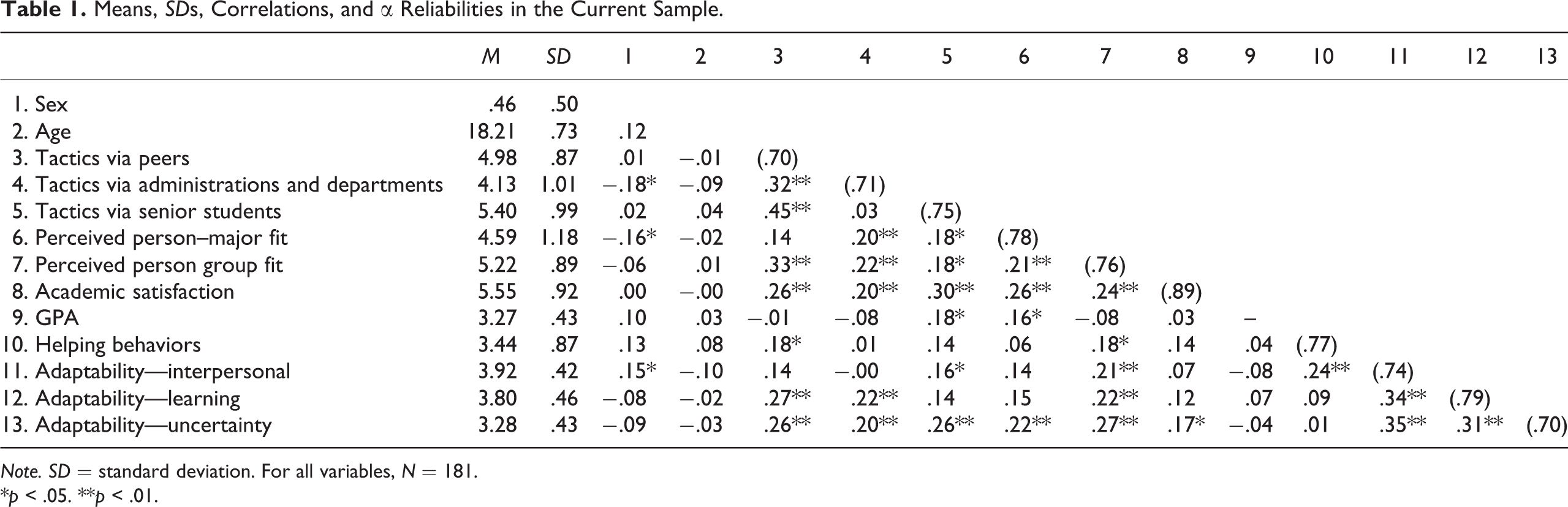
Table 1 shows the means, SDs, α reliabilities, and correlations of the variables. The correlations support most of the proposed linkages between tactics and adjustment outcomes, except the linkage between tactics via school administrations and departments and GPA (Hypothesis 1b). Specifically, tactics via school administrations and departments was significantly correlated with academic satisfaction (r = .20, p < .01); tactics via senior students was significantly correlated with academic satisfaction (r = .30, p < .01) and GPA (r = .18, p < .05); tactics via peers was significantly related to helping behaviors (r = .18, p < .05).
Means, SDs, Correlations, and α Reliabilities in the Current Sample.
Note. SD = standard deviation. For all variables, N = 181.
*p < .05. **p < .01.
Measurement Model Testing
Following the two-stage procedure for structural equation modeling (Anderson & Gerbing, 1988), we first tested a measurement model (M0) that included all the latent constructs (socialization tactics, fit variables, helping behaviors, and academic satisfaction) and observed variables (GPA). The covariates were also included to ensure that the subsequent structural equation models were nested to the measurement model. The measurement model provided a good fit, χ2(223, N = 181) = 267.10, p < .05, CFI = .97, RMSEA = .03, and SRMR = .05. In addition, all the scale items loaded significantly onto their corresponding latent constructs (standardized factor loadings ranged from .41 to .91). Therefore, the measurement model appeared well suited to test further structural equation models.
Structural Model Testing
To test our hypotheses, we estimated the proposed partial-mediation model (M1) in Figure 1 on the basis of the measurement model. Covariates are simultaneously added on the mediators and outcome variables. The model demonstrated good fit, χ2(233) = 277.92, p < .05, CFI = .97, RMSEA = .03, and SRMR = .06, and most of the hypothesized paths were significant. Moreover, model fit between M1 and the measurement model M0 had no significant difference, Δχ2(10) = 10.82, p > .10. We also compared M1 with a full mediation model M2 in which we did not estimate direct effects of tactics on outcomes. For M2, χ2(238) = 304.41, p < .01, CFI = .95, RMSEA = .04, and SRMR = .07. M1 had a significantly better model fit than that of M2, Δχ2(5) = 26.49, p < .01. Given that our hypotheses imply differential predictions, we also compared the partial mediation model with an alternative model M3 that included additional paths from all dimensions of tactics to all types of perceived fit and another model M4 that included additional paths from all types of fit to all the outcomes (i.e., nondifferential predictions). Neither M3 nor M4 yielded significantly better fit than the partial mediation model, Δχ2(7) = 7.81, p > .10; Δχ2(7) = 6.42, p > .10, thus supporting the differential predictions implied by our hypotheses.

The proposed mediation model.
Figure 2 shows the significant standardized path coefficients in M1. As shown, both tactics via school administrations and departments and tactics via senior students were positively related to P-M fit (β = .23, p < .05; β = .22, p < .01), which in turn was positively related to academic satisfaction (β = .25, p < .01) and GPA (β = .24, p < .01), showing preliminary support for the mediation Hypotheses 2a–d. Furthermore, tactics via peers was positively related to P-G fit (β = .41, p < .01), which in turn was positively related to helping behaviors (β = .21, p < .05), providing preliminary support for the mediation Hypothesis 3.
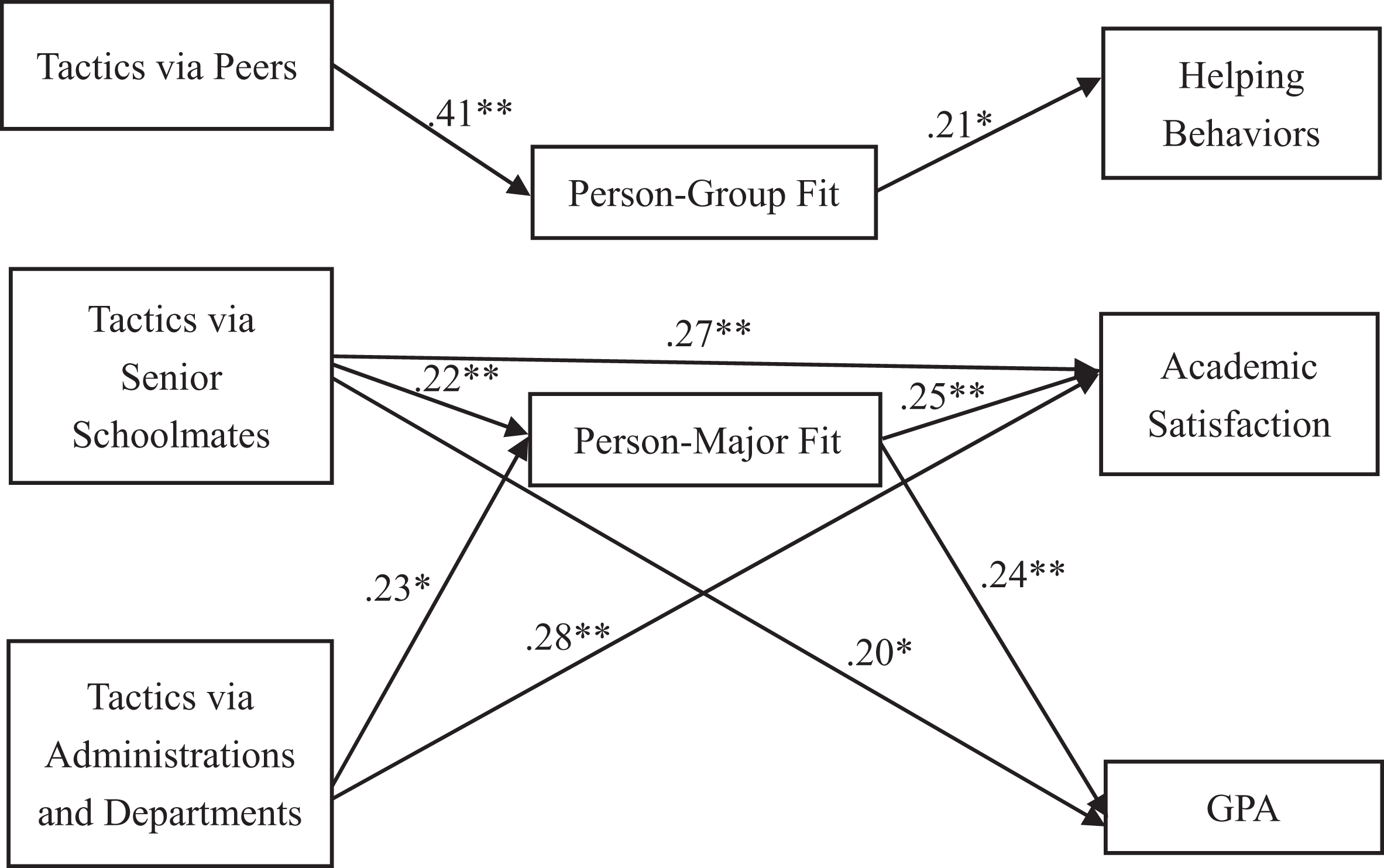
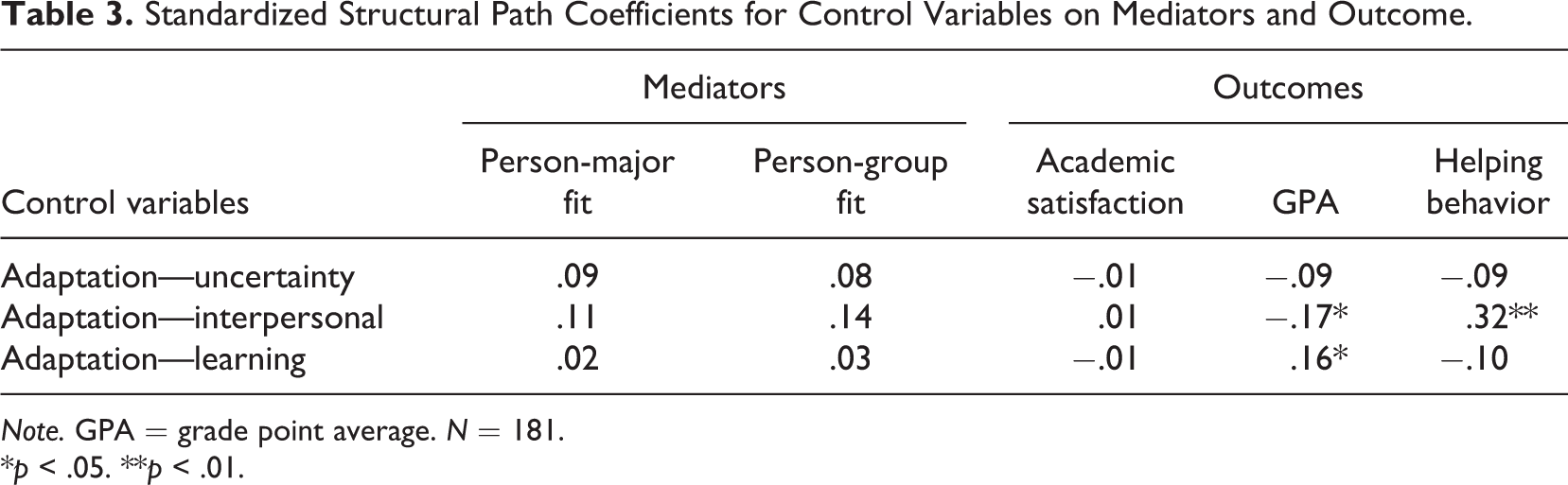
The mediation model with standardized structural path coefficients (N = 181). Only significant paths were reported. For the purpose of brevity, standardized structural path coefficients for control variables were shown in Table 3.
Testing Indirect Effect
Current approaches to mediation emphasize empirically estimating and testing the significance of the indirect effect and no longer require that independent variables have a significant total effect on the dependent variables to establish mediation (Hayes, 2009; Shrout & Bolger, 2002). Thus, we used the model indirect command and bias corrected bootstrapping procedure in Mplus to test the mediation hypotheses (Preacher & Hayes, 2008). The bootstrapping method uses a resampling procedure to create confidence intervals (CIs) for the indirect effects. This approach for testing the significance of the indirect effect (i.e., mediation) is more appropriate and powerful (MacKinnon, Lockwood, & Williams, 2004) than the traditional causal steps and product of coefficients in the Sobel test approaches. In this study, 95% bias-corrected bootstrap CIs were obtained for hypothesized indirect effects using 1,000 bootstrap samples. Table 2 presents the bias-corrected bootstrap CIs for each indirect effect between antecedents and outcomes via mediators. Mediation was indicated by the exclusion of zero from the CI for the unstandardized indirect effect. As Table 2 shows, the 95% CIs for the indirect effects do not contain zero, which indicates mediation and supports Hypotheses 2a–d and 3.
Bootstrap CIs and Point Estimates for the Indirect Effects.
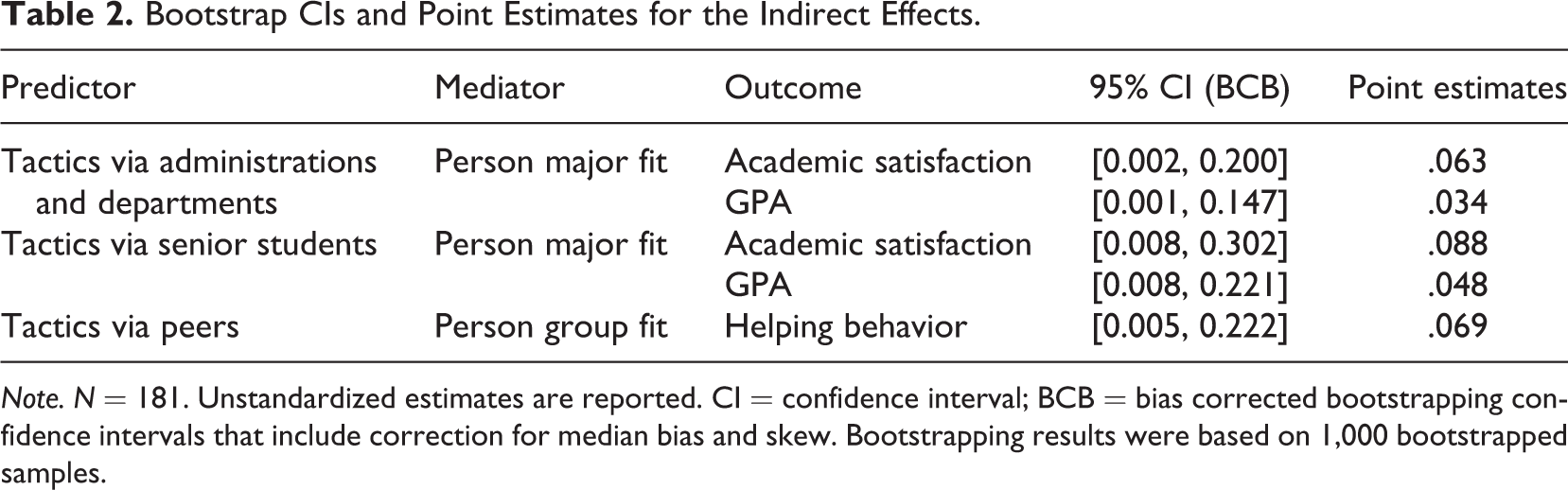
Note. N = 181. Unstandardized estimates are reported. CI = confidence interval; BCB = bias corrected bootstrapping confidence intervals that include correction for median bias and skew. Bootstrapping results were based on 1,000 bootstrapped samples.
Standardized Structural Path Coefficients for Control Variables on Mediators and Outcome.
Note. GPA = grade point average. N = 181.
*p < .05. **p < .01.
Discussion
This study is the first to construct college socialization tactics from a social capital perspective and to test the relationships between different college tactics and various adjustment outcomes. Results indicate that the proposed three-factor college socialization tactics model achieved good construct validity, and each factor was uniquely related to fit perceptions and adjustment outcomes, suggesting that within-college administrations and academic departments, senior students, and peers play different roles in freshmen’s socialization processes. Specifically, tactics via administrations and departments, and tactics via senior students influence academic adjustment through the mediation of perceived P-M fit, whereas tactics via peers impact interpersonal adjustment through the mediation of perceived P-G fit.
Identifying the “college socialization tactics–fit–adjustment” relationship, this study contributes to an improved understanding of career development and decision making of college students. Previous studies in organizational and academic settings have shown that perceived fit, satisfaction, and interpersonal support are important predictors of turnover intention (or major change intention) and absenteeism (Li et al., 2013; Schmitt et al., 2008; Wessel et al., 2008). This study has linked socialization tactics via different entities with those variables. In this regard, inferior tactics might lead to unfit perception, and unfit perception might increase absenteeism and the probability of major change, received support. The tactic–fit–outcome chain may finally lead to changes of one’s career path. For example, a student originally interested in medical science may eventually change his major and give up his career as a physician, because he does not perceive fit and is academically unsatisfied due to a lack of institutionalized socialization tactics. Therefore, educational institutions and career counselors should recognize socialization tactics as crucial factors in individuals’ career development and create a supportive environment facilitating freshmen adjustment.
Compared with tactics via administrations and departments, tactics via senior students is more strongly associated with academic performance, shown by direct and indirect effects on GPA. The finding, consistent with research on workplace socialization practices, shows that newcomers acquire information primarily from interpersonal sources (Ostroff & Kozlowksi, 1992), which are even more important than organization-initiated practices (Saks & Gruman, 2012). This suggests that universities should provide students with more opportunities to communicate with senior students for better academic adjustment. One approach might be to appoint senior students as freshmen mentors for more extensive mutual involvement.
Although this study failed to find that tactics via peers directly affect helping behaviors, it did show that tactics via peers was positively associated with P-G fit, which in turn generated helping behaviors. This result underscores that peers play a role in integrating each other into their group, which is consistent with research on the influence of coworkers on newcomer socialization (Kammeyer-Mueller & Wanberg, 2003). Therefore, we advise universities to help freshmen fit into their peer groups by organizing more orientation programs and activities, and encouraging students to engage broadly in extracurricular activities.
As the first attempt to classify socialization tactics based on entities involved in socialization processes and the first to investigate college socialization effects on adjustment outcomes, our study has several limitations. First, our use of self-report measures may render the findings susceptible to common method bias. Although we cannot completely rule that out, we believe the problem was not serious. We used longitudinal and objective GPA data, reducing the likelihood of common method variance. Second, the construct of college socialization tactics is new and needs further validity testing. Although CFA and scanning electron microscope results indicate that the current classification has satisfactory validity, the relatively small and less-diverse sample may still be a concern. Third, this study examined students’ fit perceptions at one time point although fit is not a static process; it unfolds over time (Schmitt et al., 2008), and students’ fit perceptions at the initial socialization stage might potentially influence later fit perceptions and adjustment outcomes. Therefore, future study should include baseline fit perceptions as covariates and look at the effects of socialization tactics on fit improvement rather than fit measured at certain time points. In addition, this study examined only perceived fit, regardless of actual fit. As previously suggested (Cable & DeRue, 2002), it would be useful to further examine the linkages between tactics, actual fit, perceived fit, and outcomes.
Finally, we conducted the study in a Chinese university, so we must interpret and generalize the results cautiously. The findings might be susceptible to cultural differences because many North American and European university students declare their majors later in their academic careers, rather than in their freshmen year. Therefore, much of their socialization occurs in the context of the larger university rather than through their major departments. They interact instead with a wide range of communities and organizations, including their dorms, student dining halls, recreational activities, various kind of academic and social support services, and so forth. It would be more appropriate to study not only peers in the same department but also others interacting with a student in the larger university context. Furthermore, in North America and Europe where first-year students tend to take general education courses outside their eventual major studies, researchers should focus on broader academic fit rather than specific major fit.
Footnotes
Declaration of Conflicting Interests
The author(s) declared the following potential conflicts of interest with respect to the research, authorship, and/or publication of this article.
Funding
The author(s) disclosed receipt of the following financial support for the research, authorship, and/or publication of this article: This article was funded by The National Natural Science Foundation of China (No: 31200792, J1103602).